Archive for the 'The Orthodox Faith' Category


Yesterday, tomorrow, and beyond (with a little bit about today)

Local coffeehouse The Pourhouse Cafe is a ministry of Sherwood Oaks Christian Church, one of the bigger (if not the biggest) evangelical megachurches in Bloomington. They don’t have “owners, but donors,” it’s staffed by volunteers, it’s part of their college ministry, and all of the profits go to charities in Third World countries. I’ll also note that what it cost to get it up and running is more than All Saints’ entire annual budget, which gives you an idea a) of how big and how rich Sherwood Oaks is, b) the converse truth with respect to All Saints, and c) why All Saints is not in the coffeehouse ministry business (although it’s something Fr. Peter has said he’d like to get into eventually).

Anyway, they have live music every so often, and last night my friend Lacey Brown was playing (with husband Phil Woodward on guitar and all-around personification of awesomeness John Berry on drums), so I dropped in. I also got to hear Brooks Ritter (who reminded me a lot of Glen Hansard) and Jamie Barnes (maybe somebody can tell me — any relation to Paul Barnes? They sure look alike). I enjoyed the music and the musicians a lot, and while I was very much aware that this wasn’t exactly my scene (for reasons of age, at least — it scares me that that at not-quite-32, there’s already at least a narrow generation gap between me and people in their 20s), I was also scratching my head thinking, “How do we get some Orthodox Christian musicians/musicans who are Orthodox Christians exposed in this venue?”

Well, to some extent, it’s already happened; The SmallTown Heroes played here a couple of weeks ago. Still, I kinda wonder — what if, say, a men’s sextet did a set of Byzantine chant in English? No context, no preparation, just did it? What would the pomo crowd get out of something like that? Would it just turn them off? Would they connect with it, instinctively sensing something genuine, and want to know more? Maybe it’s worth a try… maybe not.

What does seem to be worth a try is NaNoWriMo, which starts tomorrow. I can easily write 50,000 words in a month; I’m pretty sure I’ve done at least that some months with this blog (hard to say for certain, since WordPress.com blogs don’t provide you with a way of checking), so it will be just a matter of redirecting some of the effort. As a result, there may be light blogging in the coming month, but I’ve got something I’ve been picking at in one form or another for four years, and it’d be really nice to actually finish a draft of something. This little story of Matthias and Isaac is really kind of peripheral to that of Petros’, and its Petros’ story I started out telling (back when I was still calling him Peter Lewis), but this way I can write something a bit more bite-sized, something that serves as a “test reel,” if you like, or “proof of concept,” and go back later if it turns out anybody cares. It’s somewhat as if C. S. Lewis first wrote a novella within the timeframe of Prince Caspian, about a side story happening to Reepicheep in which Caspian and the Pevensies were sort of side characters who were mostly there as background color. (Not that anything I’m doing will be anything remotely near to the Narnia books in terms of quality; I’m just using that to try to explain something without explaining much of anything.)

Anway, in fits and starts over the last several months, I’ve spat out about 5,000 words already, and I saw guidelines that said while it’s “discouraged” to use NaNoWriMo to finish something you’ve already started, as long as you write at least 50,000 words, it’s fair game. I don’t know that this story is 55,000 words long, but I’ll find out. I need to just make myself do it and finish a draft, see how it holds together. So, November could be interesting.

Finally — I’d just like to note that as of today, October represented, in terms of total traffic for the month, a spike of 296% from the previous month and 244% from my previous best month. So, now that I have five regular readers, I hope y’all stick around!

Holy Trinity Church in Piraeus, Greece

Another place to add the list of places I want to go before I die… (Hat tip: Solomon, I Have Surpassed Thee)

How sweet the Saveur

My stepmother-in-law (gotta love the twenty-first century) got us a gift subscription to Saveur about a year ago. It’s really only been in the last few months that I’ve really started to appreciate it. The recipes are great, reasonably “cookable,” and the way they do theme issues means there will be at least one or two keepers among the recipes one way or the other.

Recent successes:

Stretch’s Chicken Savoy

Sausages with French Green Lentils

Eggs Benedict (with lots of great variations in the actual issue, although not online)

Man. I’m suddenly acutely aware that the Nativity Fast is all of two weeks away.

Vernacular American Byzantine architecture?

I’d like to express some appreciation for Orthodox architect Andrew Gould. Christ J. Kamages is the primary name I’ve been hearing for a few years (and not without very good reason), so Gould seems to me to be new on the scene, but having been running in Orthodox circles for all of five years I lack proper perspective on the matter. I certainly think we can only benefit from more architects who specialize in Orthodox church design, and I very much like what Gould brings to the table in terms of figuring out how churches might look at once authentically Byzantine and authentically American (a question I’ve written about in relation to another liturgical craft, too). I assume Gould would be deeply unappreciative of anybody reposting his images, so I encourage you to check out his (as well as Kamages’) website.

You can also listen to an interview with him here.

Things you think about when you’re trying not to fall

This morning was the first frost in Bloomington, Indiana — or, at the very least, the first at our house. This is a relatively early first frost; I’m more accustomed to it staying hot until sometime in November, at some point during which God hits a switch and the temperature drops fifty degrees in a week. Given that my ancestors, centuries ago, were roaming the frozen wastes of Scandinavia wearing fur loincloths and swinging battleaxes, and that I’ve inherited their programming to stay perfectly comfortable in cold temperatures while wearing shorts and a t-shirt, as well as having to face the unpleasant corollary that above 75 degrees Fahrenheit I tend to be very uncomfortable no matter how little I’m wearing, I am very, very, very much okay with an early frost. The nice thing about cold weather is that you can always put more on. Hot weather… well, not so much. There’s only so much you can take off. (And trust me, you’re thankful for that — very very very thankful.)

What I emphatically don’t like is getting to the top step of my front porch on my way out to the car and realizing, in rapid succession, a) the first frost has arrived very much unannounced and b) I need to grab onto something very quickly. I am not one normally given to quoting John Mayer, but gravity, stay the hell away from me. Otherwise, I will be in repair (again).

For those who have asked — I do not, as of yet, have any information on the outcome of Fr. John Peck’s 16 October meeting with Metropolitan Gerasimos. All I know is that Fr. John is still listed here on the Prescott Orthodox Church website as the priest. Once I hear something I will post it (if I can).

A couple of links to pass along — Anna passed along the article “Keeping the End in View” by James R. Payton, Jr., over at Christianity Today. Prof. Payton, a Protestant, is also the author of Light From the Christian East: An Introduction to the Orthodox Tradition, a book which I have not yet read myself, but I have heard Orthodox say that it is a better introduction to Orthodoxy than some books by Orthodox authors. (One hopes that he has less in common with Daniel Clendenin than with, say, Met. Kallistos Ware.) The article is an examination of the Orthodox Christian understanding of “theosis,” comparing it to how Protestants understand conversion, justification, and sanctification as “phases” of salvation. In general, Prof. Payton treats the Orthodox position quite favorably, but there are two points I’d like to mention.

In Orthodox teaching, “image” and “likeness” are not the same: the first is gift, the second, goal.

This is a matter of some imprecision; it’s not called “Orthodox teaching,” it’s called “the Greek language.” εἰκών and ὁμοίωσις are the words in question, and as even a cursory examination of their entries in either Liddell-Scott or BDAG shows pretty quickly, these are different words with related-but-different meanings, and authors do not use them interchangeably. This has nothing to do with “Orthodox teaching” except insofar as Orthodox teaching reflects how the Greek Fathers use the words. “Policy” and “law” are English words which have related but ultimately different meanings, for example. If a German author wrote that “In American politics, ‘law’ and ‘policy’ are not the same…” it would be a similar situation. It’s an issue of what the words mean, not an issue of how they’re treated by a particular group of people.

While evangelicals can learn from the Orthodox, it is fair to note that Orthodox believers can learn from us, too. The Eastern presentation of salvation can smudge the distinct steps of salvation. Justification and sanctification often get folded into the broader concept of theosis, and they become so blurred that Orthodox believers often don’t know what to make of the terms. They would be well served by an explanation of how the steps of salvation as presented in apostolic teaching fit into the larger package of divinization.

While appreciating Prof. Payton’s open-minded, open-armed approach and thus being willing to lay aside concerns about how patronizing this paragraph might be, I will suggest that he fails to mention that the issues he brings up are addressed by the participation of the Orthodox Christian in the sacramental life of the Church. I assume he knows this, and that this is a concept which probably will sail right over the heads of most CT readers, so I can understand why he doesn’t go there, but ultimately the picture he paints is misleading.

I would also direct your attention to the paper, “Approaching the Educated Person in the Post-Christian Era” by Abp. Lazar Puhalo (ret., OCA). I don’t necessarily agree with every point, but I think it’s worth reading and discussing. I might have more to say about it later.

Current reading: The Conservative Intellectual Movement in America Since 1945, by George H. Nash. Whether one agrees with everybody he describes or not, the story he tells is fascinating. I may have more to say about this later.

By the way, I’m considering participating in NaNoWriMo for purposes of finishing a first draft of a particular writing project of mine. I’m not sure I’d quite hit 50,000 words, but I’d have a draft finished finally, after four years of picking away at something.

I’ll wrap this up for now by saying that my application for West European Studies has been submitted, and that now it’s just a matter of my letters of recommendation rolling in. Hopefully I’ll know something soon. In the meantime, another option has come up in terms of a departmental home, and the person who suggested it did so unprompted. I don’t want to say much more about it for the time being. For right now I’ll just say that I’m flipping two coins, West European Studies and this other possibility, and we’ll see what comes up. Maybe both will come up heads, in which case I’m decidedly not opposed to leaving IU with more rather than less. Maybe both will come up tails, and I really will have to leave here with 30+ worthless graduate credits. We’ll see. Meanwhile, a near-annual conversation with a particular faculty member about said options has led to this person dubbing me a “professional applicant.” I suppose he/she isn’t wrong.

Tomorrow morning I’ll be prepared for the frost.

tmatt on what converts want

I’d like to call your attention to an essay by Terry Mattingly which also appears in the current issue of AGAIN, entitled “What Do The Converts Want?” The Conciliar Press website, you will notice, still contains no reference to the new issue, but happily the piece has been posted online before — look for it here. It is very much worth reading, and I don’t wish to repost it here. That said, there are a few points I wish to engage — not disagree with, exactly, but which I think are worth further discussion, particularly in light of Fr. John Peck’s article and the spirited discussion surrounding it.

For example:

If you attend the Sunday night service at a typical Baptist church and look around at the 40 people there in comparison to the 200 or 300 in attendance on Sunday morning, you will find that about 80 percent of the church’s giving is accounted for in that group.

[…] The Sunday night experience in a Baptist church is very similar to that in Saturday evening Vespers services in an Orthodox church. As Bishop Antoun told me once, if you look at who attends Great Vespers and comes to confession, you are looking at about 80 percent of the service, the giving, and the energy in most parishes.

Who comes to Vespers? Who comes to confession? Who comes to the feasts, and why do they come?

I understand what Prof. Mattingly is getting at, but All Saints is the counterexample. The people who come to Vespers (both on Saturday night and during the week) represent a chunk of the service and the energy, to be sure, but on the whole, a very small portion of the giving. For the most part, the Vespers crowd, as well as the non-Sunday festal crowd, is made up of people who are some combination of college students, young married couples (some with kids, some without), and inquirers — all of that is to say, people who are on the whole very much willing to serve and are excited to do so, but who aren’t in a position to be substantial donors. There is, in fact, a very small number of parishioners who are long-term-to-permanent residents who come when it isn’t Sunday. Some of that is simple geography; we are the only Orthodox church for at least an hour in any direction (more like four depending on the direction), and we have a number of people who have at least a half hour drive to get to church. These are not folks who are going to make it more than once a week, at least not terribly often. In addition, a plurality of our parishioners are working-class people who work irregular hours; nurses, maintenance workers, restaurant managers, and so on. These are not people who are always going to be able to make it on Sunday, let alone Saturday or Wednesday or any other day. Finally, we’re in unincorporated Monroe county, not in the municipality of Bloomington, meaning we’re at a very inconvenient distance from the city center, and bus service does not come within two miles of us. This makes us hard to get to for a lot of the college students; if you want to come to Vespers but don’t have a ride, you’re out of luck. Again, the realities of what this particular college town are like make the situation at All Saints a significant variance from the model described here. We’ve talked any number of times about how best to solve this problem, but short of petitioning the city to redraw the boundaries so that we get bus service, operating a private bus ourselves, moving the church into city limits, planting new missions, or telling everybody to move closer, all of which carry some kind of a dealbreaker (invariably having to do with money), there’s just not a great solution.

That said —

I believe that most of these converts are coming out of that core 20 percent of their former churches. They are active, highly motivated people. They read, they think, they sing, and they serve.

Yes, indeed. Let me just offer a caveat, however:

That’s the approach of the converts. They are not looking for “Orthodoxy Lite.” They want more.

This is the approach of some converts, yes. Don’t, however, discount the converts who may have converted for basic theological, ecclesiological, or historical reasons who, a few years later, have to admit that they still find the Byzantine rite foreign and strange, or still are having trouble with some of the Marian doctrines or not ordaining women or this or that. These are converts who probably can be fairly described as wanting “Orthodoxy Lite,” because the “more” is ultimately more than they can take. These are generally not people who actively want to be “Eastern Rite Protestants,” but they might have thought that it would be okay, at least at first, if that’s what they were, and they’ve just never quite grown beyond it.

The American converts are not looking for some kind of post-Vatican II, carved-down liturgical experience. They have that all around them. They are not trying to cut the service down another 15 to 20 minutes so that more young people will hang around — as if that would work. […] You see, the people who want to worship, want to worship.

Again, I have to hold up All Saints as the counterexample. Because of the various factors mentioned earlier, our parishioners tend to be very sensitive to the clock. My standing instructions as the cantor for Matins: no matter where you are or how much you have left, at 10am, call it good and start the Great Doxology. Matins just happens to be the service where length is going to be most variable, depending on the length of the Gospel reading or how many stichera we have at Lauds or which canon we’re singing and so on — but I’m told, “If Matins runs to 10:02, we get asked, ‘Does Liturgy start at 10:00 or 10:05?'” Another piece of the puzzle here is that because Sunday is the only day when attendance can be counted on, the time following Liturgy is highly prized by the various ministries — including my own, the choir — and a Liturgy ending at 11:30 rather than 11:20 means that’s either 10 minutes less a particular group will have or 10 minutes later they’ll have to stay. For people who may have to work at 2pm (which used to be the case for me when I first got here), that makes a big difference. Keeping services on the shorter end is the practical reality for this community for right now, for better or for worse.

Many Orthodox churches are having trouble retaining their young people, so they are seeking ways to stop the bleeding. But there’s the rub. If you are not creating new faith, you will not retain the children of those who had the faith in the first place.

Here’s where All Saints is a happier counterexample. We’ve got a lot of kids up through high school and a lot of college students.

I remember something that happened when my family was part of an ethnic parish that had installed pews in the sanctuary. During Great Lent, the number of people who came to church on Wednesday nights — for the Liturgy of the Presanctified Gifts — was small, so we could stand in the front of the church. Freed from the pews, all sorts of Orthodox things started happening again. Prostrations returned. People were bowing, people were worshiping with their whole bodies. It was a very moving experience.

I am fully in agreement with Prof. Mattingly on this point; the first several Orthodox churches I visited had no pews, and the experience was something very different from what I was used to as a Protestant. I’m always overjoyed and heartened to walk into a church and not see chairs or pews littering the floor. How can you even do a metania without bonking your head on the pew in front of you? How do you do prostrations during Lent? How do you even successfully have everybody gather around the priest during the Great Entrance, touching his vestments as he goes by with the Gifts?

The trouble with this particular example, however, is that he connects, intentionally or not, the issue of pews with “ethnic parishes.” It is true that a number of ethnic parishes, particularly Greek and Arab parishes, have pews, and they ain’t goin’ nowhere. Here in the Midwest, however, I’ve seen nice, neat rows of seating being the rule more often than not, even in the parishes where there are mostly converts, and it’s just not up for discussion whether or not they belong there, whether or not they’re actually a part of our tradition, etc. “This is America and Americans expect comfortable seating,” is what even the convert clergy say, some acknowledging in private that yes, it’s a concession, but it would otherwise be a losing battle and that those who prefer an open floor need to forget it. I’m familiar with one case where the priest one day said to his parish, “We’re going to take out the pews. Now. You will get used to it.” They did, and they got used to it — but as another priest pointed out, “He’s a monkpriest. He can do that.”

Americans who visit an Orthodox church will judge the vitality of that congregation based on how many people sing and take part in their worship. That is really unfair to many Orthodox who were raised to stand in quiet holiness, but it’s the truth.

Americans will want to take part in the service. If they have mustered up the courage to walk through the door of an Orthodox church in the first place, they’re not going to want to just sit or stand once they’re in there. They will feel left out, if there is no way for them to sing, if there is no way for them to take part in the service. The church will have just sent them back out the door. Let me repeat: Americans will judge the spiritual vitality of an Orthodox parish on whether or not the congregation is reverently and enthusiastically singing, praying, and participating in worship.

This is a point which is frequently asserted by all kinds of people. “Participation” seems to be defined as “everybody sings everything.” I really struggle with this.

Reality: there are so many moving parts in a Divine Liturgy, let alone most other services, that there is no way to keep everything you might sing in a compact little hymnal which lives in the pew in front of you. Even us cantors and choir directors don’t have everything readily available at any given moment. The refrain of the Second Antiphon, the various troparia and kontakia, the entrance hymn, the possible replacements of the Trisagion, the communion hymns which change throughout the year — it is just not reasonable for everybody to be able to sing everything. Even if you could have everything in a wieldy hymnal, at my parish, for example, just about everybody who could read the notes is in the choir anyway.

I’m familiar with one parish that solved this problem by saying, “Okay, then we don’t change any of the moving parts. We just sing the Liturgy congregationally with the parts we know, week in, week out, regardless of what’s actually appointed for the day.” That’s an extremely comprehensive solution (to say nothing of extremely, well, extreme), but it’s a very real problem, because our various liturgical texts are our theology.

Can we do a better job of coming up with congregational service books which actually correspond, at least by and large, to what a parish actually does? Yes, absolutely, and in this age of Microsoft Word, Sibelius, and cheap laser printers, there’s no reason we shouldn’t — it just takes time and a little know-how. I came up with congregational service books for the Divine Liturgy of St. James which contained every note sung and every word said (at least that wasn’t marked as one of the priest’s private prayers). However, only the readings, and the portions of the service connected to the readings (the prokeimenon and Alleluia), change in a St. James Liturgy, so it’s a lot more feasible. I can also tell you that while the visitors may have been following along with the books, I’m not sure the parishioners were (given instances such as a part clearly being marked as the deacon’s in the service book, and the entire congregation coming in for it because it’s something they’re used to saying on a Sunday Liturgy).

Participation is not necessarily singing along — it might very well be, but there is also the possibility that it might not be. Liturgical singing is a craft, one that has historically been very much valued as such, even as early as the fourth century, when the Council of Laodicea outright forbade singing in church except by those formally appointed to do so. I’m not advocating that by any means, don’t get me wrong, but I guess what I am saying is that we need to be clear on what we mean by “congregational singing” and “participation.” Do we mean “everybody sings everything”? Do we mean people sing the responses at various appropriate points? These are things we have to figure out. We also have to avoid the false dichotomy of “worship” and “performance.” “I’d rather hear the Liturgy sung badly and prayerfully than by the Metropolitan Opera Chorus,” somebody once told me. I’d never want to hear a Divine Liturgy sung by that particular ensemble, I guarantee you, but that doesn’t mean we should hold up some kind of aesthetic minimalism as a good thing. We don’t put up ugly icons, we don’t use bad-smelling incense, and by the same token it shouldn’t be acceptable that liturgical singing be an area where mediocrity is not only okay, it’s preferred, just because it means people are “participating.” To (almost) end this with an extreme example, if my participation is causing the person standing next to me to cover their ears, then I’m not worshipping — I’m calling attention to myself. By the same token, if my participation is causing people to gush and applaud, that’s equally problematic, because it is once again calling attention to itself rather than to the actual intended focus of the worship.

I recognize this is a topic where emotions tend to run hot and everybody’s opinion is strong. As a musician, somebody who has had years of training to do what I do, this is how I see it (which, some might argue, is exactly why we shouldn’t listen to musicians, because they think they know better than everybody else want to keep everything for themselves). My final thought here is that I’m not convinced that we Americans do “reverently and enthusiastically” well, at the very least not at the same time.

As threatening as it sounds, our goal — if there is to be a united Orthodoxy — is to be united in worship and sacramental practice. This unity will blend gifts from across our great ethnic traditions. However, it will be a vital, growing Orthodoxy that at the congregational level can welcome Americans with open arms. It will make them feel strange, but it will be a place they can become a part of and even help change over time. This Orthodoxy will assimilate on the level of culture and language, but it will not assimilate to America at the level of practice, sacrament, and doctrine. It will not compromise on the essentials. It will not compromise on what unites Orthodoxy around the world and through the millennia. It will create a worthy expression of Orthodoxy that will, over time, be unique to this culture.

Once again, I understand what Prof. Mattingly means (I think), but I very much struggle with how he puts it. When he says, “It will not compromise on the essentials,” what are the non-essentials on which he believes we will compromise? What does he mean that American unity “will blend gifts from across our great ethnic traditions”? Does he mean that churches might give out palms and pussy willows on Palm Sunday? Well, okay. Does he mean this liturgically, that we’ll pick and choose from various typika to create some kind of “blended” American typikon? If so, is that really a good idea? I keep coming back to the Greek parish in Krefeld, Germany that I visited last summer — the Liturgy was “of a piece.” It was a unified, centuries old knowledge of Tradition which guided how they celebrated the Liturgy, rather than a hodge-podge of this bit from the Russians and that bit from the Arabs and this other bit from the Greeks, and if you’ve got any special requests please see our liturgical committee. And yes, the Greeks were pretty much standing there in holy silence, and it was no less glorious than if they had all been singing along. Yes, Prof. Mattingly, meaning absolutely no disrespect, but what you say is quite unfair to those who have been raised to be that way. Their way is absolutely no less legitimate than our American tendency to want to have a hand in everything lest we feel excluded, take our ball and go home.

The reality is, all of these bits from various national traditions which developed with particular variations did so for a reason. The way the Russians do, say, the Beatitudes, isn’t meant to follow a Byzantine setting of the Entrance Hymn.

It seems to me that if we’re serious about wanting to be unified in worship and sacramental practice, the first step is to come up with a definitive English language version of the Liturgy and the Offices. I find it to be a terribly distracting problem that I can’t even visit another Antiochian parish, to say nothing of an OCA or GOArch parish, and count on being able to say the Creed with them without needing a cheat sheet. Once we have that, then perhaps we can put our minds to re-setting the hymns using these texts. Then we let a few generations just receive the Tradition and — as I have suggested before — let it change us for awhile before we start trying to change it.

The worship in these churches will be in English, and the people — all the people — will be singing.

Here is this point again. Again, I don’t know that I can completely go there without defining terms more particularly.

Some of these churches will have tight budgets, but they will be tight because they are struggling to cope with growth, not decline.

Amin, amin, lego imin. Here All Saints is the example, not the counterexample. “Strugging to cope with growth” is it exactly.

Yet, at the high point of that service, as a small choir entered the sanctuary singing, “Christ is risen from the dead, trampling down death by death,” the members of the congregation stood in silence — watching.

My friend saw this and, trust me, this was not what he was looking for. He wanted Orthodoxy, for himself and for his family. He wanted more, not less. He still does.

I have suggested before that, granted that it is the parish’s joyful responsibility to welcome the stranger, people who are new arrivals to a parish, particularly inquirers, might be well-served by a little humility and try to accept the parish for who they are, rather than judging them against what the inquirer might like them to be. When I first came to All Saints as a young inquirer, having spent a wonderful group of Sundays with a particular Seattle-area parish, I had a checklist of what I thought it should be like based on that other parish. Guess what? All Saints failed on virtually every count, and I wanted absolutely nothing more than to never darken their door again. Guess what? That checklist had a lot more to do with me and my not-inconsiderable baggage than anything All Saints was doing wrong. Each parish has its own ethos, its own set of strengths, and we’re going to be wasting our time — particularly as inquirers — if we take the attitude that somehow we’re getting “less” Orthodoxy because our laundry list isn’t getting ticked off the way we’d like it to be.

While I very much agree with the overall point and tone of Prof. Mattingly’s piece, I feel like I have to bring up the fact that we need not count our American pride as a Christian essential, much less an Orthodox Christian essential. We will ultimately be frustrated if we do so, and we will get, in fact, less Orthodoxy, not more. We’ve also got to be careful that we don’t overgeneralize the experience of the local parish (and Prof. Mattingly’s is an extraordinary and unusual one), or our own individual experience, and call that “what American Orthodoxy will be.” I would count myself among those whom he describes as wanting “more Orthodoxy, not less,” but I’ve seen a wide enough variety of converts and inquirers to know that this isn’t precisely the case with everybody, and certainly not to the same extent. Surely there are those who might see me as being at the “lukewarm” end of the spectrum, for various reasons. (I, of course, see myself as being perfectly in the middle, but I at least am aware that I am deluding myself in thinking that.)

Prof. Mattingly gets a lot of things right in this essay, and there are other things which I believe are worth discussing further. I’m glad he got the conversation going; let’s keep talking about it, by all means. It’s going to be centuries before the last word is had, more than likely.

Finally, the announcement I announced earlier

There’s nothing on the website yet to which I can link, but the Fall 2008 issue of AGAIN finally arrived in my mailbox today, containing my article about the Fellowship of Ss. Alban and Sergius conference, as well as my review of Cappella Romana’s The Divine Liturgy in English. None of the material will be new to either of my regular readers, although the format, length and structure of the pieces themselves are unique to the print publication — the Fellowship writeup is ~2,500 words (as opposed to the ~6,000 words my blog entries contained), and the review is 750 words, vs. 2,500 here.

As I said earlier, nobody stumbled across the blog and said, “Hey! We should run this!” I thought that I could tailor both pieces to suit AGAIN’s format, and wrote a query note to the managing editor, Fr. Michael Gillis. He liked the ideas, gave me word counts to shoot for, and I set to work getting what I put up here into a form manageable for a magazine. He liked what I turned in, made some suggestions and some editorial decisions, and then ran them. It’s worked out well enough that I wouldn’t be surprised to see some other things come of this, but I know darn well that until you have the issue in hand nothing’s a done deal, so I don’t want to say any more than that for the time being. I have other ideas that might perhaps make a good working relationship with Conciliar Press advantageous down the road a piece; we’ll just see. It’s a beginning.

I’ll put up links once they’re available.

The Divine Liturgy of St. James: A recap

To answer the first question everybody asks: No, it wasn’t five hours long. Truth be told, we didn’t cut a blessed thing from Fr. Ephrem’s text and rubrics (perhaps the only service where we haven’t), and it was…

…drumroll please…

all of an hour and thirty-five minutes. I’m guessing the issue regarding length is a function of two things — 1) it is a recension which is itself abridged (Fr. Ephrem does note that there is an “extremely long commemoration of the Saints” that is missing), and 2) many of the priest’s “silent” prayers would have at one time been said aloud. At any rate, with the materials we have, it’s not really any longer than a Divine Liturgy of St. Basil; we may very well wind up doing it again for the Sunday after Christmas (the other traditional day for it, evidently).

Alas, nobody was there to take pictures. There are a couple of people in the parish who would normally function as “event photographers,” and neither of them could be there. If we do it again in a couple of months, we can rectify that then.

I will note that I made an earlier comment in error: the Liturgy does not begin with the entrance into the nave with the Gifts, but rather with the Gospel (roughly corresponding to the Little Entrance in St. Basil/St. John Chrysostom). This is the only “Entrance” in Fr. Ephrem’s rubrics, hence my confusion; “Let all mortal flesh keep silence” does accompany the deacon while he processes, by himself, into the sanctuary with the Gifts (presumably the idea is that this is the time when he would get them from the skevophylakion), but it’s not quite the same big to-do that it is in St. Basil’s or St. John Chrysostom’s Liturgy.

For a Liturgy perhaps one person there (Fr. Nabil from St. George) had seen before, everything hung together remarkably well; the choir kept it together very well on the music, there were no train wrecks, and everything proceeded smoothly in general for clergy, choir, and congregation alike. The makeshift ambo was quite a nice touch; the proclamation of the Word from the center of the people seemed to have an impact on some. When it was over, after we returned the church to normal and replaced the platforms in the choir area, there were a couple of people who expressed the sentiment, “Now that it’s gone, I sort of miss it.” Fr. Peter even suggested that it might not be out of the question to include a central ambo in the design of the permanent All Saints temple, hinting that it’s starting to be revived in other places.

We had a nice group of visitors; one inquirer brought his whole family, plus a contingent of folks from St. George, and a handful of people from the Bloomington Chamber Singers (who consulted us a bit regarding their upcoming performance of the Rachmaninoff Vigil).

I’m looking forward to the next time we do this. It’s a wonderful, prayerful Liturgy, and it would be nice for it to have a regular spot in the liturgical life of our parish.

Kickin’ it oldschool, ambo-style

“You say amvon, I say ambo…”

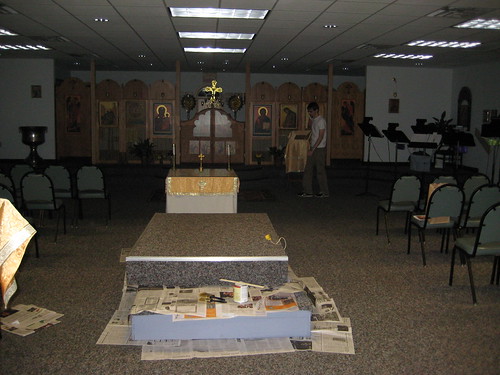
So, in going over the Divine Liturgy of St. James with our clergy Monday evening, something which became clear is that the rubrics assume that there’s something in the middle of the nave on which one may place things, from which one may read things, etc. — that is, an ambo in it’s original location.

Initial discussions had us placing the memorial table in the middle of the center aisle, but then Fr. Peter thought it would be nice to put it on a raised platform of some kind. There is a rank of platforms back in the choir area of All Saints on which the women stand, and we moved one of those out and placed the table on it. Realizing the platform segments were of staggered lengths, however, it hit me that we could place them on top of each other, giving us two steps leading up to the memorial table, making something of a makeshift ambo. The prokeimenon, epistle, and alleluia could be sung from the first step — remember that the prokeimenon corresponds to the “gradual” in Western practice, known as such because it was sung from the steps of the ambo — and the Gospel from the second step. (No steps leading down on the other side, but oh well.)

The only problem was that, since the church ran out of carpet while covering the tops of these platforms, there was a decent amount of bare plywood showing, and setting them up this way only exposed it. Really, Fr. Peter said, the only thing we could do to make it something other than a horrible eyesore would be to paint over the exposed plywood with something like a gunmetal grey. Lucas and I looked at each other — “What are you doing tomorrow evening after work?” I asked him. “I think I’m painting these platforms with you,” he said.

So, following a quick trip to the hardware store for a quart of paint and brushes, we headed to All Saints yesterday to do what was necessary. “How good of an idea is this,” I asked Lucas, “letting guys like you and me into the nave by ourselves with paint and brushes?”

“I’m just hoping nobody notices that we’ve had to take out chairs to make everything fit in the space,” he replied.

It didn’t take more than 45 minutes or so to actually do the painting; we then had to move the choir up to the front of the church in order to answer some other logistical concerns the ambo created. After doing that, and destroying taking all of the displaced chairs into the fellowship hall, the paint was dry, and we set it up as it will be for tonight.

Hagia Sophia it ain’t, and I’m not going to argue that it’s gorgeous (particularly with the power outlets on the sides), but it at least looks more or less intentional. (Alas, Fr. Peter is just going to use the prothesis table behind the iconostasis rather than use one of our outdoor shrines as a skevophylakion.) We’ll see how it goes tonight — it sounds like we will have some number of visiting clergy and interested people from the community and around the area, including a contingent of folks from St. George, the big Antiochian parish in Indianapolis. Hopefully somebody will be around who can take pictures. A colleague of my wife’s is coming tonight out of curiosity, and he has never been to an Orthodox service before. Given its length and the fact that this is the first time any of us have ever attempted to celebrate this particular Liturgy, I’m pretty sure that all I can tell him is, “God be with you.”

God be with us all — St. James, pray for us!

Review: Richard Toensing: Kontakion on the Nativity of Christ, by Cappella Romana

About four years ago, I was lucky enough to get to sing in concert performances of both the Gretchaninoff and Rachmaninoff settings of the Vigil (more commonly, and incompletely, known as “Vespers” to Western audiences because they don’t know what a Vigil is). Something that was very difficult about the experiences of singing them, however, was knowing that we English-speaking Orthodox Christians do not yet have equivalent works, and that to sing such things in translation would be to largely destroy much what makes the settings so beautiful, since they’re so tied to the Slavonic texts. Subsequent conversations about this with friends of mine who are composers and Orthodox Christians revealed a very real reluctance to become “Orthodox composers” — and I’m still not sure I totally get why, but there we are. Since then, I’ve discovered the music of people like Kurt Sander, whose setting of the Nunc dimittis in English is itself a mini-masterwork, and Ivan Moody, to say nothing of Fr. Sergei Glagolev — and while as a whole we are miles from maturity, it would not be at all fair to say that there are no English-language Orthodox composers attempting to pick up the gauntlet thrown down by some of their old-world counterparts.

Richard Toensing’s Kontakion on the Nativity of Christ is a large-scale work by a fully mature composer which picks up that gauntlet and throws it down again, quite honestly. The intended scope of the piece is indicated by its subtitle, “A Choral Concerto,” and one important point to make before we get any further — this is not, repeat not, a liturgical work. I suppose there might be, hypothetically speaking, a cathedral somewhere with an absolutely amazing choir who could pull it off liturgically, but who actually does the full Nativity kontakion liturgically anyway, these days?

(You might be thinking to yourself one of three things right now. If either 1 — “What’s a kontakion and why do I care?” — or 2 — “Don’t we sing different kontakia for various liturgical seasons?” — then I can tell you that a kontakion in its original form was a very lengthy kind of hymn with many stanzas and a refrain, and the proper kontakia we sing now are only the first stanzas of the applicable full-length versions. If 3 — “Well, we do sing a kontakion every time we do an Akathist” — then please pat yourself on the head and have a cookie.)

As a work intended explicitly for the concert stage rather than the parish choir, much like the Rachmaninoff Vigil setting, Toensing is free to paint on a vast, expansive canvas, and does he ever. He liberally employs text painting, use of soloists and small ensembles, an extensive harmonic vocabulary, adept counterpoint, tone clusters, and so on. Great — but does it sound like music? Yes, most definitely — glorious, lush, beautiful, dramatic, and demanding music. The press materials state that Toensing is “indebted to Slavic traditions,” and perhaps that’s true to some extent, but what I also hear is a master composer, fully on top of his game, synthesizing many of the best influences of 20th century choral writing, including Francis Poulenc, William Harris, Ralph Vaughan Williams, even Lloyd Pfautsch. The wordy text is set in a very sensitive but expressive manner often evocative of the deftness which made Benjamin Britten such a master with English. At some points I found myself thinking, “This is what Morten Lauridsen would sound like if he had more than one trick up his sleeve.” At the same time, the way Toensing uses the music to support the text is strongly suggestive, not just of well-trained artistic sensibility, but also of a deep faith informing his compositional choices, much like Bach.

Toensing shifts from one color to another with ease and control, and is as much an expert with different choral textures. For example, the first stanza begins with a solo cantor on a chant melody, joined gradually by the rest of the ensemble, building until finally the choir is all together on the refrain (“He who from eternity is God”). One stanza transitions smoothly into another, no matter how stark the contrast — in Movement III, Stanza IX (“Receive then, O Holy Lady”) he renders the refrain (“He who from eternity is God”) as a heart-stopping, everybody singing out, vocal-folds-to-the-wall climax, only to begin the next movement immediately with a simple, peaceful melody introduced by the women, without it ever feeling like any kind of a disconnect.

The members of Cappella Romana bring their usual high standard into the game, delivering Toensing’s “poeticized” version of St. Romanos the Melodist’s text with crispness and clarity. Too often choirs sing modern choral works like they’re just trying to get the notes right and they’ll let somebody else figure out how to make music with it later; in this premiere recording of Toensing’s work, Alexander Lingas refuses to take that route, and the ensemble makes music with it now, taking Toensing’s sonic palette firmly in hand and detailing the peaks and valleys rather than just sketching them in. Soprano LeeAnne DenBeste sings the Theotokos’ lines (I really hesitate to call “the part of the Theotokos”) with a crystal clear timbre and laserlike accuracy, and the other soloists acquit themselves admirably as well.

All of that said, I am not convinced that the depths of Toensing’s piece are fully plumbed, and the disc is not flawless. In the case of the former — well, no, of course not. A recording like this is hopefully the beginning of a conversation, rather than just a monologue. It would a rarity indeed for a premiere to be both the first and last word on a given piece (expressively speaking, at least — it is quite common for such recordings to be the first and last word from a commercial standpoint). This recording is without doubt a very strong opening statement to the conversation, but I would be very curious to know what the Kontakion might sound like using boys and men (with boys singing the solo soprano parts as well, not just the choral sections), and I would also love to hear, just for the sake of knowing the difference, what kind of nuances an English conductor might discover in the piece.

My criticisms of the disc itself center around one particular technical point — the acoustic is on the dry side, and there are times where the singers are clearly not loving the dryness of the room as much as they might — which I can well understand, singing services every week as I do in a church where the ceiling of acoustic tiles is inches from my head. My guess is that they chose the less-reverberant approach to clarify the text as much as possible, which I can also appreciate, but there are times where the vocal writing sounds like some reverberation of the chord has been assumed by the composer to be there, so when it doesn’t happen it sounds like something is missing. With nothing but admiration and respect for the effort as presented here, this is another reason why I’d be interested in a performance by somebody native to the English choral tradition — I would like to hear their solution.

One thing I am obliged to mention — something we forget sometimes in a world where we hear music in every kind of room and venue and in every medium imaginable except live in the hall is that music like this is intended to be heard, well, live in the hall. That’s really where the Kontakion needs to be heard, not on an iPod or in the car. It is difficult, therefore, to fairly judge this recording without knowing firsthand what it should sound like in person. I don’t say that to qualify my criticisms or to de-emphasize the praise; I’m just saying that to have a premiere recording three months before the premiere performance is putting the cart before the horse, particularly for somebody wanting to write as honest a review of the music as possible — it is unavoidable in the music landscape of today, unfortunately, but I sincerely hope I can have the chance at some point to experience Toensing’s music as it was intended rather than an electronic simulation of same. It would be akin to writing a review of The Dark Knight based on a pan-and-scan DVD screener watched on a 20″ TV. It doesn’t change the plot, the dialogue, the performances, or anything like that, but it is clear enough from the smaller-scale experience that “there’s a lot more ‘there’ there,” if you know what I mean, and without actually seeing it in IMAX to catch everything, you don’t know exactly what it is.

Besides the Kontakion are several “Orthodox Christmas carols,” Toensing’s settings of Fr. Jack Sparks’ metrical translations of Nativity hymnody. These are all positively delightful and inventive, surprisingly so, and good luck getting them out of your head once you’re familiar with them (particularly “What Shall We Call You,” from the Royal Hours of the Nativity, and “O Let Creation All Rejoice,” from the First Canon of Nativity Eve Matins). I could easily see these settings as having a place within the liturgical life of Orthodox Christianity, as well as possibly being adopted as anthems by church choirs in other communions. As with parts of the Kontakion, many of these are particularly evocative of the best of English choral writing, but there are also clearly some American folk influences (“Now Christ is Born Upon the Earth,” from the Canon of Nativity Matins, particularly has shapenote-esque things going on) suggesting that elements of both sung traditions may ultimately be useful as “American Orthodox music,” whatever it winds up being, coalesces.

In summary, Toensing’s Kontakion is an epic choral masterwork by a composer who is both American and Orthodox, and as a result it is perhaps the first such piece we might dub “American Orthodox.” If it is not quite on par with the best of its Russian Orthodox counterparts, it is only because it does not have the centuries of native Orthodox Christian tradition upon which to draw, not because of anything lacking in Toensing’s abilities as a composer or in the piece itself. The performance itself is, despite a key technical choice which is probably arguable one way or the other, a very compelling case for the work to have a life beyond Cappella Romana’s advocacy and championing, and I very much hope this happens. Recommended.

(Kurt Sander, I think you’re next up at bat.)


adventures in writing alexander lingas all saints bloomington all saints orthodox church american orthodox architecture american orthodox music american orthodoxy Antiochian Archdiocese Antiochian Orthodox Christian Archdiocese of North America Antiochians books byzantine chant cappella romana chant church architecture ecclesiastical chant ethnomusicologists ethnomusicology fellowship of ss. alban and sergius Greece Greek greek food greekness hazards of church music international travel tips ioannis arvanitis joe mckamey john michael boyer kurt sander Latin liturgical adventures liturgical architecture liturgical music liturgical texts and translation liturgy liturgy and life lycourgos angelopoulos medieval byzantine chant Metropolitan PHILIP militant americanist orthodoxy modern byzantine architecture modern greek music music as iconography my kids will latin and greek when they're newborns my kids will learn latin and greek when they're newborns orthodox architecture orthodox architecture is bloody expensive Orthodox choir schools Orthodox Ecclesiology orthodox outreach orthodox travel pascha at the singing school Patriarchate of Antioch Patriarch IGNATIUS IV Patriarch of Antioch publishing random acts of chant richard barrett in greece richard toensing rod dreher sacred music st. vlads st john of damascus society Syriac the Bishop MARK fan club the convert dilemma the dark knight The Episcopacy The Episcopate the only good language is a dead language this american church life travel we need more american saints why do we need beautiful music in churches?

Blog Stats

  • 270,391 hits

Flickr Photos