Archive for the 'Media' Category


Things Jesus would say if He were physically on the planet today…

“A city set upon a hill…”

“…probably isn’t wheelchair accessible!”

(Terribly insensitive humor inspired by the following chain —

This story: http://www.msnbc.msn.com/id/25825608/

Which then led me here: http://wirednewyork.com/forum/showthread.php?t=3426

And you have this quote from the architect here: http://wirednewyork.com/forum/showthread.php?s=9062f44d4a8168a55a0532331fbef550&t=3426&page=2

Planners for the archdiocese want the new building close to Greenwich Street, rather than behind or on top of the hill that will be formed by the entryway to the ramps.

“The church has to be accessible,’ said Nicholas P. Koutsomitis, an architect who is preparing the master plan for St. Nicholas. “It can’t be perched on top of a hill.” (emphasis mine)

Let it be said that I have every sympathy for the desire to make a church building accessible; I just find the irony of the statement to be quite thick.)

Something I don’t usually do…

I’ve kept my comments here restricted to a few general categories — more to the point, there are a few things I’ve avoided talking about. I don’t talk about politics here (although perhaps some stances are indirectly discernible), I don’t generally blog about what I do at work (mostly because that would generate an even smaller number of readers; I work a desk job, and there’s not much to say), I don’t say much (with some exceptions) about my personal life, and I don’t for the most part do things like movie reviews.

Well, this isn’t going to be a movie review, exactly, but it’s going to be about movies, and it’s going to deal with, in large part, a movie you had a statistical likelihood of seeing this last weekend if you bothered darkening the door of your local movie theatre at all between midnight last Thursday and Sunday evening. (No, shocked as you may be, I’m not talking about Mamma Mia!)

I’ve been a Batman guy for a loooooooooong time. There was a little Brave and the Bold digest my mom brought me home once when I was probably about five and home sick; it collected this neat little Batman vs. Deadman story which was drawn by Neal Adams — “You Can’t Hide From a Deadman,” originally printed in Brave and the Bold #86, Oct/Nov 1969 — and I was hooked ever since. It was still a few years yet before I started reading comics regularly, but I remember coming in on the tail end of Batman: Year 2, reading Ten Nights of the Beast, The Killing Joke, and A Death in the Family when they were first printed (The Dark Knight Returns I came to about three years late or so just ’cause it looked kinda ugly to this ten year old when I first saw it on the shelves — let’s face it, I was just too young to get it), and I was definitely at the movie theatre on 23 June 1989 for the first night the Burton/Keaton Batman was playing, which I saw three times that summer while it was still in the theatres. A tick over nineteen years later, maybe not much has changed.

I’ve also been a Christopher Nolan guy for a good bit. I saw Memento three times when it was in theatres, and keep in mind that meant, at least for the first couple of times I saw it, driving about half an hour to the arthouse which was playing it. I talked it up to whomever would listen, took friends to see it, bought David Julyan’s score CD, bought the DVD (both versions), and so on. I bought (and quite liked) Following when it came out on DVD, and while for various reasons had to miss Insomnia when it was in theatres, I’ve enjoyed it on DVD since (but, truthfully, it remains the one I’ve seen the least number of times — maybe that’s nothing to lose sleep over?).

For me, getting to know a director’s work is getting to know what kinds of themes interest them, what kinds of images they consistently use, what they like to do with structure, which actors they re-use, who scores their movies, what kind of pattern they’re continuing (or establishing) with new works, and so on. To put it another way, a director is always infinitely more interesting to me when there is something more I can get out of one of their movies by placing it in the context of the rest of their work.

Which brings me to The Dark Knight. There are major spoilers to follow from The Dark Knight, Batman Begins, Memento, Following, Insomnia, and The Prestige, so do read at your own risk.

I’ve seen it twice now; I was lucky enough to get in on the viral marketing IMAX ticket giveaway, only because I live in a market where two hours after the site went live there were still tickets available (although only just — I was 164/170), and thus saw it 50.5 hours before most of the rest of the world had a chance. I also saw it again (in IMAX, natch) last Friday night. I’ll get the easy stuff out of the way first: some movies are overhyped. A couple of well-edited trailers, a flashy marketing campaign, and a couple of glowing early reviews can all add up to a disappointing experience in the actual cinema because in the end, it’s “just a movie” and doesn’t cure cancer. The Dark Knight is not this movie — it is every bit as good as you’ve heard, and gets better on repeat viewings. Everybody brings their A-game, be they in front of the camera or behind the camera, be they in a big role or a small role, and they craft a crime epic for the ages along the lines of Heat or The Departed or L. A. Confidential. This isn’t Tim Burton’s self-aware, dark-but-comic freakshow; this isn’t Joel Schumacher tweaking your nose. And — I say this as somebody who saw Iron Man twice and who thinks it was absolutely terrific — this also definitely isn’t Jon Favreau’s bright, flashy, action-adventure story in which A Flawed But Ultimately Good Man Learns Something While Wearing A Costume. The Dark Knight takes the idea of a “comic book movie” and elevates it to a whole new genre and a whole new level of filmmaking; you’ll either like that or you won’t (I’ve read some reviews that say it’s pointless to try to elevate source material which is absurd to the core to the level of Hamlet), but if your reasons for not liking a movie like this have to do with the title character being dressed as a bat rather than wearing a shirt and tie, that’s really your problem, and not that of the filmmakers.

One thing about the story – two years ago, when the title was revealed and Nolan said it was “quite important to the film” (http://www.batman-on-film.com/batmovienewsarchives48.html), I immediately understood it to be a double entendre with “the dark night”. Putting that together with the recasting of Rachel Dawes rather than creating a new character (seeming to point to the need for somebody in whom we were already invested emotionally), I believed from that moment on that Rachel was going to be dead as a doornail by the end of the film. Sure enough. If the rumors are true that Rachel was originally supposed to be Harvey Dent in Batman Begins until there was a studio note saying “We need a chick in the pic, stat”, then that was a great way for Nolan to take it and run with it.

Okay — I haven’t said anything new there. You’ve probably read a dozen reviews which have said something similar, so I’ll move on now to what I really want to write about.

The Dark Knight keys off of several important ideas set up in Batman Begins; definitely that of “escalation,” established in the closing conversation in BB between Gordon and Batman, but also very much the repeated line, “It’s not who I am underneath, but what I do that defines me” as well as the notion that Batman isn’t just Bruce Wayne in a mask; it is in fact who Bruce Wayne actually is.

And as bleak as people are saying it is, the two important things with which you’re left at the end of the movie are a) nobody on either boat pressed the button and b) Batman did not let the Joker fall to his death — a correction of a huge misunderstanding on Tim Burton’s part nineteen years ago, and a clear indicator that Batman has decided that “I won’t kill you, but I don’t have to save you” is no longer a clear enough line in the moral sand, not when your enemy has no rules whatsoever.

All well and good. However, looking at it through the lens of Nolan’s other work, bigger themes start to emerge. Much has been made of how much Nolan likes to play with time, but that’s really window dressing, a story-telling tool rather than a theme (and it’s telling how, as he has matured as a filmmaker, he’s done it less and less). Identity, on the other hand, has been a key question in his movies from the get-go; Following and The Prestige study characters who deliberately take on other identities but then find that they can’t just simply go back to normal when they’re done. The narrator of Following turns himself into somebody who seems slick and clever and affluent, emulating Cobb as much as he can at Cobb’s own encouragement, but in doing so he makes it impossible to prove that Cobb ever existed and/or that he’s not, in fact, Cobb — which was, of course, “all part of the plan” in the first place. Angier and Borden in The Prestige both are leading double lives (I’ve always thought it was particularly clever of Nolan to cast as his leads actors most famous for playing superheroes, and that it added a fascinating subtext to the film), and must maintain the “act” at all costs, to the extent that their lives are quite dependent on it. In trying to figure out each other’s magic tricks, Angier and Borden are actually solving the problem of who the other person actually is.

Memento‘s Leonard Shelby, on the other hand, is an examination of how our natural identities depend on how we experience time and form memories — if we can’t, we’re slaves to external sources of information, never able to trust our own instincts about who we are. As a result, Leonard can never stop mourning the death of his wife, because his own perception of time (or lack thereof) can never provide any distance from it. It will always have just happened for him.

Batman Begins and The Dark Knight bring many of these concepts together. Bruce Wayne, as depicted by Nolan, his brother Jonathan, and David Goyer, has assumed at least one identity (if not two, counting the “playboy Bruce” persona) which changes him and those with whom he interacts permanently. At the same time, the whole reason he does so is because, to a certain extent, he can never get past the trauma of losing his parents, because the one way he knows to heal, revenge, has been taken from him — and he realizes it won’t necessarily do what he hopes for anyway. One way or the other, he’s permanently emotionally stuck, much like Leonard Shelby, and this drives him to take on the dual persona (which is itself an interesting inversion of Bale’s character/characters in The Prestige, Borden — two men having to lead one life). To apply Memento‘s questions, then — can Bruce trust his own sense of who he is? Is the Batsuit really a message he sends to criminals, or a message he’s sending to himself, much like Leonard Shelby’s tattoos? To apply The Prestige‘s questions, can he stop being Batman without causing himself, to say nothing of others, harm?

Several of the films deal with familial loss; Memento and The Prestige both with the loss of a wife under circumstances which are left ambiguous, Batman Begins obviously having the murder of parents as a pivotal point (but also has Ra’s Al Ghul talking about taking vengeance for a murdered wife), and The Dark Knight has the murder of Harvey Dent’s fiancée as a major engine of the plot (while also showing Gordon’s wife mourning his death in the line of duty). All of these cases are motivators for vengeance, but in The Prestige in particular it’s clear that Angier’s lust for revenge eventually wanes, and he continues out of the sheer momentum of hatred — “I don’t care about my wife, I care about his secret,” he spits out halfway through the movie. Looking forward, perhaps we can surmise that Bruce Wayne eventually faces the danger of being Batman just to be Batman, with no particular purpose driving him.

One can draw a line of connection between Dormer’s corruption in the name of catching the bad guys in Insomnia to what Gordon and Batman choose to do at the end of The Dark Knight; if it can be proven Dormer planted evidence even once, then it calls all of the convictions to which he’s contributed into question. In TDK, if Harvey’s spree as Two-Face is made public, their efforts to fight the mob will have been entirely in vain. Bending the rules to make the criminals pay is a slippery slope in Nolan’s universe, one with very real consequences. Even if everything ostensibly turns out all right, somebody will have to pay the piper — and sometimes it’s the wrong person.

(By the way, Nolan has mentioned that Aaron Eckhart was looked at for Memento. I think one can look at Eckhart’s Two-Face for a glimpse of what he might have been like as Leonard Shelby. I think that was a career-defining performance for Guy Pearce, so I wouldn’t have it any other way, but Eckhart would have been really interesting in the role. Different from what we got, but definitely interesting.)

In terms of recurring visual motifs — there is always a “lair” in Nolan’s film, a location where the main character’s dark secrets are hidden and their true identity may be found. This goes all the way back to Following, where The Young Man takes Cobb to his apartment under the ruse that it’s somebody else’s (and of course Cobb knows what’s going on immediately). In Memento it is the basement of the abandoned building where Jimmy Gantz’s body and Leonard’s real clothes have been left. In Insomnia it is Finch’s cabin. In Batman Begins and The Dark Knight it is the Batcave (or its temporary replacement). In The Prestige it is the theatre basement where all of Angier’s “prestige materials” are kept. More often than not it involves “going down” someplace; I will leave others more qualified to speak about Jungian psychology to discuss the implications of the “descent” into the place where one keeps secrets, potentially even from oneself.

Breaking of legs is something which has shown up twice in a row now — Angier falls through a trapdoor and the cushion has been removed, shattering the entire limb from the looks of the brace he’s put in, and Batman drops Sal Maroni from a height which is just enough to break his ankle (although Nolan is far more subtle about showing Maroni with a cane later than he is with Angier). Being a year and a half out from a broken ankle myself and still recovering to some degree, both of those moments make me squirm each time.

Casting is an interesting point — Nolan doesn’t quite seem to have the “stock company” of David Mamet or, to a lesser degree, of David Lynch or Tim Burton, but three films in a row now have starred Christian Bale and Michael Caine. To some extent, Bale, Guy Pearce, and maybe Following‘s Jeremy Theobald, too have a visual continuity I can’t quite explain — distinctive faces which wear woundedness well, maybe. Bale and Pearce definitely have a carved-out-of-wood quality — and I don’t mean that in a bad way — to their facial and bodily structures (harder to say with Theobald). Hugh Jackman and Aaron Eckhart are somewhat the opposite — classically good-looking men who you want to like and have be the ostensible good guys (which, naturally, is what makes their characters more interesting when they turn). Mark Boone Junior has had significant supporting roles a couple of times, Theobald showed up in a bit role in Batman Begins, and Larry Holden is quite the chameleon, going from L. A. lowlife Jimmy Gantz in Memento to the dapper D. A. Finch in Batman Begins (as well as having a bit in Insomnia). He gets really interesting performances out of people, be it well-established character actors like Joe Pantoliano or Andy Serkis or people harder to define, such as David Bowie — who, by the way, I really wished would have gotten a Best Supporting Actor nod for Tesla. He was onscreen for all of ten minutes, maybe, but he owned every frame in which he appeared. I’d love for Nolan to find a reason to cast Carrie-Anne Moss again — her appearance in Memento is still the most interesting thing she’s ever done, in black vinyl or out of it, as far as I’m concerned. (Probably, since she’s being cast in “mom” roles now — at all of 40! — she would be out of the running for a future cinematic appearance of Selina Kyle/Catwoman. Maybe she could play Selina’s mother, Cougarwoman?) Gary Oldman disappears so completely into the role of Gordon that it’s hard to tell if Nolan is actually giving him any direction or if he’s just getting out of the way.

So — back to The Dark Knight for a moment. What’s ahead? Where can a third Batman movie potentially go Or, to put it another way, what in the world do they do to top this one? And I think the answer is, they need to not bother trying. They need to go in the opposite direction and do something smaller, grittier, more – dare I say it – intimate. Maybe even something which feels more like a stage play than a movie – I don’t know, something more like Memento (and maybe even with David Julyan scoring rather than the Zimmer/Howard team, good as it is). They’ve set it up well to go in that direction – Batman is on the run (although presumably Bruce Wayne is not, since his being outed was prevented), his relationship with Lucius is strained (if not severed entirely) so that he won’t be able to just go to him with gadget requests anymore, and so on. Somehow he’ll have to repair what the events of The Dark Knight have broken, but that’s going to require operating on a smaller scale for awhile, I expect. Robin could work within this thematic framework, but it seems unlikely they’d go that way. Presumably in a third movie we’d be able to return to Wayne Manor, which itself could thematically represent some sort of shift back to the status quo.

In terms of what this means for a villain – hard to say. I would say that the Riddler could work on the thematic level – possibly something like Saw, only, y’know, worth watching. I’d be really surprised if the people at the helm wanted to revisit the character. Hard to say. I wonder if maybe somebody like Talia wouldn’t work, perhaps continuing her father’s efforts? It would certainly tie into what’s come before, and with Batman as a reluctant outlaw, there would be the element of temptation for him to join her on several levels. Catwoman could be done easily within the rules of Nolan’s universe, but I doubt Warner Bros. wants to go anywhere near that character for awhile.

(Here’s an idea – what about a Gotham Central TV series set in the Nolanverse between TDK and film #3 — The Dark Knight Returns??? — ? If Batman is having to be in hiding to some extent, then he can just be a vague, undefined presence to some extent who doesn’t have to directly appear.)

(Which reminds me – having watched the Gotham Knight DVD a few times now, too, I’ll say that presumably, Anna Ramirez was used instead of Renee Montoya because the powers that be didn’t want Renee Montoya to wind up as a dirty cop. That said, “Crossfire” now makes less sense as a result, not more – unless the point was to make her fall be even tougher for those who figured she was just a generic Montoya stand-in. Also, the Goyer segment doesn’t exactly jive with what we see of Crane at the beginning of The Dark Knight, but at the same time, Gotham Knight appears to also forget that Wayne Manor burned down during Batman Begins, so it’s not an exact match anyway.)

(I will also note that I think the Joker could be recast. Likely? No. Possible? Yes. Nolan would just have to do what he did this time, which is find the best actor for the job.)

(Okay, enough with the parentheticals.)

(I mean it.)

Maybe the biggest clue is in the final scene. It’s clear that Nolan and co. regard the Batman/Gordon relationship as the moral foundation of the particular stories they’re telling. That may seem obvious, but I think it’s very much underscored in the last scene of TDK, which is a clear counterpoint to the last scene of BB. For example –- Gordon telling Batman “thank you” and him replying, “You don’t have to thank me” seems to be very much a reference to the last line of BB, and in general both scenes function to wrap up the moral point of the preceding story and establish what the guiding principle will be for the next one. Given that, as much as escalation was the driving force of TDK, can we surmise that Gotham learning to accept the hero they need will be the plot engine of the third film?

Enough for now. I have plenty to say about all of this, but this is already quite long. I’ll come back to it another day, maybe.

It’s here…

Buy me!

Buy me!

Cappella Romana’s The Divine Liturgy in English arrived in the mail today. I will have more extensive comments about it later, but the bottom line is that once everybody in my choir has a copy, I can just tell them, for the most part anyway, “Sing it like that.” Let me assure you that I am not getting any incentive to advertise this disc in the slightest — it is no more and and no less that I firmly believe that this is a very important work which can serve as a model from here on out of what the ideal should be for Byzantine chant in English. There are some caveats there, but they have to do with circumstances which are going to change from parish to parish, and don’t really impact the general point.

Which is — buy it, listen to it, learn from it. Please don’t rip copies and give them out. This wasn’t cheap or easy for Cappella Romana to produce and it will impact the ability of ensembles such as CR to produce future such works if people just steal it. Cappella Romana ain’t Radiohead, folks.

Alexander Lingas talks about Cappella Romana’s The Divine Liturgy in English

Ancient Faith Radio has a half-hour interview with Dr. Lingas about The Divine Liturgy in English. This touches on the translation, the process used to make the settings workable in English, and much more. Highly recommended. (Hat tip to my godson, Subdn. Lucas Christensen the Blogless.)

The moment you’ve all been waiting for…

At long last, Cappella Romana is releasing their recording of the Divine Liturgy in English:

To be released this July
The Divine Liturgy in English
In Byzantine Chant – A 2-CD set

RELEASE DATE: JULY 14, 2008

The highly anticipated release of Cappella Romana’s groundbreaking recording of the complete Divine Liturgy in English, set to traditional Byzantine chant, will be released on July 14 at the Clergy-Laity Congress of the Greek Orthodox Church of America in Washington, DC.

The CD will first be available at the congress, and orders may be placed online beginning July 14. Shipments will begin July 19.

ABOUT THE RECORDING

Employing the official English translation of the Greek Orthodox Archdiocese of Thyateira and Great Britain, this 2-disc set presents the complete service (ακολουθία) of the Divine Liturgy of St John Chrysostom. Litanies and prayers pertaining to the entire Eucharistic assembly are rendered in full. The hymns and responses represent the central traditions of Byzantine chanting, including works adapted from Petros Peloponnesios, Nileus Kamarados, and St. John Koukouzelis.

A collection of musical scores for the chants on this recording will be available in Byzantine and Western (staff) notation through our website.

This recording was made possible by major grants from the Virginia H. Farah Foundation, the A.G. Leventis Foundation, the Fellowship of St. Alban and St. Sergius, and the National Forum of Greek Orthodox Church Musicians.

I realize that there are two of you pumping your fists right now cheering “Right ON!” and the remaining three of you who are wondering what the heck this is and why it’s important. That’s okay. Basically, this recording, has the potential to set the standard for what Byzantine chant should sound like in English. Right now there’s kind of a range of poor to really good — the best example in English of which I can think right now being the Mt. Lebanon Choir’s recording (but which doesn’t quite set the standard, at least for me, because it’s clear it’s being sung by non-native English speakers), and I’d really rather not go into which ones I don’t exactly find optimal, at least not in a public forum.

Let’s put it this way — it’s clear to me that the English recordings of the St. Vladimir’s Seminary Chapel Choir over the years have had a huge impact on what people expect to hear. I’m very hopeful that this recording, intentionally a thorough effort to match a good English translation to the traditional settings, sung by a professional choir which counts several faithful Orthodox Christians among its membership and staff (including its artistic and executive directors), can have a similar impact. If the entire recording is as good as excerpts to which I was treated a couple of years ago, it should also settle once and for all the silly question of whether or not Byzantine chant can sound good in English or if it will always sound like “camel-whipping music” (a particular friend’s term).

For my own part, I will say that I believe this recording was announced four years ago, and was completed two years ago or so, and I’ve definitely been one of the people “highly anticipating” its release that whole time. (I think I’ve been posting annoying “When does it come out?” comments on the CR blog for roughly the last year.) I’ll also briefly mention that the friendship of the executive director, Mark Powell, along with his wife Kathleen, to say nothing of the willingness to talk about his faith and to answer questions, was one of the major instruments by means of which Megan and I were initially exposed to Orthodox Christianity, and it’s been an example we’ve tried to follow since — but that’s a story for another time.

I will also note that Cappella Romana also has a sale going on where the Lycourgos Angelopoulos recording of the Divine Liturgy is available for roughly 20% off. This is one of the recordings which really captivated me early on, and I can’t recommend it highly enough. It was very difficult to find in this country five years ago, and could very well be so again with the way non-pop recordings come in and out of print, so I encourage you to get it while you can!

Today’s sign that the end is near

Watch the skies, that’s all I can say.

“The spread of coffee bars? Germs outpacing antibiotics? And boy bands?! Come on! Who would gain from all this?”

“Glorious hope is risen today”? What the hell?

With a tip of the hat to Rod Dreher, I’ll let this piece from the Canadian paper, The Globe and Mail, speak for itself. Mostly.

That triumphal barnburner of an Easter hymn, Jesus Christ Has Risen Today – Hallelujah, this morning will rock the walls of Toronto’s West Hill United Church as it will in most Christian churches across the country.

But at West Hill on the faith’s holiest day, it will be done with a huge difference. The words “Jesus Christ” will be excised from what the congregation sings and replaced with “Glorious hope.”

Thus, it will be hope that is declared to be resurrected – an expression of renewal of optimism and the human spirit – but not Jesus, contrary to Christianity’s central tenet about the return to life on Easter morning of the crucified divine son of God.

Generally speaking, no divine anybody makes an appearance in West Hill’s Sunday service liturgy.

There is no authoritative Big-Godism, as Rev. Gretta Vosper, West Hill’s minister for the past 10 years, puts it. No petitionary prayers (“Dear God, step into the world and do good things about global warming and the poor”). No miracles-performing magic Jesus given birth by a virgin and coming back to life. No references to salvation, Christianity’s teaching of the final victory over death through belief in Jesus’s death as an atonement for sin and the omnipotent love of God. For that matter, no omnipotent God, or god.

So, this isn’t really Christianity — maybe GoodFeelingsity, WarmFuzziesity, or just Ity?

Ms. Vosper has written a book, published this week – With or Without God: Why the Way We Live is More Important than What We Believe – in which she argues that the Christian church, in the form in which it exists today, has outlived its viability and either it sheds its no-longer credible myths, doctrines and dogmas, or it’s toast.

Uh, Rev. Vosper? John Shelby Spong called. He’d like his atheism back.

I’m reminded of the one time I went to St. Mark’s Episcopal Cathedral in Seattle for Easter, ten years ago (sheesh — has it really been that long?). The sermon was really more of a tapdance than anything, with the dean of the cathedral appearing to do anything and everything he could to avoid mentioning the “r” word (that is, resurrection). Since it was, well, the Feast of the Resurrection, it kinda stuck out like a sore thumb, to say the least.

Buying books of Bartholomew’s while browsing at Borders

A hearty Christ is risen! to my readers who are on the Gregorian calendar.

Just out of curiosity, yesterday I decided to check out how available Encountering the Mystery might be in a typical bricks-and-mortar chain store. I figured, it’s the day before Western Easter so Christian books will probably be prominently displayed, plus it’s the first Saturday since the book was released. If there was a day they would have it set out for the masses, it would have been yesterday.

Well, John Shelby Spong’s Jesus for the Non-Religious was set out with the books for Easter at my local Borders. The Patriarch of Constantinople got no such love, there being no copies set out in the front half of the store, either among the Christian books for Easter or in the display of new non-fiction. There were, nonetheless, two copies on the shelf back in the “Christianity: Catholic and Orthodox” section. And, actually, the Orthodox pickings were slim, but not totally absent. The following were also in stock:

And then a couple of not specifically Orthodox books but church history books by Orthodox authors, such as The Christian Tradition: The Development of Christian Doctrine, Volume 1: The Emergence of the Catholic Tradition (100-600), by Jaroslav Pelikan (and yes, I know he was Lutheran, not Orthodox when he wrote it).

All in all — it’s not anywhere close to the equivalent of a well-stocked parish bookstore, but it could be a lot worse. Like, say, nothing. (No copies of the Orthodox Study Bible, however. It is listed as “on the way” in the digital customer service kiosks. Given you still have to pre-order it on Amazon, my guess is that copies have not yet actually gone out to distributors who are not named Conciliar Press.)

I’m still irked that Spong was out with the Easter books (a real irony, if you think about it) and the Patriarch wasn’t. I guess, if one uses as one’s thesis that part of the point of the Patriarch’s book is to raise awareness (well, generate awareness — you can’t raise what isn’t there) of the Patriarchate’s existence in the West, then this makes the point pretty clear. When an atheist who just happens to have a collar is able to get better display space among the Christian books than the Patriarch of Constantinople, that says something.

I’m two and a half chapters into the Patriarch’s book. I don’t have anything to say quite yet — I want to finish it first. All in good time. I will say only for now that I do not believe the average American who is already Orthodox is his intended audience for the book (although I think there is good that such a person can take from reading it), that it needs to be read through that lens, and therefore, with charity if he doesn’t put everything exactly in the language we would want him to use. But more on that later.

While today was not Easter for my little Orthodox parish, it was nonetheless a special weekend, as our bishop, His Grace Bishop MARK, was with us. More on that later as well.

His All-Holiness’ book

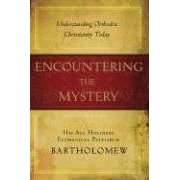
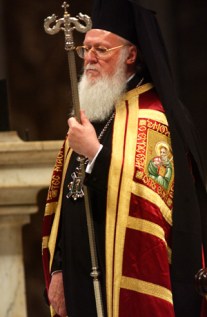
217qkj0zbl_aa180_.jpg Patriarch Bartholomew’s book, Encountering the Mystery: Understanding Orthodox Christianity Today arrived yesterday. Metropolitan Dumbledore… er, Kallistos provides the Foreword; Dr. Dn. John Chryssavgis contributes a rather lengthy biographical essay. I am through the Foreword and will work my way through Dr. Dn. Chryssavigis’ material this evening. Likely this book will serve as my Lenten reading in capacity, probably in conjunction with Oliver Clément’s Conversations with Ecumenical Patriarch Bartholomew I, which UPS’ website tells me was delivered today.

(Funny story about the Clément book: I saw it at the St. George bookstore after the Triumph of Orthodoxy Vespers on Sunday. It was $15, and noting a fairly substantial — if not downright questionable — markup on a couple of other items, opted to not get it. Upon getting home, I checked the St. Vlad’s Press website, and found that the book was on sale for $3 — $9 after shipping, but still well worth resisting the impulse purchase.)

The first thing that jumps out at me in the Foreword is liberal use of words to which I try to avoid, like “dialogue.” However, the Patriarch of Constantinople using the word “dialogue” somehow seems more appropriate to me than, well, me using it. I will therefore reserve judgment.patriarch_bartholomew.jpg

The second thing that is crystal clear is that part of the point of this book, even if it isn’t the prophetic witness regarding the situation in Turkey that some would have preferred, is to give Americans a reason to care that the Patriarch exists.

I’ll have more to say as I go on, but for now — I am at the very least respectfully intrigued.

(And yes, I think the same can be said of the Patriarch’s appearance that can be said of Met. Kallistos’. Check how I’ve tagged this post, then click on the tag, if you don’t understand what I mean.)

Wasted opportunities for a good chat over a beer

I’ve suggested before that “dialogue” is too lofty a word for us Joe Schmoes here in the trenches. I don’t really want to have a “dialogue” with people who have ecclesiastical disagreements with me; I’d rather have a conversation over a beer. That seems to me to be more a appropriate aim for us Reg’lar Folks.

My apathy towards “dialogue” notwithstanding, I think when questions get asked and answered publicly about those with whom we disagree, we should at least make efforts to answer the questions honestly, even if that means — gasp —  deferring to those with whom we disagree so that they may define themselves.

What am I talking about? First off, read this. Now, Campus Life’s Ignite Your Faith is a daughter publication of Christianity Today, so I hardly expect it to quote the Catholic Catechism, but I also don’t expect it to take a tone which approaches “Well, Jimmy, the Papists want to put God in a box so they can have an excuse to worship idols and preach works-based salvation, but we’re the real Christians, so we don’t.”  Marshall Shelley, it is to be hoped, would be better than this.

I sent them this response. Nearly five months later, I have yet to receive any response whatsoever. It’s probably better I don’t hold my breath. To be fair, me getting at all worked up over this is probably tantamount (to paraphrase Robin Williams) to coming out of a, um, house of ill repute complaining that you didn’t feel loved. I just find it unfortunate that many will read Mr. Shelley’s answer to this kid’s very honest question and accept it uncritically.

To whom it may concern:

In regards to Marshall Shelley’s answer to the question, “What Are Sacraments?” —

A question such as “What are sacraments?” could and should be seen as an opportunity to honestly examine the differences between various sorts of Protestantism and communions which adhere to an older tradition, such as Roman Catholicism and/or Eastern Orthodoxy, and explore what the relationship between us is. Unfortunately, the answer Mr. Shelley provides does neither of these things, being rather a woefully knee-jerk misrepresentation of sacramental theology that borders on being not much more than an anti-Catholic strawman.

First of all, the word “sacrament” is a perfectly biblical word; it is nothing more than the Latin translation of the Greek word “mysterion”, which simply means “mystery” and appears twenty-two times in the New Testament according to Strong’s. Indeed, “Mystery” is the word still given preference over “Sacrament” for many Orthodox Christians.

Second, the assertion that “[t]he early church believed preaching was the main way of sharing of God’s plan of salvation with others” is somewhat confusing, at least in terms of trying to draw a connection to sacramental practice. There is, to be sure, no question about the importance of preaching even in the extra-biblical textual sources (for example, the Didache says “My child, day and night you should remember him who preaches God’s word to you, and honor him as you would the Lord”, Did. 4:1), but to suggest that this is somehow over and above, or as opposed to, sacramental practice is at odds with both the witness of the New Testament and early church history. To be fair, Mr. Shelley correctly links sacramental practice to liturgical practice (although to say that sacraments are exclusively manifested liturgically is a severe overstatement), but this is not in opposition to preaching. The Book of Acts often places even preaching in this liturgical context, such as in 2:42: “And they continued steadfastly in the apostles’ doctrine, and fellowship, and in breaking of the bread, and in the prayers.” Acts 13:2 is often translated so that the church in Antioch “ministering to the Lord,” but the Greek verb used is leitourgein, “liturgize.” The letters of Ignatius of Antioch also underscore this liturgical context, as does the Apology of Justin Martyr:

“And this food is called among us the Eucharist… For not as common bread and common drink do we receive these; but in like manner as Jesus Christ our Saviour, having been made flesh by the Word of God, had both flesh and blood for our salvation, so likewise have we been taught that the food which is blessed by the prayer of His word, and from which our blood and flesh by transmutation are nourished, is the flesh and blood of that Jesus who was made flesh. […] And on the day called Sunday, all who live in cities or in the country gather together to one place, and the memoirs of the apostles or the writings of the prophets are read, as long as time permits; then, when the reader has ceased, the president verbally instructs, and exhorts to the imitation of these good things. Then we all rise together and pray, and, as we before said, when our prayer is ended, bread and wine and water are brought, and the president in like manner offers prayers and thanksgivings, according to his ability, and the people assent, saying Amen; and there is a distribution to each, and a participation of that over which thanks have been given, and to those who are absent a portion is sent by the deacons.” (First Apology, 66-7)

Third, the clericalism assumed by Mr. Shelley to be held by those who use the word “sacrament” is frankly bizarre. It is true that the priest stands in persona Christi, but insofar as a priest participates in a sacrament he is allowing himself to be used as a vessel of the Holy Spirit, not somehow casting a magic spell which compels the Holy Spirit to action. The liturgical texts employed by Roman Catholics and Eastern Orthodox make this quite explicit. There is nothing to say that the Holy Spirit cannot work in other ways; “the wind blows where it will,” after all. Nonetheless, as Paul exhorts the Corinthians, “Let all things be done decently and according to order,” and again, the early church writers make it plain that these functions have been in place since the earliest of days, and that they are strictly a matter of function, not a matter of quality or access.

Fourth, it is not entirely true that Protestants believe in “two ordinances” instead of “seven (or however many) sacraments.” This is true of some Protestants; however, Anglicans profess seven sacraments, and Lutherans also use the word “sacrament” (although they profess two).

This still leaves the question, “What is a sacrament?” A sacrament is, plainly, a way in which the Holy Spirit interacts with the created order in a transformative manner. The philosopher theologians of Roman Catholicism such as Thomas Aquinas analyze this in terms of concepts such as matter, substance, accidents, etc. which make the whole notion sound very technical, but it can be understood far more simply. At the Eucharist, the Holy Spirit interacts with the bread, the wine, the celebrant, and the people; as a result, it is not just the bread and wine that are changed, but all participating. At Baptism, the Holy Spirit interacts with the water and, again, the people, transforming those being baptized. Sacraments are, really, nothing short of miracles, and miracles which are considered to be normative. In that sense, then, to limit the number of sacraments to seven is somewhat missing the point; any time the Holy Spirit interacts with the world, it is a sacrament.

In Christ,

Richard Barrett
Bloomington, IN


adventures in writing alexander lingas all saints bloomington all saints orthodox church american orthodox architecture american orthodox music american orthodoxy Antiochian Archdiocese Antiochian Orthodox Christian Archdiocese of North America Antiochians books byzantine chant cappella romana chant church architecture ecclesiastical chant ethnomusicologists ethnomusicology fellowship of ss. alban and sergius Greece Greek greek food greekness hazards of church music international travel tips ioannis arvanitis joe mckamey john michael boyer kurt sander Latin liturgical adventures liturgical architecture liturgical music liturgical texts and translation liturgy liturgy and life lycourgos angelopoulos medieval byzantine chant Metropolitan PHILIP militant americanist orthodoxy modern byzantine architecture modern greek music music as iconography my kids will latin and greek when they're newborns my kids will learn latin and greek when they're newborns orthodox architecture orthodox architecture is bloody expensive Orthodox choir schools Orthodox Ecclesiology orthodox outreach orthodox travel pascha at the singing school Patriarchate of Antioch Patriarch IGNATIUS IV Patriarch of Antioch publishing random acts of chant richard barrett in greece richard toensing rod dreher sacred music st. vlads st john of damascus society Syriac the Bishop MARK fan club the convert dilemma the dark knight The Episcopacy The Episcopate the only good language is a dead language this american church life travel we need more american saints why do we need beautiful music in churches?

Blog Stats

  • 272,462 hits