Archive for the 'Media' Category


YouTube is my Pensieve

It’s amazing the pieces of one’s childhood one can reconstruct using YouTube. Surely, I’m the 9,081,726,354th (and if somebody wants to tell me what’s interesting about that number, you’ll get a classic Marvel No-Prize from me) person to post this out of nostalgia:

But then, surely, there are the things of which you only have vague memories, haven’t seen it in years, have never heard anybody else ever mention it, it’s never come out on DVD, you question whether or not it even existed or if you just imagined it, etc.

We got cable when I was probably about five (c. 1981-1982), and I remember this short film that I saw on HBO numerous times. The main image that I remember is this mass of magnetic tape chasing somebody around an office building, and eventually consuming him. Over the years I’ve inquired here and there on the internet to see if anybody knew anything about it; nothing. One or two people thought they remembered seeing part of the film, but had no further information. Well, I finally found it last night. I give you 1975’s “Recorded Live”:

Oh, the mustache. Man.

Two interesting names in the end credits: George Winston and Ben Burtt, Jr. The former is the pianist; the latter would go on to become George Lucas’ main sound effects guy (and creator of the lightsaber noise).

Something else I saw on cable a lot as a little kid was an animated movie called “The Mouse and His Child.” I remember parts of it really messing with my head, particularly a sequence where there’s a can of dogfood with a highly recursive label, and the titular characters are trying to figure out where it ends. It has evidently never been released on DVD, I’ve never met anybody else who remembers it, but here’s the whole thing (and it’s well-worth the watch if you’ve got 77 minutes to spare):

“Will that be cash, or –”

“TREACLE BRITTLE!” (smash to head)

Finally (for now), in the late 1980s, the church my mother and I attended for awhile used to show this movie every so often to the junior high kids. The protagonist is a schlub of a guy who leads a very humdrum life (no doubt today he would be played by either Philip Seymour Hoffman or Paul Giamatti) in a very ugly, grey and industrial city. One day a gospel group simply appears in front of him, singing music that makes him happy in a way he’s clearly never experienced before. They disappear, leaving a box behind. He lifts the lid of the box, and their music comes out. He then walks around with the box up to his ear, listening to it wherever he goes, but he doesn’t want anybody else to hear it. One night, the band appears to him again when he’s in bed, and they tell him, “You’re supposed to share it!” To his terror, they start a song, waking up his family. They rush in, wondering what’s going on, and then find themselves infected by the music as well. When he realizes that it’s a good thing for him to let others hear the music of the box, he starts going everywhere with the lid open, and there’s a closing montage of him doing so. The last shot is of him standing on the roof of a tall building, holding the box open for the whole city to hear.

Same deal — I never knew what it was called, never heard of it again after we stopped going to that church, never met anybody who knew anything about it. The images from it have nonetheless stuck with me over the years. I finally found it, and turns out it is called, prosaically enough, “Music Box.” Here is the beginning:

There’s that ‘stache again. Were there special steroids one could feed facial hair follicles in those days?

The whole thing may be found here. It’s just a tick under half an hour.

I will say that whenever the topic of evangelism comes up, the images that come to mind are from this movie. Not the, um, special white tuxedos with fluttering wings, but rather that keeping what we have to ourselves out of fear is missing the point, and that we can shout it from the rooftops in such a way that will be more than just us making pests of ourselves. Let’s not keep our lights under bushels, in other words.

Anyway — watch and enjoy.

Missionaries, not professionals

Unlike many, I didn’t grow up singing in church; the music of the churches I went to growing up actually made me distinctly uncomfortable. I didn’t really start singing in church as a regular practice until I was eighteen and part of the choir at St. Paul’s Episcopal Church in Bellingham, WA. (By the way, I have nothing but the fondest of fond memories of St. Paul’s.)

The St. Paul’s experience, it must be said, made a church musician out of me, or at least started the process. I have never been one for whom either prayer or singing is as natural as breathing, but I found that by putting them together it makes both significantly easier. Fourteen years, lots of singing, and a music degree later, I serve in the function of choir director and cantor at All Saints Orthodox Church, where I was received by chrismation a little over three years ago. So — I am Orthodox; I am a church musician; therefore, I am an Orthodox church musician.

My Orthodox church musicianship does not exist in isolation, however; I am also trying to be a scholar of things liturgical, and I am also just a guy trying (unsuccessfully, more often than not) to live a Christian life. These matters, it may be said, all feed into one another — the scholar I am trying to be wants to understand the tradition, how it developed, how it was received, how it was expressed, how it was proclaimed, and how it was handed down; the church musician I am wants to figure out how I might best apply the tradition to the function I presently serve, not just in my own parish but in a way that will be more broadly beneficial; the “little Christ” I really wish I were and am not has his hands full just failing to order my own life around the same principles which the scholar and church musician are trying to place in a larger context.

And if it was confusing reading that, I can tell you it’s also confusing living it. I’ve never wanted to be a “church musician” in the sense that I go where the paycheck is (I never would have become Orthodox if I had); I eschewed “church jobs” so that I could sing in the choirs of the parishes I actually attended, and eventually became the choir director at All Saints. For me, it is service; it is a vocation in its own way; it is application of my research interests; I seriously doubt it will ever be a way for me to earn a living. Those kinds of jobs simply do not yet exist in Orthodox parishes in this country, with the number of exceptions perhaps in the low single digits.

It is also very much the case that being aware of what the ideal might be which informs the tradition that ultimately filters down to present-day parish practice is not necessarily an asset as a parish choir director. I expect that many choir directors are familiar with the cognitive dissonance which arises when an attempt to adhere more closely to traditional practice, rather than enriching parish experience, clearly diminishes parish practice for some people, if not outright disenfranchising them, for no other reason than it isn’t what they know or expect. I’m sure my colleagues know what it’s like to hear somebody say, “But nobody ever does it that way” — meaning, at times, the two parishes they’ve been to don’t do it — “and we’ve never done it that way here, and it doesn’t go with the music everybody already knows.” I would assume that other choir directors are aware that sometimes that response even comes, not from an in-depth theological or historical justification, but from merely pointing out what the service books actually say. This is not — let the reader understand — to speak ill of anybody; we choir directors are certainly not perfect, and if I’ve learned anything in my tenure as choir director, it is that it is impossible to please everybody no matter what you do, and that doesn’t need to be taken personally. (What I describe, by the way, isn’t specifically an Orthodox problem, either. Read The New Liturgical Movement sometime — although I would argue the historical reasons the Orthodox have some of these issues in America are different from why Roman Catholics might have them.)

If it sounds like I’m saying, more or less, that it’s a lot of unappreciated work for next to zero compensation, and the harder you work and the more you put into doing it right the less it will be appreciated — well, okay, sometimes that’s indeed how it seems. However, that’s looking at it from a strictly professional point of view. I would argue that Orthodox liturgical musicianship is quite far away from being able to consider itself a professional endeavor, that the necessary structures to support such a notion simply don’t yet exist, and that we need to consider ourselves first and foremost missionaries rather than professionals. In so doing, we will be in a much healthier spiritual place as choir directors and cantors.

Which brings me to “Historical Models of the Patronage of the Liturgical Arts,” by Rev. Deacon Nicholas Denysenko, in the Winter 2008 issue (Vol. IX, No. 2) of PSALM Notes.

Dn. Nicholas, a Ph.D. candidate at Catholic University’s Liturgical Studies program, puts forth the thesis that

[t]he Church…finds herself in an increasingly prophetic situation, with the need to define her distinct identity in the midst of religious pluralism and confusion. Within this context, Orthodoxy needs to develop a new model for supporting the liturgical arts for the proliferation of the Church’s tradition. (p. 4)

No question about that — as Dn. Nicholas also says, we don’t have a well-funded and well-heeled state church in this country to fund the kinds of artisans and craftsmen who built Hagia Sophia, and many parishes struggle to pay a fulltime salary for a priest, let alone a building sometimes. Pay musicians? What?

Some of Dn. Nicholas’ examples of alternate models ultimately undermine his point, however. He speaks of the “liturgical movement” of the early twentieth century which, as he notes, culminated in the Constitution of the Sacred Liturgy at Vatican II. The Liturgical Arts Society was a

small group of art professionals… [who encouraged] new styles… that would facilitate full ecclesial participation in worship… [and engaged] many clergy in the discourse on good liturgy and by carving a niche for the important role of the arts in the [Constitution on the Sacred Liturgy]. (p. 5)

“This legacy,” he writes, “provides a positive example of the good influence the gathering, cooperation, and educational endeavors of liturgical arts professionals can have on the life of the Church” (p. 5).

Dn. Nicholas is very careful to not speak of how the recommendations of Vatican II were implemented in the Mass, but it is nonetheless troubling to me that he would point up as a positive example efforts which culminated in such a radical discontinuity from what came before. This example is ultimately unhelpful because the post-Vatican II reforms have made life harder, not easier, for many who would consider themselves traditional Roman Catholic church musicians.

What is also troubling is an uncritical use of the phrase “full ecclesial participation” — what does that mean? In practice, it seems like more often than not what people want it to mean is “if everybody isn’t singing everything, then they aren’t being allowed full participation.” “Full participation” is also the language used by many who want to see a revision in the understanding of clerical eligibility. We need to clarify what “full participation” means from an Orthodox perspective — better yet, let’s avoid reflexively adopting language that isn’t ours in the first place.

Then there is this hypothetical example:

Let’s say the choir director at St. Mary’s parish in Anywhere, USA, has run across a new setting for the Eucharistic Canon that provides a perfect fit for both her parish and her choir. The price for a single copy is $1.75… Before making the purchase, however, she needs to receive approval from the choir council for the expenditure. The choir treasurer tells her that the choir’s budget is entirely devoted to an upcoming event, and asks her if she can buy one copy and then photocopy as many as the choir needs… Feeling frustrated, the director decides to wait on ordering the music until the choir budget has sufficient funds. (pp. 1-2)

To be perfectly frank, this example is so divorced from the reality I face as a choir director as to be close to absurd. The idiosyncrasy of Dn. Nicholas referring to the Anaphora as the Canon aside (unless St. Mary’s happens to be a Western Rite parish), if I were to simply decide on a new setting of it, I would have people calling for my head. Beyond that, the idea of a “choir council” or “choir treasurer” is completely removed from the little heartland parish I serve. Dn. Nicholas prefaces this example by saying that “[i]n an ideal situation, the conductor will have the opportunity to review new and fresh compositions for the weekly services and liturgical seasons at least semi-annually,” but I’m trying to imagine my choir, let alone my congregation, being receptive to that kind of constant flow of “new and fresh compositions.” Perhaps it makes sense to me as a musician to have different settings of the Liturgy available for different liturgical seasons, but I guarantee Dn. Nicholas that my own parish would not view such a rhythm favorably. At least not yet.

Now, I understand that the thrust of Dn. Nicholas’ point has more to do with the hypothetical choir director’s choice to not buy the music, and to some extent he acknowledges my situation as a possibility when in the next paragraph he speaks of these problems being rooted in “a lack of appreciation for the integral role liturgical music plays in church life, and a lack of knowledge of the arduous work that is put into creating and expressing this art,” but I suppose my point is that at least some of us are very much in, as Dn. Nicholas put it, “prophetic roles” in our own parishes, perhaps more than others might realize.

The part of his example that does actually resonate with my experience is the issue of photocopying. When I first took on the choir directorship, the choir books were filled with umpteenth-generation photocopies, often of handwritten stuff of uncertain origin. I have no idea what the copyright status of any of it was; some of it I’m sure was authorized to be copied for liturgical use, but it’s hard to say. I will say that in general, the Antiochian Archdiocese is very good about making its musical resources readily available and affordable, but it is very true that copyright status and the financial implications higher up in the food chain generally aren’t the first consideration of the folks whom I would ask to write a check for additional Vespers books, etc.

There is certainly a conversation worth having about copyright, photocopying, and how to make money off of liturgical music. I’d point the interested reader to this piece on The New Liturgical Movement for a point of view to which I’d be interested in hearing Dn. Nicholas’ response.

My overall reaction to Dn. Nicholas’ article is this — I’d argue along with him that the fullness of our music practice can itself be just as expensive as the fullness of any other part of our liturgical life. A well-trained cantor and choir director with a professional degree who is at every service and also rehearsing the choir regularly could very well be spending 20-30 hours a week doing what they do, particularly during Great Lent. If they’re trying build towards anything that looks remotely like a traditional two-choir setup (go here and click on the photo labeled “Please click on the photo for an excerpt of Sunday services” to see what I’m talking about), that’s going to be even more work. Copies of music for everybody will cost; traditional-looking kliroi and/or choir stalls will most certainly cost, and so on and so forth. It won’t just be a dollar cost, either; because most people haven’t seen anything like this in their parishes, something of a public relations effort will be required as well. If you pay what all of this would actually be worth, you’re looking at capital investments, at least one full-time salary for the protopsaltis, and maybe a few part-time salaries as well. I don’t know that there is a single parish in this country which is exactly falling all over itself to provide this, and to that extent, Dn. Nicholas is absolutely right — the liturgical practice which we have inherited is, in many regards, predicated on the availability of resources which we just don’t have, and we have to find new ways of making provision for them.

However, my sense from my own parish experience is that we’re just not there yet, and some parishes are, shall we say, less “there” than others. Saying “we’re not there yet” isn’t just applicable at the parish level, either; the means by which we systematically cultivate and train choir directors and cantors and composers for service in the Orthodox Church are still nascent at best. It’s going to take work, and a lot of it, to get this into place, and to cultivate a love for the best what we can do as liturgical musicians among the faithful. (I have weighed in elsewhere about what I think a step in the right direction could be — “get ’em while they’re young” being a guiding principle.) As I said earlier — missionaries, not professionals. Missionaries, in particular, who aren’t afraid to stick their neck out and be prophetic. Pastoral, certainly, but still prophetic. Dn. Nicholas gets there, sort of, in saying that “professional liturgists and musicians must take the initiative in educating the Church” (p. 6), but there’s that word “professional” again for which I’m not at all convinced we’re ready.

I must also confess that I don’t know what a “liturgist” is in an Orthodox context. The services already exist. We don’t need to mess with them, and moreover, we shouldn’t mess with them. Pull the book off the shelf and follow it. Liturgy, and liturgical music, adapts organically. Let it, and don’t force it. Let’s not make changes we don’t need to make just for the sake of doing things differently.

Which brings me to my final thought (for now). Dn. Nicholas asserts that “the liturgical arts of the Church are steeped in repetition and aridity, with no new expressive elements… Tradition cannot… be understood as mere repetition of past models” (p. 2). Agreed that we cannot define Tradition as “we do it this way because we’ve always done it this way and don’t have a better answer,” but liturgy expresses the faith of a community first and foremost, and individuals secondarily. Liturgical musicians and artisans should not be in the business of trying to “express themselves” — that’s not the point, anymore than an iconographer should be trying to “express himself.” What they are tasked to express is the faith of the community as it was received and as it always has been. While there is certainly room for creativity within that, it is creativity within definite boundaries — particularly given the fact that a culture of Orthodox liturgical singing in this country is far, far, far from mature. To put it another way, if we find ourselves dialoguing (I really hate that word) with Tradition, let’s remember it’s not a conversation between equals.

If I had a concrete, positive suggestion to make, I’d say let’s figure out how to adapt genuine American folk singing (for example, Sacred Harp/shapenote) to Orthodox liturgical use. That would be creativity within the Tradition, and I argue it will be a lot more productive in the long run for Orthodox Christianity in America than continuing to try to cram the English language into a Slavic paradigm of setting texts.

(I lied — I’ve got one more thing to say, and that’s the observation that Dn. Nicholas’ bibliography is not exactly crammed to the gills with the work of Orthodox scholars. Is that because it’s not out there for it to be cited, or is it for another reason? Either way, it seems to me that’s another issue we need to address.)

A one-sided interfaith dialogue

With a tip of the hat to Dr. Liccione, I give you “Is religion losing the millennial generation?” from the weekend’s USA Today. I won’t belabor any point Dr. Liccione hasn’t already made, except to take some of what he says a step further and to suggest that the way these students “invent” their religions indicates that for them, religion is best when it functions as a mild, feel-good, universally-affirming entertainment — not unlike, perhaps, a Tom Hanks/Meg Ryan comedy.

That said, there’s this point —

Study after study has shown that American college students are fleeing from organized religion to mix-and-match spirituality.

True; let’s also note, however, that this trend also exists within organized religion. My emergent church friends like to tell me that their idea is to take the best of all Christian traditions, put ’em all into the same pot, and then have everybody put something else intensely personal into the mix, so that the end result is (as they argue) something totally new. They may not be busting down the door of their parents’ or grandparents’ churches, but they want to build a modern church using the best of what those congregations had to offer. No, they say, we don’t want to be Orthodox and limit ourselves to a particular tradition, but icons, incense, and chant seem like they’d be cool to use as building blocks for something else. Their argument is that, sure, maybe that’s reinventing the wheel, but wouldn’t it be limiting the creative movement of the Holy Spirit to have it any other way?

Then there’s this point:

…I can’t help but think that priests, rabbis, imams and ministers would do well to engage in interfaith dialogue not only with one another but also with this “spiritual but not religious” generation.

It is certainly true that we need to do a better job of engaging the “spiritual but not religious,” but I think it would be a mistake to suggest that it’s “interfaith dialogue.” “Nothing” is not a different kind of “something”; it is nothing. The job we need to do is, while having compassion and charity for how they’ve arrived where they are at, showing them why having something is better than having nothing.

It will be a tough job, no question about it. Part of the problem — and I think this is demonstrated by the article — is that if they don’t think it’s real in the first place, then why does it matter which made-up version to which one ascribes? Then it really is a question of which one is more entertaining, which one gives you a fuzzier feeling in your stomach. So how do you engage so that they see that there is in fact something real there with which to connect?

It’s going to take some work.

Is it February already?

It’s been one of those proverbial long weeks. Rehearsals for a choral concert (my first extra ecclesiam gig in a couple of years), a vocabulary quiz in Syriac (which was, shall we say, humbling), plus all of my normal stuff. We’re reading the Gospel of St. Mark in my Syriac class; a moment of unintentional humor may be found in 15:34 — “Jesus cried out in a high voice: ‘My God, my God, why have you left me?’ which is, ‘My God, my God, why have you left me?'” I guess it tells you that the Syriac scribes were following as closely as they could.

I’m still waiting, by the way.

The current issue of AGAIN has a few things worth noting. More than anything, I want to point out the article by my friend Maggie Downham, “The Raphael House: An Orthodox Response to Poverty.” It’s a combination of elements of her senior thesis, “Eastern Orthodox Theology and Virtue Ethics,” with things she’s experienced since she moved to San Francisco to work for Raphael House. The article isn’t yet available online, but here is an excerpt or five (and I wouldn’t post so many if I didn’t think they were worth your time and/or if AGAIN were easily obtainable at Borders):

In 1971, Raphael House of San Francisco became the first shelter in the city to focus on the needs of the family as a holistic entity… [Its] approach to poverty goes well beyond the provision of shelter, however. While there are numerous family shelters in San Francisco, an Orthodox presence at Raphael House creates a very different atmosphere and purpose from those of its secular counterparts… [I]t is the sacramental focus of the Church that makes Raphael House a working whom in which the Liturgy is the focus and renewal of those who both live and serve here. The shared experience of the Kingdom and partaking of the Eucharist make it possible for this community to serve the residential families in a way that goes deeper than provision.

[…] The Church as the koinonia is charged with the responsibility to love its neighbor as Christ has loved His people. It is union with Christ through the cup that strengthens the people to return to the world as one body, just as they entered into it, and to perform the Liturgy after the Liturgy. Having been to the Kingdom, they are now able to understand what the world needs… The formation of the koinonia in the Liturgy is not complete or sufficient in and of itself. Instead, the purpose of the koinonia in the Liturgy is to work on behalf of all people everywhere and at all times, manifesting the social responsibility the koinonia has to the people and the world at large… It is the mission of the Church to make known to the world the love of Christ that is manifested to them through participation in the Liturgy and their mystical entrance into the Kingdom of God… Theoretically, the Church is the embodiment of what the world should be, for it is the manifestation of the reality that is to come. In this way, the Church is to transform the world… [T]he Church’s mission… is to transform the world into the Kingdom through the love and light of Christ it receives in the Liturgy.

[…] Addressing social ills, then, becomes more than an external issue. It is a spiritual matter at its root. Healing people is a matter of reaching out to their souls, of addressing the spiritual violence and evil that roars within. Our work should be oriented toward holistic healing: first spiritual healing, followed naturally by healing the physical consequences of spiritual ills.

It is the responsibility of the Orthodox to make our voice known and to take decisive action if we are going to transform the world.

So — how best to respond to her rallying cry? I’ve got some ideas, sure, on what might charitably be called a sliding scale of practicality. Some of them I’ve discussed here and elsewhere. I’m not sure, in general, that I’m the person to propose them so that anyone will listen. Maggie might be, however.

I’ll just say that I met Maggie when she arrived here to finish her undergrad studies, and in the nearly three years I’ve known her she has never ceased to amaze me, for all kinds of reasons (all of them good). I think she’s got a book in her, and that the work she’s doing (of which this article is just the tip of the iceberg) is very important. Her biographical blurb says that she “hopes to explore her interest in the connection between Orthodox theology and social action through her involvement in the nonprofit sector and in future graduate studies”; let it be so!

Along similar lines — elsewhere in AGAIN, a book due out in March by His All Holiness Patriarch Bartholomew of Constantinople, Encountering the Mystery: Understanding Orthodox Christianity Today is discussed (“Conflicted Hearts: Orthodox Christians in an Age of Globalization,” John Couretas). Rod Dreher spoke somewhat dismissively of the book, essentially saying it wasn’t the bold work of prophecy he wanted the Patriarch to have written (and he’s not the only one to have expressed that criticism), but I have pre-ordered it and will discuss it further once I have read it. Couretas certainly makes it sound interesting one way or the other:

The patriarch sees how viewpoints on social questions informed by faith are “proving to be the subjects of renewed interest and attention” in politics and policy circles. Yet he provides a caution: It is not social dogma or political ideology that should be at the center of the Christian’s concerns, but the “sacredness of the human person, created in the image and likeness of God.”

Sounds like a book Maggie should read, too.

The letter column in the same issue of AGAIN also contains a letter from John Truslow, Jr., which makes the excellent and indisputable point that in the United States, Orthodox Christianity is not even a single pixel of a blip on the cultural radar, and up until recently we’ve tossed around demographic data which were inflated at best. He then takes this wonderful, important point and hangs exactly the wrong hat on it:

How we do things either helps or hinders the unchurched from coming to Christ and His Church and either encourages or discourages communicants — particularly “the next generation” of younger Orthodox — from either remaining Orthodox or moving on to other Christian faith communities, many of which are intentionally very attractive (and good for them for bothering to be attractive!). Our theology and morality are not up for negotiation. Everything else we do should be the subject of endless review and creative change.

I cannot disagree with Mr. Truslow in the least that we need to engage our culture more fully, and that disappearing Orthodox youth is a gaping wound we need to figure out how to close, and fast. I find his argument to be rather troubling nonetheless. Rather than shoot off my own mouth about it, I will direct the reader to Fr. Stephen Freeman’s recent blog entry, “At the Edge of Tradition”:

[…] The content of the Tradition is not a set of ideas – but a reality – God with us.

And this is the problem that always accompanies attempts to reach that reality through reform. It is not our reformation that is the problem in the first place. We cannot reform ourselves into union with Christ. We can submit ourselves to union with Christ and not much else. We can cooperate with union with Christ.

[…] You do not appropriate something whose content is God. You are Baptized into it. You are Chrismated into it. You are absolved for ever having lived apart from it. You are fed it on a spoon. You are splashed with it. But you cannot appropriate it. To paraphrase: Your life’s too small to appropriate God.

This is very much the point Maggie makes above: the Liturgy, what the Church does, is how we engage the world. As she says, it is in having been to the Kingdom in the Liturgy that we know what the world needs — not, emphatically not, knowing what the world needs, we now know how to serve the Liturgy.

I would also caution Mr. Truslow of the lessons learned the hard way by the Roman Catholics in Chicago as they’ve been trying to figure out how to stop losing Latinos in droves: “We keep trying to imitate the Protestants, but it doesn’t work.” Why does it seem like we’re trying to talk ourselves into making same mistakes everybody else has made in the last forty years? Maybe we all need to go back and re-read Laurence Iannaconne’s “Why Strict Churches Are Strong.” (Hint: it isn’t exactly because of “endless review and creative change”.)

If we want to engage the culture, then we need to show the culture more of what Orthodox Christianity is, not only try to carefully show them the parts we think they can handle. We’re told to not hide our lights under bushels; we aren’t told to still try to dim the lights when they aren’t covered so that we don’t blind people. This is certainly food for thought, too.

How about this — there are “evangelism packs” of books like Josh McDowell’s More Than a Carpenter; can’t we do something similar with Metropolitan Kallistos’ The Orthodox Church — say, five-packs that we then just give away randomly? He’s the closest thing to an Orthodox equivalent of C. S. Lewis that we have, after all.

…and then I discover that this group exists. Hmm. Y’know, I remember in the summer of 2004, something of a big deal was made over Bush visiting the Knights of Columbus during his campaign. As I recall, I wondered to myself — do the Orthodox even have an organization like that for presidential candidates to snub? Maybe we do. I think I’m interested in finding out more… but I’m also wary. There’s another, shall we say, “concerned laypeople” organization (which shall remain nameless for a couple of reasons) that I almost joined until I realized that what they were advocating was, for all intents and purposes, congregationalism with bishops being kept around for show.

Okay, it’s after midnight. In pace in idipsum dormiam et requiescam.

Varia

latin_ms.jpgI’m slowly getting back in oscillationem rerum with Latin. The grammatical concepts are all more or less there, it’s just little things like, oh, vocabulary and the whole freakin’ verb system I have to cram back into my head. Optare, optavisse, optaturus esse, optari, optatus esse, optatum iri… if you see me on the elliptical machine at the gym looking like I’m having a very agitated conversation with myself, I’m reviewing Latin.
Fr. Stephen Freeman has an interesting look at the the word “fullness” and its implications within Orthodox Christianity. It is very much worth reading in its entirety, but a couple of points jump out at me:

Fullness means more than being correct. It is possible to be correct about something, and yet be empty and lifeless. Fullness is correct because it is a true reflection of God and not because it can be measured against the law or a set of rules (or the canons, etc.).

“It is possible to be correct about something, and yet be empty and lifeless.” So true as to not require any comment, only repetition.

Fullness implies a completeness.

The word Fr. Stephen is hinting at without saying is catholic–from κατά + ὅλον kata-holon, “according to the whole.” Catholicity, while a much-debated word, really boils down to the state of lacking nothing. The fullness of our faith, in other words, is where our catholicity is to be found–but this brings us to an irony:

I do know, and have said elsewhere, “Why would anyone want something less than the fullness of the faith?”

The irony here is that the very claim of “the fullness of the faith” is exactly what turns away some who I’ve known. Even if it’s true, so some have said to me, that shouldn’t be anything we care about if we are to preach only Christ, and Him crucified. If you think you’ve got the fullness of the faith, in other words, that’s proof that you don’t.

Isn’t epistemology fun?

Get Religion has a good post on political writers ignoring Roman Catholics. The last line sums it up well:

Yes, there is a longstanding antipathy between intellectuals devoted to the Enlightenment and Catholics devoted to Rome. Yet magazine writers wrote about Catholic voting trends. So why don’t political reporters?

I’m reminded of how in 2004, something of a big deal was made about how the Catholic vote was important enough to the Republicans that Bush paid a visit to the Knights of Columbus. I remember thinking to myself, “Do the Orthodox even have a comparable group for any of the political parties to snub?”

And, well–no, we don’t.

Not yet.

Christ is born! Glorify him!

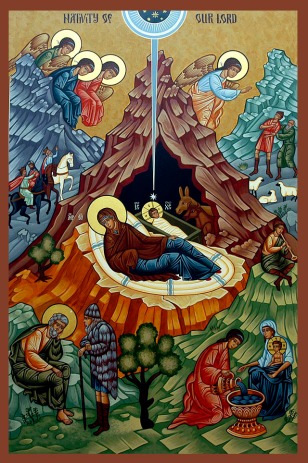
nativity.jpgAnd it came to pass that Mary was enrolled with Joseph the old man in Bethlehem, since she was of the seed of David, and was great with the Lamb without seed. And when the time for delivery drew near, and they had no place in the village, the cave did appear to the Queen as a delightful palace. Verily, Christ shall be born, raising the likeness that fell of old.(Troparion from the Royal Hours of the Nativity, Byzantine rite)

A child is born to us, and a son is given to us, whose government is upon his shoulder; and his name will be called, the Angel of great counsel.

(Introit of the third Mass of Christmas Day, Roman rite)

Expect the media to bring up the usual historical “problems” with the Nativity account, according to Fr. Stephen Freeman, and don’t fret about it:

Literalism is a false means of interpretation (hermenuetic) and is a vain attempt to democratize the Holy writings. If they can be read on a literal level, then everyone has equal access to them and everybody has equal authority to interpret them. […] the seasons come and go and the media cannot resist speaking of what they do not know. And so they ask those who do not know to speak on their behalf. But if we would know Christ and the wonder of His incarnation, then we would do well to listen to those who have been appointed to speak and to hear them in the context given to us for listening – the liturgical life of the Church.

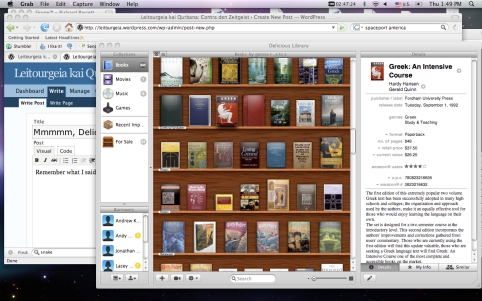
photo-6.jpgIn other news, blogging has been light the last couple of days because we’ve been madly scanning and shelving books. The Delicious Library and LibraryThing system has been fantastic, but most definitely less than perfect. One annoying thing is that even if Library of Congress data exists for a book, LibraryThing won’t always find it, requiring you to find it yourself on the Library of Congress website and enter it manually. For books that don’t have LC numbers, I’m not sure what I’m supposed to do; is there a way that one can divine what the number will eventually be?

What’s also frustrating is that LibraryThing is in theory able to identify new ISBNs when a list is uploaded and add only those, and it does this successfully in most cases, but there are somewhere around ten books that are always duplicated when I add a new list. This afternoon I eliminated somewhere around fifty dupes, in some cases there being seven entries for one book.

Another issue: I’ve entered 718 books into Delicious (representing probably roughly half of what we have), and I’ve exported the catalog to LibraryThing on a fairly regular basis. This afternoon, LibraryThing showed 756 books; after eliminating the duplicates, I’m down to 702 in LibraryThing with 8 ISBNs it can’t find (European books, I think). That means there are eight books Delicious is listing in its catalog that for some reason LibraryThing isn’t picking up.

Nonetheless, we’ve been able to accomplish in a weekend what would have surely taken us a month on our own, and that’s most certainly worth it.

Finally–any other Leopard users out there finding that with the latest update, searching for files within the File Upload dialog appears to be broken?

Merry Christmas to all!

Mmmmm, Delicious

delicious-screenshot.jpg

Usually it’s my pal Gavin who posts this kind of thing, but hey, why not. Maybe he’ll blog about dead languages tomorrow.

Remember what I said about maybe getting Delicious Library going over the break? Well, it’s going… and going… and going. I’ve got 245 books entered in so far. Only about 6,342,351 to go.

The whole thing is pretty slick, actually. You enter books (or DVDs, or CDs) by title, author, ISBN number, or even by scanning the barcode with an iSight camera, and then it pulls the item’s data off of Amazon.com—cover, genre, publisher, series, retail value, description, etc. (all as available, of course). You can hand-edit anything you need to, you can update cover art by dragging an image onto the item’s entry, you can sort by any category you like, and so on. Other very practical features include easily being able to set up a “checkout” system for loaning out books, integration with Amazon.com Marketplace if you want to get rid of things, and so on. It will also make book recommendations based on what you have (with quick ‘n easy links to the product on Amazon.com, of course).

It’s not perfect by any means; Library of Congress or Dewey data would be nice, as would the ability to generate a bibliography, the genres imported from Amazon are not consistently accurate or useful—and it’s going to take a lot of hand-tweaking to make them useful. Custom fields would be a most appreciated feature. On the other hand, this is a version 1.5 product, and I’m told some of these things will be available in v2.0 (due within a couple of months, apparently). Also, you can easily export your Delicious catalog to LibraryThing, which does do Library of Congress and plenty of other things, enough so that it’s worth it to have both, really.

If you’re a Mac user drowning in books, Delicious Library might very well be worth your time.

Rod Dreher: “what integrity really is”

Food for thought which speaks for itself.

U. S. News and World Report on a return to the old stuff

With a tip of the hat to the good folks over at Get Religion, I give you an article in U. S. News and World Report by Jay Tolson entitled “A Return to Tradition: A new interest in old ways takes root in Catholicism and many other faiths.”

Go ahead and take a moment to read it—it won’t take long. On a personal note, not to mention in the interests of full disclosure, I’ve met Roger Finke; his daughter and son-in-law are my godchildren, and his son and daughter-in-law are also dear friends. As converts to Orthodox Christianity, they themselves are part of this “return to tradition” of which the article speaks. (EDIT: the referents of “they” are Dr. Finke’s son, daughter, and in-laws; Dr. Finke himself is LCMS, not Orthodox.)

A few broad observations: it appears to be an article of faith for the mainstream media that Pope Benedict XVI’s liberalization of the traditional rite will ultimately have little to no effect, and certainly won’t catch on terribly well—it just means that a handful of old folks can now go back to saying their rosaries on their own while the ad orientem priest mumbles in Latin and a smaller handful of young militants can pretend to insert themselves into a tradition which was never theirs in the first place. This is not, of course, what Tolson says in so many words, but it certainly seems important to him to make sure to include a quote from somebody downplaying the significance of Benedict’s move.

Along the same lines, does the “return to tradition” mean a break from the “religious service provider” mentality, according to Tolson? Of course not. Tolson provides a quote from Finke that makes it very explicit that the cafeteria is by no means closed; it’s just that perhaps some people are trying to add a sit-down restaurant option for those who want it: “It’s a structured life, but it’s a structure they are seeking and not simply submitting to authority.” An earlier quote from IUPUI sociologist Sister Patricia Wittberg underscores this: “I think the future is with a group that is interested in reviving the old stuff and traditions in a creative way.” In other words, what we’re talking about is a group of people who are interested in tradition, but on their own terms. It’s less the received tradition and more the cherry-picked tradition; tradition-as-trapping rather than Tradition-as-authority.

In the interests of fairness, there is a fundamental conundrum that, some would argue, ensures that anybody who embraces a more traditional expression of Christianity is going to be engaging in a range of cherry-picking, cafeteria-esque behavior. “There’s nothing more un-Orthodox,” I’ve heard various people claim, “then intentionally converting to Orthodoxy.” In other words, if you’re converting to a faith in which you were not raised, you’re already cherry-picking; you’re already intentionally grafting yourself onto something else rather than accepting whatever tradition you received growing up. You’re asserting yourself onto an organic entity in such a way that ensures you will never be part of it. You’ve already chosen what it is you’re willing to submit to, and since you’ve already presumably left something else at least once, you’re tacitly reserving the right to do so again. It’s healthy, so the argument goes, to acknowledge that we’re all cafeteria believers of one form or another, and that there’s no other way you can be in this country, where religion is just another part of the marketplace of ideas.

I suppose to some extent this is true; I will say that for myself and people I know who have converted to either Eastern Orthodoxy or Roman Catholicism (or even people raised in either communion who have made a conscious choice to more fully “own” their faith), there is always a struggle to figure out how to live life more fully within the faith but also with an awareness of the reality of the world. That’s the struggle of any Christian at any point in history, really. As G. K. Chesterton might have put it, the struggle doesn’t invalidate the conversion any more than the rain invalidated the ark.

Finally—the following point is worth noting, as much as for how Tolson says it as what he says:

Something curious is happening in the wide world of faith, something that defies easy explanation or quantification. More substantial than a trend but less organized than a movement, it has to do more with how people practice their religion than with what they believe, though people caught up in this change often find that their beliefs are influenced, if not subtly altered, by the changes in their practice.

First of all, this assumes that there is a divide between belief and practice. This may very well be the case, but it’s a divide which would have been quite foreign to the early Christians, who were very aware that how one prayed and worshipped impacted how they believed. (Google Lex orandi, lex credendi if you don’t believe me.) As an Episcopalian praying the Rite II Eucharist Sunday in, Sunday out, in allowing myself to actually pray the liturgy, I was occasionally confronted by something in the text, and I realized that in order to keep praying it, I had to decide if I actually believed it or not. Did I actually believe the words of the Nicene Creed? Did I actually believe I was receiving the Body and Blood of Christ? Did I believe in one, holy, catholic and apostolic church? And so on. The more I decided that yes, I actually believed what I was praying, ironically enough, the less tenable of a position it seemed to remain an Episcopalian.

Liturgical practice is at once both the expression and the teaching of the faith held by the community; someone actively engaging it and praying it will of course find what they believe being influenced by it. That is the whole point, and it is a point easily lost on people who think that worship is all about style, taste, and aesthetic preference.

“It’s common knowledge that Christmas and its customs have nothing to do with the Bible” (updated)

reportcard.jpgSo, the good news is that for all of my handwringing about Greek this semester, it wound up being more of a bright spot on my transcript than I would have thought. It’s still a variety of “B” rather than a variety of “A”, but it’s a better variety than I figured possible, and it’s certainly not a variety of “C”. I’m still probably going to try to sit in on third semester Greek again next fall as a refresher (since, because of scheduling issues, I can’t take the fourth semester until next year), but the unmitigated disaster I was convinced was inevitable on Wednesday afternoon appears to have been nonetheless avoided.

unchristmas.gifThere’s an article in the Associated Press about Protestants who don’t celebrate Christmas (hat tip: Dr. Philip Blosser), and it provides an interesting overview of the history of Christmas celebrations in the United States. In a nutshell, Protestant America was at best uncomfortable with and at worst hostile towards Christmas until the 19th century, when it shifted towards being more of a secular, family holiday and less of a religious observance associated with Catholics. In other words, it was largely because it took on commercial aspects (at least according to this piece) that its liturgical trappings were tolerated. Still, despite this “domestication,” certain Protestant groups retain the objection into our own time:

Christians like the United Church of God reject the holiday [because they] say divine instruction, rather than culture and society, should determine whether the holiday is appropriate.

“It’s common knowledge that Christmas and its customs have nothing to do with the Bible,” said Clyde Kilough, president of the United Church of God, which has branches all over the world. “The theological question is quite simple: Is it acceptable to God for humans to choose to worship him by adopting paganism’s most popular celebrations and calling them Christian?”

I have to say, there’s a part of me that has absolutely no problem with this attitude. What reason do Christians who reject the liturgical calendar as a whole have to keep Christmas as an observance? Aren’t they trying to have it both ways? Here’s the follow-up question, though—do these same groups reject Easter? If not, why not? It seems to me they’d have to, to stay consistent.

Here’s what is, for me, the money quote:

[T]he mainline Protestant churches have learned to accommodate Christmas. But the change came from the pews rather than the pulpit.

Christmas benefited from a 19th century “domestication of religion,” said University of Texas history professor Penne Restad, in which faith and family were intertwined in a complementary set of values and beliefs.

Christmas became acceptable as a family-centered holiday, Restad said, once it lost its overtly religious significance.

At the same time, aspects of the holiday like decorated trees and gift-giving became status symbols for an aspirant middle class. When Christmas began its march toward dominance among holidays, it was because of a change in the culture, not theology.

“In America, the saying is that the minister follows the people, the people don’t follow the minister,” Restad said. “This was more of a sociological change than a religious one. The home and the marketplace had more sway than the church (emphasis mine).”

The minister follows the people, the people don’t follow the minister. The home and the marketplace had more sway than the church. That’s a mouthful, folks, and one that strikes me as bearing some real consideration.

All that said, I have to say I’d love for the guys at Get Religion to offer their thoughts on this story; I’m sure there’s a lot here I’m missing.

UPDATE: Fr. Stephen Freeman has some words which are directly applicable to the matter at hand:

…[T]radition is not only normal – it is inevitable… We cannot, without great violence, declare that there will be no traditions. This has been sought through the centuries by various iconoclast regimes (Puritans come to mind the easiest). But they never completely succeed. Today, the descendants of Puritans will seek Christmas trees whether they believe in God or not. The tradition is stronger even than the belief. But the tradition wasn’t given in order to destroy the belief, but to live it out.


adventures in writing alexander lingas all saints bloomington all saints orthodox church american orthodox architecture american orthodox music american orthodoxy Antiochian Archdiocese Antiochian Orthodox Christian Archdiocese of North America Antiochians books byzantine chant cappella romana chant church architecture ecclesiastical chant ethnomusicologists ethnomusicology fellowship of ss. alban and sergius Greece Greek greek food greekness hazards of church music international travel tips ioannis arvanitis joe mckamey john michael boyer kurt sander Latin liturgical adventures liturgical architecture liturgical music liturgical texts and translation liturgy liturgy and life lycourgos angelopoulos medieval byzantine chant Metropolitan PHILIP militant americanist orthodoxy modern byzantine architecture modern greek music music as iconography my kids will latin and greek when they're newborns my kids will learn latin and greek when they're newborns orthodox architecture orthodox architecture is bloody expensive Orthodox choir schools Orthodox Ecclesiology orthodox outreach orthodox travel pascha at the singing school Patriarchate of Antioch Patriarch IGNATIUS IV Patriarch of Antioch publishing random acts of chant richard barrett in greece richard toensing rod dreher sacred music st. vlads st john of damascus society Syriac the Bishop MARK fan club the convert dilemma the dark knight The Episcopacy The Episcopate the only good language is a dead language this american church life travel we need more american saints why do we need beautiful music in churches?

Blog Stats

  • 272,467 hits

Flickr Photos