Posts Tagged 'Latin'


In case you’ve been wondering what to get me as a gift…

(…since I know that’s a question keeping all of you up nights…)

Oxford University Press is having a rather amazing spring sale right now. Two items of particular interest:

Oxford Latin Dictionary, $120.75 (regular price: $345)

A Greek-English Lexicon (a/k/a “The Big Liddell” or “The Great Scott”), $85.00 (regular price: $170)

Either of these would be perfectly acceptable “Hey, congratulations on leaving a halfway-decent job to go be a professional student for the next six years” presents. Alternately, you could use the TipJoy Tip Jar link the Tip Jar page with the PayPal button to help pay for my side trip to Istanbul while I’m in Greece.

Or, when you’re all done laughing yourselves to tears over the very idea proposed here, you could take advantage of the sale to order these fine items for yourself and then e-mail me a picture of yourself with them, if that’s your taste and times being what they are.

Sanctus Deus, sanctus fortis, sanctus immortalis, miserere nobis

Here’s a fascinating liturgical curiosity, courtesy some weird Dutchman named Gerrit Gerritszoon.

I’d love to know if anybody has tried to use this, and/or if anybody has tried to set any of it to music.

The Final hours of Bright Week

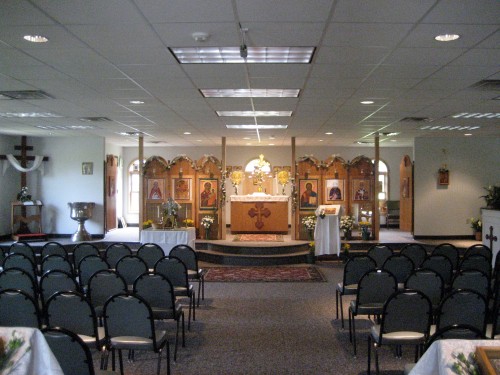
All Saints on Pascha just before Agape VespersMeshiha qam! Bashrira qam!*

So, I find it more than a little ironic that, having opened the doors of the iconostasis for Bright Week, tonight will have been my first time in the nave since Agape Vespers, and the doors will be closed fifteen minutes or so after I get there.

On the other hand, since Bright Week did double duty as Finals Week, I’m not really sure it could have been any other way, at least not this year.

I had two finals this week; Latin and Syriac. Latin was relatively easy; I’ve commented before that studying a language like Latin, one is the beneficiary of all kinds of useful pedagogical editions of things with helpful features like half of the page being a glossary and 75% of the words being glossed. With Syriac, as I have commented before, one, well, isn’t.

Going into the Syriac final, we were all rather panicked; we read three longish texts — The Gospel of Mark chap. 14 through the end, The Doctrine of Addai, and the Life of Ephraim — with just an impossible amount of vocabulary being contained therein. (And make no mistake: at least at this stage of the game, until we get to texts that don’t have vowel-pointing, it’s the vocabulary that’s the killer. Syriac grammar is actually remarkably uncomplicated, at least so far.)  We studied one of the passages from the Life of Ephraim that we thought might be on the exam the evening before, got it down pretty well, and we all felt a bit better. The next morning, the professor handed out the exams and just said, “Do what you can.” Of course, the three passages that actually wound staring up at us from the page were nothing from any of those three texts which I had actually spent any particular time mastering. As my Syriac co-sufferer Diane acknowledged, “There were a lot of made-up words and grammatically-appropriate blanks in my translation.” Um, yeah.

Nonetheless, the school year is over, and as soon as grades were posted yesterday morning (not to mention no e-mails having arrived from my Syriac professor asking, “You know, have you ever considered a direction change? Like, say, becoming a shepherd?”), I felt a great weight lift from my shoulders. I survived the school year, something that at points felt unlikely for a whole host of reasons. Between classes being over (at least for six weeks) and settling into the new job, I am getting to truly decompress a bit for the first time in perhaps a year and a half — certainly since before I broke my ankle last February, one way or the other. We’ll see if I know what to do with myself.

(By the way, Iron Man rocks. Hard.)

* Just to prove I learned something in Syriac — “Meshiha” is “Christ”, being a passive pe’al participle used attributively in the singular masculine emphatic (from the root mshah, “to anoint”), therefore carrying the meaning “anointed one”; “qam” is the 3rd person masculine singular pe’al perfect form of the verb which means “to stand”; “ba-” is a preposition meaning “in”; and “shrira” is “truth”. So — “Christ stood/arose/got up!” “In truth He arose!” Isn’t this fun? Next year I’ll do it in Coptic.

Christus resurrexit! Vere resurrexit!

 In Old English: “Crist aras! Crist sodhlice aras!”

In Modern English: “Christ is risen! Indeed He is risen!”

In Modern South Central Indiana English: “Christ done riz! Sho’ ’nuff!”

I have a fairly long blog post or two in me, as well as notes for Lesson 3 of Hansen & Quinn, but it’s still going to have to wait until after this week. Last week being Holy Week and this week being Finals Week… yeah. Next week.

Brief updates, however (with explanations to come):

  • Lazarus Saturday saw the reception of six into the Orthodox Christian faith at All Saints; four by Baptism, two by Chrismation. Two of those baptized were my wife’s and my new godchildren, Matthew and Erin. Theirs is a good story, and the morning (not to mention the subsequent Holy Week) was a beautiful welcoming home (as it were) for them. I have pictures and I’ll post some eventually.
  • I started a new job on Monday of Holy Week. The new job is a Very, Very, Very Good Thing; truly, a major blessing. That said, I don’t ever recommend starting a new job during Holy Week. I also don’t recommend Finals Week being Bright Week, and I particularly don’t recommend having a Latin final at 10:15am on Bright Monday, but sometimes there’s little we can do about these things in a fallen world.
  • My mother was with us for most of Holy Week (starting with Unction on Wednesday evening) and Pascha. She survived, and would like to come back and do it again… someday.
  • I’ve decided to take the Reading French for Graduate Students course this summer. I’d like to refresh my French, particularly now that I’ve had a couple of years of Latin and Greek and actually understand some of the grammatical concepts and could actually explain to somebody what a subjunctive is.

Okay. More later.

Thursday and all’s well

To follow are what would normally be inline asides on a blog which uses them. I don’t yet, because I’m not convinced I want to pay for the privilege of editing the CSS, particularly with WordPress’ upgrade to 3GB of free space in the last couple of days. So, bear with me.

I’m waiting right now. Some of you know what I’m waiting for. It is unclear how long I will be waiting. One person who went through this exact same process told me he knew within a couple of weeks; another told me it probably won’t be until the middle of March. I will be happier when I am no longer waiting, regardless of the outcome.

I’m starting to lose a battle against a sore throat. I was in Michigan last weekend with many of our parish’s youth, and between the quite cold weather and being around lots of kidlets, I think I’m set up to come down with something. I always know I’m getting sick because coffee (without which Richard ain’t a happy man, folks) tastes terrible to me when I’m sick; this morning, the coffee wasn’t tasting very good. Sigh.

Now having dipped my toe into three different dead languages over the last couple of years, let me say that one of the gifts of studying a lingua mortua like Latin or Greek is that, without doubt, tons and tons of time and resources have been spent putting together usable materials. This would be as opposed to Syriac, where tons and tons of time and resources, well, haven’t.

For example, one can reasonably expect the following about your standard Greek New Testament:

  • It will have a decent glossary.
  • It will be typeset in a very readable fashion.
  • It will have an apparatus so you know where the text came from.

Whatever one’s disagreements might be regarding the use of the Nestle-Aland critical text, $25.05 for all of the above is a danged good value.

Now, the Syriac New Testament, the ABS edition which is really the only one available, by contrast to the above:

  • doesn’t.
  • isn’t.
  • doesn’t, so you don’t.

Where dictionaries are concerned, you have a bit of a choice: the three-volume Payne-Smith lexicon which is big, expensive, and in Latin; the one-volume Payne-Smith lexicon which is big and moderately expensive; and finally, the much smaller but not much cheaper New Testament lexicon.

So, when reading the New Testament, one way or the other you’re constantly having to look things up in a separate book, and you’re not always sure what you’re looking up because Syriac adds both suffixes AND prefixes to words depending on how they’re used, plus they can go through all kinds of fun changes depending on how they’re prefixed, and, well, the typesetting sucks.

Oh, and the typesetting of the dictionary also sucks. The plates are just old, old, old. You can see what I mean by looking inside the one-volume Payne-Smith on Amazon here. Eventually somebody needs to go through and redo it digitally; I refer anybody to the glossary in the recent `Enbe men Karmo Suryoyo (Bunches of Grapes from the Syriac Vineyard): A Syriac Chrestomathy compiled by Martin Zammit to see what this stuff can and should look like in the age of digital typesetting.

Of course, it’ll still be hella expensive, since there are like forty people in the English-speaking world who care about these things, this being why it won’t happen in my lifetime. If I were a more ambitious and serious Semiticist, maybe I’d entertain the notion of figuring out how to attach myself to such a project and help do it the way it would need to be done, but I’ve no real intention of being that kind of scholar. I am but a beachcomber along the shores of the Semitic ocean, not a deep-sea diver…

…aaaaaaaannnd that was the sound of you (both of you) rolling your eyes simultaneously. Sorry.

At the very least it would be nice to have a standard textbook which isn’t inherently problematic in many respects (both the Coakley and Thackston grammars are, shall we say, no Hansen and Quinn), and/or an English version of the Brockelmann grammar with the chrestomathy (that’s a fancy word which means “reader”), and/or an edition of the Syriac New Testament that is a comparable package to your average Nestle-Aland Greek New Testament. I hear rumors of a thing such as the latter being done at Notre Dame, but it also sounds like there’s going to be a thick, expensive volume for each book of the NT the way they’re going about it. Oh well.

Well. That wound up being a bit more than an aside.

I don’t normally talk about politics here, but this whole business about tax rebates–didn’t we do this back in 2001 or thereabouts? And didn’t it, er, not work, exactly? I mean, I’m not going to beat away with a baseball bat a couple of checks for $300 or $600 or however much they are for our household, but this whole thing sort of comes across to me as, “Now, don’t worry, just go buy a Blu-Ray player and a couple of movies, you’ll feel better.” Am I wrong?

Still waiting.

More from Alden Swan

Swan has some interesting things to say on the relationship between post-Reformation church and Modernism, as well as the question of by which authority we not only interpret Scripture, but by which authority we determine the canon of Scripture.

For example:

One of the most irritating qualities of Modernism is the almost essential arrogance that comes from the belief in progress; that is, that “new” is better than “old.” Evangelicalism seems to exhibit the same tendency to believe in theological “progress,” as well as the resulting sense of arrogance in how they deal with past theological positions. While many would argue, especially in the case of fundamentalists, that this is absurd, I think in the “big picture” it makes sense.

With Evangelicalism, there are some basic presumptions that may not be true. One such presumption is that it is an advancement to think of theology almost as a science, being able to break large concepts down into minute detail and argue over the fine points. This scientific approach has, as Webber points out, reduced theology to a set of facts or propositions which can – and must – be believed. This systematic approach appears to have a goal of eradicating any sort of mystery from theology, believing that we can reason our way through our faith. Our faith (as Webber also points out) can then conceivably be conveyed to others in a logical, reasoned way, what we think of a “apologetics.” Evangelicals reason their way to truth, whereas the reformers simply proclaimed it.

To restate one of his points, Christianity is reduced by this approach to an ideology and a philosophy, rather than a means by which the faithful live their lives. By believing we can simply reason our way through our faith, the opposite has been greatly enabled–one can also very easily reason one’s way right out of their faith, too. I recall no examples from Acts or the Epistles of anybody coming to Christianity through a well-reasoned argument. Truth is a Person whom we meet in Christianity, not a set of precepts. To put it another way, it is not the case that the more one knows about God, the closer one is to God.

I would also tweak his last sentence–the reformers proclaimed the truth which they believed they had found while rejecting the truth which they had received. To understand what I mean by this, it is necessary to jettison the baggage most of us have with the word “tradition”, that it means “we do it this way because we’ve always done it this way and we don’t have a better answer than that”, as typified popularly everywhere from Fiddler on the Roof (a humorous example) to the Shirley Jackson short story “The Lottery” (a horrifying example). It is a given that “tradition” is used in both a positive and negative light in Scripture; there is of course the admonition about “traditions of men” but then also there is 2 Thess 2:15, “Therefore, brethren, stand fast and hold the traditions which you have been taught, whether by word or by our epistle” (compare to 2 Tim 1:13–“Hold fast the pattern of sound words which you have heard from me, in faith and love which are in Christ Jesus”) and 2 Thess 3:6, a reference to “the tradition which you received from us”. The Greek word here is παράδοσις paradosis, derived from the verb παραδίδωμι paradidomi, “to hand over, to transmit”. So, literally, παράδοσις is “that which is handed down” or “that which is handed over”. “Tradition” is simply the Latinate form of the same word; it is from “traditus”, the perfect passive participle of “tradere”, “to hand over”.

So what was passed down? “The faith once delivered to the saints” (Jude 3). “Delivered” in Greek here is again a form of παραδίδωμι, so this is the faith once “traditioned” to the saints. That faith is “the apostles’ doctrine and fellowship, the breaking of the bread, and the prayers” (Acts 2:42), and the apostles had been told that the Holy Spirit, “the Spirit of truth”, “will guide you into all truth” (John 16:13), that truth of the which the Church is “the pillar and ground” (1 Tim 3:15).

Tradition, therefore, is the truth, it is the life of the Holy Spirit in the Church, the Church which is both Body and Bride of Christ, Christ who is Himself the Truth. Tradition is not what we do because we’ve always done it and don’t have a better reason, but rather it is the the faith once “traditioned.”

So, from this perspective, the Reformers rejected that which had been “traditioned” to them while proclaiming what they believed to have been the truth they found, rather than received, by narrowing the list of acceptable sources.

By contrast, what we might generally refer to as “the catholic tradition” proclaims the truth which it receives. I don’t mean for that to sound arrogant (although it inevitably will); rather, that’s what the Greek Orthodox priest to whom Swan was speaking meant when he said that, on the inerrancy of Scripture, “we don’t think that way…we’ve just never questioned it.”

Still, there’s more of a context to his statement than just that, which brings me to Swan’s other piece:

As I think I’ve mentioned before, it is interesting to note that based on what we read in the New Testament, the “Word of God” does not seem limited to anything which was written down, and in fact, seems to speak of oral testimony.

Exactly, per 2 Thess 2:15, as quoted above. This again gets to the heart of the what the priest was saying–the New Testament is a witness to the tradition, to the authority, to the life of the Church already ongoing, not the instruction manual and not the source itself. More specifically, the Gospels and the Epistles are the Truth proclaimed and witnessed to in community–that is, liturgically, since they were written to be read to the assembly when they had gathered. To remove Scripture from this context and try to make it its own discrete source of authority is to obscure its meaning and reduce its authority, not to clarify it.

To relate this to an earlier point, Christianity is not a philosophy derived from a text, it is new life through an encounter with a Person who is the Truth. By being reduced to adherence to a set of precepts found in a text without the continuity of the life of the Church which has been ongoing since Pentecost, Christianity has been severely weakened.

What St. Ignatius wrote to the Philadelphians comes to mind: “When I heard some say, ‘Unless I find it in the official records–in the Gospel I do not believe’; and when I answered them, ‘It is in the Scriptures,’ they retorted: ‘That is just the point at issue.’ But to me the official record is Jesus Christ; the inviolable record is His Cross and His death and His Resurrection and the faith of which He is the Author.” The Scriptures witness to the Faith, not the other way around.

We seal a dial, she weans a Liam…

I am slowly but surely cramming the Latin verb system back into my head. Today, in class, I realized why I was having trouble distinguishing between second and third conjugation verbs based on the infinitive form: we weren’t using macrons anymore! With saintly patience as though explaining it as though to a four year old, my instructor reminded me that you pretty much have to go to the first principal part to tell the difference without macrons; -eo being the characteristic ending of the first principal part for the second conjugation. And then, of course, for the vowel change in the subjunctive, “we fear a liar.” “He eats caviar.” Or something.

I love being thirty-one and being more-or-less newly at an educational level which, ideally, I would have been at when I was twelve or thirteen.

On the other hand, Syriac was good fun yesterday; we’re reading the Gospel of St. Mark now, and it’s not bad. I do sincerely wish there was an equivalent of the Nestle-Aland critical New Testament for the Peshitta–i.e., with an apparatus and glossary; alas, the UBS edition has none of that, and is extremely hard to read. Sounds like somebody up the road might be working on something like this…? Anybody know?

While I’m thinking about it, anybody know how to get my blogroll displayed using this template?

And yes, I know that my notes for Unit 2 of Hansen & Quinn aren’t posted yet. I’m working on them–the last month or so has just been busier than I would like for such things.

More later.

Varia

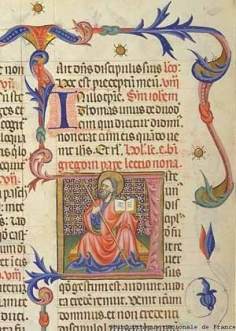
latin_ms.jpgI’m slowly getting back in oscillationem rerum with Latin. The grammatical concepts are all more or less there, it’s just little things like, oh, vocabulary and the whole freakin’ verb system I have to cram back into my head. Optare, optavisse, optaturus esse, optari, optatus esse, optatum iri… if you see me on the elliptical machine at the gym looking like I’m having a very agitated conversation with myself, I’m reviewing Latin.

Fr. Stephen Freeman has an interesting look at the the word “fullness” and its implications within Orthodox Christianity. It is very much worth reading in its entirety, but a couple of points jump out at me:

Fullness means more than being correct. It is possible to be correct about something, and yet be empty and lifeless. Fullness is correct because it is a true reflection of God and not because it can be measured against the law or a set of rules (or the canons, etc.).

“It is possible to be correct about something, and yet be empty and lifeless.” So true as to not require any comment, only repetition.

Fullness implies a completeness.

The word Fr. Stephen is hinting at without saying is catholic–from κατά + ὅλον kata-holon, “according to the whole.” Catholicity, while a much-debated word, really boils down to the state of lacking nothing. The fullness of our faith, in other words, is where our catholicity is to be found–but this brings us to an irony:

I do know, and have said elsewhere, “Why would anyone want something less than the fullness of the faith?”

The irony here is that the very claim of “the fullness of the faith” is exactly what turns away some who I’ve known. Even if it’s true, so some have said to me, that shouldn’t be anything we care about if we are to preach only Christ, and Him crucified. If you think you’ve got the fullness of the faith, in other words, that’s proof that you don’t.

Isn’t epistemology fun?

Get Religion has a good post on political writers ignoring Roman Catholics. The last line sums it up well:

Yes, there is a longstanding antipathy between intellectuals devoted to the Enlightenment and Catholics devoted to Rome. Yet magazine writers wrote about Catholic voting trends. So why don’t political reporters?

I’m reminded of how in 2004, something of a big deal was made about how the Catholic vote was important enough to the Republicans that Bush paid a visit to the Knights of Columbus. I remember thinking to myself, “Do the Orthodox even have a comparable group for any of the political parties to snub?”

And, well–no, we don’t.

Not yet.

Urbs, urbis, urbi, urbem, urbe…

Back to Latin today, and tomorrow morning back to Syriac. Blogging may remain light for a few days while the rust shakes out.

End-of-Finals-Week miscellany

In a nutshell: Greek not so good, Syriac very good.

cursivegkms-640w.gifGreek this semester (my third) has been a war over a particular person getting to make a particular point, fought in such a way so that it is those in the classroom who have been the collateral damage, and the final was very much a final salvo. I’m being deliberately vague for a lot of reasons; suffice it to say I did the work, put in my time, and learned a lot, but it is questionable how much of a high point it will wind up being on my transcript. Oh well; it happens.curetoniansyriac-640w.gif

By contrast, I handed in my Syriac final feeling quite chipper, on the other hand, and I felt quite justified in my chipperness when I saw the posted grade this morning.

Now I get to spend the break reviewing Latin for next semester. Opto, optare, optavi, optatus. Sum, esse, fui, futurus. Femina, feminae, feminae, feminam, femina

Dr. Liccione has an essay entitled “Freedom, evolution, and original sin” which he posted yesterday. It’s the kind of thing which, when I read it, makes me think things along the lines of, “You know, maybe things could be worked out between Roman Catholicism and Eastern Orthodoxy within my lifetime…” I’m not qualified to engage the post on any kind of a theological or doctrinal level, but I do want to point out a few things.

Kecharitomene is an interesting word in Greek. If my Greek teacher were to ask me to give its syntax on a test, I would say that it is a feminine singular participle, perfect tense to show completed aspect, passive voice, in the vocative case, agreeing in gender, number, and case with the unexpressed subject (being the Virgin Mary), and it is being used attributively.

What in the world does all of that mean?

A participle as a verbal adjective; in English we end participles with “-ing” and then use them in conjunction with the verb “to be” to express various tenses periphrastically. If I say, “I am walking,” “am” is the finite verb and “walking” is the participle–it’s attributing the characteristic “walking” to me rather than expressing it directly as a finite verb, whereas a single finite verb in Greek, “baino,” says all of that on its own—the “o” ending indicates that it’s first-person singular, so the subject is already implied, and it in the present tense, so it doesn’t need the helper verb “to be.” In Greek, you would use the participle perhaps to express a parallel thought to the main idea of the sentence (e.g., in “The turkey being cooked, we will now eat dinner”, “being cooked” would be expressed as a participle), often to indicate a present state before an action is taken (my Greek teacher likes to use the example that instead of “Take the money and run,” Plato would say, “Taking the money, run!”), and also to attribute verbal characteristics to people. Think of the movie “The Running Man,” and you’ve got the idea. Kecharitomene is an example of this last use—the verb is being applied to the Virgin Mary as an attribute, and therefore is singular and feminine, since in Greek adjectives must agree with what they modify in gender, number (singular/plural, as in “I/we”), and case. This is direct address, and that case is called “vocative.”

Participles, while not being finite verbs, have tenses like finite verbs; we usually think of tenses as expressing time, but Greek (at least how my teacher taught us) is a little more granular, expressing both time and aspect, aspect being the state in which the action is being performed. There is simple aspect, which means that the action is done once; progressive or repeated aspect, which means that it occurs continuously or over and over, and completed aspect, which means that the action is, well, done to completion. “I am walking” is present time, progressive or repeated aspect. “I was walking” is past time, progressive/repeated aspect. “I walked to the store” is past time, simple aspect. “I have walked home” is present time, completed aspect. And so on. Kecharitomene is in the perfect tense, which indicates present time, completed aspect. One thing about Greek, though, is that participles, if they communicate time at all (outside of the indicative mood, tenses lose connotation of absolute time and only have to do with aspect) communicate time relative to the main verb. “Chaire, Kecharitomene!” being a greeting (“Chaire” is the imperative form of the verb which means “rejoice,” used idiomatically in Greek to mean “Hello”), there’s not really a main verb, so an argument can be made that we can’t really say anything about the time in which this action was performed, only that it is done to completion.

There are two grammatical voices in English, active and passive. In the active voice, the subject performs the action of the verb; “I throw the ball.” In the passive voice, the subject receives the action of the verb; “I am thrown the ball.” Greek has both of these as well (plus a middle voice, where the action is performed reflexively or causatively or there’s some other special meaning being communicated). Kecharitomene is passive, which means the Virgin Mary has received the action of the verb; somebody else has performed the action (presumably, God).

Having now explained the syntax, the base meaning of the verb conjugated as Kecharitomene is “endow with grace.”

Therefore, if we were to try to incorporate every last nuance of the above into a literal English translation of “Chaire, Kecharitomene”, it would come out to “Hello, woman completely endowed with grace (don’t know when that happened, it’s just the way it is)!”

Doesn’t exactly roll of the tongue, does it? Regardless, Dr. Liccione’s summary of the implications is worth a glance:

[The Virgin Mary’s state of being kecharitomene] is sola gratia: a direct product of divine power divinizing. And it is itself but the most proximate effect of…the Incarnation, Passion, and Resurrection of that divine person who is Mary’s Son, a process in which we are all destined to participate, thus becoming “partakers of the divine nature” (2 Peter 1:4).

Amen! Others can hash it out further.

Pierre Teilhard de Chardin is an interesting figure, even to the Orthodox; Fr. Seraphim Rose was quite critical of him, and others (such as Fr. John Meyendorff, I believe) evidently thought he hit the nail on the head. I’ve never read any of his works myself, but I don’t claim to have any particular interest in the creation vs. evolution issue. If we are to understand time as a part of creation, and if we are to understand the Fall as having corrupted all of creation, then presumably time was part of what was corrupted, as well as how we perceive it. For all I know (and I wasn’t there), the Genesis account is exactly and literally what happened, but we’re on the wrong side of the event to be able to see empirical evidence of it. I don’t know, and it frankly is irrelevant to me, having no bearing on the personal struggle to become a partaker of the Divine Nature. Maybe that’s a shortsighted point of view, but there we are.

Moving on…

I’m still stewing deep in thought about my Greek class. I can’t really go into a lot of details because the players would easily identifiable, and I don’t want to go there. What I will say is that after the first year of Greek (assuming use of a introductory textbook like Hansen & Quinn, which appears to be the closest the Greek world has to a standard like Wheelock’s is for Latin), I can imagine a very compelling case being made for Religious Studies departments having a second-year sequence running parallel to a Classical Studies department’s sequence. For example, this semester, we spent roughly three-fourths of the term on Plato’s Ion, and the last three or four weeks on the New Testament. That’s all well and good for classicists, but let’s just say that there wasn’t a lot of love left over for anything written Anno Domini, and I believe I would have ultimately benefited more from the ratio having been reversed, particularly since the fourth semester, as taught here, is radio station WHMR, all Homer, all the time.

It also occurs to me that one thing from which my beloved Hansen & Quinn textbook could benefit, faithful and constant companion, friend, and projectile over the last year as it has been, would be something of a supporting library along the lines of what’s available for Wheelock’s. It’s also quite amusing, looking back at the sentences I slaved over for hours in September 2006; if anyone would like an exact count of how many ways Homer can send the brothers into the battle in the country on the road with books, drop me a line and I’ll see what I can do.

OK. Enough for now. Finals week is over, Deo gratias, the syntax of “deo” being that it’s an indirect object “to/for” dative, and in the singular number you decline that deus, dei, deo, deum, deo…


adventures in writing alexander lingas all saints bloomington all saints orthodox church american orthodox architecture american orthodox music american orthodoxy Antiochian Archdiocese Antiochian Orthodox Christian Archdiocese of North America Antiochians books byzantine chant cappella romana chant church architecture ecclesiastical chant ethnomusicologists ethnomusicology fellowship of ss. alban and sergius Greece Greek greek food greekness hazards of church music international travel tips ioannis arvanitis joe mckamey john michael boyer kurt sander Latin liturgical adventures liturgical architecture liturgical music liturgical texts and translation liturgy liturgy and life lycourgos angelopoulos medieval byzantine chant Metropolitan PHILIP militant americanist orthodoxy modern byzantine architecture modern greek music music as iconography my kids will latin and greek when they're newborns my kids will learn latin and greek when they're newborns orthodox architecture orthodox architecture is bloody expensive Orthodox choir schools Orthodox Ecclesiology orthodox outreach orthodox travel pascha at the singing school Patriarchate of Antioch Patriarch IGNATIUS IV Patriarch of Antioch publishing random acts of chant richard barrett in greece richard toensing rod dreher sacred music st. vlads st john of damascus society Syriac the Bishop MARK fan club the convert dilemma the dark knight The Episcopacy The Episcopate the only good language is a dead language this american church life travel we need more american saints why do we need beautiful music in churches?

Blog Stats

  • 262,832 hits

Flickr Photos