Archive Page 4

Books for sale

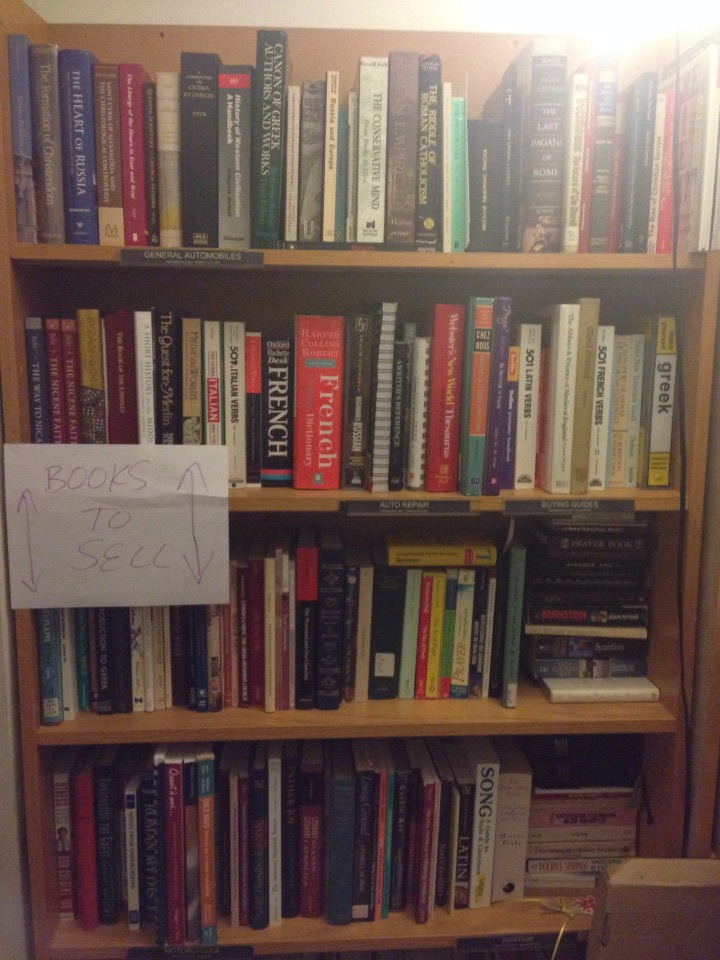
books for saleYesterday I posted some “special-interest” things I have for sale; I’d also like to give everybody a heads up on the highlights of some more books I’m still trying to sell. E-mail with offers; I don’t necessarily have a set price in mind for anything, but serious offers are of course preferred. If you see anything in the picture that you can’t find below, drop me a line. E-mail address is rrbarret AT indiana DOT edu.

In alphabetical order by author’s last name (or by title if that’s more appropriate):

– Benz, The Eastern Orthodox Church: Its Thought and Life

– Berkowitz/Squitier, Thesaurus Linguae Graecae: Canon of Greek Authors and Works, Third Edition (cloth)

– Bouyer, Rite and Man

– Braga, On the Way of Our Faith: Faith, Freedom, and Love

– Cameron, The Last Pagans of Rome

– Constantelos, Understanding the Greek Orthodox Church: Its Faith, History, and Practice

– Cormack, Painting the Soul

– Crane, Prose and Poetry

– Deuchler, Gothic (Universe History of Art and Architecture)

– Dostoyevsky, Notes from Underground (Katz translation)

– Dyck, A Commentary on Cicero, De Officiis

– Grant, Constantine the Great: The Man and His Times

– Grant, Roman Myths

– Griffen, Names from the Dawn of British Legend

– Hall, Reading Scripture with the Church Fathers (paperback)

– Heather, The Fall of the Roman Empire

– Herrin, Byzantium (cloth)

– Herrin, The Formation of Christendom (cloth, mylar sleeve)

– Hoare, The Western Fathers (cloth with mylar sleeve)

– Met. Hierotheos of Nafpaktos, The Illness and Cure of the Soul in the Orthodox Tradition

– Kaczynski, Greek in the Carolingian Age

– Kenworthy, The Heart of Russia: Trinity-Sergius, Monasticism, and Society after 1825

– Kirk, The Conservative Mind (Seventh Revised Edition, paperback)

– Küng, Truthfulness: The Future of the Church (ex-library copy, cloth)

– McGuckin, Saint Cyril of Alexandria and the Christological Controversy (paperback)

– Momigliano, The Development of Greek Biography

– Nasr, Resource Book for Mission and Evangelism

– Newell, Celtic Prayers from Iona

– Nicene/Post Nicene Fathers, Second Series, Volume IX: Hilary of Poitiers and John of Damascus

– Norris, McTeague

– Oakley, The Western Church in the Later Middle Ages

– Ousterhout, Master Builders of Byzantium (paperback)

– Palmer/Sherrard/Ware, The Philokalia, Volume One (paperback)

– Payne, The Holy Fire: The Story of the Early Centuries of the Christian Church in the Near East

– Pelikan, The Riddle of Roman Catholicism

– Ratzinger, The Spirit of the Liturgy

– Rose, The Place of the Blessed Augustine in the Orthodox Church

– Russell, The Sparrow

– Schmemann, Liturgy and Life: Christian Development through Liturgical Experience

– Temple, Icons and the Mystical Origins of Christianity

– Vasileios, Hymn of Entry

– White, Introduction to Christian Worship (Revised Edition)

Liturgical/Prayer books/Devotional

– Baz, The Book of the Epistles (Antiochian Archdiocese, 2010)

– A Book of Personal Prayer, Bideaux, Upper Room Books.

– The Divine Liturgy of St. John Chrysostom, bi-lingual service book, Byzantine Design Works (Bouras/Tomaras, 2003)

– Orthodox Daily Prayers, St. Tikhon’s Press. Comb bound with laminated covers.

– Orthodox Prayers of Old England, St. Hilarion Press.

– Papadas, Holy Week & Easter, bi-lingual service book, Patmos Press (1990 edition)

– A Pocket Orthodox Prayer Book for Orthodox Christians, Antiochian Archdiocese.

– The Saint Ambrose Prayerbook, Lancelot Andrewes Press, 2009.

– Service Book (“the 2 Pounder”), Antiochian Archdiocese.

– Service Books of the Orthodox Church, Volume 1, The Divine Liturgy of St. John Chrysostom, St. Tikhon’s Press.
For your consideration: Robotech Academy on Kickstarter

http://www.youtube.com/watch?v=eUk_2JebvrA

I am bringing the Kickstarter campaign to fund a proof-of-concept pilot of a new Robotech TV series called Robotech Academto your attention. I think you should fund it. However, I’m not happy about it.

Being an eight year old kid enamored with Star WarsStar Blazers and Transformers, I remember that all the advertising for Robotech caught my eye, and I thought it looked awesome. My interest was piqued, at least in part, because I had the Jetfire Autobot amongst my Transformers, I didn’t understand what this whole intermediate mode was supposed to be, and a lot of friends of mine had the Bandai/Takatoku Valkyrie VF-1S version that Hasbro repainted for Jetfire. (There used to be this extremely awesome toy store in Woodinville, Arnie’s Toys, that had a whole freaking wall of imports of the Japanese versions of lots of things. While I wish I still had a lot of the original Generation 1 Transformers I had back then, I also wish I had asked for more of the Japanese versions.)

But there was a problem — Robotech wasn’t on when I could, y’know, watch it. It was on at some ridiculous time like 7 or 7:30 in the morning, when my dad was watching the news on one TV and my mom was watching The 700 Club on the other TV. I think all I ever saw when it was broadcast was like five minutes of the Southern Cross episode “The Final Nightmare”, and I was really confused because all of the advertising was about this guy named Rick Hunter, and he was nowhere to be found. Then, by the time my family figured out how to program our VCR, it was off the air.

There was this older kid I was friends with, Stefan Hahn, who had all of the “Jack McKinney” novels (little did I know at the time that Brian Daley, writer of my beloved TRON novelization and the Han Solo books, was one half of “Jack McKinney”); he loaned them to me, and I devoured them all over the course of about a month. I was captivated. I started buying the Palladium role-playing game books. I bought the Robotech Art books. I read the comics. I kept hearing about this sequel series called Robotech II: The Sentinels that was supposed to come out. I bought the Perfect Collection soundtrack album on vinyl. My first published writing anywhere was Robotech fanfiction and a book review in the fanzine Protoculture AddictsI was into it, man.

I just had never actually seen any of the friggin’ TV series. It was kind of like reading a whole bunch of Orthodox liturgical books and listening to a lot of Orthodox music without ever having the chance to go to a service.

Somewhere along the way, Robotech Art 3 came out, which told the whole sad story of why neither The Sentinels nor the promised Robotech The Movie: The Untold Story would ever see the light of day as envisioned. What it boiled down to was that Robotech’s holding company, Harmony Gold, wasn’t a production company, as such; they were a dubbing and distribution company, and they had no facility or finances to produce anything on their own. All they really had the wherewithal to do was adapt existing properties. Carl Macek had accidentally hit upon something that resonated with people when he came up with the idea of stringing MacrossSouthern Cross, and Mospeada together, but it wasn’t like he could create animation out of thin air (even if it seemed like maybe he came up with Protoculture as the MacGuffin across the three generations out of thin air). Harmony Gold and Macek were dependent on toy sales to make the economics work for anything beyond the first couple of runs of the 85-episode cycle, and, well, to say Matchbox’s toy line fell short of expectations both in quality and sales — heartbreaking, really, when you think about how toy-friendly the series actually was, even with interesting human characters in the foreground — doesn’t even begin to cover it. It didn’t help that the dollar collapsed against the yen during the initial phases of production.

Harmony Gold squeezed out a video release of what little had been completed of The Sentinels; ironically, I think it was the first actual animation from Robotech I ever saw. Over the years I caught bits here and there; a local Blockbuster had the Family Home Entertainment VHS releases (that cut each episode down to 15 minutes from 22), and then I bought the first wave of Robotech DVDs when they were released.

Toynami started a new toyline about 13 years ago, but basically they were incredibly expensive, slightly-smaller retoolings of the Bandai toys with an extra bell here and a whistle there, and they got a small production run of a few thousand apiece. I got a couple of them, but it just wasn’t worth it. I would have loved to have gotten one of the Alpha/Beta Fighter pairs, but that was going to be a poor use of $200+, and let’s not even talk about what the Cyclone toy cost. That thing cost something like $20 at Arnie’s Toys back in 1985; don’t even try to tell me that $200 is a reasonable price for one made today.

The Robotech.com website seemed to promise a new series, which became a different series, which then became a movie, which then became a direct-to-video release, which took them forever to release because whatever distribution deal they’d had — or thought they’d had — when they started production fell apart. The Shadow Chronicles came out a good year or so after the website had assured people that it was done and just around the corner from a major release that surely would re-ignite the franchise and only be the first of several new OVAs, if not a new TV series, that would give the Robotech saga its due at long last.

Well, um, about that. The Shadow Chronicles wasn’t bad, exactly, it just wasn’t really worth the wait, and it didn’t exactly set the world on fire. As yet, a promised followup — Shadow Rising — has yet to materialize, and a live-action deal made in the wake of the success of Transformers in 2007 has gone nowhere. Carl Macek passed away in 2010. I didn’t bother at all with the 2012 OVA Robotech: Love, Live, Alive (a Robotech-izing of Mospeada: Love, Live, Alive, which was released in 1985). Harmony Gold, as I understand it, has largely transitioned into being a real estate company at this point; there is a team that still works on Robotech, but mostly what they seem to do is appear at conventions, maintain the website, and talk about how they can’t talk about anything.

So, now there’s a Kickstarter campaign for the pilot episode of a new series. This is being sold as an idea of Carl Macek’s, it would happen in the Sentinels timeframe, and the pilot would be used as a proof-of-concept for selling a new series.

In other words, at the end of the day, if it’s funded, you’ll have yet another standalone video release of a Robotech project that may or may not be continued or finished. This is Sentinels all over again, but instead of Matchbox’s failing toy sales paying for all of an hour’s worth of footage, the viewer is being asked directly for money to come up with “an entire 24 minute episode”. Well, okay; as dinky as the deal has gotten (“A new 65 episode series in syndication plus a movie!” has, almost 30 years later, become “Buy a Blu-Ray of a pilot that we have so little confidence will get picked up as a series we won’t pay for it ourselves!”), I’d love to see a new Robotech series get completed, and I’d love to see it breathe new life into a franchise that never seemed to get its due or be managed by people who truly knew what to do with it. The truth is, Carl Macek seemed to catch lightning in a bottle back in 1985, but he needed a bigger player behind him than he had. Harmony Gold has played small ball with the Robotech property since day one, and it’s really irritating. It’s a franchise that wants to be, can be, by all rights would be the animated version of Star Wars, and instead it winds up being Starship more often than not. It’s the right series being shepherded by the wrong people.

Still, all right, take my money. Veronica Mars has set the precedent, done so reasonably well, and heck, it can even work for Orthodox music projects. So, yeah, go support Robotech Academy, I guess. Best case scenario, there’s a new Robotech series that comes out of it that might have a chance at fulfilling the promise of those TV and print ads back in 1985, that might have a chance as being as good as Carl Macek wanted the original to be. Worst case scenario, it goes on the shelf next to Shadow Chronicles as a reminder of what could have been. Nothing ventured, nothing gained, I guess… but can we do it right this time, please?

A few items of special (read: “geeky”) interest for sale

Howdy — with twenty-five days left before we have to be out of our house in Bloomington (with it being somewhat up in the air when precisely we’ll land in Boston), I have a few special items for sale that it may be easier to deal directly on rather than wait for somebody to find them on Amazon. (I also have several books that I’ll devote a blog post to shortly, but I’ll start here.) All serious, conscientious offers will be, well, taken seriously. If interested send me an e-mail — rrbarret AT indiana DOT edu.

Update, 11 July 2014: I have listed all of these on eBay. Links to the eBay listing are with each item.

The items are:

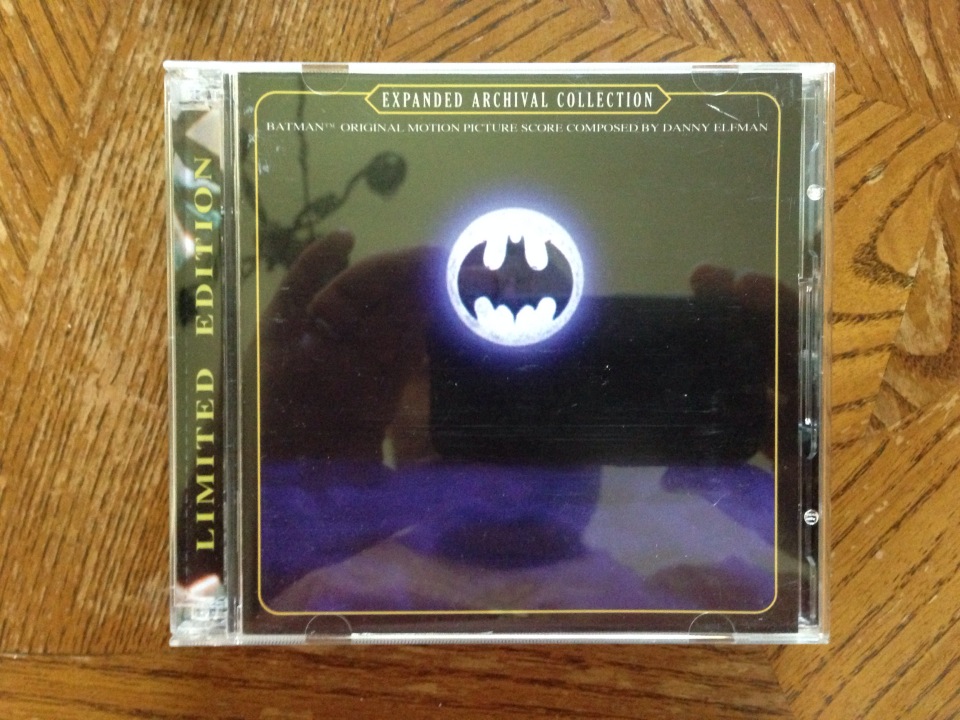
  • Batman Original Motion Picture Score, Composed by Danny Elfman. Expanded Archival Collection, La-La Land Records LLLCD 1140, Limited Edition 2 disc set, 5000 printed. eBay listing.batman 1989 expanded score


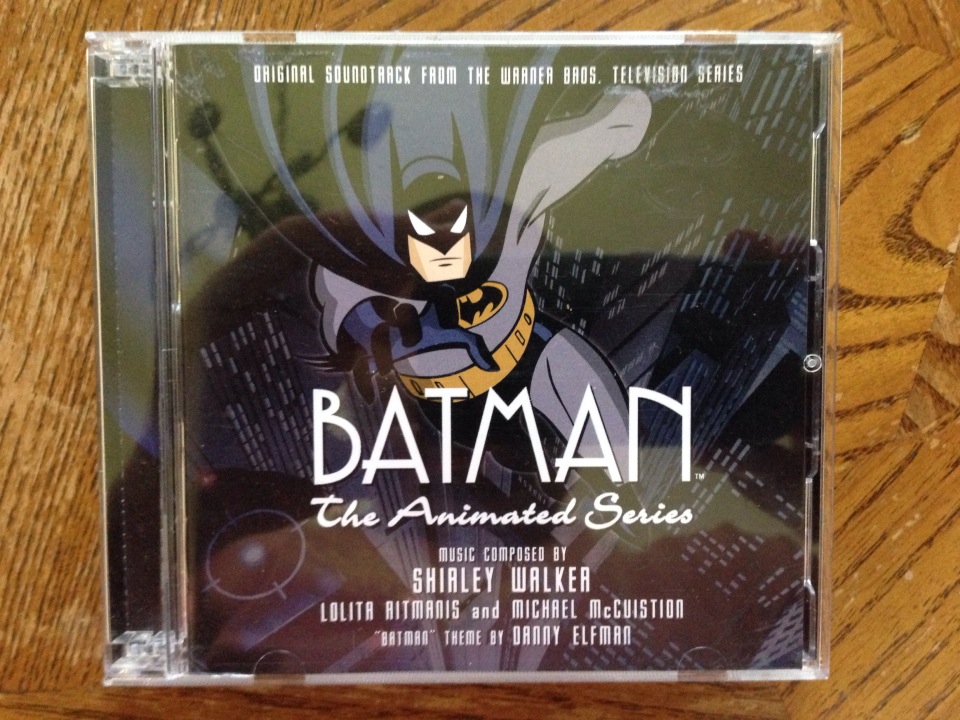
  • Batman: The Animated Series, Original Soundtrack, Music Composed by Shirley Walker. La-La Land Records LLLCD 1082, Limited Edition 2 disc set, 3000 printed. eBay listing.BTAS score


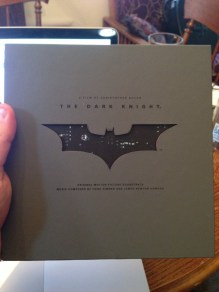
  • The Dark Knight Original Motion Picture Soundtrack, Music Composed by Hans Zimmer and James Newton Howard. Warner Bros. 511104-2, 2 disc Special Edition. eBay listing.TDK special edition


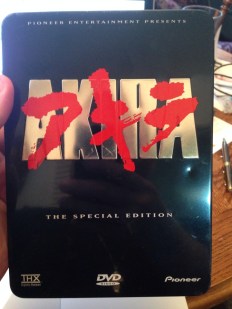
  • Akira: The Special Edition. DVD, Pioneer 11537. 2 disc special edition in tin case. eBay listing.AKIRA Special Edition DVD


Shameless commerce: Digital moving sale

With the impending move, we’re using this as an opportunity to get rid of a lot of things. Not quite ALL THE THINGS, but a lot of books and CDs, definitely. We’ll be doing a yard sale in about a month; in the meantime, I have a lot of the library listed here: http://www.amazon.com/shops/leitourgeia I also have some collectible things listed here: http://www.ebay.com/itm/Cocteau-Twins-10-CD-Single-Box-Set-/281344925213 And here: http://www.discogs.com/seller/richardrbarrett There is a wide variety of genres, artists, and authors represented here; if there’s something specific you’re looking for, let me know; also, if there’s anything you’re interested in that I’ve got listed but you want to ask a question about it or make a counteroffer or something, drop me a line — rrbarret AT indiana DOT edu.

A psalterion is empty

Eleven years ago, when I first started investigating the Byzantine chant repertoire of Orthodox sacred music, my friend Mark Powell gave me some advice — track down the Divine Liturgy recording by Lycourgos Angelopoulos and the Greek Byzantine Choir. Hard to find, he said, but it’s the real deal.

I did indeed track it down — I couldn’t find it on Amazon or on any of the usual CD websites, but I eventually found a Canadian retailer who specialized in Greek things who had it. I remember popping it into my CD player and not having any idea what to expect, and the first “Ἀμήν” just about knocked me out of my chair with its wall of men’s voices.

That CD became my benchmark for what good Byzantine chant sounded like. Other discs became other benchmarks; Cappella Romana’s Divine Liturgy in English became the benchmark for good Byzantine chant in good English, for example. In terms of a general snapshot of the sound of Byzantine chant done well, however, the Angelopoulos Divine Liturgy remained the standard.

At some point, the label Opus 3 made new stock available of the Divine Liturgy disc. It became the kind of thing that I would make sure to have extra copies around, and over the span of a few years, I gave away countless of them to people. A couple of years ago, Opus 3 apparently discontinued it, and it’s back to being scarce. Too bad.

I discovered other recordings by the Greek Byzantine Choir — their Koukouzelis disc, their Mother of God disc, their Christmas disc, the Akathistos Hymn, the anthology that alternates their recordings with some by the Serbian Orthodox singer Divna, and so on. I also found my way to Angelopoulos’ recordings with Marcel Peres and Ensemble Organum. These recordings were all gateways to different corners of the tradition, and each one became both a treasure and a learning tool.

Five years ago, I had the chance to go to Greece for the summer. I wrote Alexander Lingas a note asking, whom can you recommend for Byzantine chant teachers in Athens? His suggestions were Lycourgos Angelopoulos and Ioannis Arvanitis, and essentially, he said, it boiled down to language. They themselves were exemplary students of the same teacher, Simon Karas, but Angelopoulos spoke no English, really, only Greek and French; Arvanitis spoke very good English. Well, I opted for Arvanitis — I speak some French and I was in Greece for an immersion Greek program, but I didn’t really want my chant education to be in a language that was itself still in progress for me. I studied with Arvanitis all summer while attending Agia Irini, the church in Athens where both he and Angelopoulos chanted, so I certainly heard plenty of the psaltic ethos represented on the Divine Liturgy disc in person while I was there.

While I saw and heard him quite a bit in the flesh that summer, I never did actually get the chance to meet Angelopoulos — well, okay, that’s not entirely true. I had chances, but I chose not to introduce myself, I guess because I figured that, as my teacher, if Arvanitis thought it was appropriate to introduce me, he would do so. For the same reason I never went up to chant at Agia Irini that summer; my assumption was that if my teacher thought that was a good idea, he’d tell me. (It wasn’t until later that John Boyer told me, yeah, no, that’s not really how it works — you just go up and tell him you’re Arvanitis’ student and my friend, and he says, great, stand here and sing with us.)

After that experience, I developed other 1-degree-away connections; John Boyer, certainly, who was a student of both Angelopoulos as well as Arvanitis; Alexander Lingas, whom I got to know a bit better at Oxford Patristics in 2011; my friend Taso Nassis, a Chicago psaltis who had also studied with Angelopoulos and Arvanitis for years, was personally very close to both, and had absorbed just about everything both had to offer. Another friend, Brian Whirledge, went to Athens a couple of summers ago to study with Arvanitis, and he sang for Angelopoulos at Agia Irini while he was there as well.

Somewhere along the way, I also developed an awareness that Byzantine chant had its own internal squabbles, and that Angelopoulos and Arvanitis (and, by extension, the friends I had made in connection with them) tended to be seen as on a particular side of those squabbles. I still don’t really understand what that’s all about, and I don’t really need to understand; suffice it to say that I’ve always been grateful for both what I’ve been taught and how I was taught it.

Three days ago, Sunday morning, I had the good fortune to be singing Orthros and Divine Liturgy with Cappella Romana at St. Sophia Greek Orthodox Cathedral in Los Angeles. To be joining Cappella as a psaltis for concerts and services of Byzantine music was, in many ways, the closing of the circuit that was started all those years ago when Mark, Cappella’s Executive Director, told me to find the Angelopoulos Divine Liturgy disc. Further, we were singing a lot of things that morning that one hears on that recording. Towards the end of Liturgy, one of the psaltes checked his phone, and suddenly he was trying to get Alexander Lingas’ attention. Alex saw the phone, looked dismayed, and made the Sign of the Cross. My colleague showed me the phone — “Lycourgos Angelopoulos has died”, said the headline.

As part of our encore that afternoon, Alex gave a brief memorial speech about Angelopoulos, and we sang “Memory eternal” before launching into the medieval melody from Jerusalem for “Χριστὸς ἀνέστη”. Shortly thereafter I got a text from John saying that he was heading out to Greece the next day for the funeral.

While I never met Lycourgos Angelopoulos, it is safe to say that both in terms of his professional as well as his personal output, he had a great deal of influence on my development as a church singer and as an Orthodox Christian, even as I have been but an outlier in that structure. It seems a fair observation that what Metropolitan Kallistos (Ware) has been for theology — a strong center of pedagogical gravity and  the hub of a far-reaching network of students — Lycourgos Angelopoulos has been for the psaltic art. He has been Libanius for Byzantine chant, perhaps. Lycourgos in antiquity may have been Νομοθέτης, the Lawgiver; perhaps this Lycourgos may be fairly remembered as ψαλλοθέτης.

The psalterion at Agia Irini stands empty, and none shall take his place. Καλό ταξίδι, Δάσκαλε. Αιωνία η μνήμη σου. Ζωή σε μας.

I close with two pieces from other people — first, my 2011 translation of an article on the 30th anniversary of the Greek Byzantine Choir; second, a reflection by John Boyer on the death of his personal friend and teacher of so many years:

Αιωνία η μνήμη του Δασκάλου! Ζωή σε μας!
May the memory of our beloved teacher be eternal!

The joy I have experienced these last few days with my classmates, friends and parents during festivities surrounding graduation from Holy Cross Greek Orthodox School of Theology is tempered today with the sad news of the passing of my beloved teacher in the art of Byzantine Chant, Archon Protopsaltis Lycourgos Angelopoulos. I began studies with Mr. Lycourgo in the Summer of 1996 and remained in frequent contact with him over the last 18 years – half of my life. Never have I met a more dedicated teacher in the Psaltic Art; Lycourgo had hundreds of students over the last few decades, many of whom went on to become great cantors in their own right, others who became great scholars in Byzantine Music, others who went on to become clergy, still others who took the knowledge and skill he passed on to them to their ascetic lives in monasteries and convents. The Clan of Angelopoulos students reaches the far corners of the earth, as do the scores of recordings of his groundbreaking choir, Η Ελληνική Βυζαντινή Χορωδία (The Greek Byzantine Choir).

A controversial figure, to be sure, those who know him personally know him to have been a loving yet strict taskmaster, a consummate teacher, a faithful Christian, extraordinarily generous, with a witty sense of humor and a voice that could move mountains. I have had the honor of chanting with my beloved teacher numerous times in many different venues, most recently at his home parish of St. Irene’s in Athens last Summer. I will never forget the sound of his voice, the twinkle in his eye, his inspiring and moving chanting and his profound gift for directing a choir. Who I am today as chanter, teacher and conductor I attribute greatly to the time I was so blessed to spend with the great Lycourgos Angelopoulos. I can only aspire, along with many others of his students, to carry on his torch of Byzantine Music, especially here in the United States, not simply as cantor but as teacher, conductor, composer and promoter of this traditional liturgical music of the Greek Orthodox Church. Αιωνία η μνήμη αυτού. Ο Θεός να τον αναπαύσει. May his memory be eternal. May God lay him to rest. Χριστός ανέστη! Christ is Risen!!!

With sadness and love in the risen Christ,

John Michael Boyer, MDiv.
Protopsaltis, Greek Orthodox Metropolis of San Francisco
Lambadarios, Holy Cross Chapel, Brookline, MA

The psalterion at Agia Irini stands empty, and none shall take his place.

In which I talk about a departure and ponder what the heck to do with all the books

Wow. I haven’t posted since two days before Christmas. Yikes. Sorry about that; we spent Christmas in Alaska with my mother and stepfather, had a lovely time seeing them, spent a great Sunday afternoon with several of my relatives on my dad’s side (none of whom had yet met Theodore), attended Christmas services at Holy Transfiguration Greek Orthodox Church in Anchorage, and then came back for New Year’s in Cleveland with our friends, the newly-engaged Benjamin and Emily, and Paul.

Since then, I’ve mostly been a stressed-out wreck, wondering just where in the heck we’re going to be after the summer.

See, it’s been the idea for some time that we would do our level best to make AY2013-2014 our last year in Bloomington. Both Doctors-to-be Barrett being at the dissertation stage, there’s no concrete reason to stay here; to the extent that there might be external opportunities that would be better-suited to the completion of our respective dissertations (dissertatia? dissertationes?) in terms of working environment and locale, then it would be well worthwhile to try to take advantage of said opportunities.

This meant a lot of fellowship applications in October and November. My sights were zeroed-in on Dumbarton Oaks, of course; I was there two summers ago, and I’d very much like to go back. Fellow housing is right there, a 2-3 minute walk from the compound, the Greek cathedral is a 15 minute walk away, and you’re right there in the middle of Georgetown. What would be not to like? That was just one of several applications, though; I applied for the Notre Dame Institute for Advanced Study, too, and then I also applied for something called the Future Faculty Teaching Fellowship, which sets up advanced graduate students with yearlong Visiting Lecturer positions at Indiana University branch campuses. I thought perhaps I might be able to get a spot at IUPUI, and just relocate all the way to Indianapolis, since our lives have kind of re-centered around there lately anyway. Besides those, I applied for several non-residential fellowships; the Charlotte Newcombe Dissertation Fellowship, administered by the Woodrow Wilson Foundation, was one, as well as several IU-internal awards — generic dissertation fellowships, and a couple of named awards that were significantly bigger, like the John Edwards Fellowship and the Herman B. Wells Fellowship. If nothing else, maybe we could take the money and go spend the year in Alaska.

The other thing that was happening was that two close friends of mine started as seminarians at Holy Cross Greek Orthodox School of Theology this last fall. Holy Cross had piqued my curiosity back in 2010, when I found out that my chant teacher, Ioannis Arvanitis, was applying for the chant professor position there (and I was singularly annoyed with some friends of mine there when he was brought to campus as a finalist the following spring and nobody told me). He didn’t get it, but I was nonetheless intrigued by the possibility of spending a dissertation year there. I made some initial contact with the patristics professor there at the Byzantine Studies conference in Chicago in 2011, and visited the campus the following spring. Yes, people do come the way you’re talking about, I was told, but we’re not sure about the mechanics. Usually they come with their own funding. Hm. Well, that’s not altogether promising for a graduate student. Okay, well, maybe it’s not a realistic possibility. Still — well, who knows? When my friends got there last September, I told them, only half-joking, keep your ears to the ground. If you hear about a faculty member going on sabbatical, or a grant opportunity, or anything, let me know.

In December, one of my friends contacted me and said, hey, you realize that there’s a Fellow In Residence position outlined in the catalog? He sent me the reference in the catalog; I made some initial inquiries, and was put in touch with the Dean — who, now, is the very person I first had this conversation with in Chicago three years ago. We were going to make a visit to the campus over MLKJr weekend anyway, so we set up an in-person meeting during the trip. He was positive about the conversation, but he was nonetheless clear that it was a competitive process and subject to a faculty vote. He took my materials and said, we’ll get back to you by the end of February, I think — but if you get Dumbarton Oaks, go to Dumbarton Oaks for heavens’ sake.

Well, shortly thereafter, I started to get rejections back — the internal, generic dissertation fellowships were the first to get back to me, and those were “no”s. I got an interview for a Future Faculty Teaching Fellowship spot, but at Indiana University Columbus, which would be an hour’s commute without being worth a relocation. The interview went fine, but I think it was probably evident that I wasn’t excited about it, and ultimately that was a “no”.

Dumbarton Oaks had said that fellows would be notified in February; February came and went with no word from them or anybody else quite yet. I went back out to Holy Cross at the end of February for a conference, and the Dean made a point of telling me, hey, we hoped we’d have something to tell you by the time you got here, but we’re not going to be able to have a faculty meeting to decide until the second half of March. So, sit tight.

To say that I was tenterhooks waiting to hear where I would be in the coming year, be it Bloomington or elsewhere, was an understatement. I’ve also since realized that this is something that people tend to go through with college and grad school applications; they apply to several possibilities, wait to see what comes back, and then make the best decision they can based on the options. Well, I never did that; I only applied to one school for undergrad, and I only applied to one school for grad. This was my first time going through anything like this process.

Shortly after I got back from the conference, Dumbarton Oaks got back to me with their “no”, as did the Notre Dame folks. At the same time, the Newcombe people let me know I was a finalist, and they said I’d hear by the end of March.

The jawdropper was on Friday, 7 March, when I got the e-mail telling me I was the Wells recipient for AY2014/2015. Then, Monday, 31 March, I got a phone call from the Dean of Holy Cross, telling me that the faculty had voted to recommend me as the Fellow in Residence; the only thing left was to get the President’s office to okay it, and he didn’t anticipate that being a problem. Two days later, he called to confirm that the President had indeed approved my appointment — and that was that.

In August of 2003, I pulled into Bloomington, expecting I’d be here three years at the absolute most and then it would be back to Seattle. In August of this year, we will finally leave Bloomington, and we will do so for Boston. I am looking forward to this immensely; I’m looking forward to living in the Northeast corridor, I’m looking forward to good seafood, I’m looking forward to a 45 second walk to church — and, of course, I’m looking forward to structuring my time around writing my dissertation, something I just haven’t been able to do this year, at least not in the way that is maximally productive. I will have absolutely no excuse not to be done, that’s for sure. While I was most definitely disappointed about Dumbarton Oaks, this is probably as good of a deal as we could have possibly hoped for — and one thing that we’ll have at HCHC that we wouldn’t have had at DO is a group of people we know. That’s going to be important, particularly for Megan and Theodore.

Holy Cross was at once a somewhat after-the-fact Hail Mary pass, while also being something I had been making a nuisance of myself about for a couple of years. However it worked out, I’m not going to complain; glory to God.

I will say, though — I’m looking at our 10 large bookshelves thinking, um, yeah, so, storage. If anybody has done something like this before and has suggestions about what to do with too many damn books, I’m all ears. I’m also having to scan and return my accumulate and perpetually-renewed library books, piling up over the last 11 years. That’s going to be a project in and of itself.

I’ll also say that, while I don’t normally do this, now would be a welcome time for anybody who wants to click on the “Tip Jar” tab up above to do so, what with a move to Boston in our immediate future and all. If you’ve got any questions about any of that, drop me a line — richardbarrett (AT) johnofdamascus . org. Thanks in advance for your consideration.

Okay. I have books to scan. Back in a bit with a review of Cappella Romana’s Finnish CD.

Two more last-nanosecond gift ideas

I meant to include the following items in the previous post, and, well, it just didn’t happen. So, here we go:

– All Creation Trembled: Orthodox Hymns of the Passion Service, by the St. Romanos the Melodist Byzantine Choir of Holy Cross Greek Orthodox School of Theology (reviewed here). This is a half-in-Greek, half-in-English recording of Orthros for Holy Friday, and it’s a fantastic aural snapshot of what services are like in Holy Cross’ chapel. It’s chanted by the seminarians under the direction of Grammenos Karanos, the professor of Byzantine chant and protopsaltis for the chapel, and it’s a great addition to the growing number of recordings of Byzantine chant composed specifically for the English language. The St. Romanos Choir is a men’s ensemble; a recording of Holy Cross’ women’s chant ensemble, the St. Kassiani Choir, was made during the same sessions and will be coming out soon.


– The Choir (reviewed here). A fascinating documentary on a truly admirable musical institution in this country, the Madeleine Choir School. The Madeleine Choir School is a ministry of the Cathedral of the Madeleine (Roman Catholic) in Salt Lake City, and they do some amazing work. The DVD gives a look at the experience of participating in the academic and musical life of a choir school — an experience that might be relatively common — or at least not unknown — in England, but is esoteric in the States to say the least. This is a wonderful gift for anybody who is a choral singer or a music educator.

Need last-minute gift ideas?

It’s Monday of the week before Christmas. Do you have all your Christmas shopping done? Of course you don’t. So, here are some suggestions:

The Gifted Pan prosphora baking dish. For the would-be ecclesiastical baker who feels stymied by handheld seals that seem to have never been applied five minutes after what seems like pressing down with all your might.


Scapple. If you’re a Scrivener user, this is an excellent companion application that basically allows you to doodle your ideas without having to go quite to the intellectually self-conscious extreme of “mind-mapping”.


– Turning to Tradition: Converts and the Making of an American Orthodox Church by Fr. Dellas Oliver Herbel (Oxford University Press, 2013). I reviewed the book here; in short, it’s a great book for anybody interested in North American religious trends or Orthodox Christianity in the United States, with a lot to digest in a very reasonable length.


– Stocking stuffer 3-pack of CDs: Cappella Romana‘s Tikey Zes: The Divine Liturgy of St. John Chrysostom (reviewed here) and Robert Kyr — A Time for Life: An Environmental Oratorio (reviewed here), with Archangel Voices‘ Panagia: Orthodox Hymns to the Mother of God (reviewed here). Three very different kinds of recordings of what one might broadly call “Orthodox music”, and each very good in its own way. The Kyr is an oratorio informed by Orthodox liturgy; the Zes is an Orthodox liturgy that at times feels like an oratorio; and Panagia is a themed recital of Orthodox choral music about the Virgin Mary. What’s funny is that the Zes disc is sung entirely in Greek but often seems quite Italian; Panagia is all in English but feels quite Russian. What can you do (or, if you like, Τι να κάνουμε)?

– Sweet Song: A Story of Saint Romanos the Melodist by Jane G. Meyer (reviewed here). A beautifully-illustrated (and not distractingly anachronistic) children’s book set in sixth-century Constantinople during an episode in the saint’s life. If you’ve got a young reader who’s interested in singing in church or who has started to develop an early fascination with Byzantine and hagiographic arcanity, this is the book you want.

– 75 Years of DC Comics: The Art of Modern Mythmaking by Paul Levitz (Taschen, 2010). And this would be the book for the reader who is simply a geek and unashamed to admit it. Like, you know, me. (Just sayin’, just sayin’s is all.)

– Finally, if none of these speak to you, I offer the possibility that you could make a donation to The Saint John of Damascus Society. We’ve got a lot of different things that we’re working on, including the Psalm 103 project but also much more, and making a gift in the name of somebody you care about would be a lovely gesture for all concerned. All gifts are tax-deductible to the extent allowed by law. The above link will take you to our website’s “Support” page; click the “Donate” button and PayPal will take care of the rest. If you’re interested in giving a gift but want to have a conversation with a person about it, get in touch with me (either via the combox here or by e-mailing richardbarrett AT johnofdamascus . org), and I’ll be happy to talk to you.

And, should you for some unknown reason be looking to give me a Christmas gift, well — you can certainly give something to the Saint John of Damascus Society, and it will definitely make me happy. I also wouldn’t sneeze at 75 Years of DC Comics. And, hey, this blog has its own “Make a Donation” button. If those options don’t speak to you, well, there’s always this.

Okay — may you all stay well the rest of the fast (and beyond, of course)!

CD Review: Cappella Romana — Robert Kyr: A Time for Life: An Environmental Oratorio

Robert-Kyr_A-Time-For-LifeI am not otherwise familiar with the work of Robert Kyr, but this intriguing collaboration with Cappella Romana and the Third Angle New Music String Quartet (actually a trio) makes me very curious to become so. As performed on Cappella’s new CD release, A Time for Life: An Environmental Oratorio is a moving musical dialogue between Judeo-Christian and Native American prayer texts about the created order and our relationship to it.

Kyr here has constructed a libretto that brings together portions of two different Orthodox texts, the Akathist in Praise of God’s Creation and the Office for the Environment (observed on 1 September by the Ecumenical Patriarchate), as well as selections from the Psalms, Jeremiah, Isaiah, Ecclesiastes, the United Nations Environmental Sabbath Service, and prayers and hymns from the Sioux, Navaho, Pawnee, Ojibway, Chinook, and Netsilik Inuit tribes. It is in three parts: Creation, Forgetting, and Remembering. Kyr’s structure seems to express the idea of our present-day ecological concerns being a function of the fall of mankind; we were created first in right relationship with God and creation, but in our hubris we chose our own way over God’s, harming our relationship to both. Parts II and III express this right relationship in terms of memory; “We forget who we are; help us to remember” is the refrain throughout Part II. Part III weaves together the different ways all of the texts use the idea of remembering. “O Lord, help me to remember who I am”, says the Orthodox Office for the Environment; “Remember, remember the circle of the sky,” replies a Pawnee/Osage/Omaha song. If we can but remember, we will be able to repent; “Restore my mind for me,” the words of a Navaho chant plead. Repentance, as Kyr’s own words then tell us at the end of the peace, will then allow us to understand, to rejoice, and to appreciate the beauty of God’s created order.

Kyr does a very nice job of arranging these texts so that the dialogue never seems forced; he seems to want them all to speak on their own terms, in their own spirit. I am familiar with similar attempts to interweave religious texts from different traditions that do not give them the same respect; Giles Swayne’s Stabat mater, for example, is principally interested in using other texts to marginalize the particularity of the Virgin Mary’s lament at the cross. Musically, Kyr’s language here is not the angry, mushy, ambient noise that so much contemporary music can be; rather, the interplay with the voices and his adeptness at sung musical phrases reminds one more of Britten (and, often, Britten’s own invocation of Purcell). His music is restrained and tasteful, allowing the texts and ideas to be front and center. The “We forget who we are” refrain in Part II is particularly haunting, as I suppose it should be.

For Cappella, this CD is something of a departure; while concert works informed by Orthodox liturgical music are nothing new for the ensemble (see, for instance, Richard Toensing’s Kontakion on the Nativity of Christ and Fr. Ivan Moody’s Akathistos Hymn), this is not really a choral piece but rather a piece for a solo octet, and while they have recorded with orchestra before as well as with organ, this seems to be their first time on record with a chamber music ensemble. It is nice to see Cappella championing repertoire like this; it demonstrates an impressive artistic vision.

Happily, the performance on the disc demonstrates a very real breadth of ability that is equal to that vision. All of the soloists do marvelously with the score; in particular, Mark Powell and LeaAnne DenBeste — who was excellent as the Mother of God soloist in the Toensing Kontakion — are excellent, with crispness of diction and clarity of voice that serves Kyr’s music very well. The Third Angle New Music string trio accompanies the solo octet with a lot of sensitivity, but they are also present enough to never sound like they’re holding back in order to be a “pit band”.

The booklet contains the complete libretto of the oratorio, as well as essays from Dn. Dr. John Chryssavgis, Kyr, and Cappella’s Artistic Director Alexander Lingas. The essays are very much worth reading; they provide useful context for Kyr’s composition, Cappella’s own involvement with its performance and recording, and the interest and theological perspective of Ecumenical Patriarch Bartholomew as regards environmental concerns.

I’ll close this review with Kyr’s own words. He closes his own essay with the following:

I believe that music and the arts have a crucial role to play in the transformation of the current energy of cynicism and destruction into the life-sustaining attitude and energy of creativity.

Indeed. Go and do likewise.

CD Review: Archangel Voices, Panagia: Orthodox Hymns to the Mother of God

I-112Archangel Voices is an Orthodox vocal ensemble that specializes in liturgical choral repertoire by present-day composer, particularly focusing on English-language settings (either composed for English texts or adaptations of existing settings for English). Their Artistic Director is Dr. Vladimir Morosan, a scholar of Russian Orthodox choral music in particular (he is the translator of Johann von Gardner’s venerable series Russian Church Singing, volume 1 and volume 2, he has his own monograph on Russian church choirs right before the Revolution, and he has published several critical and performing editions of Russian choral repertoire), and an advocate of Orthodox liturgical music more generally.

Archangel Voices is one of the outlets for Morosan’s advocacy, and Panagia: Orthodox Hymns to the Mother of God is their sixth release on disc. The intent of the recording is to represent the vast diversity of Orthodox hymnody about the Mother of God — hymns from the daily cycle of services as well as the Marian feasts, special services, and also para-liturgical compositions. There is not only a rich collection of hymns but also composers; there are many Slavic composers such as Chesnokov and Bortniansky presented here, as well as composers active in present-day North America, such as Benedict Sheehan, Morosan himself, and Psalm 103 project composers Richard Toensing and Kurt Sander.

This CD is a different kind of aesthetic than that of some of the other recordings of Orthodox music that are out there. Cappella Romana’s approach is to do a variety of repertoire, make informed stylistic choices for the performance, and be as consistent with those stylistic choices as it can — an “early music” approach, if you like. Kurt Sander’s As Far as the East is from the West sought to reproduce the aesthetic of a large parish choir in a Russian choir loft. Holy Cross’ recent release was simply the sound of their chapel services transferred to disc. Samir Cohlmia’s recording of Dormition chants captures the aural experience of the Byzantine cantor as soloist. And so on. Archangel Voices does something a little different; rather than model themselves on a particular existing Orthodox musical aesthetic or attempt to be stylistic chameleons, they are more along the lines of a Western-style chamber chorale, made up of well-trained musicians who are flexible enough to sing pretty much whatever is put in front of them and make it sound good with a consistent, well-blended, shimmery, warm sound. Perhaps one could argue that Archangel Voices represents one model of what a good American parish choir could be; good enough musicians to sing virtually anything as themselves instead of trying to sound like something else.

It’s an approach that certainly does sufficient justice to most of the repertoire on this disc; particularly nice from the Slavic selections are Chesnokov’s general canon to the Mother of God, Nikolsky’s Megalynarion for Pascha (I am thankful to Morosan and co. that they opted for something less overdone than Balakirev’s setting, which is generally treated out here in the Midwest as the national anthem of American Orthodoxy), and Lvovsky’s Exaposteilarion for the Dormition. In general, I will say that the North American composers who are writing for the English language tend to stand out a little better; perhaps it is not surprising that music written for and sung in the same language sounds better than adaptations. Among this group, Morosan’s Koinonikon for Marian feasts, Nazo Zakkak’s setting of “I have thee as a fountain” from the Paraklesis service, Sander’s Megalynarion for the Divine Liturgy of St. Basil, and Toensing’s setting of “Awed by the beauty” from the Third Mode kathismata are all particularly lovely.

The recording isn’t completely flawless; there are a handful of moments that are a touch rough-feeling, where the ensemble doesn’t quite shimmer as much as they normally do. The ornaments on the ubiquitous paraliturgical Georgian hymn “O Vineyard, fair and new” don’t work as sung; they’re a mismatch with the style the choir employs otherwise, and as a result they sound like mistakes and baubles rather than specific ornamentation choices. To the extent that there’s a pastoral model here for choirs, I would suggest that the lesson here is, ornaments need to be treated as organic parts of a chosen style, not merely additional notes to be sung; if that’s not a practical or pastoral possibility, then it is an acceptable choice to leave the ornaments out. Also, given the ensemble’s stated objective in the booklet “to embrace various traditions and styles of Orthodox church music as they are manifest in the practice of parishes in North America”, it seems like something of a missed opportunity to not include any of the Greek-American composers who have written Orthodox choral music in English, or to use any of the growing library of settings of Byzantine chant composed for English (polyphonic adaptations of what are already themselves adaptations of Byzantine melodies aren’t really the same thing). Sometimes “pan-Orthodox” appears to mean, in practice, “everybody but the Greeks”, and opportunities like this would seem to be appropriate settings for trying to combat that. Alas; I’m sure there are reasons for such choices.

These are minor issues; Panagia is a high-quality effort overall from a high-quality ensemble, and very much worth checking out.


adventures in writing alexander lingas all saints bloomington all saints orthodox church american orthodox architecture american orthodox music american orthodoxy Antiochian Archdiocese Antiochian Orthodox Christian Archdiocese of North America Antiochians books byzantine chant cappella romana chant church architecture ecclesiastical chant ethnomusicologists ethnomusicology fellowship of ss. alban and sergius Greece Greek greek food greekness hazards of church music international travel tips ioannis arvanitis joe mckamey john michael boyer kurt sander Latin liturgical adventures liturgical architecture liturgical music liturgical texts and translation liturgy liturgy and life lycourgos angelopoulos medieval byzantine chant Metropolitan PHILIP militant americanist orthodoxy modern byzantine architecture modern greek music music as iconography my kids will latin and greek when they're newborns my kids will learn latin and greek when they're newborns orthodox architecture orthodox architecture is bloody expensive Orthodox choir schools Orthodox Ecclesiology orthodox outreach orthodox travel pascha at the singing school Patriarchate of Antioch Patriarch IGNATIUS IV Patriarch of Antioch publishing random acts of chant richard barrett in greece richard toensing rod dreher sacred music st. vlads st john of damascus society Syriac the Bishop MARK fan club the convert dilemma the dark knight The Episcopacy The Episcopate the only good language is a dead language this american church life travel we need more american saints why do we need beautiful music in churches?

Blog Stats

  • 262,859 hits

Flickr Photos