As always, I know that the two of you of who look in on my blog on a regular basis are dying for gift ideas for me — I mean, did I really need 225 copies of Fr. John Behr’s book? Er, wait… Anyway, in case you think that’s too impersonal and/or obvious, there’s always this one: Diane H. Touliatos-Miles’ Descriptive Catalog of the Musical Manuscript Collection of the National Library of Greece. Nur sage, wenn du verstehst was ich meine.
Archive for the 'The Orthodox Faith' Category
Another gift idea
Published 28 July 2011 Academia , General , Media , music , The Orthodox Faith 1 CommentTags: byzantine chant, chant, diane h. touliatos-miles, ecclesiastical chant, gift ideas for richard, giorgos kyriakakis, Greek, hazards of church music, liturgical adventures, liturgical music, liturgy, liturgy and life, medieval byzantine chant, modern greek, my kids will learn latin and greek when they're newborns, random acts of chant, sacred music
Giorgos Kyriakakis: 30 Years Since the Founding of the Greek Byzantine Choir
Published 27 July 2011 music , The Orthodox Faith , Uncategorized 2 CommentsTags: byzantine chant, chant, ecclesiastical chant, giorgos kyriakakis, Greek, greek byzantine choir, hazards of church music, liturgical adventures, liturgical music, liturgy, liturgy and life, lycourgos angelopoulos, medieval byzantine chant, modern greek, my kids will learn latin and greek when they're newborns, random acts of chant, sacred music, simon karas
My recent translation of Lycourgos Angelopoulos’ talk on Simon Karas got the attention of one Mr. Tom Nassis of Chicago, who asked if I wouldn’t mind translating a 2007 article by Giorgos Kyriakais on the 30 year anniversary of Angelopoulos’ Greek Byzantine Choir. I was happy to do so; Tom provided a few suggestions, and then ran it by Mr. Kyriakakis himself, who gave it his own stamp of approval. So, here it is. As always, I’m more than open to questions and comments.
Update, 27 July 2011: By request, the text with which I was provided may be found here.
—
One of the longest-lived, and in all likelihood the most internationally recognized, Greek musical ensembles, which Lycourgos Angelopoulos established and directs up to today, completed three decades of activity. The history of the choir in reality coincides with that of its founder, who has devoted himself to applying his world-renowned authentic talent and immense artistic experience to the promotion and achievement of the goals of the choir. The present writer was honored to study with him, so for this, please forgive any sentimentalities detected in the text which follows.
The Greek Byzantine Choir (EL.BY.X. [Ελληνική Βυζαντινή Χορωδία]) was founded with its objective being the study and performance of Byzantine music as it reached our time by means of written and oral tradition. The choir made its first official appearance on 12 December 1977 at Beethovenhalle in Bonn, having been invited by the West German Republic, at a concert with a mixed program. In the first part of the concert, the EL.BY.X. chanted a selection of hymns for the Nativity of Christ, while in the second part featured the world premiere of the work of Dimitri Terzaki, “Leitourgeia Profana” with Lycourgos Angelopoulos as the soloist. But the relationship of the choir and its director with contemporary (and beyond) music will be mentioned in the next article. The debuting choir, then, met with an immediate and enthusiastic reception from a difficult audience. Enthusiams which up to today it causes everywhere where it gives concerts or participates in liturgical events, in Greece and abroad. There are not a few time when it was necessary either to repeat one of its concerts, to go on in a bigger venue than originally planned to enable all of the interested audience to attend, which had surpassed in size the expectations of each of the organizers. The next great international appearance of the EL.BY.X.is scheduled in New York next January, where for a second time it will give a concert at the city’s Metropolitan Museum of Art.
The EL.BY.X., in the 30 years of its activity, has put on more than 1,500 concerts, liturgical and other events in Greece, it has done so in more than 30 countries throughout the world. Among them are the historical several hours-long vigils at the Holy Monastery of St. Catherine in Sinai (1983), in Cologne (1985), at the Holy Monastery of the Great Cave (1987), at the Holy Monastery of Vatopedi, at the Church of St. Demetrios in Thessaloniki (1993), at the Holy Monastery of Arkadi (2000) and at Krakow (2000), which, in spite of their length, were broadcast on the radio. The chief highlight was the participation in 2000 at the Pan-Orthodox Divine Liturgy of the Nativity of Christ in Bethlehem, while also especially historical and meaningful was the choir’s participation in June 2002 in the Divine Liturgy which the Ecumenical Patriarch Bartholomew celebrated for the first time after many centuries in the ancient basilica of St. Apollinarius in Classe (6th century) in Ravenna.
The choir has recorded at Europe’s greatest radio and television stations, it has presented selections of ancient Greek music and Old Roman melodies, while it presented for the first time in modern years the ancient service of the “Three Children in the Fiery Furnace”, from the few preserved examples of Orthodox liturgical drama (c. 15th century), in a transcription and reconstruction of the composer and researcher Michael Adami. From 1990 it began the recording of all of the works of the most important Greek medieval composer John Koukouzelis the Master (perhaps 13th century). The choir has participated in the festivals of Athens and Epidauros in 1987, while from 1989 to 1991 it gave an annual concert at the ancient theatre of Epidauros. The choir appeared at the Megaro Mousiki Concert Hall in Athens for the first time in 1991 and several times from 1995 up to today. In March of 1997 it gave three concerts at the Metropolitan Museum of Art in New York in the context of the exhibit “The Glory of Byzantium” and, in January of 1998, it participated in the events “Greece of Britain” with a concert at Queen Elisabeth Hall of London. In May of 2001 it sang at the initiative of Professor Alexander Lingas, also for the first time in recent years, the service of Asmatic (Sung) Vespers, at Oxford, from a transcription and reconstruction of Alexander Lingas’ and Ioannis Arvanitis’, while in August of the same year it gave for the fifth consecutive year the official concert of the International Conference of Studies in Paris together with Ensemble Organum. The above appearances constitute only a small sample of the exhaustive activity which characterizes the EL.BY.X. from its establishment up to today.
Since 1993 they have released in France and in Greece approximately 10 CDs as well as more than 30 cassettes under the name of the choir, eliciting ever-flattering reviews from the international music press. In many cases, notable music magazines have awarded their greatest distinction to the choir (e. g. fff, the magazine Diapason).
The specific and main reason, largely, that the EL.BY.X succeeded at being established internationally to a degree that should constitute worldwide an ensemble of note in the fields of religious, ancient, and Eastern music, is the fact that the choir “restores” Byzantine music, namely the medieval and more recent “art” music of the former Eastern Roman Empire, as a craft. It can be considered as self-evident that a musical ensemble serves music as a craft or an art, but for those who have inside knowledge of the world of Byzantine chant, it is an open, unacknowledged secret that this almost never occurs. The most customary response, which constitutes even substantial contempt of it from the same institutions, is that Byzantine music is a simple accompaniment, up to the point of a necessary evil, of the activity of Orthodox liturgical practice. The cantors (with or without preparation) are sometimes rendered as simple conduits of an action that often is manipulated and ultimately undermined even by the clergy when he, the priest, behaves as though he is a boss and the “psaltai” as functionaries of the church. Not to open up the Pandora’s Box where most of the “scientists” of “our national-religious-and-such music” live…
The EL.BY.X., under the adept direction of Lycourgos Angelopoulos, places this music on the pedestal that it deserves. Along with the choir’s regular, devotional or festive, but always majestic liturgical activities, its extra-ecclesiastical activity has helped greatly to clarify that Byzantine music exists as an independent musical significance, that constantly provokes the interest of an ever-wider public, but also of musicians and composers, as well as even actual scholarly researchers, in religious music and beyond. The EL.BΥ.X. does not seek to innovate. It remains faithful to the tradition, while also never resorting to complacent, loud-voiced trills that do injustice to the music for the benefit of the personal visibility of its performers, a natural consequence of the fact that it did not treat the high art which it offers to its audience in an opportunistic manner, and it continues to not do so, whether the audience is ecclesiastical or not. A simple hearing of small samples of the choir’s work not only demonstrates the things discussed so far but also guides with certainty even to the conclusions that follow; because the present article does not claim to constitute a musicological study, those conclusions ultimately will be given succinctly: the choir showcases and maintains the form of the compositions that it performs. It is the large world of music lovers that used to believe that Byzantine music is nothing other than a convoluted, boring improvisation overlaid onto orientalizing musical formulas, and it is the same large world of music lovers that changed its mind about the music itself when they heard it performed correctly. In the field of expression, the EL.BY.X. is a genuine heir apparent and practitioner of the pedagogy of the great Simon Karas. It provides a clear image of the totality and the melismas of the compositions without confusing one with the other. In general a virtually erroneous view concerning “heterophony” prevails, which wants all the members of a choir to sing on the same melodic skeleton, with individual variations in the ornamentation of melodies, with the result that a static sound, something “approximate”, reaches ears of the listener. The EL.BY.X. shows in a practical manner that the complete synchronization and coordination of all of the members of the choir is feasible, provided, of course, that proper training and preparation has preceded it… An absolutely unique characteristic of this specific choir, in our opinion, is that it chants stylistically. The choir approaches the texts differently, which results from the research and other recent developments. Nowhere in the world, excepting our small para-ecclesiastical way of doing things, is it understood that one applies the same approach of interpreting a composition of the 14th century with a composition from the 18th century, for example. The EL.BY.X. puts things in their proper place, and does not treat its repertoire as an indiscriminate hodgepodge of materials old and new, traditional and custom, trashy and expensive. Pages upon pages could be written about the importance of the work of the EL.BY.X. and its director regarding period treatment, quality and accuracy of intervals, dynamics, the rotations through both choral and solo phases, stage presence, and many other things which due to space considerations are not mentioned here, the things which all the same succeeded in convincing even an entirely “lay” audience that the EL.BY.X. practices something “religious” on the one hand, but which is still “art” above all on the other hand.
But alongside with the choir’s purely artistic activity, it also constitutes a great school. The present writer acknowledges that before he came into contact with the choir, being learned in secretive and pompous practices, used to believe that the world of Byzantine music is a closed club to which access for the one not initiated is rather impossible. The reality which he experienced contradicted him. I will not dwell on that; I will say only that for the duration of my trials with the EL.BY.X., I understood what Byzantine music actually is and how instructive it is merely to watch the choir’s members, well-trained to say the least, conversing on the matter at hand: the music. This was also the only time when I heard the “teacher” urge his “students”: Study! If somebody asks you tomorrow, “Why do you say this?”, how will you answer this person? “Because my teacher says so”? And if he should tell you, “It could be, but your teacher speaks wrongly,” then what? Study, so that you learn why you’re saying what you’re saying, and not because I myself have told you so!
And he always referred and guided us to the sources, many times even with he himself assuming the cost of any copies we needed. Finally.
Certainly, the thirty years of the choir did not pass rosily and into unalloyed glories without needing “to open the nose.” Only fruitless trees are not stoned. Our exegetical view, we believe, does not require that we live in the country where, together with chiefly historical matters, plausibility holds the title of metropolitan intolerance. And as regards the area of art… from ancient times (and this one). The Greek Byzantine Choir could not in a third of a century inconvenience the spider-filled psaltic establishment doing a decent job of the obvious thing without receiving its share of intolerance, sometimes collectively, and quite often in the form of personal attacks against its founder. Beginning already from its inception, St. Irene Church on Aiolos Street was the first testing ground. And when the EL.BY.X. was daring to not follow the stupid and distorted line, except for politically correct seasonal things, of the ridiculous three-part “harmonization” of Sakellarides style, it found the church locked at the time of the scheduled rehearsal — something which proved often to be a benefit for passersby, who had the opportunity to watch live the rehearsal that they inevitably held… on the steps of the church. But the worst came when the choir began to have prestige and to develop an international career. Then all the “trustees of tradition and style”, asleep since birth, and the only thing that bothered them was that they selling, boutique-style, their services to national-religious opportunistic merchants, and they identified the “enemy” whose existence gave them the opportunity to “intervene” critically, an opportunity which their ability to intervene musically did not particularly facilitate. Even up to the time during which these lines are written, all of these “border guards” and “zealots”, as they are fond of calling themselves, instead of seeking to be educated at least a little bit, they simply attack… Karagiozis’ Wedding… Personally, I have one question to offer: but is it well that you do not listen?
In the holy war against Angelopoulos and “Little Angelopoulites”, many funny episodes have transpired, episodes which rarely deviate from the music. There, even, many things are not able to be told. A great number of libels have been published from time to time, enough to make any embittered person laugh. Accusations of spying (what happens and what the choir does in Israel and every such thing, so that the Patriarch asking the choir to chant at the Holy Sepulchre is not enough), of heretical views (so many travels and consorting with the heterodox, the “unbaptized”, as they cannot do) and other things which, if they were all written down, anybody would believe that evil, provocative devils encourage them. Suitable for the snuff-box, but less by far for the music. Something is mumbled about contempt towards “the Patriarchal style” the identity of which, as an aside, is being researched, something about an alteration of Athonite style… ridiculous? In the ’70s, the accusation was that “they are going to bring the monastic ways to Athens,” while in the ’90s and beyond it was, “This group attacked, and then the systematic siege certainly being sustained, they laid waste to Vatopedi and having this as a base they plot against the remaining monasteries as it succeeds in imposing its style upon them.” Sometimes even some unsubstantiated speculations are heard concerning the systems of attraction and of intervals, but these hold little sway, obviously because the arguments do not persuade, and neither do those who make those arguments. Thus, henceforth the EL.BY.X. “with the assistance of the mass media, have also imposed such things, systematically altering the content of our national music,” and other humorous stories… The aforementioned matters concerning form, rhythmic training, study and correct result, research into the sources and so on, remain the fine print for a large proportion of the field, and they do not fall loudly on the table. And the sympathetic chief clergy do not make a noise but they are aware of such things. To repeat what I said earlier, a metropolis of intolerance. This time even with a Metropolitan. But all these things aside, the EL.BY.X. continues to produce work, and it does not rest on the international recognition which it already enjoys, and we pray that it continues much longer. As for the “Spartans guarding Thermopylae”, armed with the broomstick of excommunication, even they are members of the ecosystem. It is well that there are those, just as the one “having ears to hear”, able to hear these things on the one hand and able to judge on the other hand able to judge the musical interpretations and scholarly evidence.
Who is so naive as to argue that the subject of research, interpretation, and presentation of any musical movement, are the result of only a few individuals? The only certainty is that history is not rolling back; the Greek Byzantine Choir and Lycourgous Angelopoulos, here and for many years, are writing their own chapter.
– George Kyriakakis, http://www.kyriakakis.de/
Getting Past Religion (via Glory to God for All Things)
Published 30 June 2011 General , music , The Orthodox Faith Leave a CommentTags: beauty, byzantine chant, chant, ecclesiastical chant, hazards of church music, knowledge-of-god, liturgical music, Orthodox Christianity, religion-of-the-heart, sacred music
One has to love this gem in particular:
I do not wish to be foolish or dishonest: beauty, transcendant beauty is and transforming beauty is not the peculiar property of Orthodox Christianity. God is indeed everywhere present and filling all things. And he desires that all participate in His life (which is also a participation in Beauty). I do not offer this as an observation of ecumenism – merely as a resurrection that God is free and “does whatsover He pleases.”
I do, however, offer this in order to encourage Christians to consider such things as Beauty and music – and many other aspects of our lives when considering devotion to God and the presentation of the Gospel. The world in which we live (much of it, anyway) is hungry less for a careful presentation of the Christian doctrine of the atonement than for an encounter with the true and living God. Of course, such careful presentations are not foreign to God, but they rarely manage to rise above the level of religious rhetoric. The desire for beauty is far more than mere aesthetics. Mother Theresa once said that she wanted to do “something beautiful for Jesus.” She did not fail.

Lycourgos Angelopoulos: Simon Karas and Byzantine music in Greece during the 20th century
Published 27 June 2011 Academia , General , music , The Orthodox Faith 2 CommentsTags: byzantine chant, chant, ecclesiastical chant, Greek, hazards of church music, liturgical adventures, liturgical music, liturgy, liturgy and life, lycourgos angelopoulos, medieval byzantine chant, modern greek, my kids will learn latin and greek when they're newborns, random acts of chant, sacred music, simon karas

Simon Karas
I found this on the Analogion website, and it seemed worth translating. Corrections, comments, and feedback welcome, particularly where some technical terms are concerned. This makes mention of a number of what I assume to be the terms of art of Greek music theory, and I wasn’t always sure I was right. Words where I wasn’t certain there even was an English equivalent are left in Greek and in italics. To the extent that anybody’s concerned about such things, we can call this a draft until all such feedback is in.
—
Simon Karas and Byzantine music in Greece during the 20th century
Lycourgos Angelopoulos, Archon Protopsaltis of the Most-Holy Archdiocese of Constantinople, Professor of Byzantine Music at Philippos Nakas Conservatory
Opening remarks at the Symposium for Byzantine Music, Romania, December 2002
The subject of my introduction touches upon, in essence, the problem today of the pedagogical method of Byzantine music — theory and practice — a problem which surely concerns all of us, I think.
It is the chief problem which we face so much in research, as much as even in teaching, because the oral tradition which necessarily interprets the written tradition, in some places has almost vanished (where the political situation over the decades contributed to it), in other places been weakened or altered (where it was influenced by the teaching of a European pedagogy — that is to say a foreign system — and the use of a mixed means).

Lycourgos Angelopoulos
Simon Karas studied and confronted this problem, together with many other things noted. The great length of days of life which the Lord granted him (he was born in 1903 in Strovitsi of Olympia and he fell asleep in January of 1999 in Athens) helped him so that a project, an inquiry — but also a practice of life — might be published in large part in the last twenty years his life and might constitute the work of infrastructure for a systematic pedagogy which respects the written tradition and interprets it with the oral tradition. The respect for the written tradition and the the interpretation of the written tradition by the oral tradition is the basic prerequisite of service and offering for everybody who serves the current method of our ecclesiastical music.
As of this year it has been twenty years since the publication of Simon Karas’ two-volume Theoretical Treatise of Greek Music. Before we analyze the importance of its publication, which is accompanied by a practical pedagogical method of many volumes, let us give, very briefly, the situation of Byzantine music in Greece in the twentieth century.
Σince the nineteenth century the new method of the system has spread and been taught, the so-called method of the Three Teachers, which was supported by the publication of the great Theoretical Treatise of Chrysanthos (Trieste, 1832) and some subsequent theoretical publications of other authors who are emultating it.
In parallel, from 1820 and beyond, subsequent publications of music books are produced, the peak being the circulation from the Patriarchate in the middle of the nineteenth century of the four-volume publication “Pandekti,” which until today constitutes a basic pedagogical text, together with the Anastasimatarion, the Irmologion, and Mousiki Kypseli (Sticherarion).
In the modern Greek state, they are teaching students of the Three Teachers such as the Protopsaltis of Athens, Zafeirios Zafeiropoulos, or the archdeacon Anthimos the Efesiomagnis (from Asia Minor) the who founded the School in Messolonghi, with many students and successors of his work.
The support from the state but then even from the Church (between the third and fifth decades of the century) produces the poor parenthesis of the system of Giorgios Lesvos, the system which finally was rejected by the Holy Great Church of Christ in the time of Ecumenical Patriarch Anthimos VI. Most correctly, too, because the dominance of another system would have eliminated automatically the notation and would cut off every connection with the older methods of the Byzantine system and the tradition.
In the 19th century however it has her roots and another cause which troubled our ecclesiastical music: the introduction of polyphony in the central churches of Athens, initially according to the model of the Greek community of Vienna (Chaviara-Nikolaidi harmonizations) and, later, of Russian polyphonic music.
This imposition of polyphony created reactions among the people who followed the tradition. Polyphony in the Church was certainly conforming to the age with the secular music that had been introduced also from Europe (an age in which opera, operetta, and European music in general flourished, the condition in which the idea was cultivated that those genres are superior in comparison to monophonic Byzantine music). As the restoration of Byzaintine music (having been purified, supposedly cleansed from Turkish elements) presents at the end of the 19th century the musically naive system of Ioannis Sakellarides, which produced great confusion among even still-traditional cantors. Chiefly because he used traditional notation lines in many cases and some uses of signs — subordinating the whole to a rhythmic scheme of four-beat feet, impairing the modal character and adjusting their essence to the European system.
Opposite to this situation which is spreading from the capital, Athens, influencing even the other urban centers by word and the educational activity of Sakellarides (pedagogy in ecclesiastical and even secular schools), there are the traditional cantors who are trying to keep the monophonic ecclesiastical music with the teaching but also even with practice (services, vigils, etc.).
Already the Ecumenical Patriarch has convened a musical committee in 1881-3 for the completion and correction of the Great Theoretical Treatise of Chrysanthos.
The committee redefines intervals, describes the characteristic elements of the modes and chiefly defines precisely the intervalic subdivisions of flats and sharps, in other words of the function of attractions according to mode, which even then had not been determined with exactness.
In the practical field — in the printed books which individual cantors are printing at the 19th century, already a process of most analytical notation of oral tradition has begun, a process which eventually arrives at excess with the improper use of certain signs of subdivision of the beat and the use of qualitative signs without calculation of their value.
This trend, which would continue during the entire 20th century, would find the its chief spokesman in the face and work of the Archon Protopsaltis of the Most-Holy Archdiocese of Constantinople, Athanasius Karamani, who documents — as he himself calls it — the “living tradition”. For all practical purposes, these documents are meaningful witnesses for research and for the relationship with the value of the signs.
But let us come back to the beginnings of the 20th century. An important station is the decision of the Musical and Dramatic Assocation, that by 1871 has established the Conservatory of Athens, to advance even to the establishment of the School of Byzantine Music in 1903. The Director of the Conservatory, G. Naxos, goes to Constantinople and submits a request to Ecumenical Patriarch Joachim III for the sending of an appropriate teacher for the service of the School. Finally, Constantinos Psachos is sent and the service of the School begins in September of 1904. Constantinos Psachos will teach some fifteen years at the Conservatory of Athens, and after he will leave and will continue the teaching at other school. At the same time, in the years which follow, Byzantine music schools are established in the conservatories and in this way the teaching of Byzantine music spreads to schools which primarily teach European music.
This cohabitation [with Western music] is further one of the core reasons that the teaching of Byzantine music in the conservatories loses its particular character with regard to musical expression (the values of the signs) and microtones. The final sign of decline is the teaching with piano. Only a part of the repertoire is taught and dry singing prevails. This manner is characterized as “conservatory style”. The years which the Asia Minor Catastrophe (1922) will bring enough cantors from Asia Minor and Constantinople, just as even in the years of the decade of the 1960s, with the collective expulsion of those of Greek heritage from Constantinople, culminating in that [expulsion] of the Archon Protopsaltis of the Holy and Great Church of Christ, Thrasyboulos Stanitsas (1964).
Polyphony, confusion of Byzantine music with European music, along with Sakellarides, dry singing in the conservatories on the one hand, traditional cantors on the other hand, which, nevertheless, increasingly rely on one leg of the tradition — the oral tradition in other words — here is a picture in broad strokes of the situation which prevails when Simon Karas begins his activity with the establishment of the Association for the Dissemination of National Music (1929). The school of the Association has already been created and its creation has already engaged in study and research, work which will hold up for more than seventy years. From the beginning the subject of agreement of agreement of the theoretical and practical parts employs him. HE studies and he solves the problems thus in depth so that the theoretical pedagogy and the practical implementation, which he proposes for the formulation of his pedagogy, should be in agreement.
His pedagogy considers all of the old theoretical texts in conjunction with the oral tradition which he heard during the extent of his long life, and chiefly in the first decades of the 20th century.
The two-volume “Theoretical Treatise of Greek Music” which is published in 1982 is densely written on the hand with respect to his writing, exhaustive on the other hand with respect to the organization of its chapters.
The systematic ordering of the modes and of the classes of modes happens with deep knowledge of the practice. In the same way, the theoretical formulation is not stale, but always results from the practical implementation which he researches and justifies.
For example, I will relate the vivid documentation of the classes of the authentic modes (mesoi, paramesoi, plagioi, paraplagioi) and the plagal modes (difonoi, trifonoi, tetrafonoi, pentafonoi, eptafonoi) just as they result from the musical texts in use.
In this way the relationship between the modes is methodically presented, but primarily the means of generating the octave is emphasized. One consequence of this logic is the treatment of the series of pitches as a whole musical phrase of a certain mode and not separately (not as each separate pitch, in other words), this latter approach being the one which unfortunately prevailed in conservatory-style pedagogy and not only there. The treatment of the series of pitches as a musical phrase facilitates even the determination of the ison which, just as all of us recognize, is not always noted in the text. The mingling, nevertheless, with the polyphony that I talked about earlier, in the combination with the conservatory-style pedagogy produced a freakishly irregular ison based on vertical harmonic consonance, outside the logic of the system of modes, which wants for the ison the tonic of the tetrachord or the pentachord in which the musical phrase belongs.
In the chapter on the modes, the symbol of Simon Karas is important as for the intervals. With the cooperation of Constantinpolitan mathematician and physicist Stavros Vrachamis — authorized in writing by the Ecumenical Patriarch to research the subject of musical intervals according to genre and timbre (as Karas himself mentions) — the intervalic study of the modes even completes or corrects, always justifiably, the earlier opinions on the intervals. As a representative example I will mention that which highlights for the enharmonic genre, in the Great Theoretical Treatise of Chrysanthos, who, while he clearly defines which ones are the intervals of the enharmonic genre, nevertheless in another paragraph he classifies the Third and the Grave mode in the enharmonic genre with intervals of the hard diatonic (whole steps and half-steps). The contradiction is obvious. Another example is the reconstruction of the intervals which the Patriarchal Commission of 1881-3 gives as for the chromatic modes, so that the large and small chromatic thirds of the soft and hard chromatic coincide.
Nevertheless the example of Simon Karas is decisive in the chapter “Musical Expression”, which in detail negotiates the matters of actions and of voices but also of the hand-signs used in directing (“texts only through hand-signs”): the action of these signs, although it is there in the vocal tradition of traditional cantors, has suffered a blow from the conservatory-style pedagogy (and not only from that), which just as we showed, does not welcome it, resulting in the desiccation of the melodic line and deterioration (if not disappearance) of microtonal intervals.
Already this chapter resulted in the motivation for extensive research. Beyond the announcement of the signing at the conference of Delphi in 1986, two doctoral dissertations, of Professor Demetri Giannelos and of Professor Yiannis Zannos, contribute seriously to the documentation of the subject, while a third, that of Dr. Georgios Konstantinos, gives a full picture of the function of the signs in the written tradition.
The proposal of Simon Karas for the reinstatement of certain hand-signs used in directing which correspond to vocal — that is to say, oral — tradition, I think, contributes decisively to the preservation of Chrysanthine notation and the avoidance of the distortion of its nature, with the predominant analyses already changing the use of the signs and, I fear, leading ultimately to the replacement of the signs with European notation.
From the achievements of the “Theory” of Simon Karas is a complete musical terminology, which responds in theory but also in practice, the consistent documentation of attractions in agreement with the Patriarchal Commission of 1881-3, the citation of examples in every chapter from folk music (hundreds of songs, documentation of the same), the through reference to the use of instruments. The multi-volume method for practical training accompanies and fulfills the “Theory” of Simon Karas, and completes the pedagogical framework.
In the years which the work of Simon Karas begins to be published, the final 20 years in other words of the twentieth century, also begins the service of the music departments of universities in Athena, in Thessaloniki, in Corfu. The work of these music departments towards Byzantine music is chiefly theoretical, of musicological, historical, literary, or theological interest. Of a more practical direction is the department of Musical Knowledge and Art of Macedonia University in Thessaloniki. In parallel, the Institute of Byzantine Musicology of the Church of Greece is active with publishing, the creation of a choir and a discography of Byzantine and post-Byzantine musical compositions.
The University Byzantine Chorus of Thessaloniki, which was established in 1972 by Professor Antonios Alygizakis, also has a similar discography.
(Today, I will add also the postgraduate department of the Conservatory of Athens under the supervision of Doctor Georgios Konstantinos, where specialized researchers give to conservatory graduates comprehensive and knowledgeable insights for the balanced development of theoretical training and practical research.)
A seminal contribution in the history of ecclesiastical music from the sources according to the period of Turkish rule is the book of Manolis K. Chatzigiakoumis, “Manuscripts of Ecclesiastical Music, 1453-1832”, as well as the recordings of cantors which were made in the last twenty years and began to be released recently under the title “Monuments of Ecclesiastical Music”.
Finally, we mention the establishment of the Greek Byzantine Choir in 1977, which in 25 years of activity has participated in more than 900 events in 30 countries, with a similar discography in Greece and in France.
We return to Simon Karas.
We have before us, then, an important project which actually dominates the musical scene of the 20th century, a project which prepares tomorrow while at the same time it constitutes a solid link between today and yesterday. For this reason exactly it deserves to be studied more broadly, to be translated and to be useful for all researchers who will find a most important aid for study and contrast, and for teachers and performers who will discover a valuable guide for systematic pedagogy and research.
I should say here that I consider it especially a privilege that our common tradition in Byzantine music originates entirely from our common Mother the Church, the Holy and Great Church of Christ, our Ecumenical Patriarchate.
The Great Church maintained over the ages and preserved in her womb our system of music, with the pedagogy of methods over time in the Patriarchal school, and it will continue even in the future to guarantee its unhindered continuation.
This unity across of the years of the system endorses the research and the systematic pedagogy of Simon Karas — pedagogy which supports, substantiates, completes, corrects, and clarifies the later method in use of the Three Teachers.
At base, we consider the existing written tradition which necessarily is completed by the oral tradition. This means preservation of the notation of the elaborations of Gregorios and of Hourmouzios, with the simultaneous accounting of all the information which the elaborations of their students give us (Petros Ephesios, or Matthias Vatopaidinos of Mount Athos, Nikolaos Diocheiaritos, Ioasaph Dionysiatos, et al.)
The comparative study of the elaborations with each other and with the oral tradition confirms scientifically but, I would say, also solemnly, the comprehensive thesis of Simon Karas for reinstatement of certain hand-signs used in directing but also of the oxeia, already in use in the publications of Petros Ephesios.
This method of research and its practical implementation protects, on the one hand, the unity across time and the functionality of the notation and prevents its mutation in the dry notes of the European system (and thus prevents its being rendered unusable), while on the other hand, it gurantees and strengthens the absolutely necessary oral tradition (with the attractions, the microtones, the phrases et al.) without which the interpretation lacks the richness of varieties which are described theoretically as operations of the signs and are performed practically by the traditional cantors.
With these observations, in conclusion, I would pray to be given to all of those who are interested in our ecclesiastical music for current practical and theoretical study, a continuation which will have the character of the standing scientific but also artistic collaboration and exchange in the frameworks of current reality, with reference always and in relation to the older methods, from those which we will be able to derive important details for knowledge and development.
It’s all we’re saying.
Published 25 June 2011 General , music , The Orthodox Faith Leave a CommentTags: byzantine chant, ecclesiastical chant, hazards of church music, liturgical music, music, music as iconography, random acts of chant, sacred music
 (As they say at the end of every X-Files episode, “I made this.”)
Word up
Published 25 June 2011 General , The Orthodox Faith Leave a CommentTags: analogion, orthodox lectern, psalterion, st. mary orthodox church in coaldale
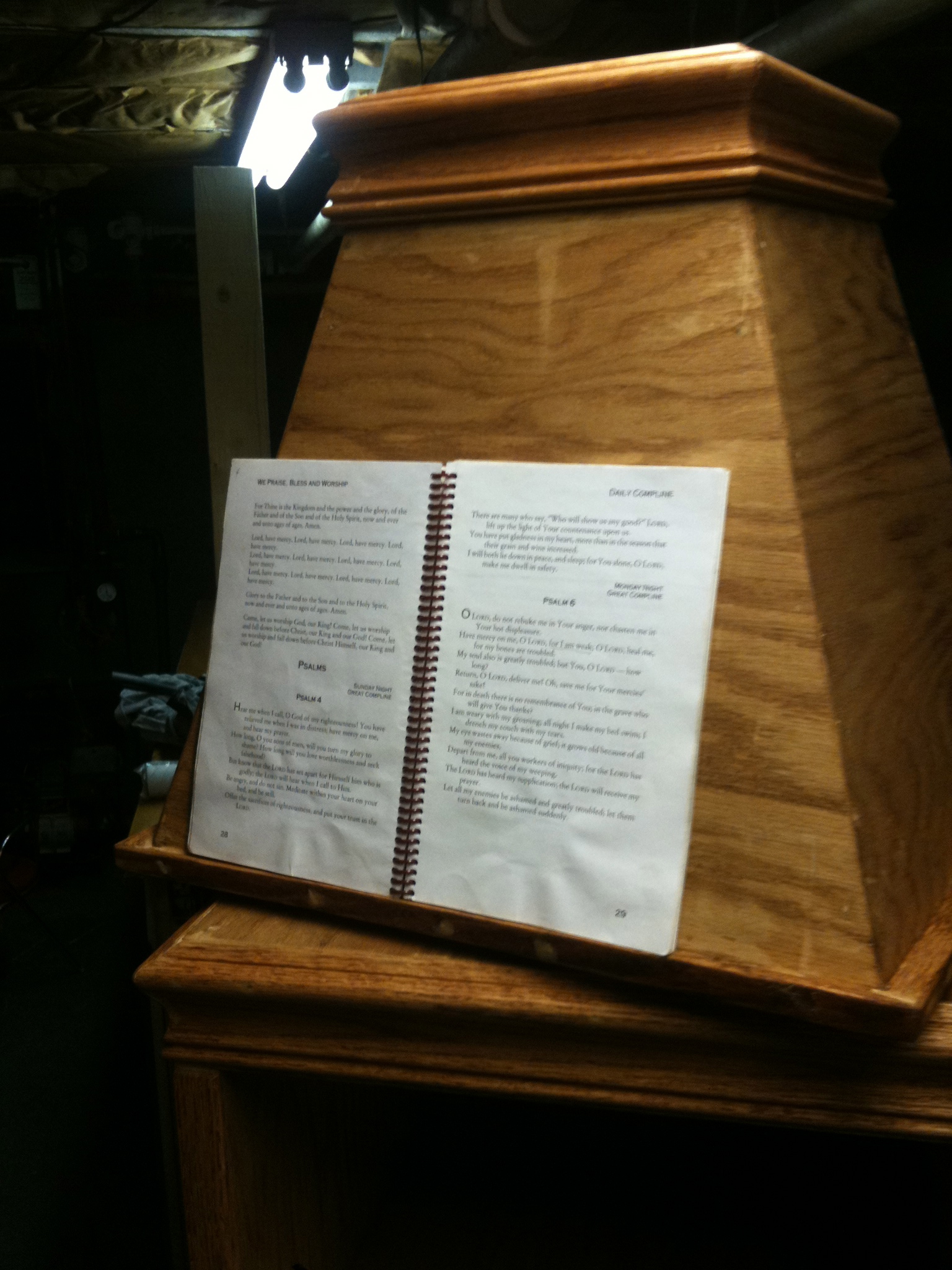
As I mentioned, I’m researching the purchase of an analogion/psalterion/lectern for the choir’s corner of the church. One of the things that has come to my attention is this, from St. Mary’s Orthodox Church in Coaldale, Pennsylvania, and it seems very much worth passing on. I don’t know yet if this will be the way we go, but this looks like beautiful work and a heck of a deal:
Dear Fathers, Brothers and Sisters in Christ,
Glory to Jesus Christ!
I pray you are having a blessed lent! Thank God, I am. It seems that the struggle has been proving to be a joy this year.
With the blessing of His Grace Bishop Tikhon youth from our parish (St. Mary’s – Coaldale, PA) will be making these beautiful prayer stands to sell, raising money for mission trips for youth inour diocese, as well as trying to provide the unemployed young men in our area the ability to work with their hands and not be idle. These stands will be made in a prayerful way, and are designed to be simple, yet very functional for parish or home use.
The main body is made of 3/4″ Oak plywood with solid oak trim. It stands about 68″ high and is appox.16″ x 16″ wide and deep. The four sided top swivels 360* and has 3 storage shelves below. The stand is also on casters so it can be moved easily. I have provided pictures so you can see the “almost finished” demo model. It will also have a three bar cross on each side, although in the pictures they have not been attached yet.
I can customize it if you like, although I am trying to keep a fairly standard sizing. I could make it shorter in height with ease, so that is not a problem. The one in the pictures is set with the book reading level falling at eye height for an average height person of 5′ 4″ to 6′ 1″. The stain in the photos is done in “Golden Oak”, but this could be any
If you are interested, we now taking orders now.
Pricing will be $680.00 plus shipping.
You can send me an email or call at 570-645-2772.
Please forward this to anyone you know who might be interested in this stand.
(We will also be producing a simple “prayer corner shelf” for your home or college dorm room- TBA)
In Christ, Fr. Daniel Mathewson
American beauty
Published 25 June 2011 General , The Orthodox Faith 4 CommentsTags: american church architecture, american orthodox architecture, american orthodoxy, andrew gould, church architecture, χρόνος, καιρός, militant americanist orthodoxy, modern byzantine architecture, orthodox architecture, orthodox architecture is bloody expensive, st. sava serbian orthodox church merrillville, the city on the hill, the difference between χρόνος and καιρός, this american church life, we need more american saints
 About seven years ago, I was driving to Chicago from Bloomington for the first time. I was with my friend Jonathan Wey, and we were on our way (as it were) there to pick up my wife up from the airport (long story). Once we were in northwest Indiana, I eventually saw this largish structure several miles off in the distance. My first thought was that it looked like an Orthodox church, but no, surely it’s a grain silo — why would there be an Orthodox church so large it’s visible from the freeway in Indiana, of all places?
As we got closer, however, it became clear that yes, it was an Orthodox church. Jonathan and I looked at each other, nodded, and I got off the highway so we could find it. It turned out to be St. Sava Serbian Orthodox Church in Merrillville (pictured), and there happened to be somebody there who let us in and showed us around. From what I remember, it’s a stunning building, lovingly constructed in every way, with an incredible attention to detail.
St. Sava Church also appears to be the only place where one can buy prints of St. Varnava, the first (and so far only) Orthodox saint from Indiana. I ordered one so that my wife could give it to the Russian church in Kiel that has been so hospitable to her over the last year, and when it arrived this week, they had also enclosed a little booklet titled “St. Sava Serbian Orthodox Church Visitor’s Guide”. It’s a lovely, professionally-produced spiral-bound publication that contains a history of the parish, details about the iconography, bells, and external mosaics, liturgical furnishings, and general information about Orthodox Christianity.
A few things jumped out at me about this little book. First off, this bit in the “Welcome” section:
Our present church was built on 140 acres… land purchased by the Church-School Congregation following [the burning down of the old building]… [T]he Priest and the Church Board undertook plans to finance and erect… what would be the “church of our dreams” in a “once-in-a-lifetime endeavor”. That seed having been planted, it gave birth to an ideal that included every church organization. Building and finance professionals helped to nurture the seed and guide its growth. It flowered as our unsolicited volunteers weed their labor-intensive work which epitomized God’s truth that “faith without work is dead”. All contributed their time, knowledge, talent and money to the church that would glorify God in the Divine Liturgy.
What’s interesting about this to me is that the building of a beautiful church is considered part of the work of the whole congregation, that it part of the expression of this community’s faith, and that this is What Orthodox Christians Do. This is reinforced a page later when the book goes into the exterior description of the building:
Saint Sava Serbian Orthodox Church was designed to conform with the spirit of Orthodox teaching. According to Orthodox belief, God is eternal King. Hence the church building, which is the sacred home for the worship of God, should be royal in every aspect. Orthodox Christians have always built their churches with that in mind and have always put into the church everything that they regarded as the best: the sturdiest building materials, the most beautiful adornments and the most costly utensils and vestments they could afford… Earthly royal splendor has always served as a pattern for the expression of heavenly glory. Orthodox church buildings are designed with the intention to make God, the Heavenly Kingdom and Salvation seem sensibly real and present.
Orthodox church have strict guidelines they must follow when building a church. The structure of church buildings is usually in the design of a ship or a cross. The ship plan resembles and signifies the ark of Noah in which he and his family were saved from the flood, while the cross plan reminds Christians of the Cross upon which Jesus Christ was crucified. Strict Orthodox Church guidelines detail that the length of the building must run parallel to the east-west line, so that the church sanctuary is always facing east. Saint John of Damascus (d.753) affirms that it is an Apostolic Tradition to worship facing east. The main entrance to the church is always through the western portal. Most churches have two side doors, the northern and the southern, and Saint Sava Church was built in accordance to all these traditions.
Byzantine architecture evolved from the Roman in the 6th century. The most popular Byzantine plan is a cross pattern in a square. The building is topped by a cupola, a cylindrical or polygonal drum covered with a dome, with narrow arched windows cut all around the concave space. Oftentimes in Byzantine architecture, the central dome is surrounded by several smaller cupolas on a lower level. Crosses embellish the top of every dome and belfry, signifying the church is glorification of the Crucified Lord and Saviour Jesus Christ. A great number of Serbian churches and monasteries have been built in the Byzantine style. Originality is expressed both in the design and the ornamentation, and no two churches are alike. Every church can be unique within traditional guidelines. Saint Sava in Merrillville was patterned after the church in Topola, Serbia, but differs with its columns and its west-facing windows.
All church buildings must be consecrated by a bishop before a Divine Liturgy can be celebrated. When a church is consecrated or christened, Kumovi (sponsors) are chosen. Glisho Rapaich, Michael and Yvonne Galich served as Kumovi to Saint Sava Church. Every Orthodox Church is dedicated to a Holy Event in the life of Jesus Christ; to the Most Pure Mother of God; to the Holy Trinity; to the Archangels Michael or Gabriel; to the Holy Apostles or to a Saint or Martyr for Jesus Christ.
The church of Saint Sava in Merrillville is a magnificent edifice which attracts great interest. People who see it from a distance are drawn to visit it personally (pp1-3).
So the building first and foremost is for the glory of God, being tangible, material icon of the Heavenly Kingdom on earth. The building itself is rooted firmly in the witness to Apostolic Tradition, the wider history of the oikoumene, that is to say, the Christian Roman Empire, and the specific, local history of Serbia. This adherence to tradition is confirmed by the whole Church, in the person of the Bishop, the people, and those in heaven with whom we worship. And, finally, this is done for the benefit of the larger community, not just for those who attend the church. The church building, in other words, is not incidental; it’s not just a random gathering of four walls and roof that only the Orthodox in a given area know about. It is an image of the Kingdom, and a witness to both the entirety of the faith and the unity of the Church for all who might see it. A lot of this we’ve heard before in the abstract, but here is an amazing, concrete example of a community making it happen.
I read a book a few months ago called When Not To Build. It’s written by a former Protestant church architect who became convinced that building new buildings is a distraction for congregations, and that churches are better off treating their buildings as more-or-less necessary evils for the purposes of gathering as we’re commanded, but beyond that, the building of big, expensive buildings is a money-pit and something that prevents churches from doing what they’re actually supposed to be doing. It’s a book that has some decent practical suggestions, to be sure, but much of it is problematic from an Orthodox point of view — it embraces the narrative of of post-legalization decline, certainly, and it has no patience whatsoever for a theology that would treat the building as having any kind of an iconographic function.
Problematic though it may be, it genuinely seems to be how a lot of people think. For the last six years, I have been part of the conversations at my parish towards building our permanent building, and these conversations continually circle back around themselves and go nowhere. Some of it has to do with money, but I think a lot of it has to do with being genuinely baffled at the idea that the building has any or all of the iconographic and traditional functions outlined by Andrew Gould and the people of St. Sava Church, and certainly the notion that the church building itself is intended to reflect royal splendor in materials and design runs contrary to Middle American ideals about avoiding conspicuous consumption. For some, it need be no more complex than a practical question of space to be solved practically — build whatever size pole barn or brick box you can manage, and retrofit a dome on top of it if it’s really that important to you for it to look “Orthodox”, whatever that means. Anything else is surely just too theoretical and abstract to be relevant to those of us here and now who have to build and use the place. I’ve even heard it suggested that building a beautiful church building is something that materially wealthy but spiritually dead communities do (usually implied somewhere along the way that these are “ethnic” parishes in addition), and that parishes that are spiritually alive (i.e., “convert” parishes) don’t need such trappings.
When Gould was here, he spent some time talking about multi-aisle design of his interiors, complete with interior columns and transepts, and how there’s a traditional diversity of kinds of spaces inside the church. Somebody asked a question that amounted to, well, so what? Why is anybody here going to think that that’s a good thing? It contributes to the beauty of the nave, Gould replied. “I don’t come to church for the beauty, I come for the participation,” was the answer. Now, to be fair, there’s evidently something of an assumption somewhere that multi-aisle designs are problematic or at least unnecessary in an American context; in the St. Sava booklet, it says that “we preserved the original model and its general characteristics of style and beauty, with additional attributes more practical to serve the religious needs of an American parish. The use of steel eliminated the need for interior columns in the nave…” (p.3) Still, it’s clear that St. Sava Church, in making those kinds of decisions, tried to work things out in the context of a traditional understanding of these matters, rather than an approach that assumes that the traditional practices are irrelevant and impractical.
And yes, traditional practices are also expensive. No question about it. Right now my parish is trying to replace our unsightly, inexpensive metal music stands with a proper analogion so that we can actually look like we belong in our little, awkward corner of the nave, and just that alone could be a few thousand dollars. One Orthodox woodworker said it could be done for as little as $1,000 and as much as $8,000, depending on how much carving we want. Extrapolate from there the cost of a full set of liturgical furnishings needed just to be functional, and it can’t be argued that there aren’t a lot of fantastic low-budget options for an Orthodox church that doesn’t have a woodcarver, metalworker, carpenter, iconographer, architect, mason, and general contractor all in-house. As somebody said to me recently, “Most of us struggle just to be able to pay the priest.”
At the same time, the St. Sava booklet acknowledges all of this, giving an account of things that makes it clear that the entire community made it its responsibility to contribute sacrificially of time, talent, and effort to build a church that would be an Orthodox witness to an entire area. They wanted people to see it from the highway and pull off to find it, and they were willing to do what they had to in order to make it happen. Maybe not everybody wants that, I suppose, but it seems to me that there’s a problem when we on the one hand criticize “ethnic” parishes for being insular and functioning as “little more than the tribe at prayer” and then set up churches in places that are hard to find, inaccessible, and invisible. However “ethnic” St. Sava may or may not be (and I don’t know, having never been there except for that afternoon), you can’t come down on them for trying to stay unnoticed.
I’m not entirely certain how to put all of these pieces together. Is a true “culturally American Orthodox Christianity” going to reflect a core frugality and practicality that sees the architectural and iconographic traditions as ostentatious and unnecessary? Are former bank buildings and insurance offices adapted as well as possible for liturgical use what we’re looking at? I suppose you could argue that church buildings started out as converted temples and public buildings, but it seems to me that that’s a different kettle of fish entirely. Do we get that there’s a difference between chronos and kairos, and that the church is built for one and not the other? Is beauty in Orthodox worship and building design something we’re going to have to redefine along American egalitarian, “horizontal” lines in order for it to be “relevant” enough? Is it a case where, if we see examples like St. Sava, we’ll be inspired to do it ourselves? Or is it a case where examples like St. Sava make us think, “Yeah, how nice for them. Nothing to do with us”?
A heads-up for all my Orthodox academic friends…
Published 21 June 2011 Academia , General , The Orthodox Faith Leave a CommentTags: orthodox scholars initiative
The Orthodox Scholars Initiative Database is up and running. Seems like a good thing to be part of — although, having just seen X-Men: First Class, the line “Identification is the first step” is still somewhat fresh in the ears… Anyway. If you’re worried about it being Orthodox LinkedIn for scholars, that doesn’t seem to be the point, thank goodness:
This database is designed to help build connections among Orthodox Christian faculty/researchers of all disciplines and specialties. In addition, it allows students, lay leaders, and clergy to register in order to discover these Orthodox Christian faculty/researchers and consult them as potential lecturers, researchers, mentors, etc.
Database interests of faculty/researchers may include, for example:
- Collaboration with Faculty
- Collaboration with Students
- Mentoring of Students
- Giving Lectures and Workshops
- Becoming Involved with Local Chapters of Orthodox Christian Fellowship (OCF)
- Field-Related Conferences
- Disciplinary Networking
- Looking for someone who is doing similar research
Registered users may choose from a range of privacy options, controlling which user groups can see profile information.
The database is born out of the work of the Office of Vocation & Ministry at Hellenic College, which sees the need on local, regional, and national levels for Orthodox faculty to be involved in the life and ministry of the Orthodox Church in the United States. We pray it will bear much fruit.
If you needed a gift idea for me…
Published 20 June 2011 Academia , Early Christianity , General , Media , The Orthodox Faith 1 CommentTags: diodore, Fr. John Behr, gift ideas for richard, oxford early christian texts, st. clement of alexandria, st. irenaeus of lyon, st. vlads, the case against diodore and theodore, theodore of mopsuestia
So, because I know my loyal readers (both of them) are desperately wondering what in the world to get the man who always seems to buy everything well in advance of his birthday and/or Christmas, or are looking for a late nameday gift, I thought I’d pass this on:
The Case Against Diodore and Theodore: Texts and Their Contexts, edited with a translation and a historical and theological introduction by John Behr.
This is a landmark work, providing the first complete collection of the remaining excerpts from the writings of Diodore of Tarsus and Theodore of Mopsuestia together with a ground-breaking study of the controversy regarding the person of Christ that raged from the fourth to the sixth century, and which still divides the Christian Church. Destroyed after their condemnation, all that remains of the dogmatic writings of Diodore and Theodore are the passages quoted by their supporters and opponents. John Behr brings together all these excerpts, from the time of Theodore’s death until his condemnation at the Second Council of Constantinople (553) – including newly-edited Syriac texts (from florilegium in Cod. Add. 12156, and the fragmentary remains of Theodore’s On the Incarnation in Cod. Add. 14669) and many translated for the first time – and examines their interrelationship, to determine who was borrowing from whom, locating the source of the polemic with Cyril of Alexandria.
On the basis of this textual work, Behr presents a historical and theological analysis that completely revises the picture of these ‘Antiochenes’ and the controversy regarding them. Twentieth-century scholarship often found these two ‘Antiochenes’ sympathetic characters for their aversion to allegory and their concern for the ‘historical Jesus’, and regarded their condemnation as an unfortunate incident motivated by desire for retaliation amidst ‘Neo-Chalcedonian’ advances in Christology. This study shows how, grounded in the ecclesial and theological strife that had already beset Antioch for over a century, Diodore and Theodore, in opposition to Julian the Apostate and Apollinarius, were led to separate the New Testament from the Old and ‘the man’ from the Word of God, resulting in a very limited understanding of Incarnation and circumscribing the importance of the Passion. The result is a comprehensive and cogent account of the controversy, both Christological and exegetical together, of the early fifth century, the way it stemmed from earlier tensions and continued through the Councils of Ephesus, Chalcedon, and Constantinople II.
About the Author
Fr John Behr is the Dean of St Vladimir’s Seminary and Professor of Patristics, teaching courses in patristics, dogmatics and scriptural exegesis at the seminary, and also at Fordham University, where he is the Distinguished Lecturer in Patristics.
His early work was on issues of asceticism and anthropology, focusing on St Irenaeus of Lyons and Clement of Alexandria. After spending almost a decade in the second century, Fr John began the publication of a series on the Formation of Christian Theology, and has now reached the fifth and sixth centuries. He has recently completed an edition and translation of, and introduction to, the remaining texts of Diodore of Tarsus and Theodore of Mopsuestia. He has also published a synthetic presentation of the theology of the early centuries, focused on the mystery of Christ.
If, perhaps, you’re looking for something a little less spendy, the book on Ss. Irenaeus and Clement would also work. There’s also the amusing anecdote in which I see somebody whom I think might be an usher at a Broadway musical who actually turns out to be Fr. John Behr (to whom I’m still quite grateful for his encouragement, I might add, even if I didn’t wind up going to St. Vlad’s and even if I decided to not go with his more specific research-related questions… yet).
Awesome.
Published 1 June 2011 General , The Orthodox Faith 9 CommentsTags: beer in bloomington, happydoxy, overlake christian church
I’m not sure why I just noticed this, but I suppose #6 represents some kind of a memorable milestone for this blog. Still, it would have been a lot cooler had the Owen White who was the old-school Ochlophobist of c. 3-4 years ago made fun of me, rather than the totally-over-Orthodoxy-and-if-I’m-not-going-to-go-to-church-anyway-I-may-as-well-not-go-to-the-Catholic-church-rather-than-not-go-to-the-Orthodox-church, “post-Ochlophobist” Owen. If I’d gotten a “Happydoxy” snipe or something like that, then that would have been major street cred, man.
I must offer a slight correction on a couple of points, however. I’m only an ex-Evangelical insofar as my mother took me to Overlake Christian Church as a child; I haven’t gone there regularly since I was 13 and at all since I was 16. To the extent that I’m ex-anything I’m an ex-Anglican. I won’t bother offering drinking and swearing bona fides to Owen, but he’s welcome to find out for himself whether or not I struggle to get through two beers should he ever come through Bloomington. I highly doubt this will ever happen for two reasons: 1) The drive between Memphis and Bloomington is awful and long under the best of circumstances, and there’s no reason to pass by Bloomington on any sane route out of Memphis unless Bloomington is exactly where you’re going, and I can’t imagine Owen ever actually wanting to come to Bloomington. 2) The only decent beer in Bloomington is from one of two microbreweries or specialty grocery stores, and surely there’s nothing more distastefully bourgeois than either of those. I could offer him a homebrew, except that I expect that a humanities grad student who homebrews is the only thing that could possibly be more bourgeois than a microbrewery.
I will note that Owen knows full well I agree with him on his criticisms of outward religious affectation in Orthodox converts, and that I’m neither the kind of guy to sign my e-mails “A sinner,” or to refer to myself as “Reader Richard”, so I have to conclude that he’s making fun of me specifically so he can refer traffic my way — in which case, thanks much! I do find it amusing that one of his busier admiring commenters now that he’s Catholic again is somebody who is one of the more notoriously argumentative anti-Orthodox online personalities out there, and who four years ago shrieked to me in an e-mail about how virulently and shamefully anti-Catholic he was, and how that was representative of most Orthodox bloggers. Maybe Owen will turn into the Catholic equivalent of… well, perhaps you already know who I mean without me saying the name, and I’d like to keep it that way, lest they appear.


 Leitourgeia kai Qurbana: Contra den Zeitgeist