Archive for the 'Media' Category


In which I finally find a reason to jump on the Susan Boyle bandwagon

Susan Boyle, as we all know by now, is naturally talented and beautiful on the inside, however her looks may rub our preconceptions a bit the wrong way. This is in marked, to say nothing of relieving, contrast to many people who go after the same dream as she is at present.

But, you know, it’s not news to me that somebody who looks like something other than a supermodel can sing. Unfortunately, neither is it news to me that many people had expectations about her based on her looks (which were, thank God, subsequently confounded).

No, the bit of this story that finally grabbed a heartstring or two was what she told Larry King:

She said she has no plans to get a makeover or alter her wardrobe — “Why should I? Why should I change?” — but did predict one big lifestyle change.

“I won’t be lonely,” she said. “I certainly won’t be lonely anymore.”

Aw, man. Now, that gets me choked up, and even starts to make me just the teensiest bit mad. I’m not even entirely sure I can articulate why.

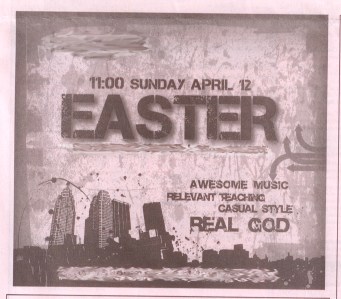
“REAL GOD”?

I found this ad in a newspaper last week. It doesn’t matter which newspaper, and I’ve intentionally removed any marks from the ad that would identify the church who placed it, because I want to deal with the content, not the agent.

So, maybe it just demonstrates that I’m not the target audience, but I have to be honest: I don’t get it.

There are exactly two details here which tell you that this has anything to do with Christianity; the presence of the words “Easter” and “God”. The cityscape and overall generic postmodern presentation certainly don’t tell you that, and there is nothing else about the ad which says in any way, “This is the day on which we celebrate the Resurrection of Our Lord and Savior Jesus Christ after His Crucifixion and three days in the tomb, and we celebrate this because if Christ is not risen, our faith is in vain and we are the most pitiable of all men.” Instead, particularly with the attributes being pointed up of “AWESOME MUSIC” and “CASUAL STYLE”, this might as well be an ad for a nightclub. Okay, fine, the ad tells us that the teaching is “RELEVANT” (whatever that means — relevant to whom?), but does it tell us that the teaching is Christian? Are we supposed to be relevant and assume the whole Christianity part will take care of itself, or vice-versa?

“REAL GOD”? What does that even mean? As opposed to the “FAKE GOD” you’ll find anyplace else?

What, in fact, does this actually do to proclaim the Gospel which Easter recognizes, commemorates, and celebrates?

There is a joke where somebody has to explain to St. Peter what Easter is in order to get into heaven. The person has to think about it a bit, but finally says, “Well, let’s see — that’s where Jesus is in the tomb, right?”

“Yes.”

“And the stone rolls away…”

“So far so good.”

“…Jesus comes out…”

“Yep.”

“…and if he sees his shadow, there are six more weeks of winter.” Ba-dum-pum.

If we want that to remain a joke with a clever punchline rather than the reality, we have to do a lot better than this. I do not doubt the sincerity of the community who placed this ad, but we either know, and are proclaiming, what we’re celebrating — that is, the Risen Christ — or we aren’t. I’m sorry, but this just plain doesn’t cut it.

If the trouble is a category error on my part — as my godson Lucas likes to put it, if I’m trying to figure out what color Tuesday is — and/or at thirty-two I’m just too much of an old fuddy-duddy to get it, then please, enlighten me.

Metropolitan Jonah: “There is an American Orthodox church. Leave it alone.”

Pan Orthodox Sermon by His Beatitude Metropolitan Jonah at St. Seraphim Orthodox Cathedral

Vodpod videos no longer available.

Well. Right or wrong, God bless Metropolitan Jonah, who has the saint’s utter lack of fear when it comes to saying what he believes God has called him to say.
So, is he right? Is he wrong? Hard to say. I suspect some people are going to find these remarks disrespectful, and I am not unsympathetic to that point of view, but I also think the reality is that prophetic words which need to be said tend to rub somebody the wrong way no matter what. That’s not to say the people who feel disrespected are wrong.
All I can say is, whether he is right or wrong, I hope people are listening. Not just the “right people,” whomever we might imagine them to be — I hope everybody is listening. Only if everybody is listening will these prophetic words have the value they need to have.
(Among the people I hope are listening is His Grace Bishop MARK. I think he and Metropolitan Jonah would be an utterly devastating team.)
(Second tip of the hat of the day to Rod Dreher.)

The preparations for the Great and Holy Council… in 1976

As noted earlier, preparations are underway to convene a pan-Orthodox synod. Looking into the background of this synod, I’ve seen references to the last big push to try to get something like this going, which occurred in the late 1960s/early 1970s and into the mid-1980s at the Orthodox Center of the Ecumenical Patriarchate in Geneva.

Fun fact: the first “preconciliar” conference started on the very day I was born, 21 November 1976 (Entrance of the Theotokos into the Temple on the Revised Julian Calendar).

So, there are nine published volumes of the acts and minutes of these various preparatory meetings. WorldCat doesn’t seem to be able to find any of them.

There also seem to have been things published in the Center’s journal, Episkepsis, but I can’t find that indexed anywhere.

Still, there’s also a collection of “introductory reports” published in 1972, and WorldCat was able to find that. I requested both the Greek and the English version via interlibrary loan.

Anyway, all of this leads me to two questions —

  1. Anybody have a sense off the top of their head how I could track these materials down?
  2. In terms of general scholarly practice, what does one do when one knows particular sources exist, but can’t find them through regular channels?

As a very general musing — how would this kind of research have been done in the days before the Internet?

By the way — my wife has a hatched chicken of her own, and I’m very proud of her. I’m not sure this one can be announced yet, but I’ll go into detail once I know I can. (No, she’s not pregnant.)

Connecticut middle school goes with Bill Cosby’s idea

At 3:28: “So you say something brilliant like, ‘LOOK, I DON’T WANT ANYBODY IN THIS HOUSE TO TOUCH ANOTHER PERSON AS LONG AS YOU LIVE!'”

As Rorschach might say, “Good joke. Everybody laugh.”

Except that East Shore Middle School in Milford, Connecticut has taken it seriously:

A Connecticut middle school principal has laid down the law: You put your hands on someone — anyone — in any way, you’re going to pay.

A violent incident that put one student in the hospital has officials at the Milford school implementing a “no touching” policy, according to a letter written by the school’s principal.

East Shore Middle School parents said the change came after a student was sent to the hospital after being struck in the groin.

Principal Catherine Williams sent out a letter earlier in the week telling parents recent behavior has seriously impacted the safety and learning at the school.

“Observed behaviors of concern recently exhibited include kicking others in the groin area, grabbing and touching of others in personal areas, hugging and horseplay. Physical contact is prohibited to keep all students safe in the learning environment,” Williams wrote.

Oh boy. Where to begin?

Look, I don’t envy public educators. They get it from all sides. They are in the position of being able to please just about nobody no matter what they do, so the best they can do is just try to cover their butts from a standpoint of legal liability and make the most of whatever it is they have. They are officially there to educate children, but for all practical purposes, they also have to function as a pharmacy, a daycare, a counseling service, and virtually every other child-related service imaginable.

Legally, public schools cannot be flexible enough to allow kids to be kids, because they are ultimately the responsible party if something goes wrong. Any ambiguity or grey area only increases their exposure to liability, thus the black-and-white, crystal-clear world of zero-tolerance policies. The bottom line is that every rule exists because of an after-the-fact need for one — zero tolerance policies are an attempt to pre-empt that after-the-fact need. The more conscience people have, the fewer cops are needed; the more cops, the less conscience.

Is it ridiculous? Of course it is. Do zero-tolerance policies relieve administrators of having to think about how they apply the rules? Of course they do. Is the goal of education taking a backseat to the necessity of keeping order? You bet. Are absurd situations being created, like zero-tolerance policies on weapons being understood to apply to things like school plays? Yessir. Are we eventually going to be encasing our kids in sanitized, hermetically-sealed plastic bubbles at school and keeping from from directly interacting with anybody? Probably. Are we overly-sanitizing more for the sake of the convenience of administrators than the benefit of students? Pretty much.

But, in all honesty, twenty years ago when I was in junior high, it wasn’t exactly like they were breeding grounds of justice and fairness then, either. They can’t be. Their job is to educate. In order to educate they have to have and keep order. In the absence of being able to do that, they can’t afford to be liable for what goes wrong. They can’t directly mete out consequences to individuals that will mean anything — and by and large, I don’t think I’m exaggerating to say that as a society we fear what that would look like — so as things get worse, all they can do is have a “one-strike-and-you’re-out” policy that applies to everybody.

We’re sending kids to school with a lot of baggage these days, and we expect the schools to check that baggage for them while they are under the school’s roof. When I was in elementary school and junior high, it was “latchkey kids” and “kids from broken homes” that had people worried. Even as late as 1985/1986, when I was in fourth or fifth grade, divorce was a scandal among us kids, enough so that we didn’t quite know what to do with kids whose parents were divorced. Mostly it was poorer families who needed to have both parents work and thus making kids go home to an empty house. Now those are pretty much the baseline of what is normative. If that’s all a kid brings to school with him/her, everybody’s gotten off easy.

Is homeschooling, the ultimate “opt-out”, the answer? I don’t know. Maybe. I don’t claim to know what the perfect solution might be. Our society is what it is. Our kids are what we’ve made them. I have very little sympathy for administrators who arm themselves with zero-tolerance policies like they’re bulletproof vests and then claim that they have no choice but to blast with a firehose rather than paint with a brush, but I also understand that most of them are human, and wouldn’t choose for things to be this way.

Every day we are robbing ourselves, and our children, of more and more of our own humanity, and the inevitable consequences take away even more of it. Eventually we’re just going to give the rest of it away because it’s too much bother, and it’s going to look a lot like a zero-tolerance no touching policy.

Bp. Hilarion watch: appointed to head Moscow Patriarchate Department of External Relations

Read about it here. Or not, in which case here’s a summary, courtesy one Nina Tkachuk Dimas:

By decision of the MP Holy Synod on 3/31/09 +Hilarion Alfeyev is appointed bp. of Volokalamsk, vicar to the Patriarch of Moscow.  +Hilarion is appointed head of the Dept. of External Relations and permanent member of the Holy Synod.  …..  +Mark of Yegoryevsk will temporarily oversee the Vienna, Austria/Hungary eparchy.

Many years! (Although, too bad for Western Europe.)

The death throes of various business models

Virgin Megastore is closing down; The Seattle Post-Intelligencer, my childhood newspaper, is going web-only, and its competitor/codependent sibling, The Seattle Times, may be following suit soon.

As a small child I once harbored fantasies of being able to organize clippings to create a real-life equivalent of Sherlock Holmes’ index; all I really managed to do was make a mess and hoard a large stack of issues of the P-I I would never be able to go through. For awhile I at least had a decent collection of clipped Phantom comic strips, and I still have virtually every item run between January and August 1989 on Tim Burton’s first Batman film in a scrapbook.

The music stores I frequented as a kid aren’t there any more; Love Music in Redmond (where a friend of mine and I drove late one night to get the new Hammerbox album on vinyl, speaking of things outdated), Easy Street Records in Kirkland (where I encountered Harry Connick Jr. once), Tower Records in Bellevue — all dead and gone, years ago. Borders and Barnes and Noble, my later retail enablers, seem to be increasingly less interested in CD sales. (“increasingly less”? Does that even make any sense?)

I will mourn the newspaper when its ultimate end arrives. It has been inevitable for some time; most of the last decade, it seems, has been the story of the decline of Seattle as a town where two dailies were viable. For a very brief period I worked for The Bellingham Herald; it was an illuminating look at a business which was horribly troubled even in 1998. It will be an odd day when the presence of a physical newspaper in a movie will be an anachronism which dates the work, but it is coming, and fast. Still, I’ve gotten the vast majority of my news via online sources for years now, and it hasn’t occurred to me that I want to buy a copy of a daily newspaper since at least 2003.

Much as I hate to admit it, however, I could not care less that the bricks-and-mortar music store is dying. Really, it’s been dead for awhile, depending on what your musical interests are — this is just a matter of the physical reality catching up with the industry. I have bought most of my music online since probably 2000 or 2001. If I see something I want in a physical store, unless it’s a copy of something that I’ve been looking for forever which has long seemed otherwise unavailable, I write down the name of it for reference and look for it on Amazon later — but the fact is, it is so rare that this happens it’s barely even worth mentioning. I’d love to be able to “buy local,” but the sad truth is that it’s been forever since small shops have been able to afford to stock what I like. I can’t find it at a small, local store even if I want to buy it there.

Regarding both the daily print newspaper and the bricks-and-mortar music store, there is simply no incentive, at least from this customer’s perspective, to stick with either business model when I can get what I want more easily, more quickly, and more inexpensively in other ways. Classical music, for example — and by that I mean the body of recordings which a classical music aficionado would actually want to buy, not Hooked on Mozart — has become harder to find at a physical retail store every time I walk into one for the last decade and a half. There’s just no point in even trying, when every time you walk in, you walk out frustrated — not when you can quickly search on Amazon and find the CD within seconds, usually even if it is out of print. I might also add that iTunes, which I originally thought would be a horrible format for classical music, seems to have figured out how to manage to make the “per-song” model work when each “song” is actually part of a bigger work. This is not just classical music, either; the further your tastes stray from the Billboard 200, the more this will be the case.

As far as the newspaper goes — y’know, nostalgia aside, let’s be honest. It’s intended to be a disposable medium anyway. Ephemeral as it effectively is (heck, the Greek word for newspaper is εφημερίδα ephimeridha), getting rid of the physical means of conveyance only makes sense, however much somebody like me, who wishes he could be cool enough to be a real Luddite, might want it to be otherwise. People aren’t going to pay for something disposable when there’s a free version that you don’t have to bother recycling, period. That said, I hope we don’t ever reach the point where we’re 100% paper-free; there is something about the interaction of content with substance that it would be a shame to totally lose. (There’s part of me that would like to argue that this is ultimately a form of Gnosticism, where media are irrelevant and content is everything, but I will need to revisit that another time.)

I raise a glass in memory of the newspaper; I frankly wish the CD store good riddance.

Asia News: Journey begins toward convening of grand pan-Orthodox synod

Perhaps this could be the topic of my West European Studies Masters thesis. From Asia News:

The invitation letters have gone out for the two preparatory meetings that will be held in June and December. Ten topics of discussion. The ecumenical patriarchate has been trying to hold a synod of Orthodox Churches since 1901.

Istanbul (AsiaNews) – With the sending of letters of invitation to all the heads of the Orthodox Churches for the two preparatory meetings for the grand pan-Orthodox synod, scheduled for June and December of this year, Bartholomew has set in motion the decisions made at the recent pan-Orthodox meeting in October, held in Constantinople, and attended by deceased patriarch of Moscow Alexy as his last act in life.

Bartholomew has stepped up the pace for the convening of the grand synod, which has the objective of responding to all of the problems that have built up over the course of centuries, and continue to plague relations among the Orthodox Churches, with extensive repercussions for the dialogue between Orthodox and Catholics as well. The schism of 1054, with all of its grave consequences for the universal Church, also deprived the Orthodox Church of the necessary impetus and ability to be constantly present in the course of history.

In the recent past, a first initiative for the convening of a pan-Orthodox synod was undertaken by Patriarch Ioakim III in 1901. He wanted to smooth over the tensions among the autocephalous Orthodox Churches, in the conviction that only an Orthodox Church engaged in a constant and constructive inner dialogue could face the challenges of the contemporary world and act with one voice and one heart. This initiative did not succeed, in part because the Orthodox Churches, which had recently emerged from
Ottoman rule, were seeking their identity in an exaggerated identification with the nation, and the full breadth of the Christian message was not instilled in their clergy.

After various mishaps, in 1961 a pan-Orthodox conference was convened in Rhodes, with significant pressure from patriarch Athenagoras, for the purpose of preparing an Orthodox synod. This conference was also followed by numerous obstacles, because as theologian Giorgos Tetsetis observes, the local Churches did not have a clear idea of what they wanted from the Synod.

Now, the letters sent for the two preparatory meetings to be held in June, in Cyprus, and in December, in a place to be determined, present the following topics:

  1. The Orthodox diaspora, where the jurisdiction over the Orthodox flock beyond national borders will be defined. According to the canons now in effect, before the growth in the phenomenon of emigration the faithful outside of their home country belong to the ecumenical patriarchate.
  2. The manner of recognizing the status of autocephalous Church.
  3. The manner of recognizing the status of Church autonomy.
  4. Dypticha, meaning the rules of mutual canonical recognition among the Orthodox Churches.
  5. Establishing a common calendar for feasts. For example, some Churches celebrate the Nativity on December 25, others 10 (sic) days later.
  6. Impediments and canonicity of the sacrament of matrimony.
  7. The question of fasting in the contemporary world.
  8. Relationships with the other Christian confessions.
  9. The ecumenical movement.
  10. The contribution of the Orthodox in affirming the Christian ideals of peace, fraternity, and freedom.

The first four questions were the cause of friction in 1993 and 1999 with the patriarch of Moscow, because of participation in the work of the autonomous Estonian Church, with Moscow does not recognize.

“It is time,” says Fr. Tetsetis, a theologian for the ecumenical patriarchate, “that our Church finally realize that it is doing poorly as a whole. The Church needs an open and sincere dialogue. Because it is only then, with its rich tradition as a compass, that it will be able to emerge from its blind alley and together face its existential problems, which are becoming increasingly severe and complicated. It is only then that the importance of the Ecumenical Patriarch’s initiative can be understood.” According to the journalist Aris Viketos, the letter from Bartholomew is being well received in the Orthodox world.

Well, the misunderstanding about the difference between calendars aside, isn’t that interesting. Oh, to be a lay observer in the planning meetings…

A reasonable question about Watchmen

An e-mail from a reader which asks an entirely fair question, and one which I wondered if I wouldn’t get from somebody:

Are you sure you want to recommend (and so enthusiastically!) … Watchmen?  It’s one thing to set such evil images before your own eyes, but must you also encourage others to do the same?  (See Psalm 101:3).  Do you really want to reward the makers of this film with your money?

I respect this question, and I do not take its points lightly. What I can say is that if I thought the film was intended to be, or best understood as, a cheap piece of trashy violence, I would neither see it nor recommend it. I don’t waste a second of my time with junk like the Saw films or Friday the 13th or Hostel or things like this. Nor does a sheen of “art” excuse everything; The English Patient is a beautifully done piece of garbage, in my opinion, which ultimately says that committing adultery is worth dying for, if it means you’re following your heart.

I’ll note, again, that I spent some time tonight listening to my priest discuss enthusiastically the Orthodox Christian merits of The Matrix, a movie which contains much violence and disturbing imagery. The Passion of the Christ is, of course, notorious for its level of gore, which I would argue exceeds that of Watchmen. The Mission, one of the most profoundly Christian movies I’ve ever seen, contains extensive nudity and quite a bit of violence interspersed with religious imagery, particularly at the end. (Don’t tell me that the nudity, being non-sexual, makes it okay; that didn’t keep parents from having their kids excused from watching it when my English teacher showed it in class my senior year of high school.)

Let’s not even talk about Shakespeare and Hamlet’s “country matters.” Or most opera.

This begs the question — what is the merit of Watchmen? I would argue that it is, at its core, a movie which suggests that whether or not God exists, we’re best off assuming He does and that He’s watching rather than deciding He doesn’t and putting ourselves in His place. This is as yet, shall we say, under-theorized, but this is part of why I say, go see it, and then we’ll talk.

At one point, a Jewish character in the movie, who has invented a superhero identity for himself, asks another superhero whose identity has heavily American patriotic overtones and who is breaking up a riot too violently for the other’s taste, “Whatever happened to the American dream?” and the patriotic hero replies, “It came true. You’re looking at him.” Now, when you realize that the way a couple of Jewish kids from Cleveland tried to actualize the American dream for themselves by inventing the first widely-known superhero who himself had American patriotic overtones (I am referring to neither a bird nor a plane), you understand what this scene is actually about. If Superman were to actually exist in real life, and be American (something explicitly said in the film), it would be monstrous; it would be an establishment of other gods in the place of the True God; it would be chiliasm. It would lead to the destruction of everything we claim to hold dear as Americans and as Christians.

All of this aside, however, one must follow their own conscience, and I don’t encourage anybody to seek out things which would make them stumble or to go against their better judgment. Do not go see it if that would be the case.

I’ll also point out that the movie is rated R, it is rated R for good reason, and that needs to be respected — in other words, it is not a movie to which I advise anybody to bring their kids. As with the source material, the violence and sexual material is used to explore, and comment upon, both the themes of the story as well as the medium through which the story is being told. I will qualify here that I don’t have a lot of perspective on how old somebody would need to be to be able to deal with this; as I said earlier, my first encounter with the source material was at age 13 or thereabouts. Then again, my first book was Carl Sagan’s Cosmos, which I read at the age of 4.

Varii (go see Watchmen) and (go see Watchmen) sundries (go see Watchmen)

A “Byzantine” monastery from the late 5th/early 6th century has been found about five miles west of Jerusalem, reports CNN:

During the first few weeks, the team exposed the church’s narthex, the broad entrance at the front of the church, whose floor is covered with colorful mosaics in geometric patterns, he said.

“Unfortunately, at the conclusion of the excavation this mosaic was defaced and almost completely destroyed by unknown vandals,” Mor [the leader of the excavation] said.

Ouch. On the other hand, I smile at this detail (particularly since I just finished my first-ever attempt at homebrewing):

The excavators also partly exposed a complex wine press, said Mor. Grapes grow well in the region, and it’s likely the monks sold the wine.

And it’s in my period and region, too. Hmmmmmmmmm.

The screenwriter of Watchmen urges people who liked it to see it again, preferably this Friday or Saturday (a tip of the hat to WatchmenComicMovie.com):

This is a movie made by fans, for fans. Hundreds of people put in years of their lives to make this movie happen, and every one of them was insanely committed to retaining the integrity of this amazing, epic tale. This is a rare success story, bordering on the impossible, and every studio in town is watching to see if it will work. Hell, most of them own a piece of the movie.

So look, this is a note to the fanboys and fangirls. The true believers. Dedicated for life.

If the film made you think. Or argue with your friends. If it inspired a debate about the nature of man, or vigilante justice, or the horror of Nixon abolishing term limits. If you laughed at Bowie hanging with Adrian at Studio 54, or the Silhouette kissing that nurse.

Please go see the movie again next weekend.

You have to understand, everyone is watching to see how the film will do in its second week. If you care about movies that have a brain, or balls, (and this film’s got both, literally), or true adaptations — And if you’re thinking of seeing it again anyway, please go back this weekend, Friday or Saturday night. Demonstrate the power of the fans, because it’ll help let the people who pay for these movies know what we’d like to see. Because if it drops off the radar after the first weekend, they will never allow a film like this to be made again.

Fine by me — er, seeing it again, that is, not the other proposition. Who wants to see it with me on Saturday sometime?

I saw Watchmen in IMAX last Friday. It is worthy of its own post, and that might happen after I see it a second time, but I will say for the moment that it is a challenging, adult, in-your-face, no-holds-barred piece of art which is worth seeing and to which it is worth reacting. Yes, it is violent and the violence makes you giggle in a way which makes you very uncomfortable with yourself after the fact. Yes, there is a bizarre use of Leonard Cohen’s original recording of “Hallelujah” (which, I must say, is very jarring listening to begin with when you’re used to the — dare I say it? — superior Jeff Buckley version). Yes, I read the book — I read it for the first time probably twenty years ago and have read it any number of times since then, including reading it aloud to my wife. I’ve read much of what’s been published about Watchmen the book and have been following its development as a film since way back in the day when Comics Scene had a half-page interview with Sam Hamm about his screenplay and about how Terry Gilliam would direct it. Hamm, as I recall, speculated about perhaps Michael York as Adrian Veidt and Robert DeNiro as Edward Blake. Might have been interesting.

Anyway, go see it. I’ll go see it with you. Blade Runner shouldn’t have taken as long as it did to be recognized, and I’d hate to see a similar fate befall Watchmen. It’s a big-budget Hollywood art movie, much like The Dark Knight was, but unlike TDK this doesn’t have much in the way of presold factors that allow people to be fooled into thinking it’s just an action movie. It’s not perfect, but that’s okay. Just go see it, and then we’ll talk.

After the Liturgy of the Presanctified Gifts tonight, Fr. Peter was talking about how Orthodox Christianity permeates the first film of The Matrix trilogy. “It’s all about the Fathers,” he said. “It’s an Orthodox movie through and through.”

“If that’s the case,” I replied, “it must be advocating specifically the Western Rite.”

“Why is that?” Fr. Peter asked, tilting his head at me with a quizzical expression (which is not uncommon).

Without missing a beat I looked him right in the eyes and said, “There is no spoon.”

I will be going to Confession this weekend, I imagine. I don’t look forward to the penance.

adventures in writing alexander lingas all saints bloomington all saints orthodox church american orthodox architecture american orthodox music american orthodoxy Antiochian Archdiocese Antiochian Orthodox Christian Archdiocese of North America Antiochians books byzantine chant cappella romana chant church architecture ecclesiastical chant ethnomusicologists ethnomusicology fellowship of ss. alban and sergius Greece Greek greek food greekness hazards of church music international travel tips ioannis arvanitis joe mckamey john michael boyer kurt sander Latin liturgical adventures liturgical architecture liturgical music liturgical texts and translation liturgy liturgy and life lycourgos angelopoulos medieval byzantine chant Metropolitan PHILIP militant americanist orthodoxy modern byzantine architecture modern greek music music as iconography my kids will latin and greek when they're newborns my kids will learn latin and greek when they're newborns orthodox architecture orthodox architecture is bloody expensive Orthodox choir schools Orthodox Ecclesiology orthodox outreach orthodox travel pascha at the singing school Patriarchate of Antioch Patriarch IGNATIUS IV Patriarch of Antioch publishing random acts of chant richard barrett in greece richard toensing rod dreher sacred music st. vlads st john of damascus society Syriac the Bishop MARK fan club the convert dilemma the dark knight The Episcopacy The Episcopate the only good language is a dead language this american church life travel we need more american saints why do we need beautiful music in churches?

Blog Stats

  • 272,453 hits