Archive for the 'General' Category


Review: Garments of Salvation: Orthodox Christian Liturgical Vesture by Krista M. West

Kh. Krista West has made a name for herself as a wonderful tailor of Orthodox church vestments. She does lovely work; I bought an exorason from her three years ago to replace the cheap, ill-fitting, mass-produced cassock that I originally got when I was tonsured as a reader, and it is high-quality. I have heard people gripe about her work being supposedly “the exact same thing you can get through one of the ecclesiastical suppliers, just for three times the cost”, but I know the difference, and that’s just not true. If one follows the principle that the most cost-effective way of doing anything is to do it right the first time, then Kh. Krista’s work is definitely worth it. Yes, I may pay four times for an exorason from her what I paid for one from one of the supply houses, but I expect one of her garments to last me a lifetime if I take care of it properly, as opposed to replacing it every few years.

Kh. Krista has done a lot of work, through media efforts like The Opinionated Tailor, to try to inform laypeople about the importance of, not just vestments, but good vestments. She’s a practitioner of a liturgical craft who, to the best of her ability, tries to be as informed about her craft as she can be, and also an evangelist through that craft, and through education about that craft. This is something I truly respect. As somebody with similar objectives in the craft I work in, I find it intriguing, but also unfortunate, that the people who work seriously with the liturgical crafts of Orthodox Christianity are put in a position of having to be the best advocates for those crafts, rather than the leadership of the Church itself. Sometimes it can very much seem like lay and clerical leadership tries very hard to downplay advocacy for liturgical crafts, either out what is called “pastoral necessity” or a desire to “not reify worship” or simply from a lack of resources making it necessary to speak of them from a spiritual, rather than practical, standpoint. I’ve seen this with music, I’ve seen it with architecture, I’ve seen it with vestments. Orthodox Arts Journal I think is a good venue for discussion of a lot of these things, and I’d love to see Kh. Krista write a piece for them. Architect Andrew Gould also has pulled together his own workshop/cooperative for liturgical crafts, and vestments are among what his collaborators are producing. My hope here is that “more is more”, and that this points to more of quality being produced by all involved, in all disciplines.

So, the most recent fruit of Kh. Krista’s efforts is a book — Garments of Salvation: Orthodox Christian Liturgical Vesture, published this year by St. Vladimir’s Seminary Press, and they were kind enough to send me a review copy.

I’ll talk about the book in a moment. Before I do so, however, I need to talk about how I approach reviews for this blog. As a blogger, I really try to review things first and foremost from an inherently friendly, constructive, and appreciative perspective. This isn’t to say I try to make every review an exercise in sending everybody off with a head pat and a “Good try!” at the very least, but I also don’t want to be a nitpicky critic who tears things down because he enjoys tearing things down, because I don’t enjoy tearing things down. I should also say that this is different from my persona as a writer of academic book reviews for scholarly journals, where it is my job to be critical and merciless where it is necessary (and I have most certainly done that when I have had to). Bottom line, I don’t like to be jerk if I don’t have to be, and even when I have to be, I try to not be any bigger of one than is necessary.

However, even within the rubric of “not being a bigger jerk than I have to be”, I still have to report fairly and honestly on things I review for this blog. If something has problems, I have to be up front about what those problems are — but I will endeavor to be as constructive in my discussion of those problems as I can manage. I don’t want to be in the business of hatchet jobs; I want to be helpful, not obnoxious.

So, all of this is is a very long-winded prelude to saying that there are severe problems with Kh. Krista’s book that can’t be sugar-coated, and this is going to be a negative review (one that I really don’t want to write). My hope is that it can be a constructive review, however, because there is a lot here that deserves a hearing; there’s just a long way to go yet before it gets there.

First off, this is a great topic. Vestments are, along with iconography and architecture, one of the most striking visual elements of an Orthodox service. Even if one is in a storefront church with two mounted print icons on easels at the front, there’s going to be a fully-vested priest (probably). The iconography of the priesthood that the vestments carry will at least go with with the person who himself stands as the icon of Christ at the altar, even if other iconography might be lacking. Kh. Krista seeks to cover a lot of ground with this topic, too, starting off with a Prologue that summarizes her own journey from recent convert to experienced vestment maker, with a discussion of Photios Kontoglou’s writings on Byzantine aesthetics as providing a basis for her understanding of the principles at work. The first chapter outlines the theological import of vestments in terms of incarnational theology, the sanctification of matter, and the heavenly beauty of the Church; the second chapter traces the historical development of garments from antiquity through late medieval Byzantium; the third chapter discusses in detail present-day use and practice; the fourth chapter looks at church furnishings or “paraments”; the fifth chapter is a discussion of the Byzantine perception of color and how that applies to the colors of vestments used throughout the liturgical year; the sixth chapter is about the history of textiles used for Orthodox liturgical vestments. There is then an Afterword that is something of a manifesto about how Orthodox Christians in this country need to approach the vestment tradition, and then appendices on the practical care of vestments, the prayers of vesting, and a glossary of terms.

Secondly, this is a great topic being tackled by somebody who clearly has a lot to say about it and has gone to great lengths to understand it from the inside out. As the above outline hopefully makes clear, Kh. Krista speaks about vestments from a number of different vantage points; the history of their development, the materials they’re made from, how rubrics in the service books about color assume a different perspective on color than our modern view, how they work in conjunction with other liturgical furnishings, how the textiles are made, and so on. These are all worthy things for Orthodox Christians to think about, whether they might be wearing them, making them, or simply looking at them being worn. What do these colorful garments mean, where do they come from, and why do our clergy wear them?

Unfortunately, this book is hampered by a lack of an obvious intended audience, which subsequently keeps the book from having sufficiently specific focus or a clear structure. It is further hampered — and this, I think, is the core problem — by an apparent lack of proofreading or outside readership at the pre-publication stage, which is made evident in some obvious factual errors and an approach to citations that is at once overdone to the point of being distracting, but also not as informative as one would want. To put it another way: this is a book that needs to decide whether it is primarily for clergy and interested laypeople, or if it is a more academically-shaded work (but perhaps still at the popular level). Right now it is trying to be both, but it manages to be neither.

Let’s start with the factual errors: the most obvious, and therefore the most troubling, are in the chapter on historical developments. Page 60, for example, tells the reader the following:

At the Council of Laodicea in Phyrgia [sic], at the end of the fourth century (AD 342-380), minor orders were forbidden to use the orarion, which demonstrates that the garment was already well established as an identifying mark of the clergy by that time.xxii In Canon 23, St John Chrysostom provides the first extant mention of the sticharion as a purely liturgical garment (although he refers to it as a “chitoniskos” which is linguistically related to “chiton,” the ancient Greek word for tunic).xiii [sic]

First of all, there’s the typo on Phrygia, but then there’s the reference to the Council being “at the end of the fourth century” with the years given as 342-380. 342-380 cannot be considered “the end of the fourth century”, but then Laodicea was actually in 363-64 to begin with, which also can’t be considered “the end of the fourth century”. And while she’s right that Canon 23 speaks of the orarion, to attribute Canon 23 of Laodicea to Chrysostom is a head-scratcher, since he wasn’t there and would have been all of 16 years old when it took place. To Kh. Krista’s credit, her footnotes help one track down the error — although, again, a typo hinders the effort somewhat; note that we go from citation xxii to citation xiii. Since the next citation is numbered as xxiv, I assume she means to give the notes in sequence, so looking at citation xxiii, she cites page 37 of Archimandrite Chrysostomos’ Orthodox Liturgical Dress, published by Holy Cross Orthodox Press in 1981. Page 37 of this book does indeed talk about the orarion and Chrysostom’s mention of it: “The first use of the sticharion as a purely liturgical garment is recorded in the writing of Saint John Chrysostom. Chrysostom describes a garment which in every respect is the sticharion, but he uses the word chitoniskos to identify it.” The author provides a footnote; it’s a Patrologia Graeca reference, and looking it up, it’s from chapter 6 of Chrysostom’s Homily on Matthew 26:26-28, not the acts of the Council of Laodicea. Finally, as a minor point, describing chitoniskos as “linguistically related” to chiton is too imprecise of a statement to be at all informative. “chitoniskos from chiton” would be sufficient here.

Another factual problem is Figure 10 on page 66 (below).
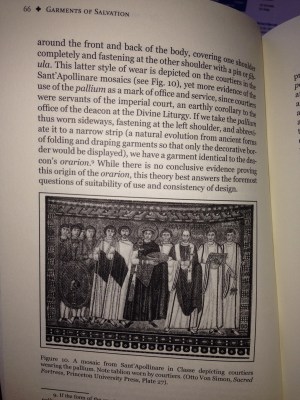
west page 66 figure 10

This is a mosaic she refers to as “[a] mosaic from Sant’Appolinare in Classe depicting courtiers wearing the pallium.” The trouble is, it isn’t; it’s the mosaic of Justinian from San Vitale in Ravenna, one of the most identifiable mosaics from Late Antiquity:

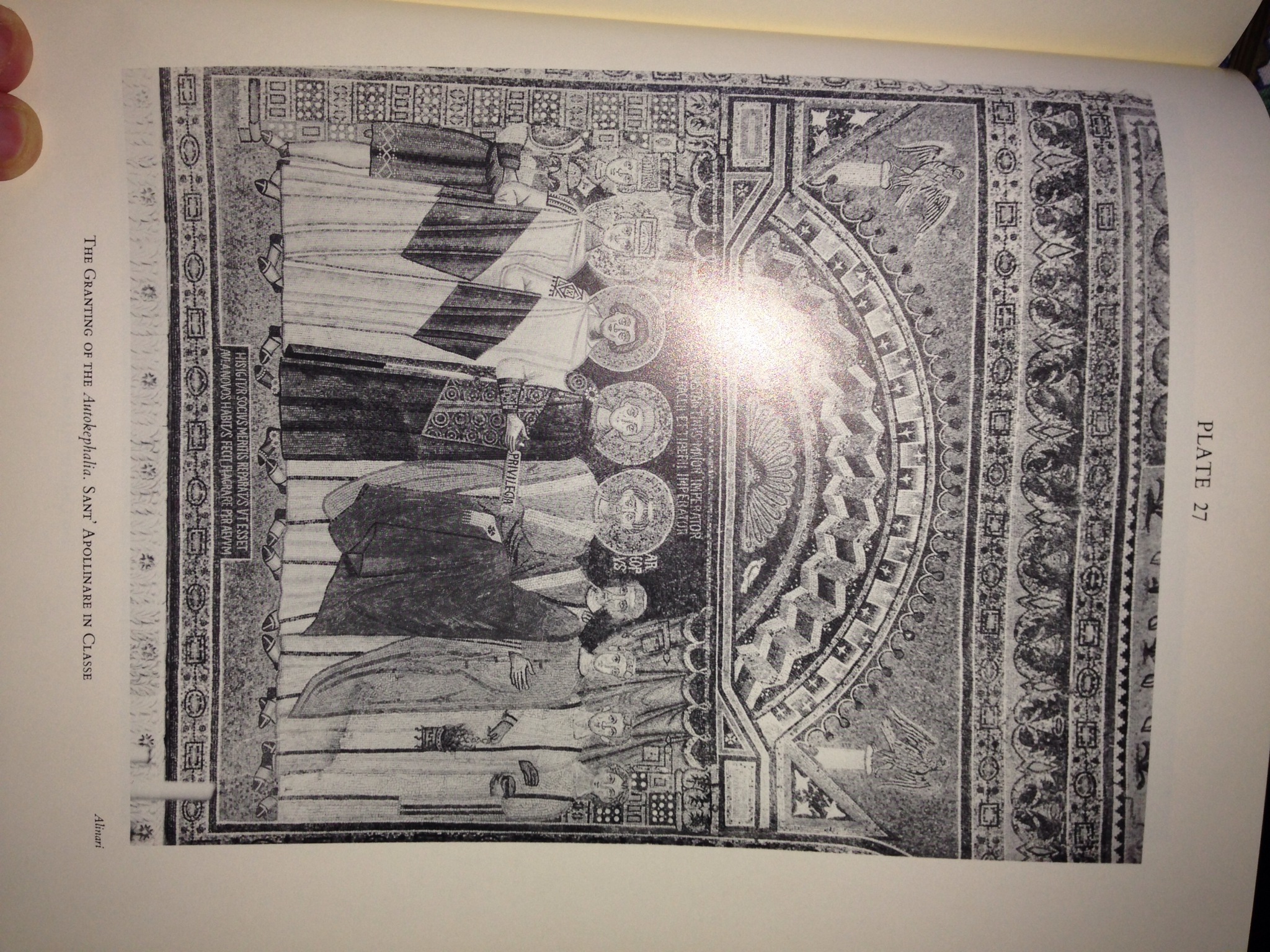
Again, to her credit, her footnotes help track down the problem. Kh. Krista cites Plate 27 of Sacred Fortress by Otto Von Simon [sic, actually Von Simson], which is this image:
von simson plate 27

This is, in fact, Sant’Apollinare in Classe, but it’s not the same image as what she shows. I grant that they are similar enough in the broad strokes that it’s easy to see how the error might happen, but this is still a major misidentification. It’s particularly unfortunate because later in the book Kh. Krista mentions seeing San Vitale in person; it’s clear she knows the difference, but this mistake made it into the manuscript and through the editorial process regardless.

The book’s citation system is helpful in cases like this, but it is also at once overdone and underdone. Kh. Krista, for some reason, uses both endnotes and footnotes, inserting numbered footnotes for additional commentary and Roman numeral endnotes for source citations. I’m not sure I understand what this accomplishes, and it’s certainly not a standard approach. Better to do all endnotes or footnotes, or, if one must separate source citations from comments, to use parenthetical citations. The problem isn’t just how she does it but also when, however; in the third chapter, she speaks extensively of practical matters concerning vestments — how they are made, what they look like, who wears them, and when — but cites almost nothing in terms of sources of this information, and this is particularly concerning when she asserts that this is the oldest tradition or that one is not in keeping with tradition.

To be clear, Kh. Krista is forthcoming about her own limitations in the acknowledgments and the Prologue; she describes herself as “just a tailor… I do not have any letters after my name and I certainly am not a scholar” (p. 16). Well, it is clear from the scope and the effort put into this book that she is more than “just a tailor”. At the same time, this is a big project with an expansive scope, and details such as those I’ve described are going to matter. Another point where the boundaries of her abilities don’t help her is with non-English sources; she is, again, up front about her limitations where this is concerned, but it means she isn’t able to engage things that should directly impact some of what she discusses. There is, for example, her discussion of the use of the exorason by cantors:

The outer cassock, known as the “exorason” in Greek or “ryasa” in Russian, is the more voluminous form of the cassock and is worn over the inner cassock in semi-formal, formal, and liturgical settings. Of elegant design, the exorason features the same front and back construction as the zostikon, but instead of angled fronts a triangular-shaped section is sewn to each front and the particular cut of this piece allows the fronts of the garment to overlap along the center without any closure, save for the hook-and-eye closure at the mandarin collar (whereas the zostikon has multiple collar variations, the exorason invariably features a mandarin collar). These front edge panels are fully lined so that, when they fall open as the wearer walks, the back side of the piece is as beautiful and finished as the front side. The garment employs the same general sleeve panel arrangement as the zostikon, but instead of a tailored sleeve-and-gusset combination it has a very large kimono sleeve sewn to a side panel which has eight-inch vents at the hem to allow greater freedom of movement while walking.The width of the sleeves is an indication of rank: chanter’s width sleeves are approximately thirty-six inches in circumference, the deacon’s and presbyter’s are forty-eight inches, and the bishop’s width is sixty inches. The sleeves have a six-inch deep lining that is made from the same fabric used for the lining of the front edge panels. The sleeves are worn long, typically two to three inches longer than inner cassock sleeves and thus covering the hands entirely when the wearer stands with his hands at his side. […]

In the Greek tradition the exorason is worn for services by chanters and sextons (liturgical assistants) with the narrowest-width sleeves and with no inner cassock underneath… Orthodox faithful in North America are sometimes puzzled by this liturgical use of the exorason by members of the laity, particularly when it is worn by women chanters. In this regard it is helpful to note that the narrow-sleeved version of the exorason is essentially the traditional Greek Orthodox Christian version of a choir robe. In Greece the chanter’s exorason is often made distinctive by the placement of galloon or colored, decorative banding upon the collar. (pp.114-116, emphasis mine)

This is certainly descriptive of some customs regarding the cantor’s use of the exorason; however, something that needs to be addressed here is the instruction of the Ecumenical Patriarchate that the psaltis‘ cassock is to be indistinguishable from that of the priest, and not made distinct by collars or sleeve width, precisely because the cantor is part of the clerical order and not something separate. Kh. Krista also does not mention in her historical discussion the distinctive vestments worn by the psaltes and domestikoi previous to the fall of Constantinople (and colorfully recreated by the Romeiko Ensemble).

There are three more problems I’ll mention briefly; there is a historiographical problem, in that her historical treatment (particularly of textiles in chapter 6) does not adequately acknowledge periodization. Does the rich textile industry she describe persist from late antiquity until the Latin Empire in 1204? How, then, to make sense of Liutprand of Cremona, who writes during his visit to Constantinople in the middle of the 10th century that the robes are “old, foul smelling, and discolored by age”? Periodization is always arbitrary, to be sure, but it will be helpful here to keep from misleading. There is also a bibliographic problem, in that even in English language literature, there is much missing from her citations that would help her discussion. One of the most interesting chapters in the book is about how the Byzantine conception of color is very different from the modern understanding of the spectrum, and the work of Liz James here would be incredibly useful — notably, Light and Colour in Byzantine Art (Clarendon Press, 1996), as well as her more recent article “Colour and Meaning in Byzantium” (Journal of Early Christian Studies 11.2, Summer 2003, pp223-33). Mark Bradley’s Colour and Meaning in Ancient Rome (Cambridge University Press, 2011) would also probably be a worthwhile reference.

Finally, there’s a theoretical problem, and it’s one that troubles everybody who would be a practitioner of traditional Orthodox liturgical crafts in this country; p.79-80 avers that “[t]he study of vestment construction… must be based upon the traditional apprentice and master model in which one desiring to learn the craft of vestments must study with a master tailor for a period of several years.” And yet, what Kh. Krista tells the reader of her own journey to being a master tailor she tells in largely the language of an autodidact. How do we reconcile this? I don’t know. It is certainly the reality of being an Orthodox Christian in this country that easy access to the sources for this kind of knowledge is not readily available — as I’ve recounted here before, the closest Byzantine chant teacher to where I live is five hours away, and I ultimately found it more practical to go to Greece for a summer and find somebody there.

All of this said — and I need to stress this, since I’ve spent around 2000 words talking about the problems — there is a lot here that’s good, it’s just a question of getting clear on the audience and reworking it accordingly. The good parts here are disjunct; her foregrounding of Photios Kontoglou’s aesthetic writings is really nice, for example, but it’s not threaded through the entire book sufficiently to feel like a framework. Besides that, it feels like there are pieces of at least three books here; a historical treatment, a description of present day practice, and a call-to-arms about what Orthodox Tradition means in the United States. These parts can be synthesized into an organic whole, but it’s not there yet.

Right now, the problem with citations aside, the chapter where she talks about present-day practice is her surest footing, and is what I would look to as the centerpiece of any revision. Perhaps the book is really for an audience that doesn’t need citations, just a list of books at the end titled “Additional Reading”, in which case the history chapter really could get away with being a summarized version of its present form that’s a few pages long. Or, maybe it really is a more scholarly treatment, in which case the third chapter is still a great anchor, it just needs to be clearer where she’s getting her information. In either case, once the focus is figured out, then the long block quotes from secondary literature need to be summarized rather than quoted, the citation system needs to be straightened out, the errors need to be fixed, and I would also make a strong plea for at least some color plates.

I’d like to close this review by saying that I think Kh. Krista has probably made about as honest of an effort as somebody in her position could possibly make on the first draft of a project like this. Errors happen, focus gets lost, chapters get away from people — even for the most celebrated of scholars! Unfortunately, much of the apparatus that used to be standard for publishers in terms of getting books to the next level after the first draft — outside readers, copy editing, fact checking, etc. — is, so people at my own lowly level are told when we attend publishing workshops, cost-prohibitive for all but the most financially secure of presses. It is unlikely that even a seasoned academic will be able to successfully edit and evaluate their own book without mistakes creeping through, so as far as I’m concerned, none of this really reflects badly on Kh. Krista, the “just a tailor” who is clearly more than “just a tailor”. My sincere hope, however, is that this feedback will help spur discussion between the author and the publisher on how to make the second edition the excellent book that it I have no doubt that it can be.

Something doesn’t smell right about the Elizabeth O’Bagy “résumé lie”

As I have said repeatedly, this is not a political blog. I have political views; this blog is not the proper forum for them. If St. John Chrysostom is incorrectly cited in support of apparently neo-conservative values, it doesn’t matter what I may or may not think of the values he’s being credited with; if he didn’t say it, it matters that we not quote him as saying it. At the same time, if he’s incorrectly cited in support of some really nice sentiments about marriage, again, it doesn’t matter how universally positive these views might or might not be seen as being in our day; if he didn’t say it, don’t quote him as saying it. What matters is not politics, but accuracy and truth.

Along those lines, it matters when somebody claims to have credentials that, upon closer inspection, seem to be somewhat misrepresented. However, it also matters when somebody is accused of lying about credentials but, upon closer inspection, it seems that there is perhaps more to the story. In neither case does it matter much whether I agree or disagree with the views of the person in question; what matters is nipping the misrepresentation in the bud.

I have not read any of Elizabeth O’Bagy’s writing on the Syria situation or heard any of her commentary on CNN. I had never heard of her before the story surfaced this morning about her alleged inflation of her credentials, and immediately something seemed off. Every story seemed to suggest something different about just what her status actually is — is she ABD? Has she defended but has not yet been hooded? 26 isn’t completely unheard of for finishing one’s PhD, not if one goes straight through everything, and one of the possibilities with respect to her Masters being awarded in 2013 is that her department doesn’t award a terminal Masters but it’s awarded at the same time that you complete the PhD requirements. That’s not entirely unlike how History does it at IU.

In any event, I’d be really surprised if somebody who works for a DC think tank would be able to just lie about a PhD from Georgetown and get away with it. That may be naive on my part, but this really seems fishy to me.

So, did Elizabeth O’Bagy lie about a PhD from Georgetown? Internet Archive shows the following on her staff website for the Institute for the Study of War:

She is in a joint Master’s/PhD program in Arab Studies and Political Science at Georgetown University and is working on a dissertation on women’s militancy… She holds a bachelor’s degree in the Arabic Language and Arab Studies from Georgetown University.

That’s from January, and it seems to be the same up through June. So, if she was lying about it, she wasn’t lying about it until after June. It seems more likely to me that it was her employers who trumped up her credentials, doing so for their own purposes, and then they turned her loose for their own purposes with this as the excuse.

That said, this isn’t a closed case for me at all. If she didn’t, in fact, lie about her credentials, then something else is going on here, something not right. Maybe her views are such that this is a good outcome regardless; greater minds than mine must judge that. Still, if she did lie about her PhD, then I wash my hands of the matter. I know too many people who have worked too hard to actually earn those damn letters to let that pass.

I think I need to be concerned

The Choir: “I remember playing tetherball in Latin”

I have spent a decent amount of time trying to advocate for the idea of adopting the choir school model in an Orthodox setting, and one of the problems I’ve always run into is that nobody seems to have any idea of what the model I’m talking about looks like. I spend a lot of my time trying to explain what I’m talking about, and I describe examples like St. Thomas Fifth Avenue in New York or Westminster Cathedral Choir School in London, but the description can only go so far to bridge the gap between frames of reference.

http://utmcs.org/news-and-updates/item/218-documentary-the-choirThe Choir is a documentary about the Choir School of the Cathedral of the Madeleine in Salt Lake City, Utah, and it could be just the thing to bridge that gap, I think. It paints an extraordinary picture of an extraordinary place, and it gives you a great sense of what the school means to its teachers, its students, its alumni, and the people in the pews who hear the school’s singers from service to service. To be a chorister at the Madeleine Choir School is to have a rarefied kind of educational experience that prepares one for more than just opening one’s mouth and making pretty sounds; the experience imparts to the kids a lasting understanding of discipline, dedication, resilience, and, of course, faith. Oh yeah, and Latin (“I remember playing tetherball in Latin,” one alumnus says. “That doesn’t happen at any other school”). And, almost forgot, you also get to sing for the Pope.

The guides through this unique school are the students and alumni themselves. Certainly, Gregory A. Glenn, the founder and pastoral administrator of the School (as well as the Cathedral’s director of music and liturgy), and Melanie Malinka, the Choir School’s director of music, are both present throughout, the Papa Bear and Mama Bear so to speak. It’s not the adults, however, but rather the kids and graduates — some of whom have gone on to singing careers, acting careers, church music careers, and so on — who give you the most insight as to what it’s like. “It’s a lot of dedication,” a seventh grade girl tells us, “because you always need to be giving 100% so that the whole choir sounds good.” A fifth grade boy nervously explains, “You have to be in every Mass, but you can miss three. You can’t miss more than three or else. I don’t know because I haven’t missed,” he makes sure to emphasize. “You have to be at all the places on time or else you have to sign the log.” “It’s a lot of our own time, our own commitment,” a chorister says, “but we also get a lot of fun things out of it… [like] we get to go to Italy.” International travel aside, “[The dedication] was the big reward,” an alumna concludes.

Self-confidence is also a fruit of the School’s labor, as we hear in a discussion of what it’s like for kids to sing their first solos. “They put me right in the center of the altar, I was right in the front,” one alum tells us in a fairly typical anecdote, “[and they] had one of the adult members sing with me because my voice was so shaky.” Still, the lesson was valuable: “You just have to do it, you have to get over the nerves, because you know you can do it, you just have to trust yourself… I think it really boosted my confidence… if I didn’t have that, I wouldn’t have been able to do a lot of the things I’ve done [since].” Along similar lines, a current student says, “[W]henever I make a mistake like crack or something, I just keep on going,” a current student says. A classmate agrees: “Now I feel very confident to do it because I’ve already done it.”

The picture that emerges of the life lived by students in the School is intense, to say the least. Regular classes, music classes, violin lessons, choir rehearsals, services, concerts, tours. Gregory Glenn and Melanie Malinka are very upfront about what it means to be a performing choir school: “[P]erformance tours are not really a luxury for a choir school, they’re a necessary part of the curriculum,” Glenn says. “It’s not a vacation,” Malinka concurs. “They are at school when they’re on these tours… We drag them from museum to museum to really enrich the experience as much as possible, and then in the evenings they have to sing a concert or a Mass.” But, Glenn insists, “what they learn on a performance tour is really remarkable.”

The Choir does a really amazing job of giving the viewer a sense of what being at the Choir School is like, and what the School contributes to the life of the Cathedral (and I have to imagine that the filmmakers drew some inspiration from the tantalizing little hint of the proposed series about the Westminster Cathedral Choir School that’s on YouTube). It’s a great ride; you know what a choir school is by the end of the film, you have some idea of what kids get out of being there as well as what they have to put into it, and you hear a lot of wonderful sacred music being sung very beautifully along the way. Still, they’re also very clear to make sure that, tours to Italy aside, the link that all of the great music and discipline and cute kids in choir robes has to the Christian faith is understood: “Even when the choir is giving a concert outside of the context of Catholic liturgy,” one of the Cathedral’s priests tells us, “they’re still evangelizing, they’re still praising God, they’re still giving glory to God[.]” Even so, as another priest says, “[M]usic and… liturgy go hand in hand. Without one, the other is a pauper… For someplace like a cathedral, which is the mother church of the diocese, it is very important to have a choir that is top-notch.”

There are stories lurking around the edges of what the filmmakers show us; how the heck did a Roman Catholic choir school wind up in Salt Lake City of all places, for example? Brief narration at the beginning ties it to a restoration of the Cathedral in the early ’90s, and Greg Glenn having the big idea that a musical institution like a choir school would go along nicely with the Cathedral’s renovation. That’s fine, but how did a building like the Madeleine Cathedral get built there to begin with? In general, the film dances around the Catholic/Mormon thing a bit (it tries to get around it with comments here and there from the conductor of the Mormon Tabernacle Choir); this is perhaps understandable, but the question looms regardless.

One also gets the impression that Gregory Glenn and Melanie Malinka are something of a yin and yang — Glenn perhaps the administrator and idea man, Malinka the teacher and musician. We see Glenn be energetic and vigorous, painting in big broad strokes in a rehearsal with older kids as well as in a performance; we’re also told in an outtake that Glenn didn’t allow any breaks during choir rehearsals, and it was only with Malinka’s hiring that the rehearsals became a little more humane. Malinka is quite enigmatic; she will take you down with the raise of an eyebrow during a Mass, but she also seems to edge towards getting teary-eyed when she talks about classes graduating (the Choir School is preschool through 8th grade). There seems to be a story here about the relationship between these two people at the center of the School, and there are moments when you find yourself curious to know more, but it’s not the story the film is telling.

Of course there is music throughout the film, and for the most part it’s fantastic. The filmmakers show you rehearsals where things don’t go so well, and when the adults react they make it clear the level of responsibility and effort they expect. There are some Morton Lauridsen things they included that I wasn’t thrilled with, but at the same time, you get them singing “Having beheld the Resurrection” from the Rachmaninoff All-Night Vigil in the Chiesa del Gesu in Rome (a very nice early moment). There is also a handful of isolated performances on the bonus disc — a chorale from a Bach cantata, an excerpt from Cherubini’s Requiem, and “Deep River” — and these are all also lovely.

If you’re somebody who does anything with music education of children in a sacred setting, you really owe it to yourself to watch The Choir (order it here). There is much here to learn from, much here to be inspired by, much here worth trying to adapt and reproduce for other contexts. I maintain that this is a model worth pondering in an Orthodox context, and I think this film will be a good tool for getting across what excellence in children’s sacred music education can look like. As Tom Hardy’s character says in Inception, “You mustn’t be afraid to dream a little bigger, darling.” Watch The Choir, and I dare you to not be inspired to dream bigger.

Some contributions elsewhere

I’ve been catching up with blogging here, yes, but I’m also catching up with things I’ve been supposed to write for other sites as well. I did a writeup of some of what the Saint John of Damascus Society has been up to during the summer (TL,DR: quite a bit, actually), and I also posted part V of my “Notes from the Psalterion” series over at Orthodox Arts Journal.

Also, this morning, I got the offprint (that is, in this case, a pdf reproduction) for “‘Let Us Put Away All Earthly Care’: Mysticism and the Cherubikon of the Byzantine Rite”, which is showing up in Studia Patristica LXIV, Vol. 12: Ascetica; Liturgica; Orientalia; Critica et Philologica. This is my second peer-jockeyed article as a historian, and it came out of the paper I presented at my first big-boy conference two years ago. I’ve uploaded the pdf to my Academia.edu profile, so give it a look if you’re curious.

The foreword for Ta Prosomoia

As promised, here is my draft translation of the foreword for George Chatzichronoglou’s book Ta Prosomoia. I have tried to make it readable while keeping Chatzichronoglou’s word order and syntax as much as possible; I have occasionally paraphrased to solve “English problems”, as my first Greek teacher liked to put it. Occasional notes are in parentheses; feedback and questions are more than welcome.

Foreword

Acknowledging that you don’t “bring coals to Newcastle” (Greek: “κομίζω γλαύκας εἰς Ἀθήνας”, lit. “bring owls to Athens”), I am undertaking the edition of the present book, with an eye towards helping my brother cantors in the important and pious task which they perform, and to bring love and instruction to those who are today’s students and tomorrow’s brother cantors, and finally to contribute to the good order of the worshipping life of our Church.

The necessity of the existence of a comprehensive edition which will include all of the original melodies and model hymns in brief and slow irmologic versions and also include most of them recorded on a compact disc, is great. There are equivalent editions. However, I want to believe that in the present edition, recording all of the familiar model hymns, while adding on the one hand the common apolytikia of the Saints and the slow festal apolytikia, and on the other hand the compact disc, we come closer to the desire and the need.

The model hymns and the Anastasimatarion (the chant book containing the weekend resurrectional hymnody for all eight modes) constitute the original and prerequisite knowledge for the cantor to endure with dignity in his many duties.

With the term “prosomoia” we mean that hymn which is chanted precisely with the music of some other model hymn (that is, it copies it (προσομοιάζει σ’αὐτόν), so to speak) which we call a “Πρόλογος” (model hymn), since it is said for (προλέγεται) the prosomoion. In other words, above the text of the prosomoion there is an ascription: Mode I (ἦχος Α) “O all-lauded martyrs” (“Πανεύφημοι μάρτυρες”). We chant thus the prosomoion that follows according to the melody of “O all-lauded martyrs”. The music of the model hymns belongs to them exclusively; for this they are named, in addition to Πρόλογοι, also “Αὐτόμελα” (roughly, “the very melody”, “the famous melody”, “THAT melody”, “its own melody”, “the original melody”, etc.). There are a lot of original melodies and they are classified as “Ἰδιόμελα” (“unique melodies”). The original melodies, the automela, are a distinct category of unique melodies which “loan” their music to other hymns (prosomoia) while the unique melodies, the idiomela, we would say, keep their music for their own use.

Our age, the Information Age, the age of superficiality, the age of short-term thinking, the age of terrible haste, in which the ring of words has been lost, did not leave even our music unaffected. There are endless reasons for musical performances, for research efforts, for musicological opinions and such other important things, but at the same time there is a shortage of effective cantors. There is consideration for music as a noble craft but not as the noble craft of music. Our acoustic aesthetic has been disturbed by “crooners” (? φάλτσα) who are clothed in the legitimacy of science and by arbitrary personal musical interpretations, which lead outside of ecclesiastical boundaries. We are bombed by hymns of Holy Week, which singers (as opposed to cantors) and actors chant on TV, with the style of the “street” and the morals of the gang and we look at all of these things, helpless to respond and to express the view of the competent cantor, because all of the doors are closed. Thus “we pick at our scab” , as our wise people say, smugly self-identified as “traditional people”, as if somebody asked us that, as if they dοn’t hear what we’re saying, as if that’s what was asked. However, outside of titles and boasts, errors and omissions, our goal is and remains one. The service of the cantor, as conscious practice, towards the believer who steps over the threshold of the Church and enters into the midst of it in order for his soul to find peace with the fear of God. I am trying to “put in order” musically this fear of God and the service to the fullness of the Church, with this book, which whereby does the following:

1) Address the so-called “practical” cantors, who are the pillars of the services of Orthodox worship, embattled in all of the remote areas of the Greek countryside and in the whole Greek community. Helpless, without support, forgotten by all of us, we who haggle between ourselves for a treasure which is not rightly our and which we ought properly to serve with respect. The scope and objective of musical study is the “high and mighty” work of the cantor who appears at the analogion (cantor’s music book stand), with knowledge and faith as support.

My sympathy and my brotherly love is given for these cantors; it is a well-worn theme in my radio broadcasts for the Church of Greece. The moment has come, then, that I should do something for them.

2) Involve the teachers and the students of Byzantine music. On the hand, to the teachers [this book] is offered as a helpful tool, to the students on the other hand as a breath between boring paralaggi (Byzantine solfegge) exercises. These breaths, however, are so necessary for them to continue their lessons with new energy, as necessary as it is for the swimmer to lift his head out of the water and to breathe.

The interposed teaching of the model hymns for the duration of many years of lessons relieves and frees the student, offering at the same time useful knowledge of Byzantine music.

3) Address the proficient brother cantors who, chiefly in the slow versions of model melodies, are finding a way to brighten the sacred feasts of their parishes and to give something different and majestic. I did not put the slow versions of the model melodies on the CD, because if and when somebody wants to use them, he should substitute the hymn of the prosomoion of the feast in the already recorded melodic line of the model hymn. (Editor’s note: I don’t completely understand what he means here. The Greek text here is πρέπει νά ἀνακαταστήσει τήν ὑμνολογία τοῦ προσομοίου τῆς πανηγύρεως, στην ἤδη καταγεγραμμένη μελωδική γραμμή τοῦ Προλόγου. If somebody can clarify, that would be most appreciated.)

And finally:

4) I think that this book is useful for priests, who, apart from the spiritual task they perform in their parishes, they also have the obligation to chant correctly. For the most part, I am referring to kontakia and apolytikia, but also all of the prosomoia which are included, mainly in the Menaion. Let us not forget that enough cantors start their training in Byzantine music prompted by the priest. Therefore, as the first teachers, apart from the customary practice of the Church, which they know best, they should be the living example even in the study of prosomoia and of Byzantine music in general.

The novelty in this book is the recording of a sufficient number of apolytikia in slow irmologic melodic style. There are enough of them scattered about in older editions, but mainly they are personal compositions appropriate for sacred feasts.

Holding the conviction that with this book, which is my first, I am helping the cantors and the Church, I ask your indulgence for any errors and omissions, and I pray that the Triune God give us strength to continue to struggle for the best.

Athens, 22 August 2010

George Epam. Chatzichronoglou

Archon Ymnodos (“Chief Singer”) of the Great Church of Christ

An opera singer, a public intellectual, and a talk show host walk into a bar…

chiasmusI’m in between instances of getting drafts of my dissertation outline back with my advisor’s comments, plus Theodore is asleep, so I’m trying to get some blog posts done that I’ve had on my mind but haven’t had a chance to actually write.

In the last 2-3 weeks there have been a number of incidents in the popular media that impact, on one level or another, things that I care about. They make something of a nice, thematically-related grouping, centering around the question of semi-esoteric (or even elite) disciplines being understood by mainstream Western media. One case is related, broadly speaking, to one of my current active professional activities; another couple of cases are related to my former professional activities.

First off, there’s the matter of Reza Aslan’s FOX News interview. The first time I watched that, there were two things that didn’t sit right with me about how he presented himself. Of course Lauren Green was being an idiot; that goes without saying. Still, there was an initial eyebrow raise on my part when he claimed “fluency” in biblical Greek. “Fluency?” Really? I was under the impression that, by definition, we can’t claim “fluency” in dead languages. A nitpicky point, absolutely, but it was a moment where he rang false. Then, there was the thought — boy, he sure is making a big show of playing, and re-playing, and re-re-playing, the “I HAVE FOUR DEGREES” card and saying, essentially, “I’m kind of a big deal”. Then I wondered — wait, if this is a scholarly monograph as he seems to be suggesting it is, why the heck does FOX care? Out of curiosity, I looked up the book on Amazon, and saw the publisher — Random House. He’s trying to sell a book published by Random House as a work of serious scholarship? Huh? This doesn’t make any sense.

So then, recalling his very specific claim to be “a scholar of religions with four degrees, including one in the New Testament… my job [is] as an academic. I am a professor of religion, including the New Testament. That’s what I do for a living, actually”, I Googled him to find out just what his four degrees actually were and what classes he taught, and what did I find? That his PhD was in sociology, one of his four degrees is a MFA in Creative Writing, and in fact his academic post at UC Riverside is in the Creative Writing department.

To be absolutely clear, in terms of academic standing, I don’t care if Aslan’s Muslim, Buddhist, Hindu, Jewish, Shinto, atheist, or anything else, and neither should anybody else who has a clue about how scholarship works. Sidney Griffith is a Catholic scholar who has published on Islam; Steven Runciman was, I think, an atheist (correct me if I’m wrong — I’m going off of a statement from Met. Kallistos Ware that he was not part of any church whatsoever) who published extensively on Byzantine Christianity; and so on. It’s simply irrelevant what Aslan’s confessional leanings are; Ms. Green was way off the mark in making that the focal point of her interview.

Secondly, the issue is not the quality of the book itself. That also is basically a side issue.

The issue that I have with Aslan, who is without question somebody who can be labeled a “public intellectual”, might best be illustrated with a counterexample first. Bart Ehrman is another public intellectual, one who works in the Christian origins sphere and who publishes with trade presses and goes on The Daily Show and NPR and whatnot. Prof. Ehrman also has published peer-reviewed monographs, critical editions, and scholarly articles. So, yes, he takes all of the 3-syllable or more words out of monographs and repackages with a catchy title put out by mass-market publishers and makes a ton of money doing so, but he also has a demonstrable non-commercial scholarly record. His CV shows what qualifies him to do that. Think what you like about him, but he’s the real deal in terms of having done his homework, paid his dues, and then some.

Go to Aslan’s website and you see nothing of the kind. You see a string of popular books and articles; nothing, so far as I can tell, that’s peer-jockeyed or published with an academic press. In fact, according to Lisa Hajjar, a member of his dissertation committee, his dissertation was mostly an elaborated version of a trade press book he had already published. Now, to be clear, the point isn’t to suggest that Aslan “isn’t good enough” (whatever that means) to do what he says; the point is that what he says and what his CV and faculty page at UC Riverside say appear to be two different things.

I should clarify a couple of things. First, why is the sociology thing a big deal? Isn’t sociology of religion a legitimate subfield, thereby qualifying you to talk about yourself as a scholar of religion? Well, sure. But even then, you have to be clear on what you’re qualified to talk about. A friend of mine is the son-in-law of a very well-known sociologist of religion, but he knows what he is and is not trained to do. One of the big differences is language training; another friend of mine wanted to go into academia studying Christianity but was turned off by the language overhead; Greek, Latin, French, German, Italian, probably Syriac, maybe Coptic, etc. This well-known sociologist told him straight up: Do sociology. The language requirements are basically nonexistent. Aslan’s own PhD advisor said that the switch to sociology was made to eliminate some language requirements. This matters because, for the most part, reading a source in translation is a no-go for making serious arguments about it as a piece of evidence. That’s not to say there aren’t any exceptions, but Aslan claiming “fluency” in biblical Greek while also having changed departments to obviate language requirements is, at the very least, a major red flag.

It’s also entirely possible that what’s going on here is that Aslan is on a career track that isn’t really about academic scholarship, peer-reviewed articles, and the like — in fact, if he’s in a Creative Writing department, that’s probably the case. Not all academic jobs have the same tenure requirements, most certainly. For all I know, there’s a “public intellectual” career track where you’re supposed to be interviewed on a talk show a certain number of times per year, also have a Huffington Post column, and then you get to go up early for tenure if somebody picks a fight with you on FOX News. But, then, the issue is, you need to be clear about what authoritative claims you’re qualified to make.

Really, nothing here is a huge problem on its own. Claiming to be a historian is fine; that’s something reasonably broad. Pretty sure Herodotus didn’t have a PhD in History. Claiming to be a scholar of religion is fine; again, that’s a broad, interdisciplinary subject. Publishing with a trade press is fine (here I will note that one of the top five most influential books on me ever, Carl Sagan’s Cosmos, was a popularizing work published by Random House). Leaving the world of academic scholarship as he seems to have done is fine. The trouble is that then he makes the far more specific claim that his “job [is] as an academic. I am a professor of religion, including the New Testament. That’s what I do for a living, actually”, and the combination of all of these factors raises red flags (and again, picayune as this may be, as does saying he’s “fluent” in biblical Greek; it’s the use of a term of competency that, as he should know if he actually does have expertise in it, is not applicable to the subject named, just like it would be a bit eyebrow-raising for me to say I got a perfect 10 on my GPA. He is perhaps eliding the matter for FOX News, but it still clanks with his claim of academic authority). So, maybe he doesn’t have the CV of an academic scholar because he isn’t an academic scholar anymore, but he asserts the authority of an academic scholar in answering Ms. Green’s (admittedly stupid) questions? Is that not, at the very least, trying to have it both ways? What I’m happy to grant is that the situation was ridiculous and should have never happened at all, but if your response to questions — yes, even stupid ones from a FOX News interviewer — is going to be an arrogant trotting out of titles and credentials, make sure everything lines up, because if it doesn’t, people will notice and it will not reflect well on you. If he had left it at a vague statement of “I wrote the book because I have an academic and professional interest” rather than going for the soundbite of the list of degrees, I wouldn’t have given it a second thought.

Further, I’d say that these things matter because it matters how you represent yourself to the public (see also the flap over Dr. Laura Schlesinger’s doctorate), it matters under what circumstances you trot out your credentials and titles to claim authority (even — maybe even especially — when stupid people are arguing with you), it matters that those things look like what you say they are when people go and check. It matters because the “I HAVE A DEGREE!” card makes you look like a real dick, particularly when you play it as early as he did and particularly to the anti-intellectual audience he knew full well he had. To me, it more and more comes across simply as peacocking for the NYT Book Review crowd he knew would be Tweeting the video clip within hours.

And if I seem to care a disproportionate amount about this — well, yeah, I do, and it’s because I’m a first-generation college graduate with close family members who think the sun rises and sets on FOX News. I already spend time trying to convince family members that academics aren’t mostly self-important, arrogant, d-bag jackasses who trot out their degrees principally for purposes of self-puffery, and it doesn’t help my case when something like this happens. From where I sit, Aslan’s behavior is bad for everybody.

But, it all comes down to what one actually means by calling Aslan an “academic” or a “scholar”. This may be not entirely unlike the problem with people like Andrea Boccelli or Jackie Evancho being called “opera singers” — that is, if you mean somebody who actually sings roles in operatic productions staged by opera houses, they’re most certainly not. But, if you just mean somebody who appears on PBS specials or Oprah and sings with heavy vibrato a repertoire that tends to be accompanied by an orchestra track, well, then maybe you can call them that. If by an “academic” or “scholar” you mean somebody who does academic, scholarly research, then it’s really unclear whether or not Aslan fits that bill, at least to me, looking at his CV. But, if you just mean somebody who is, to use this term again, basically a public intellectual of sorts, well, okay.

Which brings me to the next incident in question, Thomas Hampson’s interview with the BBC’s Sarah Montague on HARDtalk on the question whether or not opera is an elite art form that basically needs to be allowed to die off. Sarah Montague is grating and aggressive in this interview in ways she clearly doesn’t have the chops to pull off, but Thomas Hampson — by remarkable contrast to Aslan — keeps his cool, and maintains grace and humility while still answering the questions with genuine, unassuming authority. He never pulls out the “I AM AN EXPERT!” card, and as a result, everything he has to say can simply speak for itself.

But then we’ve got something that kind of muddies the waters, and that’s the case of Sean Panikkar, a legitimate operatic tenor in his own right who happens to be very good (I saw him as Lensky in Eugene Onegin at Opera Theatre of St. Louis three years ago, and he was great), appearing as a member of “poperatic” men’s trio “Forte” (doesn’t get any more on the nose than that, ladies and gentleman) on America’s Got Talent. Our godchildren Matt and Erin had gotten to know him in 2010 a bit while singing in the OTSL chorus, and they had mentioned that he was not, as a husband, father, and Christian, entirely enamored with the life of an opera singer (which this seems to bear out a bit), which I can completely understand. But still — putting himself in a situation where Howard Stern is evaluating him? Really?

There’s also this from the Saline Reporter piece —

…[Panikkar] and his agent decided it would be a good idea for him to join because it would help bring exposure to opera considering the show has between 10 and 12 million viewers.  The exposure could also dispel some of the myths surrounding opera, like it is boring or just for the elite, he said. “What I’ve found is when people give it a chance they love it,” he said.

Here’s my question — does that actually work? Now, somebody like Sean Panikkar (i.e., the real deal) doing it is maybe a different case, but at least what I’ve seen amongst people close to me (and yes, these are some of the same people mentioned above who are FOX devotees) is that they get enamored with figures like Josh Groban or Andrea Boccelli or Charlotte Church or whomever (I think I just showed my age with the figures I named — at least I didn’t say Mario Lanza), and maybe you get them to go to one legit opera (or oratorio, or something) performance, only to have them say, “Yeah, I was disappointed because it wasn’t what I was expecting,” and they never go again.

A friend of mine who is herself on her way to being Very, Very Famous Indeed (seriously), and who I think knows Sean, said that part of what’s going on here is the opera world realizing they need to engage the popular TV audience more — that back in the ’50s, ’60s, and ’70s, big opera stars appeared on the most popular television shows all the time, and people knew who they were — Beverly Sills showing up on Johnny Carson, for example. That’s certainly true; my dad, no opera fan he, says that everybody knew who Beverly Sills was in the ’60s and ’70s. The question with that, though, is this — was opera more mainstream because people like Carson had people like Beverly Sills on, or did he have people like Beverly Sills on because opera was more mainstream? Mario Lanza’s film The Great Caruso was one of the biggest movies of the year in 1951; while Lanza had considerable star power in his own right, the subject had to hold at least some built-in commercial appeal. Would it even be comprehensible today for somebody to propose, say, making a movie called The Great Pavarotti with somebody of any significant command of the box office?

I’d like to be wrong. I’ve just never seen somebody learn to like opera from this kind of thing; quite the opposite. What I’ve seen is that you probably aren’t going care about opera qua opera without somebody being up front with you about what it is as well as what it isn’t.

So, perhaps, a guy with a real operatic career doing something like this means that something different is being brought to the table. If so, great; I’ll be curious to see what that actually looks like. I still don’t like Howard Stern’s opinion of him actually mattering.

To close off what seems to have become a chiasmus, there’s Timothy Michael Law, a legit, Oxford-trained scholar of Jewish studies, whose book When God Spoke Greek: The Septuagint and the Making of the Christian Bible is, it sounds like, an introductory scholarly work (not necessarily a popularizing work) published by an academic press, dealing with a concrete historical issue of Christian origins. Naturally, FOX doesn’t seem to have the slightest interest in him, and First Things seems to be the highest-profile coverage he’s getting, but he comes across basically the same way Thomas Hampson does — i.e., like he actually knows what he’s talking about and doesn’t have to show off to anybody to prove it. There’s a lesson here; I’m not sure exactly what it is.

Upcoming itinerary: Mid-Eastern Federation of Greek Orthodox Church Musicians 2013

I didn’t have a chance to post on it at the time, but I recently had a lovely time at the 2013 Liturgical Singing Seminar of the ROCOR Diocese of Chicago and Mid-America. It was held at St. Sergius Cathedral in Cleveland, which was a breathtakingly gorgeous setting for the event. I also got to see my friends Kurt and Larissa Sander, I met some really great new friends, I got to sing some really amazing music with a wonderful group of people, and I got to experience a near-3 hour long hierarchical Divine Liturgy. Very glad I was there.

Next weekend (19-21 July) I’ll be at the convention for the Mid-Eastern Federation of Greek Orthodox Church Musicians (MEFGOX) in Cincinnati, and I’ll even be teaching a session there — on Saturday, 10:45-12:00, I’ll be giving a workshop on the Third Mode, focusing mostly on the resurrectional hymnody for Sunday morning. If you’re there, please come and say hi!

Book review: The Typikon Decoded by Archimandrite Job Getcha

French is, truthfully, not the hardest research language in the world to learn for an Anglophone, but there can be other issues of access that a translation put out by an Anglophone publisher can help minimize — like, well, access. For example, I don’t really think I would have too much of a problem with the French in Archimandrite Job Getcha’s Le typikon décrypté: manuel de liturgie byzantine (Paris: Cerf, 2009), but a quick consultation of WorldCat tells me that, were I to try to get it via interlibrary loan, my home library would have all of three options in the entire world from which they could try to acquire it. Were I to try to buy it, it would be probably close to $70 once all shipping charges and currency conversions had taken place. By contrast, even if I don’t have a problem with the French, getting Paul Meyendorff’s translation, The Typikon Decoded: An explanation of Byzantine liturgical practice (Yonkers: St. Vladimir’s Seminary Press, 2012), for $23 and free shipping is just a lot easier all around. That may not be the most scholarly attitude in the world, but I’m over it.

I will admit that I am first and foremost a bit befuddled by the title of this book. I assume it is intended to evoke Schmemann, who in Introduction to Liturgical Theology criticized the modern implementation of liturgical rubrics, arguing that liturgical taxis

was fettered and became the private possession of the typikonshckiki precisely because the ecclesiological key to its understanding and acceptance had been lost and forgotten. It is only necessary to read over the “rubrics” and prescriptions with new eyes, and to meditate on the structure of the Ordo, in order to understand that its major significance lies in its presentation of worship as the service of the new people of God… [E]verything that is important and basic in the Ordo is a Byzantine “transposition” of the original meaning of worship as the corporate act and “fulfillment” of the Church. (pp.218-19)

In other words, Schmemann is saying, the Typikon is best understood as a descriptive document of how the Church worships, not a prescriptive document of how churches should worship. I’m not here to argue or side with Schmemann; my point is simply that the title appears to be referencing this critique and suggesting that the author has taken Schmemann’s call-to-arms as his mission. The preface suggests something of this approach in talking about about how the Typikon, “…far from being merely a collection of dry and legalistic rules, is in fact a summary of two millennia of the Church’s experience… It is living Tradition and the foundation of Orthodox spiritual life” (p.7). Despite comments like that, Schmemann’s manifesto doesn’t really seem to be the practical trajectory of the book, however — which, I should hasten to say, is fine, because there are lots of other merits that make the book worthwhile, but perhaps a title less laden with baggage would have been more to the point.

So, what is the book doing? The first chapter is a very nice introduction to liturgical books used in the Byzantine rite; he uses Velkovska’s chapter “Byzantine liturgical books” in Liturgical Press’ Handbook for Liturgical Studies (1997) as a starting place, which has been a standard reference (to say nothing of the only real resource for Anglophone scholars available) up till now, but he’s able to bring a number of points up to date, which is most appreciated. It’s an excellent summary of what the different books are and the historical issues surrounding them. Following that discussion, the second chapter outlines the services of the Hours, the services celebrated daily apart from the Divine Liturgy — the Midnight office, Orthros, the Hours themselves (First, Third, Sixth, Ninth, the “Intermediary” Hours, Typika), Vespers, and Compline. Again, Archimandrite Job does a lovely job giving an introductory explanation of what the individual offices are and a brief account of where they come from.

The third, fourth, and fifth chapters are largely matters of application, dealing with the Typikon is applied for services governed by the Menaion, that is to say the observances tied to fixed calendar dates, then the Triodion, the observances leading up to Great Lent and going up through Holy Week, and finally the Pentecostarion, the services throughout Paschaltide, ending with the Feast of All Saints on the Sunday after Pentecost. As with the first couple of chapters, there are brief, useful summaries of historical matters throughout.

The Typikon Decoded is quite useful as an introductory treatment of Byzantine liturgical issues; one gets a sense of the various historical poles at work — city and monastery, Jerusalem and Constantinople, Studite vs. Sabaite, contemporary Greek practice vs. contemporary Slavic practice, etc. — and how these factors are synthesized over time. In conjunction with something like Robert Taft’s The Byzantine rite: a short history, a similarly accessible treatment of some of these issues, albeit from a bit of a different angle, Archimandrite Job’s book could serve as an excellent initial reference point. One also gets a picture of the foundational scholarship that is still yet to be done for Byzantine liturgy; critical editions of the liturgical books, for example. This is a baton that somebody needs to pick up and run with; there’s a lifetime’s worth of work out there for the textual scholar interested in Byzantine liturgy (and, it should be noted, Archimandrite Job is hardly the first person to try to encourage some reader somewhere to take it on).

Some caveats must be noted, however. Other reviewers have already noted the near-total absence of Greek language liturgical scholarship by important figures such as Gregorios Stathis; besides that oversight, with the exception of a small handful of significant references — the aforementioned Velkovska, for example, and Peter Jeffery’s work on the Georgian recensions of the Jerusalem liturgical books in relation to the Oktoechos — Archimandrite Job effectively treats Anglophone scholarship as so much chopped liver. It seems very odd to this reviewer, for example, in a discussion of the state of the question of psalmody in the Cathedral Rite of Hagia Sophia, to ignore Alexander Lingas’ studies of the Great Church’s Vespers and Matins services. Granted that the Matins study remains unpublished as a book (“yet”, I am assured), but the dissertation is readily available as a PDF with a simple Google search. In Archimandrite Job’s treatment of the historical circumstances surrounding Akathistos Saturday during Great Lent in particular, his representation of the current state of the discussion was very surprising, omitting entirely the recent work of Leena Peltomaa and Vasiliki Limberis. That said, the other side of this problem is that the book is a great bibliographic reference for the Anglophone scholar for non-Anglophone research, particularly French and — perhaps more important — Russian. As much as we English speakers may have no excuse when it comes to French (and vice-versa), many of us still make excuses where Russian is concerned (myself included!), and The Typikon Decoded is an excellent reference with respect to that particular language barrier.

Other caveats are more cosmetic; I know we’re not supposed to talk about copyediting issues in book reviews, but persistent errors become distracting. Meyendorff universally chooses the verb “incense” rather than “cense” to describe the ritual action of swinging a smoking thurible, and while the dictionary tells me that’s a perfectly acceptable option, I can’t help but instinctively feel, when I read a phrase like “The priest incenses the entire congregation”, that I’m reading about a cleric giving a particularly bad homily rather than filling the room with aromatic smoke. There’s also the matter of the page header for the fifth chapter giving the chapter title as “The Services of the Pentecostarian” (as opposed to “Pentecostarion”) on every page.

Still, I should stress that these issues are cosmetic rather than substantive. In terms of substance, SVS Press and Meyendorff’s efforts are well worth it, making a very useful introductory treatment of Byzantine liturgy accessible to a wider audience, and giving a much-needed initial glimpse into Russian scholarship for English speakers.

Update, 10:34pm 26 May 2013: Sorry, two other points — a confusing reality of translating this kind of work is that hymns tend by convention to be referred to by incipit; Χριστὸς ἀνέστη, for example, instead of the Apolytikion for Pascha. Well, you have three choices as to how to do that in the target language; if they’re in a liturgical language that you expect your audience to be familiar with, like Greek, you can leave them in Greek. Or, you translate the incipits anew; maybe I refer to Χριστὸς ἀνέστη as “Christ stood up”. Or, you can decide that you’re going to use the incipits of a commonly used set of liturgical books in the target language; the Triodion and Festal Menaion of Met. Kallistos Ware and Mother Mary, maybe, and you make that point of reference explicit in a translator’s foreword. Meyendorff does not leave them untranslated, but I’m not entirely sure what he is doing; the incipits are not what I’m used to, and while I’m able to identify them from context most of the time, he doesn’t explicitly identify a schema that he’s adopting (there is no translator’s foreword or notes, and more’s the pity).

The other point is reasonably brief: a topical index would have been most welcome. Alas.

Update #2, 10:52pm 26 May 2013: One other thing that occurred to me that I really appreciate about Archimandrite Job’s treatment of the Byzantine liturgical aesthetic vis-à-vis the application of the Typikon’s rubrics: he treats it as, in fact, a multisensory aesthetic, rather than strictly as a manipulation of texts. He makes reference to singing, to censing, to lighting of lamps, to ritual movement — he does a very nice job of presenting the services as a bodily experience of worship; it is not simply a cold transmission and reception of texts. He does this without drawing any particular attention to it, it’s simply assumed as being the case, which is why it just occurred to me that it’s one of the positive features of the book.

Newly posted: Hansen and Quinn, notes and answers, Unit VIII

As I promised when I posted the notes for Unit VI, for every $150 tipped, I promise to get the next unit posted within a week. I have to be honest, between Orthodox Holy Week and the end of the semester, I’m a day late (the $150 threshold was met a week ago yesterday), but hopefully I may be forgiven this time. In any event, here you go – I have posted the notes for Unit VIII. Many thanks to all of you who have taken the time to tip.

If you’re looking at this before 16 May 2013, perhaps also consider pledging to this other project I’m working on; if you do that, I’m happy to count that towards the $150 threshold. Just let me know via a comment that that’s what you’re doing, and once the pledge is recorded I’ll update the total here.

As always, if you’ve got corrections, questions, or comments otherwise, let me know — enjoy!


adventures in writing alexander lingas all saints bloomington all saints orthodox church american orthodox architecture american orthodox music american orthodoxy Antiochian Archdiocese Antiochian Orthodox Christian Archdiocese of North America Antiochians books byzantine chant cappella romana chant church architecture ecclesiastical chant ethnomusicologists ethnomusicology fellowship of ss. alban and sergius Greece Greek greek food greekness hazards of church music international travel tips ioannis arvanitis joe mckamey john michael boyer kurt sander Latin liturgical adventures liturgical architecture liturgical music liturgical texts and translation liturgy liturgy and life lycourgos angelopoulos medieval byzantine chant Metropolitan PHILIP militant americanist orthodoxy modern byzantine architecture modern greek music music as iconography my kids will latin and greek when they're newborns my kids will learn latin and greek when they're newborns orthodox architecture orthodox architecture is bloody expensive Orthodox choir schools Orthodox Ecclesiology orthodox outreach orthodox travel pascha at the singing school Patriarchate of Antioch Patriarch IGNATIUS IV Patriarch of Antioch publishing random acts of chant richard barrett in greece richard toensing rod dreher sacred music st. vlads st john of damascus society Syriac the Bishop MARK fan club the convert dilemma the dark knight The Episcopacy The Episcopate the only good language is a dead language this american church life travel we need more american saints why do we need beautiful music in churches?

Blog Stats

  • 269,300 hits

Flickr Photos