Archive for the 'General' Category


Orthodox Music Symposium at Indiana University — “We knew not if we were in heaven or on earth…”: Music, Liturgy, and Beauty in Orthodox Christianity

Given that there are two performing members of Cappella Romana on the panel, as well as two composers whom CR has performed, CR was nice enough to include a notice about the Symposium in their current e-newsletter (thank you, Mark!). For those readers clicking through to my blog for information (and anybody else who is finding this site looking for Symposium details), here’s the scoop:

All Saints Orthodox Church and The Early Music Institute of the Indiana University Jacobs School of Music present:

The Musical Heritage of the Orthodox Church

“We knew not if we were in heaven or on earth…”: Music, liturgy, and beauty in Orthodox Christianity

Saturday, 16 October 2010

Sweeney Hall (Simon Music Center 015)

Lecture recitals and panel discussion featuring:

Schedule:

  • 8:00am: Hall opens
  • 8:30am: Brief introductory remarks
  • 9:00: Boyer
  • 10:00: Khalil
  • 11:00-11:30: Break
  • 11:30: Sander
  • 12:30: Toensing
  • 1:30: Panel discussion, moderated by Dr. Vicki Pappas, National Forum of Greek Orthodox Church Musicians National Chairman

Download a poster here. Download a press release here.

This program has been made possible by a matching grant from the Indiana Humanities Council, in cooperation with the National Endowment for the Humanities. Additional co-sponsors include:

For any additional information, please e-mail me at rrbarret (AT) indiana.edu or call me at (812) 219-0286.

Looking forward to seeing you all there!

IU Jacobs School of Music: “Arvo Pärt: A Jubilee,” 9-10 October 2010

I was just informed that the weekend before the Symposium, the Jacobs School of Music and the Estonian Studies Program of the Department of Central Eurasian Studies, with additional support from the Russian and East European Institute as well as the Estonian Embassy in Washington, D. C. and the Estonian Institute in Tallinn, Estonia, will be hosting a weekend of events focusing on Estonian composer Arvo Pärt. Here’s the schedule of events:

“Arvo Pärt: 24 Preludes for a Fugue”
Saturday, October 9, 4pm
A Film Presentation
Sweeney Hall
(Estonia, 2002), runtime 90 minutes, English subtitles
Introduced by Dr. Toivo Raun, Professor of Central Eurasian Studies
“Arvo Pärt: Icon of an Age”
Sunday, October 10, 12-2pm
A lecture by Dr. Jeffers Engelhardt, Assistant Professor, Anthropology of Music, Department of Music, Amherst College
Sweeney Hall
**Followed by a panel discussion with Jacobs School of Music Faculty and Students
Arvo Pärt at 75: A Portrait Concert
Sunday, October 10, 4pm
Auer Hall
Contemporary Vocal Ensemble and Guests Carmen Helena Téllez, Artistic Director, & Jeffrey Smith, Guest Organist
Program:
I.
Trivium (1976) for organ
Miss Syllabica (1977) for voices and organ
Bogorodits djevo (1990) for chorus
II.
Fratres (1980) for violin and piano
Nunc dimittis (2001) for chorus a capella
Spiegel im Spiegel (1978) violin and piano
III.
Summa for string quartet
…which was the Son of… (2000) for chorus and a capella
Salve Regina (2002) for chorus and organ
More information can be found here.
I’m definitely interested in hearing Dr. Engelhardt’s talk; about a year and a half ago he published a very thoughtful study of the musical practice at the non-MP Orthodox cathedral in Tallinn, Estonia, and I discussed that study a bit here. The concert, of course, should be splendid. Highly recommended on all counts.

Orthodox Music Symposium at Indiana University a recipient of grant from the National Form of Greek Orthodox Church Musicians

I just found out this evening that we are the recipient of a grant from the National Forum of Greek Orthodox Church Musicians. As with all the other organizations that have been generous in supporting us, I’m incredibly grateful, but it is wonderful to see our little event, intended to represent a cross-section of musical heritages of the Orthodox world, be supported across jurisdictional lines. Dr. Vicki Pappas, National Chairman of the National Forum, cited this as a factor in the award letter:

The members felt that while it was unusual for us to support an individual parish and one not within the Greek Orthodox Archdiocese’s jurisdiction, we also felt that your plans were cross-jurisdictional and served to highlight and benefit Orthodox church musicians in general to a very high degree.

In a way, the National Forum grant application is what got this going in the first place. Originally I had just planned on having John Boyer and Kurt Sander, and then I helped another organization write a National Forum grant proposal. While I was writing it, I realized — “Hey! I could apply for one of these too! And actually, if I expanded the slate of speakers, I’d have a better proposal!” So I checked with Alexander Khalil and Dr. Toensing to see if they were up for it — they were, and I submitted the application. After that, I got to thinking — “You know, I have a finished grant proposal sitting on my hard drive that I might be able to tailor for other organizations.” So, I started looking around to see what else might be out there, and — well, things happened from there.

All of this is to say, I’m really thrilled that the grant proposal that started the ball rolling to begin with bore fruit in the end. Thank you very much, Dr. Pappas and the National Forum!

Orthodox Music Symposium at Indiana University recipient of Humanities Initiative Grant from the Indiana Humanities Council

Between school, the symposium, and Flesh of My Flesh being on her yearlong adventure in Germany, my life has been pretty much consumed on all fronts as of late, but I found out some fantastic news tonight that I wanted to make sure was disseminated as quickly and thoroughly as possible.

The symposium has been awarded a $2,000 Humanities Initiative Grant from the Indiana Humanities Council. I found out about this particular funding opportunity back in July, and as the deadline was 2 August I had to assemble the application very quickly (not to mention while I was in the middle of Kurt Sander’s recording project), but Prof. Rosemarie McGerr, the director of IU’s Medieval Studies Institute, and Mark Trotter, the Assistant Director and Outreach Coordinator for IU’s Russian and East European Institute, were very helpful and generous with their time, and provided wonderful letters of support for the proposal. After I hit “send” in the Starbucks in NKU’s student union building, there was nothing but to keep working on other sponsorship possibilities, and hold my breath.

In many ways I am less excited about the financial support than I am thrilled that the merit of what we’re putting together is being visibly acknowledged. I look at this as a huge step forward in terms of forging a relationship between All Saints and the university where together we can put together events that cultivate interest in Orthodox Christianity and raise awareness that All Saints exists in the first place. This is an academic event, yes, and it seems to me that there is much that an Orthodox parish in a college town should be able to offer in terms of intellectual and cultural interest, but it is also as a form of outreach to the campus. This is a way of being able to say, “Come and see.” Or, in this case, “Come and hear.”

It’s also a demonstration that support is out there for projects like this, and that All Saints doesn’t have to be the little church in the middle of nowhere that everybody ignores. I’m supposed to write letters to Indiana’s congressional delegation so that they know this is happening, since this is ultimately federal money. Yes, there is an Orthodox church in Bloomington, and even our congressmen know it!

By the way, if you aren’t able to attend the symposium but still want to support us in some way, please get in touch with me. Even with the IHC grant, there are still plenty of opportunities to be involved from afar. Drop me a line at rrbarret (AT) indiana.edu.

I guess this is technically publicity for the symposium, so that means I have to include this text: This program has been made possible through a matching grant from the Indiana Humanities Council in cooperation with the National Endowment for the Humanities.

An update on the IU Orthodox Music Symposium

Some additional details on the Orthodox Music Symposium being held on the Indiana University campus:

  • The event will be titled, “The Musical Heritage of the Orthodox Church: Music, Liturgy, and Beauty in Orthodox Christianity”.
  • It will be in Sweeney Hall (Simon Center 015) at the IU Jacobs School of Music.
  • A tentative schedule is as follows:
    • 8am: Hall opens
    • 8:00-8:30: Continental breakfast (incentive to come early!)
    • 8:30-8:50: Introductory remarks
    • 9:00-9:50: Lecture recital #1 (we haven’t yet determined the speaker order)
    • 10:00-10:50: Lecture recital #2
    • 11:00-11:30: Break
    • 11:30-12:20: Lecture recital #3
    • 12:30-1:20: Lecture recital #4
    • 1:30-2:30: Panel discussion and Q&A

I also pleased to announce some additional sponsorships:

There are some additional irons in the fire where support is concerned that I hope to be able to announce in the near future. In the meantime, I can also say that one organization in particular, while feeling it was too late to get involved this time around, said that they would be very interested in supporting future projects like this, and asked what I might be thinking about. I told them something I had in mind, and they nodded vigorously and said, “Yes, that’s exactly the kind of thing we want to get behind.” So, we’ll see what happens. I am hopeful that the outcome of this development will also be positive with respect to these kinds of events.

In the meantime, if you want more information or are interested in supporting the Symposium, please contact me at rrbarret (AT) indiana.edu or call me at (812) 219-0286.

On a lighter note…

This is from the front page of the Seattle Post-Intelligencer’s sports section, 21 April 1998. I saw the resemblance immediately and hung on to the paper. Now I finally have a venue for sharing my observation with the world.

Randy Johnson Totally Looks Like The Face on Mars

Do click on it and rate it, if you have a moment.

Oh, for simpler times

From Juliet du Boulay’s marvelous ethnography-through-the-eyes-of-liturgy, Cosmos, Life and Liturgy in a Greek Orthodox Village:

…if the tribulation of the man in the fields, fulfilled in the wheat harvest, is parallel to the self-offering of Christ, fulfilled in the liturgical bread, this gets to the heart of why it is the man’s labour which, in spite of its being universally portrayed as the punishment for the fall, has at its heart ‘a blessing’. These mediating ideas are not openly expressed, but they surface in intuitive conclusions such as the final words in a discussion about whether or not to buy bread ready-made for the eucharist: ‘I don’t know. I’m just a stupid toothless old woman, but I say that the farmer himself should produce the corn from his own land to make the liturgical bread. That is what is good.’

The liturgical order thus brings in a series of transformations which overturn the fallen world, not only moving from women’s work being ‘cursed’ to the housewife being an icon of the Panaghia [the Mother of God], but also from man’s work being the punishment for sin to its ‘having a blessing’ in bringing forth the bread which is the body of Christ (pp. 333-4).

For some reason I’m reminded of a recent post of the Ochlophobist’s — but in any event, these are the kinds of things that make me think to myself, at least for a few seconds, “Yeah, we moderns are pretty much screwed.”

SAVE THE DATE: Orthodox Music Symposium at Indiana University Jacobs School of Music

I am pleased to announce that, with the co-sponsorship of All Saints Orthodox Church, of the Early Music Institute at the Indiana University Jacobs School of Music, the IU Medieval Studies Institute, and the IU Russian and East European Institute, as well as support from Bloomingfoods, the IU Bloomington campus will host a daylong symposium on Orthodox music on Saturday, 16 October 2010. Details are still being finalized, but the program will include lecture recitals and a panel discussion from the following slate of speakers and performers:

  • John Michael Boyer, Protopsaltis of the Greek Orthodox Metropolis of San Francisco. Mr. Boyer is also Protopsaltis and Director of Liturgy for Annunciation Greek Orthodox Church in Sacramento, CA, principal singer and arranger for Cappella Romana, and Director of the St. John Koukouzelis Institute for Liturgical Arts. Mr. Boyer previously gave a weekend workshop on Byzantine chant at All Saints Orthodox Church in January of this year.
  • Alexander Khalil, PhD, psaltis at St. Spyridon Greek Orthodox Church in San Diego, CA, and postdoctoral fellow at the University of California, Riverside. Dr. Khalil’s recent dissertation explores the aural aspects of the chant tradition of the last remaining chanters of the church of the Ecumenical Patriarchate of Constantinople in Istanbul, Turkey. He has contributed as a cantor to recent efforts of both Cappella Romana and the Mount Lebanon Choir, and has taught at workshops for the Koukouzelis Institute.
  • Kurt Sander, DM, Associate Professor and Department Chair at Northern Kentucky University. Dr. Sander is a composer of many liturgical works in the traditional Slavic style, and his research interests include the history and aesthetics of Orthodox liturgical music, the cross disciplinary relationships between theology and Orthodox iconography with music composition, and the work of Estonian composer Arvo Pärt.
  • Richard Toensing, DM, Professor Emeritus at University of Colorado at Boulder. As a composer, Dr. Toensing has received many distinguished honors for his work, having been a Guggenheim Fellow and a recipient of a commission from the National Endowment for the Arts. Dr. Toensing’s composition Kontakion for the Nativity of Christ, as well as his cycle of Orthodox Christmas carols, were recently recorded and performed by Cappella Romana.
All events will be free and open to the public.
More details will be announced as they solidify, but mark your calendars! For more information, or if you wish to help support the project, please contact me by e-mail at rrbarret (AT) indiana.edu.
Watch this space!

A few additional thoughts on Inception and The Prisoner

My treadmill viewing this summer has included a string of movies that I felt like had given me a very warped view of history by the end of it — The Queen, Nixon/Frost, W., and Kingdom of Heaven — but also The Prisoner. The Blu-Ray set was on sale on Amazon very briefly for something like $40 (marked waaaaaaay down from something like $120), and I snapped it up. I had seen all of the key episodes a number of times — “Arrival”, “The Chimes of Big Ben”, “Free for All”, “Fall Out”, and “Once Upon a Time” — but had never caught the whole thing, so I started working my way through all seventeen.

At the end of “Do Not Forsake Me, Oh My Darling”, in which Number Six curiously looks like an older, fatter actor in close-ups but like Patrick McGoohan in long shots, as opposed to the rest of the series where he looks like Patrick McGoohan in closeups and a younger, trimmer actor in long shots, I noticed something out of the corner of my eye during the credits — an actor named John Nolan credited as “Young Guest”.

Wait, what? Christopher Nolan’s uncle is an actor named John Nolan. He’s cast him in a couple of small roles — The Policeman in Following and in Batman Begins as Wayne Enterprises board member Goerge Fredericks (who memorably tells Bruce Wayne that “the apple has fallen very far from the tree”). He actually looks a good bit like John Hurt (and in fact I assumed it was John Hurt the first time I saw Batman Begins, and I remember wondering, “Why does John Hurt have such a small role?), although the irony here is that apparently
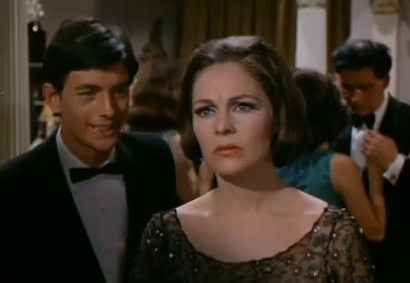
there are people who think that John Hurt looks a lot like Ian McKellen, and I don’t think that John Nolan looks anything like Ian McKellen. Maybe John Nolan looks more like John Hurt than John Hurt does.

Anyway, I skipped back to the party scene that presumably included the Young Guest, and sure enough, it was pretty unmistakably the same guy, just a few decades younger (and still looking a LOT like John Hurt and with maybe a teensy bit more of a resemblance to Ian McKellen).

My point with all of this is to establish that there’s actually a personal connection between Christopher Nolan and The Prisoner at a familial level, not just a professional level. He said back in 2006 that The Prisoner had been an interest of his for a long time, and perhaps that actually had more weight than was apparent at the time.

I mused earlier that perhaps Nolan’s re-use of the name Cobb was a reference to The Prisoner. This obviously is not proof of that, but it does suggest that that’s maybe not a terribly crazy or random idea, and it provides some interesting food for thought about other matters as well. The Prestige and “The Girl Who Was Death” both have near-identical gags involving pint glasses. “A, B, and C” is very Inception-esque, involving Number 2 trying to extract information from Number 6 by means of a constructed and controlled dream environment. The Joker’s gleeful escalation of weapons while attacking the armored van from the semi trailer in The Dark Knight is very reminiscent of a scene in “The Girl Who Was Death.”

Maybe someday we’ll get Christopher Nolan’s take on The Prisoner, but at the very least I think it’s interesting to consider the possibility that, with or without it, many of the series’ ideas have taken root in his head and have a visible influence — and as far as I’m concerned, that’s a great thing.

“My face is craggier than yours, Mr. Hurt.”

My wife knew what she married

The website NolanFans held a giveaway for Inception promo items, and I managed to be awarded “the Point Man Bundle,” consisting of a t-shirt, a cap, and a top keychain.

Yes, I’m 33 years old, and I’m a geek.

Thank you, NolanFans!


adventures in writing alexander lingas all saints bloomington all saints orthodox church american orthodox architecture american orthodox music american orthodoxy Antiochian Archdiocese Antiochian Orthodox Christian Archdiocese of North America Antiochians books byzantine chant cappella romana chant church architecture ecclesiastical chant ethnomusicologists ethnomusicology fellowship of ss. alban and sergius Greece Greek greek food greekness hazards of church music international travel tips ioannis arvanitis joe mckamey john michael boyer kurt sander Latin liturgical adventures liturgical architecture liturgical music liturgical texts and translation liturgy liturgy and life lycourgos angelopoulos medieval byzantine chant Metropolitan PHILIP militant americanist orthodoxy modern byzantine architecture modern greek music music as iconography my kids will latin and greek when they're newborns my kids will learn latin and greek when they're newborns orthodox architecture orthodox architecture is bloody expensive Orthodox choir schools Orthodox Ecclesiology orthodox outreach orthodox travel pascha at the singing school Patriarchate of Antioch Patriarch IGNATIUS IV Patriarch of Antioch publishing random acts of chant richard barrett in greece richard toensing rod dreher sacred music st. vlads st john of damascus society Syriac the Bishop MARK fan club the convert dilemma the dark knight The Episcopacy The Episcopate the only good language is a dead language this american church life travel we need more american saints why do we need beautiful music in churches?

Blog Stats

  • 270,349 hits

Flickr Photos