Posts Tagged 'we need more american saints'


On the difference between καιρός and χρόνος and building a church that makes the difference clear (Part II)

Organizing an event is a heck of a lot of work.

I had originally contacted John Boyer in late fall of 2008; I was looking around for Western notation transcriptions of Byzantine chant in Greek, and my friend Mark Powell said he was the guy with whom to inquire, and that I might also be interested in the curriculum he was developing for Byzantine notation. John was more than generous in providing very useful materials, and I figured, while I was corresponding with him and he was seeming friendly, I may as well ask what it would take to get him out to Bloomington for a workshop. This had been an idea I’d been trying to develop for a couple of years, since we were encouraged at PSALM in 2006 to try to put together local and regional events, but I’d never gotten more than a lukewarm response — “Who?” “Isn’t he too far away and too expensive?” etc. I figured it couldn’t hurt to ask him while I had his attention, however, so I did.

He quoted me a much more reasonable number than I was anticipating. I told him, right, let me check on a couple of things; I was able to convince a private donor to pay John’s fee and travel, Fr. Peter had no problem with it (particularly since it wasn’t being paid for by the parish), and I wrote back and said, let’s do it.

Well, then it took a year to make it work with everybody’s schedules. We decided on this last weekend back in August, and what I will say is that given a host of factors (not the least of which was the decision, made a month later, to bring out Andrew Gould the weekend before John’s visit) I would not have wanted any less time to get everything together. Even with five months’ advance planning, a significant chunk of my choir still couldn’t make the weekend work (although, in all fairness, one of them, Megan’s goddaughter Erin, was busy winning the Met auditions, so I guess that’s an acceptable excuse).

In October, the money from West European Studies happened; this really expanded the scope of what I had originally considered from maybe my choir and a couple of other interested parties to something that could be (well, had to be, given WEST’s terms) open to the public and conceived of as an educational outreach event. John and I finalized the schedule and the repertoire on 23 December; the Friday evening session would be the “lecture” of the series, intended to function as the academic side of the weekend, and then Saturday would be the all-day practical part. I set up a Facebook event and sent out press kits to 30 different churches, chairs, institute directors, community choral ensembles, and local news organs the first week of January, and was astounded at the responses that started rolling in. I heard from School of Music faculty; both an Early Music Institute and a Choral Conducting professor registered, and it came back to me that the Choral faculty member was even telling her entire doctoral seminar to come. I heard from a faculty member at University of Louisville presently teaching a seminar on early notation (although she ultimately decided she couldn’t make it); I heard from choir directors and priests in Indianapolis, Evansville, and Louisville; I heard from a Medieval Studies professor at Wabash College; I heard from local people in the community. By the time the registration deadline passed the week before, 45 people were registered; another ten confirmed over the course of the following week, and then still more showed up unannounced.
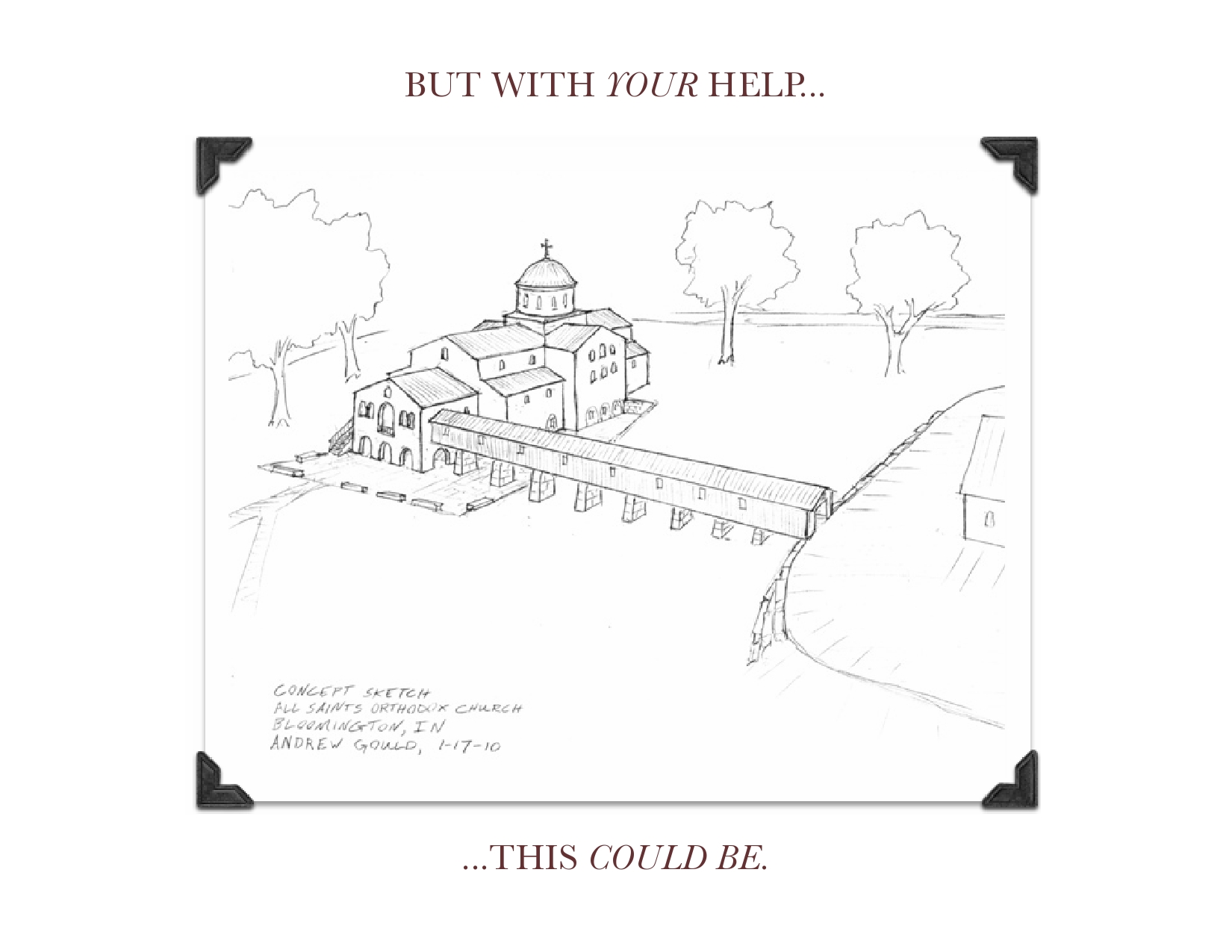
The last week before the workshop, the event planning was approaching a fulltime job; I had to make sure food got ordered and picked up, I had to track down CD shipments so we could have things to sell over the course of the weekend, I had to bug overworked Cappella Romana executive directors for scores (sorry to have been a nag, Mark, truly), I had to get registration materials printed and assembled, and I had to field phone calls from people who wanted to come but lived a couple of hours away and wanted to make sure it would really be worth their time. The last couple of days I wasn’t quite a one-man army; Megan, God bless her, helped with a lot of the last-minute errands and the putting together of the registration binders. I put together a couple of displays of Andrew’s concept sketch (pictured) so that workshop attendees could see it, at least trying to give a nod to the non-singer-friendliness of our space and indicating that we intend to do something about it.

On the other hand, once John actually got here, my job was significantly easier — I pretty much just got to sit back and enjoy the proceedings.

I must say it was worth it; all in all, throughout the course of the weekend, about 65 different people came. Not bad for an event centered around this obscure, gaudy Eastern repertoire that supposedly we Westerners can’t stand without the edges sanded down.

I picked John up at the airport last Thursday evening; his flight arrived at 10:30, and then between his checked luggage taking forever and my very smooth wrong turn leaving the airport, we didn’t get back to Bloomington until about midnight. Luckily, Megan had a wonderful meal and a good bottle of wine waiting for us when we got home (a Saveur recipe that turns lentils and sausages into a bowl of gold), and we three were up talking until around 2 in the morning.

In what would prove to be a pattern for the weekend, four hours later, it was necessary to be up and about. It was, as I told John, the “showpony” day; he was doing a radio interview for Harmonia in the morning (watch this space for details), a mini-lecture for WEST in the afternoon (no thanks to me; I had both the time and the place wrong, forcing us to rearrange our afternoon a bit), a coaching with Lucas, Megan and me on epistle cantillation, and then the first formal session of the workshop in the evening.

One thing that putting on such an event at All Saints did was push us to the absolute limits of what we’re able to do in our current space. John had a PowerPoint slide deck as part of his lecture; well, we’re a pretty low-tech parish on the whole, so I had to go out and hunt down a projector and a screen. WEST loaned us the projector by way of the Russian and East European Studies Institute; my old employers, the Archives of Traditional Music, were good enough to loan us the screen. Even so, it was difficult to figure out how to set up the presentation in our nave to maximize the size of the slides, minimize keystoning, and be within reach of our power outlets (even with extension cords). We managed, but I’d want to figure out how to do better next time.

We had made the decision to install a comprehensive sound system in the nave as the only real cost-effective solution to our acoustic woes for the time being; we gave the thumbs up to the order on 11 January, and the guys at Stansifer Radio turned it around as quickly as the possibly could, knowing that we hoped to be using it by 22 January, and they got it installed by Vespers on Wednesday, 20 January. John had also wanted to be able to plug his laptop into the sound system; I told Greg at Stansifer what I needed to do, and he told me, “Give me an hour to make you a cable.” An hour and twenty dollars later, I had exactly what I needed, and it worked beautifully.

In the end, where we needed to set up John’s presentation was nowhere near the condenser microphone installed for the homilist, so we still had to give him a handheld mic hooked up to Fr. Peter’s old amplifier so he wouldn’t kill his voice. (Why, you might ask, did we not plug the handheld into the nice sound system? Well, the mixer is back in a closet in the sanctuary, roughly 30 feet away from where John was standing. We had a long enough cable, but plugging it into the mixer produced no result. “Oh, right,” Fr. Peter said, stroking his chin. “I forgot — the long cable is dead.” Like I said — we’re kind of a low-tech community. Note to self: replace long cable before next such event.)

Nonetheless, John was a hit, a big one, and something that I heard from more than one person at the end of the session was, “You know, I was only going to come for tonight, but I need to rearrange my day tomorrow so I can come here.”

Following the lecture session, in lieu of a formal reception (which I’ll have to remember to set up for next time), a number of us tried to go to Finch’s for dinner, it being one of the nicer places in Bloomington. Alas, we got there just as the kitchen was closing, and so we relocated to Nick’s. It was a bit louder than we we might have liked otherwise, and they didn’t quite know how to make a Manhattan properly, but perhaps not an inappropriate venue, given that it was founded by a certain Νικόλαος Χρυσόμαλλος (Nick Hrisomalos).

It was a full house at Chez Barrett; besides John, our friend Max Murphy, my counterpart at Ss. Constantine and Elena in Indianapolis, was staying on our other futon for the night so that he wouldn’t have to commute. Once again, we found ourselves up until about two in the morning chatting, and needing to be up by about 6:30 to make sure our houseguests would be sufficiently plied with coffee and eggs, pick up the food for Saturday’s lunch (shout out to Eastland Plaza Jimmy John’s; three 30-piece party platters was a perfect amount of food for a very reasonable price, and they were gracious enough to have somebody there at 8:30am so I could pick it up, since All Saints is waaaaay far out of their delivery area), and get everything at the church set so that the 9am session could start on time.

Well, it didn’t quite. We might say that everybody was inspired enough by the previous evening to recalibrate their clocks to “Greek time,” and we didn’t get started until about 9:30am. Έτσι είναι η ζωή (that’s Greek for c’est la vie, which is itself French for “Life sucks, get a helmet”).
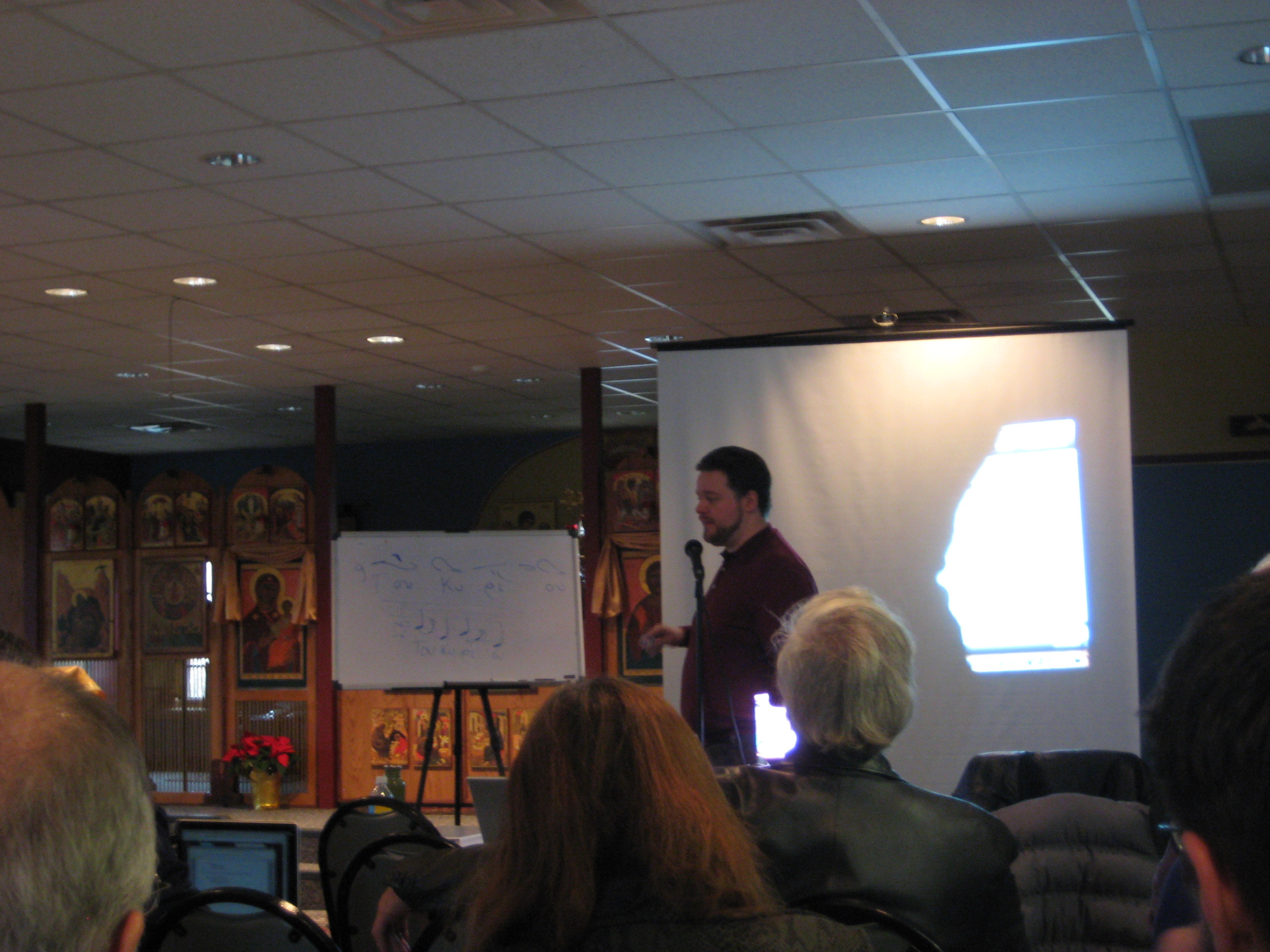
Without giving a blow-by-blow of the whole day, I’ll say that much of the day was dedicated to rehearsing the Divine Liturgy music, but there were a couple of theoretical points made that I’ll note. First, there was the issue of time, which John got at a few different ways. He has a principle, stated many times over the course of the weekend, that “If you think you’re not going fast enough, slow down.” Too often, he says, we just zip through the text like it doesn’t mean anything, which makes it not mean anything. This can be in chanting a hymn, reading the epistle, whatever. We treat hymns and readings like they’re just the next thing to get through so we can be that much closer to getting out the door, rather than adorning them with the beauty that a) they deserve and b) will make us want to be there and take part in the services as though they are gifts from God rather than as burdens to bear. So, again — if you think you’re not going fast enough, slow down.

Another way he stated this was to discuss the difference between χρόνος (chronos) and καιρός (kairos). The former is the world’s time; the latter is the Church’s time. This came up when he was talking about why some hymns are slow and melismatic, and even sometimes will revert to nonsense syllables — in the case of the latter, when this happens, the text has been stated thoroughly in a slow and melismatic fashion, and the hymn is now using “terirem” or some such to provide the opportunity to meditate on the text. Not only that, however; the whole point of the slow, melismatic style has a practical component — to cover a liturgical action, for example — but it also emphasizes the reality that in the liturgy, we are no longer in the world’s time (chronos) but on God’s time (kairos). I was reminded of what Met. Kallistos Ware says about the first time he was in an Orthodox church:

…I had no idea how long I had been inside. It might have been only twenty minutes, it might have been two hours; I could not say. I had been existing on a level at which clock-time was unimportant” (“Strange Yet Familiar: My Journey to the Orthodox Church” in The Inner Kingdom, St. Vladimir’s Seminary Press, 2000, p. 2).

As he acknowledges in the same essay, this itself was a trope (albeit realized after the fact) of what the Kievan emissaries are reported to have said after their visit to Hagia Sophia: “We knew not whether we were in heaven or on earth…”

Another thought came to mind during this discussion — what do we sing in the Cherubic Hymn? “Let us now lay aside all earthly cares.” What do most of us do with the Cherubic Hymn in our parishes? Sing a setting short and fast enough so that we repeat it three times, because we worry that people will get bored otherwise. Isn’t that rather missing the point?

The other theoretical point John made was that there are three textures of singing in our liturgical practice: soloist (priest or deacon or cantor, depending on what’s happening), choir, and congregation. “We need all three,” he said repeatedly. “It’s very much a dance of who sings what when, and if you limit yourself to only one of those textures, you lose something important and beautiful.” As you may recall, the week before, somebody told Andrew Gould that they didn’t come to church for the beauty but for the participation; one wonders how such a perspective would understand what John had to say on this point. My thought is that he’s right, but dances have to be both taught and learned or they become mass confusion.

The services themselves were an adventure, but a good one; at the kliros, the weekend suddenly turned into Byz Chant Boot Camp (or Parents’ Weekend of same, as our friend Laura Willms suggested), and John was the drill sergeant. This Was A Good Thing; he was able to do get away with making certain points in a way I simply can’t, partially because a) he won’t have to see these people next weekend b) we paid him to be here specifically to do that c) he’s Greek. He was not shy about being emphatic in terms of instructing people during services; if you were on the isokratima, for example, and were sleeping on the job and missed his cue for the move, you got an elbow in the ribs. (As John said later, and I absolutely agree with him, “Please tell me a better way to communicate with people who aren’t watching me while I am singing.”) The thing is, coming from him, people ate it up; after the service, a lot of the folks who got the business end of his drill sergeant-ness said only, “Wow — what an amazing teacher.” For me, how this manifested was him pointing to the Byzantine scores he was following and saying, “You’re reading with me, got it?” Up to that point, I hadn’t dared putting enough confidence into what I had learned over the summer to actually use it during services, but much to my own surprise, I managed to keep up. I wasn’t perfect (and when it was just me on my own I fell down and went boom a couple of times), but I kept up.

After Vespers, we were all tired and hungry enough that it seemed best to simply call off the 7-9 session — we had reached enough of a logical stopping point that anything further that evening would be a matter of diminishing returns. It was early enough that Megan, Laura and I were able to take John to Finch’s for dinner after all, and once again we all found ourselves up until 1am or so talking.

Matins and Divine Liturgy the next morning were not without their speed bumps — everybody was just enough out of their element to make sure of that — but everything went quite well regardless. (We even made it successfully through the Cherubic Hymn, which had been a cause of some lack of sleep on my part.) A lot of non-Orthodox workshop attendees came, so we had a very full church. That said, I’m not entirely certain that everybody in the parish knew what was going on or why we were doing what we were doing (despite my plugs for the weekend along the way), and some of the reactions I got from parishioners were worded accordingly (“That was beautiful, Richard, but I will be very happy when we go back to normal” was one example). On the other hand, there was the chorister who told me, “I felt like my musical soul had been fed for the first time in a long time.”

Here’s a comment made by a workshop attendee to which I keep returning — the commenter in question is part of the local UUC congregation and retired English faculty here at IU:

Excellent workshop on Byzantine chant this weekend at All Saints Orthodox church in Bloomington, with John Michael Boyer, cantor and teacher… The whole attitude of the Orthodox faith tradition is very flexible, welcoming, inclusive, and constantly changing–such a welcome change from most of the Western Christian churches… As it happens, I’m not a theist of any variety, but if I were monotheistically inclined, I’d give this church a serious thought. Good people all around… This was my third visit to your church and in every case, I was much welcomed.

Seems to me that’s successful outreach right there.

John’s flight out was scheduled for 4pm on Sunday. However, as we left All Saints around 12:30pm, he looked at me with deeply exhausted eyes and said, “Would you mind horribly if I changed my ticket and stayed an extra day?”

Well, I told him, I didn’t know for certain where he’d stay, but I’d see what I could do.

Megan and Laura made biscuits and gravy, which I think may have cemented John’s friendship with Bloomington (to say nothing of his arteries). He got a nap, and made a wonderful dinner for us that night — a recipe of his own devising, incorporating pasta, kielbasa, kalamata olives, mushrooms, and green peppers.

(Tellin’ ya — how do we rate all of these friends who ask, “Hey, can I cook in your kitchen while I’m here?”)

And, once again, we looked at the clock while talking, found that the hours had slipped away and it was three in the morning.

On the way out of town the next morning, we had lunch with Vicki Pappas, the chair of the National Forum of Greek Orthodox Church Musicians — also a Bloomington resident and founding member of All Saints (alas, in absentia for years, since she commutes to Holy Trinity in Indy). It was a very interesting conversation for which to be a fly on the wall; the musical situation in GOArch has its own intricacies, complications, and vicissitudes, to say the least.

The drive to the airport (no wrong turns this time, thank God) mostly consisted of us discussing how to get John back here, and soon. Watch this space.

Just to make sure I’ve said it: as with Andrew, I wholeheartedly recommend John if you’re looking for somebody to bring out as a speaker or as a guest instructor with respect to Byzantine chant. He’s knows his stuff inside and out, both in terms of chant and in terms of liturgics in general, he’s a great teacher, and of course he’s a wonderful cantor. He is a very effective speaker and teacher for an academic audience, an Orthodox audience, and a general audience — not something everybody can claim.

All in all, the weekend was a huge success in terms of being outreach, being educational, being of musical interest, and, more personally, building friendships. It’s very true that there’s very little in the way of specifics you can cover in a weekend; notation wasn’t discussed beyond some theoretical ideas, and there was only so much he had time to do with respect to the tuning systems, but I think what it did was threefold: it established that there is in fact interest in this material here in Bloomington, for the School of Music, the greater community, and the parish, it proved that you could talk about this subject from an explicitly confessional standpoint and have it be more informative for non-Orthodox participants than it would have been otherwise, and it stimulated interest in doing more. The School of Music faculty who came were very clear about wanting to participate more directly the next time John is here; people from the parishes of surrounding areas said, “Hey, how can we help with the next one?” and it’s also been expressed to me that there is a desire to figure out what portions of what we did last weekend we can keep as our normal practice. That will likely be a complicated conversation with a complicated outcome, but it’s a better response from the people in question than “That was nice, now let’s never do it again”.

What I will say is this: by virtue of the fact that we were open to the public and not charging admission, our own success made it quite a bit more expensive than we had originally planned. If you participated and would like to help, or would like to help regardless, please contact me (rrbarret [AT] indiana.edu). Our original donor has been very generous, but we had hoped to come away from this event with perhaps some seed money for the next one as well. Looking ahead, I am contemplating starting something which we might call “Friends of Music at All Saints” or some such, specifically to exist as some kind of a booster organization for such things; again, I am pretty much a one-man army here, so if you’re interested in participating, please let me know.

So, we had two visitors two weekends in a row. One told us about beautiful churches, another told us about what we do in those beautiful churches. Now what?

I think, if we want a useful synthesis of Andrew’s and John’s respective messages, it boils down to John’s point about kairos and chronos, and how that relates to the church building being an icon of the Kingdom. As Lucas pointed out to me, the word kairos kicks off the whole Divine Liturgy: Καιρός τοῦ ποιῆσαι τῷ Κυρίῳ — it is the time/moment/opportunity of acting for the Lord. Even better, if we want to read τῷ Κυρίῳ as a dative of the possessor, it is the Lord’s time of action. And what is the priest’s first blessing? Blessed is the Kingdom… The Liturgy is the Lord’s action in His own house on His own time. (I will note that this does not go well with the populist misunderstanding of “liturgy” as “the work of the people”, but it goes much better with the more accurate rendering of it as “public service”. It is the Lord’s public service being offered to His people, in other words.)

So, you have to liturgize in a way that emphasizes the fact that it’s God’s time, and you have to have a worship environment that emphasize’s that it’s God’s house. As Lucas also put it, you have to get across the idea that, no, actually, you don’t have anyplace better to be.

Schmemann, of course, talked about the idea that we should liturgize in a way that takes the Liturgy back out into the world. What I wonder is if we have a problem with the valve running the wrong way — that we bring our busy lives, our distractions, that is to say the world into the Liturgy with us and then expect the Liturgy to be run in a way that accommodates us. As I said with the Cherubic Hymn — we say that we are now laying aside all earthly cares, but do we really approach that text in a way that indicates we believe that that’s what we’re doing?

And when you’ve got a building that, no matter how you cut it, looks like an office building with icons and which traps our psalmody rather than lifting it up to heaven, is it any wonder that that’s our approach? Andrew was absolutely right — we’ve got the saints and the angels, but no City.

We’ve got our work cut out for us. On the other hand, here’s the good news — Fr. Peter told me a couple of days ago, “You know, a comment I got from a few people was that things seemed too slow. But you know what? In a lot of places, by having the choir sing it so slowly, I found that it matched better with the liturgical action, and it made a heck of a lot more sense.” We talked about a lot of this stuff, and it seemed to click with him that we need to figure out, and make a concerted effort reinforcing, the difference between kairos and chronos. It’s not going to be easy, but we’re at a point where it’s what we have to do.

The project that All Saints has ahead of it is not a building project or a musical project. Those are components, yes, but what it really is is a spiritual project. We’ve got to be the City on the Hill, the Heavenly City, the New Jerusalem, the Light that is not hid under a bushel. It is desperately needed in this town, in this area, in this world, and we’ve got to convince ourselves that we want to be that, that we want to be an icon of the Kingdom, more than we want to be what we’ve been pretty good at being up until now, which is a little, struggling church in a little, struggling Midwestern town.

If we can do that, then we will have the hard part out of the way. If we can convince ourselves that we believe that and that we can walk in faith, then the temple will just about build itself, $2.5 million or no, and people will stop worrying about whether or not the music is too Byzantine or too slow or not congregational enough or not “American” enough or whatever. (By the way, I found over the course of the weekend that just joining a good English translation with a melody written for the English made things pretty well more “American” on their own. Others may disagree with me, but that was my perception.) If there’s a point that both Andrew and John made, it is that the ethos of the received tradition is not a buffet, not a “meat and three”, not a list of things from which you pick and choose. There are things that we can adapt for local circumstances, but you do that after you’ve received the tradition, and then only in a way that doesn’t obscure what you’ve received. You don’t filter out the parts of the received tradition you don’t like pre-emptively. You may well come to church for participation rather than beauty, but that doesn’t mean that beauty isn’t part of the organic whole.

The church building and the liturgy have to reflect the fact that we worship a God who is bigger than we are. God already “met us where we’re at” in the Incarnation; it is up to us to respond to that in faith.

Now, having said all of that, I’m at the head of the line of people who need to figure out chronos and kairos. With these two weekends out of the way, I have a ton of reading to do on Ancient Greek democracy and a couple of weeks’ worth of working out on which I need to catch up. I’m going to be juggling things for a bit yet before I’m really into the rhythm of the semester. Along similar lines, last Wednesday, John texted me at about 8pm my time: “I’ve turned nocturnal. Just woke up. I’m not sure, but I think it’s Bloomington’s fault. :-)” I guess the gap between chronos and kairos gets us all in the end. Pray for us.

More importantly, however, pray for All Saints. We’ve got a lot of hard work ahead of us. With God’s help and by your prayers, we can do it. If you want to be involved more substantially, I’ve suggested a couple of ways you might be able to do so; contact me if you want more information.

Okay — back to being a student.

Updated link for Frontier Orthodoxy

Do note that Fr. Oliver Herbel has moved Frontier Orthodoxy to its own site. Not all of the first few articles have been moved; those you will still find here.

Of note: Frontier Orthodoxy

Fr. Oliver Herbel has a new column called Frontier Orthodoxy which looks like it has the potential to be of great interest. There are two posts up now, and my understanding is that he intends it to be a bi-monthly column. That Fr. Oliver reveals in his introductory essay that he is a fencer already means that this is going to be worth watching.

Ochlophobist on the dilemma of being “young, male, and Orthodox”

Owen made the following comment on a recent post:

There is a certain type of young man who generally pursues the priesthood. We dance around it, but in my mind it is unequivocally true. In Orthodoxy there are certain forms and postures that are, aesthetically speaking, humble, but which are easily practiced and replicated, and do not necessarily reveal the inner heart – soft, slightly effete voice, a way of walking in the cassock, a way of mentioning the contrary opinions of others and pleading one’s ignorance on matters even as it is quite clear you’ve got a strong opinion and you want it to be deemed the right one, a slightly affected, sentimentalish manner of being around icons, prayer ropes, the altar &nave, and so forth, a slightly affected manner of quoting sayings or hagiographic tidbits of the saints, etc. But beyond all that, you spend some time with the fellow and you realize that he loves and is naturally given to didacticism – here is a man who likes to be in a position of teaching others. It is also clear that he has a hunger to be in a position of spiritual authority over others. In my opinion, keeping in mind that opinions in Orthodoxy are worth as much as wax stains on nave carpets, a desire to teach in the Church and have spiritual authority over others is usually, but not always, instigated by demons.

Okay. We’re adults here; let’s not be coy and play dumb. We all know what he’s talking about, and we all know people who are more or less like this — assuming we ourselves don’t fit this description! I’m going to let Owen’s words speak for themselves, and I assume that he is savvy enough to know that he has just profiled a chunk of his readership (although I would be hard-pressed to say whether or not he would particularly care if he offended any of them).

So, neither adding nor subtracting nor commenting directly on the particulars Owen discusses, my question is, why are young men who tend to have these characteristics the ones who seem to be drawn to the priesthood like moths to flame? (Perhaps people can weigh in on whether or not the ordination-bound in other confessions/communions also behave this way.)

In the interest of full disclosure, the priesthood is something I feel reasonably certain to not be in God’s plan for me. This is not a conclusion I have reached lightly; in one form or another, the question of pastoral ministry was one that really troubled me, at least off and on, from my teenage years up to late twenties. During my time in Anglican circles, there were a couple of people who were really pushing me to consider seminary, and I think it was only the fact that I did not yet have an undergraduate degree that kept these individuals from forcibly sending me off to someplace like Trinity or Seabury (Nashotah House is not a place one hears about in the Pacific Northwest). Being an excitable young man, of course the question resurfaced for me as an Orthodox Christian, and immediately following my chrismation in February 2005 it seemed (as it does for so many of us) that surely seminary would be the logical next step for Somebody Like Me (particularly since that would make the matter of grad school much simpler). In the fall of 2005, I visited the St. Vladimir’s campus, fell in love… and then the whole issue just seemed to dissipate as a compelling force. It hasn’t resurfaced since. I sometimes wonder if the point was simply to bring me to a place where I would finally be willing to go that route, and then to redirect me elsewhere. At this stage of the game, I am no longer afraid of the priesthood (and haven’t been for awhile), but it seems more likely that, if I were to wind up at a place like St. Vlad’s, it would be as a member of the faculty (or potentially as a visiting student while I’m writing my dissertation) rather than as a candidate for priestly formation. As it is, I have a desire to teach, but not in the Church — at least not as a catechist. No, thank you. That’s not responsibility I care to have. Maybe I could help illuminate a couple of things here and there within my own area of expertise, maybe I could teach a chant lesson or two, but I’m not the person to entrust with forming the holiness of others.

Extending maximum charity to the type of gentleman Owen describes (particularly given that, for all I know, there could be people who read those words and think, “Yep, that’s Richard Barrett!”), what pushes this person onto the path of the priesthood and gives them such a desire for spiritual authority? I am not totally unwilling to discount the explanation of demons, but let us say I feel more at ease discussing what might be the concrete instruments of said demons than the demons themselves.

My favorite ’80s teenage rom-com is Say Anything… In a lot of ways, it’s really more properly considered a ’90s movie than an ’80s movie (it was released in 1989) — rather than somewhere in California, it takes place in a rather idealized and curiously rearranged Seattle four years before Meg Ryan would get from the 520 floating bridge to Sand Point in a matter of seconds (it takes twenty minutes to half an hour assuming no traffic, folks), it’s got Soundgarden and Joe Satriani on the soundtrack, it’s got John Mahoney as the problematic Seattleite father (prefiguring Frasier by about half a decade), and it’s got John Cusack as Lloyd Dobler, in what amounts to his first adult role. Young adult (the script goes out of its way to explain that Lloyd is graduating high school a year older than his classmates because of various familial matters), but he’s not fantasizing about dancing hamburgers at his fast food job anymore. One perhaps could argue that he starts the movie as a kid and finishes as an adult (cf. Lili Taylor telling him, “Don’t be a guy. The world is full of guys. Be a man“). More to the point, you can see Lloyd as potentially growing up to become Martin Blank (and I have occasionally wondered if Say Anything… wasn’t discussed, even if only in jest, as sort of a murky back story for Grosse Point Blank).

Anyway, Lloyd is a nice, if slightly off-center, guy. He wears a Fishbone t-shirt and a trenchoat. He’s a bit disconnected from his family, since his parents are in the military and stationed elsewhere, and he lives with his single-mom sister and her kid while he figures some things out. He’s not intelligent or obviously talented in conventional ways, he’s graduating high school a year late, he has no college plans, but what he does have are some very definite principles (“I don’t want to buy anything, sell anything, or process anything as a career”), and when he’s dedicated to something — like kickboxing, for example — he gives it his all. His guidance counselor buttonholes him at a party to try to persuade him to make some conventional decisions about his future, and he dismisses her advice, saying, “I’m looking for something bigger, you know? I’m looking for a dare-to-be-great situation.”

Let’s just imagine for a moment that Lloyd one day wandered into St. Nicholas Cathedral (ROCOR) in Seattle and found his dare-to-be-great situation there, giving it his all just like he did with kickboxing. I think he’d wind up a lot like the kind of young man Owen describes.

My point is this. I think there are a lot of smart guys with a genuine faith in and love for God, who want to give something the whole of their effort, who maybe just haven’t had the right — or at least the obvious — opportunity come their way and who at least know that there are some specific things they don’t want to do. Maybe they’ve had an interest in various aspects of the humanities and social sciences, enough to be broadly informed about a wide range of topics, but they’ve never had the discipline or the right setting to rise above being a dilettante, or at least an undergrad who shows some promise. Maybe they’ve had something of a taste of church service in another setting, enough so that they put on a cassock or some other kind of vestment and realize that they’re visibly part of something bigger when they do that. Maybe there are other circumstances in their life that make them determined to never do anything halfway, so that they never have to apologize for their own presence or participation.

And when these guys discover Orthodox Christianity, with all of history and all of its richness of faith and practice and all of its demands, with all of the ways it can order one’s life in the service of Christ, the various facets of their person which otherwise make it hard for them to fit in suddenly have a place, a context. They’ve discovered their dare-to-be-great situation. This is their life’s work, they just didn’t know it before. How can the priesthood, if not monasticism, not become a draw, the call that surely was always there if it could only have been perceived?

(By the way, unlike what I suppose about Owen, I care very much about offending people, so I really hope nobody thinks I’m saying this to mock or be critical. I have observed much of the above, yes, but much of it I have observed in myself. I cannot mock without mocking my own person first of all.)

I think what it often (perhaps not always) boils down to is that, for the young, male, zealous convert, it is not difficult to develop the desire to spend as much time in church as possible. Eventually, and naturally, this turns into the question — perhaps unconsciously — “If what I want to do is be in church all day, then wouldn’t a vocation just make sense?” Since there’s really only one way somebody can work for Orthodox Christianity in this country as one’s day-job, the direction becomes pretty clear from there.

Does it have to be this way? Maybe not, and I would hope that a seeming one-to-one ratio of zealot to cassock could be a reasonably short-lived phenomenon. (I say that as a cantor who wears a cassock.) The truth is, there is something that drives young men who behave as Owen outlines. If it might be healthier that not all of them get tonsured as readers the day after their chrismation and start teaching catechism after their second Divine Liturgy as a communicant, then there needs to be some active spiritual guidance about what to do with whatever it is that drives them. I have no doubt that for priests and bishops who have long lists of things to get done, young men with a lot of energy and desire to serve are hard to tell, “You need to sit back and chill for a while.” Still, it raises the question of whether or not the desire specifically to be the one serving in a visible, set-apart fashion can’t itself turn into a passion.

Ultimately, I think Owen is absolutely right from a descriptive standpoint. I’ve remarked before that there’s a certain self-consciousness of the American convert that we’re going to have to figure out how to deal with, and what Owen talks about is part and parcel of this self-consciousness. If there is a sort of contrived and constructed manner of holiness that has been assumed, then the answer is that we need more models of holiness that haven’t been contrived or constructed. Still, I think there are deeper reasons for why this occurs that we’re also going to have to figure out how to understand and deal with, and we will need to do so compassionately and productively.

In which the author laments the state of English language liturgical books

Last Saturday, it being Great Vespers for the Feast of St. Luke, there were Old Testament readings appointed for the service. I normally leave those to other people so as to save my voice, but I got asked to do one of them anyway since we were short some people we might otherwise have had. “Just read off of the printout of the liturgical guide?” I asked. Yes, I was told, since the parish doesn’t own a Prophetologion.

Well, long story short, nobody owns an English-language Prophetologion, because it doesn’t exist. There’s Archimandrite Ephrem (Lash)’s draft version online, and I’m increasingly coming to the conclusion that if I were to be involved in starting a mission I would argue passionately for the use of his translations, but obviously an electronic version just isn’t quite the same thing as actually having a printed liturgical book. Besides which, Fr. Ephrem has done the exactly right thing of translating liturgical texts as a self-referential whole, being aware of biblical references, internal references to other liturgical texts, and so on and so forth — and while this is exactly right, it also renders his liturgical texts somewhat difficult to use unless you’re using them exclusively.

Which gets us to the broader question of English language liturgical books, and the practical situation in various parishes.

The situation at All Saints is interesting, and I expect reasonably common — we use Nassar as the spine, but not everything is in there, and there has been cobbling together of things from various sources over the years. This effort has been by necessity a real “do it yourself” matter by many people, for reasons I won’t go into here but I’m going to assume can be guessed by a sufficient number of people in similar situations. As a result, we use one translation for the proper texts for weekday services, a different translation for Great Vespers, Sunday Matins and Sunday Divine Liturgy, and still another translation for some of our Lenten texts. Sometimes we use the HTM Psalter; sometimes we use the KJV/NKJV variants that are used in the Antiochian service books. For the epistle reading, we have the Holy Cross Apostolos, which we bring out during services, but we insert a sheet with the NKJV text into the book so that the reader is actually reading from that and the book itself is really for show. In other words, we have a fundamental disunity of English translations, thereby achieving a fundamental disunity in the texts themselves. It used to be worse; our Divine Liturgy music used to be a patchwork of things from all over the place, so that there was no textual consistency whatsoever within the service — “Thee/thou” in one section and “You who” in the next. I am also told that for awhile we were trying to use the Orthodox Study Bible liturgically, but since it’s not arranged as a liturgical book (i. e., no prokeimena etc.), that was a non-starter from a practical standpoint.

These are the moments when I see an excellent argument for sticking with ecclesiastical Greek or Church Slavonic.

(On the matter of the HTM Psalter — HTM obviously publishes liturgical books that a lot of people use. I will note for the record that I find the use of liturgical materials by schismatic groups problematic, but I know there are a lot of people who disagree with me.)

I’m not sure what the solution is; what I’d hate to see is the worst kind of “by committee” translation, where all of these texts which were composed by saints and monks are rendered into bland, inoffensive, artless English. There are good “by committee” translations, like the Thyateira translation of the Divine Liturgy, but on the other hand, their committee includes Fr. Ephrem as well as Metropolitan Kallistos.

Maybe if any of our seminaries start offering doctorates, the problem of establishing a fundamental unity of English language liturgical books, and doing it right, can be taken on as a dissertation — or rather, several dissertations, more than likely. Best of all would be if modern-day Ss. Cyrils and Methodiuses would make themselves known for the English-speaking world. I understand that a hundred years ago for the most part the books didn’t just exist, and thus we’re better off than we used to be, but I’d like to think that we’re at a point where we can respect the efforts that have been made, re-assess where we’re at and try to move forward from here nonetheless.

Is a unified English translation of all the liturgical books a realistic goal? Or is the hodgepodge one of those things where we need to accept that it’s not going to happen because Things Are Different In America?

When, evidently, unity in Christ is not enough

Some bloggers are having an argument right now. (What a surprise.) I’m really hesitant to name some of the parties or link to them, because up to this point they’ve mostly ignored me (with one exception), and I’ve really enjoyed not being on their radar. More than that, I am really reluctant to give any of them referral traffic. Rather, I will link to this person, already on my blogroll anyway, who is discussing the matter rather succinctly (and accurately, I think). You can find a link in his post that will take you into the heart of the conflict.

(Metropolitan Kallistos Ware at some point explored the implications of treating monasticism as a track of apostolic succession parallel to the episcopate; I am wondering if perhaps we have reached the point where we need to posit yet another parallel track, that of the blogger who has taken it up on himself to exercise the prophetic office. But I digress.)

I’ve met a lot of people during my time in Orthodox circles who have absolutely no problem being hostile, implicitly or explicitly, to other Orthodox Christians. I’ve met “ethnics” and “cradles” who have absolutely nothing but contempt for the American who presumes to convert; I’ve met converts who think that it’s okay for them to be dismissive of “ethnics” as being Christ’s lost causes. Thankfully, there are fewer of either type than many might assume, but those who are out there are disproportionately loud and obnoxious, and I don’t mean exclusively in blogdom. I have had the misfortune of having to spend large amounts of time with people of both types, and have had to experience their open and very real hostility, either towards me or towards others.

The implication from either side that somehow there’s a second class citizen status among Orthodox Christians depending, positively or negatively, on heritage, is simply astounding to me. Is there a Christian birth certificate other than baptism?

To move to another facet of the problem for a moment, it has been suggested that part of why it’s acceptable to hostile to converts is because they aren’t really Orthodox Christians; they’re Protestants playing dress-up according to things that they’ve read in books rather than actually receiving a lived tradition of Orthodox Christianity from a living source. Presumably this line of reasoning is how such people justify showing disrespect to ordained clergy and consecrated bishops by calling them things like “Mr. Paffhausen” or “Mr. Freeman,” for example.

While I would concede that there’s a real problem being identified in such a statement, the extremity of the response to the problem reveals another problem or two.

There’s an ancient heresy called Donatism. You can look it up for yourself, but I don’t think it’s misstating the position to say that it was basically a macho movement within the Church gone horribly wrong; e. g., “If you’re not at least as rigorous or pious as we are, you’re not really a Christian, and there’s not any room for error.” They reserved the right for themselves to judge the validity of Mysteries of a priest or bishop whom they deemed less rigorous than they were; in effect, much like certain parties today, they were big on saying, “We’re more Orthodox than you.”

Origenism and Arianism were also early heresies (although, in the interest of full disclosure, I acknowledge that it was not until he had been dead for three centuries that Origen’s “fabulous” and “monstrous” views were anathematized), and the trouble there can perhaps be summed up as Origen and Arius trying too hard to make Christianity palatable for the educated elite of the day — to make it possible for a respectable philosopher to be intellectually honest with himself and be a Christian at the same time, in other words. For God to truly be God in the worldview of Greek philosophy, one could not meaningfully discuss the homoousios of the Son with the Father; Christ had to be something fundamentally other than God, however exalted he might otherwise be, or else God was not God.

Now, be these as they may, there is not necessarily a fundamental error of intent in either case. Being rigorous is not in and of itself a problem; neither is trying to have a Christian intellectual culture. Monasticism is perhaps one of the correct expressions of a rigorousness that might otherwise be inclined to Donatism, and without Origen, our tradition of Scriptural exegesis would be much impoverished. The trouble is the extent to which these intents are realized; the Donatists could not stand to be in a Church where there might be worse sinners than themselves, and Arius and Origen ultimately were catering to a target demographic.

One can legitimately argue that learning the Orthodox Christian faith from the works of Schmemann and Ware, the Popular Patristics series, and maybe even Pelikan and Rose for that matter, is, as a substitute for receiving a lived tradition, rather thin gruel. There is a problem there that is most certainly worth discussing, a problem which perhaps lends itself to Origenistic or Arian developments down the road — an overly-intellectualized Christianity that finds itself at variance with the actual faith. However, to then determine that problem invalidates at a sacramental level the chrismations, ordinations, and consecrations of individuals itself suggests an issue of Donatist proportions.

At a practical level, that attitude assumes that there are alternatives of which the “konvertsy” simply hasn’t availed himself, when that’s just not the case, many times. It’s not exactly like there are large ROCOR or Serbian parishes or monasteries everywhere one goes (and even that’s not necessarily a guarantee of “real” Orthodoxy, evidently, given a particular person’s ongoing disdain for Fr. Seraphim Rose and anybody who ever had anything to do with the St. Herman of Alaska Brotherhood). A particular person commented to me yesterday that of course I was the “bad kind” of convert, since “I’m Antiochian.” Now, in all fairness, I acknowledge that this exchange was intended to be humorous, but as I told this commenter, it’s just not funny right now. It’s not funny coming from this particular individual given the kinds of negative comments they’re typically inclined to make (however cleverly and humorously formulated), it’s not funny given some of the current issues facing the Antiochian Archdiocese, and it’s not funny for the simple reason that actually, no, I’m not “Antiochan”; I’m an Orthodox Christian who happens to go to an Antiochian parish because that’s all there is locally, and I do so in spite of whatever reservations I may have about the AOCNA. Bloomington, Indiana isn’t exactly a hotbed of traditional Orthodox ethnicities and activity; all there is is the little group of people trying to work out their salvation with fear and trembling. There’s a little bit of everybody — Russians, Romanians, Arabs, Greeks, and us “konvertsy” — but not enough of anybody to constitute any kind of a critical mass. I guarantee you there are individuals in every ethnic group in this community would be more comfortable with a church of “their own people,” but that’s a luxury nobody can afford. It’s All Saints or nothing. I’d go so far as to say that our situation is absolutely fantastic relative to that of, for example, Fargo, North Dakota.

I am disheartened by people who jeer at Americans who are trying to live out their faith doing the best they can with what they’ve been given by Mother Church, which in many cases is next to nothing. I am not amused by those people when they insist that those Americans trying to do this or that in order to live out their faith and their calling more fully are not in fact Orthodox, but then refuse to offer any kind of a practical alternative. I can only conclude such people really mean that the Americans they are deriding are simply “not as Orthodox as they are.”

At the same time, I am disheartened by Americans who regard people of Greek or Russian or Arabic or whatever heritage with suspicion automatically, claiming that all of our problems stem from “foreign bishops” and culturally unintelligible practices, and assuming that such people probably don’t pray, don’t fast, don’t confess, don’t commune, don’t go to Vespers daily, and most importantly, don’t buy books or liturgical music recordings, and are only in the Church by an accident of birth, rather than Having Truly Grappled With the Big Questions the same way that they, being Godly Americans in a Godly Country, have done.

I am disheartened by people who would say that American converts are rigorous about all the wrong things and can never understand what Orthodox Christianity actually means in a lived cultural context, and use that as an excuse to disrespect the Mysteries those converts have received; I am just as disheartened by Americans who seem bent on proving exactly those points in order to demonstrate they’re better than the so-called “cultural Orthodox”. At some point, the sides start insulating themselves from each other, and then the snake is eating its own tail.

All of these things dishearten me because it would appear that unity at the Chalice, unity with Christ through Communion with Him in His Church, is simply not enough. It is evidently so meaningless as to in fact have it’s very existence be something that should be denied.

Tell me, why are we Orthodox Christians so inclined and eager to judge other Orthodox Christians so quickly? Are we not already small and scattered and minimized in this country, that it is necessary to try to splinter ourselves from each even more?

Is that love?

Is that Christlike?

American Orthodoxy and Parish Congregationalism by Fr. Nicholas Ferencz

In my research for the article on historiography of Orthodox Christianity in America, I encountered the book Orthodoxy and Parish Congregationalism by an Carpatho-Russian priest named Fr. Nicholas Ferencz. It was evidently his doctoral dissertation at Duquesne University, and it was published in 2006 by Gorgias Press under their “Gorgias Dissertations” imprint. It is, I think, a book that should be carefully read and considered by Orthodox Christians in America, and is far more of an intellectually honest look at certain issues than certain other books out there. Unfortunately, those certain other books are $15 a pop and Fr. Nicholas’ is $99 (the perils of a small boutique academic press, alas), so that’s unlikely to happen, but I’d like to make what case for the book I can.

Fr. Nicholas’ thesis is that “trusteeism” or congregationalism is unambiguously outside of Orthodox Christian tradition, but that it is nonetheless the de facto arrangement, at least in a modified form, for American parishes, and that this state of things represents a troubling gap between belief and practice in Orthodox Christianity as it is practiced in this country. “American Orthodoxy,” he contends, “lives out an experience of church which is at odds with its professed understanding of church,” a problem which most church leaders either cannot or will not acknowledge publicly, and of which most laity are unaware (p. 2).

The model of “modified congregationalism” within which most parishes function, he argues, boils down to the laity controlling the material assets of the community. At the same time, the laity allows the clergy (including the episcopate) more or less limited authority in the spiritual realm, but with the right implicitly reserved to either revoke that allowance, or to use material authority in a way that trumps the spiritual authority — that is, “the earthly coercive power of control” (p. 204). This is a problem, and a big one:

[C]ongregationalism does not work in practice within the Orthodox Church. Parish life does not divide into such neatly fragmented categories as spiritual/cleric on one side and material/laic on the other. A congregationalist structure merely serves to maintain a fiction which undermines the authority and responsibility of both the clergy and the laity, to the detriment of the parish and, therefore, of the church. (p. 7)

This state of affairs exists for a number of reasons, and there are three in particular on which Fr. Nicholas concentrates. The first is what he terms “the moral absence of the hierarchy,” both in the formative years and up to the present, the second is the long-term impact of the circumstances surrounding St. Alexis Toth’s bringing many of the Uniate parishes into the Orthodox Church, and the third is the result of lay societies being the engine which drove the formation of many early Orthodox parishes. Without going into the minutiae of his argument, the way that Fr. Nicholas lays out the historical circumstances in which the theoretical/practical gap developed in Orthodox Christianity as practiced in the United States is fascinating reading, and excellent food for thought.

So, what’s the way forward? There are several generations in this country, from cradle and convert stock alike, who are very used to things being the way they are, they don’t want to hear that what they’re doing is at variance with traditional Orthodox practice, and in fact they might even argue that we haven’t gone far enough towards congregationalism. So what do we do? Is it possible that there’s just no other way for Orthodox Christianity to function in this country? Is there just too much of a cultural disconnect for it to be otherwise?

Fr. Nicholas suggests that “[r]eal conciliarity on a parish level could be the beginning of the healing of the divisiveness of congregationalism,” (p. 210) with conciliarity being defined as “an authority structure which requires that all the People of God, ordained and unordained, participate in the authority of the church and the exercise of that authority as one, whole Body” (p. 209). At the same time, however, conciliarity is emphatically not “the gathering of an… ‘amorphous mass’ for the purpose of casting votes… [that is,] a democracy. It is the gathering, the coming together, of the Body of Christ in unity and in wholeness” (ibid.). This being the case, it is vital that we realize “[t]he participation of each member of the church is not exactly the same, uniform, and undifferentiated. Each person is called to share in Christ’s authority to the degree and in the manner in which they have received God’s grace to do so” (ibid.). It’s not an easy way forward in a culture where we don’t readily make a distinction between difference in function and difference in quality, so I don’t know how we get around that, but I suspect Fr. Nicholas is right regardless.

There’s much more to the book than this necessarily brief review will allow me to explore, but I recommend seeking it out. If you don’t want to fork out the $99 to buy it, interlibrary loan should be able to produce a copy. It’s very much worth reading and discussing further.

American Orthodox Christian Historiography: The Methodological Problem

It’s not often that I get requests. However, I got one a few weeks ago (scroll down to comment #77 if you want to cut to the chase). Here is my step-by-step attempt to make transparent the methodological points that were being discussed. I look forward to any and all comments.

Update, 18 November 2011: Taken down for the time being. I’ll hopefully have more to say later as to why (but don’t worry, it’s not because anybody sent me nasty letters or any other bad reason like that).

Update, 20 March 2012: Restored, and I’m not going to go into what was going on right this second, except that it’s evident to me that the piece was conceived for this setting and should probably stay in this setting. It’s not worth it to me to go through the rigamarole otherwise for this particular essay.

American Orthodox Christian Historiography:

The Methodological Problem

By

Richard Barrett

I. Introduction and thesis

The fundamental role of the historian, according to a current introductory text on historiographical methodology, is “to choose reliable sources, to read them reliably, and to put them together in ways that provide reliable narratives about the past” (emphasis in the original).[1] Georg G. Iggers, in discussing how methods of historical writing, and the theories which govern those methods, have developed in the twentieth century, observes that the modern historian faces the problem that there is a “fluid border…between historical discourse…and fiction…but also that which lies between honest scholarship and propaganda.”[2] This problem does not relieve the historian of any responsibility, however; “in the final analysis,” Iggers writes, “every historical work is a literary work which has to be judged by categories of literary criticism,”[3] but nonetheless the “distinction between truth and falsehood remains fundamental to the work of the historian.”[4] Therefore, it may be said that the use of reliable sources is in fact what distinguishes the modern historiographer from the fiction writer or the propagandist. For those who would write the history of Orthodox Christianity in the Americas, then, it is vital to understand not only what constitutes a reliable source, but also how to best use that source, lest the “fluid border” be improperly transgressed.

II. Methodology of sources

A. Definition, categorization, and typology of sources

To begin with, what is a source? Robert F. Berkhofer, Jr. suggests that “[s]o multiple is the number of survivals of interest today that it is difficult to find any easy classification system of their nature,”[5] but Howell and Prevenier provide a set of general, useful guidelines. First and foremost,

[s]ources are…those materials from which historians construct meanings… a source is an object from the past or testimony concerning the past on which historians depend in order to create their own depiction of that past.[6]

To this end, Howell and Prevenier offer two broad categories of sources, relics or remains, objects which “offer the researcher a clue about the past simply by virtue of their existence,”[7] and testimonies, “the oral or written reports that describe an event… [which] provide the historian information about what happened, how and in what circumstances the event occurred, and why it occurred.”[8]

Howell and Prevenier continue, describing a three-pronged approach to categorizing written testimonies:

  • Narrative or literary sources. These might include newspaper articles, diaries, memoirs, biographies, or tracts, among others; under some circumstances, possibly novels and poetry as well.[9]
  • Diplomatic sources. These include charters, wills, mortgage agreements, or some other kind of legal instrument intended to either document a contemporary legal reality or to generate a new one.[10]
  • Social documents. Howell and Prevenier classify these as “the products of record-keeping by bureaucracies such as state ministries, charitable organizations, foundations, churches, and schools.”[11]

With respect to oral testimonies, these may take many forms; sagas, folk songs, rituals, protest songs, and interviews, among others.[12]

Types of sources that fall under the classification of relics, that is to say unwritten material sources, are sketched out briefly as including archaeological evidence, currency, paintings, drawings, photographs, and other kinds of imagery.[13]

B. Primary vs. secondary sources

In an examination of what constitutes a source, it is also necessary to discuss the difference between a primary and a secondary source. Berkhofer says that

[historians] believe those sources coming most directly from the times they are researching offer the best clues to those times. Historians emphasize this preference in their research by distinguishing between what they call “primary” as opposed to “secondary” sources.[14]

Broadly speaking, this distinction may be understood as primary sources being contemporary with the period being studied, or sometimes simply the oldest available evidence about the period, and secondary sources being of a later origin, thus having to rely on sources from the former category. Berkhofer does allow that “what is a secondary source for one question may be a primary source for another question… [which] shows the importance of using contemporaneous evidence in historical research that applies to the question asked.”[15] For an immediate example, this paper being a discussion of historiography, the historiographical writings themselves are the primary sources, whereas for the periods and events they discuss, they constitute part of the secondary literature.

C. Reliability of sources

Having established a basic typology of sources for the purposes of this brief discussion, the next question is that of reliability. Per Howell and Prevenier, this is a matter of content and form. Most fundamentally, is the language of the source understandable? Is the provenance, date of origin, and authorship of the source discernible? Finally, is it authentic – in other words, is what it claims to be?[16] These are deceptively simple questions that may require various kinds of technical expertise to answer properly, but an exhaustive examination of this is outside of the scope of this paper.

Once these matters are settled, traditional source criticism then evaluates the following seven internal criteria:

  • Genealogy. Is the document being examined an original? A copy? A copy of a copy? If it is a copy, is there a way to determine its relationship to the original, if an original is even known to exist?[17]
  • Genesis. This is a somewhat less technical question than that of provenance – in this case, what is of interest are the circumstances under which the source was created, by what kind of institution, and with what authority.[18]
  • Originality. Does the text in question borrow from other texts within the contemporary intellectual tradition? If it does borrow, does it do so intentionally?[19]
  • Interpretation. What was in the intended meaning of the source?[20]
  • Authorial authority. What reason(s) does the author have to record the information in the source? Were they an eyewitness to particular events? A newspaper reporter? A monk compiling accounts from pilgrims?[21]
  • Competence of the observer. How trustworthy is the observer’s point of view given various factors, such as psychological state, outside influences, personal biases, et al?[22]
  • Trustworthiness of the observer. To what extent might politics, personal vanity, or other factors shade the reporting of events?[23]

It is necessary to note here that reliability represents a range rather than a binary value, even within a given source; for example, a document may be more reliable about certain events it reports than others.

III. Representative example: Jaroslav Pelikan

With this as a methodological starting point, then, it is useful to examine the work of a known, established historian and to see how they operate within this framework. A natural choice who should be uncontroversial given the audience and context for this discussion, is Jaroslav Pelikan and his magnum opus, The Christian Tradition: A History of the Development of Doctrine.

In his preface to the first volume, Pelikan writes:

This volume is based on a study of the primary sources in the original languages – Greek, Syriac, and Latin. To cite these, I have devised a system of marginal annotation which will, I hope, serve the interests of the scholar and the needs of the student simultaneously, without intruding the apparatus of erudition on the reader who is not interested (not yet interested or no longer interested) in the footnotes. […] The book has also derived much benefit from secondary works, a small number of which are indicated in the Bibliography, where I have given preference to the books from which I have learned the most and to those books which will take the reader to the next level of specialization.[24]

Pelikan subsequently requires nine pages, single-spaced, to list his primary sources for the first volume. With each source typically taking up no more than a single line, this indicates close to four hundred primary sources alone.[25]

Pelikan’s sources belong predominantly to the category established here as testimony, as opposed to relics. This is logical, as he is dealing with a particular kind of intellectual history. Within this category, there are several different types of testimonies, both written and oral, that he adduces as evidence. Some examples:

Literary sources Letters (e. g. The Epistles of Gregory the Great[26])Tracts (e. g. Tertullian’s On Fasting[27])

Memoirs (e. g. Augustine’s Confessions[28])

Biographies (e. g. Gregory the Presbyter’s Life of Gregory of Nazianzus[29])

Poetry (e. g. Ovid’s Metamorphoses[30], Venantius Fortunatus’ Poems[31])

Diplomatic sources The Canons of the Second Council of Constantinople[32]
Social documents Acts of the Council of Chalcedon[33]Prosper of Aquitaine’s Official Pronouncements of the Apostolic See on Divine Grace and Free Will[34]
Oral sources Gregory of Nazianzus’ Orations[35]

It is possible to argue that canons of an Ecumenical Council might be better classified as a social document rather than a diplomatic source; for the purposes of this discussion, canons are understood as a form of lawmaking, certainly one that would have had imperial endorsement, and thus their publication is considered here a legal instrument. Acts of a given Council, however, being the recordkeeping of a social body, as opposed to prescriptions carrying some kind of legal force, have been classified here as a social document.

On the question of how Pelikan judges the reliability of given sources, a useful case is that of his use of the so-called Pseudo-Dionysius the Areopagite.  A full discussion of the various issues surrounding Pseudo-Dionysius is outside of the scope of this paper, but it is informative to observe both how Pelikan uses him as a source, and how he does not, starting with the explicit identification of him as Pseudo-Dionysius in the table of primary sources.[36]

Pelikan discusses Pseudo-Dionysius in the context of the rise of mysticism as an important concept in Greek Christianity:

Mysticism became a major doctrinal force with the composition of the works that were published under the pseudonym of Dionysius the Areopagite, described in Acts 17:34 as one of the few Athenians who joined Paul and believed. Arising about 500, probably in the Monophysite circles of Syria, the Dionysian corpus soon achieved wide acceptance as a subapostolic (from the death of John of Patmos to the death of the Polycarp, roughly 100 A. D. until 156 A. D.) exposition of how the celestial hierarchy of God and the angels was related to the ecclesiastical hierarchy of bishops and priests with their sacraments. Here the mystical speculations of Neoplatonism and the spirituality of Origen were integrated into Eastern dogma in a way that was to shape the subsequent evolution of doctrine through such movements as the Hesychasm of the fourteenth century. It also shaped medieval Western theology, for the writings of Dionysius formed the basis for the mystical thought of Bernard of Clairvaux and Thomas Aquinas. These developments belong to later periods in the history of Christian doctrine and will be treated there, but the Dionysian system of mystical doctrine is itself an essential part of the story of catholic orthodoxy in the Greek church of the sixth century.[37]

Pelikan answers the questions of provenance and authenticity, while not answering questions that require speculation. Was the Dionysian corpus written under a pseudonym? Yes, but is it possible to know for certain what this meant to the author (or authors)? No – in other words, Pelikan does not ascribe an unknowable motive to Pseudo-Dionysius, but only notes that the writings were accepted by many as something they were not. Thus, while they are not a reliable source for the Apostolic or Sub-Apostolic period, they are nonetheless a reliable, and important, source for the period in which they were written and gained prominence, the sixth century, and this is exactly how Pelikan utilizes these sources.

For a representative example of exactly how Pelikan crafts a historical narrative using only primary sources, this brief passage on prayer is instructive, reproduced here, as accurately as possible, with his unique method of marginal source citation (a matter not entirely solved for purposes of web publishing, however it may have originally looked in Word, so the author begs your pardon for what is acknowledged to be a mean approximation and welcomes suggestions for fixing the formatting):

Just. I Apol.65.1 (Goodspeed 74)Tert.Apol.30.5 (CCSL 1:142)

Tert.Apol.30.6 (CCSL 1:142); Tert.Jejun.16.5 (CCSL 2:1275)

Or.Orat.33.1 (GCS 3:401)

Athenag.Leg.13 (Goodspeed 327-28)

But of course [Christian doctrine] began with, and presupposed, the fact of prayer and its forms. A Christian was a man of prayer. In the apologetic literature, the charge that Christianity was seditious was refuted by reference to the prayers that were offered for the empire and for Caesar. With rhetorical vigor Tertullian turned the tables on the critics with the assertion that it was the very refusal of the church to pray to anyone but God alone that supported Caesar and made him great. “I cannot ask this of anyone except the God from whom I know I shall receive it, both because he alone bestows it and because I have claims upon him for his gift.” This he set into contrast with the ritualism of Roman sacrifice. Reluctant though they were to expose the sacred mysteries of Christian worship to the blasphemous ridicule of their opponents, the apologists did occasionally feel constrained to describe the postures and gestures of Christian prayer as well as some of the content of the invocation, praise, confession, and thanksgiving spoken in public and in private. Significantly, however, the most complete explanations of the doctrine of prayer were reserved for writings addressed to the church.[38]

Pelikan’s citations make clear to the reader that the First Apology of Justin Martyr is the example of “apologetic literature” referenced as refuting the charge of sedition (accessible in Goodspeed’s collection Die ältesten Apologeten[39]), Tertullian’s Apology as well as his tract On Fasting are the sources for his quotes, and Origen’s On Prayer Athenagoras of Athens’ Supplication for the Christians provide the evidence on which he bases the remainder of the excerpt. At no point does he reference a secondary source to support a claim of any substance. A historian seeking to disagree with Pelikan’s narrative must do so on the basis of the primary sources themselves, or through an analysis of other primary sources that provide different information and are set forth as being more reliable, with a compelling argument being made for their greater reliability.

III. Analysis of American Orthodox historiography

With a working methodological basis having been established and a control example discussed, it is possible to discuss the application of these concepts to the historiography of Orthodox Christianity in the United States and North America. This is an area of interest as yet so new as to have few defining examples, but an analysis of some of the attempts thus far may provide some useful working answers to important methodological questions. For purposes of this discussion, three will be examined: “The Myth of Past Unity,” a paper presented by Matthew Namee at the conference Orthodoxy in America: Past, Present and Future held in 2009 at St. Vladimir’s Orthodox Theological Seminary,[40] “Jurisdictional Unity and the Russian Mission,” an essay by Fr. Oliver Herbel published on the website Orthodox Christians for Accountability in 2009,[41] and The American Orthodox Church: A History of its Beginnings, a book published in 2003 by George C. Michalopulos and Herb Ham.[42] Both Namee and Herbel have the disadvantage of not currently being available in print, although the former is reportedly preparing his work for publication[43] and the latter is based at least in part on his doctoral dissertation, which is also being prepared for publication.[44] In the case of Namee, reference will be made to the video available of his presentation online.

It should be emphasized here that the analysis of these works is solely on methodological grounds; neither any ideological alignment, nor an endorsement of any particular author’s conclusions, is implied or should be otherwise inferred from these brief remarks.

A. Herbel (2009)

Herbel, by virtue of producing a rather informal reflection for a website rather than an article for an academic publication, has far less of an evident apparatus than would be ideal for this kind of discussion; nonetheless, he clearly interacts with the relevant primary sources throughout the piece, as he also does in its follow-up – indeed, he explicitly notes that “we need to be careful to conclude only what the sources allow us to conclude,“ and encourages readers to seek out and engage the sources themselves.[45]

In particular, he cites the report of St. Tikhon to the Holy Synod of Russia, published in November 1905, provides its publication details as well as two different avenues of locating an English translation,[46] and adduces it as useful evidence both for what it does say and what it does not say:

Furthermore, in the report to the Holy Synod of Russia, which was published in November 1905 and in which St. Tikhon proposed an autonomous diocese, he was simply making a proposal, hoping to address what he saw happening. Nowhere in that report to the Synod of Russia did he treat the Orthodox who were not part of the Russian Mission as schismatics, or uncanonical. He did not complain about foreign bishops adversely affecting his own ecclesiastical prerogatives. He was aware of the relative independence of St. Raphael (1860-1915), who was the bishop of Brooklyn from 1904 until his death in 1915, and oversaw the Syro-Arab community. St. Tikhon also explicitly noted that the Greeks were asking for a bishop from Athens. Tikhon was optimistic and considered it possible that America could become an exarchate of national churches. He did not claim such was already the case. What Tikhon was attempting to do was create canonical order out of a non-canonical situation. For possibly the first time in the history of the Church, several different autocephalous Churches simultaneously viewed their immigrant flocks as missionary outposts in a new land.[47]

Herbel’s reflections, while informal, nonetheless follow a methodology that focuses on evidence provided by primary sources, and this evidence therefore can be verified by reference to those sources.

B. Namee (2009)

Namee’s presentation provides more substance for analysis; being a conference paper, the listener does not have access to his footnotes, but he nonetheless makes clear reference to a variety of relevant sources throughout the presentation.

A general observation that may be made regarding Namee’s methodology is that the secondary literature is not appealed to as evidence in his argumentation; rather, secondary sources represent the arguments he is answering, elaborating, or otherwise engaging. In other words, Namee’s references to secondary works represent the scholarly discussion of the matter at hand to which he is contributing. An example may be found in the quotation of Fr. Alexander Schmemann early in his presentation:

Now, perhaps the most celebrated and often-quoted essay on the subject of Orthodoxy in America was written by Fr. Alexander Schmemann as an introduction to the 1975 book, Orthodox America… In this essay, Schmemann describes a utopian American Orthodox past and the Fall that destroyed it. He wrote, “Unity did exist, was a reality. The first Epiphany of Orthodoxy here was not as a jungle of ethnic ecclesiastical colonies, serving primarily if not exclusively the interests of their various nationalisms and mother churches, but precisely as a local Church meant to transcend all natural divisions and to share all spiritual values.” He goes on to say that “this unity was broken and then arbitrarily replaced with the unheard-of principle of jurisdictional multiplicity, which denies and transgresses every single norm of Orthodox Tradition. This situation which exists today is thus truly a sin and a tragedy.” Now, the view that Orthodox unity in America was broken presupposes some person or persons responsible for the fracture, and besides the obvious Bolshevik culprits abroad, some have pointed the finger at Ecumenical Patriarch Meletios Metaxakis, who spearheaded the foundation of the Greek Archdiocese in 1921. […] Now, some scholars have… argued that the Greeks in America were always independent of the Russian hierarchy.[48]

Namee goes on, reviewing from other secondary sources various points of view on the jurisdictional situation in the United States, but these secondary sources, including his reference to Schmemann, are only a jumping-off point for his argumentation, and do not represent principal means of support for his central thesis that administrative separation along ethnic lines existed in American Orthodoxy previous to the Bolshevik Revolution and the formal establishment of the Greek Archdiocese in 1921.

One representative example of how Namee does support his thesis provides a reference to a type of source not yet encountered in this discussion:

In 1890, only two Orthodox churches existed in the continental United States. […] The seven largest cities in America were without an Orthodox church. As for the New Orleans parish, its jurisdictional position was ambiguous. The 1890 U. S. Census describes it as part of the Church of Greece, in connection with the Consulate of Greece in New Orleans, and it was actually founded many years earlier by the Greek Consul in New Orleans. […] Thus, I would argue that it is impossible to speak of any kind of overarching Orthodox unity in America in 1890, there being virtually no Orthodox presence in America to begin with.[49]

In this portion of Namee’s argument, census data, a kind of diplomatic source which is clearly relevant, is adduced as evidence that a parish in New Orleans was administratively under the Church of Greece and not the Russians.

A second example is useful not only for the kinds of sources explicitly referred to but also those implied:

In 1891 – again, there being only two Orthodox churches in the continental United States – there was a growing Greek community in New York City, and it began to organize itself. It formed an organization called The Society of Athena, and this was composed primarily of Greeks from Athens. The Baltimore Sun reported at the time that “[s]ince the closing of the Russian chapel, they” – the Greeks – “have found the lack of spiritual aid and counsel to be a great drawback to happiness.” So, in 1891, the New York Greeks wrote to Archbishop Methodius of Syra, Greece. The Baltimore Sun reported, “The archbishop conferred with a dignitary at Athens, and the dignitary at Athens wrote to the Patriarch of Constantinople, and the Patriarch said, ‘To be sure, they must have a priest; as it is, their souls are in peril.’”[50]

The Sun article is the principal item cited here, with newspaper articles being a common type of literary source employed in historiography of modern times. What is also alluded to, however, are the records of the Society of Athena, which would themselves be a social document – minutes of their meetings, for example. Without Namee’s footnotes, it is difficult to tell for certain, but his transparency otherwise would make it a simple matter to either contact him directly for clarification; presumably the published article will make this clear. In the interest of fairness, it must also be stressed that this is potentially a point where Namee may be critiqued depending on his published footnotes; as a point of direct comparison and a cautionary example, Fr. Nicolas Ferencz also makes reference to the Society of Athena in his book American Orthodoxy and Parish Congregationalism, but the citation he provides is only of a secondary work, Theodore Saloutas’ otherwise fine The Greeks of the United States.[51] That having been said, Ferencz’ work is not primarily a historical study,[52] and may arguably follow a different methodological standard. In any case, it is at least useful to note that this is another kind of source that is employable in this kind of historiography.

Namee explicitly invokes another kind of social document in his paper, the Russian Archdiocese’s own published records:

It is not entirely clear whether the Russian Archdiocese itself even considered the Greeks to be under its own jurisdiction. The Russian Church issued official lists of parishes that they published in 1906, 1911, and 1918; they include no Greek communities.[53]

As with the earlier example of the census data, Namee’s central thesis is supported with a direct reference to a primary source; specifically, that the absence of Greek parishes from the Russian Archdiocese’s own published lists creates doubt as to whether or not the Russians considered those communities to under their authority.

C. Michalopulos/Ham (2003)

Focusing now on Michalopulos and Ham, it must be noted that The American Orthodox Church: A History of its Beginnings has two distinct advantages over Herbel and Namee: it has been published and is thus reasonably available for perusal, and the authors have included their apparatus – that is, they have made extensive use of endnotes and include a bibliography. In many respects, it is therefore easier to make methodological observations about this work than either of the other two examples.

The Acknowledgements section notes the following:

In addition to several primary, secondary, and even tertiary sources, some of which are no longer in print, oral sources have also been used. Those oral sources that have allowed the use their names [sic] for references have been so noted. Others have asked to be quoted only “on background” or only in paraphrase, as they are otherwise unwilling to lend their names for attribution. They are referenced only as “a priest in the Diocese,” or “a highly placed source in the Archdiocese,” or “a layman on the diocesan council” and so forth. […]As a co-author, [Ham] rewrote the initial drafts and crafted the research into its final form. The final product is an example of a collaborative process that joined research methodology with historical writing skills.[54]

Two points of concern are already warranted; first, use of anonymous “background” sources suggests a methodology approaching that of journalism, an approach against which Howell and Prevenier offer caution: “[H]istorians are not reporters or detectives. They are interpreters of the past, not its mediums.”[55]

Second, while interviews may well be legitimate oral sources, exactly what kind of interview serves the purposes of the historian is a matter not to be taken lightly:

The questions asked must be carefully designed, in accordance with an overall plan about the kind of information sought and about the tests of reliability to which it will be subjected; at the same time, however, the interviewer must be flexible, able to shift the terms of the interview to pursue unexpected avenues and avoid dead ends. In general, “hard” interviews can be distinguished from “soft.” In the first – the kind of real value to historians – the interviewer has worked hard to reconstruct the historical situation in which the informant lived in order to get beyond the simple narrative about what did or did not happen. A good interview is one in which the story becomes richer, more nuanced, more understandable in the telling, not one in which guilt or innocence is proved, a cause is vindicated, a person found out. Thus, even an interview constructed as though it were a “fact-finding” expedition is something much more; it is in itself an interpretation, a source that must be analyzed with extreme care.[56]

A certain amount of methodological transparency is required, then, of Michalopulos and Ham regarding the circumstances of the interviews they are adducing as evidence, a transparency which is not evident in their brief treatment in the Acknowledgements.

Setting these concerns aside, however, turning to Michalopulos and Ham’s list of works cited, another more serious issue presents itself. Of the some forty sources listed in the bibliography, the “several primary sources” mentioned in the Acknowledgements are nowhere to be found. Not a single listing is a primary source document of any kind; rather, all works listed belong properly to the category of secondary literature.[57] Perusing the 397 individual endnotes,[58] perhaps thirty may be considered references to primary source documents.[59] Of those thirty, four are patristic references outside of the period being directly examined,[60] and seven are of the type of interview and personal correspondence, anonymous or otherwise, which has already been discussed as being potentially problematic from a methodological point of view, and the aforementioned necessary methodological clarity is not apparent here.[61]

Of the nineteen remaining citations, only nine are cited in such a way as to be useful to the researcher attempting to follow their tracks.[62] For an illustrative example, compare the citation of a memoir with that of a letter:

Fr. Peter Gillquist, Becoming Orthodox: A Journey to the Ancient Christian Faith (Ben Lomond, Calif: Conciliar Press, rev. ed., 1992), p. 147.[63]

For this source, author, title, and publication information are provided, giving another researcher sufficient information to be able to consult the work themselves. As opposed to:

OCA “Letter on the Retirement of the Metropolitan.”[64]

Here, no useful information whatsoever is provided about how the source may be accessed. For an additional example, note V.5 is a citation of the decision of a court case, an otherwise interesting diplomatic source:

Memorandum on Opinion, Superior Court of Los Angeles: The Church of the Transfiguration et al vs. Rev A Lisin et al, 1948.[65]

This lacks any kind of pertinent publication or volume information that would make this source locatable.[66]

The endnotes also reveal another problem: many sources cited refer to websites that do not exist anymore. For example, note XI.7 tells the reader that “[t]he comments of Patriarch Ignatius IV of Antioch can be accessed at http://www.voithia.org,”[67] but  an attempt to navigate to that URL reveals that it is no longer in service.

How do these issues of sources impact the argumentation? A significant problem may be illustrated with the following excerpt:

Before 1880, over 85% of the immigrants to the United States had come from Western Europe: England, Germany, Ireland and Scandinavia. After 1880, 80% of all new arrivals came from Southern and Eastern European countries: Italians, Greeks, Turks, Hungarians, Eastern European Jews, Armenians, Poles, Russians, and Slavs. The numbers were staggering. Between 1870 and 1910, more than 20 million immigrants came to the United States. In 1888, more than half a million Europeans arrived in the United States. By 1907, more than one million came into the United States via Ellis Island in New York City. Unlike immigrants from Western Europe who were mainly Protestants, these new immigrants from Southern and Eastern Europe were primarily Catholics, Jews, and Orthodox Christians.[68]

As Michalopulos and Ham are writing a history of a religion brought to the United States at least in part by immigration, clearly this is important information, a discussion of which should be expected in any reasonable work on the topic. However, not a single source is provided for any of these numbers. Census data is not cited (nor is any census data whatsoever among the nineteen citations of relevant primary source documents in the endnotes), and neither is any secondary work cited as a reference for immigration data. Indeed, the only note for this entire excerpt tells the reader only that “[i]mmigration statistics are often unclear in regards to the Turkish Empire. Syrians, Palestinians, and even Levantine Jews were often designated simply as ‘Turkish’ immigrants,” with no additional corroborative information.[69]

Another problem is demonstrated with this excerpt:

Bishop Alexander [of the ‘Greek Orthodox Church in the United States’ in 1920] realized that the downfall of his patron [Eleftherios Venizelos, Prime Minister of Greece] necessitated taking matters into his own hands. He invited “many, if not most” American priests to New York City to organize the “Association of Canonical Hellenic Clergymen,” whose “stated objectives were to preserve the doctrines of the Greek Orthodox Church and to proclaim the independence of the members of the association.” The Holy Synod of Greece took a dim view of this and summoned Alexander to appear before it in Athens. Alexander refused, arguing, “he could not communicate with ‘a degraded clergyman’ [without suffering] [sic] the penalty of his own degradation, in accordance with Canon 11 of the Holy Apostles.”[70]

In this one paragraph, several different primary sources are suggested. Perhaps Alexander’s letter calling for the convocation of the Association still exists in an archive, as might perhaps some kind of mission statement or other document stating the Association’s objectives. Surely the summons sent to Alexander by the Synod is accessible somewhere, as well as Alexander’s note of decline. Perhaps as many as four different sources might be adduced as evidence for the narrative of this paragraph – a paragraph which, as it turns out, only includes two endnotes, both of which refer to the same work of secondary literature (the aforementioned Saloutos book, The Greeks of the United States). In fact, the narrative of the following sixteen pages refers solely to Saloutos in the apparatus, comprising some thirty-three individual, consecutive endnotes. In all frankness, Michalopulos and Ham have effectively done little more than summarize Saloutos in this rather lengthy section, have added little new to the discussion, and in fact by doing so have diminished their own authority to be arguing the book’s central thesis of an Orthodox missionary effort in North America hampered by history.[71]

Unfortunately, as an examination of the apparatus makes clear, this is representative of the methodology throughout the book. Judging strictly by the endnotes, which in the first nine chapters are predominantly references to Saloutos’ work as well as Mark Stokoe’s Orthodox Christians in North America: 1794-1994, it is unclear how much the work may legitimately be considered original historical scholarship.[72] In fairness, it will be conceded that perhaps Michalopulos and Ham do not intend their work to be seen as such, in which case perhaps a title change might be considered for a future edition.

IV. Concluding remarks

With these various examples in mind, then, it is possible to make some basic statements regarding methodology, at least in terms of consultation of sources, in the field of American Orthodox historiography.

  • Languages. While this has not been specifically addressed thus far, it has been an underlying issue at several points. In short, it is probably reasonable to conclude that Modern English is not the only applicable language for this kind of research. Written sources have been discussed which were in Russian and Modern Greek, and it appears likely that Serbian and Arabic are also useful. Depending on the researcher’s particular interests and focus of study, certain dialects of the Native Alaskans might also be necessary, as might Ancient and Byzantine Greek, Latin, and/or Syriac (if a more theological approach is to be taken).
  • Sources. This is the central question of the entire discussion – what constitutes a reliable primary source for this field? In terms of written sources alone, this brief discussion has dealt with letters, minutes and mission statements of social organizations, memoirs, census and immigration data, published lists of churches, public reports, newspaper articles, and court records. This is by no means exhaustive; diaries, bills of sale, real estate records, membership rolls of parishes, baptismal certificates, minutes of parish council/trustee meetings, et al. appear to be other kinds of written sources likely to be encountered. Among unwritten sources, photographs, films, videotapes (particularly for events occurring the last twenty to thirty years), interviews with eyewitnesses, homilies, and public speeches seem reasonable to include on this list. Material sources, the relics discussed at the outset, are also not to be forgotten; church buildings and liturgical furnishings are possible objects in this category, among others. Reliability will have to be determined for a given source on an individual basis using the criteria discussed, along with whatever other technical evaluation might be required for the specific type of evidence.
  • Use of sources. To contrast specific examples from the works analyzed here: Namee, citing census data, was able to demonstrate the existence of an Orthodox parish which administratively belonged to the Church of Greece in 1891, and was subsequently able to weave this point into his greater narrative. Michalopulos and Ham, in using immigration numbers without so much as a secondary source to back them up, failed to make them relevant to their discussion once the reader looked at their apparatus. Sources will always be far more reliable, to say nothing of effective, than assertions.

As a final point – considering the long-term implications of this discussion, it will be crucial to revisit this analysis when both Herbel and Namee have published works to review, as well as at such time as Michalopulos and Ham might decide to revise their book. To be plain, none of the three works discussed here are without disadvantages. Herbel and Namee are available as yet only in online versions – ephemera which, as shown earlier, should make any responsible historian nervous. To analyze their methodology under circumstances that allow their apparatus to be fully transparent is the vital next step of this discussion. Michalopulos and Ham, on the other hand, have the disadvantage of an apparatus far more detailed than their methodology will bear, reaching a level of detail that makes the flaws of the book clearer, it cannot be doubted, than the authors anticipated. It goes without saying that it will be vital to bring other historians of this period and area of interest, as well as their studies, into the conversation.

In conclusion – to revisit Georg Iggers, he discusses the historiographical assumption “that there are objects of historical research accessible to clearly defined methods of inquiry.”[73] To the extent that this assumption is legitimate, these short remarks have been an attempt to contribute to the conversation about how methods of inquiry relative to Orthodox Christianity in the United States may be clearly defined, given that it is a new enough field that it is in many respects undefined. Historians who wish to work in this field, particularly those who are themselves Orthodox Christians, should certainly be encouraged to do so, and to a large extent it is a wide open field for those scholars. Care must be taken, however, that their studies are conducted in a way that represents both good history as well as good Orthodox Christianity. Namee makes reference in his presentation to those historians who would appeal to “the past”;[74] the responsible scholar of Orthodox Christian history in America must do far more than just that.

Works Cited

Berkhofer, Robert F. Jr. Fashioning History: Current Practices and Principles. New York, NY: Palgrave MacMillan, 2008.

Ferencz, Fr. Nicolas. American Orthodoxy and Parish Congregationalism. Piscataway, NJ: Gorgias Press, 2006.

Gibaldi, Joseph. Mla Handbook for Writers of Research Papers. 5 ed. New York, NY: The Modern Language Association of America, 1999. Reprint, 2001.

Herbel, Fr. Oliver. “A Response to Some Objections.”  http://www.ocanews.org/news/HerbelResponse5.1.09.html.

———. “Jurisdictional Unity and the Russian Mission.”  http://www.ocanews.org/Herbeljurisdiction4.22.09.html.

Howell, Martha, and Walter Prevenier. From Reliable Sources: An Introduction to Historical Methods. Ithaca, New York: Cornell University Press, 2001.

Iggers, Georg G. Historiography in the Twentieth Century: From Scientific Objectivity to the Postmodern Challenge. Hanover, NH: Wesleyan University Press, 1997.

Michalopulos, George C., and Herb Ham. The American Orthodox Church: A History of Its Beginnings. Salisbury, MA: Regina Orthodox Press, 2003.

Namee, Matthew. “The American Orthodox ‘Historiographical Problem’: Comment 43.”  http://www.aoiusa.org/blog/2009/07/the-american-orthodox-historiographical-problem/.

———. “The Myth of Past Unity.” In Orthodoxy in America: Past, Present and Future. St. Vladimir’s Seminary, Crestwood, New York, 2009.

Pelikan, Jaroslav. The Emergence of the Catholic Tradition (100-600), The Christian Tradition: A History of the Development of Doctrine. Chicago: University of Chicago Press, 1971.


[1] Martha Howell and Walter Prevenier, From Reliable Sources: An Introduction to Historical Methods(Ithaca, New York: Cornell University Press, 2001), 2.

[2] Georg G. Iggers, Historiography in the Twentieth Century: From Scientific Objectivity to the Postmodern Challenge (Hanover, NH: Wesleyan University Press, 1997), 13.

[3] Ibid., 10.

[4] Ibid., 12.

[5] Robert F. Jr. Berkhofer, Fashioning History: Current Practices and Principles (New York, NY: Palgrave MacMillan, 2008), 6.

[6] Howell and Prevenier, From Reliable Sources: An Introduction to Historical Methods, 19.

[7] Ibid., 17.

[8] Ibid.

[9] Ibid., 20.

[10] Ibid.

[11] Ibid., 22.

[12] Ibid., 23.

[13] Ibid.

[14] Berkhofer, Fashioning History: Current Practices and Principles, 19.

[15] Ibid.

[16] Howell and Prevenier, From Reliable Sources: An Introduction to Historical Methods, 43.

[17] Ibid., 61.

[18] Ibid., 62.

[19] Ibid., 63-4.

[20] Ibid., 64.

[21] Ibid., 65-6.

[22] Ibid., 66-8.

[23] Ibid., 68.

[24] Jaroslav Pelikan, The Emergence of the Catholic Tradition (100-600), The Christian Tradition: A History of the Development of Doctrine (Chicago: University of Chicago Press, 1971), x.

[25] Ibid., xiii-xxii.

[26] Ibid., xvii.

[27] Ibid., xxi.

[28] Ibid., xiv.

[29] Ibid., xviii.

[30] Ibid., xx.

[31] Ibid., xxii.

[32] Ibid., xvi.

[33] Ibid., xv.

[34] Ibid., xx.

[35] Ibid., xvii.

[36] Ibid., xvii.

[37] Ibid., 344.

[38] Ibid., 138.

[39] Ibid., xxii; Pelikan’s table of abbreviations for the editions and collections available for his primary sources is found on xxii-xxiii.

[40] Matthew Namee, “The Myth of Past Unity,” in Orthodoxy in America: Past, Present and Future (St. Vladimir’s Seminary, Crestwood, New York2009). Online at http://orthodoxhistory.org/?p=102.

[41] Fr. Oliver Herbel, “Jurisdictional Unity and the Russian Mission,”  http://www.ocanews.org/Herbeljurisdiction4.22.09.html.

[42] George C. Michalopulos and Herb Ham, The American Orthodox Church: A History of Its Beginnings (Salisbury, MA: Regina Orthodox Press, 2003).

[43] Matthew Namee, “The American Orthodox ‘Historiographical Problem’: Comment 43,”  http://www.aoiusa.org/blog/2009/07/the-american-orthodox-historiographical-problem/.

[44] Fr. Oliver Herbel, “A Response to Some Objections,”  http://www.ocanews.org/news/HerbelResponse5.1.09.html.

[45] Ibid.

[46] Ibid.

[47] Herbel, “Jurisdictional Unity and the Russian Mission.”

[48] Namee, “The Myth of Past Unity,” 7:27-10:26.

[49] Ibid. 11:43-13:27.

[50] Ibid., 14:51 – 15:45.

[51] Fr. Nicolas Ferencz, American Orthodoxy and Parish Congregationalism (Piscataway, NJ: Gorgias Press, 2006), 130.

[52] As the section titled “Methodology” makes clear; Ibid., 8-10.

[53] Namee, “The Myth of Past Unity,” 28:09-28:28.

[54] Michalopulos and Ham, The American Orthodox Church: A History of Its Beginnings, viii.

[55] Howell and Prevenier, From Reliable Sources: An Introduction to Historical Methods, 60.

[56] Ibid., 27.

[57] Michalopulos and Ham, The American Orthodox Church: A History of Its Beginnings, 235-7.

[58] Ibid., 215-34.

[59] By this author’s reckoning: III.5, IV.5 and 14, V.5 and 7, VI.41, VII.10, 11 and 16, IX.34 and 35, X.2, 13, 18, 19, 27, and 28, XI.4, 5, 6, 9, 11, 14, 19, 20, 21, 22, and 25, XII.16 and 17.

[60] IV.14, X.13, 18 and 19.

[61] VI.41, VII.11, IX.34 and 35, XI.14, 19, and 21.

[62] III.5, VII.10 and 16, X.27 and 28, XI.4, 6, 9, and 11.

[63] Michalopulos and Ham, The American Orthodox Church: A History of Its Beginnings, 231, n. X.27.

[64] Ibid., 232, n. XI.22.

[65] Ibid., 221.

[66] For example, see Joseph Gibaldi, MLA Handbook for Writers of Research Papers, 5 ed. (New York, NY: The Modern Language Association of America, 1999; reprint, 2001), 177.

[67] Michalopulos and Ham, The American Orthodox Church: A History of Its Beginnings, 231.

[68] Ibid., 19-20.

[69] Ibid., 217, n. II.9.

[70] Ibid., 91.

[71] Ibid., 223, n. 6, 7, et al.

[72] Ibid., 215-28.

[73] Iggers, Historiography in the Twentieth Century: From Scientific Objectivity to the Postmodern Challenge, 8.

[74] Namee, “The Myth of Past Unity,” 4:27 – 4:34.

Listening at the reliquary and taking Pentecostals by surprise: in which the author visits the island of Aegina

Fr. Nicholas Samaras, of Ss. Constantine and Helen Church in West Nyack, New York, told me when he found out I was going to Greece, “You need to go to an island called Aegina. St. Nectarios is there.”

When you buy tickets online to go to an island, you’re e-mailed a confirmation number. This is not a ticket, as the e-mail rather forcefully reminds you; you have to redeem the confirmation number for your ticket at the boating line’s office no later than an hour and a half before the boat pushes off. As my boat was leaving at 8:50am, this meant needing to pick up my ticket no later than 7:20am; furthermore, this meant needing to be at the Ethniki Amyna metro station by roughly 6:30am, which, the 404 bus being what it is on the weekends, meant waiting for it starting around 6am, which meant being up by 5-5:30am.

(Of course, the Halandri metro station reopens shortly after I leave. Sigh. I’m going to have to come back just to develop an impression of the public transportation system when a good chunk of it isn’t closed.)

So anyway, last Saturday I stumbled, still half-asleep, out of the Piraeus train station at a little past 7am. To say the least, it was a bit of a zoo; this is the time of year when everybody in Athens flees for the islands. Hellenic Seaways was where I needed to pick up my ticket, and I realized I didn’t know where that was. I headed for the nearest big sign that said “Hellenic Seaways,” which actually led me into the office of a travel line bearing a different name.

“Excuse me,” I said, “I don’t think this is the right spot, but where do I need to go to pick up tickets for Hellenic Seaways?”

“Here,” they told me, and gave me my ticket. Um, okay.

Now, your ticket bears a gate number and the name of your boat. You would think, as I did, going off of the system in use in most airports, that gate numbers would be unique to individual boats. So, I merrily headed for gate E-8, thinking it would be obvious as soon as I got there where I needed to go.

So, the reality is, there are something like 10-20 boats per gate. It is good that I realized this, because I was sitting at a café being robbed blind sipping a mediocre at best double espresso for which I had paid 5 Euros at gate E-8 (word to the wise: don’t bother with the gate café, just get something at one of the many other cafés around the harbor) until 8:30, wondering why the heck I wasn’t seeing the 8:50 boat for Aegina anywhere. I realized, getting up and looking around some, that gate E-8 stretched quite far away from where I was sitting. Jogging over to the far side of gate E-8, there were multiple signs, kiosks, and offices telling me I was in Hellenic Seaways country, and while it hadn’t arrived yet, they showed the Flying Dolphin XV as being on their schedule to depart for Aegina at 8:50. It arrived shortly thereafter, and off we went. It’s only about 40 minutes there (Aegina is the closest island to Athens, I believe) — no time at all.

The marina in the town of Aegina is very charming; pistachio nut stands are everywhere (these evidently being one of the island’s big exports), there is no shortage of restaurants and cafés on the water, and plenty of bakeries and shops and so on and so forth.

There’s also a butcher shop right on the water that shows you exactly what you’re buying. From left to right, I believe we have a rabbit, a lamb, and a chicken:

Plus an outdoor public market:

I’ve mentioned before, I think, that Greeks are excellent at the hard sell; there were a couple of examples of that in particular I ran into on Aegina. One involved me going into a bakery where they had nothing posted on any of the pastries to tell you what they were; I would ask what a certain item was, and the game the person behind the counter played was that he would tell me, I repeated to make sure I understood, and he would take that as an order. It took me a tiropita and a zambontiropita before I realized what he was doing, at which point I stopped asking. Well, okay, to be honest, there was another factor at work here that I may have misunderstood, but I really don’t think so. I’ll explain what I mean in another post.

The other example I’ll get to shortly.

There’s also a beautiful church along the water, the Cathedral of the Dormition (also called Panagitsa). It evidently dates from 1806; one very distinctive characteristic of this church is that, in addition to the 2+ centuries of incense permeating the walls, there is a very strong smell of honey as you walk in from the beeswax candles. Like many churches here, there is an ambo, but curiously enough they have removed the steps leading up to it, leaving only the pulpit portion in what is a clear state of disuse.

On the other hand, this is what’s called a chandelier:

I walked around the harbor for a good couple of hours, simply taking things in (and unsuccessfully trying to engage an old man in a backgammon game). At that point, it seemed like a good plan to try to find St. Nectarios.

By the way, it is difficult to overstate the level of local devotion there is to St. Nectarios on Aegina; he is everywhere. Icons of him, to say nothing of other memorabilia, are in virtually every shop (as well as prominently displayed in the churches). The island of Aegina is very insistent that you know that it is St. Nectarios’ home. But you don’t know the half of it until you see the monastery.

I had originally looked at a map of the island and thought to myself, “Oh, the island isn’t all that wide; I can probably walk it.” It is an extremely good thing that I disposed of that folly and got on a bus. It was hot, it’s a lot farther than it looks, and the terrain is not exactly even. As it was, the bus was almost too hot.

The buses, by the way, are easy to find on the harbor and cheap — about a Euro and a half each way — and they take you right to the doorstep of the monastery. If you don’t know what you’re looking for, you’ll be standing on the bus, thinking to yourself that you wonder how you’ll know when you’ve reached the monastery, and then suddenly the bus is right in front of this:

And then you’re thinking to yourself, Oh. Well, that was easy, wasn’t it?

You can go to my Flickr page and peruse the pictures all you want; one of the main things I want to point out is that they’ve built two levels of galleries in the church, and the church is already freaking huge — as in, bigger than Holy Trinity in Indianapolis huge. This suggests that on 9 November, St. Nectarios’ feast day, they expect it to be packed to the rafters.

The other thing I want to point about the interior has to do with the chapel off to the south end of the nave, where some of the relics are. Particularly, the iconography — for example, here at the dome of the apse in the chapel (and I would look at the pictures of other frescoes in the chapel, too — time and space simply do not allow for a full discussion here). Does that look familiar? It should. The point is, here’s a holy man who died less than a century ago — for all I know, there is still a living memory of him somewhere. Despite being contemporary, he is still “discussed” iconographically in the same language as saints of antiquity. I suppose what I’m getting at is something I’ve said before — saints do not belong to a fixed time period. Someone is, or able to be, no more or less holy based on when they lived. In fact, we desperately need contemporary saints and to have such people in living memory presented to us in this way. It is one of the ways we are reminded of how to be Christlike, to have these models of holiness in our midst and thought of us as in continuity with (or in the tradition of, if you prefer) all of our other saints. It tells us that miracles still happen, that the Holy Spirit still moves among us, that Christ is still in our midst. Our saints need not, in fact must not, be limited to accounts from antiquity which we’re starting to talk ourselves out of believing. And local veneration is incredibly powerful — to look at an icon and to realize, “Hey, I’m standing right where that happened and where those people lived and breathed and did what they did,” is humbling beyond belief.

Speaking of humbling beyond belief, I will now tell you of the second hard sell I encountered.

I spent probably an hour or so in the church. After leaving, I started walking up the hill to the monastery proper. An old woman in what looked like a nun’s habit appeared out of nowhere, walked right towards me, and thrust an icon of St. Nectarios in my hands. “You need this,” she said in Greek. “You need St. Nectarios’ prayers for you. Fifty Euros.”

I had absolutely no idea what to do. This woman had two teeth. She had lines in her face like the Grand Canyon. Her voice had been sanded down with a lot of age. Worst yet, and what I never know how to deal with in such situations, was that there was an edge of desperation to her entire presentation that would slice through cement. I started to hand it back to her, saying gently in Greek, “Thank you, mother, but I need to think about it.”

She pushed it back towards me. “What’s there to think about?” she said. “The money doesn’t matter! What matters is that you have the prayers of this holy man blessing you and your life!” She made the Sign of the Cross in my direction, and then threw a prayer rope on top of the icon. “There, take that too.”

“No, really,” I said. “I should think about it.”

She tossed an icon of St. Marina and another prayer rope on top. “I’m telling you, the money doesn’t matter! What’s money when you have the prayers of these holy people in your life?” She hesitated a half-second, and then said, “Thirty Euros.”

“Thirty Euros?” I repeated.

“Thirty Euros.”

I gave in. It was clearly very, very important to her that I take these icons off her hands, and ultimately the thought which I couldn’t escape was, “What’s thirty Euros to me compared with what it would be to her?” I gave her the money, thanked her, and as I walked away I muttered to myself, “I just got hustled by a nun.”

Only about half of the monastery proper is open to the public; this includes two (much) smaller churches, the chapel where St. Nectarios’ body is , two bookstores, and then his cell is open as an exhibit. The main thing I want to talk about here is seeing the veneration of his body, and (to some extent) participating in it myself; this is something that up to this point was rather foreign to me as an Orthodox Christian in the United States, given that, of the three analogous examples I can think of, only two are actual glorified saints (Ss. Herman of Alaska and John Maximovitch) and all are in California or Alaska (the third is Fr. Seraphim Rose), meaning that they’re rather remote for somebody whose Orthodox Christian life has been spent in the Midwest thus far.

People knelt and prayed at the casket which held his bones; I saw pilgrims weeping; and strangest of all, I saw people pressing their ears to the reliquary, as though they were listening for some sound from within. I really didn’t know exactly where to put myself in all of this, to be honest; I lit a candle, and I prayed at the reliquary, but my emotional response wasn’t quite that demonstrative — which isn’t to say that I didn’t have one, I did, it was just rather internalized — and since I didn’t know what was going on with the listening thing, I didn’t do it.

I went into the bookstore and asked the woman behind the counter, “I’m Orthodox, but I’m American, and I’ve never seen anything like this before. Why do people listen at the body?” She wasn’t sure how to answer; she said that it was a way of honoring St. Nectarios with another sense, but she couldn’t quite articulate exactly how.

All told, I spent about four hours at the monastery; I had originally hoped to be able to stay for Vespers, but my boat back to Athens was leaving at 8pm, and the bus schedule didn’t quite line up to make things work. That’s okay; as I’ve had to tell myself a number of times, this won’t be the only time I come to this part of the world.

Let’s say that there was a lot about the monastery that was spiritually overwhelming, even if I didn’t necessarily understand everything I saw. Part of why I spent so much time there is that I kept returning to the body and to the other reliquaries — there was something pulling me back to them, something that I was supposed to learn from being there. I’m still figuring out exactly what that is.

From the monastery, I took the bus to to the Temple of Aphaia which, as I noted earlier, is said to form an equilateral triangle with the Parthenon in Athens and the Temple of Poseidon at Sounio. There really is something very cool about being able to walk around structures from antiquity like this; that said, I think I would have rather come here first and then gone to the monastery. My head was simply too occupied by what I had witnessed there to really be able to appreciate what all I was seeing at the ruin. The Temple of Aphaia is certainly fascinating intellectually, but I was very much someplace else spiritually, so it left me a little cold.

Even if that was the case, however, I have to say that there were some really beautiful views from the top of the hill. It is nice being someplace where one can see water and hills and mountains, I can’t deny that.

Something that was really bizarre: there was a father and son walking around the ruin, and I heard them speaking German. I addressed them in German, and we talked a bit. They were just in Greece for the weekend(!), and I found out that the boy would be going to high school in Boston. No, that’s not the weird part. The weird part was that I started sentences in German but kept finishing them in Greek. My mouth really, really, really wanted to default to Greek, and I had very real trouble staying in German. I kept having to apologize — luckily, they just laughed and took it in stride.

Anyway — I didn’t spent four hours at the Temple. More like one and a half.

I got on the bus back to the harbor. I had a Frappé (I am going to have to get a handheld mixer when I get back to the States so I can make these blasted things myself), and then settled down for a grilled fish dinner at Inomagirion, one of the waterfront restaurants. The fish was very good, as a local resident assured me (pictured left), and I had to agree with him, although he kept wanting to verify that it really was as good as he remembered. Being thankful for his help, I obliged a reasonable amount. (Best meal he’s had in weeks, I would have to guess.)

I tried to go to Vespers at Panagitsa before taking the boat back to Athens, but as it started at 7pm and was combined with 9th Hour, so I had to duck out at 7:30, when they had just begun “Lord I have cried…” Alas.

On the boat back to Athens, I became aware that the young (mid-20s, maybe) couple sitting next to me was American. Their names were Erin and Jeremy. We got to talking, and it turned out that they were Pentecostals of the Assemblies of God variety. Erin has been working for some time in the Dominican Republic for a ministry that deals with troubled youth called New Horizons; “If you’ve heard of us, it’s probably from bad publicity,” she said. “We get that a lot.” Well, there came a point in the conversation where I was asked point blank what I was, and I was obliged to tell them I was Orthodox (“Greek Orthodox,” I said, for purposes of convenience) — not that I had been hiding it, mind you. I brought up the St. Innocent Academy after she talked about New Horizons, for example.

Anyway, the point is, after I told them I was Orthodox, she got a funny look on her face. “Really?” she said. “I’m sorry — from the way you were talking, I would have thought you were Christian.”

Let’s not even go into what my inner monologue was doing at this stage of the game. I just smiled and said, “I am.”

“Really? I thought Greek Orthodox were like Catholics. Well, okay, so Greek Orthodox think of themselves as Christians?”

“Yes, we do.”

The funny look became an intensely puzzled look. “Like, do you guys have a personal relationship with Christ and all of that?”

“Absolutely,” I said, although the inner monologue continued without me — just not exactly in the same way you mean that…

“Well, okay, then what’s a basic summary of what you guys believe?”

“That’s the easiest question you could have possibly asked me,” I said. “It’s very simple, and it goes like this: ‘I believe in one God, the Father Almighty, Maker of heaven and earth…'” and I proceeded to recite the entire Creed for her.

The puzzled look got even moreso. “Okay, so then what’s the difference between Greek Orthodox and Pentecostal?”

Keep in mind we only had a forty minute boat ride.

I chose to explain, broadly, that we see a continuity, rather than a disconnection, of Christian history over the last 2,000 years, placing ourselves in line with that, and as such believe we are in continuity with the Church of the Apostles. And just today, I saw one of the latest heroes in that history, I thought to myself.

“Huh,” she said. It was clear she had never heard anybody talk this way before.

I don’t know what they will do with that, if anything; I spent a little bit more time with them after we got off the boat, helping them find a bus stop that would get them back to their hotel. (Boy, I sure hope it did. Some of the streets around Piraeus at night are a little sketchy.) They were nice folks, even if it still amazes me that… well, maybe it shouldn’t.

By the way, I asked Fr. Samaras about the whole business of pilgrams listening at St. Nectarios’ body. He said this:

People have reported, for years now, that they’ve heard the Saint tapping back, or have heard some kind of music, or the sound of a Bishop’s staff knocking. So, people continue to listen. […] This tradition only happens with Saint Nektarios, the people listening. It doesn’t happen anywhere else.

So, there you have it. Next time I’ll be preapred.

“…if we were to be just, then we must, first and last, to put pastoral care for the People of God before ourselves and before any other standard”

Hi.

I still don’t have an internet connection where I’m staying. It started going in and out a couple of weeks ago, and then last Monday (the 6th) it died entirely. My host spent about four days trying to get somebody on the phone to figure out what the problem was, and finally last Saturday (the 11th) a person came out to check the line. Turns out that the phone comapny put a splitter on the line, and did something that disabled the DSL connection when they did so. They are supposed to fix it, but it isn’t working yet. There appears to be some movement, because the light on the router that was blinking before, indicating the connection was totally toast, isn’t blinking anymore, but the light that needs to be on to indicate there’s a working connection hasn’t come back on.

Sigh.

In the meantime, I can go spend money at an internet café, and I can also connect via the wireless connection at the Athens Centre, but in neither case do I really have enough time to either upload pictures or blog — I barely have enough time to catch up on e-mail.

As soon as I have a regular, working connection again, I will have photos to post and plenty to chronicle for those following along at home. I’m sure nobody’s really losing sleep over whether or not I’ve posted something new, but I thought I’d let you know anyway.

In the meantime, with a tip of the hat to RightWingProf, I think there is much worth chewing on in this piece written by Archimandrite Touma, abbot of St. Silouan Monastery in Douma, Lebanon. Many thanks to Samn! for taking the time to translate the essay.

Pastoral Care and the Crisis of Power!

In the See of Antioch, at the current time, there is a confrontation, a crisis of opinion, and painful consequences may follow. Are the bishops, within an eparchy that is headed by a patriarch or a metropolitan as an ecclesial administrative unit, bishops over a territory and a faithful people, or are they auxiliary bishops (asaqifa musa’idun)?

The traditional position, within the Orthodox ecclesiological framework, makes the bishops within a single eparchy brothers and the primate (mallak) of the eparchy first of all the first among equals and secondarily the head of a local council, governed by principles and canons and made up of the bishops of that eparchy. This assumes that each of them oversees a territory and a people. In principle, bishops are not titular or auxiliaries, dependent upon the metropolitan or the patriarch.

But, historical events came about in past eras that divided some bishops from their territories and their flocks, as happened in the Byzantine Empire after the fall of some of its regions to the Ottomans. It was hoped at the time that exiled or refugee bishops would return to their regions. However, matters became more complicated and situations worsened and such bishops found themselves permanently exiled from their flocks. Or, the dioceses which they had overseen in principle were emptied of their Orthodox people.

With the passing of time, this inaugurated the custom of consecrating titular bishops who, at first, longed for military or political turnarounds that would return an Orthodox presence to their former regions. When the years went by and the winds did not blow as the boats wished, hopes changed to almost a formal etiquette, and the custom became firmly entrenched of choosing titular bishops who quickly became helpers (musa’idun) or auxiliaries (mu’awinun) to some of the actual primates of the eparchies, dependent on the patriarch. This gave birth to an unintended custom, without any ecclesiological base. However, it became accepted and enshrined in practice insofar as the ancient traditional practice among us of each bishop being the bishop of a people and a territory into decline in practice. With it, the page closed on local synods within one eparchy and it sufficed to have synods on the level of patriarchates or the equivalent.

Some circles, today, hold fast to the contingent practice over ecclesiological theology because it has become widespread and followed for many years. The temporary became permanent. Others hold to intellectual principles of ecclesiological theology and hope to rectify the current historical deviation in this situation and to return dioceses to their traditional function, especially since there exists a need, here and there, for more bishops of territory and people so that we do not go too far in making the episcopate in general only an administrative, ritual function. The bishop is the pastor par excellence and must remain so in practice.

Between those who seek this or that line of thought, today, there is confrontation and debate. It does not appear that it will result in a speedy understanding in the foreseeable future and it is to be feared that it will grow into an impasse and from there into something with an unpraiseworthy outcome.

How to get out of this dilemma?

The answer is not easy. However, if we were to put forward the reasons for this crisis, we do not find it to be simply ecclesiological or canonical in nature, but also historical, temperamental, and psychological. We have become accustomed to such with the passing of generations! It is not easy for those who have become accustomed to sole power in their eparchies and to dealing with titular bishops almost like deacons to have partners in power within the lifetime in which they work. Let us say it frankly: the problem is the problem of a power struggle! Few are prepared to let go of their prerogatives! The issue, at the base, is not ,as it is put forward, a theological issue and it is not a pastoral issue. What determines the traditional or the ecclesiological, theological or the canonical argument, at the basic level, is the holding on of each of the concerned parties to the power which they think rightly belongs to themselves and not to others. Each one brings forward this or that evidence, in reality, because it is convenient for him. If we were to hold fast to ecclesiological theology and the traditional canons, in the matter before us, then we would have to openly express only a small number of the positions we implicitly adopt or to which we consent and which are not in agreement with [Orthodox] principles.

The question of the diaspora, especially North America, is today in our opinion the foundation of the current problem and what brought to light the intellectual divide which had long remained hidden. The status of any of the Orthodox churches, the See of Antioch included, is not sound there, either from an ecclesiological or a canonical standpoint. By what right do we hold on to the dependence of the Antiochian Archdiocese in North America on us? That eparchy is no longer at the stage of just being sent out. We helped it during its beginnings, but now it is mature, and more mature than us here in its theology and its learning and its organization. By what right, then, is it assumed that it should be under our care? Is it because some of its people have left us? So what? Generations and generations have grown up there for years and the people in those lands have become American. Is it because there is a sentimental heritage which ties us to them and them to us, or because there is something like nationalist feelings which hold us to them and them to us so that they must be subject to our local ecclesial structure? This has no relation in any case to ecclesiological thought nor to the ancient ecclesiological practice which has come down to us from the Apostles and saints. Thus the practical theology which we use in this matter is faulty and unacceptable if we were to be fair and correct.

And what is to be said about the canonical disorders that we’re up to our ears in over there?

The situation of all the Orthodox eparchies dependent on mother churches in North America is uncanonical. There is one Orthodox church in those lands whose situation is sound and canonical: the American Orthodox Church (OCA). This alone is independent and autocephalous and this is de-facto recognized by the other Orthodox eparchies. Its recognition, formal or implicit, by the eparchies depending on mother churches is clear and frank confirmation that the status of these eparchies is uncanonical and unsound. If these eparchies and mother churches on which they depend were to be logical with themselves and consistent with Orthodox ecclesiological and canonical thought, in the true sense of the word, then they would belong to the OCA or would at least enter into an understanding with it and the thorny crisis of the Orthodox presence there, theologically and canonically, would end. The simplest position and the most sound is for us to leave the Orthodox in North America to themselves and to encourage them to arrange their affairs themselves! We and the other mother churches are the ones who are complicating their affairs!

Naturally, there are those who claim that the problem of the diaspora is, to a great extent, a problem of nationalist sentiment. The sentiments exist, but not to the degree that is thought. The Church in the past has dealt with nationalism– in Constantinople, in Antioch, and elsewhere– and she is able to deal with it in every time and place whenever proper ecclesial sentiment abounds. But if nationalistic notions eclipse concern of the Church, then this is a dangerous event and a serious deviation because we are no longer a church possessing one faith, but rather a group of tribes. The truth is that the mother churches hold on to their eparchies in North America because they do not want to be stripped of their prerogatives and their benefits and their power there. The issue of money plays an important role in this matter and likewise does political and ecclesial influence. None of this has any connection to the Church in the exact meaning of the word, not to her theology, nor to her canons, nor to pastoral care for her people nor to her spirituality.

I will return to the subject of the bishops and I will say that the hidden cause behind the debate going on between those who hold to the concept of titular, helper bishops and the concept of local bishops over a people and a territory is, in reality, related to the passions. There is struggle for power, in the worldly sense, going on, and the arguments put forth call for each to claim his own power and leadership. But we have no power to receive, rather service to give for the Church of Christ and the People of God. For this reason, if we were to be just, then we must, first and last, to put pastoral care for the People of God before ourselves and before any other standard. The struggle for power going on today is, unfortunately, on account of this pastoral care! The single legitimate and acceptable question in this context is: what is most appropriate for the care of the Orthodox faithful here and there?

For this reason it is to be hoped that the interaction of the metropolitan with the bishops within a single eparchy, wherever they may be and especially right now in North America, will be first of all with goodness, love, humility of heart, and magnanimity. The issue of the episcopate, which has long been outside the genuine ecclesiology, will not be solved by emptying it of its pastoral content and enshrining its titularity, and not by, in response, idolatrously harping on the application of cannons but rather by the metropolitan embracing the bishops as brothers, and the bishops the metropolitan. Calmly and deliberately we will become able to solve our issues in cooperation and simplicity and flexibility, relying on [Orthodox] principles, and we will raise up the People of God in truth so that God will be glorified in us. The way of dividing, subjugating with decisions from on high, and debasing is of no avail. It will only alienate and create factions and lead to schism! I say this and it is to be feared that we are in a delicate and dangerous situation. Orthodox America will not be treated in the ruinous way we are accustomed to in our lands here! If we do not leave our selfishness and our pride and build each other up with kindness and generosity and put the good of the Church and its unity and theological principles ahead of any personal consideration, whatever it may be, then worse is to come!

Archimandrite Touma (Bitar)
Abbot of the Monastery of St. Silouan the Athonite– Douma
Sunday July 12, 2009


adventures in writing alexander lingas all saints bloomington all saints orthodox church american orthodox architecture american orthodox music american orthodoxy Antiochian Archdiocese Antiochian Orthodox Christian Archdiocese of North America Antiochians books byzantine chant cappella romana chant church architecture ecclesiastical chant ethnomusicologists ethnomusicology fellowship of ss. alban and sergius Greece Greek greek food greekness hazards of church music international travel tips ioannis arvanitis joe mckamey john michael boyer kurt sander Latin liturgical adventures liturgical architecture liturgical music liturgical texts and translation liturgy liturgy and life lycourgos angelopoulos medieval byzantine chant Metropolitan PHILIP militant americanist orthodoxy modern byzantine architecture modern greek music music as iconography my kids will latin and greek when they're newborns my kids will learn latin and greek when they're newborns orthodox architecture orthodox architecture is bloody expensive Orthodox choir schools Orthodox Ecclesiology orthodox outreach orthodox travel pascha at the singing school Patriarchate of Antioch Patriarch IGNATIUS IV Patriarch of Antioch publishing random acts of chant richard barrett in greece richard toensing rod dreher sacred music st. vlads st john of damascus society Syriac the Bishop MARK fan club the convert dilemma the dark knight The Episcopacy The Episcopate the only good language is a dead language this american church life travel we need more american saints why do we need beautiful music in churches?

Blog Stats

  • 262,832 hits

Flickr Photos