
(Once again, this post is intended for a more general audience than what I usually do. You can see yesterday’s post for some helpful background; unfortunately, current events dictated a more immediate followup than I really had in mind.)
CNN reports that ISIS militants are presently holding as many as 150 “Assyrian” Christians hostage and are threatening to kill them. Yesterday, there were news stories that ISIS militants took some 90 Assyrians in northeastern Syria as they retreated from Kurdish forces, but the number appears to have been underestimated. The BBC’s account says that the incident took place in a town called Tal Tamr, which it locates on a map as shown to the left.
The BBC describes the “Assyrian” Christians thusly:
Assyrians, of whom there were about 40,000 in Syria, are Nestorian Christians and speak Syriac, a form of Aramaic, the language of Christ.
The largest concentration of Assyrians in Syria is in Hassakeh province, but there are also smaller communities in Aleppo, Homs and Damascus.
Again, as I tried to explain in yesterday’s piece on Coptic Christians, this is not altogether wrong, but neither is it as clear as would be ideal about who they are or why they are considered a separate group. The short version is that the Assyrian Church of the East is the modern Middle Eastern Christian group that claims continuity with the so-called Church of the East or Catholicosate of Seleucia-Ktesiphon of antiquity, a Christian group that was isolated from the Roman mainstream by the seventh century, although more because of geography and political boundaries than because of theological disputes.
To recap a couple of things from yesterday: Christianity in the early centuries emerged in a Mediterranean, Roman context where two things mattered — what major city you were in or closest to, and how close to the sea that city was. Egypt’s Alexandria and Syria’s Antioch were cities that pretty much ruled the roost as far as intellectual culture and theological thought were concerned, and represented the major poles that governed the development of orthodox (intentional lower-case “o”) Christianity. The major common language of education in this period was Greek, a language that already had a well-developed vocabulary and rhetorical approach for talking about complicated and nuanced philosophical ideas. At the same time, Latin was the language of the state, and there were of course local languages. Semitic languages were the linguae francae in the eastern part of the empire with their own gravitational pull, including Aramaic (the so-called “language of Jesus”) and its dialects, like Syriac. These languages were often employed for monastic writing and other kinds of sacred literary production, although it was not at all uncommon for authors in these languages to borrow Greek theological terminology outright rather than attempt to translate them.
Another point is that from the standpoint of this Mediterranean, Roman world, the other major player of importance was the Persian Empire. Maps are always tricky, and the nature of frontier borders is that they’re contested and always moving, but here’s a broad — if simplified — sense of the parameters of the Roman Mediterranean in the first part of the fourth century:

Basically, in terms of present-day national identities, it was England, Spain, and North Africa on the Western side to Egypt, and Israel, Turkey, Lebanon, and Syria on the Eastern side, with the Mediterranean Sea smack dab in the middle — “frogs around a pond”, as Plato put it. To the north were various Germanic tribes; to the south was desert; to the East were a handful of small kingdoms, and then Persia. Again, maps are tricky, but here’s a pretty good one showing what the Roman-Persian frontier looked like over time:

Based on what I said earlier about proximity to major cities and proximity to the sea, it should be evident that, while the Roman/Persian frontier was of strategic importance, it wasn’t really anyplace anybody from the big cities would have been excited about being in, it was pretty far removed from the Greco-Roman culture of the area more central to the Mediterranean, and local languages like Syriac were far more prevalent than Greek. And, despite its strategic importance, it was at times a hard place for emperors to justify the cost of defending; Arab the sixth century saw the frontier left to its own devices on more than one occasion when Justinian was too busy trying to reclaim the Italian peninsula. It fell to allied Arab tribes and border kingdoms to defend Roman territories in the frontier.
Christianity on the frontier was intellectually and spiritually vibrant nonetheless, even if life on the border was uncertain. The fourth century produced one of the greatest Christian poets in history, Ephrem the Syrian, who worked first in the border town of Nisibis and then moved to the somewhat more centralized Syriac city of Edessa when Nisibis was surrendered to the Persians in 363 and the Christian communities expelled.
At the same time, there were Christian communities that emerged in Persia in antiquity, and the Persian capital of Seleucia-Ktesiphon was home to its own bishopric starting in the third century. This church was obviously isolated, and while Christian communities appear to have formed there in the first couple of centuries AD, it doesn’t seem to have been until 280 that visiting bishops were able to establish a working ecclesiastical structure there. Still, they were isolated, and tended be focused further East than towards the Mediterranean centers of ecclesial activity. (How far East? They sent missionaries to the Mongols in Central Asia and to China starting in the sixth and seventh centuries.) As such, many of the theological arguments swirling around Constantinople, Alexandria, and Antioch simply weren’t terribly relevant to the churches on the border or in Persia, and the remained loyal to what they saw as their own tradition. They identified with the Council of Nicea, perhaps, since that was everybody’s major point of reference following Constantine’s legalization of Christianity, but beyond that it got a little obscure.
There was a thread of intellectual continuity that made it from Byzantium to Ktesiphon, to be sure, but the supply lines were a bit tangled and on the thin side. A major theological figure of the Syrian East, the fourth/early fifth century Theodore of Mopsuestia (close to the southeastern border of modern-day Turkey), had been the student of Libanius, a major teacher of rhetoric in Antioch. Theodore appears to have had significant influence on the thought of Nestorius, whom you may recall from yesterday’s post as the Constantinopolitan bishop on the losing side at the Council of Ephesus in 431. In the aftermath of the Christological disputes of the fifth century, Nestorius’ followers relocated to Persia; the Persians perceived in their position a fundamental continuity with Theodore and their own strongly Antiochene perspective, and they welcomed the Nestorians with open arms.
There continued to be some awareness and mutual sympathy between Persian and Roman Christianity; as late as 614, the Persian Emperor Khosroes appears to have had a Christian wife (“but after the heresy of Nestorius”, the witness is clear to specify) who did much to aid Christian prisoners of war after Khosroes’ sack of Jerusalem. The writings of the seventh century Christian ascetic figure Isaac of Nineveh (modern Mosul, in Iraq), despite Isaac formally being a part of the Persian church, were nonetheless eagerly received in Byzantium and translated into Greek. (And, as the best sign of admiration, Greek authors wrote spurious works under Isaac’s name.)
Still, in 644, the Arab invaders under Umar overthrew — or perhaps subsumed — the Persian Empire, and the church under Seleucia-Ktesiphon was permanently isolated. Over time the Persian church came to be known variously as the Nestorian Church, the Church of the East, and the Assyrian Church of the East. Syriac (more about which in a moment) remains their predominant liturgical language, and like the Copts, they have a distinctive liturgical tradition. You can get a sense of it from this video (which is in English):
From the eighth to the thirteenth centuries, the Church of the East was at the center of the intellectual life in the Islamic world and played an important role in the translation of Greek texts into Arabic. Following the Mongol sacking of Baghdad in 1258, they retreated to the relative safety of the mountains of Northern Iraq. Their period of flourishing and expansion was over, and they were isolated again in northern Mesopotamia. Since then, their relatively small size, internal divisions, shifting ecclesial ties, and political instability in the region have meant that they’ve been forced to move around a lot over the last several centuries, and they have been largely concentrated in pockets of Iran, Iraq, and Syria. Their patriarch, or chief bishop, is at present in exile in Chicago.
A last point for the moment. Concerning language: Syriac is often referred to in Western media as “the language of Christ”. This is fundamentally misleading, but it also reveals a certain myopia of our media outlets and worldview. Jesus, as a Jew in Roman Judea, probably spoke the Galilean dialect of Aramaic as his native language, a Semitic language related to Hebrew and modern Arabic. More than likely, he spoke some Greek as well, since that was the common language of business and society for a Roman province. Classical Syriac began as the dialect of Aramaic of the city of Edessa, and it developed into a key literary and liturgical language perhaps in the second century; certainly the Old Testament was translated from Hebrew to Syriac in the second century (although a complete New Testament has murkier origins, without a clear appearance until the fifth century). It should be clear, however, that a form of Syriac remains a living, albeit endangered, language in some Assyrian communities, which means that it has developed and evolved from its classical iteration. Much as calling Modern Greek “the language of Homer”, or modern Italian “the language of Virgil”, or modern English “the language of Beowulf” misleadingly elides centuries of language change, calling Syriac “the language of Christ” does the same. It also ignores the far more interesting linguistic relationship between ancient Aramaic, classical Syriac, and the modern language known by its speakers as Assyrian, and also implies that these people, their culture, their history, and their language are only of secondary interest to an imaginary reconstruction of the world of the New Testament. That is to do sufficient justice neither to the Syriac/Assyrian people and heritage, which are under significant and immediate attack now (besides the kidnapping, there’s also Sunday’s burning of Mosul’s library), nor to Christianity and its history, nor to the history of the Roman East and the Roman/Persian frontier in antiquity as its own fully-qualified subject of interest. There is far more going on in current events with far deeper roots than these one-paragraph summaries would have you believe, and pithy statements like “Syriac is the language of Christ” do nothing to illuminate that.
Lord have mercy on the Assyrian Christians!
(I am grateful to Sam Noble, Eric Jobe, David Maldonado-Rivera, Fr. Andrew Damick, and Lucas Christensen for their helpful comments on yesterday’s piece as well as today’s. Any errors that remain are, of course, my own.)

 So far I’m the only entrant
 Meshiha qam! Bashrira qam!*
 Conference day itself was a fascinating experience. The papers were all very interesting, ranging from linguistics to textual traditions to St. Ephrem the Syrian and so on. The intellectual dynamic, largely because of reasons mentioned above but also because of other factors — it was on an openly Christian campus, there was a crucifix on the wall of the room in which we presented, a faculty member said a blessing before lunch, one of the Notre Dame faculty present as well as the keynote speaker were priests themselves, etc. My paper, which deals with liturgical imagery in martyrdom accounts, includes some supporting detail such as specific attestation to the baptismal practice of threefold immersion in sources such as the Didache, Apostolic Constitutions, etc. and it’s there because the professor for whom I wrote it was extremely skeptical of the legitimacy of assertions about exactly that kind of liturgical practice. When I was reading that part of the paper to this group, however, I felt sort of silly, because it was clear that these weren’t people who needed to be convinced on those kinds of points.
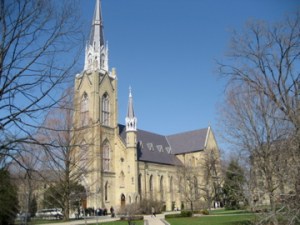 On a less academic and more tourist-y note, I’ll just say the Notre Dame campus struck me just the right way on just the right day. The Basilica is something else, inside and out — although, people, I don’t care what you think about Catholicism, don’t go into Catholic churches if all you’re going to do is go in to leave Jack Chick tracts. That happened while I was in the Basilica, and it was simply embarrassing. I’m not going to go in and start leaving Archbishop Chrysostomos publications in the pews — it’s just bad manners, and shows an utter lack of class. Going into somebody else’s house for the express purpose of insulting them is poor Christianity indeed.
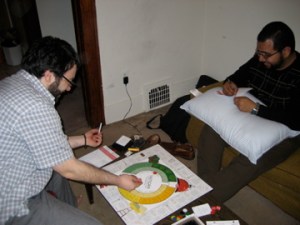 So, one thing we found at the Notre Dame bookstore that I volunteered to buy as soon as I saw they had it: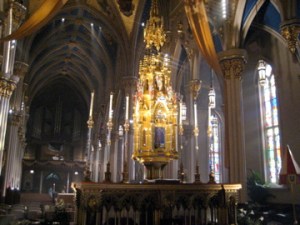

 them), we’ll move forward from here. This group wouldn’t have been able to do this at all a year ago, and it sure isn’t because of me that they can now, so that they were able to do this is a measure of the hard work they’ve put into this.


 Leitourgeia kai Qurbana: Contra den Zeitgeist