Posts Tagged 'sacred music'


Site redesign: Kurt Sander’s Orthodox Choral Music

It is a moral imperative that I inform all three of my regular readers (we’ve grown) about the redesign of Orthodox Choral Music, the website of Kurt Sander, composer of Orthodox liturgical music in the Russian idiom, scholar, Advisory Board member for the St. John of Damascus Society (website coming soon!), and all around good guy and valued colleague (insofar as I may be presumptuous enough to consider myself as having “colleagues”). Content is still being added, it would appear, but I’d say that the main treasure right now is the page of his scores. There’s a lot of really beautiful music there, and while I wouldn’t call it easy repertoire for an average choir, it’s very much worthwhile for, say, the intermediate choir that has a decent acoustic in which to sing and that can put it in the time to learn it well. It’s “American Orthodox music” in what I would consider to be the best sense of that term — settings of English texts by a native speaker in a received idiom, re-articulating the beauty of that idiom without assuming that the shift in language requires a total reconsideration of the form. Kurt understands very well the relationship between music and iconography (and based on things I’ve heard him say, he gets the difference between καιρός and χρόνος as well), and that comes out in his compositions.

Go check out Kurt’s site — it’s worth your time.

So it has come to this.

As I suspected might happen, the talks I gave as a Lenten retreat at St. Paul’s Orthodox Church in Emmaus, PA this last weekend have been posted to Ancient Faith Radio.

A few things: I’ll have a full write-up of the Emmaus trip a little later, but I had a lovely time. Fr. Andrew Damick is a wonderful priest with a wonderful parish, and I very much enjoyed getting to know all of them.

Nobody needs to tell me that there are some baubles in both talks, certainly in the musical examples, and then there are a couple of points that I certainly simplified for purposes of time. I also got a couple of things wrong (Philotheos Kokkinos is in fact a saint, as Fr. Andrew pointed out to me afterward, and Timothy McGee appears to be Canadian, not American, but at least he’s North American, I suppose). Fr. Andrew also mentions in my introduction that I’m “fluent” in Greek, which I most certainly am not, but he was being kind. On the musical baubles, I was also there as a guest cantor, by the time the first talk happened I had already sung three services, and while I was just mentally waking up by the time I went on, I was starting to lose a bit of musical steam. I know, excuses, excuses. Nonetheless, on the whole, I’m pleased with how they turned out.

This does represent at least a “soft opening” for the Saint John of Damascus Society, and while we’re still waiting for our tax-exempt status to come back before we really unveil everything, I can say that http://www.johnofdamascus.org is registered and will be live once tax-exempt status is in hand and we can really be open for business, as it were. In the meantime, if you’re intrigued by anything you hear in these talks, by all means ask me.

Review: Cappella Romana, Mt. Sinai: Frontier of Byzantium

Cappella Romana is an ensemble that’s hard to pin down. Are they an early music ensemble? Yes, sort of, but they don’t generally do Bach or Monteverdi. Are they a sacred music ensemble? Yes, but they’re not affiliated with a specific church institution (i. e., a cathedral or parish). Are they a world music ensemble? Sort of, since much of the music they sing originates in the Mediterranean, but not exactly. Are they a contemporary music ensemble? Yes, sort of, but much of the contemporary music they do is decidedly in an older tradition. Are they a pastoral, confessional affair? Of sorts, I suppose, although their membership is by no means entirely composed of Orthodox Christians. Are they a scholarly project? Well, yes, they’re kind of that too, given that the booklets tend to be article-length affairs with footnotes and bibliography. I suppose you could say that they’re an early world contemporary sacred music vocal ensemble that’s run by a musicologist.

They’ve been extraordinarily productive in terms of recorded output in the last eight years; since 2004 they’ve put out some eight discs (ten if you include the compilation for the Royal Academy’s Byzantium exhibit and their contribution to the Choral Settings of Kassiani project) that have run the gamut — medieval Byzantine chant, Russian-American liturgical settings, a long-form concert work by an American master, Western polyphony, Greek-American polyphonic liturgical music, and Christmas carols (of a sort). Their recordings also continue to get better and better; I picked up their discography in 2004 starting with the Music of Byzantium compilation of various live and recorded excerpts, followed by Lay Aside All Earthly Cares, their collection of Fr. Sergei Glagolev’s music, and then 2006’s The Fall of Constantinople, a program I had heard them perform here in Bloomington. Comparing just those three discs to each other, there’s a noticeable jump in quality, and then comparing them to recent releases such as the Peter Michaelides Divine Liturgy, it’s clear that they’ve found a groove in the studio (as well as perhaps in the editing booth) and they’re riding it now. They’re recording music nobody else is really doing, and while that means it’s hard to know what an applicable comparandum for any particular recording might be, it’s clear listening to it that they’re doing it at a very high level regardless, and the good news about the lack of comparable recordings is that it reveals the sheer richness of the Orthodox musical heritage. Arvo Pärt and Rachmaninoff are great, but there’s much, much more that you can do.

Mt. Sinai: The Frontier of Byzantium fits into this scheme by presenting music from late medieval Byzantine chant manuscripts from St. Catherine Monastery at Mt. Sinai, one of the key crossroads for Eastern Christianity. A Chalcedonian monastic outpost dating as far back as the days of Justinian in the middle of non-Chalcedonian Egypt, it is a treasure house of some of our earliest witnesses to the Christian iconographic tradition (since it was a place of refuge from the iconclasts), and its library of manuscripts in virtually every language of the Roman oikoumene is a witness to the catholicity of the Empire that produced them. The musical selections include portions of a Vespers for the monastery’s patronal feast, as well as the Service of the Three Youths in the Fiery Furnace, a quasi-liturgical drama that would have been served between Matins and Divine Liturgy on the Sunday before Christmas.

The Vespers material is interesting, particularly how Psalm 103 is treated. It is something of a mix of reconstructed Palestinian practice and present-day Greek tradition, where the first three verses are sung antiphonally, and then Koukouzelis et al.‘s setting of the Anoixantaria (the section of Ps. 103 that starts with, “Thou openest thine hand, they are filled with good…”) is interpolated with Triadika, short refrains glorifying the Trinity. It’s an approach to psalmody (in the literal sense of the word) that is generally eschewed in modern American parish practice; we tend to treat whole psalms as something to get through as quickly and as plainly as possible. Of course, just singing the Anoixantaria can take as long as 20 minutes depending on whose setting one is doing, so when parishes want to get Vespers done in half an hour or less, that’s the way it is. Elements like this emphasize how, ideally, our worship needs to be unhurried; we’re on God’s time, he’s not on our time.

The Service of the Furnace portion is lovely. It’s a real curiosity, liturgically speaking; the notes refer to it having been part of the practice of Constantinople and Thessaloniki (and subsequently Crete), and something that developed during the so-called “Byzantine ars nova“, where an artistic and spiritual flourishing was paradoxically occurring in the East at the same time as the political collapse. I’m left wanting to know more about how exactly how it developed, and why, and why it didn’t catch on elsewhere in the Orthodox world.

There are several musical textures in the Furnace section, solo to choral, syllabic to highly melismatic, and they’re all handled with beautiful musicianship and and some of the best male ensemble singing you’re ever likely to hear on a CD. One thing I’d point out is that this actually is something that has been commercially recorded before and is more or less available, even if you have to know where to look for it. Lycourgos Angelopoulos and the Greek Byzantine Choir (EBX) recorded parts of it for a Polish release called “Byzantine Hymns”, and while I have yet to actually find this for purchase anywhere, you can find their rendering of the Service of the Furnace hymnody on YouTube.   Obviously there’s a bit of a difference in approach; EBX tends to have a different vocal quality all around that I would describe as a little more suntanned and weatherbeaten, and they’re singing the material the way they sing at church every Sunday. EBX also employs a children’s choir for the Three Youths themselves, which is apparently the historical practice and sounds fantastic, but I can see several reasons why that might be an undesirable layer of complexity for Cappella’s presentation.

One other thought — something that a recording like this might help to give a glimpse of is the vitality of the Christian tradition in the Middle East. St. Catherine’s Monastery is an Egyptian witness to a faithful, diverse, cosmopolitan Christianity in the Roman world, and that Christianity is still there, alive, and hanging on. Projects like this show that it is a witness that has much still to teach us.

The ison problem

There’s something about the use of a drone that automatically puts it into the category of Something Not Us for the Western ear, at least on this side of the water. It seems to dislocate the listener either geographically or temporally, maybe both. This seems to be true whether we’re talking about Scottish bagpipes, reconstructions of medieval music, or — you guessed it — Byzantine chant; the drone itself functions as what various disciplines call a “chronotope“, something that represents, or maybe is evocative of, information about time and space. More simply, the drone calls to mind other places and other times for our ears, and if I had to make a really prosaic guess, it’s because American music by and large doesn’t use it. That’s actually more of a significant point than it presently seems; I’ll get there.

The first time I was ever exposed to music that employed a drone where I was aware it was doing so was singing the Byzantine-ish choral compositions of John Tavener in my first concert with The Tudor Choir way back in the fall of 1997. That’s a story for another time, and has an active role in a different narrative presently in progress, but what I can say for now is that that particular bass section wailing away on the drone in the amazingly resonant acoustic of St. James Cathedral in Seattle was transportive. It was so simple, so distinctive, so grounding, and so powerful.

A similar experience was to be had seven years later in Auer Hall at Indiana University, when in May of 2004 Cappella Romana performed their Fall of Constantinople program as part of the Bloomington Early Music Festival. Again — that particular group of singers on the ison, in that hall… it was something else.

As much of a sine qua non as ison seems to be for Byzantine chant on initially hearing it, however, what also seems to be the case is that it is so easy to get wrong. First of all, the so-called “Western ear” (whatever that really means) has the impulse to harmonize the melody, usually by making up a line that moves in parallel thirds, and once you’ve done that, it’s a quick hop to treating the drone as a bass line that needs to move according to the requirements of functional harmony. Follow the Bouncing Ison.

Most music in the world is modal. That means it is categorized and organized according to different kinds of scales that themselves are used for different kinds of melodies. Western music, which frankly represents a small portion of the world’s musical output, is, for the most part, not. It is tonal, which means it has whittled down the modes to two, major and minor, and has instead focused on building vertical sonorities that have particular functions based on building up of harmonic instability and subsequent resolution of that instability.

Something else Western music tends to be, at least on paper, is tuned so that all keys sound exactly the same except for the range. I had a music theory teacher who once said, “Before all of this equal-tempered nonsense, keys actually sounded like themselves and there was actually more of a musical reason to modulate [change keys].” Most modal music, however, is not tuned this way. And, really, in practice, Western music resolutely holds on to some of the old way even if we’re used to sanding off most of the corners. Singers and fretless string players have to carefully tune thirds and distinguish sevenths from leading tones, for example.

Quick demonstration of the difference — here’s the Christmas carol “What Child Is This”, a melody using a minor scale and arranged for choir using rules of tonal harmony:

Now, here’s the original melody, “Greensleeves,” using the Dorian mode rather than our typical minor (that is, Aeolian) scale:  I had a devil of a time actually finding a decent version of Greensleeves on YouTube, so this probably isn’t as clear of a demonstration as I’d like it to be, but hopefully some of the difference of character comes through.

To begin with, Byzantine chant is modal and not tonal. For purposes of liturgical organization, there are eight modes; in actual musical terms, however, depending on how you count them, that number is probably doubled. This is why harmonizing it ultimately doesn’t work, and why the automatic tendency some people with very decent ears have, to place the ison on whatever the lowest note is that they perceive can function as the root of a major or minor scale, is not only wrong, but robs this particular musical idiom of its proper character.

A somewhat more subtle point is why the ison needs to not move in parallel to the melody as though as it’s a bass line, and that’s because it’s not a bass line.

Let me say that again for emphasis: it is not a bass line. Therefore, it doesn’t need to, and in fact shouldn’t, move like one.

Here is an excerpt from the essay, “A Brief Overview of the Psaltic Art”, that starts out the Byzantine Music: Theory and Practice Guide that just came out:

The Psaltic Art is… strictly monophonic [emphasis in the original]. In other words, it is performed by a single cantor or a choir singing one melody in unison… It should also be noted that psaltic melodies are frequently accompanied by the ison (drone), which is a constant humming of a single note (the root of the main tetrachord in which the melody is moving). This… practice is sometimes considered a form of proto-polyphony. However, its primary function seems to be tonal stability rather than “harmonic” enrichment of the melody (p. iv).

So, it is not intended to be harmonized, and the drone is intended to provide stability — that is, a structural foundation — for the melody rather than instability — that is, the harmonic function of a bass line. Not only that, where the drone is pitched has to do with where in the scale the melody is, which itself is a function of what mode the melody employs. If you’re in the first tetrachord (that is, the initial division of four notes of the scale) of sticheraric Plagal Fourth Mode (a/k/a Tone 8), the ison is not  going to be sung on the same pitch as a melody written in irmologic Fourth Mode (a/k/a Tone 4) — and yet, that’s exactly where some people instinctively want to put it, and if you gently point out to them that there actually is a right way to do it, ask them nicely to do it the right way, and even if you sing it the right way in their ear, they will adamantly insist that the two modes must be the same by shoehorning them into the same Western framework of tonal harmony.

It has been suggested to me that this constitutes “organic development”, and that we don’t need to treat the Byzantine modes as anything special when there are twelve major and twelve minor keys in Western music. I cannot agree; what this constitutes is, plain and simple, doing it wrong.

Can we agree that there is a right way and a wrong way to do this stuff, and that stubornly improvising harmonies in thirds and making up drone notes that are on the wrong pitches and not functioning within the musical texture the way they’re supposed to, no matter how much you may like to sing that way for yourself personally, represents singing it the wrong way? We can deal with equal-temperament later — first we have to at least come to terms on the fundamental approach towards the music. Are we going to learn to sing it the way it’s supposed to be learned, or are we going to insist that we get to sing it in a way foreign to its nature because we’re American and thus special?

And please don’t bring up Russian music. If Obikhod is what you’re thinking of, well, there is Russian liturgical music composed before Russians started learning composition from the Italians that would singe the hair of your toes.

Why does this matter? Is it because we musicians want to control everything and force all of the regular folks in the congregation to either shut up or to do things our way? No, it matters for the same reason that you don’t get to make up your own version of the Lord’s Prayer to say when the time comes in the Liturgy for the congregation to say the Lord’s Prayer, or your own version of the Creed. It matters for the same reason that iconographers are supposed to depict the Mother of God’s veil as red and the rest of her clothing as blue, and not make up a paisley print and polka-dot pattern. It matters for the same reason that we’re supposed to use a particular kind of stamp on the Eucharistic bread rather than carving our names into the loaf. There is a way things are to be done, decently and in order, and we don’t just get to make up our own way of doing things, even in the name of “participation”. There is this impulse among some people to special-case music so that these concerns don’t apply in that sphere, and I really don’t get it. On a broader level, how I might put it is that I have never myself experienced a musical scenario where people can successfully argue that they have the right to sing wrong notes, but that comes very close to what I sometimes hear given as the response to these issues.

Update, 30 January 2012, 7:04am — I made a big point of saying that American music doesn’t generally use drone and that that was something important I’d come back to, and then I forgot to come back to it. Hazards of blogging right before you go to bed.

A related idea — I’ve had some very interesting conversations with people that lead me to believe it is possible to simply be culturally uncomfortable with monophonic music. I don’t have a clue how or why this could be, but I’ve had people tell me before, “Do I have to sing melody? Can’t I just make up a harmony? It feels wrong not to in my voice.” A couple of my attempts at Orthodox hymns that would employ some features of American folk music have met with the reaction from more than one person, “Hey, nice melody. When are you writing parts?” Explaining that I’m intentionally writing a melody to be sung in unison usually generates a confused stare and the question “Why?” asked in such a way that tells me I’m not going to be able to explain it to them.

Back to drone. I’m hardly an expert on anything, let alone American folk music, but I can’t think of any examples off the top of my head that use drone. Drone is usually discussed as a characteristic of either medieval music or “world music”, which subtly makes it a different beast than it would be living in a part of the world where it’s a characteristic of the local “folk music” rather than “world music”. I hesitate to go whole hog and say that we’ve constructed an orientalizing narrative about kinds of music that use drone, or that’s it’s a feature of “primitive” music whereas harmony is how “advanced” societies think of music, but I think there might be some relevant thoughts there.

In any event, because it’s not a feature of American vernacular music, as soon as we hear it, we know it’s either from the old country (whichever old country that might be) or just plain old. That at once seems to validate it as “authentic” and also prompt some people to look for sharp corners that need to be filed off. The chronotope is a double-edged sword.

My solution is education; cantors need to be able and willing to explain what it is, what it’s doing, and what the right way to sing it sounds like. This has to work both ways, however; people need to be willing to ask, “How is this supposed to be done?” and then willing to follow the instruction they’re given. Unfortunately, I’ve seen instances where the attitude is, “If I can’t sing it along with you in a way that seems instinctive and natural to me the first time I hear it, then you’re excluding me from participating.” It’s a tricky business, to be sure.

Lenten retreat at St. Paul Orthodox Church, Emmaus, PA

As I mentioned, Fr. Andrew Damick has been kind enough to invite me to disseminate some of my crazy ideas about Orthodox church music at his parish. I’ll be talking on Saturday, 3 March at St. Paul Orthodox Church in Emmaus, Pennsylvania. Fr. Andrew just posted a schedule for the day on the church website, and he has created a Facebook event. I should note that the flyer marks the first public mention of the St. John of Damascus Society, which hopefully means I’ll be able to talk more about what that is shortly. Anyway, if you’re anywhere close to that neck of the woods, by all means please come!

New release: Byzantine Music: Theory and Practice Guide, Archdiocesan School of Byzantine Music (GOA)

The Greek Orthodox Archdiocese has released for purchase by the general public the textbook used by the Archdiocesan School of Byzantine Music. My copy arrived in the mail today, and while I haven’t had a chance to sing through the whole thing or thoroughly read through its contents, at first glance it looks wonderful and quite handsomely put together. It’s very similar in a lot of respects to the Margaziotis exercise book that’s floating around out there, except that it’s written in English and includes both an overview of some of the theory and an essay outlining the history and key figures relevant to the Byzantine musical tradition. There’s also a CD, and while the Margaziotis pdf has musical examples embedded, the CD introduces all of the exercises in English as well.

Here is the table of contents:

  • Acknowledgments: Archdeacon Pantaleimon Papadopoulos, ASBM Director
  • Foreword: Dr. Demetrios Kehagis, ASBM Instructor
  • Introduction: A Brief Overview of the Psaltic Art, by Grammenos Karanos, Ph.D. in Byzantine Musicology, Assistant Professor of Byzantine Music, Holy Cross Greek Orthodox School of Theology
  • Byzantine music theory and practice
  • Chanting with melos
  • Definition of terms
  • A synoptic theory chart & reference
  • Index of Byzantine music characters

Here is the book opened and compared with the full-size photocopy of the Margaziotis book that I was given:

And, mostly for size purposes, here it is compared with a standard Anastasimatarion:

The CD of musical exercises is nicely and clearly sung, and among other things, I think it will be of help to people who are trying to figure out where the intervals are in their own throats.

Anyway, I’m really impressed with the care that’s gone into presenting this material to an English-speaking audience, and on the whole the exercises seem very consistent with the method used in the Margaziotis. If somebody has worked through Fr. David Barr’s materials and figured out how to understand the version of Byzantine chant that’s filtered through Western music theory well enough that they want a new challenge, this book seems like a worthy next step.

The one potential downside is that the musical examples from actual chants are all in Greek, so you need to either be able to read the Greek characters or have access to somebody who can teach the hymn texts to you phonetically. The next step after this book is going to be a Byzantine music theory and exercise book that’s not just written in English, but also uses English music examples. Factoring that out, this publication looks to be the state of the art in terms of educational materials that make learning Byzantine chant (including notation) accessible in English. I’m quite tempted to order five copies to have on hand for people in my choir.

I would very much like to think that the Antiochian Archdiocese, particularly given some things said recently by higher-ups about wanting a renewed emphasis on the Byzantine chant traditions of the Patriarchate of Antioch, would take some cues from what the Greeks are doing with the Archdiocesan School. Right now there are scattered efforts to do things, but nothing systematic so far as I can tell.

You can order Byzantine Music: Theory and Practice Guide from the link above.

An itinerary and a couple of labors of love

I’ve got three things to pass along, and I suppose I should relate them in order of interest from least to greatest. Otherwise, you’ll just read the first item and skip the rest.

First — I’m going to be mildly peripatetic in the coming months. 9-12 February I will be in New Jersey to participate in the Georges Florovsky Patristic Symposium, and then 12-15 February I will be in Boston to spend a few days at Holy Cross Greek Orthodox School of Theology. 2-4 March I will be in Emmaus, PA to give a presentation on church music as part of a Lenten retreat at St. Paul Orthodox Church. Then, looking ahead a bit farther, 24-26 May I will be participating in the North American Patristics Society (NAPS) annual meeting in Chicago. I realize that maybe I’m up to three regular readers (counting my parakeet), but if you happen to be anywhere near any of those places when I’m there, by all means let me know. I had the odd experience at the Antiochian Sacred Music Institute last summer of meeting a couple of people who said upon meeting me, “Oh! I read your blog,” and then I also met this gentleman at the Byzantine Studies conference this last October (although neither of us realized whom the other was until after we were both back home). Anyway, I won’t look at you funny or hiss at you if you introduce yourself, promise.

Second — my first peer-reviewed article, “Sensory Experience and the Women Martyrs of Najran”, has been accepted by The Journal of Early Christian Studies. It’s been an interesting road with this project; five years ago, during my initial year of being a non-matriculated continuing student, I took my first graduate seminar, a course on the Middle East in late antiquity, taught by the professor who would later become my advisor. It was my first exposure to scholars like Peter Brown and Susan Ashbrook Harvey and so on, and was a significant broadening of my horizons. The student makeup of the class was very telling; it was a History course that had no History students in it but rather three Religious Studies kids and me.

Anyway, among other things, we read Sebastian Brock and Susan Ashbrook Harvey’s translation of the section of the Second Letter of Simeon of Beth-Arsham that deals with the martyrdoms of the women during the Himyarites’ sack of Najran, and the in-class discussion sparked something for me. Other students were focused on the gory nature of the martyrdom details for their own sake — I specifically remember one person commenting, “I never understood the connection people draw between martyrdom and sadomasochism before now” — but it was clear to me that there was something else governing how those details were conveyed, namely shared liturgical experience. I raised this point, and I still remember the look that I got as clear as day. Needless to say, it didn’t get a lot of traction in class, but when paper topics had to be proposed, I mentioned it to the professor as a possibility. “I can almost guarantee you I won’t buy your argument,” he said. “You’ll have to go a long way for me to see it as at all legitimate.” Well, that’s a challenge, now isn’t it? I wrote the paper, making what I saw as explicit as I could and relating it to known liturgical practices as clearly as I was able. I presented an overview in class, and the professor was quiet for a moment. “You know,” he said, “not only am I convinced, but now I can’t see it any other way. Good for you.”

Later, as I was applying for IU’s Religious Studies graduate program, the paper was used as my writing sample. At the same time, I was alerted to one of the big religious studies journals doing a themed issue on religious violence; I figured, hey, what the heck, if it gets in it can only help the application, and I sent them the paper. I also submitted it to Dorushe, a graduate conference on Syriac studies that was being held at Notre Dame. Well, the outcome of the Religious Studies application was detailed, if somewhat obscurely, here; as far as the paper went, it got into Dorushe, but the response from the journal was a little more ambivalent. The answer was ultimately no, but they included the reviewers’ comments, and said that if I were to revise it they would be willing to look at it again (while making it clear that this was not a “revise and resubmit”). Since at that point I didn’t think I was going to have the chance to go to grad school, publication didn’t really matter anymore, and I shoved the paper and the comments sheet in a drawer. The Dorushe experience was a little weird in some ways (maybe due more to some heightened self-consciousness on my part than anything), but I met some interesting people, and Sidney Griffith, at least, liked the paper, saying, “The way you lay it out, it’s obvious.”

After actually getting in to grad school, I thought to myself a number of times, I should go back and look at those reviewers’ comments, and finally last June I spent a few days thoroughly reworking the paper. I transferred it from Word to Scrivener, I restructured it following the reviewers’ suggestions, and did what was nearly a page one-rewrite so that it reflected better what my scholarly voice (to the extent that I might pretentiously assert the existence of such a thing) actually sounds like these days. Part of this involved reducing block quotes of secondary literature (a bad habit of which I was cured by the wonderful Prof. Sarah Bassett over in Art History, who in the three years that she’s been here has really proven herself to be one of the great, if somewhat unsung, reasons to study Late Antiquity at Indiana University) down to footnotes and paraphrases, and it also involved an overall refinement of the writing style. Don’t worry, I’m still wordy as hell, but I’ve tried to make the wordiness a little more elegant. Also, there’s some additional literature on the Najran incident that’s come out in the intervening five years, and I had to make sure that all got referenced properly. Anyway, once it was done, I opted to not go back to the original publication, instead sending it off to The Journal of Early Christian Studies. In September, I got a note back from the editor telling me that the reviewers’ recommendation was “revise and resubmit”, saying that this was good news and if I took the feedback seriously, there was no reason I couldn’t have a publishable article. By November the revision was re-submitted, and I got word back this last Tuesday that it was in. Now, I have some style adjustments to make before it’s totally done, but at this stage of the game it looks like it will be appearing in the Spring 2013 issue.

So, that first seminar five years ago got me my advisor, my overall area of interest (the interaction of liturgy and history), and my first published article. (Although, while the Najran paper is related conceptually and methodologically to where I think my dissertation is going, it looks like a paper I wrote for a class I took the previous semester, fall of 2006, served as a first stab at the actual dissertation topic. I’ll have more to say after NAPS, I think.) It’s been the gift that’s kept on giving, to say the least.

Okay, on to the final, and most interesting, bit of news.

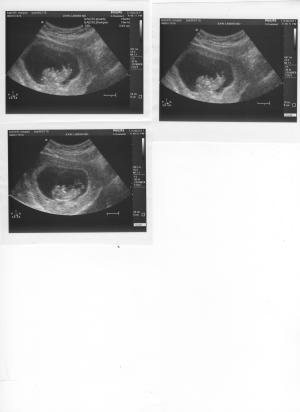
Third — on or around 26 June 2012, assuming all goes well and without incident, there will be another Barrett on the earth. Yes, be afraid, my genes are propagating, insanity, puns, tendencies towards a prolix approach of oversharing, and all. Thankfully, this child will also be carrying the genes of Flesh of My Flesh, and those characteristics involve practicality, common sense, order, and normality. (To say nothing of great beauty and brilliance.)

We had intended for the last couple of years that we would start trying once Megan got back from Germany, and we were told to prepare for it taking awhile. Well, apparently not. By the beginning of November we at least knew informally, and then our first OB appointment was Tuesday of Thanksgiving week, which confirmed matters and indicated we were nine weeks along. We spent most of the drive to our Thanksgiving destination on the phone with my mother and then Megan’s mother and stepmother; my mom got the first call, since she’s the one parent who doesn’t have any grandchildren already, and she burst into tears immediately.

We’ve been telling friends and family ever since, but a couple of things made it desirable that we wait a bit before making it “Facebook public”, as it were. Anyway, here we are, and I suppose it will be a source of reflection in the coming months/years/etc. If you’re on Facebook and want to be kept more or less up-to-date, you can join the group “Fans of Baby Barrett“; there’s not a lot to tell at this point except that we’re choosing to not find out whether it’s a boy or a girl. We’ve got some name ideas, yes, but it’s hardly practical to openly discuss those when you don’t know if it’s a boy or a girl, so I’m not going to go there except to say that there are some “legacy names”, as it were, that might make sense, and you know that we’re going to be getting one of these. We’ll see.

By the way, if you happen to be having a baby in or around Bloomington, Indiana, I really can’t recommend Bloomington Area Birth Services (AKA “BABS”) enough. We’re doing their eight-week birthing class (cue Bill Cosby: “Natural childbirth… intellectuals go to class to study how to do this”), and while, I must admit, it’s a little more of the NPR-listening “educated class” culture than I really expected, it’s a lot of excellent information that’s provided very sensitively and accessibly. I kind of surprise myself with my own reactions to some things; it should really be no surprise that “birth culture” a) exists b) is hyper-feminized, but I find a certain kind of stereotypical “maleness” emerging in how I’m processing some of the information, and it is very much out of character for me. It’s probably mostly a reflexive reaction to the explicit hyper-feminization of what’s being presented, which probably has everything to do with me and nothing to do with them, because they really are terrific at what they do. I’m just really not used to what they do. Anyway, I’ll have more to say about this as time goes on, I think.

So, there’s the news. Two different kinds of babies, I guess. There’s a third kind of baby on the way that I hope to be able to talk about more in depth soon, but it’s an outgrowth of some of the musical efforts I’ve had going here the last couple of years. For now, follow this, and I’ll be able to tell all in the next month or so, I think.

Prayers for all of these babies, please, and prayers most of all for Flesh of My Flesh. She’s got to carry our child in her womb and write a dissertation.

“Encounter” vs. “reception” vs. solutions looking for problems

As has been our custom for the last seven years, New Year’s found me and Flesh of My Flesh in the company of our dear friends Benjamin and Paul for a long weekend of food and movies. We all started out in Bloomington at about the same time, and we all converted to Orthodox Christianity within a year of each other. During academic year ’05/’06 Benjamin and Paul were roommates, and for all intents and purposes there was something of a miniature commune between our two residences, with at least one shared meal virtually daily at either our place or theirs. When they both departed for broader horizons in summer of 2006 — Benjamin to take an adjunct voice teacher position at his alma mater in Cleveland, Paul to pursue different opportunities in New Jersey — we made a point of continuing to spend New Year’s together, and save for ’10/’11 when Megan was in Germany for the year (and therefore I was overseas visiting her for the New Year), we have done so every year since. ’06/’07 and ’07/’08 were in Cleveland, ’08/’09 was here in Bloomington, and then this time we all made the trek out to New Jersey, since Paul has always been good enough to come out to see us in past years. This year the menu was French food, largely inspired by Benjamin and Paul’s respective travels; the films included The King’s Speech (I’d seen it before; it’s good but I can’t say I found it life-changing or worthy of Best Picture) and The White Countess (excellent on every level, and I was left wondering why in the world I’d never heard of it before). I also had the pleasure of introducing Paul to the Steven Moffat/Benedict Cumberbatch/Martin Freeman Sherlock, and I have to say that I have yet to show anybody the first fifteen minutes of “A Study in Pink” who hasn’t both been glued to their chair for the rest and bugging me for the next two or three days about watching the other two episodes. This means I’ve seen “A Study in Pink” now about ten times, but that has yet to be a problem. I will have to write later about how Steven Moffat, Benedict Cumberbatch, and Matt Smith have gradually taken over such TV viewing habits as I have; suffice it to say for the time being that I’m not pleased that I will have to wait until May for “A Scandal in Belgravia” and God-only-knows-when for Series 7 of Doctor Who.

A visit to Paul’s current parish Sunday morning was interesting for a number of reasons. Among them was the choir situation; they appear to be quite blessed with a volunteer choir that can pretty much sing whatever the director puts in front of them, and the director himself is a very capable conductor. He’s given them all very thick binders with multiple options for everything, and he apparently chooses everything on the fly during the service based on whom he happens to have that particular morning. He’s not shy about giving them tougher stuff, either, or about making some, uh, unorthodox musical choices, like Sarum chant and William Byrd.

We had, to say the least, a lively conversation following the Divine Liturgy, prompted in no small part by the director’s mention of the recent publication of the Suchy-Pilalis first Nativity Canon. He brought it up, mentioned that he saw that it was a new melody composed using Byzantine principles for the Lash translation, and I was about to say, “Yes, it’s great work that is one of a few things like that pointing the way forward” when he surprised me with his adamant insistence that it was nonsense. He asserted rather bluntly that composing for English texts using Byzantine compositional principles is no better than keeping an existing melody, whiting out the Greek, and shoehorning in the English. He said over and over again that you absolutely cannot do that — I think he may have even called it “unconscionable” that anybody would think that it’s an acceptable approach. His stance was that Byzantine compositional principles assume an inflected language with particular stress patterns for particular kinds of cadences, and that English doesn’t work that way, so it’s just another way of shoehorning English texts into a context they were never meant to fit. Plus, he said, even if you recompose for English, it doesn’t change the fact that you’re talking about a musical idiom that has zero cultural resonance whatever for the native English speaker, and thus utterly fails in terms of mission. In all fairness, he didn’t really single out Byzantine chant; he seemed to be suggesting that virtually all received forms of Orthodox liturgical music need to be consigned to the dustheap for purposes of English. If they’re going to survive at all, he said, they need to be adapted “organically” for purposes of a culturally American, English-language context, but even when pressed it seemed unclear exactly what he had in mind.

I found myself even more perplexed when it came to what he saw as a better alternative. He was as unsympathetic to the idea of using existing American vernacular musical idioms as a starting point as he was to anything else; “You’re just arbitrarily historicizing something else that way,” was his response. He made it clear that he wasn’t suggesting that we look to Eminem for a example of what “the music of the people” might sound like, but exactly what he thought we should be looking to was never articulated precisely.

He also had unmitigated wrath for anybody who might preserve any kind of Jacobean-style English, arguing that the style has the exact opposite effect from what it was intended to have. Thees and thous were supposed to be familiar, he said, and we now use them to distance ourselves from God and place him higher than ourselves rather than to address him with intimacy. Megan tried to express some appreciation for the style and he would have none of it; “You want Christ’s crucifixion to be meaningless just so you can have your thees and thous!” he told her. (A friend of his started to intervene at this point, only to have him yell, “WE’RE NOT ARGUING!”)

Now, lest I be misleading, I should say that while I intensely disagree with this gentleman on a number of points, he was — believe it or not — good-natured and friendly throughout the conversation, and very well-informed on the whole. There were a couple of things he said where I’m not sure where he’s getting his information, but it’s safe to say that our disagreements are generally informed disagreements, and those are the kind I’d rather have with people.

Megan also asked him, “Why do we need to reinvent the wheel when the wheels we have have done pretty well in every other situation for at least the last 1500 years?” His answer? “Good question. Because those wheels don’t travel on our roads.”

Because those wheels don’t travel on our roads.

Hm.

Matthew Namee’s recent piece over at SOCHA, “Toward and American Orthodox historical narrative”, looks to the concept of “encounter” as a way of talking about American Orthodox history — “Encounter between Orthodoxy and the West; encounter between long-isolated Orthodox ethnic groups; and encounter between the Eastern and Oriental Orthodox.” He expands on the notion of the encounter with the West using Orthodox youth as an example:

From the beginning, American Orthodoxy has struggled to retain its young people. It didn’t help that, for decades (and in some churches, up to the present) Orthodoxy was treated as more of a cultural artifact than a living faith. Old languages were preserved, and English was resisted, and most young people didn’t care about the misguided justifications for using only Greek or Slavonic or Arabic or what have you. Who wants to worship in a language they can’t understand? And no matter how beautiful a language is, if the people can’t understand it, it has failed in its fundamental purpose: to communicate meaning.

He wraps up the “encounter with the West” idea thus:

We encountered the West, and we didn’t know what in the heck to do with it. We weren’t prepared. We flailed about, dancing with the Anglicans, wallowing in our nominalism, ordaining every male American convert who expressed the faintest interest in the priesthood. All too often, we have lacked a vision for our mission in America, and even our identity as the Apostolic Church — the Church. Sentimentalism, ethnic pride, a desire for acceptance, a pleasant feeling of surprise when we are accepted — these things all can be good, and they can have their place. But they can also be our downfall.

The “encounter with the West” notion seems to agree with this New Jersey choir director that “those wheels don’t travel on our roads”. What we had doesn’t work here, and the more we try to make it work here, the more it underscores how badly it doesn’t work here. From a musical point of view this problematizes the whole notion of a “received tradition”; you can’t speak of a “received tradition” when nobody’s receiving it. This appears to be what the New Jersey choir director is getting at: reception isn’t happening, and the more you try to make the existing idioms get along with our language and culture, the more it emphasizes that it can’t be done.

As far as Matthew Namee’s piece goes — I like a lot of what he has to say, and I think what he has to say about the dangers we’ve set up for ourselves with convert clergy being ordained too lightly and too quickly is probably exactly right. Still, there are some over-generalizations that bother me. The language issue — and I’m not even going to go near the bit about the “fundamental purpose” of language, because that’s a significantly complicated matter — certainly gets its exercise in almost any conversation about this stuff, but the flipside is the phenomenon I’ve seen of people who’ve grown up in parishes where a non-vernacular liturgical language is preserved and for whom hearing the services in English is a cheapening experience. It’s great that it’s in English, it’s great that I can understand this or that part of the service, they say, but… something’s wrong. It sounds like English, but it doesn’t sound like church. What I have come to understand from what I’ve experienced in non-English parishes is that, for a significant portion of cradles, it matters that the language they hear in church is the language in which they remember hearing their grandmother pray. It matters because liturgy builds, maintains, and transmits religious identity, and to the extent that liturgy feels like a “family affair” in a broad and a narrow sense of the term, it’s going to be difficult for such people to separate their earthly family from their church family. I recently met an older Greek-American who lives here in Bloomington and was part of what became All Saints in the early days but who declined to continue to be part of it when the community incorporated under the Antiochians. He said, rather bluntly, “Forgive my ethno-centrism, but I just can’t do it. What a Greek person gets out of going to a Greek church is very personal, and it’s not something you can just transplant or translate.” A somewhat more flippant Greek-American friend of mine recently put it, “So often, you just want to say, ‘American Orthodoxy — you’re doing it wrong.'”

But let’s be honest — that’s what’s at the core of King James-style English, too. Even we as English speakers want church to sound like church. That’s the Lord’s Prayer the way we were taught it as kids — once again, the way we we remember hearing our grandmother pray. And the New Jersey choir director is right, sometimes that means the meaning has shifted — take the Paschal greeting the way it’s typically rendered into English: “Christ is risen! Truly he is risen!” And we hear things about how that means that Christ is risen now, today, that it’s an ongoing reality — but that’s not actually what “is risen” means. “Christ is risen” is an archaic way of saying what we would now express in English as “Christ has risen”. It’s a perfect tense — think the Christmas carol “Joy to the world” — “The Lord is come“. It’s still the way you do perfect tenses in German — “Christus ist auferstanden!” — but in English it’s an archaicism, and one we don’t readily grasp as being so. If you translate Χριστὸς ἀνέστη literally, it’s something like “Christ rose”; it’s an aorist tense, past time and simple aspect — the narrative past tense, if you like, which establishes it as a once-and-for-all historical event, which is something very different from understanding “Christ is risen” as being in the present tense. But if we started saying “Christ arose!” on Easter, I’m guessing it really wouldn’t work for most people.

If archaic language is keeping youth out, but English isn’t necessarily solving the problem, then there is more of an issue here, and maybe Namee gets more to the point when he says that Orthodox Christianity “didn’t know what the heck to do” with the West.

Here’s what I think is the hard reality: Orthodox Christianity in the United States, at least as presented up to this point, is a solution looking for a problem.

I don’t think I’m going too far when I say that Americans, by and large, have no interest in being part of Holy Russia, have no interest in re-establishing the Roman Empire, and have no real interest in Russian or Greek cultures except when they can get good poppyseed rolls or have a gyros while watching some kids re-enact Zorba’s dance. Yes, fine, we all know that. Americans want to be Americans.

But you know what? From what I’ve seen, I don’t think Americans, for the most part, have any particular interest in being part of “the one true Church” either. America, like it or lump it, is culturally Protestant, and as soon as you start using that kind of language, you’re already making assumptions that were rejected by our forebears centuries ago. Most Americans are not looking for a “more authentic” liturgical experience; most Americans are not looking for anything “traditional” or that constitutes a “deeper Christian spirituality”, or whatever the other buzzwords are that we all like to use. I have seen with my own eyes what can happen when certain kinds of American Protestants try to speak in that language, and the result is something like theatre for the deaf. Americans, at least some of them, can be well aware of the consequences when those elements of Christianity with even the vaguest of historical roots are traded for a mess of pottage, and in a way this can be seen as a manifestation of the same problem as language — church seems too distinct from your everyday life, which might be a problem, but in updating, it loses an important distinction from everyday life, and thus there ceases to be a compelling reason to go. But, by and large, these are pretty rarefied problems from the standpoint of most Americans trying to figure out where they might go to church on Sunday morning. Even the apparent cultural impulse in which Orthodox Christianity subsists of gilding and ornamenting the things you love and think are important falls totally flat in a culture that thinks you need to strip the things you care about down to bare essentials. As marketed and described, at least, Orthodox Christianity, frankly, is just in the wrong key for American culture, no matter what melody you try to write in that key. It may very well be what America needs, but that’s something completely different.

Orthodox Christianity, in order to succeed in any kind of an American mission, doesn’t first and foremost need to find a musical idiom that will have cultural resonance, it doesn’t first and foremost need to be in English, and it doesn’t first and foremost need a simpler liturgy or reduced vestments or married bishops or anything like this. I have a lot more faith in what has been passed down than that — those things have survived this long under wars and occupation and servitude and so on, and I’m not convinced that America is a worse threat than any of those issues. Does Orthodox Christianity need to preach the Gospel, Christ crucified? Yes, but it’s going to be painfully obvious in doing so that we’re not the only ones who are, and being “the one true Church” isn’t going to sufficiently elevate us over the competing ambient noise, I don’t think.

What Orthodox Christianity needs to do is actually have a way of addressing real problems real people have rather than thinking that Joe Average is going to care about Arianism or Iconoclasm. I think I’m on safe ground in saying that most people don’t think they have a “true Church” problem. Most people don’t think they have a liturgy problem or a filioque problem. Most people these days are just trying to get through the day with some amount of sanity and dignity and without going broke, and when they go to church they want to feel like they’re getting comfort of some kind. Solace. Some sense of belonging, of acceptance of and respite from their daily struggle the rest of the week. Some sense that God’s in control even if they’re not.

How does Orthodox Christianity do this? I don’t know. Our services don’t really do catharsis, and I don’t think we’ll serve ourselves or anybody else well to try. I don’t think we do it via self-conscious “accessibility” efforts; I could say something really obvious and pithy like, we have to do it by loving other people, and while that’s true, what does that look like so that, as C. S. Lewis might have put it, in aiming for it, the ecclesial, liturgical, and spiritual issues get thrown in? Certainly organizations like IOCC and OCMC already perform valuable social services and missions and so on, but the narrative of “Orthodoxy doesn’t do those things” already exists, rightly or wrongly, and efforts in those areas are seen as confirming their scarcity rather than speaking to their abundance or efficacy.

By the way, what I’m not arguing here is that we somehow need to come up with a “strategy”. I’m actually trying to say that the strategies we’ve come up with up to this point aren’t actually accomplishing what we think they should be. Some of you may recall that over a year ago, I was trying to get an Orthodox IU alumni association going. Well, we put together a mailing list of 500 people, and somebody got involved who himself had a lot of experience at what he called the “science” of marketing and fundraising. He gave a lot of specific advice about what the mailing should and should not do and look like, and what actually went out in the mail, even though it bore my signature, was more based on his concept than mine. In any event, he believed very strongly that what we sent out should have really grabbed a lot of attention and gotten a lot of people involved. It was a well-strategized effort, to say the least — and there was absolutely zero response. Zero. The strategy accomplished nothing. Why? Again, because we were a solution looking for a problem — for a good chunk of the people we were trying to reach, there would be no association of Orthodoxy with their time at IU because there was no church here in those days. There would be no reason for them to be sold on an Orthodox alumni association if they were already members of the regular alumni association and didn’t have any particular already-established goodwill towards the parish here. Strategies do nothing if you aren’t actually addressing an issue somebody has, unless you’re Steve Jobs, in which case you are magically able to convince people they need something they’ve never heard of before. Orthodoxy in this country has not had a lot of luck being Steve Jobs, although the reason why he was so good at it was because the designs produced under his name were useful and elegant and beautiful. We haven’t yet convinced ourselves that we have the resources to do all three of those things the way they would actually need to be done.

To come back to liturgy and music — I myself do not play to English exceptionalism. English is important, yes, sure, fine, but catering to it to the extent of throwing out large chunks of historical practice with the justification that we have to do it because it’s English can hardly be priority zero. (I’ve already said what I think about the textuality of the liturgy.) I don’t hear anybody arguing that icons need to look more like Norman Rockwell painted them. I think the wheels we have do travel on our roads — I think the simple fact is that we aren’t building the wheels well enough for the most part. If we’d actually build them as designed with skill and attention to quality, they’d work just fine. We need to do what we do and what makes us distinctive as well as we possibly can, not decide for everybody else that they won’t like it anyway. What form of music will play in Peoria is, honestly, a side issue. If the Orthodox Church can actually reach an average person in Peoria who is struggling with just getting through the day, love that person unconditionally, and proclaim the Gospel to that average person in a way that sticks, then that person isn’t going to care that the music is Byzantine chant — rather, he or she will associate that music with the difference that is made in his/her life. (That’s something I have seen, I should hasten to add.) If we don’t take our own practices seriously enough to do them well and with care, then such a hypothetical person will sense that we don’t care about them, and he/she won’t care about them either.

Anyway — all of that is to say, Orthodoxy in America as a solution looking for a problem. Discuss.

Kanon of St. Kosmas for the Nativity of Christ by Jessica Suchy-Pilalis

Happy new year! Christ is baptized! For those of you on the Old Calendar — well, hope Nativity Eve is treating you well and you get all the All-Night Vigil you’re able to handle. Theophany falls on Sunday next year on the New Calendar, and I’ve suggested to the priest here that we do a full All-Night Vigil for it. I’m not sure how seriously he took it, and I’m not sure how seriously I meant it, but we’ll see. I figure if you start at 9pm, you’re done by 5am, and then you just sleep all day. What’s the problem?

It is a bit late, and I have been somewhat otherwise occupied to give this the full attention it deserved before Christmas, but in all fairness it didn’t come to my attention until rather late in the game in the first place. Dr. Jessica Suchy-Pilalis — herself an IU alumna — has published her setting of the first Nativity canon using Archimandrite Ephrem Lash’s translation, having recomposed the melodies by applying the Byzantine compositional principles to the English text. While I’m not enough of an expert in the formulae to be able to evaluate the setting at that level, I can say that it is very singable — certainly much more singable than the Kazan equivalent. Be aware that there is a small handful of typographical errors in the psaltic notation — I believe it will be shipping with an errata sheet in the future — but they are quite minor and if you follow the line where you think it’s going rather than what the notation says in these cases, you’ll wind up in the right spot.

One person made the comment to me that they found it odd that Lash’s translation doesn’t include the Nativity greeting in its customary English form, “Christ is born, glorify him!” and that as a result, strictly from a textual standpoint, they found Dr. Suchy-Pilalis’ setting unusable, even if it may be a more accurate rendering of the Greek. “Christ is born, give glory” is how Lash translates Χριστὸς γεννᾶται, δοξάσατε, and yes, it’s closer to the Greek. Lash’s translations are excellent renderings into modern English, but he does tend to disregard established ways of saying things in English when he thinks they’re wrong. As has been discussed here before, he makes an excellent argument for why the Trisagion is better translated as “Holy God, Holy Strong, Holy Immortal, have mercy on us”, but it still apparently sounds wrong to a lot of people. He also translates Χριστὸς ἀνέστη as “Christ HAS risen,” which better conveys the past tense of ἀνέστη (more literally, “Christ rose” or “Christ stood up”). “Christ is risen” is an archaic form of the perfect tense in English (think “Joy to the world! The Lord is come” or “Spring is sprung, the grass is ris”), but we don’t use it that way anymore, so there’s some shift of meaning. For me, the more “traditional” English translations can be quite awkward from time to time (Nasser’s Mode III Resurrectional Theotokion, for example — “Thee, who art the Mediatrix for the salvation of our race, we praise, O Virgin Theotokos” etc.), and I tend to find that Lash knows what he’s talking about, so I’m happy enough to use his translations when I have the chance.

Anyway, I got this in time to sing it at our Nativity Matins — the katabasiae, anyway, since we don’t do full canons at All Saints — and it worked well, even if the second canon was in pseudo-Jacobean (or “hieratic”, as my godson Lucas puts it) English. The pronouns didn’t match, but nobody died. Nobody has ever complained about pronouns not matching (at All Saints, we don’t have a uniform English approach in our Sunday morning Divine Liturgy to begin with, let alone the rest of our liturgical practice) but if anybody ever does complain, I want to find a nice way of saying, “This is the current state of Orthodox liturgical translation in English. If you don’t like it, please send a note with your suggested solutions to the bishop along with a check that says ‘Translation Fund’ in the memo. No? Then you can live with the pronouns not matching.”

There are a couple of little things I might criticize — I’ve had English rules of choral diction hammered into my head enough over the years that I really don’t like it when people set diphthongs as two syllables. It might make sense from a standpoint of compositional principles, but to sing it that way sounds terribly strange to my ears. I also wish she had included slow katabasiae. Still, these are quibbles that don’t take away from the excellent work Dr. Suchy-Pilalis has done. It’s too late for this year, but do keep it in mind for next year. It’s the kind of effort that needs to be encouraged and rewarded, and most importantly, actually sung in parishes.

Sander/Lapaev, As Far as the East is from the West now available

I said I’d post an update when this happened, and I’m probably a little late on doing so, but nonetheless, As Far as the East is from the West, featuring the choral music of Kurt Sander and Gennadiy Lapaev, is now available for purchase from several outlets, both as a CD and as a download. Buy early, buy often — it’s good stuff.


adventures in writing alexander lingas all saints bloomington all saints orthodox church american orthodox architecture american orthodox music american orthodoxy Antiochian Archdiocese Antiochian Orthodox Christian Archdiocese of North America Antiochians books byzantine chant cappella romana chant church architecture ecclesiastical chant ethnomusicologists ethnomusicology fellowship of ss. alban and sergius Greece Greek greek food greekness hazards of church music international travel tips ioannis arvanitis joe mckamey john michael boyer kurt sander Latin liturgical adventures liturgical architecture liturgical music liturgical texts and translation liturgy liturgy and life lycourgos angelopoulos medieval byzantine chant Metropolitan PHILIP militant americanist orthodoxy modern byzantine architecture modern greek music music as iconography my kids will latin and greek when they're newborns my kids will learn latin and greek when they're newborns orthodox architecture orthodox architecture is bloody expensive Orthodox choir schools Orthodox Ecclesiology orthodox outreach orthodox travel pascha at the singing school Patriarchate of Antioch Patriarch IGNATIUS IV Patriarch of Antioch publishing random acts of chant richard barrett in greece richard toensing rod dreher sacred music st. vlads st john of damascus society Syriac the Bishop MARK fan club the convert dilemma the dark knight The Episcopacy The Episcopate the only good language is a dead language this american church life travel we need more american saints why do we need beautiful music in churches?

Blog Stats

  • 262,835 hits

Flickr Photos