Posts Tagged 'orthodox outreach'


tmatt on what converts want

I’d like to call your attention to an essay by Terry Mattingly which also appears in the current issue of AGAIN, entitled “What Do The Converts Want?” The Conciliar Press website, you will notice, still contains no reference to the new issue, but happily the piece has been posted online before — look for it here. It is very much worth reading, and I don’t wish to repost it here. That said, there are a few points I wish to engage — not disagree with, exactly, but which I think are worth further discussion, particularly in light of Fr. John Peck’s article and the spirited discussion surrounding it.

For example:

If you attend the Sunday night service at a typical Baptist church and look around at the 40 people there in comparison to the 200 or 300 in attendance on Sunday morning, you will find that about 80 percent of the church’s giving is accounted for in that group.

[…] The Sunday night experience in a Baptist church is very similar to that in Saturday evening Vespers services in an Orthodox church. As Bishop Antoun told me once, if you look at who attends Great Vespers and comes to confession, you are looking at about 80 percent of the service, the giving, and the energy in most parishes.

Who comes to Vespers? Who comes to confession? Who comes to the feasts, and why do they come?

I understand what Prof. Mattingly is getting at, but All Saints is the counterexample. The people who come to Vespers (both on Saturday night and during the week) represent a chunk of the service and the energy, to be sure, but on the whole, a very small portion of the giving. For the most part, the Vespers crowd, as well as the non-Sunday festal crowd, is made up of people who are some combination of college students, young married couples (some with kids, some without), and inquirers — all of that is to say, people who are on the whole very much willing to serve and are excited to do so, but who aren’t in a position to be substantial donors. There is, in fact, a very small number of parishioners who are long-term-to-permanent residents who come when it isn’t Sunday. Some of that is simple geography; we are the only Orthodox church for at least an hour in any direction (more like four depending on the direction), and we have a number of people who have at least a half hour drive to get to church. These are not folks who are going to make it more than once a week, at least not terribly often. In addition, a plurality of our parishioners are working-class people who work irregular hours; nurses, maintenance workers, restaurant managers, and so on. These are not people who are always going to be able to make it on Sunday, let alone Saturday or Wednesday or any other day. Finally, we’re in unincorporated Monroe county, not in the municipality of Bloomington, meaning we’re at a very inconvenient distance from the city center, and bus service does not come within two miles of us. This makes us hard to get to for a lot of the college students; if you want to come to Vespers but don’t have a ride, you’re out of luck. Again, the realities of what this particular college town are like make the situation at All Saints a significant variance from the model described here. We’ve talked any number of times about how best to solve this problem, but short of petitioning the city to redraw the boundaries so that we get bus service, operating a private bus ourselves, moving the church into city limits, planting new missions, or telling everybody to move closer, all of which carry some kind of a dealbreaker (invariably having to do with money), there’s just not a great solution.

That said —

I believe that most of these converts are coming out of that core 20 percent of their former churches. They are active, highly motivated people. They read, they think, they sing, and they serve.

Yes, indeed. Let me just offer a caveat, however:

That’s the approach of the converts. They are not looking for “Orthodoxy Lite.” They want more.

This is the approach of some converts, yes. Don’t, however, discount the converts who may have converted for basic theological, ecclesiological, or historical reasons who, a few years later, have to admit that they still find the Byzantine rite foreign and strange, or still are having trouble with some of the Marian doctrines or not ordaining women or this or that. These are converts who probably can be fairly described as wanting “Orthodoxy Lite,” because the “more” is ultimately more than they can take. These are generally not people who actively want to be “Eastern Rite Protestants,” but they might have thought that it would be okay, at least at first, if that’s what they were, and they’ve just never quite grown beyond it.

The American converts are not looking for some kind of post-Vatican II, carved-down liturgical experience. They have that all around them. They are not trying to cut the service down another 15 to 20 minutes so that more young people will hang around — as if that would work. […] You see, the people who want to worship, want to worship.

Again, I have to hold up All Saints as the counterexample. Because of the various factors mentioned earlier, our parishioners tend to be very sensitive to the clock. My standing instructions as the cantor for Matins: no matter where you are or how much you have left, at 10am, call it good and start the Great Doxology. Matins just happens to be the service where length is going to be most variable, depending on the length of the Gospel reading or how many stichera we have at Lauds or which canon we’re singing and so on — but I’m told, “If Matins runs to 10:02, we get asked, ‘Does Liturgy start at 10:00 or 10:05?'” Another piece of the puzzle here is that because Sunday is the only day when attendance can be counted on, the time following Liturgy is highly prized by the various ministries — including my own, the choir — and a Liturgy ending at 11:30 rather than 11:20 means that’s either 10 minutes less a particular group will have or 10 minutes later they’ll have to stay. For people who may have to work at 2pm (which used to be the case for me when I first got here), that makes a big difference. Keeping services on the shorter end is the practical reality for this community for right now, for better or for worse.

Many Orthodox churches are having trouble retaining their young people, so they are seeking ways to stop the bleeding. But there’s the rub. If you are not creating new faith, you will not retain the children of those who had the faith in the first place.

Here’s where All Saints is a happier counterexample. We’ve got a lot of kids up through high school and a lot of college students.

I remember something that happened when my family was part of an ethnic parish that had installed pews in the sanctuary. During Great Lent, the number of people who came to church on Wednesday nights — for the Liturgy of the Presanctified Gifts — was small, so we could stand in the front of the church. Freed from the pews, all sorts of Orthodox things started happening again. Prostrations returned. People were bowing, people were worshiping with their whole bodies. It was a very moving experience.

I am fully in agreement with Prof. Mattingly on this point; the first several Orthodox churches I visited had no pews, and the experience was something very different from what I was used to as a Protestant. I’m always overjoyed and heartened to walk into a church and not see chairs or pews littering the floor. How can you even do a metania without bonking your head on the pew in front of you? How do you do prostrations during Lent? How do you even successfully have everybody gather around the priest during the Great Entrance, touching his vestments as he goes by with the Gifts?

The trouble with this particular example, however, is that he connects, intentionally or not, the issue of pews with “ethnic parishes.” It is true that a number of ethnic parishes, particularly Greek and Arab parishes, have pews, and they ain’t goin’ nowhere. Here in the Midwest, however, I’ve seen nice, neat rows of seating being the rule more often than not, even in the parishes where there are mostly converts, and it’s just not up for discussion whether or not they belong there, whether or not they’re actually a part of our tradition, etc. “This is America and Americans expect comfortable seating,” is what even the convert clergy say, some acknowledging in private that yes, it’s a concession, but it would otherwise be a losing battle and that those who prefer an open floor need to forget it. I’m familiar with one case where the priest one day said to his parish, “We’re going to take out the pews. Now. You will get used to it.” They did, and they got used to it — but as another priest pointed out, “He’s a monkpriest. He can do that.”

Americans who visit an Orthodox church will judge the vitality of that congregation based on how many people sing and take part in their worship. That is really unfair to many Orthodox who were raised to stand in quiet holiness, but it’s the truth.

Americans will want to take part in the service. If they have mustered up the courage to walk through the door of an Orthodox church in the first place, they’re not going to want to just sit or stand once they’re in there. They will feel left out, if there is no way for them to sing, if there is no way for them to take part in the service. The church will have just sent them back out the door. Let me repeat: Americans will judge the spiritual vitality of an Orthodox parish on whether or not the congregation is reverently and enthusiastically singing, praying, and participating in worship.

This is a point which is frequently asserted by all kinds of people. “Participation” seems to be defined as “everybody sings everything.” I really struggle with this.

Reality: there are so many moving parts in a Divine Liturgy, let alone most other services, that there is no way to keep everything you might sing in a compact little hymnal which lives in the pew in front of you. Even us cantors and choir directors don’t have everything readily available at any given moment. The refrain of the Second Antiphon, the various troparia and kontakia, the entrance hymn, the possible replacements of the Trisagion, the communion hymns which change throughout the year — it is just not reasonable for everybody to be able to sing everything. Even if you could have everything in a wieldy hymnal, at my parish, for example, just about everybody who could read the notes is in the choir anyway.

I’m familiar with one parish that solved this problem by saying, “Okay, then we don’t change any of the moving parts. We just sing the Liturgy congregationally with the parts we know, week in, week out, regardless of what’s actually appointed for the day.” That’s an extremely comprehensive solution (to say nothing of extremely, well, extreme), but it’s a very real problem, because our various liturgical texts are our theology.

Can we do a better job of coming up with congregational service books which actually correspond, at least by and large, to what a parish actually does? Yes, absolutely, and in this age of Microsoft Word, Sibelius, and cheap laser printers, there’s no reason we shouldn’t — it just takes time and a little know-how. I came up with congregational service books for the Divine Liturgy of St. James which contained every note sung and every word said (at least that wasn’t marked as one of the priest’s private prayers). However, only the readings, and the portions of the service connected to the readings (the prokeimenon and Alleluia), change in a St. James Liturgy, so it’s a lot more feasible. I can also tell you that while the visitors may have been following along with the books, I’m not sure the parishioners were (given instances such as a part clearly being marked as the deacon’s in the service book, and the entire congregation coming in for it because it’s something they’re used to saying on a Sunday Liturgy).

Participation is not necessarily singing along — it might very well be, but there is also the possibility that it might not be. Liturgical singing is a craft, one that has historically been very much valued as such, even as early as the fourth century, when the Council of Laodicea outright forbade singing in church except by those formally appointed to do so. I’m not advocating that by any means, don’t get me wrong, but I guess what I am saying is that we need to be clear on what we mean by “congregational singing” and “participation.” Do we mean “everybody sings everything”? Do we mean people sing the responses at various appropriate points? These are things we have to figure out. We also have to avoid the false dichotomy of “worship” and “performance.” “I’d rather hear the Liturgy sung badly and prayerfully than by the Metropolitan Opera Chorus,” somebody once told me. I’d never want to hear a Divine Liturgy sung by that particular ensemble, I guarantee you, but that doesn’t mean we should hold up some kind of aesthetic minimalism as a good thing. We don’t put up ugly icons, we don’t use bad-smelling incense, and by the same token it shouldn’t be acceptable that liturgical singing be an area where mediocrity is not only okay, it’s preferred, just because it means people are “participating.” To (almost) end this with an extreme example, if my participation is causing the person standing next to me to cover their ears, then I’m not worshipping — I’m calling attention to myself. By the same token, if my participation is causing people to gush and applaud, that’s equally problematic, because it is once again calling attention to itself rather than to the actual intended focus of the worship.

I recognize this is a topic where emotions tend to run hot and everybody’s opinion is strong. As a musician, somebody who has had years of training to do what I do, this is how I see it (which, some might argue, is exactly why we shouldn’t listen to musicians, because they think they know better than everybody else want to keep everything for themselves). My final thought here is that I’m not convinced that we Americans do “reverently and enthusiastically” well, at the very least not at the same time.

As threatening as it sounds, our goal — if there is to be a united Orthodoxy — is to be united in worship and sacramental practice. This unity will blend gifts from across our great ethnic traditions. However, it will be a vital, growing Orthodoxy that at the congregational level can welcome Americans with open arms. It will make them feel strange, but it will be a place they can become a part of and even help change over time. This Orthodoxy will assimilate on the level of culture and language, but it will not assimilate to America at the level of practice, sacrament, and doctrine. It will not compromise on the essentials. It will not compromise on what unites Orthodoxy around the world and through the millennia. It will create a worthy expression of Orthodoxy that will, over time, be unique to this culture.

Once again, I understand what Prof. Mattingly means (I think), but I very much struggle with how he puts it. When he says, “It will not compromise on the essentials,” what are the non-essentials on which he believes we will compromise? What does he mean that American unity “will blend gifts from across our great ethnic traditions”? Does he mean that churches might give out palms and pussy willows on Palm Sunday? Well, okay. Does he mean this liturgically, that we’ll pick and choose from various typika to create some kind of “blended” American typikon? If so, is that really a good idea? I keep coming back to the Greek parish in Krefeld, Germany that I visited last summer — the Liturgy was “of a piece.” It was a unified, centuries old knowledge of Tradition which guided how they celebrated the Liturgy, rather than a hodge-podge of this bit from the Russians and that bit from the Arabs and this other bit from the Greeks, and if you’ve got any special requests please see our liturgical committee. And yes, the Greeks were pretty much standing there in holy silence, and it was no less glorious than if they had all been singing along. Yes, Prof. Mattingly, meaning absolutely no disrespect, but what you say is quite unfair to those who have been raised to be that way. Their way is absolutely no less legitimate than our American tendency to want to have a hand in everything lest we feel excluded, take our ball and go home.

The reality is, all of these bits from various national traditions which developed with particular variations did so for a reason. The way the Russians do, say, the Beatitudes, isn’t meant to follow a Byzantine setting of the Entrance Hymn.

It seems to me that if we’re serious about wanting to be unified in worship and sacramental practice, the first step is to come up with a definitive English language version of the Liturgy and the Offices. I find it to be a terribly distracting problem that I can’t even visit another Antiochian parish, to say nothing of an OCA or GOArch parish, and count on being able to say the Creed with them without needing a cheat sheet. Once we have that, then perhaps we can put our minds to re-setting the hymns using these texts. Then we let a few generations just receive the Tradition and — as I have suggested before — let it change us for awhile before we start trying to change it.

The worship in these churches will be in English, and the people — all the people — will be singing.

Here is this point again. Again, I don’t know that I can completely go there without defining terms more particularly.

Some of these churches will have tight budgets, but they will be tight because they are struggling to cope with growth, not decline.

Amin, amin, lego imin. Here All Saints is the example, not the counterexample. “Strugging to cope with growth” is it exactly.

Yet, at the high point of that service, as a small choir entered the sanctuary singing, “Christ is risen from the dead, trampling down death by death,” the members of the congregation stood in silence — watching.

My friend saw this and, trust me, this was not what he was looking for. He wanted Orthodoxy, for himself and for his family. He wanted more, not less. He still does.

I have suggested before that, granted that it is the parish’s joyful responsibility to welcome the stranger, people who are new arrivals to a parish, particularly inquirers, might be well-served by a little humility and try to accept the parish for who they are, rather than judging them against what the inquirer might like them to be. When I first came to All Saints as a young inquirer, having spent a wonderful group of Sundays with a particular Seattle-area parish, I had a checklist of what I thought it should be like based on that other parish. Guess what? All Saints failed on virtually every count, and I wanted absolutely nothing more than to never darken their door again. Guess what? That checklist had a lot more to do with me and my not-inconsiderable baggage than anything All Saints was doing wrong. Each parish has its own ethos, its own set of strengths, and we’re going to be wasting our time — particularly as inquirers — if we take the attitude that somehow we’re getting “less” Orthodoxy because our laundry list isn’t getting ticked off the way we’d like it to be.

While I very much agree with the overall point and tone of Prof. Mattingly’s piece, I feel like I have to bring up the fact that we need not count our American pride as a Christian essential, much less an Orthodox Christian essential. We will ultimately be frustrated if we do so, and we will get, in fact, less Orthodoxy, not more. We’ve also got to be careful that we don’t overgeneralize the experience of the local parish (and Prof. Mattingly’s is an extraordinary and unusual one), or our own individual experience, and call that “what American Orthodoxy will be.” I would count myself among those whom he describes as wanting “more Orthodoxy, not less,” but I’ve seen a wide enough variety of converts and inquirers to know that this isn’t precisely the case with everybody, and certainly not to the same extent. Surely there are those who might see me as being at the “lukewarm” end of the spectrum, for various reasons. (I, of course, see myself as being perfectly in the middle, but I at least am aware that I am deluding myself in thinking that.)

Prof. Mattingly gets a lot of things right in this essay, and there are other things which I believe are worth discussing further. I’m glad he got the conversation going; let’s keep talking about it, by all means. It’s going to be centuries before the last word is had, more than likely.

The Divine Liturgy of St. James: A recap

To answer the first question everybody asks: No, it wasn’t five hours long. Truth be told, we didn’t cut a blessed thing from Fr. Ephrem’s text and rubrics (perhaps the only service where we haven’t), and it was…

…drumroll please…

all of an hour and thirty-five minutes. I’m guessing the issue regarding length is a function of two things — 1) it is a recension which is itself abridged (Fr. Ephrem does note that there is an “extremely long commemoration of the Saints” that is missing), and 2) many of the priest’s “silent” prayers would have at one time been said aloud. At any rate, with the materials we have, it’s not really any longer than a Divine Liturgy of St. Basil; we may very well wind up doing it again for the Sunday after Christmas (the other traditional day for it, evidently).

Alas, nobody was there to take pictures. There are a couple of people in the parish who would normally function as “event photographers,” and neither of them could be there. If we do it again in a couple of months, we can rectify that then.

I will note that I made an earlier comment in error: the Liturgy does not begin with the entrance into the nave with the Gifts, but rather with the Gospel (roughly corresponding to the Little Entrance in St. Basil/St. John Chrysostom). This is the only “Entrance” in Fr. Ephrem’s rubrics, hence my confusion; “Let all mortal flesh keep silence” does accompany the deacon while he processes, by himself, into the sanctuary with the Gifts (presumably the idea is that this is the time when he would get them from the skevophylakion), but it’s not quite the same big to-do that it is in St. Basil’s or St. John Chrysostom’s Liturgy.

For a Liturgy perhaps one person there (Fr. Nabil from St. George) had seen before, everything hung together remarkably well; the choir kept it together very well on the music, there were no train wrecks, and everything proceeded smoothly in general for clergy, choir, and congregation alike. The makeshift ambo was quite a nice touch; the proclamation of the Word from the center of the people seemed to have an impact on some. When it was over, after we returned the church to normal and replaced the platforms in the choir area, there were a couple of people who expressed the sentiment, “Now that it’s gone, I sort of miss it.” Fr. Peter even suggested that it might not be out of the question to include a central ambo in the design of the permanent All Saints temple, hinting that it’s starting to be revived in other places.

We had a nice group of visitors; one inquirer brought his whole family, plus a contingent of folks from St. George, and a handful of people from the Bloomington Chamber Singers (who consulted us a bit regarding their upcoming performance of the Rachmaninoff Vigil).

I’m looking forward to the next time we do this. It’s a wonderful, prayerful Liturgy, and it would be nice for it to have a regular spot in the liturgical life of our parish.

Kickin’ it oldschool, ambo-style

“You say amvon, I say ambo…”

So, in going over the Divine Liturgy of St. James with our clergy Monday evening, something which became clear is that the rubrics assume that there’s something in the middle of the nave on which one may place things, from which one may read things, etc. — that is, an ambo in it’s original location.

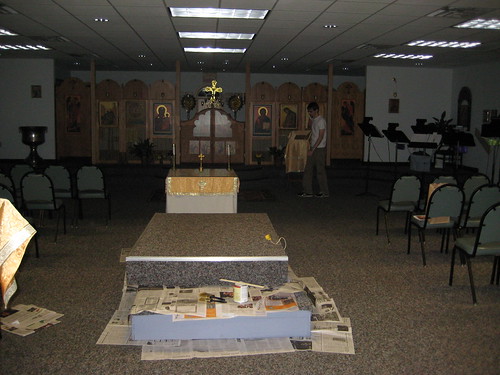
Initial discussions had us placing the memorial table in the middle of the center aisle, but then Fr. Peter thought it would be nice to put it on a raised platform of some kind. There is a rank of platforms back in the choir area of All Saints on which the women stand, and we moved one of those out and placed the table on it. Realizing the platform segments were of staggered lengths, however, it hit me that we could place them on top of each other, giving us two steps leading up to the memorial table, making something of a makeshift ambo. The prokeimenon, epistle, and alleluia could be sung from the first step — remember that the prokeimenon corresponds to the “gradual” in Western practice, known as such because it was sung from the steps of the ambo — and the Gospel from the second step. (No steps leading down on the other side, but oh well.)

The only problem was that, since the church ran out of carpet while covering the tops of these platforms, there was a decent amount of bare plywood showing, and setting them up this way only exposed it. Really, Fr. Peter said, the only thing we could do to make it something other than a horrible eyesore would be to paint over the exposed plywood with something like a gunmetal grey. Lucas and I looked at each other — “What are you doing tomorrow evening after work?” I asked him. “I think I’m painting these platforms with you,” he said.

So, following a quick trip to the hardware store for a quart of paint and brushes, we headed to All Saints yesterday to do what was necessary. “How good of an idea is this,” I asked Lucas, “letting guys like you and me into the nave by ourselves with paint and brushes?”

“I’m just hoping nobody notices that we’ve had to take out chairs to make everything fit in the space,” he replied.

It didn’t take more than 45 minutes or so to actually do the painting; we then had to move the choir up to the front of the church in order to answer some other logistical concerns the ambo created. After doing that, and destroying taking all of the displaced chairs into the fellowship hall, the paint was dry, and we set it up as it will be for tonight.

Hagia Sophia it ain’t, and I’m not going to argue that it’s gorgeous (particularly with the power outlets on the sides), but it at least looks more or less intentional. (Alas, Fr. Peter is just going to use the prothesis table behind the iconostasis rather than use one of our outdoor shrines as a skevophylakion.) We’ll see how it goes tonight — it sounds like we will have some number of visiting clergy and interested people from the community and around the area, including a contingent of folks from St. George, the big Antiochian parish in Indianapolis. Hopefully somebody will be around who can take pictures. A colleague of my wife’s is coming tonight out of curiosity, and he has never been to an Orthodox service before. Given its length and the fact that this is the first time any of us have ever attempted to celebrate this particular Liturgy, I’m pretty sure that all I can tell him is, “God be with you.”

God be with us all — St. James, pray for us!

A comment on “The vision of Fr. John Peck, in which the author sighs, ‘It’s all Greek to me'”

I just checked my spam comments, and there was one from a few days ago which was clearly not spam. It commented on “The vision of Fr. John Peck, in which the author sighs, ‘It’s all Greek to me’“, and was of enough substance that it seemed too bad that the post to which it referred had scrolled off the main page, so I repost it here (please read the post on which it comments for proper context):

John9 October 2008 at 8:02 pm

Fr. Peck little diatribe has no basis in fact, but instead is based on prejudice, ignorance and not a little anti-ethnic wishful thinking. He deserves to be sacked for his ingratitude and for his delusional pseudo-prophetic screed.

Here’s are the facts:

Excerpted from:

‘More Orthodox’ than the Orthodox
Christian Century, Dec 28, 2004 by John Dart

http://findarticles.com/p/articles/mi_m1058/is_26_121/ai_n8702767/pg_1?tag=artBody;col1

IT’S COMMONLY observed that converts to a faith are the most ardent defenders of it. That seems to be the case with American converts to Orthodoxy. The large number of converts attending Orthodox seminaries prompted Alexey D. Krindatch, a sociologist of religion, to wonder whether an “Americanization” of Eastern Orthodoxy might lie ahead. His conclusion: “Probably not.”

Responses from students at three seminaries of the Greek Orthodox Archdiocese and the Orthodox Church in America (OCA)–the two largest Orthodox bodies in the U.S.–confirmed, he said, “the widespread notion that Protestant and Catholic converts tend to be ‘more Orthodox’ than persons who were born and raised” as Orthodox.

======
The “Americanization” of the the Orthodox Church in America is just a racist pipedream.

And here is the article to which he refers in full:

‘More Orthodox’ than the Orthodox

IT’S COMMONLY observed that converts to a faith are the most ardent defenders of it. That seems to be the case with American converts to Orthodoxy. The large number of converts attending Orthodox seminaries prompted Alexey D. Krindatch, a sociologist of religion, to wonder whether an “Americanization” of Eastern Orthodoxy might lie ahead. His conclusion: “Probably not.”

Responses from students at three seminaries of the Greek Orthodox Archdiocese and the Orthodox Church in America (OCA)–the two largest Orthodox bodies in the U.S.–confirmed, he said, “the widespread notion that Protestant and Catholic converts tend to be ‘more Orthodox’ than persons who were born and raised” as Orthodox.

The converts expressed more conservative attitudes than Orthodox-born seminarians did on, for instance, accepting the authority of bishops and discouraging ecumenical worship and religiously mixed marriages. Krindatch reported his findings at the annual meeting of the Society for the Scientific Study of Religion.

Asked why the tradition-bound, liturgically intricate Orthodox churches are attracting converts, Krindatch suggested in an interview that many of the former evangelical Protestants studying for the Orthodox priesthood see a “discrepancy” between their strong personal faith “and the fact that their churches have no historical roots in original Christianity, no apostolic succession and no liturgical atmosphere.”

In the case of former Catholics and Episcopalians, however, converts are attempting to “return to their churches’ religious experiences of 20 to 30 years ago, when their churches were more ‘traditional.'”

While both Orthodox-born seminarians and the converts were relatively similar in religious upbringing, education and family income level, the former evangelicals “come from much wealthier families” that were very active churchgoers. The ex-evangelicals were more likely to have a higher level of secular education as well as businessmen fathers, and they “were more definite in their plans to be ordained and serve as priests” than were their classmates.

Krindatch surveyed seminarians at Holy Cross (Greek Orthodox) Seminary in the Boston suburb of Brookline, where 25 percent of the students are converts, and at two OCA seminaries, St. Vladimir’s in Crestwood, New York, and St. Tikhon’s in South Canaan, Pennsylvania. The majority of the students at the latter two are converts, he said.

Krindatch recently was named director for campus ministry and church growth at the Patriarch Athenagoras Orthodox Institute, which is part of the Graduate Theological Union in Berkeley, California. Krindatch, a faculty member at the Institute of Geography in Moscow, had been doing his research as a visiting scholar at the Institute for the Study of American Religion in Santa Barbara, California.

The institute in Berkeley previously has dealt mainly with theological and historical issues, said Krindatch, but it “hopes to concentrate its future studies more on the contemporary situation and social changes within various American Orthodox churches.”

Change has been slow by Western standards. In his survey, Krindatch found that 57 to 64 percent of convert seminarians agree that while most Orthodox Christians “are socially integrated into American society, the Orthodox churches as institutions are still perceived by the vast majority of Americans as “immigrant communities,” compared to 46 percent of Orthodox-born who say that. At the same time, the proportion of the most pessimistic seminarians–those who say “the Orthodox churches still are and will remain ‘strangers’ to American society”–is higher among “cradle Orthodox” than among convert seminarians.

Cradle Orthodox students are also more pessimistic than the converts that the ethnically oriented Orthodox churches eventually will gain autonomy from mother churches abroad, or that a unified American Eastern Orthodox Church will emerge in decades to come.

Ex-Protestant seminarians may hope for ecumenical progress within Orthodoxy, but they tend to reject joint ecumenical prayers or services with non-Orthodox. Also, a significant proportion of both ex-Catholic (34 percent) and ex-Protestant (.36 percent of ex-mainliners and 52 percent of ex-evangelicals) seminarians say that Orthodox priests should try hard to discourage mixed marriages. Seminarians raised in Orthodox churches are somewhat more lenient on the issue, though not as accommodating as current priests in Orthodox parishes.

A separate survey of priests in Greek and OCA parishes found that two-thirds take a more liberal position on mixed marriages–but stay within church guidelines. In other words, priests would conduct such weddings when they are held in the Orthodox Church, and would encourage the non-Orthodox partner to join the church. “Only a minority of all seminarians (31 percent of OCA seminarians, 48 percent of Greek Orthodox seminarians) share the same view,” Krindatch said.

Krindatch acknowledged that the seminarians’ conservative stances, even if reflective of a generational trend, may evolve during “actual work in the parishes.”

John Dart is the CENTURY’S news editor.

COPYRIGHT 2004 The Christian Century Foundation

I will comment in the combox.

Coming soon: The Divine Liturgy of St. James

On 22 October 2008, at 6pm, All Saints Orthodox Church will celebrate the Divine Liturgy of St. James for the Feast of St. James, the Brother of Our Lord.

It was mentioned to me about a year ago that this might be a desirable thing to pursue. It isn’t exactly happening the way originally envisioned; the hope at the time was that we would be in a new building with more forgiving acoustics than our current nave, but that hope remains unrealized for the time being. Nonetheless, we are pushing forward — hey, since local Catholic parishes have started celebrating the Traditional Latin Mass semi-regularly, leave it to us to break out our oldest rite, right?

The Divine Liturgy of St. James — can we call this the Iakovian Liturgy? I’d hate to call it the Jacobite Liturgy — is said to have been the rite taught to St. James by Our Lord and was subsequently the principal rite of the ancient Church of Jerusalem, edited and embellished as the St. Basil Liturgy and further pared down to become the St. John Chrysostom Liturgy. I will let liturgical scholars with PhDs argue whether or not the traditional first century dating of the Iakovian rite is accurate or if it’s more reasonable to assume that it came about somewhat later. Clearly the use of the Trisagion and the “Only-begotten Son…” are later accretions, but in terms of the overall structure and character — well, let’s just say that there are ideological reasons to want to support any of the various arguments, and leave it at that. One way or the other, we can say that we know it as the oldest complete form of the Divine Liturgy still in continuous use, and it is still in use by various Syrian and Indian communities.

Putting together an English text was not a small consideration; Archimandrite Ephrem (Lash)’s translation served as the base, but it is insufficient for use in an Antiochian parish, given the official preference for Elizabethan English. Where necessary, the Antiochian text was substituted (for components such as the Lord’s Prayer, the Creed, and so on); where possible, Fr. Ephrem’s text was kept, converting to Elizabethan English as needed. Particularities such as “Let our hearts be on high”/”We have them with the Lord” were also retained.

Once we had a text, then it fell to me to create a book for choir/congregational use. Thankfully, Sibelius 5 and Microsoft Word made that relatively easy. I adapted the St. Anthony’s Monastery settings of hymnody specific to St. James to our text, used the version of “Only-begotten Son…” from the Mt. Lebanon Choir Divine Hymnal, used the Trisagion we sing every Sunday (had to keep something the same) and then added all of the other parts — litany responses, anaphora responses, etc. The choir/congregation book ultimately contains every word and every note which concerns those worshiping from the nave — it is as complete as it needs to be without including the priest’s personal prayers and so on. (At 43 pages already, it would be significantly longer were I to include those.)

I will say that, in many respects, it’s a simpler liturgy; there are no antiphons, no troparia (although we will sing the Troparion to St. James as a recessional), there is no Megalynarion, and since it begins with the clergy processing into the church with the Gifts (from the skevophylakion, no less — such things make me happy, although we don’t actually have a skevophylakion), no Great Entrance in the middle of the service, either. From the choir’s perspective, there are significantly fewer major portions to sing, and the Alleluia and Prokeimenon are the only propers. The rubrics call for the Body of Christ to be received in the hand and for the Blood to be drunk from the chalice by the communicant, but we will be communed from a spoon regardless — no one’s particularly comfortable with what could go wrong the other way, given that we’re all used to the spoon by now.

Anyway, it will be an interesting liturgical adventure, to say the least. We’ve tried to visibly open it up to as much of Bloomington’s greater Christian community as wish to attend; given the provenance of the rite, it is clearly the common heritage of all Christians, and to be able to serve it in English is a gift we would like to be able to share with as many as possible, even if it’s our humble little church that’s doing it and not the Midwestern Regional Campus of the Cathedral of Holy Wisdom. (That place is going to be gorgeous, I have to say — and they might even have built a skevophylakion, I’m not sure.) To that end, we’ve put out a press release to the local papers (let’s not hold our breath that they’ll care, but who knows) and sent flyers to every area church and campus ministry we could find. We’ll see.

On a different matter — my friend Gavin used to have a favorite Microsoft joke (at least before he started working there): “Microsoft — solving tomorrow’s problems with yesterday’s technology, today.” So, maybe that could be tweaked and made appropriate to Orthodox Christianity — “Addressing tomorrow’s problems with yesterday’s Christianity, today.”

Or maybe not.

The vision of Fr. John Peck, in which the author sighs, “It’s all Greek to me”

Read my re-post of Fr. John Peck’s “The Orthodox Church of Tomorrow” first, and possibly Anna Pougas’ post on American Orthodoxy as background if you haven’t already.

When I was in New York for the Fellowship of Ss. Alban and Sergius conference, my friends Peter and Soula called me, saying they just wanted to let me know I was hanging out with them before I headed home. The way this was going to be best effected was for me to spend Sunday morning with them, and they were good enough to pick me up at St. Vlad’s and take me out to Ss. Constantine and Helen Orthodox Church, a Greek parish in West Nyack, New York. Oh, by the way, they told me as we walked in, you’re helping with Orthros.

The priest, Fr. Nicholas Samaras, arrived. He gave me a blessing and asked where I was from. “Bloomington, Indiana,” I replied. He sized me up a bit and said, “Ah. Sounds like a good place to be from.”

Orthros/Matins wasn’t a problem; Mr. Michaels, their psaltis, would sing a verse of something in Greek, I’d sing a verse of something in English (occasionally in Greek if I knew it well enough), then Peter would alternate between Greek and English, and Soula read the psalms and prayers. It was a wonderful church in which to sing; it’s a big building with a high ceiling, and you don’t feel like you have to push at all to be heard (unlike what I’m used to, alas).

The Divine Liturgy was sung by a choir rather than the psaltai (ευχαριστώ πολυ Στέφανε αλλά τώρα είμαι συγκεχυμένος — είναι οι ψάλτες ή οι ψάλται;), but Peter and I alternated on verses for the antiphons with the choir singing the refrains. It was also mentioned to me, “Usually somebody chants the Epistle in Greek and somebody else reads it in English, but the guy who chants it isn’t here — do you want to chant it in English?” And so I did. (I purposefully don’t travel with my reader’s cassock, but this was a morning where I wished I’d had it.)

After the Liturgy, I went through the line to venerate the priest’s cross and get a blessing. Fr. Samaras blessed me and said, “Um… don’t move. Just… just don’t go anywhere for a moment.” Uh oh, I thought. I stepped on some toes and I’m going to hear about manners when one is a guest. When all had been blessed, he turned to me and said, “What time do you have?”

I looked at my watch. “Quarter after twelve.”

“Ah, okay. And how long will it take to move you and your wife out here?”

Following that, there were a couple of very kind older gentlemen who thumped me on the chest and told me, “Young man, you’ve got a gift from God.” Peter’s parents (who I had just met for the first time a week and a half earlier when they had visited Bloomingon) referred to me as “family”. Fr. Samaras was very serious about wanting to keep in touch, and we’ve kept up a correspondence since. Don’t tell me that Greeks (to say nothing of New Yorkers!) aren’t welcoming; I don’t want to hear it. I’ve also found Holy Assumption Church in Scottsdale, AZ to be very welcoming with a terrific priest, as well as Holy Apostles in Shoreline, WA (where I attended my very first Divine Liturgy). The blanket assumption that “Greeks would prefer non-Greeks to stay away” is categorically false; let’s make that clear.

I also think that the convert or the inquirer who finds himself/herself in a community with a strong ethnic contingent needs to see such a situation as a gift from God, and to approach such a parish community with a dollop of humility roughly the same size as the dollop of sour cream which I put on my nachos. The “ethnic enclave” temptation faces the convert every bit as much as anybody else — you get a community of converts who read some Lossky, Schmemann, Hopko, etc. when they were still Episcopalians a couple of years ago, and there’s a danger of an exclusivist mindset developing, very similar to what the Greeks (or the Russians, or the Romanians, or whomever) get accused of having. Reading everything in a book doesn’t make you Orthodox; you can’t teach yourself to be Orthodox, period (thank you, Seraphim Danckaert, for sharing those words of wisdom oh so long ago; they’ve stuck with me). Whenever a convert/inquirer complains about the icons looking too weird or the music sounding too strange or the language being wrong (I know of one guy for whom liturgical English isn’t close enough to “the language of the people”, let alone Greek, Slavonic, or what have you), my first thought is simply, “You’re not ready yet.” There are some things you don’t like which you have to accept with humility, however good your reasons for not liking them seem to you at the time. Icons, incense, chant, vestments… and, yes, depending on where you wind up, pews, organs, people talking during Holy Communion, and liturgical schedules that are Sunday-only. Regardless, the aforementioned gift from God is the chance to learn the faith from people who have lived it for generations, however imperfectly, rather than building up a Platonic ideal in your head from books up to which no actual parish in the world can ever hope to measure. Learning the Orthodox Christian faith from somebody’s grandmother, believe it or not, is going to actually teach a person a lot more about what it means to live the life than reading Schmemann, even if it means having to move out to aisles to prostrate during the Prayer of St. Ephraim the Syrian because pews get in the way otherwise. (And I say that as somebody who thinks you can never read enough Schmemann.) To the people who claim that we need an idiomatically and uniquely “American” cultural expression of Orthodox Christianity and we need it yesterday, I say: chill, guys. Receive the Tradition. Let it change you and yours for a couple of generations (at least) before deciding it needs updating.

All that said, I recognize that not everybody can go to your typical Greek parish and just help sing Matins or chant the Epistle as nothing more than a visitor passing through, and not everybody has a chance (or the interest, or overall inclination or ability) to take a Greek class (ancient or modern), and not everybody knows people where they’re traveling who can be a conduit to other people in the parish. So, I don’t pretend my experience, which in general has been unique, is necessarily the general case. Let’s also not pretend that every experience in every parish in every jurisdiction I’ve ever visited has been positive; they have not. I also don’t wish to pretend that I’ve never visited a parish and turned my nose up at it because it didn’t meet my expectations or cater to me; I most certainly have, and five years later — to demonstrate God’s sense of humor — I’m still there, my wife and I were chrismated there, we’ve seen four godchildren received into the faith, I’m the choir director/psaltis, and I’m on the parish council. Those people are my family in every sense of the word. First impressions really can be meaningless.

Coming on the heels of the situation regarding Fr. John Peck’s article is wind I caught yesterday of how Sunday of Orthodoxy Vespers might work this coming winter. Holy Trinity, the big Greek parish in Indianapolis, wants to host; they’re just about to finish building the Indy regional campus of Hagia Sophia, and it will be, from a standpoint of both capacity and providing an exemplar of traditional Byzantine architecture, the ideal place to hold it.

There’s a catch, however — the choir made up of Orthodox singers from around the entire Indianapolis metro area (including Bloomington)? Gone. Part of the deal is, if you do it at Holy Trinity, you do everything in-house — their psaltai/psaltes (whichever it is — I’m confused now), their music, their organ (probably), end of story. That this runs entirely counter to the spirit of how the Indianapolis clergy have always tried to celebrate Sunday of Orthodoxy seems to be not an entirely relevant point. Okay, fine, that’s their right — but why suddenly take a hard line when it comes to playing with others?

To come back to Fr. John Peck, why come down so hard on a priest who, basically, is saying that those who identify with Orthodox Christianity on a basis of ethnicity and heritage are going to have to learn how to get along with those who identify on a basis of faith if they want the Church to survive in the United States? I don’t agree with everything Fr. John said; I think his view of the future is a little too rosy, but I think he’s got the point hands-down that the makeup of the clergy coming out of the next several class years of our seminaries is going to change some things, big time. What some want to hear or not, I nonetheless fail to see how what he says is hostile or out of line. It may not necessarily be what some people want to hear, but is it really that threatening for a priest to point out what is painfully obvious — that, as Fr. Seraphim Rose said thirty years ago, “ethnic Orthodoxy” is a dead end? The current generation, by and large, either isn’t learning the faith or aren’t learning to care about the faith — I know of priest’s kids at IU who, so far as I know, have never darkened the door of All Saints since maybe the first Sunday of classes their freshman year. My Greek class right now is three-quarters full of Greek American kids, some of whom, I’ve found, didn’t even know there was a church in Bloomington until I told them about it, and at whom I’ll be surprised (but pleasantly so) if they decide to come to a service. Now, let’s clarify — that’s not an “Orthodox problem,” but rather an “everybody problem”. Convincing kids they need church while they’re in college doesn’t work until they, well, realize they need church while they’re in college. But Greek/Russian/Serbian/Romanian/Albanian/whateverian families also need to realize that their kids aren’t necessarily picking up the faith of their forebears any better than their Anglo counterparts at Tenth United Methodist Church down the street — just because they have a language and a festival to associate with it doesn’t mean it sticks better. (Hats off to some very exceptional kids I know for whom it has stuck, and stuck very well. You know who you are and why I know you. You’re doing it right, guys.)

I wonder sometimes if part of the problem is money. By and large — that is, excluding Tom Hanks and maybe Chris Hillman (late of The Byrds and The Desert Rose Band), the converts coming into Orthodox Christianity are not wealthy people, at least based on what I’ve seen; we all do what we can, to be sure, but for example, my parish right now wouldn’t be able to build the janitor’s closet of Holy Trinity’s new building. We’re a community of mostly middle-to-lower class working folks as well as people from the university community, and we’re able to keep the lights on in our humble “temporary” space and pay our priest’s salary and benefits without much left over. That seems to be fairly representative of what I’ve seen in the parishes I’ve visited — converts keep the candle fund replenished, and the Greek and Lebanese doctors and lawyers, if there are any in the community to begin with, are the ones paying for the frescoing of the walls and the maintenance of the dome. Enough converts for a critical mass and the small, cradle-less community can at least be self-sustaining, but building even a simple, small traditional Byzantine church is going to be beyond the means of that kind of group. Could it be that for some “ethnic” Orthodox who actually do write substantial checks and whose grandfather may have helped to carve the iconostasis, they just don’t want to be told what to do and held in contempt by somebody who was a Baptist perhaps as recently as a year ago and whose offering might buy the incense for Holy Week? That’s perhaps ignoring the lesson of the widow’s mite, but I know from my own experience that the convert who’s given their two pennies can probably still pick up a broom or wash a dish, and not to put too fine a point on it, but that might even be what’s needed from them more than a discussion of how Byzantine chant is driving non-Greek inquirers away or the icons aren’t Byzantine- (or Russian-) looking enough.

One more thought, and then I think my bag of prolix dust is empty for the evening. There is a certain irony to me that the Greek Orthodox Archdiocese of America, who in the early/mid-’80s suddenly wouldn’t give the Evangelical Orthodox the time of day (perhaps not for terrible reasons, depending on whose version of the story you’re hearing), has become a haven for certain former EOC communities who broke off from Antioch.

My hope is that Fr. John Peck comes out of this okay. What he had to say would ideally generate a conversation which needs to happen, and that isn’t anything over which he should be penalized. If he doesn’t, I hope he sticks to his guns — Antioch would probably take him with open arms (assuming a canonical release — Antioch is kinda touchy about such things). Pray for him, pray for the Greek Orthodox Archdiocese of America, and pray that all Orthodox in America see something in Fr. John’s article, and the response it has received, from which they can learn.

The Orthodox Church of Tomorrow by Fr. John Peck

In the interest trying to be part of a solution rather than a problem, I would like to repost the following essay. It was originally posted here; I did not say anything about it here when it was posted because plenty of other folks were saying enough about it. It having been taken down, and given the circumstances under which it seems this occurred, I am doing what I can to help make sure it remains available. I don’t agree with everything Fr. John says, but I agree with the spirit of it and am decidedly in disagreement with those who would silence and penalize him. I will comment in another post.

The Orthodox Church of Tomorrow
By Fr. John A. Peck

There is an interesting phenomenon occurring in Orthodox Christianity in America today, and reflected powerfully in our seminaries. Seminaries are loaded almost exclusively with converts, reverts (cradle Orthodox who left the faith, and were re-converted to it again), and the sons and grandsons of clergy.

I believe we are looking at the future of the American Orthodox Church — today.

The notion that traditionally Orthodox ethnic groups (the group of ‘our people’ we hear so much about from our primates and hierarchs) are going to populate the ranks of the clergy, and therefore, the Church in the future is, frankly, a pipe dream. Orthodoxy, despite the failings of its leadership, has actually lived up to its own press. The truth of the Orthodox faith, as presented on paper, is actually being believed – by those who have no familial or historical connection with the Orthodox. These poor deluded souls (of which I count myself) actually believe what they are reading about the Orthodox faith, and expect the Church to act like, well, the Church. They refuse to accept the Church as a club of any kind, or closed circle kaffeeklatsch. No old world embassies will be tolerated for much longer – they will go the way of the dodo. No one will have to work against them; they will simply die from atrophy and neglect. The passing away of the Orthodox Church as ethnic club is already taking place. It will come to fruition in a short 10 years, 15 years in larger parishes.

This is a well known problem. Statistical studies taken a mere seven years ago predicted that within 10 years the Orthodox Church in the United States would for all practical purposes, no longer be viable. If nothing was done within five years (that’s two years ago) the decline would be irreversible. Demographics determine destiny, as they say. As you may have imagined, not only was “nothing done,” such reports were surreptitiously filed away, while the calls for a solution from clergy and laity alike only increased. Larger jurisdictions will, of course, have a little more time, but not a different result.

What we are looking at, of course, is of the highest concern to the hierarchy. They know, in their heart of hearts, that they cannot reverse this trend. Yet they fight a rearguard action, hoping against hope to forestall the historically inevitable movement toward an American Orthodox Church.

Statistical studies taken a mere seven years ago predicted that within 10 years the Orthodox Church in the United States would for all practical purposes, no longer be viable. The laity has already moved on. Americans, generally, don’t fall for very much strong arm intimidation or brow beating, don’t go for bullying by insecure leaders, and certainly don’t see the value of taking on and promoting someone else’s ethnic culture. They care about the Gospel, and the Gospel does not require Slavonic or Koine Greek, or even English for that matter. The Gospel requires context, which is why it cannot be transmitted in any language unknown to the listener.

When we look at our seminaries, we are looking at the Church of Tomorrow, the Church twenty years from now. Indeed, this is the Church we are building today.

Twenty years from now, I anticipate we will see the following:

Vastly diminished parishes, both in size and number. There will be a few exceptions, (and they will be exceptional!) but for the most part, most current Orthodox parishioners will age and die, and have no one to replace them. Why? Because as they have taught the context of their culture, instead teaching the context of their faith. Some parishes will simply be merged with others. Many will close outright. A few will change how they do ministry, with a new vision of parochial ecclesiology. These newer parishes will be lighthouses of genuine Orthodox piety and experience. Some parishes, I believe, will actually be formed specifically, in the old fashion, by purchasing land, building a chapel or Temple in the midst of it, and parishioners building or buying homes around it. The Church will be the center of their lives, and many will come from far and wide to experience their way of life.

Publicly renowned Orthodox media and apologetic ministries. These ministries are the ones providing a living and powerful apologetic for the Orthodox faith in our culture (that is, our 21st Century life in the United States), and actually providing the Gospel in its proper context – engaged in society and the public arena. These will succeed in visibility and public awareness more than all the speeches before the U.N. and odd newspaper stories about Orthodox Easter or Folk Dance Festivals could ever do. In other words, the Orthodox Christian faith will become that most dangerous of all things – relevant to the lives of Americans, and known to all Americans as a genuinely American Christian entity.

More (and younger) bishops. If our current slate of bishops has been mostly a disappointment, reducing their number will only tighten this closed circle, making the hierarchy less and less accessible, and more and more immune to things like, oh, the needs and concerns of their flock. The process of selection for the episcopacy will contain a far more thorough investigation, and men with active homosexual tendencies, psychological problems, insecurities, or addictions will simply not make the cut. We aren’t far from open persecution of Christians by secularists in this country, and we need bishops who know the score. With better bishops, no one will be able to ‘buy’ a priest out of a parish with a gift of cash. Conversely, parish councils will no longer be able to bully priests into staying out of their affairs, and will be required to get out of the restaurant/festival business and get into the soul saving business.

A very different demographic of clergy. Our priests will be composed of converts, reverts, and the sons and grandsons of venerable, long-suffering clergy. These men all know the score. They won’t tolerate nonsense like homosexual clergy (especially bishops), women’s ordination, or financial corruption. They will not tolerate the Church being regularly and unapologetically dishonored by her own clergy. Twenty years from now, these convert and revert priests will be sending life-long Orthodox men, a new cradle generation, en masse to our seminaries. They will be white, black, Asian, Polynesian, Hispanic, and everything in between. Fewer will be Russian, Greek, or any other traditionally Orthodox background.

Orthodox Biblical Studies. Orthodox Biblical scholarship will flourish, and will actually advance Biblical Studies, rather than tag along for the latest trends, staying a minimum safe distance back in case the latest theory tanks unexpectedly. Septuagint studies are already on the rise and Orthodox scholars will usurp the lead in this arena, establishing a powerful and lasting influence in Biblical Studies for decades to come. Orthodox higher education — specifically in Biblical Studies in the Orthodox tradition — will finally have a place at the doctoral level in the Western hemisphere, and it will become a thriving academic entity. The whole Church will feed on the gleanings of this new scholarship and Scriptural knowledge, preaching, and Biblical morality will invigorate the Church for generations.

A much higher moral standard from all clergy. The next twenty years will see a revival of practical ethics. Instead of trailing military or business ethics, the Church will, once again, require the highest standard of ethical and professional behavior from her clergy — and they will respond! The clergy will not tolerate lying, cheating, or stealing and hold to account those who practice these vices. They will vigorously defend the honor of Christ’s priesthood, and Christ’s Church. I dare say, even the clergy will finally respect their own priesthood.

Vocations will explode. As a result of the elevated ethical standard publicly expected from the clergy, candidates in far greater numbers will flock to the priesthood. There will be very full classes, distance education, self-study and continuing education going on in every location. Education at a basal level will disappear, except in introductory parish classes. Clergy will powerfully articulate Orthodoxy to the faithful and to the culture around them. Personal opinion will no longer be the standard for clergy when articulating Orthodox ethics and morality. Our seminaries must become beacons for this teaching, and give up “training culture” once and for all. We will finally begin to penetrate our society, rather than go along for the ride like a tick on a dog’s back.

Philanthropy will flow like the floodgates of heaven. Finally, the many Orthodox Christian philanthropists who annually give millions of dollars to secular institutions will finally find their own Church completely transparent, completely accountable, and worthy of their faith-building support. Let’s face it, there is more than enough money in Orthodoxy right now to build hospitals, clinics, schools, colleges, universities, and a new Hagia Sophia right here in the United States. The reason this is not being done is because these philanthropists are intelligent men and women who do not trust the hierarchy to do the right thing with their millions. This will change in short order once it is shown that transparency doesn’t destroy the Church, but strengthens it immeasurably. Frankly, I don’t anticipate every jurisdiction to do this in the next twenty years, but those that are practicing transparency will emerge as the leaders in every arena of Church existence.

Hope
This all may seem unlikely today, but it is coming.

How do I know this? For one thing, the last holdouts of corruption, Byzantine intrigue and phyletism (a fancy theological term for ethnic preference) are clinging desperately to a vision of the Church that is, quite frankly, dying fast. Oh, they are doing everything to shore up their power and influence, and busy serving their own needs, but their vision is dying. And where there is no vision, the people perish (Proverbs 29:18).

As frightening and disconcerting as it may seem to our leaders, they will learn that emerging from a cocoon, even a Byzantine cocoon, is not a bad thing. Orthodoxy is about to take flight on new beautiful wings. These are the birth pangs of a new era for Orthodoxy. God is giving us a time of freedom and light.

This new Orthodox Church will have a different face, will be ready for contemporary challenges, and will have begun to penetrate American society at every stage and on every level. This Church is the one that will be ready for the challenges of open persecution, fighting for the soul of every American, regardless of their genetic affiliation. This Church will be the one our grandchildren and great grandchildren will grow up in, looking back on the late 20th-early 21st century as a time of sentimental darkness from which burst forth the light of the Gospel. Let it begin.

Fr. John A. Peck is pastor of Prescott Orthodox Church in Prescott, Ariz.

Evangelism the old-fashioned way

As long as we’re talking about Western saints, here’s this item from Aaron D. Wolf (what a great name) by way of Ben at the Wittenberg Trail (to whom I’d love to link, but I can’t, because the Wittenberg Trail is evidently a private forum) by way of Alden Swan:

Here’s what I can’t figure out: How in the world did Saint Patrick evangelize all of those Druid priests and clan chieftains without a mission statement? After all, history and tradition tell us that he walked around preaching and performed an occasional miracle. But how did he know what his mission was? Aaron D. Wolf, The Mission of Souls: When Experts Attack

[…] Mr. Wolf raises some interesting questions and challenges to modern Evangelical concepts of evangelization and mission, contrasting the wisdom of being “pupose driven” to the pre-marketing (pre-modern) habit of simply proclaiming the Gospel.

Wow. What a concept.

This gets me thinking about something which has occurred to me before — I have to believe that liturgy is one of our better and more underappreciated evangelism tools. I guarantee you that St. Patrick wasn’t just walking around preaching and “performing occasional miracles” — he would also have been celebrating the Mass, with the Eucharist as his “mission statement.”

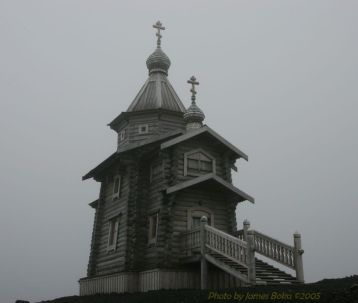
small country churchThe model of evangelism that would be wonderful, if cost-prohibitive, would be to go places where there aren’t churches and start by building simple, but identifiable, churches (such as Trinity Church in Antarctica of all places, pictured at right) where they would be visible and accessible, start publicly holding services so that people can tell that’s what you’re doing, and equip them so that they can host a soup kitchen or something similar. The problem with so many missions is that they can ill-afford being in a place where they would actually be visible and it would be clear what they are doing, so they wind up evangelizing only the people who are already there. Right now, at least in the Antiochian Archdiocese, you have to have some number of pledging families (25?) before you can have a priest assigned to you; that’s good business and fiscally responsible, no question about it, but who’s doing the evangelism in that case but people who aren’t necessarily equipped to do it? I’m not saying that any Orthodox jurisdiction in this country has the money to spend, say, a half million to a million dollars planting missions so that they have buildings, priests, and services for the poor at the outset, but I sometimes wonder if that wouldn’t be a better witness all around.

I’m still waiting. Actually, I’m waiting on a couple of things — one fairly big thing, and one thing that is big-ish, but not on the same level as the other thing. (Confused yet?) In the meantime, however, I can reveal that I’m presenting a paper at Indiana University’s Medieval Graduate Symposium on 29 March. I can also give a heads-up that my church choir will be publicly presenting music from Holy Week as part of  IU’s Middle Eastern Arts Festival on 29 March. (Yes, the same 29 March. It’s gonna be a busy day.) Details for the whole ongoing program are here, but here’s the blurb for this particular event (I’m not going to use the word “concert,” for several reasons):

Concert: Choral Music of the Middle East
Behold, the Bridegroom cometh: chants from Holy Week in the Lebanese and Syrian tradition

March 29, 2008, 8 pm
St. Paul’s Catholic Center

The All Saints Antiochian Orthodox Christian Choir under the direction of Richard Barrett will present an evening concert of liturgical music from the Middle East. The program will highlight music from the Syrian and Lebanese traditions. Meditative and celebratory selections drawn from Holy Week and Easter services exemplify how this music became an integral and functionally practical part of Orthodox ritual. While the traditional liturgical languages for the Orthodox in the Middle East are Greek and Arabic, selections will also be performed English.

I didn’t write that, by the way. I will be writing a set of program notes, however, which I will post here. I can say that this is exactly the kind of thing I hoped we’d eventually be able to do, and I’m really encouraged by how the rehearsals have gone — it’s stretching them beyond what their comfort level has been, but in a very doable fashion, and it will be a good thing for us to participate in this kind of outreach. Hopefully I can post a snippet or two from the evening itself afterwards.


adventures in writing alexander lingas all saints bloomington all saints orthodox church american orthodox architecture american orthodox music american orthodoxy Antiochian Archdiocese Antiochian Orthodox Christian Archdiocese of North America Antiochians books byzantine chant cappella romana chant church architecture ecclesiastical chant ethnomusicologists ethnomusicology fellowship of ss. alban and sergius Greece Greek greek food greekness hazards of church music international travel tips ioannis arvanitis joe mckamey john michael boyer kurt sander Latin liturgical adventures liturgical architecture liturgical music liturgical texts and translation liturgy liturgy and life lycourgos angelopoulos medieval byzantine chant Metropolitan PHILIP militant americanist orthodoxy modern byzantine architecture modern greek music music as iconography my kids will latin and greek when they're newborns my kids will learn latin and greek when they're newborns orthodox architecture orthodox architecture is bloody expensive Orthodox choir schools Orthodox Ecclesiology orthodox outreach orthodox travel pascha at the singing school Patriarchate of Antioch Patriarch IGNATIUS IV Patriarch of Antioch publishing random acts of chant richard barrett in greece richard toensing rod dreher sacred music st. vlads st john of damascus society Syriac the Bishop MARK fan club the convert dilemma the dark knight The Episcopacy The Episcopate the only good language is a dead language this american church life travel we need more american saints why do we need beautiful music in churches?

Blog Stats

  • 262,832 hits

Flickr Photos