Posts Tagged 'militant americanist orthodoxy'


Is there any more militant “anti-” than an “ex-“?

Blogging has been light for much of the last year or so. This has been because I’ve been, well, busy. Flesh of My Flesh was in Germany on an academic exchange from the middle of September 2010 to the middle of August 2011, and trying to maintain a two-person household and lifestyle as one person, while also being a full-time grad student, while also having some level of teaching responsibilities for the first time, while also still being responsible for musical duties at All Saints, while also planning a big to-do last fall, while dealing with some personal issues that required a good amount of attention (to perhaps be told someday in another blog post), while also making a couple of semi-lengthy trips to Germany myself, meant that every last second of my time was spoken for, and I had absolutely nobody around to share the load or to delegate to in any meaningful or consistent way. Granted, there were lots of people around for much-appreciated moral support, but by and large I was on my own.

Another reason why it’s been light, however, is because there have been things going on in the circle of blogdom of which I am some kind of marginal member that have prompted the thought, “Maybe I should respond to that,” and ultimately I’ve chosen not to. I don’t like blogging pissing contests; to my mind they don’t resolve anything, they engender bad will, and tend to create (to say nothing of harden) battle lines. I’m at the point where I feel like there are some things that need to be said, however, and while I want to be frank, I also don’t want to pick a fight, so I’m going to keep things reasonably specific but nonetheless as abstract as I can make it. If you know what I’m talking about, then you know what I’m talking about; if you don’t, a Google search on some of the issues I raise should be reasonably fruitful.

Converting to Orthodox Christianity is a tricky business, perhaps a bit moreso than Roman Catholicism. I’ve heard it said that getting married isn’t just saying yes to one woman, it’s saying no to all the others, and that seems applicable here. There’s a way in which it seems to me that converting to Roman Catholicism is saying yes to one communion while at the same time construing all the others as being more or less part of yours, so you’re not really deciding against them in the same way. Choosing Orthodoxy, however, involves some more serious overtones of rejection, I think; when I converted, I told myself that in Orthodoxy Christianity I found fulfillment of many of the ideals I had as an Anglican, and that had also led me to read some Roman Catholic apologetics, but there was nonetheless a line, I was choosing a side, and the only for me to un-choose it was to be for all practical purposes an atheist. From people I’ve talked to, that kind of “double-or-nothing” mindset is fairly common, and for my part, I don’t know what the alternative is that isn’t converting for what amount to warm and squishy reasons.

If that’s the case, however, and you find, for one reason or another, that you can’t stay in Orthodoxy, then I suppose it’s not all that surprising that some do effectively become atheists who are nonetheless left with a particularly dogmatic approach to their atheism. There have been some rather public (as far as this niche of the blogging world goes) departures from Orthodox Christianity recently where this has happened, despite an initial assertion that they were going to a different communion, what they really appear to have embraced is an atheism that allows them to maintain a dogma about the things that they’ve decided they really care about. The irony, inevitable though perhaps it is, is that these were some of the more militantly Orthodox bloggers in their day; calling out bishops, parishes, and whomever for not being Orthodox enough, reading all the Right Theologians and so on, and certainly putting on a show of fighting the good fight. The militancy remains; only the Orthodoxy is gone, and the vacuum seems to have filled itself rather violently with other things — secular metanarratives of Marxist-style class struggle and revolution (highly ironic, since in one case I’m thinking of the person, while Orthodox, famously claimed to despise metanarrative) being one significant example, and their new “orthodoxy” tends be tinged by an ongoing and rather world-weary intellectual dismissal of the Christianity they’ve found wanting.

You know, I can respect that somebody for whom Orthodoxy “doesn’t take” is left without a lot of intellectually honest options that actually retain some veneer of Christianity. It strikes me nonetheless that there’s something far deeper going on here, and what it really seems to boil down to is an issue with people rather than an issue with the faith. How in the world can people like that be allowed in by anything less than crawling over broken glass covered with cow excrement, the reasoning seems to go, when I have this other category that tells me we should treat them as undesirables, if not outright enemies? Why should it be acceptable that the people who are becoming Orthodox are people I don’t like? Surely that’s a flaw in the faith itself. But even that, I think, is to overthink it — what it really boils down to is that, whatever song and dance we like to put on about catholicity, we want to go to church with people like ourselves. When we don’t find people like ourselves in sufficient critical mass, then we assume that it’s not for us. If this happens after we’ve already made a spiritual commitment, then the road out seems to be paved with bitterness and sour grapes. Smash the icons, burn the books, it wasn’t what I hoped it would be, so it must be all bad and full of pathological wackos.

Let’s be honest — for all the jawing converts like to do about “ethnic enclave” parishes, converts often tend to function as their own ethnicity. And, since most converts are white (note I said “most”, not all), and it’s socially unacceptable to claim to be a “white” church in the same way that a Greek/Russian/Arab church can claim to be a Greek/Russian/Arab church, the unifying factor tends to be cultural class, subsequently and quietly reinforced by race. Ethnic parishes, from what I’ve seen, tend to be more “catholic” in terms of class, because the ethnicity is able to explicitly function as the glue. Yes, fine, the Christian faith is supposed to be the glue, but for converts and for cradles it’s more complicated than that. We converts are choosing something that is on some level countercultural, and we want to know we’re not crazy, so we want to see the people like ourselves who make it work without it being contrived, some kind of a put-on. I have a dear friend who has expressed being self-conscious in a lot of parishes just by virtue of the fact that he has red hair, immediately and unmistakably marking him as somebody who doesn’t come from a traditionally Orthodox heritage. For cradles, they come from a background where being Orthodox is simply the default option, and there is nothing to reinforce that in a North American cultural context except ethnicity. One way or the other, whether you most strongly identify with class or heritage, if you go to church and don’t see people you can identify as being like yourself in your preferred category, you’re not going to feel comfortable. I suspect that no matter how much we want to talk about “catholicity”, that’s just the reality of being human. We can be taught to like the idea of cultural or ethnic pluralism, but in the ordering of our own lives, that’s not going to be a practical reality most of us will choose to embrace. Catholicity, I suspect, is an ideal to be supported on a macro-level; on the local level, most people will choose homogeneity. If pressed, I think some people would even go so far as to say that catholicity is great, as long as it doesn’t include those people.

The stones the “ex-“es who are now “anti-“s choose to throw I must take with a boulder of salt. Surely we all know that just because a monk says it doesn’t make it necessarily a) so b) universally applicable even if true. Surely we all know that someone being proclaimed as a saint doesn’t necessarily make them perfect or not subject to various historical circumstances and forces, and I would hope that the easy categorization of “the friend of my enemy is my enemy” is something most people would see as deeply problematic from a Christian standpoint, any Christian standpoint, no matter how much critical theory and class struggle-infused rhetoric one tries to throw at it. The recent assertion by one such person that “a mature Christianity is a nominal Christianity” and that Orthodoxy constitutes “the Byzantine slammer” must be rejected with frankness, yes, but also seen as part of what, I think, is best considered a grieving process. A mature Christianity might well perhaps be a humble Christianity, but by the same token, a mature secularism must also be a humble secularism.

To wrap this up for the moment — I heard it said while I was converting that the trouble with thinking your way into a religion is that it’s then no difficult task to think your way right out when your premises change. It’s perhaps particularly easy to do when one finds that the reality on the ground is harder than the marketing materials may have suggested. For those of us who haven’t fallen prey to this, thank God, but I’ve seen enough people leave for such a variety of reasons, some surprising and some not, that you just never know what’s going to challenge you next.

American beauty

About seven years ago, I was driving to Chicago from Bloomington for the first time. I was with my friend Jonathan Wey, and we were on our way (as it were) there to pick up my wife up from the airport (long story). Once we were in northwest Indiana, I eventually saw this largish structure several miles off in the distance. My first thought was that it looked like an Orthodox church, but no, surely it’s a grain silo — why would there be an Orthodox church so large it’s visible from the freeway in Indiana, of all places?

As we got closer, however, it became clear that yes, it was an Orthodox church. Jonathan and I looked at each other, nodded, and I got off the highway so we could find it. It turned out to be St. Sava Serbian Orthodox Church in Merrillville (pictured), and there happened to be somebody there who let us in and showed us around. From what I remember, it’s a stunning building, lovingly constructed in every way, with an incredible attention to detail.

St. Sava Church also appears to be the only place where one can buy prints of St. Varnava, the first (and so far only) Orthodox saint from Indiana. I ordered one so that my wife could give it to the Russian church in Kiel that has been so hospitable to her over the last year, and when it arrived this week, they had also enclosed a little booklet titled “St. Sava Serbian Orthodox Church Visitor’s Guide”. It’s a lovely, professionally-produced spiral-bound publication that contains a history of the parish, details about the iconography, bells, and external mosaics, liturgical furnishings, and general information about Orthodox Christianity.

A few things jumped out at me about this little book. First off, this bit in the “Welcome” section:

Our present church was built on 140 acres… land purchased by the Church-School Congregation following [the burning down of the old building]… [T]he Priest and the Church Board undertook plans to finance and erect… what would be the “church of our dreams” in a “once-in-a-lifetime endeavor”. That seed having been planted, it gave birth to an ideal that included every church organization. Building and finance professionals helped to nurture the seed and guide its growth. It flowered as our unsolicited volunteers weed their labor-intensive work which epitomized God’s truth that “faith without work is dead”. All contributed their time, knowledge, talent and money to the church that would glorify God in the Divine Liturgy.

What’s interesting about this to me is that the building of a beautiful church is considered part of the work of the whole congregation, that it part of the expression of this community’s faith, and that this is What Orthodox Christians Do. This is reinforced a page later when the book goes into the exterior description of the building:

Saint Sava Serbian Orthodox Church was designed to conform with the spirit of Orthodox teaching. According to Orthodox belief, God is eternal King. Hence the church building, which is the sacred home for the worship of God, should be royal in every aspect. Orthodox Christians have always built their churches with that in mind and have always put into the church everything that they regarded as the best: the sturdiest building materials, the most beautiful adornments and the most costly utensils and vestments they could afford… Earthly royal splendor has always served as a pattern for the expression of heavenly glory. Orthodox church buildings are designed with the intention to make God, the Heavenly Kingdom and Salvation seem sensibly real and present.

Orthodox church have strict guidelines they must follow when building a church. The structure of church buildings is usually in the design of a ship or a cross. The ship plan resembles and signifies the ark of Noah in which he and his family were saved from the flood, while the cross plan reminds Christians of the Cross upon which Jesus Christ was crucified. Strict Orthodox Church guidelines detail that the length of the building must run parallel to the east-west line, so that the church sanctuary is always facing east. Saint John of Damascus (d.753) affirms that it is an Apostolic Tradition to worship facing east. The main entrance to the church is always through the western portal. Most churches have two side doors, the northern and the southern, and Saint Sava Church was built in accordance to all these traditions.

Byzantine architecture evolved from the Roman in the 6th century. The most popular Byzantine plan is a cross pattern in a square. The building is topped by a cupola, a cylindrical or polygonal drum covered with a dome, with narrow arched windows cut all around the concave space. Oftentimes in Byzantine architecture, the central dome is surrounded by several smaller cupolas on a lower level. Crosses embellish the top of every dome and belfry, signifying the church is glorification of the Crucified Lord and Saviour Jesus Christ. A great number of Serbian churches and monasteries have been built in the Byzantine style. Originality is expressed both in the design and the ornamentation, and no two churches are alike. Every church can be unique within traditional guidelines. Saint Sava in Merrillville was patterned after the church in Topola, Serbia, but differs with its columns and its west-facing windows.

All church buildings must be consecrated by a bishop before a Divine Liturgy can be celebrated. When a church is consecrated or christened, Kumovi (sponsors) are chosen. Glisho Rapaich, Michael and Yvonne Galich served as Kumovi to Saint Sava Church. Every Orthodox Church is dedicated to a Holy Event in the life of Jesus Christ; to the Most Pure Mother of God; to the Holy Trinity; to the Archangels Michael or Gabriel; to the Holy Apostles or to a Saint or Martyr for Jesus Christ.

The church of Saint Sava in Merrillville is a magnificent edifice which attracts great interest. People who see it from a distance are drawn to visit it personally (pp1-3).

So the building first and foremost is for the glory of God, being tangible, material icon of the Heavenly Kingdom on earth. The building itself is rooted firmly in the witness to Apostolic Tradition, the wider history of the oikoumene, that is to say, the Christian Roman Empire, and the specific, local history of Serbia. This adherence to tradition is confirmed by the whole Church, in the person of the Bishop, the people, and those in heaven with whom we worship. And, finally, this is done for the benefit of the larger community, not just for those who attend the church. The church building, in other words, is not incidental; it’s not just a random gathering of four walls and roof that only the Orthodox in a given area know about. It is an image of the Kingdom, and a witness to both the entirety of the faith and the unity of the Church for all who might see it. A lot of this we’ve heard before in the abstract, but here is an amazing, concrete example of a community making it happen.

I read a book a few months ago called When Not To Build. It’s written by a former Protestant church architect who became convinced that building new buildings is a distraction for congregations, and that churches are better off treating their buildings as more-or-less necessary evils for the purposes of gathering as we’re commanded, but beyond that, the building of big, expensive buildings is a money-pit and something that prevents churches from doing what they’re actually supposed to be doing. It’s a book that has some decent practical suggestions, to be sure, but much of it is problematic from an Orthodox point of view — it embraces the narrative of of post-legalization decline, certainly, and it has no patience whatsoever for a theology that would treat the building as having any kind of an iconographic function.

Problematic though it may be, it genuinely seems to be how a lot of people think. For the last six years, I have been part of the conversations at my parish towards building our permanent building, and these conversations continually circle back around themselves and go nowhere. Some of it has to do with money, but I think a lot of it has to do with being genuinely baffled at the idea that the building has any or all of the iconographic and traditional functions outlined by Andrew Gould and the people of St. Sava Church, and certainly the notion that the church building itself is intended to reflect royal splendor in materials and design runs contrary to Middle American ideals about avoiding conspicuous consumption. For some, it need be no more complex than a practical question of space to be solved practically — build whatever size pole barn or brick box you can manage, and retrofit a dome on top of it if it’s really that important to you for it to look “Orthodox”, whatever that means. Anything else is surely just too theoretical and abstract to be relevant to those of us here and now who have to build and use the place. I’ve even heard it suggested that building a beautiful church building is something that materially wealthy but spiritually dead communities do (usually implied somewhere along the way that these are “ethnic” parishes in addition), and that parishes that are spiritually alive (i.e., “convert” parishes) don’t need such trappings.

When Gould was here, he spent some time talking about multi-aisle design of his interiors, complete with interior columns and transepts, and how there’s a traditional diversity of kinds of spaces inside the church. Somebody asked a question that amounted to, well, so what? Why is anybody here going to think that that’s a good thing? It contributes to the beauty of the nave, Gould replied. “I don’t come to church for the beauty, I come for the participation,” was the answer. Now, to be fair, there’s evidently something of an assumption somewhere that multi-aisle designs are problematic or at least unnecessary in an American context; in the St. Sava booklet, it says that “we preserved the original model and its general characteristics of style and beauty, with additional attributes more practical to serve the religious needs of an American parish. The use of steel eliminated the need for interior columns in the nave…” (p.3) Still, it’s clear that St. Sava Church, in making those kinds of decisions, tried to work things out in the context of a traditional understanding of these matters, rather than an approach that assumes that the traditional practices are irrelevant and impractical.

And yes, traditional practices are also expensive. No question about it. Right now my parish is trying to replace our unsightly, inexpensive metal music stands with a proper analogion so that we can actually look like we belong in our little, awkward corner of the nave, and just that alone could be a few thousand dollars. One Orthodox woodworker said it could be done for as little as $1,000 and as much as $8,000, depending on how much carving we want. Extrapolate from there the cost of a full set of liturgical furnishings needed just to be functional, and it can’t be argued that there aren’t a lot of fantastic low-budget options for an Orthodox church that doesn’t have a woodcarver, metalworker, carpenter, iconographer, architect, mason, and general contractor all in-house. As somebody said to me recently, “Most of us struggle just to be able to pay the priest.”

At the same time, the St. Sava booklet acknowledges all of this, giving an account of things that makes it clear that the entire community made it its responsibility to contribute sacrificially of time, talent, and effort to build a church that would be an Orthodox witness to an entire area. They wanted people to see it from the highway and pull off to find it, and they were willing to do what they had to in order to make it happen. Maybe not everybody wants that, I suppose, but it seems to me that there’s a problem when we on the one hand criticize “ethnic” parishes for being insular and functioning as “little more than the tribe at prayer” and then set up churches in places that are hard to find, inaccessible, and invisible. However “ethnic” St. Sava may or may not be (and I don’t know, having never been there except for that afternoon), you can’t come down on them for trying to stay unnoticed.

I’m not entirely certain how to put all of these pieces together. Is a true “culturally American Orthodox Christianity” going to reflect a core frugality and practicality that sees the architectural and iconographic traditions as ostentatious and unnecessary? Are former bank buildings and insurance offices adapted as well as possible for liturgical use what we’re looking at? I suppose you could argue that church buildings started out as converted temples and public buildings, but it seems to me that that’s a different kettle of fish entirely. Do we get that there’s a difference between chronos and kairos, and that the church is built for one and not the other? Is beauty in Orthodox worship and building design something we’re going to have to redefine along American egalitarian, “horizontal” lines in order for it to be “relevant” enough? Is it a case where, if we see examples like St. Sava, we’ll be inspired to do it ourselves? Or is it a case where examples like St. Sava make us think, “Yeah, how nice for them. Nothing to do with us”?

Pulling some old things out of the trunk

In light of some very recent events, I thought it might not be the worst idea in the world to repost this, albeit with some introductory matter; it does seem to me that there is more to say, six years after it was published. For five of those years I’ve been a fairly regular reader of several blogs. For four of those years I have been a minor contributor to “Orthoblogdom”. There have been some, in their own way, high-profile (let’s agree that there’s an asterisk there) conversions to and high-profile departures from Orthodox Christianity that seem to have happened within the blogosphere (even within the last couple of weeks), as though their actual baptisms and chrismations and communion and living out of the Christian life were themselves more or less irrelevant — rather, what was important was how it was going to validate or invalidate what they blogged about. In the last couple of days, it looks like perhaps Orthodoxy in America has developed, at least on a very small scale (although, considering what I expect some of the consequences will be for at least one of the players, perhaps not so small to that person) it’s own version of WikiLeaks-style problems. There are attempts out there, generally bad, to create an Orthodox version of Facebook; to some extent, Orthodox blogging is Orthodox Facebook. It’s looser, less structured, less organized, but would we expect any less — or, perhaps, any more?

I said that there was an asterisk next to “high-profile” earlier. You want reality? Reality is that there is a group on Facebook called “I Bet I Can Find 1,000,000 Orthodox Christians on Facebook” that, three years after it got started, has just over 25,000 members. Reality is that a few months ago, statistics were publicly released for an Orthodox outreach website that was touted as a huge success. When I did the math, I found that the site in question had had less traffic in its entire two years of existence than this very blog had in its first year — a blog that something like five people read on a regular basis. The Internet has a way of papering over this state of affairs. One can start a group blog and call it an “institute”. One can have an individual blog and call themselves a “journalist”. Perspective is important, particularly as regards self-selection and the signal-to-noise ratio. If you’re a blogger, you’re part of a self-selected bunch. If you’re Orthodox, you’re part of a smaller self-selected bunch. If you’re an Orthodox convert, you’re part of a self-selected bunch that’s even smaller than that. If you’re an Orthodox convert who blogs, you’re part of an unbelievably tiny self-selected bunch. You can call yourself whatever you want and you can style yourself as representative of whatever you want, but don’t kid yourself about what you actually are just because you’ve got a premium theme on WordPress and a word in a dead language in your blog title (something I have been in a small way sticking my elbow into the ribs of since day one here, even if I don’t call a lot of attention to it) or because you’ve got a group blog with some pretend organizational name. Some of the self-appointed heroes and prophets of Internet Orthodoxy would do well to remember that a blog that nobody’s paying you to write doesn’t make you CNN, or Meet the Press, or Edward R. Murrow for the twenty-first century. It doesn’t even make you the Drudge Report. It makes you freaking public access, folks. The way some people smugly pat themselves on the back for whatever change they think they’ve effected, or are effecting, by virtue of a self-important blog, and use it to justify some pretty nasty actions (like, say, posting e-mails that aren’t yours that were sent to you by yet another person to whom they didn’t belong knowing full well that somebody else is likely going to lose their job over it — something like that) — how can we call this any form of Christianity with a straight face, let alone Orthodox Christianity? Really? I call it public backstabbing.

Besides the wannabe Woodwardopouloi and Bernsteinevskies, there are the Orthodox bloggers (or ex-Orthodox bloggers, I might also say) who are, plain and simple, cranks who just get crankier with every post. This is a phenomenon that I suspect would be unnecessary in an Orthodox culture; cranks have a social function after all, it’s just that Orthodox cranks don’t have a social function in American culture. What they do have are broadband connections and/or library cards. They may be entertaining from time to time, they may be thought-provoking, they may be outrageous, but what the Internet also teaches them to be is narcissistic and arrogant.

I recognize that somebody criticizing people who blog by means of a blog is problematic, and I don’t have an easy way around that one. What I can say is that as somebody who keeps a blog, even one that virtually nobody cares about (I get 60-70 hits on a busy day, and most of my hits come from people looking for Greek answer keys), I have always tried to be mindful that I published an article called “Becoming Orthodox in Spite of the Internet”. I don’t blog about theology, I’ve never made this about my conversion experience, and in general I don’t get into the various online cockfights (which is why, I think, I’m generally ignored). It’s a wannabe academic’s notebook of random things. I’ve spent more time writing about not getting into (and then getting into) grad school and why I think Christopher Nolan is influenced by The Prisoner than I have about this or that theological position. I’ve written about places I’ve been and things I’ve learned and the things I’m interested in, but I don’t use this blog to try to style myself as an Orthodox Prophet for the Digital Wilderness. The point is, I still think the things that concerned me about Internet Orthodoxy six years ago are legitimate points of concern today, if not vastly moreso, and I’ve tried to not contribute to the problem — probably unsuccessfully, but that’s the reality of being a human being.

Anyway, here it is:

Becoming Orthodox in Spite of the Internet

The Internet provides an unprecedented amount of information on virtually any topic, all at the click of a mouse. Fly-fishing, comic book collecting, the history of woodcarving, how to knit sweaters for your dog–it’s all out there. Some of it’s even useful. Not only that, it so happens that there are a huge number of websites out there devoted entirely to Orthodox Christianity. Sounds like a wonderful thing, doesn’t it? Well, maybe not. The Internet has the potential to be the biggest stumbling block over which an inquirer might trip. As somebody who was recently received into the Church after a two-year period of inquiry and instruction, I certainly found this to be the case.

I still recall my first time in an Orthodox church, and my reaction to it. It was St. Nicholas Russian Orthodox Cathedral in Seattle, Washington–it’s a seventy year-old building, with a very tall and ornate iconostasis, candles and icons covering virtually every space on the walls, and decades’ worth of incense permeating everything. As a liturgical environment, it was like nothing I had ever experienced before, and it all added up to a very tangible awareness of the presence of God. You could have knocked me over with a feather. My reaction came in three stages: first, while still in the nave, I felt compelled to light candles. Second, before leaving the premises, I dropped about $50 at their book counter. Third, as soon as I got home, I did a Google search on “Orthodox Christianity” and browsed through the hits.

Sound familiar? And why not? That’s how we’ve been trained, in this age of the Information Superhighway. When I was a little kid, if a new topic of interest made itself known to me, the first thing I would do was to go to the library and look it up there, but the Internet makes it so that you don’t even have to leave your home. Googling “Orthodox Christianity” gives you lots of interesting-looking web pages right off the bat: the Greek Orthodox Archdiocese home page, the Orthodox Church in America home page, something called “orthodoxinfo.com”, the Orthodox Christian Fellowship site, another page called “Orthodox Ireland”, a document called “Celtic Orthodoxy–the Celtic Orthodox Christian Revival”… hm. And here’s a site run by something called “The American Orthodox Church” that claims to be the “Voice of American Orthodox Catholic Christianity”. A note on the page says “The American Orthodox Church was originally established in 1927 with the blessings of the Holy Patriarchate of Moscow. No Other so-called ‘Mother Church’ or jurisdiction has been in existence until 1971-1972 and this is why we are the true Mother Church in the USA and Canada.”

And herein lies the problem with the phenomenon of “Internet Orthodoxy”. There is no barrier to entry with respect to posting pages on the World Wide Web; anybody with a computer and a phone jack can publish anything they want and make it accessible to anyone using a search engine. (Or, as UC Berkeley computer science professor Robert Wilensky puts it, “We’ve all heard that a million monkeys banging on a million typewriters will eventually reproduce the entire works of Shakespeare. Now, thanks to the Internet, we know this is not true.”) There is a lot out there that the wide-eyed inquirer can easily encounter, for which they simply will not have the spiritual maturity to deal with. At least two of the sites listed above are going to be controversial for people within the Church; how in the world is an inquirer who might not even have attended a service yet going to make any sense of it?

Which brings us to another issue–no amount of information and no amount of reading is going to make one Orthodox. Knowledge will not bring one into the Church; the Holy Spirit has to do that. That’s sounds like a horrible thing to say in our rational day and age, but the books and websites are, plainly, no substitute for prayer, going to services, establishing a relationship with and receiving instruction from a priest. I truly wonder how today’s inquirers would do with the early practice of catechumens knowing nothing of the Mysteries of the Church until after their baptism–and not even being told exactly what was happening to them in their baptism until after it was already done! The Church at that time held that knowledge wasn’t going to do one a lot of good until they were already part of the family and could put that knowledge in context. Perhaps, in this time of unrestricted, instantly available information, there’s something we can learn from that.

In this “do-it-yourself” world, the truth of the matter is that you cannot teach yourself to be Orthodox, regardless of how good the instructional materials seem to be. A close family member of mine is undergoing her own inquiry right now; we recently had a conversation where she told me about having spent three-quarters of her day reading things on the Internet, but she hadn’t yet been to a service. I gently suggested that the next thing she needed to do was to go to a Divine Liturgy, and that perhaps she had better not read anything more until she had done so. If you want to learn more about the Church, go to church. It’s that easy, and that difficult.

Something else that one is likely to encounter on the Internet: chat rooms, discussion groups, mailing lists, newsgroups, whatever you want to call them, proclaiming to be places where one can discuss Orthodoxy. I spent a lot of time in these early on in my inquiry, and for my part, I found the tone of most of these to be as un-Christian as one could get–petty, contentious, often with the overall message of “my jurisdiction is holier than your jurisdiction”, and frequently becoming dominated by arguments over secular politics. What also would inevitably occur is the appearance of non-Orthodox and sometimes non-Christian posters who weren’t truly interested in honest discussion, but rather just being gadflies. Even in some of the milder of these groups, where in theory jurisdictional discussions were off-limits, it seemed that folks had a tendency to be on a fairly short fuse, and exchanges could turn into yelling matches rather quickly. I reached a point where I realized that these groups were distracting my catechesis; they were in no way contributing to it. It was so much “godless chatter”, of which St. Paul counseled avoidance (1 Timothy 6:20).

Are there good uses of the Internet for the inquirer and catechumen? Of course. The home pages for the canonical Orthodox jurisdictions, as well as for most individual parishes, provide a lot of wonderful information, and the outside links they provide are in general quite trustworthy. There are excellent resources out there with respect to the Orthodox approach to prayer, liturgical texts, setting up the home icon corner, as well as a wonderful database of the writings of the Church Fathers. Other websites have made the acquisition of previously not-so-easy-to-find liturgical items a fairly simple matter–prayer books, icons, prayer ropes, incense, home censers, candles, recordings of the music of the Church, and so on. At the same time, it is also true that many of the suppliers of these items are themselves of a questionable status; that’s not to say they’re off-limits, but the inquirer visiting some of these online establishments must exercise caution and discernment about where they venture on these sites. Perhaps, if a local parish has an ordering relationship with a supplier like Light and Life, the inquirer is better off going that route–and that way, the parish will benefit. Ask your priest, once you have a relationship with one.

For my part, I can honestly say that I became Orthodox in spite of the Internet, rather than because of it. It wasn’t until I decided that I would limit my exposure to those sites run by a canonical jurisdiction or to online shops, and avoid pretty much everything else, that a lot of things became clearer for me on my road to conversion. At most, an inquirer’s Orthosurfing needs to judiciously supplement, rather than supplant, their attendance at services, prayer, and talking to a priest. If you want to know more about the various historical and doctrinal issues, your local parish has either a good library, a well-stocked book counter, or both, and the priest can suggest which books to read. Books are still no substitute for going to church, but at least it is more likely that a book by a reputable author and publisher will have been carefully vetted in a way that a website probably will not have been.

Unfortunately, the signal-to-noise ratio with respect to what’s out there on the Net is so low, the wheat will sit right next to the chaff and most inquirers–and frankly, most Orthodox laity–won’t be able to tell the difference. If you still want to attempt to use the Internet as a resource, a search engine is only going to give you a list of hits that will be, at best, confusing once you start working your way through all of them. Better to start out with the home pages of the canonical jurisdictions, and take note of the pages to which they’ve linked.

But hey, a Google search is still great for figuring out how to spin thread from cat hair.

On package deals

The “Package Deals” piece over at Ius Honorarium has gotten some attention via the Google Reader circuit and whatnot; an Orthodox friend was chatting with me about it and asked, okay, if this guy’s right, what’s the point of being any kind of Christian, if there doesn’t seem to be any real way of doing it that isn’t completely self-engineered and self-directed? Why not just become a Taoist? He pointed out that many of the things they say plague what Esteban Vasquez calls “militant Americanist Orthodoxy” are things that have plagued cultural Orthodoxy from the earliest times —  a cafeteria approach, syncretism, hyper-monastic zeal, and so on. Orthodoxy, this person argues, may be sold in our crass, marketing-language culture in a way that tends toward disillusionment for some people, but the core of the criticism isn’t new or patently American.

I have another friend, a philosophy grad student, a Christian who has occasionally and uncomfortably flirted with Orthodoxy like the girl your friends introduce you to whom you’re supposed to just instantly fall in love with, and you can respect all the reasons they thought you would like her, and you can see that there other people who just think she’s the most gorgeous woman there, but the more you look at her and talk to her the more you’re looking for the quickest and most direct way out of the room. Yes, it might be nice if there were another girl who looked sort of like this girl and who had some of her personality traits, but with this one in particular all you can think about is how it’s just not working for you. And, the thing of it is, it’s not just Orthodoxy that he’s like that with — he’s said that for him to do anything more than uncomfortably flirt with a communion or confession would be for him to acknowledge that communion or confession as something more than he feels able to do. In a pluralistic, postmodern world, he doesn’t feel that there’s any way to choose among the pre-existing options that is going to be any more than simply picking the set of traditions you like the most on a personal level, and he doesn’t see, as he says, how you get any more Jesus that way. His solution is, to use his own word, syncretist — “I want it all,” he’s told me before. “I want Orthodoxy and and Quaker meeting all in the same church. The way I see that we transcend the individual and create a new Christian community is by bringing together a bunch of things that are all intensely personal and then building something new out of that.”

My friend is also a C. S. Lewis devotee. At times when we’ve talked about his confessional wanderings, I’ve brought up the quote from Mere Christianity:

It is more like a hall out of which doors open into several rooms. . . . It is in the rooms, not in the hall, that there are fires and chairs and meals. The hall is a place to wait in, a place from which to try the various doors, not a place to live in. For that purpose the worst of the rooms (whichever that may be) is, I think, preferable.

“Yeah, in the present day, Lewis is wrong,” my friend has said. “That presumes a default option, and there just isn’t one in our society. The modern American religious landscape is predicated on the lack of a default option.”

So, as Neo says, the problem is choice. Or, to put it another way, the problem is pluralism.

As I see it, American culture in modernity is fundamentally a culture of being uprooted. I have lived for the last eight years in small-town Indiana after growing up in Seattle, and when I’m at a parish council meeting talking about how we need to be reaching out to families who are actually staying put, I’m quickly told, “Those kinds of families don’t exist anymore.” We have people who commute to All Saints from an hour away or more, which makes trying to do certain things in a regular way very difficult, and I usually hear a speech about “the reality of our mobile society” about once a month. To the extent that this uprootedness is an issue on a personal level, the solution is then to try to construct a personal narrative that either provides one with “virtual” roots or establishes them going forward.

I maintain that for the Christian who is sensitive to such matters, the flaws of American Protestantism become really evident really fast. This can lead to embracing forms of Christianity that at least appear to have stronger historical roots than simply the America of the last fifty years (look at how some Evangelical churches define “traditional” services sometime). Anglicanism is one possibility that at least used to provide some of the trappings without challenging your existing beliefs overly much, if not so much anymore in a lot of parts of the country. Traditional Roman Catholicism, and Orthodoxy of course, provide these things while also challenging one’s existing beliefs (at least to some extent, depending on your resident apologist). Modern Roman Catholicism provides an abstract way of changing your affiliation and beliefs without changing your externals too terribly much.

Still, here’s the problem: if Orthodoxy is the path you choose (and of course implicit here is my own belief that that’s the right path, but we’re not talking about that right this second) you eventually find out one of two things:

  1. Not everybody there is there for the same reasons you are, and those reasons might not be mutually intelligible, and/or very difficult to translate across cultural barriers.
  2. You find yourself in a community of people who ARE there for the same reasons you are, but it’s for that exact reason there’s a kind of hyper-idealized vision that is individually held and to some extent mutually exclusive with the hyper-idealized vision other people have.

And, of course, there’s the simple fact that the “true church” isn’t the perfect church in an earthly sense. All of these points have significant implications; Rod Dreher’s insistence that ethnic parishes are little more than “the tribe at prayer” is a serious misunderstanding of what’s actually going on, but that’s a result of the first point, for example.

As regards the second point — well, in retrospect, let’s just say that I see the mass conversion of the EOC in their existing communities as setting a really dangerous precedent. Along similar lines, if you look at the mission guidebook for the Greek Orthodox Archdiocese, one of the things it mandates is that the initial group of families MUST be made up of a certain number of Greeks. The point seems to be, “We’re not going to let a bunch of converts who don’t know what’s going on just set up shop and go to town.”

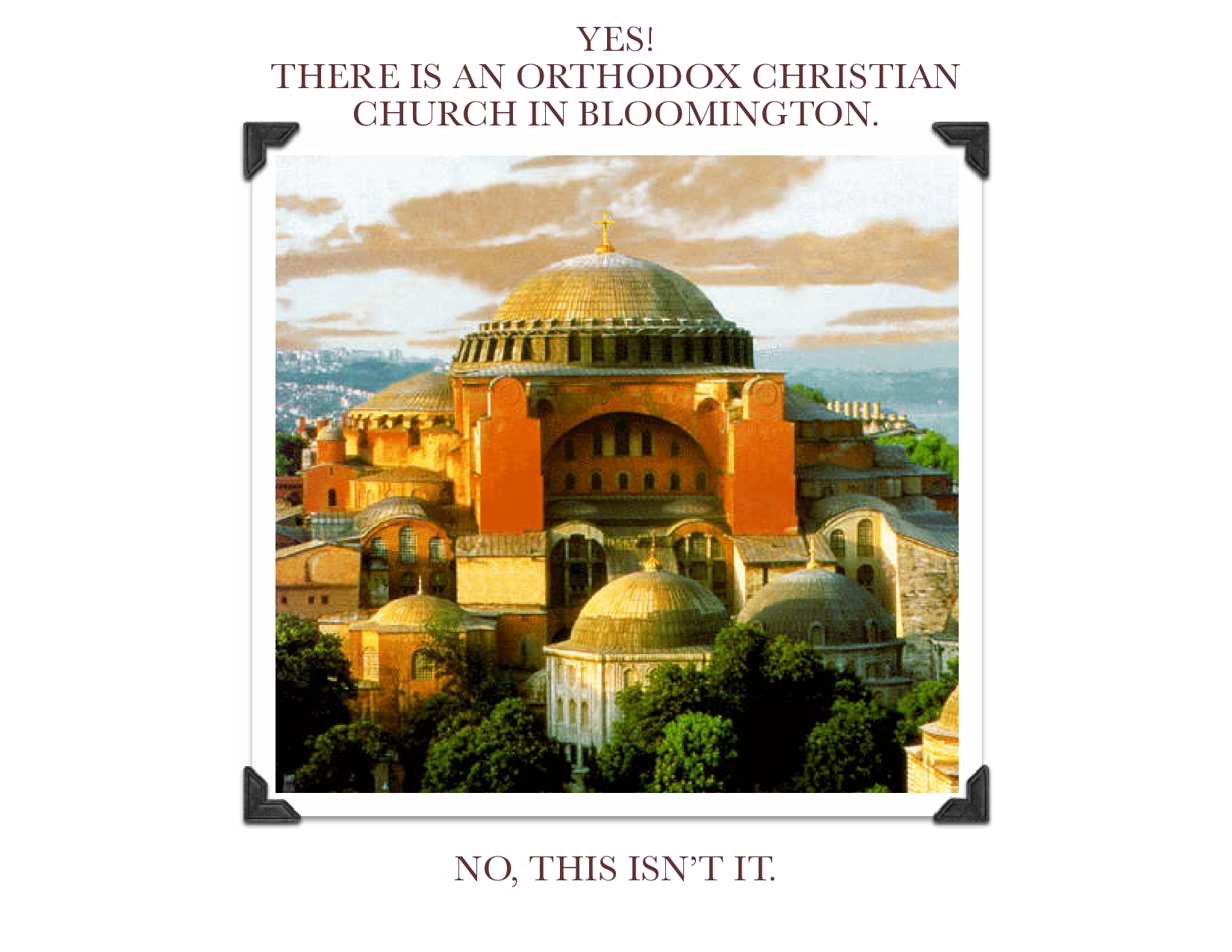
In any event, where I think some of the disillusionment comes from is this —  I think what happens is that there are people who convert thinking that it’s going to be all awesome sauce and incense and kissing chalices and domes and “Boy, people will just come in droves if they can just see what’s happening!” — the Russian Primary Chronicle all over again, only this time, in America. What happens, however, is that bishops turn out to be fallible, English translations of liturgical poetry tend to clank (let’s talk about the canon for Lazarus Saturday sometime), it becomes evident really quickly that the Episcopalians are able to pay their musicians a lot better, there are folding chairs in the middle of a nave that looks like an office building, and if you can convince your friends to come, more often than not, they are frankly mystified and manage to eke out a somewhat patronizing “Well, that was really interesting and I can see why you’re there” before running for the door. If you’re the kind to educate yourself more, you find that what’s happening in American parishes, even a lot of the ethnic ones, is pretty far removed from much of what happens in the old country parishes (what I think Owen White has called “Orthodox Orthodoxy” once or twice), and you realize that part of why the beauty of Hagia Sophia was able to convert the Russians is because the emperor could basically say “you’re converting” by fiat.

Then there’s the problem that i bring up here — people pick up on the fact that the people and places they hear about in our liturgical texts are called Demetrios and Ephesus, not Joe and Akron, Ohio. That can have a kind of mysterious, otherworldly appeal for awhile, but then you start to think, “Wow, is there really nothing of import in my faith to have ever happened where I live?”

But what the real problem is, and what isn’t comfortable to talk about in a culture where religious freedom is one of the fundamentals, is that there’s an extent to which Orthodoxy has to function in a public, popular way in order to really work, and it can’t do that here. How can you have a village or a city popularize a saint in this country when there are no villages or cities that are Orthodox? This is, I suppose, why the “let’s start Orthodox communities” idea is so popular among some converts, but that’s not really something that can work in this country without it being a synthetic utopia that will fall apart within one generation. Orthodoxy really isn’t intended to function as the boutique SWPL religion that Owen semi-accurately accuses it of being — it’s intended to be the local, popular, public church, and there’s virtually no way for it to be that in this country, not with either Orthodoxy or the USA in their current forms. The religious and cultural equilibrium in this country is, frankly, set up to make sure that such a thing doesn’t happen. Orthodoxy has the problem of being just one more Christian group among lots and lots of other Christian groups in this country, and being so in a country that in theory is already culturally Christian, as opposed to being the Christian group in a pagan country that is culturally pagan.

What’s the answer? I have said it before, but I genuinely think that the rabid insistence on divorcing “little-t” and “Big-T” Tradition turns Orthodox Christianity into an abstraction that one can mold into whatever form of Christian idiolect with Byzantine trappings that one likes. Orthodoxy as received by American converts tends to be reduced down into a palatable form, with certain teachings carefully restated so that they don’t actually say what they are, and various “ethnic customs” being essentially “flavors” that one can mix and match as they so choose. It’s an attempt to transplant Orthodoxy in a way that allows you to transplant yourself into it with minimal discomfort. But here’s the thing — all those distasteful ethnic “little-t” traditions come out of the fact that Orthodox Christianity is lived and received in a cultural context and a particular rhythm of life. Read Juliet du Boulay’s Cosmos, Life and Liturgy in a Greek Orthodox Village for some sense of what I’m talking about. As much as we scions of American Puritanism are uncomfortable admitting it, dancing, feasting, and singing folk songs are as much a part of lived, received Orthodox practice in the parts of the world that are actually Orthodox as eight hour long services, monasteries, beards, chant and stone churches. (I will point out that a big point made at a recent rembetiki concert in Bloomington was that the vocal style of rembetiki is grounded in the technique and theory of Byzantine chant.) We want the asceticism and discipline because it helps us to feel something real in our world of ready-made plastic pleasures, but that doesn’t mean that we know what we’re talking about when we write off Greek festivals and haflis and poppyseed rolls as irrelevant, if not dangerous, externals.

If we want Orthodoxy to give us roots, then we need to watch and learn how Orthodox live their lives and not be so quick to judge or talk about how this or that “little-t tradition” “won’t work in America”. Otherwise we’re still Protestants. And if we’re going to still be Protestants, let’s at least be honest about that. I agree that this doesn’t have to mean monarchism, or sequestering ourselves into SCA-style reconstructions of Russian peasant villages, and that a “package deal” mentality is going to be rife with cognitive dissonance in the long run, but the whole experience of being a Christian in the present day is an exercise in cognitive dissonance in one form or another. And let’s be honest — it always has been, and always will be. Something about seeing through a glass darkly and being a folly to the Greeks comes to mind.

Pearls Before Swine weighs in on Orthodox administrative unity in North America?

My godson Lucas is a big Pearls Before Swine fan and often passes along strips that he think might resonate with my lack of a sense of humor. This one struck us both as neatly summarizing how many of the arguments concerning “American Orthodoxy” appear to go:

Pearls Before Swine

On the difference between καιρός and χρόνος and building a church that makes the difference clear (Part II)

Organizing an event is a heck of a lot of work.

I had originally contacted John Boyer in late fall of 2008; I was looking around for Western notation transcriptions of Byzantine chant in Greek, and my friend Mark Powell said he was the guy with whom to inquire, and that I might also be interested in the curriculum he was developing for Byzantine notation. John was more than generous in providing very useful materials, and I figured, while I was corresponding with him and he was seeming friendly, I may as well ask what it would take to get him out to Bloomington for a workshop. This had been an idea I’d been trying to develop for a couple of years, since we were encouraged at PSALM in 2006 to try to put together local and regional events, but I’d never gotten more than a lukewarm response — “Who?” “Isn’t he too far away and too expensive?” etc. I figured it couldn’t hurt to ask him while I had his attention, however, so I did.

He quoted me a much more reasonable number than I was anticipating. I told him, right, let me check on a couple of things; I was able to convince a private donor to pay John’s fee and travel, Fr. Peter had no problem with it (particularly since it wasn’t being paid for by the parish), and I wrote back and said, let’s do it.

Well, then it took a year to make it work with everybody’s schedules. We decided on this last weekend back in August, and what I will say is that given a host of factors (not the least of which was the decision, made a month later, to bring out Andrew Gould the weekend before John’s visit) I would not have wanted any less time to get everything together. Even with five months’ advance planning, a significant chunk of my choir still couldn’t make the weekend work (although, in all fairness, one of them, Megan’s goddaughter Erin, was busy winning the Met auditions, so I guess that’s an acceptable excuse).

In October, the money from West European Studies happened; this really expanded the scope of what I had originally considered from maybe my choir and a couple of other interested parties to something that could be (well, had to be, given WEST’s terms) open to the public and conceived of as an educational outreach event. John and I finalized the schedule and the repertoire on 23 December; the Friday evening session would be the “lecture” of the series, intended to function as the academic side of the weekend, and then Saturday would be the all-day practical part. I set up a Facebook event and sent out press kits to 30 different churches, chairs, institute directors, community choral ensembles, and local news organs the first week of January, and was astounded at the responses that started rolling in. I heard from School of Music faculty; both an Early Music Institute and a Choral Conducting professor registered, and it came back to me that the Choral faculty member was even telling her entire doctoral seminar to come. I heard from a faculty member at University of Louisville presently teaching a seminar on early notation (although she ultimately decided she couldn’t make it); I heard from choir directors and priests in Indianapolis, Evansville, and Louisville; I heard from a Medieval Studies professor at Wabash College; I heard from local people in the community. By the time the registration deadline passed the week before, 45 people were registered; another ten confirmed over the course of the following week, and then still more showed up unannounced.
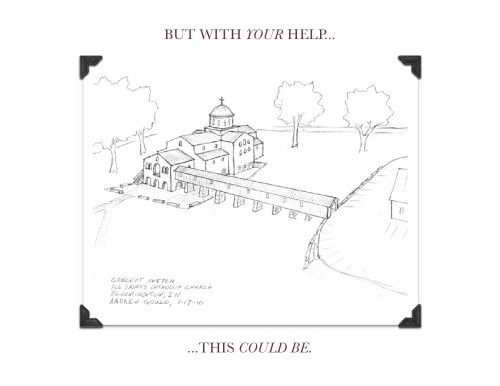
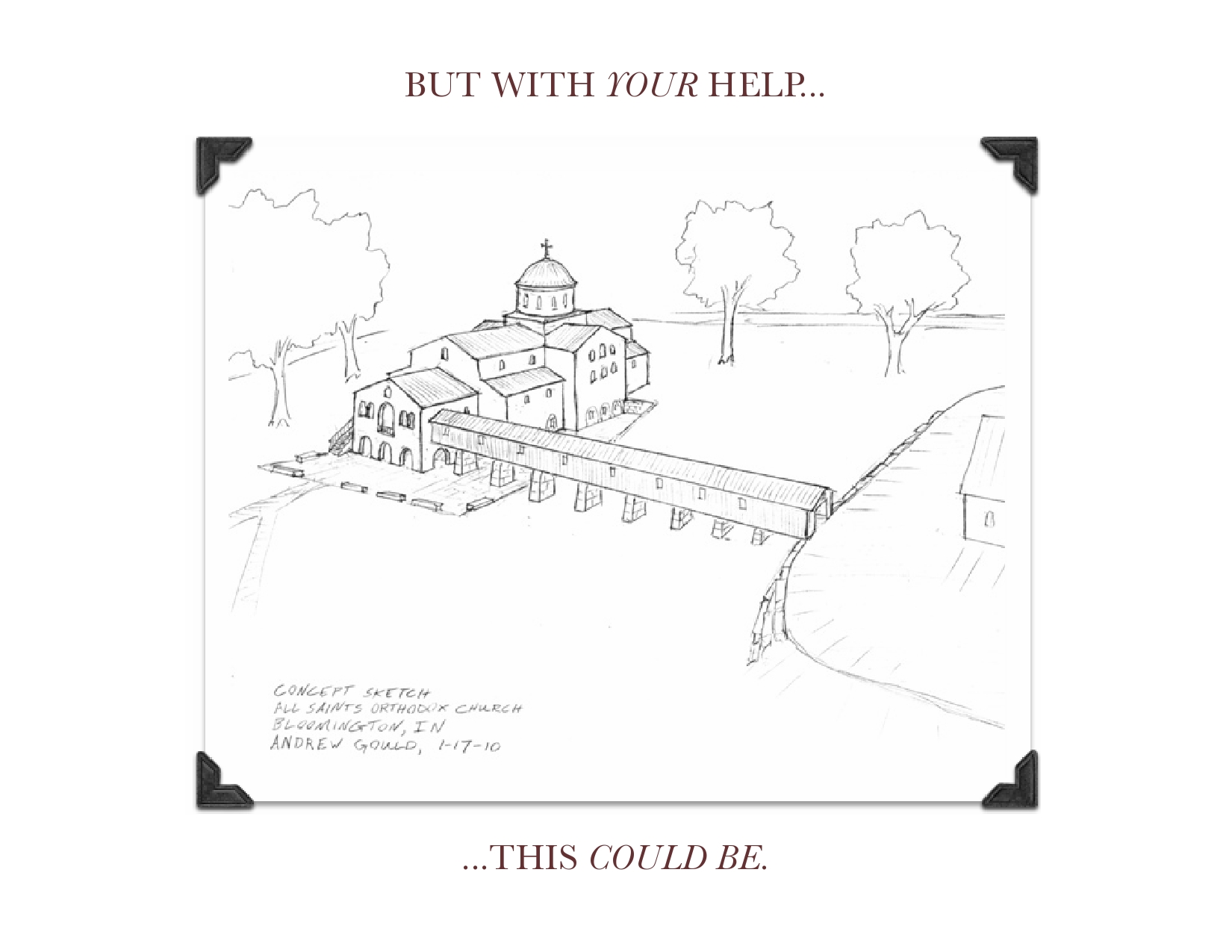
The last week before the workshop, the event planning was approaching a fulltime job; I had to make sure food got ordered and picked up, I had to track down CD shipments so we could have things to sell over the course of the weekend, I had to bug overworked Cappella Romana executive directors for scores (sorry to have been a nag, Mark, truly), I had to get registration materials printed and assembled, and I had to field phone calls from people who wanted to come but lived a couple of hours away and wanted to make sure it would really be worth their time. The last couple of days I wasn’t quite a one-man army; Megan, God bless her, helped with a lot of the last-minute errands and the putting together of the registration binders. I put together a couple of displays of Andrew’s concept sketch (pictured) so that workshop attendees could see it, at least trying to give a nod to the non-singer-friendliness of our space and indicating that we intend to do something about it.

On the other hand, once John actually got here, my job was significantly easier — I pretty much just got to sit back and enjoy the proceedings.

I must say it was worth it; all in all, throughout the course of the weekend, about 65 different people came. Not bad for an event centered around this obscure, gaudy Eastern repertoire that supposedly we Westerners can’t stand without the edges sanded down.

I picked John up at the airport last Thursday evening; his flight arrived at 10:30, and then between his checked luggage taking forever and my very smooth wrong turn leaving the airport, we didn’t get back to Bloomington until about midnight. Luckily, Megan had a wonderful meal and a good bottle of wine waiting for us when we got home (a Saveur recipe that turns lentils and sausages into a bowl of gold), and we three were up talking until around 2 in the morning.

In what would prove to be a pattern for the weekend, four hours later, it was necessary to be up and about. It was, as I told John, the “showpony” day; he was doing a radio interview for Harmonia in the morning (watch this space for details), a mini-lecture for WEST in the afternoon (no thanks to me; I had both the time and the place wrong, forcing us to rearrange our afternoon a bit), a coaching with Lucas, Megan and me on epistle cantillation, and then the first formal session of the workshop in the evening.

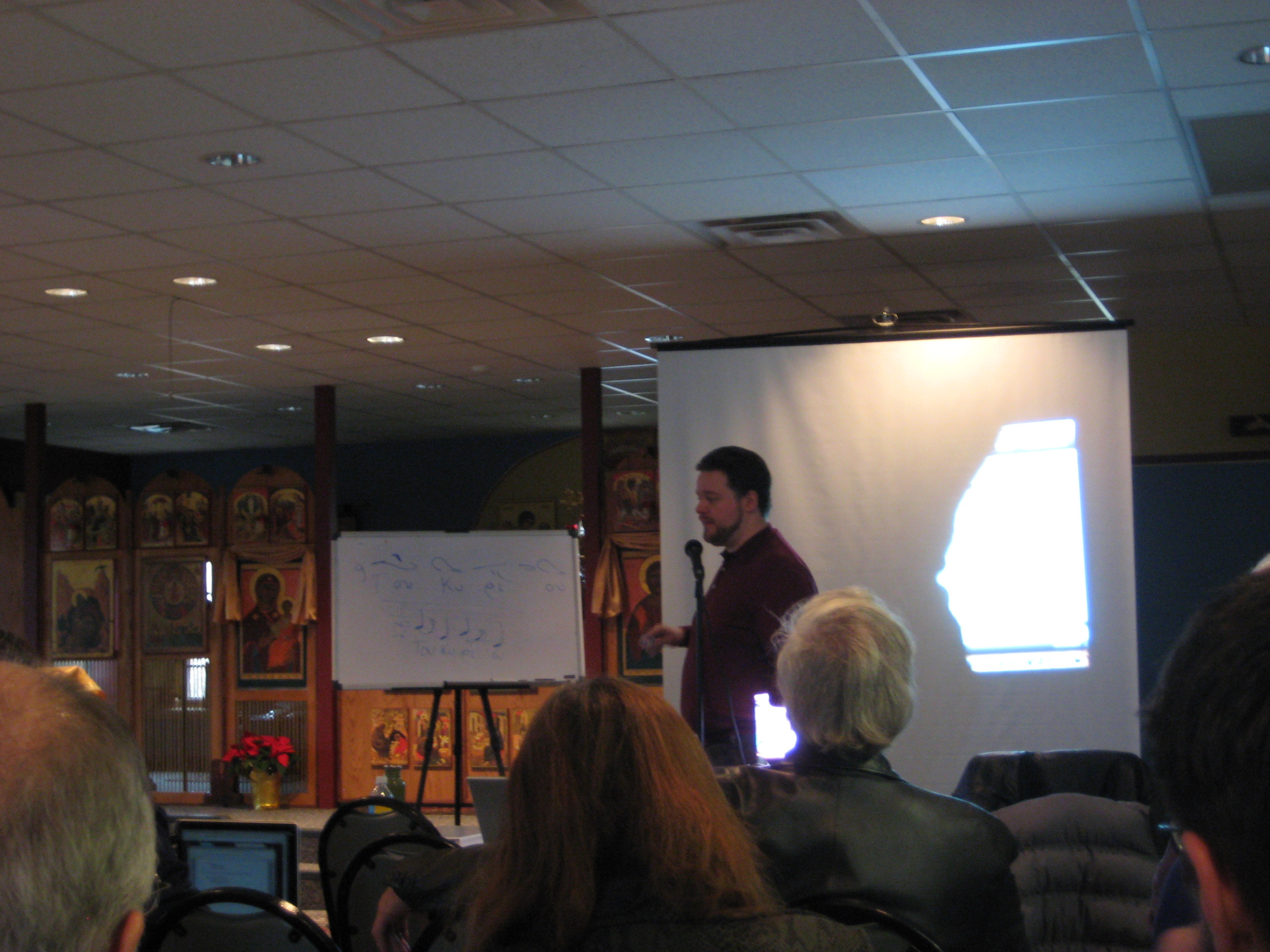
One thing that putting on such an event at All Saints did was push us to the absolute limits of what we’re able to do in our current space. John had a PowerPoint slide deck as part of his lecture; well, we’re a pretty low-tech parish on the whole, so I had to go out and hunt down a projector and a screen. WEST loaned us the projector by way of the Russian and East European Studies Institute; my old employers, the Archives of Traditional Music, were good enough to loan us the screen. Even so, it was difficult to figure out how to set up the presentation in our nave to maximize the size of the slides, minimize keystoning, and be within reach of our power outlets (even with extension cords). We managed, but I’d want to figure out how to do better next time.

We had made the decision to install a comprehensive sound system in the nave as the only real cost-effective solution to our acoustic woes for the time being; we gave the thumbs up to the order on 11 January, and the guys at Stansifer Radio turned it around as quickly as the possibly could, knowing that we hoped to be using it by 22 January, and they got it installed by Vespers on Wednesday, 20 January. John had also wanted to be able to plug his laptop into the sound system; I told Greg at Stansifer what I needed to do, and he told me, “Give me an hour to make you a cable.” An hour and twenty dollars later, I had exactly what I needed, and it worked beautifully.

In the end, where we needed to set up John’s presentation was nowhere near the condenser microphone installed for the homilist, so we still had to give him a handheld mic hooked up to Fr. Peter’s old amplifier so he wouldn’t kill his voice. (Why, you might ask, did we not plug the handheld into the nice sound system? Well, the mixer is back in a closet in the sanctuary, roughly 30 feet away from where John was standing. We had a long enough cable, but plugging it into the mixer produced no result. “Oh, right,” Fr. Peter said, stroking his chin. “I forgot — the long cable is dead.” Like I said — we’re kind of a low-tech community. Note to self: replace long cable before next such event.)

Nonetheless, John was a hit, a big one, and something that I heard from more than one person at the end of the session was, “You know, I was only going to come for tonight, but I need to rearrange my day tomorrow so I can come here.”

Following the lecture session, in lieu of a formal reception (which I’ll have to remember to set up for next time), a number of us tried to go to Finch’s for dinner, it being one of the nicer places in Bloomington. Alas, we got there just as the kitchen was closing, and so we relocated to Nick’s. It was a bit louder than we we might have liked otherwise, and they didn’t quite know how to make a Manhattan properly, but perhaps not an inappropriate venue, given that it was founded by a certain Νικόλαος Χρυσόμαλλος (Nick Hrisomalos).

It was a full house at Chez Barrett; besides John, our friend Max Murphy, my counterpart at Ss. Constantine and Elena in Indianapolis, was staying on our other futon for the night so that he wouldn’t have to commute. Once again, we found ourselves up until about two in the morning chatting, and needing to be up by about 6:30 to make sure our houseguests would be sufficiently plied with coffee and eggs, pick up the food for Saturday’s lunch (shout out to Eastland Plaza Jimmy John’s; three 30-piece party platters was a perfect amount of food for a very reasonable price, and they were gracious enough to have somebody there at 8:30am so I could pick it up, since All Saints is waaaaay far out of their delivery area), and get everything at the church set so that the 9am session could start on time.

Well, it didn’t quite. We might say that everybody was inspired enough by the previous evening to recalibrate their clocks to “Greek time,” and we didn’t get started until about 9:30am. Έτσι είναι η ζωή (that’s Greek for c’est la vie, which is itself French for “Life sucks, get a helmet”).
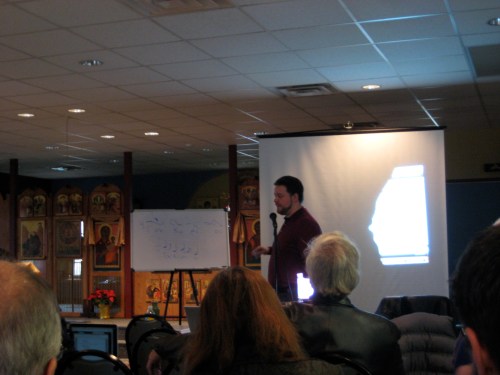
Without giving a blow-by-blow of the whole day, I’ll say that much of the day was dedicated to rehearsing the Divine Liturgy music, but there were a couple of theoretical points made that I’ll note. First, there was the issue of time, which John got at a few different ways. He has a principle, stated many times over the course of the weekend, that “If you think you’re not going fast enough, slow down.” Too often, he says, we just zip through the text like it doesn’t mean anything, which makes it not mean anything. This can be in chanting a hymn, reading the epistle, whatever. We treat hymns and readings like they’re just the next thing to get through so we can be that much closer to getting out the door, rather than adorning them with the beauty that a) they deserve and b) will make us want to be there and take part in the services as though they are gifts from God rather than as burdens to bear. So, again — if you think you’re not going fast enough, slow down.

Another way he stated this was to discuss the difference between χρόνος (chronos) and καιρός (kairos). The former is the world’s time; the latter is the Church’s time. This came up when he was talking about why some hymns are slow and melismatic, and even sometimes will revert to nonsense syllables — in the case of the latter, when this happens, the text has been stated thoroughly in a slow and melismatic fashion, and the hymn is now using “terirem” or some such to provide the opportunity to meditate on the text. Not only that, however; the whole point of the slow, melismatic style has a practical component — to cover a liturgical action, for example — but it also emphasizes the reality that in the liturgy, we are no longer in the world’s time (chronos) but on God’s time (kairos). I was reminded of what Met. Kallistos Ware says about the first time he was in an Orthodox church:

…I had no idea how long I had been inside. It might have been only twenty minutes, it might have been two hours; I could not say. I had been existing on a level at which clock-time was unimportant” (“Strange Yet Familiar: My Journey to the Orthodox Church” in The Inner Kingdom, St. Vladimir’s Seminary Press, 2000, p. 2).

As he acknowledges in the same essay, this itself was a trope (albeit realized after the fact) of what the Kievan emissaries are reported to have said after their visit to Hagia Sophia: “We knew not whether we were in heaven or on earth…”

Another thought came to mind during this discussion — what do we sing in the Cherubic Hymn? “Let us now lay aside all earthly cares.” What do most of us do with the Cherubic Hymn in our parishes? Sing a setting short and fast enough so that we repeat it three times, because we worry that people will get bored otherwise. Isn’t that rather missing the point?

The other theoretical point John made was that there are three textures of singing in our liturgical practice: soloist (priest or deacon or cantor, depending on what’s happening), choir, and congregation. “We need all three,” he said repeatedly. “It’s very much a dance of who sings what when, and if you limit yourself to only one of those textures, you lose something important and beautiful.” As you may recall, the week before, somebody told Andrew Gould that they didn’t come to church for the beauty but for the participation; one wonders how such a perspective would understand what John had to say on this point. My thought is that he’s right, but dances have to be both taught and learned or they become mass confusion.

The services themselves were an adventure, but a good one; at the kliros, the weekend suddenly turned into Byz Chant Boot Camp (or Parents’ Weekend of same, as our friend Laura Willms suggested), and John was the drill sergeant. This Was A Good Thing; he was able to do get away with making certain points in a way I simply can’t, partially because a) he won’t have to see these people next weekend b) we paid him to be here specifically to do that c) he’s Greek. He was not shy about being emphatic in terms of instructing people during services; if you were on the isokratima, for example, and were sleeping on the job and missed his cue for the move, you got an elbow in the ribs. (As John said later, and I absolutely agree with him, “Please tell me a better way to communicate with people who aren’t watching me while I am singing.”) The thing is, coming from him, people ate it up; after the service, a lot of the folks who got the business end of his drill sergeant-ness said only, “Wow — what an amazing teacher.” For me, how this manifested was him pointing to the Byzantine scores he was following and saying, “You’re reading with me, got it?” Up to that point, I hadn’t dared putting enough confidence into what I had learned over the summer to actually use it during services, but much to my own surprise, I managed to keep up. I wasn’t perfect (and when it was just me on my own I fell down and went boom a couple of times), but I kept up.

After Vespers, we were all tired and hungry enough that it seemed best to simply call off the 7-9 session — we had reached enough of a logical stopping point that anything further that evening would be a matter of diminishing returns. It was early enough that Megan, Laura and I were able to take John to Finch’s for dinner after all, and once again we all found ourselves up until 1am or so talking.

Matins and Divine Liturgy the next morning were not without their speed bumps — everybody was just enough out of their element to make sure of that — but everything went quite well regardless. (We even made it successfully through the Cherubic Hymn, which had been a cause of some lack of sleep on my part.) A lot of non-Orthodox workshop attendees came, so we had a very full church. That said, I’m not entirely certain that everybody in the parish knew what was going on or why we were doing what we were doing (despite my plugs for the weekend along the way), and some of the reactions I got from parishioners were worded accordingly (“That was beautiful, Richard, but I will be very happy when we go back to normal” was one example). On the other hand, there was the chorister who told me, “I felt like my musical soul had been fed for the first time in a long time.”

Here’s a comment made by a workshop attendee to which I keep returning — the commenter in question is part of the local UUC congregation and retired English faculty here at IU:

Excellent workshop on Byzantine chant this weekend at All Saints Orthodox church in Bloomington, with John Michael Boyer, cantor and teacher… The whole attitude of the Orthodox faith tradition is very flexible, welcoming, inclusive, and constantly changing–such a welcome change from most of the Western Christian churches… As it happens, I’m not a theist of any variety, but if I were monotheistically inclined, I’d give this church a serious thought. Good people all around… This was my third visit to your church and in every case, I was much welcomed.

Seems to me that’s successful outreach right there.

John’s flight out was scheduled for 4pm on Sunday. However, as we left All Saints around 12:30pm, he looked at me with deeply exhausted eyes and said, “Would you mind horribly if I changed my ticket and stayed an extra day?”

Well, I told him, I didn’t know for certain where he’d stay, but I’d see what I could do.

Megan and Laura made biscuits and gravy, which I think may have cemented John’s friendship with Bloomington (to say nothing of his arteries). He got a nap, and made a wonderful dinner for us that night — a recipe of his own devising, incorporating pasta, kielbasa, kalamata olives, mushrooms, and green peppers.

(Tellin’ ya — how do we rate all of these friends who ask, “Hey, can I cook in your kitchen while I’m here?”)

And, once again, we looked at the clock while talking, found that the hours had slipped away and it was three in the morning.

On the way out of town the next morning, we had lunch with Vicki Pappas, the chair of the National Forum of Greek Orthodox Church Musicians — also a Bloomington resident and founding member of All Saints (alas, in absentia for years, since she commutes to Holy Trinity in Indy). It was a very interesting conversation for which to be a fly on the wall; the musical situation in GOArch has its own intricacies, complications, and vicissitudes, to say the least.

The drive to the airport (no wrong turns this time, thank God) mostly consisted of us discussing how to get John back here, and soon. Watch this space.

Just to make sure I’ve said it: as with Andrew, I wholeheartedly recommend John if you’re looking for somebody to bring out as a speaker or as a guest instructor with respect to Byzantine chant. He’s knows his stuff inside and out, both in terms of chant and in terms of liturgics in general, he’s a great teacher, and of course he’s a wonderful cantor. He is a very effective speaker and teacher for an academic audience, an Orthodox audience, and a general audience — not something everybody can claim.

All in all, the weekend was a huge success in terms of being outreach, being educational, being of musical interest, and, more personally, building friendships. It’s very true that there’s very little in the way of specifics you can cover in a weekend; notation wasn’t discussed beyond some theoretical ideas, and there was only so much he had time to do with respect to the tuning systems, but I think what it did was threefold: it established that there is in fact interest in this material here in Bloomington, for the School of Music, the greater community, and the parish, it proved that you could talk about this subject from an explicitly confessional standpoint and have it be more informative for non-Orthodox participants than it would have been otherwise, and it stimulated interest in doing more. The School of Music faculty who came were very clear about wanting to participate more directly the next time John is here; people from the parishes of surrounding areas said, “Hey, how can we help with the next one?” and it’s also been expressed to me that there is a desire to figure out what portions of what we did last weekend we can keep as our normal practice. That will likely be a complicated conversation with a complicated outcome, but it’s a better response from the people in question than “That was nice, now let’s never do it again”.

What I will say is this: by virtue of the fact that we were open to the public and not charging admission, our own success made it quite a bit more expensive than we had originally planned. If you participated and would like to help, or would like to help regardless, please contact me (rrbarret [AT] indiana.edu). Our original donor has been very generous, but we had hoped to come away from this event with perhaps some seed money for the next one as well. Looking ahead, I am contemplating starting something which we might call “Friends of Music at All Saints” or some such, specifically to exist as some kind of a booster organization for such things; again, I am pretty much a one-man army here, so if you’re interested in participating, please let me know.

So, we had two visitors two weekends in a row. One told us about beautiful churches, another told us about what we do in those beautiful churches. Now what?

I think, if we want a useful synthesis of Andrew’s and John’s respective messages, it boils down to John’s point about kairos and chronos, and how that relates to the church building being an icon of the Kingdom. As Lucas pointed out to me, the word kairos kicks off the whole Divine Liturgy: Καιρός τοῦ ποιῆσαι τῷ Κυρίῳ — it is the time/moment/opportunity of acting for the Lord. Even better, if we want to read τῷ Κυρίῳ as a dative of the possessor, it is the Lord’s time of action. And what is the priest’s first blessing? Blessed is the Kingdom… The Liturgy is the Lord’s action in His own house on His own time. (I will note that this does not go well with the populist misunderstanding of “liturgy” as “the work of the people”, but it goes much better with the more accurate rendering of it as “public service”. It is the Lord’s public service being offered to His people, in other words.)

So, you have to liturgize in a way that emphasizes the fact that it’s God’s time, and you have to have a worship environment that emphasize’s that it’s God’s house. As Lucas also put it, you have to get across the idea that, no, actually, you don’t have anyplace better to be.

Schmemann, of course, talked about the idea that we should liturgize in a way that takes the Liturgy back out into the world. What I wonder is if we have a problem with the valve running the wrong way — that we bring our busy lives, our distractions, that is to say the world into the Liturgy with us and then expect the Liturgy to be run in a way that accommodates us. As I said with the Cherubic Hymn — we say that we are now laying aside all earthly cares, but do we really approach that text in a way that indicates we believe that that’s what we’re doing?

And when you’ve got a building that, no matter how you cut it, looks like an office building with icons and which traps our psalmody rather than lifting it up to heaven, is it any wonder that that’s our approach? Andrew was absolutely right — we’ve got the saints and the angels, but no City.

We’ve got our work cut out for us. On the other hand, here’s the good news — Fr. Peter told me a couple of days ago, “You know, a comment I got from a few people was that things seemed too slow. But you know what? In a lot of places, by having the choir sing it so slowly, I found that it matched better with the liturgical action, and it made a heck of a lot more sense.” We talked about a lot of this stuff, and it seemed to click with him that we need to figure out, and make a concerted effort reinforcing, the difference between kairos and chronos. It’s not going to be easy, but we’re at a point where it’s what we have to do.

The project that All Saints has ahead of it is not a building project or a musical project. Those are components, yes, but what it really is is a spiritual project. We’ve got to be the City on the Hill, the Heavenly City, the New Jerusalem, the Light that is not hid under a bushel. It is desperately needed in this town, in this area, in this world, and we’ve got to convince ourselves that we want to be that, that we want to be an icon of the Kingdom, more than we want to be what we’ve been pretty good at being up until now, which is a little, struggling church in a little, struggling Midwestern town.

If we can do that, then we will have the hard part out of the way. If we can convince ourselves that we believe that and that we can walk in faith, then the temple will just about build itself, $2.5 million or no, and people will stop worrying about whether or not the music is too Byzantine or too slow or not congregational enough or not “American” enough or whatever. (By the way, I found over the course of the weekend that just joining a good English translation with a melody written for the English made things pretty well more “American” on their own. Others may disagree with me, but that was my perception.) If there’s a point that both Andrew and John made, it is that the ethos of the received tradition is not a buffet, not a “meat and three”, not a list of things from which you pick and choose. There are things that we can adapt for local circumstances, but you do that after you’ve received the tradition, and then only in a way that doesn’t obscure what you’ve received. You don’t filter out the parts of the received tradition you don’t like pre-emptively. You may well come to church for participation rather than beauty, but that doesn’t mean that beauty isn’t part of the organic whole.

The church building and the liturgy have to reflect the fact that we worship a God who is bigger than we are. God already “met us where we’re at” in the Incarnation; it is up to us to respond to that in faith.

Now, having said all of that, I’m at the head of the line of people who need to figure out chronos and kairos. With these two weekends out of the way, I have a ton of reading to do on Ancient Greek democracy and a couple of weeks’ worth of working out on which I need to catch up. I’m going to be juggling things for a bit yet before I’m really into the rhythm of the semester. Along similar lines, last Wednesday, John texted me at about 8pm my time: “I’ve turned nocturnal. Just woke up. I’m not sure, but I think it’s Bloomington’s fault. :-)” I guess the gap between chronos and kairos gets us all in the end. Pray for us.

More importantly, however, pray for All Saints. We’ve got a lot of hard work ahead of us. With God’s help and by your prayers, we can do it. If you want to be involved more substantially, I’ve suggested a couple of ways you might be able to do so; contact me if you want more information.

Okay — back to being a student.

Updated link for Frontier Orthodoxy

Do note that Fr. Oliver Herbel has moved Frontier Orthodoxy to its own site. Not all of the first few articles have been moved; those you will still find here.

Of note: Frontier Orthodoxy

Fr. Oliver Herbel has a new column called Frontier Orthodoxy which looks like it has the potential to be of great interest. There are two posts up now, and my understanding is that he intends it to be a bi-monthly column. That Fr. Oliver reveals in his introductory essay that he is a fencer already means that this is going to be worth watching.

Ochlophobist on the dilemma of being “young, male, and Orthodox”

Owen made the following comment on a recent post:

There is a certain type of young man who generally pursues the priesthood. We dance around it, but in my mind it is unequivocally true. In Orthodoxy there are certain forms and postures that are, aesthetically speaking, humble, but which are easily practiced and replicated, and do not necessarily reveal the inner heart – soft, slightly effete voice, a way of walking in the cassock, a way of mentioning the contrary opinions of others and pleading one’s ignorance on matters even as it is quite clear you’ve got a strong opinion and you want it to be deemed the right one, a slightly affected, sentimentalish manner of being around icons, prayer ropes, the altar &nave, and so forth, a slightly affected manner of quoting sayings or hagiographic tidbits of the saints, etc. But beyond all that, you spend some time with the fellow and you realize that he loves and is naturally given to didacticism – here is a man who likes to be in a position of teaching others. It is also clear that he has a hunger to be in a position of spiritual authority over others. In my opinion, keeping in mind that opinions in Orthodoxy are worth as much as wax stains on nave carpets, a desire to teach in the Church and have spiritual authority over others is usually, but not always, instigated by demons.

Okay. We’re adults here; let’s not be coy and play dumb. We all know what he’s talking about, and we all know people who are more or less like this — assuming we ourselves don’t fit this description! I’m going to let Owen’s words speak for themselves, and I assume that he is savvy enough to know that he has just profiled a chunk of his readership (although I would be hard-pressed to say whether or not he would particularly care if he offended any of them).

So, neither adding nor subtracting nor commenting directly on the particulars Owen discusses, my question is, why are young men who tend to have these characteristics the ones who seem to be drawn to the priesthood like moths to flame? (Perhaps people can weigh in on whether or not the ordination-bound in other confessions/communions also behave this way.)

In the interest of full disclosure, the priesthood is something I feel reasonably certain to not be in God’s plan for me. This is not a conclusion I have reached lightly; in one form or another, the question of pastoral ministry was one that really troubled me, at least off and on, from my teenage years up to late twenties. During my time in Anglican circles, there were a couple of people who were really pushing me to consider seminary, and I think it was only the fact that I did not yet have an undergraduate degree that kept these individuals from forcibly sending me off to someplace like Trinity or Seabury (Nashotah House is not a place one hears about in the Pacific Northwest). Being an excitable young man, of course the question resurfaced for me as an Orthodox Christian, and immediately following my chrismation in February 2005 it seemed (as it does for so many of us) that surely seminary would be the logical next step for Somebody Like Me (particularly since that would make the matter of grad school much simpler). In the fall of 2005, I visited the St. Vladimir’s campus, fell in love… and then the whole issue just seemed to dissipate as a compelling force. It hasn’t resurfaced since. I sometimes wonder if the point was simply to bring me to a place where I would finally be willing to go that route, and then to redirect me elsewhere. At this stage of the game, I am no longer afraid of the priesthood (and haven’t been for awhile), but it seems more likely that, if I were to wind up at a place like St. Vlad’s, it would be as a member of the faculty (or potentially as a visiting student while I’m writing my dissertation) rather than as a candidate for priestly formation. As it is, I have a desire to teach, but not in the Church — at least not as a catechist. No, thank you. That’s not responsibility I care to have. Maybe I could help illuminate a couple of things here and there within my own area of expertise, maybe I could teach a chant lesson or two, but I’m not the person to entrust with forming the holiness of others.

Extending maximum charity to the type of gentleman Owen describes (particularly given that, for all I know, there could be people who read those words and think, “Yep, that’s Richard Barrett!”), what pushes this person onto the path of the priesthood and gives them such a desire for spiritual authority? I am not totally unwilling to discount the explanation of demons, but let us say I feel more at ease discussing what might be the concrete instruments of said demons than the demons themselves.

My favorite ’80s teenage rom-com is Say Anything… In a lot of ways, it’s really more properly considered a ’90s movie than an ’80s movie (it was released in 1989) — rather than somewhere in California, it takes place in a rather idealized and curiously rearranged Seattle four years before Meg Ryan would get from the 520 floating bridge to Sand Point in a matter of seconds (it takes twenty minutes to half an hour assuming no traffic, folks), it’s got Soundgarden and Joe Satriani on the soundtrack, it’s got John Mahoney as the problematic Seattleite father (prefiguring Frasier by about half a decade), and it’s got John Cusack as Lloyd Dobler, in what amounts to his first adult role. Young adult (the script goes out of its way to explain that Lloyd is graduating high school a year older than his classmates because of various familial matters), but he’s not fantasizing about dancing hamburgers at his fast food job anymore. One perhaps could argue that he starts the movie as a kid and finishes as an adult (cf. Lili Taylor telling him, “Don’t be a guy. The world is full of guys. Be a man“). More to the point, you can see Lloyd as potentially growing up to become Martin Blank (and I have occasionally wondered if Say Anything… wasn’t discussed, even if only in jest, as sort of a murky back story for Grosse Point Blank).

Anyway, Lloyd is a nice, if slightly off-center, guy. He wears a Fishbone t-shirt and a trenchoat. He’s a bit disconnected from his family, since his parents are in the military and stationed elsewhere, and he lives with his single-mom sister and her kid while he figures some things out. He’s not intelligent or obviously talented in conventional ways, he’s graduating high school a year late, he has no college plans, but what he does have are some very definite principles (“I don’t want to buy anything, sell anything, or process anything as a career”), and when he’s dedicated to something — like kickboxing, for example — he gives it his all. His guidance counselor buttonholes him at a party to try to persuade him to make some conventional decisions about his future, and he dismisses her advice, saying, “I’m looking for something bigger, you know? I’m looking for a dare-to-be-great situation.”

Let’s just imagine for a moment that Lloyd one day wandered into St. Nicholas Cathedral (ROCOR) in Seattle and found his dare-to-be-great situation there, giving it his all just like he did with kickboxing. I think he’d wind up a lot like the kind of young man Owen describes.

My point is this. I think there are a lot of smart guys with a genuine faith in and love for God, who want to give something the whole of their effort, who maybe just haven’t had the right — or at least the obvious — opportunity come their way and who at least know that there are some specific things they don’t want to do. Maybe they’ve had an interest in various aspects of the humanities and social sciences, enough to be broadly informed about a wide range of topics, but they’ve never had the discipline or the right setting to rise above being a dilettante, or at least an undergrad who shows some promise. Maybe they’ve had something of a taste of church service in another setting, enough so that they put on a cassock or some other kind of vestment and realize that they’re visibly part of something bigger when they do that. Maybe there are other circumstances in their life that make them determined to never do anything halfway, so that they never have to apologize for their own presence or participation.

And when these guys discover Orthodox Christianity, with all of history and all of its richness of faith and practice and all of its demands, with all of the ways it can order one’s life in the service of Christ, the various facets of their person which otherwise make it hard for them to fit in suddenly have a place, a context. They’ve discovered their dare-to-be-great situation. This is their life’s work, they just didn’t know it before. How can the priesthood, if not monasticism, not become a draw, the call that surely was always there if it could only have been perceived?

(By the way, unlike what I suppose about Owen, I care very much about offending people, so I really hope nobody thinks I’m saying this to mock or be critical. I have observed much of the above, yes, but much of it I have observed in myself. I cannot mock without mocking my own person first of all.)

I think what it often (perhaps not always) boils down to is that, for the young, male, zealous convert, it is not difficult to develop the desire to spend as much time in church as possible. Eventually, and naturally, this turns into the question — perhaps unconsciously — “If what I want to do is be in church all day, then wouldn’t a vocation just make sense?” Since there’s really only one way somebody can work for Orthodox Christianity in this country as one’s day-job, the direction becomes pretty clear from there.

Does it have to be this way? Maybe not, and I would hope that a seeming one-to-one ratio of zealot to cassock could be a reasonably short-lived phenomenon. (I say that as a cantor who wears a cassock.) The truth is, there is something that drives young men who behave as Owen outlines. If it might be healthier that not all of them get tonsured as readers the day after their chrismation and start teaching catechism after their second Divine Liturgy as a communicant, then there needs to be some active spiritual guidance about what to do with whatever it is that drives them. I have no doubt that for priests and bishops who have long lists of things to get done, young men with a lot of energy and desire to serve are hard to tell, “You need to sit back and chill for a while.” Still, it raises the question of whether or not the desire specifically to be the one serving in a visible, set-apart fashion can’t itself turn into a passion.

Ultimately, I think Owen is absolutely right from a descriptive standpoint. I’ve remarked before that there’s a certain self-consciousness of the American convert that we’re going to have to figure out how to deal with, and what Owen talks about is part and parcel of this self-consciousness. If there is a sort of contrived and constructed manner of holiness that has been assumed, then the answer is that we need more models of holiness that haven’t been contrived or constructed. Still, I think there are deeper reasons for why this occurs that we’re also going to have to figure out how to understand and deal with, and we will need to do so compassionately and productively.

In which the author laments the state of English language liturgical books

Last Saturday, it being Great Vespers for the Feast of St. Luke, there were Old Testament readings appointed for the service. I normally leave those to other people so as to save my voice, but I got asked to do one of them anyway since we were short some people we might otherwise have had. “Just read off of the printout of the liturgical guide?” I asked. Yes, I was told, since the parish doesn’t own a Prophetologion.

Well, long story short, nobody owns an English-language Prophetologion, because it doesn’t exist. There’s Archimandrite Ephrem (Lash)’s draft version online, and I’m increasingly coming to the conclusion that if I were to be involved in starting a mission I would argue passionately for the use of his translations, but obviously an electronic version just isn’t quite the same thing as actually having a printed liturgical book. Besides which, Fr. Ephrem has done the exactly right thing of translating liturgical texts as a self-referential whole, being aware of biblical references, internal references to other liturgical texts, and so on and so forth — and while this is exactly right, it also renders his liturgical texts somewhat difficult to use unless you’re using them exclusively.

Which gets us to the broader question of English language liturgical books, and the practical situation in various parishes.

The situation at All Saints is interesting, and I expect reasonably common — we use Nassar as the spine, but not everything is in there, and there has been cobbling together of things from various sources over the years. This effort has been by necessity a real “do it yourself” matter by many people, for reasons I won’t go into here but I’m going to assume can be guessed by a sufficient number of people in similar situations. As a result, we use one translation for the proper texts for weekday services, a different translation for Great Vespers, Sunday Matins and Sunday Divine Liturgy, and still another translation for some of our Lenten texts. Sometimes we use the HTM Psalter; sometimes we use the KJV/NKJV variants that are used in the Antiochian service books. For the epistle reading, we have the Holy Cross Apostolos, which we bring out during services, but we insert a sheet with the NKJV text into the book so that the reader is actually reading from that and the book itself is really for show. In other words, we have a fundamental disunity of English translations, thereby achieving a fundamental disunity in the texts themselves. It used to be worse; our Divine Liturgy music used to be a patchwork of things from all over the place, so that there was no textual consistency whatsoever within the service — “Thee/thou” in one section and “You who” in the next. I am also told that for awhile we were trying to use the Orthodox Study Bible liturgically, but since it’s not arranged as a liturgical book (i. e., no prokeimena etc.), that was a non-starter from a practical standpoint.

These are the moments when I see an excellent argument for sticking with ecclesiastical Greek or Church Slavonic.

(On the matter of the HTM Psalter — HTM obviously publishes liturgical books that a lot of people use. I will note for the record that I find the use of liturgical materials by schismatic groups problematic, but I know there are a lot of people who disagree with me.)

I’m not sure what the solution is; what I’d hate to see is the worst kind of “by committee” translation, where all of these texts which were composed by saints and monks are rendered into bland, inoffensive, artless English. There are good “by committee” translations, like the Thyateira translation of the Divine Liturgy, but on the other hand, their committee includes Fr. Ephrem as well as Metropolitan Kallistos.

Maybe if any of our seminaries start offering doctorates, the problem of establishing a fundamental unity of English language liturgical books, and doing it right, can be taken on as a dissertation — or rather, several dissertations, more than likely. Best of all would be if modern-day Ss. Cyrils and Methodiuses would make themselves known for the English-speaking world. I understand that a hundred years ago for the most part the books didn’t just exist, and thus we’re better off than we used to be, but I’d like to think that we’re at a point where we can respect the efforts that have been made, re-assess where we’re at and try to move forward from here nonetheless.

Is a unified English translation of all the liturgical books a realistic goal? Or is the hodgepodge one of those things where we need to accept that it’s not going to happen because Things Are Different In America?


adventures in writing alexander lingas all saints bloomington all saints orthodox church american orthodox architecture american orthodox music american orthodoxy Antiochian Archdiocese Antiochian Orthodox Christian Archdiocese of North America Antiochians books byzantine chant cappella romana chant church architecture ecclesiastical chant ethnomusicologists ethnomusicology fellowship of ss. alban and sergius Greece Greek greek food greekness hazards of church music international travel tips ioannis arvanitis joe mckamey john michael boyer kurt sander Latin liturgical adventures liturgical architecture liturgical music liturgical texts and translation liturgy liturgy and life lycourgos angelopoulos medieval byzantine chant Metropolitan PHILIP militant americanist orthodoxy modern byzantine architecture modern greek music music as iconography my kids will latin and greek when they're newborns my kids will learn latin and greek when they're newborns orthodox architecture orthodox architecture is bloody expensive Orthodox choir schools Orthodox Ecclesiology orthodox outreach orthodox travel pascha at the singing school Patriarchate of Antioch Patriarch IGNATIUS IV Patriarch of Antioch publishing random acts of chant richard barrett in greece richard toensing rod dreher sacred music st. vlads st john of damascus society Syriac the Bishop MARK fan club the convert dilemma the dark knight The Episcopacy The Episcopate the only good language is a dead language this american church life travel we need more american saints why do we need beautiful music in churches?

Blog Stats

  • 262,832 hits

Flickr Photos