Posts Tagged 'liturgy'


Poking my head back up…

…at least for a moment. The thing about blogging is, when you’re doing it, you’re able to do it. When you’re not doing it, it’s hard to get back into it because you feel like you’ve got so much catching up to do.

In brief, I was deliberately keeping blogging on the downlow the first half of April or so while a couple of situations finished playing themselves out, and they did, and everything turned out okay, but then it was Holy Week, and my mom was here, and then it was Finals Week, and then I’ve also been adjusting to a new job, and, and, and…

The other thing is that my new job is significantly less stressful than my old one. By metric tons, even, and for every imaginable reason. Between that and having a break from classes, the decompression rate is astounding. One of the things this has underscored for me is the sheer amount of stress with which I’ve lived for about the last year and a quarter — it’s been a pressure cooker, and not entirely for great, rewarding reasons. There are details on which I’m not going to elaborate here, so let’s just say for the moment that when somebody stops communicating with you, or intentionally communicates poorly, but still makes you responsible for what you would have known had they been communicating with you, and makes that standard operating procedure, there is no longer any reason to stick around — that person has already decided you don’t belong there. You’re not going to win, nor are you going to be able to fix anything.

Anyway, the point is, in decompressing, I have found myself picking up threads of particular projects that have lay fallow for much of the last year. This has been a good and productive thing — although the main one is not something I’m yet ready to discuss here — but it’s also taken time from other things I might have done more readily a month ago. Like blogging.

But here I am now, nonetheless.

I’m in the midst of reading Sunday Matins in the Byzantine Cathedral Rite, the doctoral dissertation of Dr. Alexander Lingas, the founding Artistic Director of Cappella Romana. I don’t have a lot of specific commentary on it just yet because I’m only about a quarter of the way through it, but one thing I will say is that I’m somewhat bemused by the fact that I’m having to read it in the form of a copy ordered from Proquest rather than an actual published book. Amazon.com lists it as having a publication date of 28 June 2008, but it is not yet available for pre-order; on the other hand, it is available for pre-order on Amazon.co.uk. However, if you go to the publisher’s website, it isn’t listed anywhere — neither as a forthcoming release nor anything else. Thing of it is, this has happened before; two years ago it had a publication date listed on Amazon of June 2006, and then right around May the date was yanked. An e-mail to Ashgate generated a reply that publication had been rescheduled to 2008, and here we are, but there’s nothing from Ashgate right now to suggest this is in fact happening. And, so far as I can tell, this has been going on with this particular work, with more than one publisher, for about ten years.

Gotta love academic publishing. I mean, it’s going to be approximately a $100 book, and I suspect that a thousand copies is a fairly optimistic estimate of the print run for this specific of a project, so I’m sure that whoever the publisher ultimately is, they’re not going to pull the trigger until the numbers make the most sense possible, and everything I hear about academic publishing says that, frankly, the numbers suck more often than not.

I’m also reading Bp. Hilarion Alfeyev’s The Spiritual World of St. Isaac the Syrian, and that’s another fascinating case with regard to publishing. It is readily available from its publisher, Cistercian Publications; however, for whatever inexplicable reason, it is not available through Amazon. That’s not all; the current edition really looks like it needed an editor. Capitalizations are extremely inconsistent, for example; a sample sentence tells us that “[t]he christological position ofthe Council of Ephesus was purely alexandrian: it took no account of the antiochene position, and it was precisely the antiochene (and not ‘nestorian’) Christology that was the Christology of the Church of the East” (p22, entire quote sic). Bp. Hilarion is a native Russian speaker, I believe, not a native English speaker, so perhaps that explains it, but one might expect that a native English-speaking editor would normalize these things.

In terms of my own adventures with academic publishing, I submitted my “Sensory Experience and the Women Martyrs of Najran” paper to a particular journal that had a call for papers that seemed appropriate. I got the response on Monday, and it was a bit curious. It wasn’t a “yes,” but it was a “no” that I wasn’t totally sure what to do with, since it wasn’t a form letter rejection (I’m very used to those). Basically they said, “This is really interesting, but in its current form it’s not appropriate for us. If you wanted to make it appropriate for us, here’s what our reviewers suggest.” The letter specifically says, “While we are not asking you to revise and resubmit, we would be happy to look at the paper again, provided you address all of our reviewer comments.”

So, what does this mean? Is this how journals try to let people down easily (“You’ve got a really great personality”), or does this mean it might be worth my time to make the revisions they suggest? If the latter, I’m going to need some help deciphering the editor-ese, so I’ll make dinner for whoever might be interested on that front.

Humorous note: The salutation of the letter was, “Dear Prof. Barrett”. Heh. Uh, no, to say the least.

I will eventually have pictures and a more detailed report regarding Lazarus Saturday’s baptisms and chrismations, but there is a related matter I wish to mention regarding a couple of the people involved, and it’s not completely public knowledge yet. Watch this space.

In other matters… in case you were wondering, no, as it happens, melted wax from a beeswax candle does not improve the functionality of a laptop keyboard. My wife felt compelled to perform this experiment this last Friday, so please don’t think that you need to determine this for yourself. Now, thankfully, Dell laptop keyboards appear to be designed to have things spilled on them and are incredibly easy and inexpensive to replace with no further trouble; Triangle Laptops was a terrific source, and I have no complaints about their pricing or their service. Should this happen to you, that’s the first place I’d look.

There is an effort at All Saints underway to explore ways of “greening the church”; without wishing to get into an argument here and now about whether or not this is a concept with which Orthodox need concern themselves, I’ll pass along that there were a few ideas which immediate came to mind for me:

  1. Commit to burning only olive oil and beeswax (excluding incense) — no paraffin, in other words. Olive oil and beeswax are, first and foremost, the traditional materials to use for candles and lamps in the church, and they have the added benefit of being clean-burning. St. Gregory Palamas Monastery in Ohio, I believe, does this.
  2. Start an herb garden. Given the various liturgical uses of basil, at least, this strikes me as a no-brainer. No reason to spend tons of money on fresh basil for Holy Saturday and house blessings and so on when, for a small fraction of that cost, a church could grow its own. Grow enough and there might be a reason to have a regular presence at the local farmer’s market, which could itself be a form of outreach.
  3. On a completely basic, practical level–have a rain barrel, or two, or three, or however many would be useful to have.

Anybody have any other thoughts?

I will wrap this up for the moment with a plug for the book The Oldways Table. If you’re a Michael Pollan or a Rod Dreher person, you may very well find that this book helps to suggest practical ways that some of their ideas might be put into practice. I’ll have more to say about it later once I’ve tried a few more of its ideas (and more importantly, adapted them into some of my own).

(And yes, I did in fact finish the Patriarch’s book on Lazarus Saturday; I’ve got plenty to say about it, but it can wait. Suffice it to say, for the moment, that I believe his intended audience for the book is not comprised of the Orthodox faithful, but that this does not in and of itself have to mean that the Orthodox faithful are justified in viewing what he says uncharitably.)
Practical considerations in liturgy

I have nothing against Daylight Savings Time. I grew up with it; I’m accustomed to it. It was weird when we moved to Indiana and didn’t have it; it felt like a return to normal, in some respects, when Indiana candles1.jpgadopted it.

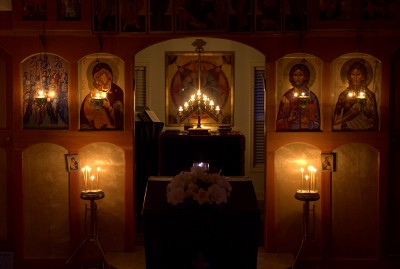
That said, if full daylight is streaming through the windows, it robs the moment of much of its power when, in the Divine Liturgy of the Presanctified Gifts, right before the second epistle reading when the priest holds up the candle in what is supposed to be a darkened church and intones, “The Light of Christ illumines all!” I suppose it also doesn’t help that Great Lent started a bit late this year.

It’s one of these practical considerations that’s easier to see when the intended conditions aren’t there — much how like “O gladsome light” was originally intended to accompany the physical action of lighting candles and lamps, an event now replaced in most parishes by the flipping of a light switch, it would seem. I’m not sure what you do about these things; in the former case, sunset is now late enough in the day to make it impractical to schedule services by it, and in the latter case, somebody seriously suggesting that a church go wholesale back to candles and oil lamps instead of electric light would, I’m certain, be laughed out of the building.

Clean week varia

I have finally posted the notes and answer key for Hansen & Quinn unit II. Click on the “Greek resources” tab and check it out. As always, e-mail me at rrbarret (AT) indiana.edu with any questions, comments, errata, etc. I hope it is useful. Unfortunately, it is likely to not be until after the semester is over before I can even think about unit III, but I should have a decent amount of time over the summer to devote to this project on an ongoing basis.

So, it’s the first week of Great Lent. This means, plainly, a lot of church.

At our parish, Great Compline with the Great Canon of St. Andrew of Crete is served Monday, Tuesday, and Thursday of Clean Week. This service is, shall we say, a commitment. The Great Canon is a leisurely stroll through the Old Testament; Great Compline could be thought of as the Orthodox Workout Plan. Because, you see, we make prostrations. A lot of them.

A lot of them. Want to know what it sounds like when the cantor has had to make so many prostrations he can’t catch his breath anymore but has to continue singing regardless? Come to All Saints this Thursday evening. There is a very practical reason why the rubrics of these services call for a left choir and a right choir — it’s called survival. We, alas, don’t have that, so Fr. Peter sings responsorially with me where he can, but he has enough to do as it is as well. There are moments where I can’t catch my breath and am drooling on my cassock because I don’t even have a chance to swallow — the service has to go on, and the congregation is so conditioned to get its cues aurally that if I stop in the middle of the Trisagion to swallow, a good three quarters of the congregation stops with me.

Starting tonight and throughout the fast, we celebrate the Liturgy of the Presanctified Gifts. This is the highlight of the week for me throughout Lent — it’s a beautiful service, and having an additional opportunity to receive Holy Communion throughout the week when our earthly food changes so drastically is something for which I’m always thankful. It is a Liturgy attributed to Pope St. Gregory the Great (and we commemorate him as “the Pope of Rome” during the service), but it is unclear exactly how that is to be understood — that is, did he write it himself (the traditional understanding)? Was it a service he witnessed in Constantinople and wrote down later (the modern understanding)? Either way, it’s a witness to the existence of the pre-schismatic undivided East and West, particularly since those in the Roman Rite also serve a form of it on Good Friday.

Friday evening we start serving the Akathist to the Theotokos. Saturday and Sunday we have the typical Vespers/Matins/Divine Liturgy cycle (although this Sunday begins the use of the Divine Liturgy of St. Basil the Great throughout Lent), and then this Sunday evening, Sunday of Orthodoxy Vespers will be served up at St. George in Indianapolis.

So, from last Saturday starting with Cheesefare Vespers through this Sunday, we’ve got at least one, if not two, services a day. In some ways it’s a nice symmetry with Holy Week; from Friday before Holy Week through Pascha there will be more like at least two services every day, so we will finish the way we started… just with more of it. (“More of what?” you ask. “Everything,” I reply.)

At its best, from a liturgical standpoint anyway, Orthodox Christianity does not gather as a community to worship on a Sunday-morning-only basis. This is, to be sure, not practical for some parishes and missions, particularly those who might not have their own building or a fulltime priest. Some parishes which do have their own building and a fulltime priest still nonetheless only serve the Divine Liturgy on Sunday mornings and hold no services at any other time; I’m not sure I understand this, but I say that as somebody who from the first time he ever heard the word “Vespers” (at age 16) asked “What is it and why don’t we do it anymore?”

It being the first week of Lent also means I’m a bit on the grumpy side. “Where’s all my protein?” my body wants to know right about now. The adjustment, at least for me, usually is made by about the second week or so.

I am lucky in many respects that this is Spring Break week. Things are very quiet in general, and I don’t have to worry about schoolwork or whatnot conflicting with services… that, unfortunately, will be Holy Week, since Pascha is the day before finals begin.

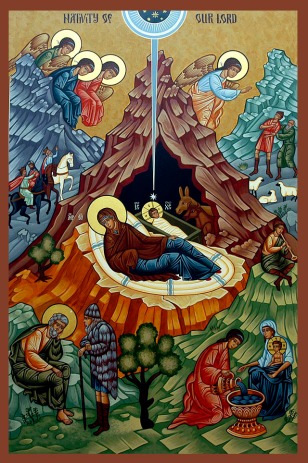
Christ is born! Glorify him!

nativity.jpgAnd it came to pass that Mary was enrolled with Joseph the old man in Bethlehem, since she was of the seed of David, and was great with the Lamb without seed. And when the time for delivery drew near, and they had no place in the village, the cave did appear to the Queen as a delightful palace. Verily, Christ shall be born, raising the likeness that fell of old.(Troparion from the Royal Hours of the Nativity, Byzantine rite)

A child is born to us, and a son is given to us, whose government is upon his shoulder; and his name will be called, the Angel of great counsel.

(Introit of the third Mass of Christmas Day, Roman rite)

Expect the media to bring up the usual historical “problems” with the Nativity account, according to Fr. Stephen Freeman, and don’t fret about it:

Literalism is a false means of interpretation (hermenuetic) and is a vain attempt to democratize the Holy writings. If they can be read on a literal level, then everyone has equal access to them and everybody has equal authority to interpret them. […] the seasons come and go and the media cannot resist speaking of what they do not know. And so they ask those who do not know to speak on their behalf. But if we would know Christ and the wonder of His incarnation, then we would do well to listen to those who have been appointed to speak and to hear them in the context given to us for listening – the liturgical life of the Church.

photo-6.jpgIn other news, blogging has been light the last couple of days because we’ve been madly scanning and shelving books. The Delicious Library and LibraryThing system has been fantastic, but most definitely less than perfect. One annoying thing is that even if Library of Congress data exists for a book, LibraryThing won’t always find it, requiring you to find it yourself on the Library of Congress website and enter it manually. For books that don’t have LC numbers, I’m not sure what I’m supposed to do; is there a way that one can divine what the number will eventually be?

What’s also frustrating is that LibraryThing is in theory able to identify new ISBNs when a list is uploaded and add only those, and it does this successfully in most cases, but there are somewhere around ten books that are always duplicated when I add a new list. This afternoon I eliminated somewhere around fifty dupes, in some cases there being seven entries for one book.

Another issue: I’ve entered 718 books into Delicious (representing probably roughly half of what we have), and I’ve exported the catalog to LibraryThing on a fairly regular basis. This afternoon, LibraryThing showed 756 books; after eliminating the duplicates, I’m down to 702 in LibraryThing with 8 ISBNs it can’t find (European books, I think). That means there are eight books Delicious is listing in its catalog that for some reason LibraryThing isn’t picking up.

Nonetheless, we’ve been able to accomplish in a weekend what would have surely taken us a month on our own, and that’s most certainly worth it.

Finally–any other Leopard users out there finding that with the latest update, searching for files within the File Upload dialog appears to be broken?

Merry Christmas to all!

U. S. News and World Report on a return to the old stuff

With a tip of the hat to the good folks over at Get Religion, I give you an article in U. S. News and World Report by Jay Tolson entitled “A Return to Tradition: A new interest in old ways takes root in Catholicism and many other faiths.”

Go ahead and take a moment to read it—it won’t take long. On a personal note, not to mention in the interests of full disclosure, I’ve met Roger Finke; his daughter and son-in-law are my godchildren, and his son and daughter-in-law are also dear friends. As converts to Orthodox Christianity, they themselves are part of this “return to tradition” of which the article speaks. (EDIT: the referents of “they” are Dr. Finke’s son, daughter, and in-laws; Dr. Finke himself is LCMS, not Orthodox.)

A few broad observations: it appears to be an article of faith for the mainstream media that Pope Benedict XVI’s liberalization of the traditional rite will ultimately have little to no effect, and certainly won’t catch on terribly well—it just means that a handful of old folks can now go back to saying their rosaries on their own while the ad orientem priest mumbles in Latin and a smaller handful of young militants can pretend to insert themselves into a tradition which was never theirs in the first place. This is not, of course, what Tolson says in so many words, but it certainly seems important to him to make sure to include a quote from somebody downplaying the significance of Benedict’s move.

Along the same lines, does the “return to tradition” mean a break from the “religious service provider” mentality, according to Tolson? Of course not. Tolson provides a quote from Finke that makes it very explicit that the cafeteria is by no means closed; it’s just that perhaps some people are trying to add a sit-down restaurant option for those who want it: “It’s a structured life, but it’s a structure they are seeking and not simply submitting to authority.” An earlier quote from IUPUI sociologist Sister Patricia Wittberg underscores this: “I think the future is with a group that is interested in reviving the old stuff and traditions in a creative way.” In other words, what we’re talking about is a group of people who are interested in tradition, but on their own terms. It’s less the received tradition and more the cherry-picked tradition; tradition-as-trapping rather than Tradition-as-authority.

In the interests of fairness, there is a fundamental conundrum that, some would argue, ensures that anybody who embraces a more traditional expression of Christianity is going to be engaging in a range of cherry-picking, cafeteria-esque behavior. “There’s nothing more un-Orthodox,” I’ve heard various people claim, “then intentionally converting to Orthodoxy.” In other words, if you’re converting to a faith in which you were not raised, you’re already cherry-picking; you’re already intentionally grafting yourself onto something else rather than accepting whatever tradition you received growing up. You’re asserting yourself onto an organic entity in such a way that ensures you will never be part of it. You’ve already chosen what it is you’re willing to submit to, and since you’ve already presumably left something else at least once, you’re tacitly reserving the right to do so again. It’s healthy, so the argument goes, to acknowledge that we’re all cafeteria believers of one form or another, and that there’s no other way you can be in this country, where religion is just another part of the marketplace of ideas.

I suppose to some extent this is true; I will say that for myself and people I know who have converted to either Eastern Orthodoxy or Roman Catholicism (or even people raised in either communion who have made a conscious choice to more fully “own” their faith), there is always a struggle to figure out how to live life more fully within the faith but also with an awareness of the reality of the world. That’s the struggle of any Christian at any point in history, really. As G. K. Chesterton might have put it, the struggle doesn’t invalidate the conversion any more than the rain invalidated the ark.

Finally—the following point is worth noting, as much as for how Tolson says it as what he says:

Something curious is happening in the wide world of faith, something that defies easy explanation or quantification. More substantial than a trend but less organized than a movement, it has to do more with how people practice their religion than with what they believe, though people caught up in this change often find that their beliefs are influenced, if not subtly altered, by the changes in their practice.

First of all, this assumes that there is a divide between belief and practice. This may very well be the case, but it’s a divide which would have been quite foreign to the early Christians, who were very aware that how one prayed and worshipped impacted how they believed. (Google Lex orandi, lex credendi if you don’t believe me.) As an Episcopalian praying the Rite II Eucharist Sunday in, Sunday out, in allowing myself to actually pray the liturgy, I was occasionally confronted by something in the text, and I realized that in order to keep praying it, I had to decide if I actually believed it or not. Did I actually believe the words of the Nicene Creed? Did I actually believe I was receiving the Body and Blood of Christ? Did I believe in one, holy, catholic and apostolic church? And so on. The more I decided that yes, I actually believed what I was praying, ironically enough, the less tenable of a position it seemed to remain an Episcopalian.

Liturgical practice is at once both the expression and the teaching of the faith held by the community; someone actively engaging it and praying it will of course find what they believe being influenced by it. That is the whole point, and it is a point easily lost on people who think that worship is all about style, taste, and aesthetic preference.

“…how dare we think we can do better?”

I think I’ve dealt with some of my funk. I think. I’ll still feel a lot better once Friday rolls around, but I don’t feel quite so much like the world ended anymore.

Jeffrey Tucker over at The New Liturgical Movement posted a link to Google Books’ digitization of the 7th century Gelasian Sacramentary. He has some choice words for those who might find it, shall we say, not quite in the spirit of Vatican II:

Just looking through it, one is touched by how close a connection we have to history in the Roman Rite. Humbling, isn’t it? How dare we litter this pious masterpiece with our own pop music and pop theology, and how dare we think that we can do better by making up our own words and importing our own sensibility to the liturgy?

Standard disclaimers—I’m not Roman Catholic, and I am really less than qualified to deal with issues of theory and theology. (Let’s be honest; I’m really not qualified to deal with much of anything at this point, which is why I’m trying to get into grad school.) Still, even as an Eastern Orthodox Christian, the Gelasian Sacramentary is part of the spiritual patrimony of the undivided Church, and therefore as much a part of my liturgical heritage as it would be for a Roman Catholic.

With that in mind, allow me to play devil’s advocate for a moment. What do you mean, “how dare we”? They’re just words men wrote, after all, somebody had to make them up at some point, somebody had to import their own sensibility into the liturgy somewhere along the line, and surely we can make a case, even for a late antique liturgical book, that it is not much more than a product of what would have been the pop culture of its day. All worship styles were “contemporary” when they were first put into practice, right? How dare we not put these things in the language, context, and culture of our own day?

In The Mystery of Christ, Dr. Fr. John Behr speaks about the difference in how truth is thought of between the pre-modern, modern, and post-modern minds. For the pre-modern, truth is found in what something means. If we want to understand this in terms of grammar, this is the Greek present tense—present time, progressive/repeated aspect. In other words, what does it mean right now and on an ongoing basis?

For the modern, truth is found in what something meant—aorist tense, so past time, simple aspect. What did it mean at the point in the past when it was relevant, and then how do we transplant that to today?

For the post-modern, per Fr. Behr, truth is located in what something will have meant—future perfect tense; future time, completed aspect. Real meaning is somehow always something that hasn’t happened yet, but even once it does it will be something looked back upon, not something occurring on an ongoing basis.

I suggest, therefore, that part of the problem Mr. Tucker describes comes from a modern way of looking at the problem and an attempt at a post-modern solution. The “return to the sources” approach is certainly nothing new, but it seems to me that it what one finds there will depend on one’s assumptions. If you begin with the assumption that an old liturgical practice as received today is somehow beyond the comprehension of the average person in the pews (which already cuts off the possibility of talking about what it might mean here and now), then in looking at the historical context for the development of that practice, you’ll find the reasons to justify your point of view—“See? They had that, that, and that happening, and we don’t, which is why this, this, and this practiced in today’s world makes no sense.” A break from the received tradition now having been justified, something can be inserted which will hopefully take hold and become the received tradition down the road.

“Returning to the sources” doesn’t necessitate a lack of continuity, however; sometimes what it can generate is a reminder of of what something means when many people have forgotten. Many Christians in this country have no idea what an Easter basket actually means, for example, since there’s no fasting or abstention during Great Lent to put it into context.

To reclaim what something like the Gelasian Sacramentary means, however, takes effort—no doubt about that. I suspect that for many who would rather insert contemporary-sounding praise songs, it’s an effort that isn’t worth it; “It won’t reach today’s people the way our music does,” I suspect many would say. In other words, it won’t have meant what contemporary music will have, from their point of view, and I also suggest that the problem is exacerbated by the perception that people will go where they hear what they like, and if one church won’t do it, another will. (Which suggests to me that the biggest threat to cohesion among church communities is the automobile, but that’s a different topic altogether.)

What effort would it it take to reclaim what it means, present tense, here and now? Well, I’ll humbly suggest that if people would dare to think they can do better, then it’s up to those who would hold fast to the received tradition to dare to teach them why they won’t do better.


adventures in writing alexander lingas all saints bloomington all saints orthodox church american orthodox architecture american orthodox music american orthodoxy Antiochian Archdiocese Antiochian Orthodox Christian Archdiocese of North America Antiochians books byzantine chant cappella romana chant church architecture ecclesiastical chant ethnomusicologists ethnomusicology fellowship of ss. alban and sergius Greece Greek greek food greekness hazards of church music international travel tips ioannis arvanitis joe mckamey john michael boyer kurt sander Latin liturgical adventures liturgical architecture liturgical music liturgical texts and translation liturgy liturgy and life lycourgos angelopoulos medieval byzantine chant Metropolitan PHILIP militant americanist orthodoxy modern byzantine architecture modern greek music music as iconography my kids will latin and greek when they're newborns my kids will learn latin and greek when they're newborns orthodox architecture orthodox architecture is bloody expensive Orthodox choir schools Orthodox Ecclesiology orthodox outreach orthodox travel pascha at the singing school Patriarchate of Antioch Patriarch IGNATIUS IV Patriarch of Antioch publishing random acts of chant richard barrett in greece richard toensing rod dreher sacred music st. vlads st john of damascus society Syriac the Bishop MARK fan club the convert dilemma the dark knight The Episcopacy The Episcopate the only good language is a dead language this american church life travel we need more american saints why do we need beautiful music in churches?

Blog Stats

  • 269,301 hits

Flickr Photos