Posts Tagged 'liturgy'


Nice ways to spend Valentine’s Day or, things I’ll probably only ever be able to pull of once, part VII

Monday was our last day in England. We had an early flight out of Heathrow on Tuesday, so we had to make the day count as much as possible.

First order of business was food and real coffee. (Did I say that I don’t understand this Nescafé nonsense?) Megan wanted to try a full English breakfast, so off we went. Several restaurants within a few blocks of our hotel advertised a full English breakfast, but upon closer inspection of menus all were missing a vital ingredient — that being, of course, black pudding. In fact, black pudding seemed to be nowhere to be found anywhere, with it being replaced wholesale by tomatoes. That being the case, we finally settled on a café in Leicester Square called Fiori Corner. It was good food despite a lack of blood sausage, and I can recommend it, but do be aware that they are cash only, and they will charge for coffee refills.

Following breakfast, we headed for the British Museum. Let me tell you, if you’ve never seen it before, the British Museum is huge — so huge that if you don’t know what you’re looking for, you might very well assume that what you’re looking at isn’t the British Museum, because no museum would ever be that big. (By the way, the British Museum is right across from a thoroughfare called Coptic Street, and about the history of which I would be fascinated to learn more.) Oh, and by the way, while the entrance is free, everything else is not. You’ll pay, I think, £6 or so for a reasonably basic guidebook and map, and more depending on how detailed and complete you want it.

Hey -- eyes up here, pal.

Hey -- eyes up here, pal.

The British Museum is also so big that there’s just no way you’re going to see everything in a day, or even in a week, maybe. You really have to pick a specific area of interest and spend time there. We decided on Anglo-Saxon England and Medieval Europe, while quickly walking through some other areas on our way to find the Rosetta Stone. Among other things, we saw the Sutton Hoo exhibit, which while having a rather high percentage of replicas and reconstructions is still fascinating — particularly since I took a class a few years ago where the professor had worked on the site in her grad school days and incorporate the material into her lectures.

Following the British Museum, we went to the Royal Academy of Arts for their Byzantium exhibit with a stop at a place called Rendezvous in Leicester Square for gelato. It was good and hit the spot, but it was definitely expensive. I’ll also point out that the sign they had posted to let people know they can’t sleep in doorways is a bit odd. It looks like the caption should be, “No sensual reclining in doorways.”

From Leicester Square, it’s maybe a ten minute walk tops to RAA; it looks a lot farther on the map than it actually is. Piccadilly Circus, by the way, is somewhat Blade Runner-esque; if I had been there at night it would have seemed even moreso.

RAA, unlike the British Museum, is not free; bring a student ID if you have one — it’ll save you a few pounds on the entrance fee. You also pay for a specific exhibit, not general admission to the museum. Also, unlike the British Museum, there is no photography allowed.

The Byzantium exhibit is stunning; the examples of iconography are really breathtaking  and leave you wanting to venerate them, even though there are ropes that quite handily keep you from doing so. There was also a 13th-century Syriac Gospel lectionary on display; that was pretty darn cool. Something that rankled a bit was the caption on the wall about church life that talked about how the iconostasis was to keep the unholy masses from even being able to see the altar and how the chanting was done by all-male voices, words that seemed specifically chosen to play up how backwards these Byzantines with their alien form of Christianity were, but I suppose the real question is, what should I have expected?

A humorous moment was at an icon depicting St. Thomas with the Risen Christ; while looking at it, I heard a woman’s voice say, “There’s Thomas, doubting away.” I glanced at the person who said this, and it was a woman who looked to be of Indian descent, prompting me to think, “Hey, he’s your patron saint, lady.”

One of the big takeaways for me from the Byzantium exhibit was how Orthodox Christianity didn’t engage Byzantine culture; it was the culture, in a way that I don’t know Christianity can ever be again, anywhere. I’m not sure what that means in the long run; that may be a blog post for another time.

A leisurely walk from RAA to Westminster Cathedral for Sung Mass took us through Green Park and past Buckingham Palace. We bought some tea and some other gifts from one of the many Buckingham Palace gift shops; Megan hoped to find a tea cozy, but those turned out to be as hard to find as black pudding, for some reason. Finally we had coffee at the Costa across the street from the Cathedral, and then it was time for Mass.

The boys, alas, were not in residence, and neither was Martin Baker, so it was just the lay clerks serving as the choir. Nonetheless, it was quite beautiful, as beautiful as I’ve ever seen a Mass in the Ordinary Form. Very much worthwhile.

We walked back to the hotel afterwards, with me pausing to be amused by a sign from the Considerate Builders Scheme, and started packing things up. We decided to go to the Sherlock Holmes Pub and Restaurant for dinner; please let me caution you against making the same mistake. It is a tourist trap with a capital T, capital TR. The food is expensive and not good enough to merit the price (although now I know what “Toad in the Hole” is, and it would be curious to try it again someplace better), and overall it is just not worth it at all.

The next morning, breakfast was at one of the Starbucks locations in Heathrow; seemed like it was time to start re-acclimating to the American world. At long last, around 10:30pm, reluctant to wake from the dream, we stumbled across the threshhold of our little house in Bloomington, with our once-in-a-lifetime long Valentine’s Day weekend adventure completed, and the real world now calling us back.

Having the story to tell, and the memories we have of there with each other, is worth it.

Pictures can be found here.

Nice ways to spend Valentine’s Day or, things I’ll probably only ever be able to pull off once, part VI

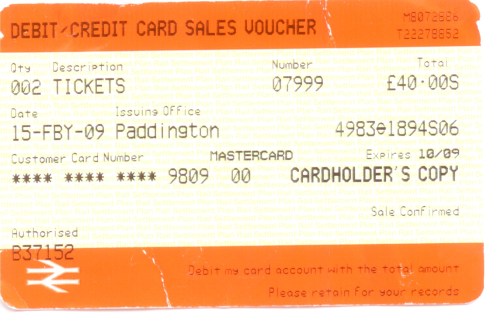
oxford-ticket-2Back to happier things.

My initial thought had been that we could go to Hagia Sophia Cathedral in London for Liturgy on Sunday; I had only been able to quickly walk through there back in ’07, and thought it would be awesome to actually go for a service and perhaps see the folks I had met who attended there.

Turned out that the Sunday we were going to be in England was the Sunday of the Prodigal Son, however, and given the role of that day in preparing for Great Lent, it seemed preferable to attend a service in English. The Cathedral does a Divine Liturgy in English on the first and third Saturdays of the month; otherwise, they do everything in Greek. (“We’re the patriarchal cathedral for the Greeks in London,” the choir director there told me when I met him. “Our services are in Greek or else.”) Alas, we were there for the second Saturday.

Plus, as Dr. Lingas had told us on Friday, it was a Sunday for Byzantine chant in English up in Oxford.

Liturgy started at 10:30; the earliest train to Oxford we could catch was at approximately 8:30am, and that got us up there around 9:50. It was about a twenty minute walk from the Oxford train station to the Holy Octagon, and I remembered where it was easily enough.

This was the first time I had seen the interior of the Oxford church; while humble in a lot of respects — it is a very simple brick building — they have done a lot with what they have. Also, while somewhat smaller than All Saints, I’d say they packed in about 30-40 more people than we typically do — it was filled to the gills. On the other hand, it was 2 February on the Old Calendar (the Meeting of the Lord, or Candlemas as doubtless some of the English converts might call it), so it being a major feast might well have accounted for the attendance.

The celebrant was Metropolitan Kallistos (Ware); the homilist Fr. Ian Graham; the cantor Dr. Lingas. Talk about a delightful treat of a morning. Metropolitan Kallistos served with a great deal of enthusiasm and verve; I’ve said before that recordings really do not capture how animated he is, and I would like to reiterate that point. Fr. Ian’s homiletics are very different from what we were used to, but not in a bad way, and it was very valuable to hear on this particular Sunday. Dr. Lingas — with one other person — sang essentially a stripped down version of The Divine Liturgy in English; what was interesting was that many of the same, shall we say, pastoral realities were present as I run into at All Saints. For example, the “Dynamis” of the Trisagion was, as is the case for us, merely a repeat of the first iteration rather than a separate, longer, melismatic comp0sition. Also, as with Bloomington, as soon as the Liturgy was over — time to start chatting! In all fairness, they actually have to go to a separate building entirely for their coffee hour, so there’s no hallway into which they may just quietly slip. It was nonetheless comforting to see that such issues are not geographically limited, shall we say. One fascinating difference is that at All Saints, more or less everybody in the congregation tries to sing everything; in Oxford, the people were largely silent.

The Oxford church is on the property of something called Ss. Gregory and Macrina House; it’s a house that exists as a center for non-liturgical Orthodox activity at Oxford, including some accommodations for students and the occasional visitor. It also appears to be where the offices for the Fellowship of Ss. Alban and Sergius are presently located, and is also where the coffee hour occurs. I hope to have some occasion to spend more time there in the future.

Following Liturgy, we ate lunch at the Eagle and Child; alas, it was full enough that the Rabbit Room was inaccessible, but the bangers and mash — and the fish and chips, and the beer — were still quite tasty regardless.

The rest of the day was spent strolling around the town and the campus, and it was a gorgeous, if chilly, day for it. In some respects, it was good we were there on a Sunday — most places where we might have been tempted to spend lots of money were closed. That said, Blackwell’s is an exceedingly pleasant place to spend several hours (and perhaps hundreds of pounds). They have shelves and shelves of things which have to be special ordered here — Greek New Testaments and Septuagints, English-Norwegian dictionaries, and so on. On the other hand, Oxford is certainly a place where people with those kinds of interests are concentrated, so that shouldn’t be a surprise. One more reason to contrive a reason to move there someday. Alternately, it’s a great reason to have a little notebook in which one can write down ISBN numbers and look online for better deals in US dollars.

We attended Evensong at Queen’s College; it was almost entirely at the other end of the spectrum of liturgical practice and singing from Metropolitan Kallistos and Dr. Lingas, but it was a nice reminder of what good liturgical singing can sound like in the Western tradition. I forget how much I like a pointed psalm sung antiphonally.

Finally, it was time to go back into the city. We got good sausage rolls from a bakery called La Croissanterie, and boarded the train.

Tips: It is reasonably common to encounter cash-only locations in Oxford. The bakery was cash-only, a coffee chain called Caffè Nero, and admission to the Saxon tower of St. Michael’s at the North Gate (“the oldest building in Oxford”) was cash only. (Megan went up; I didn’t. Again, something about paying to see part of a church just doesn’t sit well.)

Evidently, if the Orthodox visitor to Oxford were to contact the Ss. Gregory and Macrina House well enough in advance, they might find that they would be able to stay there. I don’t have any other details, and they don’t have a website or an e-mail address I am able to find, so the easiest way to contact them appears to be by phone — 01865 513117.

Yeah, Oxford is still my favorite place in the universe. What can I say?

Coming soon: how we actually got to bum around, y’know, London for day, and why the Sherlock Holmes Pub and Restaurant should be avoided at all costs.

Χριστὸς γεννᾶται, δοξάσατε!

Christ is born! Glorify Him!

Christmas Eve found me singing the services of the Royal Hours of the Nativity, as well as the Vesperal Liturgy of St. Basil, in the morning. We only started doing the Liturgy in the last couple of years, and last year I had to leave right after the Hours, so this marks the first time I’ve sung this particular service.

The idea of the Royal Hours of the Nativity is one of my favorite services; it is, so far as I can tell, a Christmas service that is entirely ours and for which no other communion has an equivalent. I’ve always thought of it as a service that, in theory, could be a wonderful outreach if done really beautifully (of course, the same could be said of all of our services). Also the parallel of the hymn from Ninth Hour, “Today is born of the Virgin Him who holdest all creation in the hollow of His hand,” to the Fifteenth Antiphon from the Matins of Holy Friday, “Today is suspended upon the tree He who suspended the earth upon the waters,” is also one of those liturgical moments that reveals how carefully our ecclesiastical year is constructed.

The execution of the Royal Hours tends to stress me out, however. The last couple of years in particular have always had little gotchas (or big gotchas, as sometimes is the case) — two years ago, for example, my priest forwarded me an e-mail from our bishop saying, “This is how we’re going to do the Royal Hours throughout the entire diocese this year; please make a note of it.” I dutifully prepared to do the service exactly that way, I made a verbal attempt to verify Fr. Peter and I were on the same page before the service, and I reached the end of the Royal Hours as outlined by the bishop only to have the priest continuing on with exactly the portion of the service I had not brought with me for the morning. He asked me afterwards what happened; I told him I was following the bishop’s e-mail that he had forwarded me. Without going into messy details, we’ll just say that the decision had been made to not change anything in consideration of it being Fr. Peter’s first year at the parish, and that this not being conveyed to me was, one way or the other, an oversight. Last year, the Vesperal Liturgy was added to the schedule immediately following the Hours; unfortunately, for whatever reason the Liturgy was scheduled for an hour following the Hours, and the Hours take somewhere close to two hours if sung as written. We sped through as much as we possibly could, cutting repeats, and it was still about an hour and forty-five minutes. This incident was unfortunately forgotten, and the same mistake was made on this year’s calendar. The solution this time was to sing the troparion and kontakion at each hour, then read rather than sing the stichera leading up to the prokeimenon. This got us down to an hour and a half. Then there’s the matter of our Kazan Menaion for December being in horrible disarray with a lot of things having been lost or removed over the years. I will replace that, with my own money if need be, shortly (assuming they still exist). Hopefully, one way or the other, all of these issues can be addressed for next year.

Following the services for the morning, there was much goose-preparing, present-wrapping, cleaning and decorating to do before we returned to church for a chrismation, Nativity Matins, and Divine Liturgy at 8:30pm.

Goose, as it turns out, is on the expensive side. Being married to me has evidently done horrible things to Megan’s math, and/or her approach to thinking about food, and when she was asked how many people she was feeding when she ordered the goose, she added one plus one (her and me), and came up with the number seven. The resulting ten pound goose was, as you can see, not cheap. Ah well — if it had turned out terribly, it would have been a tragedy. As it is, we’re just fine with a few days’ worth of leftovers.

I mentioned earlier the matter of brining the goose. This involved cleaning the bird and soaking it overnight in five gallons of water with lots of salt, sugar, peppercorns, bay leaves, cardamom, and so on. The exact recipe may be found here. It was not terribly difficult, but all the ready-making was time-consuming, and I found myself wrapping Megan’s presents just minutes before we had to head back to church.

Matins and Liturgy were a good deal less stressful than the morning’s services, and set the Feast off well, I thought. Christmas is always a strange-feeling time at All Saints; college town that Bloomington is, a lot of people are gone, and even some people who are in town often stay home. To some extent, this underscores for me how Easter really is the main holy day on our calendar, and as much as the Nativity is a major feast, it just still isn’t as big of deal. Nonetheless, the Nativity Liturgy is the best-attended non-Sunday major feast at All Saints, even if it doesn’t pack the house the way Pascha does. We did have the nine-member family of a catechumen — which included a Pentecostal preacher. I was asked, seconds before we were about to start Matins, if there was anything with which he could follow along — having to think quickly, I handed the requestor an extra copy of both the Nassar book of liturgical texts (aka “the Five Pounder”) and the Antiochian service book. I still have no idea if that wound up being useful.

Another part of why it’s strange, though, is that there is nothing in the Byzantine celebration of the Nativity that corresponds to what is done at the popular level in American society. We sing totally different hymns, we don’t do a “living Christmas tree,” and incense, candles and whatnot are normative parts of every service for us, not just for high holy days. All Saints has sung Christmas carols in the church following the dismissal, but in the last 2-3 years that’s fallen out of practice because we’ve started reading the post-Communion prayers at that point, so there’s not really a logistically clean point anymore where that might work. For my own part, I can say that the last thing in the world I want to do after singing Nativity Matins and Divine Liturgy is to start singing Christmas carols, for a whole host of reasons, not the least of which being that I’m vocally exhausted, and also that aesthetically it seems like it would be the most jarring transition possible. Still, I know it’s difficult for some people, that to some extent it doesn’t feel like the same Christmas everybody else is celebrating. I’m not sure what the solution is, if there even really is one.

A nightcap of eggnog with bourbon found me before we hit the sack, and then that was that for the night.

I think we finally rolled out of bed around 10:30am on Christmas morning. We opened presents — some festal icons for us, a couple of reference works Megan wanted, and then for me home coffee roasting supplies — and then what I was really waiting for: eggs benedict from scratch, with biscuits made from the buttermilk that Megan’s butter-making efforts from a couple of days before had yielded.

Then it was time to start roasting a goose.

Roasting a goose is less tricky than some might have you believe, but the incontrovertible truth is that there is a lot of fat. You have to prick a lot of holes in the skin so that the fat can drain out while the bird is cooking, and then you have to be immensely careful when pulling it in and out of the oven lest all of the drippings splash over the side of the roasting pan. The plus of this is that goose fat is supposed to make fantastic mashed potatoes.

We followed this recipe and liked it a lot; the one caveat I might mention is that the way the steps are organized, it is not made clear that the stock is a vital ingredient of the gravy until it is too late to go back and rectify the matter if you skipped over it. We were able to improvise so that all was not lost, and the stock made a really tasty soup a couple of days later, but do be aware of this. Also, the recipe assumes a thirteen pound bird; ours was a ten-pounder, and by the time we got to the last 50 minutes of roasting as called for in the recipe, our meat thermometer told us that it was already done. Next time we will attempt to recalibrate the cooking times to match up with the goose’s size.

Anyway, one way or the other, the fowl was not foul in the least. My impression of how goose tastes is that it’s similar to roast beef as well as good dark meat on a turkey. We also had mashed potatoes, collard greens, and spinach, served with a very nice Lebanese red wine. Dessert was homemade pound cake.

I also decided I was in the mood to read the Sherlock Holmes story “The Adventure of the Blue Carbuncle” aloud and in character; my reading of this story when I was seven or eight, after all, is the whole reason I ever had any idea there was such a thing as a Christmas goose in the first place, so it seemed appropriate. It was fun; we’ll see if this particular practice lasts.

Friday, Saturday, and Sunday have, of course, seen us feeding a lot of people with goose leftovers. You can do all the same things with it as turkey; sandwiches, soup, and so on. As well as that’s gone over, maybe it was a good thing that Megan’s math was faulty — I look forward to doing it again.

All Saints served the Divine Liturgy of St. James again yesterday, the Sunday after Nativity being the other day when it is customary (at least in some places) to celebrate it; I hope to be able to post pictures soon. It really is a beautiful Liturgy, I’m finding it very enriching to become more familiar with it, and far more people in the parish got to be part of it than did in October. I’m only sad that it’s going to be almost ten months before the next time we do it.

And a new year is almost upon us. Thank God for that, for so many reasons.

The Divine Liturgy of St. James: A recap

To answer the first question everybody asks: No, it wasn’t five hours long. Truth be told, we didn’t cut a blessed thing from Fr. Ephrem’s text and rubrics (perhaps the only service where we haven’t), and it was…

…drumroll please…

all of an hour and thirty-five minutes. I’m guessing the issue regarding length is a function of two things — 1) it is a recension which is itself abridged (Fr. Ephrem does note that there is an “extremely long commemoration of the Saints” that is missing), and 2) many of the priest’s “silent” prayers would have at one time been said aloud. At any rate, with the materials we have, it’s not really any longer than a Divine Liturgy of St. Basil; we may very well wind up doing it again for the Sunday after Christmas (the other traditional day for it, evidently).

Alas, nobody was there to take pictures. There are a couple of people in the parish who would normally function as “event photographers,” and neither of them could be there. If we do it again in a couple of months, we can rectify that then.

I will note that I made an earlier comment in error: the Liturgy does not begin with the entrance into the nave with the Gifts, but rather with the Gospel (roughly corresponding to the Little Entrance in St. Basil/St. John Chrysostom). This is the only “Entrance” in Fr. Ephrem’s rubrics, hence my confusion; “Let all mortal flesh keep silence” does accompany the deacon while he processes, by himself, into the sanctuary with the Gifts (presumably the idea is that this is the time when he would get them from the skevophylakion), but it’s not quite the same big to-do that it is in St. Basil’s or St. John Chrysostom’s Liturgy.

For a Liturgy perhaps one person there (Fr. Nabil from St. George) had seen before, everything hung together remarkably well; the choir kept it together very well on the music, there were no train wrecks, and everything proceeded smoothly in general for clergy, choir, and congregation alike. The makeshift ambo was quite a nice touch; the proclamation of the Word from the center of the people seemed to have an impact on some. When it was over, after we returned the church to normal and replaced the platforms in the choir area, there were a couple of people who expressed the sentiment, “Now that it’s gone, I sort of miss it.” Fr. Peter even suggested that it might not be out of the question to include a central ambo in the design of the permanent All Saints temple, hinting that it’s starting to be revived in other places.

We had a nice group of visitors; one inquirer brought his whole family, plus a contingent of folks from St. George, and a handful of people from the Bloomington Chamber Singers (who consulted us a bit regarding their upcoming performance of the Rachmaninoff Vigil).

I’m looking forward to the next time we do this. It’s a wonderful, prayerful Liturgy, and it would be nice for it to have a regular spot in the liturgical life of our parish.

Kickin’ it oldschool, ambo-style

“You say amvon, I say ambo…”

So, in going over the Divine Liturgy of St. James with our clergy Monday evening, something which became clear is that the rubrics assume that there’s something in the middle of the nave on which one may place things, from which one may read things, etc. — that is, an ambo in it’s original location.

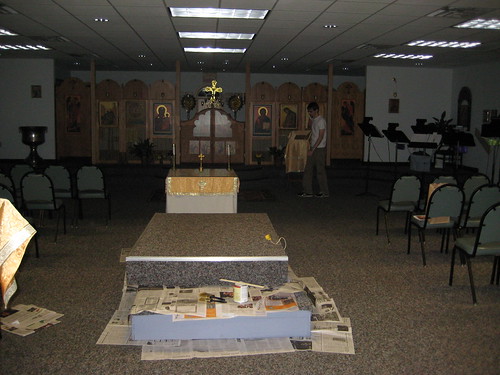
Initial discussions had us placing the memorial table in the middle of the center aisle, but then Fr. Peter thought it would be nice to put it on a raised platform of some kind. There is a rank of platforms back in the choir area of All Saints on which the women stand, and we moved one of those out and placed the table on it. Realizing the platform segments were of staggered lengths, however, it hit me that we could place them on top of each other, giving us two steps leading up to the memorial table, making something of a makeshift ambo. The prokeimenon, epistle, and alleluia could be sung from the first step — remember that the prokeimenon corresponds to the “gradual” in Western practice, known as such because it was sung from the steps of the ambo — and the Gospel from the second step. (No steps leading down on the other side, but oh well.)

The only problem was that, since the church ran out of carpet while covering the tops of these platforms, there was a decent amount of bare plywood showing, and setting them up this way only exposed it. Really, Fr. Peter said, the only thing we could do to make it something other than a horrible eyesore would be to paint over the exposed plywood with something like a gunmetal grey. Lucas and I looked at each other — “What are you doing tomorrow evening after work?” I asked him. “I think I’m painting these platforms with you,” he said.

So, following a quick trip to the hardware store for a quart of paint and brushes, we headed to All Saints yesterday to do what was necessary. “How good of an idea is this,” I asked Lucas, “letting guys like you and me into the nave by ourselves with paint and brushes?”

“I’m just hoping nobody notices that we’ve had to take out chairs to make everything fit in the space,” he replied.

It didn’t take more than 45 minutes or so to actually do the painting; we then had to move the choir up to the front of the church in order to answer some other logistical concerns the ambo created. After doing that, and destroying taking all of the displaced chairs into the fellowship hall, the paint was dry, and we set it up as it will be for tonight.

Hagia Sophia it ain’t, and I’m not going to argue that it’s gorgeous (particularly with the power outlets on the sides), but it at least looks more or less intentional. (Alas, Fr. Peter is just going to use the prothesis table behind the iconostasis rather than use one of our outdoor shrines as a skevophylakion.) We’ll see how it goes tonight — it sounds like we will have some number of visiting clergy and interested people from the community and around the area, including a contingent of folks from St. George, the big Antiochian parish in Indianapolis. Hopefully somebody will be around who can take pictures. A colleague of my wife’s is coming tonight out of curiosity, and he has never been to an Orthodox service before. Given its length and the fact that this is the first time any of us have ever attempted to celebrate this particular Liturgy, I’m pretty sure that all I can tell him is, “God be with you.”

God be with us all — St. James, pray for us!

Coming soon: The Divine Liturgy of St. James

On 22 October 2008, at 6pm, All Saints Orthodox Church will celebrate the Divine Liturgy of St. James for the Feast of St. James, the Brother of Our Lord.

It was mentioned to me about a year ago that this might be a desirable thing to pursue. It isn’t exactly happening the way originally envisioned; the hope at the time was that we would be in a new building with more forgiving acoustics than our current nave, but that hope remains unrealized for the time being. Nonetheless, we are pushing forward — hey, since local Catholic parishes have started celebrating the Traditional Latin Mass semi-regularly, leave it to us to break out our oldest rite, right?

The Divine Liturgy of St. James — can we call this the Iakovian Liturgy? I’d hate to call it the Jacobite Liturgy — is said to have been the rite taught to St. James by Our Lord and was subsequently the principal rite of the ancient Church of Jerusalem, edited and embellished as the St. Basil Liturgy and further pared down to become the St. John Chrysostom Liturgy. I will let liturgical scholars with PhDs argue whether or not the traditional first century dating of the Iakovian rite is accurate or if it’s more reasonable to assume that it came about somewhat later. Clearly the use of the Trisagion and the “Only-begotten Son…” are later accretions, but in terms of the overall structure and character — well, let’s just say that there are ideological reasons to want to support any of the various arguments, and leave it at that. One way or the other, we can say that we know it as the oldest complete form of the Divine Liturgy still in continuous use, and it is still in use by various Syrian and Indian communities.

Putting together an English text was not a small consideration; Archimandrite Ephrem (Lash)’s translation served as the base, but it is insufficient for use in an Antiochian parish, given the official preference for Elizabethan English. Where necessary, the Antiochian text was substituted (for components such as the Lord’s Prayer, the Creed, and so on); where possible, Fr. Ephrem’s text was kept, converting to Elizabethan English as needed. Particularities such as “Let our hearts be on high”/”We have them with the Lord” were also retained.

Once we had a text, then it fell to me to create a book for choir/congregational use. Thankfully, Sibelius 5 and Microsoft Word made that relatively easy. I adapted the St. Anthony’s Monastery settings of hymnody specific to St. James to our text, used the version of “Only-begotten Son…” from the Mt. Lebanon Choir Divine Hymnal, used the Trisagion we sing every Sunday (had to keep something the same) and then added all of the other parts — litany responses, anaphora responses, etc. The choir/congregation book ultimately contains every word and every note which concerns those worshiping from the nave — it is as complete as it needs to be without including the priest’s personal prayers and so on. (At 43 pages already, it would be significantly longer were I to include those.)

I will say that, in many respects, it’s a simpler liturgy; there are no antiphons, no troparia (although we will sing the Troparion to St. James as a recessional), there is no Megalynarion, and since it begins with the clergy processing into the church with the Gifts (from the skevophylakion, no less — such things make me happy, although we don’t actually have a skevophylakion), no Great Entrance in the middle of the service, either. From the choir’s perspective, there are significantly fewer major portions to sing, and the Alleluia and Prokeimenon are the only propers. The rubrics call for the Body of Christ to be received in the hand and for the Blood to be drunk from the chalice by the communicant, but we will be communed from a spoon regardless — no one’s particularly comfortable with what could go wrong the other way, given that we’re all used to the spoon by now.

Anyway, it will be an interesting liturgical adventure, to say the least. We’ve tried to visibly open it up to as much of Bloomington’s greater Christian community as wish to attend; given the provenance of the rite, it is clearly the common heritage of all Christians, and to be able to serve it in English is a gift we would like to be able to share with as many as possible, even if it’s our humble little church that’s doing it and not the Midwestern Regional Campus of the Cathedral of Holy Wisdom. (That place is going to be gorgeous, I have to say — and they might even have built a skevophylakion, I’m not sure.) To that end, we’ve put out a press release to the local papers (let’s not hold our breath that they’ll care, but who knows) and sent flyers to every area church and campus ministry we could find. We’ll see.

On a different matter — my friend Gavin used to have a favorite Microsoft joke (at least before he started working there): “Microsoft — solving tomorrow’s problems with yesterday’s technology, today.” So, maybe that could be tweaked and made appropriate to Orthodox Christianity — “Addressing tomorrow’s problems with yesterday’s Christianity, today.”

Or maybe not.

Sanctus Deus, sanctus fortis, sanctus immortalis, miserere nobis

Here’s a fascinating liturgical curiosity, courtesy some weird Dutchman named Gerrit Gerritszoon.

I’d love to know if anybody has tried to use this, and/or if anybody has tried to set any of it to music.

The Divine Liturgy in English by Cappella Romana: the review and other thoughts

As someone who has sung in church at a more-or-less professional level for many years and who always had a deep love and appreciation for, shall we say, more historic forms of liturgical music, when I first became aware of Orthodox Christianity it was a very natural instinct for me to seek out this aspect of the faith. The trick here, of course, is that when you don’t know what you’re looking for it’s a bit difficult to find it, but eventually what I found was the Boston Byzantine Choir‘s recording of the Divine Liturgy, called Mystical Supper: Byzantine Chant in English. I was quite struck at how similar the approach on this recording sounded to something like Shapenote/Sacred Harp singing, to say nothing just how much of the service was sung rather than spoken. When I told my friend Mark Powell about this, he said simply, “Listen to the Greek Byzantine Choir’s recording of the Divine Liturgy in Greek. Then we’ll talk.” It was not an easy recording to find in the States in 2003; I wound up having to order it from a Canada-based Hellenic specialist, as I recall. (It’s much easier to find these days, at least for the moment. Amazon seems to no longer sell it directly — which has changed from a month ago — which suggests to me that the current pressing is gone, the distributor is out of stock, and whoever has it, has it, whoever doesn’t, doesn’t.) This recording really blew the lid off of my nice, safe, clean world of church singing, and redefined a lot of my expectations. Between that and getting to hear Cappella Romana‘s Fall of Constantinople program in the summer of 2004, I began to develop a strong affinity for the Byzantine repertoire.

What I didn’t learn, and what I wouldn’t fully appreciate until I was leading an Orthodox parish choir myself for the first time, from these exposures to Byzantine music — which are, admittedly, highly-idealized “best case scenario” presentations; as one musicologist told me, “Field recordings made at monasteries in Greece don’t sound anywhere close to the Greek Byzantine Choir” — is how divisive the repertoire can be for some people. It is clear that for certain ears, the otherworldly musical characteristics are, to say the least, less transcendent than foreign — “music to whip camels by” and “the nasal-sounding stuff the old man sings before the Divine Liturgy” being among the characterizations I’ve heard. I’ve even heard somebody say that Byzantine music “sounds more like the Muslim call to prayer than Christian singing.” The common assertion appears to be that there’s no way to make Byzantine music sound “friendly” to Western ears — it’s always going to sound like an ethnic import, “too Arabic” or “too Greek” or too something. A related concern is that it’s unison singing (save for the ison, the drone underneath), and Western ears expect four-part harmony as a non-negotiable given, period. It is certainly fair to say that Byzantine music is not appropriate for harmonization; this is for the simple reason that the conventions of four-part harmony are based on a tonal system, and Byzantine music is modal. You can’t harmonize a modal melody according to tonal conventions (i. e., “What Would Bach Do?”) without largely eliminating the distinctives of the given mode (as can be made clear when a new cantor instinctively, but erroneously, assumes that the ison for Byzantine Modes 2 and 4 is supposed to be C/Ne instead of G/Dhi and E/Vou, respectively).

There’s also the more specific complaint that Byzantine music doesn’t play well with English. This is a view shared by some rather visible and influential people; for example, the Preface of Mother Mary and Metropolitan Kallistos (Ware)’s edition of The Festal Menaion (St. Tikhon’s Press, 1969) says the following:

In course of time English-speaking Orthodox will doubtless evolve a musical tradition of their own, which will takes its place alongside those of Greece, Russia, and the other Orthodox nations. As yet, no such tradition has had time to develop: and Orthodox of English language must therefore draw for the present upon some existing musical heritage within Orthodoxy. The best adapted for this purpose seems to be that of Russia. Byzantine chant is too intricate: if it is to be used, then the stress and rhythm of the Greek original must be preserved almost exactly in English translation, and this raises insuperable difficulties. But Russian music is far more flexible; and in particular the simpler Russian monastic chants can easily be adapted to an English text. (p. 13, emphasis mine)

I have to be honest and say that I find this to be an odd claim (and yet one which seems to have influenced the assumptions and thinking of many people since its publication); it seems to me that Byzantine music is far more extensible and expressive when it comes to being adapted to English texts, where many forms of Russian chant, at least as presently used in English adaptation, tend to utterly disrespect the needs and conventions of English. It’s true that in many of the attempts to adapt the Byzantine repertoire to English — Kazan’s Byzantine Project, for example, being the one I use week in, week out — it seems like one winds up with melismas on odd words or emphases on the wrong syllables and so on, but I’d argue only that this means we haven’t perfected the system of adaptation yet (or perfected the English version of the text, for that matter), not that it fundamentally can’t work or that somehow we need to “file the corners off” of Byzantine chant, or in general make it something it isn’t, in order to make it work for English-speakers.

But nonetheless, the assumption is held by many that Byzantine chant fundamentally won’t work for English-language, Western Orthodox folks. The lengths to which some marginalize Byzantine music as being merely one of those pesky, overly ethnic, “little-t traditions” which drive away people who are culturally Western is demonstrated by a recent discussion on the PSALM Yahoo! group which involved speculation as to whether or not use of Byzantine chant might contribute to a decline in attendance in parishes.

Which brings me, at last, to Cappella Romana’s masterful, ground-breaking new release, The Divine Liturgy in English, which serves as the definitive response to all of these concerns, providing a fantastic model to emulate, transparency enough in the process to make it replicable, and, for the foreseeable future, the standard to meet for liturgical singing.

This is the recording of Byzantine chant in English which says, “Yes, we can.” This is the CD which you will see wearing black body armor and fighting off Rottweilers on an IMAX screen and telling Michael Caine, “Byzantine chant in English has no limits.”

Several years in the making and part of Cappella Romana’s “Excellence in Orthodox Liturgical Music in English” project — which includes the delightful Lay Aside All Earthly Cares, a collection of the liturgical music of Fr. Sergei Glagolev, which I’ll say more about shortly, and a future release of a Divine Liturgy setting by Peter Michaelides — this 2-disc set represents the monumental effort of adapting the traditional Byzantine repertoire so that it fits the English language idiomatically, often recomposing melodies from scratch in order to match the text. Conducted by Artistic Director Alexander Lingas, these settings are presented in a natural church acoustic, using native English speakers, and in their proper liturgical context, with Archimandrite Meletios (Webber) and Dn. John Chryssavgis serving as the clergy. The result is at once prayerful and phenomenally well-sung, full, rich, and in tune, and entirely Byzantine in character while never straying from understandable, natural-sounding English. It is ecclesiastical ensemble singing of the highest order, easily ranking with the recordings of Lycourgos Angelopoulos and the Greek Byzantine Choir, as well as with the best of English-language recordings of liturgical music such as those by the Choir of King’s College, Cambridge.

Because it is a Divine Liturgy entirely sung in one musical idiom, and therefore comes across as a seamless garment of whole cloth as it were, it is difficult, if not inappropriate, to make critiques of particular sections, so I’m not going to do that. I would say that the best way to get a sense of exactly what has been accomplished with this recording is to become familiar with a recording of the traditional Greek repertoire such as Angelopoulos’, getting a sense for the function and aesthetic which govern hymns such as the Trisagion or the Cherubikon, and then to listen to this recording and hear how those principles are maintained in the English language adaptation. The exact notes of the Greek versions are not preserved because they’ve applied the Byzantine compositional process to the English text, not simply slapped the existing Byzantine melody over the English text and then figured out how to make the syllables fit. The result is a new melody which is completely faithful to the spirit of the model and the conventions of Byzantine music, and fits the English text like a glove at the same time. These adaptations — which Cappella Romana are publishing on their website in both Byzantine and Western notation — range from simple and syllabic (such as the troparia and the Anaphora) to florid and melismatic (the Dynamis of the Trisagion, the Cherubic Hymn), according to the rubrics and intended liturgical function. The booklet credits John Boyer, Protopsaltis of the Greek Orthodox Metropolis of San Francisco, with much of the work of adapting of the chants, and his sensitivity to the English text while maintaining the Byzantine ethos is to be highly commended.

Let’s be clear — The Divine Liturgy in English is not intended as a musicological curiosity for specialists, but rather as a practical liturgical model for the wider Church. In other words, this is meant to be a clear demonstration of how we can do things now, not an obscure example of how some people used to do it. As such, the set presents a complete Divine Liturgy as would be found on a typical, non-festal Sunday after Pentecost (a “vanilla Sunday” as some choir directors jokingly call it). This includes the celebrant’s spoken prayers, the Epistle and the Gospel, as well as the full Alleluia and Prokeimenon with verses — only a homily is omitted. (An argument can be made that the way they’ve harmonized the various Typika, they’ve in fact left some things out such as the Beatitudes, but this is addressed in the liner notes.)

Among the many delights of this recording is the text. The official translation of the Archdiocese of Thyateira and Great Britain is used, the product of a panel involving scholars and clergy such as Archimandrite Ephrem (Lash), Metropolitan Kallistos, and Fr. Andrew Louth. Certain renderings are initially unfamiliar — in particular, the use of “Mother of God” instead of Theotokos, and “Holy Strong” in the Trisagion — but It is nonetheless a wonderful translation which adheres quite closely to the Greek text. The booklet includes a helpful essay by Archimandrite Ephrem about the methodology and pastoral principles guiding the Thyateira translation. “Holy Strong” is arguably closer to the actual meaning of the Greek text than “Holy Mighty,” despite the English tradition of the text; see this paper for a thorough look at translating the hymn. I would have liked the “Mother of God” usage to have been addressed in the liner notes; as it is, it is unclear why the Greek word Theotokos, surely standard usage for English-speaking Orthodox by now, is not retained when Greek words such as Dynamis are. Such questions aside, the Thyateira text is an incredible effort which would ideally influence future undertakings of the translation of liturgical texts. 

I will admit to being somewhat puzzled as to why, given the clearly considerable vocal resources Cappella Romana has at its disposal, antiphonal choirs were not used; the liner notes say that “some elements of of the traditional interchange between two choirs are preserved through the use of alternating soloists”, but this strikes me as an unnecessary reduction given everything else they go out of their way to achieve on the recording.

Another major plus of this recording is something which actually isn’t sung — it includes the entire ensemble speaking the Creed and Lord’s Prayer with conviction. This is sadly lacking on the Mount Lebanon Choir recording, where one guy limply reading the prayers into a microphone is too-obviously spliced in after the fact.

Can the musical level achieved on this set, and/or the acoustic in which it was recorded, truly be seen as practical or normative? To be sure, the kind of training needed to meet this standard is not yet widely available in the United States, and many parishes do not have the resources to either provide such musical instruction or to give attention to proper acoustics in their building design. Nonetheless, The Divine Liturgy in English should be understood as a presentation of the “best-case scenario” to which liturgical singers may aspire. As well, Lingas opts for an all-male ensemble — the traditional arrangement, certainly, but unlikely to be the pastoral reality in most places.

The Divine Liturgy in English also shows the way for future adaptations of other Orthodox liturgical music into English, not just Byzantine. To slavishly preserve music written for a different language when adapting it to English is to miss the point of adaptation; that approach does violence to the language and, eventually, the music as well. Rather, those who would adapt the chants for use in a different language must understand the principles which guided the composition in the first place, and then apply those to the new text, while preserving the spirit of the original as much as possible. The music on the previously-mentioned disc of Fr. Sergei Glagolev’s liturgical settings — I said I’d get back to him, didn’t I? — demonstrates his own mastery of how this works for music in a Russian idiom; it is identifiably Slavic in terms of musical character, while still being sung, and sung well, in natural-sounding English in a way which does not obscure the meaning of the text. Perhaps with both the Glagolev settings as well these Byzantine adaptations, one inevitably runs into the objection, “Nobody knows them!” That will simply take time to overcome.

Cappella Romana’s recording is no less than a gift to the English-speaking Orthodox world which will inspire and instruct. Thyateira’s Archbishop Gregorios writes in the liner notes that The Divine Liturgy in English is intended to “increase the understanding and appreciation of both the spirituality of Orthodox worship and the heights of musical expression to which its chanting aspires”; this it does stunningly well. Highly recommended (in case that wasn’t clear by now).

Bp. Hilarion (Alfeyev) on the relative merits of different kinds of Orthodox liturgical music

With a tip of the hat to Subdn. Lucas the Blogless, an excerpt from a 2002 lecture entitled “Orthodox Worship as a School of Theology“:

Permit me to say a few words about church singing. Recently I visited the Valaam Monastery of the Transfiguration, where I served an all-night vigil and Divine Liturgy in the monastery’s main church. The services there struck me by their prayerfulness, harmony, simplicity and grandeur. The monastic singing and Valaam chant used during the services made an especially strong impression. I suddenly recalled the words of St Ignatius (Brianchaninov), who visited Valaam one and a half centuries ago and was also taken by the monastery’s chant:

The tones of this chant are majestic and protracted…they depict the groans of the repentant soul, sighing and longing in the land of its exile for the blessed, desired country of eternal rejoicing and pure, holy delights…These tones now drag on lugubriously, melancholically, drearily, like a wind through the wilderness, now gradually disappear like an echo among cliffs and gorges, now thunder suddenly…The majestic “Lord, have mercy” is like a wind through a desolate place, so sorrowful, moving and drawn out. The troparion “We hymn thee” ends with a protracted, shimmering, overflowing sound, gradually abating and imperceptibly fading under the vaults of the church, just as an echo dies out under a church’s arches. And when the brethren sing at vespers “Lord, I have cried unto Thee, hearken unto me”, the sounds emanate as if from a deep abyss, are quickly and thunderously wrested therefrom and rise to heaven like lightning, taking with them the thoughts and wishes of those at prayer. Everything here is full of significance and majesty, and anything merry, light-hearted of playful would simply seem strange and ugly.

Valaam chant is a form of ancient Russian Znamenny chant, which itself absorbed the main characteristics of Byzantine church music. It is known that Byzantine chant was brought to Kievan Rus’ already during the time of Yaroslav the Wise. The “Book of Degrees” (Stepennaya Kniga, 1563) mentions that it was during this time that three Greek chanters came to Rus’ from Constantinople, bringing with them “special eight-tone, sweet, three-component, and most beautiful extended singing to praise and glorify God”. The word “three-component” has been subject to various interpretations by musicologists and theologians. In any case, it refers not to three-voiced, but unison singing. One could suppose that the word “three-component” points to the three dimensions of ancient church chant: the musical, verbal and spiritual, through which it differed from secular singing, which had only two: verbal and musical.

Being comprised of these three aspects, both Russian Znamenny chant and Byzantine singing are phenomena of the same order. They are characterized by a spirituality that is lacking not only in many works of secular music, but also in the contemporary western-style church singing, which is composed according to principles totally different from those of ancient chant. It is no secret that the concert-like, “Italianate” singing performed in many churches does not correspond to the spirit of the traditional liturgical texts to which they were written. The main aim of such music is to give pleasure to the ear, while the aim of true church singing is to help the faithful immerse themselves in the prayerful experience of the mysteries of the faith.

The structure and musical characteristics of ancient Russian singing are also diametrically opposed to those of Western-style singing. Znamenny chant was not written by composers but rather compiled from an already existing collection of canonical musical fragments, just like ancient mosaics were pieced together from a collection of stones of various colours. It is not easy for modern man to appreciate ancient chant, and just as difficult to “lay aside all earthly cares” and enter the depths of prayerful contemplation. But only this and similar singing is truly canonical and corresponds best to the spirit of Orthodox divine services.

Bishop Porfiry (Uspensky), the well-known 19th-century church archaeologist, wrote the following regarding the mystical “three-component” singing of the ancient Russian Church: “We have forgotten this mystery of music, but it was known to our ancestors. The history of our Church shows that at one time Greek chanters from Constantinople brought to Russia angelic three-component singing, that is, singing comprised of three intonations corresponding to the three faculties of the soul. It seems that it would not be too difficult to revive this singing”. It is indeed possible to revive it by returning to the ancient, time-tested models of Znamenny chant, as has already taken place in Valaam and several other monasteries.

At present, the monuments of ancient Russian chant are becoming better and better known. Just as ancient Russian icons, once-forgotten but relatively recently (at the beginning of the 20th century) restored to their original splendour once cleaned of centuries of accumulated soil, Znamenny chant is now being revived by masters skillful at reading its “hook notation”. In my opinion, the restoration of Orthodox liturgical culture to its original beauty, grandeur and instructiveness is unthinkable without the revival of canonical Church singing, which for the Russian Church is Znamenny chant. Concerts of Church music by Bortnyansky and Vedel, and Cherubic hymns by Kastalsky and Archangelsky may be beautiful and moving in certain respects, but their music does not teach us anything, since it only creates a kind of background that is more or less neutral with respect to the words of the service. On the other hand, Znamenny chant possesses enormous edifying power since it was created for prayer, fosters prayer and is irrelevant outside of the context of prayer.

Even the so-called “popevki” (canonical musical fragments), the main building components of Znamenny chant, are nothing other than a musical reflection of various prayerful movements of the soul. Moreover, each musical fragment has its own theological basis. If ancient Russian icons are said to be “theology in colours”, then ancient Russian chant can be considered theology in music. And if western-style church singing, like the Russian “academic” paintings on religious themes are at best a school of piety, then monophonic Znamenny chant can be regarded as a school of prayer and theology.

I may have more to say about this later, but in the meantime, how do we start a fan club for this man?

It’s here…

Buy me!

Buy me!

Cappella Romana’s The Divine Liturgy in English arrived in the mail today. I will have more extensive comments about it later, but the bottom line is that once everybody in my choir has a copy, I can just tell them, for the most part anyway, “Sing it like that.” Let me assure you that I am not getting any incentive to advertise this disc in the slightest — it is no more and and no less that I firmly believe that this is a very important work which can serve as a model from here on out of what the ideal should be for Byzantine chant in English. There are some caveats there, but they have to do with circumstances which are going to change from parish to parish, and don’t really impact the general point.

Which is — buy it, listen to it, learn from it. Please don’t rip copies and give them out. This wasn’t cheap or easy for Cappella Romana to produce and it will impact the ability of ensembles such as CR to produce future such works if people just steal it. Cappella Romana ain’t Radiohead, folks.


adventures in writing alexander lingas all saints bloomington all saints orthodox church american orthodox architecture american orthodox music american orthodoxy Antiochian Archdiocese Antiochian Orthodox Christian Archdiocese of North America Antiochians books byzantine chant cappella romana chant church architecture ecclesiastical chant ethnomusicologists ethnomusicology fellowship of ss. alban and sergius Greece Greek greek food greekness hazards of church music international travel tips ioannis arvanitis joe mckamey john michael boyer kurt sander Latin liturgical adventures liturgical architecture liturgical music liturgical texts and translation liturgy liturgy and life lycourgos angelopoulos medieval byzantine chant Metropolitan PHILIP militant americanist orthodoxy modern byzantine architecture modern greek music music as iconography my kids will latin and greek when they're newborns my kids will learn latin and greek when they're newborns orthodox architecture orthodox architecture is bloody expensive Orthodox choir schools Orthodox Ecclesiology orthodox outreach orthodox travel pascha at the singing school Patriarchate of Antioch Patriarch IGNATIUS IV Patriarch of Antioch publishing random acts of chant richard barrett in greece richard toensing rod dreher sacred music st. vlads st john of damascus society Syriac the Bishop MARK fan club the convert dilemma the dark knight The Episcopacy The Episcopate the only good language is a dead language this american church life travel we need more american saints why do we need beautiful music in churches?

Blog Stats

  • 269,300 hits

Flickr Photos