Posts Tagged 'liturgy and life'


(hack) Thanksgiving leftovers (koff)

It’s the first day of December. How the heck did that happen?

On the way out to New Mexico last week, I sat between a married couple who were both sick and kept coughing across me. It was Southwest Airlines, so seating was first come first serve, and they made it clear they would rather have me in the crossfire than give up either an aisle or a window seat. It must have been clear how this came across, because as we were getting off the plane, the wife said to me, “Don’t worry, you won’t catch anything from us — we’ve had this for the last four weeks.”

My stepfather was sick when I got to New Mexico. Flesh of My Flesh was sick on Thanksgiving day. My mom was getting sick over the weekend as we were preparing to leave.

So, perhaps it was inevitable, but Sunday evening I started developing a sore throat on the flight home, yesterday it was getting worse, and today I’m staying home trying to keep from getting worse or giving it to lots of people. I hate to be “that guy” who suspiciously gets sick immediately following a break, but here we are.

As I drink my gallon of Throat Coat tea, there are a few things upon which to muse:

  • My review copy of Cappella Romana’s recording of the Michaelides Divine Liturgy arrived in my absence, as did the Ensemble Organum disc I mentioned earlier. A full review will come shortly; for the moment, I will say only that both are worth your time and represent, in an odd way, flip sides of the same coin.
  • If you do iTunes, Lycourgos Angelopoulos’ 1993 album of Byzantine hymnody for Christmas has been rereleased in that format. It has been out of print for years as an actual disc, although there seem to be some used copies on Amazon. (Note that the iTunes release has a slightly different title: The Glory of Byzantium: Christmas Hymns.)
  • Rod Dreher is leaving the Dallas Morning News to become director of publications for the John Templeton Foundation. Close to four years ago, I started hearing various grumpy old men murmuring about “crunchy cons”. My godson Lucas at some point started reading the book and recommended I read it. It resonated quite a bit with me as somebody who looks more to Russell Kirk than Glenn Beck or Sarah Palin as a model of what conservatism should look like, and the point of the book seemed to me to be to ask how conservatives might, y’know, actually conserve something other than money or power or status. I gave copies of it to a lot of people, and I’m reasonably sure I know everybody in Bloomington who has read it (I’ll let you decide if I’m joking). I’ll fess up that, while a lot of Dreher’s critics had no patience for how he discussed food, I really appreciated what he had to say about a sacramental approach to it, and even if Michael Pollan isn’t using the word “sacramental”, his work and Dreher’s demonstrate that it can be a topic where liberals and conservatives can make common cause (and of course, Dreher interviewed Pollan for The American Conservative last year). Since the book came out, it has seemed as though he was searching unsuccessfully for a way to follow up what should have served as a strong statement of purpose; what he touted as a “sensibility” never quite materialized as a movement, exactly, eventually Crunchy Cons went out of print, and the hinted-at sequel about “the Benedict Option” never materialized, presumably because (as he kept saying in his blog) his newspaper job had become an exercise in self-preservation. A lot of water has flowed under the bridge in the last four years; Dreher converted to Orthodox Christianity, and right now conservatism seems to be floundering on the very cultural essentials the importance of which he was trying to stress, consequently lurching even more towards negativity and hostility. My hope is that a break from political commentary will allow Dreher to follow up on the issues discussed in Crunchy Cons from a more purely cultural perspective, because I think that’s where his heart has wanted to go with it anyway.
  • There was an interesting article in the New York Times this last Sunday about the traditional Latin Mass. Even more interesting has been the discussion of it in places like The New Liturgical Movement and Commonweal. I’m really not sure what a “liturgist” is — a liturgical scholar? a liturgical composer? a person who interprets rubrics? — but what I find striking is how for many modern Catholics, it seems like the rupture from tradition is in fact a selling point. I was in a large, old stone Catholic church once where they were doing a lot of work to restore the interior. The high altar was still in place, and I asked somebody if it ever got used; the person I asked looked highly offended that I would even dare to mention the high altar’s existence, and said, “No, Vatican II turned the altars around and returned the focus of the Mass to the people,” and made it clear that was the end of the conversation. Sometimes it seems like the majority of Westerners truly and actively yearn for their worship to be sentimental, banal, and tacky. At any rate, I don’t have a dog in this fight (except insofar as I strongly disagree with certain parties who think Orthodoxy needs its own Vatican II), but it seems to me that the traditionalist and modernist narratives are irreconcilable, as the comments on Wolfe’s article indicate. What I will say is that the invocation by a commenter at Commonweal of C. S. Lewis (“The modern habit of doing ceremonial things unceremoniously is no proof of humility; rather it proves the offender’s inability to forget himself in the rite, and his readiness to spoil for every one else the proper pleasure of ritual”) seems quite apt, and the apparent need, not just for the 1970 Missal to be embraced but for anything that ever came before it to be wiped from the face of the earth, is very telling — at least to me. At the risk of elevating aesthetics over all other concerns, I’ll point out that the Mass of St. Gregory inspired people like Josquin and Palestrina; the kinds of composers the Novus Ordo appears to have inspired are, shall we say, not even close.

Okay. I need more tea.

In which the author laments the state of English language liturgical books

Last Saturday, it being Great Vespers for the Feast of St. Luke, there were Old Testament readings appointed for the service. I normally leave those to other people so as to save my voice, but I got asked to do one of them anyway since we were short some people we might otherwise have had. “Just read off of the printout of the liturgical guide?” I asked. Yes, I was told, since the parish doesn’t own a Prophetologion.

Well, long story short, nobody owns an English-language Prophetologion, because it doesn’t exist. There’s Archimandrite Ephrem (Lash)’s draft version online, and I’m increasingly coming to the conclusion that if I were to be involved in starting a mission I would argue passionately for the use of his translations, but obviously an electronic version just isn’t quite the same thing as actually having a printed liturgical book. Besides which, Fr. Ephrem has done the exactly right thing of translating liturgical texts as a self-referential whole, being aware of biblical references, internal references to other liturgical texts, and so on and so forth — and while this is exactly right, it also renders his liturgical texts somewhat difficult to use unless you’re using them exclusively.

Which gets us to the broader question of English language liturgical books, and the practical situation in various parishes.

The situation at All Saints is interesting, and I expect reasonably common — we use Nassar as the spine, but not everything is in there, and there has been cobbling together of things from various sources over the years. This effort has been by necessity a real “do it yourself” matter by many people, for reasons I won’t go into here but I’m going to assume can be guessed by a sufficient number of people in similar situations. As a result, we use one translation for the proper texts for weekday services, a different translation for Great Vespers, Sunday Matins and Sunday Divine Liturgy, and still another translation for some of our Lenten texts. Sometimes we use the HTM Psalter; sometimes we use the KJV/NKJV variants that are used in the Antiochian service books. For the epistle reading, we have the Holy Cross Apostolos, which we bring out during services, but we insert a sheet with the NKJV text into the book so that the reader is actually reading from that and the book itself is really for show. In other words, we have a fundamental disunity of English translations, thereby achieving a fundamental disunity in the texts themselves. It used to be worse; our Divine Liturgy music used to be a patchwork of things from all over the place, so that there was no textual consistency whatsoever within the service — “Thee/thou” in one section and “You who” in the next. I am also told that for awhile we were trying to use the Orthodox Study Bible liturgically, but since it’s not arranged as a liturgical book (i. e., no prokeimena etc.), that was a non-starter from a practical standpoint.

These are the moments when I see an excellent argument for sticking with ecclesiastical Greek or Church Slavonic.

(On the matter of the HTM Psalter — HTM obviously publishes liturgical books that a lot of people use. I will note for the record that I find the use of liturgical materials by schismatic groups problematic, but I know there are a lot of people who disagree with me.)

I’m not sure what the solution is; what I’d hate to see is the worst kind of “by committee” translation, where all of these texts which were composed by saints and monks are rendered into bland, inoffensive, artless English. There are good “by committee” translations, like the Thyateira translation of the Divine Liturgy, but on the other hand, their committee includes Fr. Ephrem as well as Metropolitan Kallistos.

Maybe if any of our seminaries start offering doctorates, the problem of establishing a fundamental unity of English language liturgical books, and doing it right, can be taken on as a dissertation — or rather, several dissertations, more than likely. Best of all would be if modern-day Ss. Cyrils and Methodiuses would make themselves known for the English-speaking world. I understand that a hundred years ago for the most part the books didn’t just exist, and thus we’re better off than we used to be, but I’d like to think that we’re at a point where we can respect the efforts that have been made, re-assess where we’re at and try to move forward from here nonetheless.

Is a unified English translation of all the liturgical books a realistic goal? Or is the hodgepodge one of those things where we need to accept that it’s not going to happen because Things Are Different In America?

real live preacher visits St. Anthony’s again

Gordon Atkinson went back to St. Anthony’s (although this time without his family). Once again, his thoughts speak for themselves, but I am most struck by this anonymous comment:

I wouldn’t hang out there at the Orthodox Church any more unless you’re planning on converting. Use your sabbattical (sic) to get as much variety as possible. Go to a Pentecostal or charismatic church. Try to find a black church. You will be richer for the experience and will become a better pastor to your congregation.

“I wouldn’t hang out there at the Orthodox Church any more unless you’re planning on converting.” That’s a loaded statement, to say the least. Depending on how it is motivated (and it’s anonymous, so we can only speculate), I could read wisdom or snark into it. Any thoughts?

real live preacher: “You have a hard time standing for 2 hours? Do some sit ups and get yourself into worship shape”

This is already making the rounds, but this is too good to not keep passing on. Gordon Atkinson, pastor of Covenant Baptist Church in San Antonio, TX, is on a thirteen week sabbatical and visiting various churches during that time. Here he recounts his recent visit to a Divine Liturgy at St. Anthony the Great Orthodox Church (OCA) during said sabbatical. His story really speaks for itself, but I’d like to excerpt this bit:

So what did I think about my experience at Saint Anthony the Great Orthodox Church?

I LOVED IT. Loved it loved it loved it loved it loved it.

In a day when user-friendly is the byword of everything from churches to software, here was worship that asked something of me. No, DEMANDED something of me.

“You don’t know what Theotokos means? Get a book and read about it. You have a hard time standing for 2 hours? Do some sit ups and get yourself into worship shape. It is the Lord our God we worship here, mortal. What made you think you could worship the Eternal One without pain?”

See, I get that. That makes sense to me. I had a hard time following the words of the chants and liturgy, but even my lack of understanding had something to teach me.

“There is so much for you to learn. There is more here than a person could master in a lifetime. THIS IS BIGGER THAN YOU ARE. Your understanding is not central here. These are ancient rites of the church. Stand with us, brother, and you will learn in time. Or go and find your way to an easier place if you must. God bless you on that journey. We understand, but this is the way we do church.”

I’m going back again on Sunday. I started to write, “I’m looking forward to it.” But that’s not right. I’m feeling right about it.

And feeling right is what I’m looking for.

I’ve been privy to a lot of discussions at various levels about wanting to water down or remove or totally rethink this, that, or the other element of Orthodox Christian liturgical practice, in the name of removing stumbling blocks for people who don’t know what’s going on (among other reasons). We need rows of seating instead of the normative open floor because people won’t want to stand. We need to do something other than Byzantine chant because people won’t want to hear music that’s ethnic-sounding (whatever that means). We need to cut out these parts of the services because people are watching the clock and don’t want to be at church that long. And so on and so forth.

Here’s a guy, a Protestant, a Baptist minister at that, who has absolutely no reason to be sympathetic to the peculiarities of Orthodox Christian worship. (Granted, if you poke around Covenant’s website, you’ll see that they are not exactly your average Baptist church, and they are Texas Baptist, which seems to be an altogether different beast than Southern Baptist. Nonetheless.) He has every reason to react badly to every single part of the Divine Liturgy to which he is not accustomed — no chairs, chanting he doesn’t understand, service length, and so on — and yet he instinctively gets it. Not only does he get that everything around him is done that way for a particular reason, but he gets that his discomfort has more to do with him than it does with the practices that make him uncomfortable. He realizes he doesn’t want the worship to condescend to him and his frailties.

The counterargument, of course, is that of the four Atkinsons who went that Sunday (him, his wife, and two daughters), only one remained by the end. I think the response to that, however, is that Atkinson demonstrates the flaw in the visitor assuming that they aren’t going to encounter anything which will challenge them, as well as the flaw in a parish assuming that visitors (and parishioners!) can’t/won’t deal with the traditional practice when confronted with it, and if they don’t deal with it the first time, they’ll never be able to adjust.

Χριστὸς γεννᾶται, δοξάσατε!

Christ is born! Glorify Him!

Christmas Eve found me singing the services of the Royal Hours of the Nativity, as well as the Vesperal Liturgy of St. Basil, in the morning. We only started doing the Liturgy in the last couple of years, and last year I had to leave right after the Hours, so this marks the first time I’ve sung this particular service.

The idea of the Royal Hours of the Nativity is one of my favorite services; it is, so far as I can tell, a Christmas service that is entirely ours and for which no other communion has an equivalent. I’ve always thought of it as a service that, in theory, could be a wonderful outreach if done really beautifully (of course, the same could be said of all of our services). Also the parallel of the hymn from Ninth Hour, “Today is born of the Virgin Him who holdest all creation in the hollow of His hand,” to the Fifteenth Antiphon from the Matins of Holy Friday, “Today is suspended upon the tree He who suspended the earth upon the waters,” is also one of those liturgical moments that reveals how carefully our ecclesiastical year is constructed.

The execution of the Royal Hours tends to stress me out, however. The last couple of years in particular have always had little gotchas (or big gotchas, as sometimes is the case) — two years ago, for example, my priest forwarded me an e-mail from our bishop saying, “This is how we’re going to do the Royal Hours throughout the entire diocese this year; please make a note of it.” I dutifully prepared to do the service exactly that way, I made a verbal attempt to verify Fr. Peter and I were on the same page before the service, and I reached the end of the Royal Hours as outlined by the bishop only to have the priest continuing on with exactly the portion of the service I had not brought with me for the morning. He asked me afterwards what happened; I told him I was following the bishop’s e-mail that he had forwarded me. Without going into messy details, we’ll just say that the decision had been made to not change anything in consideration of it being Fr. Peter’s first year at the parish, and that this not being conveyed to me was, one way or the other, an oversight. Last year, the Vesperal Liturgy was added to the schedule immediately following the Hours; unfortunately, for whatever reason the Liturgy was scheduled for an hour following the Hours, and the Hours take somewhere close to two hours if sung as written. We sped through as much as we possibly could, cutting repeats, and it was still about an hour and forty-five minutes. This incident was unfortunately forgotten, and the same mistake was made on this year’s calendar. The solution this time was to sing the troparion and kontakion at each hour, then read rather than sing the stichera leading up to the prokeimenon. This got us down to an hour and a half. Then there’s the matter of our Kazan Menaion for December being in horrible disarray with a lot of things having been lost or removed over the years. I will replace that, with my own money if need be, shortly (assuming they still exist). Hopefully, one way or the other, all of these issues can be addressed for next year.

Following the services for the morning, there was much goose-preparing, present-wrapping, cleaning and decorating to do before we returned to church for a chrismation, Nativity Matins, and Divine Liturgy at 8:30pm.

Goose, as it turns out, is on the expensive side. Being married to me has evidently done horrible things to Megan’s math, and/or her approach to thinking about food, and when she was asked how many people she was feeding when she ordered the goose, she added one plus one (her and me), and came up with the number seven. The resulting ten pound goose was, as you can see, not cheap. Ah well — if it had turned out terribly, it would have been a tragedy. As it is, we’re just fine with a few days’ worth of leftovers.

I mentioned earlier the matter of brining the goose. This involved cleaning the bird and soaking it overnight in five gallons of water with lots of salt, sugar, peppercorns, bay leaves, cardamom, and so on. The exact recipe may be found here. It was not terribly difficult, but all the ready-making was time-consuming, and I found myself wrapping Megan’s presents just minutes before we had to head back to church.

Matins and Liturgy were a good deal less stressful than the morning’s services, and set the Feast off well, I thought. Christmas is always a strange-feeling time at All Saints; college town that Bloomington is, a lot of people are gone, and even some people who are in town often stay home. To some extent, this underscores for me how Easter really is the main holy day on our calendar, and as much as the Nativity is a major feast, it just still isn’t as big of deal. Nonetheless, the Nativity Liturgy is the best-attended non-Sunday major feast at All Saints, even if it doesn’t pack the house the way Pascha does. We did have the nine-member family of a catechumen — which included a Pentecostal preacher. I was asked, seconds before we were about to start Matins, if there was anything with which he could follow along — having to think quickly, I handed the requestor an extra copy of both the Nassar book of liturgical texts (aka “the Five Pounder”) and the Antiochian service book. I still have no idea if that wound up being useful.

Another part of why it’s strange, though, is that there is nothing in the Byzantine celebration of the Nativity that corresponds to what is done at the popular level in American society. We sing totally different hymns, we don’t do a “living Christmas tree,” and incense, candles and whatnot are normative parts of every service for us, not just for high holy days. All Saints has sung Christmas carols in the church following the dismissal, but in the last 2-3 years that’s fallen out of practice because we’ve started reading the post-Communion prayers at that point, so there’s not really a logistically clean point anymore where that might work. For my own part, I can say that the last thing in the world I want to do after singing Nativity Matins and Divine Liturgy is to start singing Christmas carols, for a whole host of reasons, not the least of which being that I’m vocally exhausted, and also that aesthetically it seems like it would be the most jarring transition possible. Still, I know it’s difficult for some people, that to some extent it doesn’t feel like the same Christmas everybody else is celebrating. I’m not sure what the solution is, if there even really is one.

A nightcap of eggnog with bourbon found me before we hit the sack, and then that was that for the night.

I think we finally rolled out of bed around 10:30am on Christmas morning. We opened presents — some festal icons for us, a couple of reference works Megan wanted, and then for me home coffee roasting supplies — and then what I was really waiting for: eggs benedict from scratch, with biscuits made from the buttermilk that Megan’s butter-making efforts from a couple of days before had yielded.

Then it was time to start roasting a goose.

Roasting a goose is less tricky than some might have you believe, but the incontrovertible truth is that there is a lot of fat. You have to prick a lot of holes in the skin so that the fat can drain out while the bird is cooking, and then you have to be immensely careful when pulling it in and out of the oven lest all of the drippings splash over the side of the roasting pan. The plus of this is that goose fat is supposed to make fantastic mashed potatoes.

We followed this recipe and liked it a lot; the one caveat I might mention is that the way the steps are organized, it is not made clear that the stock is a vital ingredient of the gravy until it is too late to go back and rectify the matter if you skipped over it. We were able to improvise so that all was not lost, and the stock made a really tasty soup a couple of days later, but do be aware of this. Also, the recipe assumes a thirteen pound bird; ours was a ten-pounder, and by the time we got to the last 50 minutes of roasting as called for in the recipe, our meat thermometer told us that it was already done. Next time we will attempt to recalibrate the cooking times to match up with the goose’s size.

Anyway, one way or the other, the fowl was not foul in the least. My impression of how goose tastes is that it’s similar to roast beef as well as good dark meat on a turkey. We also had mashed potatoes, collard greens, and spinach, served with a very nice Lebanese red wine. Dessert was homemade pound cake.
I also decided I was in the mood to read the Sherlock Holmes story “The Adventure of the Blue Carbuncle” aloud and in character; my reading of this story when I was seven or eight, after all, is the whole reason I ever had any idea there was such a thing as a Christmas goose in the first place, so it seemed appropriate. It was fun; we’ll see if this particular practice lasts.

Friday, Saturday, and Sunday have, of course, seen us feeding a lot of people with goose leftovers. You can do all the same things with it as turkey; sandwiches, soup, and so on. As well as that’s gone over, maybe it was a good thing that Megan’s math was faulty — I look forward to doing it again.

All Saints served the Divine Liturgy of St. James again yesterday, the Sunday after Nativity being the other day when it is customary (at least in some places) to celebrate it; I hope to be able to post pictures soon. It really is a beautiful Liturgy, I’m finding it very enriching to become more familiar with it, and far more people in the parish got to be part of it than did in October. I’m only sad that it’s going to be almost ten months before the next time we do it.

And a new year is almost upon us. Thank God for that, for so many reasons.

Christ is born! Glorify him!

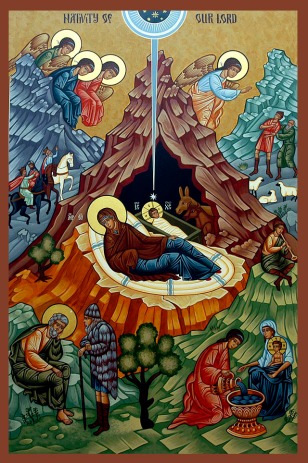
nativity.jpgAnd it came to pass that Mary was enrolled with Joseph the old man in Bethlehem, since she was of the seed of David, and was great with the Lamb without seed. And when the time for delivery drew near, and they had no place in the village, the cave did appear to the Queen as a delightful palace. Verily, Christ shall be born, raising the likeness that fell of old.(Troparion from the Royal Hours of the Nativity, Byzantine rite)

A child is born to us, and a son is given to us, whose government is upon his shoulder; and his name will be called, the Angel of great counsel.

(Introit of the third Mass of Christmas Day, Roman rite)

Expect the media to bring up the usual historical “problems” with the Nativity account, according to Fr. Stephen Freeman, and don’t fret about it:

Literalism is a false means of interpretation (hermenuetic) and is a vain attempt to democratize the Holy writings. If they can be read on a literal level, then everyone has equal access to them and everybody has equal authority to interpret them. […] the seasons come and go and the media cannot resist speaking of what they do not know. And so they ask those who do not know to speak on their behalf. But if we would know Christ and the wonder of His incarnation, then we would do well to listen to those who have been appointed to speak and to hear them in the context given to us for listening – the liturgical life of the Church.

photo-6.jpgIn other news, blogging has been light the last couple of days because we’ve been madly scanning and shelving books. The Delicious Library and LibraryThing system has been fantastic, but most definitely less than perfect. One annoying thing is that even if Library of Congress data exists for a book, LibraryThing won’t always find it, requiring you to find it yourself on the Library of Congress website and enter it manually. For books that don’t have LC numbers, I’m not sure what I’m supposed to do; is there a way that one can divine what the number will eventually be?

What’s also frustrating is that LibraryThing is in theory able to identify new ISBNs when a list is uploaded and add only those, and it does this successfully in most cases, but there are somewhere around ten books that are always duplicated when I add a new list. This afternoon I eliminated somewhere around fifty dupes, in some cases there being seven entries for one book.

Another issue: I’ve entered 718 books into Delicious (representing probably roughly half of what we have), and I’ve exported the catalog to LibraryThing on a fairly regular basis. This afternoon, LibraryThing showed 756 books; after eliminating the duplicates, I’m down to 702 in LibraryThing with 8 ISBNs it can’t find (European books, I think). That means there are eight books Delicious is listing in its catalog that for some reason LibraryThing isn’t picking up.

Nonetheless, we’ve been able to accomplish in a weekend what would have surely taken us a month on our own, and that’s most certainly worth it.

Finally–any other Leopard users out there finding that with the latest update, searching for files within the File Upload dialog appears to be broken?

Merry Christmas to all!

U. S. News and World Report on a return to the old stuff

With a tip of the hat to the good folks over at Get Religion, I give you an article in U. S. News and World Report by Jay Tolson entitled “A Return to Tradition: A new interest in old ways takes root in Catholicism and many other faiths.”

Go ahead and take a moment to read it—it won’t take long. On a personal note, not to mention in the interests of full disclosure, I’ve met Roger Finke; his daughter and son-in-law are my godchildren, and his son and daughter-in-law are also dear friends. As converts to Orthodox Christianity, they themselves are part of this “return to tradition” of which the article speaks. (EDIT: the referents of “they” are Dr. Finke’s son, daughter, and in-laws; Dr. Finke himself is LCMS, not Orthodox.)

A few broad observations: it appears to be an article of faith for the mainstream media that Pope Benedict XVI’s liberalization of the traditional rite will ultimately have little to no effect, and certainly won’t catch on terribly well—it just means that a handful of old folks can now go back to saying their rosaries on their own while the ad orientem priest mumbles in Latin and a smaller handful of young militants can pretend to insert themselves into a tradition which was never theirs in the first place. This is not, of course, what Tolson says in so many words, but it certainly seems important to him to make sure to include a quote from somebody downplaying the significance of Benedict’s move.

Along the same lines, does the “return to tradition” mean a break from the “religious service provider” mentality, according to Tolson? Of course not. Tolson provides a quote from Finke that makes it very explicit that the cafeteria is by no means closed; it’s just that perhaps some people are trying to add a sit-down restaurant option for those who want it: “It’s a structured life, but it’s a structure they are seeking and not simply submitting to authority.” An earlier quote from IUPUI sociologist Sister Patricia Wittberg underscores this: “I think the future is with a group that is interested in reviving the old stuff and traditions in a creative way.” In other words, what we’re talking about is a group of people who are interested in tradition, but on their own terms. It’s less the received tradition and more the cherry-picked tradition; tradition-as-trapping rather than Tradition-as-authority.

In the interests of fairness, there is a fundamental conundrum that, some would argue, ensures that anybody who embraces a more traditional expression of Christianity is going to be engaging in a range of cherry-picking, cafeteria-esque behavior. “There’s nothing more un-Orthodox,” I’ve heard various people claim, “then intentionally converting to Orthodoxy.” In other words, if you’re converting to a faith in which you were not raised, you’re already cherry-picking; you’re already intentionally grafting yourself onto something else rather than accepting whatever tradition you received growing up. You’re asserting yourself onto an organic entity in such a way that ensures you will never be part of it. You’ve already chosen what it is you’re willing to submit to, and since you’ve already presumably left something else at least once, you’re tacitly reserving the right to do so again. It’s healthy, so the argument goes, to acknowledge that we’re all cafeteria believers of one form or another, and that there’s no other way you can be in this country, where religion is just another part of the marketplace of ideas.

I suppose to some extent this is true; I will say that for myself and people I know who have converted to either Eastern Orthodoxy or Roman Catholicism (or even people raised in either communion who have made a conscious choice to more fully “own” their faith), there is always a struggle to figure out how to live life more fully within the faith but also with an awareness of the reality of the world. That’s the struggle of any Christian at any point in history, really. As G. K. Chesterton might have put it, the struggle doesn’t invalidate the conversion any more than the rain invalidated the ark.

Finally—the following point is worth noting, as much as for how Tolson says it as what he says:

Something curious is happening in the wide world of faith, something that defies easy explanation or quantification. More substantial than a trend but less organized than a movement, it has to do more with how people practice their religion than with what they believe, though people caught up in this change often find that their beliefs are influenced, if not subtly altered, by the changes in their practice.

First of all, this assumes that there is a divide between belief and practice. This may very well be the case, but it’s a divide which would have been quite foreign to the early Christians, who were very aware that how one prayed and worshipped impacted how they believed. (Google Lex orandi, lex credendi if you don’t believe me.) As an Episcopalian praying the Rite II Eucharist Sunday in, Sunday out, in allowing myself to actually pray the liturgy, I was occasionally confronted by something in the text, and I realized that in order to keep praying it, I had to decide if I actually believed it or not. Did I actually believe the words of the Nicene Creed? Did I actually believe I was receiving the Body and Blood of Christ? Did I believe in one, holy, catholic and apostolic church? And so on. The more I decided that yes, I actually believed what I was praying, ironically enough, the less tenable of a position it seemed to remain an Episcopalian.

Liturgical practice is at once both the expression and the teaching of the faith held by the community; someone actively engaging it and praying it will of course find what they believe being influenced by it. That is the whole point, and it is a point easily lost on people who think that worship is all about style, taste, and aesthetic preference.


adventures in writing alexander lingas all saints bloomington all saints orthodox church american orthodox architecture american orthodox music american orthodoxy Antiochian Archdiocese Antiochian Orthodox Christian Archdiocese of North America Antiochians books byzantine chant cappella romana chant church architecture ecclesiastical chant ethnomusicologists ethnomusicology fellowship of ss. alban and sergius Greece Greek greek food greekness hazards of church music international travel tips ioannis arvanitis joe mckamey john michael boyer kurt sander Latin liturgical adventures liturgical architecture liturgical music liturgical texts and translation liturgy liturgy and life lycourgos angelopoulos medieval byzantine chant Metropolitan PHILIP militant americanist orthodoxy modern byzantine architecture modern greek music music as iconography my kids will latin and greek when they're newborns my kids will learn latin and greek when they're newborns orthodox architecture orthodox architecture is bloody expensive Orthodox choir schools Orthodox Ecclesiology orthodox outreach orthodox travel pascha at the singing school Patriarchate of Antioch Patriarch IGNATIUS IV Patriarch of Antioch publishing random acts of chant richard barrett in greece richard toensing rod dreher sacred music st. vlads st john of damascus society Syriac the Bishop MARK fan club the convert dilemma the dark knight The Episcopacy The Episcopate the only good language is a dead language this american church life travel we need more american saints why do we need beautiful music in churches?

Blog Stats

  • 262,832 hits

Flickr Photos