Posts Tagged 'liturgical music'


The Voice of the Lord: Selected Hymns from the Feast of Theophany

Yesterday I came to home to an unexpected surprise: a complimentary copy of The Voice of the Lord: Selected Hymns from the Feast of Theophany, a new recording of Byzantine chant in English dedicated to the memory of Sonia Belcher. Sonia was a dear friend of my priest and his family, and when she passed last February, Fr. Peter spoke about her quite a bit. This CD is quite the labor of love, to say the least, and proceeds from it will go to support The Theophany School in Boston, an Orthodox Christian school which began largely as a result of Sonia’s effort and perseverance.

The collaborators on the project are impressive, to say the least. Hieromonk Ephraim of St. Anthony’s Monastery (aka “Papa Ephraim”) composed the English-language versions of the hymns specifically for the recording (music found here under the entry for Theophany, 6 January); the protopsaltis is Rassem El Massih, a graduate of the Archdiocese of Tripoli’s School of Byzantine Music, and the choir roster is a who’s who of the new generation of Byzantine cantors in AOCNA — including Gregory Abdalah, Basil Crow, Jamil Samara, and Khalil Samara. Dn. Nicholas, Sonia’s husband, is also a part of the ensemble. As the notes say, the goal was to produce a recording of traditionally chanted Byzantine hymns re-composed for the English music, and specifically in the style idiomatic to the Patriarchate of Antioch.

I’ve only listened to it all the way through a couple of times thus far, but my initial impressions are that the result of their efforts is top-drawer through and through. The ensemble sings together beautifully and is very well-coordinated; the English diction is clear as a bell, and hearing the melodies match the English texts as well as they do is very refreshing. The liner notes do a moving job of telling the reader who Sonia is and just why she inspired both the recording project as a whole as well as this particular repertoire.

One curious thing I’ll note is that, as good as the English diction is — compare, for example, with the Mt. Lebanon Choir — the kind of sound the ensemble produces made my ear expect Arabic when I first popped in the disc. It took about ten seconds for me to be able to “hear” the English; when I listened to it a second time, I couldn’t believe that I’d had a problem in the first place. Go figure.

I’d like to thank Basil Crow and Khalil Samara for sending me the disc, and all involved for contributing a fine example of what traditional Byzantine chant can sound like when sung well in English. I’d like to encourage anybody who knew Sonia, or who might be interested in Byzantine chant or Orthodox Christian education, to buy this CD; it’s a more than worthy effort, and a more than worthy cause.

Unanticipated interest

I’m taking most of this week off. Megan’s grandmother on her father’s side passed away last Thursday — memory eternal, Frances — and while we’re not traveling for her funeral, it was evident that it would be beneficial for me to spend a few days at home. Plus, I have some vacation time I need to use or lose, and our friend Benjamin Czarnota has been here for a visit.

The other positive, if not exactly enjoyable, thing has been using the time to make use of my insurance benefits while I still have them. So, Monday, I got an eye exam — dilation makes me intensely irritable, by the way, because I can’t bloody read, but the upshot is that my prescription hasn’t changed — Tuesday I got a dental checkup and cleaning, and then, this morning, as a result of yesterday’s dental checkup, I got a root canal. For a variety of reasons, this was not entirely unexpected — let me simply say that delaying having one’s wisdom teeth removed by five years can have far-reaching consequences, and I do not recommend it as a course of action.

I am hopeful that tomorrow might not randomly involve invasive surgery.

Anyway, something very unexpectedly cool that happened today is that, after four years of talking about the whole choir schools thing and having people not get it and/or otherwise ignore me, the publication of the piece in AGAIN has generated interest from a rather unanticipated source. I got a phone call from the church today saying that such-and-such person from such-and-such entity had read my article, really liked it, and wanted to do an interview about the ideas I was discussing. I called this person back, we had a lovely chat, and it looks like this is going to happen in a couple of weeks.

Now, similar interest in a different piece has come from a different-but-similar source before, but this is different in that what’s been asked for is an interview rather than a reading, and the entity in question is taking responsibility for the recording and editing themselves. (Since I didn’t say anything else about that recording, I’ll say now that after posting the file to the FTP site specified, I never heard from the people in question again. I’m reasonably certain that what happened is that probably the quality I was able to achieve at home wasn’t up to snuff, which is not anything I take personally, but this particular institution not having the wherewithal to make its own recording arrangements is something that’s going to rather severely limit its potential contributors. Oh well). Anyway, I’m still not going to go into too many details until it’s a done deal and I know exactly what’s going to happen and when, but it’s still a rather exciting development, and we’ll see if it’s actually meant to be.

The narrative of decline vs. the narrative of continuity in Byzantine music

Such profound hostility to the performing practice of the received tradition made the sanitisation of Byzantine chant a fundamental prerequisite for its acceptance and consumption by Westerners and Westernised Greeks. Conscious emulation of the Solesmes restoration was, as we have already indicated, a particularly ingenious solution to this problem. Adoption of the earliest manuscripts as the sole arbiters of authenticity and without grounding them in a developed concept of performing practice meant that Tillyard, Wellesz, and Høeg were able to bypass entirely the embarrassing “nasal singing” of traditional Greek cantors in favour of a hypothetical reconstruction that was both aurally and methodologically fashionable. With everything distasteful thus reassuringly dismissed as “Arabo-Turkish” accretions, its new Western curators could ensure that Byzantine music “in all its original purity” assumed its rightful place alongside Gregorian chant in the pantheon of European musical history. (Alexander Lingas, “Performance Practice and the Politics of Transcribing Byzantine Chant”, Acta Musicae Byzantinae VI, Iaşi, Romania, December 2003, p. 74)

Full article is here. It’s a barnburner, and tells you not only what Lingas thinks of the “narrative of decline” but also what Greek chant specialists thought of it while it was initially being promulgated in the first place. (A tip of the hat to Basil Crow, who passed this along.)

Mediterranean microtonal melismas are not unAmerican: making time for some musical musings

A few things have come out recently to which I’ve been meaning to respond, and I’m finally able to take a moment to do so.

First of all, the issue of AGAIN which just came out, among other things, reprints Fr. John Finley’s essay, “Authentic Church Music”. This was originally a talk given to the the AOCNA Conference on Missions and Evangelism in 2002, and I have seen it in at least two print publications since then — PSALM‘s newsletter, PSALM Notes, and now AGAIN. It is also, as the link shows, posted on the Antiochian website itself, so clearly Fr. John’s piece has found an audience. Give it a read; I’ll come back to this.

Second, there was this short piece which was run on PBS a couple of weeks ago. I’d love to find a way to embed it, but I haven’t yet, so click on the link, watch it, then come back.

Third, RightWingProf has a couple of posts on music with which I tend to agree. The earlier is here, and a more recent one is here. Go read those, too.

Okay. You got all of that?

I’ve met Fr. John Finley a number of times. I met him at the Antiochian Sacred Music Institute back in 2004, and again at the PSALM National Conference in 2006. I also love his cookbook. He’s a good man, so far as I can tell he’s a good priest, and we know many of the same people. He’s also one of the people to whom I’ve tried talking about the choir school model (an idea which I just seem to have the darndest time communicating in a form that makes sense to anybody but me).

There’s a reason Fr. John’s article has a continuing audience; it is well-written, it expresses a point of view clearly, and it is a point of view which is popular among many American converts to Orthodox Christianity:

Some may negatively assume that such a proposal must necessarily lead to the development of an American Orthodox music, which will sound like Protestant music or the 70’s rock and roll Christian music of the baby boomer generation’s surfer churches. On the contrary, we are hinting at the development of authentic sacred music for the One, Holy, Catholic and Apostolic Church in North America, a music founded on “that which has been delivered to us”, but which is also the result of our interaction as Orthodox Christians with the surrounding American culture. (emphasis mine)

Fully Orthodox and fully American! Orthodox as the Seven Ecumenical Councils and American as apple pie! Isn’t that what we all want?

The trouble that I have with the article, and what I offer as a critique, is that Fr. John unfortunately buys into what Alexander Lingas refers to as “the narrative of decline” with respect to Byzantine music as part of his argument. Specifically, this paragraph is problematic:

Is the Byzantine music that we sing today really Byzantine, i.e. from the Byzantine era of the 4th through the 15th Centuries? Are we not aware that the Church music of the See of Constantinople was heavily influenced by the demands of the Turks after the fall of the empire in 1453 AD? Are we aware that the authentic music of the Byzantine Church lost its diatonic character and accepted enharmonic and chromatic intervals during this period of the Turkish yoke? Are we aware that the music of today’s churches in the Byzantine tradition throughout the entire Mediterranean region of the world is the result of the codification of these oriental elements by Chrysanthus in the 19th Century and is scarcely 200 years old?

Checking his footnotes, his citations are predictable — Strunk (1977) and Tillyard (1923). It’s an appealing narrative for many folks; hey, you know that stuff in Byzantine music that makes you feel uncomfortable as an American because it sounds, well, Eastern? It’s not actually as Orthodox as the Hellenophiles and Arabicists want you to think! It’s a later development which occurred under the Turkish yoke! It’s a narrative which validates the supposed biases of the “Western ear” (whatever that means) and knocks the practices of various national churches down a peg or two all at the same time — it’s a very economical argument in that regard.

There’s something else it manages to accomplish, too, which is hinted at in the body of the text and made explicit in a footnote:

We should continue the work of transcribing Byzantine notation into modern western linear notation and adopt modern western scale intervals.* We need to simplify the melodies in connection with the texts and encourage congregational participation. We should encourage the harmonization of the melodies. I have heard it said that the great musical contribution of the East is its melodies and the great contribution of the West is its development of harmony. What better place than America to bring these two great traditions together to form something uniquely American in terms of Orthodox Music? This, of course, has already been done in Russia, and will undoubtedly be a powerful influence on what is done in America in this area of musical development.

* This will, given time, effectively conform all Byzantine melodies to a diatonic equal-tempered scale. According to Byzantine Musical theorists, Medieval Byzantine Music was wholly diatonic anyway. So this could be construed as a move back toward a more pure form of Byzantine chant rather than a perversion of it.

So, actually, the more we file the edges and corners off of Byzantine music, the more Byzantine we make it, in fact! Better yet — we also make it more American at the same time. Perfect.

Also present is the fallacy that somehow congregational singing and congregational participation are coterminous. This seems to be one of those assumptions that makes people feel good but for which I have never actually seen any evidence. Don’t take this as me meaning that I’m against congregational singing; I’m not, not at all. What I disagree with is the “everybody sings everything or they’re not participating” model that seems to be the core postulate of many modern liturgists; that makes as much sense to me as saying “everybody paints the icons or they’re not praying with them”.

Now might be a good time to point out that in the last week, thanks to the magic of Inter-Library Loan, I’ve read Towards the Great Council: Introductory Reports of the Inter-Orthodox Commission in Preparation for the Next Great and Holy Council of the Orthodox Church, published in 1971, back when they thought the next Synod would be occurring around 1974 or 1975. I’ll discuss it in more depth later, but Section 2 of this document is called “Fuller participation by the laity in the worship and life of the Church.” It is all of two pages. This section seems relevant to the present discussion:

…the nature of lay participation in the life of the Church is clearly expressed in her dogmatic and canonical teaching; it is not a question causing special concern to the Orthodox Church and, for the time being at any rate, it does not constitute a burning problem for her. In all conscience the Orthodox church believes that there has never been, nor is there now, a spontaneous movement among the laity to acquire greater rights and duties in the Church, different from those which they have had since the Church’s foundation. For they have always participated actively in worship and administration, in the pastoral work and teaching ministry of the Church, according to the rights and duties clearly laid upon them by Holy Tradition and the Canons. Their main rights and duties, as lay people and members of the Church, are to live in the fullness of the gifts and divine grace within our Holy Church and to witness by word and way of life to Christ the Saviour and to His gospel. (p. 23)

Obviously, this being 1971, this need not be the last word on the subject, but let’s keep in mind that this was in the immediate wake of 1970 Roman Missal taking a pair of pinking shears to the Mass in the name of “active participation,” and the Commission which drafted this document appears to be intending to head off any such attempts in the Orthodox world.

I must disagree with Fr. John about Byzantine notation and intervals; on a practical level, I might suggest that we might have an easier time getting the Greeks on board with the mission in America if we would stop treating their music as something we just found on the bottom of our shoe that somehow we have to fix and rescue from itself.

On a technical level, I wholeheartedly disagree about harmonization of Byzantine melodies. They function modally, not tonally; you cannot harmonize them according to conventions of Western functional harmony without eliminating the distinctives of the eight-mode system and reducing it to effectively two modes. This already happens when the well-meaning beginning isocratima thinks that the Second and Fourth Modes are intended to be major in character and mistakenly drones away on ni because it sounds like a tonic. The attempts at harmonizing many of these melodies which I have seen have been well-intentioned but nonetheless unfortunate; part-writing errors abound, to some extent unavoidably because the melodies are simply not conceived in the same way as melodies which follow Western conventions. Unavoidable though they may be, they still look, and sound, like part-writing errors.

On a level of Orthodox spirituality — here’s one idea: how about we immerse ourselves in the received tradition before we start trying to “fix” it? Might not something emerge organically over time if we were to do that? That’s not to say that we can’t try things to see if they work, but my thinking is that we’d be best off doing so in continuity with the tradition, not at variance from. If we want to make Byzantine music conceptually more accessible to Western ears, the first step is recomposing melodies to fit the English texts according to Byzantine conventions, not just sanding off the corners of pre-existing melodies and shoehorning in the English. There are increasingly good models for doing so — we should follow them.

From the standpoint of scholarship — at the very least, I would encourage Fr. John to at least familiarize himself with, and subsequently engage, the scholarship which recasts the narrative into one of continuity rather than decline. A place to start might be Lingas’ essay “Medieval Byzantine chant and the sound of Orthodoxy” in the book Byzantine Orthodoxies, Louth and Casiday, eds.

This brings me to the PBS piece on Emily Lowe at Holy Cross in Linthicum, MD. I am not certain if I’ve met Ms. Lowe; I met several people from Holy Cross at the Antiochian Sacred Music Institute back in ’04, and she looks familiar, but I honestly can’t remember. She has a lovely voice; the church is beautiful, and they’ve got her singing one of the signature hymns of Sunday Matins. It’s also kind of fun seeing people like Kh. Frederica Mathewes-Green and Terry Mattingly in the choir.

The problem is when things like this are said (which I copy here from the transcript):

During the time of the Ottoman Empire, the Greek chants took on sort of a very Middle Eastern character, and that’s when you hear this sort of dissonant, odd sounding things:  (singing) Hallelujah, Hallelujah, Hallelujah, glory to thee oh God.”  It sounds very foreign to Western ears.

Again, there’s that narrative of decline and cultural captivity with respect to Byzantine music. Granted, there are a lot of people in the Antiochian Archdiocese who teach that, including Fr. John, so it’s not a huge surprise, but my guess is that if the PBS documentarians were to have interviewed somebody like John Michael Boyer, they would have had a different set of quotes.

Ms. Lowe describes herself in one of the comments on the video’s page as “a piano teacher who just loves to sing”. I’m going to guess we have a lot in common; we’re what you might call armchair Byzantine musicologists. We’ve read a lot, we’ve heard a lot of recordings, been to a PSALM event or two and/or the Sacred Music Institute at the Antiochian Village, and we do our best with what we have, which are, as a rule, the Kazan transcriptions. I know I haven’t yet had a chance to actually study with a chant teacher who genuinely knows what they are doing and has direct contact with the received tradition, and my hunch is that neither has Ms. Lowe. The practical reality for me is that there isn’t anybody within a 4-5 hour drive for me to learn from; the closest person about whom I know is protopsaltis at Holy Trinity in Nashville, TN.

All of that is to say, if PBS came knocking on my door, I’d tell them I’m the wrong guy, everything I know I know because I read it in a book or have imitated a recording, I’m not an expert, I’m not an authority, and that they need to go talk to somebody like Boyer or Leonidas Kotsiris in Nashville, who have studied with great teachers (who were themselves students of great teachers and who have been singing these services in this idiom since they were blastocytes), and are themselves teaching it and passing it on. I would tell them they need to talk to people, not who are trying synthesize water from hydrogen and oxygen, but who have actually drunk from the well, if not marinated themselves in it.

Don’t get me wrong — I’m absolutely not attacking Ms. Lowe here. I have bags and bags and bags of admiration for her. She’s clearly wonderful, and a huge asset to Holy Cross. She does what she does very well, loves to do it, and offers it humbly in the service of Christ. That should be the big takeaway from this video, and it should be a model which all of us who use our voices in the service of the Church follow. It would be an honor to sing a service with her, anytime, anywhere. The trouble is the editors of the video presenting the content as authoritative and normative when it isn’t.

Finally, for the most part, all I really have to say about RightWingProf’s posts is — right on, brother. I take issue with a lot of the four-part writing which is out there for English translations for many of the same reasons he does. I don’t think it has to be that way; I think passing 7ths and 2nds can work okay, but they can’t be used as a sentimental harmonic trick.

There are a few little points I wish to engage, however.

I tend to disagree that professional choirs are somehow undesirable. Yes, fine, the Rachmaninoff Vigil is going to be too much for a parish choir as a rule. However, if you’ve got a cathedral choir that can pull it off — defined, as far as I’m concerned, as being able to sing it well and prayerfully — I don’t see a problem using it liturgically. My overall discomfort is that we approach a mindset that says, “You’re too good of a musician to serve the Church with the fullness of your gifts.” I can’t imagine telling an architect or an iconographer that, but we seem really comfortable telling singers that. No, it’s not a concert, but there’s a dichotomy between worship and performance which I think approaches being a false dichotomy at some point. My belief has always been, with respect to that dichotomy, if you sacrifice one for the other, you will do neither well. I completely own that I say that as a former Anglican, however, and that this informs my point of view.

I also fundamentally disagree with the blanket assumption, constantly asserted by many, that Slavic music is “more accessible to American ears”. If sung well, in English, with a melody that actually fits the text in terms of stresses and meter, Byzantine music is plenty accessible to American ears. By contrast, Slavic music sung poorly with stresses and meter distributed in such a way as to do violence to the English text is going to be just as inaccessible to the American ear as people so frequently proclaim Byzantine music as being. This is not a slam against Slavic music or Orthodox music in the Slavic idiom; I’m a big fan of Fr. Sergei Glagolev (who was kind enough to inscribe my volume of his music at PSALM in 2006), and the Kurt Sander settings I’ve sung I’ve really liked. All I’m saying is that I think it is an error to say that somehow one national idiom of Orthodox music is fundamentally more accessible than another and to privilege that idiom based on that assertion. There may very well be reasons to privilege particular idioms in particular contexts, but I don’t think this one holds up at all, and I think recent recordings of Byzantine chant in English bear that out.

Along similar lines, and to repeat a point made earlier, not everything needs to be sung along with by the congregation. Yes, it’s church, not a concert; I might reply by saying it’s church, not a campfire singalong. Melisma serves a particular function in the Byzantine idiom — frankly, that of following the rubrics. ἀργὰ καὶ μελὠς, “slowly and melodically”, is sometimes what the rubrics call for. It is not the aberration many would make it, so I can’t agree that it should be absolutely avoided in the parish.

That said, a parish choir needs to fight its weight. Period. If a choir can’t sing it well and prayerfully, they shouldn’t sing it at all. So, from that standpoint, I agree that there is nothing wrong with “keeping it simple,” insofar as what we mean by that is that the music should be no more complicated than what the choir can sing well and prayerfully. In all likelihood, that’s probably going to mean keeping things a lot simpler than we might otherwise like for the time being — heck, we use the Antiochian Village camp music book as the normative setting at All Saints — but it doesn’t necessarily follow that choirs and congregations can’t ultimately grow into certain kinds of repertoire.

If I were helping to start a mission, what I would be very curious to try, if I had 3-4 other singers who were up for it and who could sing it well and prayerfully, plus an acoustic which would complement it at least somewhat, is using the Thyateira translation with the Boyer/Lingas Byzantine arrangements, as found on The Divine Liturgy in English, as the standard music, and setting it up from the get-go in an antiphonal formation. The idea would be to make a particular traditional practice normative from the get-go so that people are used to it from the start, rather than the mission making it up as they go along. I’ve seen what that can look like, and I can’t quite shake the idea that it is self-defeating and ultimately serves to paint missions into corners.

Perhaps it is good that I am not helping to start a mission.

On Bright Friday: Christ is risen! Indeed He is risen!

This is the time of year, the last week before dead week, when I typically find myself scratching my head, thinking, “Where the heck did the school year go?”

Heck — where did April go?

Tomorrow will be the first Saturday here at home when I haven’t had to set an alarm since February. Note to self: next year, when you’re asked if you’re up to 8am Saturday Liturgies all throughout Great Lent, say “no”.

Anyway… getting home after the trip to Seattle, I was ragged to say the least, but I was nonetheless returned to your regularly-scheduled Byzantine Holy Week, already in progress. To say it was bizarre I’m not sure really covers it; being in the midst of a death in the family (and recovering from bronchitis before we left), and having missed, more or less, Palm Sunday, plus all of the Bridegroom Matins services, as well as having broken the fast while traveling, during Western Easter no less, to just drop in with Unction on Wednesday and return to fasting for all of five days just felt weird. Also, since my experience of Orthodox Christianity has been very much in the context of my marriage, having my wife gone made it even weirder. By the time people were yelling “CHRIST IS RISEN!” late Saturday night, I just had to admit — “Sorry, not feeling it this year.”

Which makes it a good thing that the Resurrection of Christ does not particularly depend on my feelings, I suppose.

Agape Vespers Sunday morning found me missing a perfect fifth at the top of my voice and in possession of an extra major third at the bottom. Such was the case for much of my choir. Folks, I will write a separate blog post about this later, but let me beseech, implore, plead with, beg you — for the health, sanity, and vocal longevity of your choir and cantors, when you decide upon a mission space or build a church, however temporary you plan for it to be, acoustics and an intentional, non-negotiable place for your choir and cantors are not a “nice to have”. They are a “need to have”. Low drop ceilings with acoustic tiles and carpets cannot be considered a reasonable option, because then your choir and cantors, who likely won’t be trained singers in the first place and who won’t have any way of adjusting for how an acoustically dead space messes with your hearing or your singing — to say nothing of your priest, particularly during Holy Week — will have really no option in the long haul but to yell through services against the room or just not be heard — and frankly, you probably won’t be heard terribly well anyway. As well, to haphazardly jam the choir into a corner they were never meant to occupy, where they are walled in by, well, a wall, the congregation, the solea, and the plane of a deacon’s door, particularly on Pascha when you’ve got extra choristers as well as people’s baskets encroaching on what is already too little space — well, it just doesn’t work very well, from any standpoint. Do not tell yourself, “Well, the space is temporary, so we’ll just make do while we have to,” either — temporary is a guest with a habit of staying late.

But I’ll come back to that another time.

After Agape Vespers, I was prepared to go home, make my Paschal nachos, bottle beer, catch up on some homework, and then go pick up my wife at the Indianapolis airport at 10:30pm.

Did you hear that? That was God elbowing me in the ribs, saying, “Gotcha good, didn’t I?”

At 3:30pm, I got a phone call from Megan at the Seattle airport. The short version is that, thanks to weather, the Chicago-to-Indy leg of her flight had been cancelled, and because it was a FAA-imposed delay which caused the cancellation, there really wasn’t much United Airlines was willing to do beyond to say, “Have a nice night at O’Hare and we’ll get you on standby the next day… at some point.”

“All you have is carry-on luggage, right?” I asked.

“Yes.”

“OK. I’ll see you in Chicago.”

I quickly called friends to let them know that nachos would have to wait, and I left at 4:30pm (EST) to try to intercept the 8pm (CST) flight.

Thanks to an eight-mile backup on northbound highway I-65 (the left lane was closed for construction, although no actual construction was occurring that I could see), I finally got there about 9:30pm (CST), or 10:30EST — the time I was supposed to pick her up in Indianapolis in the first place.

We got home around 3:30am (EST), making it an impromptu eleven hour round trip. Thankfully, Megan was up to driving most of the way home so I could sleep, since I had to go to work the next morning.

It was a great start to the week.

I am, however, finally caught up with all of the Greek homework that I missed while I was sick and subsequently out of town, as well as ready, more or less, for the conference paper-style presentation of my research project for the history seminar I’ve been in this semester. It will be a work in progress, and I’ve already said I’ll need an incomplete for the full paper given all the surrounding circumstances, but I at least have something to show people, and I think it’s reasonably interesting. I think. In short, it has to do with how Coptic and Byzantine liturgical texts show us how each Church builds its communal identity relating to, and institutional memory of, the Council of Chalcedon with the rhetoric employed in the relevant hymnody, synaxarion readings, and even in fixed portions of the Liturgy such as the Commemoration of the Saints in the Coptic rite, and so on.

We’ll see how it plays in Peoria. I don’t think I can assume any liturgical knowledge whatsoever, so a good chunk of my time is having to be taken explaining various segments of the different services. Hopefully eyes won’t glaze over too much.

So, besides not having gotten enough sleep in two months and coming up on the end of my part-time status as a student, I can say that I appear to have a chant teacher while I’m in Greece, I have my renewed passport, and we have Megan booked to come out to Greece for the last 9 days or so that I am there.

I had received some suggestions about chant teachers, but held off acting on any of them until a particular individual got back to me. This person finally did, saying, “Well, here’s how you get in touch with Lycourgos Angelopoulos as well as Ioannis Arvanitis.” The catch with Πρωτοψάλτης Λυκούργος, alas, is that he speaks Greek and is “able to communicate in French”; I’m not sure I want to depend on languages which are works in progress for this kind of instruction, so I sent an introductory e-mail to Arvanitis in Greek (proofread by my friend Anna Pougas, so that I wasn’t inadvertently telling him “έχω τρία αρχίδια” or anything like that) and in English. He wrote back in English, saying yes, I’ll be here, here’s my number, call me when you get to Athens. We’ll see what can actually be done in seven weeks, but I’m looking forward to actually getting to learn even the most basic of basics from somebody who actually knows what they’re talking about and who has had the real thing in his ear and his blood for his whole life.

Anyway — life is slowly returning to manageable levels. At least until it’s time to leave my job and go to Greece for the summer.

Christ is risen! Indeed He is risen!

Sunday of Orthodoxy qua Orthodoxy in America

This last Sunday, being the first Sunday in Great Lent, was the so-called “Sunday of Orthodoxy,” commemorating the victory of iconodules over iconoclasm at the Seventh Ecumenical Council (“Nicea II — The Wrath of Arius”). In years past, there has been a Sunday evening Vespers in Indianapolis, participated in by all the area clergy and their parishes. This year, instead of Vespers, a morning Divine Liturgy was planned at Holy Trinity Greek Orthodox Church, who had just started worshiping in their new building in December.

All Saints’ participation was determined rather late in the game; being an hour and twenty minutes south, and with some of our parishioners commuting from as much as an hour away even further south, it took some figuring out. Ultimately our deacon stayed behind and served a Typika for those who weren’t going to Indianapolis, allowing Fr. Peter to concelebrate and a group of us from All Saints to attend.

The morning was stunning in several respects. For the occasion, a new icon was commissioned of All Saints of North America, which now includes Indiana-born St. Barnabas. The original was put out for us to venerate, and we were all given prints of it as well. I’ve jokingly called Holy Trinity’s new building the satellite campus of Hagia Sophia, but it really is frickin’ huge. As the pictures make clear, I think we had close to a thousand people in there, and people were still having to gather in the narthex. We had everybody, too (among the clergy as well as the people); Serbians, Greeks, Arabs, Bulgarians, Russians, Ukrainians, Romanians, American converts, and even a handful of Copts, Ethiopians, Eritreans and Indians. (Okay, I’m not sure we had any Finns or Estonians.) The communion of the faithful easily took half an hour, and that was with six chalices, I believe. Add another twenty minutes or so for the communion of the clergy.

Some general observations: Holy Trinity is an example of a church which I think would be too big for me to be comfortable in it as my home parish. It is a beautiful building, and it will only get more beautiful as they fresco it, marble the floors, put up the iconostasis, etc., but I’d rather see the design principles applied to a church maybe a quarter of the size. (This begs the question of why Holy Trinity, which I believe has something like 600 people, doesn’t plant some churches, but never mind that now.) I’ve heard it suggested that past 250 souls or so, you really overtax a priest’s ability to minister; I’ll throw out another possible metric, which is that you don’t want the building to be any larger than that in which the cantor can sing comfortably and be understood and heard without needing a microphone. (This assumes that churches are being built with attention to acoustics, which isn’t even necessarily the case with Holy Trinity, unfortunately — there were one or two odd decisions made on that front.) That said, I think it’s wonderful that a traditional-looking Byzantine temple now exists which is large enough to hold everybody in the metro area. I somewhat wonder if perhaps, with Detroit being, well, Detroit, there might not be talk behind the scenes of moving Metropolitan Nicholas’ throne to Indianapolis, hence the building being a size more appropriate to a cathedral than a parish church.

I wound up joining the choir; Max Murphy, my counterpart at Ss. Constantine and Elena, conducts the choir for these big combined services and I sing for him when I am able. The music was, more or less, OCA music with some simplified Byzantine things reworked for a large ensemble. My trouble is that the Orthodox musical heritage is so much richer than the utility music which tends to dominate services like this, but the reason why it dominates services like this is because it is easily scalable to huge ensembles (as well as makes congregational singing reasonably easy). Mark Bailey once told me that Kievan common chant is great because you can get 50 people singing the front page of the New York Times to it in fifteen minutes; on the other hand, he freely admitted, the downside of Kievan common chant is that you can get 50 people singing the front page of the New York Times to it in fifteen minutes. There wasn’t an overabundance of Kievan common chant at this service, but the principle was still largely the same. At any rate, it was, mostly, the music that virtually everybody in the Indianapolis area sings except Holy Trinity (and All Saints, for that matter), so it was familiar to Max, the majority of the choir, and a good chunk of the congregation.

There were some interesting moments during the procession of the icons; Fr. Taso (the pastor of Holy Trinity) originally asked the congregation to all sing the litany responses in their own languages, in the spirit of our coming together as a symbol of our unity as Orthodox Christians. This didn’t quite work the way he intended, so ultimately he led us in the Tone 4 threefold English “Lord, have mercy” common to Greek parishes (and Antiochian parishes during Holy Week if one is following Kazan). That worked just fine (although it was different from the responses the choir prepared — Max gave up when he realized that Fr. Taso was going off-script).

One always wonders what happens behind the scenes when that many clergy gather on another priest’s turf, particularly when the event functions something of a “coming out party” for said turf, but Fr. Peter made a point of bringing up that very question last night after the Liturgy of the Presanctified Gifts. “It was very peaceful, as surprising as that sounds,” he said. “Fr. Taso called us all together and said, ‘Brothers, what do you want to do?’ To have the protos do something like that, particularly at a Greek church, is unheard of.” (When there were some inevitable uncomfortable chuckles, he said, “That’s not a swipe against the Greeks — they’d tell you the same thing!”)

Given events of the last few weeks, there have been conversations about what Orthodox unity in America means, if it can even happen at all now, if we’re looking a big step backwards, what’s the path from here, etc. etc. etc. I think that to some extent these nervous questions are a bit misguided; it’s not exactly like the AOCNA and OCA were preparing to announce an administrative merger next week and the news out of Damascus derailed it at the last second. However, I think we can look at events like this Sunday of Orthodoxy Divine Liturgy and make some informed guesses about what the practical side of jurisdictional unity might look like.

  • Somebody’s going to have to be the protos, as it were, and it’s probably going to be whoever has the resources to be so effectively, including the space to be a meeting ground for everybody. This was true in 1975 when Met. PHILIP and Met. MICHAEL unified the Antiochian churches in this country, and Met. MICHAEL stepped down; it will still be true going forward.
  • Along similar lines, there will be a group who is numerically dominant. There were ten or so parishes represented at Holy Trinity this last Sunday, and at least half of the congregation was Holy Trinity’s own people.
  • It will be up to the group who is numerically dominant and who functions as the “protos” to be a loving and welcoming brother in Christ. It will be up to the others to be receptive to that, and to return it in-kind.
  • It might be a bit of a cacophony for awhile until people figure things out. The job of the dominant group will be to help guide everybody into unity, and to do so in love.

Looking at these points, I’d argue this wouldn’t be a bad model for how things should be now, even, with or without unity on paper.

One other thought for the moment. That icon of All Saints of North America? A couple of them are American born; some of them were active in America. However, with the exception of St. Peter the Aleut (who was martyred young), none of those saints were both born here and active here. Let me suggest that before we have an indigenous church, we’re going to need indigenous saints. Some might argue that we should start with Fr. Seraphim Rose (which reminds me — I’m reading The Soul After Death right now); while recognizing he’s a controversial figure, I don’t really think that it’s in question that he is a native-born model of sanctity. I personally think he is a saint, and I believe he interceded to heal my mother from a heart issue a few years back, but I also think it will take time for the amen of American faithful to be uttered. I know a priest, and perhaps a bishop or two, who I believe might be glorified after their respective reposes. I have heard some suggest Lynette Hoppe; certainly this book seems designed to make that case. There are others I can think of, too.

My point is, until there are models of holiness who have been raised up out of “our people,” as it were, I’m not sure it makes any sense to be so neurotic and anxious about our earthly organization. Once we start producing saints, administrative questions will take care of themselves. The importance of saints who are local and recent, I have come to realize, is that they shine forth the light of Christ in a way that is immediate. What is more powerful, reading a story about somebody who supposedly did something fifteen hundred years ago, or hearing first-hand accounts of people who did those very things within the last few years? We run a great risk by holding ourselves at a distance from saints — they are less convicting that way, I suppose, meaning they’re more comfortable to be around, but they are also less compelling and convincing.

In other words — if we want a solution to the jurisdictional problem in this country, maybe what we need to do is, before we write a letter or join a lay activist organization or start a blog (all potentially worthy things to do, don’t get me wrong), we need to go out and be saints.

We will see.

Nice ways to spend Valentine’s Day or, things I’ll probably only ever be able to pull of once, part VII

Monday was our last day in England. We had an early flight out of Heathrow on Tuesday, so we had to make the day count as much as possible.

First order of business was food and real coffee. (Did I say that I don’t understand this Nescafé nonsense?) Megan wanted to try a full English breakfast, so off we went. Several restaurants within a few blocks of our hotel advertised a full English breakfast, but upon closer inspection of menus all were missing a vital ingredient — that being, of course, black pudding. In fact, black pudding seemed to be nowhere to be found anywhere, with it being replaced wholesale by tomatoes. That being the case, we finally settled on a café in Leicester Square called Fiori Corner. It was good food despite a lack of blood sausage, and I can recommend it, but do be aware that they are cash only, and they will charge for coffee refills.

Following breakfast, we headed for the British Museum. Let me tell you, if you’ve never seen it before, the British Museum is huge — so huge that if you don’t know what you’re looking for, you might very well assume that what you’re looking at isn’t the British Museum, because no museum would ever be that big. (By the way, the British Museum is right across from a thoroughfare called Coptic Street, and about the history of which I would be fascinated to learn more.) Oh, and by the way, while the entrance is free, everything else is not. You’ll pay, I think, £6 or so for a reasonably basic guidebook and map, and more depending on how detailed and complete you want it.

Hey -- eyes up here, pal.

Hey -- eyes up here, pal.

The British Museum is also so big that there’s just no way you’re going to see everything in a day, or even in a week, maybe. You really have to pick a specific area of interest and spend time there. We decided on Anglo-Saxon England and Medieval Europe, while quickly walking through some other areas on our way to find the Rosetta Stone. Among other things, we saw the Sutton Hoo exhibit, which while having a rather high percentage of replicas and reconstructions is still fascinating — particularly since I took a class a few years ago where the professor had worked on the site in her grad school days and incorporate the material into her lectures.

Following the British Museum, we went to the Royal Academy of Arts for their Byzantium exhibit with a stop at a place called Rendezvous in Leicester Square for gelato. It was good and hit the spot, but it was definitely expensive. I’ll also point out that the sign they had posted to let people know they can’t sleep in doorways is a bit odd. It looks like the caption should be, “No sensual reclining in doorways.”

From Leicester Square, it’s maybe a ten minute walk tops to RAA; it looks a lot farther on the map than it actually is. Piccadilly Circus, by the way, is somewhat Blade Runner-esque; if I had been there at night it would have seemed even moreso.

RAA, unlike the British Museum, is not free; bring a student ID if you have one — it’ll save you a few pounds on the entrance fee. You also pay for a specific exhibit, not general admission to the museum. Also, unlike the British Museum, there is no photography allowed.

The Byzantium exhibit is stunning; the examples of iconography are really breathtaking  and leave you wanting to venerate them, even though there are ropes that quite handily keep you from doing so. There was also a 13th-century Syriac Gospel lectionary on display; that was pretty darn cool. Something that rankled a bit was the caption on the wall about church life that talked about how the iconostasis was to keep the unholy masses from even being able to see the altar and how the chanting was done by all-male voices, words that seemed specifically chosen to play up how backwards these Byzantines with their alien form of Christianity were, but I suppose the real question is, what should I have expected?

A humorous moment was at an icon depicting St. Thomas with the Risen Christ; while looking at it, I heard a woman’s voice say, “There’s Thomas, doubting away.” I glanced at the person who said this, and it was a woman who looked to be of Indian descent, prompting me to think, “Hey, he’s your patron saint, lady.”

One of the big takeaways for me from the Byzantium exhibit was how Orthodox Christianity didn’t engage Byzantine culture; it was the culture, in a way that I don’t know Christianity can ever be again, anywhere. I’m not sure what that means in the long run; that may be a blog post for another time.

A leisurely walk from RAA to Westminster Cathedral for Sung Mass took us through Green Park and past Buckingham Palace. We bought some tea and some other gifts from one of the many Buckingham Palace gift shops; Megan hoped to find a tea cozy, but those turned out to be as hard to find as black pudding, for some reason. Finally we had coffee at the Costa across the street from the Cathedral, and then it was time for Mass.

The boys, alas, were not in residence, and neither was Martin Baker, so it was just the lay clerks serving as the choir. Nonetheless, it was quite beautiful, as beautiful as I’ve ever seen a Mass in the Ordinary Form. Very much worthwhile.

We walked back to the hotel afterwards, with me pausing to be amused by a sign from the Considerate Builders Scheme, and started packing things up. We decided to go to the Sherlock Holmes Pub and Restaurant for dinner; please let me caution you against making the same mistake. It is a tourist trap with a capital T, capital TR. The food is expensive and not good enough to merit the price (although now I know what “Toad in the Hole” is, and it would be curious to try it again someplace better), and overall it is just not worth it at all.
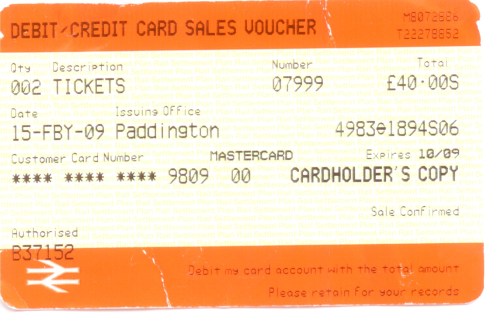
The next morning, breakfast was at one of the Starbucks locations in Heathrow; seemed like it was time to start re-acclimating to the American world. At long last, around 10:30pm, reluctant to wake from the dream, we stumbled across the threshhold of our little house in Bloomington, with our once-in-a-lifetime long Valentine’s Day weekend adventure completed, and the real world now calling us back.

Having the story to tell, and the memories we have of there with each other, is worth it.

Pictures can be found here.

Nice ways to spend Valentine’s Day or, things I’ll probably only ever be able to pull off once, part VI

oxford-ticket-2Back to happier things.

My initial thought had been that we could go to Hagia Sophia Cathedral in London for Liturgy on Sunday; I had only been able to quickly walk through there back in ’07, and thought it would be awesome to actually go for a service and perhaps see the folks I had met who attended there.

Turned out that the Sunday we were going to be in England was the Sunday of the Prodigal Son, however, and given the role of that day in preparing for Great Lent, it seemed preferable to attend a service in English. The Cathedral does a Divine Liturgy in English on the first and third Saturdays of the month; otherwise, they do everything in Greek. (“We’re the patriarchal cathedral for the Greeks in London,” the choir director there told me when I met him. “Our services are in Greek or else.”) Alas, we were there for the second Saturday.

Plus, as Dr. Lingas had told us on Friday, it was a Sunday for Byzantine chant in English up in Oxford.

Liturgy started at 10:30; the earliest train to Oxford we could catch was at approximately 8:30am, and that got us up there around 9:50. It was about a twenty minute walk from the Oxford train station to the Holy Octagon, and I remembered where it was easily enough.

This was the first time I had seen the interior of the Oxford church; while humble in a lot of respects — it is a very simple brick building — they have done a lot with what they have. Also, while somewhat smaller than All Saints, I’d say they packed in about 30-40 more people than we typically do — it was filled to the gills. On the other hand, it was 2 February on the Old Calendar (the Meeting of the Lord, or Candlemas as doubtless some of the English converts might call it), so it being a major feast might well have accounted for the attendance.

The celebrant was Metropolitan Kallistos (Ware); the homilist Fr. Ian Graham; the cantor Dr. Lingas. Talk about a delightful treat of a morning. Metropolitan Kallistos served with a great deal of enthusiasm and verve; I’ve said before that recordings really do not capture how animated he is, and I would like to reiterate that point. Fr. Ian’s homiletics are very different from what we were used to, but not in a bad way, and it was very valuable to hear on this particular Sunday. Dr. Lingas — with one other person — sang essentially a stripped down version of The Divine Liturgy in English; what was interesting was that many of the same, shall we say, pastoral realities were present as I run into at All Saints. For example, the “Dynamis” of the Trisagion was, as is the case for us, merely a repeat of the first iteration rather than a separate, longer, melismatic comp0sition. Also, as with Bloomington, as soon as the Liturgy was over — time to start chatting! In all fairness, they actually have to go to a separate building entirely for their coffee hour, so there’s no hallway into which they may just quietly slip. It was nonetheless comforting to see that such issues are not geographically limited, shall we say. One fascinating difference is that at All Saints, more or less everybody in the congregation tries to sing everything; in Oxford, the people were largely silent.

The Oxford church is on the property of something called Ss. Gregory and Macrina House; it’s a house that exists as a center for non-liturgical Orthodox activity at Oxford, including some accommodations for students and the occasional visitor. It also appears to be where the offices for the Fellowship of Ss. Alban and Sergius are presently located, and is also where the coffee hour occurs. I hope to have some occasion to spend more time there in the future.

Following Liturgy, we ate lunch at the Eagle and Child; alas, it was full enough that the Rabbit Room was inaccessible, but the bangers and mash — and the fish and chips, and the beer — were still quite tasty regardless.

The rest of the day was spent strolling around the town and the campus, and it was a gorgeous, if chilly, day for it. In some respects, it was good we were there on a Sunday — most places where we might have been tempted to spend lots of money were closed. That said, Blackwell’s is an exceedingly pleasant place to spend several hours (and perhaps hundreds of pounds). They have shelves and shelves of things which have to be special ordered here — Greek New Testaments and Septuagints, English-Norwegian dictionaries, and so on. On the other hand, Oxford is certainly a place where people with those kinds of interests are concentrated, so that shouldn’t be a surprise. One more reason to contrive a reason to move there someday. Alternately, it’s a great reason to have a little notebook in which one can write down ISBN numbers and look online for better deals in US dollars.

We attended Evensong at Queen’s College; it was almost entirely at the other end of the spectrum of liturgical practice and singing from Metropolitan Kallistos and Dr. Lingas, but it was a nice reminder of what good liturgical singing can sound like in the Western tradition. I forget how much I like a pointed psalm sung antiphonally.

Finally, it was time to go back into the city. We got good sausage rolls from a bakery called La Croissanterie, and boarded the train.

Tips: It is reasonably common to encounter cash-only locations in Oxford. The bakery was cash-only, a coffee chain called Caffè Nero, and admission to the Saxon tower of St. Michael’s at the North Gate (“the oldest building in Oxford”) was cash only. (Megan went up; I didn’t. Again, something about paying to see part of a church just doesn’t sit well.)

Evidently, if the Orthodox visitor to Oxford were to contact the Ss. Gregory and Macrina House well enough in advance, they might find that they would be able to stay there. I don’t have any other details, and they don’t have a website or an e-mail address I am able to find, so the easiest way to contact them appears to be by phone — 01865 513117.

Yeah, Oxford is still my favorite place in the universe. What can I say?

Coming soon: how we actually got to bum around, y’know, London for day, and why the Sherlock Holmes Pub and Restaurant should be avoided at all costs.

One new recording and one that’s just new to me

One nice thing about listening to Ancient Faith Music is that it can bring to my attention recordings of international origin of which I would otherwise have had no knowledge. A terrific example is My Soul, Rise Up! put out by a self-described “ensemble of folklore spiritual music” called The Svetilen Ensemble. Last week I turned on AFM and heard this joyful, full-throated, not careful, and stunning singing, and I had to know where it came from. Yesterday the CD arrived, and the whole thing is pretty much exactly like the excerpt I heard. It’s not all liturgical music; some of the pieces are folk part-songs (called kanty, so far as I can tell — somebody can correct me if I’m wrong) on Christian themes but which are paraliturgical. One thing the recording really does right is that it recognizes the link between folk culture and liturgical singing, and it emphasizes that folk culture shares a lot of common elements across national boundaries. Many of the kanty sound like American Sacred Harp hymns which just happen to not be in English, for example. Anyway — time does not permit a full review at this time, but this is a recording well worth a listen. Some excerpts may be found at the link provided above.

A brand-new recording is The Great Doxologies in the Eight Modes by the Mount Lebanon Choir. Now that we have a couple of decent (and up) recordings of the Divine Liturgy in English, the ensembles active in this kind of thing are going to start looking for other things to record, so here we are. The Great Doxologies is good for the reasons the Mt. Lebanon Choir’s The Divine Liturgy of the Holy Orthodox Church of Antioch is good and kinda, er, quirky for the reasons their Divine Liturgy is quirky. You’ve got authentic chants by people who know what they’re doing, with a high level of musicianship all around, to say nothing of Old Country legitimacy. This also has the extra value of being the only recording of its kind in English so far. On the other hand, the English diction, while better than a recording of me chanting in Arabic would be, is clearly not at a native level. This is okay with me, but it will make it a tough sell with some of the folks whom this recording is intended to help win over to Byzantine chant. Additionally, as with The Divine Liturgy, it sounds like an organ is used to shore up the ison (although an organist is not credited in the notes), and that just sounds not quite right. Still, where the matter of good recordings of Byzantine chant in English is concerned, more is more, I think, and hopefully all of these efforts combined will bear good fruit down the road.

If anybody’s taking requests, I’d love to see some festal Vespers or Matins recordings. “O Lord I have cried” in all eight modes, maybe. A recording of Holy Week music, of course, would also be a great thing, as would the Great Supplicatory Canon. Perhaps also examples of how some of the offices like Small Compline, First Hour, etc. can be sung if desired.

Maybe we need a few more ensembles specializing in doing this stuff well, too. More is more where this is concerned, as I said.

End-of-year appeal from Cappella Romana

In support of an organization which does work I support and believe is very important, I pass on the following.

I’m writing to ask you to make a gift today to support Cappella Romana’s important work in Orthodox music.

This January, the world premiere of Kontakion on the Nativity by Antiochian composer Richard Toensing will require 30 singers — nearly twice our normal size. Individual gifts are critical to ensure our success, making up nearly 50% of the budget; grants and corporate support come only in addition to individual support from people like you.

Your gift of $25, $50, $100 – or whatever amount you choose – gives you a role in the timeless, world-class Orthodox music that you value. Your gift is also tax-deductible as the law provides.

This year, donors in North America giving $100 or more by December 31 will receive a free gift: the CD, Byzantium: 330-1453.

Make a gift today | View YouTube video from “Heart of Kiev”

TAKE PART TODAY

We are asking everyone in Cappella’s family (nearly 4,000 in our worldwide email list) to participate with a gift right now in a true grass-roots effort. It’s more important than ever. We’re saving precious resources by using email and online giving opportunities instead of costly printed materials and postage. If you prefer, feel free to write a check and mail it to our address below.

If you know someone who loves Cappella Romana like you do, be sure to pass on this message by clicking on “forward this email to a friend.”

Thank you for your support,

MariaBOYER_Signature_blue72.gif

Maria Boyer
President
CAPPELLA ROMANA
Voices of Byzantium

Richard here… Just for fun, this seems like as good a place as any to add this performance of Cappella Romana with Ioannis Arvanitis:


adventures in writing alexander lingas all saints bloomington all saints orthodox church american orthodox architecture american orthodox music american orthodoxy Antiochian Archdiocese Antiochian Orthodox Christian Archdiocese of North America Antiochians books byzantine chant cappella romana chant church architecture ecclesiastical chant ethnomusicologists ethnomusicology fellowship of ss. alban and sergius Greece Greek greek food greekness hazards of church music international travel tips ioannis arvanitis joe mckamey john michael boyer kurt sander Latin liturgical adventures liturgical architecture liturgical music liturgical texts and translation liturgy liturgy and life lycourgos angelopoulos medieval byzantine chant Metropolitan PHILIP militant americanist orthodoxy modern byzantine architecture modern greek music music as iconography my kids will latin and greek when they're newborns my kids will learn latin and greek when they're newborns orthodox architecture orthodox architecture is bloody expensive Orthodox choir schools Orthodox Ecclesiology orthodox outreach orthodox travel pascha at the singing school Patriarchate of Antioch Patriarch IGNATIUS IV Patriarch of Antioch publishing random acts of chant richard barrett in greece richard toensing rod dreher sacred music st. vlads st john of damascus society Syriac the Bishop MARK fan club the convert dilemma the dark knight The Episcopacy The Episcopate the only good language is a dead language this american church life travel we need more american saints why do we need beautiful music in churches?

Blog Stats

  • 269,312 hits

Flickr Photos