A few things have come out recently to which I’ve been meaning to respond, and I’m finally able to take a moment to do so.
First of all, the issue of AGAIN which just came out, among other things, reprints Fr. John Finley’s essay, “Authentic Church Music”. This was originally a talk given to the the AOCNA Conference on Missions and Evangelism in 2002, and I have seen it in at least two print publications since then — PSALM‘s newsletter, PSALM Notes, and now AGAIN. It is also, as the link shows, posted on the Antiochian website itself, so clearly Fr. John’s piece has found an audience. Give it a read; I’ll come back to this.
Second, there was this short piece which was run on PBS a couple of weeks ago. I’d love to find a way to embed it, but I haven’t yet, so click on the link, watch it, then come back.
Third, RightWingProf has a couple of posts on music with which I tend to agree. The earlier is here, and a more recent one is here. Go read those, too.
Okay. You got all of that?
I’ve met Fr. John Finley a number of times. I met him at the Antiochian Sacred Music Institute back in 2004, and again at the PSALM National Conference in 2006. I also love his cookbook. He’s a good man, so far as I can tell he’s a good priest, and we know many of the same people. He’s also one of the people to whom I’ve tried talking about the choir school model (an idea which I just seem to have the darndest time communicating in a form that makes sense to anybody but me).
There’s a reason Fr. John’s article has a continuing audience; it is well-written, it expresses a point of view clearly, and it is a point of view which is popular among many American converts to Orthodox Christianity:
Some may negatively assume that such a proposal must necessarily lead to the development of an American Orthodox music, which will sound like Protestant music or the 70’s rock and roll Christian music of the baby boomer generation’s surfer churches. On the contrary, we are hinting at the development of authentic sacred music for the One, Holy, Catholic and Apostolic Church in North America, a music founded on “that which has been delivered to us”, but which is also the result of our interaction as Orthodox Christians with the surrounding American culture. (emphasis mine)
Fully Orthodox and fully American! Orthodox as the Seven Ecumenical Councils and American as apple pie! Isn’t that what we all want?
The trouble that I have with the article, and what I offer as a critique, is that Fr. John unfortunately buys into what Alexander Lingas refers to as “the narrative of decline” with respect to Byzantine music as part of his argument. Specifically, this paragraph is problematic:
Is the Byzantine music that we sing today really Byzantine, i.e. from the Byzantine era of the 4th through the 15th Centuries? Are we not aware that the Church music of the See of Constantinople was heavily influenced by the demands of the Turks after the fall of the empire in 1453 AD? Are we aware that the authentic music of the Byzantine Church lost its diatonic character and accepted enharmonic and chromatic intervals during this period of the Turkish yoke? Are we aware that the music of today’s churches in the Byzantine tradition throughout the entire Mediterranean region of the world is the result of the codification of these oriental elements by Chrysanthus in the 19th Century and is scarcely 200 years old?
Checking his footnotes, his citations are predictable — Strunk (1977) and Tillyard (1923). It’s an appealing narrative for many folks; hey, you know that stuff in Byzantine music that makes you feel uncomfortable as an American because it sounds, well, Eastern? It’s not actually as Orthodox as the Hellenophiles and Arabicists want you to think! It’s a later development which occurred under the Turkish yoke! It’s a narrative which validates the supposed biases of the “Western ear” (whatever that means) and knocks the practices of various national churches down a peg or two all at the same time — it’s a very economical argument in that regard.
There’s something else it manages to accomplish, too, which is hinted at in the body of the text and made explicit in a footnote:
We should continue the work of transcribing Byzantine notation into modern western linear notation and adopt modern western scale intervals.* We need to simplify the melodies in connection with the texts and encourage congregational participation. We should encourage the harmonization of the melodies. I have heard it said that the great musical contribution of the East is its melodies and the great contribution of the West is its development of harmony. What better place than America to bring these two great traditions together to form something uniquely American in terms of Orthodox Music? This, of course, has already been done in Russia, and will undoubtedly be a powerful influence on what is done in America in this area of musical development.
* This will, given time, effectively conform all Byzantine melodies to a diatonic equal-tempered scale. According to Byzantine Musical theorists, Medieval Byzantine Music was wholly diatonic anyway. So this could be construed as a move back toward a more pure form of Byzantine chant rather than a perversion of it.
So, actually, the more we file the edges and corners off of Byzantine music, the more Byzantine we make it, in fact! Better yet — we also make it more American at the same time. Perfect.
Also present is the fallacy that somehow congregational singing and congregational participation are coterminous. This seems to be one of those assumptions that makes people feel good but for which I have never actually seen any evidence. Don’t take this as me meaning that I’m against congregational singing; I’m not, not at all. What I disagree with is the “everybody sings everything or they’re not participating” model that seems to be the core postulate of many modern liturgists; that makes as much sense to me as saying “everybody paints the icons or they’re not praying with them”.
Now might be a good time to point out that in the last week, thanks to the magic of Inter-Library Loan, I’ve read Towards the Great Council: Introductory Reports of the Inter-Orthodox Commission in Preparation for the Next Great and Holy Council of the Orthodox Church, published in 1971, back when they thought the next Synod would be occurring around 1974 or 1975. I’ll discuss it in more depth later, but Section 2 of this document is called “Fuller participation by the laity in the worship and life of the Church.” It is all of two pages. This section seems relevant to the present discussion:
…the nature of lay participation in the life of the Church is clearly expressed in her dogmatic and canonical teaching; it is not a question causing special concern to the Orthodox Church and, for the time being at any rate, it does not constitute a burning problem for her. In all conscience the Orthodox church believes that there has never been, nor is there now, a spontaneous movement among the laity to acquire greater rights and duties in the Church, different from those which they have had since the Church’s foundation. For they have always participated actively in worship and administration, in the pastoral work and teaching ministry of the Church, according to the rights and duties clearly laid upon them by Holy Tradition and the Canons. Their main rights and duties, as lay people and members of the Church, are to live in the fullness of the gifts and divine grace within our Holy Church and to witness by word and way of life to Christ the Saviour and to His gospel. (p. 23)
Obviously, this being 1971, this need not be the last word on the subject, but let’s keep in mind that this was in the immediate wake of 1970 Roman Missal taking a pair of pinking shears to the Mass in the name of “active participation,” and the Commission which drafted this document appears to be intending to head off any such attempts in the Orthodox world.
I must disagree with Fr. John about Byzantine notation and intervals; on a practical level, I might suggest that we might have an easier time getting the Greeks on board with the mission in America if we would stop treating their music as something we just found on the bottom of our shoe that somehow we have to fix and rescue from itself.
On a technical level, I wholeheartedly disagree about harmonization of Byzantine melodies. They function modally, not tonally; you cannot harmonize them according to conventions of Western functional harmony without eliminating the distinctives of the eight-mode system and reducing it to effectively two modes. This already happens when the well-meaning beginning isocratima thinks that the Second and Fourth Modes are intended to be major in character and mistakenly drones away on ni because it sounds like a tonic. The attempts at harmonizing many of these melodies which I have seen have been well-intentioned but nonetheless unfortunate; part-writing errors abound, to some extent unavoidably because the melodies are simply not conceived in the same way as melodies which follow Western conventions. Unavoidable though they may be, they still look, and sound, like part-writing errors.
On a level of Orthodox spirituality — here’s one idea: how about we immerse ourselves in the received tradition before we start trying to “fix” it? Might not something emerge organically over time if we were to do that? That’s not to say that we can’t try things to see if they work, but my thinking is that we’d be best off doing so in continuity with the tradition, not at variance from. If we want to make Byzantine music conceptually more accessible to Western ears, the first step is recomposing melodies to fit the English texts according to Byzantine conventions, not just sanding off the corners of pre-existing melodies and shoehorning in the English. There are increasingly good models for doing so — we should follow them.
From the standpoint of scholarship — at the very least, I would encourage Fr. John to at least familiarize himself with, and subsequently engage, the scholarship which recasts the narrative into one of continuity rather than decline. A place to start might be Lingas’ essay “Medieval Byzantine chant and the sound of Orthodoxy” in the book Byzantine Orthodoxies, Louth and Casiday, eds.
This brings me to the PBS piece on Emily Lowe at Holy Cross in Linthicum, MD. I am not certain if I’ve met Ms. Lowe; I met several people from Holy Cross at the Antiochian Sacred Music Institute back in ’04, and she looks familiar, but I honestly can’t remember. She has a lovely voice; the church is beautiful, and they’ve got her singing one of the signature hymns of Sunday Matins. It’s also kind of fun seeing people like Kh. Frederica Mathewes-Green and Terry Mattingly in the choir.
The problem is when things like this are said (which I copy here from the transcript):
During the time of the Ottoman Empire, the Greek chants took on sort of a very Middle Eastern character, and that’s when you hear this sort of dissonant, odd sounding things: (singing) Hallelujah, Hallelujah, Hallelujah, glory to thee oh God.” It sounds very foreign to Western ears.
Again, there’s that narrative of decline and cultural captivity with respect to Byzantine music. Granted, there are a lot of people in the Antiochian Archdiocese who teach that, including Fr. John, so it’s not a huge surprise, but my guess is that if the PBS documentarians were to have interviewed somebody like John Michael Boyer, they would have had a different set of quotes.
Ms. Lowe describes herself in one of the comments on the video’s page as “a piano teacher who just loves to sing”. I’m going to guess we have a lot in common; we’re what you might call armchair Byzantine musicologists. We’ve read a lot, we’ve heard a lot of recordings, been to a PSALM event or two and/or the Sacred Music Institute at the Antiochian Village, and we do our best with what we have, which are, as a rule, the Kazan transcriptions. I know I haven’t yet had a chance to actually study with a chant teacher who genuinely knows what they are doing and has direct contact with the received tradition, and my hunch is that neither has Ms. Lowe. The practical reality for me is that there isn’t anybody within a 4-5 hour drive for me to learn from; the closest person about whom I know is protopsaltis at Holy Trinity in Nashville, TN.
All of that is to say, if PBS came knocking on my door, I’d tell them I’m the wrong guy, everything I know I know because I read it in a book or have imitated a recording, I’m not an expert, I’m not an authority, and that they need to go talk to somebody like Boyer or Leonidas Kotsiris in Nashville, who have studied with great teachers (who were themselves students of great teachers and who have been singing these services in this idiom since they were blastocytes), and are themselves teaching it and passing it on. I would tell them they need to talk to people, not who are trying synthesize water from hydrogen and oxygen, but who have actually drunk from the well, if not marinated themselves in it.
Don’t get me wrong — I’m absolutely not attacking Ms. Lowe here. I have bags and bags and bags of admiration for her. She’s clearly wonderful, and a huge asset to Holy Cross. She does what she does very well, loves to do it, and offers it humbly in the service of Christ. That should be the big takeaway from this video, and it should be a model which all of us who use our voices in the service of the Church follow. It would be an honor to sing a service with her, anytime, anywhere. The trouble is the editors of the video presenting the content as authoritative and normative when it isn’t.
Finally, for the most part, all I really have to say about RightWingProf’s posts is — right on, brother. I take issue with a lot of the four-part writing which is out there for English translations for many of the same reasons he does. I don’t think it has to be that way; I think passing 7ths and 2nds can work okay, but they can’t be used as a sentimental harmonic trick.
There are a few little points I wish to engage, however.
I tend to disagree that professional choirs are somehow undesirable. Yes, fine, the Rachmaninoff Vigil is going to be too much for a parish choir as a rule. However, if you’ve got a cathedral choir that can pull it off — defined, as far as I’m concerned, as being able to sing it well and prayerfully — I don’t see a problem using it liturgically. My overall discomfort is that we approach a mindset that says, “You’re too good of a musician to serve the Church with the fullness of your gifts.” I can’t imagine telling an architect or an iconographer that, but we seem really comfortable telling singers that. No, it’s not a concert, but there’s a dichotomy between worship and performance which I think approaches being a false dichotomy at some point. My belief has always been, with respect to that dichotomy, if you sacrifice one for the other, you will do neither well. I completely own that I say that as a former Anglican, however, and that this informs my point of view.
I also fundamentally disagree with the blanket assumption, constantly asserted by many, that Slavic music is “more accessible to American ears”. If sung well, in English, with a melody that actually fits the text in terms of stresses and meter, Byzantine music is plenty accessible to American ears. By contrast, Slavic music sung poorly with stresses and meter distributed in such a way as to do violence to the English text is going to be just as inaccessible to the American ear as people so frequently proclaim Byzantine music as being. This is not a slam against Slavic music or Orthodox music in the Slavic idiom; I’m a big fan of Fr. Sergei Glagolev (who was kind enough to inscribe my volume of his music at PSALM in 2006), and the Kurt Sander settings I’ve sung I’ve really liked. All I’m saying is that I think it is an error to say that somehow one national idiom of Orthodox music is fundamentally more accessible than another and to privilege that idiom based on that assertion. There may very well be reasons to privilege particular idioms in particular contexts, but I don’t think this one holds up at all, and I think recent recordings of Byzantine chant in English bear that out.
Along similar lines, and to repeat a point made earlier, not everything needs to be sung along with by the congregation. Yes, it’s church, not a concert; I might reply by saying it’s church, not a campfire singalong. Melisma serves a particular function in the Byzantine idiom — frankly, that of following the rubrics. ἀργὰ καὶ μελὠς, “slowly and melodically”, is sometimes what the rubrics call for. It is not the aberration many would make it, so I can’t agree that it should be absolutely avoided in the parish.
That said, a parish choir needs to fight its weight. Period. If a choir can’t sing it well and prayerfully, they shouldn’t sing it at all. So, from that standpoint, I agree that there is nothing wrong with “keeping it simple,” insofar as what we mean by that is that the music should be no more complicated than what the choir can sing well and prayerfully. In all likelihood, that’s probably going to mean keeping things a lot simpler than we might otherwise like for the time being — heck, we use the Antiochian Village camp music book as the normative setting at All Saints — but it doesn’t necessarily follow that choirs and congregations can’t ultimately grow into certain kinds of repertoire.
If I were helping to start a mission, what I would be very curious to try, if I had 3-4 other singers who were up for it and who could sing it well and prayerfully, plus an acoustic which would complement it at least somewhat, is using the Thyateira translation with the Boyer/Lingas Byzantine arrangements, as found on The Divine Liturgy in English, as the standard music, and setting it up from the get-go in an antiphonal formation. The idea would be to make a particular traditional practice normative from the get-go so that people are used to it from the start, rather than the mission making it up as they go along. I’ve seen what that can look like, and I can’t quite shake the idea that it is self-defeating and ultimately serves to paint missions into corners.
Perhaps it is good that I am not helping to start a mission.
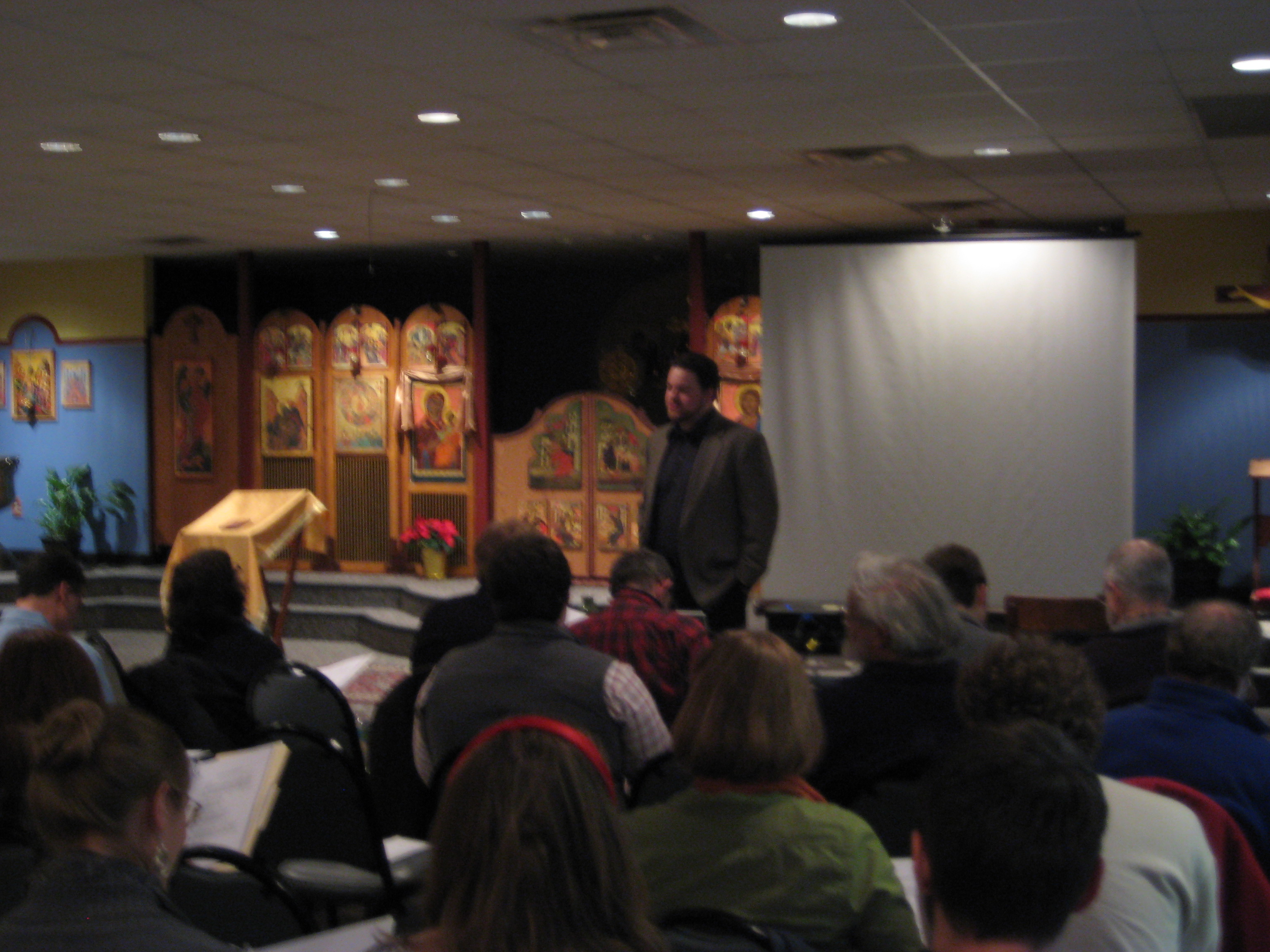 We had Andrew Gould’s answer a bit ago as to why we need beautiful churches; last weekend, we got John Michael Boyer’s answer to the question, “Why do we need beautiful music in those churches?” What John said is of a somewhat different tone than what Andrew told us; it is less theoretical and more practical, but to that extent I think the answers complement each other. John provides an excellent patristic reference for his practicality, and I think he says a number of things worth thinking about. I’ll have more to say shortly.
 This has been in the works for a little over a year, but the time approaches quickly and with the new semester upon us, I am kicking the publicity into high gear (at least as high as I can working on my own).


 Leitourgeia kai Qurbana: Contra den Zeitgeist