Posts Tagged 'ecclesiastical chant'


Bay Area, California: Josquin Singers, “The Empty Tomb & Tongues of Fire, From Easter to Pentecost in East & West”

Here are the details of the concert I’m singing next weekend in the San Francisco area with the Josquin Singers — please come if you’re around!

Celebrating the Feast of Feasts and the foundation of the Church, Artistic Director John Michael Boyer leads the ensemble on a journey from Easter to Pentecost and from East to West.  The holidays of Pascha (Easter) and Pentecost have yielded some of the most joyful and profound music in both the East and the West. This Pentecost weekend, the Josquin Singers will perform repertoire from this joyful season taken from the chant and polyphonic traditions of Rome, England, Moscow and Constantinople, sung in their original languages of Latin, Greek and Slavonic.

Thursday, May 20, 2010 7:30 pm
Blessed Sacrament Cathedral, Sacramento
1017 11th Street, Sacramento
$25 General, $20 Senior, $12 Student
CLICK HERE TO PURCHASE TICKETS

Friday, May 21, 2010 7:30 pm
Greek Orthodox Cathedral of the Ascension
4700 Lincoln Avenue, Oakland
$25 Suggested Donation
CLICK HERE TO MAKE RESERVATIONS

Saturday, May 22, 2010 7:30 pm
Holy Trinity Greek Orthodox Church
999 Brotherhood Way, San Francisco
$25 General, $20 Senior, $12 Student
CLICK HERE TO PURCHASE TICKETS

On the difference between καιρός and χρόνος and building a church that makes the difference clear (Part II)

Organizing an event is a heck of a lot of work.

I had originally contacted John Boyer in late fall of 2008; I was looking around for Western notation transcriptions of Byzantine chant in Greek, and my friend Mark Powell said he was the guy with whom to inquire, and that I might also be interested in the curriculum he was developing for Byzantine notation. John was more than generous in providing very useful materials, and I figured, while I was corresponding with him and he was seeming friendly, I may as well ask what it would take to get him out to Bloomington for a workshop. This had been an idea I’d been trying to develop for a couple of years, since we were encouraged at PSALM in 2006 to try to put together local and regional events, but I’d never gotten more than a lukewarm response — “Who?” “Isn’t he too far away and too expensive?” etc. I figured it couldn’t hurt to ask him while I had his attention, however, so I did.

He quoted me a much more reasonable number than I was anticipating. I told him, right, let me check on a couple of things; I was able to convince a private donor to pay John’s fee and travel, Fr. Peter had no problem with it (particularly since it wasn’t being paid for by the parish), and I wrote back and said, let’s do it.

Well, then it took a year to make it work with everybody’s schedules. We decided on this last weekend back in August, and what I will say is that given a host of factors (not the least of which was the decision, made a month later, to bring out Andrew Gould the weekend before John’s visit) I would not have wanted any less time to get everything together. Even with five months’ advance planning, a significant chunk of my choir still couldn’t make the weekend work (although, in all fairness, one of them, Megan’s goddaughter Erin, was busy winning the Met auditions, so I guess that’s an acceptable excuse).

In October, the money from West European Studies happened; this really expanded the scope of what I had originally considered from maybe my choir and a couple of other interested parties to something that could be (well, had to be, given WEST’s terms) open to the public and conceived of as an educational outreach event. John and I finalized the schedule and the repertoire on 23 December; the Friday evening session would be the “lecture” of the series, intended to function as the academic side of the weekend, and then Saturday would be the all-day practical part. I set up a Facebook event and sent out press kits to 30 different churches, chairs, institute directors, community choral ensembles, and local news organs the first week of January, and was astounded at the responses that started rolling in. I heard from School of Music faculty; both an Early Music Institute and a Choral Conducting professor registered, and it came back to me that the Choral faculty member was even telling her entire doctoral seminar to come. I heard from a faculty member at University of Louisville presently teaching a seminar on early notation (although she ultimately decided she couldn’t make it); I heard from choir directors and priests in Indianapolis, Evansville, and Louisville; I heard from a Medieval Studies professor at Wabash College; I heard from local people in the community. By the time the registration deadline passed the week before, 45 people were registered; another ten confirmed over the course of the following week, and then still more showed up unannounced.
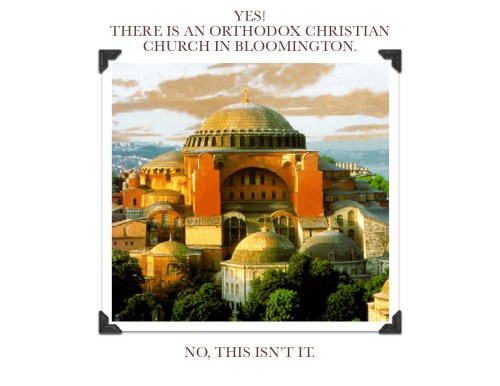
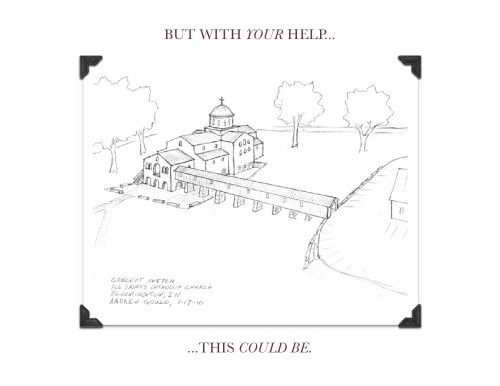
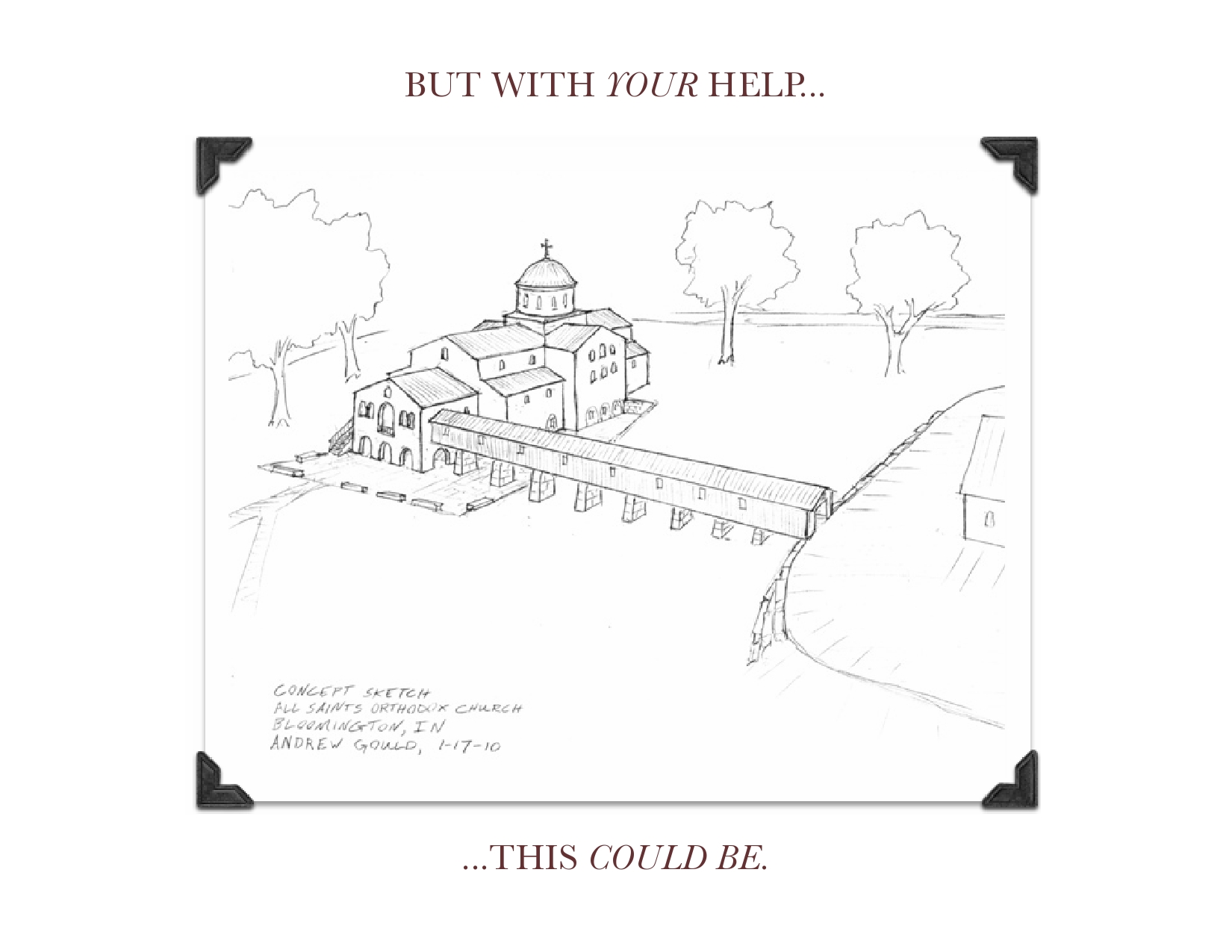
The last week before the workshop, the event planning was approaching a fulltime job; I had to make sure food got ordered and picked up, I had to track down CD shipments so we could have things to sell over the course of the weekend, I had to bug overworked Cappella Romana executive directors for scores (sorry to have been a nag, Mark, truly), I had to get registration materials printed and assembled, and I had to field phone calls from people who wanted to come but lived a couple of hours away and wanted to make sure it would really be worth their time. The last couple of days I wasn’t quite a one-man army; Megan, God bless her, helped with a lot of the last-minute errands and the putting together of the registration binders. I put together a couple of displays of Andrew’s concept sketch (pictured) so that workshop attendees could see it, at least trying to give a nod to the non-singer-friendliness of our space and indicating that we intend to do something about it.

On the other hand, once John actually got here, my job was significantly easier — I pretty much just got to sit back and enjoy the proceedings.

I must say it was worth it; all in all, throughout the course of the weekend, about 65 different people came. Not bad for an event centered around this obscure, gaudy Eastern repertoire that supposedly we Westerners can’t stand without the edges sanded down.

I picked John up at the airport last Thursday evening; his flight arrived at 10:30, and then between his checked luggage taking forever and my very smooth wrong turn leaving the airport, we didn’t get back to Bloomington until about midnight. Luckily, Megan had a wonderful meal and a good bottle of wine waiting for us when we got home (a Saveur recipe that turns lentils and sausages into a bowl of gold), and we three were up talking until around 2 in the morning.

In what would prove to be a pattern for the weekend, four hours later, it was necessary to be up and about. It was, as I told John, the “showpony” day; he was doing a radio interview for Harmonia in the morning (watch this space for details), a mini-lecture for WEST in the afternoon (no thanks to me; I had both the time and the place wrong, forcing us to rearrange our afternoon a bit), a coaching with Lucas, Megan and me on epistle cantillation, and then the first formal session of the workshop in the evening.

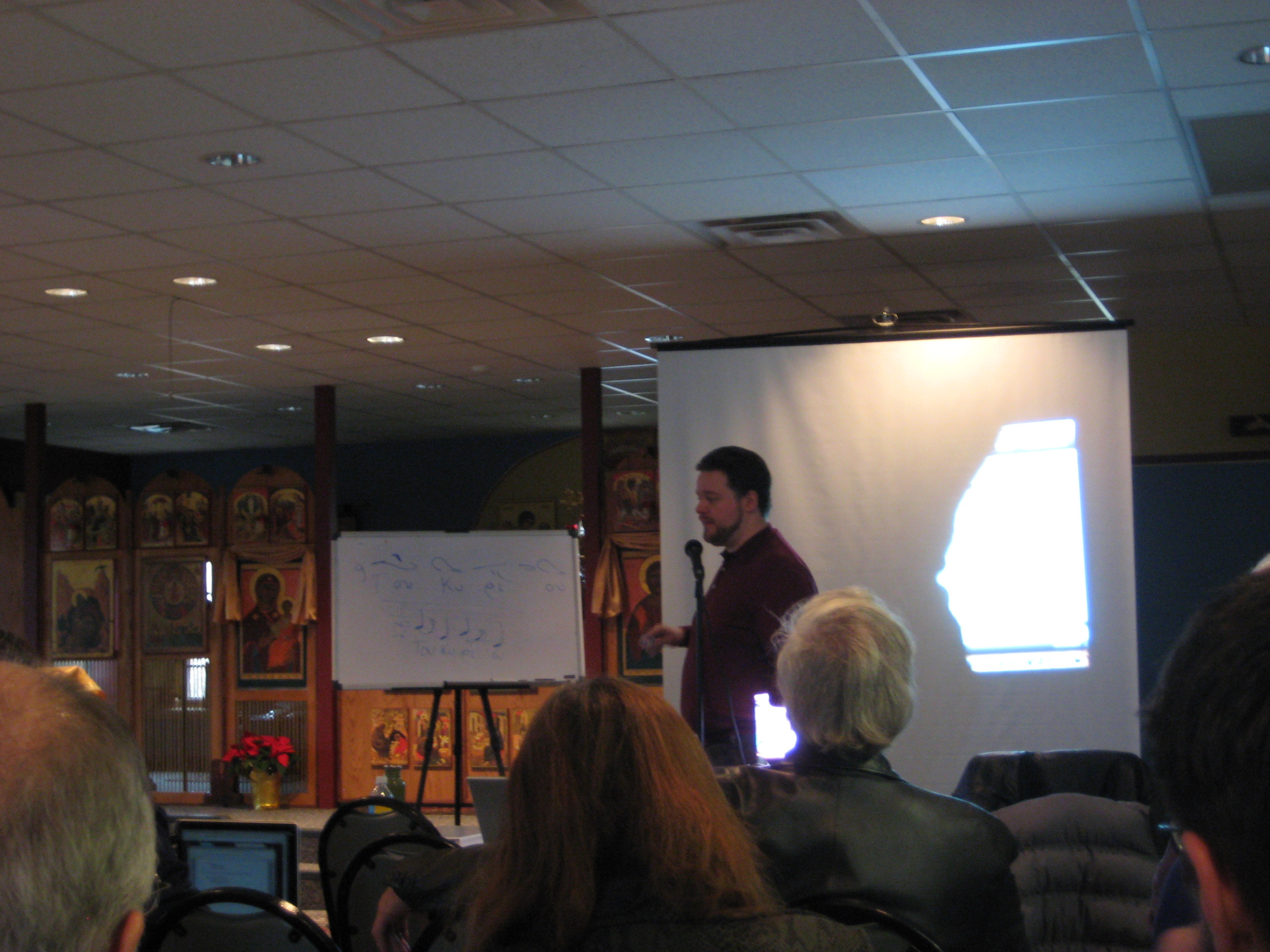
One thing that putting on such an event at All Saints did was push us to the absolute limits of what we’re able to do in our current space. John had a PowerPoint slide deck as part of his lecture; well, we’re a pretty low-tech parish on the whole, so I had to go out and hunt down a projector and a screen. WEST loaned us the projector by way of the Russian and East European Studies Institute; my old employers, the Archives of Traditional Music, were good enough to loan us the screen. Even so, it was difficult to figure out how to set up the presentation in our nave to maximize the size of the slides, minimize keystoning, and be within reach of our power outlets (even with extension cords). We managed, but I’d want to figure out how to do better next time.

We had made the decision to install a comprehensive sound system in the nave as the only real cost-effective solution to our acoustic woes for the time being; we gave the thumbs up to the order on 11 January, and the guys at Stansifer Radio turned it around as quickly as the possibly could, knowing that we hoped to be using it by 22 January, and they got it installed by Vespers on Wednesday, 20 January. John had also wanted to be able to plug his laptop into the sound system; I told Greg at Stansifer what I needed to do, and he told me, “Give me an hour to make you a cable.” An hour and twenty dollars later, I had exactly what I needed, and it worked beautifully.

In the end, where we needed to set up John’s presentation was nowhere near the condenser microphone installed for the homilist, so we still had to give him a handheld mic hooked up to Fr. Peter’s old amplifier so he wouldn’t kill his voice. (Why, you might ask, did we not plug the handheld into the nice sound system? Well, the mixer is back in a closet in the sanctuary, roughly 30 feet away from where John was standing. We had a long enough cable, but plugging it into the mixer produced no result. “Oh, right,” Fr. Peter said, stroking his chin. “I forgot — the long cable is dead.” Like I said — we’re kind of a low-tech community. Note to self: replace long cable before next such event.)

Nonetheless, John was a hit, a big one, and something that I heard from more than one person at the end of the session was, “You know, I was only going to come for tonight, but I need to rearrange my day tomorrow so I can come here.”

Following the lecture session, in lieu of a formal reception (which I’ll have to remember to set up for next time), a number of us tried to go to Finch’s for dinner, it being one of the nicer places in Bloomington. Alas, we got there just as the kitchen was closing, and so we relocated to Nick’s. It was a bit louder than we we might have liked otherwise, and they didn’t quite know how to make a Manhattan properly, but perhaps not an inappropriate venue, given that it was founded by a certain Νικόλαος Χρυσόμαλλος (Nick Hrisomalos).

It was a full house at Chez Barrett; besides John, our friend Max Murphy, my counterpart at Ss. Constantine and Elena in Indianapolis, was staying on our other futon for the night so that he wouldn’t have to commute. Once again, we found ourselves up until about two in the morning chatting, and needing to be up by about 6:30 to make sure our houseguests would be sufficiently plied with coffee and eggs, pick up the food for Saturday’s lunch (shout out to Eastland Plaza Jimmy John’s; three 30-piece party platters was a perfect amount of food for a very reasonable price, and they were gracious enough to have somebody there at 8:30am so I could pick it up, since All Saints is waaaaay far out of their delivery area), and get everything at the church set so that the 9am session could start on time.

Well, it didn’t quite. We might say that everybody was inspired enough by the previous evening to recalibrate their clocks to “Greek time,” and we didn’t get started until about 9:30am. Έτσι είναι η ζωή (that’s Greek for c’est la vie, which is itself French for “Life sucks, get a helmet”).
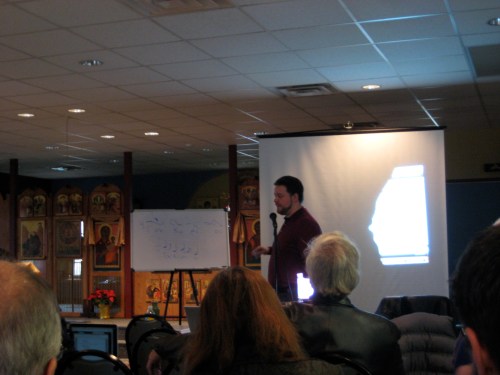
Without giving a blow-by-blow of the whole day, I’ll say that much of the day was dedicated to rehearsing the Divine Liturgy music, but there were a couple of theoretical points made that I’ll note. First, there was the issue of time, which John got at a few different ways. He has a principle, stated many times over the course of the weekend, that “If you think you’re not going fast enough, slow down.” Too often, he says, we just zip through the text like it doesn’t mean anything, which makes it not mean anything. This can be in chanting a hymn, reading the epistle, whatever. We treat hymns and readings like they’re just the next thing to get through so we can be that much closer to getting out the door, rather than adorning them with the beauty that a) they deserve and b) will make us want to be there and take part in the services as though they are gifts from God rather than as burdens to bear. So, again — if you think you’re not going fast enough, slow down.

Another way he stated this was to discuss the difference between χρόνος (chronos) and καιρός (kairos). The former is the world’s time; the latter is the Church’s time. This came up when he was talking about why some hymns are slow and melismatic, and even sometimes will revert to nonsense syllables — in the case of the latter, when this happens, the text has been stated thoroughly in a slow and melismatic fashion, and the hymn is now using “terirem” or some such to provide the opportunity to meditate on the text. Not only that, however; the whole point of the slow, melismatic style has a practical component — to cover a liturgical action, for example — but it also emphasizes the reality that in the liturgy, we are no longer in the world’s time (chronos) but on God’s time (kairos). I was reminded of what Met. Kallistos Ware says about the first time he was in an Orthodox church:

…I had no idea how long I had been inside. It might have been only twenty minutes, it might have been two hours; I could not say. I had been existing on a level at which clock-time was unimportant” (“Strange Yet Familiar: My Journey to the Orthodox Church” in The Inner Kingdom, St. Vladimir’s Seminary Press, 2000, p. 2).

As he acknowledges in the same essay, this itself was a trope (albeit realized after the fact) of what the Kievan emissaries are reported to have said after their visit to Hagia Sophia: “We knew not whether we were in heaven or on earth…”

Another thought came to mind during this discussion — what do we sing in the Cherubic Hymn? “Let us now lay aside all earthly cares.” What do most of us do with the Cherubic Hymn in our parishes? Sing a setting short and fast enough so that we repeat it three times, because we worry that people will get bored otherwise. Isn’t that rather missing the point?

The other theoretical point John made was that there are three textures of singing in our liturgical practice: soloist (priest or deacon or cantor, depending on what’s happening), choir, and congregation. “We need all three,” he said repeatedly. “It’s very much a dance of who sings what when, and if you limit yourself to only one of those textures, you lose something important and beautiful.” As you may recall, the week before, somebody told Andrew Gould that they didn’t come to church for the beauty but for the participation; one wonders how such a perspective would understand what John had to say on this point. My thought is that he’s right, but dances have to be both taught and learned or they become mass confusion.

The services themselves were an adventure, but a good one; at the kliros, the weekend suddenly turned into Byz Chant Boot Camp (or Parents’ Weekend of same, as our friend Laura Willms suggested), and John was the drill sergeant. This Was A Good Thing; he was able to do get away with making certain points in a way I simply can’t, partially because a) he won’t have to see these people next weekend b) we paid him to be here specifically to do that c) he’s Greek. He was not shy about being emphatic in terms of instructing people during services; if you were on the isokratima, for example, and were sleeping on the job and missed his cue for the move, you got an elbow in the ribs. (As John said later, and I absolutely agree with him, “Please tell me a better way to communicate with people who aren’t watching me while I am singing.”) The thing is, coming from him, people ate it up; after the service, a lot of the folks who got the business end of his drill sergeant-ness said only, “Wow — what an amazing teacher.” For me, how this manifested was him pointing to the Byzantine scores he was following and saying, “You’re reading with me, got it?” Up to that point, I hadn’t dared putting enough confidence into what I had learned over the summer to actually use it during services, but much to my own surprise, I managed to keep up. I wasn’t perfect (and when it was just me on my own I fell down and went boom a couple of times), but I kept up.

After Vespers, we were all tired and hungry enough that it seemed best to simply call off the 7-9 session — we had reached enough of a logical stopping point that anything further that evening would be a matter of diminishing returns. It was early enough that Megan, Laura and I were able to take John to Finch’s for dinner after all, and once again we all found ourselves up until 1am or so talking.

Matins and Divine Liturgy the next morning were not without their speed bumps — everybody was just enough out of their element to make sure of that — but everything went quite well regardless. (We even made it successfully through the Cherubic Hymn, which had been a cause of some lack of sleep on my part.) A lot of non-Orthodox workshop attendees came, so we had a very full church. That said, I’m not entirely certain that everybody in the parish knew what was going on or why we were doing what we were doing (despite my plugs for the weekend along the way), and some of the reactions I got from parishioners were worded accordingly (“That was beautiful, Richard, but I will be very happy when we go back to normal” was one example). On the other hand, there was the chorister who told me, “I felt like my musical soul had been fed for the first time in a long time.”

Here’s a comment made by a workshop attendee to which I keep returning — the commenter in question is part of the local UUC congregation and retired English faculty here at IU:

Excellent workshop on Byzantine chant this weekend at All Saints Orthodox church in Bloomington, with John Michael Boyer, cantor and teacher… The whole attitude of the Orthodox faith tradition is very flexible, welcoming, inclusive, and constantly changing–such a welcome change from most of the Western Christian churches… As it happens, I’m not a theist of any variety, but if I were monotheistically inclined, I’d give this church a serious thought. Good people all around… This was my third visit to your church and in every case, I was much welcomed.

Seems to me that’s successful outreach right there.

John’s flight out was scheduled for 4pm on Sunday. However, as we left All Saints around 12:30pm, he looked at me with deeply exhausted eyes and said, “Would you mind horribly if I changed my ticket and stayed an extra day?”

Well, I told him, I didn’t know for certain where he’d stay, but I’d see what I could do.

Megan and Laura made biscuits and gravy, which I think may have cemented John’s friendship with Bloomington (to say nothing of his arteries). He got a nap, and made a wonderful dinner for us that night — a recipe of his own devising, incorporating pasta, kielbasa, kalamata olives, mushrooms, and green peppers.

(Tellin’ ya — how do we rate all of these friends who ask, “Hey, can I cook in your kitchen while I’m here?”)

And, once again, we looked at the clock while talking, found that the hours had slipped away and it was three in the morning.

On the way out of town the next morning, we had lunch with Vicki Pappas, the chair of the National Forum of Greek Orthodox Church Musicians — also a Bloomington resident and founding member of All Saints (alas, in absentia for years, since she commutes to Holy Trinity in Indy). It was a very interesting conversation for which to be a fly on the wall; the musical situation in GOArch has its own intricacies, complications, and vicissitudes, to say the least.

The drive to the airport (no wrong turns this time, thank God) mostly consisted of us discussing how to get John back here, and soon. Watch this space.

Just to make sure I’ve said it: as with Andrew, I wholeheartedly recommend John if you’re looking for somebody to bring out as a speaker or as a guest instructor with respect to Byzantine chant. He’s knows his stuff inside and out, both in terms of chant and in terms of liturgics in general, he’s a great teacher, and of course he’s a wonderful cantor. He is a very effective speaker and teacher for an academic audience, an Orthodox audience, and a general audience — not something everybody can claim.

All in all, the weekend was a huge success in terms of being outreach, being educational, being of musical interest, and, more personally, building friendships. It’s very true that there’s very little in the way of specifics you can cover in a weekend; notation wasn’t discussed beyond some theoretical ideas, and there was only so much he had time to do with respect to the tuning systems, but I think what it did was threefold: it established that there is in fact interest in this material here in Bloomington, for the School of Music, the greater community, and the parish, it proved that you could talk about this subject from an explicitly confessional standpoint and have it be more informative for non-Orthodox participants than it would have been otherwise, and it stimulated interest in doing more. The School of Music faculty who came were very clear about wanting to participate more directly the next time John is here; people from the parishes of surrounding areas said, “Hey, how can we help with the next one?” and it’s also been expressed to me that there is a desire to figure out what portions of what we did last weekend we can keep as our normal practice. That will likely be a complicated conversation with a complicated outcome, but it’s a better response from the people in question than “That was nice, now let’s never do it again”.

What I will say is this: by virtue of the fact that we were open to the public and not charging admission, our own success made it quite a bit more expensive than we had originally planned. If you participated and would like to help, or would like to help regardless, please contact me (rrbarret [AT] indiana.edu). Our original donor has been very generous, but we had hoped to come away from this event with perhaps some seed money for the next one as well. Looking ahead, I am contemplating starting something which we might call “Friends of Music at All Saints” or some such, specifically to exist as some kind of a booster organization for such things; again, I am pretty much a one-man army here, so if you’re interested in participating, please let me know.

So, we had two visitors two weekends in a row. One told us about beautiful churches, another told us about what we do in those beautiful churches. Now what?

I think, if we want a useful synthesis of Andrew’s and John’s respective messages, it boils down to John’s point about kairos and chronos, and how that relates to the church building being an icon of the Kingdom. As Lucas pointed out to me, the word kairos kicks off the whole Divine Liturgy: Καιρός τοῦ ποιῆσαι τῷ Κυρίῳ — it is the time/moment/opportunity of acting for the Lord. Even better, if we want to read τῷ Κυρίῳ as a dative of the possessor, it is the Lord’s time of action. And what is the priest’s first blessing? Blessed is the Kingdom… The Liturgy is the Lord’s action in His own house on His own time. (I will note that this does not go well with the populist misunderstanding of “liturgy” as “the work of the people”, but it goes much better with the more accurate rendering of it as “public service”. It is the Lord’s public service being offered to His people, in other words.)

So, you have to liturgize in a way that emphasizes the fact that it’s God’s time, and you have to have a worship environment that emphasize’s that it’s God’s house. As Lucas also put it, you have to get across the idea that, no, actually, you don’t have anyplace better to be.

Schmemann, of course, talked about the idea that we should liturgize in a way that takes the Liturgy back out into the world. What I wonder is if we have a problem with the valve running the wrong way — that we bring our busy lives, our distractions, that is to say the world into the Liturgy with us and then expect the Liturgy to be run in a way that accommodates us. As I said with the Cherubic Hymn — we say that we are now laying aside all earthly cares, but do we really approach that text in a way that indicates we believe that that’s what we’re doing?

And when you’ve got a building that, no matter how you cut it, looks like an office building with icons and which traps our psalmody rather than lifting it up to heaven, is it any wonder that that’s our approach? Andrew was absolutely right — we’ve got the saints and the angels, but no City.

We’ve got our work cut out for us. On the other hand, here’s the good news — Fr. Peter told me a couple of days ago, “You know, a comment I got from a few people was that things seemed too slow. But you know what? In a lot of places, by having the choir sing it so slowly, I found that it matched better with the liturgical action, and it made a heck of a lot more sense.” We talked about a lot of this stuff, and it seemed to click with him that we need to figure out, and make a concerted effort reinforcing, the difference between kairos and chronos. It’s not going to be easy, but we’re at a point where it’s what we have to do.

The project that All Saints has ahead of it is not a building project or a musical project. Those are components, yes, but what it really is is a spiritual project. We’ve got to be the City on the Hill, the Heavenly City, the New Jerusalem, the Light that is not hid under a bushel. It is desperately needed in this town, in this area, in this world, and we’ve got to convince ourselves that we want to be that, that we want to be an icon of the Kingdom, more than we want to be what we’ve been pretty good at being up until now, which is a little, struggling church in a little, struggling Midwestern town.

If we can do that, then we will have the hard part out of the way. If we can convince ourselves that we believe that and that we can walk in faith, then the temple will just about build itself, $2.5 million or no, and people will stop worrying about whether or not the music is too Byzantine or too slow or not congregational enough or not “American” enough or whatever. (By the way, I found over the course of the weekend that just joining a good English translation with a melody written for the English made things pretty well more “American” on their own. Others may disagree with me, but that was my perception.) If there’s a point that both Andrew and John made, it is that the ethos of the received tradition is not a buffet, not a “meat and three”, not a list of things from which you pick and choose. There are things that we can adapt for local circumstances, but you do that after you’ve received the tradition, and then only in a way that doesn’t obscure what you’ve received. You don’t filter out the parts of the received tradition you don’t like pre-emptively. You may well come to church for participation rather than beauty, but that doesn’t mean that beauty isn’t part of the organic whole.

The church building and the liturgy have to reflect the fact that we worship a God who is bigger than we are. God already “met us where we’re at” in the Incarnation; it is up to us to respond to that in faith.

Now, having said all of that, I’m at the head of the line of people who need to figure out chronos and kairos. With these two weekends out of the way, I have a ton of reading to do on Ancient Greek democracy and a couple of weeks’ worth of working out on which I need to catch up. I’m going to be juggling things for a bit yet before I’m really into the rhythm of the semester. Along similar lines, last Wednesday, John texted me at about 8pm my time: “I’ve turned nocturnal. Just woke up. I’m not sure, but I think it’s Bloomington’s fault. :-)” I guess the gap between chronos and kairos gets us all in the end. Pray for us.

More importantly, however, pray for All Saints. We’ve got a lot of hard work ahead of us. With God’s help and by your prayers, we can do it. If you want to be involved more substantially, I’ve suggested a couple of ways you might be able to do so; contact me if you want more information.

Okay — back to being a student.

John Michael Boyer: “Why do we need beautiful music in church?” “So that it gives us joy in church”

We had Andrew Gould’s answer a bit ago as to why we need beautiful churches; last weekend, we got John Michael Boyer’s answer to the question, “Why do we need beautiful music in those churches?” What John said is of a somewhat different tone than what Andrew told us; it is less theoretical and more practical, but to that extent I think the answers complement each other. John provides an excellent patristic reference for his practicality, and I think he says a number of things worth thinking about. I’ll have more to say shortly.

(I will note that, thanks to how the acoustics at All Saints work, or rather don’t work, I had to be a bit creative in figuring out how to edit this so that it could be heard. There are still a couple of spots that are wonkier than I’d like, but I think it’s all audible. It looks like every second of decay in the proposed new temple will cost us approximately $1 million, so please pray for our building project!)

John Michael Boyer at All Saints Orthodox Church, 22-24 January 2010

This has been in the works for a little over a year, but the time approaches quickly and with the new semester upon us, I am kicking the publicity into high gear (at least as high as I can working on my own).

John Michael Boyer, protopsaltis of the Metropolis of San Francisco (GOArch), protopsaltis and Director of Liturgy at Annunciation Greek Orthodox Church in Sacramento, and one of the principal singers of Cappella Romana, will be coming to Bloomington to conduct a series of lectures and workshops at All Saints Orthodox Church from 22-24 January 2010.

The schedule is as follows:

Friday, 22 January 2010
6-9pm: Lecture, Practicum, and Q&A – A Historical and Theoretical Overview of Issues in Byzantine Chant

Saturday, 23 January 2010
9am-12:30pm: Byzantine Chant Practicum, Pt. I
12:30-1:30: Lunch (on-site)
1:30-5:30pm: Byzantine Chant Practicum, Pt. II
6pm: Great Vespers
7-9pm: Conclusion of Chant Practicum

Sunday, 24 January 2010
8:30am: Resurrectional Orthros (Matins)
10am: The Divine Liturgy of St. John Chrysostom

Lecture, practica and services are free and open to the public; donations will be accepted, but just to clarify what’s happening here — between a private donor and very generous support from Indiana University’s Center for West European Studies, this is pretty much covered, but there are always last-minute expenditures one wasn’t expecting, and it is one of my goals to establish some seed money to be able to do something like this again. It’s good for All Saints to be able to do things like this that can draw the interest of the local and university communities, and musical events have a unique ability to attract a lot of different kinds of people. So, anyway, the point is, we’re not taking donations because this isn’t paid for; we’re taking donations because the next one (whatever it may turn out to be) isn’t.

If you want to come, there are two ways to register: You can either e-mail me at rrbarret (AT) indiana.edu and let me know that you’re coming, or you can RSVP on the Facebook event I’ve created. Either way, please let me know if you plan on bringing somebody besides yourself; it’s totally fine if you are, but I just need to know how many sets of materials to prepare.

If you want a press kit for this event to help get the word out, you can download a headshot here, get a press release here, and find a color flyer here.

(Side story about the press kits: on Monday, as I was starting to assemble a mailing of press kits to several different department chairs, newspapers, and neighboring parishes, I realized in horror that all of the materials listed the dates as 22-24 January 2009. This was, of course, after I had already spent money on color prints of the flyers, and naturally five different proofreaders had failed to notice it entirely. Twenty-four hours later, I had corrected versions of everything ready to go, and it was one of those weird quirks of fate that in putting together the 2010 version, I came up with an idea that made everything look far better than would have otherwise been the case. Of course, when I arrived at the post office with 27 individual manila envelopes to be individually weighed and stamped, the line to the counter was out the door and the line for the automated kiosk was about seven people long. Two or three of the people in line for the kiosk took a good ten minutes apiece; I felt rather self-conscious and guilty with my stack of things that was going to take a long time, and let several people go ahead of me who only had one thing to send off or who only wanted to buy stamps. When it was finally my turn, however, within about three minutes I had people hovering over my shoulders, until I finally turned to them and said, “With all respect, I let about eight people go ahead of me before you showed up.” They backed off, but I still got to be “that guy” for about 20 minutes or so. I at least waited to actually put the postage on the envelopes until I was out of line, but nonetheless, as Larry Miller said, “I was makin’ friends all over the place.”)

Anyway — more to come.

Update, 11 January 2010: A bit ran in the Bloomington Herald-Times about this on Sunday (won’t bother linking to it since it won’t do non-subscribers any good) and gave the church’s website as the only source of follow-up information. Thus, I have posted everything here.

Fun things from the Synaxarion…

From yesterday’s Synaxarion reading:

As Bishop of Antioch, Ignatius governed the Church of God as a good shepherd and was the first to introduce antiphonal chanting in the Church, in which two choirs alternate the chanting. This manner of chanting was revealed to St. Ignatius by the angels in heaven.

My hope is to eventually have antiphonal choirs at my parish. I keep being told “Nobody does that,” but there seems to be a vehemence to that insistence, so that it comes across as though it actually means, “That’s too much trouble, so don’t even talk about it.” I can point out places in our rubrics where a left choir and right choir are assumed, and I certainly saw plenty of counterexamples in Greece, so it’s not that “nobody” does it, it’s that by and large it isn’t done here. Well, why not? Because the Orthodox Christians who came here weren’t exactly overflowing with psaltai and that was a way they could consolidate, and so when converts started coming, that particular tradition just wasn’t there to pass on anymore? I don’t know, but that seems like a possibility.

Anyway, what I find fascinating is that there was at least a time when antiphonal choirs were such a distinctive part of Christian liturgy that it was important that it be acknowledged within the Liturgy itself whence it came. (And yes, I’m aware that there are a handful of saints credited with its implementation, which is also fascinating.) The next time somebody tells me, “Nobody does that,” I’m going to pull out the Prologue and show them the reading for 20 December.

Review — Cappella Romana The Divine Liturgy by Peter Michaelides and Ensemble Organum: Chant de l’Eglise de Rome: VIe-XIIIe Siecles

My copies of The Divine Liturgy by Peter Michaelides and the latest installment of Ensemble Organum’s Chant de l’Eglise de Rome arrived while I was traveling for Thanksgiving, and upon my return I was neck deep in finishing things up for the semester. Now that fall term of 2009/2010 is in the books, time to give these recordings its due attention.

My experience with a lot of the four-part Orthodox liturgical music that’s out there is that, frankly, it’s either terrible or plain mediocre. I have sometimes heard it said that Western ears are too used to harmony to like unison singing, so we have to add parts to chant melodies, and this attitude seems to be borne out in much of what we sing in our churches today. A lot of what I’ve encountered consists of Byzantine melodies harmonized very badly, as though somebody said suddenly, “Oh! I need a four-part arrangement of this hymn for tomorrow!”, proceeded to bang the melody out on some keyboard instruments, and wrote down whatever progression underneath it that was simplest and most tonal (and which also typically produced part-writing errors). A related problem is an overabundance, at least in some scenarios, of simplistic utility music. At the other end of the spectrum is really overblown, self-consciously polyphonic music — I can think of one example (which I decline to name) that seems to essentially ask the question, “What if Palestrina wrote a Divine Liturgy?” There are, of course, exceptions; Fr. Sergei Glagolev’s music is very nice and singable, for example, and I’ve expressed my appreciation for Kurt Sander before.

I am very happy to add Peter Michaelides’ Divine Liturgy to the list of exceptions. Michaelides’ choral music is certainly prayerful, and while it is certainly not an exercise in compositional excess (like, say, Tchaikovsky’s Divine Liturgy), neither is it so restrained as to simply be an unnecessary sheen over the text. The character of the music is evocative enough of the Byzantine tradition that it is identifiably Orthodox music; some of the melodies of Sakellarides are used as a jumping-off point, but then the medium of the mixed choir is used to its advantage, always sounding like a completion of, rather than an addition to, the melody. That is to say, the music actually needs the harmonies — the vertical and horizontal dimensions of the music are complementary rather than one being tacked on. The Cherubic Hymn of the setting is perfect example of this balance; the different voices intertwine and interlock beautifully but never gratuitously.

The recording strikes a very nice aural balance of clarity of text and resonance of the room, and it is a credit to Cappella Romana that they have the flexibility to sing this kind of choral music and the Byzantine repertoire as beautifully as they consistently do. One thing I am very appreciative of is that the setting is presented practically, as a real Divine Liturgy, with the Very Rev. Archpriest George A. Gray III singing the priest’s parts (including the Gospel reading) and Alexander Lingas chanting the Epistle. This is music that should be presented in a liturgical, rather than a concert, setting. As an additional “realistic” detail, parts of the setting are alternated between Greek, English and Arabic — both a nice touch and a nod towards the pastoral reality in many parishes. It is exactly because of this attention to liturgical authenticity, however, that Lingas speaking the Creed and the Lord’s Prayer by himself, rather than these parts being said by the entire choir, comes off as a bit jarring.

It has been said that, in terms of how Orthodox liturgical music might develop in this country, what the Byzantine repertoire has to offer is a richness of melody, and what the Western idiom has to offer is a richness of harmony. Along these lines, while acknowledging that the Sakellarides material does not necessarily represent the best of what the Byzantine tradition has to offer, Michaelides’ music nonetheless suggests what could be a way forward. Rather than haphazardly forcing modal melodies into a tonal box with sloppy part writing that’s little more than a sop to “that guy” in the congregation who instinctively sings parallel thirds to everything, with the result sounding neither like good chant or good four part music, it is possible for these melodies to serve as a springboard into something more carefully crafted and more, dare I say it, iconographic in quality.

Now, what does any of this have to do with Ensemble Organum’s recording? Hang on for a second and I’ll explain.

Over the last twenty years, Ensemble Organum has put out a series of recordings of Western liturgical music off of manuscripts that represent the so-called “Old Roman” repertoire. I’m probably the wrong guy, at least at this stage of the game, to try to go into all the issues surrounding this music; suffice it to say that the liner notes of these recordings present this is as the older, pre-Gregorian chant repertoire of the Roman church.

Now, these recordings are, essentially, reconstructions of what they think the chants sounded like; knowing what notes the signs represent are only half the battle, of course, there are also the questions of rhythm, tuning, ornamentation, and overall vocal approach. Working with Lycourgos Angelopoulos, Ensemble Organum has taken the approach of interpreting these manuscripts more like Byzantine chant than Gregorian chant, complete with isokratema (drone) and very Greek ornamentation. Are they right? I don’t know — it sure sounds convincing enough. On the other hand, I can imagine that there is no shortage of counterarguments. Maybe something like this: how convenient for Byzantine psaltai that the Old Roman repertoire, which may or may not date from before the sixth century, sounds exactly the same as their music (which of course isn’t really Byzantine at all, but Ottoman, per the “narrative of decline” which I’ve discussed earlier). I’m not a musicologist, so I can’t really argue one way or the other for Ensemble Organum’s performance practice, but I do think that seeing the diversity of liturgical practice within the context of a unified Roman Christian identity is a fascinating idea.

What I can say is that these recordings sound really beautiful. For that reason alone, whatever their musicological merit might be, I find them quite compelling.

The latest in the series is hymnody from Christmas; the Vigil Mass, the Midnight Mass, the Mass at dawn, and the Mass of the day itself. If you’re used to the Gregorian repertoire, something like “Puer natus est nobis,” the introit for the Mass of Christmas day, is going to be quite foreign to you. It’s over twice as long as presented by EO (almost six minutes, as opposed to the two and a half minutes the Gregorian version typically takes), it’s a much more elaborate melody, it’s in a different mode, and the earthy, rich Byzantine approach is very different from the austerity employed by the typical Gregorian schola.

I suppose the value of a recording like this is that it gets people thinking differently about the context in which the Gregorian repertoire emerged and what that might imply for how it should be approached. It also suggests a way we might aurally frame the united Christendom of the Roman world, and how could have been both alike and different from the modern received chant traditions inherited from that world.

In the case of both of these recordings — told you I’d get to this eventually — you have a suggested musical ethos that draws from both the Christian East and West. Michaelides uses Western harmonic vocabulary to elaborate Eastern melodies and does so in a way that creates something new; Ensemble Organum uses Eastern stylistic practice to interpret Western melodies in order to suggest something very old.

These recordings share a common problem, too — essentially, what is the impact either of these recordings could potentially have on modern parish practice? Is there a Catholic church out there that is going to be rushing out to incorporate the Old Roman repertoire in their Christmas festivities? Despite Cappella Romana’s presentation of the Michaelides setting as music for practical use in worship rather than as a concert piece, is it likely to find a place in a church culture that sees the Liturgy as a sing-along and defines “participation” as “everybody sings everything”? Are people going to hear the recording and say, “Wow, our choir should sing this!” or are they going to say, “Boy, that sounds like it would be too hard for the congregation to be able to sing along with.” One thing about bad part-writing that caters to parts people are improvising anyway — it makes congregational singing very easy, if that’s the goal.

At any rate, I would love for the answer for both recordings to be “yes”. I would love to think that this kind of music could find a place in the venue for which it was written, the church, and not be treated as concert pieces best appreciated at arm’s length. I would love for Catholic and Orthodox churches to be striving for musical excellence, and to be incorporating music like this as a way to pursue that excellence. Time will tell.

In any case, both recordings would make excellent stocking stuffers, and consider them recommended.

This sounds familiar somehow…

Ensemble Organum, singing the Introit for the Midnight Mass of Christmas Day, “Dominus dixit ad me” (Ps. 2:7,1). From the recording Chant de l’Eglise de Rome (VIe – XIIIe Siècles). Old Roman Chant (perhaps c. 6th century) from an 11th century manuscript. (Consider my hat tipped to The New Liturgical Movement.)

Vodpod videos no longer available.

more about “This sounds familiar somehow…“, posted with vodpod


Liturgical question…

So, All Saints has historically just sung the Great Doxology in Tone 6 (that’s “Second Plagal Mode” for those of you out there who speak Byz) since time immemorial, and I am starting the long, slow process of incorporating the other seven modes into our liturgical practice. My understanding has always been that it goes with the Resurrectional mode of the week (an understanding reinforced by the OrthodoxWiki entry for the Great Doxology, which is clearly a critical source of no small import), but looking at the AOCNA liturgical guide (online, printed, and L.A. diocese version) it appears that they have it going with the Eothinon (hence being in Tone 5 this week rather than Tone 7). Looking at the Liturgikon, the “Five Pounder” (Divine Prayers and Services, Nassar), and the Antiochian little red service book, a rubric is not provided that resolves the question; in the Kazan Byzantine Project Matins book, the table of contents indicates that the Great Doxology is sung in the “tone of the day” but then the rubric in the music itself has it going with the Eothinon (first Eothinon, Tone 1, second Eothinon, Tone 2, etc.).

Can anybody clear up for me what’s happening here?

Alternate universes

I agree with every word of this article. On the other hand, it is so divorced from the reality I experience as a church musician that it may as well be Un Chien Andalou. Even in the comments thread, where it is suggested that $75,000/year is not a realistic number for some parishes and $5,000 might be closer to what would be doable, I have to shake my head and say, “That’s just not the world in which I live.”

I had an e-mail correspondence a few weeks ago with somebody who is very active in the world of Orthodox sacred music. He was responding to my article on choir schools, and while he thought that I had said all the right things to the extent of stating what should be obvious, and there’s no harm in trying to start a conversation, the blunt reality is that apathy and inertia have dominated musical practice in American parishes, and that we’re so far away from what the historical models look like that it’s probably not going to be terribly productive to talk about how things “should” or even “could” be:

Even those examples that you cite in your article are few and far between, no doubt the result of one extraordinary individual’s vision and focused effort. The reality must be “met,” so to speak, on its own, current level. Most parishes don’t even understand the need to hire well-qualified, educated professionals to lead the singing at worship (as they do, for example, in hiring a plumber or an electrician), so most of our churches are filled with well-meaning, dedicated church singers who don’t even know what it is they don’t know. How does one begin to address that?

That’s a great question, that is. How does one begin to address that? I’ve mused about some of this before, but how does one develop a vision in such a way that it can be articulated to others and have them understand, when we’re talking about an overall state of reality in which as soon as you say the words “professionally trained and paid cantor/choir director” (and notice that the correspondent here can’t even bring himself to use the words “choir director”, presumably because even that is to assume something that isn’t the reality at many parishes) you’re likely to encounter blank stares, if not outright hostility?

At least when it’s a blank stare, often it is informed by the plain reality that, minus a state-funded church, we have the level of Orthodox practice and expression for which we’re willing to pay. Traditional Christianity in its various expressions isn’t exactly populated by people who are rolling in dough, folks, at least not in this country; in the publication world, AGAIN has found this out the hard way, and Touchstone appears to be in the process of facing this reality. My own stipend as cantor and choir director is undeniably tiny, far less than what section leaders and soloists get at the Protestant churches up the street when they’re singing significantly less than I do on a weekly basis, but it’s still a burden for the parish. I’ve told the priest and the parish council chair any number of times that it is not about the money for me, not by any means, but I do think it’s important that the community understand that there is a value attached to what somebody like me does. We wouldn’t expect to get icons, architecture, vestments, or incense for free, but there is a mindset out there that assumes musicians are going to understand that providing for their services is something that just cannot be a priority right now, which usually means “not ever.” (Which is roughly where we’re at with being able to improve the acoustics in our nave, unfortunately.)

At the other end of the spectrum from the blank stare is the outright hostility. These are the people who would tell you that we don’t need “professionals” at our church, thank you very much, who also conveniently never come to rehearsal or are willing to put any time into learning to read music, who say that it’s far more important for the Liturgy to be prayerful than well-sung (a false dichotomy which I have always found bizarre and self-serving), and they’d rather have the whole congregation singing together in a different key per worshipper than have the Liturgy sung by the Metropolitan Opera Chorus. Among other issues, this is somebody who doesn’t understand that there is precious little difference between those two scenarios.

(Ba-DUM-pum.)

This is perhaps one area (of several) where the criticism that America is, at its core, “culturally Protestant” manifests itself unmistakeably. As I’ve said before, we would never tell an iconographer or an architect or a vestment maker that they’re too good at what they do to be able to do it in its fullness in the service of the Church, but many people seem very comfortable telling musicians exactly this (and that’s hardly limited to Orthodox Christianity, in all fairness — it seems to be an American thing in general). We pay lip service to “receiving the tradition,” but we can’t resist putting our own populist, Main Street Baptist Church spin on it, cutting ourselves off from a lot of the good things that we would be exposed to if we just received the tradition without tweaking it. Unfortunately, an approach of “say the black, do the red” is itself treated as a personal preference that isn’t any better than any other personal preference. I’m familiar with a mission parish that made the decision in its early days that congregational singing of everything was going to be one of its foundational principles; the way they accomplished this was simply to never sing any of the proper hymnody except for certain troparia for major feasts that everybody already knew anyway. If “the people” didn’t know it, they didn’t sing it, period, and it didn’t matter what the book said. I have also heard very earnest people refer to Orthodox Christianity in the United States as “an experiment by necessity,” and speaking as somebody who wanted very much to get away from ecclesiastical experiments, such statements trouble me greatly.

On the other hand, in all fairness, it’s not like the Orthodox musical tradition, regardless of national expression, is readily available to learn from a living source in the United States if you’re living deep in the heart of Middle America. For me to learn Byzantine chant from somebody who knows what they’re doing, for example, I either have to drive five hours to Nashville or fly somebody in from the East Coast or the West Coast. (Or, as it worked out, go to Greece for two months.) It’s unrealistic to expect that people are going to have the opportunities to do those things given what seem to be the economic and demographic realities of many parishes. The various jurisdictions have their weekend workshops and whatnot, but they can still be hard to get to, and my own experience of such things is that they tend to be rather idiosyncratic in their presentation of the material. The various seminaries have courses they teach on liturgical music, but again, what I’ve heard about the content is mixed at best. There need to be teachers here who know what they’re doing, but in order for those teachers to be accessible, they themselves have to learn from somebody, and in order for them to learn, there need to be teachers… you see the problem? From a perspective of scarce resources, getting it “good enough” from materials you can find online and having simple music that doesn’t require much more than a willing congregation seems rather practical. (Of course, even simple four-part music takes, well, four parts, not to mention some rehearsal, but never mind that now.) If it isn’t exactly the glory of Byzantine liturgical practice in all of its fullness, well, Orthodox Christianity in the United States is an experiment, remember?

A $75,000 salary for the choir director/cantor of a medium-to-large parish? Must be nice. So far as I know, most priests aren’t being paid that (although I’d love to be wrong). At the present moment, I can’t conceive of Orthodox Christianity in the United States being at a point where even half of this number would be something other than the punchline to a bad joke.

Ethnomusicology: “Right Singing in Estonian Orthodox Christianity: A Study of Music, Theology, and Religious Ideology” by Jeffers Engelhardt

As I’ve more or less said before, I’m not an ethnomusicologist, but my interests do tend to at least touch things ethnomusicologists care about and vice versa. Thus, I at least keep my eyes open, and also as I’ve noted before, I’m in a good place to to do so (at least for the next two weeks).

The current issue (Winter 2009, Vol. 53, No. 1) of Ethnomusicology: The Journal of the Society for Ethnomusicology has an article titled, “Right Singing in Estonian Orthodox Christianity: A Study of Music, Theology, and Religious Ideology,” by Amherst College faculty member Jeffers Engelhardt. It is “an intimate musical ethnography of how Estonian Orthodox Christians at a small parish in Tallinn are making their liturgical singing ‘right'” (p.32), and seeks to examine the questions,

What do musical change and religious renewal reveal about the dynamic interrelationship of theologies and musical styles? How are orthodoxy and orthopraxy established musically? How do local histories condition the possibility of current and future practices? (p.32)

These are great, practical questions, and Prof. Engelhardt has been able to base his exploration of them on practical experience — between 2002 and 2007, he spent a lot of time conducting field research at Cathedral of Saint Simeon and the Prophetess Hanna in Tallinn, including singing in the choir (although, as he notes, he is not an Orthodox Christian himself).

Prof. Engelhardt makes several excellent points and observations; he places his work in the context of religious renewal for Christians in general in Estonia, which is “a process of investing their lives in the post-Soviet order with a particular morality and soteriology.” Estonian religious renewal is significant because

[it] both recognize[s] and resist[s] conventional aspects of the modernity mythologized in post-Soviet and postsocialist transition and ostensibly figured in the European Union: democracy, liberal pluralism, secularism, free markets, cosmopolitanism, universal human rights, consumerism, individualism, “normalcy,” and benign nationalism. (p.36)

For the Orthodox Christians in particular, “right singing” is an ideal which exists in this context;

it is a musico-religious poetics whereby Orthodox Christians are transforming understandings of personhood, human ecology, and secularism in Estonian society through sonic ideals that have decided moral and ideological dimensions. […] Thus, the musical and liturgical practices, congregational life, and institutional affiliations of local Orthodox communities in Estonia bring together a host of aesthetic, theological, social, and ideological concerns. All of these concerns coalesce in the idea lof right singing… [which] is a conduit of illumination and transforms invidiual and corporate bodies into Orthodox bodies of Christ. Right singing creates the correct unity of doxa (belief) and praxis (practice) that is the conservative essence of Orthodox Christianity. (Ibid.)

Prof. Engelhardt follows up on this point by suggesting that “[i]f the singing is right, then the belief expressed in that singing is right; if the belief is right, then the musical practices grounded in that belief are right” (p.37).

In other words, religious renewal in Estonia is not just about reclaiming something repressed during the Soviet era but about fundamentally trying to reshape the world around them into something consonant with their Christian faith; furthermore, “right singing” is not just an expression of these aims for the Orthodox Christian in Estonia, but one of the instruments through which the aims will be completed.

Given this, one of the really interesting points of Prof. Engelhardt’s analysis of the Cathedral’s practice is when he speaks of using Byzantine music for special Liturgies, such as a specific example where a parishioner was to be ordained to the diaconate.

There are a number of reasons why [the Cathedral] would use [Byzantine music] to make this liturgy special. Singers, priests, and parishioners at the Cathedral…invest Byzantine chant and styles of singing perceived as temporally or geographically distant with special significance. These ways of singing are right because they sound the right religious ideology and create the right religious imaginary [sociological term referring to a set of values, institutions, laws, and symbols common to a particular social group and the corresponding society]; they distinguish Estonian Orthodox musical practices from Russian Orthodox Obikhod-inspired practices. For [the Cathedral], Byzantine sounds are “right” because they are “more archaic” and “more monastic” than the Estonian Orthodox traditions with marked Russian Orthodox and Protestant Lutheran influences; Byzantine sounds bring worshipers to the “right level”… [and] Byzantine ways of singing are “more ascetic” and evoke the “feeling” that is such an important part of Orthodox Christian experience… [and] Byzantine ways of singing bring [the congregation] “to the source” of the Christian tradition[.] (p.39-40)

This interlocks with earlier point of how “right singing” (orthopsalmody?) is an ideal which exists in the context of religious renewal in Estonia: “[F]or Orthodox Estonians, the trajectories, geopolitics, ideologies, and moral norms of this kind of transition do not correspond entirely with the Orthodox lives they imagine leading” (p. 41), therefore

[r]ight singing is…how Orthodox Christians situation themselves within a global religious imaginary… [which] has enabled religious renewal and, in the process, established alternative, Orthodox perspectives on the modernity being fashioned through post-Soviet transition, reframing its liberal ideologies and doctrine of secularism. The Byzantine aspects of right singing, in other words, create a form of “morally inflected cosmopolitanism”…that is given voice through liturgical practice[.] (p.44)

He reaffirms and restates this point a little later:

In general, then, what is sung at the Cathedral…and, just as important, how it is sung, localizes temporally and geographically distant Orthodox sounds in order to make singing right… Byzantine is a chronotope (a temporal and spatial field of action) incorporating aspects of musical style, theology, and religious imagination that captures what singers sense as the archaic, originary, and more authentic qualities of their way of singing. Negotiating this kind of proximity…within a global Byzantine imaginary as part of the ongoing renewal of Estonian Orthodoxy and amidst ongoing social, economic, and ideological transformation, then, is a process of making singing right. (p.46)

Prof. Engelhardt concludes with some startlingly sympathetic observations:

The ideal of right singing gives voice to eternal religious truths that empower Orthodox Estonians to live faithfully and in relation to God, one another, and a global religious community. The soteriological, ethical, and affective dimensions of right singing are profound, and by singing the right way, Orthodox Estonians realize their full humanity through the unity of beauty and truth, aesthetics and veracity. […] By endeavoring to sing the right way… Orthodox Estonians work at incrementally transforming themselves, their Church, and their world into this likeness [of God]. Musical practice, in other words, is an agentive means of religious transformation as it shapes individual and communal disciplines, sensibilities, and moral actions. (p. 50)

Prof. Engelhardt’s ethnography is very thought-provoking, and it is remarkable how applicable the picture he paints of the situation in Tallinn is to the Orthodox church choirs in the United States I’ve seen or with whom I’ve sung. While not using the specific technical language of ethnomusicology and sociology, I’ve participated in many conversations about Orthodox liturgical music that wind up in largely the same place as this article. One question that comes to mind is, just as much as the “Byzantine imaginary” allows Orthodox Estonians a means to frame their responses to modernity, I wonder to what extent we might hypothesize that some Orthodox Americans, or even Orthodox Christians elsewhere, wish instead to synthesize modernity with the Byzantine imaginary? What does that look like? How does the synthesis differ from the response?

Now, a questionable point, at least for me, is methodology. A large portion of Prof. Engelhardt’s fieldwork depends on his perspective as a participant in the choir, and he acknowledges that while he is participating with the faithful, he is not participating as one of the faithful. Without getting into the question of whether or not one should sing in the choir if one is not Orthodox, I’ll just say that it begs the question of how his observations were colored by the perspective of a non-believing participant. I don’t doubt that it likely helped to make his observations as sympathetic as they are, but it seems to me that there are lines being crossed with this methodology. Again, I am not an ethnomusicologist, so I acknowledge I raise this question from a standpoint of ignorance, and I would be curious as to how an ethnomusicologist might answer this concern. One way or the other, this is a methodological approach that strikes me as at least requiring full disclosure — that is, it not being enough for the researcher to state that they are a non-adherent; rather, a statement of of what the researcher’s religious beliefs actually are is needed to clear up any ambiguities. I could very well be totally wrong on this point, and if I am, that’s fine, but that is my initial reaction.

In all fairness, Prof. Engelhardt acknowledges the problem to some extent, noting that not being an Orthodox Christian presents certain challenges to this kind of work:

The ideal of right singing gets at things that are hard for ethnomusicologists to get at: belief, faith, the numinous, and apophatic ways of knowing through negation rather than through the positive statements of modern scholarly practice. The challenge for non-Orthodox ethnographers like myself, then, is to apprehend at all the correct unity that makes singing right. (p. 37)

Another shortcoming is the bibliography; of 125 total references listed, literature which specifically treats Orthodox Christianity only gets six entries. Of those six works, four deal with Orthodox sacred music, three of which focus on Russian practice. Given the prominence of Byzantine chant in the ethnography, it is odd to me that the references would not reflect more substantial reading and understanding in that area. Some citations talking about theology of icons or liturgical aesthetics in general would also seem appropriate, given how Prof. Engelhardt synthesizes his points in the conclusion.

There are also some curious imprecisions here and there; there is a quotation on pp. 35-6 from the “Canon for Sunday Orthros,” which hardly narrows down exactly which Canon it might be (and his translation from Estonian isn’t a lot of help, either). He refers to the diaconate being the first step in becoming a priest; while it can be, yes, it is not the prescriptive matter that he implies. In another instance, he speaks of “an authentic Orthodox theology of sound” (p. 49) without clearly stating what that might be or providing a citation.

Having noted these points, however, I think there is much to appreciate about Prof. Engelhardt’s work, and whatever I may wonder about his methodological approach, I applaud his willingness as a non-Orthodox Christian to treat the musical practices of Estonian Orthodox Christians on their own terms. If you are interested in reading the entire article, it is not available online, but if you’re near a university library, they should have the journal on their shelves.

I’ll close with Prof. Engelhardt’s final paragraph, which is perhaps the part every scholar who works in areas related to religion should read:

Beyond these conclusions about why the right singing of Orthodox Estonians is right (conclusions based on a musical ethnography of orthopraxy), one verges on matters of belief and faith (the inwardness and veracity of doxa) that reveal the limits of how modern, secular scholarship produces knowledge… Suggesting how musical style, religious ideology, and sociohistorical circumstance affect the rightness of sound is only part of the story. The other part of the story is about the epistemology given voice through the outward expressions of orthopraxy; it is about the ineffability of some religious experiences, the unverifiable efficacy of some rituals, the possibility of divine revelation, and the corporeal sensibility of the authentic, all of which are no less real or true than musical style, religious ideology, and sociohistorical circumstance. Regarding these profoundly significant aspects of right sounds, one must, I believe, defer to those for whom they are right, stopping short of any complete representation in order to recognize and reflect on their ultimate meaning and power in the lives of the faithful. (p. 52)


adventures in writing alexander lingas all saints bloomington all saints orthodox church american orthodox architecture american orthodox music american orthodoxy Antiochian Archdiocese Antiochian Orthodox Christian Archdiocese of North America Antiochians books byzantine chant cappella romana chant church architecture ecclesiastical chant ethnomusicologists ethnomusicology fellowship of ss. alban and sergius Greece Greek greek food greekness hazards of church music international travel tips ioannis arvanitis joe mckamey john michael boyer kurt sander Latin liturgical adventures liturgical architecture liturgical music liturgical texts and translation liturgy liturgy and life lycourgos angelopoulos medieval byzantine chant Metropolitan PHILIP militant americanist orthodoxy modern byzantine architecture modern greek music music as iconography my kids will latin and greek when they're newborns my kids will learn latin and greek when they're newborns orthodox architecture orthodox architecture is bloody expensive Orthodox choir schools Orthodox Ecclesiology orthodox outreach orthodox travel pascha at the singing school Patriarchate of Antioch Patriarch IGNATIUS IV Patriarch of Antioch publishing random acts of chant richard barrett in greece richard toensing rod dreher sacred music st. vlads st john of damascus society Syriac the Bishop MARK fan club the convert dilemma the dark knight The Episcopacy The Episcopate the only good language is a dead language this american church life travel we need more american saints why do we need beautiful music in churches?

Blog Stats

  • 262,837 hits

Flickr Photos