 My copies of The Divine Liturgy by Peter Michaelides and the latest installment of Ensemble Organum’s Chant de l’Eglise de Rome arrived while I was traveling for Thanksgiving, and upon my return I was neck deep in finishing things up for the semester. Now that fall term of 2009/2010 is in the books, time to give these recordings its due attention.
My experience with a lot of the four-part Orthodox liturgical music that’s out there is that, frankly, it’s either terrible or plain mediocre. I have sometimes heard it said that Western ears are too used to harmony to like unison singing, so we have to add parts to chant melodies, and this attitude seems to be borne out in much of what we sing in our churches today. A lot of what I’ve encountered consists of Byzantine melodies harmonized very badly, as though somebody said suddenly, “Oh! I need a four-part arrangement of this hymn for tomorrow!”, proceeded to bang the melody out on some keyboard instruments, and wrote down whatever progression underneath it that was simplest and most tonal (and which also typically produced part-writing errors). A related problem is an overabundance, at least in some scenarios, of simplistic utility music. At the other end of the spectrum is really overblown, self-consciously polyphonic music — I can think of one example (which I decline to name) that seems to essentially ask the question, “What if Palestrina wrote a Divine Liturgy?” There are, of course, exceptions; Fr. Sergei Glagolev’s music is very nice and singable, for example, and I’ve expressed my appreciation for Kurt Sander before.
I am very happy to add Peter Michaelides’ Divine Liturgy to the list of exceptions. Michaelides’ choral music is certainly prayerful, and while it is certainly not an exercise in compositional excess (like, say, Tchaikovsky’s Divine Liturgy), neither is it so restrained as to simply be an unnecessary sheen over the text. The character of the music is evocative enough of the Byzantine tradition that it is identifiably Orthodox music; some of the melodies of Sakellarides are used as a jumping-off point, but then the medium of the mixed choir is used to its advantage, always sounding like a completion of, rather than an addition to, the melody. That is to say, the music actually needs the harmonies — the vertical and horizontal dimensions of the music are complementary rather than one being tacked on. The Cherubic Hymn of the setting is perfect example of this balance; the different voices intertwine and interlock beautifully but never gratuitously.
The recording strikes a very nice aural balance of clarity of text and resonance of the room, and it is a credit to Cappella Romana that they have the flexibility to sing this kind of choral music and the Byzantine repertoire as beautifully as they consistently do. One thing I am very appreciative of is that the setting is presented practically, as a real Divine Liturgy, with the Very Rev. Archpriest George A. Gray III singing the priest’s parts (including the Gospel reading) and Alexander Lingas chanting the Epistle. This is music that should be presented in a liturgical, rather than a concert, setting. As an additional “realistic” detail, parts of the setting are alternated between Greek, English and Arabic — both a nice touch and a nod towards the pastoral reality in many parishes. It is exactly because of this attention to liturgical authenticity, however, that Lingas speaking the Creed and the Lord’s Prayer by himself, rather than these parts being said by the entire choir, comes off as a bit jarring.
It has been said that, in terms of how Orthodox liturgical music might develop in this country, what the Byzantine repertoire has to offer is a richness of melody, and what the Western idiom has to offer is a richness of harmony. Along these lines, while acknowledging that the Sakellarides material does not necessarily represent the best of what the Byzantine tradition has to offer, Michaelides’ music nonetheless suggests what could be a way forward. Rather than haphazardly forcing modal melodies into a tonal box with sloppy part writing that’s little more than a sop to “that guy” in the congregation who instinctively sings parallel thirds to everything, with the result sounding neither like good chant or good four part music, it is possible for these melodies to serve as a springboard into something more carefully crafted and more, dare I say it, iconographic in quality.
 Now, what does any of this have to do with Ensemble Organum’s recording? Hang on for a second and I’ll explain.
Over the last twenty years, Ensemble Organum has put out a series of recordings of Western liturgical music off of manuscripts that represent the so-called “Old Roman” repertoire. I’m probably the wrong guy, at least at this stage of the game, to try to go into all the issues surrounding this music; suffice it to say that the liner notes of these recordings present this is as the older, pre-Gregorian chant repertoire of the Roman church.
Now, these recordings are, essentially, reconstructions of what they think the chants sounded like; knowing what notes the signs represent are only half the battle, of course, there are also the questions of rhythm, tuning, ornamentation, and overall vocal approach. Working with Lycourgos Angelopoulos, Ensemble Organum has taken the approach of interpreting these manuscripts more like Byzantine chant than Gregorian chant, complete with isokratema (drone) and very Greek ornamentation. Are they right? I don’t know — it sure sounds convincing enough. On the other hand, I can imagine that there is no shortage of counterarguments. Maybe something like this: how convenient for Byzantine psaltai that the Old Roman repertoire, which may or may not date from before the sixth century, sounds exactly the same as their music (which of course isn’t really Byzantine at all, but Ottoman, per the “narrative of decline” which I’ve discussed earlier). I’m not a musicologist, so I can’t really argue one way or the other for Ensemble Organum’s performance practice, but I do think that seeing the diversity of liturgical practice within the context of a unified Roman Christian identity is a fascinating idea.
What I can say is that these recordings sound really beautiful. For that reason alone, whatever their musicological merit might be, I find them quite compelling.
The latest in the series is hymnody from Christmas; the Vigil Mass, the Midnight Mass, the Mass at dawn, and the Mass of the day itself. If you’re used to the Gregorian repertoire, something like “Puer natus est nobis,” the introit for the Mass of Christmas day, is going to be quite foreign to you. It’s over twice as long as presented by EO (almost six minutes, as opposed to the two and a half minutes the Gregorian version typically takes), it’s a much more elaborate melody, it’s in a different mode, and the earthy, rich Byzantine approach is very different from the austerity employed by the typical Gregorian schola.
I suppose the value of a recording like this is that it gets people thinking differently about the context in which the Gregorian repertoire emerged and what that might imply for how it should be approached. It also suggests a way we might aurally frame the united Christendom of the Roman world, and how could have been both alike and different from the modern received chant traditions inherited from that world.
In the case of both of these recordings — told you I’d get to this eventually — you have a suggested musical ethos that draws from both the Christian East and West. Michaelides uses Western harmonic vocabulary to elaborate Eastern melodies and does so in a way that creates something new; Ensemble Organum uses Eastern stylistic practice to interpret Western melodies in order to suggest something very old.
These recordings share a common problem, too — essentially, what is the impact either of these recordings could potentially have on modern parish practice? Is there a Catholic church out there that is going to be rushing out to incorporate the Old Roman repertoire in their Christmas festivities? Despite Cappella Romana’s presentation of the Michaelides setting as music for practical use in worship rather than as a concert piece, is it likely to find a place in a church culture that sees the Liturgy as a sing-along and defines “participation” as “everybody sings everything”? Are people going to hear the recording and say, “Wow, our choir should sing this!” or are they going to say, “Boy, that sounds like it would be too hard for the congregation to be able to sing along with.” One thing about bad part-writing that caters to parts people are improvising anyway — it makes congregational singing very easy, if that’s the goal.
At any rate, I would love for the answer for both recordings to be “yes”. I would love to think that this kind of music could find a place in the venue for which it was written, the church, and not be treated as concert pieces best appreciated at arm’s length. I would love for Catholic and Orthodox churches to be striving for musical excellence, and to be incorporating music like this as a way to pursue that excellence. Time will tell.
In any case, both recordings would make excellent stocking stuffers, and consider them recommended.
 My secondary, personal objective, to be able to study Byzantine chant with a “native speaker” as it were, was also accomplished. I can now look at a Byzantine score and at least have some idea what I need to do with it. We’re talking about the basics here, to say the least, and I need to keep up with what Arvanitis taught me in order to not lose it, but that’s a lot better than I was able to do on my own in Bloomington. It remains to be seen whether or not it will be possible for what I learned to have any practical application at the parish level, which troubles me somewhat; if I learned all of this stuff strictly for my own benefit and not for the service of the Church, I’m not sure I see the point. Nonetheless, Arvanitis really was a gem and exactly the kind of person with whom I needed to be studying; he was able to discuss the psaltic art not just from the standpoint of applied performance but also in terms of historical development and paleography, and even more than that, he was a grade-A human being all around. It was a joy to get to know him and his wife Olga, however briefly, and if I go back next summer, I look forward to being able to do more with him.
 That centermost white dot is Tom Hanks.
 A couple of weeks ago, I went with Frank (my Greek teacher at IU), his wife, and my fellow student Stefanos to see Phaedra with Helen Mirren at the ancient theatre of Epidauros. It was a really wonderful day all around; we first went swimming at a beach in Loutraki, a seaside town on the Peleponnesian peninsula — and let me say, swimming in the Gulf of Corinth ain’t bad. I think that’s the first time in probably eight years I’ve been in a body of water of any size, or salt water for that. Following the swim, we drove to the port town, and former Greek capital, of Nafplion. We ate a late lunch at a taverna called Vasillis (hey! That’s “Richard” translated into Greek! Perfect!), walked around the square, and also drove up to Palamidi, the Byzantine/Venetian/Ottoman mountaintop fortress which overlooks the city (“Real cities have medieval castles”).
 The play was good; it was a bit weird, seeing a French Baroque playwright’s adaptation of Euripides, translated into English by a modern author, with Modern Greek supertitles, but there we are. It was very nearly a bare stage, with only a few chairs, some sort of small circular platform in the center, and a shell around the back of the stage with ramps leading off and on. Dress was modern, with Hippolytus pacing around the stage in a wifebeater in the first scene. Stanley Townsend was a larger-than-life, aged Theseus; for all of you IU kids reading along at home, think Tim Noble. Helen Mirren, naturally, owned the stage every second she was on it, and was downright creepy for much of the evening. I tend to think that her death scene didn’t have a ton of impact, but that seemed to be a bit of awkward staging more than anything.
 The very next day, Giorgos took me for a drive along the coastline to Sounio — in myth, the place where Aegeus threw himself into the sea, and where there is a temple to Poseidon which is said to form an equilateral triangle with the Parthenon and the Temple of Aphaia on the island of Aegina. The point where Aegeus is said to jumped is very rocky and uneven with a lot of loose stones; to be honest, if there was an Aegeus, I find it more likely that he just tripped and
 fell, black sails or no black sails. I was wearing Birkenstocks instead of my Merrells — bad idea.
 The following Monday, I went to an event called the
  e between the seats and the field; they are evidently are various serious about not wanting fans to rush the pitch — not surprising, since it’s also used for soccer.
 en I walked in to browse, somebody was immediately following me, asked if they could help me, and when I said I was just looking, they didn’t leave me alone. It was clear they didn’t want me in there (and I’m not altogether certain why), so I won’t burden them again.

 There are a couple of housekeeping things I would like to bring to your attention.
 I left off last time just before a trip to a nearby beach for Anna’s goodbye party (this would be two Sundays ago, 21 June). At the beach, I had the, er, amusing experience of trying to explain to the bartender, in Greek, how to make a Manhattan. I did so; they didn’t believe me and looked on some recipe card that told them to add orange juice of all things, and I got to pay 7 Euros for the privilege of drinking what I didn’t order (and with Jack Daniels as the whiskey, no less). It wasn’t horrible; it was actually kind of interesting and potentially worth playing with further. It just wasn’t a Manhattan.
 The next night, for the after-party of Anna’s goodbye party, I more than happily paid 8 Euros for drinks that I knew were made the way I wanted them. (By the way, I have become a fan of the
 The monastery is really lovely; I can’t say I’ve ever seen any place quite like it in the States. While we were there, Giorgos pointed out a priest and identified him as a “left-wing monk” named Fr. Timotheos, saying that he’s quite the publicity hound. He didn’t go into a lot of detail, but what I was able to dig up later suggested that he’s more of a nationalist figure than anything. Not quite certain what the deal there is.
 (Oh, and paging

 Friday morning, I attended a session of the second annual “Greece in the World” conference, with this year’s theme being Byzantine Studies. This particular session was titled “Byzantine Studies and the Orthodox Tradition”; Metropolitan John (Zizioulas) of Pergamon was the moderator, and the speakers were Dimitrios Balageorgos of the National and Kapodistrian University of Athens, who gave a talk on Byzantine music in today’s educational system, Giorgos Filias of the University of Athens, who spoke on liturgy and the Byzantine tradition, and Archimandrite Nicholas Ioannides of the University of Athens, who spoke on theology and Byzantine tradition.
 Saturday I spent some time exploring Athens and points south. I found
  I had lots of time before Vespers at St. Irene, so I took the train down to Piraeus Harbor. This is where one catches the boats to the various islands; for example, I’ll be going to

 (Did I mention there are a lot of cats and dogs in Athens? Here’s one at a table near where I was sitting at Singles.)
 Monday I was walking home through Halandri after my chant lesson, and as I passed St. George Church, I was aware of a large reception on the lawn with music, a sit-down dinner, and so on. Is this a wedding reception? I wondered. Then it occurred to me that it was a celebration of Ss. Peter and Paul (29 June), which seems to be a big deal over here. Anna told me that she didn’t know what the Apostles’ Fast was before she started going to All Saints in Bloomington, but the Greeks definitely know what 29 June is. I had seen other signs and posters elsewhere indicating festal services for Ss. Peter and Paul, as well.
 The baptism was at St. George, a small chapel in Kifisia. Frank explained that for a family that doesn’t really go to church much, it can be difficult to get one of the nicer churches for a baptism or a wedding; you have to plan about a year in advance. Thus, it seems that infants tend to get baptized at around one or two years old rather than at a few weeks or months old.
 As an event with familial significance beyond just the practice of the faith, it is a big, rowdy occurrence, with people moving around everywhere and talking and often not paying much attention to the service itself. This is not necessarily a bad thing, and need not be indicative of much more than the practice of baptism being very tightly woven into the culture. That said, clergy here seem to have less compunction here about telling the congregation that they need to be quiet when it is necessary to do so. Here, part of what contributed to the tenor of the crowd was that it was outside, and when the liturgical action moved into the chapel for First Communion, really only the parents and godparents could go in.
 There were a few liturgical differences I saw; for example, as opposed to Antiochian practice where oil is pretty much just dotted in the necessary spots, this kid was absolutely slathered everywhere, like a plucked turkey getting basted. The chrismation portion is done, but no particular emphasis is put on it; in other words, the crowd pretty much stops paying attention at that point. This helps to explain why, sometimes, when cradle Orthodox find out converts get received by chrismation in some circles, they get a quizzical look on their face and ask what that is. It goes by really fast, and can just seem like the last step of the baptism before First Communion. I’d be curious to see a baptism in a country like Lebanon to see if it’s the same way. Finally, since the baptism doesn’t occur in the context of a service, First Communion is part of the baptism. One small difference was that, instead of the hair from the tonsuring being burned, it was thrown into the baptismal font (pictured).
 Following Liturgy, Anna and I had coffee with Arvanitis at a café right behind St. Irene. I was tickled to find that the brand of coffee they were serving was “Café Barretti,” which along with the “Rihardhos Mousikos Oikos” makes Athens a city that just has my name all over it.
 My class is small; four people including myself, and then the teacher. From left to right in the picture is Alexander, who is from Switzerland, with a Greek mother and a Swiss father; Aspasia, a Texan woman with a Greek father; Anna, the teacher, who is as native Greek as the day is long; and Maro, a woman from Wisconsin who lives here now and also is of Greek heritage.
 In the early evening, Stefanos Fafulas, the other IU student who’s here on the FLAS, met me at Syntagma, and Anna also joined us. We met up with Frank Hess, Stefanos’ and my Modern Greek teacher at IU, and his wife Vasiliki, whom I had never met before. We went to a café near the Acropolis for a frappé and caught up some. It was odd seeing all these people whom I know from school suddenly in the context of the Parthenon being visible over Frank’s right shoulder, but there you go.
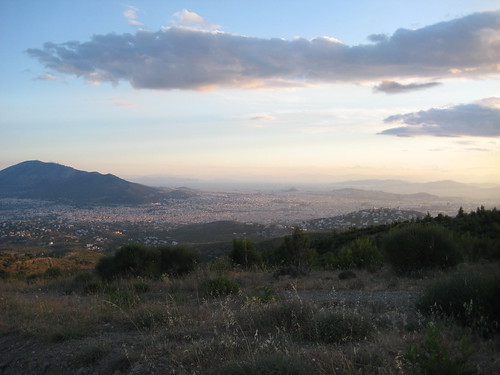
 Tuesday I discovered this view from the roof of the Athens Centre. That’s the Acropolis on the left. You know how in movies set in Seattle, the Space Needle is visible from every point of view in the city, even though it isn’t in real life? Well, in real life, the Acropolis is pretty much visible from any point in Athens. It’s a city that hasn’t really discovered ultra-tall skyscrapers, and while there are a number of smaller buildings that crowd together and make it difficult to see a lot of the surrounding hills, you can catch a glimpse of the former cathedral of Athens virtually everywhere you go.
 Wednesday, I went with Anna, Stefanos, and Liana to a concert at
  d she doesn’t quite yet know how to end a song all the time, but there’s a lot there to like. The only place I have found where somebody in the United States might buy her music is
  Also, Coraline (subtitled “The house in the fog” in Greek) was a lot better with Greek subtitles than Angels and Demons was. (Not, mind you, that we should be surprised by this.)


 Leitourgeia kai Qurbana: Contra den Zeitgeist