Archive Page 7

Upcoming itinerary: Mid-Eastern Federation of Greek Orthodox Church Musicians 2013

I didn’t have a chance to post on it at the time, but I recently had a lovely time at the 2013 Liturgical Singing Seminar of the ROCOR Diocese of Chicago and Mid-America. It was held at St. Sergius Cathedral in Cleveland, which was a breathtakingly gorgeous setting for the event. I also got to see my friends Kurt and Larissa Sander, I met some really great new friends, I got to sing some really amazing music with a wonderful group of people, and I got to experience a near-3 hour long hierarchical Divine Liturgy. Very glad I was there.

Next weekend (19-21 July) I’ll be at the convention for the Mid-Eastern Federation of Greek Orthodox Church Musicians (MEFGOX) in Cincinnati, and I’ll even be teaching a session there — on Saturday, 10:45-12:00, I’ll be giving a workshop on the Third Mode, focusing mostly on the resurrectional hymnody for Sunday morning. If you’re there, please come and say hi!

Call for papers for Byzantine Studies Association of North America sessions at Kalamazoo 2014

The Byzantine Studies Association of North America (BSANA) sponsored sessions at the International Medieval Congress in Kalamazoo this last May, trying raise the profile of Byzantine matters amongst medievalists in general. They’re sponsoring another couple of sessions in 2014, and I pass along the CFPs here:

CFPs: BSANA-sponsored sessions at 2014 International Congress on Medieval Studies, 8-11 May 2014, Western Michigan University, Kalamazoo, MI

Session A: Contested Spaces and Byzantium

The landscape of the Roman world as it began fragmenting in late antiquity, as well as its proximity to Sassanid Persia (and later, the Caliphates, the Abbasids, the Seljuks, and then finally the Ottomans) meant that the Eastern half of the Empire was constantly having to solve the problem of contested spaces on several fronts. Militarily, the frontier of the Middle East was subject to much back-and-forth between Persia and Byzantium, as the early sixth century Sassanid siege of Amida demonstrates, as does the expedition of the Himyarites into northern Arabia. The Sassanid desire to restore Achaemenid-era borders in the Middle East and Asia Minor also made Jerusalem and Antioch the objects of struggle over occupation in the early seventh century. Of course, Muslim possession of formerly Roman territories fueled the Crusades during the Middle Ages, making Constantinople itself an object of siege and an occupied territory in the thirteenth century. In between the seventh and thirteenth centuries, the Bulgars, Khazars, Rus’, and Seljuk Turks turned eastern Europe and the Balkans into focal points of military struggle as well, such as with the Battle of Manzikert in the eleventh century.

From a religious point of view, central and eastern Europe became loci of conflict and negotiation between Byzantine and Frankish Christianity, such as the mission to Moravia of Cyril and Methodius, and the apparent jockeying of the Bulgars and the Rus’ between Constantinople and Rome for the most favorable terms on conversion.

On a civic scale, the Byzantine city itself has been a location of physical and religious strife; militarily, besides the 1204 sack of Constantinople by the Fourth Crusaders, there was the 626 attack by the Avars, and the tenth century sea attacks by the Rus’. In religious terms, the public spaces of cities in Byzantium have been subject to struggle, such as the competing choral street processions of the Arians and the Nicenes led by John Chrysostom in the late fourth/early fifth century, the East/West religious aspects of the Latin Empire of Constantinople in the thirteenth century, and into fourteenth century with the theological dimensions of the Zealot/Hesychast controversy in Thessaloniki. Even within the church building, there is discursive and liturgical struggle, such as Symeon of Thessaloniki’s pitting of the “sung service” of Hagia Sophia in Constantinople against the neo-Sabaïtic typikon that had become nearly universal by the time Symeon was writing in the fifteenth century.

This panel, then, will explore the theme of contested spaces in Byzantium. How can we better understand and interrogate issues of space and society in the Byzantine world? How do social forces in Byzantium construct these spaces, and how do these spaces, be they physical or ideological, subsequently influence society? What fresh theoretical approaches might be helpful?

Session B: Remaking the Empire: Socioeconomic Connectivity and Imperial Architecture under Justinian

Justinian’s empire saw Constantinople control the most extensive territory it would hold for the rest of its days.  These conquests also renewed networks of socioeconomic connectivity across the Mediterranean, bonds that held west and east together and facilitated the movement of not only goods and people, but ideas, styles, and even disease.  Within the artistic and architectural spheres, this connectivity–along with the emperor’s Mediterranean-wide ambitions–led to a period of building on a grand scale. Broadly Byzantine structures in part modeled on the cosmopolitan style of the imperial heartland appeared throughout the Mediterranean, and even the white marble quarried from the island of Marmara saw use in every corner of the restored Empire. Justinian’s building program itself has been well studied and its artistic uniformity is well known.  What is comparatively poorly understood are the networks of exchange and communication that facilitated the movement of these ideas and materials, and the situation of these new structures and styles within local settings. Under what directive was marble quarried and shipped?  How were building materials transported, and how was this transportation financed and organized by official or private mechanisms?  Who were the artisans? And how were these new structures understood by local communities far from the Byzantine core?  To what extent did they represent foreign dominance? How might their meanings have been transformed and renegotiated within different local contexts? This session brings together scholars exploring the role of renewed socioeconomic connectivity in the development of the vibrant artistic and architectural programs of late antiquity.

Please send abstracts of no more than a page to Richard Barrett at rrbarret [AT] indiana . edu by 15 September 2013.

A new acronym – ABD

I suggested three and a half months ago, right after I passed my exams, that I might defend my dissertation proposal by the beginning of May. Well, for reasons of the availability of committee members, it didn’t get scheduled until 10 July, this last Wednesday. Between 29 March (my oral exam) and 10 July, I finished out the semester, presented part of an earlier draft of the proposal at the International Medieval Congress in at Western Michigan University in Kalamazoo, MI, started a 9-week intensive summer Arabic course, and did a page 1 rewrite of the dissertation proposal about two and a half weeks before the defense.

I’m not even going to suggest that Wednesday was a smooth ride. They grilled me so thoroughly I felt like St. Laurence of Rome by the end — black and crispy on both sides. Still, I passed, which means I’m now a Ph. D. candidate and not just a student — ABD, “all but dissertation”. I’ve gotten over all the hurdles I’ve needed this year (although it might fairly be said that I caught my toe on one or two of them in the leap), and now it’s time to actually demonstrate I can write a dissertation — “Civic Devotions to the Mother of God in Late Antique Constantinople” is the working title right now, although that will likely change. In a nutshell, I’m foregrounding liturgical issues in the growth of Byzantine Marian devotions between the Council of Ephesus and the Persian/Avar siege of 626 and trying to see what that can tell us about why the Constantinopolitan cult of the Theotokos develops the way it does.

That said, my first task as a newly-defended candidate is to rewrite my proposal from scratch (again) by the beginning of August. Yeah. There’s a story there that I’ll have to save for another time; suffice to say that, like I said, I was black and crispy on both sides by the time we were all done on Wednesday. Still, we’re all shooting for me to be done by the end of the 2014/15 academic year, and I think that’s going to be very doable, God willing.

I’d like to take a moment to thank two people in particular (not that they will ever see this blog, but never mind): Professors Edward Watts and Deborah Deliyannis. I have been fortunate enough to be blessed with both a wonderful Doktorvater as well as Doktormutter in this crazy experience of getting into (and checking the boxes to then get out of) grad school, and without their advice, guidance, and occasionally pugilant advocacy since before I even got admitted to the department, I’d have been up a creek from the start. I’m thankful for both of them, to say the least.

More a bit later.

Book review: The Typikon Decoded by Archimandrite Job Getcha

French is, truthfully, not the hardest research language in the world to learn for an Anglophone, but there can be other issues of access that a translation put out by an Anglophone publisher can help minimize — like, well, access. For example, I don’t really think I would have too much of a problem with the French in Archimandrite Job Getcha’s Le typikon décrypté: manuel de liturgie byzantine (Paris: Cerf, 2009), but a quick consultation of WorldCat tells me that, were I to try to get it via interlibrary loan, my home library would have all of three options in the entire world from which they could try to acquire it. Were I to try to buy it, it would be probably close to $70 once all shipping charges and currency conversions had taken place. By contrast, even if I don’t have a problem with the French, getting Paul Meyendorff’s translation, The Typikon Decoded: An explanation of Byzantine liturgical practice (Yonkers: St. Vladimir’s Seminary Press, 2012), for $23 and free shipping is just a lot easier all around. That may not be the most scholarly attitude in the world, but I’m over it.

I will admit that I am first and foremost a bit befuddled by the title of this book. I assume it is intended to evoke Schmemann, who in Introduction to Liturgical Theology criticized the modern implementation of liturgical rubrics, arguing that liturgical taxis

was fettered and became the private possession of the typikonshckiki precisely because the ecclesiological key to its understanding and acceptance had been lost and forgotten. It is only necessary to read over the “rubrics” and prescriptions with new eyes, and to meditate on the structure of the Ordo, in order to understand that its major significance lies in its presentation of worship as the service of the new people of God… [E]verything that is important and basic in the Ordo is a Byzantine “transposition” of the original meaning of worship as the corporate act and “fulfillment” of the Church. (pp.218-19)

In other words, Schmemann is saying, the Typikon is best understood as a descriptive document of how the Church worships, not a prescriptive document of how churches should worship. I’m not here to argue or side with Schmemann; my point is simply that the title appears to be referencing this critique and suggesting that the author has taken Schmemann’s call-to-arms as his mission. The preface suggests something of this approach in talking about about how the Typikon, “…far from being merely a collection of dry and legalistic rules, is in fact a summary of two millennia of the Church’s experience… It is living Tradition and the foundation of Orthodox spiritual life” (p.7). Despite comments like that, Schmemann’s manifesto doesn’t really seem to be the practical trajectory of the book, however — which, I should hasten to say, is fine, because there are lots of other merits that make the book worthwhile, but perhaps a title less laden with baggage would have been more to the point.

So, what is the book doing? The first chapter is a very nice introduction to liturgical books used in the Byzantine rite; he uses Velkovska’s chapter “Byzantine liturgical books” in Liturgical Press’ Handbook for Liturgical Studies (1997) as a starting place, which has been a standard reference (to say nothing of the only real resource for Anglophone scholars available) up till now, but he’s able to bring a number of points up to date, which is most appreciated. It’s an excellent summary of what the different books are and the historical issues surrounding them. Following that discussion, the second chapter outlines the services of the Hours, the services celebrated daily apart from the Divine Liturgy — the Midnight office, Orthros, the Hours themselves (First, Third, Sixth, Ninth, the “Intermediary” Hours, Typika), Vespers, and Compline. Again, Archimandrite Job does a lovely job giving an introductory explanation of what the individual offices are and a brief account of where they come from.

The third, fourth, and fifth chapters are largely matters of application, dealing with the Typikon is applied for services governed by the Menaion, that is to say the observances tied to fixed calendar dates, then the Triodion, the observances leading up to Great Lent and going up through Holy Week, and finally the Pentecostarion, the services throughout Paschaltide, ending with the Feast of All Saints on the Sunday after Pentecost. As with the first couple of chapters, there are brief, useful summaries of historical matters throughout.

The Typikon Decoded is quite useful as an introductory treatment of Byzantine liturgical issues; one gets a sense of the various historical poles at work — city and monastery, Jerusalem and Constantinople, Studite vs. Sabaite, contemporary Greek practice vs. contemporary Slavic practice, etc. — and how these factors are synthesized over time. In conjunction with something like Robert Taft’s The Byzantine rite: a short history, a similarly accessible treatment of some of these issues, albeit from a bit of a different angle, Archimandrite Job’s book could serve as an excellent initial reference point. One also gets a picture of the foundational scholarship that is still yet to be done for Byzantine liturgy; critical editions of the liturgical books, for example. This is a baton that somebody needs to pick up and run with; there’s a lifetime’s worth of work out there for the textual scholar interested in Byzantine liturgy (and, it should be noted, Archimandrite Job is hardly the first person to try to encourage some reader somewhere to take it on).

Some caveats must be noted, however. Other reviewers have already noted the near-total absence of Greek language liturgical scholarship by important figures such as Gregorios Stathis; besides that oversight, with the exception of a small handful of significant references — the aforementioned Velkovska, for example, and Peter Jeffery’s work on the Georgian recensions of the Jerusalem liturgical books in relation to the Oktoechos — Archimandrite Job effectively treats Anglophone scholarship as so much chopped liver. It seems very odd to this reviewer, for example, in a discussion of the state of the question of psalmody in the Cathedral Rite of Hagia Sophia, to ignore Alexander Lingas’ studies of the Great Church’s Vespers and Matins services. Granted that the Matins study remains unpublished as a book (“yet”, I am assured), but the dissertation is readily available as a PDF with a simple Google search. In Archimandrite Job’s treatment of the historical circumstances surrounding Akathistos Saturday during Great Lent in particular, his representation of the current state of the discussion was very surprising, omitting entirely the recent work of Leena Peltomaa and Vasiliki Limberis. That said, the other side of this problem is that the book is a great bibliographic reference for the Anglophone scholar for non-Anglophone research, particularly French and — perhaps more important — Russian. As much as we English speakers may have no excuse when it comes to French (and vice-versa), many of us still make excuses where Russian is concerned (myself included!), and The Typikon Decoded is an excellent reference with respect to that particular language barrier.

Other caveats are more cosmetic; I know we’re not supposed to talk about copyediting issues in book reviews, but persistent errors become distracting. Meyendorff universally chooses the verb “incense” rather than “cense” to describe the ritual action of swinging a smoking thurible, and while the dictionary tells me that’s a perfectly acceptable option, I can’t help but instinctively feel, when I read a phrase like “The priest incenses the entire congregation”, that I’m reading about a cleric giving a particularly bad homily rather than filling the room with aromatic smoke. There’s also the matter of the page header for the fifth chapter giving the chapter title as “The Services of the Pentecostarian” (as opposed to “Pentecostarion”) on every page.

Still, I should stress that these issues are cosmetic rather than substantive. In terms of substance, SVS Press and Meyendorff’s efforts are well worth it, making a very useful introductory treatment of Byzantine liturgy accessible to a wider audience, and giving a much-needed initial glimpse into Russian scholarship for English speakers.

Update, 10:34pm 26 May 2013: Sorry, two other points — a confusing reality of translating this kind of work is that hymns tend by convention to be referred to by incipit; Χριστὸς ἀνέστη, for example, instead of the Apolytikion for Pascha. Well, you have three choices as to how to do that in the target language; if they’re in a liturgical language that you expect your audience to be familiar with, like Greek, you can leave them in Greek. Or, you translate the incipits anew; maybe I refer to Χριστὸς ἀνέστη as “Christ stood up”. Or, you can decide that you’re going to use the incipits of a commonly used set of liturgical books in the target language; the Triodion and Festal Menaion of Met. Kallistos Ware and Mother Mary, maybe, and you make that point of reference explicit in a translator’s foreword. Meyendorff does not leave them untranslated, but I’m not entirely sure what he is doing; the incipits are not what I’m used to, and while I’m able to identify them from context most of the time, he doesn’t explicitly identify a schema that he’s adopting (there is no translator’s foreword or notes, and more’s the pity).

The other point is reasonably brief: a topical index would have been most welcome. Alas.

Update #2, 10:52pm 26 May 2013: One other thing that occurred to me that I really appreciate about Archimandrite Job’s treatment of the Byzantine liturgical aesthetic vis-à-vis the application of the Typikon’s rubrics: he treats it as, in fact, a multisensory aesthetic, rather than strictly as a manipulation of texts. He makes reference to singing, to censing, to lighting of lamps, to ritual movement — he does a very nice job of presenting the services as a bodily experience of worship; it is not simply a cold transmission and reception of texts. He does this without drawing any particular attention to it, it’s simply assumed as being the case, which is why it just occurred to me that it’s one of the positive features of the book.

More thoughts on crowdfunding

Almost three months ago I posted my thoughts on Amanda Palmer’s TED talk, and I hinted at the end that The Saint John of Damascus Society would be trying its own hand at crowdfunding. We unveiled the project on 16 April, and I’m happy to be able to say that when the clock ran out at 11:23am on 16 May, this is how things looked:

sjds kickstarter final tallyMany thanks to all who pledged; there is much more to come where this project is concerned, so if you want to support us as we go forward, you most certainly can — just click here for SJDS’s PayPal button. If you don’t want to do it electronically, that’s fine too; send a note via this form and we’ll work something out.

To share some observations about the campaign that hopefully others might find helpful —

We really learned a lot by just muddling through on this one. The original thought was, hey, let’s make pledging as economically accessible as possible. We want lots and lots of $1-$50 pledges, not a smaller number of $100-$1000 pledges, and we structured the pledging rewards along those lines. The first video was also basically just my disembodied voice presenting a Keynote slide deck as though I were doing a grant proposal. There were a lot of issues that I felt we had to overcome; we’re a new organization without any kind of a built-in audience or name recognition, so we’ve got to sell who we are, we’ve got to sell the project as a whole, and we’ve also got to explain the breakdown of the phases and exactly what is being paid for when. Also, we don’t have any rights to any musical excerpts ourselves, so we seemed limited to what we could do visually. Anyway, I made the snazziest slide deck I could, narrated it as clearly as I could, converted it to QuickTime, and hoped that it would speak for itself.

I got some criticism on the video; too long, too dry, no one’s going to watch it, you pause waaaaaaay too long in between composer names, you sound like Seth Rogen(!), etc. I also got some praise on the video; it’s really compelling how you lay it out, you say everything that needs to be said, etc. The lines seemed to be somewhat age-based; in the end, we went with it.

We launched the day after the Boston Marathon bombing. That was actually really tricky; we were ready to go by the end of March, but we had some administrative hurdles to clear. We decided to launch on 16 April so that we’d be going after tax season — then the bombing happened. We couldn’t really delay any longer because we need to start making arrangements for the fall, so we went with it, and we acknowledged the bombing in our launch blog post. Well, okay, but then the bishops in Syria got kidnapped, which has (appropriately) captured a particular segment of Orthodox social media. All we could do was do our thing, acknowledging that things were happening in the world as it was possible to do so, but I’d be lying if I said that I thought it didn’t hurt us; and, yes, I feel terrible for even acknowledging that. There are things far more important than Kickstarter campaigns.

Regardless, we had a good first few days. We passed $2k in a week, which was ahead of the clock. The trouble was, then we plateaued. We had a few days where we got barely $300 in pledges total. Uh oh, I thought to myself. What’s wrong here? Well, maybe a few things, a friend of mine suggested. The video needs music, the video also needs a face since people give money to a person and not an idea, and you need higher pledging reward levels. Yes, fine, having accessible pledging levels is good, but you don’t want people who want to give more to feel like you don’t want their money. Okay, points taken. With Holy Week coming up, I thought that perhaps we could come up with a new video to reinvigorate the campaign after Pascha; meanwhile, Cappella Romana was kind enough to grant us permission to use some musical excerpts, I restructured the pledging so that there were some higher reward levels, and I also happened to take this picture:

first kickstarter theo pictureWell, right then I knew what to do — promise on the Facebook page that every pledge would generate a new picture of a smiling Theodore.

The combination of the pictures and the higher pledging levels got us another $1,000 of the way there or so, then it was Holy Week. We announced a pause during Holy Week, and posted only links to hymns appropriate to the given day of Holy Week, in various musical styles.

Meanwhile, I was thinking, how do I make a new video? Like, physically and technically, how do I do it?

This turned out to be a question of knowing what I already had. Turns out you can get an attachment for under $20 that makes your iPhone tripod mountable, and the iPhone 5 isn’t a half-bad portable video camera. Also, I found out that iMovie is pretty easy to use, all things considered. So, I got some of my board members on camera at my Paschal lamb roast talking enthusiastically about the project, devised a Theodore-centric framing device, and on Bright Monday I put up the new video, with ten days left to go in the campaign. Within two or three days, the campaign had picked up considerable renewed steam.

There were other issues, though; we got some very puzzling reactions, as well as non-reactions, in certain circles. Some people really wanted to make sure their special interest would be represented before they pledged. “Promise me that one of your composers will include some prostopinije and I’ll pledge, otherwise no deal,” one person said; needless to say, there was no deal to be had, since that’s a creative decision that isn’t up to me, but rather to the composers. (I will say there were a couple of prostopinije partisans who asked very pointed questions; anybody who says Byz chant folks are myopic has never talked to these guys!) Some people didn’t understand that this is intended more as a concert piece than something for liturgical use; other people understood very well that this will be a concert piece and thought that Orthodox composers had no business being involved in such things (one particular jurisdictional music representative said to us, in a nutshell, that the very existence of this project violated most of everything that he had tried to tell people about sacred music over the years, and he saw no good reason to support it), others really didn’t understand why we would bother with the whole science-faith thing, etc. Then there were those who either just completely shrugged it off or who were broke and for whom even $1 was simply too much. It’s possible that we underestimated just how many people for whom this is true who might otherwise be interested in what we’re doing; I’m not sure. In any event, trying to raise awareness in two major avenues of contact for Orthodox musicians produced a certain amount of verbal goodwill (and even there less than perhaps might have been expected, given that the people involved in the Psalm 103 project are largely longtime friends of these groups) but relatively little in the way of pledging.

(Also, I got into a discussion with somebody who was formerly a mover and a shaker in one of the Orthodox music organizations that has been, shall we say, regrouping for a while; this person was in the main supportive, particularly once it was made clear that this work was intended paraliturgically, but did raise the issue that, if we had the resources to start the Saint John of Damascus Society, why couldn’t we have directed those resources to revitalizing an organization that already existed? Alas, as I explained to this person, we actually tried that route quite early on, only to get diddly squat in the way of any kind of interested response.)

What ultimately really worked was when all of our people figured out how to better leverage their own social networks; mine only got us so far, as I expected, but when our board members started directly engaging their own friends and family, it generated a lot of momentum. By the last couple of days in particular, it had become a real horse race, and the drama seemed to produce a number of pledges all on its own. We finished off the campaign with three $1,000 days in a row, and we still got another $400 in pledges in the 12 hours after we hit the goal. By that point, people wanted to back a winner.

So, what are the lessons here? I could make a number of observations, I suppose — for example, the people with a direct, active interest in your project are not necessarily the ones with the resources to support it, and even if they do have those resources, even minor philosophical divergences can be enough to keep them from giving. Thus, you need to be able to sell the idea to people with a more casual, indirect interest. To do that, you need, frankly, a gimmick, you need to not be boring, and you need routes through your social network to reach those people.

Also, acknowledgment goes a long way. In our higher pledging levels, very little of material value was promised as a reward; it was more a question of how far along in the life of the project will somebody continue to be recognized. While our topmost couple of reward levels got no pledges, we got a surprising number of $500 pledges, and that recognition is the main thing they’ll get.

Judging by the number of notes I got last Thursday saying “Wow, congratulations! I didn’t think you’d make it!”, we’ve gotten some attention as a result of successfully getting funded, and that attention is worth something. The thing is, the next couple of phases after this composition phase are going to be exponentially more expensive than this one. We perhaps could have raised the money through more conventional means, but what we wouldn’t necessarily have on the other side is the 143 people we have who now have an active, vested interest in seeing this project develop, progress, and succeed. Those people will be able to help us raise at least some of the money for the next phases, and we’ll be able to point to them as a built-in audience when we’re trying to sell the project to bigger donors and granting agencies.

Anyway — I’m glad it worked out one way or the other, and I’m glad to have a counterexample to my more pessimistic assessment of crowdfunding. If there’s a way what we learned during the campaign can help others launching these kinds of projects, so much the better.

Onward and upward; we’ve got a lot of work to do now. Thanks again to everybody who supported this!

happy theodore

An update on The Saint John of Damascus Society’s Psalm 103 project

Christ is risen! Truly He is risen!

If it’s not one thing it’s another — exams, grading for finals week, Holy Week, and then I’ve also been working on promotion for the Saint John of Damascus Society’s Kickstarter campaign for the Psalm 103 project.

The campaign is proceeding apace; we’re getting into the home stretch, and we still need everybody’s help we can get to get across the finish line. One very cool thing I can share is that during Holy Week, we got word that a public presentation of our work on this project had been accepted as part of Indiana University’s fall co-curricular program Themester.

Here’s an update video we just posted:

Thanks very much for your support!

Newly posted: Hansen and Quinn, notes and answers, Unit VIII

As I promised when I posted the notes for Unit VI, for every $150 tipped, I promise to get the next unit posted within a week. I have to be honest, between Orthodox Holy Week and the end of the semester, I’m a day late (the $150 threshold was met a week ago yesterday), but hopefully I may be forgiven this time. In any event, here you go – I have posted the notes for Unit VIII. Many thanks to all of you who have taken the time to tip.

If you’re looking at this before 16 May 2013, perhaps also consider pledging to this other project I’m working on; if you do that, I’m happy to count that towards the $150 threshold. Just let me know via a comment that that’s what you’re doing, and once the pledge is recorded I’ll update the total here.

As always, if you’ve got corrections, questions, or comments otherwise, let me know — enjoy!

For your consideration: Psalm 103 for the Creation of the Whole Cosmos

Today, the Saint John of Damascus Society unveiled a project that we’ve had in the works since last summer — a collaborative setting of Psalm 103 by a group of Orthodox composers from different musical traditions, inspired specifically by last summer’s announcement about the discovery of the Higgs boson. We’re funding it through Kickstarter; here’s the link. I’ve said pretty much everything I have to say about it on the SJDS blog, but the thing I’ll add is that we’ve intentionally gone with rewards for smaller gifts to maximize numbers of people participating over zeroes on a check.

So, take a look — please help spread the word, on Facebook and elsewhere, please pledge if you feel so inclined, and please pray for us as we undertake this effort!

A word about where we’ve wound up…

In January, we started attending Holy Apostles Greek Orthodox Church in Indianapolis. I had been there once before; they had hosted one of the Indianapolis-area Sunday Vespers services that occur during Lent two years ago, and I was invited to help chant by one of the people who helps coordinate those services. Everybody at the parish was very warm and welcoming, as well as seemingly appreciative of the chanting help, and I’ll tell you what, if the drive hadn’t been such a conceptual barrier at that point (and if Flesh of My Flesh hadn’t been in Germany for the year and therefore not able to participate in such decisions), I would have started going there regularly right there and then.

So, when it became clear that a change of air was inevitable and necessary, my first thought was Holy Apostles. It wasn’t the shortest drive (~1:10), but it also wasn’t the longest, and the memory of them being as nice to me as they had been had really stuck with me in the intervening year and a half. We decided to go after the New Year, on a more or less non-committal basis; however, it’s not stretching things too far to say that that first Sunday, they rather insistently adopted us, and we’ve been there ever since, missing only a Sunday in February when all three of us were sick as dogs.

This community has extended us a lot of hospitality, and has been such a wonderful counterexample to the trope of “unwelcoming cradle parishes”. These people have bent over backwards to make us feel welcome; they have fawned over Theodore, they have taken a lot of time to get to know us, they have opened their homes to us, and really have done more than I would have ever expected based on previous experiences to make us feel like part of the family. Some of the interactions with Theodore have been particularly touching; for example, a yiayia yesterday suddenly came up to him and said in Greek, “Come on, little one, come with me,” and just whisked him off to the front of the nave. “We’re going to see Christ,” she said, taking him up to the icon. “Kiss Christ,” she said, holding him up to it. “He loves you very much!”

As regards chanting, they talked to me about it our first Sunday there, and I was actually planning on just standing in the congregation with my wife and child for a month or so, but when we came back the second Sunday, let’s just say that I found myself unambiguously summoned. At any rate, I have been able to contribute what makes sense to me to contribute, and it has worked well. The other couple of cantors, a couple of Greek gentlemen who belong to the previous couple of generations, have been very generous and just as hospitable as everybody else; they want me to sing what I’ve been trained to sing, be it in Greek or English, and it seems to have been received well thus far. Others in the congregation have been very helpful in terms of helping Megan with Theodore, and that’s also been very much appreciated.

I also have to say, acoustically, it’s a nice little church in which to sing — that is to say, while it’s not a resonant cathedral, I also don’t feel like I have to push at 200% every time I open my mouth to be heard. It’s a favorable enough acoustic that it’s pleasant to sing and I can still talk at the end of the morning. Holy Apostles meets in the freestanding side chapel of a large Disciples of Christ congregation in central Indianapolis; it is a really lovely building, and they have been able to do a lot with it. While it’s not exactly spacious, it’s basically everything they need, and it works just fine for the most part. The cantors wind up standing in the sanctuary, but that’s a practice with ample historical precedent, I suppose, and it works well enough with the space considerations.

Right now, Holy Apostles only meets every other Sunday — as a small community getting established in a rented space, it’s what they feel is the most practical thing for them to do right now, plus they are only serving Divine Liturgy on the Sundays they do meet, not Orthros (another practical necessity, since the host congregation uses the chapel for an early morning service). That has its upsides and downsides for us — it’s meant we haven’t felt like we’ve missed much by commuting, certainly, and we have a relatively easy Sunday morning when we go, but it’s also been hard to feel like a rhythm has gotten established, and it underscores that, as wonderful and embracing as everybody has been, we’re at some distance from the community.

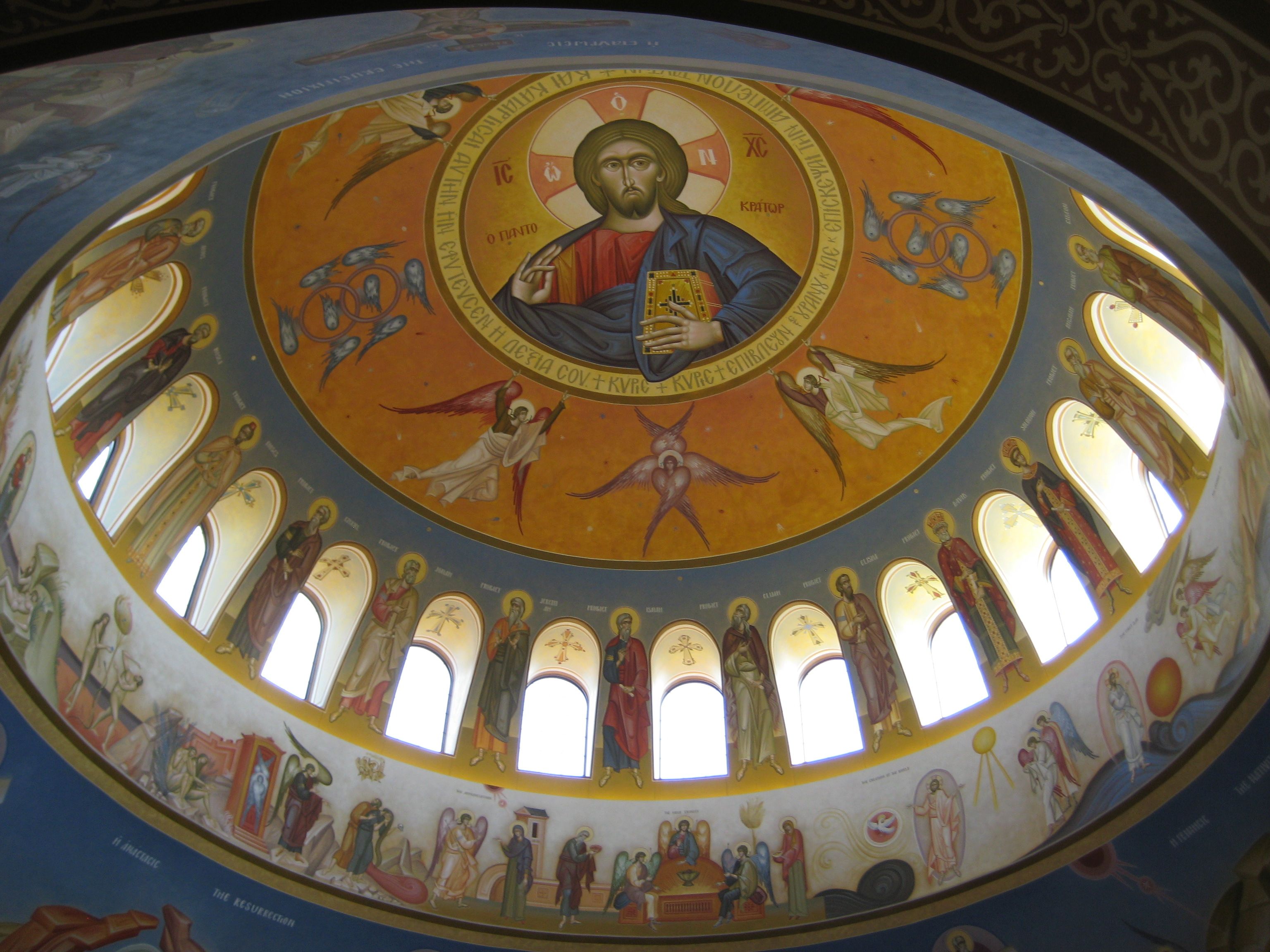
holy trinity frescoing2The lemonade-from-lemons that I’m trying to make from that is chanting at Holy Trinity Greek Orthodox Church on Holy Apostles’ off-Sundays; that’s been harder, because while they do Orthros, it starts at 8:15, so I’ve got to leave here around 6:45am. There are a couple of other couples/families in our peer group who are also driving up there semi-regularly, so how we’re trying to work it for now is I go up for Orthros, while Megan and Theodore come up with one of the other families. Holy Trinity has also been very welcoming to us, and their protopsaltis has been extraordinarily gracious in letting me help, given the irregular basis that I’m there. They’ve also just completed the first major stage of frescoing their new building; iconographer Dr. George Kordis and his team were in residence for a few weeks, painting the dome, the cornices, and the sanctuary. When we were there last he had just finished, and he gave a fascinating talk about the work they had done; the talk alone was worth the drive for the morning.

So, that’s how things have shaken out for us for the time being. We’re members at Holy Apostles, while also floating to Holy Trinity semi-regularly on Holy Apostles’ off-Sundays. I may also float to St. George every so often after this summer; I’m doing an intensive first-year Arabic program, and while I have scholarly applications for that, I’m also doing it, at least in part, to gain some facility with it as a liturgical language. So, we’ll see.

If I may — twice-monthly service schedule aside, if you’re looking for an Orthodox parish in the Indianapolis area, Holy Apostles really is a lovely, warm, and welcoming group of people, and their priest, Fr. John Koen, is a very kind and soft-spoken man who’s got a lot to say of substance, but he won’t beat you over the head with it. By all means come visit, and please find me and say hi if you do. (You can find them on the web as well as on Facebook; in both cases the presence is still developing, but the core details are there.)

One more hurdle cleared…

As noted back in January after I passed my Latin exam, yesterday was the date schedule for my oral qualifying exams. Preparation these last two and a half months has involved familiarizing myself with a bibliography of ~70 books (30 Roman history, 15 ancient Greek history, 15 medieval history, 15 relating to my dissertation topic), making sure I can talk with some authority about all of those areas of historical inquiry, as well as keep in my head the broad sweep of those histories, and produce (and be able to justify my choices for) syllabi for undergrad survey courses in ancient Greece and the middle ages.

Simple, right?

What I found during my preparation is that the hardest thing for me to do was keep the big picture in my head. This makes a lot of sense, really; most people start with a survey and then gradually narrow their focus. Because of how I got here, I really started with the details I was already interested in, and then had to figure out how to broaden my perspective so I could contextualize those details in a wider discussion. At some point I had to sit down, make a huge timeline from 753 BC to 1453 AD, divide it into periods, and force myself to refer to it constantly.

Anyway, without getting into a transcript of the exam, my committee members seemed pleased enough to tell me yesterday afternoon that I had indeed passed. The issue I describe above came up in their feedback, and what they said about definitely made sense and was helpful in terms of figuring out how to frame things in the future, but they didn’t treat it as a showstopping issue by any means.

It’s a step that feels very good to have done, and I left the room yesterday with both a sense of accomplishment (to say nothing of gratitude to my committee and everybody else who has helped get me here). So, on to the next step. I have a dissertation prospectus to defend now, and we’re trying to button that date down right now. It looks like it might be sometime during Orthodox Holy Week, possibly Holy Friday; we’ll see how it all shakes out. Once that’s defended, then I’ll be ABD (“all but dissertation”), and while I know this isn’t the case for everybody, the dissertation is the part I’m really looking forward to.

Your prayers up to his point have been greatly appreciated; your prayers moving forward are equally craved. I’m getting there, bit by bit…


adventures in writing alexander lingas all saints bloomington all saints orthodox church american orthodox architecture american orthodox music american orthodoxy Antiochian Archdiocese Antiochian Orthodox Christian Archdiocese of North America Antiochians books byzantine chant cappella romana chant church architecture ecclesiastical chant ethnomusicologists ethnomusicology fellowship of ss. alban and sergius Greece Greek greek food greekness hazards of church music international travel tips ioannis arvanitis joe mckamey john michael boyer kurt sander Latin liturgical adventures liturgical architecture liturgical music liturgical texts and translation liturgy liturgy and life lycourgos angelopoulos medieval byzantine chant Metropolitan PHILIP militant americanist orthodoxy modern byzantine architecture modern greek music music as iconography my kids will latin and greek when they're newborns my kids will learn latin and greek when they're newborns orthodox architecture orthodox architecture is bloody expensive Orthodox choir schools Orthodox Ecclesiology orthodox outreach orthodox travel pascha at the singing school Patriarchate of Antioch Patriarch IGNATIUS IV Patriarch of Antioch publishing random acts of chant richard barrett in greece richard toensing rod dreher sacred music st. vlads st john of damascus society Syriac the Bishop MARK fan club the convert dilemma the dark knight The Episcopacy The Episcopate the only good language is a dead language this american church life travel we need more american saints why do we need beautiful music in churches?

Blog Stats

  • 266,235 hits

Flickr Photos