Archive Page 57

Evangelism the old-fashioned way

As long as we’re talking about Western saints, here’s this item from Aaron D. Wolf (what a great name) by way of Ben at the Wittenberg Trail (to whom I’d love to link, but I can’t, because the Wittenberg Trail is evidently a private forum) by way of Alden Swan:

Here’s what I can’t figure out: How in the world did Saint Patrick evangelize all of those Druid priests and clan chieftains without a mission statement? After all, history and tradition tell us that he walked around preaching and performed an occasional miracle. But how did he know what his mission was? Aaron D. Wolf, The Mission of Souls: When Experts Attack

[…] Mr. Wolf raises some interesting questions and challenges to modern Evangelical concepts of evangelization and mission, contrasting the wisdom of being “pupose driven” to the pre-marketing (pre-modern) habit of simply proclaiming the Gospel.

Wow. What a concept.

This gets me thinking about something which has occurred to me before — I have to believe that liturgy is one of our better and more underappreciated evangelism tools. I guarantee you that St. Patrick wasn’t just walking around preaching and “performing occasional miracles” — he would also have been celebrating the Mass, with the Eucharist as his “mission statement.”

small country churchThe model of evangelism that would be wonderful, if cost-prohibitive, would be to go places where there aren’t churches and start by building simple, but identifiable, churches (such as Trinity Church in Antarctica of all places, pictured at right) where they would be visible and accessible, start publicly holding services so that people can tell that’s what you’re doing, and equip them so that they can host a soup kitchen or something similar. The problem with so many missions is that they can ill-afford being in a place where they would actually be visible and it would be clear what they are doing, so they wind up evangelizing only the people who are already there. Right now, at least in the Antiochian Archdiocese, you have to have some number of pledging families (25?) before you can have a priest assigned to you; that’s good business and fiscally responsible, no question about it, but who’s doing the evangelism in that case but people who aren’t necessarily equipped to do it? I’m not saying that any Orthodox jurisdiction in this country has the money to spend, say, a half million to a million dollars planting missions so that they have buildings, priests, and services for the poor at the outset, but I sometimes wonder if that wouldn’t be a better witness all around.

I’m still waiting. Actually, I’m waiting on a couple of things — one fairly big thing, and one thing that is big-ish, but not on the same level as the other thing. (Confused yet?) In the meantime, however, I can reveal that I’m presenting a paper at Indiana University’s Medieval Graduate Symposium on 29 March. I can also give a heads-up that my church choir will be publicly presenting music from Holy Week as part of  IU’s Middle Eastern Arts Festival on 29 March. (Yes, the same 29 March. It’s gonna be a busy day.) Details for the whole ongoing program are here, but here’s the blurb for this particular event (I’m not going to use the word “concert,” for several reasons):

Concert: Choral Music of the Middle East
Behold, the Bridegroom cometh: chants from Holy Week in the Lebanese and Syrian tradition

March 29, 2008, 8 pm
St. Paul’s Catholic Center

The All Saints Antiochian Orthodox Christian Choir under the direction of Richard Barrett will present an evening concert of liturgical music from the Middle East. The program will highlight music from the Syrian and Lebanese traditions. Meditative and celebratory selections drawn from Holy Week and Easter services exemplify how this music became an integral and functionally practical part of Orthodox ritual. While the traditional liturgical languages for the Orthodox in the Middle East are Greek and Arabic, selections will also be performed English.

I didn’t write that, by the way. I will be writing a set of program notes, however, which I will post here. I can say that this is exactly the kind of thing I hoped we’d eventually be able to do, and I’m really encouraged by how the rehearsals have gone — it’s stretching them beyond what their comfort level has been, but in a very doable fashion, and it will be a good thing for us to participate in this kind of outreach. Hopefully I can post a snippet or two from the evening itself afterwards.

St. Richard of Wessex

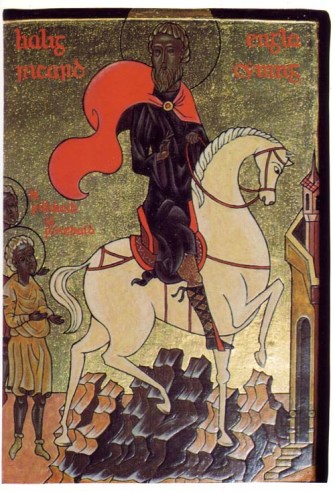
st_richard_of_wessex.jpg There isn’t exactly a ton known about St. Richard of Wessex (alternately known as St. Richard of Swabia and St. Richard the Pilgrim), whose feast is celebrated today. All we really know for sure is that he was an English saint who, after reposing in Italy, was venerated in Germany. There is far more known about his children, Ss. Walpurga, Winebald, and Willibald, and his brother, St. Boniface (aka St. Wilfrid) than about him. Nonetheless, here is a fairly reasonable summary of what can be said about St. Richard, from this website.

Died 722. Perhaps Saint Richard was not really a king–early Italian legend made him a prince of Wessex–but his sanctity was verified by the fact that he fathered three other saints: Willibald, Winebald (Wunibald), and Walpurga (Walburga). Butler tells us that “Saint Richard, when living, obtained by his prayers the recovery of his younger son Willibald, whom he laid at the foot of a great crucifix erected in a public place in England, when the child’s life was despaired of in a grievous sickness. . . . [he was] perhaps deprived of his inheritance by some revolution in the state; or he renounced it to be more at liberty to dedicate himself to the pursuit of Christian perfection. . . . Taking with him his two sons, he undertook a pilgrimage of penance and devotion, and sailing from Hamble-haven, landed in Neustria on the western coasts of France. He made a considerable stay at Rouen, and made his devotions in the most holy places that lay in his way through France.”

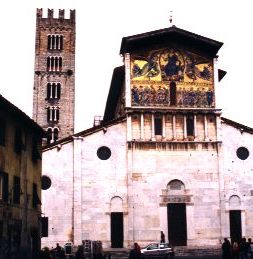
He fell ill, died suddenly at Lucca, Italy, and was buried in the church of San Frediano. A later legend makes him the duke of Swabia, Germany. Miracles were reported at his tomb, and he became greatly venerated by the citizens of Lucca and those of Eichstatt to where some of his relics were translated. The natives of Lucca amplified accounts of his life by calling him king of the English. Neither of his legends is especially trustworthy–even his real name is unknown and dates only from the 11th century. A famous account of the pilgrimage on which he died was written by his son’s cousin, the nun Hugeburc, entitled Hodoeporicon (Benedictines, Encyclopedia, Farmer, Gill, Husenbeth, White)

In art, King Saint Richard is portrayed as a royal pilgrim (ermine- lined cloak) with two sons–one a bishop and one an abbot. His crown may be on a book (Roeder). He is venerated at Heidenheim and Lucca (Roeder).

sanfrediano.jpgSome additional information about St. Richard and his family can also be found here. I hope that at some point I can visit the church of San Frediano in Lucca (pictured) to venerate his relics. I almost had a chance to go a few years ago, but it didn’t pan out.
A word about names. “Richard” is a Germanic name which means “Powerful ruler”; I expect it is related to the modern German word “Reich” and the name “Reichert”, and I’d be really surprised if it weren’t cognate with the Latin “rex”. If they presumed the anonymous saint was a king, “Richard” would have been a perfectly descriptive name to ascribe to him.
For my part, I was thrilled to discover the existence of a pre-schismatic St. Richard. Richard is my name, and count me as part of the camp that believes that names are given and not chosen, so I was overjoyed when it turned out that my given name was a perfectly good Orthodox saint’s name. Of course, having a feast day doesn’t mean he’s on my priest’s list of saints to commemorate, so it’s a name day that virtually nobody (and I mean nobody) ever remembers, but oh well.
St. Richard of Wessex, pray to God for us!

A one-sided interfaith dialogue

With a tip of the hat to Dr. Liccione, I give you “Is religion losing the millennial generation?” from the weekend’s USA Today. I won’t belabor any point Dr. Liccione hasn’t already made, except to take some of what he says a step further and to suggest that the way these students “invent” their religions indicates that for them, religion is best when it functions as a mild, feel-good, universally-affirming entertainment — not unlike, perhaps, a Tom Hanks/Meg Ryan comedy.

That said, there’s this point —

Study after study has shown that American college students are fleeing from organized religion to mix-and-match spirituality.

True; let’s also note, however, that this trend also exists within organized religion. My emergent church friends like to tell me that their idea is to take the best of all Christian traditions, put ’em all into the same pot, and then have everybody put something else intensely personal into the mix, so that the end result is (as they argue) something totally new. They may not be busting down the door of their parents’ or grandparents’ churches, but they want to build a modern church using the best of what those congregations had to offer. No, they say, we don’t want to be Orthodox and limit ourselves to a particular tradition, but icons, incense, and chant seem like they’d be cool to use as building blocks for something else. Their argument is that, sure, maybe that’s reinventing the wheel, but wouldn’t it be limiting the creative movement of the Holy Spirit to have it any other way?

Then there’s this point:

…I can’t help but think that priests, rabbis, imams and ministers would do well to engage in interfaith dialogue not only with one another but also with this “spiritual but not religious” generation.

It is certainly true that we need to do a better job of engaging the “spiritual but not religious,” but I think it would be a mistake to suggest that it’s “interfaith dialogue.” “Nothing” is not a different kind of “something”; it is nothing. The job we need to do is, while having compassion and charity for how they’ve arrived where they are at, showing them why having something is better than having nothing.

It will be a tough job, no question about it. Part of the problem — and I think this is demonstrated by the article — is that if they don’t think it’s real in the first place, then why does it matter which made-up version to which one ascribes? Then it really is a question of which one is more entertaining, which one gives you a fuzzier feeling in your stomach. So how do you engage so that they see that there is in fact something real there with which to connect?

It’s going to take some work.

On being late to parties

It often happens to me that I come to a particular conclusion on my own in isolation, only to find out much later that not only are there educated people who are thinking the same way, but there have been educated people thinking about it for years and have a formal way of talking about it.

When I was a child of eight or nine, I formulated a set of principles regarding how to describe the sounds we use to form words; I tried explaining them to my parents, who didn’t understand anything I was saying, patted me on my head and treated it similarly to when, at age five, I told them I was going to build a time machine. (Long story. Short version: I built it, but it didn’t work.) When I was seventeen, in my freshman Italian Diction for Singers course, I learned the International Phonetic Alphabet and was floored to realize this was exactly what I was trying to explain to Mom and Dad ten years earlier when they were giving each other looks saying, “Are you sure this is our kid?”

When I was thirteen, I discovered this awesome movie on VHS that neither my parents nor any of my friends had ever seen. It was called Blade Runner. It was 1990.

When I was sixteen, realizing I was extremely hard on my footwear, I shopped around for a good, durable shoe that could last me a couple of years. After a bit of research, I bought a pair of Dr. Martens, only to discover that the alterna-kids had been wearing them for a couple of years by that point.

Then there are parties to which I’ve been late as an adult.

All of this is to say — because I’ve evidently been far more sheltered than I realize, it’s always a shock to me to find out that there are smart, credentialed people out there who have had “my ideas” — well before I was born, in some cases. It’s a good shock, more often than not; it tells me I’m not as crazy as I sometimes think I am.

So, with that as background — my whole life, I’ve felt quite conflicted in terms of where I fall on the political spectrum. In broad strokes, we may say that I’ve never felt conservative enough for the Republicans or liberal enough for the Democrats, or at least never on the right issues, for either platform to particularly want me. I’ve often self-identified as a “moderate,” which I’ve sometimes joked as meaning “Everybody wants my vote but nobody wants to admit they agree with me.”

Let me give an example to demonstrate how this is problematic. I’ve come to the conclusion over the years that I’m pro-life, but I’ve further concluded that in order to be completely consistent and intellectually honest, “pro-life” can’t just mean “anti-abortion.” It has to mean pro-life. All life. Therefore, if abortion isn’t justifiable, neither is capital punishment, nor war. However, insofar as “pro-life” means “anti-abortion,” I vehemently disagree with people who blow up abortion clinics and attempt to kill doctors who work at Planned Parenthood. I would rather see about volunteering at a Crisis Pregnancy Center (which is itself problematic, partially because I’m a guy and partially because many of those places are set up around an Evangelical Protestant paradigm and want you to sign a “Statement of Faith” which includes things with which Orthodox and Catholics disagree) or supporting peaceful, positive events like the Walk for Life or some such.

Anyway, the point is, already I’ve taken a stance that pretty much rules out any ability to identify with Democrats, and also eliminates the Republicans as political allies, by and large.

This has had no small impact on how I’ve practiced my faith; there was a point, particularly in my late teens, when I was hesitant to identify myself as a Christian, because the biggest and loudest examples I saw of Christianity were abhorrent to me. Particularly given how I grew up, I knew of only three ways: Evangelical Christianity, which certainly had the most airtime and seemed to yell the loudest, but which also seemed to put forth the most effort in pointing the Almighty Finger; Roman Catholicism and anything which looked, sounded, or smelled like it, which I had been carefully taught was not Christianity and was potentially the most dangerous force on earth; and finally, the blatant non-Christian cults, which, I had been taught, included Mormonism, Jehovah’s Witness, and Unitarian Universalism. My Evangelical friends didn’t understand my discomfort with identifying Christianity with the Republican party OR with the handwaving and shouting that went on at the church at which I (sort of) grew up; my liberal, “spiritual but not religious” friends didn’t understand why I couldn’t see that Christianity was fundamentally stupid and evil.

Over the years, these issues have sort of shaken themselves out. When I first discovered Russell Kirk and his six tenets of conservatism, I thought to myself, “If that’s what a conservative thinks, then I guess I’m a conservative.” Kirk’s classical conservatism was radically different from the angry, anti-intellectual neo-conservatism to which I had been primarily exposed growing up — a philosophy that steadfastly refused to define itself any further than, “If it ain’t broke, don’t fix it.” Kirk, Orthodox Christianity, Crunchy Cons, G. K. Chesterton — these have all to some extent provided answers and explanations, if not easy resolutions, to many of the tensions I perceived growing up. If they haven’t provided answers, they’ve at least given a window through which I can see the other people who are thinking the same way I am — however few there may be.

Having developed at least a loose framework for the way I’m learning to see things, I have two words with which I want to leave off for now.

Those two words are: Christian communitarianism.

So. Discuss. I think I have a bit of reading to do, on the other side of which it might turn out that it’s nothing. Or, it may very well be another party to which I’ve simply come late, in which case let me know, and then give me a few minutes so I can run out and bring back some beer — or at least read some Wendell Berry.

Is it February already?

It’s been one of those proverbial long weeks. Rehearsals for a choral concert (my first extra ecclesiam gig in a couple of years), a vocabulary quiz in Syriac (which was, shall we say, humbling), plus all of my normal stuff. We’re reading the Gospel of St. Mark in my Syriac class; a moment of unintentional humor may be found in 15:34 — “Jesus cried out in a high voice: ‘My God, my God, why have you left me?’ which is, ‘My God, my God, why have you left me?'” I guess it tells you that the Syriac scribes were following as closely as they could.

I’m still waiting, by the way.

The current issue of AGAIN has a few things worth noting. More than anything, I want to point out the article by my friend Maggie Downham, “The Raphael House: An Orthodox Response to Poverty.” It’s a combination of elements of her senior thesis, “Eastern Orthodox Theology and Virtue Ethics,” with things she’s experienced since she moved to San Francisco to work for Raphael House. The article isn’t yet available online, but here is an excerpt or five (and I wouldn’t post so many if I didn’t think they were worth your time and/or if AGAIN were easily obtainable at Borders):

In 1971, Raphael House of San Francisco became the first shelter in the city to focus on the needs of the family as a holistic entity… [Its] approach to poverty goes well beyond the provision of shelter, however. While there are numerous family shelters in San Francisco, an Orthodox presence at Raphael House creates a very different atmosphere and purpose from those of its secular counterparts… [I]t is the sacramental focus of the Church that makes Raphael House a working whom in which the Liturgy is the focus and renewal of those who both live and serve here. The shared experience of the Kingdom and partaking of the Eucharist make it possible for this community to serve the residential families in a way that goes deeper than provision.

[…] The Church as the koinonia is charged with the responsibility to love its neighbor as Christ has loved His people. It is union with Christ through the cup that strengthens the people to return to the world as one body, just as they entered into it, and to perform the Liturgy after the Liturgy. Having been to the Kingdom, they are now able to understand what the world needs… The formation of the koinonia in the Liturgy is not complete or sufficient in and of itself. Instead, the purpose of the koinonia in the Liturgy is to work on behalf of all people everywhere and at all times, manifesting the social responsibility the koinonia has to the people and the world at large… It is the mission of the Church to make known to the world the love of Christ that is manifested to them through participation in the Liturgy and their mystical entrance into the Kingdom of God… Theoretically, the Church is the embodiment of what the world should be, for it is the manifestation of the reality that is to come. In this way, the Church is to transform the world… [T]he Church’s mission… is to transform the world into the Kingdom through the love and light of Christ it receives in the Liturgy.

[…] Addressing social ills, then, becomes more than an external issue. It is a spiritual matter at its root. Healing people is a matter of reaching out to their souls, of addressing the spiritual violence and evil that roars within. Our work should be oriented toward holistic healing: first spiritual healing, followed naturally by healing the physical consequences of spiritual ills.

It is the responsibility of the Orthodox to make our voice known and to take decisive action if we are going to transform the world.

So — how best to respond to her rallying cry? I’ve got some ideas, sure, on what might charitably be called a sliding scale of practicality. Some of them I’ve discussed here and elsewhere. I’m not sure, in general, that I’m the person to propose them so that anyone will listen. Maggie might be, however.

I’ll just say that I met Maggie when she arrived here to finish her undergrad studies, and in the nearly three years I’ve known her she has never ceased to amaze me, for all kinds of reasons (all of them good). I think she’s got a book in her, and that the work she’s doing (of which this article is just the tip of the iceberg) is very important. Her biographical blurb says that she “hopes to explore her interest in the connection between Orthodox theology and social action through her involvement in the nonprofit sector and in future graduate studies”; let it be so!

Along similar lines — elsewhere in AGAIN, a book due out in March by His All Holiness Patriarch Bartholomew of Constantinople, Encountering the Mystery: Understanding Orthodox Christianity Today is discussed (“Conflicted Hearts: Orthodox Christians in an Age of Globalization,” John Couretas). Rod Dreher spoke somewhat dismissively of the book, essentially saying it wasn’t the bold work of prophecy he wanted the Patriarch to have written (and he’s not the only one to have expressed that criticism), but I have pre-ordered it and will discuss it further once I have read it. Couretas certainly makes it sound interesting one way or the other:

The patriarch sees how viewpoints on social questions informed by faith are “proving to be the subjects of renewed interest and attention” in politics and policy circles. Yet he provides a caution: It is not social dogma or political ideology that should be at the center of the Christian’s concerns, but the “sacredness of the human person, created in the image and likeness of God.”

Sounds like a book Maggie should read, too.

The letter column in the same issue of AGAIN also contains a letter from John Truslow, Jr., which makes the excellent and indisputable point that in the United States, Orthodox Christianity is not even a single pixel of a blip on the cultural radar, and up until recently we’ve tossed around demographic data which were inflated at best. He then takes this wonderful, important point and hangs exactly the wrong hat on it:

How we do things either helps or hinders the unchurched from coming to Christ and His Church and either encourages or discourages communicants — particularly “the next generation” of younger Orthodox — from either remaining Orthodox or moving on to other Christian faith communities, many of which are intentionally very attractive (and good for them for bothering to be attractive!). Our theology and morality are not up for negotiation. Everything else we do should be the subject of endless review and creative change.

I cannot disagree with Mr. Truslow in the least that we need to engage our culture more fully, and that disappearing Orthodox youth is a gaping wound we need to figure out how to close, and fast. I find his argument to be rather troubling nonetheless. Rather than shoot off my own mouth about it, I will direct the reader to Fr. Stephen Freeman’s recent blog entry, “At the Edge of Tradition”:

[…] The content of the Tradition is not a set of ideas – but a reality – God with us.

And this is the problem that always accompanies attempts to reach that reality through reform. It is not our reformation that is the problem in the first place. We cannot reform ourselves into union with Christ. We can submit ourselves to union with Christ and not much else. We can cooperate with union with Christ.

[…] You do not appropriate something whose content is God. You are Baptized into it. You are Chrismated into it. You are absolved for ever having lived apart from it. You are fed it on a spoon. You are splashed with it. But you cannot appropriate it. To paraphrase: Your life’s too small to appropriate God.

This is very much the point Maggie makes above: the Liturgy, what the Church does, is how we engage the world. As she says, it is in having been to the Kingdom in the Liturgy that we know what the world needs — not, emphatically not, knowing what the world needs, we now know how to serve the Liturgy.

I would also caution Mr. Truslow of the lessons learned the hard way by the Roman Catholics in Chicago as they’ve been trying to figure out how to stop losing Latinos in droves: “We keep trying to imitate the Protestants, but it doesn’t work.” Why does it seem like we’re trying to talk ourselves into making same mistakes everybody else has made in the last forty years? Maybe we all need to go back and re-read Laurence Iannaconne’s “Why Strict Churches Are Strong.” (Hint: it isn’t exactly because of “endless review and creative change”.)

If we want to engage the culture, then we need to show the culture more of what Orthodox Christianity is, not only try to carefully show them the parts we think they can handle. We’re told to not hide our lights under bushels; we aren’t told to still try to dim the lights when they aren’t covered so that we don’t blind people. This is certainly food for thought, too.

How about this — there are “evangelism packs” of books like Josh McDowell’s More Than a Carpenter; can’t we do something similar with Metropolitan Kallistos’ The Orthodox Church — say, five-packs that we then just give away randomly? He’s the closest thing to an Orthodox equivalent of C. S. Lewis that we have, after all.

…and then I discover that this group exists. Hmm. Y’know, I remember in the summer of 2004, something of a big deal was made over Bush visiting the Knights of Columbus during his campaign. As I recall, I wondered to myself — do the Orthodox even have an organization like that for presidential candidates to snub? Maybe we do. I think I’m interested in finding out more… but I’m also wary. There’s another, shall we say, “concerned laypeople” organization (which shall remain nameless for a couple of reasons) that I almost joined until I realized that what they were advocating was, for all intents and purposes, congregationalism with bishops being kept around for show.

Okay, it’s after midnight. In pace in idipsum dormiam et requiescam.

Thursday and all’s well

To follow are what would normally be inline asides on a blog which uses them. I don’t yet, because I’m not convinced I want to pay for the privilege of editing the CSS, particularly with WordPress’ upgrade to 3GB of free space in the last couple of days. So, bear with me.

I’m waiting right now. Some of you know what I’m waiting for. It is unclear how long I will be waiting. One person who went through this exact same process told me he knew within a couple of weeks; another told me it probably won’t be until the middle of March. I will be happier when I am no longer waiting, regardless of the outcome.

I’m starting to lose a battle against a sore throat. I was in Michigan last weekend with many of our parish’s youth, and between the quite cold weather and being around lots of kidlets, I think I’m set up to come down with something. I always know I’m getting sick because coffee (without which Richard ain’t a happy man, folks) tastes terrible to me when I’m sick; this morning, the coffee wasn’t tasting very good. Sigh.

Now having dipped my toe into three different dead languages over the last couple of years, let me say that one of the gifts of studying a lingua mortua like Latin or Greek is that, without doubt, tons and tons of time and resources have been spent putting together usable materials. This would be as opposed to Syriac, where tons and tons of time and resources, well, haven’t.

For example, one can reasonably expect the following about your standard Greek New Testament:

  • It will have a decent glossary.
  • It will be typeset in a very readable fashion.
  • It will have an apparatus so you know where the text came from.

Whatever one’s disagreements might be regarding the use of the Nestle-Aland critical text, $25.05 for all of the above is a danged good value.

Now, the Syriac New Testament, the ABS edition which is really the only one available, by contrast to the above:

  • doesn’t.
  • isn’t.
  • doesn’t, so you don’t.

Where dictionaries are concerned, you have a bit of a choice: the three-volume Payne-Smith lexicon which is big, expensive, and in Latin; the one-volume Payne-Smith lexicon which is big and moderately expensive; and finally, the much smaller but not much cheaper New Testament lexicon.

So, when reading the New Testament, one way or the other you’re constantly having to look things up in a separate book, and you’re not always sure what you’re looking up because Syriac adds both suffixes AND prefixes to words depending on how they’re used, plus they can go through all kinds of fun changes depending on how they’re prefixed, and, well, the typesetting sucks.

Oh, and the typesetting of the dictionary also sucks. The plates are just old, old, old. You can see what I mean by looking inside the one-volume Payne-Smith on Amazon here. Eventually somebody needs to go through and redo it digitally; I refer anybody to the glossary in the recent `Enbe men Karmo Suryoyo (Bunches of Grapes from the Syriac Vineyard): A Syriac Chrestomathy compiled by Martin Zammit to see what this stuff can and should look like in the age of digital typesetting.

Of course, it’ll still be hella expensive, since there are like forty people in the English-speaking world who care about these things, this being why it won’t happen in my lifetime. If I were a more ambitious and serious Semiticist, maybe I’d entertain the notion of figuring out how to attach myself to such a project and help do it the way it would need to be done, but I’ve no real intention of being that kind of scholar. I am but a beachcomber along the shores of the Semitic ocean, not a deep-sea diver…

…aaaaaaaannnd that was the sound of you (both of you) rolling your eyes simultaneously. Sorry.

At the very least it would be nice to have a standard textbook which isn’t inherently problematic in many respects (both the Coakley and Thackston grammars are, shall we say, no Hansen and Quinn), and/or an English version of the Brockelmann grammar with the chrestomathy (that’s a fancy word which means “reader”), and/or an edition of the Syriac New Testament that is a comparable package to your average Nestle-Aland Greek New Testament. I hear rumors of a thing such as the latter being done at Notre Dame, but it also sounds like there’s going to be a thick, expensive volume for each book of the NT the way they’re going about it. Oh well.

Well. That wound up being a bit more than an aside.

I don’t normally talk about politics here, but this whole business about tax rebates–didn’t we do this back in 2001 or thereabouts? And didn’t it, er, not work, exactly? I mean, I’m not going to beat away with a baseball bat a couple of checks for $300 or $600 or however much they are for our household, but this whole thing sort of comes across to me as, “Now, don’t worry, just go buy a Blu-Ray player and a couple of movies, you’ll feel better.” Am I wrong?

Still waiting.

More from Alden Swan

Swan has some interesting things to say on the relationship between post-Reformation church and Modernism, as well as the question of by which authority we not only interpret Scripture, but by which authority we determine the canon of Scripture.

For example:

One of the most irritating qualities of Modernism is the almost essential arrogance that comes from the belief in progress; that is, that “new” is better than “old.” Evangelicalism seems to exhibit the same tendency to believe in theological “progress,” as well as the resulting sense of arrogance in how they deal with past theological positions. While many would argue, especially in the case of fundamentalists, that this is absurd, I think in the “big picture” it makes sense.

With Evangelicalism, there are some basic presumptions that may not be true. One such presumption is that it is an advancement to think of theology almost as a science, being able to break large concepts down into minute detail and argue over the fine points. This scientific approach has, as Webber points out, reduced theology to a set of facts or propositions which can – and must – be believed. This systematic approach appears to have a goal of eradicating any sort of mystery from theology, believing that we can reason our way through our faith. Our faith (as Webber also points out) can then conceivably be conveyed to others in a logical, reasoned way, what we think of a “apologetics.” Evangelicals reason their way to truth, whereas the reformers simply proclaimed it.

To restate one of his points, Christianity is reduced by this approach to an ideology and a philosophy, rather than a means by which the faithful live their lives. By believing we can simply reason our way through our faith, the opposite has been greatly enabled–one can also very easily reason one’s way right out of their faith, too. I recall no examples from Acts or the Epistles of anybody coming to Christianity through a well-reasoned argument. Truth is a Person whom we meet in Christianity, not a set of precepts. To put it another way, it is not the case that the more one knows about God, the closer one is to God.

I would also tweak his last sentence–the reformers proclaimed the truth which they believed they had found while rejecting the truth which they had received. To understand what I mean by this, it is necessary to jettison the baggage most of us have with the word “tradition”, that it means “we do it this way because we’ve always done it this way and we don’t have a better answer than that”, as typified popularly everywhere from Fiddler on the Roof (a humorous example) to the Shirley Jackson short story “The Lottery” (a horrifying example). It is a given that “tradition” is used in both a positive and negative light in Scripture; there is of course the admonition about “traditions of men” but then also there is 2 Thess 2:15, “Therefore, brethren, stand fast and hold the traditions which you have been taught, whether by word or by our epistle” (compare to 2 Tim 1:13–“Hold fast the pattern of sound words which you have heard from me, in faith and love which are in Christ Jesus”) and 2 Thess 3:6, a reference to “the tradition which you received from us”. The Greek word here is παράδοσις paradosis, derived from the verb παραδίδωμι paradidomi, “to hand over, to transmit”. So, literally, παράδοσις is “that which is handed down” or “that which is handed over”. “Tradition” is simply the Latinate form of the same word; it is from “traditus”, the perfect passive participle of “tradere”, “to hand over”.

So what was passed down? “The faith once delivered to the saints” (Jude 3). “Delivered” in Greek here is again a form of παραδίδωμι, so this is the faith once “traditioned” to the saints. That faith is “the apostles’ doctrine and fellowship, the breaking of the bread, and the prayers” (Acts 2:42), and the apostles had been told that the Holy Spirit, “the Spirit of truth”, “will guide you into all truth” (John 16:13), that truth of the which the Church is “the pillar and ground” (1 Tim 3:15).

Tradition, therefore, is the truth, it is the life of the Holy Spirit in the Church, the Church which is both Body and Bride of Christ, Christ who is Himself the Truth. Tradition is not what we do because we’ve always done it and don’t have a better reason, but rather it is the the faith once “traditioned.”

So, from this perspective, the Reformers rejected that which had been “traditioned” to them while proclaiming what they believed to have been the truth they found, rather than received, by narrowing the list of acceptable sources.

By contrast, what we might generally refer to as “the catholic tradition” proclaims the truth which it receives. I don’t mean for that to sound arrogant (although it inevitably will); rather, that’s what the Greek Orthodox priest to whom Swan was speaking meant when he said that, on the inerrancy of Scripture, “we don’t think that way…we’ve just never questioned it.”

Still, there’s more of a context to his statement than just that, which brings me to Swan’s other piece:

As I think I’ve mentioned before, it is interesting to note that based on what we read in the New Testament, the “Word of God” does not seem limited to anything which was written down, and in fact, seems to speak of oral testimony.

Exactly, per 2 Thess 2:15, as quoted above. This again gets to the heart of the what the priest was saying–the New Testament is a witness to the tradition, to the authority, to the life of the Church already ongoing, not the instruction manual and not the source itself. More specifically, the Gospels and the Epistles are the Truth proclaimed and witnessed to in community–that is, liturgically, since they were written to be read to the assembly when they had gathered. To remove Scripture from this context and try to make it its own discrete source of authority is to obscure its meaning and reduce its authority, not to clarify it.

To relate this to an earlier point, Christianity is not a philosophy derived from a text, it is new life through an encounter with a Person who is the Truth. By being reduced to adherence to a set of precepts found in a text without the continuity of the life of the Church which has been ongoing since Pentecost, Christianity has been severely weakened.

What St. Ignatius wrote to the Philadelphians comes to mind: “When I heard some say, ‘Unless I find it in the official records–in the Gospel I do not believe’; and when I answered them, ‘It is in the Scriptures,’ they retorted: ‘That is just the point at issue.’ But to me the official record is Jesus Christ; the inviolable record is His Cross and His death and His Resurrection and the faith of which He is the Author.” The Scriptures witness to the Faith, not the other way around.

Um, that’s Lisbon

…and speaking of Anthony of Padua, can somebody please get rid of the nonsense in the first paragraph of his Wikipedia entry which somebody apparently thought was funny? Many thanks.

UPDATED, 6:54am 24 January 2008: It’s gone now. Thank you to whoever fixed it.

St. Anthony, St. Anthony, please come around…

One thing I’m hopeful that Delicious will do for me is cut down on the number of books I lose because I loan them out to somebody and forget who. This is not to offer any rebuke to those to whom I have loaned books and who have forgotten to return them or moved away or whatever; Lord knows I’m guilty of same, probably far more than I’m aware.

That said, if I loaned you my copy of Fr. Andrew Phillips’ Orthodox Christianity and the Old English Church, or you know where to find an actual printed copy, could you please drop me a line at richard_barrett (AT) mac.com? This one stings more than some others because the copy I had was extraordinarily difficult to find to begin with, and it has been thus far impossible to replace. Yes, I know Fr. Andrew has made it available as a pdf; you’ll notice I linked to it. For the life of me I cannot remember to whom I loaned it, but I must have loaned it to somebody, because I’ve gone through literally every book in the house–it ain’t there, kids. I don’t mind buying another one if that’s what I have to do, I just don’t have a source through which to do so at present.

If you can help, let me know!

Roman fever and so on

This is over a week old now, but this is the first chance I’ve really had to say anything about it.

Please refresh your memory on what I have said before regarding Orthodoxy and anti-Catholicism.

With that in mind, consider this posting, plus all the comments, over at Cathedra Unitatis.

Personal engagement of one’s faith is a really tricky thing. We are well past the days, for good or ill, when you simply were whatever your family was when you were born and you could count on your parents being the same thing, at least nominally, because they would have to be in order to get married. I would never have been born under such a societal expectation, because my parents have wildly divergent religious beliefs, and neither of my parents really are exactly what they were raised. Mom was raised Lutheran and left that in her 30s for Evangelical shores; Dad was raised nothing exactly, but my grandfather apparently believed in God at some level, and Dad, well, doesn’t. Mom had me baptized Lutheran, we were both baptized again by the non-denominational congregation she chose when I was seven, we drifted through Baptist waters briefly when I was a teenager, I received adult confirmation as an Episcopalian, and was received into Orthodox Christianity by chrismation. Call it “church shopping” if you want, for me, or Mom, or Dad. I call it doing the work of figuring out what you believe and taking it seriously. My father is an atheist because he takes very seriously his beliefs about the nature of the universe, and those beliefs make God irrelevant at best, assuming He even exists. My mother became an Evangelical because she became committed to the things which are distinctive to Evangelicals. I was confirmed as an Episcopalian because I found myself having to take seriously the concept of being in continuity with the Christianity of history when it was manifestly obvious to me that mainline American Christianity did not care about that continuity; I left the ECUSA because it was clear to me the ECUSA as a body was no longer actively interested in maintaining that continuity or even passively allowing for it.

Truth be told, however, I suspect a lot of people, if they were honest about it, would ask, “Why bother?” I’ve read opinions before from people who say that apologetics and convert stories are inherently unconvincing to Joe Average because they’re written from a point of view which already takes this stuff far more seriously than most people ever will. It’s extremely unusual, so the argument goes, for the average person to actually engage faith on such a level–more often than not, people will just fall away rather than attempt to go deeper. Maybe that’s true; I don’t know. So, sure–“why bother?” I can’t really speak for either of my parents, but I bother because my belief that Christianity is true compels me to engage it and take it seriously. It is, as I like to say, that simple and that complicated.

Still, it’s all well and good to say, as I have elsewhere, that I became an Orthodox Christian because I believe it is true (or as Fr. Stephen Freeman likes to say, it is the truth in its fullness). That doesn’t alter the cultural reality that the questions I had are, in this country, far more easily and readily answered by Roman Catholicism, or the personal reality that I was already quite far along on my path to Rome before a couple of chance occurrences redirected my steps towards Constantinople. At the time I realized I couldn’t remain an Episcopalian, Orthodoxy wasn’t even a blip on my radar, and all sights were set on the Vatican. Save for a couple of chance occurrences, I could very well have attended Mass at the various churches I visited in Europe last summer as a communicant. (Yes, yes, I know that as far as Rome is concerned, I still can. As far as the bishop under whose jurisdiction I fall is concerned, however, that’s not the case.) People far wiser than myself have chosen to swim the Tiber; others, also far wiser than myself, have chosen to swim the Bosphorus. I cannot argue with or judge either choice, because various factors make it difficult and painful either way. Whenever somebody suggests that Orthodox converts are inherently anti-Catholic or people who just ultimately couldn’t set aside a cultural anti-Catholicism or people who didn’t consider the evidence with enough faith, I want to both laugh and cry.

I said something about a cultural reality in the last paragraph. I have an Orthodox friend who has periodic bouts of what he terms “Roman fever.” He spent a number of years examining the arguments on the Catholic and Orthodox sides, and ultimately found the Catholic argument unconvincing. He spent a bit longer evaluating the Rome vs. Constantinople case than it really took for him to be convinced because, as he says, he didn’t want there to be any historical or theological “gotchas” that could take him by surprise later–and there haven’t been. What there have been, however, are spiritual and cultural “gotchas,” and those have been much harder to deal with. As he says, it gets hardest around the Nativity Fast and Christmas–it occurs to him, as he’s at the Divine Liturgy for the Nativity listening to texts and music that bear zero relation to anything which has been familiar to him, that just down the street at the Roman Catholic parish is a Christmas service that is using the prayers and carols he knows as somebody who is culturally Western, and he begins to wonder if Orthodoxy isn’t, in practice, really some kind of society for the preservation of Byzantine culture. How in the world does the Divine Liturgy of St. John Chrysostom have anything to do with the modern world, the here and now? What impact on our culture can these alien externals of icons, incense, chanting, vestments, and so on actually have when it seems like we’re basically ignored by most people as “an ethnic thing”, and converts can go off the deep end in terms of embracing ethnic customs that aren’t really theirs in any kind of an organic sense? The history and theology keep my friend where he is, but not without significant and ongoing cultural pain.

Truth be told, while I haven’t had the same issues adapting to the Byzantine Rite, I’m not unsympathetic to any of this. Those of us in the West who convert to Orthodox Christianity are culturally Western; there is no getting around this, and I don’t agree with those Orthodox who would take a stance which amounts to “all things Western are of the devil.” Despite the differences, Western and Eastern Christianity grew from the same seed, and that common origin is more than evident. (See Fr. Stephen Freeman’s excellent posts which relate to this here, here, and here.) It is the various Western liturgies and chant repertoires which are, even from an Orthodox point of view, the spiritual patrimony of pre-schismatic Western Christendom, not the Byzantine; one can go on and on. From this standpoint, I’m very much in favor of the use of the Gregorian Mass by Western Rite parishes. If you take a look at my CD collection, I’ve got recordings from the St. Gregory Society, Westminster Cathedral, and so on. I’ve got books by the current pope from when he was still Joseph Cardinal Ratzinger. I have my own copy of the Liber Usualis. If I can ever get my blogroll to display again, you’ll see I link to many Catholic blogs, all of which I read regularly. Images, incense, chant, and vestments, up until the last generation or two, were universal throughout what I might call “catholic minded” communions–Roman Catholic, Anglican, Orthodox, even Lutheran. (In fact, the first time I ever experienced incense in church was at an LCMS service.) That which seems “Byzantine” now perhaps seems so largely because it’s far more rare than it used to be (although it is to be hoped that Summorum Pontificum will in the long run make this less the case).

The truth of the matter is, at the level of externals, traditional Roman Catholicism and Orthodoxy aren’t all that dissimilar–with the subsequent irony that this makes the differences which seem minor all the more serious. I’ve got a Roman Catholic friend who has made the comment, “I have to keep reminding myself you’re not Catholic,” to which I’ve replied, “I have to keep reminding myself you’re not Orthodox.” Nonetheless, when he visited my parish, while saying the Divine Liturgy was basically the same as a High Mass, he did not genuflect at the altar; I understood why, and I didn’t expect him to. I don’t genuflect at a Roman Catholic altar, either–not out of spite, not out of any kind of inherent anti-Catholicism, but because whatever anybody else may say, we’re not in communion. I do not claim Rome is “utterly devoid of grace” as some do, but neither can I positively affirm Rome’s Mysteries, any more than I would expect my Roman Catholic friend to affirm ours. That isn’t anti-anything; that’s acknowledging the truth, however painful, of the state that exists between the Patriarchate of Rome and the Patriarchates of Antioch, Jerusalem, Constantinople, Alexandria, Moscow, and so on. If we all believe what we say we believe about Holy Communion (Orthodox and Catholic alike), it can hardly be otherwise. It’s not hostility, it is the tragic reality which must be respected until the reality changes.

So, to relate this back to Cathedra Unitatis’ update, the comments, and my own earlier post…

As with the friend I mentioned earlier (and for all I know, my friend is Cathedra Unitatis, since CU is thus far anonymous), I am sympathetic to the journey he has taken over the last year in the hard task of personally engaging his beliefs, and I find that I would have been unable to judge him either way he went. Do I think CU made the right choice? Yes, I’m Orthodox, so of course I do, but this whole business in the comments of it now becoming an issue of “whose ox is gored” is absurd. There is, apparently, an unfortunate double standard among some on both sides–if you argue in favor of your position, you are being hostile towards my position; if I argue in favor of my position, I am only doing what is my unquestionable duty, and you disagreeing with that only shows how hostile you really are. Maybe that’s unavoidable, and a symptom of how deep the issues actually go; I don’t know, but I know I don’t want to contribute to the problem, and I would hope that none of my fellow Orthodox would either.

I support CU’s current focus on trying to play his own small part in building Christian unity, which is something we should all be doing–with the caveat that unity cannot be based on false pretenses, on a “wishing away” of the genuine differences and issues which need to be worked out. An ecumenism which is based on a wink and a nudge or a papering over of problems is a false ecumenism, and false ecumenism is a cure which is ultimately going to be worse than the disease. Let us embrace each other as brothers, let us mourn together the fact that we may not gather around the same altar at the present moment, let us talk and work together to solve the problems which divide us, but let us not simply pretend those problems don’t exist, and let us not assume our brother wishes us ill because conscience will not let them cross a line–charity demands better of us. There are, without question, Orthodox who are nastily anti-Catholic, and there are also, without question, Catholics who are nastily anti-Orthodox; it is our job to not let those people control the conversation–but it is also our job to be discerning about what is hostility and what is an honest sticking to one’s guns.

The paradox is this–as laypeople, we have to be obedient to our bishops, and as such, we can’t just take it upon ourselves to ignore the question of with whom we are and are not in communion. However, neither can our bishops impose Christian unity from the top down if it is to mean anything–they can only formally recognize a unity which already exists in the hearts of the laypeople. The Council of Florence should have taught us all that. As I’ve said before, I think the key here is to set aside concerns of concelebration and communion and forget about “dialogue”–those are all things about which our bishops need to be doing the worrying. The focus of those of us on the ground should be on cooperation and conversation–the “beer and pizza rule,” as Rod Dreher likes to put it, implying a willingness to lay aside the assumption that the other party intends for us the worst.

Judging each other harshly is a big part of why Christian disunity exists. Let’s not be in the business of repeating the same mistakes.


adventures in writing alexander lingas all saints bloomington all saints orthodox church american orthodox architecture american orthodox music american orthodoxy Antiochian Archdiocese Antiochian Orthodox Christian Archdiocese of North America Antiochians books byzantine chant cappella romana chant church architecture ecclesiastical chant ethnomusicologists ethnomusicology fellowship of ss. alban and sergius Greece Greek greek food greekness hazards of church music international travel tips ioannis arvanitis joe mckamey john michael boyer kurt sander Latin liturgical adventures liturgical architecture liturgical music liturgical texts and translation liturgy liturgy and life lycourgos angelopoulos medieval byzantine chant Metropolitan PHILIP militant americanist orthodoxy modern byzantine architecture modern greek music music as iconography my kids will latin and greek when they're newborns my kids will learn latin and greek when they're newborns orthodox architecture orthodox architecture is bloody expensive Orthodox choir schools Orthodox Ecclesiology orthodox outreach orthodox travel pascha at the singing school Patriarchate of Antioch Patriarch IGNATIUS IV Patriarch of Antioch publishing random acts of chant richard barrett in greece richard toensing rod dreher sacred music st. vlads st john of damascus society Syriac the Bishop MARK fan club the convert dilemma the dark knight The Episcopacy The Episcopate the only good language is a dead language this american church life travel we need more american saints why do we need beautiful music in churches?

Blog Stats

  • 271,592 hits

Flickr Photos