My godson Lucas is a big Pearls Before Swine fan and often passes along strips that he think might resonate with my lack of a sense of humor. This one struck us both as neatly summarizing how many of the arguments concerning “American Orthodoxy” appear to go:
Archive Page 23
Pearls Before Swine weighs in on Orthodox administrative unity in North America?
Published 1 June 2010 General , Media , The Orthodox Faith 1 CommentTags: american orthodoxy, militant americanist orthodoxy, this american church life, we need more american saints
The ison cannot be the “dummy note”: in which the author gets to be a Cappella Romana groupie and gets to know the Oakland Police Department better than ever anticipated
Published 18 May 2010 Academia , College , General , Media , music , The Orthodox Faith 6 CommentsTags: alexander khalil, andrew chung, andrew gorny, annunciation church sacramento, ascending voice ii, ascension orthodox cathedral oakland, byzantine chant, byzantine notation, cappella romana, chant, chanticleer, cortez mitchell, david dickens, david krueger, diana taweel, ecclesiastical chant, ethnomusicologists, ethnomusicology, fr. george taweel, fr. michael najim, hazards of church music, ian jones, isokratima, ison, john michael boyer, john s. boyer, liturgical music, pepperdine university, random acts of chant, sacred music, southern appalachian chamber singers, st. john maximovitch, st. nicholas cathedral los angeles, taverner/tavener, tudor choir
I’ve forgotten some things about what it’s like to be a “professional musician” in the intervening years since I went into remission for it.
First of all, I’ve forgotten that there really are things about it I enjoy. I’ve had a ball the eleven days or so that I’ve been here, getting to make music with people who know what they’re doing, in a setting where getting notes and rhythms right is assumed to be the basic starting point, not something unrealistically hoped for as the entirety of the final product, and in an environment, physically, acoustically, and otherwise, that is conducive to such an effort. The rehearsals we’ve had for the Josquin Singers have all gone by really quickly; the three hours are up before I know it.
It’s also a mode of existence that tends to be nomadic, and that brings together very interesting groups of people for short periods of time.
While we were planning my trip, John mentioned that he was taking a group of Cappella Romana singers to Pepperdine University for the Ascending Voice II conference while I’d be here, and that I’d be welcome to tag along if I wanted.
We’ll just say it didn’t take me long to think about it.
So, last Thursday, after singing Matins and Divine Liturgy for the Ascension at John’s parish, John, his student Dusan, and I took the short flight to Los Angeles, and there we met up with CR singers Andrew Gorny, David Krueger, and John’s dad, John S. Boyer (whom I had met once before in 1997 for a joint concert between Cappella and the Tudor Choir in which I sang). The six of us hopped in a rental minivan and drove to the Pepperdine campus in Malibu, met up with the other member of the crew Alex Khalil, and we were able to catch about three quarters of the evening’s Chanticleer concert (the showstopping highlight of which was countertenor Cortez Mitchell’s solo in “Summertime”).
The purpose of Cappella Romana’s presence at Ascending Voice was to give a Byzantine chant demonstration lecture and a workshop on Friday, and to sing a full Matins Saturday morning. John asked if, since I was there, I wouldn’t mind holding isokratima with David Krueger; sure, no problem, I said. So, following the concert, we rehearsed the demo repertoire.
Theoretically, really strong, solid musicians would be placed on the ison. It’s there so that the singers on the melody can hear the home note of the mode, and so it needs to be steady and unwavering. It can be really difficult even for singers who know what they’re doing. My experience with the drone note in parish practice, as a practical matter, is that it tends to be the “dummy note” — that is, it tends to be where people who can’t read music or who are otherwise not the most capable musicians in the choir get stuck. The intent is usually that even if singing the melody isn’t a realistic way for these people to participate, they should at least be able to hold a single note. Unfortunately, the result is often that non-singers wind up not being able to sustain the pitch; it goes flat and they can’t hear it, they can’t hear how the moves work, and so on and so forth. The deadly case is when such a singer decides that, because it’s the ison, it needs to be woofed up as much as possible, which usually means it goes way flat instantly, losing maybe a major third in pitch within seconds. In other words, the function of the drone — to be a tonal support and foundation for those on the melody — winds up being completely defeated, and those singing the melody have to work twice as hard in order to ignore what they’re hearing from those singing the ison and still stay in tune. There tends to be not much that can be done about this; yes, as stated, you actually do need strong musicians on the drone every bit as much as you do on the melody, but there usually aren’t enough people who are sufficiently confident with both reading and singing as it is to be able to spare them to support the isokratima. So you make do.
David Krueger, let it be said, does not have this problem. The guy is a freakin’ rock, and he’s got low notes that shake the floorboards. The rehearsal was a tremendously educational experience, and was great until the Southern Appalachian Chamber Singers came down around midnight and told us we were keeping them up. (“That probably wasn’t exactly successful evangelism,” John Boyer père quipped later.)
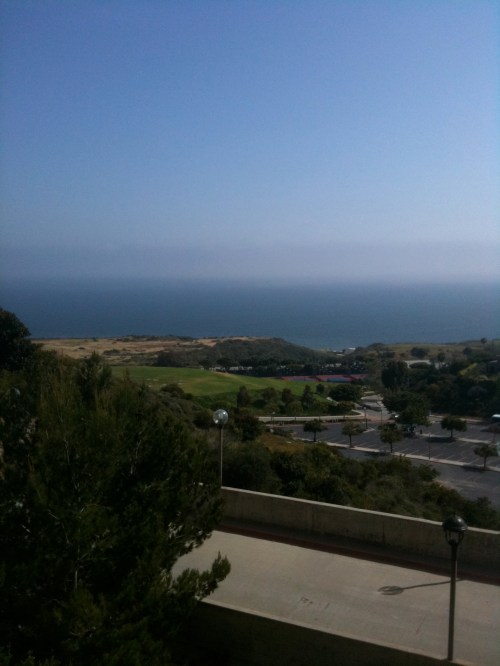
By the way, the very first thing I discovered Friday morning was that somebody was asleep at the switch in terms of finding a location for Pepperdine University. I mean, come on. What were they thinking? Terrible. Just terrible.
Both the demo and the workshop were fun; the lecture was largely the same as what John said at All Saints, but with live musical examples instead of recordings. Among other things, the examples included Ps. 102 and the Beatitudes (as heard on the Lycourgos Angelopoulos Divine Liturgy recording), the Polyeleos, and a setting of the Cherubic hymn, all off of Byzantine notation. The workshop involved teaching the participants music from the Divine Liturgy in English off of Western notation scores.
Matins on Saturday was quite an experience; we set it up with antiphonal choirs, we were all in cassocks, and we did the canons for the day in their entirety. I mostly held isokratima for the left choir, but lampadarios Alex Khalil was nice enough to let me sing a handful of troparia in the canons.
The priest who served was Fr. George Taweel of St. Nicholas, the Antiochian Cathedral in Los Angeles. Finding a priest was a bit of a challenge; John had called virtually every Greek priest in the area with no luck, but Alex knew Fr. Michael Najim, the Cathedral’s dean, and he was able to send Fr. George. Fr. George’s daughter Diana actually went to IU, and I knew her a bit from her time there. It was nice to meet him; we had lunch with him afterward, and he was a terrifically knowledgeable man and very interesting person with whom to have a conversation.
After lunch, it was back to the airport, back to Sacramento, just making it back to Annunciation for Vespers. It was a trip, short and guerilla-style as it was, that was great for which to be a fly on the wall; Alex Khalil in particular was a great person to meet. He’s an ethnomusicologist who just completed his PhD, and his dissertation is something that I think will have applicability for what I’m doing. Short version is that in his research, he applied a historical context to an ethnographic study of Byzantine chant; what I’m thinking about is sort of the reverse, where I’m interested in seeing if I can give an ethnomusicological context to a historical study of liturgy. I hope I get more of a chance to talk to him down the road.
I had hoped that friend-of-this-blog and Pepperdine employee David Dickens and I would have a chance to meet; we set up a lunch on Friday, but we managed to miss each other and he wound up being caught up by work anyway. Alas. Better luck next time.
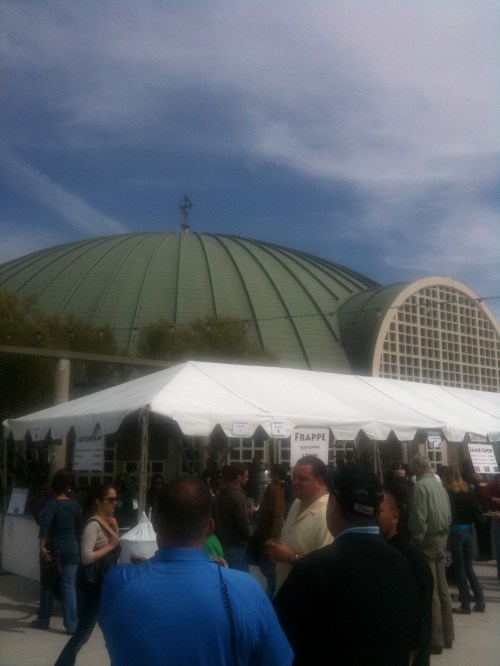
After church on Sunday it was back on the road, heading first to Ascension Cathedral in Oakland for another Byzantine chant demonstration at their Greek festival. It was largely the same repertoire as what we did at Pepperdine, again off of Byzantine notation; I had assumed that I was holding ison again, but John pulled me over and had me follow along with the melody as best as I could. (This was, in general, a more successful effort on the slower pieces.) In the audience was my friend Ian Jones, a cellist who was the very first person I ever met as a student at IU, and for whom Oakland is home. He will hopefully be able to make the Friday concert at the Cathedral; in any event, it was great to see him on his own turf.
After that it was time to head to rehearsal, and as we had rehearsal again in the Bay area Monday night, John and I stayed overnight in Oakland at his friend and fellow Josquin Singer Andrew Chung‘s condo overlooking Lake Merritt rather than drive back to Sacramento.
In theory this was a smart move; we hopefully were going to have much of Monday to hang out in the San Francisco area, with seeing St. John Maximovitch’s cathedral being on the agenda. Unfortunately, John’s car got broken into during the night, leaving him minus a driver’s side window (although nothing got stolen, thank God), and we ended up having to spend the day dealing with that. It took close to two hours just to file a police report; the form took all of two minutes to fill out, but then waiting in line to actually turn the piece of paper in to get a case number took upwards of an hour and a half. It then took another couple of hours to actually get the window replaced, and then — hey, look at that! It’s time to go to rehearsal.
Oh well. It happens.
Anyway, today has been the “day off,” which has consisted of pretty much just enjoying being in one place for the day on my part, and John furiously putting together the program for this weekend’s concerts. I don’t know how the guy does it; he’s got these concerts, his normal church duties, students, the Pepperdine thing last week, and then next week he has Cappella commitments in Oregon. He runs around a heck of a lot more than I ever did as a singer, vocally he’s always giving everything he’s got, and I know that if I were trying to do all of that, I wouldn’t last a week. He’s got to have vocal folds made of steel, that’s all I can say.
Tomorrow is the dress rehearsal, then the concerts are Thursday, Friday, and Saturday; after Liturgy on Sunday it will be off to the airport and I’ll be on my way home. It seems odd that I’m almost to the last stage of the trip, but there we are. More a bit later.
Bay Area, California: Josquin Singers, “The Empty Tomb & Tongues of Fire, From Easter to Pentecost in East & West”
Published 11 May 2010 General , Media , music , The Orthodox Faith Leave a CommentTags: byzantine chant, chant, early music in the bay area, ecclesiastical chant, hazards of church music, john michael boyer, josquin singers, liturgical music, medieval byzantine chant, music of byzantium, random acts of chant, sacred music
Here are the details of the concert I’m singing next weekend in the San Francisco area with the Josquin Singers — please come if you’re around!
Celebrating the Feast of Feasts and the foundation of the Church, Artistic Director John Michael Boyer leads the ensemble on a journey from Easter to Pentecost and from East to West. The holidays of Pascha (Easter) and Pentecost have yielded some of the most joyful and profound music in both the East and the West. This Pentecost weekend, the Josquin Singers will perform repertoire from this joyful season taken from the chant and polyphonic traditions of Rome, England, Moscow and Constantinople, sung in their original languages of Latin, Greek and Slavonic.
Thursday, May 20, 2010 7:30 pm
Blessed Sacrament Cathedral, Sacramento
1017 11th Street, Sacramento
$25 General, $20 Senior, $12 Student
CLICK HERE TO PURCHASE TICKETSFriday, May 21, 2010 7:30 pm
Greek Orthodox Cathedral of the Ascension
4700 Lincoln Avenue, Oakland
$25 Suggested Donation
CLICK HERE TO MAKE RESERVATIONSSaturday, May 22, 2010 7:30 pm
Holy Trinity Greek Orthodox Church
999 Brotherhood Way, San Francisco
$25 General, $20 Senior, $12 Student
CLICK HERE TO PURCHASE TICKETS
Event of interest: Extraordinary Form Mass at Indiana University
Published 28 April 2010 Academia , General , music Leave a CommentTags: aquinas institute, even more liturgy, fr. bob keller, fr. dominic holtz, fr. michael magiera, holy rosary church indianapolis, liturgical adventures, liturgical music, liturgical scholarship, liturgy, liturgy and life, mass appeal, more liturgy, our liturgy is older than your liturgy, st. louis university, st. paul's catholic center bloomington, traditional latin mass, tridentine mass
I was poking around my alma mater‘s online events calendar this last weekend, looking for something else, when I noticed that there was a lecture scheduled for this evening (Wednesday) titled, “Liturgical History and Musical Performance Practice: Issues to consider for a performance of a Missa Tridentina,” to be given by one Fr. Dominic Holtz, O. P., of the Aquinas Institute of Theology at Saint Louis University. Well, of course I needed to be there, so I made sure it was on my schedule for the day.
The next day, my godson Matthew mentioned to me that he would be singing in a Tridentine Mass Thursday evening that was being celebrated as part of the final project for the graduate Choral Literature course. I mentioned the lecture to him, and he said, yes, Fr. Holtz was the celebrant.
So this got all kinds of interesting really quickly. First of all, the Mass is going to be at St. Paul’s Catholic Center, the Newman Center at Indiana University. St. Paul’s, and Fr. Bob Keller in particular, has been really nice to us Orthodox, having let the OCF folks use the chapel for ostensibly “on-campus” services and so on, plus they hosted the All Saints choir’s concert a couple of years ago, so as far as I’m concerned they’re friends, but they are in no way, shape, or form architecturally or aesthetically intended for a Tridentine Mass. The church was built in 1968 and decidedly reflects what was in the air at the time. Secondly, they’re using a School of Music choir for a course project but taking great pains to celebrate it as a real Mass, and bringing a priest from St. Louis to do so? Fascinating — there have been a couple of EF Masses in Bloomington in the last two or three years, but they’ve been celebrated at St. John’s, and Fr. Michael Magiera of Holy Rosary Church in Indianapolis has been the celebrant.
Anyway — I’ll have more to say when I have more time in which to say it, but what I will say for the moment is that I found Fr. Holtz’s lecture very engaging on, and sensitive to, a number of issues, and he also came across as quite knowledgeable. I am looking forward to the Mass, and I think it would be a good thing for anybody in the area for whom this kind of thing is of interest to go and show their support, particularly given that it is being held at St. Paul’s. It will be at 8pm (with a brief talk at 7:30pm), at St. Paul’s Catholic Center, 1413 E. 17th St., Bloomington, IN. Hope to see you there; I’ll be the guy crossing himself in the wrong direction.
Finally some news about Orthodox Hoosiers
Published 17 April 2010 Academia , College , General , The Orthodox Faith Leave a CommentTags: bloomington, Christ is risen! Indeed He is risen!, Holy Week, Indiana University, john berry, john berry has a posse, orthodox hoosiers, Pascha
Christ is risen! Indeed he is risen!
I have a rather large handful of things to write about here, but we’re at that point in the semester where everything has to be done within the next couple of weeks. I anticipate having my papers done ahead of time much as with last semester, so hopefully I’ll get something up soon. Holy Week, Pascha, recovery from Pascha, and then all of my work for school has just been a prohibiting factor — but I haven’t abandoned the blog by any means. Just having to prioritize.
In the meantime, thanks to the not-insignificant assistance of the overall incarnation of awesomeness John Berry, Orthodox Hoosiers(discussed briefly in these posts) now has the beginnings of an online presence. Please go over and check it out; it’s only a beginning, but any thoughts you’ve got about what should be up there and/or how things should look, please by all means let me know. We’ve got to start somewhere.
St. George Orthodox Church (ROCOR) in Cincinnati, OH
Published 24 March 2010 General , The Orthodox Faith Leave a CommentTags: american orthodox architecture, church architecture, liturgical architecture, orthodox architecture is bloody expensive, st. george orthodox church cincinnati
I would like to bring to your attention St. George Orthodox Church (Russian Orthodox Church Outside of Russia) in Cincinnati, Ohio.
This is their current building.
This is what they are hoping to build soon:
I encourage you to do what you can to help them out. If you’re on Facebook, you can join the group titled, appropriately enough, “I just donated $20 to the St. George Building Fund will you too?” If you’re not, you can just just click here and find out everything you need to know about their building project and how to give online quickly and easily.
I’m particularly appreciative of their attempt to raise a small amount of money from thousands of people rather than large amounts of money from a small number of people. If it works for them, it could work for All Saints, too — so help make it work for them!
Why cantors and choir directors are cranky right now
Published 24 March 2010 General , music , The Orthodox Faith 6 CommentsTags: hazards of church music, holy week music, liturgical music, Pascha, sacred music
With a tip of the hat to Steve Robinson, I give you…

King Kliros!!!!!
And yes, it’s true, we’re a bit stressed right now. Let me just pass on a few reasons why, in hopes that it gives you some perspective.
1) We’ve got a week coming up full of services for which we’re responsible, we don’t have a clue who is going to be at any single one of them to help, and we probably won’t know entirely until about 15-20 minutes into each service.
2) There is no Paschal rehearsal schedule that can adequately cover the reality that no more than half of the choir is likely to be at any rehearsal. This means there is no amount of rehearsal that can prevent some number of trainwrecks, because inevitably the potential trainwreck spot you covered at rehearsal A was the rehearsal that persons B and C, most prone to trainwrecking at that particular spot, did not attend. This also means that all of the musical things you hoped to do something with, no matter how much you rehearsed them, are going to be useless because not everybody was there to rehearse those bits, and the people who weren’t there will just sing what they’re used to singing, regardless of how you try to conduct it.
3) There is also no Paschal rehearsal schedule that can adequately prepare for the reality that no matter how much you try to find out in advance who is singing with you, there will always be two or three people who show up five minutes before Rush and say, “Hey, mind if I sing?”
4) There is no Paschal rehearsal schedule that covers the fact that the music that you do lives way too high for your tenors and sopranos, but if you repitch it will be too low for your basses. The alternative, different music that would be appropriate for the singers you have, would get you your head handed to you by the people who have an emotional connection to this music that is incomprehensible to you.
5) It’s Lent, so just like everybody else, we’re fasting and struggling too, in addition to the above points.
If you would like to not contribute to our stress level, what would be helpful is this:
1) Come to every rehearsal and every service, tell us if you’re coming or not coming so that we know in advance, come on time, and encourage everybody you know to do the same. I know you’re busy. So is everybody else. So am I. If you’re sick or have to be out of town, that’s one thing. If you’re of the opinion that you have better things to do than rehearse, then why are you in the choir in the first place?
2) Do not think, “It doesn’t matter if I’m missing.” Yes, it does. I have had to cancel rehearsals this Lent because enough people have just not bothered to come for the time to be productive.
3) If you’re part of another ministry that meets during what is the choir’s normal rehearsal time and has a significant overlap of membership with the choir, please bring up the possibility of rescheduling those meetings during Lent so that we aren’t having to hold rehearsals with an even more severely compromised membership than usual. See point of crankiness #2.
4) Ask your friendly neighborhood choir director, “What can I do to help?” We don’t hear that nearly often enough.
5) Last but certainly not least, please pray for us! These next ten days or so of all days.
Just some food for thought.
Participation vs. nostalgia
Published 21 March 2010 General , Media , music , The Orthodox Faith 5 CommentsTags: liturgical adventures, liturgical participation, liturgy, liturgy and life, rembetiko
I watched a movie in my Greek class a few weeks ago called Rembetiko. It’s an excellent film on several levels; it uses the form of Greek music referred to in the title (basically Greek blues, but it’s a lot more than that) as a way of dramatizing what is essentially the national mourning of the Greeks following the 1922 disaster in Smyrna and the population exchange with Turkey. What pervades Rembetiko is a sense of the music being a way that people are trying to find and keep their dignity under what are absolutely tragic circumstances. Here’s a sample of the music:
Um, yeah, so about the Edward James Olmos lookalike with the very intimidating fake moustache… well, never mind that now.
One of the really interesting things about the film is how it presents the venue of the music changing over the years and how people are presented as engaging with the songs. In the first extended musical scene after the Asia Minor tragedy, we see the band right in the middle of the audience, and the people reacting to the music in ways that show it is very much a way of dealing with a shared pain and sense of mourning. The members of the audience weep, they dance, they drink, they slash their wrists, they punch things until their hands bleed — the music means, and functions as, a kind of catharsis. It isn’t pretty, but it’s real and unvarnished, and it matches closely with songs that are about prostitution and drugs and in general about the seamy side of the life they are all sharing.
As time goes on, the band becomes a little more separated from their audience. The music is still on the darker side (the song in the above clip is about, and is being performed at, a hash bar), but it is becoming more formalized, and it is more self-consciously “performed” and “listened to”. There’s a scene where a singer tells her manager that she can’t sing comfortably even as close to the audience as you see in the clip; she’s got to be farther away still. The music is starting to become “entertainment”.
At the end of the movie, in the late 1950s, a tribute concert is staged for a particular singer, and this is where the transformation is complete — the singer and the band are on a stage in front of rows of seating. However, it isn’t just the performers who have become self-conscious — now the audience is getting into the act. Rather than dancing or drinking or smoking or in general using the music as an outlet for pain, now the audience is singing along cheerfully and clapping to the exact same songs they were literally shedding blood and tears for thirty years ago. The music no longer engages memories of a shared tragic past — the music engages memories of the music itself. Really, what it has become is an exercise in nostalgia. The music no longer means what it used to mean — now the singers and audience members are remembering what the music meant. As such, I would argue that, despite a communal action more closely coordinate with the onstage action (i. e., singing along and clapping), they are actually not participating so much as they are remembering the time when they used to fully participate in a way that engaged what the music means.
Which brings me to a particular experience I had during a service recently (for various reasons, I do not wish to identify which service or the precise time when it occurred).
As of late, one of my colleagues at the kliros has taken to singing a particular hymn in a language other than English (for the same aforementioned reasons, I’d rather not get any more specific than that). This is something that this particular cantor used to do back in the early days of All Saints; for reasons I won’t go into, he stopped this practice for awhile, but he has reintroduced it when he’s singing. I don’t have a problem with it; a rather tight leash has been put on me when it comes to liturgical languages, and I abide by the restrictions that have been expressed to me, but this gentleman is able to do it and get away with it because, well, he can, and nobody really wants to fight with him.
(For the record, I’d love to do more than we do with the various liturgical languages, but the problems there are twofold: 1) I try to conceive of and sing services as a musical whole; I really think that a hodgepodge of different musical styles that were never intended to be sung in the same service does neither the liturgy, nor the music, nor the congregation any justice. I believe that services are intended to be “of a piece”. 2) It’s one thing for me to say, “Oh, sure, we’ll do that particular hymn in Greek/Slavonic/Romanian/Arabic/Syriac/Finnish/Estonian/whatever.” It’s something else entirely for many of my choristers, to say nothing of the congregation, many of whom maybe had a bit of Spanish in high school years ago. It’s just a different comfort level for such things altogether, illustrated by the confusion a few years ago when some people thought that in our acclamation for the bishop — “Eis polla eti, Despota” — we were singing about Hezbollah.)
Well, at the point in this service where this particular hymn is sung, my cantorial counterpart asked me, “Do you want me to sing it?” I indicated that yes, I did, which was overheard by somebody else in the congregation, another founding member of the parish. This prompted this person to run over to the kliros and join in for just this particular hymn sung in this particular language. Once the hymn had concluded, the drop-in psaltis clasped their hands, sighed “Beautiful,” clapped my colleague on the back, thanked me for letting them stand there, and returned to their chair.
I am still trying to figure out exactly what happened and why. I do not say that to be critical or condescending; what this person did is just not something that would ever occur to me to do, having sung in church for almost half of my life.
Perhaps, as in Rembetiko, what we’re talking about is “participation” manifesting itself as “nostalgia” (or should that be vice versa?). I rather got the sense of two people engaging the hymn as a way of remembering what All Saints was like 20+ years ago, when they met in a borrowed space and still had 300 people for Easter. I don’t relate to the giddy excitement about this particular person singing this particular hymn in this particular language, “just like we used to do years ago,” because I wasn’t there. I don’t, nor can I ever, have the emotional attachment that is in play there. I’ve been there all of seven years, which is the longest I’ve ever spent worshipping with the same congregation, but which pretty much makes the “But we always used to do it this way” argument incomprehensible to me when I’m talking to people who helped start All Saints. I don’t know if that kind of nostalgia is a legitimate argument for a particular liturgical practice one way or the other; I just know I don’t share it, and I approach my own participation in the services looking through a very different set of lenses. What that means, however, is that when I hear “But we always used to do it this way” and try to answer it with “But the service book actually says this,” more often than not my interlocutors and I wind up talking past each other. Perhaps we can say that it is because I am trying to function according to how I understand particular things mean; others are functioning according to their memory of what things meant.
My only other thought is that my instinct is to want to resist nostalgia; there is an element of interaction with the past in our liturgical practice, yes, but as Orthodox liturgy is also eschatological we also interact with time yet to pass. To the extent that we interact with the past we do so with the shared Christian past — that is, Tradition. The other side of that is that I say that as somebody who has never been involved with the founding of a mission, so I fully concede that my perspective is exactly that — my perspective. That and $4 will you get you a soy latte at Starbucks.
I suppose that in a historically Orthodox country, this is a dynamic that would ultimately be self-regulating; here, it’s rather more complicated. My assumption is that in a relatively isolated community like ours, what we’re talking about probably will take two or three generations to work out.
Spring break at last: in which the author returns from blogslackdom
Published 12 March 2010 Academia , General Leave a CommentTags: adventures in writing, blogslackdom, pascha at the singing school, publishing, Well-Intentioned Academic Mistakes
The end of January and beginning of February were crazy because I was catching up on work after the extracurricular activities I had going on in the second half of January, and then the first week of February I also had to prepare for a workshop I was helping with at St. Nicholas Church in the Urbana-Champaign area. Megan was flattened with the flu that week as well, but I seemed to be okay.
As I was driving to Champaign Friday night, I started to feel a little tickle in my throat. When I woke up Saturday morning, I could only pray that I would make it through the day. I did, sure enough, but as soon as Vespers was over and it was time for me to head home, it was as though a metric ton of unfinished brick was dropped on my head.
I got home, went to sleep, and woke up long enough Sunday morning to croak voicelessly at Megan, “I don’t think I’m going anywhere today, let along singing anything.” (Actually, it came out more like “CHHHHccckkkkAAAAAAAaaaaHHHHHhaaaaaeeeeeeeeecccccchhhhhiiiiiick”, but she got the point.) I then proceeded to not leave my house until the following Friday.
Let me tell you, losing an entire week when you’re in grad school suh-HUCKS. I was out of commission enough that I really couldn’t do anything productive, so come Saturday, when I actually felt like I had some life in me, I really did have the entirety of the previous week as well as the coming week to prepare in order to catch up.
And, as can happen, I missed something.
As I sat down in my seminar on democracy in Ancient Greece on my first Tuesday back after being sick, the professor said, “…and today we’re going to hear from Richard on whether or not the generalship in Athens was a democratic institution…” and my heart jumped out through my throat. I had managed to miss an entire presentation. Had I written it down? Yes. I just didn’t catch it when I was reviewing what I needed to do post-illness. In four years of taking graduate courses, I had never just not done something; of course, this particular professor didn’t know that. That said, he wasn’t a jerk about it, and it will be made up somehow, but this is somebody who will probably be on my committee and this isn’t exactly the kind of impression I like to make on people. Since it was a faculty member in my home department, I thought it probably would be a good idea to drop my advisor a line, saying, “Just because I’d rather you hear this from me…” This appears to have been a good call; he wrote back saying, glad you told me, don’t let it happen again, produce at your usual level from here, and this should fall under the category of “no harm, no foul.”
Thus, I had to make sure I was on my best behavior, and how, for my next presentation, which was this last Tuesday. That involved reading German, French, and Greek; this was my first shot at actually reading academic German, which is tougher than it looks. However, I managed to misread the syllabus for this particular assignment in a way that worked in my favor; I understood the reading to be a 15 page German article or a 15 page French article, and then one way or the other a 50 page French chapter of a book. Still, as I was wrapping up the German piece, I realized that the “or” was rather ambiguously placed, and I asked the professor for clarification. “Oh, good Lord, I didn’t imagine that somebody would be able to read both German and French,” he told me. “Tell you what — read the shorter French piece along with the German and I’ll be happy.” So that’s what I did.
In addition to that, I’ve also had two book reviews to write for another class, and we also took a long-delayed trip to Arizona last month to see my dad and stepmom for a few days.
Oh yeah, and it’s Lent.
I haven’t had time to exercise in the last six weeks, let alone blog. Yesterday was my last day of classes before Spring Break; I promptly came home and hopped on the treadmill. (And yes, today, I’m sore as hell. Heading back to the treadmill as soon as I wrap up this post.)
I’ll say it again: losing an entire week in grad school sucks. It really has taken me this whole month to catch up, and Spring Break really could not have come soon enough in terms of giving me a much-needed breather.
I need to wrap this up for now so that I can go exercise before Akathist, but one update I’ll give for now: Pascha at the Singing School has hit an interesting phase of development. I had been waiting until John finished all of the illustrations before sending it anywhere, but I looked at the submission guidelines for one of the publishers I’ve always envisioned as being ideal, and found that it wasn’t necessary to have them all done before sending them a proposal. So, I went ahead and fired off a book proposal, and two hours later got an invitation to send them the manuscript and sample illustrations.
Two and a half weeks after sending it to them, I got an answer.
It wasn’t “no,” but neither was it an unqualified “yes.”
Essentially, what they said was positive but that they would want to see certain revisions before they considered it any further. Once I’ve made those revisions, we’ll go from there. And, in all truthfulness, the feedback they had was all legitimate and useful. So, one of my goals over the break is to rework the manuscript based on their suggestions. My assumption is that they wouldn’t have bothered with this level of feedback if they didn’t think it would be worth their time; rejection slips are usually what one sees, not thoughtful suggestions. So, I’m taking this as a positive, and we’ll see what happens there.
More later.