Quick question for my Orthodox readers who regularly attend or chant Matins — what do you do for Psalm 50 (i. e., read, intone, chant, skip altogether), and what informs this practice? Are you aware of an “official” or “authoritative” rubric being one thing and your parish practice being something else? Are you aware of your parish practice being either standard or deviating from your diocesan or jurisdictional norm? If you could answer along with your parish location and jurisdiction, that would also be great to know. I am just trying to get a sense of the range of what is done out there — in other words, this is strictly a matter of data-gathering. Thank you in advance!
Archive Page 22
Straw poll regarding local liturgical practice
Published 4 July 2010 General , The Orthodox Faith 2 CommentsTags: liturg, liturgical adventures, liturgical music, liturgical texts and translation, liturgy, matins, orthros, psalm 50
End-of-fiscal-year appeal from Cappella Romana
Published 22 June 2010 General , Media , music , The Orthodox Faith Leave a CommentTags: byzantine chant, cappella romana, chant, ecclesiastical chant, hazards of church music, liturgical music, medieval byzantine chant, music as iconography, new choral music, random acts of chant, sacred music, why do we need beautiful music in churches?
 I thought it important to pass on that Cappella Romana is doing a last-minute fundraising push before 30 June, the end of their fiscal year.
You can give to their general operating fund, and/or you can designate gifts toward one of the four recordings they are working on releasing in the near future:
- Byzantine Chant from Mt. Sinai (hopefully to be released in April of 2011 in time for Cappella’s 20th anniversary)
- Tikey Zes Divine Liturgy
- Robert Kyr: A Time for Life
- Arctic Light: Finnish Orthodox Music
For my part, I believe that CR deserves a lot of support; they are pretty much the only ensemble in this country representing the repertoire they sing. Besides that, music was certainly a huge factor, a “gateway drug” if you will, with regard to my eventual conversion to the Orthodox Christian faith, and Cappella Romana was a big part of that in several respects. The evangelical value of what they do should not be underestimated, at least in my view.
Please consider making a gift. You can do so online here, or you can also send a check to Cappella Romana, 3131 NE Glisan St, Portland, OR 97232 USA.
Early Christian Attitudes toward Images by Steven Bigham
Published 21 June 2010 Academia , Early Christianity , General , Media , The Orthodox Faith 1 CommentTags: art history, byzantine art, christian art, cyril mango, early christian attitudes toward images, edict of milan, eusebius of caesarea, fr. steven bigham, iconoclasm, icons, orthodox research institute, st. constantine the great, st. john of damascus, the art of the byzantine empire 312-1453, Université de Sherbrooke
Last fall, as I mentioned here, I sat in on an Art History seminar titled “Problems in Early Christian Art.” It was a really valuable experience for several reasons, and one of the big takeaways for me was the rather frank admission on the part of the professor, as well as several of our readings, that the origins of Christian uses of figurative art are murky at best. As much as art historians might like there to be a clear narrative of “pristine original Christianity seeing any and all images as idolatry” vs. “big corrupted institutional church with pagan ceremony adapted for imperial use,” that narrative just isn’t supported by the evidence, and the narrative that can be constructed from the evidence is still quite foggy. There is definitely a strain of what can be read as image-cautious (at least) rhetoric in some early writers, but the fact is that the images were nonetheless there in one form or another from earliest days, and they didn’t go away. What struck me was that veneration of images always seemed popular, in the sense of it being something that the people did, and it didn’t appear to matter too much who was telling them not to do it — it was instinctive to make an image of the object of one’s devotion, and this had even more meaning in an era when not everybody had digital cameras on their cell phones. For me, it raised the question — is it possible that the theological place of images was simply something God chose to reveal in a “bottom-up” fashion rather than “top-down”? The question of divine intent is obviously not the kind of matter one can address using secular historical methodology, but in any event it was fascinating to hear a secular academic acknowledge that the history doesn’t fit into as neat of a little box as they would like.
 Early Christian Attitudes toward Images by Fr. Steven Bigham, published in 2004 by the Orthodox Research Institute, examines this absence of a neat narrative from an explicitly confessional point of view. It is a translation of a work he originally published in French in 1992; Fr. Bigham is a Carpatho-Russian priest who serves the Francophone Orthodox community in Montreal, and who teaches Orthodox theology at Université de Sherbrooke. In a nutshell, his argument is that the historical and scriptural witness in no way supports the idea of the Second Commandment being understood by the Jews as an absolute prohibition on figurative art, with or without a liturgical use, and neither is there a clear, unambiguous witness either from the New Testament or from patristic writings supporting such a blanket hostility towards images. Examining the historical evidence up to 313 A. D. (in other words, using the Edict of Milan as the dividing line) he argues that while there is a clear and universal condemnation of idolatrous images, it does not follow that all images are presented as idolatrous. In fact, he points out, St. John of Damascus understood a writer like Eusebius of Caesarea to be supportive of Christian images, as opposed to the contemporary perception of Eusebius as proto-iconoclast.
In many ways, a book like this is useful as a tool for the faithful more than as a scholarly work. It is an excellent introduction to the historiography of this problem, a good overview of the major scholarly players and the literature (with whom and which Fr. Bigham is clearly very familiar), and it’s extremely useful as a tour through the source texts and the archaeological evidence. His argument, as presented, is an absolutely fair set of points; he makes plain that the rhetoric of the textual sources must be both properly understood in terms of their context as well as reconciled with archaeological evidence, and that when you do that, there is no way to arrive at the conclusion that pre-Constantinian Christians were uniformly and universally against the use of images for Christian purposes. For the Orthodox Christian wanting to understand more about what the scholarly discourse is regarding the history of Christian art, this book is a terrific place to start, and should also be an excellent catechetical tool.
From a scholarly perspective, however, the book is problematic. The most glaring problem is that the translation from the French is awkward and not necessarily well-edited; mistakes like not distinguishing between “principle” and “principal” abound, for example. In addition, Fr. Bigham’s treatment of the primary source texts leaves the impression that he is reading them in translation. An extreme case that underscores the problem is the following citation of St. Irenaeus of Lyons:
Gnosticos se autem vocant: etiam imagines, quasdam quidem depictas, quasdam autem et de reliqua materia fabricatas habent, decentes formam Christi factam a Pilato, illo in tempore quo fuit Jesus cum hominibus: (p. 99)
The footnote for this passage doesn’t actually cite St. Irenaeus, but rather a scholar quoting him. Fr. Bigham then gives the following translation:
As if all above-mentioned things were not enough, these people even have images… which practice they justify… by saying that an image of Christ… (ibid.)
This is, Fr. Bigham qualifies, a “free translation” from the scholar he’s quoting. The trouble is, it’s a translation so “free” as to have nothing to do with the Latin that’s quoted. To make things worse, a reasonable, if elliptical, translation is quoted on the previous page, properly citing the Eerdmans ANF edition:
Irenaeus of Lyons informs us that the Gnostic Carpocratians “also possess images, some of them painted, and others formed from different kinds of materials; while they maintain that a likeness of Christ was made by Pilate at that time when Jesus lived among them.” (p.98)
It seems likely that this is just an author’s mistake not caught by the translator or the editor; that the English translation on p. 99 was probably just mismatched to the wrong Latin text — or there was some similar error — and nobody along the way in the editorial process knew enough Latin to be able to catch the problem. Even if that was what happened, it is unclear which passage we are supposed to understand as being important to Fr. Bigham’s point. The net result is that it just looks like it was translated wrong one way or the other, and it doesn’t leave the reader who does have knowledge of Greek and/or Latin with confidence in Fr. Bigham’s ability to properly analyze these texts.
Another, more minor, quibble is that, while extensively footnoted, the book lacks a comprehensive bibliography. The footnotes are perhaps the single most valuable asset this book has, but a catalogue of primary and secondary sources would make the book more efficiently accessible from a scholarly point of view.
In summary, this is a book well worth reading by the armchair Orthodox Christian art historian — perhaps in conjunction with a sourcebook like Cyril Mango’s The Art of the Byzantine Empire 312-1453 — as a clear discussion of the issues, the sources, and the scholarship. It is also a worthwhile read for the theology student who is interested in a frankly Orthodox exploration of the topic. Fr. Bigham demonstrates considerable facility in engaging the literature on the matter, and his citations alone are extremely valuable as a reading list on the topic for both scholar and casual reader (although do be aware that, while the English translation is recent, the original French text dates back eighteen years, so scholarship cited tends to not be later than the 1980s). In terms of its academic use, however, it seems to me that it might best function as a roadmap for somebody who is more comfortable accessing the Greek and Latin sources in the original languages, and be able to more convincingly analyze those texts with authority. It is certainly the kind of contribution that Orthodox scholars should be trying to make to the bigger conversation, and it would be a welcome thing if it could be made in a way that makes a bigger audience more inclined to take it seriously.
Just posted: Hansen and Quinn notes and answers, Unit VI — and a proposition
Published 17 June 2010 Academia , General 4 CommentsTags: Greek, hansen & quinn, language pedagogy, let's make English an inflected language again, my kids will learn latin and greek when they're newborns, the only good language is a dead language, up with inflected languages
For those of you anxiously awaiting these installment, I’ve just posted my notes and answers for Unit VI of Hansen and Quinn. My goal is to try to get through Unit X by the end of the summer, so that theoretically somebody taking first year Greek this fall can have a whole semester’s worth of support materials (assuming the book is split in half per semester). We’ll see how my good intentions jibe with the other things I need to get done this summer.
On that note — I am doing this largely for my own benefit. It’s a fantastic grammar and vocabulary review exercise, at least; not only that, an express goal of my graduate program is that its alumni will be able to at least teach introductory Greek and Latin, and already having a set of teaching notes for first year Greek will be an asset. However, it’s a side project, it’s a side project that’s time-consuming because I want to do it right and thoroughly, and it’s a side project that tends to be low priority because of the other things on my plate as somebody trying to complete a PhD program.
That said, I get more hits on my blog on account of these notes than anything else, so I am more than aware that some of you are actually using these things, and would like me to give a higher priority to getting these done.
Let me offer the following deal, then, with the idea being that those who find these notes useful might have a mechanism that would enable me to more align my priorities with theirs.
There’s a PayPal button on the “Tip Jar” page of this blog. Starting Monday, for every $150 that gets tipped to me, I promise to complete a unit’s notes within a week of that $150 milestone being hit. In other words, if $150 gets tipped to me by the end of the day Monday, 20 June, then Unit VII’s notes will be posted by the end of the day Monday, 27 June. If not, I send you back your money. Without hitting the $150 milestone, I continue to work on these at my own pace, and I will still aim for getting Unit X done by the end of the summer, but I am unable to make guarantees.
Does that seem fair? Going by the stats I see, if everybody who ever downloaded these notes gave a dollar, I could get through Unit X in a month, so these numbers aren’t striking me as unreasonable.
Hey, I know that guy…
Published 17 June 2010 Academia , Media , music , The Orthodox Faith Leave a CommentTags: Arbëresh, byzantine catholics in italy, byzantine chant, dom lorenzo tardo, grottaferrata, ioannis arvanitis, piana degli albanesi, sicilian greco-albanian colonies
This is a very recently posted video I found on YouTube featuring the man kind enough to let me call him my teacher for a couple of months last summer:
In March of 2008, Ioannis Arvanitis directed the Hagiopolites Choir at a conference focusing on Dom Lorenzo Tardo, an Italian musicologist who was evidently interested in the reception and transmission of Byzantine chant in Sicily’s Greco-Albanian colonies. K. Arvanitis also delivered a paper called “Towards a Modern Interpration of Grottaferrata’s Musical Manuscripts” (seems to me I heard somewhere he knew something about those). The concert was in the Cathedral of St. Demetrius.
The location of the conference was a place called Piana degli Albanesi, one of the Greco-Albanian colonies that interested Tardo so much, dating back to the end of the fifteenth century. Like the abbey in Grottaferrata, they are Byzantine Catholics who are Italian by geography and communion but Greek and/or Albanian by culture and liturgy.
The “Arvanites,” of course, are Greeks whose heritage is Albanian*; K. Arvanitis’ involvement certainly seems fitting.
* Annotation added, 29 October 2010: I have been asked to clarify that the Arvanites are not Albanian in the strict anthropological, ethnosocial and cultural sense but are in fact Greek-speaking and Hellenic-Orthodox-accultured people who populated and expanded as a group in the geographic region that today is Albania. See here and here for more information.
Feeling Minnesota: In which the author discusses being the descendant of a footnote to history
Published 8 June 2010 General 3 CommentsTags: barrett minnesota, battle of palmito ranch, civil war history, dick barrett, frances capdeville, genealogy, general theodore h. barrett, george barrett, georgia barrett, georgianna barrett, grant county minnesota historical society, jack barrett, marita rhude, my wild and wacky family, patricia benson, richardson damon barrett, roger barrett, theodore h. barrett, theodore sedgwick barrett, theodore sylvester barrett
Sometime around 1990, I got to meet my dad’s aunt Frances. He hadn’t seen her in about thirty years; we met her in Edmonds, Washington at the condominium of my grandmother Irene (affectionately known as “Mimi”). I remember the evening very clearly; she talked a lot about writing her memoirs, and about my great-great-grandfather, Theodore H. Barrett, who had commanded a battalion of African American soldiers for the North in the Civil War. (Not having seen it yet, we briefly wondered if perhaps the movie Glory had been about him.) It turned out that a small town in Minnesota had grown up around the ranch Theodore had built after his military service, and was named for the general. Shortly thereafter, Frances passed away, but I never forgot that evening.
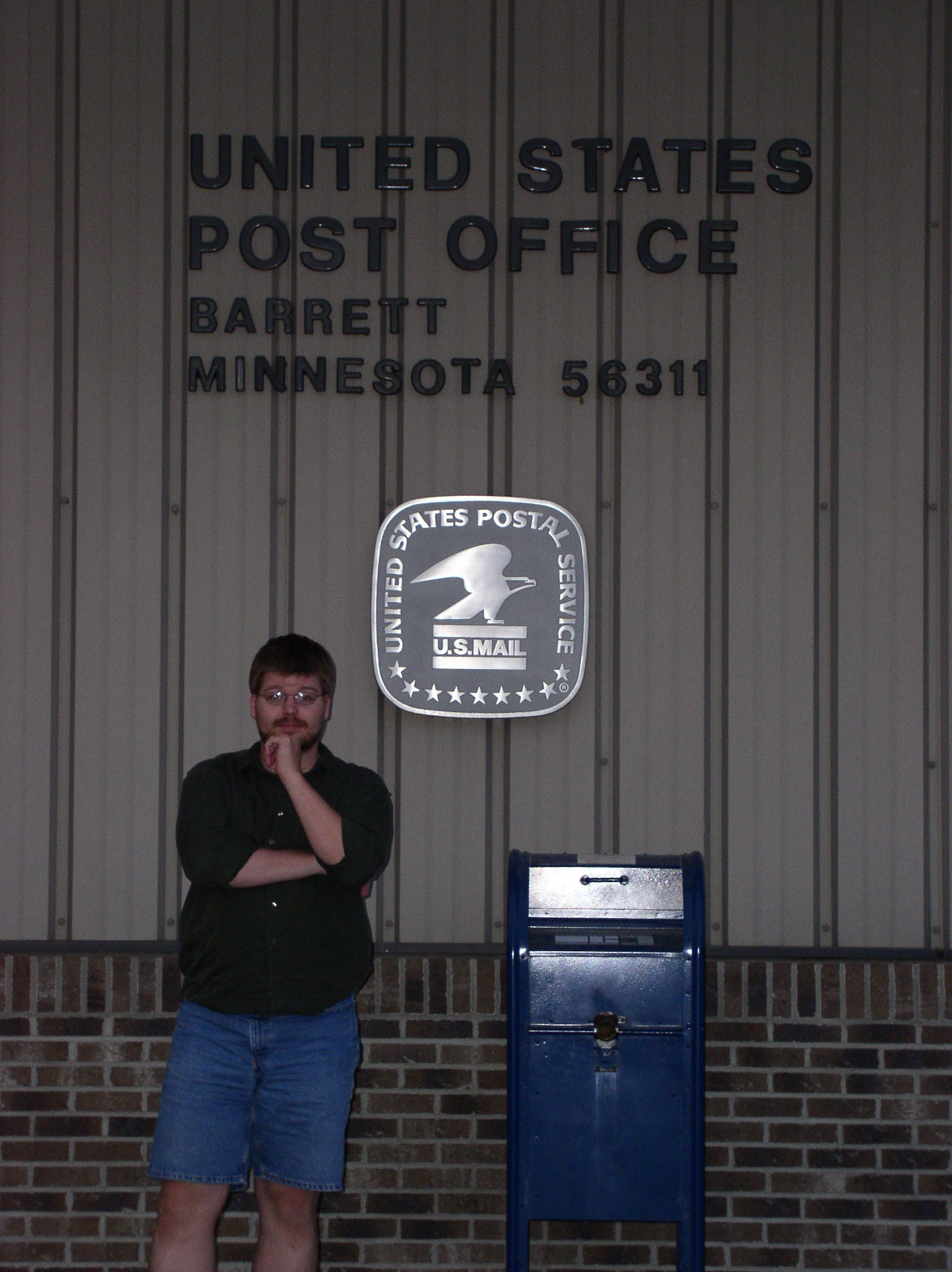 Seven years ago, on my way from Seattle to Bloomington, Indiana to re-start my junior year at the IU School of Music (it wasn’t yet called “Jacobs”), I made it a point to pass through Barrett. It’s about two hours or so west of the Twin Cities, and somewhat off the beaten path, but as I had never had a reason to go to Minnesota before and wasn’t sure when I would have another, I wasn’t going to miss the opportunity to connect somehow with my family’s past.
There wasn’t exactly a ton to see, particularly since it was past business hours and getting dark, but I was able to get a picture taken of me in front of the post office. I had always been curious to know if I had any relatives still in the area; the phone book didn’t show any Barretts still nearby. I would have stayed there for the night, or at least stopped and had dinner there, had there been any places open that offered that kind of service, but alas, nothing seemed to be operating.
Over the years, I tried digging into the other branches of the Barrett family to see if there was anybody out there to try to connect with; General Theodore had three children, two sons and a daughter, but I only knew about children that my dad’s grandfather, Theodore Sedgwick Barrett, had had. A copy of an obituary for the other son, Richardson Damon Barrett, indicated that he had stayed in Minnesota and had had a son, Roger, but there were no other details mentioned. The daughter, Georgia Barrett, was a mystery — no details about her seemed available at all. I discovered through a Google search that General Theodore was actually something of an infamous figure for Civil War historians, having led the North (and lost) in the Battle of Palmito Ranch, the last battle of the Civil War — fought some five weeks after Appomattox. I briefly mentioned this to a friend who is a Civil War buff, and he smiled and said, “I know exactly who your great-great-grandfather is. Pleased to know a descendant of General Barrett!”
A couple of weeks ago, I discovered that Barrett, Minnesota had a website. It didn’t mention anything about the history of the town, but links concerning the Old Settlers’ Reunion and the Historical Photo Project piqued my curiosity. I sent the city office a note identifying myself as a descendant of the general’s, asking if they were going to have any exhibits about Theodore or his life, and if they had any information about other descendants.
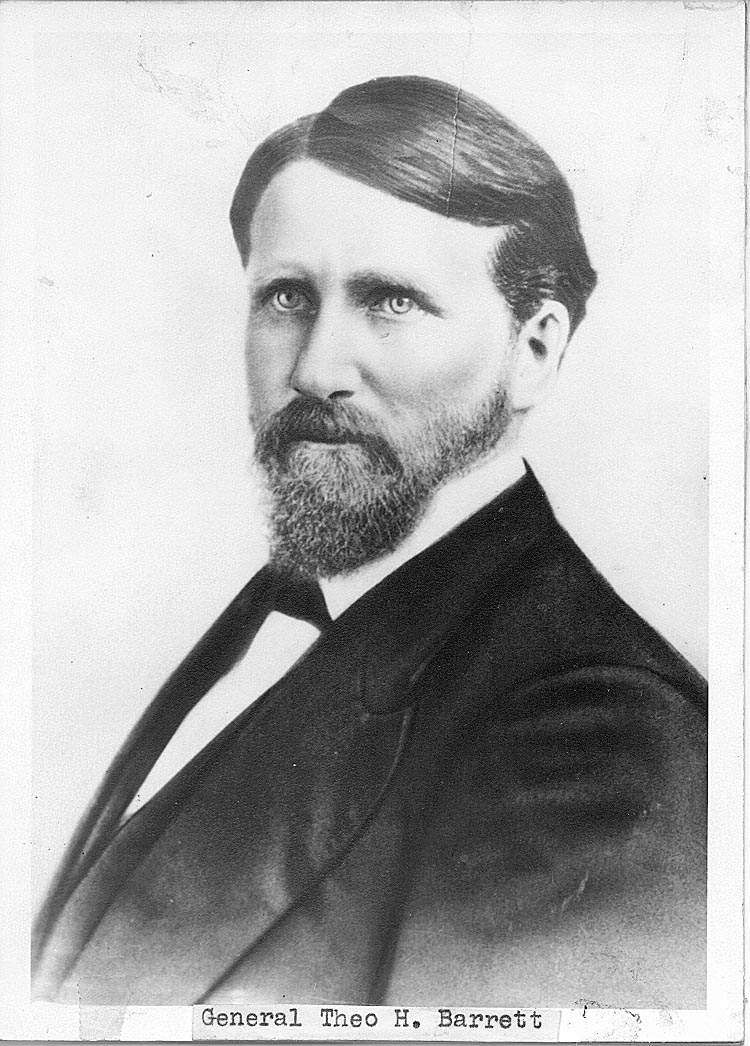
I got a very nice reply from Marita Rhude in the city office, and she put me in touch with Patricia Benson of the Grant County Historical Society. She sent me a scan of a handwritten document provided by none other than my dad’s Aunt Frances that detailed everything about Theodore’s descendants, as well as several photos — of him, his estate, and some of the tribe. One thing that was immediately clear is that the reason why I wasn’t finding out much about Barretts in other branches of the family is because, well, there wasn’t really much to know. Richardson Damon’s son Roger had a daughter, Deborah; Theodore’s daughter, Georgia, had no children. Theodore Sedgwick’s three children were my grandfather Jack, my dad’s aunt Frances, and then another son, Theodore Sylvester. Frances married and had two sons and a daughter; Theodore had no children. The sons of Jack’s sons, that is, myself and my uncle George’s sons, represent the last generation of Barretts descended from Theodore. There is no “greater Barrett family” outside of those of us descended from Jack.
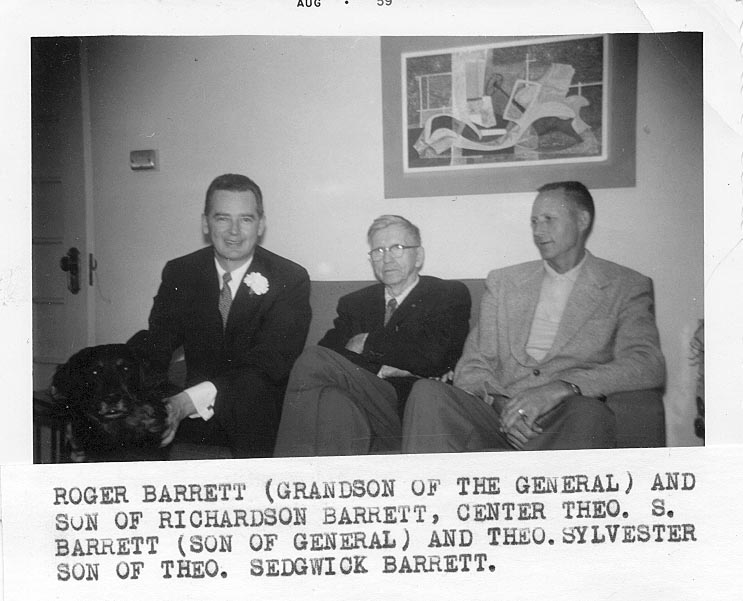 One of the pictures Ms. Benson sent me that was remarkable is from 1959 — it’s my dad’s grandfather, Theodore Sedgwick, his son Theodore Sylvester, and Richardson Damon’s son Roger. What strikes me about it is that Roger and Theodore Sylvester both unquestionably look like Barrett men to me. Roger looks a lot like the pictures I’ve seen of my grandfather Jack, and certainly bears a strong resemblance to my dad and my uncle George. My dad’s senior picture is posted here so that this might be obvious. Theodore Sylvester also has that going on, and curiously enough he also looks a lot like my aunt Pip, the youngest of my dad’s sisters.

Dick Barrett as a high school senior
I’m in the processing of circulating all of these photos to my family — my dad says that he only met his grandfather Theodore once, when he was around 13 years old. He was already blind, and he thought that Dad was my uncle George. Georgianna, Theodore’s wife and my dad’s grandmother, had died when she was still quite young, and none of the kids ever met her. Beyond that, it seems he never knew or heard about any of these people. It sort of makes me wonder how intentional that may have been — did Jack head up to Alaska to get away from his family? Hard to say, and I’m not sure there’s anybody left alive who can help fill in the gaps.
I’d really like to thank Marita Rhude in the Barrett city office and Patricia Benson of the Grant County Historical Society for their generosity and their time, and I’d also like to encourage anybody with a mind to do so to help out with the Historical Photo Project. If you stumble across this blog post and discover that you know anything more about these people or this place, I’d love to hear about it; drop me a line at rrbarret (AT) indiana.edu.
A visit from His Grace Bishop MARK
Published 8 June 2010 Academia , College , General , music , The Orthodox Faith 5 CommentsTags: ancient faith radio, liturgical adventures, liturgical music, liturgy, liturgy and life, the Bishop MARK fan club, the divine liturgy in english
In a perfect world, the way I — or any other cantor — would learn the ropes of a hierarchical visit would be to spend ten to fifteen years singing at the analogion with a protopsaltis who knew what he was doing. Excepting that, I would take a priest who understood the rubrics with a thorough knowledge of detail and could explain clearly what was supposed to happen from the cantor’s perspective. Excepting that, liturgical books that were written to address matters from a cantor’s point of view rather than a cleric’s would be acceptable.
None of those possibilities in fact being the case, what I’ve had to do for the last five years is pretty much wing it. For my first episcopal visit, Fr. Athanasius handed me a photocopy of the Liturgikon’s rubrics for the Divine Liturgy and said, “These are wrong, but you’ll get the basic idea.” He gave me notes on what was really supposed to happen, which I followed, and in turn, that wound up being not quite what we did either. Some variation on that has occurred every time since then; each visit has gotten a little better, and each visit has yielded a priest or somebody coming up to me afterward and saying, “Oh yeah, what I forgot to tell you earlier was this…” It wasn’t until after the third visit, I think, that anybody bothered to tell me that the bishop is supposed to vest during Lauds and that there are some changes made to accommodate that action.
There are multiple issues; I don’t know what I don’t know, so if somebody tells me something that’s incorrect or incomplete, I don’t have any way of knowing that until after the mistake is made. Plus, our diocese has its own in-house hierarchical service book that differs from the Liturgikon in a couple of respects, the net result of that being that I don’t trust any rubric I see printed anywhere without somebody in a position of authority telling me, “Yes, that’s actually what we’re doing,” because it’s clear not everybody’s on the same page (literally). What has sometimes happened is that a priest will tell me to do one thing via a note sent from the altar or some such, only to have a subdeacon come scurrying along twenty seconds later instructing me to do exactly the opposite. Our priest has always served with His Grace at the altar, so he himself doesn’t know exactly what should be happening from the perspective of the kliros. This is made more complex by the fact that our diocesan service book, while unquestionably useful, is written by and for a priest, not a cantor. For example, at the reception of the bishop it’s just noted that “the following hymn is sung in tone 4” instead of “the irmos for the ninth ode of the Palm Sunday canon,” which would make it infinitely more useful in terms of actually locating the music for said “hymn in tone 4”. To say nothing of the fact that, every time we’ve ever had a hierarchical visit, the Trisagion has gone haywire; the congregation hears the Trisagion to which they’re accustomed, they automatically start singing along, but but they don’t realize that it’s different with a bishop until they notice that the choir has stopped and that they’re singing over His Grace. Yes, the order of the hierarchical Trisagion is in the bulletin, but it is perhaps unreasonable to assume that everybody has has read or retained it in-depth. At one of his last visits, Bp. MARK stopped in the middle of the Trisagion with a bit of a smile and said, “We’ll get this right someday.”
(Let me emphasize, lest I be misunderstood, that I do not think it reasonable or realistic to expect the congregation to know the order of the hierarchical Trisagion. This is one of those areas, rather, where I think the argument for a model of congregational singing that consists of “everybody sings everything” breaks down.)
But, again, each time has gotten a little better, and for His Grace’s visit a couple of weekends ago for the Feast of All Saints we got it mostly right. The one thing I know I missed was the “Many years, master” that replaces “We have seen the true light…”, but I had Papa Ephraim’s long “O Lord, guard our master and chief priest” prepared for the Kairon, and the solution for the Trisagion problem was to swap out the setting from Cappella Romana’s The Divine Liturgy in English, adapted for hierarchical use. It was not the familiar version, so the autopilot problem was avoided. (Bp. MARK had mentioned to us before that the Greek model, as heard on the Angelopoulos Divine Liturgy recording, was in fact the usual Trisagion for hierarchical visits.) I got one person afterward who asked, “Since when is God ‘strong’ and not ‘mighty’?”, but beyond that, things were pretty smooth.
While he was here he also gave a talk on ministering to a college town (which may show up down the road on Ancient Faith Radio; we’ll see — do note that an iPhone is actually a really fantastic portable voice recorder, and I was very glad to have it when our $2,000 sound system failed), and we also briefed him on where the building conversation stands. When we showed him Andrew’s sketch and told him about his ideas, his response, in short, was “Build it. Just let me know how I can help.”
I’ve observed before that, when I participate in a hierarchical Divine Liturgy, the structure of the service and the way the parts function suggest to me that the presence of a celebrating bishop is actually assumed to be the norm, and that only having a priest as the celebrant is the accommodation. A way this was made manifest this time around was at the Cherubic Hymn. To back up for a second — in February, Fr. Peter had me sing the long Cherubic Hymn from The Divine Liturgy in English for the Divine Liturgy of the Presentation of Christ in the Temple. He had liked how it had worked liturgically during John’s visit; we only needed to sing it once (instead of the threefold repetition we have to do with our usual setting), it was unhurried, and then he actually had enough time after the Great Entrance to do what he needed to do. “Sing it again,” he said, “I want to see if it really worked as well as I remember.” Well, afterward, he said, “No, that won’t work. It’s too long. I was waiting behind the iconostasis for three minutes for you to finish the first part.” So there went that idea.
Well, what was clear that weekend, as we repeated the Cherubic Hymn a third time, and then had to repeat “Let us now lay aside all earthly cares” on its own, a second time, then a third time, and still a fourth time before the procession came out from behind the iconostasis, was that the reason the other setting was “too long” is because it assumes the presence of a bishop. What was also clear was the assumption that the Cherubic Hymn will cover the Great Entrance a good chunk of the way around the church, since the priest only has one petition before he reaches the bishop at the solea. “Perhaps it’s better to make the long way the usual way so that you aren’t having to rejigger everything when the bishop comes,” I observed to Fr. Peter afterward. “You might be right,” he said. I think I will probably have the choir review the long Cherubic Hymn for next time.
In any event, it was good to have Bp. MARK with us; I haven’t seen him since January of ’09, a month before the confusion (as it is convenient to refer to it) started. Εἰς πολλὰ ἔτη, Δέσποτα!
I Josquin get enough: in which the author gets mistaken for a Russian priest and concludes his Californian sojourn
Published 6 June 2010 Academia , General , Media , music , The Orthodox Faith 6 CommentsTags: bay area classical harmonies, john michael boyer, josquin singers, my sense of humor, my wife says it's ok to hit me, st. john maximovitch
(Before I get started — couple of music jokes:
Q. Which famous composer carried the least amount of debt in his lifetime?
A. Berlioz.
Q. Which famous composer was only barely able to pay his bills every month?
A. Josquin.
Right, onward and upward.)
I got back from California a couple of weeks ago only to be plunged into some last-minute efforts for Bp. MARK’s pastoral visit to All Saints the very next weekend, and I’m only now really coming back up for air. I tell you, a blog is a lot harder to maintain when one actually has things going on in their life that are important to them!
Over the last five years or so, the narrative I’ve had in my head and that I’ve propagated is, more or less, “I failed as a musician because I wasn’t good enough, and the upside of this is that it enabled me to discover what I was actually good at doing.” This is part of why it was a huge shock to me to have John invite me out to California, even if he was desperate; my working assumption is that, as formally trained musicians go, everybody else is about a million times better than I am, and that the people who have me sing for them here and there do so mostly as a favor to me and because they’re short other options.
At some point while I was in California, John asked over a beer, “So, what other singing do you do besides All Saints?”
I kind of blinked, and explained that I didn’t really, save for the occasional recording studio gig in Indianapolis, and my godson Matthew‘s pickup choir that has done all of two Christmas concerts thus far (and that will be the end of its short happy life, as it works out).
“I’m surprised you’re not more involved in the scene,” he said. “A singer like you, you really should be.”
Well, there were two problems with this. First off is, frankly, what scene? There is no scene in Bloomington that isn’t strictly a product of the Jacobs School of Music, save for a large community choir that, meaning no disrespect to said community choir or its members, is not really what I would find fulfilling at this stage of the game. Some of the bigger churches do things, but I obviously don’t go to those churches, and despite efforts of mine to the contrary, All Saints just is not equipped in any way, shape, or form to be making its own contribution to “the scene,” nor are we likely to in the near future. There really isn’t anything in Indianapolis, either, at least nothing that would inspire me to want to commute on a regular basis, save for the random studio thing and miscellaneous choral performance my friend Max Murphy occasionally organizes. I suppose I could go to the choral folks at the School of Music and say, hey, I’m an alumnus, and I’m a registered fulltime grad student in the College of Arts and Sciences, any chance I might be able to have a spot in one of the chamber choirs? Realistically, however, there aren’t enough choral spots for the singers they have. So, what scene is it of which I should be part, again?
Secondly, as I explained, I quit five years ago because it was clear to me I wasn’t all that good in the first place. In context, this seemed like such a painfully obvious thing to say as to make me almost embarrassed to have to say it; John is somebody who has been making music at a very high level since he was a little kid, has had a rather rarefied musical education as a result of those — and many other — experiences, and who has been, not just a specialist, but an expert in his field from a very young age, to the extent that formal, piece-of-paper education has almost been more of a hindrance than a help. I’m, well, working class by comparison, at best.
Still, he said, “Well, you’re doing just fine with us,” and went on to say that if geography were no object, there would be a number of excellent opportunities of which I would have no problem taking advantage, in his view.
This jogged a memory for me.
Bryon Grohman is a guy I got to know a bit the two years we overlapped at IU. He was a doctoral student but we were close to the same age, and I first met him taking vocal pedagogy from him. At his encouragement, I was able to publish the paper I wrote for him in the Journal of Singing, and after the class was over, we got to be friendly, at least enough to have a beer together here and there when we had the chance. When he passed his quals, I was supposed to buy him a drink before he left town; we weren’t able to quite make the connection, but we were at least able to chat briefly. It was right when I was deciding to hang it up; I told him that, and I said that while I wasn’t sure what I was going to do next, it was just clear to me that downstage center at the Met wasn’t in my future.
“That may be,” he said. “But whatever you do, you need to not forget that you are a very well-trained musician, and that’s not something that can be taken away from you.”
I hadn’t remembered that conversation in five years before what John and I were talking about brought it to mind, and it made me think a bit.
Anyway, the concerts on the whole were a lot of fun. Ian, my cellist friend, was able to come to the Friday night performance at the Oakland cathedral, I finally got to meet his mom after years of hearing about him talking about his parents, and it looks like he may have been recruited to play in BACH’s presentation of Mozart’s Requiem this fall.
One of the good things about not really having done any performing in the last few years, and to have that downtime come on the heels of the experiences that convinced me to quit, is that my expectations regarding anything were virtually nonexistent. Any performance I can walk away from is a good one. What this means is that crashing and burning doesn’t bother me all that much; at the very least, it doesn’t raise existential dilemmas for me. It just makes me say, “Well, that can go better next time,” and that’s that. So, I can say that I enjoyed singing in all three concerts; the second two were a lot more consistent than the first for everybody, I think, but whatever wasn’t right the first night, it was still light-years ahead from some of the things I’ve done to which I might compare it. This means that I may not be the best person to ask, but it also means that if you do ask me, I’ll tell you that I had a ball with all three of them, and that it was wonderful getting to sing beautiful music with a group of good musicians in three good venues.
One interesting thing about the experience: in the last few years, outside of church, whenever I’ve been in a situation where I’ve had to sing a solo, it’s really been something I’ve hated doing. In one of Matthew’s concerts, for example, I had a little Gregorian chant incipit before a motet, and even that was horribly traumatic. I felt awful singing it in rehearsal, I dreaded the moment when I would have to sing it in the concert, and then it felt awful singing it in performance.
Well, John gave me a solo verse in the ninth ode of the Paschal canon for these concerts. I hadn’t expected or wanted him to do that, I had avoided volunteering for other solos, and I almost told him no, but it really didn’t seem to be up for discussion, so I just let it go. The first rehearsal where I sang it, it felt awkward vocally and I was self-conscious and it really was not enjoyable to do. The dress rehearsal wasn’t much different.
But then the concerts came, and much to my surprise, it felt fine, I wasn’t terrified out of my wits, and I was still alive at the end of it. It was actually, dare I say it, an enjoyable thing to do. I’m still not sure what changed.
On a totally different note (as it were)… the one thing that I told John I really wanted to make sure I did while I was in the Bay area was go to St. John Maximovitch’s cathedral. He’s one of the only saints in the United States where one has that kind of opportunity, and it was very important to me to have a chance to visit him. Absolutely, John said.
Well, as it worked out, it seemed to be a never-ending struggle finding the time to make it out that way. John’s car getting vandalized ate up one of the days that was discussed as a possibility, and that put us very much at a deficit in terms of available time. It was a lot like trying to go to the Hagia Sophia cathedral in London the first time I visited there; the ordeal in terms of just figuring out how and when to go the location reached a level where it could plausibly have been a spiritual struggle masquerading as a series of unrelated annoyances. To John’s credit, no matter how difficult as it got, he refused my offers to let him off the hook. What it amounted to nonetheless was that we got to Geary Avenue at 5:40pm on the Saturday of the last concert, needing to be in Daly City by 6:15pm — literally the last possible five minutes I would have, since I was flying out of Sacramento the next afternoon. John dropped me off, told me to put on my cassock before going in and to text him when I was done.
The cassock had an interesting effect; as I walked up to the cathedral, a woman started talking to me in Russian. “Sorry, I don’t speak Russian,” I said.
“Oh,” replied the woman in accent-free American English. “Can you tell me how to get to the freeway from here?”
Inside the cathedral, another woman came up to me, her palms cupped over each other. I again had to say I didn’t speak Russian. “Oh, sorry, Father,” she said. “Will you give me a blessing?”
Well, I thought. That’s never happened to me before. “Oh, I’m sorry, I’m not a priest,” I said. “I’m a, er, psalomchik.” (“You should have replied in Greek,” John chuckled when I told him the story.)
I had just enough time to be amazed by the cathedral, venerate St. John the Wonderworker of Shanghai and San Francisco, and be told at the book counter that they couldn’t sell me anything because they weren’t the regular person and didn’t know if they could take a check or not, before John texted me — We gotta go.
Yes, it would have been nice to have had an hour or two so that my experience there could have been a bit more, shall we say, meditative. It was decidedly not the same half-day of contemplating the holiness of the saint that I had at St. Nektarios’ monastery last summer. I didn’t even have time to get a picture of anything. But nonetheless, I got to go, and I got to see St. John’s incorrupt relics with my own eyes. That’s something, most definitely.
“Why did you tell me to put on the cassock?” I asked John as we drove away.
“You’re wearing jeans and a short-sleeved shirt, and they tend to be a bit persnickety about that,” he said. “They also tend to get a bit weird about making sure you’re actually Orthodox and not a tourist. You wearing the rasso was a quick way to bypass all of those issues.” Word to the wise, I suppose.
We got back to Sacramento quite late that night, and Matins was at 8am the next morning. I stumbled through Matins, Divine Liturgy and Kneeling Vespers a bit given how tired I was, but then it was immediately off to the airport for both us — I to fly back to Indiana and John to fly to Portland for a Cappella Romana fundraiser and a mini-tour on the Oregon coast. My brief couple of weeks pretending to be a singer again was in the books; time to go home.
A couple days after I got home, Ian the cellist was coming through Bloomington again, and we talked about my time out there a bit. He really enjoyed the concert, and he had some interesting thoughts about what it really meant to be a good musician. “Thing is, being around a school like IU can distort what being a musician really is,” he said. “Here, it’s just all about being super-competitive all the time. But when you go to a gig, what it’s about is showing up and being able to do what you’re asked to do. That transcription you did, not just anybody could have done that, but you got off the plane and did it, and you were able to do it because you were trained to do it, even if it seemed like just a party trick at the time with no application. People like you and me really do come out of a place like this being able to perform at a particular level, and even if it maybe takes you a few days to shake off the rust when you haven’t done it in awhile, you’re still going to be able to do it.”
I really don’t know if this trip will wind up leading to any other musical opportunities; it might, it might not. We’ll cross that bridge when we come to it. I came back wanting to discuss with Matthew how we might make his pickup group more of a going concern, but as I alluded to, that’s not going to be a possibility moving forward, for reasons I’ll explain later.
If nothing else, however, maybe the experience of my couple of weeks in California allows me to change the narrative a bit. Maybe I didn’t fail as a musician. Maybe it really was just that I chose otherwise, not that I didn’t have a choice by virtue of not being good enough. Maybe I can take the line of my CV that says “failed singer” and have it just say “singer.”
Two weeks well-spent, one way or the other. Many thanks to John for the opportunity, the hospitality, the friendship and encouragement (to say nothing of the helpful jabs to the ribs), Dušan Radosavljevic for being a fantastic help at several points and a great person to get to know in general, St. John Maximovitch for not smacking me down despite having to be in and out, and Andrew Chung and the rest of the Josquin Singers/Bay Area Classical Harmonies for letting me play with them in their sandbox for a bit. Hope we get to do it again at some point, guys.
All Saints in the Herald-Times
Published 5 June 2010 College , General , Media , The Orthodox Faith Leave a CommentTags: adventures in writing, all saints bloomington, bloomington herald-times, publishing, this american church life
Bloomington’s local paper, The Herald-Times, ran a piece on All Saints for their religion page in today’s edition. If you’re a subscriber, you can find it here; otherwise, it’s posted over at Orthodox Hoosiers.
The story here is this — last weekend was our annual pastoral visit from His Grace Bp. MARK (about which more a bit later), and we realized somewhat at the last minute that it might be a good event to try to publicize to the greater community, particularly since he was giving a post-Vespers talk about ministry in a college town. Parish council chair Jeff Weber had called the paper, and they told him they’d be happy to run whatever we sent them as long as it was 400 words or less and we got it to them by noon Wednesday. Somebody had taken a shot at writing a really short press release, and while it wasn’t bad as an event announcement, I knew from my own experience getting press releases to the Herald-Times that what had been written wasn’t going to fly. So, Tuesday night, in consultation with Fr. Peter and parish council chair Jeff Weber, I wrote a press release for Bp. MARK’s visit as well as a short, rather general feature article about All Saints and Orthodoxy in Bloomington. With Fr. Peter’s and Jeff’s suggestions and tweaks, we got them over to the paper at 11:59am Wednesday.
And on Saturday, we opened the paper and saw nary a word of what we had sent them.
This last Thursday, Fr. Peter left me a voicemail, saying that he had talked to the appropriate editor at the Herald-Times, and they had been very apologetic, saying that somebody had been out of town, wires got crossed, etc., they would run what we sent them this weekend modifying for past tense, and that they looked forward to covering All Saints more in the future.
So, today, the feature article was there, and true to their word, they printed the whole thing, changing only the applicable verb tenses relating to the episcopal visit.
Anyway, all’s well that ends well; we’re hoping that cultivating a bit more of a relationship with the Herald-Times will help raise awareness of All Saints in the community, so there will hopefully be more of these in the near future.
St. Vlad’s symposium next week
Published 4 June 2010 Academia , General , The Orthodox Faith 1 CommentTags: st. vlads, SVS annual summer symposium
A brief post for the moment (with a longer post coming) — anybody out there planning on going to the St. Vladimir’s Annual Summer Symposium next week? I am strongly considering going, last minute though it may be, and am curious who else might be there. Let me know.


 Leitourgeia kai Qurbana: Contra den Zeitgeist