Archive for the 'The Orthodox Faith' Category


Buying books of Bartholomew’s while browsing at Borders

A hearty Christ is risen! to my readers who are on the Gregorian calendar.

Just out of curiosity, yesterday I decided to check out how available Encountering the Mystery might be in a typical bricks-and-mortar chain store. I figured, it’s the day before Western Easter so Christian books will probably be prominently displayed, plus it’s the first Saturday since the book was released. If there was a day they would have it set out for the masses, it would have been yesterday.

Well, John Shelby Spong’s Jesus for the Non-Religious was set out with the books for Easter at my local Borders. The Patriarch of Constantinople got no such love, there being no copies set out in the front half of the store, either among the Christian books for Easter or in the display of new non-fiction. There were, nonetheless, two copies on the shelf back in the “Christianity: Catholic and Orthodox” section. And, actually, the Orthodox pickings were slim, but not totally absent. The following were also in stock:

And then a couple of not specifically Orthodox books but church history books by Orthodox authors, such as The Christian Tradition: The Development of Christian Doctrine, Volume 1: The Emergence of the Catholic Tradition (100-600), by Jaroslav Pelikan (and yes, I know he was Lutheran, not Orthodox when he wrote it).

All in all — it’s not anywhere close to the equivalent of a well-stocked parish bookstore, but it could be a lot worse. Like, say, nothing. (No copies of the Orthodox Study Bible, however. It is listed as “on the way” in the digital customer service kiosks. Given you still have to pre-order it on Amazon, my guess is that copies have not yet actually gone out to distributors who are not named Conciliar Press.)

I’m still irked that Spong was out with the Easter books (a real irony, if you think about it) and the Patriarch wasn’t. I guess, if one uses as one’s thesis that part of the point of the Patriarch’s book is to raise awareness (well, generate awareness — you can’t raise what isn’t there) of the Patriarchate’s existence in the West, then this makes the point pretty clear. When an atheist who just happens to have a collar is able to get better display space among the Christian books than the Patriarch of Constantinople, that says something.

I’m two and a half chapters into the Patriarch’s book. I don’t have anything to say quite yet — I want to finish it first. All in good time. I will say only for now that I do not believe the average American who is already Orthodox is his intended audience for the book (although I think there is good that such a person can take from reading it), that it needs to be read through that lens, and therefore, with charity if he doesn’t put everything exactly in the language we would want him to use. But more on that later.

While today was not Easter for my little Orthodox parish, it was nonetheless a special weekend, as our bishop, His Grace Bishop MARK, was with us. More on that later as well.

“Perhaps it is tidier to deal in false dichotomies than to face the fullness of Christ”

On Good Friday as found on the Gregorian Calendar, I give you Teague McKamey (who is, in the interest of full disclosure, my brother-in-law):

Death and resurrection cannot be separated. This may appear so obvious that saying it seems like a platitude. But what I observe quite often, in the words of others and in my own thoughts, is a dividing of these into two separate categories. Now, it is often necessary and profitable to separate them for the purpose of teaching, to gain the clarity that only comes when a thing is considered in its own right. But it is disastrous to separate these two in actual belief and in the living walk of the believer. Perhaps we have grown too accustomed to thinking of death and resurrection as different subjects. Perhaps it is tidier to deal in false dichotomies than to face the fullness of Christ. We can say with certainty that there are theologies in the church that are based on neglecting or marginalizing either death or resurrection. Protestants avoid crucifixes. Prosperity teachers make great use of 3 John 2 but can’t preach on Philippians 4:12. Christian ascetics love to fast but don’t show up to the wedding feast. In the first few centuries, the church had to vigorously stave off attempts to deny Christ’s divinity or His humanity. I wonder: is diminishing the reality of Christ’s death or Christ’s resurrection any less serious?

I’ll let you read the rest.

In addition to Teague’s observations, one can also point out that Christ’s death was a function of His humanity; the resurrection, His divinity. There are still those today who try to deny (or downplay, at least) either the crucifixion or the resurrection, and intentional or not, a concurrent denial of His humanity or divinity is the inevitable result.

Also, consider the publishers of the First Look Sunday school curriculum, who are skipping the crucifixion altogether in their Holy Week materials, and as a result, can’t talk about the resurrection either.

We have made this choice because the crucifixion is simply too violent for preschoolers. And if we were to skip the crucifixion and go straight to the resurrection, then preschoolers would be confused. […] We’re using these formative preschool years to build a foundation for that eventual decision by focusing on God’s love and telling preschoolers that “Jesus wants to be my friend forever.”

Without the crucifixion, as this letter acknowledges, the resurrection winds up meaning nothing; without the resurrection, as these people have found to be inevitable, there’s nothing left to talk about but warm fuzzies. This is an extreme which, intentionally or no, winds up meeting the opposite extreme, denial of Christ’s existence entirely, at the other end.

One thing — clearly, the Christological controversies weren’t limited to the “first few centuries.” Those “tidy false dichotomies” are still with us today — Arianism still exists, in the form of certain sects who are more common than one might realize. (Do a Google search on the words “Arius was right” and you will discover that there are at least two well-known and established, if controversial, groups who claim the teachings of Arius as their spiritual patrimony.) Gnosticism and Nestorianism, I suspect, contain teachings which many modern Christians would encounter and say, “Well, that makes sense enough to me. What was the big deal?” Iconoclasm is proudly and openly claimed by some Christians.

Orthodox Christianity likes to say, “We’re both/and rather than either/or” — Christ was fully God and fully man, for example. Teague is absolutely right — this approach is non-negotiable when it comes to the crucifixion and resurrection as well. Otherwise — as one commenter to the Touchstone posting put it — the Gospel might as well simply be, “Adam and Eve lived in this really great garden that God made for them! Noah really loved animals (and rainbows)! Jesus loved giving children hugs! The end!”

His All-Holiness’ book

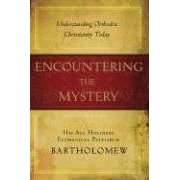
217qkj0zbl_aa180_.jpg Patriarch Bartholomew’s book, Encountering the Mystery: Understanding Orthodox Christianity Today arrived yesterday. Metropolitan Dumbledore… er, Kallistos provides the Foreword; Dr. Dn. John Chryssavgis contributes a rather lengthy biographical essay. I am through the Foreword and will work my way through Dr. Dn. Chryssavigis’ material this evening. Likely this book will serve as my Lenten reading in capacity, probably in conjunction with Oliver Clément’s Conversations with Ecumenical Patriarch Bartholomew I, which UPS’ website tells me was delivered today.

(Funny story about the Clément book: I saw it at the St. George bookstore after the Triumph of Orthodoxy Vespers on Sunday. It was $15, and noting a fairly substantial — if not downright questionable — markup on a couple of other items, opted to not get it. Upon getting home, I checked the St. Vlad’s Press website, and found that the book was on sale for $3 — $9 after shipping, but still well worth resisting the impulse purchase.)

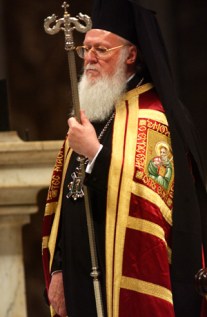
The first thing that jumps out at me in the Foreword is liberal use of words to which I try to avoid, like “dialogue.” However, the Patriarch of Constantinople using the word “dialogue” somehow seems more appropriate to me than, well, me using it. I will therefore reserve judgment.patriarch_bartholomew.jpg

The second thing that is crystal clear is that part of the point of this book, even if it isn’t the prophetic witness regarding the situation in Turkey that some would have preferred, is to give Americans a reason to care that the Patriarch exists.

I’ll have more to say as I go on, but for now — I am at the very least respectfully intrigued.

(And yes, I think the same can be said of the Patriarch’s appearance that can be said of Met. Kallistos’. Check how I’ve tagged this post, then click on the tag, if you don’t understand what I mean.)

“Are we saved by the same forces that sell a Chevrolet?”

Given my previously posted thoughts on this topic, I am extremely appreciative of Fr. Stephen Freeman’s post, “Means and Ends:”

…[I]n our modern world, some denominations (and “non-denominations”) have themselves become a members of the market, recognizing the unbeliever as a consumerof religion, and itself as a purveyor. God, or salvation, becomes the commodity.

I suppose there are some who would say that in a pluralistic country which lacks a national religion, this is inevitable; religion, being entirely a matter of choice, is effectively entirely a matter of subjective opinion — that is, taste —  thereby being forcibly relegated to the marketplace of ideas, and that This is a Good Thing in a Free Society. There are certainly Christians who point to this and say, see? This is why we need to be “relevant.”

I’m not sure I have an answer to the secularist who would make this argument. I nonetheless say to my fellow Christians: we can, and must, do better. (Please note the “we.”) Mars Hill was not, in short, the excuse for Christianity to become a disposable consumer product, which is too often what seems to happen when we make “relevance” our goal. We can, and must, engage the culture, but this should elevate the culture, not bring the faith down.

Wasted opportunities for a good chat over a beer

I’ve suggested before that “dialogue” is too lofty a word for us Joe Schmoes here in the trenches. I don’t really want to have a “dialogue” with people who have ecclesiastical disagreements with me; I’d rather have a conversation over a beer. That seems to me to be more a appropriate aim for us Reg’lar Folks.

My apathy towards “dialogue” notwithstanding, I think when questions get asked and answered publicly about those with whom we disagree, we should at least make efforts to answer the questions honestly, even if that means — gasp —  deferring to those with whom we disagree so that they may define themselves.

What am I talking about? First off, read this. Now, Campus Life’s Ignite Your Faith is a daughter publication of Christianity Today, so I hardly expect it to quote the Catholic Catechism, but I also don’t expect it to take a tone which approaches “Well, Jimmy, the Papists want to put God in a box so they can have an excuse to worship idols and preach works-based salvation, but we’re the real Christians, so we don’t.”  Marshall Shelley, it is to be hoped, would be better than this.

I sent them this response. Nearly five months later, I have yet to receive any response whatsoever. It’s probably better I don’t hold my breath. To be fair, me getting at all worked up over this is probably tantamount (to paraphrase Robin Williams) to coming out of a, um, house of ill repute complaining that you didn’t feel loved. I just find it unfortunate that many will read Mr. Shelley’s answer to this kid’s very honest question and accept it uncritically.

To whom it may concern:

In regards to Marshall Shelley’s answer to the question, “What Are Sacraments?” —

A question such as “What are sacraments?” could and should be seen as an opportunity to honestly examine the differences between various sorts of Protestantism and communions which adhere to an older tradition, such as Roman Catholicism and/or Eastern Orthodoxy, and explore what the relationship between us is. Unfortunately, the answer Mr. Shelley provides does neither of these things, being rather a woefully knee-jerk misrepresentation of sacramental theology that borders on being not much more than an anti-Catholic strawman.

First of all, the word “sacrament” is a perfectly biblical word; it is nothing more than the Latin translation of the Greek word “mysterion”, which simply means “mystery” and appears twenty-two times in the New Testament according to Strong’s. Indeed, “Mystery” is the word still given preference over “Sacrament” for many Orthodox Christians.

Second, the assertion that “[t]he early church believed preaching was the main way of sharing of God’s plan of salvation with others” is somewhat confusing, at least in terms of trying to draw a connection to sacramental practice. There is, to be sure, no question about the importance of preaching even in the extra-biblical textual sources (for example, the Didache says “My child, day and night you should remember him who preaches God’s word to you, and honor him as you would the Lord”, Did. 4:1), but to suggest that this is somehow over and above, or as opposed to, sacramental practice is at odds with both the witness of the New Testament and early church history. To be fair, Mr. Shelley correctly links sacramental practice to liturgical practice (although to say that sacraments are exclusively manifested liturgically is a severe overstatement), but this is not in opposition to preaching. The Book of Acts often places even preaching in this liturgical context, such as in 2:42: “And they continued steadfastly in the apostles’ doctrine, and fellowship, and in breaking of the bread, and in the prayers.” Acts 13:2 is often translated so that the church in Antioch “ministering to the Lord,” but the Greek verb used is leitourgein, “liturgize.” The letters of Ignatius of Antioch also underscore this liturgical context, as does the Apology of Justin Martyr:

“And this food is called among us the Eucharist… For not as common bread and common drink do we receive these; but in like manner as Jesus Christ our Saviour, having been made flesh by the Word of God, had both flesh and blood for our salvation, so likewise have we been taught that the food which is blessed by the prayer of His word, and from which our blood and flesh by transmutation are nourished, is the flesh and blood of that Jesus who was made flesh. […] And on the day called Sunday, all who live in cities or in the country gather together to one place, and the memoirs of the apostles or the writings of the prophets are read, as long as time permits; then, when the reader has ceased, the president verbally instructs, and exhorts to the imitation of these good things. Then we all rise together and pray, and, as we before said, when our prayer is ended, bread and wine and water are brought, and the president in like manner offers prayers and thanksgivings, according to his ability, and the people assent, saying Amen; and there is a distribution to each, and a participation of that over which thanks have been given, and to those who are absent a portion is sent by the deacons.” (First Apology, 66-7)

Third, the clericalism assumed by Mr. Shelley to be held by those who use the word “sacrament” is frankly bizarre. It is true that the priest stands in persona Christi, but insofar as a priest participates in a sacrament he is allowing himself to be used as a vessel of the Holy Spirit, not somehow casting a magic spell which compels the Holy Spirit to action. The liturgical texts employed by Roman Catholics and Eastern Orthodox make this quite explicit. There is nothing to say that the Holy Spirit cannot work in other ways; “the wind blows where it will,” after all. Nonetheless, as Paul exhorts the Corinthians, “Let all things be done decently and according to order,” and again, the early church writers make it plain that these functions have been in place since the earliest of days, and that they are strictly a matter of function, not a matter of quality or access.

Fourth, it is not entirely true that Protestants believe in “two ordinances” instead of “seven (or however many) sacraments.” This is true of some Protestants; however, Anglicans profess seven sacraments, and Lutherans also use the word “sacrament” (although they profess two).

This still leaves the question, “What is a sacrament?” A sacrament is, plainly, a way in which the Holy Spirit interacts with the created order in a transformative manner. The philosopher theologians of Roman Catholicism such as Thomas Aquinas analyze this in terms of concepts such as matter, substance, accidents, etc. which make the whole notion sound very technical, but it can be understood far more simply. At the Eucharist, the Holy Spirit interacts with the bread, the wine, the celebrant, and the people; as a result, it is not just the bread and wine that are changed, but all participating. At Baptism, the Holy Spirit interacts with the water and, again, the people, transforming those being baptized. Sacraments are, really, nothing short of miracles, and miracles which are considered to be normative. In that sense, then, to limit the number of sacraments to seven is somewhat missing the point; any time the Holy Spirit interacts with the world, it is a sacrament.

In Christ,

Richard Barrett
Bloomington, IN
Chills down the spine

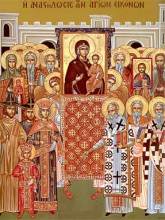
sunday_of_orthodoxy.jpgA blessed Sunday of Orthodoxy to both of my readers; I give you the Synodikon as read by the combined Orthodox clergy of central Indiana at the Triumph of Orthodoxy Vespers (as well as Vespers for the Feast of St. Patrick), St. George Orthodox Church, Indianapolis. Hope none of you are anathematized by it.
As well, here is my priest, Fr. Peter Jon Gillquist, as the guest homilist at this service, on “Engaging the Culture.”

Practical considerations in liturgy

I have nothing against Daylight Savings Time. I grew up with it; I’m accustomed to it. It was weird when we moved to Indiana and didn’t have it; it felt like a return to normal, in some respects, when Indiana candles1.jpgadopted it.

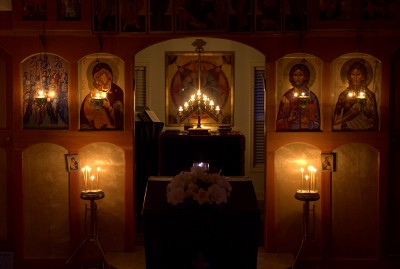
That said, if full daylight is streaming through the windows, it robs the moment of much of its power when, in the Divine Liturgy of the Presanctified Gifts, right before the second epistle reading when the priest holds up the candle in what is supposed to be a darkened church and intones, “The Light of Christ illumines all!” I suppose it also doesn’t help that Great Lent started a bit late this year.

It’s one of these practical considerations that’s easier to see when the intended conditions aren’t there — much how like “O gladsome light” was originally intended to accompany the physical action of lighting candles and lamps, an event now replaced in most parishes by the flipping of a light switch, it would seem. I’m not sure what you do about these things; in the former case, sunset is now late enough in the day to make it impractical to schedule services by it, and in the latter case, somebody seriously suggesting that a church go wholesale back to candles and oil lamps instead of electric light would, I’m certain, be laughed out of the building.

Clean week varia

I have finally posted the notes and answer key for Hansen & Quinn unit II. Click on the “Greek resources” tab and check it out. As always, e-mail me at rrbarret (AT) indiana.edu with any questions, comments, errata, etc. I hope it is useful. Unfortunately, it is likely to not be until after the semester is over before I can even think about unit III, but I should have a decent amount of time over the summer to devote to this project on an ongoing basis.

So, it’s the first week of Great Lent. This means, plainly, a lot of church.

At our parish, Great Compline with the Great Canon of St. Andrew of Crete is served Monday, Tuesday, and Thursday of Clean Week. This service is, shall we say, a commitment. The Great Canon is a leisurely stroll through the Old Testament; Great Compline could be thought of as the Orthodox Workout Plan. Because, you see, we make prostrations. A lot of them.

A lot of them. Want to know what it sounds like when the cantor has had to make so many prostrations he can’t catch his breath anymore but has to continue singing regardless? Come to All Saints this Thursday evening. There is a very practical reason why the rubrics of these services call for a left choir and a right choir — it’s called survival. We, alas, don’t have that, so Fr. Peter sings responsorially with me where he can, but he has enough to do as it is as well. There are moments where I can’t catch my breath and am drooling on my cassock because I don’t even have a chance to swallow — the service has to go on, and the congregation is so conditioned to get its cues aurally that if I stop in the middle of the Trisagion to swallow, a good three quarters of the congregation stops with me.

Starting tonight and throughout the fast, we celebrate the Liturgy of the Presanctified Gifts. This is the highlight of the week for me throughout Lent — it’s a beautiful service, and having an additional opportunity to receive Holy Communion throughout the week when our earthly food changes so drastically is something for which I’m always thankful. It is a Liturgy attributed to Pope St. Gregory the Great (and we commemorate him as “the Pope of Rome” during the service), but it is unclear exactly how that is to be understood — that is, did he write it himself (the traditional understanding)? Was it a service he witnessed in Constantinople and wrote down later (the modern understanding)? Either way, it’s a witness to the existence of the pre-schismatic undivided East and West, particularly since those in the Roman Rite also serve a form of it on Good Friday.

Friday evening we start serving the Akathist to the Theotokos. Saturday and Sunday we have the typical Vespers/Matins/Divine Liturgy cycle (although this Sunday begins the use of the Divine Liturgy of St. Basil the Great throughout Lent), and then this Sunday evening, Sunday of Orthodoxy Vespers will be served up at St. George in Indianapolis.

So, from last Saturday starting with Cheesefare Vespers through this Sunday, we’ve got at least one, if not two, services a day. In some ways it’s a nice symmetry with Holy Week; from Friday before Holy Week through Pascha there will be more like at least two services every day, so we will finish the way we started… just with more of it. (“More of what?” you ask. “Everything,” I reply.)

At its best, from a liturgical standpoint anyway, Orthodox Christianity does not gather as a community to worship on a Sunday-morning-only basis. This is, to be sure, not practical for some parishes and missions, particularly those who might not have their own building or a fulltime priest. Some parishes which do have their own building and a fulltime priest still nonetheless only serve the Divine Liturgy on Sunday mornings and hold no services at any other time; I’m not sure I understand this, but I say that as somebody who from the first time he ever heard the word “Vespers” (at age 16) asked “What is it and why don’t we do it anymore?”

It being the first week of Lent also means I’m a bit on the grumpy side. “Where’s all my protein?” my body wants to know right about now. The adjustment, at least for me, usually is made by about the second week or so.

I am lucky in many respects that this is Spring Break week. Things are very quiet in general, and I don’t have to worry about schoolwork or whatnot conflicting with services… that, unfortunately, will be Holy Week, since Pascha is the day before finals begin.

On Forgiveness Sunday, the alleged plurality of methods by which one may relieve a feline of its flesh, and other musings

First off, this very important announcement:

My Peculiar Aristocratic Title is:
Imperial Majesty Richard the Mad of Nether Wombleshire
Get your Peculiar Aristocratic Title

Right.

So, Cheesefare Week, as noted earlier, started off with some bad news. I had been obliquely informed about a month ago that good news would come via e-mail, and bad news would come via postal mail; therefore, when I saw the envelope in my mailbox on Monday, I knew exactly what it contained before I even opened it. Bottom line: I will not be a matriculated graduate student this fall. Ricardus est insufficiens petitor.

Exactly what is next for me is unclear. I was instructed to thank God for keeping me from going down this path since He obviously has something better in mind for me, so I’ll start there. There are some well-placed people who have told me they absolutely believe I can do this and want to talk about what happened and what they think I can do from here; I’m more than happy to listen, but in the meantime, I am beginning to consider what my other options are, up to and including the possibility that, being 31, perhaps my window of opportunity just isn’t open anymore.

However, without conceding that point just yet, I can say that I will finish this school year with two years of Latin, three semesters of Greek, and a year of Syriac. By the end of next year, I will have the fourth semester of Greek, a second year of Syriac, and a year of Coptic. I will also begin the St. Stephen’s course through the Antiochian House of Studies in the fall, with a concentration in Byzantine Musicology. This will, eventually, lead to a Masters in Applied Theology accredited by the Balamand Seminary (although I am under no illusions that anybody will take that seriously if I try to pass that off as my only Masters degree). I plan to forge ahead with a project I proposed in my personal statement, since I still think it very much worth doing, and I believe I’ve got the toolbox at this point to at least give it a shot and see if something productive (and perhaps publishable) comes of it. I will perhaps discuss it here from time to time as I make progress on it.

After that… I guess we’ll see. Perhaps there is something to be said for trying to do a Masters at a seminary such as St. Vlad’s; it wouldn’t exactly be ideal financially (depending on what our other circumstances are at that point), but there might be far worse things than working with Fr. John Behr and Dr. Paul Meyendorff for a couple of years. At least given what the current data are, Bloomington does not exactly seem like the place I am meant to thrive, so perhaps once some other things are clear, it will simply be time to move on.

My path has been less than linear up to this point; why should it be any different now?

Meanwhile…  Forgiveness Vespers has been served, and Great Lent is upon us. Forgiveness Vespers is a fascinating service; I’ve never seen the Mutual Forgiveness portion have the same tone two years in a row. Some years it seems quite somber; some years it can seem very chipper and cheery. I’m sure somehow that sets the mood for a given year’s Great Lent one way or the other, but I haven’t yet figured out how. Regardless, it’s a beautiful and moving service — I just wish more people came. It seems to me that if everybody isn’t there, part of the point has been missed.

On a different matter altogether — things like this just make me sad:

The Kingsway Cathedral in the Sherman Hill Neighborhood may be demolished to make room for a gas station and convenience store.

Right, because that’s what the world needs.

And then things like this just make me shake my head: “Satanism in Orthodox Catholicism!” It being Forgiveness Sunday, I suppose my most appropriate reaction would simply be to say, “Forgive them, Lord, for they know not what they do.”

Forgive me, a sinner.

Goodbye butter, goodbye eggs, goodbye barbecued chicken legs…

…with cheese. Lots and lots of cheese.

Great Lent as reckoned on the Orthodox liturgical calendar is upon us. This is my fourth Great Lent as an Orthodox Christian, and the first one I will have really observed in a couple of years. (I broke my ankle two hours after Forgiveness Vespers last year, and was thus ordered to refrain from fasting.) It’s always a challenge to wash your face and anoint yourself during this period and, of course, to be the Publican rather than the Pharisee. Of course, the challenge is part of the point. Draw attention to the fact that you’re fasting and you’ve received your reward already. Sometimes for me that means choosing to not fast around non-Orthodox so as to not generate questions; I’m not always sure that’s the right way to go, but there we are. It is the challenge of trying to practice a faith in a culture that fundamentally doesn’t get it.

For the moment, I give you Rod Dreher’s Lenten blog, The Reluctant Vegan.

Cheese. Melt it if you got it.


adventures in writing alexander lingas all saints bloomington all saints orthodox church american orthodox architecture american orthodox music american orthodoxy Antiochian Archdiocese Antiochian Orthodox Christian Archdiocese of North America Antiochians books byzantine chant cappella romana chant church architecture ecclesiastical chant ethnomusicologists ethnomusicology fellowship of ss. alban and sergius Greece Greek greek food greekness hazards of church music international travel tips ioannis arvanitis joe mckamey john michael boyer kurt sander Latin liturgical adventures liturgical architecture liturgical music liturgical texts and translation liturgy liturgy and life lycourgos angelopoulos medieval byzantine chant Metropolitan PHILIP militant americanist orthodoxy modern byzantine architecture modern greek music music as iconography my kids will latin and greek when they're newborns my kids will learn latin and greek when they're newborns orthodox architecture orthodox architecture is bloody expensive Orthodox choir schools Orthodox Ecclesiology orthodox outreach orthodox travel pascha at the singing school Patriarchate of Antioch Patriarch IGNATIUS IV Patriarch of Antioch publishing random acts of chant richard barrett in greece richard toensing rod dreher sacred music st. vlads st john of damascus society Syriac the Bishop MARK fan club the convert dilemma the dark knight The Episcopacy The Episcopate the only good language is a dead language this american church life travel we need more american saints why do we need beautiful music in churches?

Blog Stats

  • 270,526 hits

Flickr Photos