Archive for the 'The Orthodox Faith' Category


The golden rule, reality and other musings: or, happy first day of Great Lent

You know, there’s a particular reality that’s a bit hard to face when it comes to organizations. Not just churches (but churches are definitely included) — really, any organization. What I’m talking about is, of course, the Golden Rule.

“Of course,” you’re thinking. “Do unto others as…”

Nope, sorry, that’s not what I mean. What I mean is this: He who has the gold makes the rules.

This is more or less true everywhere. Government, non-profits, business, so on and so forth. There’s a very simple reason for it: unless the people able to write big checks have an interest in staying in the game, they won’t. Probably most of us would like to think that if we had lots of money, we’d behave differently, but the fact of the matter is that the more you have to protect, the more you will act to protect it — that is, the more you will act in what you see as your own best interests, and you will define what your best interests are in terms of what you have to lose.

Take charitable foundations. Do you think those exist for any other reason than it is in the best economic interests of the people funding them to do so? These entities exist because what it costs to fund them is less expensive than paying taxes on the same money. Show me somebody who gives away lots and lots of money without setting up a foundation or a charitable trust, meaning that they don’t care what the tax implications are, and I’ll show you somebody who is being truly selfless with their money. That’s not to belittle those who set up these organs of charity with truly the best of intentions, not in the slightest; this interaction of tax laws, wealth, and charity functions as intended, and in our society there’s probably no other way it could work. I’m just saying that it is probably naive, at best, to think that there isn’t anything in it for the person writing the checks.

As I said at the start of this rambling monstrosity, of course this applies to churches. At Overlake Christian Church, which is where I spent the plurality of my childhood churchgoing, the folks who wrote the biggest checks were the ones who got facetime with Pastor Bob Moorehead. That was evident even to an eight year old. And, really, why would it be any different in a church of 6,000 people (huge by 1985 standards) which had a mammoth building to maintain and which had designs on building an even larger structure?

At the church where my wife and I were married, it played out a little differently, but it was still the same story. The service schedule was structured around giving pride of place to the “Contemporary Praise Music” Eucharist — why? Because that was the service that had the greatest attendance of young, wealthy families. The choir and organ Eucharist had several older wealthy people, but the Microsoft families were able to outbid them (this was the late ’90s and early Aughts, after all).

You have to keep the people paying the bills in the game. They have to get value for their money, and there has to be an additional benefit proportional to the additional giving. How can it be any other way?

In the same way, I tend to see the perceived discomfort between so-called “ethnic” or “cradle” Orthodox and converts, if it actually exists at all, as being primarily an economic issue. Pews? Organs? Byzantine chant? Liturgical language? Even, yes, how episcopal authority gets defined and exercised? These are all issues subject to how the bills get paid. This isn’t something many of us who came to Orthodox Christianity for convictions of faith want to hear, but I think it’s probably the case.

Let’s take a hypothetical Orthodox priest from a country we’ll call Dolaria. He’s got a parish of three-quarters ethnic Dolarians, the richest five of whom give approximately 95% of the parish’s annual budget. The other quarter is mostly converts and maybe people from other ethnic backgrounds for whom a parish from “their own” church is too far away; maybe this group gives more consistently and regularly than the previous group, and maybe not. One way or the other, all told, this quarter of the parish makeup gives about 15% of the annual budget. On a given Sunday, the church might be three-quarters full and attendance might be split 50-50 between converts and ethnic Dolarians. Despite a fulltime priest, the parish only serves Orthos and Divine Liturgy on Sunday during a normal week. The metropolitan area in which this predominantly Dolarian community finds itself has a number of other parishes which tend to be heavier on converts, but the Dolarian parish’s annual budget is bigger than all of the rest of them combined.

Perhaps this hypothetical priest doesn’t participate much in pan-Orthodox events when they occur. Maybe a convert priest presses him about this, and also rags on him a bit for building a brand new church, an exemplar of traditional Dolarian Orthodox church architecture — except that it has pews and an organ. We can hypothesize that the Dolarian priest replies, “You know, you converts can play happy-clappy pan-Orthodox unity all you want, but the reality is that I’ve got a big church of Dolarians that takes up all my time, and the people who pay me to do that are Dolarians. When you converts actually match or outnumber us in giving and in attendance, then we’ll talk. A convert who comes to every service but gives $1,000 a year doesn’t help keep the doors open and the lights on in the way that a Dolarian who comes maybe once a month but gives $500,000 a year does. If ten people are writing me checks for $1 million apiece towards a $15 million church, and they want pews and an organ, they’re going to get it. If a hundred people are writing me $100 checks towards that church, and they want an open floor with no organ, I’m sorry, but they’re in the wrong demographic across the board for me to be willing to die on that hill.”

And you know what? While I wouldn’t like it or agree with it, I wouldn’t necessarily be unsympathetic to that point of view. Freedom of religion in a pluralistic, capitalist society where there is officially a separation between church and state effectively means that you get the religion for which you’re able to pay. To put it another way, if you want a church to be a particular way, you have to put your money where your faith is. We speak as Christians about “sacrificial giving,” but the reality is that the vast majority of people, particularly the wealthy, even Christians, and yes, even Orthodox Christians, are not going to give anything they can’t afford to lose. Ten middle-class converts who have bookshelves of the entire Popular Patristics line from St. Vladimir’s Seminary Press are neither going to be able to match ten ethnic millionaire entrepeneurs who have no idea what the Council of Nicea decided and prefer to hear the Liturgy in <fill in name of language> because it makes them feel more <fill in name of ethnicity> even though that means they don’t even know what we actually sing in the Paschal troparion, nor are the middle-class converts going to bring in enough additional middle-class converts to outmatch the same.

We converts can say all we want that we just want to submit to the Tradition, that we should follow the Typikon, we want traditional music (but sung in English!), traditional architecture, have a fuller liturgical schedule, take out the pews and chairs, only have a tuning fork for instruments, have icons handwritten in Byzantine style with egg tempera and mineral pigments, and burn nothing but olive oil and beeswax with not an electric light to be found. I myself am firmly in that camp, believe me.

Economic realities interfere pretty fast with that picture, however. First of all, a priest costs money, or at least he does if you actually want him to be able to survive. Not paying a priest carries its own cost — if he works a secular job, that means he will have less time for his parish. Plus, if you really want a fuller liturgical schedule, and you have a priest with a family, you almost need two priests. That costs money, too.

Traditional music? It takes having people who know what they’re doing musically. Guess what? That will in all likelihood cost money.

Traditional architecture? Hoo boy, does that cost money.

Take out the pews and chairs? Since that will likely cause a chunk of your congregation to leave, that has a cost.

Longer services? You’ll probably lose people over this, too. Check.

Handwritten icons? Wait till you see the bill. Yes, that costs money. A lot of it.

Olive oil and beeswax? Inherently higher maintenance, which means it costs money.

To apply this to current events, if there is a perception among people who write checks with lots of zeros (at least, zeros to the left of the decimal point) that an organization is in the process of giving away the farm to people who write checks with far fewer zeroes, behave in a way which makes them uncomfortable, and frankly, whom they might perceive as having less of a vested interest in that organization than they do (because, let’s be honest, this is a group of people who already left something else to be part of this organization, so how do we know they won’t do it again?), they are going to pressure the leadership of that organization to start making different choices. And, eventually, the power of the pocketbook will be the deciding factor. The outcome will go to the highest bidder. He who has the gold makes the rules. Issues of canonicity, conciliarity, communion, doctrine, tradition, etc. simply do not have the force in our current system, the so-called “marketplace of ideas,” that being willing to write a check does. When the emperor was able to outbid everybody, that was one thing, but that’s not how we do things here and now.

Let me make something clear: this is in no way an indictment of the people who write the checks and expect, implicitly or explicitly, things to go their way — neither is it an indictment of the people to whom those checks are given and who then act accordingly. That is, for better or for worse, the way our culture works. Adjunct to that is the idea of choice — if you don’t like it, go someplace else or start your own. That Orthodox ecclesiology doesn’t exactly allow for that is an internal technical matter, not truly the concern of the culture at large.

Rather, I’m really talking to fellow converts. We need a reality check, folks. I include myself in that — I’m low-level support staff at a university and a part-time grad student, married to a full-time grad student. I can only do so much, and even that’s hard to do. The people whom I have brought to church with me are people in similar situations — students and working class folks who read a lot. It would take around sixty pledging units like us to be able to pay the priest’s compensation (which is already less than what he’s worth), and two hundred pledging units like us to be able to completely replace our parish’s budget. As it is, our parish has around eighty pledging units total. Yes, I’m there for virtually every service, but so what? That means I’m taking up more space and resources than that for which I am able to pay, more than likely. I’m a net loss for my parish, in other words, particularly since as the choir director and cantor I’m also one of the only paid staff. My potential as a net loss is further amplified by music having a status as a potential flashpoint of controversy. The most mild, reasonable, and practical of musical decisions made by a cantor/choir director — say, picking a setting of the Liturgy that the choir is actually able to sing — has the potential to be a reason for somebody to leave, and take their pledge with them. Trust me on this point.

We need to assume that we, as converts, will get the respect we can afford. Metropolitan PHILIP likes to point out the growth in the number of Antiochian parishes since he was became primate; what would be a better metric of growth, I think, would be an aggregate total of the annual budgets of all parishes, adjusted for inflation. I’m going to guess that that number would not suggest as optimistic a present reality as the number of parishes does.

I suspect that current events are, in one way or another, related to people in charge having to follow the money. I’m not sure it’s any one person; I think both New Jersey and Damascus have vested financial interests which need to be tended, which, again, canonicity or no canonicity, is the way things work in the here and now. The rent has to be paid, whether or not a bishop has been canonically enthroned as a diocesan bishop and not as an auxiliary. We proclaim ourselves to be the true Church; it does not follow that we are the perfect Church or a Church which, under current circumstances, can operate independently of financial concerns.

Does that change what anything looks like, for good or ill? No. However, does it change anything about the faith or how we are supposed to live it? No. Does it change Christ? It would be blasphemy to suggest that it did. What it does mean is that we must necessarily scale our expectations about what parish life is like to appropriate levels, and not to expect that people who are human are going to be anything other than human. Our deacons, priests and bishops (and cantors — especially cantors) are all working out their salvation with fear and trembling, too. It also means it is incumbent upon us to pray, to confess, to act and give according to our convictions, as much as we possibly can, and to understand that the way the world works, to say nothing of all the broken people in it, things are going to move slowly even if we do that.

I’m not thrilled about what I’m hearing about this decision from Antioch or the potential consequences; I love my bishop dearly and do not like seeing him demoted, not in the least. It’s actually rather shaken me to the core, simply because it seems to be a very large and significant action which is about nothing so much as power and money and which has nothing to do with the faith. But that’s exactly it — it has nothing to do with the faith. It does not impact who Christ is, or my need for communion with Him, one whit. As well, given that this is the very beginning of Lent, to rush to judgment and start separating the various figures into the “good guys” and the “bad guys” is very clearly a temptation which requires resistance. Avoiding Big Macs and nachos over the next few weeks isn’t all we have to do; we also have to avoid judging our brothers… and our priests, and our bishops… and especially our cantors who have to sing so many ginormously long services over this week alone to say nothing of Holy Week… and instead put in the effort to love them.

Patriarchate of Antioch: “All bishops within the Antiochian See are auxiliary bishops”

Posted to the website of the Antiochian Orthodox Christian Archdiocese of North America:

THE DECISION REGARDING THE AMENDING OF ARTICLES CONCERNING BISHOPS ACCORDING TO THE BY-LAWS OF HE PATRIARCHATE

CHAPTER VI, THE BISHOPS

Article 75: The Patriarch is the reference point of all bishops in Damascus, Patriarchal Monasteries and Vicariates; and they are under his authority[.]

Article 76: The Metropolitan is the point of reference of all bishops in his Archdiocese and they are under his authority.

Article 77: All bishops within the Antiochian See are auxiliary bishops and are directly under their spiritual authority.

Article 78: The Metropolitan defines the responsibilities of the bishops and the place where they should serve. The bishop does not do anything contrary to the will of the Metropolitan.

Article 79: The aforementioned articles 75, 76, 77 and 78 are applicable in all Antiochian Archdioceses and whatever contradicts these articles is null and void.

Issued by the Holy Synod of Antioch, Damascus, February 24, 2009

Signed by:

His Beatitude, IGNATIUS IV, Patriarch

His Eminence, ILYAS, Tripoli

His Eminence, ELIA, Hama

His Eminence, ELIAS, Tyre and Sidon

His Eminence, GEORGE, Homs

His Eminence, PAUL, Australia

His Eminence, DAMASKINOS, Brazil

His Eminence, ESPER, Houran

His Eminence, BASILIOS, Akkar

So, there is a great deal I could say about what this looks like to me, and there are a number of things which stick out like a sore thumb on which I could comment. Not just this text, but the language used in posting it:

Since this was a special Synod meeting with only one item on the agenda concerning the bishops, the proposed text of this decision was sent to the members of the Holy Synod, who were not present, for their approval. (emphasis in original)

However, before I shoot my mouth off, is there anybody familiar with the situation who would care to comment?

For potentially useful background reading, I suggest the interview with His Beatitude Patriarch IGNATIUS IV in the December 2008 issue of The Word, pp. 5-8. I might also suggest His Eminence Metropolitan PHILIP’s discussion of primacy at the American Conference of the Fellowship of Ss. Alban and Sergius last June.

I will be very curious to hear what people have to say.

When Orthodox Christians make the news, part II

Yes, it’s a couple of days after the SuperBowl, which just means I actually had things to do yesterday, but anyway —

Eis Polamalu eti, Dhespota!

Nice to have an Orthodox Christian be in the media spotlight for some positive reasons.

The poorly-named The Great Doxologies in the Eight Modes

I didn’t notice it until I was having to enter track names manually (Manuel-ly?) in iTunes, but anybody want to look at the track list and tell me why this CD is poorly named?

The Saint Ambrose Prayer Book

Thanks to Fr. Benjamin Johnson over at Western Orthodoxy, I learned of The Saint Ambrose Prayer Book a week and a half ago or so. Much of the formation I had as an Episcopalian which led me down an Anglo-Catholic path was thanks to The Saint Augustine Prayer Book, and while I’ve not had the nagging, unfulfilled yearning for that aesthetic that some ex-Anglicans have, I do have to give credit where it is due to the Anglicans who taught me about Apostolic Succession, the Sacraments, and the Real Presence, among other things. Thus, the idea an Orthodox devotional manual after the fashion of the St. Augustine at the very least got my attention.

It arrived yesterday, and while I’ll keep my comments brief, it’s presented really nicely. It is compact, practical, easy to read, the catechetical information is very useful, and the renderings of the prayers and liturgical texts are beautiful and elegant. It is clearly a conscious Orthodox re-think of the St. Augustine, to the extent that it is organized in a nearly identical fashion, many of the images used are similar, the typeface is pretty darn close to being the same, and even the Forewords are word-for-word identical in places. I found myself wondering at times if the text of the St. Augustine had been entered into a word processor and then simply updated where it was determined was necessary. As a result, it feels very much like seeing an old friend wearing brand new clothes.

This is not necessarily a bad thing, by the way; I’m no authority one way or the other on the implementation of the Western Rite and have never seen it in action, but I do think that, insofar as it is an attempt to reclaim historically Orthodox liturgies for modern practice, it could be a good thing. I have no way of knowing if it is or isn’t in its present manifestation.

My main complaint is, as with many Orthodox publishing projects, the copy-editing could have used at least one more pass, and some of the typos are a bit embarrassing, given how nice the rest of the book is. The Foreword somehow manages to be a “Forward”, and there are a number of places where “principle” manages to sneak in for “principal”. If you’re talking about a primary reason, folks, use the word “principal” and do so on “principle.” Follow me? There are also errors like being referred to page 188 for the Six Penitential Psalms, only to have nothing of the kind be within ten pages of 188. One hopes these things can get cleared up in a second edition.

I’ll have more to say once I’ve spent more time with it, but I’d recommend it, at least at this point, partcularly to somebody who comes from a background like mine. You’ll remember some of the good things about Anglican practice that helped you to relate to Orthodoxy better when you started down that path.

AGAIN, again — postcript

My Divine Liturgy in English review generated a letter to the AGAIN editor over a not-unexpected issue — that of the use of “Holy Strong” in the Trisagion. Here are the highlights:

I’m uneasy with regards to the language [Cappella Romana] would institute. Changing the music is one thing; changing the language it’s written in is another thing entirely.

It’s important we don’t discard and/or replace the words that stir mind and soul, just to smooth some inconvenient bumps that have come about with the coupling of the Byzantine chants to English. If the truth be told, there’s a strong benefit inherent in the older English words. Simply because it takes an act of self will to use them, just like enter our church buildings leaving the physical world for the spiritual. The uncommon older words in our worship allow for the erecting of a similar barrier for the mind allowing separation from the offal baggage of our degenerate common day to day language. It’s a mistake to replace the word mighty with the word strong; to do so is to lose the Divine Authority inspired by the first in exchange for the wrongly elevated physical insinuation of the second.

Whatever the history regarding these two words, as well [as] the translations that have brought us to this point, the fact is the word strong is no longer capable of instilling the divine contemplation needed to lift the mind from the physical to reflect on the mystery of the spiritual. Our modern English speaking society throughout the world has mitigated this awe inspiring word by making an idol of strength.

Mighty, another word that carries much the same thoughts as the word strong once did, is currently used in the Liturgy. It has been for the most part spared the jaded attention of our society. Retaining its potency it bears well its burden, conveying the authority, the astonishment, the respect required of us. It commands us to humility, and as much as our puny minds can attempt, to contemplate and reverence the trenchant* power of our triune God.

If people don’t understand the meaning of such words, we should follow the example of our early church fathers that developed though God given inspiration the Divine Liturgy and a system of enlightening the ignorant, and educate them.

So when we think of our risen Lord seated at the right hand of the Father, do we want to glimpse him in the Divine Authority of his Majesty, or as…a glorified strongman?

Holy God. Holy Mighty. Holy Immortal; have mercy on us.

Phillip, your brother in Christ

* Keen, Sharp, vigorous, intensely perceptive, Penetrating, clear-cut, Distinct

My response:

Dear Phillip,

Thank you for your reflections on the translation of the Trisagion as sung by Cappella Romana. I am agreed wholeheartedly that it is a mistake to replace or discard words capriciously. What might help clarify things for you is that Cappella Romana followed the official translation of the Greek Orthodox Archdiocese of Thyateira; that is to say, Dr. Lingas and co. did not write their own translation or change words as they saw fit. Archimandrite Ephrem Lash, neither an amateur nor a shrinking violet when it comes to the matter of rendering biblical or liturgical  texts into English, was the chief architect of the Thyateira translation, and he has a detailed essay regarding the proper translation of the Trisagion, found here: http://www.anastasis.org.uk/THE%20TRISAGION02.pdf

In any event, the two most salient points might be:

  1. The Greek word “ischyros” is translated as “strong” virtually every other place it is used, and in other liturgical languages (such as Slavonic) the equivalent of “strong” is employed rather than “mighty”; “krataios” is the word which better corresponds to “mighty,” as in “Pantokrator” – “All-Mighty” being how that is often rendered in English.
  2. Translating “ischyros” as “mighty” in the translation of the Trisagion, ironically enough, appears to date back to the 1772 translation of Dr. John King, a Protestant. The earliest known English translation, that of Dr. John Covel in 1722, uses “strong.”

I hope this helps!

In Christ,

Richard Barrett

No denying it’s a sensitive matter; this is a tricky instance where a translation of a prayer, regardless of its relative merits, has taken on a life of its own beyond that of its source. The 20th century certainly demonstrated that you mess with the language in which people pray at your own risk. On the other hand, Phillip makes the excellent point that in such cases an effort should be made to educate the people, and I think Fr. Ephrem’s essay does that quite well. The other side of that bargain is just that the people need to be willing to not refuse the instruction out of hand.

For my own part, I’ll note that I don’t consider myself my own authority on Greek, particularly not where these kinds of issues are concerned. I’ve been there for Fr. Ephrem Lash sight-translating a Gospel reading from Greek during a Liturgy without realizing he wasn’t reading from an English version until I was told later, so if he says “Holy Strong” is what the prayer actually says and means, I don’t think I have too much of a basis to disagree with him.

AGAIN, again

In case you’re interested, the current issue of AGAIN just came out (Winter 2009), and my article “Prepare for Joy: An Orthodox Christian Look at Being Engaged” is included amongst its pages. Alas, the Conciliar Press website continues to show Summer 2008 as the latest issue, so I have nothing to which I might link, but what I at least think I can do is post the draft I initially submitted. It was changed enough in the editorial process that I think I can do that without it being a problem for anybody, and if you have the issue sitting in front of you, you might get a peek behind the curtain of how it works – things which are suggested, changes that are made, additions which are inserted, bits taken out, and so on.

I hope it’s of interest; it’s something I haven’t seen discussed very much, and to be frank, many of the premarital materials the various jurisdictions publish are awful. Not that this is intended to be a definitive resource, but hopefully it at least can get a conversation started.

Matthew, my godson, was at my house one evening, lamenting some issues he and Erin, his significant other of two years, along with whom he had just been baptized into the Orthodox Christian faith, were having. The two of them had started talking about marriage within a few months of beginning their relationship, and Matthew, by this point, had bought the engagement ring a year previous — but the step of actually getting engaged had not yet been taken.

“We’re reaching the point where it feels awkward to be still introducing each other as ‘boyfriend’ and ‘girlfriend,'” he sighed to me as my wife Megan and I were doing dishes.

I had wondered when they would start feeling this way. I simply looked at him and said, “Yes.”

“Which, I suppose, means I need to get my act in gear and propose sometime soon.”

“Yes,” I said, having thought exactly this for months.

Matthew’s face brightened a bit. “I suppose I could do it tonight…”

“Yes.”

“In fact,” he said, now beaming with the possibilities, “I could do it right now!”

“Yes.”

Off he went, taking two of our crystal champagne flutes on his way out. An hour and a half later, we were admiring the ring now in its proper place on Erin’s hand and toasting them; they’re set to be crowned unto each other late summer of 2009.

So — now what? Okay, have a fun year, guys. Enjoy the planning and anticipation, but don’t enjoy the anticipation too much, if you know what I mean. Other than that — see you at the service.

Surely there’s more that we can tell Matthew and Erin than that??? Megan and I discovered for ourselves when we were engaged that there’s definitely a lot of advice out there of varying quality — but what does Orthodox Christianity have to tell a newly-baptized and newly-engaged young couple which will be substantively different from what they would find in a secular self-help book, and which will be uniquely Orthodox?

The trouble is that engagement itself doesn’t fit neatly into a particular category from an Orthodox Christian standpoint. Yes, it is true that the betrothal service used to be the Church’s formal acknowledgment of an engagement and was served well in advance of the order of crowning itself. Still, Fr. John Meyendorff’s Marriage: An Orthodox Perspective (St. Vladimir’s Seminary Press, 1975) emphasizes that engagement as it is known today cannot be understood as the same as betrothal; betrothal “is the marriage contract as the Church understands it [for it] involves not only the bridal pair, but God Himself” (Meyendorff, 33, emphasis mine). Meyendorff notes that that in Byzantine society, a betrothal could only be broken by divorce — thus, “lacking only the ultimate sacramental fulfilment”, the betrothal service came to be celebrated with the crowning, rather than in advance.

So what can we say about this modern in-between state of engagement, clearly more than dating or courtship but still less than betrothal, that will be useful and practical for those moving through this particular harbor?

Fr. Peter A. Chamberas’ excellent book, This Is A Great Mystery: Christian Marriage in the Orthodox Church (Greek Orthodox Archdiocese of America, Metropolis of Boston, 2003) encourages engagement to be treated as a time for “substantive preparation” so that the couple not “miss altogether the awesome day of their visitation by the grace of God” (Chamberas, 8). By the time the wedding itself comes about, he writes, the couple’s “heart and mind must already be transformed and committed to the real nature and ultimate purpose of Christian Marriage, seeking fullness of life and salvation in God.” In other words, the primary purpose of engagement, as neither-here-nor-there as it may seem from a sacramental standpoint, is to prepare the man and woman for one of the ways through which they will be working out their salvation with fear and trembling. That’s a lot more than just picking out flowers and a cake, isn’t it?

Fine — but what does that mean, exactly?

The text of the betrothal and crowning services provides helpful illumination on this point; they are, as Fr. Chamberas eloquently describes, “the primary and most appropriate educational resource for informing and preparing the spouses for their married life as active members of the Church” (ibid., 22). Fr. Meyendorff agrees, exhorting “all couples intending to get married [to] make a point of reading the entire service carefully in advance…for the sake of conscious and prayerful participation” (Meyendorff, 35-6).

With that in mind, there are several observations about engagement one can make from the liturgical texts. In the services themselves, the couple takes no vows, but they are instead merely asked by the priest, “Have you a good, free, and unconstrained will and a firm intention to take unto yourself [as a spouse] this [person] whom you see here before you?” Fr. Chamberas writes, “This mutual, free and sincere agreement for Marriage is…an absolute necessary presupposition for the Sacrament to be performed” (Chamberas, 50), and Fr. Meyendorff sees it as a “useful way of emphasizing their personal commitment and active participation” (Meyendorff, 35). Thus, we might understand engagement as a period of discernment during which the couple prepares to be asked that very question, so that, to quote Fr. Chamberas again, they may offer “their sincere pledge of love and faithfulness…like the bread and wine in the Divine Liturgy, to be blessed and transformed” (Chamberas, 50). There are tools which the Church offers in aid of this process; the place for the couple to start is to begin premarital counseling with the priest who will marry them. These sessions will be, among other things, a source of specific advice regarding how to develop good spiritual habits from the outset, such as praying together, for example.

Given that marriage is a Mystery of the Church, however, this mystical transformation impacts not only the man and the woman being married but the entire community, just as the bread and wine must be distributed to the community of the faithful after being consecrated. This is reflected in the fact that the betrothal service begins with a Great Litany, a liturgical exchange in which the priest asks the assembly for prayers for the couple, and the people (the laos in the Greek Euchologion), the members of the community, affirm these petitions. This suggests that the period of engagement is not just a period of preparation and discernment between the man and woman, but also between the two of them and the community of the Church who will be asked to bless their union. “It is to the Church that the couple has come to be married,” observes Fr. Chamberas, “[and] it is the whole Church that prays [for them]… [T]he engaged couple…are making a mutual pledge before God and the congregation, not only to share their life but also to graft it upon the Tree of Life in the Church” (Chamberas, 51). Fr. John McGuckin, in his book The Orthodox Church: An Introduction to its History, Doctrine, and Spiritual Culture (Blackwell Publishing, 2008), paints the vivid picture of “their mutual love and joy [functioning] to others (as well as themselves) as a living icon of the burning love Christ has for his church” (McGuckin, 311). In the absence of a liturgical means by which the engagement can be recognized, a simple, practical way that the man and woman to be married might begin to engage their community in this way is to ask to be added to the list of those prayed for at the altar. This way, the entire congregation is praying for them week in, week out during the course of their engagement.

Much more can be said about the betrothal service, but I will conclude with the final observation that all of the petitions made on behalf of the man and woman suggest very strongly that the Church believes that they need them. In other words, the engagement may also be seen as preparation for the inevitable tough times to come and learning to work through them. If you think planning the reception seating chart was tough, just wait.

Which brings us to the crowning service. The very use of crowns and related imagery suggest martyrdom; not in the sense of suffering being an unavoidable element of the Christian marriage, but in the sense that within the marriage, as in every other element of the Christian life, the victory in Christ — that for which the martyr’s crown is bestowed — is achieved through humility and death to oneself in seeking to serve Christ in the other person. This is made explicit in the epistle reading — “Be subject to one another out of reverence for Christ” (Eph. 5:20). Fr. McGuckin points out that what St. Paul is exhorting the husband and wife to do in this oft-misunderstood passage is “to outdo one another in putting their own self at the service of the other” (McGuckin, 311). From this standpoint, the engaged couple needs to prepare themselves to be able to accept the crown with all that it entails. Fr. Chamberas again: “[T]heir crowns must remind them always, not of a mere symbolical ritual, but the very condition which makes their Marriage a Christian Marriage. By being crowned in the name of the Holy Trinity…the couple are challenged to see that real glory and honor are to be found in their joyful self-offering and service to each other” (Chamberas, 75).

A final observation is that the crowning service, in the final prayer before the actual bestowing of crowns, provides the engaged couple with a very clear outline of what is normative in the Christian marriage: “Unite them, O Lord, to have oneness of mind. Crown them in marriage to be one flesh. Grant them the fruit of their bodies and procreation of blessed children. Grant also, O Lord, that their life together may be blameless and without reproach.”

This, ultimately, is what the engaged couple needs to be working towards — oneness of mind. One flesh. Yes, children, if God wills. A life blameless and without reproach. It’s not necessarily a life of material wealth and happiness and unconcerned bliss — but the fruit of the time spent preparing in the frustratingly neither-here-nor-there state that is engagement is, as Fr. Chamberas puts it, “a real expression of their entrance into the Kingdom of God… the beginning of their own familiar kingdom, which is destined to be a small reflection of the true Kingdom” (Chamberas, 75).

What the engaged man and woman must remember is that the Christian life may not always promise happiness — but “the key issue…is the presence of joy,” Fr. McGuckin writes. “And joy is wholly a spiritual phenomenon that cannot be counterfeited” (McGuckin, 317). Christian marriage is not the exercise of two people merely pursuing in parallel individual ease or the ephemera of “being happy,” in other words; such things may happen, but they are to be in the service of mutual joy, which is sacrificial, selfless, and seeking Christ.

So, to Matt, Erin, and all other engaged couples who may be reading this: prepare for saying yes. Prepare your church community and your family to say “Amen.” Prepare for martyrdom. Prepare to be one, to be blameless, to be parents. Prepare to fail at most or all of this at least some of the time (and thus prepare, maybe, to go to confession a little more frequently).

But nonetheless, above all — prepare for joy.

One new recording and one that’s just new to me

One nice thing about listening to Ancient Faith Music is that it can bring to my attention recordings of international origin of which I would otherwise have had no knowledge. A terrific example is My Soul, Rise Up! put out by a self-described “ensemble of folklore spiritual music” called The Svetilen Ensemble. Last week I turned on AFM and heard this joyful, full-throated, not careful, and stunning singing, and I had to know where it came from. Yesterday the CD arrived, and the whole thing is pretty much exactly like the excerpt I heard. It’s not all liturgical music; some of the pieces are folk part-songs (called kanty, so far as I can tell — somebody can correct me if I’m wrong) on Christian themes but which are paraliturgical. One thing the recording really does right is that it recognizes the link between folk culture and liturgical singing, and it emphasizes that folk culture shares a lot of common elements across national boundaries. Many of the kanty sound like American Sacred Harp hymns which just happen to not be in English, for example. Anyway — time does not permit a full review at this time, but this is a recording well worth a listen. Some excerpts may be found at the link provided above.

A brand-new recording is The Great Doxologies in the Eight Modes by the Mount Lebanon Choir. Now that we have a couple of decent (and up) recordings of the Divine Liturgy in English, the ensembles active in this kind of thing are going to start looking for other things to record, so here we are. The Great Doxologies is good for the reasons the Mt. Lebanon Choir’s The Divine Liturgy of the Holy Orthodox Church of Antioch is good and kinda, er, quirky for the reasons their Divine Liturgy is quirky. You’ve got authentic chants by people who know what they’re doing, with a high level of musicianship all around, to say nothing of Old Country legitimacy. This also has the extra value of being the only recording of its kind in English so far. On the other hand, the English diction, while better than a recording of me chanting in Arabic would be, is clearly not at a native level. This is okay with me, but it will make it a tough sell with some of the folks whom this recording is intended to help win over to Byzantine chant. Additionally, as with The Divine Liturgy, it sounds like an organ is used to shore up the ison (although an organist is not credited in the notes), and that just sounds not quite right. Still, where the matter of good recordings of Byzantine chant in English is concerned, more is more, I think, and hopefully all of these efforts combined will bear good fruit down the road.

If anybody’s taking requests, I’d love to see some festal Vespers or Matins recordings. “O Lord I have cried” in all eight modes, maybe. A recording of Holy Week music, of course, would also be a great thing, as would the Great Supplicatory Canon. Perhaps also examples of how some of the offices like Small Compline, First Hour, etc. can be sung if desired.

Maybe we need a few more ensembles specializing in doing this stuff well, too. More is more where this is concerned, as I said.

All Saints gets a facelift

Before:

And after, or at least in progress — this was as of this last Saturday evening:

All of my pictures can be found here. All of the lampadas and icons still needed to be hung as of Sunday, the moveable wall is going to be painted to fit this overall scheme, the flourescent lights are going to go away, and there is still some lettering yet to go on the walls — but we’re getting there.

Milestone 1: The first draft

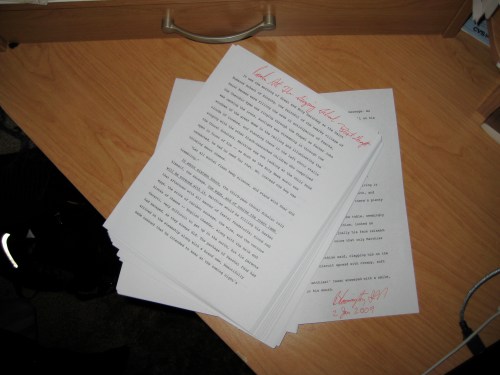
img_0663In the summer of 2004, a conversation with my dad (about which I might go into detail sometime later), along with an idea for something I’d love to see in real life, mingled in my head to become an idea for a children’s book. Over the next couple of years, I got some thoughts down on paper, did some world-building, even wrote four chapters or so, and then somebody pointed out that a fundamental flaw in my setup, of which I was already aware and was trying to write around, wasn’t going to be written around very well.

I rethought my setup without discarding the overarching plot or concept, and started writing again. My problem was, I could never quite get things down to a manageable scale to actually feel like I could write anything and get anywhere.

So, I decided on a different tack — pick a smaller event in the same universe at a different point in time, and tell a much smaller story with people who would be side characters in the main story, just to help find my voice and get a “proof of concept” down on paper. Suddenly The Singing School became Holy Week at the Singing School. Eventually even Holy Week proved to be too big for what I wanted to do, and last spring I started one more rewrite, Pascha at the Singing School. I figured it would be somewhere around 10,000 words — 40-50 pages tops.

This evening I finally finished the first draft of Pascha at the Singing School, weighing in at around 21,000 words and 91 double-spaced pages.

So, I’ve written a book. It’s a short book. Editing, revising, and publishing said book will likely be a very different matter from writing the first draft — but the first stab at putting all the words, plot points, and characters together to telling the story is, er, in the books.

We’ll see what happens next.


adventures in writing alexander lingas all saints bloomington all saints orthodox church american orthodox architecture american orthodox music american orthodoxy Antiochian Archdiocese Antiochian Orthodox Christian Archdiocese of North America Antiochians books byzantine chant cappella romana chant church architecture ecclesiastical chant ethnomusicologists ethnomusicology fellowship of ss. alban and sergius Greece Greek greek food greekness hazards of church music international travel tips ioannis arvanitis joe mckamey john michael boyer kurt sander Latin liturgical adventures liturgical architecture liturgical music liturgical texts and translation liturgy liturgy and life lycourgos angelopoulos medieval byzantine chant Metropolitan PHILIP militant americanist orthodoxy modern byzantine architecture modern greek music music as iconography my kids will latin and greek when they're newborns my kids will learn latin and greek when they're newborns orthodox architecture orthodox architecture is bloody expensive Orthodox choir schools Orthodox Ecclesiology orthodox outreach orthodox travel pascha at the singing school Patriarchate of Antioch Patriarch IGNATIUS IV Patriarch of Antioch publishing random acts of chant richard barrett in greece richard toensing rod dreher sacred music st. vlads st john of damascus society Syriac the Bishop MARK fan club the convert dilemma the dark knight The Episcopacy The Episcopate the only good language is a dead language this american church life travel we need more american saints why do we need beautiful music in churches?

Blog Stats

  • 270,380 hits

Flickr Photos