Archive for the 'Media' Category


Some contributions elsewhere

I’ve been catching up with blogging here, yes, but I’m also catching up with things I’ve been supposed to write for other sites as well. I did a writeup of some of what the Saint John of Damascus Society has been up to during the summer (TL,DR: quite a bit, actually), and I also posted part V of my “Notes from the Psalterion” series over at Orthodox Arts Journal.

Also, this morning, I got the offprint (that is, in this case, a pdf reproduction) for “‘Let Us Put Away All Earthly Care’: Mysticism and the Cherubikon of the Byzantine Rite”, which is showing up in Studia Patristica LXIV, Vol. 12: Ascetica; Liturgica; Orientalia; Critica et Philologica. This is my second peer-jockeyed article as a historian, and it came out of the paper I presented at my first big-boy conference two years ago. I’ve uploaded the pdf to my Academia.edu profile, so give it a look if you’re curious.

Addenda to Chapter Five: Easing back into the unintentional epic

About a year and a half ago, some commentary on the complex relationship some younger people growing up today have with organized religion prompted me to start telling my own story with respect to organized religion (while wanting to keep it from becoming the “conversion story” that has rather become its own genre in American Orthodox Christianity). It was by necessity divided into pieces, and I got here before life as a new father, husband to a new mother, and as a PhD student racing to candidacy status meant that I just didn’t have time to write long blog posts.

I’m trying to get some momentum back, because I’d like to finish that particular project. The pattern I was following was this — post about religious developments followed by post giving some life context for those religious developments. So, I guess what that means is that life context for summer 1997 through summer 2003 is up next.

Summer 1997 saw me as somebody who had dropped out of college in disgrace and who was scraping out an existence in Bellingham selling classified ads for the local newspaper. The  major developments (that I’ll talk about here, anyway) during those few months were that I bought my first car (a teal 1992 Volkswagen Golf GL), I got a relatively substantial settlement from a car accident I had been in the summer before, I resumed voice lessons with Dennis Kruse, my high school voice teacher, and I got my first non-ecclesial professional singing gig with The Tudor Choir. The first of these developments enabled the latter two, since they required me to drive to Seattle (an hour and a half each way), and this got me pondering how I might be able to move back south, since there was really no great reason anymore for me to stay in Bellingham.

An old friend of mine was working for one of the major software companies in the Seattle area, and he suggested that I might be able to get a agency temp position as a software tester. He helped me prepare for the interview process, and when his team had some spots they were looking to fill, he was able to recommend me. I successfully got through the interview, and in February 1998 I moved back to Seattle and started my five-year excursion into the tech industry. It really was only ever going to be a stop on the way to someplace else for me, but it was definitely a nice stopover for a while.

The next year basically consisted of me trying to clean up the mess my four years in Bloomington had left in my life; I lost some weight I needed to lose, I fixed some financial issues, I got my voice back, I developed a relationship with a priest and a parish that was important to me, I bought my first Mac (an iMac Rev B), I fulfilled part of a teenage fantasy by getting to be friends, at least for a while, with Hammerbox’s Carrie Akre, and Megan McKamey re-entered my life.

Sometime during the summer of 1998 I was cleaning out a box I had found in my closet, and I came across an old address book. (“Old” meaning it I had bought it in 1994, four years previous. Four years ago I had just gotten back from Greece and was about to start graduate school. There’s nothing from 2009 that I consider “old”. Oh, perspective.) I found, among other things, the last home address I had for Megan, and for one reason or another, it hit me hard. I had started thinking of her in the back of my head as “the one that got away”, or more accurately, “the one I had foolishly let go”, and other circumstances in my life had emphasized for me how foolish I had been in letting her go. Anyway, I wrote a letter that amounted to, “Hey, haven’t seen you in about a year, and I suppose you’ve graduated by now and are back home figuring out what to do next. I’m back in the Seattle area too; let’s hang out sometime.” Time passed, and I got no response.

Then, in October (I think), a letter showed up in my mailbox from, of all places, Shanghai, China. I opened it up, and it was a letter from none other than Megan, where she was spending six months teaching English at a girls’ school. She seemed more or less happy to hear from me, or at least happy to get mail from home (declining to give me an e-mail address because, as she said, she’d rather get paper letters), and with that encouragement, I started writing her a handwritten, six-page letter a week. It would be wrong for me to suggest that she replied with the same kind of frequency; I think I got three more letters from her between October 1998 and when she returned in February 1999.

Anyway, by 28 February 1999, I been waiting to hear from her all month, since she had never said precisely when she was coming back to the States, and that afternoon I looked up her parents’ home phone number in the phone book (remember that people used to look up such things in such publications?), left a message on the answering machine, and basically paced around the apartment for awhile. Sometime in the early evening she called me back; we chatted briefly, she said we needed to hang out in person sometime soon, and I asked, well, what are you doing right now?

“Uh, I’m in Sumner.” (A little over half an hour away from where I was.)

“So what? I’ll be there in a bit.”

I drove down to Sumner immediately (I was excited), saw her for the first time in probably two years, met her family for the first time (well, not entirely true — I had met her brother Teague a couple of times in 1995), and the two of us went out for dinner and then to a movie (Shakespeare in Love, as I recall). It was very much like a date, and we made plans to hang out in my end of town the next weekend.

The next Saturday, I drove down to Sumner, picked Megan up (she did not yet have a car), and brought her back up to the Eastside. She showed me China pictures for awhile, we decided to go see Analyze This!, and then we went out to dinner. As we pulled into the parking lot of Redmond Town Center to go to Cucina! Cucina!, I decided it would probably be a good idea for me to have some clarity in my own head as to what we were doing. “Just so I know,” I asked, “is this a date?”

It took Megan about a minute to stop fumbling over her words sufficiently to answer me. The answer was “no”. The reason why the answer was “no” was, she explained, because she had started dating an old friend from high school shortly after she had gotten back from China.

Shortly after her “no”, it seemed that Cucina! Cucina! had an hourlong wait.

No worries, I told her; there was another place I could take her just up the road that was maybe a bit better, and I took her to the Salish Lodge in North Bend. Why not? It wasn’t exactly like I was just going to sullenly drive her home and never talk to her again; that’s not how I do things. May as well have an evening out as friends in as high a style as I could manage to improvise. We had crab cakes as an appetizer and expensive cocktails. It was fun, and I started making that my M.O. when we saw each other.

At the risk of this becoming a blow-by-blow of the following eight weekends, I’ll just sum up a number of events by saying that, by the end of April, she and the high school friend had decided that they were better off as friends, I had been invited to spend Easter with her family, I’d also been invited to come to her little brother’s confirmation, her stepdad had made the offhand comment to her that “I like Richard — he’s trying harder”, and we spent a very nice Saturday in Seattle, taking her to my old friend Bryn Martin (memory eternal) to have her hair done, going to The Owl ‘N Thistle for dinner, then taking advantage of the Pioneer Square joint cover (something that seems to no longer exist in that form, exactly, alas) to go dancing.

As we were walking back to the car, around 1:30 in the morning or so, we were holding hands, and Megan said, “We need to talk about where we’re at, don’t we? Because I think it’s changed.” She was quite right.

Around the same time, two other things happened — I was hired as a permanent employee at the company I was temping for, and my parents also announced, once and for all, that they were getting a divorce, once and for all. They had made similar announcements before only to reconcile, but this time was the real deal, ironically right as the relationship that would become my marriage was starting up.

The divorce was made more awkward by the fact that my dad had a heart attack in June of 1999, and my mom was the only person who could really help him in rehab. Whatever good that possibly may have been done was completely unraveled by the hard feelings and sharp words exchanged in the mediation proceedings. I took Megan up to Alaska at Christmas to introduce her to everybody (we were already looking at rings by that point), and the first of exactly two times she ever saw them in the same room together, the second being our wedding, was when my dad came by my mom’s house to claim a snowblower. We’ll just say that’s not a pleasant memory.

I also started to get busy as a singer starting in the fall of 1999. I put together a recital over the summer that was intended to be the junior recital I never actually got to do at Western, and that emboldened me to start auditioning for things. In the Seattle area, there’s a fair amount for a young tenor to do if he’s willing to work for nothing (or next to), and I started getting some of those gigs. Gilbert and Sullivan kind of became a niche of mine, falling in with a group called Bellevue Opera and doing three shows for them as the tenor lead — The MikadoH. M. S. Pinafore, and The Gondoliers. I also got to do Tony in West Side Story, I did a very ill-advised Almaviva in Il barbiere di Siviglia (a job that I got without being heard first, and in retrospect, I think everybody, including me, would have liked there to have been an audition, because I learned the hard way with that show that my voice doesn’t do Rossini), I had a bizarre experience as a backup singer for a Sarah Brightman concert, I got a very small handful of oratorio gigs (those were pretty hard to come by, truthfully, if you weren’t already one of the 2-3 singers in each voice type that most conductors in the area used), some opera previews, some operetta with Seattle musical institution Hans Wolf, eventually I got a regular slot with the Seattle Opera chorus, a demo recording of an opera about the 2000 presidential election titled Al and George, I did little church gigs here and there while also singing regularly in the St. Margaret’s choir, I still did things with the Tudor Choir, and I also did four summers with the Seattle Gilbert and Sullivan Society. It was a heady, busy time, and it was a group of experiences that seemed to point to something bigger. There were a lot of teachers and coaches who helped get me through all of this; besides Dennis Kruse, I had two teachers who were invaluable, Roberta Manion and Erich Parce, and then Glenda Williams, Beth Kirchhoff, and Dean Williamson gave me a lot of extremely helpful advice as coaches.

The best advice that I got, however, was from Ellen McLain (yes, that Ellen McLain), who ran the Seattle Opera Guild previews. I auditioned for her and she flatly said, “Absolutely not. Could you sing these previews? Yes, and you’d be fine. But you have not yet even come close to finishing your training as a singer, you need to go back to school and finish at least your Bachelors, there isn’t a halfway decent school of music in the country that wouldn’t give you a full ride with what you’ve got to offer, and I am not going to hire you and contribute to any perception you may have of yourself as anything close to a finished product.” Well, it was certainly good advice (and in some ways, I feel like she was honest with me in a way that some others weren’t), and I started thinking about what my next move was going to be. I had always figured that I would spend 5 years working before contemplating my next move, which meant that 2003 was what I was looking at as when I would move on to the next chapter.

On 24 February 2001, Megan and I got married. It was one of the very best days of my life, and is a story unto itself that I’ll tell another time. We honeymooned in Victoria, B. C., which was an absolutely lovely trip; we stayed a week at Abigail’s Hotel, which I’d recommend wholeheartedly, and I hope to get to go back someday.

Meeting the wonderful Joey Evans when he sang Captain Vere in Seattle Opera’s production of Billy Budd, I decided to pay a visit to University of Houston to see if it might be a viable option as a place to finish the B. Mus. The school was lovely, and Joey would have been a great help to me I’m sure, but the thing was, I arrived in Houston on Monday, 10 September 2001. I’m sure you can imagine that was not a great week to be trying to get an impression of a school, and I just didn’t love Houston enough otherwise to want to go there. Big, flat, and hot are not exactly my thing.

Fall of 2002, I started applying for Young Artist Programs. At the advice of Dean Williamson, I applied for Houston Grand Opera, Seattle Opera, and a third I can’t recall. The third didn’t even give me an audition (probably why I don’t remember which one it was); I made the huge mistake of thinking that Houston’s audition, being held in San Francisco, could be done as a day trip (SINGERS! DO NOT PUT YOURSELF IN POSITIONS WHERE YOU HAVE TO SING RIGHT AFTER GETTING OFF A PLANE! BAD IDEA!), so it was an audition that sucked to say the least, and then Seattle was looking for tenors who could sing Mozart’s Cosi fan tutte, and “Un’aura amorosa” was just never an aria I sang if I didn’t have to, so that audition also sucked.

The truth is, I just wasn’t ever all that good. I could be heard past the front row, I sang on pitch, but I wasn’t very musical, and I had neither fabulous high notes nor amazing flexibility nor incredible expressive ability nor anything else going for me. I was tall, I wasn’t the size of a house (then), I could learn repertoire fairly quickly, I seemed reasonably comfortable onstage, and I could be funny when I needed to be. At 25, I was pretty good for a 22 year old, and that was sort of the extent of it. I wasn’t a freak of nature, I wasn’t a Wunderkind, I wasn’t a “natural voice” (whatever that means), I was just somebody who had to work hard at it for it to be any good, and who enjoyed working hard at it, but “has to work hard at it” is very much not necessarily the same thing as “born performer”; “making it look easy” is the qualifier there, and I was never really able to do that.

Still, I won an Encouragement Award at the district Met auditions that fall, and I took that as, well, encouragement. I needed to move on to something else (I was getting to a point where I needed to commit to either my day job or to whatever I was going to do with singing). I found out that a singer friend of mine whom I had thought had been a shoo-in for Seattle’s Young Artist Program had also not gotten in and was instead going to go to Indiana University; well, I thought, if he can do it, then I can do it. I quickly made arrangements to visit IU during the first audition weekend, and I took a lesson with a teacher who was willing to back my (late) application and get me a special audition slot. I flew back to Indiana in the middle of March to do the audition, I got in, and after some favorable negotiating over scholarships (Ellen McLain wasn’t entirely accurate in her assessment, I’ll say, but close enough), I told my managers at the software company that I would be leaving at the end of July (and we’ll just say that what had been an optimistic appraisal in 1999 of what my new-hire stock option package might be worth by 2003 was optimistic indeed, to be maximally kind — thank God nobody ever tried to convince me to borrow money against it; more on that professional experience as a whole here). My Washington state chapter was coming to a close after twenty-three years.

Okay. More to come.
The foreword for Ta Prosomoia

As promised, here is my draft translation of the foreword for George Chatzichronoglou’s book Ta Prosomoia. I have tried to make it readable while keeping Chatzichronoglou’s word order and syntax as much as possible; I have occasionally paraphrased to solve “English problems”, as my first Greek teacher liked to put it. Occasional notes are in parentheses; feedback and questions are more than welcome.

Foreword

Acknowledging that you don’t “bring coals to Newcastle” (Greek: “κομίζω γλαύκας εἰς Ἀθήνας”, lit. “bring owls to Athens”), I am undertaking the edition of the present book, with an eye towards helping my brother cantors in the important and pious task which they perform, and to bring love and instruction to those who are today’s students and tomorrow’s brother cantors, and finally to contribute to the good order of the worshipping life of our Church.

The necessity of the existence of a comprehensive edition which will include all of the original melodies and model hymns in brief and slow irmologic versions and also include most of them recorded on a compact disc, is great. There are equivalent editions. However, I want to believe that in the present edition, recording all of the familiar model hymns, while adding on the one hand the common apolytikia of the Saints and the slow festal apolytikia, and on the other hand the compact disc, we come closer to the desire and the need.

The model hymns and the Anastasimatarion (the chant book containing the weekend resurrectional hymnody for all eight modes) constitute the original and prerequisite knowledge for the cantor to endure with dignity in his many duties.

With the term “prosomoia” we mean that hymn which is chanted precisely with the music of some other model hymn (that is, it copies it (προσομοιάζει σ’αὐτόν), so to speak) which we call a “Πρόλογος” (model hymn), since it is said for (προλέγεται) the prosomoion. In other words, above the text of the prosomoion there is an ascription: Mode I (ἦχος Α) “O all-lauded martyrs” (“Πανεύφημοι μάρτυρες”). We chant thus the prosomoion that follows according to the melody of “O all-lauded martyrs”. The music of the model hymns belongs to them exclusively; for this they are named, in addition to Πρόλογοι, also “Αὐτόμελα” (roughly, “the very melody”, “the famous melody”, “THAT melody”, “its own melody”, “the original melody”, etc.). There are a lot of original melodies and they are classified as “Ἰδιόμελα” (“unique melodies”). The original melodies, the automela, are a distinct category of unique melodies which “loan” their music to other hymns (prosomoia) while the unique melodies, the idiomela, we would say, keep their music for their own use.

Our age, the Information Age, the age of superficiality, the age of short-term thinking, the age of terrible haste, in which the ring of words has been lost, did not leave even our music unaffected. There are endless reasons for musical performances, for research efforts, for musicological opinions and such other important things, but at the same time there is a shortage of effective cantors. There is consideration for music as a noble craft but not as the noble craft of music. Our acoustic aesthetic has been disturbed by “crooners” (? φάλτσα) who are clothed in the legitimacy of science and by arbitrary personal musical interpretations, which lead outside of ecclesiastical boundaries. We are bombed by hymns of Holy Week, which singers (as opposed to cantors) and actors chant on TV, with the style of the “street” and the morals of the gang and we look at all of these things, helpless to respond and to express the view of the competent cantor, because all of the doors are closed. Thus “we pick at our scab” , as our wise people say, smugly self-identified as “traditional people”, as if somebody asked us that, as if they dοn’t hear what we’re saying, as if that’s what was asked. However, outside of titles and boasts, errors and omissions, our goal is and remains one. The service of the cantor, as conscious practice, towards the believer who steps over the threshold of the Church and enters into the midst of it in order for his soul to find peace with the fear of God. I am trying to “put in order” musically this fear of God and the service to the fullness of the Church, with this book, which whereby does the following:

1) Address the so-called “practical” cantors, who are the pillars of the services of Orthodox worship, embattled in all of the remote areas of the Greek countryside and in the whole Greek community. Helpless, without support, forgotten by all of us, we who haggle between ourselves for a treasure which is not rightly our and which we ought properly to serve with respect. The scope and objective of musical study is the “high and mighty” work of the cantor who appears at the analogion (cantor’s music book stand), with knowledge and faith as support.

My sympathy and my brotherly love is given for these cantors; it is a well-worn theme in my radio broadcasts for the Church of Greece. The moment has come, then, that I should do something for them.

2) Involve the teachers and the students of Byzantine music. On the hand, to the teachers [this book] is offered as a helpful tool, to the students on the other hand as a breath between boring paralaggi (Byzantine solfegge) exercises. These breaths, however, are so necessary for them to continue their lessons with new energy, as necessary as it is for the swimmer to lift his head out of the water and to breathe.

The interposed teaching of the model hymns for the duration of many years of lessons relieves and frees the student, offering at the same time useful knowledge of Byzantine music.

3) Address the proficient brother cantors who, chiefly in the slow versions of model melodies, are finding a way to brighten the sacred feasts of their parishes and to give something different and majestic. I did not put the slow versions of the model melodies on the CD, because if and when somebody wants to use them, he should substitute the hymn of the prosomoion of the feast in the already recorded melodic line of the model hymn. (Editor’s note: I don’t completely understand what he means here. The Greek text here is πρέπει νά ἀνακαταστήσει τήν ὑμνολογία τοῦ προσομοίου τῆς πανηγύρεως, στην ἤδη καταγεγραμμένη μελωδική γραμμή τοῦ Προλόγου. If somebody can clarify, that would be most appreciated.)

And finally:

4) I think that this book is useful for priests, who, apart from the spiritual task they perform in their parishes, they also have the obligation to chant correctly. For the most part, I am referring to kontakia and apolytikia, but also all of the prosomoia which are included, mainly in the Menaion. Let us not forget that enough cantors start their training in Byzantine music prompted by the priest. Therefore, as the first teachers, apart from the customary practice of the Church, which they know best, they should be the living example even in the study of prosomoia and of Byzantine music in general.

The novelty in this book is the recording of a sufficient number of apolytikia in slow irmologic melodic style. There are enough of them scattered about in older editions, but mainly they are personal compositions appropriate for sacred feasts.

Holding the conviction that with this book, which is my first, I am helping the cantors and the Church, I ask your indulgence for any errors and omissions, and I pray that the Triune God give us strength to continue to struggle for the best.

Athens, 22 August 2010

George Epam. Chatzichronoglou

Archon Ymnodos (“Chief Singer”) of the Great Church of Christ

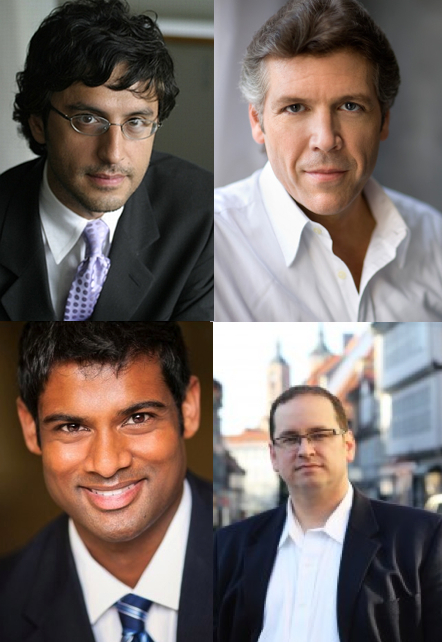
An opera singer, a public intellectual, and a talk show host walk into a bar…

chiasmusI’m in between instances of getting drafts of my dissertation outline back with my advisor’s comments, plus Theodore is asleep, so I’m trying to get some blog posts done that I’ve had on my mind but haven’t had a chance to actually write.

In the last 2-3 weeks there have been a number of incidents in the popular media that impact, on one level or another, things that I care about. They make something of a nice, thematically-related grouping, centering around the question of semi-esoteric (or even elite) disciplines being understood by mainstream Western media. One case is related, broadly speaking, to one of my current active professional activities; another couple of cases are related to my former professional activities.

First off, there’s the matter of Reza Aslan’s FOX News interview. The first time I watched that, there were two things that didn’t sit right with me about how he presented himself. Of course Lauren Green was being an idiot; that goes without saying. Still, there was an initial eyebrow raise on my part when he claimed “fluency” in biblical Greek. “Fluency?” Really? I was under the impression that, by definition, we can’t claim “fluency” in dead languages. A nitpicky point, absolutely, but it was a moment where he rang false. Then, there was the thought — boy, he sure is making a big show of playing, and re-playing, and re-re-playing, the “I HAVE FOUR DEGREES” card and saying, essentially, “I’m kind of a big deal”. Then I wondered — wait, if this is a scholarly monograph as he seems to be suggesting it is, why the heck does FOX care? Out of curiosity, I looked up the book on Amazon, and saw the publisher — Random House. He’s trying to sell a book published by Random House as a work of serious scholarship? Huh? This doesn’t make any sense.

So then, recalling his very specific claim to be “a scholar of religions with four degrees, including one in the New Testament… my job [is] as an academic. I am a professor of religion, including the New Testament. That’s what I do for a living, actually”, I Googled him to find out just what his four degrees actually were and what classes he taught, and what did I find? That his PhD was in sociology, one of his four degrees is a MFA in Creative Writing, and in fact his academic post at UC Riverside is in the Creative Writing department.

To be absolutely clear, in terms of academic standing, I don’t care if Aslan’s Muslim, Buddhist, Hindu, Jewish, Shinto, atheist, or anything else, and neither should anybody else who has a clue about how scholarship works. Sidney Griffith is a Catholic scholar who has published on Islam; Steven Runciman was, I think, an atheist (correct me if I’m wrong — I’m going off of a statement from Met. Kallistos Ware that he was not part of any church whatsoever) who published extensively on Byzantine Christianity; and so on. It’s simply irrelevant what Aslan’s confessional leanings are; Ms. Green was way off the mark in making that the focal point of her interview.

Secondly, the issue is not the quality of the book itself. That also is basically a side issue.

The issue that I have with Aslan, who is without question somebody who can be labeled a “public intellectual”, might best be illustrated with a counterexample first. Bart Ehrman is another public intellectual, one who works in the Christian origins sphere and who publishes with trade presses and goes on The Daily Show and NPR and whatnot. Prof. Ehrman also has published peer-reviewed monographs, critical editions, and scholarly articles. So, yes, he takes all of the 3-syllable or more words out of monographs and repackages with a catchy title put out by mass-market publishers and makes a ton of money doing so, but he also has a demonstrable non-commercial scholarly record. His CV shows what qualifies him to do that. Think what you like about him, but he’s the real deal in terms of having done his homework, paid his dues, and then some.

Go to Aslan’s website and you see nothing of the kind. You see a string of popular books and articles; nothing, so far as I can tell, that’s peer-jockeyed or published with an academic press. In fact, according to Lisa Hajjar, a member of his dissertation committee, his dissertation was mostly an elaborated version of a trade press book he had already published. Now, to be clear, the point isn’t to suggest that Aslan “isn’t good enough” (whatever that means) to do what he says; the point is that what he says and what his CV and faculty page at UC Riverside say appear to be two different things.

I should clarify a couple of things. First, why is the sociology thing a big deal? Isn’t sociology of religion a legitimate subfield, thereby qualifying you to talk about yourself as a scholar of religion? Well, sure. But even then, you have to be clear on what you’re qualified to talk about. A friend of mine is the son-in-law of a very well-known sociologist of religion, but he knows what he is and is not trained to do. One of the big differences is language training; another friend of mine wanted to go into academia studying Christianity but was turned off by the language overhead; Greek, Latin, French, German, Italian, probably Syriac, maybe Coptic, etc. This well-known sociologist told him straight up: Do sociology. The language requirements are basically nonexistent. Aslan’s own PhD advisor said that the switch to sociology was made to eliminate some language requirements. This matters because, for the most part, reading a source in translation is a no-go for making serious arguments about it as a piece of evidence. That’s not to say there aren’t any exceptions, but Aslan claiming “fluency” in biblical Greek while also having changed departments to obviate language requirements is, at the very least, a major red flag.

It’s also entirely possible that what’s going on here is that Aslan is on a career track that isn’t really about academic scholarship, peer-reviewed articles, and the like — in fact, if he’s in a Creative Writing department, that’s probably the case. Not all academic jobs have the same tenure requirements, most certainly. For all I know, there’s a “public intellectual” career track where you’re supposed to be interviewed on a talk show a certain number of times per year, also have a Huffington Post column, and then you get to go up early for tenure if somebody picks a fight with you on FOX News. But, then, the issue is, you need to be clear about what authoritative claims you’re qualified to make.

Really, nothing here is a huge problem on its own. Claiming to be a historian is fine; that’s something reasonably broad. Pretty sure Herodotus didn’t have a PhD in History. Claiming to be a scholar of religion is fine; again, that’s a broad, interdisciplinary subject. Publishing with a trade press is fine (here I will note that one of the top five most influential books on me ever, Carl Sagan’s Cosmos, was a popularizing work published by Random House). Leaving the world of academic scholarship as he seems to have done is fine. The trouble is that then he makes the far more specific claim that his “job [is] as an academic. I am a professor of religion, including the New Testament. That’s what I do for a living, actually”, and the combination of all of these factors raises red flags (and again, picayune as this may be, as does saying he’s “fluent” in biblical Greek; it’s the use of a term of competency that, as he should know if he actually does have expertise in it, is not applicable to the subject named, just like it would be a bit eyebrow-raising for me to say I got a perfect 10 on my GPA. He is perhaps eliding the matter for FOX News, but it still clanks with his claim of academic authority). So, maybe he doesn’t have the CV of an academic scholar because he isn’t an academic scholar anymore, but he asserts the authority of an academic scholar in answering Ms. Green’s (admittedly stupid) questions? Is that not, at the very least, trying to have it both ways? What I’m happy to grant is that the situation was ridiculous and should have never happened at all, but if your response to questions — yes, even stupid ones from a FOX News interviewer — is going to be an arrogant trotting out of titles and credentials, make sure everything lines up, because if it doesn’t, people will notice and it will not reflect well on you. If he had left it at a vague statement of “I wrote the book because I have an academic and professional interest” rather than going for the soundbite of the list of degrees, I wouldn’t have given it a second thought.

Further, I’d say that these things matter because it matters how you represent yourself to the public (see also the flap over Dr. Laura Schlesinger’s doctorate), it matters under what circumstances you trot out your credentials and titles to claim authority (even — maybe even especially — when stupid people are arguing with you), it matters that those things look like what you say they are when people go and check. It matters because the “I HAVE A DEGREE!” card makes you look like a real dick, particularly when you play it as early as he did and particularly to the anti-intellectual audience he knew full well he had. To me, it more and more comes across simply as peacocking for the NYT Book Review crowd he knew would be Tweeting the video clip within hours.

And if I seem to care a disproportionate amount about this — well, yeah, I do, and it’s because I’m a first-generation college graduate with close family members who think the sun rises and sets on FOX News. I already spend time trying to convince family members that academics aren’t mostly self-important, arrogant, d-bag jackasses who trot out their degrees principally for purposes of self-puffery, and it doesn’t help my case when something like this happens. From where I sit, Aslan’s behavior is bad for everybody.

But, it all comes down to what one actually means by calling Aslan an “academic” or a “scholar”. This may be not entirely unlike the problem with people like Andrea Boccelli or Jackie Evancho being called “opera singers” — that is, if you mean somebody who actually sings roles in operatic productions staged by opera houses, they’re most certainly not. But, if you just mean somebody who appears on PBS specials or Oprah and sings with heavy vibrato a repertoire that tends to be accompanied by an orchestra track, well, then maybe you can call them that. If by an “academic” or “scholar” you mean somebody who does academic, scholarly research, then it’s really unclear whether or not Aslan fits that bill, at least to me, looking at his CV. But, if you just mean somebody who is, to use this term again, basically a public intellectual of sorts, well, okay.

Which brings me to the next incident in question, Thomas Hampson’s interview with the BBC’s Sarah Montague on HARDtalk on the question whether or not opera is an elite art form that basically needs to be allowed to die off. Sarah Montague is grating and aggressive in this interview in ways she clearly doesn’t have the chops to pull off, but Thomas Hampson — by remarkable contrast to Aslan — keeps his cool, and maintains grace and humility while still answering the questions with genuine, unassuming authority. He never pulls out the “I AM AN EXPERT!” card, and as a result, everything he has to say can simply speak for itself.

But then we’ve got something that kind of muddies the waters, and that’s the case of Sean Panikkar, a legitimate operatic tenor in his own right who happens to be very good (I saw him as Lensky in Eugene Onegin at Opera Theatre of St. Louis three years ago, and he was great), appearing as a member of “poperatic” men’s trio “Forte” (doesn’t get any more on the nose than that, ladies and gentleman) on America’s Got Talent. Our godchildren Matt and Erin had gotten to know him in 2010 a bit while singing in the OTSL chorus, and they had mentioned that he was not, as a husband, father, and Christian, entirely enamored with the life of an opera singer (which this seems to bear out a bit), which I can completely understand. But still — putting himself in a situation where Howard Stern is evaluating him? Really?

There’s also this from the Saline Reporter piece —

…[Panikkar] and his agent decided it would be a good idea for him to join because it would help bring exposure to opera considering the show has between 10 and 12 million viewers.  The exposure could also dispel some of the myths surrounding opera, like it is boring or just for the elite, he said. “What I’ve found is when people give it a chance they love it,” he said.

Here’s my question — does that actually work? Now, somebody like Sean Panikkar (i.e., the real deal) doing it is maybe a different case, but at least what I’ve seen amongst people close to me (and yes, these are some of the same people mentioned above who are FOX devotees) is that they get enamored with figures like Josh Groban or Andrea Boccelli or Charlotte Church or whomever (I think I just showed my age with the figures I named — at least I didn’t say Mario Lanza), and maybe you get them to go to one legit opera (or oratorio, or something) performance, only to have them say, “Yeah, I was disappointed because it wasn’t what I was expecting,” and they never go again.

A friend of mine who is herself on her way to being Very, Very Famous Indeed (seriously), and who I think knows Sean, said that part of what’s going on here is the opera world realizing they need to engage the popular TV audience more — that back in the ’50s, ’60s, and ’70s, big opera stars appeared on the most popular television shows all the time, and people knew who they were — Beverly Sills showing up on Johnny Carson, for example. That’s certainly true; my dad, no opera fan he, says that everybody knew who Beverly Sills was in the ’60s and ’70s. The question with that, though, is this — was opera more mainstream because people like Carson had people like Beverly Sills on, or did he have people like Beverly Sills on because opera was more mainstream? Mario Lanza’s film The Great Caruso was one of the biggest movies of the year in 1951; while Lanza had considerable star power in his own right, the subject had to hold at least some built-in commercial appeal. Would it even be comprehensible today for somebody to propose, say, making a movie called The Great Pavarotti with somebody of any significant command of the box office?

I’d like to be wrong. I’ve just never seen somebody learn to like opera from this kind of thing; quite the opposite. What I’ve seen is that you probably aren’t going care about opera qua opera without somebody being up front with you about what it is as well as what it isn’t.

So, perhaps, a guy with a real operatic career doing something like this means that something different is being brought to the table. If so, great; I’ll be curious to see what that actually looks like. I still don’t like Howard Stern’s opinion of him actually mattering.

To close off what seems to have become a chiasmus, there’s Timothy Michael Law, a legit, Oxford-trained scholar of Jewish studies, whose book When God Spoke Greek: The Septuagint and the Making of the Christian Bible is, it sounds like, an introductory scholarly work (not necessarily a popularizing work) published by an academic press, dealing with a concrete historical issue of Christian origins. Naturally, FOX doesn’t seem to have the slightest interest in him, and First Things seems to be the highest-profile coverage he’s getting, but he comes across basically the same way Thomas Hampson does — i.e., like he actually knows what he’s talking about and doesn’t have to show off to anybody to prove it. There’s a lesson here; I’m not sure exactly what it is.

Book review: The Typikon Decoded by Archimandrite Job Getcha

French is, truthfully, not the hardest research language in the world to learn for an Anglophone, but there can be other issues of access that a translation put out by an Anglophone publisher can help minimize — like, well, access. For example, I don’t really think I would have too much of a problem with the French in Archimandrite Job Getcha’s Le typikon décrypté: manuel de liturgie byzantine (Paris: Cerf, 2009), but a quick consultation of WorldCat tells me that, were I to try to get it via interlibrary loan, my home library would have all of three options in the entire world from which they could try to acquire it. Were I to try to buy it, it would be probably close to $70 once all shipping charges and currency conversions had taken place. By contrast, even if I don’t have a problem with the French, getting Paul Meyendorff’s translation, The Typikon Decoded: An explanation of Byzantine liturgical practice (Yonkers: St. Vladimir’s Seminary Press, 2012), for $23 and free shipping is just a lot easier all around. That may not be the most scholarly attitude in the world, but I’m over it.

I will admit that I am first and foremost a bit befuddled by the title of this book. I assume it is intended to evoke Schmemann, who in Introduction to Liturgical Theology criticized the modern implementation of liturgical rubrics, arguing that liturgical taxis

was fettered and became the private possession of the typikonshckiki precisely because the ecclesiological key to its understanding and acceptance had been lost and forgotten. It is only necessary to read over the “rubrics” and prescriptions with new eyes, and to meditate on the structure of the Ordo, in order to understand that its major significance lies in its presentation of worship as the service of the new people of God… [E]verything that is important and basic in the Ordo is a Byzantine “transposition” of the original meaning of worship as the corporate act and “fulfillment” of the Church. (pp.218-19)

In other words, Schmemann is saying, the Typikon is best understood as a descriptive document of how the Church worships, not a prescriptive document of how churches should worship. I’m not here to argue or side with Schmemann; my point is simply that the title appears to be referencing this critique and suggesting that the author has taken Schmemann’s call-to-arms as his mission. The preface suggests something of this approach in talking about about how the Typikon, “…far from being merely a collection of dry and legalistic rules, is in fact a summary of two millennia of the Church’s experience… It is living Tradition and the foundation of Orthodox spiritual life” (p.7). Despite comments like that, Schmemann’s manifesto doesn’t really seem to be the practical trajectory of the book, however — which, I should hasten to say, is fine, because there are lots of other merits that make the book worthwhile, but perhaps a title less laden with baggage would have been more to the point.

So, what is the book doing? The first chapter is a very nice introduction to liturgical books used in the Byzantine rite; he uses Velkovska’s chapter “Byzantine liturgical books” in Liturgical Press’ Handbook for Liturgical Studies (1997) as a starting place, which has been a standard reference (to say nothing of the only real resource for Anglophone scholars available) up till now, but he’s able to bring a number of points up to date, which is most appreciated. It’s an excellent summary of what the different books are and the historical issues surrounding them. Following that discussion, the second chapter outlines the services of the Hours, the services celebrated daily apart from the Divine Liturgy — the Midnight office, Orthros, the Hours themselves (First, Third, Sixth, Ninth, the “Intermediary” Hours, Typika), Vespers, and Compline. Again, Archimandrite Job does a lovely job giving an introductory explanation of what the individual offices are and a brief account of where they come from.

The third, fourth, and fifth chapters are largely matters of application, dealing with the Typikon is applied for services governed by the Menaion, that is to say the observances tied to fixed calendar dates, then the Triodion, the observances leading up to Great Lent and going up through Holy Week, and finally the Pentecostarion, the services throughout Paschaltide, ending with the Feast of All Saints on the Sunday after Pentecost. As with the first couple of chapters, there are brief, useful summaries of historical matters throughout.

The Typikon Decoded is quite useful as an introductory treatment of Byzantine liturgical issues; one gets a sense of the various historical poles at work — city and monastery, Jerusalem and Constantinople, Studite vs. Sabaite, contemporary Greek practice vs. contemporary Slavic practice, etc. — and how these factors are synthesized over time. In conjunction with something like Robert Taft’s The Byzantine rite: a short history, a similarly accessible treatment of some of these issues, albeit from a bit of a different angle, Archimandrite Job’s book could serve as an excellent initial reference point. One also gets a picture of the foundational scholarship that is still yet to be done for Byzantine liturgy; critical editions of the liturgical books, for example. This is a baton that somebody needs to pick up and run with; there’s a lifetime’s worth of work out there for the textual scholar interested in Byzantine liturgy (and, it should be noted, Archimandrite Job is hardly the first person to try to encourage some reader somewhere to take it on).

Some caveats must be noted, however. Other reviewers have already noted the near-total absence of Greek language liturgical scholarship by important figures such as Gregorios Stathis; besides that oversight, with the exception of a small handful of significant references — the aforementioned Velkovska, for example, and Peter Jeffery’s work on the Georgian recensions of the Jerusalem liturgical books in relation to the Oktoechos — Archimandrite Job effectively treats Anglophone scholarship as so much chopped liver. It seems very odd to this reviewer, for example, in a discussion of the state of the question of psalmody in the Cathedral Rite of Hagia Sophia, to ignore Alexander Lingas’ studies of the Great Church’s Vespers and Matins services. Granted that the Matins study remains unpublished as a book (“yet”, I am assured), but the dissertation is readily available as a PDF with a simple Google search. In Archimandrite Job’s treatment of the historical circumstances surrounding Akathistos Saturday during Great Lent in particular, his representation of the current state of the discussion was very surprising, omitting entirely the recent work of Leena Peltomaa and Vasiliki Limberis. That said, the other side of this problem is that the book is a great bibliographic reference for the Anglophone scholar for non-Anglophone research, particularly French and — perhaps more important — Russian. As much as we English speakers may have no excuse when it comes to French (and vice-versa), many of us still make excuses where Russian is concerned (myself included!), and The Typikon Decoded is an excellent reference with respect to that particular language barrier.

Other caveats are more cosmetic; I know we’re not supposed to talk about copyediting issues in book reviews, but persistent errors become distracting. Meyendorff universally chooses the verb “incense” rather than “cense” to describe the ritual action of swinging a smoking thurible, and while the dictionary tells me that’s a perfectly acceptable option, I can’t help but instinctively feel, when I read a phrase like “The priest incenses the entire congregation”, that I’m reading about a cleric giving a particularly bad homily rather than filling the room with aromatic smoke. There’s also the matter of the page header for the fifth chapter giving the chapter title as “The Services of the Pentecostarian” (as opposed to “Pentecostarion”) on every page.

Still, I should stress that these issues are cosmetic rather than substantive. In terms of substance, SVS Press and Meyendorff’s efforts are well worth it, making a very useful introductory treatment of Byzantine liturgy accessible to a wider audience, and giving a much-needed initial glimpse into Russian scholarship for English speakers.

Update, 10:34pm 26 May 2013: Sorry, two other points — a confusing reality of translating this kind of work is that hymns tend by convention to be referred to by incipit; Χριστὸς ἀνέστη, for example, instead of the Apolytikion for Pascha. Well, you have three choices as to how to do that in the target language; if they’re in a liturgical language that you expect your audience to be familiar with, like Greek, you can leave them in Greek. Or, you translate the incipits anew; maybe I refer to Χριστὸς ἀνέστη as “Christ stood up”. Or, you can decide that you’re going to use the incipits of a commonly used set of liturgical books in the target language; the Triodion and Festal Menaion of Met. Kallistos Ware and Mother Mary, maybe, and you make that point of reference explicit in a translator’s foreword. Meyendorff does not leave them untranslated, but I’m not entirely sure what he is doing; the incipits are not what I’m used to, and while I’m able to identify them from context most of the time, he doesn’t explicitly identify a schema that he’s adopting (there is no translator’s foreword or notes, and more’s the pity).

The other point is reasonably brief: a topical index would have been most welcome. Alas.

Update #2, 10:52pm 26 May 2013: One other thing that occurred to me that I really appreciate about Archimandrite Job’s treatment of the Byzantine liturgical aesthetic vis-à-vis the application of the Typikon’s rubrics: he treats it as, in fact, a multisensory aesthetic, rather than strictly as a manipulation of texts. He makes reference to singing, to censing, to lighting of lamps, to ritual movement — he does a very nice job of presenting the services as a bodily experience of worship; it is not simply a cold transmission and reception of texts. He does this without drawing any particular attention to it, it’s simply assumed as being the case, which is why it just occurred to me that it’s one of the positive features of the book.

For your consideration: Psalm 103 for the Creation of the Whole Cosmos

Today, the Saint John of Damascus Society unveiled a project that we’ve had in the works since last summer — a collaborative setting of Psalm 103 by a group of Orthodox composers from different musical traditions, inspired specifically by last summer’s announcement about the discovery of the Higgs boson. We’re funding it through Kickstarter; here’s the link. I’ve said pretty much everything I have to say about it on the SJDS blog, but the thing I’ll add is that we’ve intentionally gone with rewards for smaller gifts to maximize numbers of people participating over zeroes on a check.

So, take a look — please help spread the word, on Facebook and elsewhere, please pledge if you feel so inclined, and please pray for us as we undertake this effort!

A word about where we’ve wound up…

In January, we started attending Holy Apostles Greek Orthodox Church in Indianapolis. I had been there once before; they had hosted one of the Indianapolis-area Sunday Vespers services that occur during Lent two years ago, and I was invited to help chant by one of the people who helps coordinate those services. Everybody at the parish was very warm and welcoming, as well as seemingly appreciative of the chanting help, and I’ll tell you what, if the drive hadn’t been such a conceptual barrier at that point (and if Flesh of My Flesh hadn’t been in Germany for the year and therefore not able to participate in such decisions), I would have started going there regularly right there and then.

So, when it became clear that a change of air was inevitable and necessary, my first thought was Holy Apostles. It wasn’t the shortest drive (~1:10), but it also wasn’t the longest, and the memory of them being as nice to me as they had been had really stuck with me in the intervening year and a half. We decided to go after the New Year, on a more or less non-committal basis; however, it’s not stretching things too far to say that that first Sunday, they rather insistently adopted us, and we’ve been there ever since, missing only a Sunday in February when all three of us were sick as dogs.

This community has extended us a lot of hospitality, and has been such a wonderful counterexample to the trope of “unwelcoming cradle parishes”. These people have bent over backwards to make us feel welcome; they have fawned over Theodore, they have taken a lot of time to get to know us, they have opened their homes to us, and really have done more than I would have ever expected based on previous experiences to make us feel like part of the family. Some of the interactions with Theodore have been particularly touching; for example, a yiayia yesterday suddenly came up to him and said in Greek, “Come on, little one, come with me,” and just whisked him off to the front of the nave. “We’re going to see Christ,” she said, taking him up to the icon. “Kiss Christ,” she said, holding him up to it. “He loves you very much!”

As regards chanting, they talked to me about it our first Sunday there, and I was actually planning on just standing in the congregation with my wife and child for a month or so, but when we came back the second Sunday, let’s just say that I found myself unambiguously summoned. At any rate, I have been able to contribute what makes sense to me to contribute, and it has worked well. The other couple of cantors, a couple of Greek gentlemen who belong to the previous couple of generations, have been very generous and just as hospitable as everybody else; they want me to sing what I’ve been trained to sing, be it in Greek or English, and it seems to have been received well thus far. Others in the congregation have been very helpful in terms of helping Megan with Theodore, and that’s also been very much appreciated.

I also have to say, acoustically, it’s a nice little church in which to sing — that is to say, while it’s not a resonant cathedral, I also don’t feel like I have to push at 200% every time I open my mouth to be heard. It’s a favorable enough acoustic that it’s pleasant to sing and I can still talk at the end of the morning. Holy Apostles meets in the freestanding side chapel of a large Disciples of Christ congregation in central Indianapolis; it is a really lovely building, and they have been able to do a lot with it. While it’s not exactly spacious, it’s basically everything they need, and it works just fine for the most part. The cantors wind up standing in the sanctuary, but that’s a practice with ample historical precedent, I suppose, and it works well enough with the space considerations.

Right now, Holy Apostles only meets every other Sunday — as a small community getting established in a rented space, it’s what they feel is the most practical thing for them to do right now, plus they are only serving Divine Liturgy on the Sundays they do meet, not Orthros (another practical necessity, since the host congregation uses the chapel for an early morning service). That has its upsides and downsides for us — it’s meant we haven’t felt like we’ve missed much by commuting, certainly, and we have a relatively easy Sunday morning when we go, but it’s also been hard to feel like a rhythm has gotten established, and it underscores that, as wonderful and embracing as everybody has been, we’re at some distance from the community.

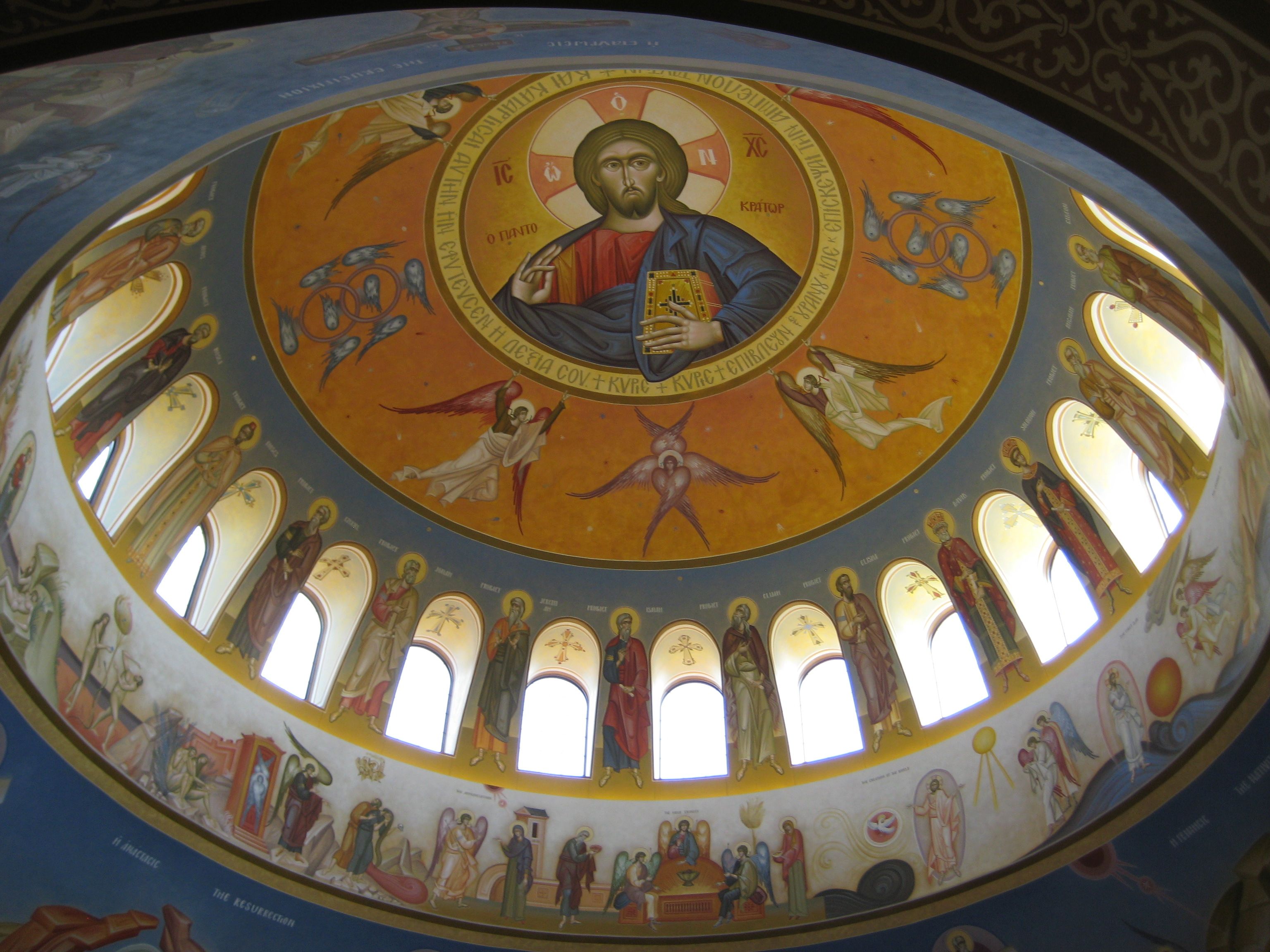
holy trinity frescoing2The lemonade-from-lemons that I’m trying to make from that is chanting at Holy Trinity Greek Orthodox Church on Holy Apostles’ off-Sundays; that’s been harder, because while they do Orthros, it starts at 8:15, so I’ve got to leave here around 6:45am. There are a couple of other couples/families in our peer group who are also driving up there semi-regularly, so how we’re trying to work it for now is I go up for Orthros, while Megan and Theodore come up with one of the other families. Holy Trinity has also been very welcoming to us, and their protopsaltis has been extraordinarily gracious in letting me help, given the irregular basis that I’m there. They’ve also just completed the first major stage of frescoing their new building; iconographer Dr. George Kordis and his team were in residence for a few weeks, painting the dome, the cornices, and the sanctuary. When we were there last he had just finished, and he gave a fascinating talk about the work they had done; the talk alone was worth the drive for the morning.

So, that’s how things have shaken out for us for the time being. We’re members at Holy Apostles, while also floating to Holy Trinity semi-regularly on Holy Apostles’ off-Sundays. I may also float to St. George every so often after this summer; I’m doing an intensive first-year Arabic program, and while I have scholarly applications for that, I’m also doing it, at least in part, to gain some facility with it as a liturgical language. So, we’ll see.

If I may — twice-monthly service schedule aside, if you’re looking for an Orthodox parish in the Indianapolis area, Holy Apostles really is a lovely, warm, and welcoming group of people, and their priest, Fr. John Koen, is a very kind and soft-spoken man who’s got a lot to say of substance, but he won’t beat you over the head with it. By all means come visit, and please find me and say hi if you do. (You can find them on the web as well as on Facebook; in both cases the presence is still developing, but the core details are there.)

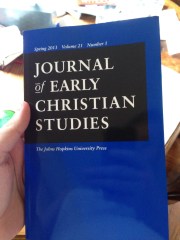
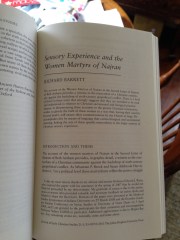
New journal article: “Sensory Experience and the Women Martyrs of Najran”

A bit over a year ago, I announced, along with an impending next generation, that my first peer-reviewed article in my more-or-less official field (late antique Roman history) had been accepted for publication. Well, the issue of Journal of Early Christian Studies arrived in my mailbox today, and they have also posted it online. If you’re interested in the piece, you can either access the entire issue via a research library’s subscription, or I’ve posted the pdf to my academia.edu profile. Onward and upward.

I should note that the issue includes an article by Jonathan Zecher, another former Seattleite and all-around cool guy whom I met via some mutual friends at North American Patristics Society last year (and with whom I had some other, unexpected friends in common); besides us punk kids, there is also an article by NAPS president Dennis Trout (it’s actually his address from last year’s conference), as well as Oxford legend Fergus Millar. All of that is to say, I find myself in unexpectedly good company — there goes the neighborhood, I guess.

855982_10102601286403059_189812403_o889249_10102601285983899_66939021_o

Amanda Palmer’s TED talk

I’m not a humongous fan of Amanda Palmer’s creative output. I like the idea of it more than I like its execution. I find her creative processes and chances to be intriguing, and on the whole I guess I’m glad that there are people trying to push the envelope of the present day economic model for the arts, particularly since I’m also somebody who is hoping that there are alternate funding models out there that can work. I’ve bought some of her music; as I say, it’s more interesting than enjoyable to me, on the whole, but the stuff that’s interesting can be pretty interesting. As I’ve said elsewhere, I’m an Oingo Boingo fan from way back in the day, and her “punk cabaret” thing is sort of a de-professionalized version of the the same idea. Sort of.


Ms. Palmer’s TED talk appears to be tearing up the Internet, and there are a couple of things I’d like to throw out there about it.

First off, I recently attended a seminar by a political theorist who is proposing that, along with liberty and equality, dignity is the third necessary precondition for democracy to work — that is, there has to be some way that the intrinsic worth of the participant is going to be preserved in the democratic process. This is interesting to me on a number of different levels, but for present purposes, I will say that it seems to me to be a big part of Ms. Palmer’s point. What she’s saying, essentially, is that if you ask for something in a way that affirms the dignity of both the person asking and the person being asked, rather than demanding in a way that assumes you’re asking from a position of authority or begging in a way that debases yourself as the petitioner, but that just says, “Hey, one human being to another, can you do something that’s in your power to do?” — that is, presents the proposed transaction as something mutual and participatory — then you’re more likely to get what you’re asking for, you’re also more likely to broaden your social network in some way through that person, that person’s social network is reciprocally expanded, and they are likely to feel like they got something of value out of the transaction. It’s a really lovely idea, no question.

I have no doubt that there are game theoreticians out there who will have plenty to say about Ms. Palmer’s model. My amateur’s observations are this:

Crowdfunding amounts to the thought I think probably every college student has ever had — “You know,” they say to themselves, walking to their next class, “if I could figure out a way to get a dollar from every person on this campus, then my tuition bill would be covered.” It’s a perfectly sensible thought if you can just figure out how to do it — why shouldn’t it be easier to get $1 from 40,000 people than to get $40,000 from a single source?

Well, there are a lot of reasons, it seems, why it isn’t easier, but Ms. Palmer starts out by saying, well, that’s the model that I followed as a street performer, and I did okay enough to see it as being fundamentally worthwhile. Here’s the thing, though — what she doesn’t tell you is that she did it in Boston. In order for something like that to work, you basically have to assume a certain size city, with a certain density of people on foot, and you have to assume a critical mass of a certain kind of person with a certain amount of cash on their person.

To put it another way, you couldn’t really do it in Bloomington.

Second, Ms. Palmer presents it as a model of “all you have to do is ask and anybody can do this”, and I’m just not convinced that it’s at all that simple. She at once talks about the value of expanding one’s social network through the average person on the street while also downplaying her own not-inconsiderable non-Average-Joe social network. She’s married to Neil Gaiman, is my point. That’s wonderful that she can get a Neti pot delivered to her at a coffee shop within 5 minutes of Tweeting the need for same; if only it were that easy for me to find Theodore a babysitter that way — but that’s just not my (or my wife’s) social network. Our networks are largely outside of Bloomington, which means they’re not terribly useful for immediate and personal needs — that’s what happens when you live in this kind of town for ten years, all your friends move away.

(Mr. Palmer — er, Neil Gaiman — also has a talk floating out there online that I intend to comment on soon. All in good time.)

All of that said, there is absolutely an art to asking, and fearlessness in reaching out really is the first step. I have found in my own projects that, if you’re hoping that somebody can give you $100, it’s better to ask for $400 and have them give you $200 because they really are happy to help than to ask for $100, have them figure you don’t really need the money if you’re asking for so little, and they give you $50. That doesn’t work in all cases, but it works in a reasonable proportion of them.

At the same time, there is no bigger draw to my blog than the materials under the tab “Greek Resources”. I have put them up for free, there are a lot of links out there to them, and I have tried to suggest over the years — Hey, if you think there’s a value here, then it’d be great if you expressed that value somehowAnd, well, that’s generated all of I think $20 a year since I started putting them up. That’s fine; I’m not going to take them down, and I’ll keep plugging away at them eventually, but that tells me something about how Ms. Palmer’s economic model works — that is, there’s more to it than simply putting up what you got and asking people to pay what they can. Along those lines, the funniest moment in the movie Julie and Julia to me is when Julie’s complaining about what she spends on cooking, somebody suggests to her that she put a PayPal button on her blog, and next thing you know, gifts and checks just start rolling in. Yeah, it’s just not that simple, kids. Would that it were.

The Saint John of Damascus Society is about to try to crowdsource a particular creative project, or at least the first stages of it, and I will be very curious to see how it goes. I do have a particular social network made up of particular kinds of people I’ve gotten to know over the years, and while it can’t get me a babysitter, I will be very interested to see if it can generate support for something creative. We shall see.

CD Review: A Concert of Syro-Byzantine Music by the St. Romanos the Melodist Byzantine Choir

Last fall, the St. Romanos Byzantine Choir of Beirut did a concert tour of the eastern part of the United States, from Chicago to New York. (I’m still enough of a Northwesterner to think of Chicago as “eastern”.) I had really hoped to be able to go to one of the stops, but the only real possibilities were Chicago and Cleveland, and the dates just weren’t friendly to either option. Hopefully, the next they come to the States, the St. John of Damascus Society can help bring them to Indianapolis (I can’t imagine Bloomington being a reasonable possibility without resorting to putting them in a straight-up concert hall, which would sound great, but it really wouldn’t feel right).

A live recording of the final stop on the tour at St. Nicholas Cathedral (Antiochian) in Brooklyn has been released as a two-disc set; this particular concert also happened to feature the GOA Archdiocesan Byzantine Choir, both as a featured choir and with the two groups singing some combined and antiphonal things.

The program represents a nice sample of the Byzantine repertoire throughout the liturgical year, largely in Arabic, and in a variety of textures; the Megalynarion for Pascha, the Kontakion for Annunciation, and the Katavasiae for Theophany, for example. The Greek choir does a lovely handful of things such as “A Good Word” with kratema, and “Before Thy Cross” with Dynamis, and then the combined choir sings a short program including hymns like the Varys Great Prokeimenon and an alternating Greek/Arabic Great Doxology.

The musical ability on display here is top-shelf indeed; St. Romanos is a great choir made up of first class singers. There is the characteristic strength of individual voices that one finds with good Byzantine choirs, but there is also a blend, a unity to the sound achieved by strong direction and solidity of musicianship throughout the ensemble, that one only hears with exceptional choirs, regardless of repertoire or geography. They achieve this in faster, syllabic textures, such as the Theophany Katavasiae, as well as in slower, melismatic textures, like the Holy Saturday Doxastikon of the Praises “The Great Moses”.

Production values are quite high; the recording is very clean with minimal background noise (always a potential problem), and the presentation of the CD itself is very handsome and professional. The whole package represents a nice step forward for this kind of product, and I hope that this is not merely a one-off but the first of multiple such efforts out of the Antiochian Archdiocese.

I’m only just in the last year or so starting to get to know Arabic as a liturgical language (entirely passively thus far, to be sure), and this recording (as well as Sam Cohlmia’s Dormition CD that came out last year) is helping my ear start to become accustomed to it. Both Dr. Cohlmia and the St. Romanos Choir give a moving account of the liturgical use of Arabic; when sung well — as on this CD — the language comes to life beautifully in Byzantine chant. The music is identifiably the same “language”, as it were, but in a different “dialect”. The style adapts itself to the language when both are given proper attention, it seems to me. I am certainly not one to argue that one should “have” to learn Greek or Arabic or Russian or Finnish or Romanian to be Orthodox; not at all. However, I would say that to me, these represent wonderful opportunities to learn a language in a particular context, as well as to get to know an additional (not necessarily better, don’t misunderstand) dimension of the faith. None of these are “God’s language”, as such, of course (any more than, say, King James-style English is), but each perhaps has something to teach about how we worship God. In the world of classical voice, languages have different things to teach us about singing; it seems to me the same could be true of worship.

Overall, this recording is a lovely document of what seems to have been an amazing event to have participated in; I wish even more than I did that I could have been there, and I am left hoping that it happens again soon. Recommended.


adventures in writing alexander lingas all saints bloomington all saints orthodox church american orthodox architecture american orthodox music american orthodoxy Antiochian Archdiocese Antiochian Orthodox Christian Archdiocese of North America Antiochians books byzantine chant cappella romana chant church architecture ecclesiastical chant ethnomusicologists ethnomusicology fellowship of ss. alban and sergius Greece Greek greek food greekness hazards of church music international travel tips ioannis arvanitis joe mckamey john michael boyer kurt sander Latin liturgical adventures liturgical architecture liturgical music liturgical texts and translation liturgy liturgy and life lycourgos angelopoulos medieval byzantine chant Metropolitan PHILIP militant americanist orthodoxy modern byzantine architecture modern greek music music as iconography my kids will latin and greek when they're newborns my kids will learn latin and greek when they're newborns orthodox architecture orthodox architecture is bloody expensive Orthodox choir schools Orthodox Ecclesiology orthodox outreach orthodox travel pascha at the singing school Patriarchate of Antioch Patriarch IGNATIUS IV Patriarch of Antioch publishing random acts of chant richard barrett in greece richard toensing rod dreher sacred music st. vlads st john of damascus society Syriac the Bishop MARK fan club the convert dilemma the dark knight The Episcopacy The Episcopate the only good language is a dead language this american church life travel we need more american saints why do we need beautiful music in churches?

Blog Stats

  • 262,833 hits

Flickr Photos