Archive for the 'General' Category


A word about where we’ve wound up…

In January, we started attending Holy Apostles Greek Orthodox Church in Indianapolis. I had been there once before; they had hosted one of the Indianapolis-area Sunday Vespers services that occur during Lent two years ago, and I was invited to help chant by one of the people who helps coordinate those services. Everybody at the parish was very warm and welcoming, as well as seemingly appreciative of the chanting help, and I’ll tell you what, if the drive hadn’t been such a conceptual barrier at that point (and if Flesh of My Flesh hadn’t been in Germany for the year and therefore not able to participate in such decisions), I would have started going there regularly right there and then.

So, when it became clear that a change of air was inevitable and necessary, my first thought was Holy Apostles. It wasn’t the shortest drive (~1:10), but it also wasn’t the longest, and the memory of them being as nice to me as they had been had really stuck with me in the intervening year and a half. We decided to go after the New Year, on a more or less non-committal basis; however, it’s not stretching things too far to say that that first Sunday, they rather insistently adopted us, and we’ve been there ever since, missing only a Sunday in February when all three of us were sick as dogs.

This community has extended us a lot of hospitality, and has been such a wonderful counterexample to the trope of “unwelcoming cradle parishes”. These people have bent over backwards to make us feel welcome; they have fawned over Theodore, they have taken a lot of time to get to know us, they have opened their homes to us, and really have done more than I would have ever expected based on previous experiences to make us feel like part of the family. Some of the interactions with Theodore have been particularly touching; for example, a yiayia yesterday suddenly came up to him and said in Greek, “Come on, little one, come with me,” and just whisked him off to the front of the nave. “We’re going to see Christ,” she said, taking him up to the icon. “Kiss Christ,” she said, holding him up to it. “He loves you very much!”

As regards chanting, they talked to me about it our first Sunday there, and I was actually planning on just standing in the congregation with my wife and child for a month or so, but when we came back the second Sunday, let’s just say that I found myself unambiguously summoned. At any rate, I have been able to contribute what makes sense to me to contribute, and it has worked well. The other couple of cantors, a couple of Greek gentlemen who belong to the previous couple of generations, have been very generous and just as hospitable as everybody else; they want me to sing what I’ve been trained to sing, be it in Greek or English, and it seems to have been received well thus far. Others in the congregation have been very helpful in terms of helping Megan with Theodore, and that’s also been very much appreciated.

I also have to say, acoustically, it’s a nice little church in which to sing — that is to say, while it’s not a resonant cathedral, I also don’t feel like I have to push at 200% every time I open my mouth to be heard. It’s a favorable enough acoustic that it’s pleasant to sing and I can still talk at the end of the morning. Holy Apostles meets in the freestanding side chapel of a large Disciples of Christ congregation in central Indianapolis; it is a really lovely building, and they have been able to do a lot with it. While it’s not exactly spacious, it’s basically everything they need, and it works just fine for the most part. The cantors wind up standing in the sanctuary, but that’s a practice with ample historical precedent, I suppose, and it works well enough with the space considerations.

Right now, Holy Apostles only meets every other Sunday — as a small community getting established in a rented space, it’s what they feel is the most practical thing for them to do right now, plus they are only serving Divine Liturgy on the Sundays they do meet, not Orthros (another practical necessity, since the host congregation uses the chapel for an early morning service). That has its upsides and downsides for us — it’s meant we haven’t felt like we’ve missed much by commuting, certainly, and we have a relatively easy Sunday morning when we go, but it’s also been hard to feel like a rhythm has gotten established, and it underscores that, as wonderful and embracing as everybody has been, we’re at some distance from the community.

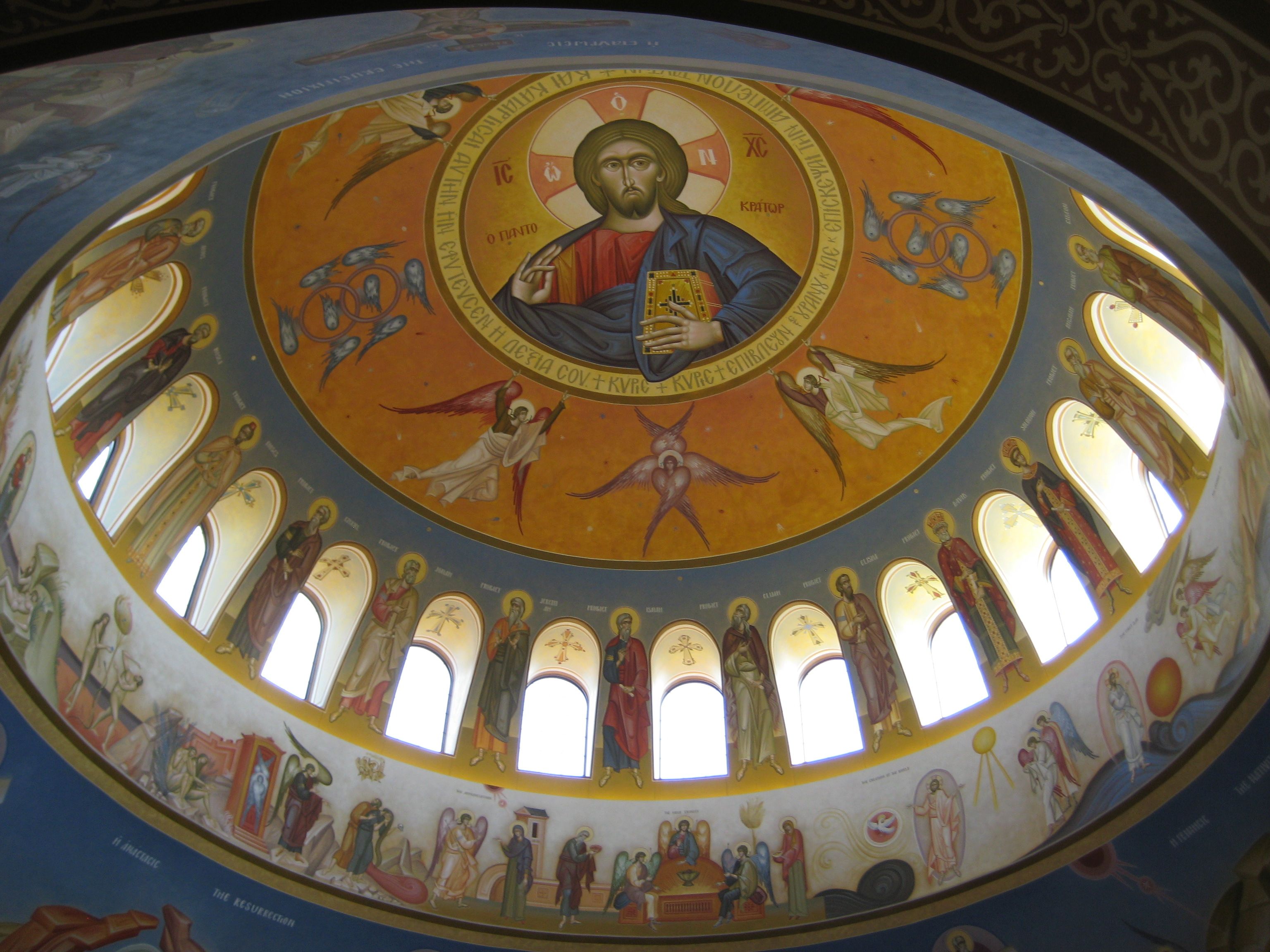
holy trinity frescoing2The lemonade-from-lemons that I’m trying to make from that is chanting at Holy Trinity Greek Orthodox Church on Holy Apostles’ off-Sundays; that’s been harder, because while they do Orthros, it starts at 8:15, so I’ve got to leave here around 6:45am. There are a couple of other couples/families in our peer group who are also driving up there semi-regularly, so how we’re trying to work it for now is I go up for Orthros, while Megan and Theodore come up with one of the other families. Holy Trinity has also been very welcoming to us, and their protopsaltis has been extraordinarily gracious in letting me help, given the irregular basis that I’m there. They’ve also just completed the first major stage of frescoing their new building; iconographer Dr. George Kordis and his team were in residence for a few weeks, painting the dome, the cornices, and the sanctuary. When we were there last he had just finished, and he gave a fascinating talk about the work they had done; the talk alone was worth the drive for the morning.

So, that’s how things have shaken out for us for the time being. We’re members at Holy Apostles, while also floating to Holy Trinity semi-regularly on Holy Apostles’ off-Sundays. I may also float to St. George every so often after this summer; I’m doing an intensive first-year Arabic program, and while I have scholarly applications for that, I’m also doing it, at least in part, to gain some facility with it as a liturgical language. So, we’ll see.

If I may — twice-monthly service schedule aside, if you’re looking for an Orthodox parish in the Indianapolis area, Holy Apostles really is a lovely, warm, and welcoming group of people, and their priest, Fr. John Koen, is a very kind and soft-spoken man who’s got a lot to say of substance, but he won’t beat you over the head with it. By all means come visit, and please find me and say hi if you do. (You can find them on the web as well as on Facebook; in both cases the presence is still developing, but the core details are there.)

One more hurdle cleared…

As noted back in January after I passed my Latin exam, yesterday was the date schedule for my oral qualifying exams. Preparation these last two and a half months has involved familiarizing myself with a bibliography of ~70 books (30 Roman history, 15 ancient Greek history, 15 medieval history, 15 relating to my dissertation topic), making sure I can talk with some authority about all of those areas of historical inquiry, as well as keep in my head the broad sweep of those histories, and produce (and be able to justify my choices for) syllabi for undergrad survey courses in ancient Greece and the middle ages.

Simple, right?

What I found during my preparation is that the hardest thing for me to do was keep the big picture in my head. This makes a lot of sense, really; most people start with a survey and then gradually narrow their focus. Because of how I got here, I really started with the details I was already interested in, and then had to figure out how to broaden my perspective so I could contextualize those details in a wider discussion. At some point I had to sit down, make a huge timeline from 753 BC to 1453 AD, divide it into periods, and force myself to refer to it constantly.

Anyway, without getting into a transcript of the exam, my committee members seemed pleased enough to tell me yesterday afternoon that I had indeed passed. The issue I describe above came up in their feedback, and what they said about definitely made sense and was helpful in terms of figuring out how to frame things in the future, but they didn’t treat it as a showstopping issue by any means.

It’s a step that feels very good to have done, and I left the room yesterday with both a sense of accomplishment (to say nothing of gratitude to my committee and everybody else who has helped get me here). So, on to the next step. I have a dissertation prospectus to defend now, and we’re trying to button that date down right now. It looks like it might be sometime during Orthodox Holy Week, possibly Holy Friday; we’ll see how it all shakes out. Once that’s defended, then I’ll be ABD (“all but dissertation”), and while I know this isn’t the case for everybody, the dissertation is the part I’m really looking forward to.

Your prayers up to his point have been greatly appreciated; your prayers moving forward are equally craved. I’m getting there, bit by bit…

New journal article: “Sensory Experience and the Women Martyrs of Najran”

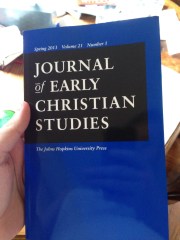
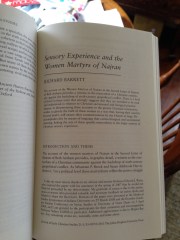
A bit over a year ago, I announced, along with an impending next generation, that my first peer-reviewed article in my more-or-less official field (late antique Roman history) had been accepted for publication. Well, the issue of Journal of Early Christian Studies arrived in my mailbox today, and they have also posted it online. If you’re interested in the piece, you can either access the entire issue via a research library’s subscription, or I’ve posted the pdf to my academia.edu profile. Onward and upward.

I should note that the issue includes an article by Jonathan Zecher, another former Seattleite and all-around cool guy whom I met via some mutual friends at North American Patristics Society last year (and with whom I had some other, unexpected friends in common); besides us punk kids, there is also an article by NAPS president Dennis Trout (it’s actually his address from last year’s conference), as well as Oxford legend Fergus Millar. All of that is to say, I find myself in unexpectedly good company — there goes the neighborhood, I guess.

855982_10102601286403059_189812403_o889249_10102601285983899_66939021_o

Amanda Palmer’s TED talk

I’m not a humongous fan of Amanda Palmer’s creative output. I like the idea of it more than I like its execution. I find her creative processes and chances to be intriguing, and on the whole I guess I’m glad that there are people trying to push the envelope of the present day economic model for the arts, particularly since I’m also somebody who is hoping that there are alternate funding models out there that can work. I’ve bought some of her music; as I say, it’s more interesting than enjoyable to me, on the whole, but the stuff that’s interesting can be pretty interesting. As I’ve said elsewhere, I’m an Oingo Boingo fan from way back in the day, and her “punk cabaret” thing is sort of a de-professionalized version of the the same idea. Sort of.


Ms. Palmer’s TED talk appears to be tearing up the Internet, and there are a couple of things I’d like to throw out there about it.

First off, I recently attended a seminar by a political theorist who is proposing that, along with liberty and equality, dignity is the third necessary precondition for democracy to work — that is, there has to be some way that the intrinsic worth of the participant is going to be preserved in the democratic process. This is interesting to me on a number of different levels, but for present purposes, I will say that it seems to me to be a big part of Ms. Palmer’s point. What she’s saying, essentially, is that if you ask for something in a way that affirms the dignity of both the person asking and the person being asked, rather than demanding in a way that assumes you’re asking from a position of authority or begging in a way that debases yourself as the petitioner, but that just says, “Hey, one human being to another, can you do something that’s in your power to do?” — that is, presents the proposed transaction as something mutual and participatory — then you’re more likely to get what you’re asking for, you’re also more likely to broaden your social network in some way through that person, that person’s social network is reciprocally expanded, and they are likely to feel like they got something of value out of the transaction. It’s a really lovely idea, no question.

I have no doubt that there are game theoreticians out there who will have plenty to say about Ms. Palmer’s model. My amateur’s observations are this:

Crowdfunding amounts to the thought I think probably every college student has ever had — “You know,” they say to themselves, walking to their next class, “if I could figure out a way to get a dollar from every person on this campus, then my tuition bill would be covered.” It’s a perfectly sensible thought if you can just figure out how to do it — why shouldn’t it be easier to get $1 from 40,000 people than to get $40,000 from a single source?

Well, there are a lot of reasons, it seems, why it isn’t easier, but Ms. Palmer starts out by saying, well, that’s the model that I followed as a street performer, and I did okay enough to see it as being fundamentally worthwhile. Here’s the thing, though — what she doesn’t tell you is that she did it in Boston. In order for something like that to work, you basically have to assume a certain size city, with a certain density of people on foot, and you have to assume a critical mass of a certain kind of person with a certain amount of cash on their person.

To put it another way, you couldn’t really do it in Bloomington.

Second, Ms. Palmer presents it as a model of “all you have to do is ask and anybody can do this”, and I’m just not convinced that it’s at all that simple. She at once talks about the value of expanding one’s social network through the average person on the street while also downplaying her own not-inconsiderable non-Average-Joe social network. She’s married to Neil Gaiman, is my point. That’s wonderful that she can get a Neti pot delivered to her at a coffee shop within 5 minutes of Tweeting the need for same; if only it were that easy for me to find Theodore a babysitter that way — but that’s just not my (or my wife’s) social network. Our networks are largely outside of Bloomington, which means they’re not terribly useful for immediate and personal needs — that’s what happens when you live in this kind of town for ten years, all your friends move away.

(Mr. Palmer — er, Neil Gaiman — also has a talk floating out there online that I intend to comment on soon. All in good time.)

All of that said, there is absolutely an art to asking, and fearlessness in reaching out really is the first step. I have found in my own projects that, if you’re hoping that somebody can give you $100, it’s better to ask for $400 and have them give you $200 because they really are happy to help than to ask for $100, have them figure you don’t really need the money if you’re asking for so little, and they give you $50. That doesn’t work in all cases, but it works in a reasonable proportion of them.

At the same time, there is no bigger draw to my blog than the materials under the tab “Greek Resources”. I have put them up for free, there are a lot of links out there to them, and I have tried to suggest over the years — Hey, if you think there’s a value here, then it’d be great if you expressed that value somehowAnd, well, that’s generated all of I think $20 a year since I started putting them up. That’s fine; I’m not going to take them down, and I’ll keep plugging away at them eventually, but that tells me something about how Ms. Palmer’s economic model works — that is, there’s more to it than simply putting up what you got and asking people to pay what they can. Along those lines, the funniest moment in the movie Julie and Julia to me is when Julie’s complaining about what she spends on cooking, somebody suggests to her that she put a PayPal button on her blog, and next thing you know, gifts and checks just start rolling in. Yeah, it’s just not that simple, kids. Would that it were.

The Saint John of Damascus Society is about to try to crowdsource a particular creative project, or at least the first stages of it, and I will be very curious to see how it goes. I do have a particular social network made up of particular kinds of people I’ve gotten to know over the years, and while it can’t get me a babysitter, I will be very interested to see if it can generate support for something creative. We shall see.

CD Review: A Concert of Syro-Byzantine Music by the St. Romanos the Melodist Byzantine Choir

Last fall, the St. Romanos Byzantine Choir of Beirut did a concert tour of the eastern part of the United States, from Chicago to New York. (I’m still enough of a Northwesterner to think of Chicago as “eastern”.) I had really hoped to be able to go to one of the stops, but the only real possibilities were Chicago and Cleveland, and the dates just weren’t friendly to either option. Hopefully, the next they come to the States, the St. John of Damascus Society can help bring them to Indianapolis (I can’t imagine Bloomington being a reasonable possibility without resorting to putting them in a straight-up concert hall, which would sound great, but it really wouldn’t feel right).

A live recording of the final stop on the tour at St. Nicholas Cathedral (Antiochian) in Brooklyn has been released as a two-disc set; this particular concert also happened to feature the GOA Archdiocesan Byzantine Choir, both as a featured choir and with the two groups singing some combined and antiphonal things.

The program represents a nice sample of the Byzantine repertoire throughout the liturgical year, largely in Arabic, and in a variety of textures; the Megalynarion for Pascha, the Kontakion for Annunciation, and the Katavasiae for Theophany, for example. The Greek choir does a lovely handful of things such as “A Good Word” with kratema, and “Before Thy Cross” with Dynamis, and then the combined choir sings a short program including hymns like the Varys Great Prokeimenon and an alternating Greek/Arabic Great Doxology.

The musical ability on display here is top-shelf indeed; St. Romanos is a great choir made up of first class singers. There is the characteristic strength of individual voices that one finds with good Byzantine choirs, but there is also a blend, a unity to the sound achieved by strong direction and solidity of musicianship throughout the ensemble, that one only hears with exceptional choirs, regardless of repertoire or geography. They achieve this in faster, syllabic textures, such as the Theophany Katavasiae, as well as in slower, melismatic textures, like the Holy Saturday Doxastikon of the Praises “The Great Moses”.

Production values are quite high; the recording is very clean with minimal background noise (always a potential problem), and the presentation of the CD itself is very handsome and professional. The whole package represents a nice step forward for this kind of product, and I hope that this is not merely a one-off but the first of multiple such efforts out of the Antiochian Archdiocese.

I’m only just in the last year or so starting to get to know Arabic as a liturgical language (entirely passively thus far, to be sure), and this recording (as well as Sam Cohlmia’s Dormition CD that came out last year) is helping my ear start to become accustomed to it. Both Dr. Cohlmia and the St. Romanos Choir give a moving account of the liturgical use of Arabic; when sung well — as on this CD — the language comes to life beautifully in Byzantine chant. The music is identifiably the same “language”, as it were, but in a different “dialect”. The style adapts itself to the language when both are given proper attention, it seems to me. I am certainly not one to argue that one should “have” to learn Greek or Arabic or Russian or Finnish or Romanian to be Orthodox; not at all. However, I would say that to me, these represent wonderful opportunities to learn a language in a particular context, as well as to get to know an additional (not necessarily better, don’t misunderstand) dimension of the faith. None of these are “God’s language”, as such, of course (any more than, say, King James-style English is), but each perhaps has something to teach about how we worship God. In the world of classical voice, languages have different things to teach us about singing; it seems to me the same could be true of worship.

Overall, this recording is a lovely document of what seems to have been an amazing event to have participated in; I wish even more than I did that I could have been there, and I am left hoping that it happens again soon. Recommended.

In which St. John Chrysostom shows up on another digital bumper sticker

This has been one of the more stressful semesters of my college career. Not quite the most stressful, but there has definitely been plenty of pressure.

I started off with my Latin exam. Then I was going to have a relatively nice and easy semester preparing for my quals, for which I sit on 29 March. Flesh of My Flesh had a cushy-ish research assistantship that could be done from home, so there was supposed to be very little going on to distract from what we needed to do to get through the term.

Er, well, no.

Megan got a last-minute teaching assignment right after I took my Latin exam; one of her faculty members had a personal concern that took him out of the classroom on literally a couple of hours’ notice, and she got handed his class — a 400-level content course in German. It meets an hour before the class I’m assisting with on Monday and Wednesday, and then at the same time as one of my lecture sections on Friday. This means every day is a juggling act with Theodore Harvey Barrett The Second The Bouncing Baby Boy, and has effectively meant that for either of us to get anything done, we either have to have a babysitter or the other person has to get nothing done. In a way, this really has turned out to be an ideal semester to give up having four services a week to chant (although I am chanting at Holy Apostles now, which has been really nice on several levels), but it’s still been, shall we say, less than restful.

I’m also in full-blown “Hi, I’m a professional late antique Roman historian” mode, which means that when I see quotes that purport to be from somebody I study but with no citation, I instinctively start asking questions, as I’ve done before.

So, yesterday, I see a few people start to post this on Facebook:

“A young husband should say to his bride: ‘I have taken you in my arms, and I love you, and I prefer you to my life itself. For the present life is nothing, and my most ardent dream is to spend it with you in such a way that we may be assured of not being separated in the life reserved for us.’” — St. John Chrysostom

That’s a lovely sentiment, it truly is, and it is one that I would never want to slap down, exactly. If Chrysostom said it, that’s fantastic. Still, something about it felt “off”, and without the citation, it seemed like it would be worth seeing if I could track it down. Part of it was that I’m sure my previous effort likely struck some as an ideological project; I tried to make it clear that it wasn’t an ideological project at all, but rather an accuracy project. If that “quote” about how the rich “will joyfully share their wealth” isn’t legitimate (and so far nobody has come up with anything substantial to indicate that it is), then it doesn’t help anybody’s side to continue to circulate it under Chrysostom’s name. (No, I’m not going to tell you which side I agree with on that — i.e., whether or not I wish it were authentic. My politics are my own business, and current politics are actually among the things in the world in which I am least interested.) So, anyway, if that wasn’t ideological, then I should be willing to do that kind of work even when it’s a greeting-card sentiment that surely everybody should unambiguously approve of, right? Exactly.

Off to Google I went. I couldn’t come up with anything searching on that text except for, well, the quote presented as the quote. A TLG search on Greek keywords like νύμφη (bride) and ὄνειρος (dream) came up with nothing that looked anything like it. I also didn’t find anything in Chrysostom on Marriage and Family Life that resembled the passage in question. None of this necessarily meant anything except that I hadn’t found the right keywords, of course.

Finally, somebody pointed me to this page, which presented the text this way:

The words of one of the greatest-ever preachers, St John Chyrsostom, might deepen the question. He said that a young husband should say to his bride: “I have taken you in my arms, and I love you, and I prefer you to my life itself. For the present life is nothing, and my most ardent dream is to spend it with you in such a way that we may be assured of not being separated in the life reserved for us” (Homilies on Ephesians, 20,8).

There are a couple of useful bits of information there. There is the citation, of course. There’s also the incipit of the quote as it appears on Facebook, “…a young husband should say to his bride”, except it’s not actually in the quoted text. It’s the introduction to the quote, not part of the quote itself. By the time it gets to Facebook, however, it’s part of the quote. Someday, I’m sure, textual criticism of the Internet will be its own scholarly field. Things like this will be among the phenomena to study, I’m sure.

The citation allowed me to look up the Greek text on TLG. I have to say, at best, the quote is a rather, uh, free paraphrase of the Greek, and it’s also somewhat out of context. Here it is with some context (translation mine):

“For if Paul did not refrain from saying, ‘Do not deceive each other,’ and he was speaking the words of a bridesmaid, or rather not of a bridesmaid but a spiritual soul, by much more we will not refrain from saying [the same thing]. What, then, is it necessary to say to her? With great grace indeed [it is necessary] to be saying to her: ‘I took you, child, as a sharer of life, and I led you in to the most serious and necessary things as one sharing them with me, [namely] in the begetting of children and the leadership [or protection — the word is προστασία, the same word we call the Mother of God in the usual Sunday kontakion — “Protection of Christians that cannot be put to shame…” etc.] of the household. How, then, will I encourage you?’ Rather, before this, speak of the matters of love [ἀγάπη]. For there is nothing that thus avails to persuade the ones hearing to welcome the things said [to persuade one to listen to what you’re saying] than to learn that it is spoken with much love [ἀγάπη]. How then do you show love [ἀγάπη]? If you say, ‘Being able to take many women, both more well-provided-for and of clear lineage, I didn’t choose [them], but I was longing for you, and your conduct, your propriety, your graciousness, your prudence.’ Then immediately from these things prepare a way of words concerning philosophy, and in a roundabout way [lit. ‘with a way around’] denounce wealth. For, on the one hand, if you simply prolong your speech against wealth, you will be burdensome; but on the other hand, if the subject is taken up, you will finish quickly. For you will seem to do this thing in the manner of explanation, not as somebody strict and graceless and of small account. But when you take up this subject in a way related to her [lit. ‘from her things’], it will even be enjoyable.

You, then, will say (for again it is necessary to take up the speech)…”

Here I must pause to note that everything up to this point is what the Facebook quote glosses as “A young husband should say to his bride…”, and we’ve still got some other stuff to go:

“…’it was possible and easily done to marry a rich woman [or, “it was was possible to marry a rich and well-provided for woman”], but I did not suffer it. Why, do you suppose? Not simply, or haphazardly, but I was educated well, that wealth is no possession but a contemptible thing, belonging to thieves and prostitutes and grave-robbers. On which account giving up these things, I came upon the virtue of your soul, which I value above all gold. For an intelligent and free young woman cultivating the fear of God is worthy of the entire known world [οἰκουμένη, which strikes me as also being something of a pun on the idea of the household]. On account of these things…”

…and now we finally get to what the quoted passage says:

“I embraced you for my own, and I am giving you affection [φιλῶ], and I am setting you over my own soul [προτίθημι is the same word used to denote a liturgical offering to God, so Chrysostom may be suggesting something of the sacramental nature of marriage here]. For the present life is nothing, and I pray and I request and I do everything so that we are counted worthy to stand this present life, and to be able to be with each other there in the age to come with much freedom from fear.”

And that’s the end of the quotation. As I said, what’s on Facebook is a rather free paraphrase that shades it more towards notions of romantic love that, while not necessarily wrong, aren’t really what Chrysostom is talking about. The next little bit also seems quite relevant:

“For on the one hand this time [χρόνος, earthly time] is short and perishable; on the other hand, if we, being pleasing to God, are counted worthy to change this life for that one, we will be always both with Christ and with each other with the fullness of pleasure. I set your love [ἀγάπη] before everything, and nothing is thus difficult or burdensome to me as when I quarrel with you. Even if it should be necessary that I lose everything, that I become poorer than Irus [a beggar in The Odyssey], that I endure extreme dangers, that I suffer anything whatsoever, to me everything is tolerable and bearable, as long as matters for you are well-ordered for me. And children will then be desirable for me, as long as you are favorably disposed towards me. But it will be necessary that you do these things too.'”

The whole homily is very much worth reading, but again, it’s pretty clear to me that what Chrysostom is saying is very different than what the short paraphrase suggests. The old Schaff Nicene and Post-Nicene Fathers translation can be found here; if you read Greek, you can find it in TLG (PG 62.146-147).

So, yeah. Don’t trust greeting-card-style quotes that are attributed to Chrysostom, I guess. He was a pretty grumpy saint for such quotes to be reliably authentic.

Back to exams…

Places I wish I could be: Cappella Romana goes to Hagia Sophia by way of Stanford

Something that I’ve been paying a good deal of attention to in the last year is the Icons of Sound project at Stanford University. Art historian Bissera Pentcheva has been involved in piecing together a working model of the aesthetic environment of Hagia Sophia, and the work has involved a recreation of the Great Church’s acoustics. Strategically placed (to say nothing of carefully negotiated with the Turkish government) balloon pops in the cathedral provided an audio sample sufficient to generate a computer model of the building’s resonance and decay, and they called in the big guns, Cappella Romana, to record some things that would demonstrate the model’s efficacy. An initial proof of concept of the project was published in the form of the stunning video found on this page.

The project has proceeded from there, and this weekend is a huge development — Cappella Romana doing a weekend residency at Stanford and presenting two concerts in the university’s new state-of-the-art Bing Hall. These concerts will involve setting up a sound system that uses the computer model of Hagia Sophia’s acoustic; the ensemble and the audience will, in theory, experience the music as though it were being sung in the Great Church itself.

I really wish I could be there, no question about it; if you live anywhere near Stanford, tickets are still available for Saturday evening’s performance. More information is at the Cappella Romana blog, and there’s also a fascinating article about the project in Stanford Live Magazine.

Since the ideal acoustic environment for churches, particularly Orthodox churches, is a topic about which I find myself constantly trying to evangelize to others, I would like to note the following excerpt from the magazine article:

“We learned that spaces have their own particular sound, created by the reverberation and patterns of the reflections that interact with the performer,” says [Jonathan Abel, a consulting professor at the Center for Computer Research in Music and Acoustics in Stanford’s Music Department]. “Singers vary tempo and even subtly vary pitch to hit resonances of the building. There’s an interaction that happens in the field of the space, to the point where it’s difficult to separate the acoustics of the space from the performance of the music. When you perform a piece of music that was written for a particular acoustic in that very same space, it conveys something unique to the listener.”

CR’s Artistic Director, Alexander Lingas, follows up on this a bit later in the piece:

“As singers,” says Lingas, “we’re used to making adjustments for specific acoustics. We can feel and hear the resonances where harmonics lock in between each other, which affects tempo and tuning. So we’re very interested in seeing how it will work when we unite all the parts together in Bing Hall.”

If you’re somebody who is going to be at one of these concerts, I’d love to hear about your experience.

CORRECTION, 8:04pm — I am told that Saturday’s concert is in Memorial Church, not Bing. Thank you for letting me know!

Another contribution elsewhere

Just FYI — Fr. Andrew Damick invited me to contribute an essay to the Orthodoxy and Heterodoxy blog considering the points raised by this piece, and my essay was published this morning. Should you be coming here from Orthodoxy and Heterodoxy, welcome. There’s a decent amount to read in the archives; oral exam prep and fatherhood have slowed my output down somewhat, but I still treat this blog as a going concern, so do please stick around.

Some thoughts on The Hobbit: An Unexpected Journey

On New Year’s Day Megan and I finally got to see The Hobbit: An Unexpected Journey. Friends of ours were willing to watch Theodore for a few hours, and even bought tickets, bless them. Seeing it in 3-D 24fps, I rather enjoyed it; the supposed departures from the book didn’t bother me for many of the reasons discussed here. One of the things I really liked about it that this article does not mention is that there weren’t any American actors (save Elijah Wood oh-so-briefly) doing English accents that won’t have aged well 10 years from now. That’s something about the LOTR trilogy that really sticks out for me these days; the simple fact is, some American actors have gotten a lot better at accents since those movies were made, and Elijah Wood and Sean Astin really give it their all, but on repeated viewings some things annoy that I suspect won’t with Martin Freeman’s performance.

On that — arguably, Martin Freeman starts out playing his straight man type, John Watson with prosthetic feet, but I assume part of the point will be to see the transformation by the third film (much as, I should add, we see Watson progress in Sherlock). There were already little ways he was incorporating some of Ian Holm’s characteristics; I assume he’ll go further with that as the films progress.

Speaking of Ian Holm, I watched Alien a couple of nights ago for the first time in a long time, and Martin Freeman really does look a good bit like Ian Holm in his younger days. They could have done a lot worse in terms of matching actors.

I saw that Christopher Tolkien has claimed that Peter Jackson’s films “eviscerated” the books. I respect where the Tolkien family is coming from. I can understand the problem of films overtaking the imaginary impetus of the source material and perhaps setting up false expectations. Something very similar to this has historically been my objection to people like Andrea Bocelli and Sarah Brightman being referred to as “opera singers”.

However, something worth pointing out is that Tolkien’s work has in no way been “eviscerated”. Whatever one thinks of the films (and, call me a casual, unserious, uninformed Tolkien reader if you like, but I’ve read them all multiple times, I’m actually surprised at how much Peter Jackson’s films actually do maintain what I see as the spirit, if not the letter, of the books), the books are still right there on the shelves. Not a word of them has been changed (except those that Tolkien himself changed through the various edits and revisions). You can buy Tolkien’s books and read his words for yourself, and many, many people continue to do so, so I find it somewhat disingenuous to claim that the Tolkien heirs don’t benefit at all from this.

Two books I read a long time ago that very much changed how I saw cinematic adaptations of stories from other media are Syd Field’s Screenplay  and J. Michael Straczynski’s The Complete Book of Screenwriting. There are reasons things get changed for films, and even factoring out issues of the economics of film, they have to do with the needs of the medium. Even something as simple as having to decide on a consistent way a character looks or how their name is pronounced has to be decided upon, which itself means you’re going with one interpretation over another. Don’t think this is a big deal? Google “Balrog wings controversy” sometime. I also have friends who insist that the names “Smaug” and “Gollum” are actually pronounced “Smog” and “Gah-LUM”. These are things that an individual reader can decide for themselves when reading it in their own head, but you can’t do that with film.

And, like it or not, film presents an opportunity to “correct” the source material. For every person who thinks it’s ridiculous that Arwen’s story got expanded in the LOTR films, there’s somebody who thinks the filmmakers caved to chauvinistic purists by not going ahead with having Arwen go all-out warrior princess and fighting at Helm’s Deep. (According to the commentaries on the DVD, this was all shot, but it apparently didn’t work when they looked at what they had. Did Liv Tyler just not have the chops for it? I don’t know.) Maybe you can argue that such changes are precisely what take away from the spirit of the source material, but also consider that variations are part of what make myth myth. To the extent that Tolkien was “subcreating” myth, then it becomes problematic to apply some kind of “sola scriptura” rubric to the story. Myths get retold, and they get retold in ways that suit new audiences. Even within the universe of The Lord of the Rings — the book that we call The Hobbit is different in a crucial way from what Tolkien originally published, and it’s because he realized he needed the story to do something else when he revisited it years later.

All of this is to say — I don’t doubt that Christopher Tolkien, perhaps the closest person on earth to the textual sources of Middle Earth still living, feels every and any change from the text like a stab to the gut. I do suggest, however, that that very intimacy with his father’s words make it very difficult for him to properly see the big picture.

“Always start out with a few good jokes” — a choir director’s initial and parting thoughts

I had my last rehearsal with the All Saints choir last night, and I gave a little bit of a farewell speech. I found some prepared notes from my very first rehearsal with the All Saints choir seven and a half years ago, and they still seemed relevant, if clearly pre-dating some things that I’ve learned in the intervening time. I prefaced all of this by mentioning that my favorite quote from my teaching evaluations this fall was, “Needs dumbed down”, which I find wonderful on several levels. Anyway, I didn’t read all of this last night, just some select chunks, but here’s the whole thing:

2 July 2005, All Saints Choir Rehearsal #1

Always start out with a few good jokes:

Music vocabulary—

Bar line: A gathering of people, usually among which may be found a church musician or two (usually Episcopalians).

Tenors: Most choirs have either a) none, or b) too many. When wholly absent they leave an aching void. When too numerous, they fill the void without removing the ache. Tenors rarely sing words and often produce regional sensations rather than actual notes. During the mating season, they draw attention to themselves by sustaining high notes while the rest of the choir has gone on with the phrase.

Seen in a church bulletin: “At the evening service tonight, the sermon topic will be ‘What is hell?’ Come early and listen to our choir practice.

The Scriptures on singing in worship

Romans 15:9—And that the Gentiles might glorify God for his mercy; as it is written, For this cause I will confess to thee among the Gentiles, and sing unto thy name.

1 Cor 14:15—What is it then? I will pray with the spirit, and I will pray with the understanding also: I will sing with the spirit, and I will sing with the understanding also.

Ephesians 5:19—Speaking to yourselves in psalms and hymns and spiritual songs, singing and making melody in your heart to the Lord

Colossians 3:16—Let the word of Christ dwell in you richly in all wisdom; teaching and admonishing one another in psalms and hymns and spiritual songs, singing with grace in your hearts to the Lord.

Hebrews 2:12–Saying, I will declare thy name unto my brethren, in the midst of the church will I sing praise unto thee.

James 5:13—Is any among you afflicted? let him pray. Is any merry? let him sing psalms.

The Church Fathers on singing in worship

“Let us consider the entire multitude of angels, how standing by you they minister to his will. For the Scripture says: ‘Ten thousand stood by him and a thousand ministered to him and cried out, ‘Holy, holy, holy is the Lord of Sabaoth, the whole creation is full of his glory.’ (Isaiah 6:3) Let us, therefore, gathered together in concord by conscience, cry out earnestly to Him as if with one voice, so that we might come to share in his great and glorious promises.” (St. Clement of Rome (c. 96 A.D.), First Epistle to the Corinthians, italics mine)

“…you make up a chorus, so that joined together in harmony, and having received the godly strain in unison, you might sing in one voice through Christ to the Father, so that He might hear you and recognize you through your good deeds as members of His Son…” (St. Ignatius of Antioch (c. 100 A.D.), Epistle to the Ephesians, italics mine)

“We want to strive so that we, the many, may be brought together into one love, according to the union of the essential unity. As we do good may be similarly pursue unity….The union of many, which the divine harmony has called forth out of a medley of sounds and division, becomes one symphony, following the one leader of the choir and teacher, the Word, resting in that same truth and crying out, ‘Abba, Father.’” (St. Clement of Alexandria (c. 200 A.D.), Protrepticus)

A modern Christian writer on singing in worship:

All quotes from Why Catholics can’t sing by Thomas Day.

“[T]he sung ritual [is] a symbol of a burning faith […] The [sung] liturgy in any language [is] the symbol of faith so intense and filled with joy that it [has] to burst forth in almost continuous song.”

The Great Unwritten Law of Church Music: “[M]usic for the church must not clash with the liturgical function; it must take its place in the objective liturgical setting and not seem like an intrusion. [It] must display a degree of quality and craftsmanship which will be agreeable to a prince and peasant, male and female, young and old. Everyone who […] hears the music must sense a group endeavor, a group prayer: maybe something performed by the assembly or by a choir acting in the name of the assembly […] that seems to sum up the highest religious aspirations of a whole people. [T]he icon painters [pray] and [fast] as they [struggle] to put the holy images into the exacting forms prescribed by tradition. You must try to do something similar.”

Music in the Church is best when it “(1) expresses the noblest aspirations of the communal, cultural, tribal consciousness and (2) seems to submit to the higher purposes of the rite itself.”

So, what does this mean for us?

As an Orthodox choir, our job is not to sing one or two “anthems” or “offertories” at specific points in the service as in a Protestant church. Our job is to help the congregation sing the entire service. With a 90% sung liturgy lasting close to an hour and a half, that’s no small feat. We sing liturgical music, which means we sing the music that comes out of the work of the people (the literal meaning of “liturgy”) [NOTE, 21 Dec 2012: this is the main spot where obviously my thinking has changed, and I would find a different way of putting this today]. That means, simply put, our worship is work. Given our leadership role in the work, our job is not to be individuals who just happen to stand in a different place in the nave from everybody else; our job is to lead the rest of the congregation into the ideal of “one voice” in worship. By definition, to do this takes time, effort, and commitment to taking that leadership role seriously.

It also takes the choir functioning as a community within the community. From one perspective, the expectation is quite high: we’ve gotten up early so our voices haven’t completely woken up yet, and if we’re receiving the Eucharist we haven’t been able to do the normal things that help get the throat and vocal cords going the way they need to—drink water, coffee, tea, eat something, and so on—but we still have nearly an hour and a half worth of singing to do, more if we’re singing in the Matins service. The only way we can do that well, not to mention healthfully, is to support each other, personally and vocally, so that no one person in any section is carrying everybody else for the entire Divine Liturgy. What it takes is simply time, effort, and commitment from all who are willing to give it. It’s that difficult and that easy.

To that end: In consultation with Fr. Athanasius, while I am directing the choir, we will take the following steps:

1) Incorporate the choir into Saturday evening Vespers for the four-part portions of the service, and rehearse either before or after Vespers. We will try rehearsing after Vespers for the time being; we might very possibly try it before Vespers if it is found that this works better all around. I have deliberately scheduled the rehearsal around an already existing service, and I will never take up more than an hour of your time at any given rehearsal. Ideally, there will be rehearsals where my agenda for the evening will take up less time than that, and we will only continue through to the end of the hour if there is something that the group wishes to work on. These rehearsals will consist of a combination of vocal warm-ups, sight-singing warm-ups, announcements, polishing music we already know and learning new music. The balance of these various components will vary from week to week, based on the service requirements for that week and coming weeks.

2) Warm up as a group either at 9:35am on Sunday morning or after the Matins Gospel, whichever comes first. Starting Sunday, 17 July 2005 (that’s two weeks from now), this will be the skeletal minimum with respect to my expectation of you if you intend to sing that morning. If you cannot make a Saturday evening rehearsal at this time, then I absolutely need you to warm up with the group Sunday morning. For those of you who sing in the Matins service, we will devise a regular rotation so that one week you may finish out Matins, the next week you will warm up with the choir, and so on.

3) Gradually phase out the use of soloists for verses and replace them with unison chanting. We will talk about this more as we go, but for Psalm verses and whatnot, I would like to see an alternating “left choir/right choir” approach, where perhaps the women sing one verse, the men sing the next verse, etc. We will experiment with this over time to see how it best works with this group. The vocal and acoustic circumstances are simply not ideal for solo voices, and where it is practical to use an ensemble, we will.

I will also do the following:

1) Put out a calendar outlining rehearsals and services coming up a month out (perhaps two months out, if I find that it’s necessary). If you know you won’t be at a rehearsal or a service, please sign out on the calendar. Additionally, if you plan to attend a service or a rehearsal, should something happen at the last minute preventing your attendance please call me or e-mail me as soon as you possibly can so that I know what to expect for that rehearsal or service. I offer you all the same courtesy—if something happens to me, I will let you all know as soon as I possibly can.

2) Make myself available for work outside of regularly scheduled rehearsals and services. For example—if you need help with something musically, want extra sight-singing practice, if the tenor section needs extra help and wants a section rehearsal, if you need to talk to me about something privately, or if you just want to chat, please give me a call or send me an e-mail and we will find time to do so.

3) Make rehearsals as fun as I possibly can. I want you all to want to come to rehearsal, not feel like you have to come, which in my experience will only ensure that you want to come even less. I want our rehearsals to be a friendly, positive working environment, because I think we’ll all get more done that way.

My final point for now is this: a no is as good as a yes, as far as I’m concerned. If, after hearing all of this, you are thinking to yourself, “He’s going to have to count me out,” that’s fine. I’m not mad at you, and neither is anybody else. What I ask, however, is that you not make a snap judgment now. I ask that you give it some time to see how it will work—perhaps you’ll surprise yourself.

I believe this is a group who is capable of a lot. If we can commit to putting in the time and the effort, and remember that this is not about us but about the glorification of God, I believe we will be able to accomplish a lot.

Okay, I’m done talking now. Let’s sing.

I also mentioned some passages from +BASIL’s essay, “The Ministry of Church Singers”. I think parts of this have to be contextualized as a bishop being pastoral and pious, but there are nonetheless some things he says unequivocally:

There are few ministries of the Church that require the devotion and the dedication that church singing does. You who lead the singing as well as you who follow the leader are precious gifts to your parishes. You are as important to the parish as is the holy table itself. As there can be no liturgy without the holy table, there can be no liturgy without you. This is not to compliment you or increase your pride, but rather to put a little fear and awe in you, so you know what your responsibilities are. Church singing is not a hobby. Being a choir director is not something one does for personal fulfillment. It is first and foremost a duty, a duty of those to whom God has given musical talents. It is sinful, in my opinion, for someone not to sing who has been given the gift to sing. Sinful! You join the angels, and do that which the angels do perpetually. That’s not an interest, avocation, or a hobby; it is a duty. Angels were created to serve and to praise, and you have been given voices for that same purpose.

[…] It’s a holiness. It’s not your ministry. It’s a ministry that belongs to the Church, and you respond to the call as well as recognize that the gift which you specifically fulfill in the church was, traditionally, and in some sense still is, an ordained ministry. The choir was not some club that existed in Church for those with some particular musical talent. To be a church singer was an ordained office within the Church. Canon 15, from the Council of Nicea, the Council of the 4th century, makes its point clear that only canonical singers should be appointed for that kind of ministry in the Church. That means “one set apart” for that particular ministry. Today we might call them Readers. While I’m not saying that every choir member must be a tonsured Reader, I do say that if we fulfill at least the spirit, if not the law of the Canon, that each choir member ought to see his/her participation in the choir as seriously as the ordained clergy take their ministry. I don’t know any priest who thinks that he can say on some Sunday, “I don’t want to serve because I want to sit with my wife,” or, “I don’t feel like serving today,” or, “I’m angry, one of the altar boys offended me, so I don’t want to serve this morning.”

[…] We jump in and we jump out. Some of us jump in on time and some of us jump in a little bit late. In my opinion, being in church for that first “Amen” is a sign, an indication of one’s humility. And where humility is, indeed, a virtue, its opposite is a sin. The sin is not disturbing other people. The other people in the church are not the object of our worship. It is rude, but not necessarily sinful, to disturb other people. But it is sinful to be presumptuous and prideful that one can jump in and sing with thousands of archangels and ten-thousands of angels at one’s own whim. “This Sunday I feel like singing, and next Sunday I won’t sing. I want to sit with my wife.” Leave that Hallmark—card kind of sentimentality for restaurants, concerts, and cinemas. You sing with angels, that’s secondary to sitting with any husband or wife or children. We stand before the throne of God, and when we realize that, every other consideration, all of our own personal likes and dislikes, become secondary. I’m giving my opinion now, and hopefully it humbles all of us. It’s a humiliation, that in its end, should be something that elevates us, that exalts us, something that gives us wing.

[…] You and your choir need be as aesthetically perfect as you are able. God not only expects, but He accepts only our best.

As I said to the choir last night, I’m a convert, not a cradle, and every convert brings with them some baggage from their previous experience. My background is one that places a high value on liturgical beauty and music, and that value is practical, not just theoretical. Church music is a profession. It is not unheard-of for church musicians in my former communion to have terminal degrees and to have half-time, if not full-time, salaries. While I have always known that such a set of circumstances would never even come close to being reality at All Saints, I have always tried to fulfill the musical function at All Saints as though those were the expectations of me — and I should stress the “of me” part, because certainly the point was never to turn the All Saints choir into an opera chorus. Rather, the point was that, if I was excited about what I did and took it seriously in the way +BASIL describes, hopefully everybody else would catch the spark, too, and get excited about it along with me. It was an experiment to see if one could build a fully-functioning music ministry at the only Orthodox parish in a town that was home to a Big Ten university and one of the best schools of music in the country. I’m happy that the experiment has borne fruit, even if it won’t specifically be attached to the parish anymore. All told, this (as well as the ongoing annotation and discussion of it here) represents a pretty good snapshot of my thinking of how the effort worked, and how I would approach such a project if I were to start afresh now.

Δόξα τῷ Θεῷ πάντων ἔνεκεν. As always, we’ll see what happens next. I thank All Saints, Fr. Peter, and those who sang with me for the chance to serve over the years, I hope that I was able to communicate some small element of what I love about our Church’s music despite all of my own faults and foibles, and I wish all of them, as well as whomever my successor will be, many blessings. Again, I crave your prayers for myself and my family as we make this transition.


adventures in writing alexander lingas all saints bloomington all saints orthodox church american orthodox architecture american orthodox music american orthodoxy Antiochian Archdiocese Antiochian Orthodox Christian Archdiocese of North America Antiochians books byzantine chant cappella romana chant church architecture ecclesiastical chant ethnomusicologists ethnomusicology fellowship of ss. alban and sergius Greece Greek greek food greekness hazards of church music international travel tips ioannis arvanitis joe mckamey john michael boyer kurt sander Latin liturgical adventures liturgical architecture liturgical music liturgical texts and translation liturgy liturgy and life lycourgos angelopoulos medieval byzantine chant Metropolitan PHILIP militant americanist orthodoxy modern byzantine architecture modern greek music music as iconography my kids will latin and greek when they're newborns my kids will learn latin and greek when they're newborns orthodox architecture orthodox architecture is bloody expensive Orthodox choir schools Orthodox Ecclesiology orthodox outreach orthodox travel pascha at the singing school Patriarchate of Antioch Patriarch IGNATIUS IV Patriarch of Antioch publishing random acts of chant richard barrett in greece richard toensing rod dreher sacred music st. vlads st john of damascus society Syriac the Bishop MARK fan club the convert dilemma the dark knight The Episcopacy The Episcopate the only good language is a dead language this american church life travel we need more american saints why do we need beautiful music in churches?

Blog Stats

  • 269,301 hits

Flickr Photos