Archive for the 'General' Category


THANK YOU!!!!!!!!!!!!!!!

I’ve much more to say in a later post (that, frankly, may well have to wait until after Pascha given that every minute of this week is entirely accounted for), but I would like to sincerely thank the first contributor (or contributors?) to the tip jar, whoever he/she/they are.

Lots going on — much good, some not so much. I hope to be able to get to it soon. A blessed Holy Week to all.

I like New York in June…

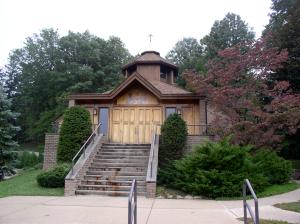
Three Hierarchs Chapel, St. Vladimir\'s Seminary, Crestwood, NY…how about you?

I am registered and have booked a flight for the Fellowship of Ss. Alban & Sergius conference. Signed, sealed, delivered, money has exchanged hands. I will have my laptop with me, of course, so I will be there reporting on the events as a blogger, I will also be there as a prospective student, and I will also be there as someone with a genuine interest in the subject matter (euphemism for “wide-eyed tourist”). If you can be there, I think you should go too. If you can’t be there, the tip jar still awaits its first contribution — I’d rattle it, but there’s nothing in it to rattle.

Who else is going? I frankly have heard of nobody else who is. I guess I’m not totally surprised, since the Fellowship really is, for all intents and purposes, a group of people with the most specialized of special interests, but I would think that the roster of speakers would have at least generated a bit more attention. Maybe it’s too soon for that. Well, regardless — I’m very much looking forward to the experience. (It is also, not terribly coincidentally, the only trip I’ll really be able to take this summer.)

I’ll note that since registering, I received an e-mail announcing that they would be making available the opportunity to students and seminarians to work at the conference in exchange for the registration fee, and would I be interested? I e-mailed back and said yes, but we’ll see how all of that works out.

Moving on to different matters… I really appreciate what Alden Swan had to say regarding a post from Michael Spencer:

I think it’s telling that the two most prolific evangelism programs in evangelicalism both approach their audience with questions that Jesus never used.

“Do you know that God loves you and has a wonderful plan for your life?”

“If you were to die tonight, and God were to asked you, why should I let you into my heaven, what would be your answer?”

[Spencer] points out that Jesus merely proclaimed the Kingdom of Heaven, which had very different connotations than our dangling Heaven on a stick (my terminology).

The comments on Spencer’s post are themselves fascinating — give them a read. I’m also considering printing up a t-shirt that says, “The Orthodox Church: Refraining From Dangling Heaven On A Stick Since 33 A.D.”

Okay, maybe not. But that’s still a great phrase which I’d love to figure out how to use sometime.

Moving on.

Rod Dreher’s “Conservatism is dead. Long live conservatism!” examines at the Tory Anarchist’s “look at the future of the right,” who says the following:

Orlet asks whether a movement with as much young talent as conservatism has can really be doomed. Of course it can. Young journalists are one thing, but there’s no young Willmoore Kendall or young James Burnham or young Frank Meyer on the scene. No, I wouldn’t expect a 20-year-old or a 30-year-old to have the gravity of any of those thinkers — but even looking at our 40-year-olds and 50-year-olds, I can’t think of too many who are of much significance as theorists or academics. […]

Part of the problem on the theoretical side is that too many of the best young minds in conservatism have followed Buckley’s example by shunning grad school and embracing journalism or the movement instead.

With that in mind, consider my liberal friend Emily Hindrichs’ opinion:

I have long maintained that the nation in which I live will not have an academic as a president for one simple reason: people fear the educated. They fear the big words and the complex sentence structure and the literary references. Instead, they elevate the mediocre with descriptors such as “down to earth” and “plain-spoken.”

Now take this incident into account. Mostly what I wish to focus on is a response in the comments:

Universities, especially humanities and social science departments, have long since ceased channeling received wisdom and have turned into liberal advocacy organizations. A good deal of what they do either subtly or overtly pushes liberal ideology. […]

One should hold one’s head low and get a technically oriented degree at a university.

If we accept that premise that conservatives have largely ceded academia, the question then becomes, “Why?” (I accept this premise in part, by the way, but not entirely.) Does Emily’s assertion and the comment about the Delaware problem answer the question satisfactorily? Is it that conservatives are anti-intellectual? (Perhaps.) Or afraid of their ideological purity being tainted? (Probably, at least in part.) Is it a utilitarian view of education? (Largely, I think.) Or maybe it’s a marketing issue — getting back to Emily’s point, they’d rather play in Peoria than compete on the academic front. It’s a way of catering to the masses, which ensures their continued ability to eat with the classes.

What is the best way to synthesize this? I don’t know. What I do know is that conservatism only has itself to blame for its intellectual bankruptcy if the only acceptable response is retreat. The alternative is not easy — that being, conservatives have to be superior in their scholarship and not hope that correct ideology will do their work for them — but it’s what needs to be done.

Last year, a question came up in a class about Nestorius — what did he actually teach? I offered what I understood to be the basic summary of the Orthodox understanding, and the liberal skeptic in the class was able to quote Nestorius’ writings chapter and verse, offering a snarky comment to the effect of, “You Orthodox types have cooked up a lot of your own issues with him.”

By contrast, I heard a lecture the same year by a scholar who is Orthodox who teaches at an Ivy League school. This. Person. Knows. Her. Stuff. Top to bottom, in and out, she’s got it cold. Somebody from here who falls under the category of a liberal debunker went up to her afterward and said, in a manner more or less suggesting a rivalry that was friendly and professional but a rivalry nonetheless, said, “There are major problems with your thesis.” At that point it becomes about which bias informs the scholarship — and make no mistake, atheism is a bias, it is not a guarantee of objectivity by any means — but there was no denying that she was right on in terms of the sources, the languages, and everything else.

That’s what we have to do. If conservatives aren’t willing to put in the time and the work, they shouldn’t be surprised when their lunch gets eaten by people who may be on Mars ideologically but have the facts and the sources straight.

Dorushe 2008

So, I arrived in South Bend Friday evening with The David and The Daniel in tow, and headed to the dinner for conference participants. It was at the home of a faculty member, and the first thing my hostess said to me as I entered the house was, “I know it’s Lent, but you are bound by manners to eat what I put in front of you.” I’m not even sure how she knew I was Orthodox, but she clearly was Catholic, and pretty much everybody there was either Catholic or Orthodox (save a couple a self-described disgruntled Evangelical and an “ex-low-church Pentecostal who’s trying to figure out what to believe”), and everybody was aware of that and comfortable with it. It also became clear that I was in a room of people who had the same interests I did, and had them from more or less the same point of view — that is, there wasn’t anybody trying to tease out sadomasochistic imagery from martyrdom accounts, for example. If somebody wants to make the argument that faith informs the scholarship of people like this, well, sure — faith informs all scholarship. It would be impossible for this not to be the case, even with atheists. What you don’t believe is as much an article of faith as what you do. It is merely a question of how much one acknowledges this, and whether or not one pretends that the bias, whatever it is, is objective.

The dinner was extremely informative on other points, as well. There were a couple of people who were St. Vlad’s alumni, and it was very useful to be able to hear their perspective on some matters. One somewhat stark reality which was driven home is that all of these folks are basically, shall we say, older teenagers in the field, but still not fully formed one way or the other, and I’ve got at least five years to go (by current reckoning) before I’ll be anywhere close to where they are. Nonetheless, the conversations I had with them lead me to believe I can get there.
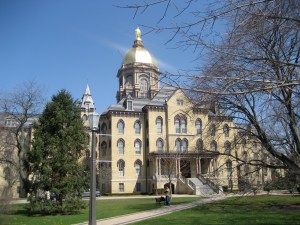
The Main Building at Notre Dame on a particularly gorgeous dayConference day itself was a fascinating experience. The papers were all very interesting, ranging from linguistics to textual traditions to St. Ephrem the Syrian and so on. The intellectual dynamic, largely because of reasons mentioned above but also because of other factors — it was on an openly Christian campus, there was a crucifix on the wall of the room in which we presented, a faculty member said a blessing before lunch, one of the Notre Dame faculty present as well as the keynote speaker were priests themselves, etc. My paper, which deals with liturgical imagery in martyrdom accounts, includes some supporting detail such as specific attestation to the baptismal practice of threefold immersion in sources such as the Didache, Apostolic Constitutions, etc. and it’s there because the professor for whom I wrote it was extremely skeptical of the legitimacy of assertions about exactly that kind of liturgical practice. When I was reading that part of the paper to this group, however, I felt sort of silly, because it was clear that these weren’t people who needed to be convinced on those kinds of points.

I felt generally good about my presentation; the odd part was that once the moderator called for questions, there was this awkward silence that filled the room, and nobody had anything (even the cheering section of The David and The Daniel — but then again, it would have been obvious that their questions would have been plants). I got direct comments during the break, and they were all positive, but during the actual question-and-answer period nobody had anything to say. A few different people offered me their takes on this; one person suggested that the after-lunch slot is always problematic when it comes to questions, and it was just luck of the draw. Another thought that part of the problem was that everybody else was talking about manuscript and textual issues, and I was talking about theology and theory. Another person said, “Well, everybody in there knows each other but you, and it’s clearly their playground. They meet, toss around ideas, read each other unfinished chapters of their dissertation, and have a good time. You’re here as an unknown quantity with a pretty polished piece of research, and you’re presenting it authoritatively. I think nobody quite knew what to do with you on that basis.” Could be — I really don’t know.

I’ll say this — it was not lost on me that the vast majority of participants were people from places like Notre Dame and Catholic University of America. Besides that majority group, there were two from Princeton, two from University of Chicago, one from Brown, and then lil’ ol’ me from IU (I suppose I might count as half a student from there). When I said where I was from, more often than not I got a very curious reaction — “Really? IU? Who are you working with down there?” An awkward question, to say the least, since the answer is, well, nobody. I would tell people the name of the professor for whom I wrote my paper, which would usually generate a furrowed brow, and then the name of my Syriac teacher, which would then garner recognition — but usually accompanied by some surprise that he would have students at an event like this. “Well, I’m not really his student, per se,” I’d tell them, and explain my situation a little more. (“Oh,” said one faculty member. “I guess that leaves you a bit at loose ends then, doesn’t it?” Um, yes, it does, thanks, very kind of you.) Anyway, the point is that I’m understanding a little better why over the last month, post-rejection, what I’ve been hearing is “People with your interests aren’t trained at places like IU, and they don’t work at places IU either.”

Not that these things are necessarily bad; as I said, the reactions as expressed afterward were positive. The keynote speaker told me, “Very good, Richard, and the way you lay it out, it’s obvious.” I explained to him the skepticism I had encountered with the professor in question when I had proposed the paper topic, and was told in reply, “Well, I don’t know why he would have told you that.” One of the faculty members in attendance asked if I would send him a clean copy of the paper, which I did. It seemed like a good start in getting to know the other people in this field, and one way or the other, that will have been worth something. (It also cements my resolve to go to New York in June. Tip jar, baby, tip jar.)
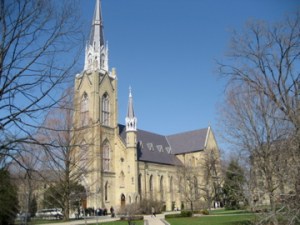
On a less academic and more tourist-y note, I’ll just say the Notre Dame campus struck me just the right way on just the right day. The Basilica is something else, inside and out — although, people, I don’t care what you think about Catholicism, don’t go into Catholic churches if all you’re going to do is go in to leave Jack Chick tracts. That happened while I was in the Basilica, and it was simply embarrassing. I’m not going to go in and start leaving Archbishop Chrysostomos publications in the pews — it’s just bad manners, and shows an utter lack of class. Going into somebody else’s house for the express purpose of insulting them is poor Christianity indeed.
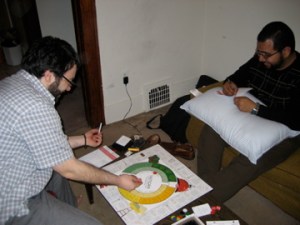
The Daniel is about to be elected the first British popeSo, one thing we found at the Notre Dame bookstore that I volunteered to buy as soon as I saw they had it: Vatican, the Board Game. I had heard of this for the first time about a year ago, but had gone beyond looking at the website. I played it with The David and The Daniel that evening, and The Daniel was elected the first English pope. I will say, it does a great job of never slipping into satire or wearing biases on its sleeve; it seems to genuinely attempt to be educational. Whether or not it truly succeeds, I have no way of knowing — I just know that there was nothing that leapt out at me as a fundamental disrespect of the Catholic faith. If there are people with differing opinions, I’d be glad to hear them. Anyway — consider it recommended.

Matins and Divine Liturgy were at St. Andrew’s, the Greek parish in South Bend — it would have been very nice except that I had to run out of the church four times during the Liturgy because I was sick. Quite embarrassing, and I’m not entirely sure what brought it on. The last time was right before Holy Communion, and I limped back in after it was over. Oh well; I guess it solved the dilemma of what to do if I should throw up after receiving.

In my Syriac class this morning, I recounted my experience. As a point of background — we’re reading the Life of St. Ephrem the Syrian in class, and one of the things it depicts is St. Ephrem meeting St. Basil of Caesarea. Whether or not this actually happened has been discussed in class as being a point of contention, and a voice or two in class have been very specific about believing that it’s pure fantasy. After describing the weekend, I jokingly mentioned that I didn’t ask any of the hardcore Ephrem scholars there whether or not they thought he met Basil; somebody replied, “Sounds like they were probably the kind of people who do.” Ouch. As I said earlier, I think I’m beginning to understand why I’ve been told what I have about IU ultimately being a bad fit for somebody like me.

Anyway — I’m really glad I was able to participate. I hope I’m able to play with some of the older kids again at some point. One way or the other, there was a bit more of this crazy world which I was able to see, and it’s a lot to process. I think it may take some time.

I leave you with my favorite of the pictures I took inside the Basilica:
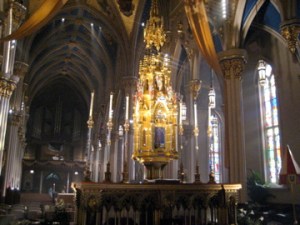
eunt anni, more fluentis aquae

From Alcuin of York (c.730-804 A.D.). Given that (per Keith Sidwell in Reading Medieval Latin) he apparently didn’t start teaching until he was around 38, I wonder if perhaps he felt like he got a late start, too.

O vos, est aetas, iuvenes, quibus apta legendo
discite: eunt anni, more fluentis aquae.

Atque dies dociles vacuis ne perdite rebus:
nec redit unda fluens, nec redit hora ruens.

floreat in studiis virtutum prima juventus,
fulgeat ut magno laudis honore senex,

utere, quisque legas librum, felicibus annis
auctorisque memor dic: “miserere deus.”

si nostram, lector, festucam tollere quaeris,
robora de proprio lumine tolle prius.

disce tuas, iuvenis, ut agat facundia causas,
ut sis defensor, cura, salusque tuis.

disce, precor, iuvenis, motus moresque venustos.
laudetur toto ut nomen in orbe tuum.

The first two couplets take enough blood out of me for now.

You who have life, young men, who are suited to reading,
learn! The years go like flowing waters.

And do not lose your peaceful days with empty things:
The flowing waves do not return, nor do the rushing hours.

Owwwwwwwwwwwch.

“How blessed we would be if theologians styled themselves as pastor-theologians”

With a tip of the hat to Dr. Rod Decker, here is a great post from one Owen Strachan:

Just as we need “theologian-pastors” (by which I’m referring to theologically astute pastors), so also are we in great need of “pastor-theologians” (by which I’m referring to academic scholars who bring pastoral concerns to bear on their work). There is a gigantic need for exegetes, historians, theologians, systematicians, and philosophers who see their work as done, generally speaking, in service of the church. Perhaps you’ve encountered scholars who don’t seem to practice such a philosophy of scholarship, but who do theology in such a way that they talk in abstracted terminology, chase rabbits (for multiple books or classes) that have little relevance to an actual person, and generally show evidence of forgetting that their ministry is accountable to their local church and responsible for equipping pastors and laypeople. Such a class of thinker, it is hoped, is on the wane in Christian circles, even as the ecclesiastically attuned class of theologian is on the rise.

[…I]t is my personal conviction that we should encourage our gifted scholars and teachers to reach us with their teaching–and not only this, but to aim at us. How blessed we would be if theologians styled themselves as pastor-theologians, and aimed to instruct the local church not incidentally, but primarily.

Read the rest. I find this very convicting and highly applicable to my own circumstances, and while not as succinctly as Mr. Strachan does here, I’ve suggested something similar before.

Q2 2008: a hopeful beginning, so far…

2007, for many reasons, was a really difficult year. 2006 was also largely problematic. 2005 and 2004 were all mixed bags. Really, in general, Bloomington has been a difficult place for me to, well, “grok,” I suppose.

At the new year, somebody who knew what a hard year 2007 was and why came up to me and said, “2006 was one of the worst years of my life. 2007 turned out to be one of the best years of my life. Maybe that’ll happen for you in 2008.”

Well, the first three months of 2008 have, bluntly, sucked. Bad news right and left with the bits of good news here and there not enough to overcome the bad, certain situations deteriorating rapidly with me absolutely helpless to do anything about them, and being left overall with a sense of being just stuck until further notice. Some of the issues I have discussed here; some of them I have not, for good reason, and most of those will remain undiscussed in this setting.

March ended with a couple of things going well but with another set of circumstances absolutely exploding in my face; April has begun with that set of circumstances having unexpectedly and quickly resolved itself, and my hope is that this bodes well. What I can say is that starting 21 April, I will be moving into a different position that, while still in the support staff hierarchy, is much closer to my areas of interest, and could very possibly be a place where I might actually accomplish something of value. It is also not lost on me that the end of this month is Pascha. So, the second three months of 2008 are revving up with a fresh start on the docket; even if it wasn’t quite the move I was hoping for (i.e., grad school), I’ll take it, and hope I can make the most of it.

What I will also say is that this move came about so lightning quick, all the doors having opened simultaneously and instantaneously, that it can only be the hand of God throwing them wide. Sometime God opens the door He wants you to go through; sometimes He closes every door He doesn’t want you to go through; sometimes he does both.

I head up to Notre Dame this weekend for Dorushe; I hopefully will get some worthwhile pictures, and I look forward to the experience.

Today’s sign that the end is near

Watch the skies, that’s all I can say.

“The spread of coffee bars? Germs outpacing antibiotics? And boy bands?! Come on! Who would gain from all this?”

Moving up in the world…

still looking for a way to convert enough of this to cash to pay for the Fellowship conference


My blog is worth $3,387.24.
How much is your blog worth?

All Saints Choir invited to be Midwest franchise of Cappella Romana

And before I say anything else about that, do check today’s date.

Fr. Peter with the choir during the Great LitanySaturday evening, the choir’s first public outing, did go very well, however. They learned the music, they were able to do it outside of the church building in front of a group of people specifically there to listen to (and, to some extent, watch) them, and I am inestimably proud of all of them for doing it and keeping it together throughout. For most of them it would have been the first time they would have ever done anything like this, and certainly the first time the choir as an ensemble has ever participated in this kind of outreach. There are always things you’d hope would go better, but they maintained composure throughout the whole program and never once crashed and burned. Just being able to do that is a fantastic start for a group like this, and now we all know we can do it (I’ve always known they could do it, it was just convincingRichard with the men them), we’ll move forward from here. This group wouldn’t have been able to do this at all a year ago, and it sure isn’t because of me that they can now, so that they were able to do this is a measure of the hard work they’ve put into this.

(Thank you to Anna for taking photos, but really just for being there.)

Here are some highlights:

Troparion of Bridegroom Matins

Lauds with stichera, Bridegroom Matins of Holy Tuesday (Matthew Wells, Megan Barrett, and me, cantors)

15th Antiphon, Great and Holy Friday (John Labban, cantor)

I’m hoping the next opportunity to do something like this comes along soon (but preferably after Pascha, at least).

In other news, my paper went well at the Medieval Studies Symposium; I felt good about the research and the presentation, particularly since I had been able to go back and replace many of my key references to English translations of Syriac sources (for which I didn’t really have a choice when I started writing the paper a year ago) to the Syriac sources themselves. I also felt like I handled the questions well. I’m looking forward to seeing how the Dorushe conference goes at Notre Dame this weekend.

I’m leaning increasingly towards going to the Fellowship of Ss. Alban & Sergius conference one way or the other. It seems very much like it would be worth the money and would behoove me to be there. Maybe I can “blog the conference,” as it were. Even so, at the risk of sounding like I’m begging for money — tip jar, baby, tip jar!

If I can just say — I am well to have March behind me. It has been a really awful month on several levels, and I have felt despairing at many points throughout the last 31 days. I am hopeful that April is beginning on a brighter note, with an eye towards the fact that the month is ending with Pascha (and Finals Week, but never mind that now). Onward and upward, with God’s help.

Guess the author (it sure isn’t me)

I do not deny that there are differences between the Churches, but I say that we must change our way of approaching them. And the question of method is in the first place a psychological, or rather a spiritual problem. For centuries there have been conversations between theologians, and they have done nothing except to harden their positions. I have a whole library about it. And why? Because they spoke in fear and distrust of one another, with the desire to defend themselves and to defeat the others. Theology was no longer a pure celebration of the mystery of God. It became a weapon. God himself became a weapon!

I repeat: I do not ignore these difficulties. But I am trying to change the spiritual atmosphere. The restoration of mutual love will enable us to see the questions in a totally different light. We must express the truth which is dear to us – because it protects and celebrates the immensity of the life which is in Christ – we must express it, not so as to repulse the other, so as to force him to admit that he is beaten, but so as to share it with him; and also for its own sake, for its beauty, as a celebration of truth to which we invite our brothers. At the same time we must be ready to listen. For Christians, truth is not opposed to life or love; it expresses their fullness. First of all, we must free these words, these words which tend to collide, from the evil past, from all political, national and cultural hatreds which have nothing to do with Christ. Then we must root them in the deep life of the Church, in the experience of the Resurrection which it is their mission to serve. We must always weigh our words in the balance of life and death and Resurrection.

Those who accuse me of sacrificing Orthodoxy to a blind obsession with love, have a very poor conception of the truth. They make it into a system which they possess, which reassures them, when what it really is, is the living glorification of the living God, with all the risks involved in creative life. And we don’t possess God; it is He who holds us and fills us with His presence in proportion to our humility and love. Only by love can we glorify the God of love, only by giving and sharing and sacrificing oneself can one glorify the God who, to save us, sacrificed himself and went to death, the death of the cross.

But I would go further. Those who reproach me with sacrificing truth to love have no confidence in the truth. They shut it up, they lock it up like an unfaithful woman. But I say, if the truth is the truth, we must not be afraid for it; let us give it, let us share it, let us show it in its fullness, let us welcome all that there is of light and love in the experience of our brethren. If we continue in this attitude, then truth will become clear of itself, it will conquer all limitations and inadequacies from within, on the basis of the common mystery of the Church. Let us enlarge our hearts, “let each one of us, as the apostle says, look not to our own things, but rather to the things of others” (Phil. 2:4). We have a sure criterion – life in Christ. Faced with a partial expression of the truth, let us ask in what measure it conveys the life in Christ, or in what measure it is liable to compromise it.

Orthodoxy, if it goes back to the sources of its great tradition, will be the humble and faithful witness to the undivided Church. The Orthodox Churches, in coming together themselves in mutual respect and love, will set a movement of brotherhood going throughout the Christian world, giving the example of a free communion of sister Churches, united by the same sacraments and the same faith. As to the Orthodox faith, centered as it is on liturgical praise and worship, and on holiness, it will bring the criterion of spiritual experience to ecumenical dialogue, a criterion which will allow us to disentangle partial truths from their limitations so that they may be reconciled in a higher plenitude of truth.

But we Orthodox: are we worthy of Orthodoxy? Up till the efforts we have made in recent years, what kind of example have our Churches given? We are united in faith and united in the chalice, but we have become strangers to one another, sometimes rivals. And our great tradition, the Fathers, Palamas, the Philokalia: is it living and creative in us? If we are satisfied to repeat our formulas, hardening them against our fellow Christians, then our inheritance will become something dead. It is sharing, humility, reconciliation which makes us truly Orthodox, holding the faith not for ourselves – if we did that we should simply be affirming yet one more historic confession of faith – but for the union of all, as the selfless witnesses of the undivided Church.

— Ecumenical Patriarch Athenagoras I (1886-1972)

(Doubtless there are those now saying, “See? They’ve been wishy-washy ecumenist heretics for awhile now.” Sigh.)

More here. And look at that picture and just try to tell me that… well, you know. Check the tags if you don’t understand.

(HT: Eirenikon.)


adventures in writing alexander lingas all saints bloomington all saints orthodox church american orthodox architecture american orthodox music american orthodoxy Antiochian Archdiocese Antiochian Orthodox Christian Archdiocese of North America Antiochians books byzantine chant cappella romana chant church architecture ecclesiastical chant ethnomusicologists ethnomusicology fellowship of ss. alban and sergius Greece Greek greek food greekness hazards of church music international travel tips ioannis arvanitis joe mckamey john michael boyer kurt sander Latin liturgical adventures liturgical architecture liturgical music liturgical texts and translation liturgy liturgy and life lycourgos angelopoulos medieval byzantine chant Metropolitan PHILIP militant americanist orthodoxy modern byzantine architecture modern greek music music as iconography my kids will latin and greek when they're newborns my kids will learn latin and greek when they're newborns orthodox architecture orthodox architecture is bloody expensive Orthodox choir schools Orthodox Ecclesiology orthodox outreach orthodox travel pascha at the singing school Patriarchate of Antioch Patriarch IGNATIUS IV Patriarch of Antioch publishing random acts of chant richard barrett in greece richard toensing rod dreher sacred music st. vlads st john of damascus society Syriac the Bishop MARK fan club the convert dilemma the dark knight The Episcopacy The Episcopate the only good language is a dead language this american church life travel we need more american saints why do we need beautiful music in churches?

Blog Stats

  • 271,017 hits

Flickr Photos