Archive for the 'Early Christianity' Category


Things you think about when you’re trying not to fall

This morning was the first frost in Bloomington, Indiana — or, at the very least, the first at our house. This is a relatively early first frost; I’m more accustomed to it staying hot until sometime in November, at some point during which God hits a switch and the temperature drops fifty degrees in a week. Given that my ancestors, centuries ago, were roaming the frozen wastes of Scandinavia wearing fur loincloths and swinging battleaxes, and that I’ve inherited their programming to stay perfectly comfortable in cold temperatures while wearing shorts and a t-shirt, as well as having to face the unpleasant corollary that above 75 degrees Fahrenheit I tend to be very uncomfortable no matter how little I’m wearing, I am very, very, very much okay with an early frost. The nice thing about cold weather is that you can always put more on. Hot weather… well, not so much. There’s only so much you can take off. (And trust me, you’re thankful for that — very very very thankful.)

What I emphatically don’t like is getting to the top step of my front porch on my way out to the car and realizing, in rapid succession, a) the first frost has arrived very much unannounced and b) I need to grab onto something very quickly. I am not one normally given to quoting John Mayer, but gravity, stay the hell away from me. Otherwise, I will be in repair (again).

For those who have asked — I do not, as of yet, have any information on the outcome of Fr. John Peck’s 16 October meeting with Metropolitan Gerasimos. All I know is that Fr. John is still listed here on the Prescott Orthodox Church website as the priest. Once I hear something I will post it (if I can).

A couple of links to pass along — Anna passed along the article “Keeping the End in View” by James R. Payton, Jr., over at Christianity Today. Prof. Payton, a Protestant, is also the author of Light From the Christian East: An Introduction to the Orthodox Tradition, a book which I have not yet read myself, but I have heard Orthodox say that it is a better introduction to Orthodoxy than some books by Orthodox authors. (One hopes that he has less in common with Daniel Clendenin than with, say, Met. Kallistos Ware.) The article is an examination of the Orthodox Christian understanding of “theosis,” comparing it to how Protestants understand conversion, justification, and sanctification as “phases” of salvation. In general, Prof. Payton treats the Orthodox position quite favorably, but there are two points I’d like to mention.

In Orthodox teaching, “image” and “likeness” are not the same: the first is gift, the second, goal.

This is a matter of some imprecision; it’s not called “Orthodox teaching,” it’s called “the Greek language.” εἰκών and ὁμοίωσις are the words in question, and as even a cursory examination of their entries in either Liddell-Scott or BDAG shows pretty quickly, these are different words with related-but-different meanings, and authors do not use them interchangeably. This has nothing to do with “Orthodox teaching” except insofar as Orthodox teaching reflects how the Greek Fathers use the words. “Policy” and “law” are English words which have related but ultimately different meanings, for example. If a German author wrote that “In American politics, ‘law’ and ‘policy’ are not the same…” it would be a similar situation. It’s an issue of what the words mean, not an issue of how they’re treated by a particular group of people.

While evangelicals can learn from the Orthodox, it is fair to note that Orthodox believers can learn from us, too. The Eastern presentation of salvation can smudge the distinct steps of salvation. Justification and sanctification often get folded into the broader concept of theosis, and they become so blurred that Orthodox believers often don’t know what to make of the terms. They would be well served by an explanation of how the steps of salvation as presented in apostolic teaching fit into the larger package of divinization.

While appreciating Prof. Payton’s open-minded, open-armed approach and thus being willing to lay aside concerns about how patronizing this paragraph might be, I will suggest that he fails to mention that the issues he brings up are addressed by the participation of the Orthodox Christian in the sacramental life of the Church. I assume he knows this, and that this is a concept which probably will sail right over the heads of most CT readers, so I can understand why he doesn’t go there, but ultimately the picture he paints is misleading.

I would also direct your attention to the paper, “Approaching the Educated Person in the Post-Christian Era” by Abp. Lazar Puhalo (ret., OCA). I don’t necessarily agree with every point, but I think it’s worth reading and discussing. I might have more to say about it later.

Current reading: The Conservative Intellectual Movement in America Since 1945, by George H. Nash. Whether one agrees with everybody he describes or not, the story he tells is fascinating. I may have more to say about this later.

By the way, I’m considering participating in NaNoWriMo for purposes of finishing a first draft of a particular writing project of mine. I’m not sure I’d quite hit 50,000 words, but I’d have a draft finished finally, after four years of picking away at something.

I’ll wrap this up for now by saying that my application for West European Studies has been submitted, and that now it’s just a matter of my letters of recommendation rolling in. Hopefully I’ll know something soon. In the meantime, another option has come up in terms of a departmental home, and the person who suggested it did so unprompted. I don’t want to say much more about it for the time being. For right now I’ll just say that I’m flipping two coins, West European Studies and this other possibility, and we’ll see what comes up. Maybe both will come up heads, in which case I’m decidedly not opposed to leaving IU with more rather than less. Maybe both will come up tails, and I really will have to leave here with 30+ worthless graduate credits. We’ll see. Meanwhile, a near-annual conversation with a particular faculty member about said options has led to this person dubbing me a “professional applicant.” I suppose he/she isn’t wrong.

Tomorrow morning I’ll be prepared for the frost.

Kickin’ it oldschool, ambo-style

“You say amvon, I say ambo…”

So, in going over the Divine Liturgy of St. James with our clergy Monday evening, something which became clear is that the rubrics assume that there’s something in the middle of the nave on which one may place things, from which one may read things, etc. — that is, an ambo in it’s original location.

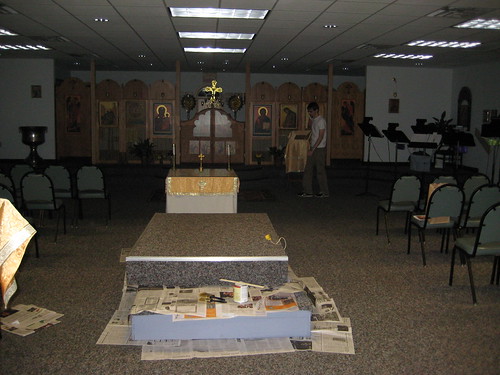
Initial discussions had us placing the memorial table in the middle of the center aisle, but then Fr. Peter thought it would be nice to put it on a raised platform of some kind. There is a rank of platforms back in the choir area of All Saints on which the women stand, and we moved one of those out and placed the table on it. Realizing the platform segments were of staggered lengths, however, it hit me that we could place them on top of each other, giving us two steps leading up to the memorial table, making something of a makeshift ambo. The prokeimenon, epistle, and alleluia could be sung from the first step — remember that the prokeimenon corresponds to the “gradual” in Western practice, known as such because it was sung from the steps of the ambo — and the Gospel from the second step. (No steps leading down on the other side, but oh well.)

The only problem was that, since the church ran out of carpet while covering the tops of these platforms, there was a decent amount of bare plywood showing, and setting them up this way only exposed it. Really, Fr. Peter said, the only thing we could do to make it something other than a horrible eyesore would be to paint over the exposed plywood with something like a gunmetal grey. Lucas and I looked at each other — “What are you doing tomorrow evening after work?” I asked him. “I think I’m painting these platforms with you,” he said.

So, following a quick trip to the hardware store for a quart of paint and brushes, we headed to All Saints yesterday to do what was necessary. “How good of an idea is this,” I asked Lucas, “letting guys like you and me into the nave by ourselves with paint and brushes?”

“I’m just hoping nobody notices that we’ve had to take out chairs to make everything fit in the space,” he replied.

It didn’t take more than 45 minutes or so to actually do the painting; we then had to move the choir up to the front of the church in order to answer some other logistical concerns the ambo created. After doing that, and destroying taking all of the displaced chairs into the fellowship hall, the paint was dry, and we set it up as it will be for tonight.

Hagia Sophia it ain’t, and I’m not going to argue that it’s gorgeous (particularly with the power outlets on the sides), but it at least looks more or less intentional. (Alas, Fr. Peter is just going to use the prothesis table behind the iconostasis rather than use one of our outdoor shrines as a skevophylakion.) We’ll see how it goes tonight — it sounds like we will have some number of visiting clergy and interested people from the community and around the area, including a contingent of folks from St. George, the big Antiochian parish in Indianapolis. Hopefully somebody will be around who can take pictures. A colleague of my wife’s is coming tonight out of curiosity, and he has never been to an Orthodox service before. Given its length and the fact that this is the first time any of us have ever attempted to celebrate this particular Liturgy, I’m pretty sure that all I can tell him is, “God be with you.”

God be with us all — St. James, pray for us!

Coming soon: The Divine Liturgy of St. James

On 22 October 2008, at 6pm, All Saints Orthodox Church will celebrate the Divine Liturgy of St. James for the Feast of St. James, the Brother of Our Lord.

It was mentioned to me about a year ago that this might be a desirable thing to pursue. It isn’t exactly happening the way originally envisioned; the hope at the time was that we would be in a new building with more forgiving acoustics than our current nave, but that hope remains unrealized for the time being. Nonetheless, we are pushing forward — hey, since local Catholic parishes have started celebrating the Traditional Latin Mass semi-regularly, leave it to us to break out our oldest rite, right?

The Divine Liturgy of St. James — can we call this the Iakovian Liturgy? I’d hate to call it the Jacobite Liturgy — is said to have been the rite taught to St. James by Our Lord and was subsequently the principal rite of the ancient Church of Jerusalem, edited and embellished as the St. Basil Liturgy and further pared down to become the St. John Chrysostom Liturgy. I will let liturgical scholars with PhDs argue whether or not the traditional first century dating of the Iakovian rite is accurate or if it’s more reasonable to assume that it came about somewhat later. Clearly the use of the Trisagion and the “Only-begotten Son…” are later accretions, but in terms of the overall structure and character — well, let’s just say that there are ideological reasons to want to support any of the various arguments, and leave it at that. One way or the other, we can say that we know it as the oldest complete form of the Divine Liturgy still in continuous use, and it is still in use by various Syrian and Indian communities.

Putting together an English text was not a small consideration; Archimandrite Ephrem (Lash)’s translation served as the base, but it is insufficient for use in an Antiochian parish, given the official preference for Elizabethan English. Where necessary, the Antiochian text was substituted (for components such as the Lord’s Prayer, the Creed, and so on); where possible, Fr. Ephrem’s text was kept, converting to Elizabethan English as needed. Particularities such as “Let our hearts be on high”/”We have them with the Lord” were also retained.

Once we had a text, then it fell to me to create a book for choir/congregational use. Thankfully, Sibelius 5 and Microsoft Word made that relatively easy. I adapted the St. Anthony’s Monastery settings of hymnody specific to St. James to our text, used the version of “Only-begotten Son…” from the Mt. Lebanon Choir Divine Hymnal, used the Trisagion we sing every Sunday (had to keep something the same) and then added all of the other parts — litany responses, anaphora responses, etc. The choir/congregation book ultimately contains every word and every note which concerns those worshiping from the nave — it is as complete as it needs to be without including the priest’s personal prayers and so on. (At 43 pages already, it would be significantly longer were I to include those.)

I will say that, in many respects, it’s a simpler liturgy; there are no antiphons, no troparia (although we will sing the Troparion to St. James as a recessional), there is no Megalynarion, and since it begins with the clergy processing into the church with the Gifts (from the skevophylakion, no less — such things make me happy, although we don’t actually have a skevophylakion), no Great Entrance in the middle of the service, either. From the choir’s perspective, there are significantly fewer major portions to sing, and the Alleluia and Prokeimenon are the only propers. The rubrics call for the Body of Christ to be received in the hand and for the Blood to be drunk from the chalice by the communicant, but we will be communed from a spoon regardless — no one’s particularly comfortable with what could go wrong the other way, given that we’re all used to the spoon by now.

Anyway, it will be an interesting liturgical adventure, to say the least. We’ve tried to visibly open it up to as much of Bloomington’s greater Christian community as wish to attend; given the provenance of the rite, it is clearly the common heritage of all Christians, and to be able to serve it in English is a gift we would like to be able to share with as many as possible, even if it’s our humble little church that’s doing it and not the Midwestern Regional Campus of the Cathedral of Holy Wisdom. (That place is going to be gorgeous, I have to say — and they might even have built a skevophylakion, I’m not sure.) To that end, we’ve put out a press release to the local papers (let’s not hold our breath that they’ll care, but who knows) and sent flyers to every area church and campus ministry we could find. We’ll see.

On a different matter — my friend Gavin used to have a favorite Microsoft joke (at least before he started working there): “Microsoft — solving tomorrow’s problems with yesterday’s technology, today.” So, maybe that could be tweaked and made appropriate to Orthodox Christianity — “Addressing tomorrow’s problems with yesterday’s Christianity, today.”

Or maybe not.

“The image of Christ according to Theodore the Studite” by Fr. John Meyendorff (part 1 of 2)

This was my final project for the French reading knowledge class I took this summer. It is a short essay Fr. John Meyendorff wrote for a book entitled Synthronon: Art et Archéologie de la fin de l’Antiquité et du Moyen Age (Paris: Libraire C. Klincksieck, 1968). I’ve seen it cited before, but to the best of my knowledge it has never been translated into English. This is the first half; the second half is forthcoming. Numbered footnotes are Meyendorff’s; cross notes are mine (usually a comment, for the sake of the instructor, as to why I chose to translate something the way I did, in at least one occasion in response to his remarks on an early draft).

Nowhere other than in Byzantium has the problem of Christian art sparked off a purely theological debate. The Christian, and non-Christian, philosophers often discussed the religious implications of art and, conversely, were able to establish that the religious sentiment is inseparable from an aesthetic experience. In Byzantium, however, during the course of the long Iconoclast controversy, the problem acquired straightaway a whole other dimension and effort of thought and of expression which the adversaries of images, as well as their defenders, provided, and which left a deep mark on Byzantine art. For the Byzantine, the icon became at the time a confession of faith and a quasi-sacramental presence, and “the Christian doctrine was left enriched by the Iconoclast crisis.”[1]

The debate concerned, first of all, the very nature of the “image.” The cultural, psychological, and social elements which contributed, within Christianity, to the formation of an “iconoclast” tradition and an “iconodule” tradition, in the centuries which preceded the crisis, were resolved through a philosophical problem: was the image a suitable representation of the prototype, “consubstantial” with it, or, by contrast, was it only a crude form, only fitting to distract the intellect and to divert its natural enthusiasm towards the Invisible? But this philosophical problem itself depended on a precondition: the nature of the Protoype. If, for a Jew and a Muslim, God is essentially invisible and one could not therefore make an image of Him, is it the same for a Christian who believes that “the Word became flesh”?

Thus it is that, from the third century, until the age when the problem of religious images began to be debated between the Neo-Platonists Celsus and Porphyry on one side, and, on the other side, the Christian apologists who attacked pagan idolatry, the Christian doctrine of the Incarnation of the Word found itself at the center of the debate. Accused of idolatry by the Christians, the Neo-Platonists proceeded to the counterattack:

If some Greeks (writes Porphyry) are so weak of mind as to believe that gods live inside of idols, their thought remains rather more pure than the thought of these (Christians) who believe that the Divine entered the bosom of the Virgin Mary, became a fetus, was begotten and wrapped in linens, full of blood, of tissue, of bile and of things even more base.[2]

The contemptuous tone set aside, the argument of Porphyry was not lacking in gravity: if the Christian faith was founded on the historic fact of the Incarnation, there was no longer a question for the Christians of despising matter. Consequently, a recent historian was able to write:

There came a moment, between the third and the fifth centuries, when the Christians adopted (in the problem of images) the pagan arguments.[3]

Certainly not in order to restore idolatry, but in order to say that the images, within Christianity, were genuinely able to be suitable to the Prototype, since the Object of Christian worship is the Word Incarnate, a visible and circumscribable reality.

From the beginning of the Iconoclast quarrel itself, the Orthodox recalled this argument. Germanus, patriarch of Constantinople, writes, for example:

This is in memory eternal of the life in the flesh of Our Lord Jesus Christ, of his passion, of his salvific death and of the redemption for the world which resulted, that we have received the tradition of the depiction of his human body, that is to say his visible theophany, understanding well that by it we glorify the humiliation of God the Word.[4]

The Iconoclasts responded by elaborating their own Christological argument: Christ is at once God and man; he possesses, therefore, two natures, which the Council of Chalcedon (451) declared to be united “without mixture, without transformation, without division, without separation”; in rendering the image of Christ, does the iconographer depict the humanity of Christ? But then he “separates” the humanity from the Divinity and becomes guilty of Nestorianism. Does he represent at once the two natures? If such is his claim, it is not possible to avoid saying that he represents “God” himself, he who is inconceivable.[5] The union of the two natures makes, therefore, according to the iconoclasts, a “suitable” image of Christ impossible.

This iconoclast Christology necessitated a response from the orthodox side. This response would be worked out by theologians from the beginning of the ninth century, the patriarch Nicephorus and Saint Theodore the Studite. While continuing the debate regarding the notion of the “image” and the educational value of Christian art, they developed the argument which, for them, was certainly decisive: Jesus was truly man, visible, therefore “circumscribable” (περιγραπτός), and the Council of Chalcedon, while defining the union of the natures, had specified that “each of them (the natures) retained its proper manner of being.”[6] Being circumscribable constitutes a character proper to humanity: no man could be deprived of it without ceasing to be man; thus, according to Theodore the Studite, “Christ would not be Christ, if he could not be depicted.”[7] This new insistence regarding the fully real humanity of Jesus certainly contributed to the turnaround of the dominant tendency for Byzantium, since the age of Justinian, to favor exclusively the Alexandrian Christology and to exclude the Antiochene heritage, in which it had something eminently positive: the vision of the Christ-Man.


[1] A. Grabar, L’Iconoclasme Byzantin. Dossier Archéologique, Paris, 1957, p. 5.

[2] Against the Christians, fragment 77, ed. A. Harnack, in Abhandlungen der Königlich Preussischen Akademie der Wissenschaften, Berlin, 1916, p. 93.

[3] P. J. Alexander, The Patriarch Nicephorus, Oxford, 1958, p. 33.

See following note.

[4] De Haeresibus et synodis, P. G. 98, col. 80 A. In one his first articles devoted to iconoclasm, G. Ostrogorsky drew attention to the central character of the Christological argument, “Soedinenie voprose o sviatykh ikonah s khristologicheskoi dogmatikoi”, in Seminarium Kondakovianum, I, 1927, pp. 35-48.

[5] Mansi, Collectio Conciliorum, XIII, col. 252 AB; 256 AB; for a recent analysis of the arguments of the iconoclast council of 754, see M. Anastos, “The argument for iconoclasm as presented by the iconoclastic council of 754”, in Late Classical and Medieval Studies in Honor of A. M. Friend, Jr., Princeton, 1955, pp. 177-188.

The French word Meyendorff uses, descriptible, is translated in most dictionaries as “describable” or “representable”; as he is using the word to translate the Greek word περιγραπτός, a technical term in the Iconoclastic controversy for which the proper English translation is “circumscribable,” I have translated the Greek term in both instances of descriptible rather than translating Meyendorff’s translation.

[6] Mansi, Collectio, VII, col. 116.

[7]Χριστὸς οὐ Χριστὸς εἰ μῂ ἐγγράφοιτο, Antirrh. III, 1, P. G., 99, col. 389.

Consulting this author’s works in English on similar topics, “Christ-Man” is a term used a number of times, and it appears unlikely that “Man-Christ” is what he intends here. See, for example, Meyendorff, Living Tradition, St. Vladimir’s Seminary Press, 1975, p. 180.

Breaking radio silence…

Blogging has been quite inconsistent over the last six weeks, but I doubt that the two of you out there who check in regularly have lost much sleep over that. Bottom line is that I have worn my temporary bachelorhood neither well nor gladly, and it’s been difficult to motivate myself to do things like this. The good news is that Flesh of My Flesh gets home on Thursday; the bad news is that I’m going to have to move the books I’m reading off of her side of the bed now.

A brief update on Cappella Romana’s The Divine Liturgy in English: you can now pre-order it from their website, and there is also an absolutely gorgeous pdf of of the liner notes. I’d also bookmark this page for the future. Noting that the ship date for online orders is one week from today, I’m looking very much forward to posting a review of this sometime by the end of the next week.

My French class has been a good opportunity to formally review some things with this language, and to have a chance to start getting a bit of a sense of what kind of scholarship is out there in French in my areas of interest. As it works out, I’ll be translating a short article by Fr. John Meyendorff for my final project — it’s called “The Image of Christ According to Theodore the Studite.”

Along related lines, I have decided to swap out Coptic for Modern Greek this fall. Ultimately, I have a tough time making a case for Coptic in terms of being directly related to my areas of interest; if I were more interested in early monasticism or gnosticism or such things, that would be one thing — and if it were actually going to be fulfill a degree requirement (which, in the alternate universe where I was admitted to the M.A. program here, it does), that would be something too.

But I’m not, and it isn’t. I may keep the textbook for purposes of picking through it later if I ever figure out how to motivate myself independently; we’ll see.

By contrast, I can make a much better case for Modern Greek being directly related to my interests. There is scholarship in Modern Greek, it will be a good thing to be able to speak if I’m ever fortunate enough to be able to travel for research reasons, and in the more likely scenario that someday we’re at a church where Greek is the primary language of the people. Also, it is at least strongly related to something with which I already have some familiarity, so I won’t be starting over completely from scratch.

And, finally, a 12:20-1:10 timeslot is simply a heck of a lot easier for an 8-5 working man to manage than 8:00-9:15. Y’know, practical matters like that have to intervene at some point.

On a matter completely unrelated to academic or ecclesiastical pursuits — through a stroke of absolute dumb luck, I am going to have, shall we say, a rather early dark (k)night, and I’m expecting it to be cool to the (i)max. I’ll have more to say about this Wednesday morning, I expect.

Finally (for now), I’ll note that my stock has risen some in the last couple of months. If only I could figure out which ATM machine I’m supposed to use to get access to this…


My blog is worth $4,516.32.
How much is your blog worth?

Poking my head back up…

…at least for a moment. The thing about blogging is, when you’re doing it, you’re able to do it. When you’re not doing it, it’s hard to get back into it because you feel like you’ve got so much catching up to do.

In brief, I was deliberately keeping blogging on the downlow the first half of April or so while a couple of situations finished playing themselves out, and they did, and everything turned out okay, but then it was Holy Week, and my mom was here, and then it was Finals Week, and then I’ve also been adjusting to a new job, and, and, and…

The other thing is that my new job is significantly less stressful than my old one. By metric tons, even, and for every imaginable reason. Between that and having a break from classes, the decompression rate is astounding. One of the things this has underscored for me is the sheer amount of stress with which I’ve lived for about the last year and a quarter — it’s been a pressure cooker, and not entirely for great, rewarding reasons. There are details on which I’m not going to elaborate here, so let’s just say for the moment that when somebody stops communicating with you, or intentionally communicates poorly, but still makes you responsible for what you would have known had they been communicating with you, and makes that standard operating procedure, there is no longer any reason to stick around — that person has already decided you don’t belong there. You’re not going to win, nor are you going to be able to fix anything.

Anyway, the point is, in decompressing, I have found myself picking up threads of particular projects that have lay fallow for much of the last year. This has been a good and productive thing — although the main one is not something I’m yet ready to discuss here — but it’s also taken time from other things I might have done more readily a month ago. Like blogging.

But here I am now, nonetheless.

I’m in the midst of reading Sunday Matins in the Byzantine Cathedral Rite, the doctoral dissertation of Dr. Alexander Lingas, the founding Artistic Director of Cappella Romana. I don’t have a lot of specific commentary on it just yet because I’m only about a quarter of the way through it, but one thing I will say is that I’m somewhat bemused by the fact that I’m having to read it in the form of a copy ordered from Proquest rather than an actual published book. Amazon.com lists it as having a publication date of 28 June 2008, but it is not yet available for pre-order; on the other hand, it is available for pre-order on Amazon.co.uk. However, if you go to the publisher’s website, it isn’t listed anywhere — neither as a forthcoming release nor anything else. Thing of it is, this has happened before; two years ago it had a publication date listed on Amazon of June 2006, and then right around May the date was yanked. An e-mail to Ashgate generated a reply that publication had been rescheduled to 2008, and here we are, but there’s nothing from Ashgate right now to suggest this is in fact happening. And, so far as I can tell, this has been going on with this particular work, with more than one publisher, for about ten years.

Gotta love academic publishing. I mean, it’s going to be approximately a $100 book, and I suspect that a thousand copies is a fairly optimistic estimate of the print run for this specific of a project, so I’m sure that whoever the publisher ultimately is, they’re not going to pull the trigger until the numbers make the most sense possible, and everything I hear about academic publishing says that, frankly, the numbers suck more often than not.

I’m also reading Bp. Hilarion Alfeyev’s The Spiritual World of St. Isaac the Syrian, and that’s another fascinating case with regard to publishing. It is readily available from its publisher, Cistercian Publications; however, for whatever inexplicable reason, it is not available through Amazon. That’s not all; the current edition really looks like it needed an editor. Capitalizations are extremely inconsistent, for example; a sample sentence tells us that “[t]he christological position ofthe Council of Ephesus was purely alexandrian: it took no account of the antiochene position, and it was precisely the antiochene (and not ‘nestorian’) Christology that was the Christology of the Church of the East” (p22, entire quote sic). Bp. Hilarion is a native Russian speaker, I believe, not a native English speaker, so perhaps that explains it, but one might expect that a native English-speaking editor would normalize these things.

In terms of my own adventures with academic publishing, I submitted my “Sensory Experience and the Women Martyrs of Najran” paper to a particular journal that had a call for papers that seemed appropriate. I got the response on Monday, and it was a bit curious. It wasn’t a “yes,” but it was a “no” that I wasn’t totally sure what to do with, since it wasn’t a form letter rejection (I’m very used to those). Basically they said, “This is really interesting, but in its current form it’s not appropriate for us. If you wanted to make it appropriate for us, here’s what our reviewers suggest.” The letter specifically says, “While we are not asking you to revise and resubmit, we would be happy to look at the paper again, provided you address all of our reviewer comments.”

So, what does this mean? Is this how journals try to let people down easily (“You’ve got a really great personality”), or does this mean it might be worth my time to make the revisions they suggest? If the latter, I’m going to need some help deciphering the editor-ese, so I’ll make dinner for whoever might be interested on that front.

Humorous note: The salutation of the letter was, “Dear Prof. Barrett”. Heh. Uh, no, to say the least.

I will eventually have pictures and a more detailed report regarding Lazarus Saturday’s baptisms and chrismations, but there is a related matter I wish to mention regarding a couple of the people involved, and it’s not completely public knowledge yet. Watch this space.

In other matters… in case you were wondering, no, as it happens, melted wax from a beeswax candle does not improve the functionality of a laptop keyboard. My wife felt compelled to perform this experiment this last Friday, so please don’t think that you need to determine this for yourself. Now, thankfully, Dell laptop keyboards appear to be designed to have things spilled on them and are incredibly easy and inexpensive to replace with no further trouble; Triangle Laptops was a terrific source, and I have no complaints about their pricing or their service. Should this happen to you, that’s the first place I’d look.

There is an effort at All Saints underway to explore ways of “greening the church”; without wishing to get into an argument here and now about whether or not this is a concept with which Orthodox need concern themselves, I’ll pass along that there were a few ideas which immediate came to mind for me:

  1. Commit to burning only olive oil and beeswax (excluding incense) — no paraffin, in other words. Olive oil and beeswax are, first and foremost, the traditional materials to use for candles and lamps in the church, and they have the added benefit of being clean-burning. St. Gregory Palamas Monastery in Ohio, I believe, does this.
  2. Start an herb garden. Given the various liturgical uses of basil, at least, this strikes me as a no-brainer. No reason to spend tons of money on fresh basil for Holy Saturday and house blessings and so on when, for a small fraction of that cost, a church could grow its own. Grow enough and there might be a reason to have a regular presence at the local farmer’s market, which could itself be a form of outreach.
  3. On a completely basic, practical level–have a rain barrel, or two, or three, or however many would be useful to have.

Anybody have any other thoughts?

I will wrap this up for the moment with a plug for the book The Oldways Table. If you’re a Michael Pollan or a Rod Dreher person, you may very well find that this book helps to suggest practical ways that some of their ideas might be put into practice. I’ll have more to say about it later once I’ve tried a few more of its ideas (and more importantly, adapted them into some of my own).

(And yes, I did in fact finish the Patriarch’s book on Lazarus Saturday; I’ve got plenty to say about it, but it can wait. Suffice it to say, for the moment, that I believe his intended audience for the book is not comprised of the Orthodox faithful, but that this does not in and of itself have to mean that the Orthodox faithful are justified in viewing what he says uncharitably.)

Dorushe 2008

So, I arrived in South Bend Friday evening with The David and The Daniel in tow, and headed to the dinner for conference participants. It was at the home of a faculty member, and the first thing my hostess said to me as I entered the house was, “I know it’s Lent, but you are bound by manners to eat what I put in front of you.” I’m not even sure how she knew I was Orthodox, but she clearly was Catholic, and pretty much everybody there was either Catholic or Orthodox (save a couple a self-described disgruntled Evangelical and an “ex-low-church Pentecostal who’s trying to figure out what to believe”), and everybody was aware of that and comfortable with it. It also became clear that I was in a room of people who had the same interests I did, and had them from more or less the same point of view — that is, there wasn’t anybody trying to tease out sadomasochistic imagery from martyrdom accounts, for example. If somebody wants to make the argument that faith informs the scholarship of people like this, well, sure — faith informs all scholarship. It would be impossible for this not to be the case, even with atheists. What you don’t believe is as much an article of faith as what you do. It is merely a question of how much one acknowledges this, and whether or not one pretends that the bias, whatever it is, is objective.

The dinner was extremely informative on other points, as well. There were a couple of people who were St. Vlad’s alumni, and it was very useful to be able to hear their perspective on some matters. One somewhat stark reality which was driven home is that all of these folks are basically, shall we say, older teenagers in the field, but still not fully formed one way or the other, and I’ve got at least five years to go (by current reckoning) before I’ll be anywhere close to where they are. Nonetheless, the conversations I had with them lead me to believe I can get there.

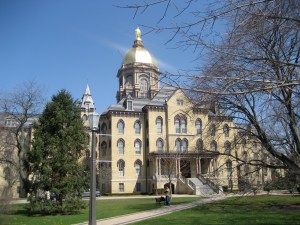
The Main Building at Notre Dame on a particularly gorgeous dayConference day itself was a fascinating experience. The papers were all very interesting, ranging from linguistics to textual traditions to St. Ephrem the Syrian and so on. The intellectual dynamic, largely because of reasons mentioned above but also because of other factors — it was on an openly Christian campus, there was a crucifix on the wall of the room in which we presented, a faculty member said a blessing before lunch, one of the Notre Dame faculty present as well as the keynote speaker were priests themselves, etc. My paper, which deals with liturgical imagery in martyrdom accounts, includes some supporting detail such as specific attestation to the baptismal practice of threefold immersion in sources such as the Didache, Apostolic Constitutions, etc. and it’s there because the professor for whom I wrote it was extremely skeptical of the legitimacy of assertions about exactly that kind of liturgical practice. When I was reading that part of the paper to this group, however, I felt sort of silly, because it was clear that these weren’t people who needed to be convinced on those kinds of points.
I felt generally good about my presentation; the odd part was that once the moderator called for questions, there was this awkward silence that filled the room, and nobody had anything (even the cheering section of The David and The Daniel — but then again, it would have been obvious that their questions would have been plants). I got direct comments during the break, and they were all positive, but during the actual question-and-answer period nobody had anything to say. A few different people offered me their takes on this; one person suggested that the after-lunch slot is always problematic when it comes to questions, and it was just luck of the draw. Another thought that part of the problem was that everybody else was talking about manuscript and textual issues, and I was talking about theology and theory. Another person said, “Well, everybody in there knows each other but you, and it’s clearly their playground. They meet, toss around ideas, read each other unfinished chapters of their dissertation, and have a good time. You’re here as an unknown quantity with a pretty polished piece of research, and you’re presenting it authoritatively. I think nobody quite knew what to do with you on that basis.” Could be — I really don’t know.

I’ll say this — it was not lost on me that the vast majority of participants were people from places like Notre Dame and Catholic University of America. Besides that majority group, there were two from Princeton, two from University of Chicago, one from Brown, and then lil’ ol’ me from IU (I suppose I might count as half a student from there). When I said where I was from, more often than not I got a very curious reaction — “Really? IU? Who are you working with down there?” An awkward question, to say the least, since the answer is, well, nobody. I would tell people the name of the professor for whom I wrote my paper, which would usually generate a furrowed brow, and then the name of my Syriac teacher, which would then garner recognition — but usually accompanied by some surprise that he would have students at an event like this. “Well, I’m not really his student, per se,” I’d tell them, and explain my situation a little more. (“Oh,” said one faculty member. “I guess that leaves you a bit at loose ends then, doesn’t it?” Um, yes, it does, thanks, very kind of you.) Anyway, the point is that I’m understanding a little better why over the last month, post-rejection, what I’ve been hearing is “People with your interests aren’t trained at places like IU, and they don’t work at places IU either.”

Not that these things are necessarily bad; as I said, the reactions as expressed afterward were positive. The keynote speaker told me, “Very good, Richard, and the way you lay it out, it’s obvious.” I explained to him the skepticism I had encountered with the professor in question when I had proposed the paper topic, and was told in reply, “Well, I don’t know why he would have told you that.” One of the faculty members in attendance asked if I would send him a clean copy of the paper, which I did. It seemed like a good start in getting to know the other people in this field, and one way or the other, that will have been worth something. (It also cements my resolve to go to New York in June. Tip jar, baby, tip jar.)

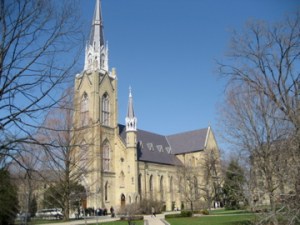
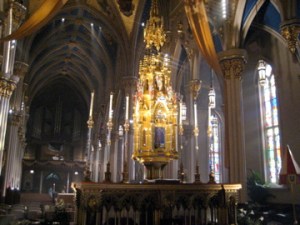
On a less academic and more tourist-y note, I’ll just say the Notre Dame campus struck me just the right way on just the right day. The Basilica is something else, inside and out — although, people, I don’t care what you think about Catholicism, don’t go into Catholic churches if all you’re going to do is go in to leave Jack Chick tracts. That happened while I was in the Basilica, and it was simply embarrassing. I’m not going to go in and start leaving Archbishop Chrysostomos publications in the pews — it’s just bad manners, and shows an utter lack of class. Going into somebody else’s house for the express purpose of insulting them is poor Christianity indeed.
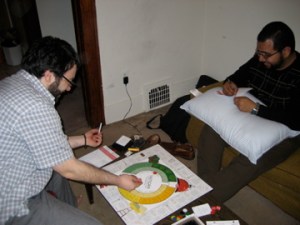
The Daniel is about to be elected the first British popeSo, one thing we found at the Notre Dame bookstore that I volunteered to buy as soon as I saw they had it: Vatican, the Board Game. I had heard of this for the first time about a year ago, but had gone beyond looking at the website. I played it with The David and The Daniel that evening, and The Daniel was elected the first English pope. I will say, it does a great job of never slipping into satire or wearing biases on its sleeve; it seems to genuinely attempt to be educational. Whether or not it truly succeeds, I have no way of knowing — I just know that there was nothing that leapt out at me as a fundamental disrespect of the Catholic faith. If there are people with differing opinions, I’d be glad to hear them. Anyway — consider it recommended.
Matins and Divine Liturgy were at St. Andrew’s, the Greek parish in South Bend — it would have been very nice except that I had to run out of the church four times during the Liturgy because I was sick. Quite embarrassing, and I’m not entirely sure what brought it on. The last time was right before Holy Communion, and I limped back in after it was over. Oh well; I guess it solved the dilemma of what to do if I should throw up after receiving.

In my Syriac class this morning, I recounted my experience. As a point of background — we’re reading the Life of St. Ephrem the Syrian in class, and one of the things it depicts is St. Ephrem meeting St. Basil of Caesarea. Whether or not this actually happened has been discussed in class as being a point of contention, and a voice or two in class have been very specific about believing that it’s pure fantasy. After describing the weekend, I jokingly mentioned that I didn’t ask any of the hardcore Ephrem scholars there whether or not they thought he met Basil; somebody replied, “Sounds like they were probably the kind of people who do.” Ouch. As I said earlier, I think I’m beginning to understand why I’ve been told what I have about IU ultimately being a bad fit for somebody like me.

Anyway — I’m really glad I was able to participate. I hope I’m able to play with some of the older kids again at some point. One way or the other, there was a bit more of this crazy world which I was able to see, and it’s a lot to process. I think it may take some time.

I leave you with my favorite of the pictures I took inside the Basilica:

Wherever the bishop appears, there let the congregation be

ὅπου ἂν φανῇ ὁ ἐπίσκοπος, ἐκεῖ τὸ πλῆθος ἤτω, ὥσπερ ὅπου ἂν ῇ Ἰησοῦς Χριστός, ἐκεῖ ἡ καθολικὴ ἐκκλησία. (Ignatius to the Smyrneans, 8:2. Full Greek text can be found here, or here as a pdf; there’s also a nice new edition of The Apostolic Fathers by Michael W. Holmes that has Greek-English facing pages and a very useful apparatus and set of notes.)

“Wherever the bishop is, there let the congregation be, just as wherever Jesus Christ is, there is the whole/universal/general/complete/according to the whole/lacking nothing/catholic church.” (Add whatever doctrinally-influenced translation of καθολικὴ you wish if I’ve left one out that’s particularly near and dear to you.)

(By the way, anybody want to tell me something about that sentence that demonstrates the limitations of a book like Hansen & Quinn when it comes to reading early Christian writings?)bishopmark.jpg

His Grace Bishop MARK visited All Saints over the weekend. I missed his last visit because, scheduled at the last minute as it was, it coincided with my dad’s (already rescheduled due to heart attack) wedding. So, it’s been a couple of years since I’ve seen him. We were originally supposed to have him present for Friday’s Akathist, Saturday Great Vespers, and then Matins and Divine Liturgy on Sunday, but he ended up attending the funeral services for Metropolitian Laurus of ROCOR (memory eternal) and thus couldn’t be there on Friday. (Or rather, I should say, he attended most of the services. He left, as he said, nine hours into it because he had to catch a plane; they still had about three hours to go.)

(Nine hours into it.)

(With three to go.)

(Sheesh. I can’t imagine anything more fitting for a man such as Metropolitan Laurus, but sheesh.)

Anyway,  every time I meet Bp. MARK, it strikes me that we are very lucky to have him. He is an imposing physical presence, but he is warm and gentle in a way that belies his size. He is completely unassuming — one gets the impression that he’d be just as happy as a reader or a subdeacon. (Imagine a world where all bishops were like this. Perhaps let’s also imagine, as part of this world, that we are also free of readers and subdeacons who would be just as happy being bishops.)

(But I digress.)

He had some interesting remarks; among other things, he expressed some reservations regarding the Triumph of Orthodoxy Vespers that gets celebrated as the “Pan-Orthodox Show of Unity” in many places. Among is comments were, “If we want to have a service that shows our unity, why not make it Forgiveness Vespers?” When asked about the Ecumenical Patriarch, he said, “Well, let’s hope he doesn’t mean everything he says. But let’s also remember that his circumstances are not ours, and that the way we in the free world behave can have a negative impact on those who are not as free as we are.”

The big thing I’m trying to get to, however, is the services. Hierarchical services are a bit of a headache for the choir director and cantor; for my own part, I was sweating bullets over this weekend because I have made major mistakes the last two visits, and they were mistakes made because I either wasn’t told what I needed to know, or I was told the wrong thing. The hierarchical Trisagion in particular is one of those things which, if you’re not told exactly what’s going to happen, you will get lost very fast. And when the poor guy waving his arms in front of the choir doesn’t know what he doesn’t know… yeah. When he doesn’t know what he doesn’t know, and no matter who he asks nobody can seem to tell him what it should look like except to say, “Just read the Liturgikon, but prepare for it to be wrong,” well… what can you do? (I remember the time I thought he was going to be here for the Exaltation of the Cross, and, realizing I didn’t have a hierarchical “Before Thy Cross,” I cooked one up on Sibelius two days before. Then it turned out he was going to be here, but not celebrating.)

Thankfully, everything went off without a hitch this weekend, and it really struck me (not for the first time) that the bishop being present for the Divine Liturgy is in fact intended to be normative. That is, during episcopal visits, the bishop is not celebrating in the place of the priest with extra stuff added; rather, on ordinary Sundays, the priest is celebrating in the place of the bishop and stuff has been taken out. As St. Ignatius describes, we are at our fullest when we, the local church, can gather around our bishop to celebrate the Eucharist. When all four orders — episcopate, presbytery, diaconate, and laity — are present for a Liturgy, it is more clear what our individual roles are. It is truly the bishop, the icon of Christ in our midst, who stands in persona Christi during the Liturgy — the presbyter, if the bishop isn’t there, stands in persona episcopi.

That said, on a practical level, I’m just fine with it only happening once a year. It’s quite a blessing to have him here, but it’s a stressful blessing nonetheless.

“Perhaps it is tidier to deal in false dichotomies than to face the fullness of Christ”

On Good Friday as found on the Gregorian Calendar, I give you Teague McKamey (who is, in the interest of full disclosure, my brother-in-law):

Death and resurrection cannot be separated. This may appear so obvious that saying it seems like a platitude. But what I observe quite often, in the words of others and in my own thoughts, is a dividing of these into two separate categories. Now, it is often necessary and profitable to separate them for the purpose of teaching, to gain the clarity that only comes when a thing is considered in its own right. But it is disastrous to separate these two in actual belief and in the living walk of the believer. Perhaps we have grown too accustomed to thinking of death and resurrection as different subjects. Perhaps it is tidier to deal in false dichotomies than to face the fullness of Christ. We can say with certainty that there are theologies in the church that are based on neglecting or marginalizing either death or resurrection. Protestants avoid crucifixes. Prosperity teachers make great use of 3 John 2 but can’t preach on Philippians 4:12. Christian ascetics love to fast but don’t show up to the wedding feast. In the first few centuries, the church had to vigorously stave off attempts to deny Christ’s divinity or His humanity. I wonder: is diminishing the reality of Christ’s death or Christ’s resurrection any less serious?

I’ll let you read the rest.

In addition to Teague’s observations, one can also point out that Christ’s death was a function of His humanity; the resurrection, His divinity. There are still those today who try to deny (or downplay, at least) either the crucifixion or the resurrection, and intentional or not, a concurrent denial of His humanity or divinity is the inevitable result.

Also, consider the publishers of the First Look Sunday school curriculum, who are skipping the crucifixion altogether in their Holy Week materials, and as a result, can’t talk about the resurrection either.

We have made this choice because the crucifixion is simply too violent for preschoolers. And if we were to skip the crucifixion and go straight to the resurrection, then preschoolers would be confused. […] We’re using these formative preschool years to build a foundation for that eventual decision by focusing on God’s love and telling preschoolers that “Jesus wants to be my friend forever.”

Without the crucifixion, as this letter acknowledges, the resurrection winds up meaning nothing; without the resurrection, as these people have found to be inevitable, there’s nothing left to talk about but warm fuzzies. This is an extreme which, intentionally or no, winds up meeting the opposite extreme, denial of Christ’s existence entirely, at the other end.

One thing — clearly, the Christological controversies weren’t limited to the “first few centuries.” Those “tidy false dichotomies” are still with us today — Arianism still exists, in the form of certain sects who are more common than one might realize. (Do a Google search on the words “Arius was right” and you will discover that there are at least two well-known and established, if controversial, groups who claim the teachings of Arius as their spiritual patrimony.) Gnosticism and Nestorianism, I suspect, contain teachings which many modern Christians would encounter and say, “Well, that makes sense enough to me. What was the big deal?” Iconoclasm is proudly and openly claimed by some Christians.

Orthodox Christianity likes to say, “We’re both/and rather than either/or” — Christ was fully God and fully man, for example. Teague is absolutely right — this approach is non-negotiable when it comes to the crucifixion and resurrection as well. Otherwise — as one commenter to the Touchstone posting put it — the Gospel might as well simply be, “Adam and Eve lived in this really great garden that God made for them! Noah really loved animals (and rainbows)! Jesus loved giving children hugs! The end!”

Wasted opportunities for a good chat over a beer

I’ve suggested before that “dialogue” is too lofty a word for us Joe Schmoes here in the trenches. I don’t really want to have a “dialogue” with people who have ecclesiastical disagreements with me; I’d rather have a conversation over a beer. That seems to me to be more a appropriate aim for us Reg’lar Folks.

My apathy towards “dialogue” notwithstanding, I think when questions get asked and answered publicly about those with whom we disagree, we should at least make efforts to answer the questions honestly, even if that means — gasp —  deferring to those with whom we disagree so that they may define themselves.

What am I talking about? First off, read this. Now, Campus Life’s Ignite Your Faith is a daughter publication of Christianity Today, so I hardly expect it to quote the Catholic Catechism, but I also don’t expect it to take a tone which approaches “Well, Jimmy, the Papists want to put God in a box so they can have an excuse to worship idols and preach works-based salvation, but we’re the real Christians, so we don’t.”  Marshall Shelley, it is to be hoped, would be better than this.

I sent them this response. Nearly five months later, I have yet to receive any response whatsoever. It’s probably better I don’t hold my breath. To be fair, me getting at all worked up over this is probably tantamount (to paraphrase Robin Williams) to coming out of a, um, house of ill repute complaining that you didn’t feel loved. I just find it unfortunate that many will read Mr. Shelley’s answer to this kid’s very honest question and accept it uncritically.

To whom it may concern:

In regards to Marshall Shelley’s answer to the question, “What Are Sacraments?” —

A question such as “What are sacraments?” could and should be seen as an opportunity to honestly examine the differences between various sorts of Protestantism and communions which adhere to an older tradition, such as Roman Catholicism and/or Eastern Orthodoxy, and explore what the relationship between us is. Unfortunately, the answer Mr. Shelley provides does neither of these things, being rather a woefully knee-jerk misrepresentation of sacramental theology that borders on being not much more than an anti-Catholic strawman.

First of all, the word “sacrament” is a perfectly biblical word; it is nothing more than the Latin translation of the Greek word “mysterion”, which simply means “mystery” and appears twenty-two times in the New Testament according to Strong’s. Indeed, “Mystery” is the word still given preference over “Sacrament” for many Orthodox Christians.

Second, the assertion that “[t]he early church believed preaching was the main way of sharing of God’s plan of salvation with others” is somewhat confusing, at least in terms of trying to draw a connection to sacramental practice. There is, to be sure, no question about the importance of preaching even in the extra-biblical textual sources (for example, the Didache says “My child, day and night you should remember him who preaches God’s word to you, and honor him as you would the Lord”, Did. 4:1), but to suggest that this is somehow over and above, or as opposed to, sacramental practice is at odds with both the witness of the New Testament and early church history. To be fair, Mr. Shelley correctly links sacramental practice to liturgical practice (although to say that sacraments are exclusively manifested liturgically is a severe overstatement), but this is not in opposition to preaching. The Book of Acts often places even preaching in this liturgical context, such as in 2:42: “And they continued steadfastly in the apostles’ doctrine, and fellowship, and in breaking of the bread, and in the prayers.” Acts 13:2 is often translated so that the church in Antioch “ministering to the Lord,” but the Greek verb used is leitourgein, “liturgize.” The letters of Ignatius of Antioch also underscore this liturgical context, as does the Apology of Justin Martyr:

“And this food is called among us the Eucharist… For not as common bread and common drink do we receive these; but in like manner as Jesus Christ our Saviour, having been made flesh by the Word of God, had both flesh and blood for our salvation, so likewise have we been taught that the food which is blessed by the prayer of His word, and from which our blood and flesh by transmutation are nourished, is the flesh and blood of that Jesus who was made flesh. […] And on the day called Sunday, all who live in cities or in the country gather together to one place, and the memoirs of the apostles or the writings of the prophets are read, as long as time permits; then, when the reader has ceased, the president verbally instructs, and exhorts to the imitation of these good things. Then we all rise together and pray, and, as we before said, when our prayer is ended, bread and wine and water are brought, and the president in like manner offers prayers and thanksgivings, according to his ability, and the people assent, saying Amen; and there is a distribution to each, and a participation of that over which thanks have been given, and to those who are absent a portion is sent by the deacons.” (First Apology, 66-7)

Third, the clericalism assumed by Mr. Shelley to be held by those who use the word “sacrament” is frankly bizarre. It is true that the priest stands in persona Christi, but insofar as a priest participates in a sacrament he is allowing himself to be used as a vessel of the Holy Spirit, not somehow casting a magic spell which compels the Holy Spirit to action. The liturgical texts employed by Roman Catholics and Eastern Orthodox make this quite explicit. There is nothing to say that the Holy Spirit cannot work in other ways; “the wind blows where it will,” after all. Nonetheless, as Paul exhorts the Corinthians, “Let all things be done decently and according to order,” and again, the early church writers make it plain that these functions have been in place since the earliest of days, and that they are strictly a matter of function, not a matter of quality or access.

Fourth, it is not entirely true that Protestants believe in “two ordinances” instead of “seven (or however many) sacraments.” This is true of some Protestants; however, Anglicans profess seven sacraments, and Lutherans also use the word “sacrament” (although they profess two).

This still leaves the question, “What is a sacrament?” A sacrament is, plainly, a way in which the Holy Spirit interacts with the created order in a transformative manner. The philosopher theologians of Roman Catholicism such as Thomas Aquinas analyze this in terms of concepts such as matter, substance, accidents, etc. which make the whole notion sound very technical, but it can be understood far more simply. At the Eucharist, the Holy Spirit interacts with the bread, the wine, the celebrant, and the people; as a result, it is not just the bread and wine that are changed, but all participating. At Baptism, the Holy Spirit interacts with the water and, again, the people, transforming those being baptized. Sacraments are, really, nothing short of miracles, and miracles which are considered to be normative. In that sense, then, to limit the number of sacraments to seven is somewhat missing the point; any time the Holy Spirit interacts with the world, it is a sacrament.

In Christ,

Richard Barrett
Bloomington, IN


adventures in writing alexander lingas all saints bloomington all saints orthodox church american orthodox architecture american orthodox music american orthodoxy Antiochian Archdiocese Antiochian Orthodox Christian Archdiocese of North America Antiochians books byzantine chant cappella romana chant church architecture ecclesiastical chant ethnomusicologists ethnomusicology fellowship of ss. alban and sergius Greece Greek greek food greekness hazards of church music international travel tips ioannis arvanitis joe mckamey john michael boyer kurt sander Latin liturgical adventures liturgical architecture liturgical music liturgical texts and translation liturgy liturgy and life lycourgos angelopoulos medieval byzantine chant Metropolitan PHILIP militant americanist orthodoxy modern byzantine architecture modern greek music music as iconography my kids will latin and greek when they're newborns my kids will learn latin and greek when they're newborns orthodox architecture orthodox architecture is bloody expensive Orthodox choir schools Orthodox Ecclesiology orthodox outreach orthodox travel pascha at the singing school Patriarchate of Antioch Patriarch IGNATIUS IV Patriarch of Antioch publishing random acts of chant richard barrett in greece richard toensing rod dreher sacred music st. vlads st john of damascus society Syriac the Bishop MARK fan club the convert dilemma the dark knight The Episcopacy The Episcopate the only good language is a dead language this american church life travel we need more american saints why do we need beautiful music in churches?

Blog Stats

  • 262,836 hits

Flickr Photos