Archive for the 'Beginnings' Category


Addenda to Kapitel Vier: The post-high school, struggling through junior year of college, and giving up to enter the workforce blues

Exactly what would happen to me following high school graduation was a point of no small controversy. My parents wanted me in Alaska with them as soon as possible and to stay up there as long as possible. The stated reason was so I could work as long as possible; there were at least two other reasons, however, that are probably best summed up by saying that me going to college “in state” (that is, in Washington), while it had seemed like a great idea up until summer of 1993, now didn’t seem like such a hot deal from a familial perspective. At best I’d now be a three hour flight away instead of an hour and a half’s drive (not that I had a car anyway), and while I still had incentives to go back to the Seattle area on the weekends, they weren’t part of it. My parents were going to have to deal with an empty nest in a place that had never actually been our nest, and they would have to do so with me relatively inaccessible. This is, I am certain, difficult under the best of circumstances, and the family difficulties we had been struggling with for the past several years meant that these were not the best of circumstances.

The bottom line was that, for that last summer before college, I really didn’t want to go to Alaska and they really didn’t want me to stay in Seattle. I had no desire to go someplace that I had no real memory of to be around two people who were likely to re-negotiate the manner of their life together after a year apart in a way that was going to be extremely unpleasant for any additional parties. If the point was for me to work, I could do that in Seattle without paying for a plane ticket; from where I sat, that made a heck of a lot more sense than forcing me to be a continuing participant in their drama. I had people I wanted to be around, but that was also part of the issue for my parents; they weren’t people they wanted me to be around. There’s not much more I can say about that without getting into specifics that aren’t appropriate for me to get into, so I’ll leave this by noting that I had a conversation with one parent where I expressed all of my concerns quite openly; this parent replied, well, yes, that’s all probably true. It isn’t going to be fun, and you’re probably going to have to deal with us fighting a lot. But that’s the way it goes, we’re a family, messed up though we may be, this is the way we want it for you right now, and we’re still in charge.

This was a growing source of tension as high school graduation neared; ultimately, however, there were two things that threw a wrench into the plan for me to be in Alaska for the entire summer — one was early orientation for Western Washington University, and the other was the aforementioned opportunity to work as an extra on the movie Mad Love. Again, don’t bother looking for me; everything I was in was cut. I could have worked more, but the three days I did work meant a two week delay in my departure for Alaska, and my parents weren’t willing to delay it any more. Still, as it worked out, I had to be back a month later anyway for early orientation and registration. The schedule became a month up, three weeks back, and a month up.

Yes, the time in Anchorage was rough, for all of the reasons I expected it to be. However, I will be the first person to say that there are parts of it I’m glad for; I had the chance to reconnect with some family members I hadn’t seen in years, and I was able to continue some of my vocal momentum with a voice teacher named Bettyrae Easley, who did the very practical thing of getting me ready to audition for Western’s music major, something in the post-graduation whirlwind that there just hadn’t been time to discuss with Dennis once my voice had finally opened up. Among other things, Bettyrae taught me my first French mélodie, Fauré’s “Lydia”, which served as my introduction to an entirely new song paradigm (to say nothing of the beginning of a, shall we say, complex relationship with French diction).

I did wind up working a bit in Anchorage; not overly much due to the time constraints, but there were a couple of odd jobs here and there that I did for friends of my dad. Among other things, I helped a future protest candidate for the United States Senate and right-wing filmmaker move out of a landmark Lloyd Wright home, and I also spent a couple of weeks assembling and finishing ulus.

One of the things that was difficult for me conceptually about preparing to go to college was that nobody seemed to actually have a clear idea in their head why I was going, or how to relate it to anything I was interested in doing, or how to relate any of those things to how I might actually earn a living on the other end. I was supposed to have been a smart kid, but none of the various things I was good at really lent themselves to careers, per se, at least as my parents or the people in their circles understood them. I was a voracious reader, I retained information, I read about all kinds of things as a kid from astronomy to cryptography to computer science to paleontology to mythology and everything in between, but what did that mean in terms of what I could do to feed myself? Coming into high school, math and science bored me silly, I hated sports, I was more interested in what computers could be used for than what they did under the hood, I enjoyed creative writing, I seemed to have some aptitudes for drawing and painting up to a point, and I enjoyed music but puberty had freaked me out with my voice change and I convinced myself I couldn’t sing anymore. There really wasn’t anything obvious in there in terms of “normal” career paths; not business, not medicine, none of that. Neither of my parents finished college and academia wasn’t anything I had ever heard of as a career.

Once I got into high school and discovered that I seemed to have an aptitude for theatre and music, that was a relief in some respects and it gave me some idea of a path. The thing was, nobody took it seriously. I remember my senior year of high school telling people, I’m going to major in music and theatre. Typically, that would generate a condescending smile and a sentence that sounded something like, “Oh, well, it really doesn’t matter what you start with, because you’ll probably change ten times before you’re done.” That, frankly, pissed me off; it was clear that I was being patronized and not listened to. At the same time, I had to acknowledge that having it in my head that I would finish a major wasn’t the same thing as knowing exactly how to get to the “pay your bills” part of the deal.

My parents didn’t know what to tell me. They didn’t really understand my interests, and they didn’t have any advice regarding college except get good grades and finish as soon as possible. Neither was there was ever any clear idea of what the trajectory of life post-high school was going to be for us, even before they moved back to Alaska. Was there an expectation that I was going to live with them until I got married? Was there an expectation about when it would be “okay” for me to think about getting married? None of this was discussed. At least when they were still going to be in Seattle, some small level of continuity could be assumed, but the mechanics and specifics still weren’t really talked about. After the move, all bets were off.

Thus it was that I found myself in Bellingham in September of 1994, living in a dorm room in Ridgeway Sigma with one Will Bass, and most of my worldly possessions were under my then-girlfriend’s house (many of which never to be seen again, alas, as will be explained in a future installment). I auditioned for the voice major, got in, then walked over to the other side of the Performing Arts Center and declared myself a theatre major. My very first class on the first day of my freshman year was Music Theory I, taught by Prof. Jeffrey Gilliam (to this day perhaps the single most naturally musical person I have ever met, to say nothing of the very best music theory instructor I have ever had). It was off to the races.

There were a number of highlights to that year: I was in my very first opera, singing Marco, one of i parenti in Gianni Schicchi (with the previously-mentioned future Metropolitan Opera baritone Aaron St. Clair Nicholson in the title role). I also got to sing the high baritone drunken abbot solo in Carmina Burana (“Ego sum abbas Cucaniensis… WAAAAAAAAAAAAFNA!”). My friend Gavin Shearer sat me down at some point in the fall to show me this awesome thing that was happening in computers called “the World Wide Web” that used this amazing program called Mosaic to do what Prodigy and AOL had utterly failed to do up to that point. Two portentous occurrences: a master class with a voice teacher named Roy Samuelsen from Indiana University, a school I had never heard of before but that apparently had quite a reputation for opera, and dating very briefly this lovely brunette named Megan McKamey, who was absolutely wonderful in every way, but everything going on around me made it difficult to feel capable of committing at the level I felt she deserved.

The trouble was, my parents and I didn’t even get through the first quarter without some massive meltdowns. The situation was complex; Seattle was still home for me, and I would go back on the weekends, because I felt very much alone at Western. My parents didn’t want Seattle to continue to feel like home for me, since from their perspective I needed to start thinking of Anchorage as home, but from where I sat they had moved, not me; I was just following the plan we had always had, and… yeah. The whole situation had nowhere to go but down. At some point it was suggested that maybe the whole idea of me going to college at Western was no longer tenable, and that marked the point where the irreconcilable differences in how we saw what was happening meant that there was basically no reasonable conversation to be had about anything. There was a brief period of rapprochement over spring break; my paternal grandmother passed away, and my dad and I spent the week together while he cleaned out her condo. Still, once summer came and I made it clear I wasn’t going back to Alaska, whatever brief peace had been achieved was broken. “In ten years you’re going to remember this moment as the day you pissed your life away,” I recall being told on the phone. What drove me absolutely batty about all of this was how inevitable it had all seemed from the time my dad had announced that he was going back to Anchorage, and everything was happening exactly as I had feared it would. Nobody had listened to me, and somehow I was being blamed for it. The stress made me a charmer to deal with, I’m sure; certainly it impacted a number of relationships I valued, but there just wasn’t anything I could do. I wasn’t equipped to deal with any of it, and I had no particular support system to fall back onto.

That summer I worked at Computer City, sold the first copy of Windows 95 at midnight of 24 August 1995 (there used to be a photo online of me ringing it up, not sure where it might be found these days), and took voice lessons from Dennis Kruse. We were working on preparing me for opera auditions at Western in the fall — the opera was Marriage of Figaro, not exactly a huge tenor show, but Basilio would be worth it for a kid like me. “O wie ängstlich” from Mozart’s Abduction from the Seraglio was the audition piece we worked up, and Dennis put me as the last singer on his summer studio recital, even over some of his students who were ostensibly his stars and who had made it clear much of the time I had worked with Dennis that they thought I was a waste of his time.

Sophomore year wasn’t exactly an amazing improvement over freshman year. A high school friend and his mother — J. P. had been the Danny Zuko in Grease! and Tony in West Side Story, and was also a student of Dennis Kruse — were killed in a car crash in the fall, which led to a reunion nobody particularly wanted. Fallout from that, plus still trying to figure out how to resolve the family situation, meant that I was even more of a wreck that year than I had been my freshman year. I agreed to spend the holidays and the following summer in Alaska, hoping that it would ease off some of the tension, but if anything, it ratcheted it up.

Marriage of Figaro was fun, but it was a bizarre reconstruction/translation that basically turned it into musical theatre — the recitatives were replaced with spoken dialogue from the Beaumarchais play. There were a number of practical reasons to do this, I suppose; hiring a harpsichordist and having the time to coach the recits properly being two of the major concerns, as I understand it. They had piddled away the fall quarter with a lot of political nonsense over sets and casting professionals for Figaro and the Count in one of the casts, and didn’t even post the cast list until sometime towards the end of the quarter, even though auditions had been in September and the performances were set for March. It was a strange experience all around.

I wound up in Alaska three weeks before the end of the quarter. I was supposed to work for my mother’s company over the summer, and they had revised their policies sometime in the spring so that everybody for the summer needed to be in place by 1 May. “So, you’ll just have to come up here early,” I was told. Um, the school year isn’t over? Not even close? “The opportunity cost of you finishing the quarter isn’t worth it. Anybody with half a brain should be able to see that.” Did I mention that I was a first generation college graduate?

I negotiated what I could with my professors (which in some cases, meant taking Fs). I can’t say I exactly made myself popular with anybody during this time, and not for no reason. I was a basketcase through and through, and nothing I was trying to do seemed to work out in a straightforward fashion. Going to college right out of high school had turned into a disaster; I was unprepared for it, my parents were unprepared for it, additional circumstances meant that there was additional burden for all of us to bear, and my friends were unprepared for how unpleasant of a person the whole experience was making me.

Summer of 1996 I cannot describe in much detail without going into things that I’d rather not discuss publicly. Suffice it to say that I got a front row seat for much of why my parents were freaked out over me being 2,500 miles away; a lot of the unpleasantness that had been plaguing our family life since the mid-1980s had come home to roost with their move, we were all now having to confront it head on, and none of us were doing a particularly good job. I returned to Bellingham in September unsure of what kind of a relationship would be possible with my parents after certain events, conversations, and revelations. I focused on what I could, namely, trying to rebuild my relationships at Western.

In short, however, that ship had sailed, and now I had to sleep in the bed of frustrations I had made the previous two years. Whatever had been the cause of all my erratic behavior, certain relationships were damaged beyond repair, and I continued to make unhealthy decisions with respect to other relationships. I couldn’t find a way to focus on being at school, partially because the muddied reasons I had for being there continued to get muddier, partially because all of my personal issues made it impossible to ever feel sufficiently centered and stable. I also made some poor choices vocally — Dennis had gone to a lot of trouble to figure out how to work much of the tension I usually carried with me out of my voice, a wonderful teacher named Virginia Hunter had done a very nice job teaching me to sing with the instrument Dennis had shown me I’d had, but that year, for reasons that seemed great at the time, I switched to a teacher who went out of their way to work all of that tension back in. Within three months my top was completely gone and my voice had regained a strangled quality that I thought had been left behind after graduating high school.

There was one more factor in this equation. In fall of ’96, I became aware of some behavior on a faculty member’s part that I believed (and believe) to be unethical, and at the very least political maneuvering at the expense of students. I attempted to seek advice on how to deal with these things in a way which I thought to be private which instead publicly blew up in my face. Later, I understood that whatever my concerns were, the way I sought to deal with it was totally unprofessional on my part and embarrassing to the faculty member in question. This culminated in a letter from the chair of the department telling me that all three of us — he, the faculty member, and I — would likely be happier if I went someplace else. So, midway through winter quarter, so many threads having come unraveled, I decided that college had become a gigantic, expensive exercise in beating my head against a brick wall, and it was time to acknowledge that it just wasn’t the right thing for me to be doing at that moment. I subsequently dropped out in disgrace, with the straw that broke the camel’s back being something which really was entirely my own fault. Today I would deal with a similar situation very differently because I would understand better what was happening; the bottom line is that when someone’s on a tenure track, you either play along or get out of the way, particularly under circumstances where resources are scarce and only so many people can get what they want. Anyway, after flailing about for a few months and still making really bad decisions (almost reflexively, at this point), I started selling classified advertising for the Bellingham Herald and trying to figure out how I might be able to move back to the Seattle area.

1994-1997 was a difficult, unpleasant time. It is difficult to even know where to begin explaining that the poor, confused, unhappy person who arrived at WWU in the fall of 1994 was not me at my best, not by a long shot. I started college not having any idea which way was up and having nobody, really, to whom I could turn. I was trying to do everything right which I possibly could, but there was just very little good that anybody could do for me, and trying to do everything right when one doesn’t even know what all one needs to do means one is bound to get quite a bit wrong. There continue to be ramifications to this day — people who don’t talk to me because some of my choices, people who, even if they’re still friends with me, can get easily upset when discussing some of what happened, and other consequences. A few years later, I did my best to apologize to everybody I hurt in those years, with somewhat mixed results. Whenever I think about that period, it is with a lot of pain and regret, but also a lot of confusion. In broad strokes, under the circumstances, I have a hard time imagining what I could have done differently that would have been any better beyond, quite simply, dropping out earlier. The kind of wrench my parents’ move threw into the works was comprehensive, I had no idea how to deal with it, my parents had no ideal how to deal with it, and they had no ideal how to help me deal with it. In retrospect, maybe it would have been better for me to find a way to work full-time while doing an Associate’s degree at a community college and continuing to study with Dennis. The trouble with that, however, was that I didn’t really have a place to live available to me full-time. Moving to Anchorage would have cut me off from much of what I was trying to do post-high school, and would likely have only hastened the inevitable. Maybe I could have just taken a year off out of high school to figure things out — I was starting college at 17, after all, thanks to my skipped grade — but that wasn’t really presented as an option. The expectation had always been that I would go to a four year college right out of high school; it was exactly what I would do while I was there and what would happen after that were all quite vague.

I should note that there are a number of people from this time for whom I remain grateful: an incomplete list includes Brian Ward, Holly Zehnder, Mike Cook (memory eternal), Peter and Arwyn Smalley (née Moilanen), Suzann Miller (née Welch), Jon Haupt, JOHHHHHHHHHHHHN Davies, David Harsh, Jon Lutyens, Matthew Murray, Kai Morrison, Dennis Kruse, Tom and Jordin Baugh (née Peters), Matt Carter, Sue Fletcher, Sarah O’Brien (née Wright), Liz Holmes, Eric Rachner, and, of course, Flesh of My Flesh herself, Megan Barrett (née McKamey).

Addenda to Part the Third: Never before has so much been said about so little

It’s been close to a month and a half since I’ve had a chance to return to telling this story, and believe it or not, there have been a couple of people who have asked, “Hey, when are you getting back to that?” Of course, then there was maniacal laughter on the other end of the phone, followed by something that sounded like maybe one person being subdued by several, so you have to consider the source. Anyway, the last installment dealt with my religious formation from the end of my seventh grade year to the end of high school, approximately 1989-94. We’re effectively dealing with the years of my adolescence — messy years in any kid’s life, to be sure, and I’d rather this not turn into an after-the-fact tween confessional, but there are maybe some details worth talking about.

If I had to come up with a particular narrative arc to describe those five years of my life, I suppose I might call it a quest for community. I had a number of interests, and I tried to find ways of using them to make friends. Taking after my dad, I took up the guitar, first learning from him and then from a teacher, a great guy named Dave Head. I became a reasonable rhythm player, and I could learn the mechanics of other peoples’ solos pretty quickly, and so I tried to see what I could do about getting into a band. Can’t say it worked terribly well; bottom line is that I was neither cool enough as a person nor flashy enough as a player to be terribly attractive to anybody who actually knew what they were doing (plus I couldn’t exactly afford the highest end equipment). Eventually my teacher and I realized that being a rock guitar player just didn’t fit my personality — and part of it seemed to be that I actually had a teacher and wasn’t self-taught — and he put a piece of Bach in front of me and said, “Learn this. See what it does for you.” That marked my first step into the world of classical music, and my life was not to be the same. Anyway, I became acquaintances with some other band-minded musicians my age, and I got the impression that they respected my efforts and enthusiasm even if I wasn’t really up to snuff as a performer (or perhaps I have just wistfully constructed the memory of that impression), but it just wasn’t meant to be.

In January of 1990, winter trimester of my 8th grade year, my mom brought home a computer. It was an old IBM XT — two 5.25″ floppy drives, no hard drive, 128k RAM, monochrome monitor with no graphics card, and an internal 1200 baud modem, all running on PC-DOS 3.0 (as I recall — might have been 2.0). It also came with a printer — a Commodore 6400 daisywheel model that was larger and heavier than the PC and had something like a 6 characters-per-second output. The whole setup was a dinosaur even for 1990, but it had cost all of $100, and I’ll tell you what, I squeezed every last drop of value out of that $100. My first computer was an Atari 800XL that was a Christmas present in 1983, but I had never been able to quite figure out how to get the use out of that machine I wanted. The IBM, with all of its capabilities current to, well, at least 1985, I was able to still use in 1990 for word processing (even if it did take 20 minutes to print out a lab report), uh… word processing, and… well, word processing…

…but then I realized it had a modem.

In seventh grade, much like many other adolescents of my generation, I had read, and been captivated by, Orson Scott Card’s Ender’s Game and Speaker for the Dead. As a kid in “gifted programs” (whatever that meant) who seemed to have a hard time not being a target for others, obviously there was a lot of relatable material. Particularly fascinating, however, was the way that Valentine and Peter took over the world via some kind of anonymous electronic presence.

So when it was pointed out to me that the modem allowed me to use my computer to call up things called “bulletin board systems” — well, that just sounded like the coolest thing I had ever heard of. An issue of Puget Sound Computer User provided some phone numbers, and soon I was “Synthman” (just sounded cool) on Miranda S. Station, as well as “Demosthenes” (and that was the sound of everybody who’s ever read Ender’s Game rolling their eyes simultaneously) on The Centuriate Assembly and other boards. Here it was, a social (arguably) context where it didn’t matter what I looked like, whether I was awkward — it was entirely a matter of how I was able to express myself. And, while I had a bit of a learning curve about the etiquette and protocol of BBS interaction, I found I was able to express myself reasonably well.

My parents were not entirely thrilled; when the topic of BBS in-person meetups arose, it became a real conceptual problem for them and a bit of a catch-22 for me. These were largely high school and college people; I was in the 8th grade. “What could possibly be a good reason that somebody in high school or college would want to spend time with somebody your age?” was the barrier for them. The thing that was crazy-making for me was that they already knew full well that I had always tended to get along better with people older than me, but the entire idea of establishing any kind of basis for interaction independent of concrete external factors was completely foreign to them. It also meant that I was hearing concerns expressed about establishing online friendships for purposes of kidnapping and sexual abuse years before instances of these became national news. Anyway, eventually my parents relented, and it just became something that I was regularly involved with. I didn’t do any extracurricular activities in junior high, so BBS-land rather became my social circle. What in-person friends I did have in junior high seemed to follow me into the electronic realm; among this group is one Eric Rachner, a computer security expert and famous Seattle urban golfer. I remember going to his house and him showing me their Prodigy subscription; shortly after he came over to my house and saw what I was doing on various boards, he had written his own BBS hosting software.

My interactions on BBSes had a great deal of decisive influence on my musical tastes. My guitar playing took me down a path that included Joe Satriani, Steve Vai, and lots of classic and progressive rock like Led Zeppelin and Rush (which also led to a brief dalliance with Ayn Rand in eighth and ninth grade); the BBS folks turned me on to Cocteau Twins, Lush, Gary Numan, the Smiths, et al. — everything a socially awkward young man needed in the early 1990s. Cocteau Twins in particular was my first foray into singing where there was an assumption that you weren’t necessarily going to understand the words, which was an important leap for me to take.

My taste in music also brought to my attention the Seattle bands that would eventually hit the big time — Soundgarden, Alice in Chains, Mother Love Bone (Pearl Jam’s predecessor), all right around the first wave of major label debuts hit from these acts (i.e., the first batch to be entirely ignored). I also recall the death of Andrew Wood (Mother Love Bone’s lead singer) being announced on one of the BBSes I frequented by somebody who was a friend of his. I can remember doing a presentation for my ninth grade Social Studies class sometime in the spring of 1991 about Seattle music starting to get national attention; Queensryche’s “Empire” and “Silent Lucidity” were getting some play on MTV, as was Alice in Chains’ “Man in the Box”, but it was to be another six months or so before the hype would really hit with Nirvana’s Nevermind, so for the most part I remember a lot of vacant expressions on the part of my classmates during the talk.

My favorite Seattle band from the period was called Hammerbox. Right before I started my sophomore year of high school, I wandered into their Bumbershoot show, Labor Day weekend 1991, knowing nothing about them except that they were supposedly good, and I didn’t really want to go with my parents to see Tony Bennett. They were amazing. Carrie Akre was a great rock singer and had a stunning stage presence; I’m pretty sure that just about every guy who ever saw one of their concerts developed some kind of crush on her, and I was no exception. The songs were balls of energy that bounced through the Mercer Arena (a trope in their press clippings was that their sound was “whirling”), and all I knew coming out of there was that I had to find their CD, I had to see them again live, and I had to find some way to make Carrie fall in love with me. Well, I accomplished two out of the three; I was lucky enough to get to see Hammerbox a total of three times over the next couple of years, and I found their album. Carrie I would eventually meet and get to be at least friendly acquaintances with for a brief period in my early 20s, but, you know, by that point we had both moved on, you know what I mean?

Hammerbox, by the way, was a great cautionary example of what could happen to a Seattle band. I still maintain that the self-titled C/Z Records debut is one of the best releases of any local artist from that period; “When 3 is 2” should have been picked up as a radio-friendly hit for the same reasons that “Smells Like Teen Spirit” was, and Carrie should have been somebody that the label realized could have been a gold mine. They signed with A&M Records, Soundgarden’s label, released Numb, their major-label debut, in 1993 (complete with a redo of “When 3 is 2”, clearly recognizing its potential as a breakout hit), and… well, and nothing. No MTV play, no airplay, nothing. Part of the trouble is that Numb sounded like somebody had tried to make a Nirvana record with Carrie behind the microphone, and even “When 3 is 2” came across as overproduced in all the wrong ways, as though the producer and engineer had completely misunderstood what made the song work both onstage and on the first album. Everything that was distinctive about the band’s stage presence and live sound had been sort of run through a grunge filter, and as a result there was nothing to distinguish the album. It’s sad, because the songs that are on the album were great live; on the CD, something just didn’t work the same way. By 1994 the band had broken up, and Carrie went on to form another band called Goodness… where just about exactly the same series of events happened, beat by beat, right down to the major label debut that should have been a smash but went nowhere because clearly the A&R guys had a completely misinformed picture of what they were selling. Girl just could not catch the break that she should have. Hammerbox had a very brief reunion about 8 years ago or so, but it doesn’t seem to have been meant to be.

In 1991, I started my sophomore year at Inglemoor High School. For the most part, all of my junior high friends were heading off to Woodinville High School, so I was faced with starting afresh, for better or for worse. As it worked out, this problem largely solved itself. For some reason that was never made clear, the schedules we had received in August were tossed out and completely reformulated right before the beginning of the year, which left me with some unexpected blanks in my day. In a move that turned out to be pivotal, I decided to take a bunch of English electives, which meant that in the fall I took both Speech and Drama, and in the winter I took Journalism. The combination of Speech and Drama did much to bring me out of my shell; I found that I could speak in front of people without really caring what they thought, and I also found that I had some ability to be onstage.

I auditioned for the fall play, a 1920s period piece from the 1950s called The Dark at the Top of the Stairs by William Inge (perhaps best known for the Warren Beatty film Splendor in the Grass). Much to my surprise, I got the part of Sammy Goldenbaum, a key supporting role, and what do you know? Suddenly I had a social circle, suddenly I had something to do after school, and suddenly I had something that I seemed to be good at. Dr. Chumley in Harvey followed in the spring, as well as the “Best New Actor” award from the drama club. Journalism, as it happened, was also something I turned out to be good at, so for my junior year, Advanced Drama and the school paper were both rather foregone conclusions.

Junior year was very busy indeed; PSATs, newspaper, and lots of shows. Clement in The Wisdom of Eve, Norm in Present Tense, Stuart in The Enigma, and then in another pivotal happenstance, Doody in Grease!. Short version there is that I knew a musical was coming. I hadn’t sung since elementary school, but I figured I had two options: try to sing and maybe get a role, or not try to sing and definitely not get a role. As it worked out, I was the only guy, besides the kid who was the foregone conclusion for Danny, who was able to hit Doody’s high notes in “Those Magic Changes” without looking like he was in pain, and I could play the guitar. As for the high notes, all I can say is, I didn’t know they were supposed to be high. It was a positive enough experience all around that I decided to do choir the next year, which became another pivot point, and I won the drama club’s Best Supporting Actor award that year.

Still another pivot point was my decision to tag along with Woodinville High School on their trip to the International Thespian Society’s high school festival at Ball State University, Muncie, Indiana, June 1993. We didn’t really have the money for me to go, but I was bound and determined to make it work. I participated as fully as I could in the fundraising, and particularly since I was the only one doing that fundraising at my own high school, I was able to do pretty well. It all worked out; I went, had a ball (as it were), and even came back with my first girlfriend.

Here I should note that just because I was in theatre and had a social circle, it didn’t automatically solve all of my awkwardness. Our theatre crowd at Inglemoor wasn’t made up of The Beautiful People in the first place, and we all had our eccentricities, to say the least. Even in that context, I was a late bloomer, and kind of tended to be The Nice Guy Who Was Everybody’s Friend rather than anybody who girls might look upon with interest beyond that. I certainly had my share of girls I was interested in, but it was plain that it just wasn’t reciprocated. There was a lot of fumbling on my part my junior year with respect to The Girlfriend Issue, and it was all very frustrating.

A practical point is that I didn’t drive; I had taken driver’s ed the summer after my sophomore year, but Dad was very strict about the parameters of me practicing; short version is that unless he was the one in the passenger seat with nobody else in the car, I was not to be allowed to practice — he did not want me driving with my mother under any circumstances, for reasons I’m still not certain I understand. Anyway, because — as I’ve suggested — he and my mom were enduring their own circles of hell around this time, that meant he did not generally have the energy or presence of mind to allow me to drive, and the few times that he did, he argued with virtually everything I had been taught in class. His fear turned to anger so rapidly in those rare occasions that it was not an uncommon outcome for us to be pulled over with him screaming at me while I was sobbing. I almost failed the class itself because he refused to let me practice outside of class; his argument was, “We’ve paid for them to teach you to drive. If I’ve signed a check to relegate that responsibility to them, why is it still my responsibility to let you practice on my time?” The behind-the-wheel instructor (a kind gentleman, even if he was somewhat bewildered at my situation, named Vance Spangler) eventually realized what was happening, took pity on me, and started spending extra time with me outside of class so that I could pass the behind-the-wheel portion. For several months after the class was over, Dad and I had a ritual; I would go with him somewhere, ask if I could drive, and he would say, “No, not today.” If I asked something along the lines of, “If not now, when?” he would get mad and say, “When I think it is the right time. You driving is not at the top of my list of priorities right now, so drop it. I’ll let you know when you can practice.” There came a point when finally he said, “I want you to forget everything you learned. If we’ve satisfied a formality with you taking the class, fine, but I will be the one to teach you how to drive.” I thought that was a sign that we would be practicing more often, but it wasn’t, and before long he moved back to Alaska anyway (I’ll get to that). As I have said, this was a very difficult period in our lives at home, so this all has to be understood in that context, but it was what it was, and the practical effect was that I was The Kid Who Always Needed A Ride. Not exactly something to endear one to members of the opposite sex.

My not driving, incidentally, led to one of my more infamous goof-ups with the newspaper. Through Say Anything… and Singles, I had become somewhat enamored of Cameron Crowe, and was inspired to try to get an interview with Hammerbox for the school paper. I wrote letters to both The Rocket, the local rock weekly, and C/Z Records, trying to see what I could come up with. Turned out the person I connected with at The Rocket was the girlfriend of Harris Thurmond, the band’s guitarist, and she sent me a Hammerbox press kit as well as put me in touch with Harris. Harris and I talked on the phone several times, he was more than amenable to the idea, we set a date and a time, I found a photographer who could also drive, and we were set.

Except that I, the non-driver, had no idea how to get where we were going. I had assumed the driver/photographer would, since she spent a lot of time in Seattle. She assumed I would know how to get there. I had an address, and that was it — in 1993, long before the days of GPS or Google Maps or high schoolers having cell phones or things like this.

After about an hour and a half of driving around downtown Seattle, it became clear we weren’t going to find the place. When I got home, I tried calling Harris, I explained to his answering machine what happened as apologetically as I could, begged for a rescheduled time, and… yeah. Never heard from him again. “Getting Hammerboxed” shortly became a new expression amongst the rest of the newspaper crew.

Anyway, I was talking about my somewhat late development on the girls front. Somehow in the run-up to the Muncie trip (as Anna Russell might say, “D’you remember Muncie?”), I befriended a nice Woodinville High School girl who was on the tech end named Michelle. There was a level of mutual attraction, the week in Indiana turned out to be a good context for that to be investigated, and there it was. It wasn’t to last very long, but she has remained a good friend throughout the last twenty years regardless, so I guess it couldn’t have gone too horribly badly.

So, I was starting up my senior year as Drama Club president, editor of the school paper (getting Hammerboxed and all), and I had a girlfriend finally. I was getting ready to start what seemed like would be a triumphant last year of high school…

…and I got knocked down a few pegs, and I found myself going in a totally different direction by the end of the year than I thought I was going at the beginning.

That summer, Dad got an offer from a friend of his in Alaska to come work for his family’s bank in Anchorage. I have said that 1986-1993 represented years of hell for our family. This represented, more or less, the end of part of that hell for Dad. His attempt at being a small businessman in the suburbs of Seattle had gone nowhere fast since the rise of big box office supply outlets, to say nothing of Costco, and he was spending 70+ hours a week just trying to not sink too quickly. He had contemplated other options over the years (including the one he eventually took in 2003, Arizona), but could never quite bring himself to pull the trigger on what it would take to make the move. He had let go all of his employees, he was doing absolutely everything himself (except filing, that was my job), and there was no real way for it to get any better. As he said later, his friend lured him back to Alaska with one word: “Saturday.” He couldn’t get out of there fast enough; he closed up the shop as quickly as he responsibly could, and in September of 1993 he left for Alaska, marking the last time he was a regular, everyday part of my life. My mom and I stayed in Seattle so that I could finish high school; it was brutally difficult for both of us, but the options were between bad and worse. Staying was hard, but leaving would be harder.

In the fall, there was good news and bad news on the theatrical front. We were doing another musical, West Side Story, and I had my sights set on Riff. I knew there was no way I was going to be cast as Tony (that already seemed to be intended for the guy who had played Danny Zuko), since I wasn’t a good enough singer, but if I approached Riff as an acting challenge, then that could work. I was also enamored with Russ Tamblyn at the time — I had gotten into him thanks to Twin Peaks, and had become really impressed with his multitalented work in West Side StoryFastest Gun in the WestSeven Brides for Seven Brothers, and so on. Well, I got the part, but I also got totally shut out of the fall play — a student teacher was directing that one, and she decided she wanted to go with a cast that didn’t consist of the “regulars”. Well, fair enough, but it was the first time I hadn’t been cast in something in two years, and it stung a bit, to say the least (particularly when, late in the game, I was asked to be on standby for one of the roles when that particular cast member got a bit flaky).

I started Concert Choir at the same time, and it became very obvious to me very quickly, between that daily experience and West Side Story auditions, that I was well behind where I needed to be vocally. So, I started taking voice lessons from the guy all of the great singers in choir and in the musical were with, Dennis Kruse. No, we couldn’t really afford it, it meant giving up guitar lessons, but the choir director not only was able to get Music Boosters to pick up part of it, she herself paid for a chunk out of her own pocket. We made it work.

It was in this context that I was quite unwise with my heart for the first time. I won’t go into this story too terribly much (it’s boring, it’s exactly the kind of “tween confessional” nonsense I don’t want this to turn into, and I don’t really want to tell those kinds of stories about somebody who has a totally different life now), but I’ll just say that the main problem was that I fell in love with a voice and not a person, my surrounding circumstances were such that they constituted an emotional vacuum, and as a result the person to whom that voice was attached wound up getting the full force of my attempt to fill that vacuum, which was far more than she should have been expected to handle. It was a mistake that wound up being far more painful before, during, and after its making than really should have been the case for a high school relationship, but there we are. Under different circumstances, I would have been better equipped to keep what was going on in perspective, but that wasn’t what I had to work with at the time. Έτσι είναι ζωή (Greek for “C’est la vie”, which is French for “Life sucks, get a helmet”).

(Somewhere in here I finally got my driver’s license. Didn’t do me a heck of a lot of good without a car, and that was still a few years away.)

The upshot of that, though, was that opera first came onto my radar. This girl was being primed big time for the opera world, and my thought was, “Well, if she can do it, I can do it.” I sometimes gloss this by saying that I got into opera to impress a girl, which is not entirely untrue by any means. Thing is, I wasn’t really an obvious candidate vocally for that kind of thing — I had, effectively, an actor’s singing voice. I could carry a tune well enough to get through musical theatre, but I didn’t have the clear, clarion instrument that theoretically one should have if they want to be on the operatic stage. I wasn’t a “natural voice” by any stretch of the imagination. Still, I kept at it, and little by little I got better. Opera, I thought, would be the perfect melding of the things I was trying to be good at, acting and singing — so what if I didn’t know anything about it and had never been to one? I could act, and I was learning to sing. If I could get better and keep getting better, then it would be workable. Everything else was just detail. Somewhere in here I got admitted to Western Washington University; it was the only school I had applied to (being broke sort of made the whole exercise of applying for colleges moot), it was where we had talked about me going since sophomore year, and while the looming Alaska move meant that its advantages of location and being in-state were called into question if not eliminated entirely, I figured hey, what the heck, I’ll do a double major of theatre and music. No problem, right?

Being newspaper editor, by the way, was a disaster. Short version is that I was doing too much. Concert choir, jazz choir, theatre, voice lessons, school paper — I just wasn’t able to be the guy who could stay and put the paper to bed no matter what. The teacher who was the advisor later told me that he had had that concern from the beginning, but he figured if anybody could successfully keep all the balls in the air, it would have been me. “All you proved is that nobody can do all of that, which isn’t your fault,” he said, but he asked for my resignation anyway, and I was smart enough to know that retreat, at that point, was the wiser part of valor.

West Side Story went well, but some of us got stupid and decided to ruin closing night by replacing the fake profanity in the script (“…when you’re a Jet, if the spit hits the fan…”) with the real words. It was my idea, the impetus came from me, and I’ll totally own that; it was a dumb, dumb, dumb stunt, even moreso since the superintendent of the school district was in the audience that night. A two-day suspension and six hours of Saturday school later, and it was evident to me that things like that really weren’t as cool as they seemed when you were thinking them up.

Even so, I got cast as Charlie Baker, the lead role of Larry Shue’s The Foreigner, the very last play of my senior year. It almost didn’t happen (after the West Side Story incident, the principal wanted to make not casting me a condition of allowing the play to go forward, since she had concerns about its subject matter to begin with), but it did nonetheless. All I will say about it is that it, in my own estimation, it was the best performance I ever gave anywhere in anything, and I won the drama club’s Best Actor award that spring. Unfortunately, the audio levels of the videotape were set too low, so there is no way to get anything useful out of it and you’ll simply have to take my word for it.

I also had a curious experience that year going to an open call for the role of Robin in what was then being called Batman 3. If you ever see the name “Mali Finn” in the credits for a movie as the casting director, well, I met her, I still have her card, and I even got a callback (which was the same night as the winter formal, but there you go). They wanted an unknown, they wanted somebody who could be believably street smart, and presumably they wanted somebody who was going to be shorter than Michael Keaton (who was still attached to the part of Bruce Wayne at that point). Well, I was unknown, at least (I’m a good 3 inches taller than Keaton), and of course it didn’t get any further than that, but it’s one of the cool things that I can say happened to me in high school. Obviously, since they ultimately went with Chris O’Donnell (over, it was rumored, Leonardo DiCaprio and Christian Bale), I’m inclined to believe that they were never seriously looking for an unknown to begin with, but who knows.

I had other interesting run-ins with show business; our drama teacher also worked for one of the big casting agencies in Seattle, and she would try to find opportunities for her students where she could. I read for a couple of commercials, and also read for a part in a movie we weren’t told the name of, but a couple of years later I was sitting in the audience for Mr. Holland’s Opus and realized I was watching the very scene I had read in the casting office. None of these came to anything; the one thing that actually happened was getting to work for three days as an extra on the movie Mad Love with Chris O’Donnell, Drew Barrymore, and Matt Lillard. (Don’t bother looking for me; everything I was in got cut. Still, you can see a bunch of my friends very prominently in several scenes.)

My dad flew back from Alaska the day before my high school graduation. We did some packing up of the house. The next day, I graduated high school. The day after that, my parents flew to Alaska together, and I spent the night in the house by myself. The day after that, movers came, packed everything, and put it on a truck to Anchorage. I also had a voice lesson that day; out, at long last, came a voice that was clear, strong, had even vibrato, and extended up to a high E flat. Dennis got up and gave me a hug, saying, “I think you left your kid voice at the graduation ceremony.”

That gets me through high school graduation, so I’ll stop there. As I said before — after that, things got complicated.

I should add that I would have never survived the high school experience without some excellent teachers who made it a point to take an interest in me and care what became of me — some in big ways, some in small ways, but all in important ways. Dennis Kruse, Laurie Levine, Judy Filibeck, Sean Burrus, Tim Curtis, Bob Engle, Hjalmer Anderson, Dave Head, Bob Stewart, James Wilson, Vance Spangler, and Sheri Rosenzweig are all the main teachers I think of; thank God for all of them.

“…they don’t know what it means…”

I’m way behind in blogging, I realize. I have a lot to say about the Florovsky Symposium as well as my trip to Holy Cross, plus there some other cool things going on I need to talk about, etc. but it’s probably going to have to wait until after my visit to Emmaus.
11 years ago today, Megan and I got married. I must say it was the best stroke of good fortune I’ve ever had; I married the most awesome person I know. Brains, looks, character, portability — she’s got it all. (Maybe not so lucky for her, but I guess that’s how it goes when the man marries up.) The full run-down of the day must wait for another time, but the four things everybody seems to remember are 1) me being a wet drippy faucet as Megan came down the aisle, 2) my father-in-law’s Vito Corleone impression during his toast (the sole reason I wish we had we had had a videographer, at least for the reception), 3) the magic show put on by our dear friend Bill Darkow (aka “The Amazing William”) as a distraction while our caterer* was being good-cop/bad-cop-ed by the dads for being unapologetically two hours late, and 4) the priest saying during his homily, “They’re getting married, and they don’t know what it means.”

Well, eleven years later with, at long last, our first child on the way, I think we still don’t know what it means, really. Neither of us are really the same people who stood in St. Margaret’s Episcopal Church on 24 February 2001 and said “I do”. And you know what? Thank God, on both counts. That means that we’re not prone to the problem of familiarity breeding contempt. God forbid we ever think of ourselves as “done”, or else we most certainly will be in short order.

Love you most, Cadt!

(* Lyle Finley d/b/a Ritz Catering, and perhaps these days as Lyle’s Catering Company; in any event, based on our experience, I not only cannot recommend him, I must actively evangelize against doing business with him, but I’ll tell the whole story another time.)

Part the Third: The Nowhere In Particular Years

Where we last left off, I had been given an immersion, threefold, believer’s baptism at Overlake Christian Church in the spring of 1989, only for my mother and I to stop going entirely.

Why did this happen? Well, it’s complicated, and I’m not completely certain I understand it myself. What seems to have happened is that, as I said, domestically we were in crisis mode, and while Overlake’s services did a nice job of whipping you up into an arm-waving frenzy under their roof, Mom seemed to be weighed down by the disconnect between that stirring up and the despair that we were dealing with in the rest of our life. To a very real extent, I think the unraveling of our collective household well-being was also underscoring for my parents what it meant to be “unequally yoked”. In the midst of all of this trouble, the only two things my parents seemed to really have in common were me and their mutual unhappiness, and I think my mom maybe wanted to de-emphasize the religious difference to see what would happened, and perhaps she just wanted some time away from God to try to understand why he had put her there. On a practical level, between it taking over a year to sell our house, starting to hop from rental property to rental property once every year or so, and also having to go back to work, maybe Mom was just too exhausted to make Sunday mornings work for awhile.

Whatever the case was, she wasn’t going, and that meant I wasn’t going. For us, that changed a lot; absolutely zero changed for my dad, except that he didn’t have to worry that somebody was going to pressure him into doing something he didn’t want to do. (“Why in the hell would somebody who can’t think of a halfway decent way to spend Sunday morning want to live forever?” was one of his memorable lines in this period.)

In the vacuum, I became… I don’t know. Between all the arguing and the stress they were constantly under, all I wanted was to not be part of the problem. So I basically stopped talking to them and did my best to be a good kid, whatever that meant, on my own. In religious terms, I had absolutely no idea how to make that mean anything by myself; the only concrete ideas I had to fall back on were the precepts outlined in Josh McDowell’s Answers book, but those weren’t really holding up very well anymore. There was no community to reinforce anything, and my parents were dealing with their own problems, so I was scrambling.

I became a goth kid of sorts; I started wearing mostly black, I discovered the Cocteau Twins and David Lynch and Gary Numan and Blade Runner and Christian Slater and re-discovered anime, I started playing Rush songs on the guitar, and I got into the major Seattle bands a couple of years early. More about this later.

I have to skip ahead to my junior year of high school, because there really isn’t anything of note between the time we stopped going to Overlake and ’92/’93 in terms of me and Christianity. My grandmother tried to insist to my mom that she needed to find a good old-fashioned Lutheran church, and my mom just smiled and nodded. My dad had made friends with one Rick Snodgrass, an Evangelical pastor who had started a church in Redmond, and my mom and I tried to go there a couple of Sundays, but it just didn’t take. (Rick also offered to let me play guitar in their praise band, but I went to one rehearsal and felt like a square peg in a round hole.) The one major thing I can say, I suppose, is that I never lost my faith; there wasn’t anything in particular supporting it, and it was becoming evident to me that the Evangelicals on a national scale were distinctly interested in pointing fingers at other people as much as they could with no room for disagreement, but that couldn’t mean that Christianity itself was invalid, right? I didn’t really know what that meant for me, since so far as it had been explained to me, there were the real Christians who went to Overlake, explicitly non-Christian cults like Catholicism and Mormonism and Unitarianism, and then the “denominations” which were basically implicitly non-Christian cults made up of people who weren’t really serious about Christ. So where in the world did somebody like me fit in, somebody who believed but who wasn’t thrilled with who appeared to be controlling the conversation? I had no way to answer that question. It was kind of academic anyway, since I didn’t drive until my senior year of high school (I’ll explain later), and couldn’t get anywhere on my own Sunday mornings.

Junior year of high school, I had a crush on a very nice and very pretty Christian girl who went to Overlake. This was, alas, not destined to be my first successful attempt to convince somebody I liked that they liked me back enough to want to actually call ourselves something (that would have to wait a few more months), but she liked me enough at least that when I said that I used to go to Overlake until my mom stopped going, she offered to pick me up on Sunday mornings. Well, okay, then.

It was a curious experience, being back after four years. The high schoolers had their own separate service with their own pastor, which is what my friend and I went to, although it was basically the exact same format as the adult service. The very best thing I remember about the experience is that the high school pastor was a wonderful guy who genuinely cared about kids and had a very real love for God. He also had a heart for the outsider, which meant that the couple of times I specifically went to him because I needed to talk, he knew exactly what to say to me, and he appeared to actually be concerned with what became of me. I’m really grateful for that man, and only wish I could have gotten to know him better.

The rest of it… well, not to put too fine a point on it, but my chief impression was one of conservative rich white kids patting themselves on the back for being conservative rich white kids, and it was plain as day to me that I didn’t fit in with that crowd, no matter how much I wanted to go to church somewhere and no matter how much I wanted to make this girl like me. (She herself also didn’t entirely fit in, but she fit in better and more naturally than I did.) Most of my memories on this point are somewhat impressionistic — I remember a couple of guys who were very reminiscent of Roger and Burt, the two Young Republican groupies from Bob Roberts, getting up and singing a song one day called “All He Needs Is A Few Good Men”. I remember there being this guy who was far, far, far more of a suburban goth-wannabe than I ever was who was bragging one day about having written a “gay-bashing techno song” that he had poetically titled “Hey You Faggot”. I remember Bill Clinton’s candidacy being of great concern, with somebody getting up one Sunday and talking very solemnly and seriously about how we had to consider the possibility that he could be the Anti-Christ, and somebody else saying that the central credit card computer was being openly referred to by the banks as “the Beast”. I remember there being nobody who really talked to me besides my friend (plus a couple of other people I already knew who went there) and the high school pastor. I even tried to do some of the social events like rollerskating and whatnot, but I just felt awkward and didn’t know where to put myself. (Again, the pastor was the main person who talked to me that evening.)

I talked with one of my other friends who went there about feeling lonely at Overlake. “Well,” he said very sincerely, “you’re somebody who’s got a lot of questions. Overlake is really someplace for people who have accepted the answers.” Huh. Okay, then. If even this guy felt I didn’t belong there, then maybe I didn’t belong there. By that point it was also clear that my friend had considered the notion of being more than friends with me and found the idea ultimately wanting, which was making the extra effort for her of picking me up something of a strain. The best thing to do seemed to just stop going, and that’s what I did. I wanted so badly to be a Christian and to have a church to go to — but the feeling wasn’t being reciprocated, apparently, and it seemed really hard to fit in where affluent suburban Evangelicals wanted kids like me to fit in.

Shortly thereafter, during my very first trip to Indiana in fact, the word “girlfriend” actually became a practical word in my vocabulary rather than simply a theoretical construct. She was raised Lutheran, more or less, which, as somebody with Lutheran roots for whom non-denominationalism hadn’t worked, sounded potentially promising to me, only to find out that she herself had no particular interest in it. Ah, well.

A few months after that, another girl was in the picture (oh, the drama that was my senior year of high school) who had been raised Unitarian, sort of. By that point I actually had a driver’s license and could go to church wherever I wanted if I wanted to go; I did so want, and she was okay with going with me. The question was, where to? There was a Baptist church that one of my favorite teachers went to, and I had gone there once with my mom, but it was too much like Overlake. I was completely out of the loop otherwise and had no idea where to go.

One day at school, I overheard a guy, an acquaintance whom I liked and respected but didn’t know all that well, talking with somebody about the sermon they had heard at church the previous Sunday. I can’t remember a thing about what he actually said, but it sounded interesting and thought-provoking at least, so I asked where he went. “Northlake Lutheran,” he said. Huh. Okay. I looked it up, and it was maybe 10 minutes from where I lived. Well, why not.

That’s where I found myself the next Sunday. The first thing that jumped out at me was that the place was small. There were certainly less than 200 people in the nave, which made it smaller than Overlake’s high school service alone. The next thing was that there was some kind of order to the service — “liturgy”, I heard this referred to as, which was a word I couldn’t remember hearing before. The singing free-for-all at the beginning and end wasn’t at all what happened here; there seemed to be specific moments where music happened, and it was regulated. There were hymnals, and we were supposed to be able to pick up the hymnals to follow what was going on. There was an organ and a choir, characteristics that had seemed to be stereotypically “churchy” in the movies but hadn’t ever been part of my experience. The next thing was that the sermon was short — like ten minutes tops, and the pastor seemed to base his homily on something other than his personality, which was hardly magnetic. He was kind of awkward, really, but that actually made the content of his sermon all the more powerful. Well, I did my best to sing along from the hymnal, I stumbled along with service as best as I could, with everything being sort of half-remembered (since it had been ten years since I had been to a Lutheran service), I was sort of scandalized by the use of real wine at Communion, and then that was that — the service was over. Maybe an hour.

The moment that brought me back the following Sunday, though, was that as the congregation filed out of the church, the pastor (Wm. Chris Boerger, now bishop of the ELCA Northwest Washington Synod) greeted everybody personally, and when he got to me, he shook my hand and said, “Hi, I’m Pastor Chris. I don’t know you. What’s your name?”

What? The pastor knew his people well enough to know that there was somebody there he didn’t know? And he cared enough to find out my name? That was beyond my comprehension after what I had been accustomed to at Overlake. The very best part, though, was the next Sunday, when he saw me and said, “Hi, Richard!” Beyond anything else — beyond creationism, tribulation, abortion, whatever, I desperately needed somebody to actually notice that I had shown up, and cared enough to say something about it. Going by myself at the age of seventeen to a church I had no family history at whatsoever was really going out on a limb in ways I think I understand better now, and that notice and welcome kept me in the game at a time when I might not have otherwise felt like I had any reason to stay in it.

I kept going to Northlake up through my high school graduation. It started to actually feel like a “church home”.

Then things became a little complicated.

Addenda ad Secundam Partem: In which the CIA and Howard the Duck make an appearance

Basically the years we’re talking about right now are third through seventh grade — two thirds of my elementary school years and my first year of junior high. It’s hard to make those years interesting on their own terms, but I’ll see what I can do.

When we got to the Seattle area, I managed to be placed in a magnet program called TAG, “Talented And Gifted”. (How on the nose can you be?) That took me up through sixth grade, and I discuss that experience somewhat here, so I won’t go over that particular ground again.

At the start of the school year, Wellington Elementary (where the TAG program was housed that first year I was in it) announced a musical — none other than You’re A Good Man, Charlie Brown. Needless to say, I auditioned. I said earlier that I had thoroughly internalized the character, and this must have been evident in the audition process, because I was cast in the title role. It was my first theatrical endeavor of any sort (at least going by chronology of auditions; the first performed was an in-class presentation of “Witling and the Stone Princesses”, an adaptation of the Grimm fairy tale “The Queen Bee”) and certainly my first musical, although one could argue that I had been playing the part for some time by that point. The rehearsal process was fairly lengthy, as I recall, and I think nobody was quite sure how I’d actually do once it became work, but it was the time of my life up to that point. The irony is that I’d identified the character because I was awkward and felt like an outsider most of the time, but I loved the other kids who were in it with me, and tried to stay friends with them. That might have worked better had the magnet programs not all moved to their own school the following year, and I lost touch with everybody pretty quickly (plus I was on the younger side of the cast anyway). Google searches turn up some of those folks — here’s Katie Margeson, my Lucy; and her sister, Anne, was Patty (none of this revisionist “Sally” nonsense in our production!). Chad Afanador, our Linus, actually has an IMDB page, and the Snoopy, Scott Grimm, is now a linguist of some note. (I am blanking on the name of our Schroeder. I’m sorry, man.) Anyway, I’d love to put up some pictures or video of this, but I think my mother has all of the photos. Dad videotaped the dress rehearsal, but the tape has been missing since 1994, when it was loaned to my then-girlfriend’s mother who was considering putting it on with her elementary school class, and I was never able to get it back (and in fact it was later claimed that she never remembered having it in the first place). If you ever find a VHS cassette labeled “Original C.B. Play” with a piece of masking tape on the front, do drop me a line. The thing about the videotape is that at some point during one of the verses of “The Kite Song”, I realized I was being filmed and choked on the words for a line or two, so it was never perfect anyway (but the actual performances were spot on!), but that’s maybe in keeping with the spirit of the character.

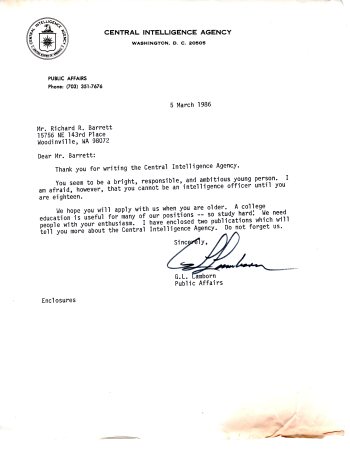
In absence of any of those pictures or video, here’s something that I’m pretty sure not every kid on my block had. Short version is that it wasn’t too far of a leap from Sherlock Holmes, Encyclopedia Brown, and The Young Detective’s Handbook to spies, and I started reading everything I could on real-world espionage. A briefcase replaced my backpack to accompany the deerstalker and trenchcoat. When I was nine, I decided that I would be a perfect recruit as an intelligence agent — I was too young for anybody to ever suspect as a spy. With the courage of my convictions on the matter, I did what any normal kid would have done and wrote a letter to the CIA telling them they should bring me aboard.

I got a letter back, dated 5 March 1986, from one G. L. Lamborn, Public Affairs (who, if I’m not mistaken, is the author of this forthcoming book). “Dear Mr. Barrett: Thank you for writing the Central Intelligence Agency. You seem to be a bright, responsible, and ambitious young person. I am afraid, however, that you cannot be an intelligence officer until you are eighteen. We hope you will apply with us when you are older. A college education is useful for many of our positions — so study hard! We need people with your enthusiasm. I have enclosed two publications which will tell you more about the Central Intelligence Agency. Do not forget us.”

Well, obviously it didn’t turn into a career. It’s an interesting souvenir to have, at least, and I’m sure it made for an entertaining story for Mr. Lamborn.

Comic books became a big deal for me in around 1984. I still remember my parents freaking out the day when I decided that I was now collecting them — taking the advice of one collector’s manual to buy a bunch of new comics and see what I liked, I spent around $25 on a stack of new releases about as tall as my belly button (remember that these were the days of a 65-cent cover price). My Batman obsession has been reasonably well-discussed here, but I also quickly fell in love with the back issues of Howard the Duck. Yes, you read that correctly. The thing is, as written in the mid-’70s, Howard the Duck was an experiment on Marvel Comics’ part, a social satire, and it was hysterical. (I mean, c’mon. It took place in Cleveland, for heaven’s sake.) Imagine my bewilderment when I saw it realized on the big screen as kids’ horror-action-comedy. I still don’t quite know what George Lucas was thinking, but the movie’s duck simply wasn’t the same Howard who ran for President for the All Night Party in 1976 and fought Doctor Bong. Not even close. Batman in 1989 was a much happier time at the movies all around, to say the least.

In terms of music, piano lessons continued through the fifth grade, I think. There came a point where I was feeling overstressed; I was doing Columbia Boys Choir, piano lessons, and then my dad had enrolled me in karate lessons two days a week. I think I had one day at home after school a week, and it was getting a bit much. Plus, my voice was breaking, and I didn’t know how to manage that. This was in the middle of our domestic meltdown, so everybody was happy to have me doing less for multiple reasons. I didn’t necessarily give up the activities, just the formal involvement; I played Sir Joseph Porter in a sixth grade production of Gilbert & Sullivan’s HMS Pinafore, and I started learning the guitar.

This meant I also picked up the pace in terms of reading. I read a lot of different kinds of mythology and folktales; Greek mythology, Welsh mythology (inspired somewhat by a book called Dogsbody by Diana Wynne Jones), Nordic mythology, and even French-Canadian folktales (in the form of a little collection called The Golden Phoenix). I read a lot of role-playing games, but I could never quite figure out how to play them myself. Genre fiction became a real love for me in sixth grade, starting with Piers Anthony, with whom I even had a correspondence going for a couple of years (well, with his assistant, anyway, even if he signed the letters). This really picked up momentum in my junior high years, so its flourishing is somewhat beyond the present scope.

“Hey, Richard!” I’m hearing a couple of people say. “That’s awesome that the CIA started a file on you when you were nine, but did you do any, you know, normal kid things?” Eh, I don’t know. I wasn’t a terribly athletic kid, and I didn’t really understand sports or why I was automatically supposed to care about them. I hated fishing — the first time I went, I was having a great time with my dad and my great-uncle until they took the fish I caught and bashed it over the head with a rock. I burst into tears — I was not expecting that in the least. I went to summer camp a few times, the YMCA’s Camp Colman and Camp Orkila. I played with fire once by burning some thread in the sink to see if they’d burn the same way fuses were depicted as doing in cartoons and movies. My parents freaked out when they found me, thought I was trying to burn the house down (the house that they were trying to sell), and I had bruises on my rear end from a plastic spoon for a week. I guess that’s reasonably normal.

I didn’t have a ton of friends in elementary school and was the object of a good amount of merciless bullying, much of it by girls, which meant that other boys generally wanted nothing to do with me. From third to fifth grade, my best friend in the world was Jeff Fletcher, a kid who was one year older than I was and who was simply a kindred spirit in many ways. He was always at my house, and we were inseparable. Then he went to junior high a year before I did (naturally enough), and our paths diverged a bit, coming back together when I got to junior high. There was also Brian Ward, whom I met in sixth grade and whose family also went to Overlake. In seventh grade, there was a bit of peer group that I found, consisting of Matthew Arndt, Brian, Eric Rachner, Eric Stangeland (another friend of mine with an IMDB page), Robert Stevens, and Russ Needham (who, with Brian, is pictured with me on 23 June 1989 at Luxury Alderwood Cinemas for Batman).

And that’s that for now.

Update, 6 February 2012, 3:06pm — I should mention that Jeff Fletcher and I were all-too briefly accompanied in our early years by one Chris Holtorf. He wasn’t around anywhere near as long as we should have liked, since his family moved to California when I was in fourth grade, I believe, but for the short time we were together, were a terrible trio, to say the least.

Chris and I recently (like, in the last few hours) re-established contact via Facebook for the first time in, I believe, twenty-six years, and he wanted me to also pass on that the three of us had a plan to construct a working replica of the Millennium Falcon in my backyard. It’s true. We were generally too busy sliding in sleeping bags down my staircase into Ember, my beloved Bernese Mountain Dog (an activity we generally referred to as “SLEEPING BAG DOGGIE!!!!!!!!!”), to actually get the damn thing built. Oh well.

Secunda Pars, the Overlake years

Here’s how we got here, and here’s some corroborative detail intended to give artistic verisimilitude to an otherwise bald and unconvincing narrative.

The whole point of moving to Wenatchee in the first place was that my parents wanted to get out of Anchorage, and my dad wanted to try to set himself up as a successful small business owner in a small town. After four years in Wenatchee, he still liked the small business owner idea but was done with the small town part, and in 1984 we passed westward over the mountains and wound up in Seattle. Well, Woodinville, which back then was barely no longer rural. Dad bought a small business furniture concern called Redmond Office Supply and we built a house maybe five minutes from Chateau Ste. Michelle Winery, the house that I still remember my mother describing, on the day we moved in, as the house in which she and my dad would grow old.

Church was a question mark now that we were in something vaguely resembling a major metropolitan area. The truth is, I don’t think my mother ever had any particular love for the Augsburg Confession, and thought of it perhaps as mostly a default. My grandmother Helen (departed this life last September with her beloved husband Donald ten days previous, αἰωνία αὐτῶν ἡ μνήμη) had passed on some level of Danish-American consciousness to Mom, but nothing overwhelming, and nothing that I don’t think she got out of her system by living in Copenhagen for a year after high school. Since Dad certainly wasn’t going to church with us, there wasn’t any particular family cohesion to be maintained, so now that we lived someplace with more options, my mother wanted to explore them. I remember her taking me church-shopping several Sundays in a row; I don’t remember where, but I don’t recall that we ever went to the same place twice.

Somewhere along the way, we wound up at Overlake Christian Church, and I got saved for the first time. These were unrelated events.

This may be ancient history for some readers, but 30 years ago, kids actually would go trick or treating in a door to door fashion in neighborhoods rather than going to the mall. 1984-5 was the height of my Charlie Brown identification (which had a very interesting denouement I’ll go into later), so my recollection is that my costume in 1984 was the sheet-over-the-head ghost. Anyway, among the takings was a little card giving a phone number that you could call if you really loved Jesus and wanted to be saved. I really loved Jesus, so I asked Mom if I could call, she was thrilled to say yes, and a nice man on the other end of the line prayed with me that Jesus would come into my heart, and that was that.

Meanwhile, church shopping was going nowhere for us. At some point, my mom discovered KCIS, “The Christian Information Station”, on which Pastor Bob Moorehead’s sermons were broadcast. These connected with her well enough that one Sunday, we found ourselves in the middle of the humongous melee that was Overlake.

At the time, I believe, Overlake was the largest independent congregation in Washington state, with some ungodly huge number like 3,000 people. (Yes, I know, that seems like a small, quaint country church in present-day Evangelical terms.) They did something like three or four services a weekend, so their auditorium had around 1,000 people in it at any given moment in the course of a weekend. My recollection is that there was a huge cross on the wall with the text, “Go forth and make ye disciple of all nations…” You came in, and half an hour of lively singing to words projected on the walls was followed by some announcements, special music while an offering was taken, a 45 minute sermon, maybe communion, and then another twenty minutes to half an hour of congregational singing, usually wrapping up with an altar call. It was completely different from what I had experienced in our little Lutheran congregation back in Wenatchee, and it seemed to be exactly what my mother was looking for.

I remember asking my mom, “Does this mean we’re not Lutheran anymore?” “No, honey, we’re just Christians now,” she said.

One of the interesting things about Overlake — and to this day I don’t have a great sense about how common this is or is not for Protestant groups — was that a baptized Protestant Christian couldn’t just start going there and bam, they were a member. First you had to have a believer’s baptism — infant baptism didn’t count — then you had to go through the six-week “Basic Beliefs” class (so, yes, you had to undergo an action that, by virtue of its appellation — believer’s baptism — strongly implied belief in something, and then you had to take a class to find out what you had just professed to believe), and then you were welcomed as a member. My mother, who seemed to embrace what Overlake was all about fairly quickly, responded to an altar call one Sunday, took the class, and was welcomed as a member. I did not; I didn’t really understand why all of this was necessary — wasn’t I already baptized, and didn’t we make a big deal out of it? But there we were.

Even as a little kid, I can’t say I ever felt like a totally natural fit at Overlake. It seemed weird to me that you never sat next to the same people twice, I didn’t understand how it seemed that everybody knew the songs we were singing except me, particularly when all they projected were the words and no music? (This was also right towards the beginning of my boy alto period.) Why was all the music so incredibly different from what we had had at Grace Lutheran? Why was the music… well… stupid? Why was the sermon so long? Why couldn’t I leave to go to the bathroom? (Seriously. I got blocked at the doors by the ushers.) Who actually got to talk to Pastor Bob? Why did everything seem so centered around him? Why, if being saved was something that happened to us once, was a big point always made of saying the prayer to let Jesus into our hearts as personal savior at the end of every service?

Still, it was where we were going. Sometimes I went to the adult service with Mom, sometimes I went to the kids’ service. At the kids’ service, sometimes they showed things like the Christian anime Superbook (which went well with my love of Star Blazers), and a movie called “Music Box” that I’ve talked about before. I also remember them talking to us about evolution and AIDS, and sometimes in the adult service hearing them talk about abortion and how there were no Christians in Russia (keeping in mind that this was the mid-1980s).

Strange Stories, Amazing Facts, as I mentioned, had some interesting bits on various supernatural phenomena (including an article on demon possession that absolutely freaked me out). Among other things, there was a riveting, lengthy piece on the Shroud of Turin. I remember showing it to my mom, who said, “Well, most Christians don’t think it’s real.” In support of her answer, she gave me the book Answers to Tough Questions Skeptics Ask About the Christian Faith by Josh McDowell, which had roughly a 30-page section debunking the Shroud. (Curiously, I discovered about ten years ago that newer editions of the book no longer have this section. I’ve not encountered any comment or explanation as to why; it just seems to have been quietly dropped. Perhaps McDowell changed his mind. If anybody knows anything about that, I’d love to hear more.)

I’m trying to remember how old I actually was when I read McDowell’s book for the first time. Maybe eight? Nine? Anyway, much of the Shroud of Turin stuff seemed a little over my head, but a lot of the evolution/creationism material was gripping for an eight year old, particularly since we were doing a unit on Jericho at school that could serve as a bridge between the “historical” past and the “creationist” past. I was inspired to try to calculate the age of the earth counting what seemed to be the Biblical chronology backward from the historical dates we were talking about in class. I can’t remember what I came up with — a 10,000 year old earth, maybe a 15,000 year old earth. My dad pointed out that even that was far older than what most creationists seemed to want to talk about.

McDowell aside, there was a nagging question that I had that nobody could seem to quite answer for me. I was becoming aware through certain cinematic tropes and articles in — again — Strange Stories, Amazing Facts that what seemed to be the Christianity of history and the Christianity I experienced at Overlake Christian Church were two different things. Why was this? I mean, I got what seems to have been the standard fundamentalist lines about Catholicism and Mormonism being in the same category as “non-Christian cults”, and I also was starting to become aware that Christian bookstores usually had a shelf devoted to the subject of Why Catholics Were Wrong, but I didn’t understand who the Pope was supposed to be (beyond my dad saying once, “He’s an old Polish man who believes that he has a direct link to God”), and I didn’t understand the disconnect at all between past and present. The way some people talked, it sounded like we were to understand that there were no Christians between the time of the apostles and Martin Luther. Could that actually be? The way other people tried to explain it, however, it sounded like their way around it was to say that if there were Christians during those centuries when the Roman Catholic Church was all there was and they were leading everybody astray, they were saved by the grace of God and that was incidental to their being Catholic. Well, whatever the case, I had to admit to myself, even at the tender age of nine or ten, that as far as Overlake was concerned, that I didn’t understand all the hand waving and I hated the music. Regardless, since Overlake was where the real Christians were going in the Seattle area, that’s where we were going.

An anecdote that, while random-seeming, demonstrates even a small way that I felt this disconnect — in sixth and seventh grade, I was big into Piers Anthony. I’ll go into how big in a different post. Suffice it to say, for the moment, that there is a key moment in On A Pale Horse that involves the singing of the hymn “Holy, Holy, Holy”, and depends on its near-universal familiarity. I had never heard of it before, I could not place it, all I knew is that for all the book implied its fame, it was never sung at Overlake. It was easily another eight or nine years before I heard it, and of course by now it has achieved “old chestnut” status, but it’s an example of the gulf between the Christian culture that Overlake promoted and “recognizable” Christian culture.

Another thread in all of this was that starting in 1986, our lives were falling apart. The really short version is that Dad’s livelihood was not coming from being a small businessman in a Seattle suburb; that was a hobby. Rather, to the extent that we were at all affluent, it was a result of Dad’s interest in a commercial building in Anchorage, and this is around the time that the price of oil collapsed, tanking Alaska’s economy. Some of this I talk about here. The house my parents built for $250,000 in 1984 was sold in 1988 for something absurd like $150,000 after more than a year on the market — and one of the tragedies there is that, had they been able to hold onto it for another few months, they would have been able to catch the rebound of the Seattle housing market which just went up and up and up and up for the next twenty years. As you can see for yourself if you check out the Zillow link I provided, the house sold again for $425k in 1994 and peaked in value in 2007 at around a million. It’s now sitting somewhere around $625k, I think. And we, the family that built it as our dream home, had to take a $100k loss. Before my parents got divorced and when I still thought I might walk away from the software industry with something worth having, I had a dream that someday I might be able to buy back that house for them — just show up on the doorstep with a blank check, ask whomever lived there, “Hey, I think I can convince you to sell,” and give them whatever they wanted. Ah well. Anyway, we lost our shirts, to say the least, and to call it a strain on our family doesn’t even begin to describe the hell that the three of us were collectively in from 1986-1993.

And when I say strain, I’m not necessarily talking in terms of subsistence. The money was what it was — the real tragedy was the irreparable damage done to relationships, some of it immediately, some of it long-term. I’m not going to go into the details of that here, although I’ve alluded to some of the permanent consequences of it here and there throughout the life of this blog. The point is, my mom was starting to discover that the emotional high she got from Overlake’s services simply did not prepare her for what the reality of the rest of her week actually was.

In the spring of 1989, I got baptized again. As I said, each service at Overlake ended with an altar call, and one Sunday, for reasons still unknown to me, I felt compelled to respond. My mom, as noted earlier, had gone through the membership process, but I never had. This was, theoretically, the first step. A nice man took me back to an office, we talked a little bit, I explained that I had been baptized when I was little, and he asked if I wanted to be baptized again. I said yes. He said the same prayer with me then that the other nice man had said with me over the phone at Halloween in 1984, so once again I was saved, and I agreed to be baptized the next Sunday.

Dad didn’t understand. “Wasn’t he already baptized?” he grumbled, but he came anyway. (Ironically, he, the grouchy atheist, has attended three out of my four reception ceremonies, thus holding the record of any of my friends or family members for such things.) I showed up early the next Sunday, I was led through the back to a changing room where I was given a white robe. During the service I was led to the baptistery — a pool built into the stage — and somebody, not Pastor Bob but a different member of the ministry team, baptized me by threefold immersion in the name of the Father… <dunk> …and of the Son… <dunk> …and of the Holy Spirit <dunk>. <applause>

That was that; when I got back to where my mom was sitting, Dad had already left to go sit in the car for the rest of the service (somehow getting past the reverse bouncers at the doors).

So, supposedly, after getting baptized, I should have gone on to take the Basic Beliefs class, and then I would have been a member of Overlake. Shortly after my second baptism, however, we stopped going to Overlake altogether.

More to come.

Fleshing some things out

I realized yesterday after I hit “publish” that outlining my religious development is going to be terribly dull reading if I stick strictly to that topic and that topic alone, and probably pretty dull writing, too.

A few hopefully more-colorful details: you may have noticed that, when the guy at church was trying to strongarm me into standing, I wasn’t running around like a cat chasing a laser pointer dot, I wasn’t screaming my head off, and I wasn’t playing with the myriad of Star Wars action figures that I had at home. I was sitting quietly and reading.

My parents claim that nobody taught me to read. That strikes me as unlikely (check back with me again in four years on that one), but at the same time, I don’t remember ever actually learning to read. In any event, reading was how I instinctively occupied my time as a little kid, and I wasn’t intimidated by “grown-up books” even if I didn’t necessarily understand everything. I was memorizing passages out of Carl Sagan’s Cosmos from the time I was four. By the time I was seven, I found my way into Sherlock Holmes, Encyclopedia Brown, C. S. Lewis, Greek mythology, Madeleine L’Engle, and much more (including some potentially unlikely stuff for a little boy, like Ursula Nordstrom’s The Secret Language, the first boarding-school book I recall encountering). When I was five or thereabouts, my parents got me this Reader’s Digest collection of articles on various topics called Strange Stories, Amazing Facts, and I read that thing cover to cover probably ten times by the time we left Wenatchee. In its pages I read about regression hypnosis, St. Christopher having a dog’s head, Jack the Ripper (as well as Spring-Heeled Jack), cybernetic implants, the Shroud of Turin, Bridey Murphy, Stefan Lochner’s The Last Judgment, and hundreds of other crazy things. I have no doubt that being so exposed to such an crazy range of topics so early on influenced how I perceive and process the world around me, but there we are. I like to think that at the very least, it helped to inspire a sense of wonder.

My formational religious reading was mostly the old Golden Press The Children’s Bible, which to describe as dated is nowhere near adequate, but it was what it was. Besides that, my mom gave me a copy of Luther’s Small Catechism. I wouldn’t say that a huge deal was made out of this, and it was sort of treated more as a curiosity, an heirloom, than anything I was to take seriously.

Probably like every other kid born around the time I was, the other overarching obsessions were Star Wars and the Christopher Reeve Superman movies. I can remember being in the movie theatre at the age of three for the 1979 re-release of A New Hope, and I got the Death Star playset as a Christmas present the same year. I don’t know for sure that I remember seeing Superman: The Movie  in theatres, but it was the first movie I remember seeing on VHS, probably c. 1980 or so, and I saw Superman II probably five or six times in theatres. For after-school cartoons, I was a Star Blazers kid all the way.

And between 1982 and 1983, Tron and WarGames came out, which guaranteed that even to this day, Kevin Flynn (“BECAUSE, MAN! …somewhere IN one of these… MEMORIES… is the evidence!“) and not The Dude is the iconic Jeff Bridges performance for me, I naturally think of Global Thermonuclear War and not a Ferrari when I see Matthew Broderick, and I’m trying to imagine how my digital alter-ego is delivering my e-mails.

Then there was Charlie Brown. Yes, I had started carrying around a magnifying glass by this point, and certainly had the deerstalker hat and trenchcoat a bit later, but during those early elementary school years there was no literary character with whom I identified more fully than Charlie Brown. You’ve Done It Again, Charlie Brown! was a collection of strips I think my mother brought home for me one day when I was sick, and it was but the first of many, many more. I had devoured enough of those little Fawcett-Crest paperback collections by the time we moved to the Seattle area to have completely internalized the persona. I wanted to legally change my name. I know I’m not exactly unique to have had this particular childhood hero — that’s what made Peanuts so compelling for so long, after all, Charlie Brown’s Everykid status — but the thing is, I was awkward, even as a little kid I always felt like I struggled to get through the day, and I really did have a head round enough to be mistaken for a bowling ball. In general, while I was apparently a naturally gregarious and friendly kid, that made me fresh meat for other kids almost from day one.

Well. There was me being a naturally friendly and gregarious kid, yes. There was also the fact that I got bumped up a grade two weeks into kindergarten because of what I was reading (and supposedly that was a compromise with my parents, because the school wanted to put me in fifth grade or some nonsense like that). There was the stuff I was reading, like D’aulaires’ Book of Greek Myths and Sherlock Holmes and H. G. Wells’ The Time Machine (to say nothing of the subsequent conviction that I could build a working time machine out of spare computer parts, and to say nothing even further still of my actual attempt to do so). Yyyyeeaaaahhhh… there was no way I wasn’t going home in tears after school most days. I had a couple of friends that I spent a good amount of time with, but in some ways I got along with their parents better than I got along with them.

Somewhere in here — I must have been five or six tops, and it was on a drive between Wenatchee and Seattle, for reasons that are presently escaping me — my mother said, “Richard, when you’re older, I’m taking you to Europe. I went when I was young, and it’s something I really want for you.”

The final detail I’ll give for now is the piano lessons I started when I was five. My dad had bought a beautiful Yamaha upright grand, and shortly thereafter I found myself being taken to a music store for my first formal music instruction. To bring this all back around to reading, the story my parents tell is that at the first piano recital, I sat in the audience reading a book. When it was my turn, I put the book down, went up to the piano, played my pieces, then returned to my chair and went back to reading.

By the way — hopefully it’s clear that all of these details are in no way comprehensive or anything other than impressionistic (however well-remembered I think they are) or given from the perspective of the most unreliable of unreliable narrators, and give no more and no less than exactly the picture I wish to give. If you want accuracy and objectivity you’re going to have to get it from Mrs. Plouff, my first grade teacher, and I don’t have a clue where she is these days.

Be all of that as it may, hopefully this spices things up a bit.

Everybody’s got a story

I have never particularly wanted this to be “a convert’s blog”. I am an Orthodox Christian, yes, and a convert to same, and that’s one of the things I write about, but hardly the only thing. This is basically my notebook for interesting things that happen to me and the things that occur to me that I hope will be interesting, and I’ve written about my experience as an Orthodox Christian but also about religion as a broader phenomenon, movies, music, travel, language, school, and so on. There are big things that have happened to me I have specifically not written about, either because discussing them publicly will either be awkward, send the wrong message to certain parties, and maybe they’ll just be boring in the context of a blog.

My conversion experience falls under the last of those categories. There was a time when I was devouring convert stories and eager to tell my own to whomever might listen, but after awhile I realized that it The Journey of the American Orthodox Convert had become its own genre with its own tropes. Much like, say, Rush, it’s a kind of product that is principally interesting to other people who produce the same kind of product (and I speak as a Rush fan), and while that’s not to say that people don’t encounter such an account for the first time and find it meaningful (after all, I had to become a Rush fan), the Next Great Conversion Story isn’t, I don’t think, really the cultural lack that somebody like me needs to be desperate to fill. I’m happy to tell my story if people ask, but the other problem is that if the chrism oil going on the forehead is the telos, the happy ending and the whole point of the story, then that’s a truly unrealistic picture of the Christian life. It’s really not a matter of being dunked and/or basted, everybody saying “Seal!”, receiving the Body and Blood for the first time, going home, and then everybody lives happily ever after on a diet of incense, icons, and chant, all covered with awesome sauce. That’s no more true than the wedding being the end of the story for a relationship — and also recall that the normative experience for an Orthodox Christian would be infant baptism, which makes these kinds of convert stories not just outliers, but self-selected outliers. Anyway, there’s still a life that has to be lived afterward, and that’s the real story and struggle. I’ve seen my share of converts who fall off as quickly as they jumped on, and I think it’s because they weren’t adequately prepared for that, perhaps due to the unrealistically rosy picture that some convert accounts paint.

Still, some of my recent posts, I realize, perhaps need more context. I came very close a couple of times to referencing things that happened to me during my path to being received into the Orthodox Church, and I realized that they wouldn’t make any sense without the whole story. So I left those things out. I told somebody recently that I’m no good at apologetics, because what I find convincing is a result of some points that are a little too peculiar to me, but I should probably explain what those points actually are.

Here’s the thing — I’m really terrible at short versions of stories, as anybody who is the least bit familiar with me or this blog probably knows (and certainly as the board members of the St. John of Damascus Society know by now). I also really really really don’t have time to just write a novel right now, so this is going to get split up into multiple posts. It’s entirely possible that it may not happen linearly. Nobody’s exactly begged me to write this, so I’m certain the three of you out there who read this won’t care, but just so we’re all clear. Don’t make me pull this car over.

Where I will start for now is that my first real “religious” memory is being baptized at the age of three on Easter Sunday, 6 April 1980 (right in the middle of the Iranian hostage crisis, and evidently the same day the Paschal greeting was first given in Hebrew by Pope John Paul II), in Anchorage, Alaska at St. Mark Lutheran Church (way back in the day when it was LCA rather than ELCA). I got dressed up in a sailor suit, and what I remember is that my godfather (Karl Bartholomy, my dad’s best friend) picked me up by my ankles and dipped my head in the baptismal font. That’s about all of that I remember, but my mother provides an account in my baby book:

Richard was baptized on Easter Sunday. It was a lovely and very special ceremony. Karl lifted Richard up to the baptismal font and the highlight was when they lighted a candle and gave it to Richard to hold. He wore a little white sailor suit with gold buttons, a red tie and his black water boots! (His new sandals were too small.) Uncle Dan [my mother’s brother] couldn’t make it as he lives in Seattle. But Mimi [my paternal grandmother], Great Grandpa [my dad’s maternal grandfather] and Alma came up especially for Richard’s baptism! He was so cute and sweet and such a good boy. I took my first communion on that day too. So it was all in all a very special day. (Karl and Nancy camee from Fairbanks just for Richard too.) And Daddy came to church!

Huh. I actually don’t think I knew that Mom took first communion that day. She was 25, and my dad was 34.

My mom and I went to St. Mark’s semi-regularly, as I recall, but my first memory of regular church attendance was when we moved to Wenatchee, Washington towards the end of 1980. We went to Grace Lutheran Church, and what I principally remember are a) not really wanting to go because I liked to sleep in on Sunday morning, b) sitting in a pew at some point during the service and reading a book, minding my own business, and some dude standing behind me thumping my shoulders to try to get me to stand up, c) the pastor giving me a blessing at the rail rather than communion, and d) being entranced by the candlelight service at Christmas Eve. It’s the only aesthetic point I remember at all about my Lutheran experience, truth be told.

If it’s not evident by now, there was no particular unity of faith in our little family — my dad, as I understood by the time I was five, is an avowed atheist. More on that as it is relevant.

This manner of being didn’t last long, as in 1984 we moved from the east side of the mountains to the Seattle area, at which point much about how my family functioned in relation to Christianity changed. So much, in fact, that it’s going to have to wait for another post.

An itinerary and a couple of labors of love

I’ve got three things to pass along, and I suppose I should relate them in order of interest from least to greatest. Otherwise, you’ll just read the first item and skip the rest.

First — I’m going to be mildly peripatetic in the coming months. 9-12 February I will be in New Jersey to participate in the Georges Florovsky Patristic Symposium, and then 12-15 February I will be in Boston to spend a few days at Holy Cross Greek Orthodox School of Theology. 2-4 March I will be in Emmaus, PA to give a presentation on church music as part of a Lenten retreat at St. Paul Orthodox Church. Then, looking ahead a bit farther, 24-26 May I will be participating in the North American Patristics Society (NAPS) annual meeting in Chicago. I realize that maybe I’m up to three regular readers (counting my parakeet), but if you happen to be anywhere near any of those places when I’m there, by all means let me know. I had the odd experience at the Antiochian Sacred Music Institute last summer of meeting a couple of people who said upon meeting me, “Oh! I read your blog,” and then I also met this gentleman at the Byzantine Studies conference this last October (although neither of us realized whom the other was until after we were both back home). Anyway, I won’t look at you funny or hiss at you if you introduce yourself, promise.

Second — my first peer-reviewed article, “Sensory Experience and the Women Martyrs of Najran”, has been accepted by The Journal of Early Christian Studies. It’s been an interesting road with this project; five years ago, during my initial year of being a non-matriculated continuing student, I took my first graduate seminar, a course on the Middle East in late antiquity, taught by the professor who would later become my advisor. It was my first exposure to scholars like Peter Brown and Susan Ashbrook Harvey and so on, and was a significant broadening of my horizons. The student makeup of the class was very telling; it was a History course that had no History students in it but rather three Religious Studies kids and me.

Anyway, among other things, we read Sebastian Brock and Susan Ashbrook Harvey’s translation of the section of the Second Letter of Simeon of Beth-Arsham that deals with the martyrdoms of the women during the Himyarites’ sack of Najran, and the in-class discussion sparked something for me. Other students were focused on the gory nature of the martyrdom details for their own sake — I specifically remember one person commenting, “I never understood the connection people draw between martyrdom and sadomasochism before now” — but it was clear to me that there was something else governing how those details were conveyed, namely shared liturgical experience. I raised this point, and I still remember the look that I got as clear as day. Needless to say, it didn’t get a lot of traction in class, but when paper topics had to be proposed, I mentioned it to the professor as a possibility. “I can almost guarantee you I won’t buy your argument,” he said. “You’ll have to go a long way for me to see it as at all legitimate.” Well, that’s a challenge, now isn’t it? I wrote the paper, making what I saw as explicit as I could and relating it to known liturgical practices as clearly as I was able. I presented an overview in class, and the professor was quiet for a moment. “You know,” he said, “not only am I convinced, but now I can’t see it any other way. Good for you.”

Later, as I was applying for IU’s Religious Studies graduate program, the paper was used as my writing sample. At the same time, I was alerted to one of the big religious studies journals doing a themed issue on religious violence; I figured, hey, what the heck, if it gets in it can only help the application, and I sent them the paper. I also submitted it to Dorushe, a graduate conference on Syriac studies that was being held at Notre Dame. Well, the outcome of the Religious Studies application was detailed, if somewhat obscurely, here; as far as the paper went, it got into Dorushe, but the response from the journal was a little more ambivalent. The answer was ultimately no, but they included the reviewers’ comments, and said that if I were to revise it they would be willing to look at it again (while making it clear that this was not a “revise and resubmit”). Since at that point I didn’t think I was going to have the chance to go to grad school, publication didn’t really matter anymore, and I shoved the paper and the comments sheet in a drawer. The Dorushe experience was a little weird in some ways (maybe due more to some heightened self-consciousness on my part than anything), but I met some interesting people, and Sidney Griffith, at least, liked the paper, saying, “The way you lay it out, it’s obvious.”

After actually getting in to grad school, I thought to myself a number of times, I should go back and look at those reviewers’ comments, and finally last June I spent a few days thoroughly reworking the paper. I transferred it from Word to Scrivener, I restructured it following the reviewers’ suggestions, and did what was nearly a page one-rewrite so that it reflected better what my scholarly voice (to the extent that I might pretentiously assert the existence of such a thing) actually sounds like these days. Part of this involved reducing block quotes of secondary literature (a bad habit of which I was cured by the wonderful Prof. Sarah Bassett over in Art History, who in the three years that she’s been here has really proven herself to be one of the great, if somewhat unsung, reasons to study Late Antiquity at Indiana University) down to footnotes and paraphrases, and it also involved an overall refinement of the writing style. Don’t worry, I’m still wordy as hell, but I’ve tried to make the wordiness a little more elegant. Also, there’s some additional literature on the Najran incident that’s come out in the intervening five years, and I had to make sure that all got referenced properly. Anyway, once it was done, I opted to not go back to the original publication, instead sending it off to The Journal of Early Christian Studies. In September, I got a note back from the editor telling me that the reviewers’ recommendation was “revise and resubmit”, saying that this was good news and if I took the feedback seriously, there was no reason I couldn’t have a publishable article. By November the revision was re-submitted, and I got word back this last Tuesday that it was in. Now, I have some style adjustments to make before it’s totally done, but at this stage of the game it looks like it will be appearing in the Spring 2013 issue.

So, that first seminar five years ago got me my advisor, my overall area of interest (the interaction of liturgy and history), and my first published article. (Although, while the Najran paper is related conceptually and methodologically to where I think my dissertation is going, it looks like a paper I wrote for a class I took the previous semester, fall of 2006, served as a first stab at the actual dissertation topic. I’ll have more to say after NAPS, I think.) It’s been the gift that’s kept on giving, to say the least.

Okay, on to the final, and most interesting, bit of news.

Third — on or around 26 June 2012, assuming all goes well and without incident, there will be another Barrett on the earth. Yes, be afraid, my genes are propagating, insanity, puns, tendencies towards a prolix approach of oversharing, and all. Thankfully, this child will also be carrying the genes of Flesh of My Flesh, and those characteristics involve practicality, common sense, order, and normality. (To say nothing of great beauty and brilliance.)

We had intended for the last couple of years that we would start trying once Megan got back from Germany, and we were told to prepare for it taking awhile. Well, apparently not. By the beginning of November we at least knew informally, and then our first OB appointment was Tuesday of Thanksgiving week, which confirmed matters and indicated we were nine weeks along. We spent most of the drive to our Thanksgiving destination on the phone with my mother and then Megan’s mother and stepmother; my mom got the first call, since she’s the one parent who doesn’t have any grandchildren already, and she burst into tears immediately.

We’ve been telling friends and family ever since, but a couple of things made it desirable that we wait a bit before making it “Facebook public”, as it were. Anyway, here we are, and I suppose it will be a source of reflection in the coming months/years/etc. If you’re on Facebook and want to be kept more or less up-to-date, you can join the group “Fans of Baby Barrett“; there’s not a lot to tell at this point except that we’re choosing to not find out whether it’s a boy or a girl. We’ve got some name ideas, yes, but it’s hardly practical to openly discuss those when you don’t know if it’s a boy or a girl, so I’m not going to go there except to say that there are some “legacy names”, as it were, that might make sense, and you know that we’re going to be getting one of these. We’ll see.

By the way, if you happen to be having a baby in or around Bloomington, Indiana, I really can’t recommend Bloomington Area Birth Services (AKA “BABS”) enough. We’re doing their eight-week birthing class (cue Bill Cosby: “Natural childbirth… intellectuals go to class to study how to do this”), and while, I must admit, it’s a little more of the NPR-listening “educated class” culture than I really expected, it’s a lot of excellent information that’s provided very sensitively and accessibly. I kind of surprise myself with my own reactions to some things; it should really be no surprise that “birth culture” a) exists b) is hyper-feminized, but I find a certain kind of stereotypical “maleness” emerging in how I’m processing some of the information, and it is very much out of character for me. It’s probably mostly a reflexive reaction to the explicit hyper-feminization of what’s being presented, which probably has everything to do with me and nothing to do with them, because they really are terrific at what they do. I’m just really not used to what they do. Anyway, I’ll have more to say about this as time goes on, I think.

So, there’s the news. Two different kinds of babies, I guess. There’s a third kind of baby on the way that I hope to be able to talk about more in depth soon, but it’s an outgrowth of some of the musical efforts I’ve had going here the last couple of years. For now, follow this, and I’ll be able to tell all in the next month or so, I think.

Prayers for all of these babies, please, and prayers most of all for Flesh of My Flesh. She’s got to carry our child in her womb and write a dissertation.


adventures in writing alexander lingas all saints bloomington all saints orthodox church american orthodox architecture american orthodox music american orthodoxy Antiochian Archdiocese Antiochian Orthodox Christian Archdiocese of North America Antiochians books byzantine chant cappella romana chant church architecture ecclesiastical chant ethnomusicologists ethnomusicology fellowship of ss. alban and sergius Greece Greek greek food greekness hazards of church music international travel tips ioannis arvanitis joe mckamey john michael boyer kurt sander Latin liturgical adventures liturgical architecture liturgical music liturgical texts and translation liturgy liturgy and life lycourgos angelopoulos medieval byzantine chant Metropolitan PHILIP militant americanist orthodoxy modern byzantine architecture modern greek music music as iconography my kids will latin and greek when they're newborns my kids will learn latin and greek when they're newborns orthodox architecture orthodox architecture is bloody expensive Orthodox choir schools Orthodox Ecclesiology orthodox outreach orthodox travel pascha at the singing school Patriarchate of Antioch Patriarch IGNATIUS IV Patriarch of Antioch publishing random acts of chant richard barrett in greece richard toensing rod dreher sacred music st. vlads st john of damascus society Syriac the Bishop MARK fan club the convert dilemma the dark knight The Episcopacy The Episcopate the only good language is a dead language this american church life travel we need more american saints why do we need beautiful music in churches?

Blog Stats

  • 262,832 hits

Flickr Photos