Archive for the 'Academia' Category


Review: Anton Baumstark, On the Historical Development of the Liturgy, trans. Fritz West

I first encountered the ideas of Anton Baumstark in the fall of 2005, when I wrote a paper for my undergraduate early music history course that (badly) attempted to compare Byzantine, Gregorian, and Old Roman use of Psalm 67 (“Let God arise…”), specifically one of the cornerstones of his comparative liturgy project, the so-called Gesetz der Erhaltung des Alten in liturgisch hochwertiger Zeit (usually translated as something like “law of preservation of ancient practice in especially solemn celebration”). There’s not really anything salvageable in that paper, but it pushed me towards many of the things I do now, and Baumstark was effectively a “gateway drug” to other liturgical scholars of the twentieth century, such as Dix, Schmemann, Taft, and so on.

Vom geschichtlichen Werden der Liturgie is a somewhat lesser-known work of Baumstark’s; it was published in 1923, a good eleven years before the publication of the lectures that would become the more famous Liturgie comparée (Comparative Liturgy). While the latter has been available in English translation since 1958, the former has only just been translated by Fritz West and published as On the Historical Development of the Liturgy.[1] West, a liturgical scholar and UCC minister, has produced a very accessible and thoroughly annotated edition of the book, which hopefully will be thought-provoking and generative for a current crop of both liturgical historians and historians interested in liturgy.

A truly useful outcome of West’s translation would be a re-articulation of Baumstark’s framework in a way that takes into account modern historiographical approaches; as West notes in his introduction, Baumstark’s perspective is notably weighed down for today’s reader by a reliance on “Great Man”-style theoretical models. Even more problematic, however, is his post-World War I resentment-fueled German nationalism (Baumstark would become a Nazi sympathizer in the 1930s). This is most clearly evident in chapter 11, titled “Language and Nation,” in which he attempts to show the relationship between ethnic identity (the German word he uses is Blut; West translates it as “race”) and liturgical development. This section of the book is frankly uncomfortable to read, given Baumstark’s own historical context; consider passages such as this one:

The readings in the Roman Breviary from the First and Second Books of Maccabees make for a singular impression, with their responses containing prayers for times of war and expressing a soldier’s delight upon seeing sunlight reflecting off of golden shields. Had the German people not become the preeminent guarantor of the Roman liturgy’s preservation and dissemination, these readings would have been hard put to maintain their impressive position in the lectionary of the office. Now they stand there as a towering monolith, recalling the proud days of the Vikings and bearing public witness against all would confuse the virile spirit of the church with programs for world peace, born of a weak and weary spirit. Could a nation in fact collapse utterly when suffering the heaviest blow fate could mete out in a national war of desperation if — in that decisive hour of its history — that nation were able to experience firsthand the Breviary prayer for the month of October in a liturgical setting? […] Without exception it was emotional values that the German people contributed to their adopted Roman liturgy… the full actualization of the German national character in liturgy was fettered by the use of Latin, a foreign language… one can only imagine how the Roman liturgy would have developed on German soil had the dialect of the Saxon troubadours, who chanted Heliand, had the opportunity of becoming the language it used for worship.[2]

Looked at another way, however, it is possible to see Baumstark’s project as tracing liturgical development in history as a way of constructing a Christian community that is truly universal, not just in geographic or national terms but in temporal terms — a way to establish a link to the Fathers, to putatively better times for German “Roman” Christianity in the person of Charlemagne (a figure constantly invoked by Baumstark), to Christ and the apostles themselves.

[The liturgical partcipant] participates in the deepest life of them all: the life of the millenniums. His individual prayer becomes for him an infinitesimally small ringlet in a virtually endless golden chain, stretching from the earthly days of the Son of Man, when Jesus wandered upon the shores of the blue Sea of Galilee, until that final day when he will await the return of the Son of Man in the glory of the Father.[3]

Baumstark’s proposal is that the impact of historical factors — such as political developments, missionary activity, theological crises, and so on — on liturgical development leads to identifiable strata in the evidence, explicitly invoking geology as a comparable image (chapter 1). He begins tracing this impact through identifiable modalities in pre-Constantinian Christianity: differing liturgical practices in the private home and public gatherings (chapter 2), the Jewish synagogue (chapter 3), and the Hellenized world in Greece, Asia Minor, and beyond (chapter 4). This examination leads to the preliminary conclusion that the trajectory of liturgical development has been a fundamental diversity which are molded into increasing conformity (chapter 5).

Following that, Baumstark examines how the fundamental diversity manifests regionally, with major cities functioning as strong centers of influence on surrounding regions (chapter 6). These centers tend to influence each other, such as Jerusalem and Constantinople in the East and Rome and Gaul in the West (chapter 7). The top-down influence of political and ecclesiastical elites on liturgical development, with Baumstark’s prime example being Charlemagne’s project of simultaneously forging a German identity that is Roman and a “Roman” identity that is unmistakably German (chapter 8). Monastic and urban practices represent another axis that tends to more or less blend together (chapter 9).

Baumstark also argues that the impact of notable historical actors upon liturgical development is paradoxical but undeniable. The end result of the liturgy for the worshiper of any given period is necessarily impersonal, an object fundamentally rooted in communal experience, but looking backward, the hand of individuals must be acknowledged, be they hymnographers, ecclesiarchs, or putative “authors” of entire rites — but he is careful to point out that sometimes it is less significant that an individual actually had a particular liturgical impact than the community believes that person to be worth the attribution (chapter 10). Language and ethnic identity, as already discussed, are also important factors to be considered for Baumstark (chapter 11).

At some point, rites tend to coalesce into more-or-less final forms with their own immutable tendencies and characteristics that reflect the various factors that have led to this point (chapter 12). This seems to inevitably give rise to a situation where liturgical language is frozen independent of vernacular usage, leading to a pastoral problem that a given rite has to figure out how to solve without losing its fundamental character. Baumstark argues that the West solved this problem by emphasizing Latin as a unifying characteristic of the Roman liturgy; the East by assigning to the deacon a role that mediates the action at the altar to the congregation (chapter 13).

Rites may tend to let their characteristic tendencies completely overshadow their core liturgical function; here Baumstark specifically criticizes the East’s allowance of liturgical poetry to become a “thicket of rank growth, proliferating out of control (chapter 14).[4] He also argues that the manifests in the East as a tendency towards overscripting the altar, turning the liturgy into a long exercise of personal devotion for the celebrant (chapter 15).

In the West, at least, the coalescence into a final form has led to formal, top-down mechanisms of reform and pruning, starting with the Council of Trent. These mechanisms, according to Baumstark, generally work as intended in the West, although in the East similar attempts appear to have messier results, such as the Old Believer schism in Russia (chapter 16).

Finally, Baumstark cautions, the scholar and worshiper must be careful with what they do with this kind of information, because of the clear limits of what we can conclude from our data. Of course, the methodology modeled by Baumstark is useless for predicting future changes, but epistemological boundaries exist looking backward as well. A historical understanding of the liturgy can enrich a present-day encounter, but without the context of direct experience, we can never completely ascertain the liturgical practices of a given time and place in their fulness (chapter 17).

It seems to me that it would be useful to reconsider many elements of Baumstark’s perspective anew. Off the top of my head, some possibilities of what could be done seem to be — how does a periodization model that includes late antiquity impact how these arguments are articulated?[5] How does a model of center and periphery clarify the relationships of geography and liturgy?[6] How could recent explorations of sensory experience in liturgy allow us to rethink the text-heavy emphasis?[7] How do frameworks such as Benedict Anderson’s imagined community illuminate the various social dimensions of the liturgy?[8] How does Paul Connerton’s work on inscribed vs. Incorporated memory suggest further pathways to better understanding Baumstark’s argument that the liturgy functions “trans-historically”?[9] How does the identification of orientalism as a problematic meta-narrative help us to tease apart Baumstark’s tendency to view development in the East as self-indulgent overgrowth, while the character of Roman liturgy is the standard to which everything else adheres or from which everything else falls away?[10] How might the methodology of ethnomusicology help us to better understand the ways in which the liturgy expresses characteristics and tendencies of the worshipping community?[11] If the liturgy is itself an object that belongs to the community, can we push that further and try to talk about a given rite, or a given section of a rite, as a “thing”?[12] Those are all very theory-heavy ideas from somebody who generally only half-jokingly introduces himself as a “paleostructuralist”, but they strike me as having the potential to be genuinely illuminating and generative of further discussion. They also have the extra advantage of being the kinds of approaches that would make liturgical matters relevant to historians who are not liturgical specialists.

West’s translation is quite lucid and readable; the annotations are generally very useful, if verging on repetitive at times. He also includes a collection of short biographies of all historical figures mentioned, which in and of itself is an invaluable reference. There are minor errors, such as the claim that the Syriac language is named for historic Syria[13] (it appears to have nothing to do with the historic region, with its origins as a distinct literary language apparently being in Mesopotamia)[14]. There also seems to be some fuzziness on the specifics of Eastern liturgical forms; Baumstark refers to the Latin Stabat mater text as “a Western counterpart to the ancient Syrian-Greek lament heard from Mary at the cross,”[15] most likely a reference to the genre of Eastern hymn known as the stavrotheotokion, but West’s note relates it to the ninth ode of the canon for Holy Saturday (“Do not lament me, O Mother…”), which seems to me improbable. Nonetheless, West has made a most valuable contribution by making this book accessible to English audiences.

I can’t help but wonder what Baumstark would have thought about the developments in the Roman liturgy post-Vatican II; would his framework have allowed him to understand the changes in terms of continuity? I expect not, but that may be something for others to argue about.

Works Cited

Anderson, Benedict. Imagined Communities. 2 ed. New York: Verso, 2006.

Baumstark, Anton. On the Historical Development of the Liturgy. Translated by Fritz West. Collegeville: Liturgical Press, 2011.

Boulay, Juliet du. Cosmos, Life and Liturgy in a Greek Orthodox Village. Edited by Denise Harvey, The Romiosyni Series. Limni, Evia: Denise Harvey (Publisher), 2009.

Brown, Bill. “Thing Theory.” Critical Inquiry 28, no. 1 (2001): 1-22.

Brown, Peter. The World of Late Antiquity: Ad 150-750. Edited by Geoffrey Barraclough, Library of World Civilization. London: W. W. Norton and Co., 1989.

Coakley, J. F. Robinson’s Paradigms and Exercises in Syriac Grammar. 5 ed. Oxford: Oxford University Press, 2002.

Connerton, Paul. How Societies Remember. Cambridge, England: Cambridge University Press, 1989.

Galtung, Johan. “A Structural Theory of Imperialism.” Journal of Peace Research 8, no. 2 (1971): 81-117.

Harvey, Susan Ashbrook. Scenting Salvation: Ancient Christianity and the Olfactory Imagination. Edited by Peter Brown, The Transformation of the Classical Heritage. Berkeley: University of California Press, 2006.

Jeffery, Peter. Re-Envisioning Past Musical Cultures: Ethnomusicology in the Study of Gregorian Chant. Edited by Philip V. Bohlman and Bruno Nettle, Chicago Studies in Ethnomusicology. Chicago: University of Chicago Press, 1992.

Said, Edward. Orientalism. New York: Vintage Books, 1994. Reprint, 2003.


[1] Anton Baumstark, On the Historical Development of the Liturgy, trans. Fritz West (Collegeville: Liturgical Press, 2011).

[2] Ibid., 172-74.

[3] Ibid., 44.

[4] Ibid., 204.

[5] Peter Brown, The World of Late Antiquity: Ad 150-750, ed. Geoffrey Barraclough, Library of World Civilization (London: W. W. Norton and Co., 1989).

[6] e.g, Johan Galtung, “A Structural Theory of Imperialism,” Journal of Peace Research 8, no. 2 (1971).

[7] Notably, Susan Ashbrook Harvey, Scenting Salvation: Ancient Christianity and the Olfactory Imagination, ed. Peter Brown, The Transformation of the Classical Heritage (Berkeley: University of California Press, 2006).

[8] Benedict Anderson, Imagined Communities, 2 ed. (New York: Verso, 2006).

[9] Paul Connerton, How Societies Remember (Cambridge, England: Cambridge University Press, 1989).

[10] Edward Said, Orientalism (New York: Vintage Books, 1994; reprint, 2003).

[11] e.g, Juliet du Boulay, Cosmos, Life and Liturgy in a Greek Orthodox Village, ed. Denise Harvey, The Romiosyni Series (Limni, Evia: Denise Harvey (Publisher), 2009). Also, Peter Jeffery, Re-Envisioning Past Musical Cultures: Ethnomusicology in the Study of Gregorian Chant, ed. Philip V. Bohlman and Bruno Nettle, Chicago Studies in Ethnomusicology (Chicago: University of Chicago Press, 1992).

[12] Bill Brown, “Thing Theory,” Critical Inquiry 28, no. 1 (2001).

[13] Baumstark, Historical Development, 56, n. 1.

[14] J. F. Coakley, Robinson’s Paradigms and Exercises in Syriac Grammar, 5 ed. (Oxford: Oxford University Press, 2002), 1, n. 1.

[15] Baumstark, Historical Development, 212.
Call for papers — Paraklitiki: The Journal of the Saint John of Damascus Society

(Please note that the website link is not quite live, but the e-mail addresses are, and there should be something up at the website relatively shortly. Soon enough, at any rate. In the meantime, you can also go to our Facebook group.)

Bloomington, IndianaThe Saint John of Damascus Society, founded in 2011, is a new sacred arts organization that seeks to promote excellence in the liturgical music of the Orthodox Christian Church, regardless of ethnic/national heritage of style, as well as support related outreach, educational, and academic efforts. We are pleased to announce our new publication, Paraklitiki: The Journal of the Saint John of Damascus Society. Publication in both print and electronic form will be twice-yearly, and the first issue will appear in January 2013. The language of the journal will be English.

Paraklitiki welcomes quality essays and articles dealing with any aspect of Orthodox liturgical music, monophonic and polyphonic, including history, theory, pedagogical matters and performance practice, theological issues, language, music as outreach, source studies, cultural aspects, and interplay with vernacular music. New compositions are also welcome, regardless of style, heritage, or type of notation.

Submissions should adhere to the following guidelines:

  • Submissions are accepted on an ongoing basis.
  • Conformity to the Chicago Manual of Style, 16th Edition, as appropriate to the piece.
  • Length may vary depend on topic and treatment; in general, submissions longer than 5,000 words may either be edited or split across issues.
  • Previously published material will not be accepted. Pieces that have been previously disseminated electronically (e.g., as a blog post or in a message forum) will be evaluated on a case-by-case basis. Please inquire via e-mail in this case.
  • Applicant’s name and contact information should appear only on a cover page.
  • Articles, essays, and reviews should be submitted in MS Word format.
  • Scores should be digitally typeset and submitted in PDF format.

Books and recordings will also be reviewed; review copies should be sent to The Saint John of Damascus Society, 2609 Spicewood Lane, Bloomington, IN 47401 ATTN: Paraklitiki.

Please send all manuscripts, as well as any queries concerning possible submissions, to submissions@johnofdamascus.org, (alternate: st.johnofdamascussociety@gmail.com) and please ensure that the subject line of the e-mail begins with the word “SUBMISSION” in all-caps.

Home page: http://www.johnofdamascus.org

E-mail: info@johnofdamascus.org (alternate: st.johnofdamascussociety@gmail.com)

Facebook: http://www.facebook.com/TheSaintJohnOfDamascusSociety

Twitter: http://twitter.com/StJohnDamSoc

Not an April Fool’s joke — a sincere invitation

I don’t know who you might be, or what your circumstances are. Regardless, if you’re an Orthodox Christian (or are in the process of converting) and a musician, I’d like to invite you to come to Bloomington, Indiana.

Maybe, it being college decision time of year, you’re a graduating high school senior who has grown up singing in your choir or chanting at your analogion, you’re trying to figure out which of your many college acceptance offers to take, and Indiana University is one of your options. Maybe you’re a grad student who’s considering coming here. Maybe you’re an adult who’s at a transitional point for one reason or another and Bloomington has something else you’re looking for. I really have absolutely no idea to whom this invitation might speak, but I feel like it must be extended.

I will be frank. I have absolutely nothing to offer you. I have no means by which to negotiate a recruitment package. My own stipend is modest at best, and it’s as much as can responsibly fit into the parish’s budget, so I have no way to pay soloists or section leaders. In the long term, I am working on a way that eventually there might be scholarships that we can offer to incoming students who are interested in Orthodox music and are willing to make a commitment to the choir while they’re here, but that’s a few years off yet at least. It’s a building that’s a challenge to sing in, to put it mildly. I will expect you to make music here a priority — at the very least, to come to rehearsals on Thursday evenings, and I will hope that you choose to come to Vespers and Matins as well as Divine Liturgy. You will need to have a car, because the parish isn’t accessible any other way.

However, we are trying to build something at All Saints. We’re trying to develop the music at All Saints into something we’re proud of, to turn All Saints into a home for Orthodox music fitting for the only Orthodox church in the town that hosts one of the best schools of music in the United States. Right now, for a number of reasons, we’re focusing on Byzantine chant, and trying to do that as well as we can with what resources we have available. We’re hoping that very soon we will have concrete developments that we can announce with regard to a new building that will be, if all goes well, the best place to sing in Bloomington. We’re not there yet, but we’re trying as hard as we can to get there as soon as we can. The St. John of Damascus Society — and we’re still waiting for our tax-exempt status to come back, which is why I haven’t made any humongous formal announcement about anything we’re doing quite yet — is part of how we’re trying to get there.

So, again, if you’re an Orthodox Christian with an interest in and an aptitude for our liturgical music, and you for some reason or another might be considering a move, I invite you to consider Bloomington, Indiana. There is an Orthodox church here, we’re hoping to be able to carry out some big dreams, and we need your help to do it, if you’re so inclined to take a leap of faith. I’ve got no idea at all who you might be that you are in a station in life where what I have to say might speak to you. There’s nothing to lose by trying at least — but if there might be people out there and I don’t try, then nothing will have been accomplished. So, if you’re out there, give it some thought and some prayer.

If you have questions, you can reach me at rrbarret AT indiana . edu.

An itinerary and a couple of labors of love

I’ve got three things to pass along, and I suppose I should relate them in order of interest from least to greatest. Otherwise, you’ll just read the first item and skip the rest.

First — I’m going to be mildly peripatetic in the coming months. 9-12 February I will be in New Jersey to participate in the Georges Florovsky Patristic Symposium, and then 12-15 February I will be in Boston to spend a few days at Holy Cross Greek Orthodox School of Theology. 2-4 March I will be in Emmaus, PA to give a presentation on church music as part of a Lenten retreat at St. Paul Orthodox Church. Then, looking ahead a bit farther, 24-26 May I will be participating in the North American Patristics Society (NAPS) annual meeting in Chicago. I realize that maybe I’m up to three regular readers (counting my parakeet), but if you happen to be anywhere near any of those places when I’m there, by all means let me know. I had the odd experience at the Antiochian Sacred Music Institute last summer of meeting a couple of people who said upon meeting me, “Oh! I read your blog,” and then I also met this gentleman at the Byzantine Studies conference this last October (although neither of us realized whom the other was until after we were both back home). Anyway, I won’t look at you funny or hiss at you if you introduce yourself, promise.

Second — my first peer-reviewed article, “Sensory Experience and the Women Martyrs of Najran”, has been accepted by The Journal of Early Christian Studies. It’s been an interesting road with this project; five years ago, during my initial year of being a non-matriculated continuing student, I took my first graduate seminar, a course on the Middle East in late antiquity, taught by the professor who would later become my advisor. It was my first exposure to scholars like Peter Brown and Susan Ashbrook Harvey and so on, and was a significant broadening of my horizons. The student makeup of the class was very telling; it was a History course that had no History students in it but rather three Religious Studies kids and me.

Anyway, among other things, we read Sebastian Brock and Susan Ashbrook Harvey’s translation of the section of the Second Letter of Simeon of Beth-Arsham that deals with the martyrdoms of the women during the Himyarites’ sack of Najran, and the in-class discussion sparked something for me. Other students were focused on the gory nature of the martyrdom details for their own sake — I specifically remember one person commenting, “I never understood the connection people draw between martyrdom and sadomasochism before now” — but it was clear to me that there was something else governing how those details were conveyed, namely shared liturgical experience. I raised this point, and I still remember the look that I got as clear as day. Needless to say, it didn’t get a lot of traction in class, but when paper topics had to be proposed, I mentioned it to the professor as a possibility. “I can almost guarantee you I won’t buy your argument,” he said. “You’ll have to go a long way for me to see it as at all legitimate.” Well, that’s a challenge, now isn’t it? I wrote the paper, making what I saw as explicit as I could and relating it to known liturgical practices as clearly as I was able. I presented an overview in class, and the professor was quiet for a moment. “You know,” he said, “not only am I convinced, but now I can’t see it any other way. Good for you.”

Later, as I was applying for IU’s Religious Studies graduate program, the paper was used as my writing sample. At the same time, I was alerted to one of the big religious studies journals doing a themed issue on religious violence; I figured, hey, what the heck, if it gets in it can only help the application, and I sent them the paper. I also submitted it to Dorushe, a graduate conference on Syriac studies that was being held at Notre Dame. Well, the outcome of the Religious Studies application was detailed, if somewhat obscurely, here; as far as the paper went, it got into Dorushe, but the response from the journal was a little more ambivalent. The answer was ultimately no, but they included the reviewers’ comments, and said that if I were to revise it they would be willing to look at it again (while making it clear that this was not a “revise and resubmit”). Since at that point I didn’t think I was going to have the chance to go to grad school, publication didn’t really matter anymore, and I shoved the paper and the comments sheet in a drawer. The Dorushe experience was a little weird in some ways (maybe due more to some heightened self-consciousness on my part than anything), but I met some interesting people, and Sidney Griffith, at least, liked the paper, saying, “The way you lay it out, it’s obvious.”

After actually getting in to grad school, I thought to myself a number of times, I should go back and look at those reviewers’ comments, and finally last June I spent a few days thoroughly reworking the paper. I transferred it from Word to Scrivener, I restructured it following the reviewers’ suggestions, and did what was nearly a page one-rewrite so that it reflected better what my scholarly voice (to the extent that I might pretentiously assert the existence of such a thing) actually sounds like these days. Part of this involved reducing block quotes of secondary literature (a bad habit of which I was cured by the wonderful Prof. Sarah Bassett over in Art History, who in the three years that she’s been here has really proven herself to be one of the great, if somewhat unsung, reasons to study Late Antiquity at Indiana University) down to footnotes and paraphrases, and it also involved an overall refinement of the writing style. Don’t worry, I’m still wordy as hell, but I’ve tried to make the wordiness a little more elegant. Also, there’s some additional literature on the Najran incident that’s come out in the intervening five years, and I had to make sure that all got referenced properly. Anyway, once it was done, I opted to not go back to the original publication, instead sending it off to The Journal of Early Christian Studies. In September, I got a note back from the editor telling me that the reviewers’ recommendation was “revise and resubmit”, saying that this was good news and if I took the feedback seriously, there was no reason I couldn’t have a publishable article. By November the revision was re-submitted, and I got word back this last Tuesday that it was in. Now, I have some style adjustments to make before it’s totally done, but at this stage of the game it looks like it will be appearing in the Spring 2013 issue.

So, that first seminar five years ago got me my advisor, my overall area of interest (the interaction of liturgy and history), and my first published article. (Although, while the Najran paper is related conceptually and methodologically to where I think my dissertation is going, it looks like a paper I wrote for a class I took the previous semester, fall of 2006, served as a first stab at the actual dissertation topic. I’ll have more to say after NAPS, I think.) It’s been the gift that’s kept on giving, to say the least.

Okay, on to the final, and most interesting, bit of news.

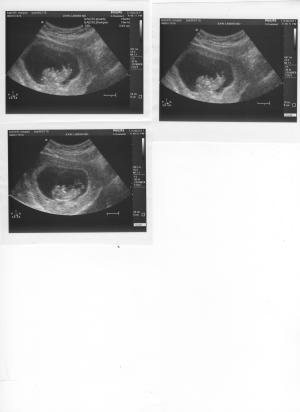
Third — on or around 26 June 2012, assuming all goes well and without incident, there will be another Barrett on the earth. Yes, be afraid, my genes are propagating, insanity, puns, tendencies towards a prolix approach of oversharing, and all. Thankfully, this child will also be carrying the genes of Flesh of My Flesh, and those characteristics involve practicality, common sense, order, and normality. (To say nothing of great beauty and brilliance.)

We had intended for the last couple of years that we would start trying once Megan got back from Germany, and we were told to prepare for it taking awhile. Well, apparently not. By the beginning of November we at least knew informally, and then our first OB appointment was Tuesday of Thanksgiving week, which confirmed matters and indicated we were nine weeks along. We spent most of the drive to our Thanksgiving destination on the phone with my mother and then Megan’s mother and stepmother; my mom got the first call, since she’s the one parent who doesn’t have any grandchildren already, and she burst into tears immediately.

We’ve been telling friends and family ever since, but a couple of things made it desirable that we wait a bit before making it “Facebook public”, as it were. Anyway, here we are, and I suppose it will be a source of reflection in the coming months/years/etc. If you’re on Facebook and want to be kept more or less up-to-date, you can join the group “Fans of Baby Barrett“; there’s not a lot to tell at this point except that we’re choosing to not find out whether it’s a boy or a girl. We’ve got some name ideas, yes, but it’s hardly practical to openly discuss those when you don’t know if it’s a boy or a girl, so I’m not going to go there except to say that there are some “legacy names”, as it were, that might make sense, and you know that we’re going to be getting one of these. We’ll see.

By the way, if you happen to be having a baby in or around Bloomington, Indiana, I really can’t recommend Bloomington Area Birth Services (AKA “BABS”) enough. We’re doing their eight-week birthing class (cue Bill Cosby: “Natural childbirth… intellectuals go to class to study how to do this”), and while, I must admit, it’s a little more of the NPR-listening “educated class” culture than I really expected, it’s a lot of excellent information that’s provided very sensitively and accessibly. I kind of surprise myself with my own reactions to some things; it should really be no surprise that “birth culture” a) exists b) is hyper-feminized, but I find a certain kind of stereotypical “maleness” emerging in how I’m processing some of the information, and it is very much out of character for me. It’s probably mostly a reflexive reaction to the explicit hyper-feminization of what’s being presented, which probably has everything to do with me and nothing to do with them, because they really are terrific at what they do. I’m just really not used to what they do. Anyway, I’ll have more to say about this as time goes on, I think.

So, there’s the news. Two different kinds of babies, I guess. There’s a third kind of baby on the way that I hope to be able to talk about more in depth soon, but it’s an outgrowth of some of the musical efforts I’ve had going here the last couple of years. For now, follow this, and I’ll be able to tell all in the next month or so, I think.

Prayers for all of these babies, please, and prayers most of all for Flesh of My Flesh. She’s got to carry our child in her womb and write a dissertation.

What does the term “educated class” actually mean?

In an exchange on Facebook yesterday where I outed myself as a godless commie pinko (I think that noise was Owen White blowing beer through his nose onto the library computer screen) because I think FOX is ridiculous in claiming that the Muppets are radical leftist propaganda, I mused that being part of the “educated class” (which, so we’re clear, I put in scare quotes and qualified by saying, “whatever that actually means”) seems to automatically place one to the left of most who publicly identify as “conservative”.

So what does the term “educated class” actually mean? About a year ago I was having a conversation with a friend about NPR as a source for news. I expressed appreciation for what seemed to be, on the whole, a lack of FOX News-style hyperbole; my friend said, “Well, it’s certainly the news outlet of choice for the educated class.” I’m sure that I had encountered the term “educated class” before, but not in a way struck me as being a discrete, identifiable category, and I’ve been chewing on it every so often over the past year.

Of course, in the past year, I’ve finished a Masters degree and completed doctoral coursework, so that makes me part of the so-called “educated class,” whatever that actually means, right…? I don’t know. Some initial poking into how the term actually gets used in public discourse turned up some not terribly conclusive references — it seems to be a term that neo-cons and moderates and “RINOs” use to pick cultural fights with each other more than anything. I’m half-tempted to see it as one of those terms like “moderate” where really it’s a label that allows for self-identification apart from distasteful extremes and is another way of saying “people like me”. It still seems, to me at least, that members of the “educated class” follow gut instinct as much as anybody else does, it’s just that we can back up our gut instinct with books you can’t find at Wal-Mart. Is that actually any better? I don’t know.

Since I’m not really sure whether or not to take it seriously, here is a half-serious/half-not look at what I think makes me part of the “educated class” (whatever that actually means):

  • I have multiple degrees and am still trying to get more.
  • I mostly hang out with people who have multiple degrees and/or are still working on more of them.
  • I am married to somebody with multiple degrees who is still working on more.
  • When I move (and remember I’m married to another academic), the single most expensive part of the move will be figuring out what to do with all of the books.
  • I belong to more academic societies than I will have degrees.
  • I assume that the people who write the books I read don’t make any money off of them.
  • I travel for conferences.
  • I actually attend conferences.
  • There are conferences for people in my field.
  • I have a “field”.
  • When I think of “conservatives” I think of people like David Gergen, Russell Kirk, and Rod Dreher. Names like Sarah Palin and Dick Cheney come to mind when I think of “angry and/or creepy white people”.
  • I get frustrated that what is presented as conservatism today seems to ignore its own intellectual history.
  • I think conservatism has an “intellectual history”.
  • I think there’s such a thing as “intellectual history”.
  • I think it’s weird that it’s spelled “conservatism” rather than “conservativism”.
  • I’d like to think that public discourse doesn’t have to be lowest common denominator in order to be effective.
  • I’ve read all of Ayn Rand’s major works (including some of her “non-fiction”) and I still think it’s not only intellectual garbage but bad literature.
  • I have to concede, with regret, that conservatives, at least in the last few decades, tend to produce lousy art.
  • I tend to agree with Paul Krugman that Newt Gingrich is a stupid person’s idea of what a smart person sounds like. I also think that tends to apply to Ayn Rand.
  • I think that “What do you read?” is a friendly, getting-to-know-you question. I’d love it if Katie Couric asked me that.
  • I’m weary of Republicans claiming that their willingness to eat their own is what separates them from the Democrats, when it is obvious to me that it isn’t true.
  • I’m aware that NPR isn’t free of bias but it’s nice to hear rational adults talking like rational adults, rather than watching either plastic people trying to buddy up to me over the anchor desk or angry white people yelling at me or each other about how a president who is to the right of Nixon on some points is a radical socialist.
  • I can tell you that Theodosius, not Constantine, made Christianity the official state religion of the Roman Empire.
  • Even as an Orthodox Christian, I don’t think that science is a secular conspiracy theory, and as such I think science has implications and consequences for my behavior and choices — much as Christianity does.
  • I actually want my hypothetical future kids to learn languages other than English.
  • I actually believe there’s a connection between what academics do and what happens in the real world.
  • I don’t see being articulate (read: “being able to string a coherent sentence together”) and being authentic as diametrically opposed qualities. I’m a both/and kind of guy.
  • When I’m given the opportunity to donate a book to a children’s group, I instinctively grab a single-volume copy of The Lord of the Rings and hope that it inspires some kid somewhere to think, to believe, to wonder, and maybe to be interested in the stuff that made Tolkien want to write the story in the first place.
  • To think, to believe, and to wonder are the things I learned to do best as a little kid and they’re what I’ve tried to figure out how to make a living at doing ever since.

That’s all I can think of for now. Yeah, it’s kinda SWPL-ish, isn’t it? Maybe that’s inescapable. I’d be curious for anybody to come up with their own list.

A second hurdle cleared…

As chronicled somewhat after-the-fact, in November of 2010 I cleared the first of a handful of hurdles towards finishing graduate school — I passed my third semester review, which meant that I had finished my Masters degree.

For a number of reasons, I took an incomplete in a seminar that same semester. I’d planned on a paper for that seminar that had the severe discourtesy to show up in a major journal written by somebody else that same fall, which really threw me for a loop, and for a number of reasons the prof was largely unavailable (for good reasons, I should stress) for consultation on other possibilities. I sort of cobbled together some thoughts from the rubble, and showed them to the prof in March of this year as something of an abstract/outline/stream-of-consciousness, and he found them largely incomprehensible. When I tried to re-explain what I was shooting for, he had some more or less decent suggestions, but he didn’t exactly seem thrilled, and I wasn’t exactly thrilled either. By May I had completed all coursework requirements except for this seminar.

When I feel like I’m on shaky ground with my subject, my instinct is to show my work. So, taking some of the professor’s suggestions and trying to turn them into a paper, but not feeling totally confident it by any means, I showed my work. A lot. I turned in a rather long paper in June, and I still think it’s work that had a good point to make, but I got an e-mail from him a week later asking if it was a draft to be discussed or a final paper that needed a grade. The vibe I got from the question indicated to me that it would be in my best interest to say, Oh, it’s a draft, of course it’s a draft, yes, since is the last seminar paper I get to write I’d love to have feedback.

Thus it was in July that my instincts proved correct; he gave it back to me and said, in essence, I don’t know what the hell you thought you were writing, but try again, and good luck, because I don’t really know how you’re going to fix what you have.

I still think, as I said, that what I wrote was more reasonable than what he thought. However, I also have to acknowledge that I wrote a patristics paper for a political historian, and therefore it should be no real surprise that the political historian took one look at it and said, “Huh?” I’m absolutely certain it wasn’t a perfect patristics paper, but I’m positive it wasn’t the awful one he said it was — it just wasn’t a good enough one to really be able to transcend methodological boundaries.

Well, anyway, I kind of flailed about with what I wanted to do for a couple of months. Then I had a conversation with a different faculty member who revealed that she had been one of the reviewers for the article that had knocked the wind out my sails on my original topic, she said her feedback had been rather clumsily incorporated, and that there was lots wrong with the finished product. Suddenly I felt quite emboldened to return to the project the way I had originally conceived it, and once I got going on it, it went pretty quickly. The result was much leaner and tighter, and after a round of feedback on it with this second professor, I turned it in three weeks ago yesterday (Thursday).

Yesterday I got the paper back, and it was a much happier conversation than the one we’d had in July. My incomplete was changed to a grade by yesterday afternoon, and so now I’m officially done with PhD coursework. Next up, exams… which will be their own party to be sure, but the hurdles are getting cleared.

Reviewing some of my thoughts during this blog’s first year of existence (like the examples below) — well, I’ve come a long way, thank God.  I just turned 35 a couple of weeks ago, and It’s still even possible I might have a real job before I’m 40. (Assuming that higher education doesn’t completely collapse, but never mind that now.)

https://leitourgeia.com/2007/12/10/getting-a-late-start/

https://leitourgeia.com/2008/03/03/a-high-number-of-strong-applicants/

https://leitourgeia.com/2008/03/09/on-forgiveness-sunday-the-alleged-plurality-of-methods-by-which-one-may-relieve-a-feline-of-its-flesh-and-other-musings/

https://leitourgeia.com/2008/03/18/dr-liccione-my-prayeris-to-be-shown-a-way-out-of-the-box-im-in/

https://leitourgeia.com/2008/03/20/more-on-the-alleged-plurality-of-means-by-which-one-may-remove-flesh-from-a-feline/

https://leitourgeia.com/2008/04/25/a-parable/

https://leitourgeia.com/2008/07/28/that-unwelcome-guest-known-as-reality/

In which the footnote to history perhaps gets its own body paragraph

There are times when people question why I have a blog. Particularly in the early days, my wife wavered from not understanding why anybody would ever have one to actively resenting the existence of the entire medium from time to time. Some fellow academics have (correctly) warned that you have to be very careful about what you post lest a journal down the road decide that you’re the person they’re going to take a hard line on with respect to how “previously published” is defined. Particularly in those moments when I feel burdened by a lack of time to put up posts, there are times when it just seems it would be better to take it down. Then, at other times, I realize that it’s very useful as a way of developing writing discipline, a way of spitballing certain kinds of ideas (even if it’s best to not fully develop them here), and that even if I’m not Rod Dreher and can just put up five 3,000 word essays a day before I’ve even finished my first cup of coffee, there’s a utility to keeping it up, even if I do so irregularly.

Then, every so often, there are other things that happen that make me glad that I have the blog.

Earlier this week, I got an e-mail from one Michael Kukowski, who had come across my earlier post on my great-great-grandfather, General Theodore H. Barrett. He believed he was in possession of a letter written by Theodore, dated 22 July 1871 from Fort Arbuckle, “Indian Territory” (now Oklahoma). The letter is requesting equipment for the effort of the initial survey of the Territory, making the document a witness, as Michael put it, to “the literal birth of Oklahoma”.

Initially, however, it seemed like perhaps there had been a mistake. The letter was actually signed “T. H.”, not Theodore, and a timeline to Oklahoma history that Michael pointed me to referenced the survey work being done by Thomas Barrett, not Theodore. A quick Google search did turn up mentions of “Theodore Barrett” as the surveyor, but it was enough to generate questions. I had also never heard of Theodore doing any surveying, so I wasn’t quite sure what to do with all of this.

So, like the good historian I aspire to be, it was time to check my sources. As it happens, I have in my possession a scan of a different letter that we know was written by Theodore in 1889, so there was a handwriting sample against which Michael’s letter could be compared. I also knew that I had seen a fairly extensive obituary for Theodore at some point, but since my dad, uh, appropriatedall of the stuff his aunt Frances sent me all those years ago (“What are you doing with that? She must have meant to send that to me, not you. Why would she send it to you? I’d like it back, please.”), I didn’t have recourse to it. I started to see if there might be an electronic version of it anywhere, and curiously, I came up with — of all things — an Amazon.com listing for a publication called “Gen. Theo. H. Barrett: Address Delivered before the National Farmer’s Alliance At It’s Seventh Annual Meeting Held at Minneapolis, Minnesota, Tuesday, October 4th, 1887”, AKA “Address to the American People”, published in an undated (but no earlier than 1900) “memorial edition” by the Morris Tribune of Morris, Minnesota. I remembered this being referenced in Frances’ materials, and it seemed like it might be worthwhile to track down. Amazon listed it as, surprise of surprises, “Presently unavailable”, but it occurred to me that if Amazon listed it, maybe WorldCat might be able to find it, in which case I might be able to get it via interlibrary loan.

WorldCat listed two libraries in the world that have a copy: The Minnesota Historical Society Library, and — wait, what? — yes, no kidding, Indiana University.

Two libraries in the whole world. Sometimes, I tell you, it’s just clear to me that there are no accidents.

Within 24 hours, I had IU’s copy of the booklet in my hands. I appear to be the first person to have ever checked it out. It was just waiting for me.

The pamphlet is prefaced with a biographical sketch of Theodore, and it contains the following helpful information:

[Barrett] taught school for a short time and at the age of 19 [~1854] went to Wheeling, Virginia, where he engaged at surveying. He came to the then territory of Minnesota in 1856, and engaged in the practice of his profession, surveying, until 1862… [Following the Civil War,] General Barrett was mustered out of the service on the 19th day of January 1866 at which time he was brevetted Brigadier-General of the United States Volunteers, to take rank from March 13, 1865. After he was mustered out of the service he returned to Minnesota, and was for several years engaged in surveying the Government lands in Minnesota, Dakota, Canada, Oklahoma, Texas and the Indian Territory (emphasis mine).

So, there you have it. The other part of the happy ending is that Michael sent me a scan of his letter, and the handwriting on the two letters matched. So, yes, no question it’s the same Theodore. My great-great-grandfather invented Oklahoma.

The address is actually a fascinating little document on several levels. I plan on scanning it before returning it to the library, and I’m also really curious to contact the Morris Tribune (which still runs) to see if they have either any archival copies or any documents related to its publication. There seems to be a particular historical circumstance that he’s responding to in his speech, and I don’t feel like I know enough about what it is, but much of what he says seems applicable to present circumstances. I will perhaps more to say about that later.

In any event, while I’m definitely not a Civil War historian or an American historian by any means, I’m still a historian, and there’s part of me that is curious to see if there’s enough here for an article, particularly given the raw deal the history books have given Theodore when they do see fit to make mention of him. Michael wants to put the letter in a museum, possibly in Barrett, MN, and while I don’t know that they’ll have the right kind of facility for it, it would be great if it could wind up there. We’ll see.

In any event — these are the kinds of things that make me glad I write a blog. Thanks very much, Michael!

Announcement: debut issue of Journal of American Orthodox Church History

The Society for Orthodox Christian History in the Americas (SOCHA) has published the first issue of its journal, the Journal of American Orthodox Church History. It looks like SOCHA has set this up as a peer-reviewed electronic journal (although I’m told that they are toying with the possibility of a print edition for academic libraries), with scholarly articles, source translations, and book reviews in each issue. It will be published annually on the Feast of the Dormition of the Mother God, 15 August. Issues are $10 apiece, which I would suggest is more than reasonable for an academic journal. The table of contents for the first issue, a summary of submission guidelines, and a brief statement of purpose for the Journal by SOCHA Executive Director Fr. Oliver Herbel, may be found here.

This seems like a great effort to support, both by buying issues as they come out, by citing articles that get published, and by submitting articles of publishable quality. I intend to do all three as I am able; please consider doing the same.

Another gift idea

As always, I know that the two of you of who look in on my blog on a regular basis are dying for gift ideas for me — I mean, did I really need 225 copies of Fr. John Behr’s book? Er, wait… Anyway, in case you think that’s too impersonal and/or obvious, there’s always this one: Diane H. Touliatos-Miles’ Descriptive Catalog of the Musical Manuscript Collection of the National Library of Greece. Nur sage, wenn du verstehst was ich meine.

Lycourgos Angelopoulos: Simon Karas and Byzantine music in Greece during the 20th century

Simon Karas

I found this on the Analogion website, and it seemed worth translating. Corrections, comments, and feedback welcome, particularly where some technical terms are concerned. This makes mention of a number of what I assume to be the terms of art of Greek music theory, and I wasn’t always sure I was right. Words where I wasn’t certain there even was an English equivalent are left in Greek and in italics. To the extent that anybody’s concerned about such things, we can call this a draft until all such feedback is in.

Simon Karas and Byzantine music in Greece during the 20th century

Lycourgos Angelopoulos, Archon Protopsaltis of the Most-Holy Archdiocese of Constantinople, Professor of Byzantine Music at Philippos Nakas Conservatory

Opening remarks at the Symposium for Byzantine Music, Romania, December 2002

The subject of my introduction touches upon, in essence, the problem today of the pedagogical method of Byzantine music — theory and practice — a problem which surely concerns all of us, I think.

It is the chief problem which we face so much in research, as much as even in teaching, because the oral tradition which necessarily interprets the written tradition, in some places has almost vanished (where the political situation over the decades contributed to it), in other places been weakened or altered (where it was influenced by the teaching of a European pedagogy — that is to say a foreign system — and the use of a mixed means).

Lycourgos Angelopoulos

Simon Karas studied and confronted this problem, together with many other things noted. The great length of days of life which the Lord granted him (he was born in 1903 in Strovitsi of Olympia and he fell asleep in January of 1999 in Athens) helped him so that a project, an inquiry — but also a practice of life — might be published in large part in the last twenty years his life and might constitute the work of infrastructure for a systematic pedagogy which respects the written tradition and interprets it with the oral tradition. The respect for the written tradition and the the interpretation of the written tradition by the oral tradition is the basic prerequisite of service and offering for everybody who serves the current method of our ecclesiastical music.

As of this year it has been twenty years since the publication of Simon Karas’ two-volume Theoretical Treatise of Greek Music. Before we analyze the importance of its publication, which is accompanied by a practical pedagogical method of many volumes, let us give, very briefly, the situation of Byzantine music in Greece in the twentieth century.

Σince the nineteenth century the new method of the system has spread and been taught, the so-called method of the Three Teachers, which was supported by the publication of the great Theoretical Treatise of Chrysanthos (Trieste, 1832) and some subsequent theoretical publications of other authors who are emultating it.

In parallel, from 1820 and beyond, subsequent publications of music books are produced, the peak being the circulation from the Patriarchate in the middle of the nineteenth century of the four-volume publication “Pandekti,” which until today constitutes a basic pedagogical text, together with the Anastasimatarion, the Irmologion, and Mousiki Kypseli (Sticherarion).

In the modern Greek state, they are teaching students of the Three Teachers such as the Protopsaltis of Athens, Zafeirios Zafeiropoulos, or the archdeacon Anthimos the Efesiomagnis (from Asia Minor) the who founded the School in Messolonghi, with many students and successors of his work.

The support from the state but then even from the Church (between the third and fifth decades of the century) produces the poor parenthesis of the system of Giorgios Lesvos, the system which finally was rejected by the Holy Great Church of Christ in the time of Ecumenical Patriarch Anthimos VI. Most correctly, too, because the dominance of another system would have eliminated automatically the notation and would cut off every connection with the older methods of the Byzantine system and the tradition.

In the 19th century however it has her roots and another cause which troubled our ecclesiastical music: the introduction of polyphony in the central churches of Athens, initially according to the model of the Greek community of Vienna (Chaviara-Nikolaidi harmonizations) and, later, of Russian polyphonic music.

This imposition of polyphony created reactions among the people who followed the tradition. Polyphony in the Church was certainly conforming to the age with the secular music that had been introduced also from Europe (an age in which opera, operetta, and European music in general flourished, the condition in which the idea was cultivated that those genres are superior in comparison to monophonic Byzantine music). As the restoration of Byzaintine music (having been purified, supposedly cleansed from Turkish elements) presents at the end of the 19th century the musically naive system of Ioannis Sakellarides, which produced great confusion among even still-traditional cantors. Chiefly because he used traditional notation lines in many cases and some uses of signs — subordinating the whole to a rhythmic scheme of four-beat feet, impairing the modal character and adjusting their essence to the European system.

Opposite to this situation which is spreading from the capital, Athens, influencing even the other urban centers by word and the educational activity of Sakellarides (pedagogy in ecclesiastical and even secular schools), there are the traditional cantors who are trying to keep the monophonic ecclesiastical music with the teaching but also even with practice (services, vigils, etc.).

Already the Ecumenical Patriarch has convened a musical committee in 1881-3 for the completion and correction of the Great Theoretical Treatise of Chrysanthos.

The committee redefines intervals, describes the characteristic elements of the modes and chiefly defines precisely the intervalic subdivisions of flats and sharps, in other words of the function of attractions according to mode, which even then had not been determined with exactness.

In the practical field — in the printed books which individual cantors are printing at the 19th century, already a process of most analytical notation of oral tradition has begun, a process which eventually arrives at excess with the improper use of certain signs of subdivision of the beat and the use of qualitative signs without calculation of their value.

This trend, which would continue  during the entire 20th century, would find the its chief spokesman in the face and work of the Archon Protopsaltis of the Most-Holy Archdiocese of Constantinople, Athanasius Karamani, who documents — as he himself calls it — the “living tradition”. For all practical purposes, these documents are meaningful witnesses for research and for the relationship with the value of the signs.

But let us come back to the beginnings of the 20th century. An important station is the decision of the Musical and Dramatic Assocation, that by 1871 has established the Conservatory of Athens, to advance even to the establishment of the School of Byzantine Music in 1903. The Director of the Conservatory, G. Naxos, goes to Constantinople and submits a request to Ecumenical Patriarch Joachim III for the sending of an appropriate teacher for the service of the School. Finally, Constantinos Psachos is sent and the service of the School begins in September of 1904. Constantinos Psachos will teach some fifteen years at the Conservatory of Athens, and after he will leave and will continue the teaching at other school. At the same time, in the years which follow, Byzantine music schools are established in the conservatories and in this way the teaching of Byzantine music spreads to schools which primarily teach European music.

This cohabitation [with Western music] is further one of the core reasons that the teaching of Byzantine music in the conservatories loses its particular character with regard to musical expression (the values of the signs) and microtones. The final sign of decline is the teaching with piano. Only a part of the repertoire is taught and dry singing prevails. This manner is characterized as “conservatory style”. The years which the Asia Minor Catastrophe (1922) will bring enough cantors from Asia Minor and Constantinople, just as even in the years of the decade of the 1960s, with the collective expulsion of those of Greek heritage from Constantinople, culminating in that [expulsion] of the Archon Protopsaltis of the Holy and Great Church of Christ, Thrasyboulos Stanitsas (1964).

Polyphony, confusion of Byzantine music with European music, along with Sakellarides, dry singing in the conservatories on the one hand, traditional cantors on the other hand, which, nevertheless, increasingly rely on one leg of the tradition — the oral tradition in other words — here is a picture in broad strokes of the situation which prevails when Simon Karas begins his activity with the establishment of the Association for the Dissemination of National Music (1929). The school of the Association has already been created and its creation has already engaged in study and research, work which will hold up for more than seventy years. From the beginning the subject of agreement of agreement of the theoretical and practical parts employs him. HE studies and he solves the problems thus in depth so that the theoretical pedagogy and the practical implementation, which he proposes for the formulation of his pedagogy, should be in agreement.

His pedagogy considers all of the old theoretical texts in conjunction with the oral tradition which he heard during the extent of his long life, and chiefly in the first decades of the 20th century.

The two-volume “Theoretical Treatise of Greek Music” which is published in 1982 is densely written on the hand with respect to his writing, exhaustive on the other hand with respect to the organization of its chapters.

The systematic ordering of the modes and of the classes of modes happens with deep knowledge of the practice. In the same way, the theoretical formulation is not stale, but always results from the practical implementation which he researches and justifies.

For example, I will relate the vivid documentation of the classes of the authentic modes (mesoi, paramesoi, plagioi, paraplagioi) and the plagal modes (difonoi, trifonoi, tetrafonoi, pentafonoi, eptafonoi) just as they result from the musical texts in use.

In this way the relationship between the modes is methodically presented, but primarily the means of generating the octave is emphasized. One consequence of this logic is the treatment of the series of pitches as a whole musical phrase of a certain mode and not separately (not as each separate pitch, in other words), this latter approach being the one which unfortunately  prevailed in conservatory-style pedagogy and not only there. The treatment of the series of pitches as a musical phrase facilitates even the determination of the ison which, just as all of us recognize, is not always noted in the text. The mingling, nevertheless, with the polyphony that I talked about earlier, in the combination with the conservatory-style pedagogy produced a freakishly irregular ison based on vertical harmonic consonance, outside the logic of the system of modes, which wants for the ison the tonic of the tetrachord or the pentachord in which the musical phrase belongs.

In the chapter on the modes, the symbol of Simon Karas is important as for the intervals. With the cooperation of Constantinpolitan mathematician and physicist Stavros Vrachamis — authorized in writing by the Ecumenical Patriarch to research the subject of musical intervals according to genre and timbre (as Karas himself mentions) — the intervalic study of the modes even completes or corrects, always justifiably, the earlier opinions on the intervals. As a representative example I will mention that which highlights for the enharmonic genre, in the Great Theoretical Treatise of Chrysanthos, who, while he clearly defines which ones are the intervals of the enharmonic genre, nevertheless in another paragraph he classifies the Third and the Grave mode in the enharmonic genre with intervals of the hard diatonic (whole steps and half-steps). The contradiction is obvious. Another example is the reconstruction of the intervals which the Patriarchal Commission of 1881-3 gives as for the chromatic modes, so that the large and small chromatic thirds of the soft and hard chromatic coincide.

Nevertheless the example of Simon Karas is decisive in the chapter “Musical Expression”, which in detail negotiates the matters of actions and of voices but also of the hand-signs used in directing (“texts only through hand-signs”): the action of these signs, although it is there in the vocal tradition of traditional cantors, has suffered a blow from the conservatory-style pedagogy (and not only from that), which just as we showed, does not welcome it, resulting in the desiccation of the melodic line and deterioration (if not disappearance) of microtonal intervals.

Already this chapter resulted in the motivation for extensive research. Beyond the announcement of the signing at the conference of Delphi in 1986, two doctoral dissertations, of Professor Demetri Giannelos and of Professor Yiannis Zannos, contribute seriously to the documentation of the subject, while a third, that of Dr. Georgios Konstantinos, gives a full picture of the function of the signs in the written tradition.

The proposal of Simon Karas for the reinstatement of certain hand-signs used in directing which correspond to vocal — that is to say, oral — tradition, I think, contributes decisively to the preservation of Chrysanthine notation and the avoidance of the distortion of its nature, with the predominant analyses already changing the use of the signs and, I fear, leading ultimately to the replacement of the signs with European notation.

From the achievements of the “Theory” of Simon Karas is a complete musical terminology, which responds in theory but also in practice, the consistent documentation of attractions in agreement with the Patriarchal Commission of 1881-3, the citation of examples in every chapter from folk music (hundreds of songs, documentation of the same), the through reference to the use of instruments. The multi-volume method for practical training accompanies and fulfills the “Theory” of Simon Karas, and completes the pedagogical framework.

In the years which the work of Simon Karas begins to be published, the final 20 years in other words of the twentieth century, also begins the service of the music departments of universities in Athena, in Thessaloniki, in Corfu. The work of these music departments towards Byzantine music is chiefly theoretical, of musicological, historical, literary, or theological interest. Of a more practical direction is the department of Musical Knowledge and Art of Macedonia University in Thessaloniki. In parallel, the Institute of Byzantine Musicology of the Church of Greece is active with publishing, the creation of a choir and a discography of Byzantine and post-Byzantine musical compositions.

The University Byzantine Chorus of Thessaloniki, which was established in 1972 by Professor Antonios Alygizakis, also has a similar discography.

(Today, I will add also the postgraduate department of the Conservatory of Athens under the supervision of Doctor Georgios Konstantinos, where specialized researchers give to conservatory graduates comprehensive and knowledgeable insights for the balanced development of theoretical training and practical research.)

A seminal contribution in the history of ecclesiastical music from the sources according to the period of Turkish rule is the book of Manolis K. Chatzigiakoumis, “Manuscripts of Ecclesiastical Music, 1453-1832”, as well as the recordings of cantors which were made in the last twenty years and began to be released recently under the title “Monuments of Ecclesiastical Music”.

Finally, we mention the establishment of the Greek Byzantine Choir in 1977, which in 25 years of activity has participated in more than 900 events in 30 countries, with a similar discography in Greece and in France.

We return to Simon Karas.

We have before us, then, an important project which actually dominates the musical scene of the 20th century, a project which prepares tomorrow while at the same time it constitutes a solid link between today and yesterday. For this reason exactly it deserves to be studied more broadly, to be translated and to be useful for all researchers who will find a most important aid for study and contrast, and for teachers and performers who will discover a valuable guide for systematic pedagogy and research.

I should say here that I consider it especially a privilege that our common tradition in Byzantine music originates entirely from our common Mother the Church, the Holy and Great Church of Christ, our Ecumenical Patriarchate.

The Great Church maintained over the ages and preserved in her womb our system of music, with the pedagogy of methods over time in the Patriarchal school, and it will continue even in the future to guarantee its unhindered continuation.

This unity across of the years of the system endorses the research and the systematic pedagogy of Simon Karas — pedagogy which supports, substantiates, completes, corrects, and clarifies the later method in use of the Three Teachers.

At base, we consider the existing written tradition which necessarily is completed by the oral tradition. This means preservation of the notation of the elaborations of Gregorios and of Hourmouzios, with the simultaneous accounting of all the information which the elaborations of their students give us (Petros Ephesios, or Matthias Vatopaidinos of Mount Athos, Nikolaos Diocheiaritos, Ioasaph Dionysiatos, et al.)

The comparative study of the elaborations with each other and with the oral tradition confirms scientifically but, I would say, also solemnly, the comprehensive thesis of Simon Karas for reinstatement of certain hand-signs used in directing but also of the oxeia, already in use in the publications of Petros Ephesios.

This method of research and its practical implementation protects, on the one hand, the unity across time and the functionality of the notation and prevents its mutation in the dry notes of the European system (and thus prevents its being rendered unusable), while on the other hand, it gurantees and strengthens the absolutely necessary oral tradition (with the attractions, the microtones, the phrases et al.) without which the interpretation lacks the richness of varieties which are described theoretically as operations of the signs and are performed practically by the traditional cantors.

With these observations, in conclusion, I would pray to be given to all of those who are interested in our ecclesiastical music for current practical and theoretical study, a continuation which will have the character of the standing scientific but also artistic collaboration and exchange in the frameworks of current reality, with reference always and in relation to the older methods, from those which we will be able to derive important details for knowledge and development.


adventures in writing alexander lingas all saints bloomington all saints orthodox church american orthodox architecture american orthodox music american orthodoxy Antiochian Archdiocese Antiochian Orthodox Christian Archdiocese of North America Antiochians books byzantine chant cappella romana chant church architecture ecclesiastical chant ethnomusicologists ethnomusicology fellowship of ss. alban and sergius Greece Greek greek food greekness hazards of church music international travel tips ioannis arvanitis joe mckamey john michael boyer kurt sander Latin liturgical adventures liturgical architecture liturgical music liturgical texts and translation liturgy liturgy and life lycourgos angelopoulos medieval byzantine chant Metropolitan PHILIP militant americanist orthodoxy modern byzantine architecture modern greek music music as iconography my kids will latin and greek when they're newborns my kids will learn latin and greek when they're newborns orthodox architecture orthodox architecture is bloody expensive Orthodox choir schools Orthodox Ecclesiology orthodox outreach orthodox travel pascha at the singing school Patriarchate of Antioch Patriarch IGNATIUS IV Patriarch of Antioch publishing random acts of chant richard barrett in greece richard toensing rod dreher sacred music st. vlads st john of damascus society Syriac the Bishop MARK fan club the convert dilemma the dark knight The Episcopacy The Episcopate the only good language is a dead language this american church life travel we need more american saints why do we need beautiful music in churches?

Blog Stats

  • 263,859 hits

Flickr Photos