Archive for the 'Academia' Category


Center, periphery, and shaking the dust off one’s feet (long)

(Warning: long and rambly. Sorry.)

This has been a difficult semester.

I’m at the point in my program where I’m having to jump over the big hurdles; this is no bad thing on the face of it, because I don’t want to be in grad school forever, I’d like to have a real job before I’m 40, and there are certain funding realities that mean it’s in my best interests to get to candidacy/ABD (“All But Dissertation”) sooner than later. To that end, this year has been all about getting myself through those hoops. Fall term I spent getting my Latin back in shape, I got that exam out of the way back in January, and now I’m three weeks out from my oral qualifying exams. Assuming all is well there, then I have a paper that I need to rework into a dissertation proposal, and then I can defend that before the end of April. Once I’m on the other side of all of that, then there are certain kinds of doors I can knock on. I don’t necessarily have to go knocking on them, since I still have two years of funding left and I’m pretty sure that if push comes to shove I can get the dissertation done in one year, but on the other hand, we’ve now been in Bloomington ten years, and we’re very much feeling like our own internal sell-by date has passed for this town. It would be very much to our advantage, on a few fronts, to be able to move on soon, and some of the research/teaching fellowship opportunities that are out there once both Barretts have unlocked the PhD candidacy achievement would be more than helpful in allowing us to move on.

See, we’ve basically been here long enough that we’ve outlasted just about everybody who moved here within our first two or three years. It’s one of the very weird things that can happen in this kind of town; you come here for one reason, thinking you’ll be in and out in two years, three years max, and then life takes a turn that keeps you here. It can be very subtle, really; it becomes clear that there’s really not a ton here that can keep you sufficiently busy if you’re not on one of a handful of very specific tracks, but somehow there’s a center of gravity here that can hold you in place even when you don’t really want it to. (A friend of mine calls this “getting Bloomingtoned”.) Part of it is that it’s logistically a difficult town to get in and out of; you can’t just hop a plane or train and be on your merry way. Part of it is that it can seem like there should be plenty to do here if you can just come up with the right opportunity; some of those opportunities only cycle through once a year, and by the time you realize that they’ve passed you by for the year it’s too late to make plans to do something someplace else, so you’re stuck until the window re-opens. Maybe you manage to make one of those opportunities work, and then the next thing you know, you’ve looked up and four years have passed. Eventually, one way or the other, stay here long enough, and not only will most of your friends have left, but the avenues that bring new arrivals into your social circle will re-orient around other people.

We’re feeling this right now particularly keenly, at least in part, because of Theodore. We just don’t have any access to family out here; my mom is in Alaska, Megan’s is in Washington state, my sisters are in Arizona and Oregon, and Megan’s brothers are in Hawaii, eastern Washington state, and Chicago. (Chicago seems like it shouldn’t be that bad, but it’s a lot harder than you might assume.) The plan this academic year was that theoretically our respective teaching/research schedules were going to allow for somebody to always be at home; well, that didn’t quite work out. Flesh of My Flesh got a last-minute (like, three weeks into the semester) teaching reassignment that threw a massive wrench into our schedules, and what we’ve realized is that just about everybody we would have asked for help in terms of watching the Fruit of My Loins for an hour here or an hour there has moved on. Every day has really turned into a juggling act, and it’s been hard to manage with basically not much local social network left.

One of the other things that’s contributed to feeling this diminution of our social circle is the fact that we’re no longer hooked in to the parish that is ostensibly local to Bloomington. (You perhaps notice that I’ve phrased that somewhat circuitously. That’s intentional, and I’ll come back to that.) Since January, we’ve been going to Holy Apostles Greek Orthodox Church in Indianapolis; it’s one of the shorter drives, they’ve been very nice and welcoming, they’ve fawned over Theodore, and they’ve been receptive of what I have to offer in the way of chanting. They also only meet twice a month, which means that we’re not missing out on much by commuting. But, even being one of the shorter drives, it’s still an hour and fifteen minutes away, and it means that our contact with the community is by necessity pretty sporadic. Anyway, the upshot of all of this is that a couple of weeks ago, when all three of us got really sick simultaneously, a friend of ours in Indianapolis who, like us, used to go to All Saints, asked us — “Is anybody checking in on you guys?” I just had to shrug and say, who’s left to do so?

Last week, I found out that a good friend of mine, whose time here has been very much the definition of “getting Bloomingtoned” (he and his wife moved here to be close to family and to apply for grad school; the family moved away shortly thereafter, grad school didn’t work out, and they kind of got snookered into staying indefinitely, under somewhat less than ideal employment conditions, for reasons I won’t deal with specifically) and who has been waiting for the opportunity to go to seminary for the last seven years, will finally be going to seminary this fall, come hell or high water. Last I had heard, while certain necessities had managed to fall into place in the last month, they had decided to wait until fall 2014; well, no, they’re getting the heck out of Dodge and they’re doing it now. They’re done feeling stuck here; time to take the opportunity to move on. Another couple of friends of ours are also moving in May, we’ve only recently found out, but they just arrived last May. The wife was starting a PhD program in education and the husband was doing some exploratory things for nursing, and, well, let’s just say that none of that really worked out as intended. They still thought that they’d stick around Bloomington for a few years simply to try to be rooted someplace for a little while, but as I found out, in the last few weeks they’ve seen that that way lies madness, and they’re moving back to their home state in a couple of months. They are, in other words, determined to avoid “getting Bloomingtoned”. I am happy for all of those folks. At the same time, much of our small handful of remaining friends here is also moving on to greener pastures come May, and we’re really starting to feel more alone than we have in awhile.

But my point here isn’t really to complain; my point is to give a personal window into the weird way this town works. To use theoretical terms, the way center and periphery function here is a bit tough to wrap one’s brain around. One way to look at it is that Indianapolis is a center, and Bloomington is on the periphery; some might argue that actually Chicago is the center, Indianapolis is part of Chicago’s periphery, and Bloomington amounts to the outer reaches of the solar system. Well, maybe; I tend to think that Indianapolis and Chicago are both centers; culturally, my impression is that northwestern Indiana seems to rely more on Chicago as a center, and central Indiana seems to rely more on Indianapolis as the center (which is to say, it feels a lot like a slightly rougher-around-the-edges version of Ohio). But then, Bloomington is, in its own way, also a center — Indiana University is here, for example, which makes it a particular kind of center. It’s not what anybody would call a “world class city”, but it neither tries to be nor wants to be, and there’s enough activity here for there to be surrounding areas that consider Bloomington to be “town”, which means that Bloomington has its own periphery.

The trouble with Bloomington being a center is that, even at a mere hour away from Indianapolis, it’s a pretty isolated center. It’s a short drive that feels long, partially because you don’t actually get to make it on a real highway; you’ve got a couple of choices of state highways that, instead of overpasses, have intersections and therefore stoplights, it also feels long partially because so there is so little between here and there. Its nature as an isolated center has let it become something of a SWPL paradise for people who can afford it; we’ve got a food co-op with three (soon to be four) locations, we’ve got a whole street of different kinds of ethnic restaurants (no real Greek restaurant, alas), we’ve got culture provided by the university, we’ve got all kinds of green initiatives, we’ve got birthing subculture, we’ve got a winery, we’ve got homebrewing galore, we’ve got alternative schools, we’ve got biking, and we sort of have buses. This has sort of led to Bloomington’s own kind of parochialism; the feds are supposed to build part of the I-69 corridor going through here, and the SWPL folks do not want it in any form at any price. Probably if there were a commuter train between here and Indianapolis, that’d be one thing (and I myself would love such an option, because I hate the drive), but on the whole, they like Bloomington the way it is.

Well, fair enough, but then there’s a whole separate crowd that lives here, one that lives more than 2-3 miles from the university campus, that actually doesn’t see the university as the economic center of the town; they see it, rather, as mostly irrelevant at best and an unwelcome attempt to co-opt the kind of life they had 15-20 years ago. “The university is actually only a small part of the picture,” a lifelong resident told me once, telling me that the only people who see IU as rooting the activity of Bloomington are people who work for IU. “Bloomington’s main economic driving force right now is retirement,” he said.

See, 15-20 years ago, Bloomington’s economy was far more diverse in general; there were the quarries, there was RCA, there was Otis Elevator — you had a substantial blue collar sector, in other words, that could co-exist, however uneasily (see the movie Breaking Away), with the eggheads, the retailers, and the burger-flippers. All of that’s gone now, for all intents and purposes; my first year here, I worked for Kinko’s FedEx Office for a few months, and my manager was a guy who had worked for years in management at RCA. It was a great job; eventually the plant relocated most of the labor “south of the border”, as it were, and laid him off. They called him up the day after they would have had to bring him back at his old salary with full benefits and pension, and offered him his old job with no benefits, no pension, and half the salary. As he told me, “I had two words for them that weren’t happy birthday.”

So the question then becomes — how do you lure talented people here, and how do you keep them? You used to be able (I almost wrote “You used to could” — I’ve been here too long) to do it with the cost of living. The IU Jacobs School of Music voice faculty became known as “the graveyard of the Met” because they could offer star singers past their prime a salary that looked small, but in the context of a cost of living that was negligible compared to what they were used to in New York. But that was 50, 60 years ago; Bloomington now has the highest cost of living in the state.

The university certainly gets people here, both in terms of faculty and students, but a chunk of those people aren’t really here to stay. If you’re here for a terminal graduate degree, it’s almost a foregone conclusion that you aren’t going to be getting a job here. That’s just not how major universities work. It might have been a different story 30-40 years ago, but not now. There are exceptions, sort of; if the completion of your PhD times out nicely with a faculty opening, then you might get a yearlong Visiting Lecturer appointment while they do a search, but you’re not realistically going to have a shot at the tenure track position. That said, there are people who come here, fall in love with the place, and decide that they’ll be Dr. Broompusher just so that they don’t have to leave. If you’re really creative you can find ways to carve out niches for yourself, but often these can turn into ways of making a living as a self-promoter.

When I was working in support staff jobs for the university, one of the things I discovered was that a lot of longtimer secretaries and such had been gradually pushed further and further out to the outlying areas of Bloomington. Basically, if you work for the university, unless you’re faculty or in the professional track of administration, you can’t really afford to live anywhere near it — partially because East Coast undergrads whose parents are used to New York and New Jersey prices have bid up the cost of housing. We’ve experienced that a bit ourselves; the apartment that we lived in our first couple of years here was about a 15-minute walk to campus, and it was in undergrad party central. It was $850/month the first year (incidentally, only $100/month less than our apartment in Seattle); it got bumped up to $950 the second year, and then they wanted to jack it up another $100 the third year. We said no, and the very next day they were showing it. They ultimately rented it for $2,000 a month.

Anyway, the point is, Bloomington seems to function as a center, at least in some ways, and they’ve created some of their own periphery. But it’s also a periphery in its own way — it’s a periphery that’s sort of a center among other peripheries. One of the results seems to be that there is a lot of socio-economic elbowing and jostling here, and a lot of cultural discomfort amongst the different strata.

So — and this really is my main point — what do you do as a church in such a situation? Well, normally, the way this seems to work out is that people on the periphery go to their churches, people in the center go to their churches, and you’ve got different cultural groups instinctively coming together at their respective churches. You certainly see that here; you’ve got Primitive Baptist communities in some of the areas a half hour away, you’ve got Campbell/Stone and Pentecostal and Baptist churches out in the outskirts of Bloomington, you’ve got the conservative Catholic parish way out in the northwest corner of town, you’ve got the moderate suburban Catholic parish less than a mile away from the campus, and you’ve got the ultra-liberal Newman Center that hosts the Dalai Lama when he’s here (“St. Paul Outside the Faith” as I’ve heard conservative Catholics call it) right on campus. On the main commercial drag through the university’s part of town, you’ve got the big Methodist church, the Episcopal church, the Disciples of Christ church. And so on.

So where do the Orthodox fit into such a picture? Well, here in Bloomington, they kind of don’t. There is one Orthodox church here, and the idea is that it serves all the Orthodox in Bloomington and can be a home for Orthodox college students and inquirers for as long as they need it. That’s a lovely idea, but how does that work out in practice given the situation that’s here? And, again, it kind of doesn’t. The problem is that All Saints has intentionally located itself in the periphery; it’s six miles from campus, two and a half miles into unincorporated county. It’s at the intersection of a couple of country roads that are neither pedestrian nor bike friendly; I used to say that if I lived across the street I’d still drive. As a result, it’s not easily accessible from the center, and in the time I was there, I saw the demographic shift substantially away from the center and more towards the rest of the periphery. And yet, it’s ostensibly the church that is serving the center, even though, for all intents and purposes, it doesn’t, and it doesn’t really want to, either. You can’t really elide all of the geographic, socio-economic, and ethnic differences all at the same time with a little shoebox church out in the middle of nowhere; maybe in a perfect world you could, but we’re talking about human beings with human foibles, and it doesn’t really work that way. Anyway, the net effect is that being close to the center allows it to function as a central location for the other peripheries, but that means that it’s a very different culture and demographic than what you would have if it were actually in the center and serving the center. So, while there’s technically an Orthodox church with a Bloomington address, there isn’t really an Orthodox church in Bloomington.

The other tricky dynamic such a community has to navigate is one of long-term vs. short-term participation. There are people at All Saints who were born and raised in Bloomington and who will be buried in the church’s cemetery. There are people who moved there for school and decided to stay. There is the small handful of students that come and go. There are people who have moved there for various reasons, seen them not work out, and simply gotten stuck (“Bloomingtoned”). There are people like me, who came thinking we’d be here 2-3 years tops, 10 years later we’re still here, but we’re still planning on being gone sometime in the very near future — long-term short-termers, in other words. How do you work out issues of leadership within that kind of dynamic? In my case, I was on the parish council, the building committee, I directed the choir and chanted, I was OCF chair for a couple of years, and so on — and for everything I was involved in, I took the stance that, however long I’m here, I’m going to participate in decision-making as though I’m going to be here in 50 years. I took an approach of trying to build things that I would want to see still standing in my grandkids’ day, in other words. But should I have done that? Did I have any business taking the long view? Or does it simply throw off the balance if a short-termer, however long-term their short-term becomes, doesn’t defer on long-term issues to the people who actually will still be there in 50 years? Does it make any sense for somebody like me to be part of the effort to build a new church, for example, when I’m not planning to be around long enough to see it built? Are people like me just creating messes that other people will have to clean up? But then, what happens when the people who are going to be around aren’t willing to be involved?

What’s the priest’s role in figuring out such questions? It seems to me that there’s a complicated problem of priests not being able to afford to tell people with energy and ideas and willingness to participate that they need to sit things out, but at the same time, if the priest is letting those people spearhead projects that he’s not willing to take on or support himself, then at what point do such people just become, effectively, cheap labor in whom the “permanent” congregation has no investment?

I’ve mused a lot on this blog about mission and outreach. Orthodox outreach is something I care very deeply about; what I keep saying is, “If we actually believe we are what we say we are, we ought to be shouting it from the rooftops.” Taking mission seriously also, it seems to me, entails taking issues of community access seriously. How do you do that in a town like Bloomington? If you build a church in the center that is first and foremost for the center, probably people in the periphery aren’t ever going to care. In that sense, All Saints really is a mission to rural southern Indiana in a way that it couldn’t be if it were better positioned to serve the population center of Bloomington. But, at the same time, the way it has positioned itself, it’s close enough to the center to count as “the Orthodox church in Bloomington” even though it effectively isn’t, which makes it very difficult for anybody else to justify getting a mission started that would intentionally serve the center. The periphery folks have their church, and they’ve got it exactly the way they want it; it’s away from everything, it’s small, it’s relatively inexpensive, it’s low-maintenance, nobody bothers them, they don’t have to worry about a proliferation of the forces they keep away from (like the university) taking over. But then, since it’s the only game in town, you have the all-too-frequent phenomenon of certain kinds of inquirers or students walking in, realizing it’s not really intended for them, and leaving. Some of them commute to Indianapolis; some of them just don’t bother considering it further.

I was almost one of those people as an inquirer, ten years ago; not gonna lie. I walked in for the first time and really wanted to walk right out (this after getting lost on the way there because the directions on the website were unclear). I tried to make it work for nine and a half years, and it sort of did, for awhile. As I said, however, I’ve seen the demographic change while I’ve been there, and while there were still vestiges of the original self-conception as “the Orthodox church for all the Orthodox in Bloomington” 10 years ago, any sense of that is completely gone now. The families that started the church have moved away or passed on; there isn’t a second generation of those folks still hanging around. As a result, the demographic has narrowed, and it has also aged and moved outward. A new generation of converts is coming in, yes, but they’re coming in from even farther away, from points further southward. We have friends there, to be sure, and our very dear godparents, but that’s a different beast than fitting in to a community. The parish has developed, and continues to develop, a very strong identity as a church for rural southern Indiana; this isn’t a bad thing on the face of it, but it means that, after nine and a half years of trying to be part of the community, we find ourselves having to commute northward now, without a local community to speak of, at exactly the time when we find ourselves most in need of it. And we’re neither the first ones to have this problem here nor the only ones currently having to navigate it.

I should say that this isn’t an issue of university snobs not wanting to rub shoulders with the townies; that should be borne out by the fact that, as I said, we tried to make it work for almost ten years, and we were involved with community life on several fronts. The issue is that, sometimes, despite everybody’s best efforts, you just don’t fit in, and eventually you’re told, “Look, this isn’t going to get any better. It’s probably time for you to stop beating your head against the wall.” Also, as I said, we’re not the only ones in this boat.

The short-term solution, for my family, is making a concerted effort to get someplace where there can be a local community. This solution may neither be easy or soon in coming, so we just have to suck it up and deal at the moment. But what’s the long-term solution for this area, and what are the lessons here for others? For all I know, the lesson is, “Don’t let uppity college punks think they have any say in how we do things because it’ll just be an exercise in frustration for everybody”, but surely there’s something more constructive.

A final observation (yes, I know that coming from me that’s as empty a promise as hearing “Let us complete our prayer to the Lord” in an Orthodox service) — All Saints has been described to me as “an experiment in seeing if you can establish an Orthodox church somewhere where there have never been the usual reasons for having one”; that is, where there haven’t been groups of cradles who have established parishes. Well, to the extent that it has been successful, I’d argue it has done so by creating its own “ethnicity” that you belong to or you don’t. Maybe that’s what you have to do; I don’t know. The thing that’s very curious to me is that there have always been big groups of people here of ostensibly Orthodox heritage — Greeks and Russians in particular. I say sometimes that there is a big Greek community in Bloomington; they’ve started a church (the community that became All Saints was originally a group of Greeks and Arabs) and they’ve started several restaurants, but they’ve never started either a Greek church or a Greek restaurant. (Semi-untrue now — there’s Topo’s 403, but it’s less of a “Greek restaurant” and more of an upscale trendy place that happens to be somewhat Mediterranean-influenced.) There was a rembetiki concert here a couple of years ago that got around 200-250 of the Greeks in the area all under one roof; it made me very sad to hear one of them say, “It’s so nice to see everybody in one place. Maybe someday one of us will start a restaurant and we can all see each other there.” Also, the Russian Church Abroad had a mission here in the 1950s, but for one reason or another they never quite managed to keep it together. They fell apart in the ’60s, sort of re-integrated in the ’70s, and then fell apart for good in the ’80s. They started out with a building in the center of Bloomington and then moved out to the periphery, buying an auto garage out in the county. Then, as somebody told me irony-free, “the big money went with Antioch and we had to shut our doors.” (The infamous “Indiana listserv” was run by one of their minor clergy, who is now a priest in one of the “continuing” Russian Orthodox groups who didn’t like that ROCOR made nice with Moscow.) The people have been here (and are here); they just don’t seem to feel that they have any skin in the game — which, again, seems to me to be a problem with the periphery gathering in the center while simultaneously ignoring the center.

I don’t know what the answer is, and I don’t think I’ll be here long enough to see how it gets answered (noting that I’ve been wrong about such things before), but it seems to me that there’s an object lesson here. I’m just not sure what it is.

Two weeks and a day until exams. Please pray for me.
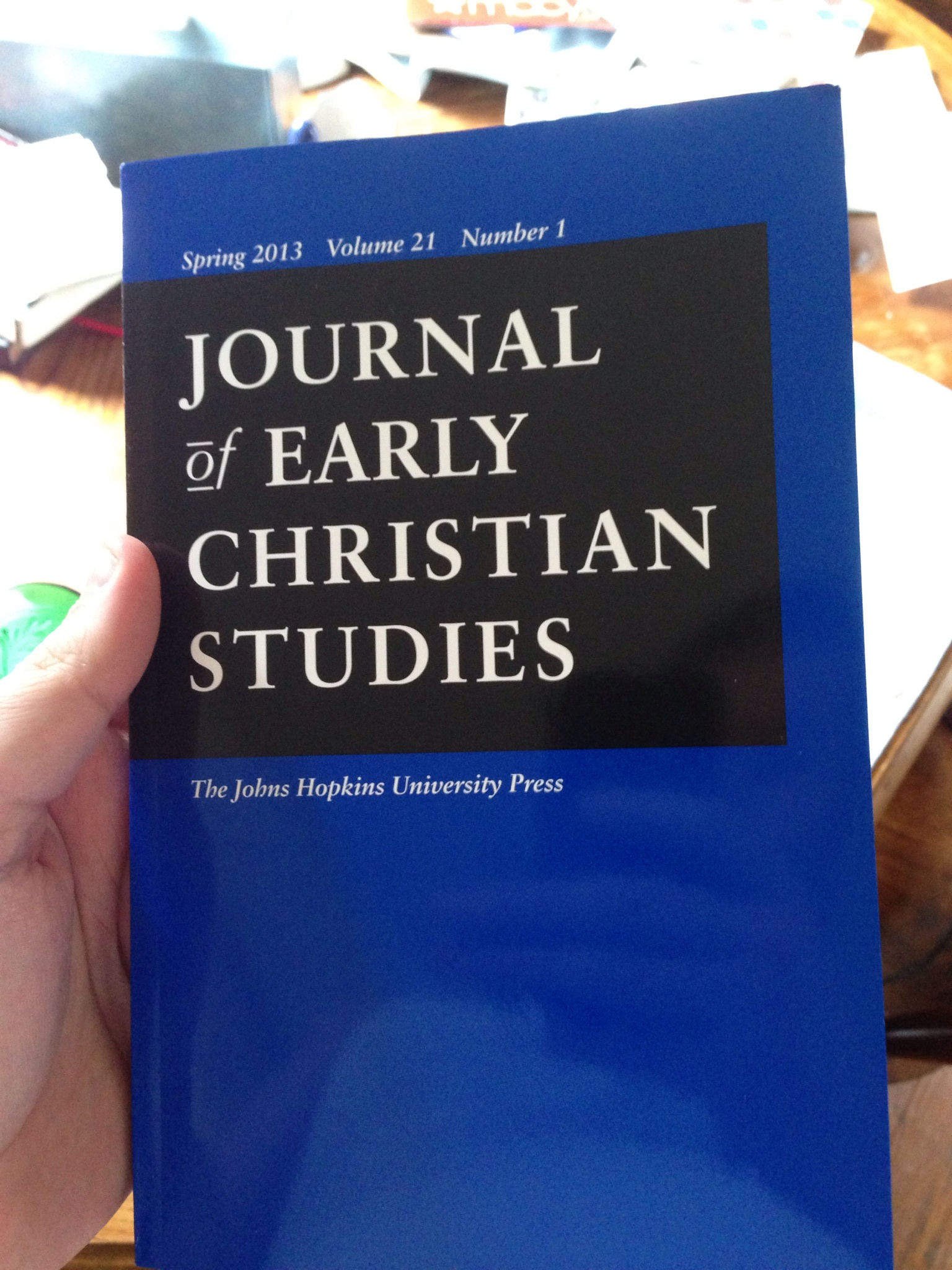
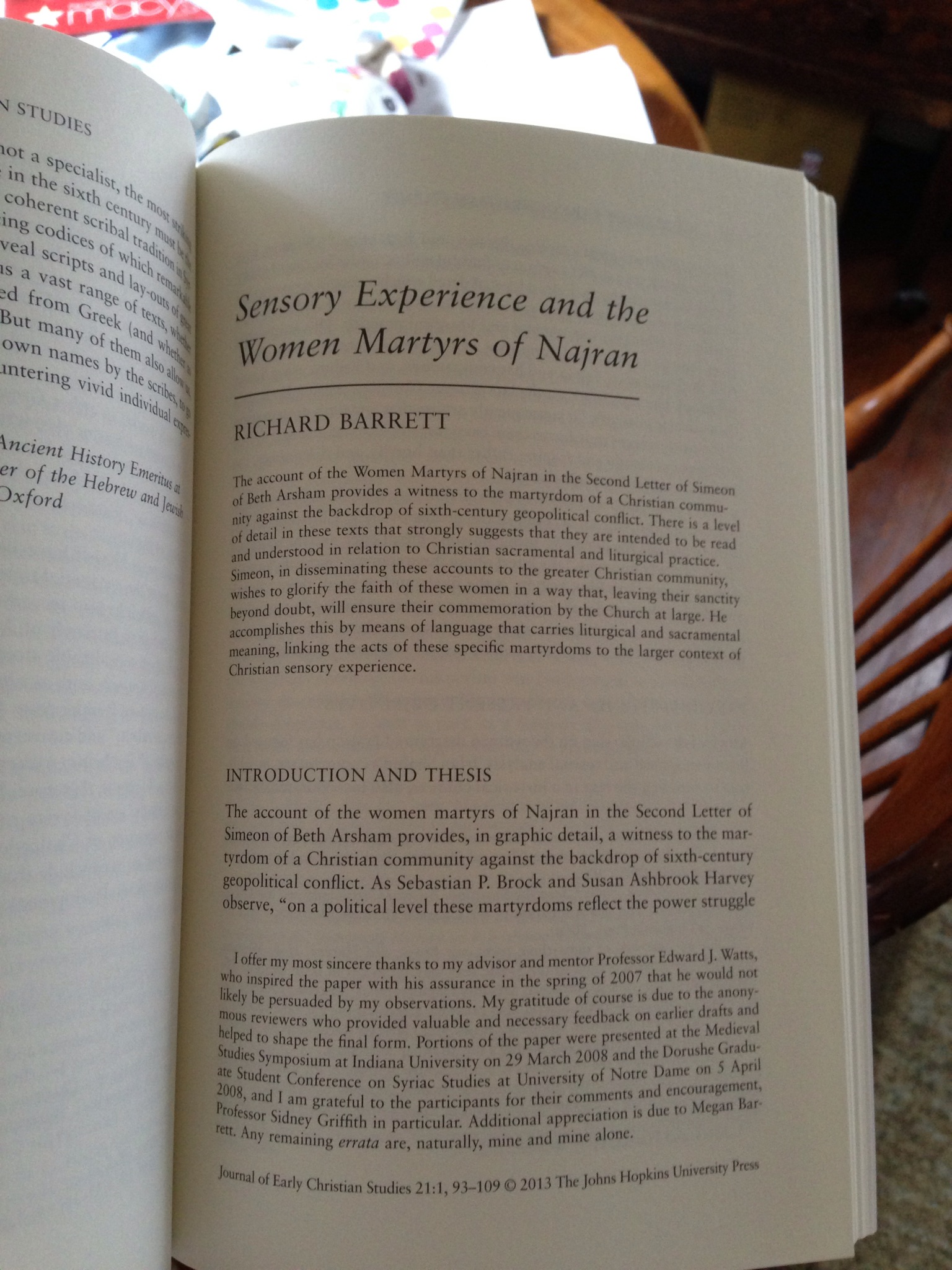
New journal article: “Sensory Experience and the Women Martyrs of Najran”

A bit over a year ago, I announced, along with an impending next generation, that my first peer-reviewed article in my more-or-less official field (late antique Roman history) had been accepted for publication. Well, the issue of Journal of Early Christian Studies arrived in my mailbox today, and they have also posted it online. If you’re interested in the piece, you can either access the entire issue via a research library’s subscription, or I’ve posted the pdf to my academia.edu profile. Onward and upward.

I should note that the issue includes an article by Jonathan Zecher, another former Seattleite and all-around cool guy whom I met via some mutual friends at North American Patristics Society last year (and with whom I had some other, unexpected friends in common); besides us punk kids, there is also an article by NAPS president Dennis Trout (it’s actually his address from last year’s conference), as well as Oxford legend Fergus Millar. All of that is to say, I find myself in unexpectedly good company — there goes the neighborhood, I guess.

855982_10102601286403059_189812403_o889249_10102601285983899_66939021_o

In which St. John Chrysostom shows up on another digital bumper sticker

This has been one of the more stressful semesters of my college career. Not quite the most stressful, but there has definitely been plenty of pressure.

I started off with my Latin exam. Then I was going to have a relatively nice and easy semester preparing for my quals, for which I sit on 29 March. Flesh of My Flesh had a cushy-ish research assistantship that could be done from home, so there was supposed to be very little going on to distract from what we needed to do to get through the term.

Er, well, no.

Megan got a last-minute teaching assignment right after I took my Latin exam; one of her faculty members had a personal concern that took him out of the classroom on literally a couple of hours’ notice, and she got handed his class — a 400-level content course in German. It meets an hour before the class I’m assisting with on Monday and Wednesday, and then at the same time as one of my lecture sections on Friday. This means every day is a juggling act with Theodore Harvey Barrett The Second The Bouncing Baby Boy, and has effectively meant that for either of us to get anything done, we either have to have a babysitter or the other person has to get nothing done. In a way, this really has turned out to be an ideal semester to give up having four services a week to chant (although I am chanting at Holy Apostles now, which has been really nice on several levels), but it’s still been, shall we say, less than restful.

I’m also in full-blown “Hi, I’m a professional late antique Roman historian” mode, which means that when I see quotes that purport to be from somebody I study but with no citation, I instinctively start asking questions, as I’ve done before.

So, yesterday, I see a few people start to post this on Facebook:

“A young husband should say to his bride: ‘I have taken you in my arms, and I love you, and I prefer you to my life itself. For the present life is nothing, and my most ardent dream is to spend it with you in such a way that we may be assured of not being separated in the life reserved for us.’” — St. John Chrysostom

That’s a lovely sentiment, it truly is, and it is one that I would never want to slap down, exactly. If Chrysostom said it, that’s fantastic. Still, something about it felt “off”, and without the citation, it seemed like it would be worth seeing if I could track it down. Part of it was that I’m sure my previous effort likely struck some as an ideological project; I tried to make it clear that it wasn’t an ideological project at all, but rather an accuracy project. If that “quote” about how the rich “will joyfully share their wealth” isn’t legitimate (and so far nobody has come up with anything substantial to indicate that it is), then it doesn’t help anybody’s side to continue to circulate it under Chrysostom’s name. (No, I’m not going to tell you which side I agree with on that — i.e., whether or not I wish it were authentic. My politics are my own business, and current politics are actually among the things in the world in which I am least interested.) So, anyway, if that wasn’t ideological, then I should be willing to do that kind of work even when it’s a greeting-card sentiment that surely everybody should unambiguously approve of, right? Exactly.

Off to Google I went. I couldn’t come up with anything searching on that text except for, well, the quote presented as the quote. A TLG search on Greek keywords like νύμφη (bride) and ὄνειρος (dream) came up with nothing that looked anything like it. I also didn’t find anything in Chrysostom on Marriage and Family Life that resembled the passage in question. None of this necessarily meant anything except that I hadn’t found the right keywords, of course.

Finally, somebody pointed me to this page, which presented the text this way:

The words of one of the greatest-ever preachers, St John Chyrsostom, might deepen the question. He said that a young husband should say to his bride: “I have taken you in my arms, and I love you, and I prefer you to my life itself. For the present life is nothing, and my most ardent dream is to spend it with you in such a way that we may be assured of not being separated in the life reserved for us” (Homilies on Ephesians, 20,8).

There are a couple of useful bits of information there. There is the citation, of course. There’s also the incipit of the quote as it appears on Facebook, “…a young husband should say to his bride”, except it’s not actually in the quoted text. It’s the introduction to the quote, not part of the quote itself. By the time it gets to Facebook, however, it’s part of the quote. Someday, I’m sure, textual criticism of the Internet will be its own scholarly field. Things like this will be among the phenomena to study, I’m sure.

The citation allowed me to look up the Greek text on TLG. I have to say, at best, the quote is a rather, uh, free paraphrase of the Greek, and it’s also somewhat out of context. Here it is with some context (translation mine):

“For if Paul did not refrain from saying, ‘Do not deceive each other,’ and he was speaking the words of a bridesmaid, or rather not of a bridesmaid but a spiritual soul, by much more we will not refrain from saying [the same thing]. What, then, is it necessary to say to her? With great grace indeed [it is necessary] to be saying to her: ‘I took you, child, as a sharer of life, and I led you in to the most serious and necessary things as one sharing them with me, [namely] in the begetting of children and the leadership [or protection — the word is προστασία, the same word we call the Mother of God in the usual Sunday kontakion — “Protection of Christians that cannot be put to shame…” etc.] of the household. How, then, will I encourage you?’ Rather, before this, speak of the matters of love [ἀγάπη]. For there is nothing that thus avails to persuade the ones hearing to welcome the things said [to persuade one to listen to what you’re saying] than to learn that it is spoken with much love [ἀγάπη]. How then do you show love [ἀγάπη]? If you say, ‘Being able to take many women, both more well-provided-for and of clear lineage, I didn’t choose [them], but I was longing for you, and your conduct, your propriety, your graciousness, your prudence.’ Then immediately from these things prepare a way of words concerning philosophy, and in a roundabout way [lit. ‘with a way around’] denounce wealth. For, on the one hand, if you simply prolong your speech against wealth, you will be burdensome; but on the other hand, if the subject is taken up, you will finish quickly. For you will seem to do this thing in the manner of explanation, not as somebody strict and graceless and of small account. But when you take up this subject in a way related to her [lit. ‘from her things’], it will even be enjoyable.

You, then, will say (for again it is necessary to take up the speech)…”

Here I must pause to note that everything up to this point is what the Facebook quote glosses as “A young husband should say to his bride…”, and we’ve still got some other stuff to go:

“…’it was possible and easily done to marry a rich woman [or, “it was was possible to marry a rich and well-provided for woman”], but I did not suffer it. Why, do you suppose? Not simply, or haphazardly, but I was educated well, that wealth is no possession but a contemptible thing, belonging to thieves and prostitutes and grave-robbers. On which account giving up these things, I came upon the virtue of your soul, which I value above all gold. For an intelligent and free young woman cultivating the fear of God is worthy of the entire known world [οἰκουμένη, which strikes me as also being something of a pun on the idea of the household]. On account of these things…”

…and now we finally get to what the quoted passage says:

“I embraced you for my own, and I am giving you affection [φιλῶ], and I am setting you over my own soul [προτίθημι is the same word used to denote a liturgical offering to God, so Chrysostom may be suggesting something of the sacramental nature of marriage here]. For the present life is nothing, and I pray and I request and I do everything so that we are counted worthy to stand this present life, and to be able to be with each other there in the age to come with much freedom from fear.”

And that’s the end of the quotation. As I said, what’s on Facebook is a rather free paraphrase that shades it more towards notions of romantic love that, while not necessarily wrong, aren’t really what Chrysostom is talking about. The next little bit also seems quite relevant:

“For on the one hand this time [χρόνος, earthly time] is short and perishable; on the other hand, if we, being pleasing to God, are counted worthy to change this life for that one, we will be always both with Christ and with each other with the fullness of pleasure. I set your love [ἀγάπη] before everything, and nothing is thus difficult or burdensome to me as when I quarrel with you. Even if it should be necessary that I lose everything, that I become poorer than Irus [a beggar in The Odyssey], that I endure extreme dangers, that I suffer anything whatsoever, to me everything is tolerable and bearable, as long as matters for you are well-ordered for me. And children will then be desirable for me, as long as you are favorably disposed towards me. But it will be necessary that you do these things too.'”

The whole homily is very much worth reading, but again, it’s pretty clear to me that what Chrysostom is saying is very different than what the short paraphrase suggests. The old Schaff Nicene and Post-Nicene Fathers translation can be found here; if you read Greek, you can find it in TLG (PG 62.146-147).

So, yeah. Don’t trust greeting-card-style quotes that are attributed to Chrysostom, I guess. He was a pretty grumpy saint for such quotes to be reliably authentic.

Back to exams…

Places I wish I could be: Cappella Romana goes to Hagia Sophia by way of Stanford

Something that I’ve been paying a good deal of attention to in the last year is the Icons of Sound project at Stanford University. Art historian Bissera Pentcheva has been involved in piecing together a working model of the aesthetic environment of Hagia Sophia, and the work has involved a recreation of the Great Church’s acoustics. Strategically placed (to say nothing of carefully negotiated with the Turkish government) balloon pops in the cathedral provided an audio sample sufficient to generate a computer model of the building’s resonance and decay, and they called in the big guns, Cappella Romana, to record some things that would demonstrate the model’s efficacy. An initial proof of concept of the project was published in the form of the stunning video found on this page.

The project has proceeded from there, and this weekend is a huge development — Cappella Romana doing a weekend residency at Stanford and presenting two concerts in the university’s new state-of-the-art Bing Hall. These concerts will involve setting up a sound system that uses the computer model of Hagia Sophia’s acoustic; the ensemble and the audience will, in theory, experience the music as though it were being sung in the Great Church itself.

I really wish I could be there, no question about it; if you live anywhere near Stanford, tickets are still available for Saturday evening’s performance. More information is at the Cappella Romana blog, and there’s also a fascinating article about the project in Stanford Live Magazine.

Since the ideal acoustic environment for churches, particularly Orthodox churches, is a topic about which I find myself constantly trying to evangelize to others, I would like to note the following excerpt from the magazine article:

“We learned that spaces have their own particular sound, created by the reverberation and patterns of the reflections that interact with the performer,” says [Jonathan Abel, a consulting professor at the Center for Computer Research in Music and Acoustics in Stanford’s Music Department]. “Singers vary tempo and even subtly vary pitch to hit resonances of the building. There’s an interaction that happens in the field of the space, to the point where it’s difficult to separate the acoustics of the space from the performance of the music. When you perform a piece of music that was written for a particular acoustic in that very same space, it conveys something unique to the listener.”

CR’s Artistic Director, Alexander Lingas, follows up on this a bit later in the piece:

“As singers,” says Lingas, “we’re used to making adjustments for specific acoustics. We can feel and hear the resonances where harmonics lock in between each other, which affects tempo and tuning. So we’re very interested in seeing how it will work when we unite all the parts together in Bing Hall.”

If you’re somebody who is going to be at one of these concerts, I’d love to hear about your experience.

CORRECTION, 8:04pm — I am told that Saturday’s concert is in Memorial Church, not Bing. Thank you for letting me know!

This is what happens when you tell me I can’t do it

Seven years ago today, somebody who was very well-informed about how such things worked told me that it was highly unlikely that I could ever be competitive for IU’s History graduate program, given an undergraduate degree in music performance rather than in something properly considered part of the Humanities, and particularly given no real background in Latin or Greek.

I’m pleased to note that as of this week, I have passed my doctoral-level Greek and Latin exams. The Greek exam requirement was satisfied last summer (thank you, Dumbarton Oaks Byzantine Greek Summer School), and I took my Latin exam this last Tuesday, which consisted of passages from St. Jerome’s Life of St. Hilarion, The Acts of the Divine Augustus, and Agnellus’ Book of the Pontiffs of Ravenna. My examiners seemed very pleased.

Now, on to my oral exams, which are scheduled for 29 March. Because I never do anything in the right order, I more or less have a dissertation proposal once my orals are out of the way, so God willing, I’ll have advanced to candidacy by the end of the semester.

I may still yet have a real job before I’m 40. We’ll see.

“My teacher can beat up your teacher” throughout the ages

Hello from… well, not Dumbarton Oaks, not quite. I’m in Washington, DC, at the George Washington University Mount Vernon campus, where our housing is. Friday night I went to bed at 12:30am so I could wake up at 2:30am so I could leave for the airport at 3:45am to get on a 6am flight so I could get to DC by 10:30am… except that we couldn’t check in here until 3pm.  Well, my longtime e-acquaintance Ivan Plis took pity on me and hung out with me for lunch, taking me to Nando’s Peri-Peri just off of DuPont Circle, which is easily the flame-grilled Portuguese chicken I have ever had. Yes, it’s also the only flame-grilled Portuguese chicken I’ve ever had, but it was still delicious. After lunch, Ivan walked me around the area a bit, or at least as much as was possible with two suitcases, and then we parted ways. Getting the rest of the way here was a bit of an adventure; my iPhone 3GS just will not hold a charge anymore, and it died just as a bus was coming that may or may not have been the bus I wanted to get on. I got on, only to realize about fifteen minutes later that it was the wrong one. I got off to wait at the stop across the street for the bus going in the opposite direction, which theoretically should have been about a half hour away… except that it was an hour away. It finally appeared, and I was able to get off at the right stop, only to still have a half mile left to walk, with most of it uphill. I guess I got my exercise today. This morning I attended Matins and Liturgy at St. Sophia Greek Orthodox Cathedral, which is about a mile away as the crow flies (but of course it’s not that simple; it’s about 2 miles by cab) and has a new protopsaltis in residence; I spent the afternoon walking around the area, attending Choral Evensong at the National Cathedral (right next door to St. Sophia, as it happens), and had a lovely day all around until I tried to go home and took a shortcut through a park’s forest trails. Zigged when I should have zagged, I had three bags of groceries, and wound up getting stuck with an uphill route I was trying to avoid. All in all, it took me about an hour and a half to get home when it should have taken about twenty minutes. Oh well. Orientation at Dumbarton Oaks is 9am Monday; we’ll see what happens.

By the way, there is going to be a group blog for Andrew Gould‘s expanded New World Byzantine concept, sort of an Orthodox version of the New Liturgical Movement. It looks like there are some definite parallels between what the Saint John of Damascus Society has in mind and what Andrew is trying to get going for liturgical crafts across the board. Should be fascinating to see where it goes. (And incidentally, there are already some big things in the works for SJDS, things that have already started to come together much more quickly than we thought might happen. Announcements to come soon.)

A few months ago I got invited to review a book titled The Past is Always Present: The Revival of the Byzantine Musical Tradition at Mount Athos by Danish ethnomusicologist Tore Tvarnø Lind. My review will be appearing in a future issue of Logos: A Journal of Eastern Christian Studies, but since I was limited to around 2,000 words (yes, I said “limited”), there was a lot that I wanted to say that I didn’t have space for (all good stuff — the book is great). I was going to have a blog post specifically about the book, but then I had to get my paper in order for the North American Patristics Society conference, do what I could to help get the house ready for impending baby, and then pack for D.C., so that didn’t quite happen.

But then, Friday, there was an unexpected post someplace I don’t check all that often.

So, I’ve noted before, perhaps somewhat infamously, that there are ways in which the internet is a problematic venue. Every imaginable cause in the world probably has a website out there run by a person for whom the sun probably only rises and sets because that issue has his voice advocating for it properly; heck, I’m sure probably somebody thinks that about my little corner of the net. Anyway, I’m somewhat reluctant to participate in many online forums, or even to monitor them too often; I’m not sure, to name but one example, that Byzantine chant needs its own version of Facebook. But, you know, it kinda has its own version of Facebook anyway, and it has its utility as a resource. Still, there are a lot of disputes that get hashed over there that I don’t care to get involved with, and the one time that I got noticed enough to be mentioned in that forum it was bad news (although my friend Taso Nassis is somebody I would not have met without that incident, so all’s well that ends well, I suppose).

On Friday, a notice was posted by one of the more argumentative individuals on that forum about a statement released by the Ecumenical Patriarchate. The Greek is here; this is my (somewhat hurried) translation:

Bulletin from the Holy and Sacred Synod on the subject of ecclesiastical music.

The Ecumenical Patriarchate, from the decision of the Holy and Sacred Synod of 29 March 2012, upon relevant public notice of the Patriachal and Synodal commission concerning divine worship, from 23 March 2012 concerning the subject of our ecclesiastical music, because of the fault of some cantors in applying a theoretical work, at first on the one hand imperceptibly, with time on the other hand more systematic, [a work] published in 1982 under the title “Method of Greek Music: A Theoretical Treatise” [by Simon Karas] and [which] created an uneasy situation, declared that:

1. It dismisses and condemns the “Theoretical Treatise”‘s self-willed, irresponsible, showy retractions to the liability and authority of the decisions of the Mother Church, as even an attempt to disseminate something – as characterized above – outdated and abnormal to the prevailing canonical order of the theory and practice of our ecclesiastical music.

2. It denounces every work of difference, adulteration, and forgery in appearance of old musical works of composers formally recognized by the Mother Church that is unlawful and strange to the prevailing works, and

3. As a musical system it recognizes, applies, and teaches according to the theory, practice, and tradition, [the system which] was established in the years 1812-14 by the Three Teachers, Chrysanthos Metropolitan of Prousa, Gregory the Protopsaltis, and Chourmouzios the Archivist, as “The New Method of Analytic Notation of Musical Melodies,” and approved by the Mother Church.

In the Patriarchate, 28 May 2012

From the Chief Secretary of the Holy and Sacred Synod

Okay. Back up a couple centuries.

As Lind’s book lays out quite well (and he’s not Orthodox, so he doesn’t himself have any particular dog in the fight), in the early part of the nineteenth century there was a reform of the notational system we usually call “Byzantine notation” or “psaltic notation”. This reform reduced the number of signs used, and also introduced a way of being able to more accurately notate rhythm, tempo, and accidentals. Well, the problem is obvious: when you change how something is written down, you effectively fork the tradition, and that’s what happened. Cantors who were trained before the reform continued either singing from old notation or singing the new notation as though it were the old notation, thus passing on the pre-reform tradition. Cantors who were trained from books compiled after the reform without any level of pre-reform tradition learned something different. Subtly different, perhaps, but different, and this appears to have become known as “patriarchal style”, as in the style practiced at and endorsed by the Ecumenical Patriarchate. The Three Teachers didn’t really give an account of their system of reform, so were they intending to preserve what came before, only simplifying how it was represented on the page, or were they intending to turn it into something else? This is the crux of the problem, it seems. (Oh, and if I’m over-simplifying or getting things wrong, please jump in. I’m trying to give a reasonably economical account here of what I think I know, but I don’t want to misrepresent anything.)

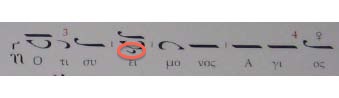
To give but one example of the practical difference that I have seen: there is a sign in Byzantine notation called a klasma. It’s a little half oval that can appear either above or below a sign depending on the sign.

Now, the way I was taught to realize a klasma by (now-Dr.) Ioannis Arvanitis is that adds a beat to the sign, but that it also has the function of adding an ornament — a little break in the voice. This ornament is suggested by the name klasma, and according to Arvanitis, it’s a holdover from the old notation, with the ornament being what distinguishes it from simply adding a dot (which also extends the sign by one beat). A somewhat clumsy way of realizing this in staff notation might be this:

When I visited Holy Cross Seminary, I got to sit in on Byzantine chant classes with Dr. Grammenos Karanos, who I’m told is an exemplar of patriarchal style. He told his students that the klasma has the principal function of adding a beat, and only in the context of a relatively small number of specific phrases does one add the ornament. Otherwise, it’s the same the thing as an aplē (adding a dot) and is maintained separately from the aplē for orthographic purposes. That would mean the above phrase would look like this in staff notation:

There’s no shortage of other examples.

Anyway, Simon Karas was an ethnomusicologist who was interested in these differences maintained through oral tradition, as well as the relationship to Greek vernacular music, and he tried to systematize what he observed in the 1982 book referenced in the Patriarchate’s bulletin. (I translated an article about him by Lycourgos Angelopoulos last year that goes into some of this.)

One can perhaps see the divide between those who sang as though the new notation were the old notation and those following the new notation more strictly in the Patriarchate’s choice of the word “outdated” (παρωχημένος) in point one. The irony that I see is that both approaches are conservative; one is performatively conservative, the other is notationally conservative. There is almost a sola Scriptura issue here (but even patriarchal style is informed by oral tradition, so not quite).

Among other things, Lind’s book talks about how Karas’ work influences the monastery of Vatopedi on Mount Athos; students of Angelopoulos (“grandstudents” of Karas, then) work with them on manuscripts, vocal style, and so on. The monks want to preserve an authentic tradition going back before the reform, and there is concern that something is lost in how the reform has been realized. One of the things I find interesting is that the tensions surrounding these preservation efforts seem to follow the old theoretical poles of cathedral (or city) and monastery, with an additional pole of the university. Vatopedi is trying to assert a certain authority and pre-eminence regarding psaltic tradition, Constantinople is trying to do the same thing (as represented by “patriarchal style”), and Karas and his legacy represent a line of academic inquiry that influence how both sides act and react. Who “owns” the tradition? Who speaks for it? Certainly there are issues surrounding how Byzantine chant is understood as something authentically “Greek”, with Constantinople looming large for obvious historical reasons, but with Karas perhaps trying to contextualize Constantinople in a larger “Greek” picture. Constantinopolitan cantors (and those faithful to them), Athenian academics, and Athonite monks — I’m not sure I can think of any particular equivalent issue in this country that’s working itself out in precisely the same way.

The thing of it is, speaking from my previous life as an opera singer, none of this is anything new. “My teacher can beat up your teacher” is part of any musician’s game from the first day they step into the studio. I remember the first time I ever took a lesson with my first voice teacher in college, and he asked me to tell him how I was thinking of certain things. I explained it the way Dennis Kruse taught me, and I can still picture the patronizing smile on this guy’s face when he said, “Oh, that’s all wrong. We’ll fix that.” I can also still remember the way Dennis shook his head when I explained to him what the new guy was telling me, saying, “He doesn’t know what he’s talking about. Get out of his studio as soon as you can.”

Heck, just speaking in terms of the Greco-Roman world, none of this is exactly news. If you were a student of rhetoric in what we might broadly call “the ancient world”, you could count on getting hazed by students of other teachers, you could count on getting beaten up by students of other teachers, and there was even a possibility you could get kidnapped upon arrival in the city by students of other teachers and forced to study with somebody other than your intended teacher. Studying something so marinated in tradition that requires a close relationship with a teacher makes this kind of thing simply inevitable.

Still, nobody here has been declared either a heretic or anathema, there’s nothing here that says “Whatever you do, don’t sing a klasma with the ornament lest your soul be in danger”, and on the whole I can’t really imagine how anything in this notice is going to have any practical force whatsoever without something that looks a lot like an Inquisition or HUAC. “Are you now, or have you ever been, influenced by the 1982 Method of Greek Music by Simon Karas?” Nope, I just don’t see that happening. This strikes me as a sop to somebody at most, but I really don’t know enough about the inner workings of the Ecumenical Patriarchate to know to whom or by whom or why. With all due respect to the Patriarchate, this comes across as over-the-top and heavy-handed, to say the least.

In any event, Ioannis Arvanitis, however poor of a student I may have been, was my teacher (and I hope someday he will be again), he’s one of the great cantors and composers of our day, he’s one of the greatest men I’ve ever had the privilege to know or learn from, and he was a Simon Karas student. Given all of this, I’m left scratching my head at what seems to be the disconnect from reality.

Anyway, I may have more to say about Lind’s book later — perhaps when the review is published I’ll put together a “director’s cut” of it. In the meantime, consider it recommended; it’s a very readable work and should be of great interest to people interested in monasticism, Byzantine music, Greece and modernity, and so on.

And a few more…

A Monk of the Eastern Church. The Jesus Prayer. “Fr. A” written on fly-leaf; otherwise clean.

Thomas Hopko. All the Fulness of God. Previous owner’s address label on fly-leaf; minor underlining.

Archimandrite Christoforos Stavropoulos. Partakers of Divine Nature, sixth printing. “12.95” written lightly in pencil on fly-leaf. Otherwise like new.

George C. Michalopulos and Herb Ham. The AMERICAN Orthodox Church: A History of its Beginnings. Some light pencil underscores.

Archimandrite Seraphim Aleksiev. The Forgotten Medicine: The Mystery of Repentance. Previous owner’s seal embossed on fly-leaf. Otherwise clean.

Stanley Samuel Harakas. Exploring Orthodox Christianity: Orthodox Christian Beliefs: Real Answers to Real Questions from Real People. Previous owner’s name and seal on the fly-leaf, otherwise clean.

R. I. Moore. The Formation of a Persecuting Society. Clean throughout.

Marianne E. Kalinke. The Book of Reykjahólar: The Last of the Great Medieval Legendaries. Like new.

Frank Miller and Lynn Varley. The Dark Knight Strikes Again. First printing. One complete set, issues 1-3. Additional copy of issue 1. Clean throughout.

Brian Michael Bendis. Ultimate Spider-Man Vol. 1: Power and Responsibility. Clean throughout.

—. Ultimate Spider-Man Vol. 2: Learning Curve. Clean throughout.

—. Ultimate Spider-Man Vol. 4: Legacy. Clean throughout.

Kevin Smith with Joe Quesada and Jimmy Palmiotti. Daredevil: Visionaries. Clean throughout.

Dan Jolley and Tony Harris. JSA: The Unholy 3, issue 1. Clean throughout.

Adisakdi Tantimedh, P. Craig Russell, and Galen Showman. JLA: Age of Wonder, issue 1. Clean throughout.

Chris Claremont, John Byrne, and Terry Austin. X-Men: The Dark Phoenix Saga. Some wear at top and bottom of spine, small tear in back cover. Interior clean.

John Byrne et alX-Men: Phoenix Rising. Like new.

Also two DVDs: The Dark Knight 2 disc Special Edition, and Blade Runner: The Director’s Cut. Both like new.

As before, I have no fixed prices in mind for any of this stuff and will entertain whatever offers come my way for individual items or for batches. E-mail at rrbarret AT indiana DOT edu.

Shout-out to Chicago for this weekend

I will be in Chicago this Thursday through Sunday for the North American Patristics Society 2012 Conference at the Holiday Inn Chicago Mart Plaza. I am presenting my paper “Civic Marian Devotions in Late Antique Rome and Constantinople” at 10:15am Friday in the Steamboat Hotel room. If you’re going to be at the conference and want to grab a beer or coffee or dinner etc. please by all means find me. Tall stocky guy with very short hair, beard, glasses.

…and as of next Saturday, 2 June, I will be in Washington, D.C. until 30 June or when my wife goes into labor, whichever comes first. If that’s your neck of the woods and want to hang out, let me know.

A curriculum proposal for Byzantine chant

So, a couple of months ago, I suggested that learning to sing needs to be part of learning to chant, and even suggested that language and diction in the appropriate languages should be an expected part of one’s training, just as it is for a classical singer.

I’ve continued to chew on some of the implications of that post, and one of the outcomes of that was to draft a proposed curriculum for what a Byzantine chant concentration could look like in the context of an undergraduate music program. Obviously, this is all entirely hypothetical; I don’t know of any music schools that are itching to add this as a concentration. St. Katherine’s College could, I suppose, eventually try to incorporate something like this into their curriculum, but who knows. Hellenic College would probably be reasonably well set-up to do something like this, but they don’t even presently offer a music major.

A few assumptions I’m making: first and foremost, that there is an on-campus chapel with regular services. Second, that chapel services would make a full-on recital unnecessary; rather, have the student do a junior and senior exam that basically are an extended jury — where they prepare a certain number of compositions ranging in difficulty and sing 2-3 of them at the request of a committee. Third, that building a good cantor who is also a good musician will require some knowledge of Western music theory and notation (I’m less sold on keyboard skills, but it still seems instinctive to me to include) in addition to Byzantine music theory and notation. Fourth, that voice lessons won’t concentrate on things like “Caro mio ben” or “Silent Noon”. They may well include that kind of repertoire if the student really wants it and the teacher is able to do it, but beyond the universals of healthy production, the specifics will by and large be those of psaltic technique. Fifth, that the academic environment would be such that it would allow for patristic and theological discussion to occur within the context of music history courses.

One observation I make immediately is that this is a very full undergraduate degree. I started off with IU’s B. Mus. in Vocal Performance as a basis, while also consulting their Early Music Vocal Performance B. Mus., and then worked from there to focus it specifically on the requirements of Byzantine chant. As with IU’s Vocal Performance B. Mus., the general education requirements are quite minimal, but it’s still jam-packed. I think the keyboard skills part could perhaps be taken out/made an elective, maybe a case is made for 2 languages rather than three, and maybe you either don’t do credits for Chapel Choir or tweak the number of credits for voice lessons. But, all that said, the B. Mus. at IU is a very full degree, and that’s just how it is.

It seems that a couple of other useful curricula to come up with would be a B. A. degree, and perhaps a more general “Orthodox Liturgical Music” degree. It’d be nice to also include a course or two on Mediterranean folk music to be able to show the relationship between liturgical and vernacular musics (hinted at in the bit about “Mediterranean instruments”, which also assumes that such instruction would be available), but maybe that would have to be kept for the Masters degree.

Anyway, here’s the draft. I’m curious to hear thoughts.

Bachelor of Music in Performance, Byzantine Chant

Major Ensemble

Chapel Choir (1 cr.) required every semester of enrollment.

Performance Study

Voice. 3 credit hours each semester until senior exam is passed, at which point they may be reduced to 2. Required: entrance audition, freshman jury, upper-division examination, junior exam, senior exam.

Secondary Piano and Keyboard Proficiency

All students must pass a keyboard proficiency examination. Voice majors must take an examination for placement in a 3-semester class piano sequence (2 credits per semester) or take elective individual lessons (1-2 credits per semester) and continue study each semester until the keyboard proficiency examination is passed.

Core Music Courses

26 credit hours

  • Placement examination or Introduction to Musical Concepts (1 cr.)
  • Core Musical Skills I (1 cr.), Western Music Theory and Literature I (3 cr.)
  • Western Music Theory and Literature II (3 cr.)
  • Western Musical Skills II (1 cr.)
  • Byzantine Musical Skills I (1 cr.)
  • Byzantine Musical Skills II (1 cr.)
  • Byzantine Music Theory and Literature I (3 cr.)
  • Byzantine Music Theory and Literature II (3 cr.)
  • Byzantine Music Theory and Literature III (3 cr.)
  • History and Literature of Western Music (3 cr.)
  • History and Literature of Byzantine Music I (2 cr.)
  • History and Literature of Byzantine Music II (2 cr.)

The above must be passed with a C or better.

Advanced Music Literature and Music Theory

3 credit hours selected from:

  • Composer or Genre (3 cr.)
  • Topics in Byzantine Music Theory (3 cr.)
  • Pre-Reform Notation (3 cr.)
  • Analysis of Modal Music (3 cr.)
Other Music Courses

25 credit hours

Required:

  • Liturgics & Chant Literature: Services and Service Structure I (3 cr.)
  • Liturgics & Chant Literature: Services and Service Structure II (3 cr.)
  • Liturgics & Chant Literature: Idiomela I (3 cr.)
  • Liturgics & Chant Literature: Idiomela II (3 cr.)
  • Liturgics & Chant Literature: Anastasimatarion and Irmologion (3 cr.)
  • Applied Greek Diction for Singers (1 cr.)
  • Applied Arabic Diction for Singers (1 cr.)
  • Applied Romanian Diction for Singers (1 cr.) OR Applied Slavonic Diction for Singers (1 cr.)
  • English Diction for Singers (1 cr.).
  • Electives: 6 credit hours, including a minimum of 2 credit hours in pedagogy courses such as Introduction to Music Learning (2 cr.) or Vocal Pedagogy (3 cr.).

Electives may also include courses for music majors in sacred music, music education, techniques, conducting, composition, music history, music theory, opera, and unclassified courses. A maximum of 4 credit hours in early or Mediterranean instruments may be counted in this area.

General Education

23-35 credit hours

  • Written and Oral Expression English composition, 2 credit hours or competency.
  • Foreign Language 12-24 credit hours or proficiency, equivalent to two semesters of first-year language study.
    • Greek: Elementary Ecclesiastical Greek I (4 cr.) and Elementary Ecclesiastical Greek II (4 cr.); or Accelerated Ecclesiastical Greek (4 cr.).
    • Arabic: Elementary Arabic I (4 cr.) and Elementary Arabic II; or Accelerated Elementary Arabic (4 cr.).
    • Choice of:
      • Romanian: Elementary Romanian I (4 cr.) and Elementary Romanian II (4 cr.); or Accelerated Elementary Romanian (4 cr.). OR
      • Slavonic: Elementary Church Slavonic I (4 cr.) and Elementary Church Slavonic II (4 cr.); or Accelerated Church Slavonic (4 cr.)
  • Humanities 3 credit hours.
  • Life and Physical Sciences and Mathematics 3 credit hours.
  • Social and Behavioral Sciences 3 credit hours.
To Complete Degree

Free music or non-music electives as needed to bring the total credit hours to 120, excluding Chapel Choir.

Addenda to Kapitel Vier: The post-high school, struggling through junior year of college, and giving up to enter the workforce blues

Exactly what would happen to me following high school graduation was a point of no small controversy. My parents wanted me in Alaska with them as soon as possible and to stay up there as long as possible. The stated reason was so I could work as long as possible; there were at least two other reasons, however, that are probably best summed up by saying that me going to college “in state” (that is, in Washington), while it had seemed like a great idea up until summer of 1993, now didn’t seem like such a hot deal from a familial perspective. At best I’d now be a three hour flight away instead of an hour and a half’s drive (not that I had a car anyway), and while I still had incentives to go back to the Seattle area on the weekends, they weren’t part of it. My parents were going to have to deal with an empty nest in a place that had never actually been our nest, and they would have to do so with me relatively inaccessible. This is, I am certain, difficult under the best of circumstances, and the family difficulties we had been struggling with for the past several years meant that these were not the best of circumstances.

The bottom line was that, for that last summer before college, I really didn’t want to go to Alaska and they really didn’t want me to stay in Seattle. I had no desire to go someplace that I had no real memory of to be around two people who were likely to re-negotiate the manner of their life together after a year apart in a way that was going to be extremely unpleasant for any additional parties. If the point was for me to work, I could do that in Seattle without paying for a plane ticket; from where I sat, that made a heck of a lot more sense than forcing me to be a continuing participant in their drama. I had people I wanted to be around, but that was also part of the issue for my parents; they weren’t people they wanted me to be around. There’s not much more I can say about that without getting into specifics that aren’t appropriate for me to get into, so I’ll leave this by noting that I had a conversation with one parent where I expressed all of my concerns quite openly; this parent replied, well, yes, that’s all probably true. It isn’t going to be fun, and you’re probably going to have to deal with us fighting a lot. But that’s the way it goes, we’re a family, messed up though we may be, this is the way we want it for you right now, and we’re still in charge.

This was a growing source of tension as high school graduation neared; ultimately, however, there were two things that threw a wrench into the plan for me to be in Alaska for the entire summer — one was early orientation for Western Washington University, and the other was the aforementioned opportunity to work as an extra on the movie Mad Love. Again, don’t bother looking for me; everything I was in was cut. I could have worked more, but the three days I did work meant a two week delay in my departure for Alaska, and my parents weren’t willing to delay it any more. Still, as it worked out, I had to be back a month later anyway for early orientation and registration. The schedule became a month up, three weeks back, and a month up.

Yes, the time in Anchorage was rough, for all of the reasons I expected it to be. However, I will be the first person to say that there are parts of it I’m glad for; I had the chance to reconnect with some family members I hadn’t seen in years, and I was able to continue some of my vocal momentum with a voice teacher named Bettyrae Easley, who did the very practical thing of getting me ready to audition for Western’s music major, something in the post-graduation whirlwind that there just hadn’t been time to discuss with Dennis once my voice had finally opened up. Among other things, Bettyrae taught me my first French mélodie, Fauré’s “Lydia”, which served as my introduction to an entirely new song paradigm (to say nothing of the beginning of a, shall we say, complex relationship with French diction).

I did wind up working a bit in Anchorage; not overly much due to the time constraints, but there were a couple of odd jobs here and there that I did for friends of my dad. Among other things, I helped a future protest candidate for the United States Senate and right-wing filmmaker move out of a landmark Lloyd Wright home, and I also spent a couple of weeks assembling and finishing ulus.

One of the things that was difficult for me conceptually about preparing to go to college was that nobody seemed to actually have a clear idea in their head why I was going, or how to relate it to anything I was interested in doing, or how to relate any of those things to how I might actually earn a living on the other end. I was supposed to have been a smart kid, but none of the various things I was good at really lent themselves to careers, per se, at least as my parents or the people in their circles understood them. I was a voracious reader, I retained information, I read about all kinds of things as a kid from astronomy to cryptography to computer science to paleontology to mythology and everything in between, but what did that mean in terms of what I could do to feed myself? Coming into high school, math and science bored me silly, I hated sports, I was more interested in what computers could be used for than what they did under the hood, I enjoyed creative writing, I seemed to have some aptitudes for drawing and painting up to a point, and I enjoyed music but puberty had freaked me out with my voice change and I convinced myself I couldn’t sing anymore. There really wasn’t anything obvious in there in terms of “normal” career paths; not business, not medicine, none of that. Neither of my parents finished college and academia wasn’t anything I had ever heard of as a career.

Once I got into high school and discovered that I seemed to have an aptitude for theatre and music, that was a relief in some respects and it gave me some idea of a path. The thing was, nobody took it seriously. I remember my senior year of high school telling people, I’m going to major in music and theatre. Typically, that would generate a condescending smile and a sentence that sounded something like, “Oh, well, it really doesn’t matter what you start with, because you’ll probably change ten times before you’re done.” That, frankly, pissed me off; it was clear that I was being patronized and not listened to. At the same time, I had to acknowledge that having it in my head that I would finish a major wasn’t the same thing as knowing exactly how to get to the “pay your bills” part of the deal.

My parents didn’t know what to tell me. They didn’t really understand my interests, and they didn’t have any advice regarding college except get good grades and finish as soon as possible. Neither was there was ever any clear idea of what the trajectory of life post-high school was going to be for us, even before they moved back to Alaska. Was there an expectation that I was going to live with them until I got married? Was there an expectation about when it would be “okay” for me to think about getting married? None of this was discussed. At least when they were still going to be in Seattle, some small level of continuity could be assumed, but the mechanics and specifics still weren’t really talked about. After the move, all bets were off.

Thus it was that I found myself in Bellingham in September of 1994, living in a dorm room in Ridgeway Sigma with one Will Bass, and most of my worldly possessions were under my then-girlfriend’s house (many of which never to be seen again, alas, as will be explained in a future installment). I auditioned for the voice major, got in, then walked over to the other side of the Performing Arts Center and declared myself a theatre major. My very first class on the first day of my freshman year was Music Theory I, taught by Prof. Jeffrey Gilliam (to this day perhaps the single most naturally musical person I have ever met, to say nothing of the very best music theory instructor I have ever had). It was off to the races.

There were a number of highlights to that year: I was in my very first opera, singing Marco, one of i parenti in Gianni Schicchi (with the previously-mentioned future Metropolitan Opera baritone Aaron St. Clair Nicholson in the title role). I also got to sing the high baritone drunken abbot solo in Carmina Burana (“Ego sum abbas Cucaniensis… WAAAAAAAAAAAAFNA!”). My friend Gavin Shearer sat me down at some point in the fall to show me this awesome thing that was happening in computers called “the World Wide Web” that used this amazing program called Mosaic to do what Prodigy and AOL had utterly failed to do up to that point. Two portentous occurrences: a master class with a voice teacher named Roy Samuelsen from Indiana University, a school I had never heard of before but that apparently had quite a reputation for opera, and dating very briefly this lovely brunette named Megan McKamey, who was absolutely wonderful in every way, but everything going on around me made it difficult to feel capable of committing at the level I felt she deserved.

The trouble was, my parents and I didn’t even get through the first quarter without some massive meltdowns. The situation was complex; Seattle was still home for me, and I would go back on the weekends, because I felt very much alone at Western. My parents didn’t want Seattle to continue to feel like home for me, since from their perspective I needed to start thinking of Anchorage as home, but from where I sat they had moved, not me; I was just following the plan we had always had, and… yeah. The whole situation had nowhere to go but down. At some point it was suggested that maybe the whole idea of me going to college at Western was no longer tenable, and that marked the point where the irreconcilable differences in how we saw what was happening meant that there was basically no reasonable conversation to be had about anything. There was a brief period of rapprochement over spring break; my paternal grandmother passed away, and my dad and I spent the week together while he cleaned out her condo. Still, once summer came and I made it clear I wasn’t going back to Alaska, whatever brief peace had been achieved was broken. “In ten years you’re going to remember this moment as the day you pissed your life away,” I recall being told on the phone. What drove me absolutely batty about all of this was how inevitable it had all seemed from the time my dad had announced that he was going back to Anchorage, and everything was happening exactly as I had feared it would. Nobody had listened to me, and somehow I was being blamed for it. The stress made me a charmer to deal with, I’m sure; certainly it impacted a number of relationships I valued, but there just wasn’t anything I could do. I wasn’t equipped to deal with any of it, and I had no particular support system to fall back onto.

That summer I worked at Computer City, sold the first copy of Windows 95 at midnight of 24 August 1995 (there used to be a photo online of me ringing it up, not sure where it might be found these days), and took voice lessons from Dennis Kruse. We were working on preparing me for opera auditions at Western in the fall — the opera was Marriage of Figaro, not exactly a huge tenor show, but Basilio would be worth it for a kid like me. “O wie ängstlich” from Mozart’s Abduction from the Seraglio was the audition piece we worked up, and Dennis put me as the last singer on his summer studio recital, even over some of his students who were ostensibly his stars and who had made it clear much of the time I had worked with Dennis that they thought I was a waste of his time.

Sophomore year wasn’t exactly an amazing improvement over freshman year. A high school friend and his mother — J. P. had been the Danny Zuko in Grease! and Tony in West Side Story, and was also a student of Dennis Kruse — were killed in a car crash in the fall, which led to a reunion nobody particularly wanted. Fallout from that, plus still trying to figure out how to resolve the family situation, meant that I was even more of a wreck that year than I had been my freshman year. I agreed to spend the holidays and the following summer in Alaska, hoping that it would ease off some of the tension, but if anything, it ratcheted it up.

Marriage of Figaro was fun, but it was a bizarre reconstruction/translation that basically turned it into musical theatre — the recitatives were replaced with spoken dialogue from the Beaumarchais play. There were a number of practical reasons to do this, I suppose; hiring a harpsichordist and having the time to coach the recits properly being two of the major concerns, as I understand it. They had piddled away the fall quarter with a lot of political nonsense over sets and casting professionals for Figaro and the Count in one of the casts, and didn’t even post the cast list until sometime towards the end of the quarter, even though auditions had been in September and the performances were set for March. It was a strange experience all around.

I wound up in Alaska three weeks before the end of the quarter. I was supposed to work for my mother’s company over the summer, and they had revised their policies sometime in the spring so that everybody for the summer needed to be in place by 1 May. “So, you’ll just have to come up here early,” I was told. Um, the school year isn’t over? Not even close? “The opportunity cost of you finishing the quarter isn’t worth it. Anybody with half a brain should be able to see that.” Did I mention that I was a first generation college graduate?

I negotiated what I could with my professors (which in some cases, meant taking Fs). I can’t say I exactly made myself popular with anybody during this time, and not for no reason. I was a basketcase through and through, and nothing I was trying to do seemed to work out in a straightforward fashion. Going to college right out of high school had turned into a disaster; I was unprepared for it, my parents were unprepared for it, additional circumstances meant that there was additional burden for all of us to bear, and my friends were unprepared for how unpleasant of a person the whole experience was making me.

Summer of 1996 I cannot describe in much detail without going into things that I’d rather not discuss publicly. Suffice it to say that I got a front row seat for much of why my parents were freaked out over me being 2,500 miles away; a lot of the unpleasantness that had been plaguing our family life since the mid-1980s had come home to roost with their move, we were all now having to confront it head on, and none of us were doing a particularly good job. I returned to Bellingham in September unsure of what kind of a relationship would be possible with my parents after certain events, conversations, and revelations. I focused on what I could, namely, trying to rebuild my relationships at Western.

In short, however, that ship had sailed, and now I had to sleep in the bed of frustrations I had made the previous two years. Whatever had been the cause of all my erratic behavior, certain relationships were damaged beyond repair, and I continued to make unhealthy decisions with respect to other relationships. I couldn’t find a way to focus on being at school, partially because the muddied reasons I had for being there continued to get muddier, partially because all of my personal issues made it impossible to ever feel sufficiently centered and stable. I also made some poor choices vocally — Dennis had gone to a lot of trouble to figure out how to work much of the tension I usually carried with me out of my voice, a wonderful teacher named Virginia Hunter had done a very nice job teaching me to sing with the instrument Dennis had shown me I’d had, but that year, for reasons that seemed great at the time, I switched to a teacher who went out of their way to work all of that tension back in. Within three months my top was completely gone and my voice had regained a strangled quality that I thought had been left behind after graduating high school.

There was one more factor in this equation. In fall of ’96, I became aware of some behavior on a faculty member’s part that I believed (and believe) to be unethical, and at the very least political maneuvering at the expense of students. I attempted to seek advice on how to deal with these things in a way which I thought to be private which instead publicly blew up in my face. Later, I understood that whatever my concerns were, the way I sought to deal with it was totally unprofessional on my part and embarrassing to the faculty member in question. This culminated in a letter from the chair of the department telling me that all three of us — he, the faculty member, and I — would likely be happier if I went someplace else. So, midway through winter quarter, so many threads having come unraveled, I decided that college had become a gigantic, expensive exercise in beating my head against a brick wall, and it was time to acknowledge that it just wasn’t the right thing for me to be doing at that moment. I subsequently dropped out in disgrace, with the straw that broke the camel’s back being something which really was entirely my own fault. Today I would deal with a similar situation very differently because I would understand better what was happening; the bottom line is that when someone’s on a tenure track, you either play along or get out of the way, particularly under circumstances where resources are scarce and only so many people can get what they want. Anyway, after flailing about for a few months and still making really bad decisions (almost reflexively, at this point), I started selling classified advertising for the Bellingham Herald and trying to figure out how I might be able to move back to the Seattle area.

1994-1997 was a difficult, unpleasant time. It is difficult to even know where to begin explaining that the poor, confused, unhappy person who arrived at WWU in the fall of 1994 was not me at my best, not by a long shot. I started college not having any idea which way was up and having nobody, really, to whom I could turn. I was trying to do everything right which I possibly could, but there was just very little good that anybody could do for me, and trying to do everything right when one doesn’t even know what all one needs to do means one is bound to get quite a bit wrong. There continue to be ramifications to this day — people who don’t talk to me because some of my choices, people who, even if they’re still friends with me, can get easily upset when discussing some of what happened, and other consequences. A few years later, I did my best to apologize to everybody I hurt in those years, with somewhat mixed results. Whenever I think about that period, it is with a lot of pain and regret, but also a lot of confusion. In broad strokes, under the circumstances, I have a hard time imagining what I could have done differently that would have been any better beyond, quite simply, dropping out earlier. The kind of wrench my parents’ move threw into the works was comprehensive, I had no idea how to deal with it, my parents had no ideal how to deal with it, and they had no ideal how to help me deal with it. In retrospect, maybe it would have been better for me to find a way to work full-time while doing an Associate’s degree at a community college and continuing to study with Dennis. The trouble with that, however, was that I didn’t really have a place to live available to me full-time. Moving to Anchorage would have cut me off from much of what I was trying to do post-high school, and would likely have only hastened the inevitable. Maybe I could have just taken a year off out of high school to figure things out — I was starting college at 17, after all, thanks to my skipped grade — but that wasn’t really presented as an option. The expectation had always been that I would go to a four year college right out of high school; it was exactly what I would do while I was there and what would happen after that were all quite vague.

I should note that there are a number of people from this time for whom I remain grateful: an incomplete list includes Brian Ward, Holly Zehnder, Mike Cook (memory eternal), Peter and Arwyn Smalley (née Moilanen), Suzann Miller (née Welch), Jon Haupt, JOHHHHHHHHHHHHN Davies, David Harsh, Jon Lutyens, Matthew Murray, Kai Morrison, Dennis Kruse, Tom and Jordin Baugh (née Peters), Matt Carter, Sue Fletcher, Sarah O’Brien (née Wright), Liz Holmes, Eric Rachner, and, of course, Flesh of My Flesh herself, Megan Barrett (née McKamey).


adventures in writing alexander lingas all saints bloomington all saints orthodox church american orthodox architecture american orthodox music american orthodoxy Antiochian Archdiocese Antiochian Orthodox Christian Archdiocese of North America Antiochians books byzantine chant cappella romana chant church architecture ecclesiastical chant ethnomusicologists ethnomusicology fellowship of ss. alban and sergius Greece Greek greek food greekness hazards of church music international travel tips ioannis arvanitis joe mckamey john michael boyer kurt sander Latin liturgical adventures liturgical architecture liturgical music liturgical texts and translation liturgy liturgy and life lycourgos angelopoulos medieval byzantine chant Metropolitan PHILIP militant americanist orthodoxy modern byzantine architecture modern greek music music as iconography my kids will latin and greek when they're newborns my kids will learn latin and greek when they're newborns orthodox architecture orthodox architecture is bloody expensive Orthodox choir schools Orthodox Ecclesiology orthodox outreach orthodox travel pascha at the singing school Patriarchate of Antioch Patriarch IGNATIUS IV Patriarch of Antioch publishing random acts of chant richard barrett in greece richard toensing rod dreher sacred music st. vlads st john of damascus society Syriac the Bishop MARK fan club the convert dilemma the dark knight The Episcopacy The Episcopate the only good language is a dead language this american church life travel we need more american saints why do we need beautiful music in churches?

Blog Stats

  • 262,833 hits

Flickr Photos