Archive for the 'Academia' Category


Finals Week, fall semester 2008

It is Friday of Finals Week; the campus is basically empty, it is grey outside and already hinting at getting dark. The next couple of weeks will be very quiet. While I generally like the winters here (as long as I’m not snapping the bones of my various extremities) I have found, particularly the last couple of winters, that I struggle somewhat with it being nearly dark out by the time I get home after work this time of year. It’s never bothered me before, so I’m not altogether sure what that’s about, but there we are.

My one final this time around was Modern Greek. Confidence, I suppose, is when you know you would have to bomb the exam completely to impact your grade at all, and I didn’t bomb it in the least. Next semester I will be bumping up to the 4th semester of the sequence, which means I have some fill-in work to do between now and then, but I am reasonably unconcerned about my ability to deal with it.

One of the problems I’ve been trying to solve this week has been that, upon realizing that my iTunes library was taking up 33 gigabytes of my 80 gigabyte hard drive, I decided to get a 1 terabyte external hard drive and hook it up to the wireless router that governs the connectivity in our house. Simple, right? Well, no. The router, one of AT&T’s custom jobs that you have to use if you have their DSL service, only has a Type B USB port on the back, and the output port on the MyBook drive is a Micro B. A USB hub didn’t solve the problem, because the only upstream port on the hub was, yep, a Micro B. A USB-to-Ethernet adapter didn’t solve the problem, either. Finally I pulled out the AirPort Extreme router I still have from my cable days, which has a Type A port on the back of it specifically for hard drives, and connected that to AT&T’s router via an Ethernet cable. It works now, more or less, but I don’t understand why this wasn’t easier. Now I’m migrating my iTunes library over, which will take another few days to sort out, I’m sure. A friend of mine in high school used to call such needlessly complicated arrangements “goat-ropes.” I’m still not sure what a “goat-rope” is, exactly, but I think this qualifies.

And, of course, Leopard’s Time Machine functionality still doesn’t work with an external hard drive connected via a wireless router, and I wasn’t about to spend $500 on a 1 TB Time Capsule when an AirPort Extreme router plus a 1 TB external hard drive cost less than $300 combined. So, whatever.

Under the category of miscellaneous observations — you know, Rick Warren certainly wouldn’t have been my choice if anybody had asked me to set up the invocation for the Presidential inauguration. (That probably would have been Metropolitan Jonah.) Still, I am bewildered by claims that his views are not “consistent [with] mainstream American values.” Now, his views are most certainly not consistent with what Ms. Kolbert’s values are, nor with what Ms. Kolbert perhaps hopes “mainstream American values” might someday be, but that does not make them inconsistent with what “mainstream American values” presently are.

We have a real problem in this country, on both sides of the aisle, with acknowledging principled, conscientious disagreement; particularly where certain social issues are involved, the same assertion is made on both sides — “We’re talking about people’s lives. You either agree with me or you’re objectively hating an entire subset of humanity” (whatever group might be impacted by the social issue in question). Somehow we have to get past this and not be constantly assuming the worst about the people with whom we disagree and their motives.

That bears repeating, I think.

I believe wholeheartedly that the level of public discourse in this country will not improve until we can stop assuming the worst about those who disagree with us and what might be motivating them.

“Baby-killer” and “bigot,” to use but two common examples, are labels that do nothing but shut down the conversation. They get used, not to further understanding, but to vilify. They identify as enemies and dehumanize those with whom there is ideological disagreement. They do nothing to identify common ground and attempt to find a way to co-exist.

If nothing else, President-elect Obama’s choice of Pastor Warren seems to acknowledge this problem and seek to find a way to navigate through it. That his choice of Warren has angered some on the Left, and Warren’s acceptance has angered some on the Right, indicates to me that it might in fact be an effective move on the part of both men.

Yesterday I was present for a discussion with somebody who very clearly believed himself to be better-informed than most and in possession of a privileged point of view, a puppet who was able to see the strings, and he made a lot of very sweeping generalizations about a great many things, clearly finding it incomprehensible that any educated, thinking person might disagree with him, thus making anybody who might disagree with him categorically uneducated and unthinking. This person might be broadly described as a Northeastern academic liberal; what was fascinating is that his manner and intellectual approach was virtually identical to that of an Alaskan neo-conservative who espoused almost perfectly antithetical views to me a few months ago. Both opiners dripped utter contempt for any who might see things differently; both were absolutely convinced that they understood reality. You know, real reality.

The truth may very well be that, eventually, the center cannot hold and the United States must splinter. Perhaps that will happen in my lifetime, or my grandchildren’s lifetime. It seems to me, however, that we have to resist such an eventuality. Sitting at the same table as those with whom we disagree is the reality of being the secular, pluralistic, supposedly egalitarian society that we like to pat ourselves on the back for being; we have to co-exist, and we have to get along, even if every settlement has not yet been negotiated and ratified. The result may be messy, the result may be something with which we’re not always happy, but that’s the nature of our system. Agreeing to disagree is the only way civil discourse can happen in the long run.

Now I get to spend the next couple of days researching how to brine a goose. Watch this space for details.

News

I figured that probably the earliest I’d hear anything from West European Studies, particularly given that they seemed unaware that I had applied for next semester (as opposed to next year) until I told them in person three weeks ago, would be the week after Thanksgiving. I also figured, based on anecdotes and previous experience, that good news would come by e-mail and bad news would come by postal mail.

Today, I got home and saw an envelope in my mailbox from West European Studies.

My first thought, as might perhaps be predictable, called to mind Oedipus. I completed the idea by saying to myself, “Well, guess that didn’t work out.”

Just for grins, I decided to open the letter. Upon unfolding it, the first few words caught my eyes:

“We are pleased to inform you that…”

So, a door has, at long last, opened. We will see what happens on the other side of it — but in the meantime, I’m drinking champagne with my wife this evening.

(Oh, and the DVD of The Dark Knight arrived today, too.)

It is evidently more important for a child to know what a chatroom is than a willow tree

Some things are beyond parody. This is truly the ugly side of academia; one wonders if the people involved genuinely think they’re just being descriptive rather than prescriptive.

I know what I’m going to do about it — firstly, of course, no way no how am I going to buy the OUP Junior Dictionary.

Of course, since I have no need (yet) of a Junior Dictionary (it’s a little advanced for my reading level, let’s be honest), that’s a rather empty tactic.

The other component of my response — well, watch this space for details.

(By the way, thanks to to the Telegraph for providing a comma-separated list of all the omitted words. It made pasting them into the Tags field infinitely easier.)

We now return you to your regularly scheduled reality…

December is here. This means any number of things. It means NaNoWriMo is over, it means the semester is almost over, it means West European Studies will hopefully get back to me soon one way or the other, it means we’re hip-deep in the Nativity Fast with the Christmas feast fast approaching, and it means we just got back from a much-needed, if shorter than ideal, vacation over the Thanksgiving break. It also means that a week from today, this blog will be a year old. Sheesh.

There were no natural disasters; I simply did not finish Pascha at the Singing School last week. Between preparing to go on the trip, going on the trip, and Megan getting sick the night before heading out for the trip, it just didn’t happen. I wrote most of Thanksgiving Day, got about 2,000 words into the ending, and I am within spitting distance, I just didn’t get there. My hope is that this weekend I’ll be able to make one last push to finish a first draft. I wrote approximately 11,442 words during November for an average of 381 words a day; not a stunning average by any means, but at least it’s an average, and the bottom line is that it was a busy month without NaNoWriMo. I am on the whole pleased that the event broke me out of the gridlock that had kept me stuck since probably April or May, now I just have to keep myself honest. Next year I might have another project for NaNoWriMo; we’ll see. There is something I’d very much like to write, but this would probably be much longer than 50,000 words, and it would require a lot of skill as a writer I’m not sure I have at this stage of the game. Maybe I’ll be brave enough to give it a shot, and maybe I won’t.

The Thanksgiving break spent in Nashville was fantastic, and a very welcome getaway for us Barrettses. Check out pictures here. As noted, the Daisy Hill Bed and Breakfast (pictured at right με γυναίκα μου) comes heartily recommended by us; do consider them if you’re looking for a place to stay in the area.

Friday we had lunch at The Pancake Pantry with our friend Chelsea; it’s an experience worth having and the food is good, but if you don’t like lines and prefer a quieter dining experience, it probably won’t be your thing. We also saw the replica of the Parthenon, which is impressive, but I gotta say, it loses something being made from poured concrete rather than marble.

Country music is decidedly not my thing, but I nonetheless have to admit that the Country Music Hall of Fame and Museum is a fascinating place to visit. Short version is that it is organized chronologically; you start at the third floor with early folk and gospel and work your way down, and you’re at the present day by the end of the second floor. I find that I am able to relate to and enjoy the early stuff a lot more than the music of the last 30-40 years; it seems to me there came a point where the musicians became very self-conscious and their music subsequently sounds, at least to me, extraordinarily contrived and false. The closer the connection to an actual folk tradition, the more genuine it sounds to my ears — to put it another way, somewhere along the way the musicians decide, “We’re going to play it and sing it this way because that’s what country music sounds like,” whereas before the mindset was perhaps more akin to, “Country music sounds like this because that’s how we play it and sing it.” As a result, at least to me (let me re-emphasize that this is subjective opinion) performers like Garth Brooks sound 100% calculated and processed, with everything intended to support a synthetic sound and persona. None of this is to say that musical forms can’t be codified or that something is inherently lost once there’s a formal idiom or tradition to which one adheres; that’s certainly what most classical is, and it’s definitely what liturgical music generally is. On the other hand, for a genre which — rather arrogantly, I find — claims to be “three chords and the truth”, it seems disingenuous to me that this would become prescriptive rather than descriptive. To quote the much underappreciated movie Singles, “You have an act, and not having an act is your act.” Good music is good music regardless of genre, but poseurs also transcend genre.

Anyway, back to the museum. There were a number of clever uses of speakers and acoustic tiles to create very localized sound exhibits, which in and of itself was interesting to see and hear. One of the things to which I found myself drawn was the archive section being visible in the center of the gallery behind glass; you can see all of their compact shelving, their sound editing stations, everything. It’s actually a useful reminder that the museum isn’t just a tourist attraction; it’s also a professional and scholarly resource. The stuff we see as the general public is really the tip of the iceberg at best.

But then, Elvis’ gold piano is pretty cool, too.

It would have been foolish to visit Nashville without hearing any live music, and we decided to go to a club called The Station Inn to hear The Roland White Band. Roland White is a bluegrass mandolin player who has been there, played that. He’s got a lot of institutional memory, as it were; he knows every song, knows who wrote it and when, and has probably taught somebody how to play it. He also has surrounded himself with a lot of absolutely fantastic younger musicians, most notably David Crow on the fiddle and Richard Bailey on the banjo. His bass player was also really good; tall, skinny younger guy named Andy, but I didn’t catch the last name. If anybody knows his last name, I’d love to know and find out what else he does. It was a show that was a lot of fun to see, and I plan on seeking out one of David Crow’s solo recordings. The Station Inn is also a neat little venue; it’s a dive that has Bud and hot nacho cheese sauce on tap and not much else, but it’s a dive with a long history, and best of all, it’s smoke-free!

On Saturday, we went to Andante Day Spa for much-needed and long-awaited massages, as well as an aromatherapy sauna. If you’re looking for something nice to do with a spouse or even just by yourself, these guys are very classy and quite reasonable for the services. We left there probably more relaxed than we’ve been in a looooooooooong time. Ramona is who did my massage, and I’d go back in a heartbeat.

After massages, we tried to go to Alektor Cafe and Books, the Orthodox bookshop in Nashville, but alas, they were closed unannounced. Perhaps this is not surprising.

Next we spent a couple of hours at the Frist Center for the Visual Arts, seeing their Rodin exhibit as well as their photography and film exhibit. Both were interesting; I’d say I liked the latter more. I don’t really have the vocabulary to discuss sculpture (or much else, let’s be honest) intelligently; let’s just say that to my eyes, Rodin goes beyond glorification of the human body and into the realm of fetishization, and leave it at that for now. The photography exhibit included a section on Moroccan photographer Lalla Essaydi, and that was captivating. She does a lot with Arabic calligraphy on the body as well as on everything else; it was interesting to me for several reasons, and I may talk a bit more about it later.

Vespers, to say nothing of Matins and Divine Liturgy on Sunday, at Holy Trinity was something else; it’s a beautiful church, they’ve got a large number of psaltes who know what they’redoing (three of them evidently having studied wtih Lycourgos Angelopoulos) and as a result they’re able to utilize a traditional two-choir setup, they’ve got a very broad 

demographic and economic base while keeping their practice pretty unapologetically Byzantine, people were nice, and Fr. Gregory is a young convert priest who seems very enthusiastic. Every parish has its problems, to be sure, but these guys seem to have a lot of very good things going on.

After Vespers Saturday we had dinner at a delicatessen called, appropriately enough, Noshville; the food was plenty good, but it was also on the expensive side for what it was — my one complaint. To put it another way, it was authentic New York delicatessen in every way, including price.

Another bit of a walk through Lower Broadway followed, as did some rain. We saw Ryman Auditorium, and we also found something neat for which we weren’t looking was a life-sized statue of Chet Atkins; Megan decided to play air guitar next to him.

We relocated to Tāyst for drinks and dessert; Tāyst is a restaurant with similar goals to those of FARMBloomington, but I’d say with significantly less of a gimmick quotient and without the self-consciousness. They have a terrific bartender, and wonderful desserts — next time we’ll actually try a meal.

Sunday was something of a demonstration that there are no accidents; we had loaded up the car before going to Holy Trinity and intended to just hit the road after Liturgy. Halfway through Liturgy I realized we had forgotten our large bag of Maggiano’s leftovers at the bed and breakfast, which necessitated a return trip to get them. It being 1pm or 

so by this point, we needed to eat something as well; being right in the neighborhood, we decided to return to the Pancake Pantry. While in line, we were chatting about the morning at Holy Trinity, when the two gentlemen, clearly a father and son, turned around to us and said, “Orthodox Christians?” Turned out the son was also Orthodox. We ended up eating breakfast with them and having an awful lot to talk about; it doesn’t seem impossible that we could have met somehow one way or the other — it is a small world when one is Orthodox, after all — but given attendance at different parishes that morning, it was one of things where the odds of running into each other randomly were infinitesimal. Had we not forgotten the food at the bed and breakfast, we would have had no reason to return to that part of town, and it certainly wouldn’t have occurred to us to go the Pancake Pantry again. As I said, there are no accidents, we know some of the same people (although not the ones I would have expected) and hopefully we’ll keep in touch. He’s going to be attending Cambridge University (yes, that Cambridge) next fall for the Institute for Orthodox Christian Studies, and I’ll be very interested to hear about his work.

And with that, we were back on I-65 heading northbound. We had a ball in Nashville, we hope to go back at some point, and we were really happy with where we stayed and what we did. It was a much-need and much-appreciated getaway for us, and hopefully it won’t be another five and a half years before we get to do something like that again. I will say that I wasn’t thrilled to go back to work yesterday, but I also wasn’t exhausted from the vacation as I have often been on little whirlwind trips, so maybe we did something right in that regard.

14 NaNoWriMo 2008 et cetera

I find it rather unlikely that I will complete 50,000 words within the next sixteen days. Nonetheless, I find it entirely possible that I will finish the first draft of what I’m working on — which, as I said before, I’m doubtful is 50,000 words long in the first place. Maybe more like 25,000 to 30,000; possibly even more like 15-20,000. We’ll see. It’s intended to be more of a shorter children’s book anyway.

Word count notwithstanding, I have been able to work on this at least a bit every day, and it’s taken me down some interesting paths. I realized that Petros and Matthias share a dorm, and that there’s a good reason for it — but I’m only going to be able to allude to that reason. I’ll have to save the full story for… well, later. I also had one of those experiences where the characters just up and decided to leave the room, leaving me behind sputtering, “Wait! Where are you going? Come back!” Unfortunately, they didn’t listen — typical 10 and 11 year-olds — meaning I had to run outside after them, only to find out that they were playing something called campyon, and now I had to learn the rules (such as they are) in order to keep up. (And, who knew, turns out campyon actually exists.) Not altogether certain about the propriety of “playing at ball” on the Feast of Feasts, but nobody asked me. Maybe once they’re done with their game, these kids can be bothered to, y’know, actually start following my outline again.

In other writing news, one of essays I put up here while lamenting a lack of a publisher seems to have found a publisher. Again, this was not a case of anybody stumbling across it online and saying, “I’ve got to have this!” Rather, I sent a revised (and ultimately, better) version of the piece to the editor saying, “I understand your theme for an upcoming issue is such-and-such. What would you think about this for that issue?” The editor wrote back saying yes, I like it, let’s do it. As before, I’d rather not say anything concrete about what or where until the issue is out, just because I know that nothing’s a done deal until the printed matter is actually in your hands, but this looks hopeful.

I urge you to listen to the final address to the OCA’s All-American Council of the newly-elected Metropolitan Jonah. (For that matter, just go here and listen to everything.) You may recall that I heard him, back when he was still Abbot Jonah (Paffhausen), at the Fellowship of Ss. Alban and Sergius Conference back in June; missing a good chunk of his talk and being in the Antiochian Archdiocese, I lacked some of the necessary context to understand what he was saying, but the reaction of those who were in the OCA and who got to hear him from the beginning was palpable. His manner is, to me anyway, rather reminiscent of that of Bishop MARK; I will be interested to see if they ever have cause to work together on anything. The address linked to above is prophetic and visionary at the very least; now, as he himself says, they’ve got a lot of work to do. He, and all of the OCA, have my fervent prayers.

Graduate Application Tip of the Day: Turns out, at least at IU, a formal IU transcript doesn’t need to be ordered (read “paid for”) for an internal application. They can just access your record electronically. If your GRE scores are already part of your record, you don’t need to pay to have those sent, either. It would have been nice to know this the last, oh, three times I applied for grad programs here, but at this stage of the game, I’ll take what I can get. If you’re in a similar situation someplace, know that it doesn’t hurt to ask.

I will wrap this up for the moment by noting two news items. First, I’m wondering, in response to this story, if perhaps somebody posted a sign saying “Free Orthodox Church.” Certainly, every time I see a sign for a “Free Methodist Church,” I think to myself, “Great, but where would I put it?”

Secondly — well, all I can say is that sometimes you can’t make this stuff up. I should go back and re-read William Gibson’s Neuromancer to see just how much stranger today’s reality of media and computers networks has become than the fantasy of twenty-some years ago.

Okay, back to waiting for these kids to finish their silly game of campyon.

Things you think about when you’re trying not to fall

This morning was the first frost in Bloomington, Indiana — or, at the very least, the first at our house. This is a relatively early first frost; I’m more accustomed to it staying hot until sometime in November, at some point during which God hits a switch and the temperature drops fifty degrees in a week. Given that my ancestors, centuries ago, were roaming the frozen wastes of Scandinavia wearing fur loincloths and swinging battleaxes, and that I’ve inherited their programming to stay perfectly comfortable in cold temperatures while wearing shorts and a t-shirt, as well as having to face the unpleasant corollary that above 75 degrees Fahrenheit I tend to be very uncomfortable no matter how little I’m wearing, I am very, very, very much okay with an early frost. The nice thing about cold weather is that you can always put more on. Hot weather… well, not so much. There’s only so much you can take off. (And trust me, you’re thankful for that — very very very thankful.)

What I emphatically don’t like is getting to the top step of my front porch on my way out to the car and realizing, in rapid succession, a) the first frost has arrived very much unannounced and b) I need to grab onto something very quickly. I am not one normally given to quoting John Mayer, but gravity, stay the hell away from me. Otherwise, I will be in repair (again).

For those who have asked — I do not, as of yet, have any information on the outcome of Fr. John Peck’s 16 October meeting with Metropolitan Gerasimos. All I know is that Fr. John is still listed here on the Prescott Orthodox Church website as the priest. Once I hear something I will post it (if I can).

A couple of links to pass along — Anna passed along the article “Keeping the End in View” by James R. Payton, Jr., over at Christianity Today. Prof. Payton, a Protestant, is also the author of Light From the Christian East: An Introduction to the Orthodox Tradition, a book which I have not yet read myself, but I have heard Orthodox say that it is a better introduction to Orthodoxy than some books by Orthodox authors. (One hopes that he has less in common with Daniel Clendenin than with, say, Met. Kallistos Ware.) The article is an examination of the Orthodox Christian understanding of “theosis,” comparing it to how Protestants understand conversion, justification, and sanctification as “phases” of salvation. In general, Prof. Payton treats the Orthodox position quite favorably, but there are two points I’d like to mention.

In Orthodox teaching, “image” and “likeness” are not the same: the first is gift, the second, goal.

This is a matter of some imprecision; it’s not called “Orthodox teaching,” it’s called “the Greek language.” εἰκών and ὁμοίωσις are the words in question, and as even a cursory examination of their entries in either Liddell-Scott or BDAG shows pretty quickly, these are different words with related-but-different meanings, and authors do not use them interchangeably. This has nothing to do with “Orthodox teaching” except insofar as Orthodox teaching reflects how the Greek Fathers use the words. “Policy” and “law” are English words which have related but ultimately different meanings, for example. If a German author wrote that “In American politics, ‘law’ and ‘policy’ are not the same…” it would be a similar situation. It’s an issue of what the words mean, not an issue of how they’re treated by a particular group of people.

While evangelicals can learn from the Orthodox, it is fair to note that Orthodox believers can learn from us, too. The Eastern presentation of salvation can smudge the distinct steps of salvation. Justification and sanctification often get folded into the broader concept of theosis, and they become so blurred that Orthodox believers often don’t know what to make of the terms. They would be well served by an explanation of how the steps of salvation as presented in apostolic teaching fit into the larger package of divinization.

While appreciating Prof. Payton’s open-minded, open-armed approach and thus being willing to lay aside concerns about how patronizing this paragraph might be, I will suggest that he fails to mention that the issues he brings up are addressed by the participation of the Orthodox Christian in the sacramental life of the Church. I assume he knows this, and that this is a concept which probably will sail right over the heads of most CT readers, so I can understand why he doesn’t go there, but ultimately the picture he paints is misleading.

I would also direct your attention to the paper, “Approaching the Educated Person in the Post-Christian Era” by Abp. Lazar Puhalo (ret., OCA). I don’t necessarily agree with every point, but I think it’s worth reading and discussing. I might have more to say about it later.

Current reading: The Conservative Intellectual Movement in America Since 1945, by George H. Nash. Whether one agrees with everybody he describes or not, the story he tells is fascinating. I may have more to say about this later.

By the way, I’m considering participating in NaNoWriMo for purposes of finishing a first draft of a particular writing project of mine. I’m not sure I’d quite hit 50,000 words, but I’d have a draft finished finally, after four years of picking away at something.

I’ll wrap this up for now by saying that my application for West European Studies has been submitted, and that now it’s just a matter of my letters of recommendation rolling in. Hopefully I’ll know something soon. In the meantime, another option has come up in terms of a departmental home, and the person who suggested it did so unprompted. I don’t want to say much more about it for the time being. For right now I’ll just say that I’m flipping two coins, West European Studies and this other possibility, and we’ll see what comes up. Maybe both will come up heads, in which case I’m decidedly not opposed to leaving IU with more rather than less. Maybe both will come up tails, and I really will have to leave here with 30+ worthless graduate credits. We’ll see. Meanwhile, a near-annual conversation with a particular faculty member about said options has led to this person dubbing me a “professional applicant.” I suppose he/she isn’t wrong.

Tomorrow morning I’ll be prepared for the frost.

Various points of interest (or not)

George List was an emeritus faculty member for the Department of Folklore and Ethnomusicology here at IU. He retired in 1976, the year I was born, but still had an office and an assistant here. I first spoke to him over the phone in April, when I started working here at the Archives of Traditional Music; I met him for the first of three times in August. He was ninety-seven years old, he was frail, he was blind, he had been a widower for “seven long years” as he put it, and he had even outlived his son. Despite all of that, he was sharp as a tack, very active mentally, perfectly articulate. He was also clearly very lonely. He made a big impression on me the three times I got to meet him, perhaps more than I realize even now.

He passed away on Sunday, 28 September. It’s affected me this week a lot more than I thought it would — I even had a dream about him a couple of nights ago, although I don’t really remember much about it, beyond wanting to say goodbye in person and trying go back in time a couple of days by crossing the international date line. Aionia mneme.

Sometimes there are these fortuitous moments of synchronicity that tell you you were supposed to do something. Megan has been toying with the idea of getting an iPod for a little while, and I finally decided it was time to take the plunge and call it a late birthday present (my regular readers, both of them, may recall that I was in New York and she had just arrived in Germany on her birthday; I was so discombobulated that I didn’t remember to say “Happy birthday”, and she was so discombobulated that she didn’t notice). So we bought one of the new 120gb iPod Classics yesterday (it was $250; for reference, my 80gb Classic was $350 a year and a half ago), and after paying for it, the guy behind us in line, noticing we had bought a different pair of earbuds, asked us, “Hey, do you want the earbuds that come with that?”

We shrugged and said, “No, not really.”

“Can I buy them from you for $10?” He was about to spend $30 or some such on a replacement pair — seemed fair to us, and appeared to be one of those moments where the timing just worked out the way it was supposed to.

Of course, once we got home, we realized that we had also given him the USB cable. Oh well — keeps us humble.

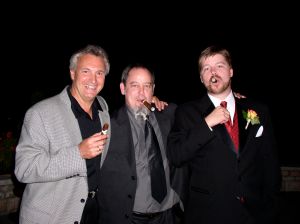
Me, Bryn, and some guy at Jeff Fletcher's wedding, 12 September 2005A year ago today my friend Bryn Patrick Martin passed away from a bad reaction to painkillers. It was a stupid way to go and entirely preventable; I’m still mad at him. He was a constant, and I mean a constant, in my life between 1993 and 2003; this picture of him and me smoking cigars (can’t remember who the guy on the far left was) was taken the last time I saw him, 12 September 2003. His devilish smile (and overall countenance), obscene sense of humor, and most of all his fierce loyalty to the people about whom he cared remain very much missed. Aionia mneme.

I note among the stats for the last few days that for the first time ever I’ve received a hit off of a Google search for “Richard Barrett.” Exactly how this works I’m not sure, since last time I checked, I think it was the 15th page of results before this blog popped up, so the searcher in question must have been very persistent. Not that I care about my Google rank, exactly, but I do hope that people don’t see all of the matches on the first several pages for the white supremacist Richard Barrett and think that’s me. (If he had any idea who I was, he’d probably hope people didn’t get us confused, too.) If people want to think I’m the English composer or the motivational speaker, that’s probably okay. (Maybe not the R&B pioneer or the minor-league Depression-era Seattle baseball player, since they’re both dead.)

Τι κάνω;

Aaaaaaaaaaaaaaaaaaand the end of week 3 of a new semester has been reached.

I’m having fun with Modern Greek thus far; given that much of what has been covered is stuff that hasn’t changed much from Attic usage (with the exception of pronunciation), I’m having, shall we say, a relaxed time of it. The prof says that he will start getting together with me and the other grad student to pick up the pace a bit, so that we can jump to the fourth semester next term, skipping the 150 and 200 level classes altogether. This doesn’t altogether depress me; the class so far certainly has been hardly anything about which I would lose sleep, but it would also be nice to untether myself enough from the pace needed by a freshman who after three weeks is still struggling to read the alphabet so that I feel like my own time is being spent wisely.

Modern Greek has also opened up a new possibility for me; in my ongoing quest to not have 30+ graduate credits just sitting as an unusable blob on my transcript that won’t transfer anywhere, I’ve brought up the possibility with my Greek teacher of doing a Masters in West European Studies, looking at the Greek diaspora in places like Germany and examining issues of religious identity and so on. He was supportive of the notion, and is reviewing my personal statement. I have to say, I’m not totally in love with the idea, but I’ve got half of the coursework done, I’d be able to finish in about a year, and it is something in which I’m legitimately interested. If I leave IU with a Masters in a field that isn’t directly related to where I go from here, I’ll at least leave here with a Masters (and keep up the pattern started with my undergrad), as opposed to a boatload of credits that nobody will care I have and won’t transfer anywhere.

The demographic makeup of the class is interesting; I’d say it’s about 3/4 Greek-American kids. I can’t tell if they’re trying to (re?)connect with their heritage, shooting for an easy A after years of Greek school growing up, or just want to be able to talk to Yia-Yia.

We use “Greek names” in class. The professor originally suggested Ριχαρδός, which is just “Richard” with a Greek masculine ending added, but thinking about it, I decided to go with a name that had the same meaning rather than the same sound. “Richard Barrett” roughly translates to “King Troublemaker” (I’m not kidding, although it depends on which part of Europe your particular Barretts are from — it can also mean “hatmaker” or “fortress”); in Greek, according to my friend Anna, that can be rendered more-or-less as ο Βασίλης Ταραχοποιός, and thus I am now called in class.

(By the way, Anna has some interesting observations which are perhaps not entirely unrelated to some I have made before. I have a hard time relating fully to either person she describes for various reasons, but have certainly encountered similar people myself. The convert friend sounds like he’s exactly the kind of guy who needs to hear The Divine Liturgy in English. Anyway, her post is, as is typically the case with Anna’s blog, worth reading.)

I have finally started the notes for Hansen and Quinn Unit III; I hope to have them in done in a week or so (once I’ve got a particular writing assignment done this weekend). If you’re waiting for them and have that particular unit staring you in the face in class — well, I’ll do my best.

(And perhaps next week I’ll finish translating the Meyendorff article, too.)

If you recall a rather cryptic post from a couple of weeks ago, I’ll add only that another very interesting (and positive) dimension has emerged from this set of circumstances. More to come once it happens.

A couple of completely random bits —

I bought a treadmill about a month and a half ago, and except for days I’ve been out of town and two somewhat exceptional evenings, I’ve been good and have used it for a half hour every day since it was delivered. I watch episodes from the various series making up the DC Animated Universe; including stretching, I usually manage to watch two episodes in one shot. I started with the second season of Justice League (when it became Justice League Unlimited); since that season ends with what is, effectively, the chronological end of that universe, it seemed only fitting that I move on from there to the show that started it all, the very first season of Batman: The Animated Season. All I can say is, it never ceases to amaze me how good these shows are on an extremely consistent basis — and as much as I think Christian Bale has become the definitive live-action Batman, there is no question in my mind that Kevin Conroy is the definitive Batman of any medium. (You know what I’d love? Bruce Timm and Paul Dini to write the script for the next Christopher Nolan Batman. It’ll never ever happen, but just imagine…)

Anyway, it keeps me excited about exercising. It begs the question what I might do when I’ve burned through them all — but hey, I’ve still got the season box sets for Babylon 5. That’ll keep me busy for a few months once the Timmverse goodness runs out.

After an interesting reference to their singer on a particular celebrity blog I read, out of morbid curiosity I bought the eponymous first studio album by the so-called “Brechtian punk cabaret” act the Dresden Dolls. I’m an Oingo Boingo fan from way back, and this is certainly within that tradition; the artists involved are definitely talented and creative; nonetheless, I can’t quite figure out if it’s my cuppa or not. I may give Amanda Palmer’s solo album a shot and see if that convinces me; at the very least, the companion book sounds intriguing.

OK — have a good weekend. I’m needing to get some sleeping done, some writing done, and some birthday parties done by Monday; let’s hope.

Price comparison shopping for Greek textbooks

So, as it works out, I’m taking Modern Greek this fall, and that’s it. I’ve canned further Syriac for the time being — frankly, it’s just tough to justify the time commitment at this point, since I was doing it to prepare for the path of further graduate study, and now that hardly seems likely to come to fruition. I’ve got enough Syriac at this point to be able to bash through texts I’m likely to run into with a dictionary and a grammar; for what I’m likely to need it for going forward — which is what, exactly? — that ought to be fine.

Modern Greek is a little easier to justify. There are people I know now with whom I could speak it. I still very much want to travel in that region, even if it probably isn’t going to be for the purpose of grant-funded research, and there are other reasons it could be useful — such as finding myself someplace where the only church is a Greek-language parish, maybe. (Using that as justification, I acknowledge that Russian, Arabic, and Romanian would also be a good plan from here.)

It also might make asking questions of His All-Holiness about his book a bit easier. (I still have never talked much about that, have I? I’ll have to get around to that someday.)

Anyway — today I ordered my Greek textbooks. The course is using Communicate in Greek by Kleanthis Arvanitakis and Froso Arvanitaki. Rather than just snatch them on a whim from the campus bookstore, I decided to do a little poking around online to see if that was actually going to be the best way to go. Here’s what I came up with:

  • Campus bookstore — $103.75 for the first year textbook, workbooks, and CD
  • Amazon.com — unavailable, for some unknown reason
  • Greece In Print — with shipping, $105.21 for the set
  • Direct from the Communicate in Greek website — $99.08 (approximately, since it’s actually priced in euros)

All more or less comparable. At this point it seemed like going direct from the website would be the best way to go — hey, four bucks is four bucks — but the tradeoff was going to be that they were shipping from Greece, and it would be difficult to know for sure that they’d arrive before 2 September.

Then I checked one more place — and as it worked out, Orthodox Marketplace had the whole set, with shipping, for $72.63.

That’s probably the one time it will ever cost less to order from there, but I’ll take it.

“The image of Christ according to Theodore the Studite” by Fr. John Meyendorff (part 1 of 2)

This was my final project for the French reading knowledge class I took this summer. It is a short essay Fr. John Meyendorff wrote for a book entitled Synthronon: Art et Archéologie de la fin de l’Antiquité et du Moyen Age (Paris: Libraire C. Klincksieck, 1968). I’ve seen it cited before, but to the best of my knowledge it has never been translated into English. This is the first half; the second half is forthcoming. Numbered footnotes are Meyendorff’s; cross notes are mine (usually a comment, for the sake of the instructor, as to why I chose to translate something the way I did, in at least one occasion in response to his remarks on an early draft).

Nowhere other than in Byzantium has the problem of Christian art sparked off a purely theological debate. The Christian, and non-Christian, philosophers often discussed the religious implications of art and, conversely, were able to establish that the religious sentiment is inseparable from an aesthetic experience. In Byzantium, however, during the course of the long Iconoclast controversy, the problem acquired straightaway a whole other dimension and effort of thought and of expression which the adversaries of images, as well as their defenders, provided, and which left a deep mark on Byzantine art. For the Byzantine, the icon became at the time a confession of faith and a quasi-sacramental presence, and “the Christian doctrine was left enriched by the Iconoclast crisis.”[1]

The debate concerned, first of all, the very nature of the “image.” The cultural, psychological, and social elements which contributed, within Christianity, to the formation of an “iconoclast” tradition and an “iconodule” tradition, in the centuries which preceded the crisis, were resolved through a philosophical problem: was the image a suitable representation of the prototype, “consubstantial” with it, or, by contrast, was it only a crude form, only fitting to distract the intellect and to divert its natural enthusiasm towards the Invisible? But this philosophical problem itself depended on a precondition: the nature of the Protoype. If, for a Jew and a Muslim, God is essentially invisible and one could not therefore make an image of Him, is it the same for a Christian who believes that “the Word became flesh”?

Thus it is that, from the third century, until the age when the problem of religious images began to be debated between the Neo-Platonists Celsus and Porphyry on one side, and, on the other side, the Christian apologists who attacked pagan idolatry, the Christian doctrine of the Incarnation of the Word found itself at the center of the debate. Accused of idolatry by the Christians, the Neo-Platonists proceeded to the counterattack:

If some Greeks (writes Porphyry) are so weak of mind as to believe that gods live inside of idols, their thought remains rather more pure than the thought of these (Christians) who believe that the Divine entered the bosom of the Virgin Mary, became a fetus, was begotten and wrapped in linens, full of blood, of tissue, of bile and of things even more base.[2]

The contemptuous tone set aside, the argument of Porphyry was not lacking in gravity: if the Christian faith was founded on the historic fact of the Incarnation, there was no longer a question for the Christians of despising matter. Consequently, a recent historian was able to write:

There came a moment, between the third and the fifth centuries, when the Christians adopted (in the problem of images) the pagan arguments.[3]

Certainly not in order to restore idolatry, but in order to say that the images, within Christianity, were genuinely able to be suitable to the Prototype, since the Object of Christian worship is the Word Incarnate, a visible and circumscribable reality.

From the beginning of the Iconoclast quarrel itself, the Orthodox recalled this argument. Germanus, patriarch of Constantinople, writes, for example:

This is in memory eternal of the life in the flesh of Our Lord Jesus Christ, of his passion, of his salvific death and of the redemption for the world which resulted, that we have received the tradition of the depiction of his human body, that is to say his visible theophany, understanding well that by it we glorify the humiliation of God the Word.[4]

The Iconoclasts responded by elaborating their own Christological argument: Christ is at once God and man; he possesses, therefore, two natures, which the Council of Chalcedon (451) declared to be united “without mixture, without transformation, without division, without separation”; in rendering the image of Christ, does the iconographer depict the humanity of Christ? But then he “separates” the humanity from the Divinity and becomes guilty of Nestorianism. Does he represent at once the two natures? If such is his claim, it is not possible to avoid saying that he represents “God” himself, he who is inconceivable.[5] The union of the two natures makes, therefore, according to the iconoclasts, a “suitable” image of Christ impossible.

This iconoclast Christology necessitated a response from the orthodox side. This response would be worked out by theologians from the beginning of the ninth century, the patriarch Nicephorus and Saint Theodore the Studite. While continuing the debate regarding the notion of the “image” and the educational value of Christian art, they developed the argument which, for them, was certainly decisive: Jesus was truly man, visible, therefore “circumscribable” (περιγραπτός), and the Council of Chalcedon, while defining the union of the natures, had specified that “each of them (the natures) retained its proper manner of being.”[6] Being circumscribable constitutes a character proper to humanity: no man could be deprived of it without ceasing to be man; thus, according to Theodore the Studite, “Christ would not be Christ, if he could not be depicted.”[7] This new insistence regarding the fully real humanity of Jesus certainly contributed to the turnaround of the dominant tendency for Byzantium, since the age of Justinian, to favor exclusively the Alexandrian Christology and to exclude the Antiochene heritage, in which it had something eminently positive: the vision of the Christ-Man.


[1] A. Grabar, L’Iconoclasme Byzantin. Dossier Archéologique, Paris, 1957, p. 5.

[2] Against the Christians, fragment 77, ed. A. Harnack, in Abhandlungen der Königlich Preussischen Akademie der Wissenschaften, Berlin, 1916, p. 93.

[3] P. J. Alexander, The Patriarch Nicephorus, Oxford, 1958, p. 33.

See following note.

[4] De Haeresibus et synodis, P. G. 98, col. 80 A. In one his first articles devoted to iconoclasm, G. Ostrogorsky drew attention to the central character of the Christological argument, “Soedinenie voprose o sviatykh ikonah s khristologicheskoi dogmatikoi”, in Seminarium Kondakovianum, I, 1927, pp. 35-48.

[5] Mansi, Collectio Conciliorum, XIII, col. 252 AB; 256 AB; for a recent analysis of the arguments of the iconoclast council of 754, see M. Anastos, “The argument for iconoclasm as presented by the iconoclastic council of 754”, in Late Classical and Medieval Studies in Honor of A. M. Friend, Jr., Princeton, 1955, pp. 177-188.

The French word Meyendorff uses, descriptible, is translated in most dictionaries as “describable” or “representable”; as he is using the word to translate the Greek word περιγραπτός, a technical term in the Iconoclastic controversy for which the proper English translation is “circumscribable,” I have translated the Greek term in both instances of descriptible rather than translating Meyendorff’s translation.

[6] Mansi, Collectio, VII, col. 116.

[7]Χριστὸς οὐ Χριστὸς εἰ μῂ ἐγγράφοιτο, Antirrh. III, 1, P. G., 99, col. 389.

Consulting this author’s works in English on similar topics, “Christ-Man” is a term used a number of times, and it appears unlikely that “Man-Christ” is what he intends here. See, for example, Meyendorff, Living Tradition, St. Vladimir’s Seminary Press, 1975, p. 180.


adventures in writing alexander lingas all saints bloomington all saints orthodox church american orthodox architecture american orthodox music american orthodoxy Antiochian Archdiocese Antiochian Orthodox Christian Archdiocese of North America Antiochians books byzantine chant cappella romana chant church architecture ecclesiastical chant ethnomusicologists ethnomusicology fellowship of ss. alban and sergius Greece Greek greek food greekness hazards of church music international travel tips ioannis arvanitis joe mckamey john michael boyer kurt sander Latin liturgical adventures liturgical architecture liturgical music liturgical texts and translation liturgy liturgy and life lycourgos angelopoulos medieval byzantine chant Metropolitan PHILIP militant americanist orthodoxy modern byzantine architecture modern greek music music as iconography my kids will latin and greek when they're newborns my kids will learn latin and greek when they're newborns orthodox architecture orthodox architecture is bloody expensive Orthodox choir schools Orthodox Ecclesiology orthodox outreach orthodox travel pascha at the singing school Patriarchate of Antioch Patriarch IGNATIUS IV Patriarch of Antioch publishing random acts of chant richard barrett in greece richard toensing rod dreher sacred music st. vlads st john of damascus society Syriac the Bishop MARK fan club the convert dilemma the dark knight The Episcopacy The Episcopate the only good language is a dead language this american church life travel we need more american saints why do we need beautiful music in churches?

Blog Stats

  • 270,201 hits

Flickr Photos