Last month I was fortunate enough to be able to attend, and present a paper at, the Patristic Symposium of the Florovsky Society at Princeton University. I had also been looking for the right opportunity to visit Holy Cross Greek Orthodox Theological Seminary for about the last year or so, and while I missed the opportunity that I had really wanted (I had wanted to coincide with Ioannis Arvanitis’ campus visit, but I wasn’t told it was happening until after it had already happened), I decided that since I was going to be out on the East Coast anyway, I may as well roll a trip to Boston into the travel for the Florovsky Symposium.
I had never been to Princeton before. It was reasonably easy to get there from Newark Airport via train, it’s a lovely little town, and the campus is quite picturesque. It was a good opportunity to see some people I don’t get to see very often; I was able to catch up with an old Jacobs School of Music buddy of mine, Ben Eley, who now works for the university in a decidedly non-musical capacity and whom I hadn’t seen since summer of 2006, and I also was able to stay with our friend Paul who lives nearby. Alexis and Eugenia Torrance, with whom I’ve crossed paths a number of times over the last few years, were there, as was Seraphim Danckaert, whom I first met in the summer of 2004 when he was studying Romanian here. Ioana Patuleanu, a former All Saints-er who relocated to New Jersey last year, was there. My friends John and Katherine, both students at Holy Cross, also came down for the conference, and I rode back to Boston with them afterward.
It was also a chance to finally meet Fr. Andrew Damick in person, with whom I have been friends in the digital world for the last few years. We met for breakfast at PJ’s Pancake House Friday morning before heading over to the conference, and I think found that we are reasonably like-minded on a number of points.
As we walked over to the conference, I saw Fr. Benedict Churchill and Dn. Gregory Hatrak of SVS Press unloading boxes of books. I had met them at Oxford last summer, so I made a point of saying hi and taking one of the boxes to be of help. Well, no good deed goes unpunished; as I set the box down where they told me to put it, I managed to catch something at exactly the wrong angle with exactly the wrong amount of tension, and ripped open the crotch of my trousers.
Do note that this was also the day on which I was presenting my paper. Since I was staying with Paul, whose house was some 5 miles away, there was very little I could do except make sure my jacket was draped strategically and deliver my paper from behind a lectern. This is the kind of thing that happens to me.
Nonetheless, the paper was well-received and got a couple of good, productive questions. The rest of the conference was really interesting, although it was a curious reversal for me; usually I’m a little too ecclesiastical in my focus to neatly fit in with my history colleagues, but here, I was clearly a historian amongst theologians. Well, there we go.
 Saturday evening John, Fr. Andrew, Alexis, and I were able to help chant Vespers for the Princeton Orthodox chaplaincy — for that service, in no less of a location than the Princeton Chapel itself. That didn’t suck (although the choir director looked a little shell-shocked at the end and said, “It’ll be lovely to have you all in the choir tomorrow morning, but I think maybe we’ll do a little less Greek chant”). I also got to briefly see an acquaintance I had made in Athens 3 years ago, who just happens to now be at Princeton and was at Vespers (even though she herself is Catholic). Small world. Following Vespers, Paul, Fr. Andrew, and I had really good Indian food for dinner, and then it was back to Emmaus for Fr. Andrew.
Sunday morning, following Divine Liturgy at the chaplaincy, Paul, John, Katherine, and I had breakfast at PJ’s (I just had to do it one more time), at which point the New Jersey leg of the trip had to come to a close, and it was time to head to Boston.
Holy Cross was a great trip; I met some neat people, including fellow blogger Kevin Edgecomb, I had some very good and productive conversations with members of the faculty (I’m contemplating spending a year there while I’m writing my dissertation), I was able to sit in on a number of good classes, especially the Byzantine chant classes, I got to sing in the left choir for a handful of chapel services, and, as with Princeton, I was able to make some new friends and catch up with some existing friends whom I don’t get to see all that often. Something that was a little unsetting was that there were people I met who said, “Oh, I know you! I read your blog!” Well, there we go.
 Alas, I wasn’t able to get a Holy Cross shirt; I was told that they only place one order a year, and the larger sizes go quickly, so thus is life. I had to get some item of HCHC swag, though, so I bought a scarf.
One of the great things about the Holy Cross visit was seeing the current level of Antiochian representation there amongst the seminarians. There are 12 AOCANA guys there right now who are all getting a good grounding in Byzantine chant from Grammenos Karanos, good liturgics in the chapel (including the experience of antiphonal choirs being normative), and exposure to Greek and Arabic. This all seems like good stuff to have happening. One of the Antiochian seminarians I met was Rassem El-Massih, whom I’ve heard about for years but had not yet met — he’s an excellent cantor from Lebanon and all around good guy, it seems, and we had a really positive conversation my last morning there. He had some very encouraging things to say about the future of traditional Byzantine chant in the Antiochian Archdiocese, and I told him a bit about the objectives of the St. John of Damascus Society. Hopefully the Society can be part of the efforts he was talking about.
By the way, if you’re a single person considering going to Holy Cross, do be aware that the dorm rooms are tiny. And I mean tiny. Word to the wise.
Anyway, after three far-too-short days in Boston (which, honestly, I didn’t get to see much of because the seminary trip took up all the time I had), it was time to take the train back to Newark and fly home.
And then it was time to start preparing for my next trip, this time to Emmaus, Pennsylvania to give a couple of talks on music at a Lenten retreat at St. Paul’s Orthodox Church, Fr. Andrew Damick’s parish.
I arrived at St. Paul’s the evening of Friday, 2 March, just in time to help sing an Akathist service. Their building is a repurposed valve machine shop; in terms of layout, it’s not unlike All Saints, low ceilings and all, except that enough surfaces are sufficiently reflective that it’s actually a reasonably decent acoustic environment. I was quite surprised.
Saturday morning I sang Matins and Divine Liturgy for St. Theodore the Tyro (we also did the Blessing of the Kollyva). The morning was pretty much up to me, and having such an uncustomary free reign, I sang an all-Byzantine liturgy. It was really nice to sing that repertoire in that room, I have to say.
Following Liturgy, I gave the first talk. There were about 15-20 people, and they had good questions (although some of the questions were such that, the frank way I had to answer them, it was best to omit the Q&A from the online version). Not bad attendance and participation, considering that Fr. Andrew made the mistake of putting my name on the flyer (see for yourself).
During the afternoon, Fr. Andrew gave me a bit of tour of Emmaus, and I have to say, as a town, the place is cute as a bug’s ear. I’d love to have more of a chance to get to know the place sometime.
After Vespers, I gave the second talk. There was about half the attendance, and about half of those people hadn’t been there in the afternoon. Again, some good questions, and all things considered pretty good given that my face was used for advertising. In any event, my job was done, Fr. Andrew took me out for Chinese food, and once again we had a great conversation over a wide range of topics.
Sunday morning, it was back to Kazan and their usual polyphonic mix of things; Gail Ortner is a capable choir director, and truthfully, it was nice to just stand there and sing and not have to worry about everything being my problem.
Thanks to a flight delay, I was able to attend the Lehigh Valley Pan-Orthodox Vespers for Sunday of Orthodoxy at St. Nicholas Cathedral (GOA). It’s a beautiful church, and it was a very nice way to end the visit. It worked out perfectly, and I got to the airport with plenty of time to catch my plane.
And now I’m home until May.
I’ll say this — getting to know Fr. Andrew a bit has been one of the real highlights of the last six weeks. He’s one of the good guys — he appears to have a genuine love of God, the Church, Tradition, and the people he serves; he is able to use his theatrical background and intellectual acuity to great effect (as opposed to great affect, which I’ve seen happen all too often); he seems to very much care about the place he is in and wants to serve it to the best of his ability; he seems to have a very good handle on where his parish is at and what they need to be doing; and — very important — he has a supportive group of parishioners behind him, and a really awesome family at home. I hope to have more of a chance to get to know him down the road.
 My secondary, personal objective, to be able to study Byzantine chant with a “native speaker” as it were, was also accomplished. I can now look at a Byzantine score and at least have some idea what I need to do with it. We’re talking about the basics here, to say the least, and I need to keep up with what Arvanitis taught me in order to not lose it, but that’s a lot better than I was able to do on my own in Bloomington. It remains to be seen whether or not it will be possible for what I learned to have any practical application at the parish level, which troubles me somewhat; if I learned all of this stuff strictly for my own benefit and not for the service of the Church, I’m not sure I see the point. Nonetheless, Arvanitis really was a gem and exactly the kind of person with whom I needed to be studying; he was able to discuss the psaltic art not just from the standpoint of applied performance but also in terms of historical development and paleography, and even more than that, he was a grade-A human being all around. It was a joy to get to know him and his wife Olga, however briefly, and if I go back next summer, I look forward to being able to do more with him.
 So, the reality is, there are something like 10-20 boats per gate. It is good that I realized this, because I was sitting at a café
 The marina in the town of Aegina is very charming; pistachio nut stands are everywhere (these evidently being one of the island’s big exports), there is no shortage of restaurants and cafés on the water, and plenty of bakeries and shops and so on and so forth.


 There’s also a beautiful church along the water, the Cathedral of the Dormition (also called Panagitsa). It evidently dates from 1806; one very distinctive characteristic of this church is that, in addition to the 2+ centuries of incense permeating the walls, there is a very strong smell of honey as you walk in from the beeswax candles. Like many churches here, there is an ambo, but curiously enough they have removed the steps leading up to it, leaving only the pulpit portion in what is a clear state of disuse.

 You can go to
  The other thing I want to point about the interior has to do with the chapel off to the south end of the nave, where some of the relics are. Particularly, the iconography — for example, here at the dome of the apse in the chapel (and I would look at the pictures of other frescoes in the chapel, too — time and space simply do not allow for a full discussion here). Does that look familiar?
  Only about half of the monastery proper is open to the public; this includes two (much) smaller churches, the chapel where St. Nectarios’ body is , two bookstores, and then his cell is open as an exhibit. The main thing I want to talk about here is seeing the veneration of his body, and (to some extent) participating in it myself; this is something that up to this point was rather foreign to me as an Orthodox Christian in the United States, given that, of the three analogous examples I can think of, only two are actual glorified saints (Ss. Herman of Alaska and John Maximovitch) and all are in California or Alaska (the third is Fr. Seraphim Rose), meaning that they’re rather remote for somebody whose Orthodox Christian life has been spent in the Midwest thus far.
 People knelt and prayed at the casket which held his bones; I saw pilgrims weeping; and strangest of all, I saw people pressing their ears to the reliquary, as though they were listening for some sound from within. I really didn’t know exactly where to put myself in all of this, to be honest; I lit a candle, and I prayed at the reliquary, but my emotional response wasn’t quite that demonstrative — which isn’t to say that I didn’t have one, I did, it was just rather internalized — and since I didn’t know what was going on with the listening thing, I didn’t do it.
 From the monastery, I took the bus to to the Temple of Aphaia which, as I noted earlier, is said to form an equilateral triangle with the Parthenon in Athens and the Temple of Poseidon at Sounio. There really is something very cool about being able to walk around structures from antiquity like this; that said, I think I would have rather come here first and then gone to the monastery. My head was simply too occupied by what I had witnessed there to really be able to appreciate what all I was seeing at the ruin. The Temple of Aphaia is certainly fascinating intellectually, but I was very much someplace else spiritually, so it left me a little cold.
 Even if that was the case, however, I have to say that there were some really beautiful views from the top of the hill. It is nice being someplace where one can see water and hills and mountains, I can’t deny that.
 I got on the bus back to the harbor. I had a Frappé (I am going to have to get a handheld mixer when I get back to the States so I can make these blasted things myself), and then settled down for a grilled fish dinner at Inomagirion, one of the waterfront restaurants. The fish was very good, as a local resident assured me (pictured left), and I had to agree with him, although he kept wanting to verify that it really was as good as he remembered. Being thankful for his help, I obliged a reasonable amount. (Best meal he’s had in weeks, I would have to guess.)
 I tried to go to Vespers at Panagitsa before taking the boat back to Athens, but as it started at 7pm and was combined with 9th Hour, so I had to duck out at 7:30, when they had just begun “Lord I have cried…” Alas.
 That centermost white dot is Tom Hanks.
 A couple of weeks ago, I went with Frank (my Greek teacher at IU), his wife, and my fellow student Stefanos to see Phaedra with Helen Mirren at the ancient theatre of Epidauros. It was a really wonderful day all around; we first went swimming at a beach in Loutraki, a seaside town on the Peleponnesian peninsula — and let me say, swimming in the Gulf of Corinth ain’t bad. I think that’s the first time in probably eight years I’ve been in a body of water of any size, or salt water for that. Following the swim, we drove to the port town, and former Greek capital, of Nafplion. We ate a late lunch at a taverna called Vasillis (hey! That’s “Richard” translated into Greek! Perfect!), walked around the square, and also drove up to Palamidi, the Byzantine/Venetian/Ottoman mountaintop fortress which overlooks the city (“Real cities have medieval castles”).
 The play was good; it was a bit weird, seeing a French Baroque playwright’s adaptation of Euripides, translated into English by a modern author, with Modern Greek supertitles, but there we are. It was very nearly a bare stage, with only a few chairs, some sort of small circular platform in the center, and a shell around the back of the stage with ramps leading off and on. Dress was modern, with Hippolytus pacing around the stage in a wifebeater in the first scene. Stanley Townsend was a larger-than-life, aged Theseus; for all of you IU kids reading along at home, think Tim Noble. Helen Mirren, naturally, owned the stage every second she was on it, and was downright creepy for much of the evening. I tend to think that her death scene didn’t have a ton of impact, but that seemed to be a bit of awkward staging more than anything.
 The very next day, Giorgos took me for a drive along the coastline to Sounio — in myth, the place where Aegeus threw himself into the sea, and where there is a temple to Poseidon which is said to form an equilateral triangle with the Parthenon and the Temple of Aphaia on the island of Aegina. The point where Aegeus is said to jumped is very rocky and uneven with a lot of loose stones; to be honest, if there was an Aegeus, I find it more likely that he just tripped and
 fell, black sails or no black sails. I was wearing Birkenstocks instead of my Merrells — bad idea.
 The following Monday, I went to an event called the
  e between the seats and the field; they are evidently are various serious about not wanting fans to rush the pitch — not surprising, since it’s also used for soccer.
 en I walked in to browse, somebody was immediately following me, asked if they could help me, and when I said I was just looking, they didn’t leave me alone. It was clear they didn’t want me in there (and I’m not altogether certain why), so I won’t burden them again.

 There are a couple of housekeeping things I would like to bring to your attention.
 I left off last time just before a trip to a nearby beach for Anna’s goodbye party (this would be two Sundays ago, 21 June). At the beach, I had the, er, amusing experience of trying to explain to the bartender, in Greek, how to make a Manhattan. I did so; they didn’t believe me and looked on some recipe card that told them to add orange juice of all things, and I got to pay 7 Euros for the privilege of drinking what I didn’t order (and with Jack Daniels as the whiskey, no less). It wasn’t horrible; it was actually kind of interesting and potentially worth playing with further. It just wasn’t a Manhattan.
 The next night, for the after-party of Anna’s goodbye party, I more than happily paid 8 Euros for drinks that I knew were made the way I wanted them. (By the way, I have become a fan of the
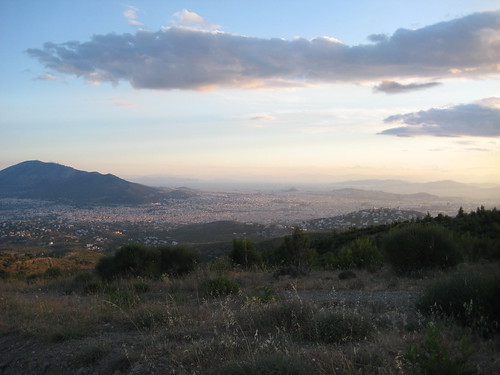
 The monastery is really lovely; I can’t say I’ve ever seen any place quite like it in the States. While we were there, Giorgos pointed out a priest and identified him as a “left-wing monk” named Fr. Timotheos, saying that he’s quite the publicity hound. He didn’t go into a lot of detail, but what I was able to dig up later suggested that he’s more of a nationalist figure than anything. Not quite certain what the deal there is.
 (Oh, and paging

 Friday morning, I attended a session of the second annual “Greece in the World” conference, with this year’s theme being Byzantine Studies. This particular session was titled “Byzantine Studies and the Orthodox Tradition”; Metropolitan John (Zizioulas) of Pergamon was the moderator, and the speakers were Dimitrios Balageorgos of the National and Kapodistrian University of Athens, who gave a talk on Byzantine music in today’s educational system, Giorgos Filias of the University of Athens, who spoke on liturgy and the Byzantine tradition, and Archimandrite Nicholas Ioannides of the University of Athens, who spoke on theology and Byzantine tradition.
 Saturday I spent some time exploring Athens and points south. I found
  I had lots of time before Vespers at St. Irene, so I took the train down to Piraeus Harbor. This is where one catches the boats to the various islands; for example, I’ll be going to

 (Did I mention there are a lot of cats and dogs in Athens? Here’s one at a table near where I was sitting at Singles.)
 Monday I was walking home through Halandri after my chant lesson, and as I passed St. George Church, I was aware of a large reception on the lawn with music, a sit-down dinner, and so on. Is this a wedding reception? I wondered. Then it occurred to me that it was a celebration of Ss. Peter and Paul (29 June), which seems to be a big deal over here. Anna told me that she didn’t know what the Apostles’ Fast was before she started going to All Saints in Bloomington, but the Greeks definitely know what 29 June is. I had seen other signs and posters elsewhere indicating festal services for Ss. Peter and Paul, as well.
 The baptism was at St. George, a small chapel in Kifisia. Frank explained that for a family that doesn’t really go to church much, it can be difficult to get one of the nicer churches for a baptism or a wedding; you have to plan about a year in advance. Thus, it seems that infants tend to get baptized at around one or two years old rather than at a few weeks or months old.
 As an event with familial significance beyond just the practice of the faith, it is a big, rowdy occurrence, with people moving around everywhere and talking and often not paying much attention to the service itself. This is not necessarily a bad thing, and need not be indicative of much more than the practice of baptism being very tightly woven into the culture. That said, clergy here seem to have less compunction here about telling the congregation that they need to be quiet when it is necessary to do so. Here, part of what contributed to the tenor of the crowd was that it was outside, and when the liturgical action moved into the chapel for First Communion, really only the parents and godparents could go in.
 There were a few liturgical differences I saw; for example, as opposed to Antiochian practice where oil is pretty much just dotted in the necessary spots, this kid was absolutely slathered everywhere, like a plucked turkey getting basted. The chrismation portion is done, but no particular emphasis is put on it; in other words, the crowd pretty much stops paying attention at that point. This helps to explain why, sometimes, when cradle Orthodox find out converts get received by chrismation in some circles, they get a quizzical look on their face and ask what that is. It goes by really fast, and can just seem like the last step of the baptism before First Communion. I’d be curious to see a baptism in a country like Lebanon to see if it’s the same way. Finally, since the baptism doesn’t occur in the context of a service, First Communion is part of the baptism. One small difference was that, instead of the hair from the tonsuring being burned, it was thrown into the baptismal font (pictured).
 Following Liturgy, Anna and I had coffee with Arvanitis at a café right behind St. Irene. I was tickled to find that the brand of coffee they were serving was “Café Barretti,” which along with the “Rihardhos Mousikos Oikos” makes Athens a city that just has my name all over it.


 Leitourgeia kai Qurbana: Contra den Zeitgeist