 There are a couple of housekeeping things I would like to bring to your attention.
First of all, I would like to congratulate my godchildren Subdn. Lucas and Stacey Christensen on the 20 June 2009 arrival of Theodore Lucas Christensen. He was born the day before Father’s Day, so Lucas’ first Father’s Day as a father was in fact within the first 24 hours of his tenure as a father. Life’s not terrible, huh? Many years to Theodore Lucas and parents!
Secondly, I would like to help spread the word about the Society for Orthodox Christian History in the Americas. This effort appears to being spearheaded by Fr. Oliver Herbel, Matthew Namee, and others, and so far as I can tell, it’s a good, honest, scholarly approach to questions that seem to be largely dominated thus far by ideological wishful thinking. I for one am looking forward to reading Fr. Oliver’s dissertation when it is published; I hope that it will serve to balance works that are out there such as The American Orthodox Church: A History of its Beginnings.
Thirdly, I’d ask your prayers for my stepfather, Joe. He is undergoing some pretty major surgery on 1 July, and as my mom put it, he’s tightly wrapped around the axle about it. So, please, if you think about it, that’d be appreciated.
Okay. Where to begin?
I’ve been gone about three weeks. My previous longest trip abroad (of the three) was something like two and a half weeks. I’ve got five weeks to go.
I’d like to tell you that everything is great, that it’s been a really smooth ride so far, and that pretty much all is going as expected.
This would be a lie.
Now, to clarify, what would also be a lie is to say that things are terrible, I’m having a horrible time, I’m getting nothing out of this trip, I want my mommy, etc. I’m saying only that reality, as is often the case, is a bit more complicated under the best and easiest of circumstances, and that adjusting to a more-or-less totally unfamiliar environment where virtually all of one’s instincts about how things work, what to say, to whom to say it, and so on, are wrong, does not exactly represent the easiest of circumstances. This is, of course, part of the education of this kind of trip, and this means that one way or the other, I will be returning to the United States having learned a tremendous amount. Whether or not it is exactly what I thought I would learn is a different question, but never mind that now. The point is, I haven’t just been thrown into the deep end of the pool; rather, it’s at the very least one of the Great Lakes. (Or maybe the Aegean Sea.) Perhaps ironically, perhaps not, the most familiar thing I encounter here is the Divine Liturgy (even given ecclesiastical Greek as the liturgical language), which is perhaps the least familiar thing for many Americans who travel here.
To put it one way, I will see foreigners in the States for extended periods with different eyes from here on out.
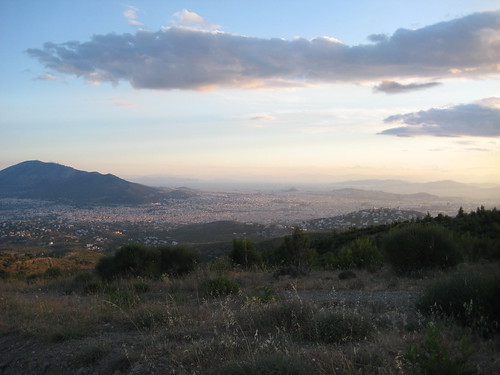
All that having been said, that photo of the Acropolis at the top of this entry is exactly what I see every day on my way to school, as is the Olympic stadium from the 1896 Summer Games. That’s saying something, isn’t it?

 I left off last time just before a trip to a nearby beach for Anna’s goodbye party (this would be two Sundays ago, 21 June). At the beach, I had the, er, amusing experience of trying to explain to the bartender, in Greek, how to make a Manhattan. I did so; they didn’t believe me and looked on some recipe card that told them to add orange juice of all things, and I got to pay 7 Euros for the privilege of drinking what I didn’t order (and with Jack Daniels as the whiskey, no less). It wasn’t horrible; it was actually kind of interesting and potentially worth playing with further. It just wasn’t a Manhattan.
 The next night, for the after-party of Anna’s goodbye party, I more than happily paid 8 Euros for drinks that I knew were made the way I wanted them. (By the way, I have become a fan of the Pomegranate Splash for fruity drinks that don’t just taste like juice with attitude. There’s a bar here in Halandri that makes a very nice one, but I am blanking on the name. I’ll get back to you on that.)
I decided to change up my route to school; rather than walking 15 minutes to catch a bus all the way into Athens and it taking 45 minutes, I now catch a bus from a block away from the house, take it a short way to a metro station, take the metro into downtown Athens, and then a streetcar (“tram”, and you have to say it with a flipped r) to the bottom of the hill where the Athens Centre is located. It can still take a little over an hour, but there’s also the possibility of it taking closer to 40-45 minutes depending on when the bus comes. The tricky thing is that the bus route goes through two different metro stations; the second is theoretically is closer to the destination, but the traffic bottleneck just before that station is horrible in the morning. The first day I went this way I rode the bus all the way to the second station (Katehaki), and got to school about twenty minutes late thanks to the traffic. The second day, I got off the bus at the stop right before Katehaki, and beat the bus there by about fifteen minutes. From the skybridge going to Katahaki Station:

The third day, I just got off at the first metro station (Ethniki Amina), which has turned out to be the best option all around. I regularly get to school now between 9:00-9:15 instead of 9:20-9:40 — and while, as my teacher told me on the first day, “This is Greece, not Germany,” I still prefer being on the early side.
While I will be very curious to see what the system is like once the three metro stations presently under construction are open and everything is running everywhere, I have to say that it’s not bad. For the international traveler, it’s a heck of a deal; you can buy a weeklong pass for 10 Euros that gets you everywhere, or you can buy a monthlong pass for 35 Euros. Couple of things to note about the monthlong pass: you have to provide a photo (four passport photos typically cost 7 Euros at a photography shop), you have to buy it at the beginning of the calendar month, and if you show a student ID, you’ll get it for 18 Euros. The passes are not like the London Underground where there’s a card you keep and top off and use with a card reading system; these are disposable tickets, and to some extent, the system is “on your honor.” You should be able to produce a validated ticket at any time, but I’ve never actually seen anybody checking.
Thursday evening, Giorgos (Anna’s dad) said to me, “Go get your camera. I’m going to take you someplace you’ll like.” He took me to some spots overlooking Athens, as well as Penteli Monastery in, appropriately enough, New Penteli. From the vantage points above the city with the landscape spread out in front of us, Giorgos talked a lot about how really, even twenty to thirty years ago, almost none of the sprawl was here. What are now the suburbs were really separate villages, and the end result of the buildup of Athens into something they want to be a major European city is that people have emptied out the real villages and small towns of Greece. “We Greeks are eating each other, and the reason why is because people are getting rich off of it,” he said.
 The monastery is really lovely; I can’t say I’ve ever seen any place quite like it in the States. While we were there, Giorgos pointed out a priest and identified him as a “left-wing monk” named Fr. Timotheos, saying that he’s quite the publicity hound. He didn’t go into a lot of detail, but what I was able to dig up later suggested that he’s more of a nationalist figure than anything. Not quite certain what the deal there is.
A disquieting moment was when we were standing in front of the gates of the monastery, and Giorgos pointed out the bullet holes in the doors from attacks in decades past. He also showed me the following:

“What do you suppose that slit in the wall next to the mosaic is all about?” he asked me. I had to confess I didn’t know.
“That was where they pointed the guns against intruders,” he said.
 (Oh, and paging Rod Dreher: the monastery has chickens.)
One thing that would be really difficult to overstate is how there are churches everywhere. Big churches, little churches, medium-sized churches, tiny village chapels. You’ll turn a corner and just see something like this:

Or this:

As I said the other day, when I walked to one church and found they weren’t having Vespers, I was able to walk ten minutes to another church and see what they were doing. Had I been inclined, another 5-10 minute walk would have gotten me to another church. Coming from a country where I have to drive 15 minutes to get to church, and then my next nearest option is an hour and twenty minutes away, it’s remarkable.
 Friday morning, I attended a session of the second annual “Greece in the World” conference, with this year’s theme being Byzantine Studies. This particular session was titled “Byzantine Studies and the Orthodox Tradition”; Metropolitan John (Zizioulas) of Pergamon was the moderator, and the speakers were Dimitrios Balageorgos of the National and Kapodistrian University of Athens, who gave a talk on Byzantine music in today’s educational system, Giorgos Filias of the University of Athens, who spoke on liturgy and the Byzantine tradition, and Archimandrite Nicholas Ioannides of the University of Athens, who spoke on theology and Byzantine tradition.
Now, I can’t tell you what these gentlemen said in their papers, exactly. There were headsets that allowed English speakers to listen to the talks being translated, but let’s just say that the level of translation wasn’t exactly that of the United Nations. I will acknowledge freely that I would not want to be a translator who had to deal with such a particular and specific vocabulary, so I’m not casting aspersions on anybody — that’s just the way it was. Still, there were three big takeaways for me from attending this session:
- Catalogs from a lot of academic publishers in Greece on Byzantine topics. Megan, stop rolling your eyes; this is more useful than it perhaps initially sounds, because it gives me an idea of the sources that are out there in modern Greek, and it gives me a sense of the institutions here who are doing Byzantine Studies in one form or another. It will be useful information in trying to determine what good possibilities might be for academic exchange if I’m ever applying for certain kinds of grants and fellowships, in other words.
- I officially see Modern Greek as a basic requirement for Byzantine studies, just as Ancient Greek is. There is so much scholarship over here in this field — and why should this make anybody scratch their head? It is their national heritage, plain and simple, and they really regard church history as their own history. You can walk into the equivalent of a Borders here and find the collected works of St. Romanos the Melodist in one volume, in Ancient Greek and Modern Greek on facing pages. I’ve seen it; it’s freaking huge. I am coming to see it as the same as needing to know modern English if you’re going to do American history. If you can’t read texts in the language, you’re cutting yourself off from a mammoth body of work in the field. My instinct, based on my own experience, is that a native English speaker interested in pursuing this path should probably do Ancient Greek before Modern Greek; I don’t know if there’s a consensus on this one way or the other. I think I would have had a much harder time if I had started out with Modern Greek’s periphrastic forms and then tried to see how they related to their Attic ancestors; the way Ancient Greek works actually forced me to learn the grammatical concepts accurately and precisely, which allowed me to make more sense of why Modern Greek does what it does when I got there.
- I know the names of some of the players over here. Knowing who Giorgos Filias is, for example, is a good thing for somebody interested in liturgy.
(Unofficial #4: a native English speaker who knew the terminology well enough to do simultaneous translation of these kinds of talks could potentially do very well for themselves.)
In the evening, Giorgos introduced me to his childhood friend, Giorgos. (“And that’s Nicky, Nicholas, Nick, Nick, Nicky, and Nick.”) Giorgos Secundus (or perhaps I should say Dhefteros) is well-read in history and very adept at ancient Greek; we had a lot to talk about, even if my Greek and his English are about on the same level. I told Giorgos Prime (or Protos, I suppose) later that I very much enjoyed meeting him; he got a bit of a smile on his face and said, “Yes, George always has something to say.” I’m not certain what that meant.
 Saturday I spent some time exploring Athens and points south. I found Apostoliki Diakonia, the bookstore of the Church of Greece; well, to be more precise, I had found it the previous Monday, but the hours of operation for smaller shops are governed by rules I’m still not sure I understand, and Saturday was the first day I could get over there when they were open.
I can best describe this store by saying that they carry everything that is virtually impossible to get in the States without mammoth effort and economic expenditure. You want an Ieratikon? Check. A Typikon? No problem. The services, the Menaion, Triodion, and Pentecostarion in Byzantine chant bound into real books? You betcha — how many and which edition? A complete Synaxarion? Right this way, sir.
This poses its own set of problems, however, as a moment’s thought should make clear.
In other words — where the heck do you begin????
I mean, okay, you could just buy one of everything. Things are reasonably inexpensive, and it would be a lot less to just buy them here rather than have them shipped.
Except… oh, wait. There’s a 50 pound limit on items of luggage before overweight charges are incurred. And you can only check two items of luggage before you start paying per item. And I have other stuff to get home. And… and… and…
Suddenly you realize there’s only so much you can take back with you before you’re not really making it any more cost-effective and just giving yourself a heck of a lot more to carry — because make no mistake, these books are heavy.
I found myself thinking, I could easily spend hundreds of Euros here, and then have to spend hundreds of more Euros toting it all back home… Ultimately, I just bought a couple of small prayerbooks for now. I will go back later and buy some other things, gifts for a few people and then one or two chant books for my own reference. Other stuff… well, this won’t be my last trip here.
Ack. So many books, so little room in the suitcases.
 I had lots of time before Vespers at St. Irene, so I took the train down to Piraeus Harbor. This is where one catches the boats to the various islands; for example, I’ll be going to Aegina from here on 18 July, where I’ll get to pay my respects to St. Nectarios.
There wasn’t a tremendous amount to do down here for somebody who was still a few weeks away from embarking, but I walked around for a bit before heading back. Here’s St. Dionysios Church, right next to the harbor:

And from the front:

Gotta love the Constantinopolitan flag, still flying after all these years… (By the way, in case anybody was wondering, yes, you can find an AEK onesie here.)
I returned to Athens and enjoyed a frappé at Singles, the café behind St. Irene Church, jotting down some notes for later before going into the church at 6:30 for 7pm Vespers.
 (Did I mention there are a lot of cats and dogs in Athens? Here’s one at a table near where I was sitting at Singles.)
As I entered the church, I clearly heard Lycourgos Angelopoulos intoning the apichima for Tone 2 (or Second Authentic mode, as I think Arvanitis would prefer I say) and then proceeding to sing the Doxastikhon for “O Lord I have cried”. I guess Vespers actually started at 6 this week. Oops. As it worked out, in the morning for Liturgy I didn’t arrive until the very last doxology before the Trisagion. I’ll live.
 Monday I was walking home through Halandri after my chant lesson, and as I passed St. George Church, I was aware of a large reception on the lawn with music, a sit-down dinner, and so on. Is this a wedding reception? I wondered. Then it occurred to me that it was a celebration of Ss. Peter and Paul (29 June), which seems to be a big deal over here. Anna told me that she didn’t know what the Apostles’ Fast was before she started going to All Saints in Bloomington, but the Greeks definitely know what 29 June is. I had seen other signs and posters elsewhere indicating festal services for Ss. Peter and Paul, as well.
This brings me pretty much up to today. I still have a lot to say, but since I’m already nearing 3,000 words for this entry, let’s call this the narrative and the next post will be the analysis and reflection. I need your paper topics by tomorrow, the quiz will be Monday, and the final is scheduled for — wait, where are you going?
More for my own organizational needs than anything else, let’s say that the next post will cover the following:
- My Greek class, colleagues, classmates, etc.
- Chanting lessons
- Some more specifics on the adjustment to an unfamiliar environment, including, but not limited to, the linguistic experience
- Travel tips, to say nothing of unavoidable realities, for heat-sensitive folks
- Other cultural observations
- Anything else that comes to mind
 The baptism was at St. George, a small chapel in Kifisia. Frank explained that for a family that doesn’t really go to church much, it can be difficult to get one of the nicer churches for a baptism or a wedding; you have to plan about a year in advance. Thus, it seems that infants tend to get baptized at around one or two years old rather than at a few weeks or months old.
 As an event with familial significance beyond just the practice of the faith, it is a big, rowdy occurrence, with people moving around everywhere and talking and often not paying much attention to the service itself. This is not necessarily a bad thing, and need not be indicative of much more than the practice of baptism being very tightly woven into the culture. That said, clergy here seem to have less compunction here about telling the congregation that they need to be quiet when it is necessary to do so. Here, part of what contributed to the tenor of the crowd was that it was outside, and when the liturgical action moved into the chapel for First Communion, really only the parents and godparents could go in.
 There were a few liturgical differences I saw; for example, as opposed to Antiochian practice where oil is pretty much just dotted in the necessary spots, this kid was absolutely slathered everywhere, like a plucked turkey getting basted. The chrismation portion is done, but no particular emphasis is put on it; in other words, the crowd pretty much stops paying attention at that point. This helps to explain why, sometimes, when cradle Orthodox find out converts get received by chrismation in some circles, they get a quizzical look on their face and ask what that is. It goes by really fast, and can just seem like the last step of the baptism before First Communion. I’d be curious to see a baptism in a country like Lebanon to see if it’s the same way. Finally, since the baptism doesn’t occur in the context of a service, First Communion is part of the baptism. One small difference was that, instead of the hair from the tonsuring being burned, it was thrown into the baptismal font (pictured).
 Following Liturgy, Anna and I had coffee with Arvanitis at a café right behind St. Irene. I was tickled to find that the brand of coffee they were serving was “Café Barretti,” which along with the “Rihardhos Mousikos Oikos” makes Athens a city that just has my name all over it.
 My class is small; four people including myself, and then the teacher. From left to right in the picture is Alexander, who is from Switzerland, with a Greek mother and a Swiss father; Aspasia, a Texan woman with a Greek father; Anna, the teacher, who is as native Greek as the day is long; and Maro, a woman from Wisconsin who lives here now and also is of Greek heritage.
 In the early evening, Stefanos Fafulas, the other IU student who’s here on the FLAS, met me at Syntagma, and Anna also joined us. We met up with Frank Hess, Stefanos’ and my Modern Greek teacher at IU, and his wife Vasiliki, whom I had never met before. We went to a café near the Acropolis for a frappé and caught up some. It was odd seeing all these people whom I know from school suddenly in the context of the Parthenon being visible over Frank’s right shoulder, but there you go.
 Tuesday I discovered this view from the roof of the Athens Centre. That’s the Acropolis on the left. You know how in movies set in Seattle, the Space Needle is visible from every point of view in the city, even though it isn’t in real life? Well, in real life, the Acropolis is pretty much visible from any point in Athens. It’s a city that hasn’t really discovered ultra-tall skyscrapers, and while there are a number of smaller buildings that crowd together and make it difficult to see a lot of the surrounding hills, you can catch a glimpse of the former cathedral of Athens virtually everywhere you go.
 Wednesday, I went with Anna, Stefanos, and Liana to a concert at
  d she doesn’t quite yet know how to end a song all the time, but there’s a lot there to like. The only place I have found where somebody in the United States might buy her music is
  Also, Coraline (subtitled “The house in the fog” in Greek) was a lot better with Greek subtitles than Angels and Demons was. (Not, mind you, that we should be surprised by this.)
 I checked in online on Tuesday; I was flying Indianapolis to Newark, with a nonstop from Newark to Athens. I had a window seat, and the plane was empty enough that I had two empty seats between me and the aisle. I thought I’d probably only need to check one bag, but I indicated two just to be on the safe side — I had packed an empty carry-on suitcase in my big suitcase, both to keep myself from overpacking as well as to have a carry-on for side trips, and to give myself room to pack gifts on the way back. I had an empty duffel bag in which to pack overflow if it actually turned out the suitcase was over.
 The next day I woke up around noon. After my bag was delivered, around 3pm, Anna and I walked into the downtown part of Halandri to see if I we could get my cell phone situation straightened out. (Side note: there are pomegranate and orange trees just growing in people’s yards and on the sidewalks.) I’m an AT&T customer so my phone — a Samsung SGH-A437 — is quad-band, and they had given me an unlock code so I could replace the SIM card overseas. We went into a Vodafone store, I unlocked the phone, put in the card they gave me, and… “Wrong card,” the phone’s display told me, even after entering the PIN for the card. I tried again. “Wrong card,” the phone’s display stubbornly repeated. “It’s difficult with Samsung phones,” they told me. Cell phone FAIL. Anna said that they had an old unused phone at home that I could use for the time being; ironically, it turned out to be the same Nokia phone that Megan has loathed for the last two years.
 One thing I discovered really quickly: much like London, where Anglican churches are virtually around every corner, so it is here with Orthodox churches. You can’t swing a dead cat without hitting a church. It’s also clear that, in most instances, the churches were here first, and people built around them (with one case in particular being a remarkable demonstration of this, but I’ll get to that later). The central church in Halandri is St. Nicholas Church, and we attended Vespers there. There’s a lot of restoration of the frescoes going on inside; on the north wall are very bright icons which have clearly been cleaned up, and scaffolds are around indicating that work is being done. From the darkness hanging over a lot of the iconography, it’s apparent that a lot of work is needed — I don’t know if it’s particulate from incense or just what happens to egg tempera after a century or so.
 It was a Friday evening, and much like the States, weekday services are clearly expected to have, er, light attendance — the priest did it entirely as a reader’s service, and I mean as a reader’s service. Nothing was sung at all except for the apolytikion for Pentecost — everything else was simply read, and quickly. We were out in less than half an hour.
 We walked around afterwards — Anna showed me the new church which is being built in Halandri, St. George, which she said has been under construction all of her life (her brother was baptized in the basement, where they’ve held services up until a few years ago when the nave was finally ready) and for which Giorgos later said he remembered helping to dig the foundations as a boy. Only (“only,” I say as an American who worships presently in a church that’s just trying to figure out how to not look like an office building) the apse and dome are frescoed at this point, and the bell tower is still being finished; “That’s still a lot farther ahead than many churches in America,” I said.
 Saturday, Anna and I decided to head into downtown Athens and attend Vespers at St. Irene, which is Lycourgos Angelopoulos’ church. (
 We got much-needed coffee from
  Just a little further down is the Cathedral of the Annunciation, the cathedral of Athens. Services are not being held right now while renovations are happening, but it is still open to the public. Among other things, they have the relics of
 And how much do you have to love being able to stand on one street corner and see a centuries-old church (foreground), a centuries-old mosque (right), and the Acropolis (hill in background)?
 Observations about churches in Greece: all but one I’ve been in so far have a left/right choir setup in front of the iconostasis in the part of the church which would actually have the architectural term of “choir” — that is, between the altar (the iconostasis in this case) and the nave, with a rail in front of the nave. This has the positive effect, particularly when one sees how the two choirs interact with each other, the clergy, and the congregation during a service, of making the two choirs integral parts of the church architecture in a way that reflects the basic cruciform structure of the building. This also strongly emphasizes that the clergy, left choir, right choir, and congregation all have distinct roles in a given service, very much unlike how in many American churches the two choirs have been collapsed into one, which is then for all intents and purposes collapsed into the congregation.
 The exhibit there is decidedly more modest than that at


 Leitourgeia kai Qurbana: Contra den Zeitgeist