Posts Tagged 'medieval byzantine chant'


John Michael Boyer at All Saints Orthodox Church, 22-24 January 2010

This has been in the works for a little over a year, but the time approaches quickly and with the new semester upon us, I am kicking the publicity into high gear (at least as high as I can working on my own).

John Michael Boyer, protopsaltis of the Metropolis of San Francisco (GOArch), protopsaltis and Director of Liturgy at Annunciation Greek Orthodox Church in Sacramento, and one of the principal singers of Cappella Romana, will be coming to Bloomington to conduct a series of lectures and workshops at All Saints Orthodox Church from 22-24 January 2010.

The schedule is as follows:

Friday, 22 January 2010
6-9pm: Lecture, Practicum, and Q&A – A Historical and Theoretical Overview of Issues in Byzantine Chant

Saturday, 23 January 2010
9am-12:30pm: Byzantine Chant Practicum, Pt. I
12:30-1:30: Lunch (on-site)
1:30-5:30pm: Byzantine Chant Practicum, Pt. II
6pm: Great Vespers
7-9pm: Conclusion of Chant Practicum

Sunday, 24 January 2010
8:30am: Resurrectional Orthros (Matins)
10am: The Divine Liturgy of St. John Chrysostom

Lecture, practica and services are free and open to the public; donations will be accepted, but just to clarify what’s happening here — between a private donor and very generous support from Indiana University’s Center for West European Studies, this is pretty much covered, but there are always last-minute expenditures one wasn’t expecting, and it is one of my goals to establish some seed money to be able to do something like this again. It’s good for All Saints to be able to do things like this that can draw the interest of the local and university communities, and musical events have a unique ability to attract a lot of different kinds of people. So, anyway, the point is, we’re not taking donations because this isn’t paid for; we’re taking donations because the next one (whatever it may turn out to be) isn’t.

If you want to come, there are two ways to register: You can either e-mail me at rrbarret (AT) indiana.edu and let me know that you’re coming, or you can RSVP on the Facebook event I’ve created. Either way, please let me know if you plan on bringing somebody besides yourself; it’s totally fine if you are, but I just need to know how many sets of materials to prepare.

If you want a press kit for this event to help get the word out, you can download a headshot here, get a press release here, and find a color flyer here.

(Side story about the press kits: on Monday, as I was starting to assemble a mailing of press kits to several different department chairs, newspapers, and neighboring parishes, I realized in horror that all of the materials listed the dates as 22-24 January 2009. This was, of course, after I had already spent money on color prints of the flyers, and naturally five different proofreaders had failed to notice it entirely. Twenty-four hours later, I had corrected versions of everything ready to go, and it was one of those weird quirks of fate that in putting together the 2010 version, I came up with an idea that made everything look far better than would have otherwise been the case. Of course, when I arrived at the post office with 27 individual manila envelopes to be individually weighed and stamped, the line to the counter was out the door and the line for the automated kiosk was about seven people long. Two or three of the people in line for the kiosk took a good ten minutes apiece; I felt rather self-conscious and guilty with my stack of things that was going to take a long time, and let several people go ahead of me who only had one thing to send off or who only wanted to buy stamps. When it was finally my turn, however, within about three minutes I had people hovering over my shoulders, until I finally turned to them and said, “With all respect, I let about eight people go ahead of me before you showed up.” They backed off, but I still got to be “that guy” for about 20 minutes or so. I at least waited to actually put the postage on the envelopes until I was out of line, but nonetheless, as Larry Miller said, “I was makin’ friends all over the place.”)

Anyway — more to come.

Update, 11 January 2010: A bit ran in the Bloomington Herald-Times about this on Sunday (won’t bother linking to it since it won’t do non-subscribers any good) and gave the church’s website as the only source of follow-up information. Thus, I have posted everything here.
CFP: American Society of Byzantine Music and Hymnology, Second International Conference, Athens, June 10-14, 2009

This is a little late, I realize, but the submission deadline still isn’t for another ten days. Conference details and CFP here. That’s actually going on the first few days I’ll be in Greece, so perhaps when I’m not fighting jetlag I’ll get the chance to drop in a couple of times. I look forward to seeing what the final program looks like.

Nice ways to spend Valentine’s Day or, things I’ll probably only ever be able to pull off once, part III

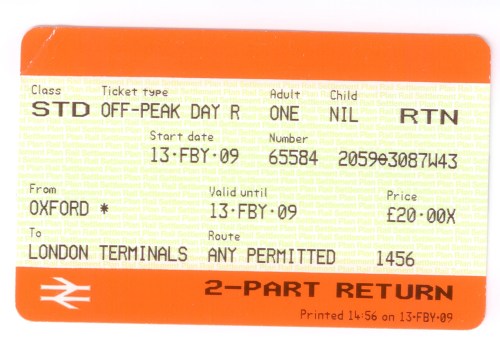
oxford-ticket-13-feb-2009I got some news on Friday that I’m thrilled to have received, to say the very least. It’s one part of a triple threat, a trifecta even, of excellent possibilities, and it is seeming rather possible right now that by this time next week, I will have found out that the other two, and thus all three, have occurred.

My only gripe is that I was hoping that I might have heard this before we went to England, so that celebrating these bits of news might be yet another pretense for the trip.

That’s okay; it just means we’ll have to go again.

But you were waiting to hear something about Oxford. Warning: this is perhaps going to be the most academically dense installment of this account. Apologies.

A couple of weeks before we left, I e-mailed my friend and Anglophile Mark Powell to see if he had any suggestions for things to do and see. E-mail Alexander Lingas, he said. He’s there.

Dr. Lingas let me know that, Friday evening, he would be delivering a lecture at Oxford’s Ioannou Centre for Classical and Byzantine Studies on Byzantine chant in Late Byzantium, and that we would certainly be welcome to come if we wanted.

I was of two minds about this, truthfully. I thought to myself, wow, what a neat opportunity to sample, even on a small scale, the academic life while we’re there, on a topic which is near and dear to our hearts, and discussed by somebody whose work we respect and have been influenced by, even.

On the other hand, that’s the same day on which we will have just concluded roughly seventeen hours of travel, and it will most certainly mean that we’ll be taking two trips to Oxford, since I was really hoping to show Megan around there (and convince her that it’s someplace we want to live and do postdoctoral work someday, but never mind that now).

Oh well. Guess we’re going.

Thus, after refreshing ourselves with showers and fresh clothes, we took the Tube to Paddington Station from Charing Cross (this is a lot easier than it initially looks on the Tube map, by the way; you just push the waste all the way in so that the door can close… uh, wait — what I meant to say was, just take the Bakerloo line north from Charing Cross to Paddington — it looks like this shouldn’t work on the map, at least at first glance, but it in fact does), and off we went. An hour later we were getting off at Oxford station.

I took us right to the Ioannou Centre (alas, the Cock and Camel, where I had a nice breakfast a year and a half ago, has been replaced by an Italian restaurant); it’s a rather new building, and I remember walking past it a year and a half ago thinking, “Hey, I need to figure out a way to visit this place next time I’m here.” (This is not the accomplishment of memory it sounds like; you go down the main drag from the train station till you get to the other main drag which is perpendicular to the one you’re on, go left, and after a block or two there it is on your left.)

We got to the hall a half hour early or so, which gave us an excellent opportunity to look like American tourists who obviously didn’t belong there, awkwardly standing outside a darkened lecture hall doing nothing while students and faculty were quite well-occupied around us. Still, people showed up soon enough to provide us fish out of water with a little bit of a pond.

The lecture, “Cathedral and Monastic Psalmody in Late Byzantium: Towards a Final Synthesis?”, was intended as an introduction to the issues surrounding the late medieval Byzantine repertoire for scholars who are in fact Byzantinists but not music specialists. Since I’ve read his dissertation, many of the broad strokes of what he discussed were not new to me, but it was very interesting to hear him sing off of the medieval manuscripts, as well as talk about some of the transmission issues with the medieval repertoire. What was great about hearing somebody like him talk about these things is that he was able to make clear that this is a part of a greater body of living tradition and practice; this is not just What Those People Back Then Used To Do.

A point which I very much appreciated: Dr. Lingas said that chant scholars such as Egon Wellesz have tended to discuss the Paleologean repertoire in the context of a narrative of overall cultural and political decline in Constantinople; of course, I’m reading The Fall of Constantinople: 1453 right now, and Runciman very pointedly observes (perhaps with people like Wellesz in mind) that culturally, Byzantium was quite alive and well even as the Empire was in its death throes. Anyway, as this particular narrative of decline has gone away, it’s been replaced by a narrative of specifically religious decline, bizarrely (at least to me) represented by a disappearance of congregational singing and the rise of professional-level, melismatic chant. “The end result is the same [in both narratives,]” Dr. Lingas said. “The cantor has hijacked the liturgy.” He took great pains to disabuse the audience of these notions, demonstrating that a great deal of continuity (but not stasis, he stressed) can be seen between the Paleologean material and the received tradition of the present day, and that by no means has the cantor hijacked anything. Since I have been the cantor getting accused of doing the hijacking, the defense to a general audience was most appreciated.

Following the lecture, we hung out for a bit at a reception for Dr. Lingas, talked with him briefly, had a lovely chat with a DPhil student there who is writing his dissertation on Galen (“I guess I specialize in pain,” he said), and then we needed some real food. We told Dr. Lingas we would see him at church on Sunday (“Great — it’s the day for Byzantine chant in English,” he said), and then hunted down a meal.

We found ourselves at an Irish pub chain restaurant called O’Neill’s; chain it may have been, but it was tasty and reasonably inexpensive, and a good place for a beer and some stew.

We were ready to head back — we’d be in Oxford again on Sunday, anyway. By this point, we had been up for close to thirty hours (give or take), and we were nodding off on the train back to London to say the least. Back in the hotel room, we were asleep before our heads even hit their respective pillows.

Travel tip: having an international flight arrive in the morning and then tiring yourself out so that go to bed at a normal hour is a great way to beat jet lag.

Next installment: When Your Definition of Modern Is Anything After 1400 or, How Emily Hindrichs Learned to Stop Worrying and Love Her Wig

Coming soon: Cappella Romana’s Greatest Hits, Vol. I (330-1453)

Well, sort of. Mark Powell tells me that to some extent, Music of Byzantium was the first “greatest hits” collection, but to me that’s the live album with some bonus tracks. This is a compilation of selections from their studio recordings of the late antique/medieval Byzantine repertoire, released as a companion to the Byzantium: 330-1453 exhibit now running at London’s Royal Academy of Arts. I don’t know that this is the kind of thing that will really scream for a full-on review since it’s all previously-released material, but we’ll see. It certainly looks like a disc that will be a terrific introduction to medieval Byzantine chant as well as to Cappella Romana, and worth recommending on that basis at least. This will only be available in the UK for a bit yet, but it will eventually be out here, I’m told. You can order it online here, but shipping from the UK will double the cost. I’d just wait for the US release (or, if you’re going to the exhibit anyway, buy it from the gift shop in person).

Here’s the press release. I have taken the liberty of linking the recording titles to the pages where they may be purchased. I have them all and can recommend them all; I will say that The Fall of Constantinople and Byzantium in Rome tend to have higher production values than the other two in my opinion, and Music of Byzantium contains live versions of much of the same repertoire as The Fall of Constantinople, sometimes with interesting differences (and sometimes with a door slamming right in the middle of a number — ah, live music). Don’t let the price for Epiphany scare you; it’s out of print at the moment, but Mark says that it will be re-released at some point.

CAPPELLA ROMANA
FOR IMMEDIATE RELEASE
Contact: Mark Powell, mobile 503-927-9027; msg line 503.236.8202; E-mail mark@cappellaromana.org

London’s Royal Academy of Arts
Releases New CD Recording by Cappella Romana
for its Mega-Exhibition “Byzantium 330-1453”

25 October 2008 — PORTLAND, Ore, USA; London, United Kingdom — Cappella Romana announces the release of its 11th recording, the official companion CD commissioned for the exhibition, BYZANTIUM: 330-1452, at London’s Royal Academy of Arts (25 October ’08 to 22 March ’08. http://www.royalacademy.org.uk)

The Royal Academy calls this new CD “A glorious collection of choral music which traces the rise and fall of the Byzantine Empire, all sung by the world’s leading performers of Byzantine chant, Cappella Romana.” The ensemble’s first museum exhibition CD, Music of Byzantium, commissioned by the Metropolitan Museum of Art in 2004, sold 12,000 copies.

The new CD, Cappella Romana’s third release in 2008, is a compilation of earlier recordings. It features tracks from Epiphany, Cappella Romana’s first full-length recording of Medieval Byzantine chant, as well as from the CD titles The Fall of Constantinople, Byzantium in Rome, and Music of Byzantium.

The disc will initially be available in the UK and Europe exclusively through the Royal Academy. Beginning in November 2008, the title will be distributed and sold in North America through Cappella Romana (www.cappellaromana.org) by special arrangement with the Royal Academy.

The Royal Academy of Arts in London is the fourth major world museum to have engaged Cappella Romana for its expertise in Medieval Byzantine Chant, joining these three institutions:

* The Metropolitan Museum in New York (Byzantium: Faith and Power, 2004; with CD selling 12,000 copies)
* The J. Paul Getty Museum in Los Angeles (Byzantium and the West, 2004 and Icons from Sinai, 2006)
* The Smithsonian Institution in Washington, D.C. (In the Beginning: Bibles before the Year 1000, 2006)

The first evening lecture of “Byzantium: 300-1453” will be given by Dr. Alexander Lingas, Cappella Romana’s founder and artistic director, on 7 November. Titled “The Heavenly Liturgy: Byzantine Psalmody to 1453, ” it will be enhanced by sung demonstrations by Dr. Lingas, Cappella singer John Michael Boyer, and three cantors from Hagia Sophia Cathedral, London.

The Royal Academy’s exhibition has received major press coverage in the UK and throughout the world, including a review and photo essay in Time magazine (Fri., 24 Oct. 2008).


adventures in writing alexander lingas all saints bloomington all saints orthodox church american orthodox architecture american orthodox music american orthodoxy Antiochian Archdiocese Antiochian Orthodox Christian Archdiocese of North America Antiochians books byzantine chant cappella romana chant church architecture ecclesiastical chant ethnomusicologists ethnomusicology fellowship of ss. alban and sergius Greece Greek greek food greekness hazards of church music international travel tips ioannis arvanitis joe mckamey john michael boyer kurt sander Latin liturgical adventures liturgical architecture liturgical music liturgical texts and translation liturgy liturgy and life lycourgos angelopoulos medieval byzantine chant Metropolitan PHILIP militant americanist orthodoxy modern byzantine architecture modern greek music music as iconography my kids will latin and greek when they're newborns my kids will learn latin and greek when they're newborns orthodox architecture orthodox architecture is bloody expensive Orthodox choir schools Orthodox Ecclesiology orthodox outreach orthodox travel pascha at the singing school Patriarchate of Antioch Patriarch IGNATIUS IV Patriarch of Antioch publishing random acts of chant richard barrett in greece richard toensing rod dreher sacred music st. vlads st john of damascus society Syriac the Bishop MARK fan club the convert dilemma the dark knight The Episcopacy The Episcopate the only good language is a dead language this american church life travel we need more american saints why do we need beautiful music in churches?

Blog Stats

  • 262,832 hits

Flickr Photos