 As someone who has sung in church at a more-or-less professional level for many years and who always had a deep love and appreciation for, shall we say, more historic forms of liturgical music, when I first became aware of Orthodox Christianity it was a very natural instinct for me to seek out this aspect of the faith. The trick here, of course, is that when you don’t know what you’re looking for it’s a bit difficult to find it, but eventually what I found was the Boston Byzantine Choir‘s recording of the Divine Liturgy, called Mystical Supper: Byzantine Chant in English. I was quite struck at how similar the approach on this recording sounded to something like Shapenote/Sacred Harp singing, to say nothing just how much of the service was sung rather than spoken. When I told my friend Mark Powell about this, he said simply, “Listen to the Greek Byzantine Choir’s recording of the Divine Liturgy in Greek. Then we’ll talk.” It was not an easy recording to find in the States in 2003; I wound up having to order it from a Canada-based Hellenic specialist, as I recall. (It’s much easier to find these days, at least for the moment. Amazon seems to no longer sell it directly — which has changed from a month ago — which suggests to me that the current pressing is gone, the distributor is out of stock, and whoever has it, has it, whoever doesn’t, doesn’t.) This recording really blew the lid off of my nice, safe, clean world of church singing, and redefined a lot of my expectations. Between that and getting to hear Cappella Romana‘s Fall of Constantinople program in the summer of 2004, I began to develop a strong affinity for the Byzantine repertoire.
What I didn’t learn, and what I wouldn’t fully appreciate until I was leading an Orthodox parish choir myself for the first time, from these exposures to Byzantine music — which are, admittedly, highly-idealized “best case scenario” presentations; as one musicologist told me, “Field recordings made at monasteries in Greece don’t sound anywhere close to the Greek Byzantine Choir” — is how divisive the repertoire can be for some people. It is clear that for certain ears, the otherworldly musical characteristics are, to say the least, less transcendent than foreign — “music to whip camels by” and “the nasal-sounding stuff the old man sings before the Divine Liturgy” being among the characterizations I’ve heard. I’ve even heard somebody say that Byzantine music “sounds more like the Muslim call to prayer than Christian singing.” The common assertion appears to be that there’s no way to make Byzantine music sound “friendly” to Western ears — it’s always going to sound like an ethnic import, “too Arabic” or “too Greek” or too something. A related concern is that it’s unison singing (save for the ison, the drone underneath), and Western ears expect four-part harmony as a non-negotiable given, period. It is certainly fair to say that Byzantine music is not appropriate for harmonization; this is for the simple reason that the conventions of four-part harmony are based on a tonal system, and Byzantine music is modal. You can’t harmonize a modal melody according to tonal conventions (i. e., “What Would Bach Do?”) without largely eliminating the distinctives of the given mode (as can be made clear when a new cantor instinctively, but erroneously, assumes that the ison for Byzantine Modes 2 and 4 is supposed to be C/Ne instead of G/Dhi and E/Vou, respectively).
There’s also the more specific complaint that Byzantine music doesn’t play well with English. This is a view shared by some rather visible and influential people; for example, the Preface of Mother Mary and Metropolitan Kallistos (Ware)’s edition of The Festal Menaion (St. Tikhon’s Press, 1969) says the following:
In course of time English-speaking Orthodox will doubtless evolve a musical tradition of their own, which will takes its place alongside those of Greece, Russia, and the other Orthodox nations. As yet, no such tradition has had time to develop: and Orthodox of English language must therefore draw for the present upon some existing musical heritage within Orthodoxy. The best adapted for this purpose seems to be that of Russia. Byzantine chant is too intricate: if it is to be used, then the stress and rhythm of the Greek original must be preserved almost exactly in English translation, and this raises insuperable difficulties. But Russian music is far more flexible; and in particular the simpler Russian monastic chants can easily be adapted to an English text. (p. 13, emphasis mine)
I have to be honest and say that I find this to be an odd claim (and yet one which seems to have influenced the assumptions and thinking of many people since its publication); it seems to me that Byzantine music is far more extensible and expressive when it comes to being adapted to English texts, where many forms of Russian chant, at least as presently used in English adaptation, tend to utterly disrespect the needs and conventions of English. It’s true that in many of the attempts to adapt the Byzantine repertoire to English — Kazan’s Byzantine Project, for example, being the one I use week in, week out — it seems like one winds up with melismas on odd words or emphases on the wrong syllables and so on, but I’d argue only that this means we haven’t perfected the system of adaptation yet (or perfected the English version of the text, for that matter), not that it fundamentally can’t work or that somehow we need to “file the corners off” of Byzantine chant, or in general make it something it isn’t, in order to make it work for English-speakers.
But nonetheless, the assumption is held by many that Byzantine chant fundamentally won’t work for English-language, Western Orthodox folks. The lengths to which some marginalize Byzantine music as being merely one of those pesky, overly ethnic, “little-t traditions” which drive away people who are culturally Western is demonstrated by a recent discussion on the PSALM Yahoo! group which involved speculation as to whether or not use of Byzantine chant might contribute to a decline in attendance in parishes.
Which brings me, at last, to Cappella Romana’s masterful, ground-breaking new release, The Divine Liturgy in English, which serves as the definitive response to all of these concerns, providing a fantastic model to emulate, transparency enough in the process to make it replicable, and, for the foreseeable future, the standard to meet for liturgical singing.
This is the recording of Byzantine chant in English which says, “Yes, we can.” This is the CD which you will see wearing black body armor and fighting off Rottweilers on an IMAX screen and telling Michael Caine, “Byzantine chant in English has no limits.”
Several years in the making and part of Cappella Romana’s “Excellence in Orthodox Liturgical Music in English” project — which includes the delightful Lay Aside All Earthly Cares, a collection of the liturgical music of Fr. Sergei Glagolev, which I’ll say more about shortly, and a future release of a Divine Liturgy setting by Peter Michaelides — this 2-disc set represents the monumental effort of adapting the traditional Byzantine repertoire so that it fits the English language idiomatically, often recomposing melodies from scratch in order to match the text. Conducted by Artistic Director Alexander Lingas, these settings are presented in a natural church acoustic, using native English speakers, and in their proper liturgical context, with Archimandrite Meletios (Webber) and Dn. John Chryssavgis serving as the clergy. The result is at once prayerful and phenomenally well-sung, full, rich, and in tune, and entirely Byzantine in character while never straying from understandable, natural-sounding English. It is ecclesiastical ensemble singing of the highest order, easily ranking with the recordings of Lycourgos Angelopoulos and the Greek Byzantine Choir, as well as with the best of English-language recordings of liturgical music such as those by the Choir of King’s College, Cambridge.
Because it is a Divine Liturgy entirely sung in one musical idiom, and therefore comes across as a seamless garment of whole cloth as it were, it is difficult, if not inappropriate, to make critiques of particular sections, so I’m not going to do that. I would say that the best way to get a sense of exactly what has been accomplished with this recording is to become familiar with a recording of the traditional Greek repertoire such as Angelopoulos’, getting a sense for the function and aesthetic which govern hymns such as the Trisagion or the Cherubikon, and then to listen to this recording and hear how those principles are maintained in the English language adaptation. The exact notes of the Greek versions are not preserved because they’ve applied the Byzantine compositional process to the English text, not simply slapped the existing Byzantine melody over the English text and then figured out how to make the syllables fit. The result is a new melody which is completely faithful to the spirit of the model and the conventions of Byzantine music, and fits the English text like a glove at the same time. These adaptations — which Cappella Romana are publishing on their website in both Byzantine and Western notation — range from simple and syllabic (such as the troparia and the Anaphora) to florid and melismatic (the Dynamis of the Trisagion, the Cherubic Hymn), according to the rubrics and intended liturgical function. The booklet credits John Boyer, Protopsaltis of the Greek Orthodox Metropolis of San Francisco, with much of the work of adapting of the chants, and his sensitivity to the English text while maintaining the Byzantine ethos is to be highly commended.
Let’s be clear — The Divine Liturgy in English is not intended as a musicological curiosity for specialists, but rather as a practical liturgical model for the wider Church. In other words, this is meant to be a clear demonstration of how we can do things now, not an obscure example of how some people used to do it. As such, the set presents a complete Divine Liturgy as would be found on a typical, non-festal Sunday after Pentecost (a “vanilla Sunday” as some choir directors jokingly call it). This includes the celebrant’s spoken prayers, the Epistle and the Gospel, as well as the full Alleluia and Prokeimenon with verses — only a homily is omitted. (An argument can be made that the way they’ve harmonized the various Typika, they’ve in fact left some things out such as the Beatitudes, but this is addressed in the liner notes.)
Among the many delights of this recording is the text. The official translation of the Archdiocese of Thyateira and Great Britain is used, the product of a panel involving scholars and clergy such as Archimandrite Ephrem (Lash), Metropolitan Kallistos, and Fr. Andrew Louth. Certain renderings are initially unfamiliar — in particular, the use of “Mother of God” instead of Theotokos, and “Holy Strong” in the Trisagion — but It is nonetheless a wonderful translation which adheres quite closely to the Greek text. The booklet includes a helpful essay by Archimandrite Ephrem about the methodology and pastoral principles guiding the Thyateira translation. “Holy Strong” is arguably closer to the actual meaning of the Greek text than “Holy Mighty,” despite the English tradition of the text; see this paper for a thorough look at translating the hymn. I would have liked the “Mother of God” usage to have been addressed in the liner notes; as it is, it is unclear why the Greek word Theotokos, surely standard usage for English-speaking Orthodox by now, is not retained when Greek words such as Dynamis are. Such questions aside, the Thyateira text is an incredible effort which would ideally influence future undertakings of the translation of liturgical texts.
I will admit to being somewhat puzzled as to why, given the clearly considerable vocal resources Cappella Romana has at its disposal, antiphonal choirs were not used; the liner notes say that “some elements of of the traditional interchange between two choirs are preserved through the use of alternating soloists”, but this strikes me as an unnecessary reduction given everything else they go out of their way to achieve on the recording.
Another major plus of this recording is something which actually isn’t sung — it includes the entire ensemble speaking the Creed and Lord’s Prayer with conviction. This is sadly lacking on the Mount Lebanon Choir recording, where one guy limply reading the prayers into a microphone is too-obviously spliced in after the fact.
Can the musical level achieved on this set, and/or the acoustic in which it was recorded, truly be seen as practical or normative? To be sure, the kind of training needed to meet this standard is not yet widely available in the United States, and many parishes do not have the resources to either provide such musical instruction or to give attention to proper acoustics in their building design. Nonetheless, The Divine Liturgy in English should be understood as a presentation of the “best-case scenario” to which liturgical singers may aspire. As well, Lingas opts for an all-male ensemble — the traditional arrangement, certainly, but unlikely to be the pastoral reality in most places.
The Divine Liturgy in English also shows the way for future adaptations of other Orthodox liturgical music into English, not just Byzantine. To slavishly preserve music written for a different language when adapting it to English is to miss the point of adaptation; that approach does violence to the language and, eventually, the music as well. Rather, those who would adapt the chants for use in a different language must understand the principles which guided the composition in the first place, and then apply those to the new text, while preserving the spirit of the original as much as possible. The music on the previously-mentioned disc of Fr. Sergei Glagolev’s liturgical settings — I said I’d get back to him, didn’t I? — demonstrates his own mastery of how this works for music in a Russian idiom; it is identifiably Slavic in terms of musical character, while still being sung, and sung well, in natural-sounding English in a way which does not obscure the meaning of the text. Perhaps with both the Glagolev settings as well these Byzantine adaptations, one inevitably runs into the objection, “Nobody knows them!” That will simply take time to overcome.
Cappella Romana’s recording is no less than a gift to the English-speaking Orthodox world which will inspire and instruct. Thyateira’s Archbishop Gregorios writes in the liner notes that The Divine Liturgy in English is intended to “increase the understanding and appreciation of both the spirituality of Orthodox worship and the heights of musical expression to which its chanting aspires”; this it does stunningly well. Highly recommended (in case that wasn’t clear by now).
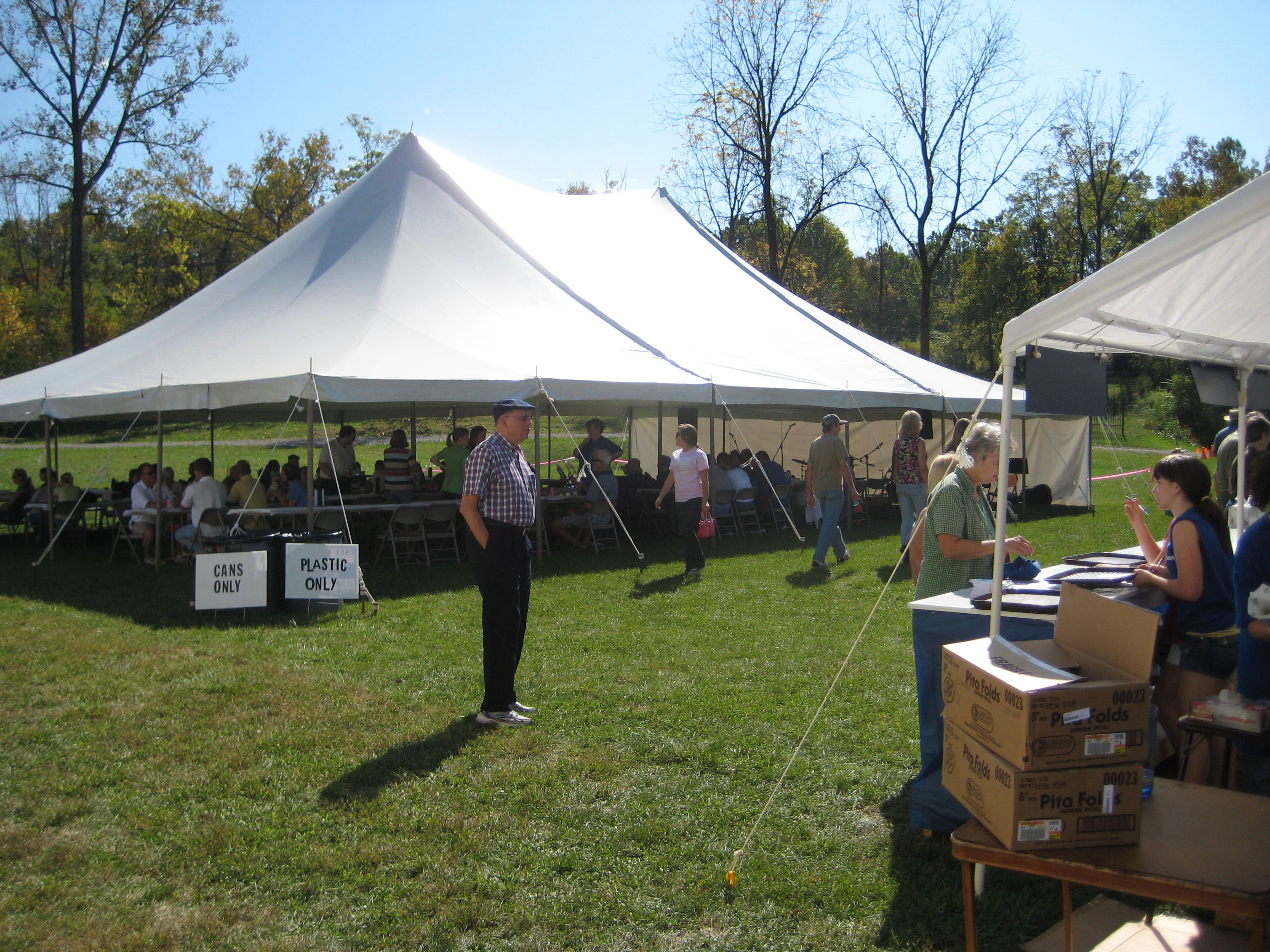
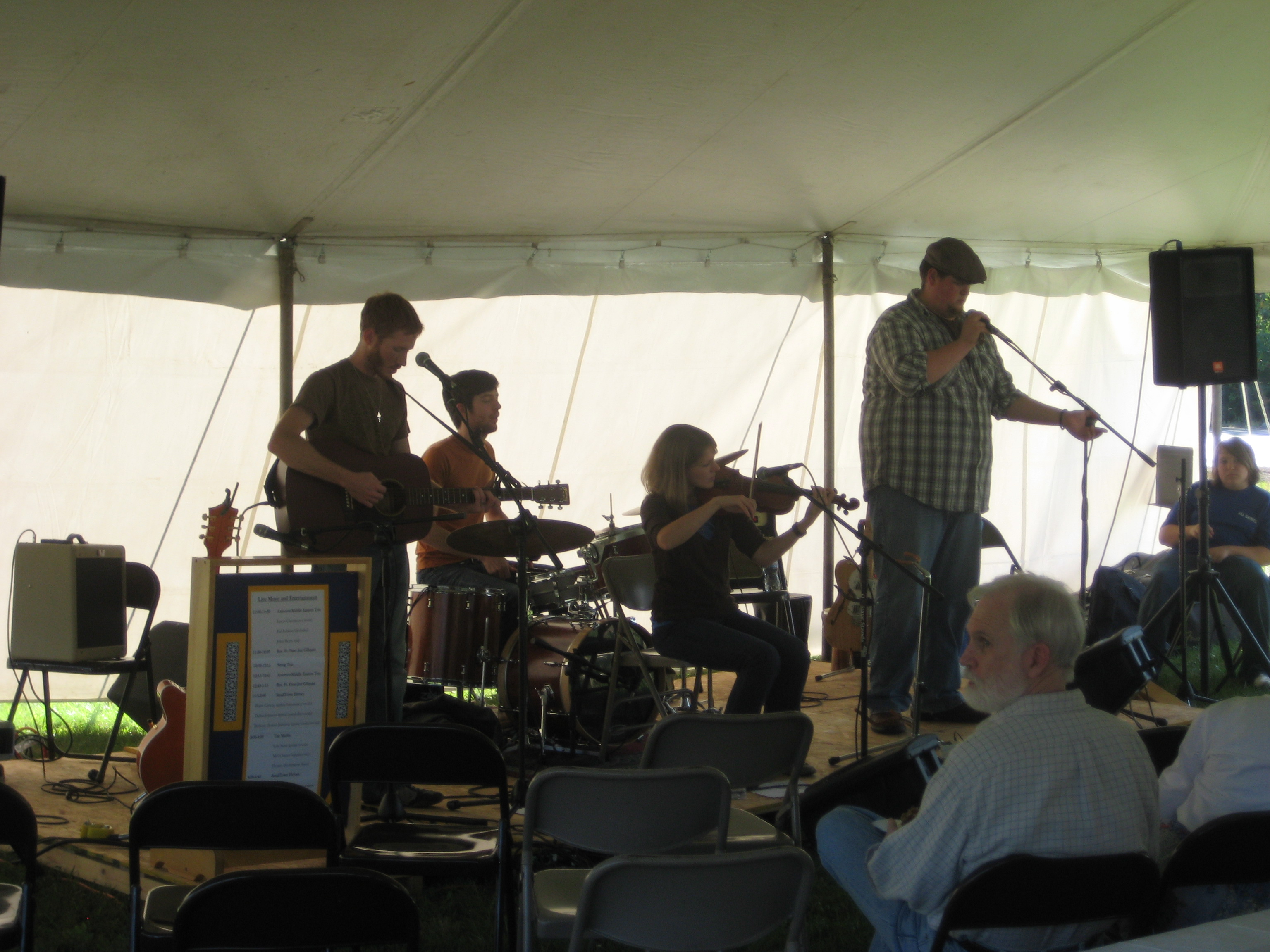
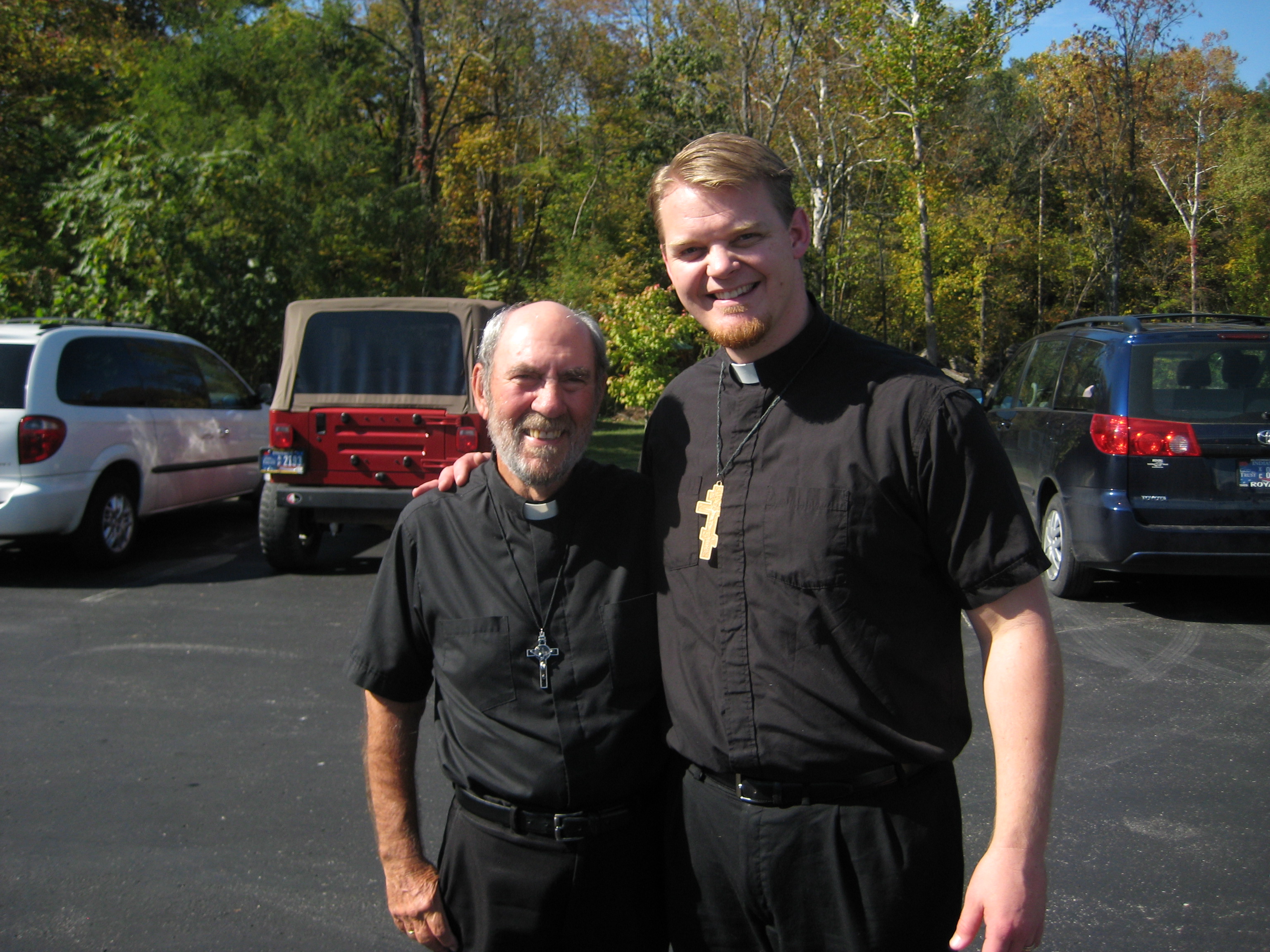
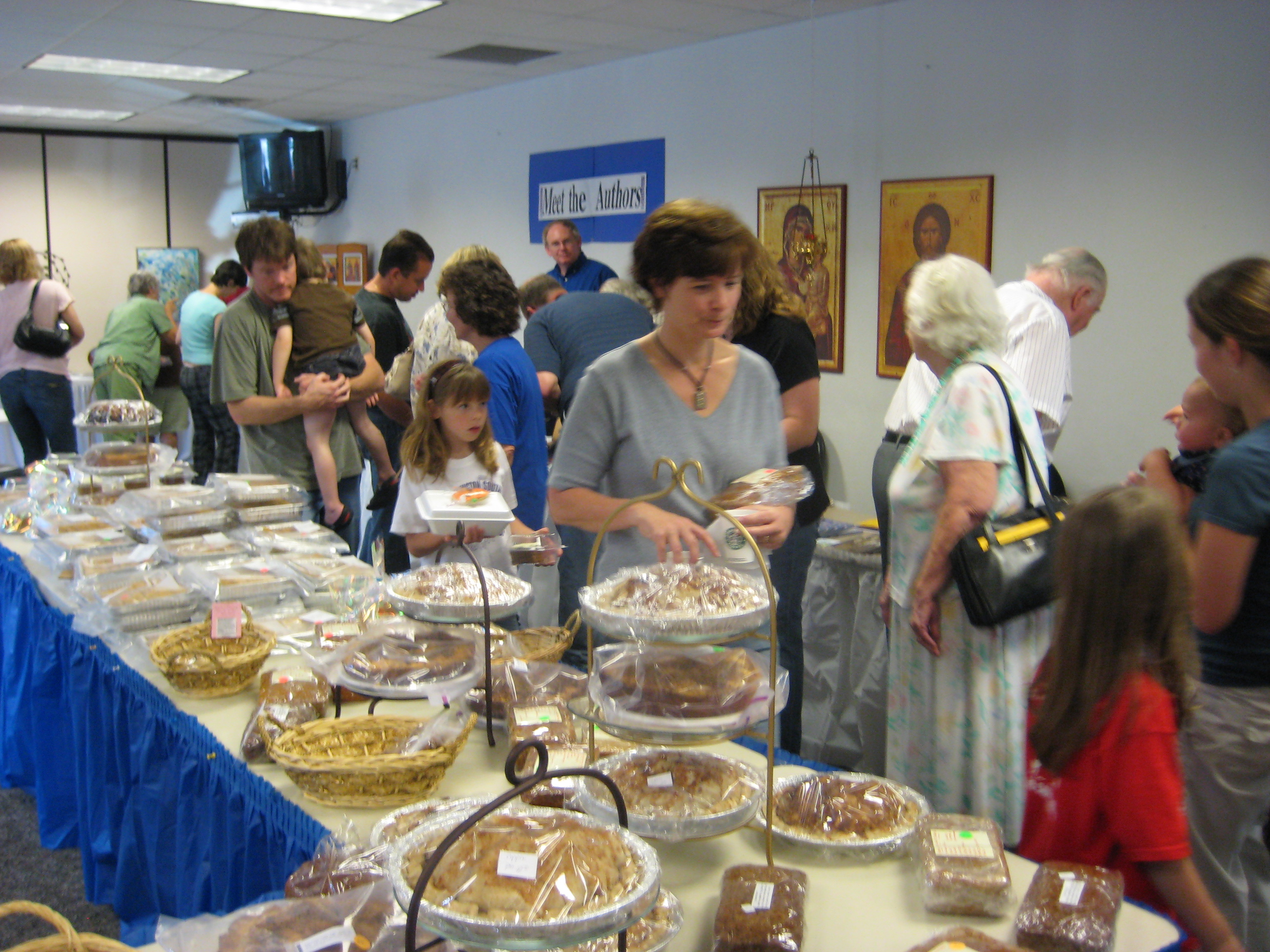 Something resembling a Greek or Middle Eastern festival is a staple of Orthodox parish life, it seems, and All Saints is no different — although we don’t call it a Greek or Middle Eastern festival, we just call it “The Festival on Fairfax” (Fairfax Road being where All Saints is located). Once a year, the community pulls together, throws open its doors to the world, and busts out the tsatsiki. Not to belabor a previously expressed point, but we legitimately have the best gyros in Bloomington, thanks to Johnny Ioannides (whose name I will continue to shout from the rooftops, since they’re just that good) — it’s just too bad it’s the only regularly scheduled day of the year they are publicly available.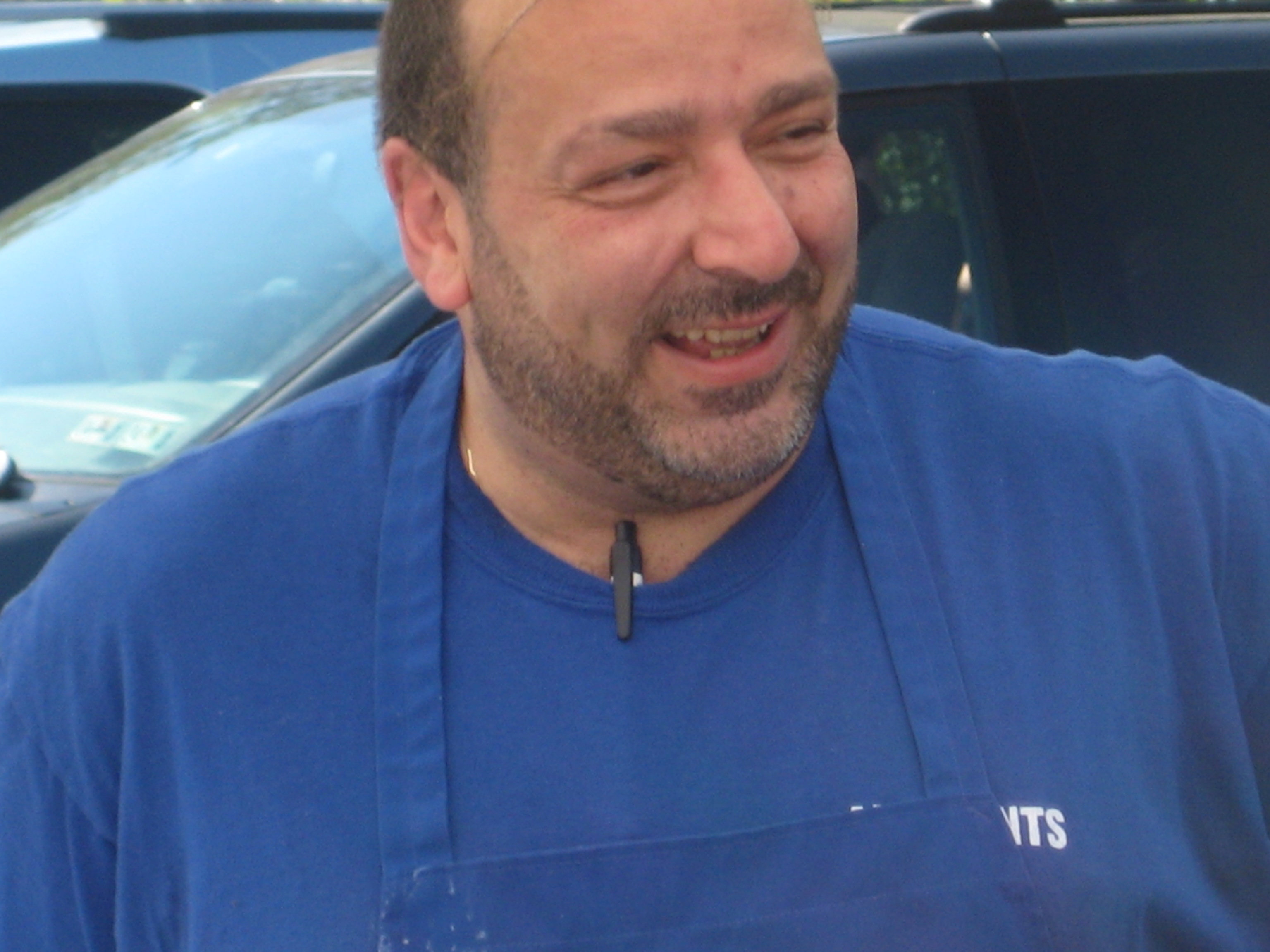
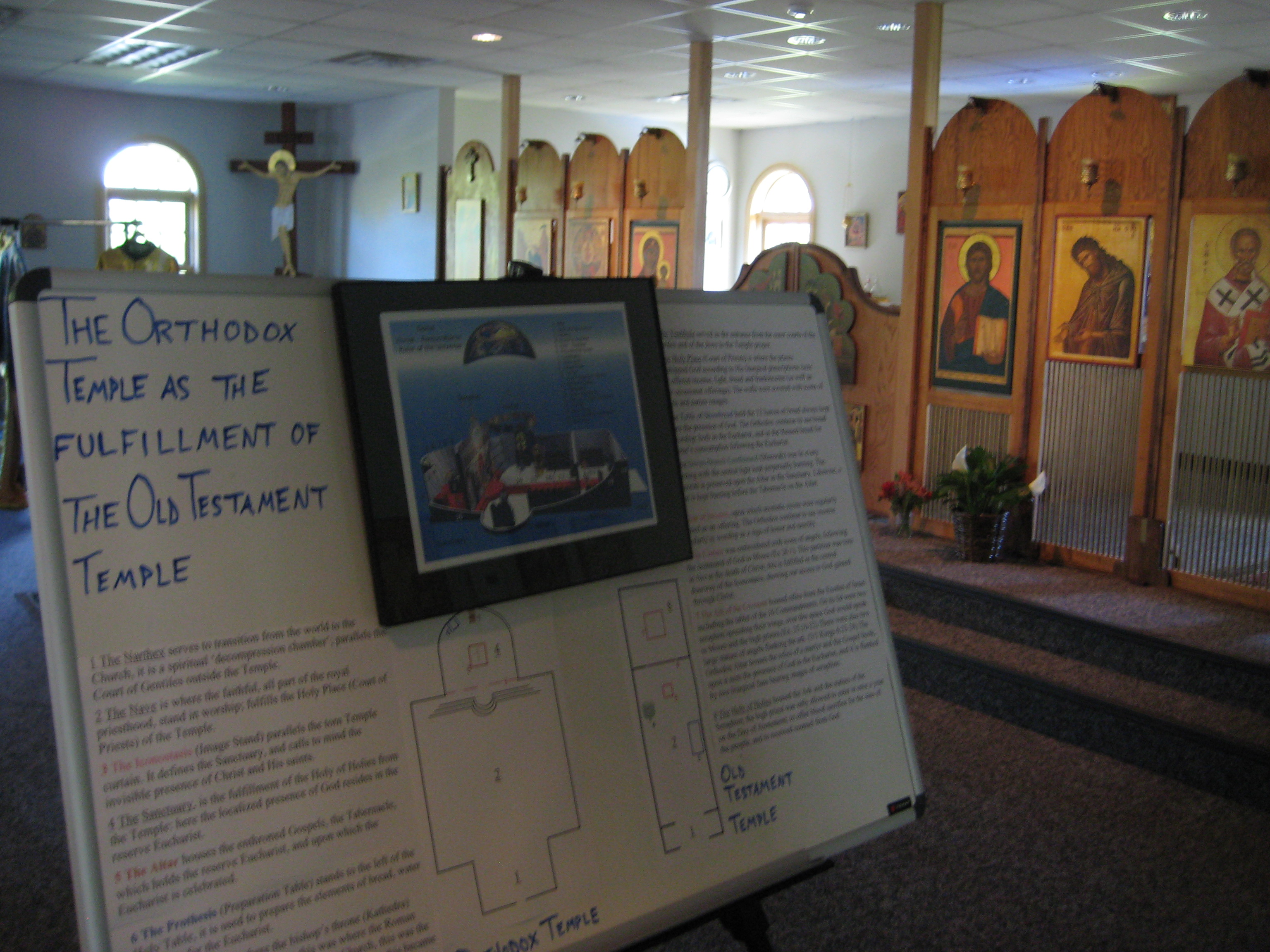 Anyway, here are some of the pictures I took throughout the day. Church tours are, of course, something we do, and there’s an information board we post relating the interior of an Orthodox church building to the interior of the Jewish temple. The big colorful image (blown up below) is, shall we say, a rather idealized digital model of a traditional Byzantine structure. I agree with my godson Lucas (who put the board together, and conducted the tours) that it would be nice if there were formal diocesan guidelines for building churches something along the lines of “come as close to this as you possibly can”; alas, much of Byzantine church architecture seems to assume the existence of an Emperor and his treasury, and the readiness of same to pay for things. Very tough for a smallish working class community to be able to come anywhere near this (as you can see from the acoustic tiles filling in for the dome).


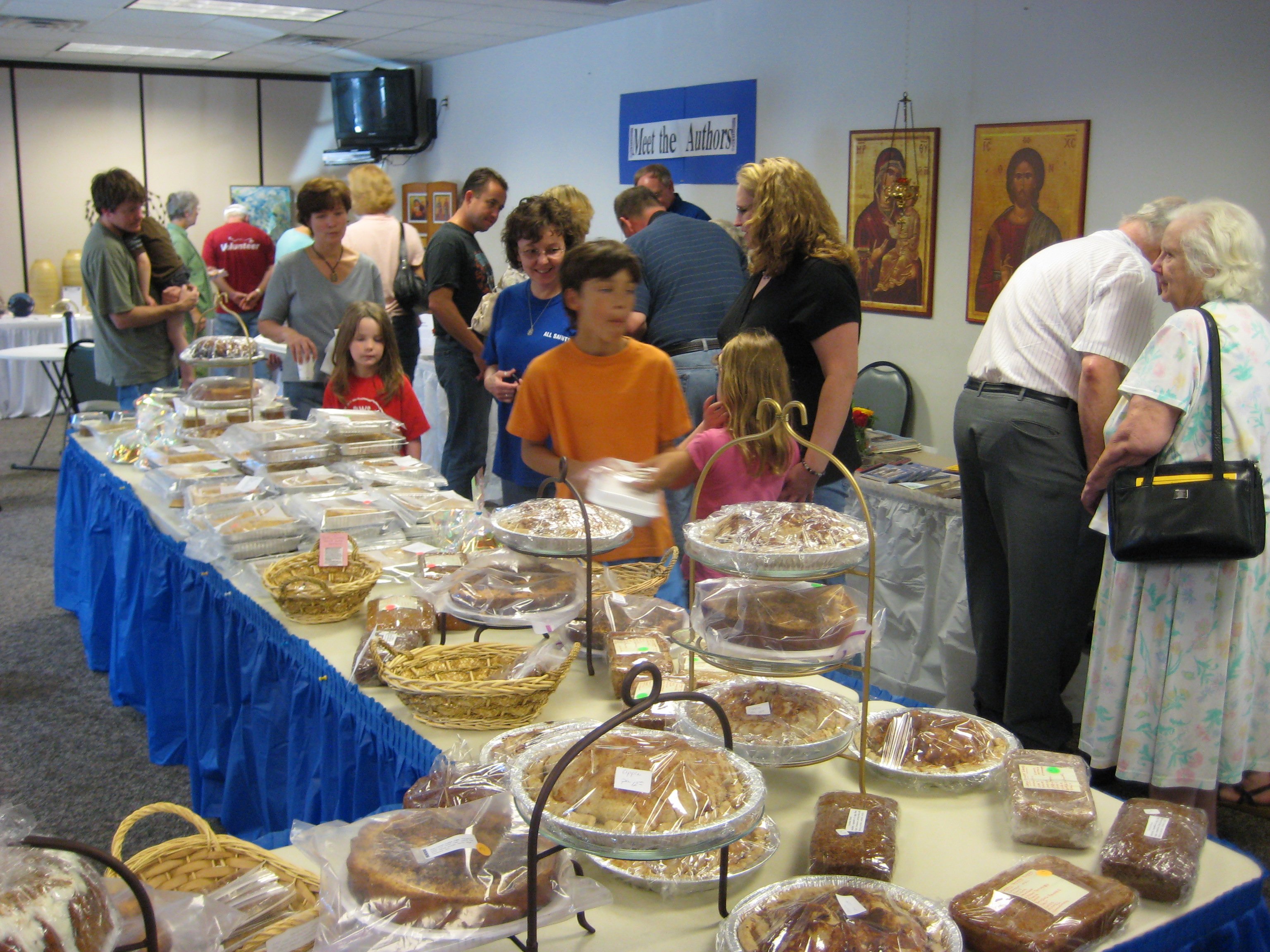 Besides tours of the nave, we also had the bake shop and silent auction inside the church. You want baklava? We’ve got baklava. Or, well, at least we did. You snooze, you lose. The parish bookstore was also open for business, and we had copies of Cappella Romana‘s The Divine Liturgy in English for sale and displayed prominently, natch.
 Cappella Romana has been good enough to allow me to post the link to the newsletter subscribers-only preview for “Richard Toensing: Kontakion on the Nativity of Christ.”


 Leitourgeia kai Qurbana: Contra den Zeitgeist