Posts Tagged 'byzantine chant'


Newsflash from New Liturgical Movement: “Chant and polyphony call for a live space with a natural acoustic”

Jeffrey Tucker at The New Liturgical Movement briefly talks about issues related to amplification and acoustics within a nave. It’s a few days old now, and the points are reasonably obvious, but nonetheless worth making. This section in particular, uh, resonates with me:

The liturgical choir, however, is there to assist the ritual and be part of a sound framework that is broad and inclusive of the entire space — to be part of something larger than the sound it is making.  […] Chant and polyphony call for a live space with a natural acoustic, and… [thus] I’m not sure that it is really possible to talk about acoustics without dealing with the style issue. How a parish deals with the issue of [acoustics] can be very revealing as to what the designers and decision makers regard as the modal music of parish life.

This is an issue with which the people who sing at my parish are currently struggling (including the priest); it is a building which was built in 2001 as a temporary space, intended in the long term to be the education wing of a larger complex which was intended to include a bigger Byzantine-ish temple with, likely, a reasonable acoustic. Because the nave was going to be classroom space eventually, it was built as acoustically dead as they could possibly manage. Low ceiling, ceiling tiles, carpet. The room actually sucks sound out of you before you ever have a chance to phonate — and that’s a feature, not a bug, according to the people who helped plan the current space. They figured the bigger complex was just a few years down the road, so it wouldn’t really be that big of a deal.

Well, already in 2003, they were realizing it was probably going to take another ten years before they would be able to build the church on which they had counted; now, eight years after the current building opened its doors, we’re looking at likely ten years before we’ll be able to knock down a couple of walls to expand what we have, let alone build another building. What we have is what we have, and that is not likely to change any time soon.

As a result, the conversation has shifted to how we can make the most of our “temporary” space that hasn’t actually turned out to be temporary. This effort was begun in earnest this last January, and a good amount has been accomplished since those pictures were taken. Still, a coat of paint isn’t going to fix the acoustics, and our focus is turning to what we can do about the acoustics. For me, it’s not an abstract question; it’s like singing into a wet towel, and I’ve been doing it for six years now. It takes a toll.

Truth is, there’s little we can do. The support beams in the structure above the ceiling tiles are horizontal; we’d get maybe eight inches if we took them out. This means we can replace the carpet with something less absorptive, like beauty bark, and/or replace the ceiling tiles with something a little less absorptive. The trouble is the next question which gets asked: how do we justify spending the money to do any of that when this building is intended to be something else in the long run, and spending the money now would simply set us back farther from being able to build the next phase?

I bring all of this up for two reasons. First of all, if there’s anybody who reads this who has solved a similar problem or has ideas regarding how this problem could be solved, I’m all ears, baby.

Secondly, I think this comes back to Mr. Tucker’s point: how those involved with decision-making at a parish deal with acoustics says a lot about what they think is important with respect to music. To that end — let’s be real, guys, we’ve got a 90% sung Liturgy. If it can’t be heard past the third row when the choir is screaming themselves hoarse, that’s a problem. I entreat anybody reading this who is ever involved either with mission planting or the building of a new church building — plan for the acoustics. Plan for the choir. Plan for the vocal health and longevity of the people who sing. Put a mission in a space that is reasonably live — nonstandard acoustics will hurt you, not help you. Involve the cantor/choir director in the design of a new building — they will be able to tell you what they need, and at a minimum, a vaulted ceiling with a floor that isn’t one giant sound absorber should be treated as a reasonable starting point. In general, please don’t deliberately hobble your singers and then say, down the road, when asked about it, “Sorry, we actually intended it that way.” Your clergy will thank you, too, particularly during Holy Week.

These things, truly, are not “nice to haves”. They are “need to haves”. It’s not a snobby musician thing; it’s the fact that if we get callouses on those two little flaps of flesh in our vocal tract, we’re done.

Churches are the last venue where one is at all likely to hear live, unamplified music anymore on a regular basis; we aren’t going to hear it at home, we aren’t going to hear it at school, and heck, a lot of the time we aren’t even going to hear it in an opera house anymore — and even in a lot of churches you’ll find amplification out the wazoo. Our ears have become accustomed to the nonstandard room as being the standard, and then just being able to turn up the volume if we can’t hear something. I cringe every time I see somebody chanting into a microphone; somebody has missed the point in that instance, and it’s either the person insisting on using the microphone or the person who has insisted that the cantor needs a microphone.

For further reading, I suggest Thomas Day’s Why Catholics Can’t Sing. I also published an article a few years ago in The Journal of Singing on this topic — maybe I’ll repost the text here.

Ethnomusicology: “Right Singing in Estonian Orthodox Christianity: A Study of Music, Theology, and Religious Ideology” by Jeffers Engelhardt

As I’ve more or less said before, I’m not an ethnomusicologist, but my interests do tend to at least touch things ethnomusicologists care about and vice versa. Thus, I at least keep my eyes open, and also as I’ve noted before, I’m in a good place to to do so (at least for the next two weeks).

The current issue (Winter 2009, Vol. 53, No. 1) of Ethnomusicology: The Journal of the Society for Ethnomusicology has an article titled, “Right Singing in Estonian Orthodox Christianity: A Study of Music, Theology, and Religious Ideology,” by Amherst College faculty member Jeffers Engelhardt. It is “an intimate musical ethnography of how Estonian Orthodox Christians at a small parish in Tallinn are making their liturgical singing ‘right'” (p.32), and seeks to examine the questions,

What do musical change and religious renewal reveal about the dynamic interrelationship of theologies and musical styles? How are orthodoxy and orthopraxy established musically? How do local histories condition the possibility of current and future practices? (p.32)

These are great, practical questions, and Prof. Engelhardt has been able to base his exploration of them on practical experience — between 2002 and 2007, he spent a lot of time conducting field research at Cathedral of Saint Simeon and the Prophetess Hanna in Tallinn, including singing in the choir (although, as he notes, he is not an Orthodox Christian himself).

Prof. Engelhardt makes several excellent points and observations; he places his work in the context of religious renewal for Christians in general in Estonia, which is “a process of investing their lives in the post-Soviet order with a particular morality and soteriology.” Estonian religious renewal is significant because

[it] both recognize[s] and resist[s] conventional aspects of the modernity mythologized in post-Soviet and postsocialist transition and ostensibly figured in the European Union: democracy, liberal pluralism, secularism, free markets, cosmopolitanism, universal human rights, consumerism, individualism, “normalcy,” and benign nationalism. (p.36)

For the Orthodox Christians in particular, “right singing” is an ideal which exists in this context;

it is a musico-religious poetics whereby Orthodox Christians are transforming understandings of personhood, human ecology, and secularism in Estonian society through sonic ideals that have decided moral and ideological dimensions. […] Thus, the musical and liturgical practices, congregational life, and institutional affiliations of local Orthodox communities in Estonia bring together a host of aesthetic, theological, social, and ideological concerns. All of these concerns coalesce in the idea lof right singing… [which] is a conduit of illumination and transforms invidiual and corporate bodies into Orthodox bodies of Christ. Right singing creates the correct unity of doxa (belief) and praxis (practice) that is the conservative essence of Orthodox Christianity. (Ibid.)

Prof. Engelhardt follows up on this point by suggesting that “[i]f the singing is right, then the belief expressed in that singing is right; if the belief is right, then the musical practices grounded in that belief are right” (p.37).

In other words, religious renewal in Estonia is not just about reclaiming something repressed during the Soviet era but about fundamentally trying to reshape the world around them into something consonant with their Christian faith; furthermore, “right singing” is not just an expression of these aims for the Orthodox Christian in Estonia, but one of the instruments through which the aims will be completed.

Given this, one of the really interesting points of Prof. Engelhardt’s analysis of the Cathedral’s practice is when he speaks of using Byzantine music for special Liturgies, such as a specific example where a parishioner was to be ordained to the diaconate.

There are a number of reasons why [the Cathedral] would use [Byzantine music] to make this liturgy special. Singers, priests, and parishioners at the Cathedral…invest Byzantine chant and styles of singing perceived as temporally or geographically distant with special significance. These ways of singing are right because they sound the right religious ideology and create the right religious imaginary [sociological term referring to a set of values, institutions, laws, and symbols common to a particular social group and the corresponding society]; they distinguish Estonian Orthodox musical practices from Russian Orthodox Obikhod-inspired practices. For [the Cathedral], Byzantine sounds are “right” because they are “more archaic” and “more monastic” than the Estonian Orthodox traditions with marked Russian Orthodox and Protestant Lutheran influences; Byzantine sounds bring worshipers to the “right level”… [and] Byzantine ways of singing are “more ascetic” and evoke the “feeling” that is such an important part of Orthodox Christian experience… [and] Byzantine ways of singing bring [the congregation] “to the source” of the Christian tradition[.] (p.39-40)

This interlocks with earlier point of how “right singing” (orthopsalmody?) is an ideal which exists in the context of religious renewal in Estonia: “[F]or Orthodox Estonians, the trajectories, geopolitics, ideologies, and moral norms of this kind of transition do not correspond entirely with the Orthodox lives they imagine leading” (p. 41), therefore

[r]ight singing is…how Orthodox Christians situation themselves within a global religious imaginary… [which] has enabled religious renewal and, in the process, established alternative, Orthodox perspectives on the modernity being fashioned through post-Soviet transition, reframing its liberal ideologies and doctrine of secularism. The Byzantine aspects of right singing, in other words, create a form of “morally inflected cosmopolitanism”…that is given voice through liturgical practice[.] (p.44)

He reaffirms and restates this point a little later:

In general, then, what is sung at the Cathedral…and, just as important, how it is sung, localizes temporally and geographically distant Orthodox sounds in order to make singing right… Byzantine is a chronotope (a temporal and spatial field of action) incorporating aspects of musical style, theology, and religious imagination that captures what singers sense as the archaic, originary, and more authentic qualities of their way of singing. Negotiating this kind of proximity…within a global Byzantine imaginary as part of the ongoing renewal of Estonian Orthodoxy and amidst ongoing social, economic, and ideological transformation, then, is a process of making singing right. (p.46)

Prof. Engelhardt concludes with some startlingly sympathetic observations:

The ideal of right singing gives voice to eternal religious truths that empower Orthodox Estonians to live faithfully and in relation to God, one another, and a global religious community. The soteriological, ethical, and affective dimensions of right singing are profound, and by singing the right way, Orthodox Estonians realize their full humanity through the unity of beauty and truth, aesthetics and veracity. […] By endeavoring to sing the right way… Orthodox Estonians work at incrementally transforming themselves, their Church, and their world into this likeness [of God]. Musical practice, in other words, is an agentive means of religious transformation as it shapes individual and communal disciplines, sensibilities, and moral actions. (p. 50)

Prof. Engelhardt’s ethnography is very thought-provoking, and it is remarkable how applicable the picture he paints of the situation in Tallinn is to the Orthodox church choirs in the United States I’ve seen or with whom I’ve sung. While not using the specific technical language of ethnomusicology and sociology, I’ve participated in many conversations about Orthodox liturgical music that wind up in largely the same place as this article. One question that comes to mind is, just as much as the “Byzantine imaginary” allows Orthodox Estonians a means to frame their responses to modernity, I wonder to what extent we might hypothesize that some Orthodox Americans, or even Orthodox Christians elsewhere, wish instead to synthesize modernity with the Byzantine imaginary? What does that look like? How does the synthesis differ from the response?

Now, a questionable point, at least for me, is methodology. A large portion of Prof. Engelhardt’s fieldwork depends on his perspective as a participant in the choir, and he acknowledges that while he is participating with the faithful, he is not participating as one of the faithful. Without getting into the question of whether or not one should sing in the choir if one is not Orthodox, I’ll just say that it begs the question of how his observations were colored by the perspective of a non-believing participant. I don’t doubt that it likely helped to make his observations as sympathetic as they are, but it seems to me that there are lines being crossed with this methodology. Again, I am not an ethnomusicologist, so I acknowledge I raise this question from a standpoint of ignorance, and I would be curious as to how an ethnomusicologist might answer this concern. One way or the other, this is a methodological approach that strikes me as at least requiring full disclosure — that is, it not being enough for the researcher to state that they are a non-adherent; rather, a statement of of what the researcher’s religious beliefs actually are is needed to clear up any ambiguities. I could very well be totally wrong on this point, and if I am, that’s fine, but that is my initial reaction.

In all fairness, Prof. Engelhardt acknowledges the problem to some extent, noting that not being an Orthodox Christian presents certain challenges to this kind of work:

The ideal of right singing gets at things that are hard for ethnomusicologists to get at: belief, faith, the numinous, and apophatic ways of knowing through negation rather than through the positive statements of modern scholarly practice. The challenge for non-Orthodox ethnographers like myself, then, is to apprehend at all the correct unity that makes singing right. (p. 37)

Another shortcoming is the bibliography; of 125 total references listed, literature which specifically treats Orthodox Christianity only gets six entries. Of those six works, four deal with Orthodox sacred music, three of which focus on Russian practice. Given the prominence of Byzantine chant in the ethnography, it is odd to me that the references would not reflect more substantial reading and understanding in that area. Some citations talking about theology of icons or liturgical aesthetics in general would also seem appropriate, given how Prof. Engelhardt synthesizes his points in the conclusion.

There are also some curious imprecisions here and there; there is a quotation on pp. 35-6 from the “Canon for Sunday Orthros,” which hardly narrows down exactly which Canon it might be (and his translation from Estonian isn’t a lot of help, either). He refers to the diaconate being the first step in becoming a priest; while it can be, yes, it is not the prescriptive matter that he implies. In another instance, he speaks of “an authentic Orthodox theology of sound” (p. 49) without clearly stating what that might be or providing a citation.

Having noted these points, however, I think there is much to appreciate about Prof. Engelhardt’s work, and whatever I may wonder about his methodological approach, I applaud his willingness as a non-Orthodox Christian to treat the musical practices of Estonian Orthodox Christians on their own terms. If you are interested in reading the entire article, it is not available online, but if you’re near a university library, they should have the journal on their shelves.

I’ll close with Prof. Engelhardt’s final paragraph, which is perhaps the part every scholar who works in areas related to religion should read:

Beyond these conclusions about why the right singing of Orthodox Estonians is right (conclusions based on a musical ethnography of orthopraxy), one verges on matters of belief and faith (the inwardness and veracity of doxa) that reveal the limits of how modern, secular scholarship produces knowledge… Suggesting how musical style, religious ideology, and sociohistorical circumstance affect the rightness of sound is only part of the story. The other part of the story is about the epistemology given voice through the outward expressions of orthopraxy; it is about the ineffability of some religious experiences, the unverifiable efficacy of some rituals, the possibility of divine revelation, and the corporeal sensibility of the authentic, all of which are no less real or true than musical style, religious ideology, and sociohistorical circumstance. Regarding these profoundly significant aspects of right sounds, one must, I believe, defer to those for whom they are right, stopping short of any complete representation in order to recognize and reflect on their ultimate meaning and power in the lives of the faithful. (p. 52)

The Voice of the Lord: Selected Hymns from the Feast of Theophany

Yesterday I came to home to an unexpected surprise: a complimentary copy of The Voice of the Lord: Selected Hymns from the Feast of Theophany, a new recording of Byzantine chant in English dedicated to the memory of Sonia Belcher. Sonia was a dear friend of my priest and his family, and when she passed last February, Fr. Peter spoke about her quite a bit. This CD is quite the labor of love, to say the least, and proceeds from it will go to support The Theophany School in Boston, an Orthodox Christian school which began largely as a result of Sonia’s effort and perseverance.

The collaborators on the project are impressive, to say the least. Hieromonk Ephraim of St. Anthony’s Monastery (aka “Papa Ephraim”) composed the English-language versions of the hymns specifically for the recording (music found here under the entry for Theophany, 6 January); the protopsaltis is Rassem El Massih, a graduate of the Archdiocese of Tripoli’s School of Byzantine Music, and the choir roster is a who’s who of the new generation of Byzantine cantors in AOCNA — including Gregory Abdalah, Basil Crow, Jamil Samara, and Khalil Samara. Dn. Nicholas, Sonia’s husband, is also a part of the ensemble. As the notes say, the goal was to produce a recording of traditionally chanted Byzantine hymns re-composed for the English music, and specifically in the style idiomatic to the Patriarchate of Antioch.

I’ve only listened to it all the way through a couple of times thus far, but my initial impressions are that the result of their efforts is top-drawer through and through. The ensemble sings together beautifully and is very well-coordinated; the English diction is clear as a bell, and hearing the melodies match the English texts as well as they do is very refreshing. The liner notes do a moving job of telling the reader who Sonia is and just why she inspired both the recording project as a whole as well as this particular repertoire.

One curious thing I’ll note is that, as good as the English diction is — compare, for example, with the Mt. Lebanon Choir — the kind of sound the ensemble produces made my ear expect Arabic when I first popped in the disc. It took about ten seconds for me to be able to “hear” the English; when I listened to it a second time, I couldn’t believe that I’d had a problem in the first place. Go figure.

I’d like to thank Basil Crow and Khalil Samara for sending me the disc, and all involved for contributing a fine example of what traditional Byzantine chant can sound like when sung well in English. I’d like to encourage anybody who knew Sonia, or who might be interested in Byzantine chant or Orthodox Christian education, to buy this CD; it’s a more than worthy effort, and a more than worthy cause.

John Michael Boyer on Ancient Faith Radio

A heads up that John Michael Boyer, Protopsaltis for the Greek Orthodox Metropolis of San Francisco and frequent collaborator with Cappella Romana, is interviewed on Ancient Faith Radio, promoting his weeklong Byzantine chant workshop, offered at St. Nicholas Ranch through the St. John Koukouzelis Institute for Liturgical Arts. Direct link to the interview here.

It sounds great; the structure of the days, as described, sounds like it really focuses the participant (and, while of course with adults, a much more specific curriculum, and a far shorter timespan, it also sounds like somewhat like how I envision time being organized at a choir school), and the faculty sounds like a wonderful gathering of people with whom it would be a valuable experience to study all at once. I will be in Greece (don’t everybody shed tears for me at once), but perhaps it’s something I can do next year.

I’ll also note that the costs (exclusive of transportation to California) are shockingly minimal; $575 for a week of this kind of instruction, including lodging and food, is really nothing.

Anyway, check it out — and if you go, let me know. I’d love to hear about it.

CFP: American Society of Byzantine Music and Hymnology, Second International Conference, Athens, June 10-14, 2009

This is a little late, I realize, but the submission deadline still isn’t for another ten days. Conference details and CFP here. That’s actually going on the first few days I’ll be in Greece, so perhaps when I’m not fighting jetlag I’ll get the chance to drop in a couple of times. I look forward to seeing what the final program looks like.

The narrative of decline vs. the narrative of continuity in Byzantine music

Such profound hostility to the performing practice of the received tradition made the sanitisation of Byzantine chant a fundamental prerequisite for its acceptance and consumption by Westerners and Westernised Greeks. Conscious emulation of the Solesmes restoration was, as we have already indicated, a particularly ingenious solution to this problem. Adoption of the earliest manuscripts as the sole arbiters of authenticity and without grounding them in a developed concept of performing practice meant that Tillyard, Wellesz, and Høeg were able to bypass entirely the embarrassing “nasal singing” of traditional Greek cantors in favour of a hypothetical reconstruction that was both aurally and methodologically fashionable. With everything distasteful thus reassuringly dismissed as “Arabo-Turkish” accretions, its new Western curators could ensure that Byzantine music “in all its original purity” assumed its rightful place alongside Gregorian chant in the pantheon of European musical history. (Alexander Lingas, “Performance Practice and the Politics of Transcribing Byzantine Chant”, Acta Musicae Byzantinae VI, Iaşi, Romania, December 2003, p. 74)

Full article is here. It’s a barnburner, and tells you not only what Lingas thinks of the “narrative of decline” but also what Greek chant specialists thought of it while it was initially being promulgated in the first place. (A tip of the hat to Basil Crow, who passed this along.)

Mediterranean microtonal melismas are not unAmerican: making time for some musical musings

A few things have come out recently to which I’ve been meaning to respond, and I’m finally able to take a moment to do so.

First of all, the issue of AGAIN which just came out, among other things, reprints Fr. John Finley’s essay, “Authentic Church Music”. This was originally a talk given to the the AOCNA Conference on Missions and Evangelism in 2002, and I have seen it in at least two print publications since then — PSALM‘s newsletter, PSALM Notes, and now AGAIN. It is also, as the link shows, posted on the Antiochian website itself, so clearly Fr. John’s piece has found an audience. Give it a read; I’ll come back to this.

Second, there was this short piece which was run on PBS a couple of weeks ago. I’d love to find a way to embed it, but I haven’t yet, so click on the link, watch it, then come back.

Third, RightWingProf has a couple of posts on music with which I tend to agree. The earlier is here, and a more recent one is here. Go read those, too.

Okay. You got all of that?

I’ve met Fr. John Finley a number of times. I met him at the Antiochian Sacred Music Institute back in 2004, and again at the PSALM National Conference in 2006. I also love his cookbook. He’s a good man, so far as I can tell he’s a good priest, and we know many of the same people. He’s also one of the people to whom I’ve tried talking about the choir school model (an idea which I just seem to have the darndest time communicating in a form that makes sense to anybody but me).

There’s a reason Fr. John’s article has a continuing audience; it is well-written, it expresses a point of view clearly, and it is a point of view which is popular among many American converts to Orthodox Christianity:

Some may negatively assume that such a proposal must necessarily lead to the development of an American Orthodox music, which will sound like Protestant music or the 70’s rock and roll Christian music of the baby boomer generation’s surfer churches. On the contrary, we are hinting at the development of authentic sacred music for the One, Holy, Catholic and Apostolic Church in North America, a music founded on “that which has been delivered to us”, but which is also the result of our interaction as Orthodox Christians with the surrounding American culture. (emphasis mine)

Fully Orthodox and fully American! Orthodox as the Seven Ecumenical Councils and American as apple pie! Isn’t that what we all want?

The trouble that I have with the article, and what I offer as a critique, is that Fr. John unfortunately buys into what Alexander Lingas refers to as “the narrative of decline” with respect to Byzantine music as part of his argument. Specifically, this paragraph is problematic:

Is the Byzantine music that we sing today really Byzantine, i.e. from the Byzantine era of the 4th through the 15th Centuries? Are we not aware that the Church music of the See of Constantinople was heavily influenced by the demands of the Turks after the fall of the empire in 1453 AD? Are we aware that the authentic music of the Byzantine Church lost its diatonic character and accepted enharmonic and chromatic intervals during this period of the Turkish yoke? Are we aware that the music of today’s churches in the Byzantine tradition throughout the entire Mediterranean region of the world is the result of the codification of these oriental elements by Chrysanthus in the 19th Century and is scarcely 200 years old?

Checking his footnotes, his citations are predictable — Strunk (1977) and Tillyard (1923). It’s an appealing narrative for many folks; hey, you know that stuff in Byzantine music that makes you feel uncomfortable as an American because it sounds, well, Eastern? It’s not actually as Orthodox as the Hellenophiles and Arabicists want you to think! It’s a later development which occurred under the Turkish yoke! It’s a narrative which validates the supposed biases of the “Western ear” (whatever that means) and knocks the practices of various national churches down a peg or two all at the same time — it’s a very economical argument in that regard.

There’s something else it manages to accomplish, too, which is hinted at in the body of the text and made explicit in a footnote:

We should continue the work of transcribing Byzantine notation into modern western linear notation and adopt modern western scale intervals.* We need to simplify the melodies in connection with the texts and encourage congregational participation. We should encourage the harmonization of the melodies. I have heard it said that the great musical contribution of the East is its melodies and the great contribution of the West is its development of harmony. What better place than America to bring these two great traditions together to form something uniquely American in terms of Orthodox Music? This, of course, has already been done in Russia, and will undoubtedly be a powerful influence on what is done in America in this area of musical development.

* This will, given time, effectively conform all Byzantine melodies to a diatonic equal-tempered scale. According to Byzantine Musical theorists, Medieval Byzantine Music was wholly diatonic anyway. So this could be construed as a move back toward a more pure form of Byzantine chant rather than a perversion of it.

So, actually, the more we file the edges and corners off of Byzantine music, the more Byzantine we make it, in fact! Better yet — we also make it more American at the same time. Perfect.

Also present is the fallacy that somehow congregational singing and congregational participation are coterminous. This seems to be one of those assumptions that makes people feel good but for which I have never actually seen any evidence. Don’t take this as me meaning that I’m against congregational singing; I’m not, not at all. What I disagree with is the “everybody sings everything or they’re not participating” model that seems to be the core postulate of many modern liturgists; that makes as much sense to me as saying “everybody paints the icons or they’re not praying with them”.

Now might be a good time to point out that in the last week, thanks to the magic of Inter-Library Loan, I’ve read Towards the Great Council: Introductory Reports of the Inter-Orthodox Commission in Preparation for the Next Great and Holy Council of the Orthodox Church, published in 1971, back when they thought the next Synod would be occurring around 1974 or 1975. I’ll discuss it in more depth later, but Section 2 of this document is called “Fuller participation by the laity in the worship and life of the Church.” It is all of two pages. This section seems relevant to the present discussion:

…the nature of lay participation in the life of the Church is clearly expressed in her dogmatic and canonical teaching; it is not a question causing special concern to the Orthodox Church and, for the time being at any rate, it does not constitute a burning problem for her. In all conscience the Orthodox church believes that there has never been, nor is there now, a spontaneous movement among the laity to acquire greater rights and duties in the Church, different from those which they have had since the Church’s foundation. For they have always participated actively in worship and administration, in the pastoral work and teaching ministry of the Church, according to the rights and duties clearly laid upon them by Holy Tradition and the Canons. Their main rights and duties, as lay people and members of the Church, are to live in the fullness of the gifts and divine grace within our Holy Church and to witness by word and way of life to Christ the Saviour and to His gospel. (p. 23)

Obviously, this being 1971, this need not be the last word on the subject, but let’s keep in mind that this was in the immediate wake of 1970 Roman Missal taking a pair of pinking shears to the Mass in the name of “active participation,” and the Commission which drafted this document appears to be intending to head off any such attempts in the Orthodox world.

I must disagree with Fr. John about Byzantine notation and intervals; on a practical level, I might suggest that we might have an easier time getting the Greeks on board with the mission in America if we would stop treating their music as something we just found on the bottom of our shoe that somehow we have to fix and rescue from itself.

On a technical level, I wholeheartedly disagree about harmonization of Byzantine melodies. They function modally, not tonally; you cannot harmonize them according to conventions of Western functional harmony without eliminating the distinctives of the eight-mode system and reducing it to effectively two modes. This already happens when the well-meaning beginning isocratima thinks that the Second and Fourth Modes are intended to be major in character and mistakenly drones away on ni because it sounds like a tonic. The attempts at harmonizing many of these melodies which I have seen have been well-intentioned but nonetheless unfortunate; part-writing errors abound, to some extent unavoidably because the melodies are simply not conceived in the same way as melodies which follow Western conventions. Unavoidable though they may be, they still look, and sound, like part-writing errors.

On a level of Orthodox spirituality — here’s one idea: how about we immerse ourselves in the received tradition before we start trying to “fix” it? Might not something emerge organically over time if we were to do that? That’s not to say that we can’t try things to see if they work, but my thinking is that we’d be best off doing so in continuity with the tradition, not at variance from. If we want to make Byzantine music conceptually more accessible to Western ears, the first step is recomposing melodies to fit the English texts according to Byzantine conventions, not just sanding off the corners of pre-existing melodies and shoehorning in the English. There are increasingly good models for doing so — we should follow them.

From the standpoint of scholarship — at the very least, I would encourage Fr. John to at least familiarize himself with, and subsequently engage, the scholarship which recasts the narrative into one of continuity rather than decline. A place to start might be Lingas’ essay “Medieval Byzantine chant and the sound of Orthodoxy” in the book Byzantine Orthodoxies, Louth and Casiday, eds.

This brings me to the PBS piece on Emily Lowe at Holy Cross in Linthicum, MD. I am not certain if I’ve met Ms. Lowe; I met several people from Holy Cross at the Antiochian Sacred Music Institute back in ’04, and she looks familiar, but I honestly can’t remember. She has a lovely voice; the church is beautiful, and they’ve got her singing one of the signature hymns of Sunday Matins. It’s also kind of fun seeing people like Kh. Frederica Mathewes-Green and Terry Mattingly in the choir.

The problem is when things like this are said (which I copy here from the transcript):

During the time of the Ottoman Empire, the Greek chants took on sort of a very Middle Eastern character, and that’s when you hear this sort of dissonant, odd sounding things:  (singing) Hallelujah, Hallelujah, Hallelujah, glory to thee oh God.”  It sounds very foreign to Western ears.

Again, there’s that narrative of decline and cultural captivity with respect to Byzantine music. Granted, there are a lot of people in the Antiochian Archdiocese who teach that, including Fr. John, so it’s not a huge surprise, but my guess is that if the PBS documentarians were to have interviewed somebody like John Michael Boyer, they would have had a different set of quotes.

Ms. Lowe describes herself in one of the comments on the video’s page as “a piano teacher who just loves to sing”. I’m going to guess we have a lot in common; we’re what you might call armchair Byzantine musicologists. We’ve read a lot, we’ve heard a lot of recordings, been to a PSALM event or two and/or the Sacred Music Institute at the Antiochian Village, and we do our best with what we have, which are, as a rule, the Kazan transcriptions. I know I haven’t yet had a chance to actually study with a chant teacher who genuinely knows what they are doing and has direct contact with the received tradition, and my hunch is that neither has Ms. Lowe. The practical reality for me is that there isn’t anybody within a 4-5 hour drive for me to learn from; the closest person about whom I know is protopsaltis at Holy Trinity in Nashville, TN.

All of that is to say, if PBS came knocking on my door, I’d tell them I’m the wrong guy, everything I know I know because I read it in a book or have imitated a recording, I’m not an expert, I’m not an authority, and that they need to go talk to somebody like Boyer or Leonidas Kotsiris in Nashville, who have studied with great teachers (who were themselves students of great teachers and who have been singing these services in this idiom since they were blastocytes), and are themselves teaching it and passing it on. I would tell them they need to talk to people, not who are trying synthesize water from hydrogen and oxygen, but who have actually drunk from the well, if not marinated themselves in it.

Don’t get me wrong — I’m absolutely not attacking Ms. Lowe here. I have bags and bags and bags of admiration for her. She’s clearly wonderful, and a huge asset to Holy Cross. She does what she does very well, loves to do it, and offers it humbly in the service of Christ. That should be the big takeaway from this video, and it should be a model which all of us who use our voices in the service of the Church follow. It would be an honor to sing a service with her, anytime, anywhere. The trouble is the editors of the video presenting the content as authoritative and normative when it isn’t.

Finally, for the most part, all I really have to say about RightWingProf’s posts is — right on, brother. I take issue with a lot of the four-part writing which is out there for English translations for many of the same reasons he does. I don’t think it has to be that way; I think passing 7ths and 2nds can work okay, but they can’t be used as a sentimental harmonic trick.

There are a few little points I wish to engage, however.

I tend to disagree that professional choirs are somehow undesirable. Yes, fine, the Rachmaninoff Vigil is going to be too much for a parish choir as a rule. However, if you’ve got a cathedral choir that can pull it off — defined, as far as I’m concerned, as being able to sing it well and prayerfully — I don’t see a problem using it liturgically. My overall discomfort is that we approach a mindset that says, “You’re too good of a musician to serve the Church with the fullness of your gifts.” I can’t imagine telling an architect or an iconographer that, but we seem really comfortable telling singers that. No, it’s not a concert, but there’s a dichotomy between worship and performance which I think approaches being a false dichotomy at some point. My belief has always been, with respect to that dichotomy, if you sacrifice one for the other, you will do neither well. I completely own that I say that as a former Anglican, however, and that this informs my point of view.

I also fundamentally disagree with the blanket assumption, constantly asserted by many, that Slavic music is “more accessible to American ears”. If sung well, in English, with a melody that actually fits the text in terms of stresses and meter, Byzantine music is plenty accessible to American ears. By contrast, Slavic music sung poorly with stresses and meter distributed in such a way as to do violence to the English text is going to be just as inaccessible to the American ear as people so frequently proclaim Byzantine music as being. This is not a slam against Slavic music or Orthodox music in the Slavic idiom; I’m a big fan of Fr. Sergei Glagolev (who was kind enough to inscribe my volume of his music at PSALM in 2006), and the Kurt Sander settings I’ve sung I’ve really liked. All I’m saying is that I think it is an error to say that somehow one national idiom of Orthodox music is fundamentally more accessible than another and to privilege that idiom based on that assertion. There may very well be reasons to privilege particular idioms in particular contexts, but I don’t think this one holds up at all, and I think recent recordings of Byzantine chant in English bear that out.

Along similar lines, and to repeat a point made earlier, not everything needs to be sung along with by the congregation. Yes, it’s church, not a concert; I might reply by saying it’s church, not a campfire singalong. Melisma serves a particular function in the Byzantine idiom — frankly, that of following the rubrics. ἀργὰ καὶ μελὠς, “slowly and melodically”, is sometimes what the rubrics call for. It is not the aberration many would make it, so I can’t agree that it should be absolutely avoided in the parish.

That said, a parish choir needs to fight its weight. Period. If a choir can’t sing it well and prayerfully, they shouldn’t sing it at all. So, from that standpoint, I agree that there is nothing wrong with “keeping it simple,” insofar as what we mean by that is that the music should be no more complicated than what the choir can sing well and prayerfully. In all likelihood, that’s probably going to mean keeping things a lot simpler than we might otherwise like for the time being — heck, we use the Antiochian Village camp music book as the normative setting at All Saints — but it doesn’t necessarily follow that choirs and congregations can’t ultimately grow into certain kinds of repertoire.

If I were helping to start a mission, what I would be very curious to try, if I had 3-4 other singers who were up for it and who could sing it well and prayerfully, plus an acoustic which would complement it at least somewhat, is using the Thyateira translation with the Boyer/Lingas Byzantine arrangements, as found on The Divine Liturgy in English, as the standard music, and setting it up from the get-go in an antiphonal formation. The idea would be to make a particular traditional practice normative from the get-go so that people are used to it from the start, rather than the mission making it up as they go along. I’ve seen what that can look like, and I can’t quite shake the idea that it is self-defeating and ultimately serves to paint missions into corners.

Perhaps it is good that I am not helping to start a mission.

On Bright Friday: Christ is risen! Indeed He is risen!

This is the time of year, the last week before dead week, when I typically find myself scratching my head, thinking, “Where the heck did the school year go?”

Heck — where did April go?

Tomorrow will be the first Saturday here at home when I haven’t had to set an alarm since February. Note to self: next year, when you’re asked if you’re up to 8am Saturday Liturgies all throughout Great Lent, say “no”.

Anyway… getting home after the trip to Seattle, I was ragged to say the least, but I was nonetheless returned to your regularly-scheduled Byzantine Holy Week, already in progress. To say it was bizarre I’m not sure really covers it; being in the midst of a death in the family (and recovering from bronchitis before we left), and having missed, more or less, Palm Sunday, plus all of the Bridegroom Matins services, as well as having broken the fast while traveling, during Western Easter no less, to just drop in with Unction on Wednesday and return to fasting for all of five days just felt weird. Also, since my experience of Orthodox Christianity has been very much in the context of my marriage, having my wife gone made it even weirder. By the time people were yelling “CHRIST IS RISEN!” late Saturday night, I just had to admit — “Sorry, not feeling it this year.”

Which makes it a good thing that the Resurrection of Christ does not particularly depend on my feelings, I suppose.

Agape Vespers Sunday morning found me missing a perfect fifth at the top of my voice and in possession of an extra major third at the bottom. Such was the case for much of my choir. Folks, I will write a separate blog post about this later, but let me beseech, implore, plead with, beg you — for the health, sanity, and vocal longevity of your choir and cantors, when you decide upon a mission space or build a church, however temporary you plan for it to be, acoustics and an intentional, non-negotiable place for your choir and cantors are not a “nice to have”. They are a “need to have”. Low drop ceilings with acoustic tiles and carpets cannot be considered a reasonable option, because then your choir and cantors, who likely won’t be trained singers in the first place and who won’t have any way of adjusting for how an acoustically dead space messes with your hearing or your singing — to say nothing of your priest, particularly during Holy Week — will have really no option in the long haul but to yell through services against the room or just not be heard — and frankly, you probably won’t be heard terribly well anyway. As well, to haphazardly jam the choir into a corner they were never meant to occupy, where they are walled in by, well, a wall, the congregation, the solea, and the plane of a deacon’s door, particularly on Pascha when you’ve got extra choristers as well as people’s baskets encroaching on what is already too little space — well, it just doesn’t work very well, from any standpoint. Do not tell yourself, “Well, the space is temporary, so we’ll just make do while we have to,” either — temporary is a guest with a habit of staying late.

But I’ll come back to that another time.

After Agape Vespers, I was prepared to go home, make my Paschal nachos, bottle beer, catch up on some homework, and then go pick up my wife at the Indianapolis airport at 10:30pm.

Did you hear that? That was God elbowing me in the ribs, saying, “Gotcha good, didn’t I?”

At 3:30pm, I got a phone call from Megan at the Seattle airport. The short version is that, thanks to weather, the Chicago-to-Indy leg of her flight had been cancelled, and because it was a FAA-imposed delay which caused the cancellation, there really wasn’t much United Airlines was willing to do beyond to say, “Have a nice night at O’Hare and we’ll get you on standby the next day… at some point.”

“All you have is carry-on luggage, right?” I asked.

“Yes.”

“OK. I’ll see you in Chicago.”

I quickly called friends to let them know that nachos would have to wait, and I left at 4:30pm (EST) to try to intercept the 8pm (CST) flight.

Thanks to an eight-mile backup on northbound highway I-65 (the left lane was closed for construction, although no actual construction was occurring that I could see), I finally got there about 9:30pm (CST), or 10:30EST — the time I was supposed to pick her up in Indianapolis in the first place.

We got home around 3:30am (EST), making it an impromptu eleven hour round trip. Thankfully, Megan was up to driving most of the way home so I could sleep, since I had to go to work the next morning.

It was a great start to the week.

I am, however, finally caught up with all of the Greek homework that I missed while I was sick and subsequently out of town, as well as ready, more or less, for the conference paper-style presentation of my research project for the history seminar I’ve been in this semester. It will be a work in progress, and I’ve already said I’ll need an incomplete for the full paper given all the surrounding circumstances, but I at least have something to show people, and I think it’s reasonably interesting. I think. In short, it has to do with how Coptic and Byzantine liturgical texts show us how each Church builds its communal identity relating to, and institutional memory of, the Council of Chalcedon with the rhetoric employed in the relevant hymnody, synaxarion readings, and even in fixed portions of the Liturgy such as the Commemoration of the Saints in the Coptic rite, and so on.

We’ll see how it plays in Peoria. I don’t think I can assume any liturgical knowledge whatsoever, so a good chunk of my time is having to be taken explaining various segments of the different services. Hopefully eyes won’t glaze over too much.

So, besides not having gotten enough sleep in two months and coming up on the end of my part-time status as a student, I can say that I appear to have a chant teacher while I’m in Greece, I have my renewed passport, and we have Megan booked to come out to Greece for the last 9 days or so that I am there.

I had received some suggestions about chant teachers, but held off acting on any of them until a particular individual got back to me. This person finally did, saying, “Well, here’s how you get in touch with Lycourgos Angelopoulos as well as Ioannis Arvanitis.” The catch with Πρωτοψάλτης Λυκούργος, alas, is that he speaks Greek and is “able to communicate in French”; I’m not sure I want to depend on languages which are works in progress for this kind of instruction, so I sent an introductory e-mail to Arvanitis in Greek (proofread by my friend Anna Pougas, so that I wasn’t inadvertently telling him “έχω τρία αρχίδια” or anything like that) and in English. He wrote back in English, saying yes, I’ll be here, here’s my number, call me when you get to Athens. We’ll see what can actually be done in seven weeks, but I’m looking forward to actually getting to learn even the most basic of basics from somebody who actually knows what they’re talking about and who has had the real thing in his ear and his blood for his whole life.

Anyway — life is slowly returning to manageable levels. At least until it’s time to leave my job and go to Greece for the summer.

Christ is risen! Indeed He is risen!

Nice ways to spend Valentine’s Day or, things I’ll probably only ever be able to pull off once, part III

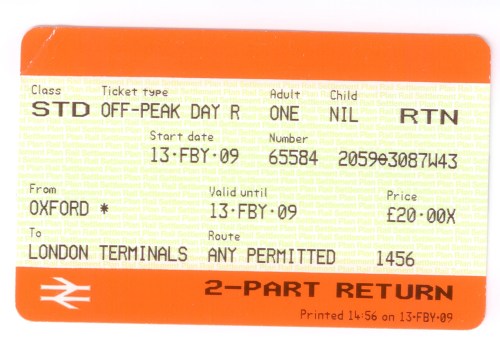
oxford-ticket-13-feb-2009I got some news on Friday that I’m thrilled to have received, to say the very least. It’s one part of a triple threat, a trifecta even, of excellent possibilities, and it is seeming rather possible right now that by this time next week, I will have found out that the other two, and thus all three, have occurred.

My only gripe is that I was hoping that I might have heard this before we went to England, so that celebrating these bits of news might be yet another pretense for the trip.

That’s okay; it just means we’ll have to go again.

But you were waiting to hear something about Oxford. Warning: this is perhaps going to be the most academically dense installment of this account. Apologies.

A couple of weeks before we left, I e-mailed my friend and Anglophile Mark Powell to see if he had any suggestions for things to do and see. E-mail Alexander Lingas, he said. He’s there.

Dr. Lingas let me know that, Friday evening, he would be delivering a lecture at Oxford’s Ioannou Centre for Classical and Byzantine Studies on Byzantine chant in Late Byzantium, and that we would certainly be welcome to come if we wanted.

I was of two minds about this, truthfully. I thought to myself, wow, what a neat opportunity to sample, even on a small scale, the academic life while we’re there, on a topic which is near and dear to our hearts, and discussed by somebody whose work we respect and have been influenced by, even.

On the other hand, that’s the same day on which we will have just concluded roughly seventeen hours of travel, and it will most certainly mean that we’ll be taking two trips to Oxford, since I was really hoping to show Megan around there (and convince her that it’s someplace we want to live and do postdoctoral work someday, but never mind that now).

Oh well. Guess we’re going.

Thus, after refreshing ourselves with showers and fresh clothes, we took the Tube to Paddington Station from Charing Cross (this is a lot easier than it initially looks on the Tube map, by the way; you just push the waste all the way in so that the door can close… uh, wait — what I meant to say was, just take the Bakerloo line north from Charing Cross to Paddington — it looks like this shouldn’t work on the map, at least at first glance, but it in fact does), and off we went. An hour later we were getting off at Oxford station.

I took us right to the Ioannou Centre (alas, the Cock and Camel, where I had a nice breakfast a year and a half ago, has been replaced by an Italian restaurant); it’s a rather new building, and I remember walking past it a year and a half ago thinking, “Hey, I need to figure out a way to visit this place next time I’m here.” (This is not the accomplishment of memory it sounds like; you go down the main drag from the train station till you get to the other main drag which is perpendicular to the one you’re on, go left, and after a block or two there it is on your left.)

We got to the hall a half hour early or so, which gave us an excellent opportunity to look like American tourists who obviously didn’t belong there, awkwardly standing outside a darkened lecture hall doing nothing while students and faculty were quite well-occupied around us. Still, people showed up soon enough to provide us fish out of water with a little bit of a pond.

The lecture, “Cathedral and Monastic Psalmody in Late Byzantium: Towards a Final Synthesis?”, was intended as an introduction to the issues surrounding the late medieval Byzantine repertoire for scholars who are in fact Byzantinists but not music specialists. Since I’ve read his dissertation, many of the broad strokes of what he discussed were not new to me, but it was very interesting to hear him sing off of the medieval manuscripts, as well as talk about some of the transmission issues with the medieval repertoire. What was great about hearing somebody like him talk about these things is that he was able to make clear that this is a part of a greater body of living tradition and practice; this is not just What Those People Back Then Used To Do.

A point which I very much appreciated: Dr. Lingas said that chant scholars such as Egon Wellesz have tended to discuss the Paleologean repertoire in the context of a narrative of overall cultural and political decline in Constantinople; of course, I’m reading The Fall of Constantinople: 1453 right now, and Runciman very pointedly observes (perhaps with people like Wellesz in mind) that culturally, Byzantium was quite alive and well even as the Empire was in its death throes. Anyway, as this particular narrative of decline has gone away, it’s been replaced by a narrative of specifically religious decline, bizarrely (at least to me) represented by a disappearance of congregational singing and the rise of professional-level, melismatic chant. “The end result is the same [in both narratives,]” Dr. Lingas said. “The cantor has hijacked the liturgy.” He took great pains to disabuse the audience of these notions, demonstrating that a great deal of continuity (but not stasis, he stressed) can be seen between the Paleologean material and the received tradition of the present day, and that by no means has the cantor hijacked anything. Since I have been the cantor getting accused of doing the hijacking, the defense to a general audience was most appreciated.

Following the lecture, we hung out for a bit at a reception for Dr. Lingas, talked with him briefly, had a lovely chat with a DPhil student there who is writing his dissertation on Galen (“I guess I specialize in pain,” he said), and then we needed some real food. We told Dr. Lingas we would see him at church on Sunday (“Great — it’s the day for Byzantine chant in English,” he said), and then hunted down a meal.

We found ourselves at an Irish pub chain restaurant called O’Neill’s; chain it may have been, but it was tasty and reasonably inexpensive, and a good place for a beer and some stew.

We were ready to head back — we’d be in Oxford again on Sunday, anyway. By this point, we had been up for close to thirty hours (give or take), and we were nodding off on the train back to London to say the least. Back in the hotel room, we were asleep before our heads even hit their respective pillows.

Travel tip: having an international flight arrive in the morning and then tiring yourself out so that go to bed at a normal hour is a great way to beat jet lag.

Next installment: When Your Definition of Modern Is Anything After 1400 or, How Emily Hindrichs Learned to Stop Worrying and Love Her Wig

The poorly-named The Great Doxologies in the Eight Modes

I didn’t notice it until I was having to enter track names manually (Manuel-ly?) in iTunes, but anybody want to look at the track list and tell me why this CD is poorly named?


adventures in writing alexander lingas all saints bloomington all saints orthodox church american orthodox architecture american orthodox music american orthodoxy Antiochian Archdiocese Antiochian Orthodox Christian Archdiocese of North America Antiochians books byzantine chant cappella romana chant church architecture ecclesiastical chant ethnomusicologists ethnomusicology fellowship of ss. alban and sergius Greece Greek greek food greekness hazards of church music international travel tips ioannis arvanitis joe mckamey john michael boyer kurt sander Latin liturgical adventures liturgical architecture liturgical music liturgical texts and translation liturgy liturgy and life lycourgos angelopoulos medieval byzantine chant Metropolitan PHILIP militant americanist orthodoxy modern byzantine architecture modern greek music music as iconography my kids will latin and greek when they're newborns my kids will learn latin and greek when they're newborns orthodox architecture orthodox architecture is bloody expensive Orthodox choir schools Orthodox Ecclesiology orthodox outreach orthodox travel pascha at the singing school Patriarchate of Antioch Patriarch IGNATIUS IV Patriarch of Antioch publishing random acts of chant richard barrett in greece richard toensing rod dreher sacred music st. vlads st john of damascus society Syriac the Bishop MARK fan club the convert dilemma the dark knight The Episcopacy The Episcopate the only good language is a dead language this american church life travel we need more american saints why do we need beautiful music in churches?

Blog Stats

  • 269,309 hits

Flickr Photos