Posts Tagged 'byzantine chant'


Breaking radio silence…

Blogging has been quite inconsistent over the last six weeks, but I doubt that the two of you out there who check in regularly have lost much sleep over that. Bottom line is that I have worn my temporary bachelorhood neither well nor gladly, and it’s been difficult to motivate myself to do things like this. The good news is that Flesh of My Flesh gets home on Thursday; the bad news is that I’m going to have to move the books I’m reading off of her side of the bed now.

A brief update on Cappella Romana’s The Divine Liturgy in English: you can now pre-order it from their website, and there is also an absolutely gorgeous pdf of of the liner notes. I’d also bookmark this page for the future. Noting that the ship date for online orders is one week from today, I’m looking very much forward to posting a review of this sometime by the end of the next week.

My French class has been a good opportunity to formally review some things with this language, and to have a chance to start getting a bit of a sense of what kind of scholarship is out there in French in my areas of interest. As it works out, I’ll be translating a short article by Fr. John Meyendorff for my final project — it’s called “The Image of Christ According to Theodore the Studite.”

Along related lines, I have decided to swap out Coptic for Modern Greek this fall. Ultimately, I have a tough time making a case for Coptic in terms of being directly related to my areas of interest; if I were more interested in early monasticism or gnosticism or such things, that would be one thing — and if it were actually going to be fulfill a degree requirement (which, in the alternate universe where I was admitted to the M.A. program here, it does), that would be something too.

But I’m not, and it isn’t. I may keep the textbook for purposes of picking through it later if I ever figure out how to motivate myself independently; we’ll see.

By contrast, I can make a much better case for Modern Greek being directly related to my interests. There is scholarship in Modern Greek, it will be a good thing to be able to speak if I’m ever fortunate enough to be able to travel for research reasons, and in the more likely scenario that someday we’re at a church where Greek is the primary language of the people. Also, it is at least strongly related to something with which I already have some familiarity, so I won’t be starting over completely from scratch.

And, finally, a 12:20-1:10 timeslot is simply a heck of a lot easier for an 8-5 working man to manage than 8:00-9:15. Y’know, practical matters like that have to intervene at some point.

On a matter completely unrelated to academic or ecclesiastical pursuits — through a stroke of absolute dumb luck, I am going to have, shall we say, a rather early dark (k)night, and I’m expecting it to be cool to the (i)max. I’ll have more to say about this Wednesday morning, I expect.

Finally (for now), I’ll note that my stock has risen some in the last couple of months. If only I could figure out which ATM machine I’m supposed to use to get access to this…


My blog is worth $4,516.32.
How much is your blog worth?

The moment you’ve all been waiting for…

At long last, Cappella Romana is releasing their recording of the Divine Liturgy in English:

To be released this July
The Divine Liturgy in English
In Byzantine Chant – A 2-CD set

RELEASE DATE: JULY 14, 2008

The highly anticipated release of Cappella Romana’s groundbreaking recording of the complete Divine Liturgy in English, set to traditional Byzantine chant, will be released on July 14 at the Clergy-Laity Congress of the Greek Orthodox Church of America in Washington, DC.

The CD will first be available at the congress, and orders may be placed online beginning July 14. Shipments will begin July 19.

ABOUT THE RECORDING

Employing the official English translation of the Greek Orthodox Archdiocese of Thyateira and Great Britain, this 2-disc set presents the complete service (ακολουθία) of the Divine Liturgy of St John Chrysostom. Litanies and prayers pertaining to the entire Eucharistic assembly are rendered in full. The hymns and responses represent the central traditions of Byzantine chanting, including works adapted from Petros Peloponnesios, Nileus Kamarados, and St. John Koukouzelis.

A collection of musical scores for the chants on this recording will be available in Byzantine and Western (staff) notation through our website.

This recording was made possible by major grants from the Virginia H. Farah Foundation, the A.G. Leventis Foundation, the Fellowship of St. Alban and St. Sergius, and the National Forum of Greek Orthodox Church Musicians.

I realize that there are two of you pumping your fists right now cheering “Right ON!” and the remaining three of you who are wondering what the heck this is and why it’s important. That’s okay. Basically, this recording, has the potential to set the standard for what Byzantine chant should sound like in English. Right now there’s kind of a range of poor to really good — the best example in English of which I can think right now being the Mt. Lebanon Choir’s recording (but which doesn’t quite set the standard, at least for me, because it’s clear it’s being sung by non-native English speakers), and I’d really rather not go into which ones I don’t exactly find optimal, at least not in a public forum.

Let’s put it this way — it’s clear to me that the English recordings of the St. Vladimir’s Seminary Chapel Choir over the years have had a huge impact on what people expect to hear. I’m very hopeful that this recording, intentionally a thorough effort to match a good English translation to the traditional settings, sung by a professional choir which counts several faithful Orthodox Christians among its membership and staff (including its artistic and executive directors), can have a similar impact. If the entire recording is as good as excerpts to which I was treated a couple of years ago, it should also settle once and for all the silly question of whether or not Byzantine chant can sound good in English or if it will always sound like “camel-whipping music” (a particular friend’s term).

For my own part, I will say that I believe this recording was announced four years ago, and was completed two years ago or so, and I’ve definitely been one of the people “highly anticipating” its release that whole time. (I think I’ve been posting annoying “When does it come out?” comments on the CR blog for roughly the last year.) I’ll also briefly mention that the friendship of the executive director, Mark Powell, along with his wife Kathleen, to say nothing of the willingness to talk about his faith and to answer questions, was one of the major instruments by means of which Megan and I were initially exposed to Orthodox Christianity, and it’s been an example we’ve tried to follow since — but that’s a story for another time.

I will also note that Cappella Romana also has a sale going on where the Lycourgos Angelopoulos recording of the Divine Liturgy is available for roughly 20% off. This is one of the recordings which really captivated me early on, and I can’t recommend it highly enough. It was very difficult to find in this country five years ago, and could very well be so again with the way non-pop recordings come in and out of print, so I encourage you to get it while you can!

Evangelism the old-fashioned way

As long as we’re talking about Western saints, here’s this item from Aaron D. Wolf (what a great name) by way of Ben at the Wittenberg Trail (to whom I’d love to link, but I can’t, because the Wittenberg Trail is evidently a private forum) by way of Alden Swan:

Here’s what I can’t figure out: How in the world did Saint Patrick evangelize all of those Druid priests and clan chieftains without a mission statement? After all, history and tradition tell us that he walked around preaching and performed an occasional miracle. But how did he know what his mission was? Aaron D. Wolf, The Mission of Souls: When Experts Attack

[…] Mr. Wolf raises some interesting questions and challenges to modern Evangelical concepts of evangelization and mission, contrasting the wisdom of being “pupose driven” to the pre-marketing (pre-modern) habit of simply proclaiming the Gospel.

Wow. What a concept.

This gets me thinking about something which has occurred to me before — I have to believe that liturgy is one of our better and more underappreciated evangelism tools. I guarantee you that St. Patrick wasn’t just walking around preaching and “performing occasional miracles” — he would also have been celebrating the Mass, with the Eucharist as his “mission statement.”

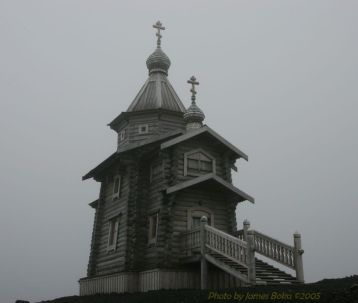
small country churchThe model of evangelism that would be wonderful, if cost-prohibitive, would be to go places where there aren’t churches and start by building simple, but identifiable, churches (such as Trinity Church in Antarctica of all places, pictured at right) where they would be visible and accessible, start publicly holding services so that people can tell that’s what you’re doing, and equip them so that they can host a soup kitchen or something similar. The problem with so many missions is that they can ill-afford being in a place where they would actually be visible and it would be clear what they are doing, so they wind up evangelizing only the people who are already there. Right now, at least in the Antiochian Archdiocese, you have to have some number of pledging families (25?) before you can have a priest assigned to you; that’s good business and fiscally responsible, no question about it, but who’s doing the evangelism in that case but people who aren’t necessarily equipped to do it? I’m not saying that any Orthodox jurisdiction in this country has the money to spend, say, a half million to a million dollars planting missions so that they have buildings, priests, and services for the poor at the outset, but I sometimes wonder if that wouldn’t be a better witness all around.

I’m still waiting. Actually, I’m waiting on a couple of things — one fairly big thing, and one thing that is big-ish, but not on the same level as the other thing. (Confused yet?) In the meantime, however, I can reveal that I’m presenting a paper at Indiana University’s Medieval Graduate Symposium on 29 March. I can also give a heads-up that my church choir will be publicly presenting music from Holy Week as part of  IU’s Middle Eastern Arts Festival on 29 March. (Yes, the same 29 March. It’s gonna be a busy day.) Details for the whole ongoing program are here, but here’s the blurb for this particular event (I’m not going to use the word “concert,” for several reasons):

Concert: Choral Music of the Middle East
Behold, the Bridegroom cometh: chants from Holy Week in the Lebanese and Syrian tradition

March 29, 2008, 8 pm
St. Paul’s Catholic Center

The All Saints Antiochian Orthodox Christian Choir under the direction of Richard Barrett will present an evening concert of liturgical music from the Middle East. The program will highlight music from the Syrian and Lebanese traditions. Meditative and celebratory selections drawn from Holy Week and Easter services exemplify how this music became an integral and functionally practical part of Orthodox ritual. While the traditional liturgical languages for the Orthodox in the Middle East are Greek and Arabic, selections will also be performed English.

I didn’t write that, by the way. I will be writing a set of program notes, however, which I will post here. I can say that this is exactly the kind of thing I hoped we’d eventually be able to do, and I’m really encouraged by how the rehearsals have gone — it’s stretching them beyond what their comfort level has been, but in a very doable fashion, and it will be a good thing for us to participate in this kind of outreach. Hopefully I can post a snippet or two from the evening itself afterwards.


adventures in writing alexander lingas all saints bloomington all saints orthodox church american orthodox architecture american orthodox music american orthodoxy Antiochian Archdiocese Antiochian Orthodox Christian Archdiocese of North America Antiochians books byzantine chant cappella romana chant church architecture ecclesiastical chant ethnomusicologists ethnomusicology fellowship of ss. alban and sergius Greece Greek greek food greekness hazards of church music international travel tips ioannis arvanitis joe mckamey john michael boyer kurt sander Latin liturgical adventures liturgical architecture liturgical music liturgical texts and translation liturgy liturgy and life lycourgos angelopoulos medieval byzantine chant Metropolitan PHILIP militant americanist orthodoxy modern byzantine architecture modern greek music music as iconography my kids will latin and greek when they're newborns my kids will learn latin and greek when they're newborns orthodox architecture orthodox architecture is bloody expensive Orthodox choir schools Orthodox Ecclesiology orthodox outreach orthodox travel pascha at the singing school Patriarchate of Antioch Patriarch IGNATIUS IV Patriarch of Antioch publishing random acts of chant richard barrett in greece richard toensing rod dreher sacred music st. vlads st john of damascus society Syriac the Bishop MARK fan club the convert dilemma the dark knight The Episcopacy The Episcopate the only good language is a dead language this american church life travel we need more american saints why do we need beautiful music in churches?

Blog Stats

  • 270,188 hits

Flickr Photos