Posts Tagged 'adventures in writing'


AGAIN, again — postcript

My Divine Liturgy in English review generated a letter to the AGAIN editor over a not-unexpected issue — that of the use of “Holy Strong” in the Trisagion. Here are the highlights:

I’m uneasy with regards to the language [Cappella Romana] would institute. Changing the music is one thing; changing the language it’s written in is another thing entirely.

It’s important we don’t discard and/or replace the words that stir mind and soul, just to smooth some inconvenient bumps that have come about with the coupling of the Byzantine chants to English. If the truth be told, there’s a strong benefit inherent in the older English words. Simply because it takes an act of self will to use them, just like enter our church buildings leaving the physical world for the spiritual. The uncommon older words in our worship allow for the erecting of a similar barrier for the mind allowing separation from the offal baggage of our degenerate common day to day language. It’s a mistake to replace the word mighty with the word strong; to do so is to lose the Divine Authority inspired by the first in exchange for the wrongly elevated physical insinuation of the second.

Whatever the history regarding these two words, as well [as] the translations that have brought us to this point, the fact is the word strong is no longer capable of instilling the divine contemplation needed to lift the mind from the physical to reflect on the mystery of the spiritual. Our modern English speaking society throughout the world has mitigated this awe inspiring word by making an idol of strength.

Mighty, another word that carries much the same thoughts as the word strong once did, is currently used in the Liturgy. It has been for the most part spared the jaded attention of our society. Retaining its potency it bears well its burden, conveying the authority, the astonishment, the respect required of us. It commands us to humility, and as much as our puny minds can attempt, to contemplate and reverence the trenchant* power of our triune God.

If people don’t understand the meaning of such words, we should follow the example of our early church fathers that developed though God given inspiration the Divine Liturgy and a system of enlightening the ignorant, and educate them.

So when we think of our risen Lord seated at the right hand of the Father, do we want to glimpse him in the Divine Authority of his Majesty, or as…a glorified strongman?

Holy God. Holy Mighty. Holy Immortal; have mercy on us.

Phillip, your brother in Christ

* Keen, Sharp, vigorous, intensely perceptive, Penetrating, clear-cut, Distinct

My response:

Dear Phillip,

Thank you for your reflections on the translation of the Trisagion as sung by Cappella Romana. I am agreed wholeheartedly that it is a mistake to replace or discard words capriciously. What might help clarify things for you is that Cappella Romana followed the official translation of the Greek Orthodox Archdiocese of Thyateira; that is to say, Dr. Lingas and co. did not write their own translation or change words as they saw fit. Archimandrite Ephrem Lash, neither an amateur nor a shrinking violet when it comes to the matter of rendering biblical or liturgical  texts into English, was the chief architect of the Thyateira translation, and he has a detailed essay regarding the proper translation of the Trisagion, found here: http://www.anastasis.org.uk/THE%20TRISAGION02.pdf

In any event, the two most salient points might be:

  1. The Greek word “ischyros” is translated as “strong” virtually every other place it is used, and in other liturgical languages (such as Slavonic) the equivalent of “strong” is employed rather than “mighty”; “krataios” is the word which better corresponds to “mighty,” as in “Pantokrator” – “All-Mighty” being how that is often rendered in English.
  2. Translating “ischyros” as “mighty” in the translation of the Trisagion, ironically enough, appears to date back to the 1772 translation of Dr. John King, a Protestant. The earliest known English translation, that of Dr. John Covel in 1722, uses “strong.”

I hope this helps!

In Christ,

Richard Barrett

No denying it’s a sensitive matter; this is a tricky instance where a translation of a prayer, regardless of its relative merits, has taken on a life of its own beyond that of its source. The 20th century certainly demonstrated that you mess with the language in which people pray at your own risk. On the other hand, Phillip makes the excellent point that in such cases an effort should be made to educate the people, and I think Fr. Ephrem’s essay does that quite well. The other side of that bargain is just that the people need to be willing to not refuse the instruction out of hand.

For my own part, I’ll note that I don’t consider myself my own authority on Greek, particularly not where these kinds of issues are concerned. I’ve been there for Fr. Ephrem Lash sight-translating a Gospel reading from Greek during a Liturgy without realizing he wasn’t reading from an English version until I was told later, so if he says “Holy Strong” is what the prayer actually says and means, I don’t think I have too much of a basis to disagree with him.

AGAIN, again

In case you’re interested, the current issue of AGAIN just came out (Winter 2009), and my article “Prepare for Joy: An Orthodox Christian Look at Being Engaged” is included amongst its pages. Alas, the Conciliar Press website continues to show Summer 2008 as the latest issue, so I have nothing to which I might link, but what I at least think I can do is post the draft I initially submitted. It was changed enough in the editorial process that I think I can do that without it being a problem for anybody, and if you have the issue sitting in front of you, you might get a peek behind the curtain of how it works – things which are suggested, changes that are made, additions which are inserted, bits taken out, and so on.

I hope it’s of interest; it’s something I haven’t seen discussed very much, and to be frank, many of the premarital materials the various jurisdictions publish are awful. Not that this is intended to be a definitive resource, but hopefully it at least can get a conversation started.

Matthew, my godson, was at my house one evening, lamenting some issues he and Erin, his significant other of two years, along with whom he had just been baptized into the Orthodox Christian faith, were having. The two of them had started talking about marriage within a few months of beginning their relationship, and Matthew, by this point, had bought the engagement ring a year previous — but the step of actually getting engaged had not yet been taken.

“We’re reaching the point where it feels awkward to be still introducing each other as ‘boyfriend’ and ‘girlfriend,'” he sighed to me as my wife Megan and I were doing dishes.

I had wondered when they would start feeling this way. I simply looked at him and said, “Yes.”

“Which, I suppose, means I need to get my act in gear and propose sometime soon.”

“Yes,” I said, having thought exactly this for months.

Matthew’s face brightened a bit. “I suppose I could do it tonight…”

“Yes.”

“In fact,” he said, now beaming with the possibilities, “I could do it right now!”

“Yes.”

Off he went, taking two of our crystal champagne flutes on his way out. An hour and a half later, we were admiring the ring now in its proper place on Erin’s hand and toasting them; they’re set to be crowned unto each other late summer of 2009.

So — now what? Okay, have a fun year, guys. Enjoy the planning and anticipation, but don’t enjoy the anticipation too much, if you know what I mean. Other than that — see you at the service.

Surely there’s more that we can tell Matthew and Erin than that??? Megan and I discovered for ourselves when we were engaged that there’s definitely a lot of advice out there of varying quality — but what does Orthodox Christianity have to tell a newly-baptized and newly-engaged young couple which will be substantively different from what they would find in a secular self-help book, and which will be uniquely Orthodox?

The trouble is that engagement itself doesn’t fit neatly into a particular category from an Orthodox Christian standpoint. Yes, it is true that the betrothal service used to be the Church’s formal acknowledgment of an engagement and was served well in advance of the order of crowning itself. Still, Fr. John Meyendorff’s Marriage: An Orthodox Perspective (St. Vladimir’s Seminary Press, 1975) emphasizes that engagement as it is known today cannot be understood as the same as betrothal; betrothal “is the marriage contract as the Church understands it [for it] involves not only the bridal pair, but God Himself” (Meyendorff, 33, emphasis mine). Meyendorff notes that that in Byzantine society, a betrothal could only be broken by divorce — thus, “lacking only the ultimate sacramental fulfilment”, the betrothal service came to be celebrated with the crowning, rather than in advance.

So what can we say about this modern in-between state of engagement, clearly more than dating or courtship but still less than betrothal, that will be useful and practical for those moving through this particular harbor?

Fr. Peter A. Chamberas’ excellent book, This Is A Great Mystery: Christian Marriage in the Orthodox Church (Greek Orthodox Archdiocese of America, Metropolis of Boston, 2003) encourages engagement to be treated as a time for “substantive preparation” so that the couple not “miss altogether the awesome day of their visitation by the grace of God” (Chamberas, 8). By the time the wedding itself comes about, he writes, the couple’s “heart and mind must already be transformed and committed to the real nature and ultimate purpose of Christian Marriage, seeking fullness of life and salvation in God.” In other words, the primary purpose of engagement, as neither-here-nor-there as it may seem from a sacramental standpoint, is to prepare the man and woman for one of the ways through which they will be working out their salvation with fear and trembling. That’s a lot more than just picking out flowers and a cake, isn’t it?

Fine — but what does that mean, exactly?

The text of the betrothal and crowning services provides helpful illumination on this point; they are, as Fr. Chamberas eloquently describes, “the primary and most appropriate educational resource for informing and preparing the spouses for their married life as active members of the Church” (ibid., 22). Fr. Meyendorff agrees, exhorting “all couples intending to get married [to] make a point of reading the entire service carefully in advance…for the sake of conscious and prayerful participation” (Meyendorff, 35-6).

With that in mind, there are several observations about engagement one can make from the liturgical texts. In the services themselves, the couple takes no vows, but they are instead merely asked by the priest, “Have you a good, free, and unconstrained will and a firm intention to take unto yourself [as a spouse] this [person] whom you see here before you?” Fr. Chamberas writes, “This mutual, free and sincere agreement for Marriage is…an absolute necessary presupposition for the Sacrament to be performed” (Chamberas, 50), and Fr. Meyendorff sees it as a “useful way of emphasizing their personal commitment and active participation” (Meyendorff, 35). Thus, we might understand engagement as a period of discernment during which the couple prepares to be asked that very question, so that, to quote Fr. Chamberas again, they may offer “their sincere pledge of love and faithfulness…like the bread and wine in the Divine Liturgy, to be blessed and transformed” (Chamberas, 50). There are tools which the Church offers in aid of this process; the place for the couple to start is to begin premarital counseling with the priest who will marry them. These sessions will be, among other things, a source of specific advice regarding how to develop good spiritual habits from the outset, such as praying together, for example.

Given that marriage is a Mystery of the Church, however, this mystical transformation impacts not only the man and the woman being married but the entire community, just as the bread and wine must be distributed to the community of the faithful after being consecrated. This is reflected in the fact that the betrothal service begins with a Great Litany, a liturgical exchange in which the priest asks the assembly for prayers for the couple, and the people (the laos in the Greek Euchologion), the members of the community, affirm these petitions. This suggests that the period of engagement is not just a period of preparation and discernment between the man and woman, but also between the two of them and the community of the Church who will be asked to bless their union. “It is to the Church that the couple has come to be married,” observes Fr. Chamberas, “[and] it is the whole Church that prays [for them]… [T]he engaged couple…are making a mutual pledge before God and the congregation, not only to share their life but also to graft it upon the Tree of Life in the Church” (Chamberas, 51). Fr. John McGuckin, in his book The Orthodox Church: An Introduction to its History, Doctrine, and Spiritual Culture (Blackwell Publishing, 2008), paints the vivid picture of “their mutual love and joy [functioning] to others (as well as themselves) as a living icon of the burning love Christ has for his church” (McGuckin, 311). In the absence of a liturgical means by which the engagement can be recognized, a simple, practical way that the man and woman to be married might begin to engage their community in this way is to ask to be added to the list of those prayed for at the altar. This way, the entire congregation is praying for them week in, week out during the course of their engagement.

Much more can be said about the betrothal service, but I will conclude with the final observation that all of the petitions made on behalf of the man and woman suggest very strongly that the Church believes that they need them. In other words, the engagement may also be seen as preparation for the inevitable tough times to come and learning to work through them. If you think planning the reception seating chart was tough, just wait.

Which brings us to the crowning service. The very use of crowns and related imagery suggest martyrdom; not in the sense of suffering being an unavoidable element of the Christian marriage, but in the sense that within the marriage, as in every other element of the Christian life, the victory in Christ — that for which the martyr’s crown is bestowed — is achieved through humility and death to oneself in seeking to serve Christ in the other person. This is made explicit in the epistle reading — “Be subject to one another out of reverence for Christ” (Eph. 5:20). Fr. McGuckin points out that what St. Paul is exhorting the husband and wife to do in this oft-misunderstood passage is “to outdo one another in putting their own self at the service of the other” (McGuckin, 311). From this standpoint, the engaged couple needs to prepare themselves to be able to accept the crown with all that it entails. Fr. Chamberas again: “[T]heir crowns must remind them always, not of a mere symbolical ritual, but the very condition which makes their Marriage a Christian Marriage. By being crowned in the name of the Holy Trinity…the couple are challenged to see that real glory and honor are to be found in their joyful self-offering and service to each other” (Chamberas, 75).

A final observation is that the crowning service, in the final prayer before the actual bestowing of crowns, provides the engaged couple with a very clear outline of what is normative in the Christian marriage: “Unite them, O Lord, to have oneness of mind. Crown them in marriage to be one flesh. Grant them the fruit of their bodies and procreation of blessed children. Grant also, O Lord, that their life together may be blameless and without reproach.”

This, ultimately, is what the engaged couple needs to be working towards — oneness of mind. One flesh. Yes, children, if God wills. A life blameless and without reproach. It’s not necessarily a life of material wealth and happiness and unconcerned bliss — but the fruit of the time spent preparing in the frustratingly neither-here-nor-there state that is engagement is, as Fr. Chamberas puts it, “a real expression of their entrance into the Kingdom of God… the beginning of their own familiar kingdom, which is destined to be a small reflection of the true Kingdom” (Chamberas, 75).

What the engaged man and woman must remember is that the Christian life may not always promise happiness — but “the key issue…is the presence of joy,” Fr. McGuckin writes. “And joy is wholly a spiritual phenomenon that cannot be counterfeited” (McGuckin, 317). Christian marriage is not the exercise of two people merely pursuing in parallel individual ease or the ephemera of “being happy,” in other words; such things may happen, but they are to be in the service of mutual joy, which is sacrificial, selfless, and seeking Christ.

So, to Matt, Erin, and all other engaged couples who may be reading this: prepare for saying yes. Prepare your church community and your family to say “Amen.” Prepare for martyrdom. Prepare to be one, to be blameless, to be parents. Prepare to fail at most or all of this at least some of the time (and thus prepare, maybe, to go to confession a little more frequently).

But nonetheless, above all — prepare for joy.
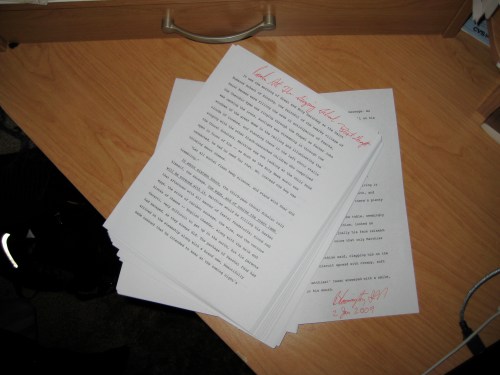
Milestone 1: The first draft

img_0663In the summer of 2004, a conversation with my dad (about which I might go into detail sometime later), along with an idea for something I’d love to see in real life, mingled in my head to become an idea for a children’s book. Over the next couple of years, I got some thoughts down on paper, did some world-building, even wrote four chapters or so, and then somebody pointed out that a fundamental flaw in my setup, of which I was already aware and was trying to write around, wasn’t going to be written around very well.

I rethought my setup without discarding the overarching plot or concept, and started writing again. My problem was, I could never quite get things down to a manageable scale to actually feel like I could write anything and get anywhere.

So, I decided on a different tack — pick a smaller event in the same universe at a different point in time, and tell a much smaller story with people who would be side characters in the main story, just to help find my voice and get a “proof of concept” down on paper. Suddenly The Singing School became Holy Week at the Singing School. Eventually even Holy Week proved to be too big for what I wanted to do, and last spring I started one more rewrite, Pascha at the Singing School. I figured it would be somewhere around 10,000 words — 40-50 pages tops.

This evening I finally finished the first draft of Pascha at the Singing School, weighing in at around 21,000 words and 91 double-spaced pages.

So, I’ve written a book. It’s a short book. Editing, revising, and publishing said book will likely be a very different matter from writing the first draft — but the first stab at putting all the words, plot points, and characters together to telling the story is, er, in the books.

We’ll see what happens next.

We now return you to your regularly scheduled reality…

December is here. This means any number of things. It means NaNoWriMo is over, it means the semester is almost over, it means West European Studies will hopefully get back to me soon one way or the other, it means we’re hip-deep in the Nativity Fast with the Christmas feast fast approaching, and it means we just got back from a much-needed, if shorter than ideal, vacation over the Thanksgiving break. It also means that a week from today, this blog will be a year old. Sheesh.

There were no natural disasters; I simply did not finish Pascha at the Singing School last week. Between preparing to go on the trip, going on the trip, and Megan getting sick the night before heading out for the trip, it just didn’t happen. I wrote most of Thanksgiving Day, got about 2,000 words into the ending, and I am within spitting distance, I just didn’t get there. My hope is that this weekend I’ll be able to make one last push to finish a first draft. I wrote approximately 11,442 words during November for an average of 381 words a day; not a stunning average by any means, but at least it’s an average, and the bottom line is that it was a busy month without NaNoWriMo. I am on the whole pleased that the event broke me out of the gridlock that had kept me stuck since probably April or May, now I just have to keep myself honest. Next year I might have another project for NaNoWriMo; we’ll see. There is something I’d very much like to write, but this would probably be much longer than 50,000 words, and it would require a lot of skill as a writer I’m not sure I have at this stage of the game. Maybe I’ll be brave enough to give it a shot, and maybe I won’t.

The Thanksgiving break spent in Nashville was fantastic, and a very welcome getaway for us Barrettses. Check out pictures here. As noted, the Daisy Hill Bed and Breakfast (pictured at right με γυναίκα μου) comes heartily recommended by us; do consider them if you’re looking for a place to stay in the area.

Friday we had lunch at The Pancake Pantry with our friend Chelsea; it’s an experience worth having and the food is good, but if you don’t like lines and prefer a quieter dining experience, it probably won’t be your thing. We also saw the replica of the Parthenon, which is impressive, but I gotta say, it loses something being made from poured concrete rather than marble.

Country music is decidedly not my thing, but I nonetheless have to admit that the Country Music Hall of Fame and Museum is a fascinating place to visit. Short version is that it is organized chronologically; you start at the third floor with early folk and gospel and work your way down, and you’re at the present day by the end of the second floor. I find that I am able to relate to and enjoy the early stuff a lot more than the music of the last 30-40 years; it seems to me there came a point where the musicians became very self-conscious and their music subsequently sounds, at least to me, extraordinarily contrived and false. The closer the connection to an actual folk tradition, the more genuine it sounds to my ears — to put it another way, somewhere along the way the musicians decide, “We’re going to play it and sing it this way because that’s what country music sounds like,” whereas before the mindset was perhaps more akin to, “Country music sounds like this because that’s how we play it and sing it.” As a result, at least to me (let me re-emphasize that this is subjective opinion) performers like Garth Brooks sound 100% calculated and processed, with everything intended to support a synthetic sound and persona. None of this is to say that musical forms can’t be codified or that something is inherently lost once there’s a formal idiom or tradition to which one adheres; that’s certainly what most classical is, and it’s definitely what liturgical music generally is. On the other hand, for a genre which — rather arrogantly, I find — claims to be “three chords and the truth”, it seems disingenuous to me that this would become prescriptive rather than descriptive. To quote the much underappreciated movie Singles, “You have an act, and not having an act is your act.” Good music is good music regardless of genre, but poseurs also transcend genre.

Anyway, back to the museum. There were a number of clever uses of speakers and acoustic tiles to create very localized sound exhibits, which in and of itself was interesting to see and hear. One of the things to which I found myself drawn was the archive section being visible in the center of the gallery behind glass; you can see all of their compact shelving, their sound editing stations, everything. It’s actually a useful reminder that the museum isn’t just a tourist attraction; it’s also a professional and scholarly resource. The stuff we see as the general public is really the tip of the iceberg at best.

But then, Elvis’ gold piano is pretty cool, too.

It would have been foolish to visit Nashville without hearing any live music, and we decided to go to a club called The Station Inn to hear The Roland White Band. Roland White is a bluegrass mandolin player who has been there, played that. He’s got a lot of institutional memory, as it were; he knows every song, knows who wrote it and when, and has probably taught somebody how to play it. He also has surrounded himself with a lot of absolutely fantastic younger musicians, most notably David Crow on the fiddle and Richard Bailey on the banjo. His bass player was also really good; tall, skinny younger guy named Andy, but I didn’t catch the last name. If anybody knows his last name, I’d love to know and find out what else he does. It was a show that was a lot of fun to see, and I plan on seeking out one of David Crow’s solo recordings. The Station Inn is also a neat little venue; it’s a dive that has Bud and hot nacho cheese sauce on tap and not much else, but it’s a dive with a long history, and best of all, it’s smoke-free!

On Saturday, we went to Andante Day Spa for much-needed and long-awaited massages, as well as an aromatherapy sauna. If you’re looking for something nice to do with a spouse or even just by yourself, these guys are very classy and quite reasonable for the services. We left there probably more relaxed than we’ve been in a looooooooooong time. Ramona is who did my massage, and I’d go back in a heartbeat.

After massages, we tried to go to Alektor Cafe and Books, the Orthodox bookshop in Nashville, but alas, they were closed unannounced. Perhaps this is not surprising.

Next we spent a couple of hours at the Frist Center for the Visual Arts, seeing their Rodin exhibit as well as their photography and film exhibit. Both were interesting; I’d say I liked the latter more. I don’t really have the vocabulary to discuss sculpture (or much else, let’s be honest) intelligently; let’s just say that to my eyes, Rodin goes beyond glorification of the human body and into the realm of fetishization, and leave it at that for now. The photography exhibit included a section on Moroccan photographer Lalla Essaydi, and that was captivating. She does a lot with Arabic calligraphy on the body as well as on everything else; it was interesting to me for several reasons, and I may talk a bit more about it later.

Vespers, to say nothing of Matins and Divine Liturgy on Sunday, at Holy Trinity was something else; it’s a beautiful church, they’ve got a large number of psaltes who know what they’redoing (three of them evidently having studied wtih Lycourgos Angelopoulos) and as a result they’re able to utilize a traditional two-choir setup, they’ve got a very broad 

demographic and economic base while keeping their practice pretty unapologetically Byzantine, people were nice, and Fr. Gregory is a young convert priest who seems very enthusiastic. Every parish has its problems, to be sure, but these guys seem to have a lot of very good things going on.

After Vespers Saturday we had dinner at a delicatessen called, appropriately enough, Noshville; the food was plenty good, but it was also on the expensive side for what it was — my one complaint. To put it another way, it was authentic New York delicatessen in every way, including price.

Another bit of a walk through Lower Broadway followed, as did some rain. We saw Ryman Auditorium, and we also found something neat for which we weren’t looking was a life-sized statue of Chet Atkins; Megan decided to play air guitar next to him.

We relocated to Tāyst for drinks and dessert; Tāyst is a restaurant with similar goals to those of FARMBloomington, but I’d say with significantly less of a gimmick quotient and without the self-consciousness. They have a terrific bartender, and wonderful desserts — next time we’ll actually try a meal.

Sunday was something of a demonstration that there are no accidents; we had loaded up the car before going to Holy Trinity and intended to just hit the road after Liturgy. Halfway through Liturgy I realized we had forgotten our large bag of Maggiano’s leftovers at the bed and breakfast, which necessitated a return trip to get them. It being 1pm or 

so by this point, we needed to eat something as well; being right in the neighborhood, we decided to return to the Pancake Pantry. While in line, we were chatting about the morning at Holy Trinity, when the two gentlemen, clearly a father and son, turned around to us and said, “Orthodox Christians?” Turned out the son was also Orthodox. We ended up eating breakfast with them and having an awful lot to talk about; it doesn’t seem impossible that we could have met somehow one way or the other — it is a small world when one is Orthodox, after all — but given attendance at different parishes that morning, it was one of things where the odds of running into each other randomly were infinitesimal. Had we not forgotten the food at the bed and breakfast, we would have had no reason to return to that part of town, and it certainly wouldn’t have occurred to us to go the Pancake Pantry again. As I said, there are no accidents, we know some of the same people (although not the ones I would have expected) and hopefully we’ll keep in touch. He’s going to be attending Cambridge University (yes, that Cambridge) next fall for the Institute for Orthodox Christian Studies, and I’ll be very interested to hear about his work.

And with that, we were back on I-65 heading northbound. We had a ball in Nashville, we hope to go back at some point, and we were really happy with where we stayed and what we did. It was a much-need and much-appreciated getaway for us, and hopefully it won’t be another five and a half years before we get to do something like that again. I will say that I wasn’t thrilled to go back to work yesterday, but I also wasn’t exhausted from the vacation as I have often been on little whirlwind trips, so maybe we did something right in that regard.

The final week of NaNoWriMo and so on

My gold coffee filter was soaking in soapy water all night; I rinsed it out before using it this morning, but the coffee still distinctly tasted of soap and had a decidedly viscous texture. My tongue still feels slimy. Blech.

I will definitely not reach 50,000 words by Sunday. However, there is no doubt in my mind that, save a natural disaster, I will finish the first draft of Pascha at the Singing School by then. I think it will end up around 20,000 words; right now, with Matthias having just confessed in the Saint Catherine Chapel and skipping off to the warmup for the Paschal liturgy, I’m just shy of 15,000 words with just the final plot point and dénouement to go, and depending on how carefully I choreograph the action in the finale, we’re probably talking 3,000-5,000 words. I think I can do this with relative ease over the Thanksgiving break. Then I will stick it in a drawer for two weeks and see what I’ve actually got afterwards. When I’m done crying, I’ll figure out what needs to be fixed and then see what I can do about having some pencil sketches done of some key moments. Maybe, just maybe, I can start trying to shop this thing around in January.

By the way, if you’re at all like me and annoyed that store-bought cereal appears to be increasingly expensive for what you get, I have found that this recipe yields absolutely wonderful results. I made a batch last night, using a cup of walnuts and a cup of pecans and following the suggestion to add hulled sunflower seeds, and tried it this morning; it’s tasty (particularly with raisins added), it’s healthy, and it’s easy to make. I’m not certain that it’s necessarily any less expensive than store-bought cereal, given what nuts cost, but I am certain that it’s more satisfying one way or the other, and likely to be a lot healthier.

14 NaNoWriMo 2008 et cetera

I find it rather unlikely that I will complete 50,000 words within the next sixteen days. Nonetheless, I find it entirely possible that I will finish the first draft of what I’m working on — which, as I said before, I’m doubtful is 50,000 words long in the first place. Maybe more like 25,000 to 30,000; possibly even more like 15-20,000. We’ll see. It’s intended to be more of a shorter children’s book anyway.

Word count notwithstanding, I have been able to work on this at least a bit every day, and it’s taken me down some interesting paths. I realized that Petros and Matthias share a dorm, and that there’s a good reason for it — but I’m only going to be able to allude to that reason. I’ll have to save the full story for… well, later. I also had one of those experiences where the characters just up and decided to leave the room, leaving me behind sputtering, “Wait! Where are you going? Come back!” Unfortunately, they didn’t listen — typical 10 and 11 year-olds — meaning I had to run outside after them, only to find out that they were playing something called campyon, and now I had to learn the rules (such as they are) in order to keep up. (And, who knew, turns out campyon actually exists.) Not altogether certain about the propriety of “playing at ball” on the Feast of Feasts, but nobody asked me. Maybe once they’re done with their game, these kids can be bothered to, y’know, actually start following my outline again.

In other writing news, one of essays I put up here while lamenting a lack of a publisher seems to have found a publisher. Again, this was not a case of anybody stumbling across it online and saying, “I’ve got to have this!” Rather, I sent a revised (and ultimately, better) version of the piece to the editor saying, “I understand your theme for an upcoming issue is such-and-such. What would you think about this for that issue?” The editor wrote back saying yes, I like it, let’s do it. As before, I’d rather not say anything concrete about what or where until the issue is out, just because I know that nothing’s a done deal until the printed matter is actually in your hands, but this looks hopeful.

I urge you to listen to the final address to the OCA’s All-American Council of the newly-elected Metropolitan Jonah. (For that matter, just go here and listen to everything.) You may recall that I heard him, back when he was still Abbot Jonah (Paffhausen), at the Fellowship of Ss. Alban and Sergius Conference back in June; missing a good chunk of his talk and being in the Antiochian Archdiocese, I lacked some of the necessary context to understand what he was saying, but the reaction of those who were in the OCA and who got to hear him from the beginning was palpable. His manner is, to me anyway, rather reminiscent of that of Bishop MARK; I will be interested to see if they ever have cause to work together on anything. The address linked to above is prophetic and visionary at the very least; now, as he himself says, they’ve got a lot of work to do. He, and all of the OCA, have my fervent prayers.

Graduate Application Tip of the Day: Turns out, at least at IU, a formal IU transcript doesn’t need to be ordered (read “paid for”) for an internal application. They can just access your record electronically. If your GRE scores are already part of your record, you don’t need to pay to have those sent, either. It would have been nice to know this the last, oh, three times I applied for grad programs here, but at this stage of the game, I’ll take what I can get. If you’re in a similar situation someplace, know that it doesn’t hurt to ask.

I will wrap this up for the moment by noting two news items. First, I’m wondering, in response to this story, if perhaps somebody posted a sign saying “Free Orthodox Church.” Certainly, every time I see a sign for a “Free Methodist Church,” I think to myself, “Great, but where would I put it?”

Secondly — well, all I can say is that sometimes you can’t make this stuff up. I should go back and re-read William Gibson’s Neuromancer to see just how much stranger today’s reality of media and computers networks has become than the fantasy of twenty-some years ago.

Okay, back to waiting for these kids to finish their silly game of campyon.


adventures in writing alexander lingas all saints bloomington all saints orthodox church american orthodox architecture american orthodox music american orthodoxy Antiochian Archdiocese Antiochian Orthodox Christian Archdiocese of North America Antiochians books byzantine chant cappella romana chant church architecture ecclesiastical chant ethnomusicologists ethnomusicology fellowship of ss. alban and sergius Greece Greek greek food greekness hazards of church music international travel tips ioannis arvanitis joe mckamey john michael boyer kurt sander Latin liturgical adventures liturgical architecture liturgical music liturgical texts and translation liturgy liturgy and life lycourgos angelopoulos medieval byzantine chant Metropolitan PHILIP militant americanist orthodoxy modern byzantine architecture modern greek music music as iconography my kids will latin and greek when they're newborns my kids will learn latin and greek when they're newborns orthodox architecture orthodox architecture is bloody expensive Orthodox choir schools Orthodox Ecclesiology orthodox outreach orthodox travel pascha at the singing school Patriarchate of Antioch Patriarch IGNATIUS IV Patriarch of Antioch publishing random acts of chant richard barrett in greece richard toensing rod dreher sacred music st. vlads st john of damascus society Syriac the Bishop MARK fan club the convert dilemma the dark knight The Episcopacy The Episcopate the only good language is a dead language this american church life travel we need more american saints why do we need beautiful music in churches?

Blog Stats

  • 261,792 hits

Flickr Photos