Archive Page 52

Coming soon…

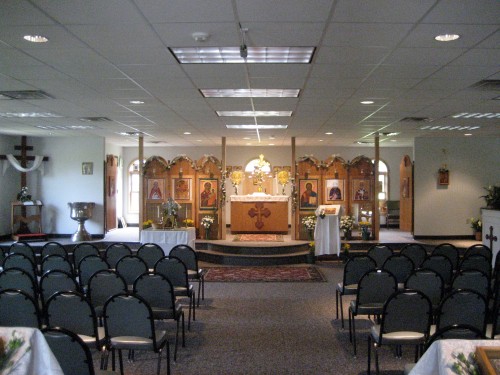
Three Hierarchs Chapel, St. Vladimir\'s Seminary, Crestwood, NYTomorrow morning, at the ungodly hour of 5:57am, I will depart Indianapolis for the Fellowship of Ss. Alban and Sergius Conference. I will note that it is by no means too late to give to the tip jar (as in “tip jar, baby, tip jar“). I will have my laptop and my brand-spankin’-new camera, so I will be providing updates as regularly as I am able.

I’m looking forward to any number of things; I am of course looking forward to getting to hear (and possibly meet) people such as Met. Kallistos Ware, Met. PHILIP, Bp. Hilarion Alfeyev, and so on. I hope that I’ll actually get to hear a particular priest (nameless for the moment but identifiable once you read the quote) say “Back when I was studying at the Pontifical Gregorian Institute…” with my own ears. I’m looking forward to the Divine Liturgy for the Ascension in the Three Hierarchs Chapel. I’m looking forward to meeting the eclectic group of people one usually meets at conferences. I’m looking forward to seeing how New York’s public transportation matches up to England’s and Germany’s.

More than anything, however, I guess I’m very much hoping to get a sense about whether or not St. Vlad’s is the place for me. I will have a chance to talk with Fr. John Behr at some point over the course of the trip, so hopefully that will be a fruitful conversation. I know I don’t belong at Indiana University, but that is not the same thing as actually having a meaningful direction.

If there’s something to which I’m not looking forward, it’s coming home Sunday night. It’ll be an empty house, and that’s what’ll be greeting me for the next six weeks.

Well — more from the road.

Many years

I can finally talk about this without any fear that it might reach certain ears prematurely (i.e., certain people who the parties involved would rather tell themselves):

Matthew and Erin, our newly-baptized godchildren (see photo), are engaged! They are planning for a wedding shortly after the Feast of the Dormition next year.

Erin started at IU as a freshman the same year I started as a transfer junior (fall of 2003), and because of the realities of how transfer credits typically don’t work with music schools, that meant we wound up taking many of the same classes together. Matthew started as a freshman the following year, and we met in the chorus for Eugene Onegin. Their story is theirs to tell, but I’ll just say that they started attending All Saints together two years ago and were subsequently blessed as catechumens last fall. All of this is to say that they have truly desired and made the effort to grow their faith in tandem with their relationship, and it’s been a really wonderful thing to see.

Many years!

Poking my head back up…

…at least for a moment. The thing about blogging is, when you’re doing it, you’re able to do it. When you’re not doing it, it’s hard to get back into it because you feel like you’ve got so much catching up to do.

In brief, I was deliberately keeping blogging on the downlow the first half of April or so while a couple of situations finished playing themselves out, and they did, and everything turned out okay, but then it was Holy Week, and my mom was here, and then it was Finals Week, and then I’ve also been adjusting to a new job, and, and, and…

The other thing is that my new job is significantly less stressful than my old one. By metric tons, even, and for every imaginable reason. Between that and having a break from classes, the decompression rate is astounding. One of the things this has underscored for me is the sheer amount of stress with which I’ve lived for about the last year and a quarter — it’s been a pressure cooker, and not entirely for great, rewarding reasons. There are details on which I’m not going to elaborate here, so let’s just say for the moment that when somebody stops communicating with you, or intentionally communicates poorly, but still makes you responsible for what you would have known had they been communicating with you, and makes that standard operating procedure, there is no longer any reason to stick around — that person has already decided you don’t belong there. You’re not going to win, nor are you going to be able to fix anything.

Anyway, the point is, in decompressing, I have found myself picking up threads of particular projects that have lay fallow for much of the last year. This has been a good and productive thing — although the main one is not something I’m yet ready to discuss here — but it’s also taken time from other things I might have done more readily a month ago. Like blogging.

But here I am now, nonetheless.

I’m in the midst of reading Sunday Matins in the Byzantine Cathedral Rite, the doctoral dissertation of Dr. Alexander Lingas, the founding Artistic Director of Cappella Romana. I don’t have a lot of specific commentary on it just yet because I’m only about a quarter of the way through it, but one thing I will say is that I’m somewhat bemused by the fact that I’m having to read it in the form of a copy ordered from Proquest rather than an actual published book. Amazon.com lists it as having a publication date of 28 June 2008, but it is not yet available for pre-order; on the other hand, it is available for pre-order on Amazon.co.uk. However, if you go to the publisher’s website, it isn’t listed anywhere — neither as a forthcoming release nor anything else. Thing of it is, this has happened before; two years ago it had a publication date listed on Amazon of June 2006, and then right around May the date was yanked. An e-mail to Ashgate generated a reply that publication had been rescheduled to 2008, and here we are, but there’s nothing from Ashgate right now to suggest this is in fact happening. And, so far as I can tell, this has been going on with this particular work, with more than one publisher, for about ten years.

Gotta love academic publishing. I mean, it’s going to be approximately a $100 book, and I suspect that a thousand copies is a fairly optimistic estimate of the print run for this specific of a project, so I’m sure that whoever the publisher ultimately is, they’re not going to pull the trigger until the numbers make the most sense possible, and everything I hear about academic publishing says that, frankly, the numbers suck more often than not.

I’m also reading Bp. Hilarion Alfeyev’s The Spiritual World of St. Isaac the Syrian, and that’s another fascinating case with regard to publishing. It is readily available from its publisher, Cistercian Publications; however, for whatever inexplicable reason, it is not available through Amazon. That’s not all; the current edition really looks like it needed an editor. Capitalizations are extremely inconsistent, for example; a sample sentence tells us that “[t]he christological position ofthe Council of Ephesus was purely alexandrian: it took no account of the antiochene position, and it was precisely the antiochene (and not ‘nestorian’) Christology that was the Christology of the Church of the East” (p22, entire quote sic). Bp. Hilarion is a native Russian speaker, I believe, not a native English speaker, so perhaps that explains it, but one might expect that a native English-speaking editor would normalize these things.

In terms of my own adventures with academic publishing, I submitted my “Sensory Experience and the Women Martyrs of Najran” paper to a particular journal that had a call for papers that seemed appropriate. I got the response on Monday, and it was a bit curious. It wasn’t a “yes,” but it was a “no” that I wasn’t totally sure what to do with, since it wasn’t a form letter rejection (I’m very used to those). Basically they said, “This is really interesting, but in its current form it’s not appropriate for us. If you wanted to make it appropriate for us, here’s what our reviewers suggest.” The letter specifically says, “While we are not asking you to revise and resubmit, we would be happy to look at the paper again, provided you address all of our reviewer comments.”

So, what does this mean? Is this how journals try to let people down easily (“You’ve got a really great personality”), or does this mean it might be worth my time to make the revisions they suggest? If the latter, I’m going to need some help deciphering the editor-ese, so I’ll make dinner for whoever might be interested on that front.

Humorous note: The salutation of the letter was, “Dear Prof. Barrett”. Heh. Uh, no, to say the least.

I will eventually have pictures and a more detailed report regarding Lazarus Saturday’s baptisms and chrismations, but there is a related matter I wish to mention regarding a couple of the people involved, and it’s not completely public knowledge yet. Watch this space.

In other matters… in case you were wondering, no, as it happens, melted wax from a beeswax candle does not improve the functionality of a laptop keyboard. My wife felt compelled to perform this experiment this last Friday, so please don’t think that you need to determine this for yourself. Now, thankfully, Dell laptop keyboards appear to be designed to have things spilled on them and are incredibly easy and inexpensive to replace with no further trouble; Triangle Laptops was a terrific source, and I have no complaints about their pricing or their service. Should this happen to you, that’s the first place I’d look.

There is an effort at All Saints underway to explore ways of “greening the church”; without wishing to get into an argument here and now about whether or not this is a concept with which Orthodox need concern themselves, I’ll pass along that there were a few ideas which immediate came to mind for me:

  1. Commit to burning only olive oil and beeswax (excluding incense) — no paraffin, in other words. Olive oil and beeswax are, first and foremost, the traditional materials to use for candles and lamps in the church, and they have the added benefit of being clean-burning. St. Gregory Palamas Monastery in Ohio, I believe, does this.
  2. Start an herb garden. Given the various liturgical uses of basil, at least, this strikes me as a no-brainer. No reason to spend tons of money on fresh basil for Holy Saturday and house blessings and so on when, for a small fraction of that cost, a church could grow its own. Grow enough and there might be a reason to have a regular presence at the local farmer’s market, which could itself be a form of outreach.
  3. On a completely basic, practical level–have a rain barrel, or two, or three, or however many would be useful to have.

Anybody have any other thoughts?

I will wrap this up for the moment with a plug for the book The Oldways Table. If you’re a Michael Pollan or a Rod Dreher person, you may very well find that this book helps to suggest practical ways that some of their ideas might be put into practice. I’ll have more to say about it later once I’ve tried a few more of its ideas (and more importantly, adapted them into some of my own).

(And yes, I did in fact finish the Patriarch’s book on Lazarus Saturday; I’ve got plenty to say about it, but it can wait. Suffice it to say, for the moment, that I believe his intended audience for the book is not comprised of the Orthodox faithful, but that this does not in and of itself have to mean that the Orthodox faithful are justified in viewing what he says uncharitably.)

Testing from flickr…

Nachos on Pascha, originally uploaded by richardtenor.

For your viewing enjoyment, Der Nachoberg…

The Final hours of Bright Week

All Saints on Pascha just before Agape VespersMeshiha qam! Bashrira qam!*

So, I find it more than a little ironic that, having opened the doors of the iconostasis for Bright Week, tonight will have been my first time in the nave since Agape Vespers, and the doors will be closed fifteen minutes or so after I get there.

On the other hand, since Bright Week did double duty as Finals Week, I’m not really sure it could have been any other way, at least not this year.

I had two finals this week; Latin and Syriac. Latin was relatively easy; I’ve commented before that studying a language like Latin, one is the beneficiary of all kinds of useful pedagogical editions of things with helpful features like half of the page being a glossary and 75% of the words being glossed. With Syriac, as I have commented before, one, well, isn’t.

Going into the Syriac final, we were all rather panicked; we read three longish texts — The Gospel of Mark chap. 14 through the end, The Doctrine of Addai, and the Life of Ephraim — with just an impossible amount of vocabulary being contained therein. (And make no mistake: at least at this stage of the game, until we get to texts that don’t have vowel-pointing, it’s the vocabulary that’s the killer. Syriac grammar is actually remarkably uncomplicated, at least so far.)  We studied one of the passages from the Life of Ephraim that we thought might be on the exam the evening before, got it down pretty well, and we all felt a bit better. The next morning, the professor handed out the exams and just said, “Do what you can.” Of course, the three passages that actually wound staring up at us from the page were nothing from any of those three texts which I had actually spent any particular time mastering. As my Syriac co-sufferer Diane acknowledged, “There were a lot of made-up words and grammatically-appropriate blanks in my translation.” Um, yeah.

Nonetheless, the school year is over, and as soon as grades were posted yesterday morning (not to mention no e-mails having arrived from my Syriac professor asking, “You know, have you ever considered a direction change? Like, say, becoming a shepherd?”), I felt a great weight lift from my shoulders. I survived the school year, something that at points felt unlikely for a whole host of reasons. Between classes being over (at least for six weeks) and settling into the new job, I am getting to truly decompress a bit for the first time in perhaps a year and a half — certainly since before I broke my ankle last February, one way or the other. We’ll see if I know what to do with myself.

(By the way, Iron Man rocks. Hard.)

* Just to prove I learned something in Syriac — “Meshiha” is “Christ”, being a passive pe’al participle used attributively in the singular masculine emphatic (from the root mshah, “to anoint”), therefore carrying the meaning “anointed one”; “qam” is the 3rd person masculine singular pe’al perfect form of the verb which means “to stand”; “ba-” is a preposition meaning “in”; and “shrira” is “truth”. So — “Christ stood/arose/got up!” “In truth He arose!” Isn’t this fun? Next year I’ll do it in Coptic.

Christus resurrexit! Vere resurrexit!

 In Old English: “Crist aras! Crist sodhlice aras!”

In Modern English: “Christ is risen! Indeed He is risen!”

In Modern South Central Indiana English: “Christ done riz! Sho’ ’nuff!”

I have a fairly long blog post or two in me, as well as notes for Lesson 3 of Hansen & Quinn, but it’s still going to have to wait until after this week. Last week being Holy Week and this week being Finals Week… yeah. Next week.

Brief updates, however (with explanations to come):

  • Lazarus Saturday saw the reception of six into the Orthodox Christian faith at All Saints; four by Baptism, two by Chrismation. Two of those baptized were my wife’s and my new godchildren, Matthew and Erin. Theirs is a good story, and the morning (not to mention the subsequent Holy Week) was a beautiful welcoming home (as it were) for them. I have pictures and I’ll post some eventually.
  • I started a new job on Monday of Holy Week. The new job is a Very, Very, Very Good Thing; truly, a major blessing. That said, I don’t ever recommend starting a new job during Holy Week. I also don’t recommend Finals Week being Bright Week, and I particularly don’t recommend having a Latin final at 10:15am on Bright Monday, but sometimes there’s little we can do about these things in a fallen world.
  • My mother was with us for most of Holy Week (starting with Unction on Wednesday evening) and Pascha. She survived, and would like to come back and do it again… someday.
  • I’ve decided to take the Reading French for Graduate Students course this summer. I’d like to refresh my French, particularly now that I’ve had a couple of years of Latin and Greek and actually understand some of the grammatical concepts and could actually explain to somebody what a subjunctive is.

Okay. More later.

A parable

Once upon a time there was a young man who was eating slices of of a particular baker’s bread, and had eaten perhaps half of a loaf, but the baker would not allow him to eat any more buying by the slice. “Any more and you have to buy the loaf,” he told the young man.

The thing was, this was a baker who was choosy about with whom he did business, and while anybody could buy slices, he wouldn’t sell an entire loaf to just anybody. He would only sell a loaf to somebody who had demonstrated that they understood how the bread was made, where the flour came from, what role the yeast played in the rising of the dough, and so on. Not only that, but he would only bake so many loaves per day.

The young man had done his homework about baking, and had gotten to know the baker by spending time in the shop. The baker seemed receptive to the idea of selling him the half of the loaf he hadn’t yet eaten. But then, suddenly, seeing how many customers were trying to buy loaves that day, the baker decided that the young man would need to come back another day for his loaf. “But what about the remainder half of the loaf I’ve already eaten in slices?” the young man asked. The baker didn’t answer him, and focused on getting to know the crowd of people in his shop to figure out who was worthy to buy his loaves of bread. The young man went away hungry and somewhat dejected.

Towards the end of the day, the young man, still hungry, dropped by the baker’s shop again, which was now empty except for the baker. The young man saw that all of the day’s loaves were sitting on the counter, including his uneaten half. “What happened?” he asked, incredulous. The baker replied, “By the time I figured out to whom I was willing to sell for the day, everybody had changed their mind and decided to go buy bread elsewhere.”

“That’s terrible!” the young man exclaimed. “Well, I’m still more than willing to buy my uneaten half!”

“No,” the baker said, gathering up all of the loaves into a trash sack, “everything has to be thrown away for the day. Bakers’ rules. Of course, since I didn’t sell anything I don’t know that I’ll have the money to buy ingredients for tomorrow’s loaves, but I guess that’s how it goes.”

“Wait a minute,” the young man said. “You know me, I had done my research on baking and bread, I was here early to talk to you, I had already eaten half a loaf paying by the slice, was willing to pay full price for a loaf for the remaining half, you still decided not to sell to me, and now you have nothing to show for the day?”

“That’s right,” the baker said, shrugging his shoulders.

The young man turned on his heel to go find a bake shop run by somebody with more sense, feeling fortunate, in a way, that his money ultimately hadn’t gone to a person so short-sighted and foolish.

Draw your own conclusions.

I should start calculating trends


My blog is worth $3,951.78.
How much is your blog worth?

If you agree with this at all — you know what I’m going to say, don’t you? — tip jar, baby, tip jar.

Also, I’d like to welcome my buddy Gavin back to the blogosphere! We’ve missed you!

THANK YOU!!!!!!!!!!!!!!!

I’ve much more to say in a later post (that, frankly, may well have to wait until after Pascha given that every minute of this week is entirely accounted for), but I would like to sincerely thank the first contributor (or contributors?) to the tip jar, whoever he/she/they are.

Lots going on — much good, some not so much. I hope to be able to get to it soon. A blessed Holy Week to all.

I like New York in June…

Three Hierarchs Chapel, St. Vladimir\'s Seminary, Crestwood, NY…how about you?

I am registered and have booked a flight for the Fellowship of Ss. Alban & Sergius conference. Signed, sealed, delivered, money has exchanged hands. I will have my laptop with me, of course, so I will be there reporting on the events as a blogger, I will also be there as a prospective student, and I will also be there as someone with a genuine interest in the subject matter (euphemism for “wide-eyed tourist”). If you can be there, I think you should go too. If you can’t be there, the tip jar still awaits its first contribution — I’d rattle it, but there’s nothing in it to rattle.

Who else is going? I frankly have heard of nobody else who is. I guess I’m not totally surprised, since the Fellowship really is, for all intents and purposes, a group of people with the most specialized of special interests, but I would think that the roster of speakers would have at least generated a bit more attention. Maybe it’s too soon for that. Well, regardless — I’m very much looking forward to the experience. (It is also, not terribly coincidentally, the only trip I’ll really be able to take this summer.)

I’ll note that since registering, I received an e-mail announcing that they would be making available the opportunity to students and seminarians to work at the conference in exchange for the registration fee, and would I be interested? I e-mailed back and said yes, but we’ll see how all of that works out.

Moving on to different matters… I really appreciate what Alden Swan had to say regarding a post from Michael Spencer:

I think it’s telling that the two most prolific evangelism programs in evangelicalism both approach their audience with questions that Jesus never used.

“Do you know that God loves you and has a wonderful plan for your life?”

“If you were to die tonight, and God were to asked you, why should I let you into my heaven, what would be your answer?”

[Spencer] points out that Jesus merely proclaimed the Kingdom of Heaven, which had very different connotations than our dangling Heaven on a stick (my terminology).

The comments on Spencer’s post are themselves fascinating — give them a read. I’m also considering printing up a t-shirt that says, “The Orthodox Church: Refraining From Dangling Heaven On A Stick Since 33 A.D.”

Okay, maybe not. But that’s still a great phrase which I’d love to figure out how to use sometime.

Moving on.

Rod Dreher’s “Conservatism is dead. Long live conservatism!” examines at the Tory Anarchist’s “look at the future of the right,” who says the following:

Orlet asks whether a movement with as much young talent as conservatism has can really be doomed. Of course it can. Young journalists are one thing, but there’s no young Willmoore Kendall or young James Burnham or young Frank Meyer on the scene. No, I wouldn’t expect a 20-year-old or a 30-year-old to have the gravity of any of those thinkers — but even looking at our 40-year-olds and 50-year-olds, I can’t think of too many who are of much significance as theorists or academics. […]

Part of the problem on the theoretical side is that too many of the best young minds in conservatism have followed Buckley’s example by shunning grad school and embracing journalism or the movement instead.

With that in mind, consider my liberal friend Emily Hindrichs’ opinion:

I have long maintained that the nation in which I live will not have an academic as a president for one simple reason: people fear the educated. They fear the big words and the complex sentence structure and the literary references. Instead, they elevate the mediocre with descriptors such as “down to earth” and “plain-spoken.”

Now take this incident into account. Mostly what I wish to focus on is a response in the comments:

Universities, especially humanities and social science departments, have long since ceased channeling received wisdom and have turned into liberal advocacy organizations. A good deal of what they do either subtly or overtly pushes liberal ideology. […]

One should hold one’s head low and get a technically oriented degree at a university.

If we accept that premise that conservatives have largely ceded academia, the question then becomes, “Why?” (I accept this premise in part, by the way, but not entirely.) Does Emily’s assertion and the comment about the Delaware problem answer the question satisfactorily? Is it that conservatives are anti-intellectual? (Perhaps.) Or afraid of their ideological purity being tainted? (Probably, at least in part.) Is it a utilitarian view of education? (Largely, I think.) Or maybe it’s a marketing issue — getting back to Emily’s point, they’d rather play in Peoria than compete on the academic front. It’s a way of catering to the masses, which ensures their continued ability to eat with the classes.

What is the best way to synthesize this? I don’t know. What I do know is that conservatism only has itself to blame for its intellectual bankruptcy if the only acceptable response is retreat. The alternative is not easy — that being, conservatives have to be superior in their scholarship and not hope that correct ideology will do their work for them — but it’s what needs to be done.

Last year, a question came up in a class about Nestorius — what did he actually teach? I offered what I understood to be the basic summary of the Orthodox understanding, and the liberal skeptic in the class was able to quote Nestorius’ writings chapter and verse, offering a snarky comment to the effect of, “You Orthodox types have cooked up a lot of your own issues with him.”

By contrast, I heard a lecture the same year by a scholar who is Orthodox who teaches at an Ivy League school. This. Person. Knows. Her. Stuff. Top to bottom, in and out, she’s got it cold. Somebody from here who falls under the category of a liberal debunker went up to her afterward and said, in a manner more or less suggesting a rivalry that was friendly and professional but a rivalry nonetheless, said, “There are major problems with your thesis.” At that point it becomes about which bias informs the scholarship — and make no mistake, atheism is a bias, it is not a guarantee of objectivity by any means — but there was no denying that she was right on in terms of the sources, the languages, and everything else.

That’s what we have to do. If conservatives aren’t willing to put in the time and the work, they shouldn’t be surprised when their lunch gets eaten by people who may be on Mars ideologically but have the facts and the sources straight.


adventures in writing alexander lingas all saints bloomington all saints orthodox church american orthodox architecture american orthodox music american orthodoxy Antiochian Archdiocese Antiochian Orthodox Christian Archdiocese of North America Antiochians books byzantine chant cappella romana chant church architecture ecclesiastical chant ethnomusicologists ethnomusicology fellowship of ss. alban and sergius Greece Greek greek food greekness hazards of church music international travel tips ioannis arvanitis joe mckamey john michael boyer kurt sander Latin liturgical adventures liturgical architecture liturgical music liturgical texts and translation liturgy liturgy and life lycourgos angelopoulos medieval byzantine chant Metropolitan PHILIP militant americanist orthodoxy modern byzantine architecture modern greek music music as iconography my kids will latin and greek when they're newborns my kids will learn latin and greek when they're newborns orthodox architecture orthodox architecture is bloody expensive Orthodox choir schools Orthodox Ecclesiology orthodox outreach orthodox travel pascha at the singing school Patriarchate of Antioch Patriarch IGNATIUS IV Patriarch of Antioch publishing random acts of chant richard barrett in greece richard toensing rod dreher sacred music st. vlads st john of damascus society Syriac the Bishop MARK fan club the convert dilemma the dark knight The Episcopacy The Episcopate the only good language is a dead language this american church life travel we need more american saints why do we need beautiful music in churches?

Blog Stats

  • 271,581 hits

Flickr Photos