Archive Page 39

Sunday of Orthodoxy qua Orthodoxy in America

This last Sunday, being the first Sunday in Great Lent, was the so-called “Sunday of Orthodoxy,” commemorating the victory of iconodules over iconoclasm at the Seventh Ecumenical Council (“Nicea II — The Wrath of Arius”). In years past, there has been a Sunday evening Vespers in Indianapolis, participated in by all the area clergy and their parishes. This year, instead of Vespers, a morning Divine Liturgy was planned at Holy Trinity Greek Orthodox Church, who had just started worshiping in their new building in December.

All Saints’ participation was determined rather late in the game; being an hour and twenty minutes south, and with some of our parishioners commuting from as much as an hour away even further south, it took some figuring out. Ultimately our deacon stayed behind and served a Typika for those who weren’t going to Indianapolis, allowing Fr. Peter to concelebrate and a group of us from All Saints to attend.

The morning was stunning in several respects. For the occasion, a new icon was commissioned of All Saints of North America, which now includes Indiana-born St. Barnabas. The original was put out for us to venerate, and we were all given prints of it as well. I’ve jokingly called Holy Trinity’s new building the satellite campus of Hagia Sophia, but it really is frickin’ huge. As the pictures make clear, I think we had close to a thousand people in there, and people were still having to gather in the narthex. We had everybody, too (among the clergy as well as the people); Serbians, Greeks, Arabs, Bulgarians, Russians, Ukrainians, Romanians, American converts, and even a handful of Copts, Ethiopians, Eritreans and Indians. (Okay, I’m not sure we had any Finns or Estonians.) The communion of the faithful easily took half an hour, and that was with six chalices, I believe. Add another twenty minutes or so for the communion of the clergy.

Some general observations: Holy Trinity is an example of a church which I think would be too big for me to be comfortable in it as my home parish. It is a beautiful building, and it will only get more beautiful as they fresco it, marble the floors, put up the iconostasis, etc., but I’d rather see the design principles applied to a church maybe a quarter of the size. (This begs the question of why Holy Trinity, which I believe has something like 600 people, doesn’t plant some churches, but never mind that now.) I’ve heard it suggested that past 250 souls or so, you really overtax a priest’s ability to minister; I’ll throw out another possible metric, which is that you don’t want the building to be any larger than that in which the cantor can sing comfortably and be understood and heard without needing a microphone. (This assumes that churches are being built with attention to acoustics, which isn’t even necessarily the case with Holy Trinity, unfortunately — there were one or two odd decisions made on that front.) That said, I think it’s wonderful that a traditional-looking Byzantine temple now exists which is large enough to hold everybody in the metro area. I somewhat wonder if perhaps, with Detroit being, well, Detroit, there might not be talk behind the scenes of moving Metropolitan Nicholas’ throne to Indianapolis, hence the building being a size more appropriate to a cathedral than a parish church.

I wound up joining the choir; Max Murphy, my counterpart at Ss. Constantine and Elena, conducts the choir for these big combined services and I sing for him when I am able. The music was, more or less, OCA music with some simplified Byzantine things reworked for a large ensemble. My trouble is that the Orthodox musical heritage is so much richer than the utility music which tends to dominate services like this, but the reason why it dominates services like this is because it is easily scalable to huge ensembles (as well as makes congregational singing reasonably easy). Mark Bailey once told me that Kievan common chant is great because you can get 50 people singing the front page of the New York Times to it in fifteen minutes; on the other hand, he freely admitted, the downside of Kievan common chant is that you can get 50 people singing the front page of the New York Times to it in fifteen minutes. There wasn’t an overabundance of Kievan common chant at this service, but the principle was still largely the same. At any rate, it was, mostly, the music that virtually everybody in the Indianapolis area sings except Holy Trinity (and All Saints, for that matter), so it was familiar to Max, the majority of the choir, and a good chunk of the congregation.

There were some interesting moments during the procession of the icons; Fr. Taso (the pastor of Holy Trinity) originally asked the congregation to all sing the litany responses in their own languages, in the spirit of our coming together as a symbol of our unity as Orthodox Christians. This didn’t quite work the way he intended, so ultimately he led us in the Tone 4 threefold English “Lord, have mercy” common to Greek parishes (and Antiochian parishes during Holy Week if one is following Kazan). That worked just fine (although it was different from the responses the choir prepared — Max gave up when he realized that Fr. Taso was going off-script).

One always wonders what happens behind the scenes when that many clergy gather on another priest’s turf, particularly when the event functions something of a “coming out party” for said turf, but Fr. Peter made a point of bringing up that very question last night after the Liturgy of the Presanctified Gifts. “It was very peaceful, as surprising as that sounds,” he said. “Fr. Taso called us all together and said, ‘Brothers, what do you want to do?’ To have the protos do something like that, particularly at a Greek church, is unheard of.” (When there were some inevitable uncomfortable chuckles, he said, “That’s not a swipe against the Greeks — they’d tell you the same thing!”)

Given events of the last few weeks, there have been conversations about what Orthodox unity in America means, if it can even happen at all now, if we’re looking a big step backwards, what’s the path from here, etc. etc. etc. I think that to some extent these nervous questions are a bit misguided; it’s not exactly like the AOCNA and OCA were preparing to announce an administrative merger next week and the news out of Damascus derailed it at the last second. However, I think we can look at events like this Sunday of Orthodoxy Divine Liturgy and make some informed guesses about what the practical side of jurisdictional unity might look like.

  • Somebody’s going to have to be the protos, as it were, and it’s probably going to be whoever has the resources to be so effectively, including the space to be a meeting ground for everybody. This was true in 1975 when Met. PHILIP and Met. MICHAEL unified the Antiochian churches in this country, and Met. MICHAEL stepped down; it will still be true going forward.
  • Along similar lines, there will be a group who is numerically dominant. There were ten or so parishes represented at Holy Trinity this last Sunday, and at least half of the congregation was Holy Trinity’s own people.
  • It will be up to the group who is numerically dominant and who functions as the “protos” to be a loving and welcoming brother in Christ. It will be up to the others to be receptive to that, and to return it in-kind.
  • It might be a bit of a cacophony for awhile until people figure things out. The job of the dominant group will be to help guide everybody into unity, and to do so in love.

Looking at these points, I’d argue this wouldn’t be a bad model for how things should be now, even, with or without unity on paper.

One other thought for the moment. That icon of All Saints of North America? A couple of them are American born; some of them were active in America. However, with the exception of St. Peter the Aleut (who was martyred young), none of those saints were both born here and active here. Let me suggest that before we have an indigenous church, we’re going to need indigenous saints. Some might argue that we should start with Fr. Seraphim Rose (which reminds me — I’m reading The Soul After Death right now); while recognizing he’s a controversial figure, I don’t really think that it’s in question that he is a native-born model of sanctity. I personally think he is a saint, and I believe he interceded to heal my mother from a heart issue a few years back, but I also think it will take time for the amen of American faithful to be uttered. I know a priest, and perhaps a bishop or two, who I believe might be glorified after their respective reposes. I have heard some suggest Lynette Hoppe; certainly this book seems designed to make that case. There are others I can think of, too.

My point is, until there are models of holiness who have been raised up out of “our people,” as it were, I’m not sure it makes any sense to be so neurotic and anxious about our earthly organization. Once we start producing saints, administrative questions will take care of themselves. The importance of saints who are local and recent, I have come to realize, is that they shine forth the light of Christ in a way that is immediate. What is more powerful, reading a story about somebody who supposedly did something fifteen hundred years ago, or hearing first-hand accounts of people who did those very things within the last few years? We run a great risk by holding ourselves at a distance from saints — they are less convicting that way, I suppose, meaning they’re more comfortable to be around, but they are also less compelling and convincing.

In other words — if we want a solution to the jurisdictional problem in this country, maybe what we need to do is, before we write a letter or join a lay activist organization or start a blog (all potentially worthy things to do, don’t get me wrong), we need to go out and be saints.

We will see.

A reasonable question about Watchmen

An e-mail from a reader which asks an entirely fair question, and one which I wondered if I wouldn’t get from somebody:

Are you sure you want to recommend (and so enthusiastically!) … Watchmen?  It’s one thing to set such evil images before your own eyes, but must you also encourage others to do the same?  (See Psalm 101:3).  Do you really want to reward the makers of this film with your money?

I respect this question, and I do not take its points lightly. What I can say is that if I thought the film was intended to be, or best understood as, a cheap piece of trashy violence, I would neither see it nor recommend it. I don’t waste a second of my time with junk like the Saw films or Friday the 13th or Hostel or things like this. Nor does a sheen of “art” excuse everything; The English Patient is a beautifully done piece of garbage, in my opinion, which ultimately says that committing adultery is worth dying for, if it means you’re following your heart.

I’ll note, again, that I spent some time tonight listening to my priest discuss enthusiastically the Orthodox Christian merits of The Matrix, a movie which contains much violence and disturbing imagery. The Passion of the Christ is, of course, notorious for its level of gore, which I would argue exceeds that of Watchmen. The Mission, one of the most profoundly Christian movies I’ve ever seen, contains extensive nudity and quite a bit of violence interspersed with religious imagery, particularly at the end. (Don’t tell me that the nudity, being non-sexual, makes it okay; that didn’t keep parents from having their kids excused from watching it when my English teacher showed it in class my senior year of high school.)

Let’s not even talk about Shakespeare and Hamlet’s “country matters.” Or most opera.

This begs the question — what is the merit of Watchmen? I would argue that it is, at its core, a movie which suggests that whether or not God exists, we’re best off assuming He does and that He’s watching rather than deciding He doesn’t and putting ourselves in His place. This is as yet, shall we say, under-theorized, but this is part of why I say, go see it, and then we’ll talk.

At one point, a Jewish character in the movie, who has invented a superhero identity for himself, asks another superhero whose identity has heavily American patriotic overtones and who is breaking up a riot too violently for the other’s taste, “Whatever happened to the American dream?” and the patriotic hero replies, “It came true. You’re looking at him.” Now, when you realize that the way a couple of Jewish kids from Cleveland tried to actualize the American dream for themselves by inventing the first widely-known superhero who himself had American patriotic overtones (I am referring to neither a bird nor a plane), you understand what this scene is actually about. If Superman were to actually exist in real life, and be American (something explicitly said in the film), it would be monstrous; it would be an establishment of other gods in the place of the True God; it would be chiliasm. It would lead to the destruction of everything we claim to hold dear as Americans and as Christians.

All of this aside, however, one must follow their own conscience, and I don’t encourage anybody to seek out things which would make them stumble or to go against their better judgment. Do not go see it if that would be the case.

I’ll also point out that the movie is rated R, it is rated R for good reason, and that needs to be respected — in other words, it is not a movie to which I advise anybody to bring their kids. As with the source material, the violence and sexual material is used to explore, and comment upon, both the themes of the story as well as the medium through which the story is being told. I will qualify here that I don’t have a lot of perspective on how old somebody would need to be to be able to deal with this; as I said earlier, my first encounter with the source material was at age 13 or thereabouts. Then again, my first book was Carl Sagan’s Cosmos, which I read at the age of 4.

Varii (go see Watchmen) and (go see Watchmen) sundries (go see Watchmen)

A “Byzantine” monastery from the late 5th/early 6th century has been found about five miles west of Jerusalem, reports CNN:

During the first few weeks, the team exposed the church’s narthex, the broad entrance at the front of the church, whose floor is covered with colorful mosaics in geometric patterns, he said.

“Unfortunately, at the conclusion of the excavation this mosaic was defaced and almost completely destroyed by unknown vandals,” Mor [the leader of the excavation] said.

Ouch. On the other hand, I smile at this detail (particularly since I just finished my first-ever attempt at homebrewing):

The excavators also partly exposed a complex wine press, said Mor. Grapes grow well in the region, and it’s likely the monks sold the wine.

And it’s in my period and region, too. Hmmmmmmmmm.

The screenwriter of Watchmen urges people who liked it to see it again, preferably this Friday or Saturday (a tip of the hat to WatchmenComicMovie.com):

This is a movie made by fans, for fans. Hundreds of people put in years of their lives to make this movie happen, and every one of them was insanely committed to retaining the integrity of this amazing, epic tale. This is a rare success story, bordering on the impossible, and every studio in town is watching to see if it will work. Hell, most of them own a piece of the movie.

So look, this is a note to the fanboys and fangirls. The true believers. Dedicated for life.

If the film made you think. Or argue with your friends. If it inspired a debate about the nature of man, or vigilante justice, or the horror of Nixon abolishing term limits. If you laughed at Bowie hanging with Adrian at Studio 54, or the Silhouette kissing that nurse.

Please go see the movie again next weekend.

You have to understand, everyone is watching to see how the film will do in its second week. If you care about movies that have a brain, or balls, (and this film’s got both, literally), or true adaptations — And if you’re thinking of seeing it again anyway, please go back this weekend, Friday or Saturday night. Demonstrate the power of the fans, because it’ll help let the people who pay for these movies know what we’d like to see. Because if it drops off the radar after the first weekend, they will never allow a film like this to be made again.

Fine by me — er, seeing it again, that is, not the other proposition. Who wants to see it with me on Saturday sometime?

I saw Watchmen in IMAX last Friday. It is worthy of its own post, and that might happen after I see it a second time, but I will say for the moment that it is a challenging, adult, in-your-face, no-holds-barred piece of art which is worth seeing and to which it is worth reacting. Yes, it is violent and the violence makes you giggle in a way which makes you very uncomfortable with yourself after the fact. Yes, there is a bizarre use of Leonard Cohen’s original recording of “Hallelujah” (which, I must say, is very jarring listening to begin with when you’re used to the — dare I say it? — superior Jeff Buckley version). Yes, I read the book — I read it for the first time probably twenty years ago and have read it any number of times since then, including reading it aloud to my wife. I’ve read much of what’s been published about Watchmen the book and have been following its development as a film since way back in the day when Comics Scene had a half-page interview with Sam Hamm about his screenplay and about how Terry Gilliam would direct it. Hamm, as I recall, speculated about perhaps Michael York as Adrian Veidt and Robert DeNiro as Edward Blake. Might have been interesting.

Anyway, go see it. I’ll go see it with you. Blade Runner shouldn’t have taken as long as it did to be recognized, and I’d hate to see a similar fate befall Watchmen. It’s a big-budget Hollywood art movie, much like The Dark Knight was, but unlike TDK this doesn’t have much in the way of presold factors that allow people to be fooled into thinking it’s just an action movie. It’s not perfect, but that’s okay. Just go see it, and then we’ll talk.

After the Liturgy of the Presanctified Gifts tonight, Fr. Peter was talking about how Orthodox Christianity permeates the first film of The Matrix trilogy. “It’s all about the Fathers,” he said. “It’s an Orthodox movie through and through.”

“If that’s the case,” I replied, “it must be advocating specifically the Western Rite.”

“Why is that?” Fr. Peter asked, tilting his head at me with a quizzical expression (which is not uncommon).

Without missing a beat I looked him right in the eyes and said, “There is no spoon.”

I will be going to Confession this weekend, I imagine. I don’t look forward to the penance.

Philoponoi

There’s a new project with which I’m helping. It’s still very much not quite together, but bookmark it and I’ll keep you posted as more happens over there. It’s called Philoponoi.

Nice ways to spend Valentine’s Day or, things I’ll probably only ever be able to pull of once, part VII

Monday was our last day in England. We had an early flight out of Heathrow on Tuesday, so we had to make the day count as much as possible.

First order of business was food and real coffee. (Did I say that I don’t understand this Nescafé nonsense?) Megan wanted to try a full English breakfast, so off we went. Several restaurants within a few blocks of our hotel advertised a full English breakfast, but upon closer inspection of menus all were missing a vital ingredient — that being, of course, black pudding. In fact, black pudding seemed to be nowhere to be found anywhere, with it being replaced wholesale by tomatoes. That being the case, we finally settled on a café in Leicester Square called Fiori Corner. It was good food despite a lack of blood sausage, and I can recommend it, but do be aware that they are cash only, and they will charge for coffee refills.

Following breakfast, we headed for the British Museum. Let me tell you, if you’ve never seen it before, the British Museum is huge — so huge that if you don’t know what you’re looking for, you might very well assume that what you’re looking at isn’t the British Museum, because no museum would ever be that big. (By the way, the British Museum is right across from a thoroughfare called Coptic Street, and about the history of which I would be fascinated to learn more.) Oh, and by the way, while the entrance is free, everything else is not. You’ll pay, I think, £6 or so for a reasonably basic guidebook and map, and more depending on how detailed and complete you want it.

Hey -- eyes up here, pal.

Hey -- eyes up here, pal.

The British Museum is also so big that there’s just no way you’re going to see everything in a day, or even in a week, maybe. You really have to pick a specific area of interest and spend time there. We decided on Anglo-Saxon England and Medieval Europe, while quickly walking through some other areas on our way to find the Rosetta Stone. Among other things, we saw the Sutton Hoo exhibit, which while having a rather high percentage of replicas and reconstructions is still fascinating — particularly since I took a class a few years ago where the professor had worked on the site in her grad school days and incorporate the material into her lectures.

Following the British Museum, we went to the Royal Academy of Arts for their Byzantium exhibit with a stop at a place called Rendezvous in Leicester Square for gelato. It was good and hit the spot, but it was definitely expensive. I’ll also point out that the sign they had posted to let people know they can’t sleep in doorways is a bit odd. It looks like the caption should be, “No sensual reclining in doorways.”

From Leicester Square, it’s maybe a ten minute walk tops to RAA; it looks a lot farther on the map than it actually is. Piccadilly Circus, by the way, is somewhat Blade Runner-esque; if I had been there at night it would have seemed even moreso.

RAA, unlike the British Museum, is not free; bring a student ID if you have one — it’ll save you a few pounds on the entrance fee. You also pay for a specific exhibit, not general admission to the museum. Also, unlike the British Museum, there is no photography allowed.

The Byzantium exhibit is stunning; the examples of iconography are really breathtaking  and leave you wanting to venerate them, even though there are ropes that quite handily keep you from doing so. There was also a 13th-century Syriac Gospel lectionary on display; that was pretty darn cool. Something that rankled a bit was the caption on the wall about church life that talked about how the iconostasis was to keep the unholy masses from even being able to see the altar and how the chanting was done by all-male voices, words that seemed specifically chosen to play up how backwards these Byzantines with their alien form of Christianity were, but I suppose the real question is, what should I have expected?

A humorous moment was at an icon depicting St. Thomas with the Risen Christ; while looking at it, I heard a woman’s voice say, “There’s Thomas, doubting away.” I glanced at the person who said this, and it was a woman who looked to be of Indian descent, prompting me to think, “Hey, he’s your patron saint, lady.”

One of the big takeaways for me from the Byzantium exhibit was how Orthodox Christianity didn’t engage Byzantine culture; it was the culture, in a way that I don’t know Christianity can ever be again, anywhere. I’m not sure what that means in the long run; that may be a blog post for another time.

A leisurely walk from RAA to Westminster Cathedral for Sung Mass took us through Green Park and past Buckingham Palace. We bought some tea and some other gifts from one of the many Buckingham Palace gift shops; Megan hoped to find a tea cozy, but those turned out to be as hard to find as black pudding, for some reason. Finally we had coffee at the Costa across the street from the Cathedral, and then it was time for Mass.

The boys, alas, were not in residence, and neither was Martin Baker, so it was just the lay clerks serving as the choir. Nonetheless, it was quite beautiful, as beautiful as I’ve ever seen a Mass in the Ordinary Form. Very much worthwhile.

We walked back to the hotel afterwards, with me pausing to be amused by a sign from the Considerate Builders Scheme, and started packing things up. We decided to go to the Sherlock Holmes Pub and Restaurant for dinner; please let me caution you against making the same mistake. It is a tourist trap with a capital T, capital TR. The food is expensive and not good enough to merit the price (although now I know what “Toad in the Hole” is, and it would be curious to try it again someplace better), and overall it is just not worth it at all.
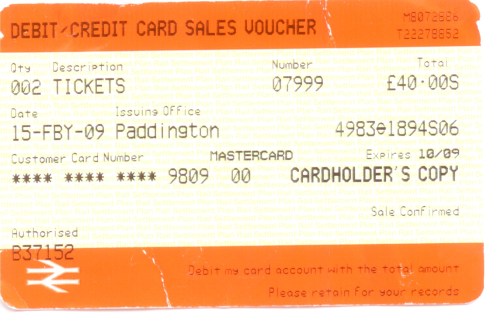
The next morning, breakfast was at one of the Starbucks locations in Heathrow; seemed like it was time to start re-acclimating to the American world. At long last, around 10:30pm, reluctant to wake from the dream, we stumbled across the threshhold of our little house in Bloomington, with our once-in-a-lifetime long Valentine’s Day weekend adventure completed, and the real world now calling us back.

Having the story to tell, and the memories we have of there with each other, is worth it.

Pictures can be found here.

Nice ways to spend Valentine’s Day or, things I’ll probably only ever be able to pull off once, part VI

oxford-ticket-2Back to happier things.

My initial thought had been that we could go to Hagia Sophia Cathedral in London for Liturgy on Sunday; I had only been able to quickly walk through there back in ’07, and thought it would be awesome to actually go for a service and perhaps see the folks I had met who attended there.

Turned out that the Sunday we were going to be in England was the Sunday of the Prodigal Son, however, and given the role of that day in preparing for Great Lent, it seemed preferable to attend a service in English. The Cathedral does a Divine Liturgy in English on the first and third Saturdays of the month; otherwise, they do everything in Greek. (“We’re the patriarchal cathedral for the Greeks in London,” the choir director there told me when I met him. “Our services are in Greek or else.”) Alas, we were there for the second Saturday.

Plus, as Dr. Lingas had told us on Friday, it was a Sunday for Byzantine chant in English up in Oxford.

Liturgy started at 10:30; the earliest train to Oxford we could catch was at approximately 8:30am, and that got us up there around 9:50. It was about a twenty minute walk from the Oxford train station to the Holy Octagon, and I remembered where it was easily enough.

This was the first time I had seen the interior of the Oxford church; while humble in a lot of respects — it is a very simple brick building — they have done a lot with what they have. Also, while somewhat smaller than All Saints, I’d say they packed in about 30-40 more people than we typically do — it was filled to the gills. On the other hand, it was 2 February on the Old Calendar (the Meeting of the Lord, or Candlemas as doubtless some of the English converts might call it), so it being a major feast might well have accounted for the attendance.

The celebrant was Metropolitan Kallistos (Ware); the homilist Fr. Ian Graham; the cantor Dr. Lingas. Talk about a delightful treat of a morning. Metropolitan Kallistos served with a great deal of enthusiasm and verve; I’ve said before that recordings really do not capture how animated he is, and I would like to reiterate that point. Fr. Ian’s homiletics are very different from what we were used to, but not in a bad way, and it was very valuable to hear on this particular Sunday. Dr. Lingas — with one other person — sang essentially a stripped down version of The Divine Liturgy in English; what was interesting was that many of the same, shall we say, pastoral realities were present as I run into at All Saints. For example, the “Dynamis” of the Trisagion was, as is the case for us, merely a repeat of the first iteration rather than a separate, longer, melismatic comp0sition. Also, as with Bloomington, as soon as the Liturgy was over — time to start chatting! In all fairness, they actually have to go to a separate building entirely for their coffee hour, so there’s no hallway into which they may just quietly slip. It was nonetheless comforting to see that such issues are not geographically limited, shall we say. One fascinating difference is that at All Saints, more or less everybody in the congregation tries to sing everything; in Oxford, the people were largely silent.

The Oxford church is on the property of something called Ss. Gregory and Macrina House; it’s a house that exists as a center for non-liturgical Orthodox activity at Oxford, including some accommodations for students and the occasional visitor. It also appears to be where the offices for the Fellowship of Ss. Alban and Sergius are presently located, and is also where the coffee hour occurs. I hope to have some occasion to spend more time there in the future.

Following Liturgy, we ate lunch at the Eagle and Child; alas, it was full enough that the Rabbit Room was inaccessible, but the bangers and mash — and the fish and chips, and the beer — were still quite tasty regardless.

The rest of the day was spent strolling around the town and the campus, and it was a gorgeous, if chilly, day for it. In some respects, it was good we were there on a Sunday — most places where we might have been tempted to spend lots of money were closed. That said, Blackwell’s is an exceedingly pleasant place to spend several hours (and perhaps hundreds of pounds). They have shelves and shelves of things which have to be special ordered here — Greek New Testaments and Septuagints, English-Norwegian dictionaries, and so on. On the other hand, Oxford is certainly a place where people with those kinds of interests are concentrated, so that shouldn’t be a surprise. One more reason to contrive a reason to move there someday. Alternately, it’s a great reason to have a little notebook in which one can write down ISBN numbers and look online for better deals in US dollars.

We attended Evensong at Queen’s College; it was almost entirely at the other end of the spectrum of liturgical practice and singing from Metropolitan Kallistos and Dr. Lingas, but it was a nice reminder of what good liturgical singing can sound like in the Western tradition. I forget how much I like a pointed psalm sung antiphonally.

Finally, it was time to go back into the city. We got good sausage rolls from a bakery called La Croissanterie, and boarded the train.

Tips: It is reasonably common to encounter cash-only locations in Oxford. The bakery was cash-only, a coffee chain called Caffè Nero, and admission to the Saxon tower of St. Michael’s at the North Gate (“the oldest building in Oxford”) was cash only. (Megan went up; I didn’t. Again, something about paying to see part of a church just doesn’t sit well.)

Evidently, if the Orthodox visitor to Oxford were to contact the Ss. Gregory and Macrina House well enough in advance, they might find that they would be able to stay there. I don’t have any other details, and they don’t have a website or an e-mail address I am able to find, so the easiest way to contact them appears to be by phone — 01865 513117.

Yeah, Oxford is still my favorite place in the universe. What can I say?
Coming soon: how we actually got to bum around, y’know, London for day, and why the Sherlock Holmes Pub and Restaurant should be avoided at all costs.

New Jersey: “Most of the auxiliary bishops will remain where they are”

An update of sorts. From the Antiochian website:

March 4, 2009

Beloved Hierarchs and Clergy, Members of the Board of Trustees of the Archdiocese, Parish Councils and Faithful of this God-Protected Archdiocese:

Greetings and blessings during this Holy Lenten Season!

There have been some questions raised regarding the February 24th decision of the Holy Synod of Antioch which addressed the status of bishops across the entire See of Antioch. The purpose of this letter is to try to answer these questions so that confusion may be avoided.

The first question deals with whether or not I am supportive of the decision of the Holy Synod of Antioch which was taken on February 24, 2009. I am supportive of this decision, for a simple reason. I am convinced that the institutional structure of our Archdiocese here requires it at this time. One of the greatest assets that we have been blessed with in this Archdiocese is our strong unity. We cannot take any chance that disunity would occur in the Antiochian Archdiocese. I believe that this decision supports maximum unity and guards against any fracture in the future. I approved the decision of the Holy Synod based on my background and personal experience. I came to this country in 1956 from a divided nation. I found in North America a divided Antiochian family: first between “Russy” and “Antaki”, and second between New York and Toledo. I worked very hard to unite this family at the cost of blood and tears. I will guard this unity with my life and I will leave to our future generations a strong and unified Antiochian family in North America. If we do not learn from the mistakes of history, we will be condemned to repeat the same mistakes. In my judgement, the models of other Orthodox jurisdictions simply do not work, and the examples are numerous. Most importantly, I do not see the action of the Holy Synod of Antioch as making that much practical change in the way we operate. Most of the auxiliary bishops will remain where they are. The auxiliary bishops will administer the dioceses on behalf of the Metropolitan. It is now clear that in the few instances in which the Metropolitan disagrees with the action of a bishop, that the Metropolitan has the authority to reverse that decision. While we have vacancies in some of the dioceses, it is important that the Metropolitan have the flexibility of moving a bishop to a place where the best interests of the Archdiocese can be served.

The second question deals with the exact status of our bishops. The decision makes it very clear that our bishops within this Archdiocese will now be considered Auxiliary Bishops. But we need to focus on the practical application of that change, and not just a title. in due time we will begin the work of editing the “Manual of Hierarchical Duties and Responsibilities” so that these changes will be clear. The Archpastoral Directive of March 3, 2009 made it clear that the Metropolitan is to be commemorated in all divine services. The auxiliary bishop will be commemorated only in the case that he is present at the divine service.

The third question deals with the impact of this decision on the provisions of our Self-Rule as well as certain articles of our Pittsburgh Constitution.

Our Self-Rule status remains in effect with regard to the relationship of this Archdiocese to the Holy Synod of Antioch. The decision of the Holy Synod is a narrow administrative decision, addressing only the standing of bishops across the See of Antioch. As we know from church history, administrative structures come and go as the needs of the church change over time. As you are all aware, there are still some differences that exist between the Archdiocese Constitution that was approved in Pittsburgh, and the constitution that was proposed by the Holy Synod of Antioch as an alternative. These differences will be addressed with the Patriarch, myself, and the Holy Synod in due time.

I pray that you will all have a blessed Journey to the Empty Tomb.

Yours in Christ,

Metropolitan PHILIP

Archbishop of New York and Metropolitan of All North America

These, I think, are the key lines:

“We cannot take any chance that disunity would occur in the Antiochian Archdiocese. I believe that this decision supports maximum unity and guards against any fracture in the future.”

“In my judgement, the models of other Orthodox jurisdictions simply do not work[.]”

“Most of the auxiliary bishops will remain where they are.”

“It is now clear that in the few instances in which the Metropolitan disagrees with the action of a bishop, that the Metropolitan has the authority to reverse that decision.”

“[I]t is important that the Metropolitan have the flexibility of moving a bishop to a place where the best interests of the Archdiocese can be served.”

I think this makes it reasonably clear what this is about. As I have said elsewhere — welcome to Lent. That’s no accident. Pray for your soul, your brothers and sisters, your priest, and your bishop and Metropolitan.

The golden rule, reality and other musings: or, happy first day of Great Lent

You know, there’s a particular reality that’s a bit hard to face when it comes to organizations. Not just churches (but churches are definitely included) — really, any organization. What I’m talking about is, of course, the Golden Rule.

“Of course,” you’re thinking. “Do unto others as…”

Nope, sorry, that’s not what I mean. What I mean is this: He who has the gold makes the rules.

This is more or less true everywhere. Government, non-profits, business, so on and so forth. There’s a very simple reason for it: unless the people able to write big checks have an interest in staying in the game, they won’t. Probably most of us would like to think that if we had lots of money, we’d behave differently, but the fact of the matter is that the more you have to protect, the more you will act to protect it — that is, the more you will act in what you see as your own best interests, and you will define what your best interests are in terms of what you have to lose.

Take charitable foundations. Do you think those exist for any other reason than it is in the best economic interests of the people funding them to do so? These entities exist because what it costs to fund them is less expensive than paying taxes on the same money. Show me somebody who gives away lots and lots of money without setting up a foundation or a charitable trust, meaning that they don’t care what the tax implications are, and I’ll show you somebody who is being truly selfless with their money. That’s not to belittle those who set up these organs of charity with truly the best of intentions, not in the slightest; this interaction of tax laws, wealth, and charity functions as intended, and in our society there’s probably no other way it could work. I’m just saying that it is probably naive, at best, to think that there isn’t anything in it for the person writing the checks.

As I said at the start of this rambling monstrosity, of course this applies to churches. At Overlake Christian Church, which is where I spent the plurality of my childhood churchgoing, the folks who wrote the biggest checks were the ones who got facetime with Pastor Bob Moorehead. That was evident even to an eight year old. And, really, why would it be any different in a church of 6,000 people (huge by 1985 standards) which had a mammoth building to maintain and which had designs on building an even larger structure?

At the church where my wife and I were married, it played out a little differently, but it was still the same story. The service schedule was structured around giving pride of place to the “Contemporary Praise Music” Eucharist — why? Because that was the service that had the greatest attendance of young, wealthy families. The choir and organ Eucharist had several older wealthy people, but the Microsoft families were able to outbid them (this was the late ’90s and early Aughts, after all).

You have to keep the people paying the bills in the game. They have to get value for their money, and there has to be an additional benefit proportional to the additional giving. How can it be any other way?

In the same way, I tend to see the perceived discomfort between so-called “ethnic” or “cradle” Orthodox and converts, if it actually exists at all, as being primarily an economic issue. Pews? Organs? Byzantine chant? Liturgical language? Even, yes, how episcopal authority gets defined and exercised? These are all issues subject to how the bills get paid. This isn’t something many of us who came to Orthodox Christianity for convictions of faith want to hear, but I think it’s probably the case.

Let’s take a hypothetical Orthodox priest from a country we’ll call Dolaria. He’s got a parish of three-quarters ethnic Dolarians, the richest five of whom give approximately 95% of the parish’s annual budget. The other quarter is mostly converts and maybe people from other ethnic backgrounds for whom a parish from “their own” church is too far away; maybe this group gives more consistently and regularly than the previous group, and maybe not. One way or the other, all told, this quarter of the parish makeup gives about 15% of the annual budget. On a given Sunday, the church might be three-quarters full and attendance might be split 50-50 between converts and ethnic Dolarians. Despite a fulltime priest, the parish only serves Orthos and Divine Liturgy on Sunday during a normal week. The metropolitan area in which this predominantly Dolarian community finds itself has a number of other parishes which tend to be heavier on converts, but the Dolarian parish’s annual budget is bigger than all of the rest of them combined.

Perhaps this hypothetical priest doesn’t participate much in pan-Orthodox events when they occur. Maybe a convert priest presses him about this, and also rags on him a bit for building a brand new church, an exemplar of traditional Dolarian Orthodox church architecture — except that it has pews and an organ. We can hypothesize that the Dolarian priest replies, “You know, you converts can play happy-clappy pan-Orthodox unity all you want, but the reality is that I’ve got a big church of Dolarians that takes up all my time, and the people who pay me to do that are Dolarians. When you converts actually match or outnumber us in giving and in attendance, then we’ll talk. A convert who comes to every service but gives $1,000 a year doesn’t help keep the doors open and the lights on in the way that a Dolarian who comes maybe once a month but gives $500,000 a year does. If ten people are writing me checks for $1 million apiece towards a $15 million church, and they want pews and an organ, they’re going to get it. If a hundred people are writing me $100 checks towards that church, and they want an open floor with no organ, I’m sorry, but they’re in the wrong demographic across the board for me to be willing to die on that hill.”

And you know what? While I wouldn’t like it or agree with it, I wouldn’t necessarily be unsympathetic to that point of view. Freedom of religion in a pluralistic, capitalist society where there is officially a separation between church and state effectively means that you get the religion for which you’re able to pay. To put it another way, if you want a church to be a particular way, you have to put your money where your faith is. We speak as Christians about “sacrificial giving,” but the reality is that the vast majority of people, particularly the wealthy, even Christians, and yes, even Orthodox Christians, are not going to give anything they can’t afford to lose. Ten middle-class converts who have bookshelves of the entire Popular Patristics line from St. Vladimir’s Seminary Press are neither going to be able to match ten ethnic millionaire entrepeneurs who have no idea what the Council of Nicea decided and prefer to hear the Liturgy in <fill in name of language> because it makes them feel more <fill in name of ethnicity> even though that means they don’t even know what we actually sing in the Paschal troparion, nor are the middle-class converts going to bring in enough additional middle-class converts to outmatch the same.

We converts can say all we want that we just want to submit to the Tradition, that we should follow the Typikon, we want traditional music (but sung in English!), traditional architecture, have a fuller liturgical schedule, take out the pews and chairs, only have a tuning fork for instruments, have icons handwritten in Byzantine style with egg tempera and mineral pigments, and burn nothing but olive oil and beeswax with not an electric light to be found. I myself am firmly in that camp, believe me.

Economic realities interfere pretty fast with that picture, however. First of all, a priest costs money, or at least he does if you actually want him to be able to survive. Not paying a priest carries its own cost — if he works a secular job, that means he will have less time for his parish. Plus, if you really want a fuller liturgical schedule, and you have a priest with a family, you almost need two priests. That costs money, too.

Traditional music? It takes having people who know what they’re doing musically. Guess what? That will in all likelihood cost money.

Traditional architecture? Hoo boy, does that cost money.

Take out the pews and chairs? Since that will likely cause a chunk of your congregation to leave, that has a cost.

Longer services? You’ll probably lose people over this, too. Check.

Handwritten icons? Wait till you see the bill. Yes, that costs money. A lot of it.

Olive oil and beeswax? Inherently higher maintenance, which means it costs money.

To apply this to current events, if there is a perception among people who write checks with lots of zeros (at least, zeros to the left of the decimal point) that an organization is in the process of giving away the farm to people who write checks with far fewer zeroes, behave in a way which makes them uncomfortable, and frankly, whom they might perceive as having less of a vested interest in that organization than they do (because, let’s be honest, this is a group of people who already left something else to be part of this organization, so how do we know they won’t do it again?), they are going to pressure the leadership of that organization to start making different choices. And, eventually, the power of the pocketbook will be the deciding factor. The outcome will go to the highest bidder. He who has the gold makes the rules. Issues of canonicity, conciliarity, communion, doctrine, tradition, etc. simply do not have the force in our current system, the so-called “marketplace of ideas,” that being willing to write a check does. When the emperor was able to outbid everybody, that was one thing, but that’s not how we do things here and now.

Let me make something clear: this is in no way an indictment of the people who write the checks and expect, implicitly or explicitly, things to go their way — neither is it an indictment of the people to whom those checks are given and who then act accordingly. That is, for better or for worse, the way our culture works. Adjunct to that is the idea of choice — if you don’t like it, go someplace else or start your own. That Orthodox ecclesiology doesn’t exactly allow for that is an internal technical matter, not truly the concern of the culture at large.

Rather, I’m really talking to fellow converts. We need a reality check, folks. I include myself in that — I’m low-level support staff at a university and a part-time grad student, married to a full-time grad student. I can only do so much, and even that’s hard to do. The people whom I have brought to church with me are people in similar situations — students and working class folks who read a lot. It would take around sixty pledging units like us to be able to pay the priest’s compensation (which is already less than what he’s worth), and two hundred pledging units like us to be able to completely replace our parish’s budget. As it is, our parish has around eighty pledging units total. Yes, I’m there for virtually every service, but so what? That means I’m taking up more space and resources than that for which I am able to pay, more than likely. I’m a net loss for my parish, in other words, particularly since as the choir director and cantor I’m also one of the only paid staff. My potential as a net loss is further amplified by music having a status as a potential flashpoint of controversy. The most mild, reasonable, and practical of musical decisions made by a cantor/choir director — say, picking a setting of the Liturgy that the choir is actually able to sing — has the potential to be a reason for somebody to leave, and take their pledge with them. Trust me on this point.

We need to assume that we, as converts, will get the respect we can afford. Metropolitan PHILIP likes to point out the growth in the number of Antiochian parishes since he was became primate; what would be a better metric of growth, I think, would be an aggregate total of the annual budgets of all parishes, adjusted for inflation. I’m going to guess that that number would not suggest as optimistic a present reality as the number of parishes does.

I suspect that current events are, in one way or another, related to people in charge having to follow the money. I’m not sure it’s any one person; I think both New Jersey and Damascus have vested financial interests which need to be tended, which, again, canonicity or no canonicity, is the way things work in the here and now. The rent has to be paid, whether or not a bishop has been canonically enthroned as a diocesan bishop and not as an auxiliary. We proclaim ourselves to be the true Church; it does not follow that we are the perfect Church or a Church which, under current circumstances, can operate independently of financial concerns.

Does that change what anything looks like, for good or ill? No. However, does it change anything about the faith or how we are supposed to live it? No. Does it change Christ? It would be blasphemy to suggest that it did. What it does mean is that we must necessarily scale our expectations about what parish life is like to appropriate levels, and not to expect that people who are human are going to be anything other than human. Our deacons, priests and bishops (and cantors — especially cantors) are all working out their salvation with fear and trembling, too. It also means it is incumbent upon us to pray, to confess, to act and give according to our convictions, as much as we possibly can, and to understand that the way the world works, to say nothing of all the broken people in it, things are going to move slowly even if we do that.

I’m not thrilled about what I’m hearing about this decision from Antioch or the potential consequences; I love my bishop dearly and do not like seeing him demoted, not in the least. It’s actually rather shaken me to the core, simply because it seems to be a very large and significant action which is about nothing so much as power and money and which has nothing to do with the faith. But that’s exactly it — it has nothing to do with the faith. It does not impact who Christ is, or my need for communion with Him, one whit. As well, given that this is the very beginning of Lent, to rush to judgment and start separating the various figures into the “good guys” and the “bad guys” is very clearly a temptation which requires resistance. Avoiding Big Macs and nachos over the next few weeks isn’t all we have to do; we also have to avoid judging our brothers… and our priests, and our bishops… and especially our cantors who have to sing so many ginormously long services over this week alone to say nothing of Holy Week… and instead put in the effort to love them.

Patriarchate of Antioch: “All bishops within the Antiochian See are auxiliary bishops”

Posted to the website of the Antiochian Orthodox Christian Archdiocese of North America:

THE DECISION REGARDING THE AMENDING OF ARTICLES CONCERNING BISHOPS ACCORDING TO THE BY-LAWS OF HE PATRIARCHATE

CHAPTER VI, THE BISHOPS

Article 75: The Patriarch is the reference point of all bishops in Damascus, Patriarchal Monasteries and Vicariates; and they are under his authority[.]

Article 76: The Metropolitan is the point of reference of all bishops in his Archdiocese and they are under his authority.

Article 77: All bishops within the Antiochian See are auxiliary bishops and are directly under their spiritual authority.

Article 78: The Metropolitan defines the responsibilities of the bishops and the place where they should serve. The bishop does not do anything contrary to the will of the Metropolitan.

Article 79: The aforementioned articles 75, 76, 77 and 78 are applicable in all Antiochian Archdioceses and whatever contradicts these articles is null and void.

Issued by the Holy Synod of Antioch, Damascus, February 24, 2009

Signed by:

His Beatitude, IGNATIUS IV, Patriarch

His Eminence, ILYAS, Tripoli

His Eminence, ELIA, Hama

His Eminence, ELIAS, Tyre and Sidon

His Eminence, GEORGE, Homs

His Eminence, PAUL, Australia

His Eminence, DAMASKINOS, Brazil

His Eminence, ESPER, Houran

His Eminence, BASILIOS, Akkar

So, there is a great deal I could say about what this looks like to me, and there are a number of things which stick out like a sore thumb on which I could comment. Not just this text, but the language used in posting it:

Since this was a special Synod meeting with only one item on the agenda concerning the bishops, the proposed text of this decision was sent to the members of the Holy Synod, who were not present, for their approval. (emphasis in original)

However, before I shoot my mouth off, is there anybody familiar with the situation who would care to comment?

For potentially useful background reading, I suggest the interview with His Beatitude Patriarch IGNATIUS IV in the December 2008 issue of The Word, pp. 5-8. I might also suggest His Eminence Metropolitan PHILIP’s discussion of primacy at the American Conference of the Fellowship of Ss. Alban and Sergius last June.

I will be very curious to hear what people have to say.

Nice ways to spend Valentine’s Day or, things I’ll probably only ever be able to pull off once, part V

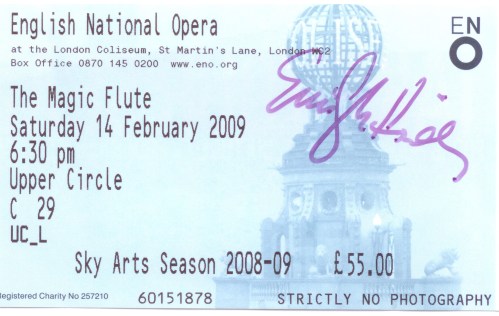
magic-flute-ticket1Word to the wise: programs are £4 apiece at ENO, and cash only.

Thus it was that all I had for Emily to sign at the end of the evening was my considerably-large ticket stub.

Thus it was, too, that I kept thinking to myself throughout the production, “Man, I wonder who that Sarastro is? It sounds a lot like Robert Lloyd,” and had to ask Emily afterward, “Who was Sarastro?”

“Robert Lloyd,” she answered.

“Oh. Well, that explains everything.”

Flute was, well, Flute. I’ve seen it probably more than any other opera, and as a piece of theatre, it just doesn’t wear terribly well for me. The dramatic impetus is silly, the reversal in terms of who the bad guys are is extraordinarily abstract, and the more people try to explain how deep it actually is the more it sounds like Wolfie and Manny just pouring a bunch of pretentious nonsense onto the page. I’ve never seen a great staging of it; because it is so ridiculous, there’s not really staging so much as there is performers moving around whatever the director’s concept is. This concept involved Tamino fighting off a bear attack with the flute.

Let me say that again: there was a bear attack, which Tamino fought off with the flute.

As Frank put it, “I was not prepared for the bear attack.”

That said, as a piece of music, it is incontrovertibly wonderful. When it’s well-sung, you don’t worry too much about the ridiculousness, and luckily, this production was well-sung. It was a reasonably young cast, save for Lloyd, and everybody brought a lot of energy and musicality to the table. Emily held her own very well and sounded like a million bucks; she has always been a perfectionist in the five years I’ve known her, so I expected no less. Her overall approach struck me as being very similar to that of Kurt Streit‘s; there’s a very similar slender, shimmery, laser-pointer-accurate approach that blossoms when she’s darn good and ready for it to blossom. Like Streit, it’s a bit early music-y in that regard, and it allows a lot of musical artistry to be displayed that might otherwise get lost in the blast of a vocal firehose.

Following the show, Megan, I, Frank, Emily, and Ayla, an old schoolfriend of hers, and her boyfriend went to a bar called The Marquis for a drink. (“I’d like a Booker’s Manhattan and some nachos.” “I’m sorry sir, but we aren’t serving cocktails or food any longer this evening.” “So what can I order?” “Beer.”) Just about the entire cast and the conductor were there, too. You know, in high school, we went to Denny’s after shows for coffee and cheesesticks. In Seattle, a place called McMenamin’s provided the post-performance libation and nourishment. It’s nice to know that, even amongst seasoned professionals at a very high professional level in a different country, the initial impulse after a performance is to go out and drink something bad for you.

Afterward, it was becoming imperative that we Feed the Megan, so there was a Parting of the Couples. Frank and Emily had an early morning trip to Scotland for an audition and also needed to eat something; we hugged goodbye, affirmed that we hoped it wouldn’t be three and a half years before we saw them again, and that was that. Thanks for making time to see us, guys — it was awesome.

We had a light dinner at a restaurant called Browns. Good pasta, good wine, decent service, not obnoxiously expensive. At the request of Megan’s father and mother-in-law, we toasted them in absentia; I managed to get the cuff of my brand new white shirt in the marinara sauce.

It was Valentine’s Day, we were together, we were in England, we had seen friends, we had seen one of those friends in an opera, and Megan had given me daisies.

Doesn’t get much better than that.

Then it was off to bed; we had to get up early to make it up to Oxford in the morning.


adventures in writing alexander lingas all saints bloomington all saints orthodox church american orthodox architecture american orthodox music american orthodoxy Antiochian Archdiocese Antiochian Orthodox Christian Archdiocese of North America Antiochians books byzantine chant cappella romana chant church architecture ecclesiastical chant ethnomusicologists ethnomusicology fellowship of ss. alban and sergius Greece Greek greek food greekness hazards of church music international travel tips ioannis arvanitis joe mckamey john michael boyer kurt sander Latin liturgical adventures liturgical architecture liturgical music liturgical texts and translation liturgy liturgy and life lycourgos angelopoulos medieval byzantine chant Metropolitan PHILIP militant americanist orthodoxy modern byzantine architecture modern greek music music as iconography my kids will latin and greek when they're newborns my kids will learn latin and greek when they're newborns orthodox architecture orthodox architecture is bloody expensive Orthodox choir schools Orthodox Ecclesiology orthodox outreach orthodox travel pascha at the singing school Patriarchate of Antioch Patriarch IGNATIUS IV Patriarch of Antioch publishing random acts of chant richard barrett in greece richard toensing rod dreher sacred music st. vlads st john of damascus society Syriac the Bishop MARK fan club the convert dilemma the dark knight The Episcopacy The Episcopate the only good language is a dead language this american church life travel we need more american saints why do we need beautiful music in churches?

Blog Stats

  • 271,464 hits

Flickr Photos