Archive Page 11

A response from a commenter

Well, that didn’t take long. I got a fairly lengthy response to the previous post via private e-mail. I present it here in full, save for the respondent’s name, which I leave out because it seems to me the issues are already personal enough for some people, and while this individual’s thoughts are worth airing, they did not express them publicly.

In response to your thoughts, perhaps there is something that the proponents of the Karas Theory refuse to address. That the Theory is based on false premises, that it is largely not in line with any historical or musicological facts, that manuscript and oral tradition debunk it and the fact that its founder, Simon Karas never had any measurable or documented training as a chanter.

The musicological arguments against the Karas Method can be summarised as follows:

1) Are the tonal intervals proposed for the genera in line with the intervals of oral tradition?

2) Simon Karas introduced (rather, re-introduced at his discretion and quite arbitrarily) Old Paleographic symbols to denote (in a stenographic manner) oral ornamentation. How faithful are those ornamentations to anything in oral tradition at the times of Karas and anytime between the 1940s-1970s?

3) Simon Karas proposes that the Patriarchal oral interpretations of music (and indeed the reformation of the musicall notation) are not in line with what, in his mind, were the interpretations of the old psaltae. Yet, given that he had no formal teachers and given that at least a century had passed between the reformation and the time he engaged in his studies, just how credible is this assertion?

4) The two chantors/scholars widely accepted by the Constantinopolitan musical circles as the most learned regarding the old paleography in the late 1800s were Nileas Kamarados and Konstantinos Psachos. In none of their works does one find the arbitrary and quite incredible proposals of Karas.

5) Angelopoulos took the Karas interpretations and further embellished them. Others have gone even further to vocal acrobatics that are short of ridiculous in the context of the history of Byzantine musical interpretation.

This is a very simplified summary of a subject that was discussed and considered by three conferences at the request of the Church of Greece on the matter. The Karas proponents were well-represented. Their arguments (historical/musical/musicological) were detailed, comprehensive and with lots of data. At the end, and in consideration of the overwhelming volume of contrary evidence along with the oral tradition, their arguments were unconvincing. The Church of Greece thus issued two edicts sensitising the musical community that there is no reason to consider anything else than the accepted tradition (Chrysanthine notation, consensus interpretations).

The debate should have ended there and then. However, the Karas proponents maintained their militancy. They continued, in very provocative terms, largely through positions in Greek academia and music conservatories some of them had obtained in the meantime, to question quite disingeniously the obvious. One can speculate that since the money was being thrown around liberally in Greece in the 90s, and many academic experts found easy sources of funding, the Karas “legacy” became a source of government money. Evidence for this comes from sizable sums of grants allotted to the choir of Angelopoulos, as well as block grants to various scholars. So, there was also a financial and professional incentive to carry on with the Karas “legacy”.

I could go on, but you may consider this wordy response as militancy. Mr. Barrett, people like myself have been on the DEFENSIVE for years facing an onslaught of a musically-untenable fabrication and every time we rebut with SCIENCE, HISTORY and FACTS, the Karas “proponents” resort to avoidance of directly addressing our points. If they are scholars, then they should be respectful and answer scholarly comments.

The Patriarchate’s role is to protect its legacy from arbitrary and unauthoritative alterations. The Patriarchate has followed this debate for years and indeed has also requested and received scholarly considerations. You may not know, but Mr. Angelopoulos was called to Istanbul recently and over a period of many hours he was asked to explain the entire matter.

The Holy Synod took his views into consideration, but in light of the overwhelming facts against the Karas “Theory and Method”, the Patriarchate ultimately did not agree with his reasoning.

It also sensitised Mr. Angelopoulos to work in Greece and abroad to find a way that would return peace among the family of chantors.

That Mr. Angelopoulos, continued his provocations after this, left the Patriarchate with no choice but to protect its legacy in the most direct manner possible short of something more serious reserved for ecclesiastic heresy.

The argument that the Patriarchate is clueless on musicology, has no “experts” at its disposal and thus does not understand the Karas “legacy” is completely bunk. It is being disingeniously thrown around currently by those who have a lot to lose by the Patriarchal decision. The fact is, as I noted above, that the Patriarchate for over a period of years, consulted with renowned musicologists, including those of the Karas camp.

In the end, the pro-Karas arguments were unconvincing.

Until the time the Karas movement accepts that the Theory has (at the very least) some serious flaws, or accepts (as do the overwhelming majority of chantors and musicologists) that it is largely an arbitrary fabrication of a person who had no serious background in Byzantine music, questions like those you raise in your thoughts will remain.

The Patriarchate has issued, through this decision, a very clear direction to church musicians. Whether one chooses to follow them or not is largely a personal matter which reflects one’s real character in terms of “respecting the church”.

As for enforcement, I cannot know. In the past, the Patriarchate has been known to be lenient or to be very strict in enforcement. Time will tell, as regards this matter.

Let me ask you this question Mr. Barrett:

Is it formally possible that what you hold so dear may be factually and historically incorrect?

Thank you for your consideration.

I would like to express my gratitude to the person who sent this to me; it is quite detailed and informative, and I expect that there will be those who will have things to say in response. I ask that any comments veer as far away from personal attacks as might be humanly possible; I don’t need my blog to become a boxing ring.

My main comment is this. If Patriarchal Style is such a clear-cut entity that is what anybody who learns Byzantine chant needs to know, then I would expect no end of easily-accessible learning resources to be made available to any and all Orthodox communities where the EP has jurisdiction, including America. Such would seem to me to be the necessity of ensuring proper training in Patriarchal Style. If conservative mimicry is how one needs to learn this stuff, then there needs to be real-time in-person access to somebody whom one can mimic.

This is, I’m afraid, not the case. From Bloomington, Indiana, I had to go to Greece to have any access at all to a teacher, and Ioannis Arvanitis was the one who was willing to teach me. That was ultimately far easier to do than travel to New York or Pittsburgh or wherever that which is considered Patriarchal Style is taught.

If this matter is as black and white as the commenter would suggest, than it seems to me that the burden is on him and those like him to see that it’s actually possible to have realistic access to the right teachers, and with all due respect to those who produced them, the YouTube videos that certain entities have put out are not adequate substitutes. It strikes me that there are productive and constructive solutions that are not happening; what there has been, rather, is a lot of sword-sharpening and saber-rattling while people Iike me are left to their own devices.

“My teacher can beat up your teacher” throughout the ages

Hello from… well, not Dumbarton Oaks, not quite. I’m in Washington, DC, at the George Washington University Mount Vernon campus, where our housing is. Friday night I went to bed at 12:30am so I could wake up at 2:30am so I could leave for the airport at 3:45am to get on a 6am flight so I could get to DC by 10:30am… except that we couldn’t check in here until 3pm.  Well, my longtime e-acquaintance Ivan Plis took pity on me and hung out with me for lunch, taking me to Nando’s Peri-Peri just off of DuPont Circle, which is easily the flame-grilled Portuguese chicken I have ever had. Yes, it’s also the only flame-grilled Portuguese chicken I’ve ever had, but it was still delicious. After lunch, Ivan walked me around the area a bit, or at least as much as was possible with two suitcases, and then we parted ways. Getting the rest of the way here was a bit of an adventure; my iPhone 3GS just will not hold a charge anymore, and it died just as a bus was coming that may or may not have been the bus I wanted to get on. I got on, only to realize about fifteen minutes later that it was the wrong one. I got off to wait at the stop across the street for the bus going in the opposite direction, which theoretically should have been about a half hour away… except that it was an hour away. It finally appeared, and I was able to get off at the right stop, only to still have a half mile left to walk, with most of it uphill. I guess I got my exercise today. This morning I attended Matins and Liturgy at St. Sophia Greek Orthodox Cathedral, which is about a mile away as the crow flies (but of course it’s not that simple; it’s about 2 miles by cab) and has a new protopsaltis in residence; I spent the afternoon walking around the area, attending Choral Evensong at the National Cathedral (right next door to St. Sophia, as it happens), and had a lovely day all around until I tried to go home and took a shortcut through a park’s forest trails. Zigged when I should have zagged, I had three bags of groceries, and wound up getting stuck with an uphill route I was trying to avoid. All in all, it took me about an hour and a half to get home when it should have taken about twenty minutes. Oh well. Orientation at Dumbarton Oaks is 9am Monday; we’ll see what happens.

By the way, there is going to be a group blog for Andrew Gould‘s expanded New World Byzantine concept, sort of an Orthodox version of the New Liturgical Movement. It looks like there are some definite parallels between what the Saint John of Damascus Society has in mind and what Andrew is trying to get going for liturgical crafts across the board. Should be fascinating to see where it goes. (And incidentally, there are already some big things in the works for SJDS, things that have already started to come together much more quickly than we thought might happen. Announcements to come soon.)

A few months ago I got invited to review a book titled The Past is Always Present: The Revival of the Byzantine Musical Tradition at Mount Athos by Danish ethnomusicologist Tore Tvarnø Lind. My review will be appearing in a future issue of Logos: A Journal of Eastern Christian Studies, but since I was limited to around 2,000 words (yes, I said “limited”), there was a lot that I wanted to say that I didn’t have space for (all good stuff — the book is great). I was going to have a blog post specifically about the book, but then I had to get my paper in order for the North American Patristics Society conference, do what I could to help get the house ready for impending baby, and then pack for D.C., so that didn’t quite happen.

But then, Friday, there was an unexpected post someplace I don’t check all that often.

So, I’ve noted before, perhaps somewhat infamously, that there are ways in which the internet is a problematic venue. Every imaginable cause in the world probably has a website out there run by a person for whom the sun probably only rises and sets because that issue has his voice advocating for it properly; heck, I’m sure probably somebody thinks that about my little corner of the net. Anyway, I’m somewhat reluctant to participate in many online forums, or even to monitor them too often; I’m not sure, to name but one example, that Byzantine chant needs its own version of Facebook. But, you know, it kinda has its own version of Facebook anyway, and it has its utility as a resource. Still, there are a lot of disputes that get hashed over there that I don’t care to get involved with, and the one time that I got noticed enough to be mentioned in that forum it was bad news (although my friend Taso Nassis is somebody I would not have met without that incident, so all’s well that ends well, I suppose).

On Friday, a notice was posted by one of the more argumentative individuals on that forum about a statement released by the Ecumenical Patriarchate. The Greek is here; this is my (somewhat hurried) translation:

Bulletin from the Holy and Sacred Synod on the subject of ecclesiastical music.

The Ecumenical Patriarchate, from the decision of the Holy and Sacred Synod of 29 March 2012, upon relevant public notice of the Patriachal and Synodal commission concerning divine worship, from 23 March 2012 concerning the subject of our ecclesiastical music, because of the fault of some cantors in applying a theoretical work, at first on the one hand imperceptibly, with time on the other hand more systematic, [a work] published in 1982 under the title “Method of Greek Music: A Theoretical Treatise” [by Simon Karas] and [which] created an uneasy situation, declared that:

1. It dismisses and condemns the “Theoretical Treatise”‘s self-willed, irresponsible, showy retractions to the liability and authority of the decisions of the Mother Church, as even an attempt to disseminate something – as characterized above – outdated and abnormal to the prevailing canonical order of the theory and practice of our ecclesiastical music.

2. It denounces every work of difference, adulteration, and forgery in appearance of old musical works of composers formally recognized by the Mother Church that is unlawful and strange to the prevailing works, and

3. As a musical system it recognizes, applies, and teaches according to the theory, practice, and tradition, [the system which] was established in the years 1812-14 by the Three Teachers, Chrysanthos Metropolitan of Prousa, Gregory the Protopsaltis, and Chourmouzios the Archivist, as “The New Method of Analytic Notation of Musical Melodies,” and approved by the Mother Church.

In the Patriarchate, 28 May 2012

From the Chief Secretary of the Holy and Sacred Synod

Okay. Back up a couple centuries.

As Lind’s book lays out quite well (and he’s not Orthodox, so he doesn’t himself have any particular dog in the fight), in the early part of the nineteenth century there was a reform of the notational system we usually call “Byzantine notation” or “psaltic notation”. This reform reduced the number of signs used, and also introduced a way of being able to more accurately notate rhythm, tempo, and accidentals. Well, the problem is obvious: when you change how something is written down, you effectively fork the tradition, and that’s what happened. Cantors who were trained before the reform continued either singing from old notation or singing the new notation as though it were the old notation, thus passing on the pre-reform tradition. Cantors who were trained from books compiled after the reform without any level of pre-reform tradition learned something different. Subtly different, perhaps, but different, and this appears to have become known as “patriarchal style”, as in the style practiced at and endorsed by the Ecumenical Patriarchate. The Three Teachers didn’t really give an account of their system of reform, so were they intending to preserve what came before, only simplifying how it was represented on the page, or were they intending to turn it into something else? This is the crux of the problem, it seems. (Oh, and if I’m over-simplifying or getting things wrong, please jump in. I’m trying to give a reasonably economical account here of what I think I know, but I don’t want to misrepresent anything.)

To give but one example of the practical difference that I have seen: there is a sign in Byzantine notation called a klasma. It’s a little half oval that can appear either above or below a sign depending on the sign.

Now, the way I was taught to realize a klasma by (now-Dr.) Ioannis Arvanitis is that adds a beat to the sign, but that it also has the function of adding an ornament — a little break in the voice. This ornament is suggested by the name klasma, and according to Arvanitis, it’s a holdover from the old notation, with the ornament being what distinguishes it from simply adding a dot (which also extends the sign by one beat). A somewhat clumsy way of realizing this in staff notation might be this:

When I visited Holy Cross Seminary, I got to sit in on Byzantine chant classes with Dr. Grammenos Karanos, who I’m told is an exemplar of patriarchal style. He told his students that the klasma has the principal function of adding a beat, and only in the context of a relatively small number of specific phrases does one add the ornament. Otherwise, it’s the same the thing as an aplē (adding a dot) and is maintained separately from the aplē for orthographic purposes. That would mean the above phrase would look like this in staff notation:

There’s no shortage of other examples.

Anyway, Simon Karas was an ethnomusicologist who was interested in these differences maintained through oral tradition, as well as the relationship to Greek vernacular music, and he tried to systematize what he observed in the 1982 book referenced in the Patriarchate’s bulletin. (I translated an article about him by Lycourgos Angelopoulos last year that goes into some of this.)

One can perhaps see the divide between those who sang as though the new notation were the old notation and those following the new notation more strictly in the Patriarchate’s choice of the word “outdated” (παρωχημένος) in point one. The irony that I see is that both approaches are conservative; one is performatively conservative, the other is notationally conservative. There is almost a sola Scriptura issue here (but even patriarchal style is informed by oral tradition, so not quite).

Among other things, Lind’s book talks about how Karas’ work influences the monastery of Vatopedi on Mount Athos; students of Angelopoulos (“grandstudents” of Karas, then) work with them on manuscripts, vocal style, and so on. The monks want to preserve an authentic tradition going back before the reform, and there is concern that something is lost in how the reform has been realized. One of the things I find interesting is that the tensions surrounding these preservation efforts seem to follow the old theoretical poles of cathedral (or city) and monastery, with an additional pole of the university. Vatopedi is trying to assert a certain authority and pre-eminence regarding psaltic tradition, Constantinople is trying to do the same thing (as represented by “patriarchal style”), and Karas and his legacy represent a line of academic inquiry that influence how both sides act and react. Who “owns” the tradition? Who speaks for it? Certainly there are issues surrounding how Byzantine chant is understood as something authentically “Greek”, with Constantinople looming large for obvious historical reasons, but with Karas perhaps trying to contextualize Constantinople in a larger “Greek” picture. Constantinopolitan cantors (and those faithful to them), Athenian academics, and Athonite monks — I’m not sure I can think of any particular equivalent issue in this country that’s working itself out in precisely the same way.

The thing of it is, speaking from my previous life as an opera singer, none of this is anything new. “My teacher can beat up your teacher” is part of any musician’s game from the first day they step into the studio. I remember the first time I ever took a lesson with my first voice teacher in college, and he asked me to tell him how I was thinking of certain things. I explained it the way Dennis Kruse taught me, and I can still picture the patronizing smile on this guy’s face when he said, “Oh, that’s all wrong. We’ll fix that.” I can also still remember the way Dennis shook his head when I explained to him what the new guy was telling me, saying, “He doesn’t know what he’s talking about. Get out of his studio as soon as you can.”

Heck, just speaking in terms of the Greco-Roman world, none of this is exactly news. If you were a student of rhetoric in what we might broadly call “the ancient world”, you could count on getting hazed by students of other teachers, you could count on getting beaten up by students of other teachers, and there was even a possibility you could get kidnapped upon arrival in the city by students of other teachers and forced to study with somebody other than your intended teacher. Studying something so marinated in tradition that requires a close relationship with a teacher makes this kind of thing simply inevitable.

Still, nobody here has been declared either a heretic or anathema, there’s nothing here that says “Whatever you do, don’t sing a klasma with the ornament lest your soul be in danger”, and on the whole I can’t really imagine how anything in this notice is going to have any practical force whatsoever without something that looks a lot like an Inquisition or HUAC. “Are you now, or have you ever been, influenced by the 1982 Method of Greek Music by Simon Karas?” Nope, I just don’t see that happening. This strikes me as a sop to somebody at most, but I really don’t know enough about the inner workings of the Ecumenical Patriarchate to know to whom or by whom or why. With all due respect to the Patriarchate, this comes across as over-the-top and heavy-handed, to say the least.

In any event, Ioannis Arvanitis, however poor of a student I may have been, was my teacher (and I hope someday he will be again), he’s one of the great cantors and composers of our day, he’s one of the greatest men I’ve ever had the privilege to know or learn from, and he was a Simon Karas student. Given all of this, I’m left scratching my head at what seems to be the disconnect from reality.

Anyway, I may have more to say about Lind’s book later — perhaps when the review is published I’ll put together a “director’s cut” of it. In the meantime, consider it recommended; it’s a very readable work and should be of great interest to people interested in monasticism, Byzantine music, Greece and modernity, and so on.

And a few more…

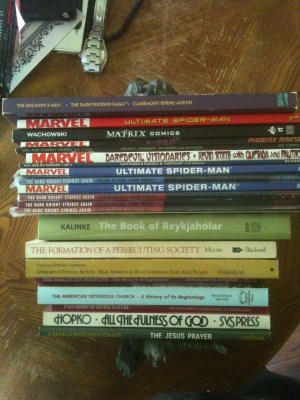
A Monk of the Eastern Church. The Jesus Prayer. “Fr. A” written on fly-leaf; otherwise clean.

Thomas Hopko. All the Fulness of God. Previous owner’s address label on fly-leaf; minor underlining.

Archimandrite Christoforos Stavropoulos. Partakers of Divine Nature, sixth printing. “12.95” written lightly in pencil on fly-leaf. Otherwise like new.

George C. Michalopulos and Herb Ham. The AMERICAN Orthodox Church: A History of its Beginnings. Some light pencil underscores.

Archimandrite Seraphim Aleksiev. The Forgotten Medicine: The Mystery of Repentance. Previous owner’s seal embossed on fly-leaf. Otherwise clean.

Stanley Samuel Harakas. Exploring Orthodox Christianity: Orthodox Christian Beliefs: Real Answers to Real Questions from Real People. Previous owner’s name and seal on the fly-leaf, otherwise clean.

R. I. Moore. The Formation of a Persecuting Society. Clean throughout.

Marianne E. Kalinke. The Book of Reykjahólar: The Last of the Great Medieval Legendaries. Like new.

Frank Miller and Lynn Varley. The Dark Knight Strikes Again. First printing. One complete set, issues 1-3. Additional copy of issue 1. Clean throughout.

Brian Michael Bendis. Ultimate Spider-Man Vol. 1: Power and Responsibility. Clean throughout.

—. Ultimate Spider-Man Vol. 2: Learning Curve. Clean throughout.

—. Ultimate Spider-Man Vol. 4: Legacy. Clean throughout.

Kevin Smith with Joe Quesada and Jimmy Palmiotti. Daredevil: Visionaries. Clean throughout.

Dan Jolley and Tony Harris. JSA: The Unholy 3, issue 1. Clean throughout.

Adisakdi Tantimedh, P. Craig Russell, and Galen Showman. JLA: Age of Wonder, issue 1. Clean throughout.

Chris Claremont, John Byrne, and Terry Austin. X-Men: The Dark Phoenix Saga. Some wear at top and bottom of spine, small tear in back cover. Interior clean.

John Byrne et alX-Men: Phoenix Rising. Like new.

Also two DVDs: The Dark Knight 2 disc Special Edition, and Blade Runner: The Director’s Cut. Both like new.

As before, I have no fixed prices in mind for any of this stuff and will entertain whatever offers come my way for individual items or for batches. E-mail at rrbarret AT indiana DOT edu.

More shameless commerce

I have these listed in my Amazon store, but I thought perhaps this might be a more direct approach. Send me an e-mail if interested: rrbarret AT indiana DOT edu. In no particular order:

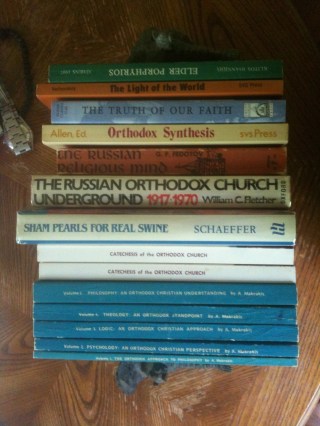
Apostolos Makrakis, The Logos and Holy Spirit in the Unity of Christian Thought, Volumes I-V. All unmarked but with labels saying “Fr. A” on the fly-leaf.

—. Catechesis of the Orthodox Church. Two copies. No underlining or maginalia in either copy; one copy has “Hanania” written in pencil on the fly-leaf. Both copies show some discoloration on the cover.

Frank Schaeffer, Sham Pearls for Real Swine. Unmarked, mylar sleeve for book cover.

William C. Fletcher, The Russian Orthodox Church Underground, 1917-1970. Unmarked, mylar sleeve for book cover.

G. P. Fedotov, The Russian Religious Mind: Kievan Christianity, the 10th to the 13th Centuries. Some underlining. Some wear on spine, binding solid.

Joseph J. Allen, ed. Orthodox Synthesis: The Unity of Theological Thought. Some underlining.

Elder Cleopa of Romania. The Truth of Our Faith. No markings; clean copy.

Serge S. Verhovsky. The Light of the World. Address label and embossed seal for previous owner on fly-leaf; some underlining and marginalia.

Klitos Ioannidis. Elder Porphyrios: Testimonies and Experiences. No markings; clean copy.

Andrew Burnham. A Manual of Anglo-Catholic Devotion. Owner’s name and purchase date written on fly-leaf; otherwise clean copy.

I have no particularly fixed prices in mind on any of these; this is mostly a last ditch effort to see if there’s a good home to be found for any of them after they’ve languished on Amazon for too long. Feel free to make offers for single items or for batches.

Shout-out to Chicago for this weekend

I will be in Chicago this Thursday through Sunday for the North American Patristics Society 2012 Conference at the Holiday Inn Chicago Mart Plaza. I am presenting my paper “Civic Marian Devotions in Late Antique Rome and Constantinople” at 10:15am Friday in the Steamboat Hotel room. If you’re going to be at the conference and want to grab a beer or coffee or dinner etc. please by all means find me. Tall stocky guy with very short hair, beard, glasses.

…and as of next Saturday, 2 June, I will be in Washington, D.C. until 30 June or when my wife goes into labor, whichever comes first. If that’s your neck of the woods and want to hang out, let me know.

A request…

A friend of mine, Michael Ewing, is going to Kenya in July as a short-term OCMC missionary. He will be helping to build churches there, and he hopes to become a permanent missionary for them once he is done with his Master’s degree. For the moment, he has to raise $4,000 for the July trip. Might you consider helping Michael out? Even if it’s only what seems to you to be a drop in the bucket, many drops make an ocean. You can support his mission here. Prayers are, of course, also most appreciated. Many thanks for your support of Michael, whatever form it takes!

Shameless commerce: stuff for sale

Due to incoming baby, we’re trying to make some additional space and get rid of some of the excesses of the various things we tend to acquire — namely, books, CDs, and DVDs. We also have a smallish roll-top desk that we’re trying to unload that has never actually served its intended purpose but has simply become a receptacle for loose stuff.

The desk is here: http://bloomington.craigslist.org/fuo/3005587538.html

Everything else is here: http://www.amazon.com/shops/leitourgeia

Do take a look. If there’s something you see that you want or have any questions or anything like that, drop me a line at rrbarret AT indiana DOT edu.

A curriculum proposal for Byzantine chant

So, a couple of months ago, I suggested that learning to sing needs to be part of learning to chant, and even suggested that language and diction in the appropriate languages should be an expected part of one’s training, just as it is for a classical singer.

I’ve continued to chew on some of the implications of that post, and one of the outcomes of that was to draft a proposed curriculum for what a Byzantine chant concentration could look like in the context of an undergraduate music program. Obviously, this is all entirely hypothetical; I don’t know of any music schools that are itching to add this as a concentration. St. Katherine’s College could, I suppose, eventually try to incorporate something like this into their curriculum, but who knows. Hellenic College would probably be reasonably well set-up to do something like this, but they don’t even presently offer a music major.

A few assumptions I’m making: first and foremost, that there is an on-campus chapel with regular services. Second, that chapel services would make a full-on recital unnecessary; rather, have the student do a junior and senior exam that basically are an extended jury — where they prepare a certain number of compositions ranging in difficulty and sing 2-3 of them at the request of a committee. Third, that building a good cantor who is also a good musician will require some knowledge of Western music theory and notation (I’m less sold on keyboard skills, but it still seems instinctive to me to include) in addition to Byzantine music theory and notation. Fourth, that voice lessons won’t concentrate on things like “Caro mio ben” or “Silent Noon”. They may well include that kind of repertoire if the student really wants it and the teacher is able to do it, but beyond the universals of healthy production, the specifics will by and large be those of psaltic technique. Fifth, that the academic environment would be such that it would allow for patristic and theological discussion to occur within the context of music history courses.

One observation I make immediately is that this is a very full undergraduate degree. I started off with IU’s B. Mus. in Vocal Performance as a basis, while also consulting their Early Music Vocal Performance B. Mus., and then worked from there to focus it specifically on the requirements of Byzantine chant. As with IU’s Vocal Performance B. Mus., the general education requirements are quite minimal, but it’s still jam-packed. I think the keyboard skills part could perhaps be taken out/made an elective, maybe a case is made for 2 languages rather than three, and maybe you either don’t do credits for Chapel Choir or tweak the number of credits for voice lessons. But, all that said, the B. Mus. at IU is a very full degree, and that’s just how it is.

It seems that a couple of other useful curricula to come up with would be a B. A. degree, and perhaps a more general “Orthodox Liturgical Music” degree. It’d be nice to also include a course or two on Mediterranean folk music to be able to show the relationship between liturgical and vernacular musics (hinted at in the bit about “Mediterranean instruments”, which also assumes that such instruction would be available), but maybe that would have to be kept for the Masters degree.

Anyway, here’s the draft. I’m curious to hear thoughts.

Bachelor of Music in Performance, Byzantine Chant

Major Ensemble

Chapel Choir (1 cr.) required every semester of enrollment.

Performance Study

Voice. 3 credit hours each semester until senior exam is passed, at which point they may be reduced to 2. Required: entrance audition, freshman jury, upper-division examination, junior exam, senior exam.

Secondary Piano and Keyboard Proficiency

All students must pass a keyboard proficiency examination. Voice majors must take an examination for placement in a 3-semester class piano sequence (2 credits per semester) or take elective individual lessons (1-2 credits per semester) and continue study each semester until the keyboard proficiency examination is passed.

Core Music Courses

26 credit hours

  • Placement examination or Introduction to Musical Concepts (1 cr.)
  • Core Musical Skills I (1 cr.), Western Music Theory and Literature I (3 cr.)
  • Western Music Theory and Literature II (3 cr.)
  • Western Musical Skills II (1 cr.)
  • Byzantine Musical Skills I (1 cr.)
  • Byzantine Musical Skills II (1 cr.)
  • Byzantine Music Theory and Literature I (3 cr.)
  • Byzantine Music Theory and Literature II (3 cr.)
  • Byzantine Music Theory and Literature III (3 cr.)
  • History and Literature of Western Music (3 cr.)
  • History and Literature of Byzantine Music I (2 cr.)
  • History and Literature of Byzantine Music II (2 cr.)

The above must be passed with a C or better.

Advanced Music Literature and Music Theory

3 credit hours selected from:

  • Composer or Genre (3 cr.)
  • Topics in Byzantine Music Theory (3 cr.)
  • Pre-Reform Notation (3 cr.)
  • Analysis of Modal Music (3 cr.)
Other Music Courses

25 credit hours

Required:

  • Liturgics & Chant Literature: Services and Service Structure I (3 cr.)
  • Liturgics & Chant Literature: Services and Service Structure II (3 cr.)
  • Liturgics & Chant Literature: Idiomela I (3 cr.)
  • Liturgics & Chant Literature: Idiomela II (3 cr.)
  • Liturgics & Chant Literature: Anastasimatarion and Irmologion (3 cr.)
  • Applied Greek Diction for Singers (1 cr.)
  • Applied Arabic Diction for Singers (1 cr.)
  • Applied Romanian Diction for Singers (1 cr.) OR Applied Slavonic Diction for Singers (1 cr.)
  • English Diction for Singers (1 cr.).
  • Electives: 6 credit hours, including a minimum of 2 credit hours in pedagogy courses such as Introduction to Music Learning (2 cr.) or Vocal Pedagogy (3 cr.).

Electives may also include courses for music majors in sacred music, music education, techniques, conducting, composition, music history, music theory, opera, and unclassified courses. A maximum of 4 credit hours in early or Mediterranean instruments may be counted in this area.

General Education

23-35 credit hours

  • Written and Oral Expression English composition, 2 credit hours or competency.
  • Foreign Language 12-24 credit hours or proficiency, equivalent to two semesters of first-year language study.
    • Greek: Elementary Ecclesiastical Greek I (4 cr.) and Elementary Ecclesiastical Greek II (4 cr.); or Accelerated Ecclesiastical Greek (4 cr.).
    • Arabic: Elementary Arabic I (4 cr.) and Elementary Arabic II; or Accelerated Elementary Arabic (4 cr.).
    • Choice of:
      • Romanian: Elementary Romanian I (4 cr.) and Elementary Romanian II (4 cr.); or Accelerated Elementary Romanian (4 cr.). OR
      • Slavonic: Elementary Church Slavonic I (4 cr.) and Elementary Church Slavonic II (4 cr.); or Accelerated Church Slavonic (4 cr.)
  • Humanities 3 credit hours.
  • Life and Physical Sciences and Mathematics 3 credit hours.
  • Social and Behavioral Sciences 3 credit hours.
To Complete Degree

Free music or non-music electives as needed to bring the total credit hours to 120, excluding Chapel Choir.

Addenda to Kapitel Vier: The post-high school, struggling through junior year of college, and giving up to enter the workforce blues

Exactly what would happen to me following high school graduation was a point of no small controversy. My parents wanted me in Alaska with them as soon as possible and to stay up there as long as possible. The stated reason was so I could work as long as possible; there were at least two other reasons, however, that are probably best summed up by saying that me going to college “in state” (that is, in Washington), while it had seemed like a great idea up until summer of 1993, now didn’t seem like such a hot deal from a familial perspective. At best I’d now be a three hour flight away instead of an hour and a half’s drive (not that I had a car anyway), and while I still had incentives to go back to the Seattle area on the weekends, they weren’t part of it. My parents were going to have to deal with an empty nest in a place that had never actually been our nest, and they would have to do so with me relatively inaccessible. This is, I am certain, difficult under the best of circumstances, and the family difficulties we had been struggling with for the past several years meant that these were not the best of circumstances.

The bottom line was that, for that last summer before college, I really didn’t want to go to Alaska and they really didn’t want me to stay in Seattle. I had no desire to go someplace that I had no real memory of to be around two people who were likely to re-negotiate the manner of their life together after a year apart in a way that was going to be extremely unpleasant for any additional parties. If the point was for me to work, I could do that in Seattle without paying for a plane ticket; from where I sat, that made a heck of a lot more sense than forcing me to be a continuing participant in their drama. I had people I wanted to be around, but that was also part of the issue for my parents; they weren’t people they wanted me to be around. There’s not much more I can say about that without getting into specifics that aren’t appropriate for me to get into, so I’ll leave this by noting that I had a conversation with one parent where I expressed all of my concerns quite openly; this parent replied, well, yes, that’s all probably true. It isn’t going to be fun, and you’re probably going to have to deal with us fighting a lot. But that’s the way it goes, we’re a family, messed up though we may be, this is the way we want it for you right now, and we’re still in charge.

This was a growing source of tension as high school graduation neared; ultimately, however, there were two things that threw a wrench into the plan for me to be in Alaska for the entire summer — one was early orientation for Western Washington University, and the other was the aforementioned opportunity to work as an extra on the movie Mad Love. Again, don’t bother looking for me; everything I was in was cut. I could have worked more, but the three days I did work meant a two week delay in my departure for Alaska, and my parents weren’t willing to delay it any more. Still, as it worked out, I had to be back a month later anyway for early orientation and registration. The schedule became a month up, three weeks back, and a month up.

Yes, the time in Anchorage was rough, for all of the reasons I expected it to be. However, I will be the first person to say that there are parts of it I’m glad for; I had the chance to reconnect with some family members I hadn’t seen in years, and I was able to continue some of my vocal momentum with a voice teacher named Bettyrae Easley, who did the very practical thing of getting me ready to audition for Western’s music major, something in the post-graduation whirlwind that there just hadn’t been time to discuss with Dennis once my voice had finally opened up. Among other things, Bettyrae taught me my first French mélodie, Fauré’s “Lydia”, which served as my introduction to an entirely new song paradigm (to say nothing of the beginning of a, shall we say, complex relationship with French diction).

I did wind up working a bit in Anchorage; not overly much due to the time constraints, but there were a couple of odd jobs here and there that I did for friends of my dad. Among other things, I helped a future protest candidate for the United States Senate and right-wing filmmaker move out of a landmark Lloyd Wright home, and I also spent a couple of weeks assembling and finishing ulus.

One of the things that was difficult for me conceptually about preparing to go to college was that nobody seemed to actually have a clear idea in their head why I was going, or how to relate it to anything I was interested in doing, or how to relate any of those things to how I might actually earn a living on the other end. I was supposed to have been a smart kid, but none of the various things I was good at really lent themselves to careers, per se, at least as my parents or the people in their circles understood them. I was a voracious reader, I retained information, I read about all kinds of things as a kid from astronomy to cryptography to computer science to paleontology to mythology and everything in between, but what did that mean in terms of what I could do to feed myself? Coming into high school, math and science bored me silly, I hated sports, I was more interested in what computers could be used for than what they did under the hood, I enjoyed creative writing, I seemed to have some aptitudes for drawing and painting up to a point, and I enjoyed music but puberty had freaked me out with my voice change and I convinced myself I couldn’t sing anymore. There really wasn’t anything obvious in there in terms of “normal” career paths; not business, not medicine, none of that. Neither of my parents finished college and academia wasn’t anything I had ever heard of as a career.

Once I got into high school and discovered that I seemed to have an aptitude for theatre and music, that was a relief in some respects and it gave me some idea of a path. The thing was, nobody took it seriously. I remember my senior year of high school telling people, I’m going to major in music and theatre. Typically, that would generate a condescending smile and a sentence that sounded something like, “Oh, well, it really doesn’t matter what you start with, because you’ll probably change ten times before you’re done.” That, frankly, pissed me off; it was clear that I was being patronized and not listened to. At the same time, I had to acknowledge that having it in my head that I would finish a major wasn’t the same thing as knowing exactly how to get to the “pay your bills” part of the deal.

My parents didn’t know what to tell me. They didn’t really understand my interests, and they didn’t have any advice regarding college except get good grades and finish as soon as possible. Neither was there was ever any clear idea of what the trajectory of life post-high school was going to be for us, even before they moved back to Alaska. Was there an expectation that I was going to live with them until I got married? Was there an expectation about when it would be “okay” for me to think about getting married? None of this was discussed. At least when they were still going to be in Seattle, some small level of continuity could be assumed, but the mechanics and specifics still weren’t really talked about. After the move, all bets were off.

Thus it was that I found myself in Bellingham in September of 1994, living in a dorm room in Ridgeway Sigma with one Will Bass, and most of my worldly possessions were under my then-girlfriend’s house (many of which never to be seen again, alas, as will be explained in a future installment). I auditioned for the voice major, got in, then walked over to the other side of the Performing Arts Center and declared myself a theatre major. My very first class on the first day of my freshman year was Music Theory I, taught by Prof. Jeffrey Gilliam (to this day perhaps the single most naturally musical person I have ever met, to say nothing of the very best music theory instructor I have ever had). It was off to the races.

There were a number of highlights to that year: I was in my very first opera, singing Marco, one of i parenti in Gianni Schicchi (with the previously-mentioned future Metropolitan Opera baritone Aaron St. Clair Nicholson in the title role). I also got to sing the high baritone drunken abbot solo in Carmina Burana (“Ego sum abbas Cucaniensis… WAAAAAAAAAAAAFNA!”). My friend Gavin Shearer sat me down at some point in the fall to show me this awesome thing that was happening in computers called “the World Wide Web” that used this amazing program called Mosaic to do what Prodigy and AOL had utterly failed to do up to that point. Two portentous occurrences: a master class with a voice teacher named Roy Samuelsen from Indiana University, a school I had never heard of before but that apparently had quite a reputation for opera, and dating very briefly this lovely brunette named Megan McKamey, who was absolutely wonderful in every way, but everything going on around me made it difficult to feel capable of committing at the level I felt she deserved.

The trouble was, my parents and I didn’t even get through the first quarter without some massive meltdowns. The situation was complex; Seattle was still home for me, and I would go back on the weekends, because I felt very much alone at Western. My parents didn’t want Seattle to continue to feel like home for me, since from their perspective I needed to start thinking of Anchorage as home, but from where I sat they had moved, not me; I was just following the plan we had always had, and… yeah. The whole situation had nowhere to go but down. At some point it was suggested that maybe the whole idea of me going to college at Western was no longer tenable, and that marked the point where the irreconcilable differences in how we saw what was happening meant that there was basically no reasonable conversation to be had about anything. There was a brief period of rapprochement over spring break; my paternal grandmother passed away, and my dad and I spent the week together while he cleaned out her condo. Still, once summer came and I made it clear I wasn’t going back to Alaska, whatever brief peace had been achieved was broken. “In ten years you’re going to remember this moment as the day you pissed your life away,” I recall being told on the phone. What drove me absolutely batty about all of this was how inevitable it had all seemed from the time my dad had announced that he was going back to Anchorage, and everything was happening exactly as I had feared it would. Nobody had listened to me, and somehow I was being blamed for it. The stress made me a charmer to deal with, I’m sure; certainly it impacted a number of relationships I valued, but there just wasn’t anything I could do. I wasn’t equipped to deal with any of it, and I had no particular support system to fall back onto.

That summer I worked at Computer City, sold the first copy of Windows 95 at midnight of 24 August 1995 (there used to be a photo online of me ringing it up, not sure where it might be found these days), and took voice lessons from Dennis Kruse. We were working on preparing me for opera auditions at Western in the fall — the opera was Marriage of Figaro, not exactly a huge tenor show, but Basilio would be worth it for a kid like me. “O wie ängstlich” from Mozart’s Abduction from the Seraglio was the audition piece we worked up, and Dennis put me as the last singer on his summer studio recital, even over some of his students who were ostensibly his stars and who had made it clear much of the time I had worked with Dennis that they thought I was a waste of his time.

Sophomore year wasn’t exactly an amazing improvement over freshman year. A high school friend and his mother — J. P. had been the Danny Zuko in Grease! and Tony in West Side Story, and was also a student of Dennis Kruse — were killed in a car crash in the fall, which led to a reunion nobody particularly wanted. Fallout from that, plus still trying to figure out how to resolve the family situation, meant that I was even more of a wreck that year than I had been my freshman year. I agreed to spend the holidays and the following summer in Alaska, hoping that it would ease off some of the tension, but if anything, it ratcheted it up.

Marriage of Figaro was fun, but it was a bizarre reconstruction/translation that basically turned it into musical theatre — the recitatives were replaced with spoken dialogue from the Beaumarchais play. There were a number of practical reasons to do this, I suppose; hiring a harpsichordist and having the time to coach the recits properly being two of the major concerns, as I understand it. They had piddled away the fall quarter with a lot of political nonsense over sets and casting professionals for Figaro and the Count in one of the casts, and didn’t even post the cast list until sometime towards the end of the quarter, even though auditions had been in September and the performances were set for March. It was a strange experience all around.

I wound up in Alaska three weeks before the end of the quarter. I was supposed to work for my mother’s company over the summer, and they had revised their policies sometime in the spring so that everybody for the summer needed to be in place by 1 May. “So, you’ll just have to come up here early,” I was told. Um, the school year isn’t over? Not even close? “The opportunity cost of you finishing the quarter isn’t worth it. Anybody with half a brain should be able to see that.” Did I mention that I was a first generation college graduate?

I negotiated what I could with my professors (which in some cases, meant taking Fs). I can’t say I exactly made myself popular with anybody during this time, and not for no reason. I was a basketcase through and through, and nothing I was trying to do seemed to work out in a straightforward fashion. Going to college right out of high school had turned into a disaster; I was unprepared for it, my parents were unprepared for it, additional circumstances meant that there was additional burden for all of us to bear, and my friends were unprepared for how unpleasant of a person the whole experience was making me.

Summer of 1996 I cannot describe in much detail without going into things that I’d rather not discuss publicly. Suffice it to say that I got a front row seat for much of why my parents were freaked out over me being 2,500 miles away; a lot of the unpleasantness that had been plaguing our family life since the mid-1980s had come home to roost with their move, we were all now having to confront it head on, and none of us were doing a particularly good job. I returned to Bellingham in September unsure of what kind of a relationship would be possible with my parents after certain events, conversations, and revelations. I focused on what I could, namely, trying to rebuild my relationships at Western.

In short, however, that ship had sailed, and now I had to sleep in the bed of frustrations I had made the previous two years. Whatever had been the cause of all my erratic behavior, certain relationships were damaged beyond repair, and I continued to make unhealthy decisions with respect to other relationships. I couldn’t find a way to focus on being at school, partially because the muddied reasons I had for being there continued to get muddier, partially because all of my personal issues made it impossible to ever feel sufficiently centered and stable. I also made some poor choices vocally — Dennis had gone to a lot of trouble to figure out how to work much of the tension I usually carried with me out of my voice, a wonderful teacher named Virginia Hunter had done a very nice job teaching me to sing with the instrument Dennis had shown me I’d had, but that year, for reasons that seemed great at the time, I switched to a teacher who went out of their way to work all of that tension back in. Within three months my top was completely gone and my voice had regained a strangled quality that I thought had been left behind after graduating high school.

There was one more factor in this equation. In fall of ’96, I became aware of some behavior on a faculty member’s part that I believed (and believe) to be unethical, and at the very least political maneuvering at the expense of students. I attempted to seek advice on how to deal with these things in a way which I thought to be private which instead publicly blew up in my face. Later, I understood that whatever my concerns were, the way I sought to deal with it was totally unprofessional on my part and embarrassing to the faculty member in question. This culminated in a letter from the chair of the department telling me that all three of us — he, the faculty member, and I — would likely be happier if I went someplace else. So, midway through winter quarter, so many threads having come unraveled, I decided that college had become a gigantic, expensive exercise in beating my head against a brick wall, and it was time to acknowledge that it just wasn’t the right thing for me to be doing at that moment. I subsequently dropped out in disgrace, with the straw that broke the camel’s back being something which really was entirely my own fault. Today I would deal with a similar situation very differently because I would understand better what was happening; the bottom line is that when someone’s on a tenure track, you either play along or get out of the way, particularly under circumstances where resources are scarce and only so many people can get what they want. Anyway, after flailing about for a few months and still making really bad decisions (almost reflexively, at this point), I started selling classified advertising for the Bellingham Herald and trying to figure out how I might be able to move back to the Seattle area.

1994-1997 was a difficult, unpleasant time. It is difficult to even know where to begin explaining that the poor, confused, unhappy person who arrived at WWU in the fall of 1994 was not me at my best, not by a long shot. I started college not having any idea which way was up and having nobody, really, to whom I could turn. I was trying to do everything right which I possibly could, but there was just very little good that anybody could do for me, and trying to do everything right when one doesn’t even know what all one needs to do means one is bound to get quite a bit wrong. There continue to be ramifications to this day — people who don’t talk to me because some of my choices, people who, even if they’re still friends with me, can get easily upset when discussing some of what happened, and other consequences. A few years later, I did my best to apologize to everybody I hurt in those years, with somewhat mixed results. Whenever I think about that period, it is with a lot of pain and regret, but also a lot of confusion. In broad strokes, under the circumstances, I have a hard time imagining what I could have done differently that would have been any better beyond, quite simply, dropping out earlier. The kind of wrench my parents’ move threw into the works was comprehensive, I had no idea how to deal with it, my parents had no ideal how to deal with it, and they had no ideal how to help me deal with it. In retrospect, maybe it would have been better for me to find a way to work full-time while doing an Associate’s degree at a community college and continuing to study with Dennis. The trouble with that, however, was that I didn’t really have a place to live available to me full-time. Moving to Anchorage would have cut me off from much of what I was trying to do post-high school, and would likely have only hastened the inevitable. Maybe I could have just taken a year off out of high school to figure things out — I was starting college at 17, after all, thanks to my skipped grade — but that wasn’t really presented as an option. The expectation had always been that I would go to a four year college right out of high school; it was exactly what I would do while I was there and what would happen after that were all quite vague.

I should note that there are a number of people from this time for whom I remain grateful: an incomplete list includes Brian Ward, Holly Zehnder, Mike Cook (memory eternal), Peter and Arwyn Smalley (née Moilanen), Suzann Miller (née Welch), Jon Haupt, JOHHHHHHHHHHHHN Davies, David Harsh, Jon Lutyens, Matthew Murray, Kai Morrison, Dennis Kruse, Tom and Jordin Baugh (née Peters), Matt Carter, Sue Fletcher, Sarah O’Brien (née Wright), Liz Holmes, Eric Rachner, and, of course, Flesh of My Flesh herself, Megan Barrett (née McKamey).

On Mother’s Day, looking for baby gear suggestions

Today, on Mother’s Day, I want to wish my own mother, my mother-in-law, my stepmother-in-law, my stepmother, and the older of my two half-sisters a happy Mother’s Day. I suppose I should also say “Happy Mother’s Day” to Flesh of My flesh, or at least practice doing so.

So, we’re less than two months out from the next generation coming into the world. It’s a little crazy, because Megan’s due date is 26 June, and starting 2 June I will be at Dumbarton Oaks for their Byzantine Greek Summer School, which goes through 30 June. We’re told that it’s not uncommon for first babies to be as much as 8 days past the due date, so it could be a total non-issue, but in any event, I’m glad to be living in an era where there are airplanes. My mom will be here in Bloomington starting 14 June, and Megan’s mom somewhere around the 25th, and the good people who run the program at DO tell me that I’m not the first person to be in this situation (I suppose with academics trying to plan babies for the summer, this isn’t all that uncommon) and of course I can leave if I have to leave and not worry about it. My advisor tells me that when he did the same program 12 years ago, he had to leave a week early to get married — “But I think you’ve got me beat,” he said. Anyway, yeah, it’s a little crazy, but what can you do except take a deep breath and pray for the best?

One of the things I’m looking forward to about being at DO is that the Greek cathedral is about a mile and a half away, and they have a new protopsaltis fresh from Greece as of last month. I’m hopeful that I can touch base with him while I’m there — we’ll see.

Anyway, as we prepare for oncoming baby, we have nascent registries at Target, Amazon, and MyRegistry.com, but if you go to any of them, you’ll see that there isn’t much there yet. The thing is, we really have no idea what we need. We don’t know if we’re having a boy or a girl (we’re being old-fashioned like that), and while we’ve gone to the stores and pushed things around, we don’t really know what we’re going to find useful in strollers or things like this.

So, I’m looking for suggestions, particularly if you’ve done the whole grad-school-with-baby thing. We live in a relatively small house, we’ve got books freaking everywhere, two cars, we live about a mile from campus, and the farthest away we go as a regular destination is church, which is 6 miles away. We’re both done with coursework, and while I’ll be on campus teaching next year, pretty much somebody will always be at home. Either Megan will be writing her dissertation, doing research assistant work for her advisor, or taking care of the baby; in my case, I’ll either be doing exam prep, grading for my class, or taking care of the baby. What are we going to need? What won’t we need? What will we not be able to live without? etc. Anybody out there who can be the voice of experience, I’m all ears.


adventures in writing alexander lingas all saints bloomington all saints orthodox church american orthodox architecture american orthodox music american orthodoxy Antiochian Archdiocese Antiochian Orthodox Christian Archdiocese of North America Antiochians books byzantine chant cappella romana chant church architecture ecclesiastical chant ethnomusicologists ethnomusicology fellowship of ss. alban and sergius Greece Greek greek food greekness hazards of church music international travel tips ioannis arvanitis joe mckamey john michael boyer kurt sander Latin liturgical adventures liturgical architecture liturgical music liturgical texts and translation liturgy liturgy and life lycourgos angelopoulos medieval byzantine chant Metropolitan PHILIP militant americanist orthodoxy modern byzantine architecture modern greek music music as iconography my kids will latin and greek when they're newborns my kids will learn latin and greek when they're newborns orthodox architecture orthodox architecture is bloody expensive Orthodox choir schools Orthodox Ecclesiology orthodox outreach orthodox travel pascha at the singing school Patriarchate of Antioch Patriarch IGNATIUS IV Patriarch of Antioch publishing random acts of chant richard barrett in greece richard toensing rod dreher sacred music st. vlads st john of damascus society Syriac the Bishop MARK fan club the convert dilemma the dark knight The Episcopacy The Episcopate the only good language is a dead language this american church life travel we need more american saints why do we need beautiful music in churches?

Blog Stats

  • 269,520 hits

Flickr Photos