Archive Page 10

In which an English-language Prophetologion makes an appearance

A touch under three years ago, I posted a bit of a complaint about the current state of liturgical books in the English language, and one of the things I mentioned was the lack of a Prophetologion outside of the incomplete draft translation of Archimandrite Ephrem’s that is online. Since then, our parish has acquired an HTM Menaion, which contains all of the Old Testament readings for fixed feasts organized for liturgical use. Alas, most of our readers still wind up using a single-volume Bible that wasn’t intended to be read liturgically, or reading straight off the printout of the liturgical guide; to retrieve the Menaion volume from the psalterion seems to be an undesirable extra step, and our priest isn’t entirely sure how he feels about their scriptural translations. If I happen to be doing the OT readings (and as a rule I don’t do readings at all, since at any given moment we have a 3-5 readers, with me at the psalterion and the others at the altar; our priest likes to keep them involved, and under the circumstances, I’m happy to have a little less vocal stress), then I will do them from the Menaion, but since I already have it in hand, that doesn’t create any extra work, real or imagined.

It has come to my attention that +Demetri of the Antiochian Archdiocese has posted a draft translation of what is purported to be the complete Prophetologion on his personal website. This is the second major previously-unavailable liturgical book that +Demetri has published on his website, with the first being “a” Typikon — it’s an English translation of the Arabic reception of Violakis, basically, and I have to say it’s a bit amusing to note the places in his work where certain “thou shalt nots” that are strictly forbidden in the printed liturgical guide on account of being “Slavic practice” are prescribed as normative “Antiochian practice”. Oops. Well, what can you do.

The text is the “St. Athanasius Academy Septuagint” — that is, the New King James corrected for the Greek text as found in the Orthodox Study Bible. This means that it uses modern English, and thus varies from most if not all AOCANA liturgical books, to say nothing of the very nice Apostolos that the Antiochian Archdiocese just published, but there we are. (So we’re clear, I’m not at all opposed to modern English by any means — I think my admiration of Archimandrite Ephrem is reasonably evident — and I’m aware that +Demetri is not publishing under the imprimatur of the Antiochian Archdiocese as such.) I’m not entirely certain how a *.pdf is going to be useful liturgically if the practice is reading from the center of the church (+Demetri has suggested that it be printed and bound locally), but if it’s read from the psalterion (which I’ve also seen), then practically speaking, it’s a non-issue — an iPad fits very nicely on the psalterion.

I haven’t had much of a chance to peruse it yet, so I’ll be curious to hear peoples’ thoughts. In the meantime, it seems like a step in the right direction, and I’ll be curious to see what +Demetri works on next.

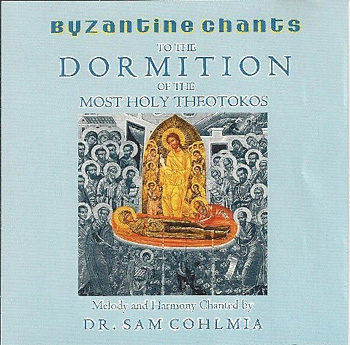
Review and a mini-interview: Dr. Sam Cohlmia, Byzantine Chants to the Dormition of the Most Holy Theotokos

Blogging has been light the last couple of months for what I hope are obvious reasons. The new school year starts up the week after next, so we’re all going to have to start making the adjustment back to the normal swing of things soon, so hopefully I can catch up then on some posts I’d intended to write over the summer but didn’t. (Of course, there’s also the matter of qualifying exams needing to happen sometime in the next twelve months.)


In the meantime, Dr. Sam Cohlmia, protopsaltis of the Antiochian Diocese of Wichita and the Midwest as well as St. George Cathedral in Wichita, was kind enough to send me a review copy of his new recording, Byzantine Chants to the Dormition of the Most Holy Theotokos. It contains many of the festal hymns for the Feast of the Dormition, with Dr. Cohlmia as solo cantor throughout (and providing his own isokratima via the miracle of modern recording technology).
The disc is fairly evenly split between English and Arabic, with Dr. Cohlmia using the Holy Transfiguration Monastery Menaion for most (not quite all) of the metered hymns (prosomoia), and Nassar (apparently modified in spots) for the non-metered hymns as well as the stichera at the Praises. In terms of musical sources, Dr. Cohlmia is using Arabic scores by composers such as Mitri El Murr and Andraos Mouaikel, and adapting those into English himself. The melodies for the Lamentations are a bit of a puzzlement to me — not necessarily on this disc, but in general — since what’s sung here represents the third set of permutations that I have been told are the “authentic” Antiochian melodies, so I’m not sure what that means.

There is a great deal to like on this disc; Dr. Cohlmia has a clear and lovely voice, and handles the vocal requirements of both languages nicely. Although Lebanese-born, his sung English diction is excellent, and all the texts sound smooth and natural throughout. He is able to bring a good sense of style to the presentation; while his approach as a solo cantor makes for a different realization of “Antiochian style” than one hears on, say, The Voice of the Lord (which represents the chant tradition of the Patriarchate of Antioch applied to an English-language choral context), the two recordings clearly share and are honoring the same heritage. That said, some of the differences in approach are evident in spots where the recordings are using the same melody — for example, in the Kathismata for both feasts, the nenano melody “Κατεπλάγη Ἰωσήφ” (“Joseph was amazed” in the HTM books) is employed, and the contrast between the choral and solo realizations is subtle, but interesting.

One thing that both recordings do that’s particularly nice for learning purposes is proper use of metered model hymns. This is a system that can be a bit opaque for cantors who are having to cut their teeth in the Antiochian Archdiocese; neither Kazan nor Nassar make note of their use, Nassar is unmetered anyway, and Kazan just writes them out and shoehorns the texts into them without telling the singer that that’s what’s happening. For metered translations one must turn to the Holy Transfiguration Monastery books, which seems to have something of a “Don’t Ask, Don’t Tell” status in the Antiochian Archdiocese, and which also aren’t complete outside of the Menaion. A metered Octoechos doesn’t appear to exist, neither does a metered Triodion, and the Pentecostarion has been being revised and “due any day now” for several years. Even if you have metered texts, however, sources for the melodies are tricky. HTM’s book of melodies is a bit idiosyncratic in terms of musical material, and while Fr. Seraphim Dedes’ is better in terms of being better-grounded in “classical” sources (like the Irmologion of John the Protopsaltis), it’s harder to use with the HTM books because the melody titles are different — sometimes marginally so, sometimes significantly so — and the translations are idiosyncratic. It’s better, frankly, to just learn Byzantine notation and learn the model melodies out of the Irmologion, but then there’s the problem of not getting the sung tradition in addition to the notated tradition. There’s this site, and the recordings are instructive, but not exactly stellar. All of this is to say, Dr. Cohlmia’s recording, as with the Theophany School disc, provides an English-language model for realizing a nice little handful of the model melodies realized with metered translations, and that makes it useful as well as enjoyable and prayerful to listen to. I’m not clear as to why he doesn’t use the metered translation for the stichera at the Praises, and the model melody is quite a bit different from the one that’s in the Greek books (“Ὡς γενναῖον ἐν μάρτυσιν”, “As one valiant”), but the others employed are wonderfully practical learning tools.

Anyway, I’d love to get Dr. Cohlmia and Rassem El Massih in the same church at some point for a Liturgy, and perhaps I will. The CD can be purchased through the Wichita Chancery (details here).

I also present Dr. Cohlmia’s responses to some follow-up questions that he was good enough to take the time to answer. I find them very illuminating, and I appreciate the perspective he brings to the table. I will be curious to hear what others think.

1) How were you trained as a cantor?

I self-trained beginning in 1991 out of interest.  Being born in Beirut and going to church there and being exposed to excellent chanting, it was relatively easy for me to understand the melodies, since several of them are derived from the 11 basic Oriental melodies, such as Hijaz (Tone 6), Nahawand (Tone 5), Bayyat (Tone 1), and so on.  I was not formally trained to become a chanter, but simply practiced constantly.

2) For this recording, did you sing off of notated scores, or did you just have texts that you knew how to sing from memory? If notated scores, did you use staff notation or Byzantine notation?

I wrote the music for the entire Orthros service of the feast of the Dormition (in Western notations).  For some of those pieces of music, I simply transcribed the Byzantine notations from Mitri Murr’s arrangements in Arabic to Western notations in English.

3) How do you approach chanting in English differently from how you approach chanting in Arabic or Greek?

Chanting in English is rather tricky when compared to doing the same in Arabic or Greek.  In English, you have to be extremely careful with the pronunciation of the various syllables in addition to the lack of enough vowels makes chanting challenging.  In Arabic, especially, there are lots of vowels, and generally it is easy to chant words without placing particular emphasis on specific syllables (that’s simply a general statement, of course).

4) Do you have a sense of how Byzantine chant in the Patriarchate of Antioch is distinct from, say, under the Church of Greece or the Ecumenical Patriarchate? How do you see how you chant as being different from how a Greek cantor might approach it, if at all?

Overall, Arabic Byzantine chant in our patriarchate differs, in my opinion, than Greek Byzantine chant in the ecumenical patriarchate.  To me, Arabic chanting is certainly more melodic and, horizontal (if you will) than Greek chanting, which at times sounds choppy.  It simply flows better and sounds more soothing, although Greek chanting is very beautiful.  My chanting style is certainly more based on the Arabic, as I use Mitri Murr’s and Fr. Nicholas Malek’s arrangements as a guideline.  I do also have Protopsaltis Kharilaos Taliadoros’ anastasimatarion (in Greek), and it is beautiful, but not as melodic as the Arabic arragements.  The arrangements of Mitri Murr, and Fr. Malek (new arrangements), truly bring the words to life, as the music is written to mirror the words.  His work is very brilliant.

5) In week-to-week services at the Cathedral, what materials do you use? Are you using the chant books of Mitri El-Murr for Arabic, for example, or something else? What do you use for English? Kazan/Nassar? Or something else?

I put together the Typikon Notes from the Arabic and Greek Typikon each week for the Sunday services.  The text that I use is a combination of that from Nassar’s book as well as the HTM Menaion.  At times, if the text does not exist, and it is called for in the Typikon, I simply translate it into English.  So, we basically use the book of Nassar, HTM Menaion, HTM Pentecostarion, +Kallistos Ware’s Lenten Triodion, to name a few.  For chanting purposes, we use the Byzantine music project put out by the Archdiocese (for English) and Mitri Murr’s work (for Arabic).  Rarely would I use Taliadoros’ anastasimatarion (for Greek) unless there are Greek parishoners at Vespers or Orthros.

6) What’s your sense of how Kazan/Nassar have represented and transmitted Antiochian tradition for English-language Orthodox Christians? What could be better? What would you hate to see changed?

Kazan’s music, like any other individual’s music, is one representation of Byzantine chant.  It is certainly very simplistic, but good enough for the minimally trained or unfamiliar chanter.  Most “chanters” in the US are not true chanters, but singers instead, so that music works fine for them.  In my opinion, true chanters need to fully learn Byzantine music.  As far as Nassar’s book, it is alright for the most part, although there are a few mis-interpretations, where the English could be better.  The best work is HTM’s Menaion and Pentecostarion, since the interpretation in extremely accurate and the special melodies are perfectly metered.  As far as what I would hate to see changed, I would hate to see the Church lose its Antiochian tradition.  I would hate to see the music being watered down from the original humble Byzantine to the more dramatic and grandiose choral.  Don’t get me wrong.  The church needs the two, but there needs to be more emphasis on Byzantine chant, because it seems that it gets put on the back-burner at times.  Furthermore, chanters need to learn Byzantine chanting and music, in addition to preserving some of the Arabic used in the church (depending on the individual church).

7) What’s the future of Byzantine chant in our Archdiocese, as you see it?

Hopefully the same if not better.  I would like to see emphasis on Byzantine chanting at the various seminaries (not just Holy Cross), as well as Byzantine courses being offered for ALL chanters.  Any person who plans to approach the Psaltyrion to chant needs to have a good education on Byzantine chanting, which hopefully could be learned at some Byzantine school or course of some kind.

In which I boil water

You may recall that a rather geeky purchase of mine proved to be difficult to reconcile with American wiring. An electric-savvy friend of mine came over and looked at our box to see what might be necessary to get it running without a transformer; the box itself would probably have to be replaced, since it was bought second-hand off of Moses, but that would probably be something that the landlord would take care of given sufficient justification. Once the box was up to code, it really wouldn’t be that big of a deal to put in a dedicated outlet for the kettle.

With a baby on the way, that was maybe sufficient justification to mention to my landlord, hey, a friend of mine checked out our fusebox and said that it probably wouldn’t be the worst idea in the world to have an electrician bring it up to date. I did so, and the landlord (who has always been a very cool guy to us) said, sure, no problem, here’s the guy I usually use.

Well, the electrician came out and definitely found some wiring issues that needed fixing, and said, yep, I can have a conversation with the homeowner about the fusebox. He wasn’t opposed to putting in a dedicated outlet, but said, you know, it’s possible that there’s a different base that will let it run on US electricity — check with the manufacturer.

But then other big things happened, and it kind of fell of my radar for awhile.

Then Madelene left a comment on the original post saying that she’d gotten this working without any massive rewiring of everything. The secret? That the US-based Chef’s Choice uses the same manufacturer as Russell Hobbs, and markets a variant of the same kettle in North America. It’s not exactly the same — no blue lights, the handle is different, other cosmetic differences — but the important thing is that the Russell Hobbs kettle will fit on the base of the Chef’s Choice version.

A phone call to Chef’s Choice confirmed the availability of replacement bases, and today the box arrived.

Which brings me to the moment where perhaps you will decide that six weeks of fatherhood have already robbed me of my sanity — yes, ladies and gentlemen, I’m posting a video of water boiling. One thing you’ll notice right off is that on American electricity, the whole “boiling in under a minute” thing doesn’t happen — more like five. Oh well. It still works.

Want a birth announcement?

Stationery card
View the entire collection of cards.

CD review: GOA Archdiocesan Byzantine Choir, Μέγαν εὕρατο (Vespers for St. Demetrios)

Archdeacon Panteleimon Papadopoulos was kind enough to send me a review copy of Μέγαν εὕρατο, the new recording released by GOA’s Archdiocesan Byzantine Choir.

The disc is a collection of the festal hymnody sung at Great Vespers for St. Demetrios (chosen to honor Abp. Demetrios), including the Anoixantaria (for those unfamiliar with the practice, Psalm 103 from “Thou openest thine hand, they are filled with good…” to the end is theoretically sung rather than merely read for major feasts in present-day Byzantine practice, although in my experience this is one of those things that a lot of people don’t do with the excuse that “nobody does that”), “O Lord I have cried” with stichera, Doxastikon, and Theotokion, hymns for Litya and Artoklasia, aposticha, apolytikion, and “Many years” for Abp. Demetrios. The ensemble, if I understand correctly from the list of participants, is a group of psaltes largely from the Northeast, including Dr. Grammenos Karanos, the current professor of Byzantine music at Holy Cross Greek Orthodox School of Theology, and others from the New York area.

The first thing that must be said is that this is a wonderfully sung program; the wall of sound produced by these gentlemen is never less than first rate, and hymns with slower, more melismatic textures such as the Anoixantaria are particularly beautiful.

One of the things that I try very much to do is to view recordings like this, labors of love by people who are clearly far more knowledgeable and able than I am, as master classes, opportunities to learn finer points that I haven’t had the opportunity to learn otherwise. I have been informed by a particular point of view that makes certain assumptions, and not everybody is necessarily informed by the same perspective and assumptions. (For example, given a number of factors, I tend to assume that even for Byzantine chant, choirs are ideal, with solo cantors needing to be judiciously used. However, I am well aware that for many people, for this repertoire, the solo cantor tends to be the assumption in terms of performing forces, with choirs only happening for special occasions.) To that end, there are questions that I have about aspects of the recording. Some of these questions veer into critical territory from an entirely subjective musical standpoint, but may well be entirely answerable in terms of style.

First off, something that is immediately apparent has to do with repertoire choices. These are, with a couple of exceptions, not selections out of what have been represented to me as “the classical books”. The melody used for the prosomoia at “O Lord I have cried”, for example, “Ὢ τοῦ παραδόξου θαύματος”, is not the melody found in the Irmologion of Ioannis Protopsaltis, and the Kekragarion is not from the Anastasimatarion of Petros Peloponessos, either. They’re not bad, necessarily (although I have to say I definitely prefer Ioannis’ melody for the prosomoia), but I am  curious about what informed the selections.

Second, there’s a tendency throughout the disc to cut off of endings of phrases (including isokratema) quite sharply; this is something that makes sense to me to do as a solo cantor, so that the congregation knows that the places where you’re breathing are intentional, but it makes less sense in a choral setting unless there’s a specific stylistic reason to do so. It’s obviously a choice, and one that is executed distinctively, carefully, and consistently, but I’m left wondering if it’s necessary for it to be as prevalent as it is here.

Third, the apichimata are sung chorally, which makes me wonder if there’s a performance tradition for apichimata that divorces them from their function. Soloists sing the verses at the “O Lord I have cried” stichera, so it’s not simply a matter of everything being choral for purposes of this disc.

Fourth, as performed, the ison moves around a lot more than I’m used to. I’m aware that this is a point where it seems everybody and their dog will tell you “the real way” you’re supposed to realize the drone, so I assume this is a stylistic point as well.

Strictly in terms of the physical presentation of the disc, it would be nice to have had more of a booklet; the performance is entirely in Greek, and while many of the texts are reasonably familiar, for those not used to Greek an included translation would help make the product more accessible. Doubtless this is a function of production cost; perhaps an “online booklet” or some such would be a way of accomplishing this in a cost-effective manner next time.

To sum up: this is a gorgeous-sounding recording that is probably best described as a snapshot of the state of Byzantine chant in Greek in the Northeast, which seems to be healthy indeed. I’ll be very interested to hear what the Archdiocesan Choir does next — the Archdiocesan School seems to doing a lot to try to raise the profile of Byzantine chant, and I’m looking forward to future developments.

“When we name our children, we should do so as ones who are identifying them as God’s heirs”

There’s a page from a church website making the usual rounds right now titled about Orthodox practices with a newborn. As somebody who is going through those steps right now and having to explain various things (what’s the difference between churching and baptism? Why do you have to do the churching? What’s the whole naming thing when you’re going to do a christening? etc.), I think it’s pretty good. We wound up churching Theodore after, well, ten days, I suppose — it was sort of curious how it worked out, since our priest came over to do the naming on a Tuesday, and told us, “Well, there’s no hard and fast reason to do 40 days if it’s not practical to do 40 days, but it’s theoretically supposed to be the first real trip outside of the house for the mother and child.” Megan looked sheepish and said, Um, I went to Target yesterday. The priest gave a dismissive wave and said, not a big deal. Let’s just do the churching on Thursday.

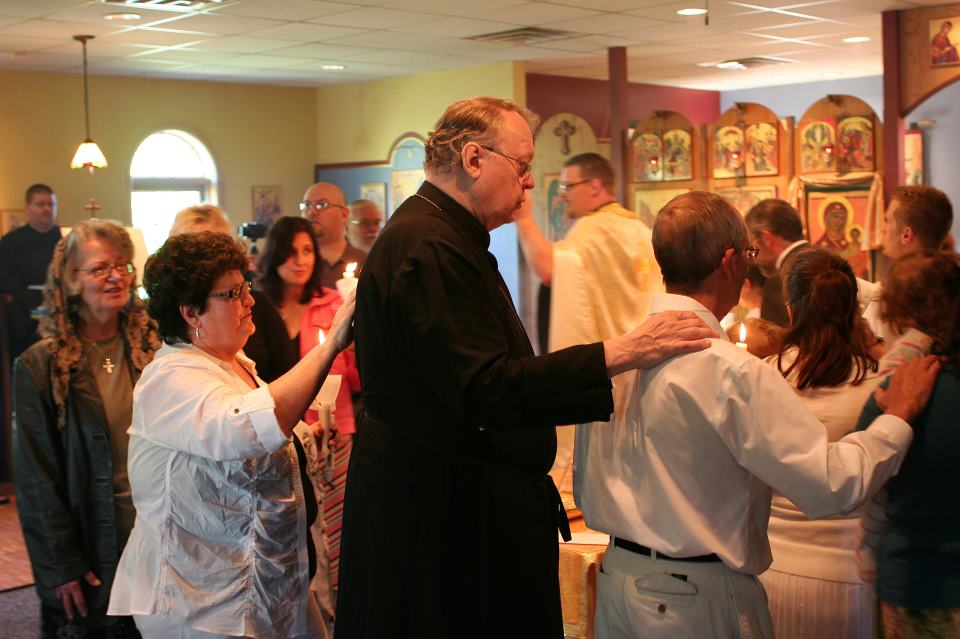
Well, the reason we could do the churching on a Thursday was because it was the same day that Fr. Peter E. Gillquist’s body was lying in the center of the church, and we were serving a Divine Liturgy before he was to be taken up to Holy Trinity in Indianapolis for the funeral services proper. (There were around 32 clergy at the altar for his funeral. There’s no freaking way All Saints could have done that.) So, Fr. Peter Jon Gillquist carried Theodore Harvey Barrett II down the aisle, past the body of his own father, Fr. Peter E. Gillquist, into the altar. There was something weirdly normal-seeming about the whole thing — in the midst of death, we are in life — and there were a number of people who said to me that it wasn’t every day that the whole circle of life seemed to get represented like that.

Anyway. Something that hit me about the Orthodox newborn practices piece was this bit about names:

Orthodox Christian naming practices vary. A child is sometimes named after the saint commemorated on the day of birth, sometimes in honour of some other saint or biblical figure. Sometimes, however, the child receives the name of a virtue, an ancestor, or some other name entirely (see for example, early saints who were named after pagan philosophers like Plato). There are no “hard and fast” rules (as there might have been in ancient Judaism), except that Christian parents should name their child in a thoughtful and prayerful manner, not whimsically, idly, or merely according to some prevailing fashion. Our names embody our identities and point to our vocation. When we name our children, we should do so as ones who are identifying them as God’s heirs and dedicating them to His service.

A philosopher (and by a “philosopher” I mean Bruce Willis speaking Roger Avary’s words) once said, “I’m American, honey. Our names don’t mean shit.” Well, that’s not quite right. My name has a meaning; “Richard” means “king” (it’s cognate with rex, Reichert, etc. and it’s the semantic equivalent of the Greek name Βασίλης), “Raymond” means “protector”, and then “Barrett” can mean “strong man”, “hatmaker”, or something like “con man”, depending on what part of Europe your family is from. My family appears to be from the part of Europe where it means “con man” (evidently the only remaining reflex of this meaning in Modern English is the legal term “barratry”, which itself seems to mean something akin to “ambulance chasing”); of course, that doesn’t mean that I’m the strong king of con men (…or does it…?). No, what it means is that my father, Richard Ellis Barrett, wanted me to have his name but didn’t want me to be a junior. My middle name comes from my maternal grandfather, Raymond Myrick, whom I never got to meet.

Theodore is named for his great-great-great-grandfather, about whom I’ve written a decent amount. Theodore means “gift of God” (Theo- “God” doros “gift”, with the appropriate inflected Greek masculine ending), and is apparently semantically equivalent to the Hebrew form of “Matthew”. His namesake was a general (if perhaps not necessarily a great or even a good one, although this much is not entirely clear to me), so it was a no-brainer to us that Theodore the General should be his patron saint. But wait — “Harvey” apparently meant “battle worthy” in Breton. So he’s the battle worthy general who’s a gift from God. Of course, there’s still the whole problem of being a con man — but anyway.

Of course, the point isn’t that our firstborn is going to be a battle-worthy general of an army of con men who all think they’re God’s gift. (Although he might be, I suppose.) The point is that, “Harvey” and “II” and all, he has the best name we could give him, with the best link to his family’s legacy that we could possibly provide, however tenuous of a connection it may be and however forgotten his namesake may have been. The argument could be made that it’s constructed and contrived and trying to revive a memory that had already apparently passed away within two generations, but one doesn’t rebuild bridges by throwing up one’s hands and saying, “I guess we can’t get there from here.”

Perhaps it’s a lot of weight to place on a little boy’s name, but at the same time, there’s no question at the very least that he’s a gift from God. Besides, Theodore has gained 23 ounces and grown an inch since being discharged from the hospital, and he was eight pounds to begin with. I think he’ll manage.

Fr. Peter E. Gillquist and Theodore Harvey Barrett II: In the midst of death we are in life

A little over nine years ago I read Becoming Orthodox: A Journey to the Ancient Christian Faith by Fr. Peter E. Gillquist. It was one of a flurry of books I read around this time, starting with the Ware The Orthodox Church and Pelikan’s The Vindication of Tradition, and including Schmemann’s For the Life of the World and Clark Carlton’s The FaithThe WayThe Truth, and The Life. I wouldn’t say the book had an overabundance of things to say to me, since I didn’t really have the conceptual problems of an evangelical per se, but given where I was at the time (the full story of which will have to wait), and given how I generally approach things, I remember thinking, Well, if this guy’s job is supposed to be missions and evangelism, then maybe he’ll know what to tell me. I wrote him a fairly lengthy letter explaining to him a lot about where I was at, and sent it off not really expecting a response, figuring that he had to get letters from perplexed Catholic-wannabe Protestants all the time.

A couple of weeks later, I got a large envelope in reply from Fr. Peter, containing a copy of Matthew Gallatin’s Thirsting for God in a Land of Shallow Wells, and a handwritten note that advised me to get in touch with a local priest named Fr. James Bernstein. “He will understand you!” the note said.

That turned out to be a fruitful pairing indeed, and I would say that Fr. Peter’s willingness to take me seriously enough to pass along some kind of useful response was a big factor in becoming Orthodox two years later.

I finally met Fr. Peter a few months after his son was assigned to All Saints, the parish in our adopted home of Bloomington, Indiana. He gave a wonderful presentation for IU’s OCF that was also attended by a good 80 people from the greater community. He continued to make appearances at All Saints every so often over the next couple of years, until finally he moved here in 2009.

Fr. Peter and I worked together on a number of projects, related to All Saints’ building project as well as Orthodox Hoosiers, the Orthodox IU alumni association that never quite achieved critical mass. It was Fr. Peter’s brainchild, he and I poured a lot of time and effort into it, and it really was (and is!) a wonderful idea. Alas, it just was the wrong time, and neither of us really had it in us to try to get it going past the first big push. We both hoped that the initial response would be sufficient to get some momentum going and to convince somebody else to take it on, and even with a mailing list of 500 people, that just didn’t turn out to be reality. I think that perhaps we had a shared vision that was nonetheless harder to realize than it could have been given a rather marked difference in methodologies — he was always very up front about trying to approach things from what he understood to be the science of marketing, and I was less trying to get people to “buy”, as such, than I was trying to get them to see the particulars of the vision for themselves. We were further hampered by some broader chicken-and-egg problems at All Saints that Orthodox Hoosiers was at once intended to help solve but also severely limited by itself. In the end, we both tried our hardest, but it was perhaps the right idea at the wrong moment.

Fr. Peter E. Gillquist with his son and baptizands on Lazarus Saturday, 2012.

Fr. Peter passed away earlier this evening after an old struggle with cancer had reared its ugly head again in the last several weeks. It was a blessing and honor to have known him, and I can truthfully say that he made a difference in my life and the lives of those around me. May his memory be eternal, and my heart goes out to his family, particularly Fr. Peter Jon.

Theodore Harvey Barrett II was born at 6:49pm on 25 June 2012; he was born in the same hospital where Fr. Peter was also undergoing some last-minute surgery. Fr. Peter Jon was able to come down to post-partum from his father’s recovery room to give the first blessing to the child after he was born. That is very much its own story, one that I do not have time to detail here in full, except to say that he and his mother are healthy and thriving. I wish that there had been more overlap of time on this earth between Theodore and Fr. Peter than simply the last week. I would have loved for Theodore to have known Fr. Peter, with his gravelly voice, his ability to grab a crowd with either a joke, a prayer, or a Bible quotation, and his insistence on treating you like he’d known you for years even if he just met you.

In the midst of death we are in life. I have more to say about both transitions, but this will have to do for now.

Thoughts on Prometheus

When I was probably five years old at the most (c. 1981), I remember my parents getting this really amazing machine called a VCR. Well, actually, it was an array of machines; there was the VCR unit itself that the tape went into, there was a separate unit that served as the TV tuner and timer (and I remember the hours that we had to spend turning the little knobs for each channel on that thing to get them to actually come in clearly so we could record TV), and then the humongous camera that connected to the VCR (which you then had to carry around with a shoulder strap if you were recording anything).

I don’t know why I remember this particular detail, but I do; the first movie my parents watched on that VCR was Alien. Maybe part of why I remember it is because they allowed me to be in the room, but I had to have my back to the TV the whole time, which I didn’t understand.

I didn’t actually see Alien myself until probably sometime in the early 1990s, perhaps some time after the time I first watched Blade Runner, which itself was probably around 1990 or so. Now is not the time necessarily to write a full-length essay about my love of Blade Runner, but what I will say is that it was a vital step along the way in my movie geekdom. Batman (1989) had gotten me excited about a number of things when it came to film — director as auteur, production design, the importance of the score, and so on — but Blade Runner really got me thinking about the process of filmmaking and how things change, evolve, progress, and yes, sometimes get messed up in the journey from page to screen. It was the first time I was introduced to the idea that there might have been a very different movie left behind somewhere in the process, and that it might be well worthwhile to restore those other concepts. (I’m sure somebody has mused at some point about the parallels between scholarly production of editions of texts based on application of theories of textual criticism to manuscript culture and the phenomenon of multiple existing cuts of a film.) Although I missed the original theatrical run in 1982, I saw it at the Neptune Theater in Seattle once if not twice in 1991, I saw the “Director’s Cut” (that wasn’t really a director’s cut, but never mind) at the Egyptian Theater in 1992, and I was also fortunate enough to see the so-called Workprint at the same theater in 1999. Another thing I remember is that each time I saw it, the place was packed to the gills. And yes, I’ve got one of the Final Cut briefcase sets. It’s right next to the Inception set. Don’t judge me.

Since Blade Runner, I have found Ridley Scott to be always creatively ambitious in the process with the final product being somewhat hit or miss, depending on the film. I still think The Duellists is an incredibly underrated and underappreciated piece of work; Legend (of which I’ve only ever watched the director’s cut with the Jerry Goldsmith score) is a movie with some fascinating ideas and beautiful visuals but that clearly was trying to overreach in terms of what could be done at the time (and in general makes me glad that nobody seriously attempted a live-action Lord of the Rings any sooner than they did); Black Rain and Hannibal are both technically terrific, and I like both movies, but they’re clearly work-for-hire efforts; Gladiator and Kingdom of Heaven (the extended cut, anyway) are both great; I liked American Gangster and Body of Lies well enough even if neither were exactly earth-shattering; Robin Hood seemed like a fantastic idea with epic scope that somewhere along the way got scaled down to an attempt to use some leftover bits from Gladiator and Kingdom of Heaven for a younger audience, and while it had its good points, it never seemed like I was actually watching a final product anybody intended me to see, but rather something that got assembled more or less by committee.

Which brings me to Prometheus.

The idea of Ridley Scott returning to what we might call “fantastic” fiction for the first time since Legend and getting to play in the Alien universe again has been an intriguing one to me from the get-go. He’s certainly a different filmmaker than he was in 1979, and technology has perhaps caught up more to the way somebody like him thinks — so what would he do? He’s said many times in interviews over the years that he would be interested in asking the question where the big guy in the chair in the first Alien came from, so presumably that’s where he would go. How would he get there and what would he do with it? At the same time, the business of filmmaking has changed a lot since 1979, so how would that impact the movie?

I saw Prometheus last night in IMAX 3-D. I’m not really going to write a review of it, as such; I can tell you that I enjoyed it immensely, thought it had a great cast, was stunning visually, told an interesting story that I expect is really just the prologue to the movie Scott really wants to make, and that it’s really more along the lines of SF adventure that has some tense, squirmy moments, rather than being a horror movie set in an SF context the way Alien was — but writing a critical evaluation of it point-by-point isn’t what I’m interested in doing. Right now I’m really quite turned off by a certain subset of movie geekdom that seems to go out of its way to tear down to component atoms anything that dares to not be exactly the same movie they’ve already made in their head (see the comboxes on a site like Ain’t It Cool News, for example — man, that site used to be pure gold; how far the mighty have fallen), and that’s not where I want to go. I’m more interested in talking about the ideas in the film, and how they link up with other things one finds in Scott’s filmography.

I will, however, acknowledge up front the impact that present-day moviemaking economics appears to have had on Prometheus so I can get it out of the way. There was a lot of nattering over the film’s rating; would it be R, like the original Alien, or would it be PG-13? Would the business side of how movies get made today allow for an ambitious R-rated SF film? You could do it back in 1979 for a number of reasons, but with today’s emphasis on the biggest opening weekend possible, it would seem to be a harder sell. When Prometheus was finally announced as having an R rating a few weeks ago, there were some who assumed that it was a “soft” R — that is, it had been edited down as much as possible in hopes of getting a PG-13, but ultimately couldn’t get there, and by that point it was too late to say, “Okay, we’ve got an R movie, it is what it is, let’s go ahead and throw everything back in.” And yes, that in fact seems to be the case. There is a lot of, shall we say, connective tissue that is missing from certain moments in the film that I assume to have been cut out in the quest for a PG-13. There are a couple of events that I suspect are the, shall we say, irreducibly minimal R-rated bits (if you’re a pregnant woman, you’re probably not going to want to see this movie until you’re well past delivery, I’ll say that much), but aside from those, in terms of language, general level of violence, sex, nudity, etc. there’s nothing that makes this a characteristically R-rated movie in the way that, say, Watchmen is. Does it come across as creatively compromised as a result? Not exactly, but I’m very curious to see how the inevitable unrated Director’s Cut differs when it comes out on Blu-Ray.

Warning: spoilers ahead.

I had a conversation the other day with one of my fellow DO summer school students in which the seeming affinity on the part of certain Evangelical Christians for Judaism and Israel came up. My colleague said, “Well, when you’re a kid, if you don’t like what Dad tells you [i.e., Catholicism/Orthodoxy], you go and ask Grandpa [Judaism]. Makes perfect sense.”

Prometheus is a story about going and asking Dad questions, and Dad not really liking that you asked and you not really liking the answers. In this way, it’s really more of a piece with Blade Runner, which in terms of theme is all about the creation getting to ask the creator, “Why did you make me, and why did you make me flawed?” It’s a moment that also crops up in Gladiator, when Commodus demands to know from Marcus Aurelius why he’s getting passed over (which is also paralleled in Prometheus by a scene between Guy Pearce’s Weyland and Charlize Theron’s Vickers). “Your faults as a son is my failure as a father,” Marcus Aurelius tells him, which echoes Tyrell telling Roy Batty, “You were made as well as we could make you.” The consequences are the same for both Tyrell and Marcus Aurelius, with the artificial golden-eyed owl in the former case and the statue heads of the Antonines in the latter case all impersonally witnessing the patricide.

Ellie Shaw has to do the same thing to her creator, her genetic “father”, but in this case it’s because her creator is about to kill her. She has led seventeen people to a far corner of the universe in order to meet the race that she believes engineered the human race, only to find out that God does not like us very much. Why? Well, that’s a question that isn’t directly answered, but the title combined with certain details in the film suggest some intriguing possibilities. Prometheus the Titan gave mankind fire against the will of the gods, and subsequently had to endure being chained to a mountain peak and having his liver eaten by an eagle every day for the rest of eternity. Were we created without permission? Certainly the film makes a visual point of the Engineers’ ship at the very beginning being a completely different design from the ships we see in towards the end, suggesting different factions. Are the Engineers ultimately victims of their own hubris, with their propensity for meddling with natural biologies resulting in weapons they can’t control, among which they count us? Certainly that would tie the iconic image of the xenomorph chestburster (which, yes, we do see in some form) to Prometheus’ mythological fate — which, incidentally, is why I don’t think the film’s final scene is “tacked on” in any way, as some have argued. It is part and parcel of the imagery and themes invoked by the title, and hardly just thrown in to underscore the obvious.

Back to the idea of going to Grandpa when you don’t like what Dad tells you. David, the android that is participating in the mission, is one part Ash (Ian Holm’s murderous robot in Alien), one part Roy Batty, one part HAL 9000, and a bit of Lance Henriksen’s Bishop from Aliens, but Michael Fassbender makes it entirely his own thing, too. He’s not terribly impressed with his creators, but he’s fascinated and delighted by what he encounters of the Engineers. David’s actions are never entirely benign, but neither is he exactly vicious in the way that HAL and Ash are. I’m certain that he was acting under Weyland’s orders to infect Holloway and get the impregnated Shaw into cryosleep as quickly as possible, but he also acts genuinely curious to see what will happen when he carries out those orders — like Ash, he admires what they’ve found, and wants to see the end result. David isn’t all that interested in why humans made him; one gets the impression that he wants to ask the Engineers (i.e., Grandpa) why they bothered making the humans in the first place. My guess is that the Engineer knocks David’s head off because he sees David as the result of humanity’s hubris, the same hubris that seems to have resulted in whatever happened on LV-223’s installation 2,000 years ago (what I assume to be an outbreak of xenomorphs, judging by the burst chests of the Engineer corpses).

I said that I expect Prometheus to be a prologue to the story Ridley Scott really wants to tell. I say that because of the narrative problem of deciding to tell the story of “the big guy in the chair”. In order for such a story to work, it has to be told from the standpoint of a human being, an audience surrogate. This protagonist has to have a reason to seek that race out, and how do you do that in a way that makes sense when, in terms of storytelling logic and what appears to be the framework set up in Alien, there’s no way the protagonist could know they exist? Well, by the end of Prometheus, Ellie Shaw knows they exist and has a reason to seek them out on their own turf, and it’s propelling the story forward into another film.

Miscellaneous comments: Ridley Scott has a thing for closeups of eyes. Instantly-recognizable shot from Blade Runner:

And Holloway in Prometheus:


I rather liked that David’s head was leaking milk. Nice visual tie to Ash in Alien. I also noticed that Ellie is dragging his body along as well, so presumably he will be whole again in a sequel.

I assume there is more of Patrick Wilson as Ellie’s father somewhere on the cutting room floor. Otherwise, why bother casting Patrick Wilson? Seems like luxury casting for five lines. Along similar lines, I assume there was footage shot of a younger Peter Weyland, because it doesn’t make sense to me to cast Guy Pearce specifically to put him in old age makeup. I could be wrong on both counts.

In terms of narrative ties to Alien — I’m sure we’ll find out more for certain in any future film, but it seems to me that the Engineers’ rush to leave the installation 2,000 years ago (and I’m intentionally not going to discuss the implications of that date in terms of Earth history) is probably what results in the ship that crash-landed on LV-426. Their weapons stock got out of control, and David mentions that there are “other ships”, plural, so not just the one that he and Ellie are flying to the Engineers’ home planet. The one on LV-426 was perhaps the one that actually was able to take off.

However, one point that I find really intriguing is the possibility of what the star map that David was interacting with might have been. Was it keeping track of every place that the Engineers had interfered or interacted with the evolutionary process? If so, they’ve seeded a lot of worlds. What else is out there to be found in this universe besides xenomorphs?

Even in its clearly toned-down form, Shaw’s self-caesarean was pretty rough going (and I assume it was ultimately one of the barriers for a PG-13 rating). I found it very uncomfortable to watch as a man; I can’t imagine what it would be like for a woman, let alone a pregnant woman. I won’t be suggesting to my wife that she watch it until we’re well past the birth. I’ll note that it is also one of the ways the imagery of Prometheus having his liver pecked out and eaten is invoked; Shaw’s faith and optimism are ultimately used against her, and this is the price. This is maybe overthinking it a touch, but as a name, Προμηθεύς means something like “forethought”, which Shaw seems to lack — she didn’t really think her ideas through sufficiently.

Anyway — Prometheus has my recommendation. Go see it and draw your own conclusions.

Byzantine chant in The Word

In the current issue of The Word one may find an article on Rassem El Massih, a Lebanese-born cantor in the Antiochian archdiocese and a current student at Holy Cross. I reviewed the CD the article mentions back when it first came out, and I also met Rassem on my trip out there back in February. While I didn’t get to chant with him, I found him to be a great person to talk to and I enjoyed getting to know him very much, however briefly. It’s great to see that his star might be on the rise. I should note, as per a discussion going on in the comments of a recent post, that Dr. Grammenos Karanos, a supposed exemplar of “Patriarchal style”, is quoted with very strongly positive words about Rassem, who is steeped in the “patriarchal style” of the Patriarchate of Antioch.

By the way: I’d link directly to the article instead of quoting it in full, but the online version of The Word is distributed only in pdf form. An article of mine that ran in The Word I’ve seen reproduced in full on church websites, so I assume I’m doing nothing untoward here, particularly since I’m not making any money off of it and the Archdiocese distributes The Word to its membership for free. In any event, copyright is acknowledged as belonging to the Archdiocese and authorship is acknowledged as being that of Linda M. Thomas.

Rassem El Massih: A Voice of the Faithful

by Linda M. Thomas

Thousands of miles from the tiny church where he first began to chant, the pure and powerful voice of Rassem El Massih rings out in prayer. The first cantor at St. George Orthodox Church in West Roxbury, Massachusetts, embraced Byzantine music from the time he was a small boy growing up in a town called Anfeh, on the coast of north Lebanon. Today his voice and spiritual presence are felt during Vespers service at Holy Cross Greek Orthodox School of Theology in Brookline, as well as Sunday mornings in nearby West Roxbury.

On October 26, 2009, El Massih led the choir at UN prayer services presided over by the Ecumenical Patriarch BARTHOLOMEW, Archbishop of Constantinople, at the Cathedral of the Holy Trinity of the Greek Archdiocese.

Last December, El Massih and four other seminarians from Holy Cross were invited to perform at Carnegie Hall with the Archdiocesan Byzantine Choir of the Greek Orthodox Archdiocese of America. The concert honored St. Nicholas Greek Orthodox Church at Ground Zero, the only house of worship destroyed on 9/11, and in thanksgiving for the announcement of its rebuilding.

“Rassem’s voice is beautiful,” said His Eminence the Most Reverend Metropolitan PHILIP, Primate of the Antiochian Archdiocese of North America, who said he was “edified” listening to the first-ever Byzantine music concert at Carnegie Hall.

“When he chants, it sounds like a nightingale. His voice is very soothing to the soul and to the heart. Sometimes he is as gentle and soft as an evening summer breeze,” the Metropolitan said of El Massih. “Sometimes he roars like a waterfall.”

Whether he’s chanting inside a celebrated arena like Carnegie Hall or a small, out-of-the-way monastery, however, the thirty-one-year-old divinity student says he feels the same: “My goal is to praise God regardless where I am.”

Drawn to Sacred Music

“I was a very shy and quiet boy who was drawn to church and, specifically, its sacred music,” El Massih said. “After school, I would eat, then try to finish my homework as fast as I could, so I could listen to Byzantine chant. I definitely also wanted to play with my friends, like any other boy my age, but church was as important to me as playing with my friends.”

He began chanting in churches and in school when he was nine. Seeking to perfect his voice, he enrolled at the School of Byzantine Music of the Archdiocese of Tripoli and El-Koura, while at the same time directing the choir of Our Lady of Al- Natour Monastery, a serene sanctuary on the shore of the Mediterranean Sea just outside Anfeh.

“Anything they taught me, I would say, ‘You  don’t have to repeat the melody for me twice.’ Boom. I got it,” he recalled. “Because I was so in love with it, I would do anything to memorize it. I spent hours and hours practicing.”

In 2002 El Massih came with his family to the United States and settled in Boston. At the time, his parents spoke no English, so El Massih got a job to help support them and his two younger sisters while still a full-time student. He earned a Bachelor of Arts degree in religious studies and a minor in human development from Hellenic College in 2010. Currently he is a graduate student at Holy Cross Seminary, and hopes to receive a degree of Master of Divinity in May 2013.

In his 33 years as a priest, said Very Rev. Father Timothy Ferguson, pastor of the West Roxbury parish where El Massih and his family are parishioners, he has not heard Byzantine tonation (or music) of the quality he now hears on a regular basis. “Rassem’s voice is a natural gift of that music – a God-given talent,” he said. “He teaches others and he’s gracious about sharing his talent.”

“He is one of the best cantors in the country,” said El Massih’s teacher, Grammenos Karanos, Assistant Professor of Byzantine Liturgical Music at the Holy Cross Greek Orthodox School of Theology. “He is also one of few people who can perform chant in three languages [Greek, Arabic and English], and may very well be the best at this in the United States.”

In addition to school, work and teaching Byzantine chant, El Massih has produced CDs. He directed a choir of nine for “The Voice of the Lord,” a compilation of hymns from the Feast of Theophany chanted in English with traditional Byzantine melodies.

“When you love something; you want to give it all you can,” El Massih explained. “You have to practice so in the end you focus not on ‘How am I going to read this musical piece?’ but ‘How am I going to pray?’ How will this piece help me pray, understand the words, live the words – and feel the words?”

“Maybe I’ll end up giving a nice performance,” he reflected, “but when I chant on a piece, I am not focusing anymore on the music, I’m just singing from my heart – I’m contemplating the words … I’m living the words while I’m chanting.”


adventures in writing alexander lingas all saints bloomington all saints orthodox church american orthodox architecture american orthodox music american orthodoxy Antiochian Archdiocese Antiochian Orthodox Christian Archdiocese of North America Antiochians books byzantine chant cappella romana chant church architecture ecclesiastical chant ethnomusicologists ethnomusicology fellowship of ss. alban and sergius Greece Greek greek food greekness hazards of church music international travel tips ioannis arvanitis joe mckamey john michael boyer kurt sander Latin liturgical adventures liturgical architecture liturgical music liturgical texts and translation liturgy liturgy and life lycourgos angelopoulos medieval byzantine chant Metropolitan PHILIP militant americanist orthodoxy modern byzantine architecture modern greek music music as iconography my kids will latin and greek when they're newborns my kids will learn latin and greek when they're newborns orthodox architecture orthodox architecture is bloody expensive Orthodox choir schools Orthodox Ecclesiology orthodox outreach orthodox travel pascha at the singing school Patriarchate of Antioch Patriarch IGNATIUS IV Patriarch of Antioch publishing random acts of chant richard barrett in greece richard toensing rod dreher sacred music st. vlads st john of damascus society Syriac the Bishop MARK fan club the convert dilemma the dark knight The Episcopacy The Episcopate the only good language is a dead language this american church life travel we need more american saints why do we need beautiful music in churches?

Blog Stats

  • 269,520 hits

Flickr Photos