“Nitwit! Blubber! Oddment! Tweak!”
The adventures of a developing academic who got a late start
“Nitwit! Blubber! Oddment! Tweak!”
Unlike many, I didn’t grow up singing in church; the music of the churches I went to growing up actually made me distinctly uncomfortable. I didn’t really start singing in church as a regular practice until I was eighteen and part of the choir at St. Paul’s Episcopal Church in Bellingham, WA. (By the way, I have nothing but the fondest of fond memories of St. Paul’s.)
The St. Paul’s experience, it must be said, made a church musician out of me, or at least started the process. I have never been one for whom either prayer or singing is as natural as breathing, but I found that by putting them together it makes both significantly easier. Fourteen years, lots of singing, and a music degree later, I serve in the function of choir director and cantor at All Saints Orthodox Church, where I was received by chrismation a little over three years ago. So — I am Orthodox; I am a church musician; therefore, I am an Orthodox church musician.
My Orthodox church musicianship does not exist in isolation, however; I am also trying to be a scholar of things liturgical, and I am also just a guy trying (unsuccessfully, more often than not) to live a Christian life. These matters, it may be said, all feed into one another — the scholar I am trying to be wants to understand the tradition, how it developed, how it was received, how it was expressed, how it was proclaimed, and how it was handed down; the church musician I am wants to figure out how I might best apply the tradition to the function I presently serve, not just in my own parish but in a way that will be more broadly beneficial; the “little Christ” I really wish I were and am not has his hands full just failing to order my own life around the same principles which the scholar and church musician are trying to place in a larger context.
And if it was confusing reading that, I can tell you it’s also confusing living it. I’ve never wanted to be a “church musician” in the sense that I go where the paycheck is (I never would have become Orthodox if I had); I eschewed “church jobs” so that I could sing in the choirs of the parishes I actually attended, and eventually became the choir director at All Saints. For me, it is service; it is a vocation in its own way; it is application of my research interests; I seriously doubt it will ever be a way for me to earn a living. Those kinds of jobs simply do not yet exist in Orthodox parishes in this country, with the number of exceptions perhaps in the low single digits.
It is also very much the case that being aware of what the ideal might be which informs the tradition that ultimately filters down to present-day parish practice is not necessarily an asset as a parish choir director. I expect that many choir directors are familiar with the cognitive dissonance which arises when an attempt to adhere more closely to traditional practice, rather than enriching parish experience, clearly diminishes parish practice for some people, if not outright disenfranchising them, for no other reason than it isn’t what they know or expect. I’m sure my colleagues know what it’s like to hear somebody say, “But nobody ever does it that way” — meaning, at times, the two parishes they’ve been to don’t do it — “and we’ve never done it that way here, and it doesn’t go with the music everybody already knows.” I would assume that other choir directors are aware that sometimes that response even comes, not from an in-depth theological or historical justification, but from merely pointing out what the service books actually say. This is not — let the reader understand — to speak ill of anybody; we choir directors are certainly not perfect, and if I’ve learned anything in my tenure as choir director, it is that it is impossible to please everybody no matter what you do, and that doesn’t need to be taken personally. (What I describe, by the way, isn’t specifically an Orthodox problem, either. Read The New Liturgical Movement sometime — although I would argue the historical reasons the Orthodox have some of these issues in America are different from why Roman Catholics might have them.)
If it sounds like I’m saying, more or less, that it’s a lot of unappreciated work for next to zero compensation, and the harder you work and the more you put into doing it right the less it will be appreciated — well, okay, sometimes that’s indeed how it seems. However, that’s looking at it from a strictly professional point of view. I would argue that Orthodox liturgical musicianship is quite far away from being able to consider itself a professional endeavor, that the necessary structures to support such a notion simply don’t yet exist, and that we need to consider ourselves first and foremost missionaries rather than professionals. In so doing, we will be in a much healthier spiritual place as choir directors and cantors.
Which brings me to “Historical Models of the Patronage of the Liturgical Arts,” by Rev. Deacon Nicholas Denysenko, in the Winter 2008 issue (Vol. IX, No. 2) of PSALM Notes.
Dn. Nicholas, a Ph.D. candidate at Catholic University’s Liturgical Studies program, puts forth the thesis that
[t]he Church…finds herself in an increasingly prophetic situation, with the need to define her distinct identity in the midst of religious pluralism and confusion. Within this context, Orthodoxy needs to develop a new model for supporting the liturgical arts for the proliferation of the Church’s tradition. (p. 4)
No question about that — as Dn. Nicholas also says, we don’t have a well-funded and well-heeled state church in this country to fund the kinds of artisans and craftsmen who built Hagia Sophia, and many parishes struggle to pay a fulltime salary for a priest, let alone a building sometimes. Pay musicians? What?
Some of Dn. Nicholas’ examples of alternate models ultimately undermine his point, however. He speaks of the “liturgical movement” of the early twentieth century which, as he notes, culminated in the Constitution of the Sacred Liturgy at Vatican II. The Liturgical Arts Society was a
small group of art professionals… [who encouraged] new styles… that would facilitate full ecclesial participation in worship… [and engaged] many clergy in the discourse on good liturgy and by carving a niche for the important role of the arts in the [Constitution on the Sacred Liturgy]. (p. 5)
“This legacy,” he writes, “provides a positive example of the good influence the gathering, cooperation, and educational endeavors of liturgical arts professionals can have on the life of the Church” (p. 5).
Dn. Nicholas is very careful to not speak of how the recommendations of Vatican II were implemented in the Mass, but it is nonetheless troubling to me that he would point up as a positive example efforts which culminated in such a radical discontinuity from what came before. This example is ultimately unhelpful because the post-Vatican II reforms have made life harder, not easier, for many who would consider themselves traditional Roman Catholic church musicians.
What is also troubling is an uncritical use of the phrase “full ecclesial participation” — what does that mean? In practice, it seems like more often than not what people want it to mean is “if everybody isn’t singing everything, then they aren’t being allowed full participation.” “Full participation” is also the language used by many who want to see a revision in the understanding of clerical eligibility. We need to clarify what “full participation” means from an Orthodox perspective — better yet, let’s avoid reflexively adopting language that isn’t ours in the first place.
Then there is this hypothetical example:
Let’s say the choir director at St. Mary’s parish in Anywhere, USA, has run across a new setting for the Eucharistic Canon that provides a perfect fit for both her parish and her choir. The price for a single copy is $1.75… Before making the purchase, however, she needs to receive approval from the choir council for the expenditure. The choir treasurer tells her that the choir’s budget is entirely devoted to an upcoming event, and asks her if she can buy one copy and then photocopy as many as the choir needs… Feeling frustrated, the director decides to wait on ordering the music until the choir budget has sufficient funds. (pp. 1-2)
To be perfectly frank, this example is so divorced from the reality I face as a choir director as to be close to absurd. The idiosyncrasy of Dn. Nicholas referring to the Anaphora as the Canon aside (unless St. Mary’s happens to be a Western Rite parish), if I were to simply decide on a new setting of it, I would have people calling for my head. Beyond that, the idea of a “choir council” or “choir treasurer” is completely removed from the little heartland parish I serve. Dn. Nicholas prefaces this example by saying that “[i]n an ideal situation, the conductor will have the opportunity to review new and fresh compositions for the weekly services and liturgical seasons at least semi-annually,” but I’m trying to imagine my choir, let alone my congregation, being receptive to that kind of constant flow of “new and fresh compositions.” Perhaps it makes sense to me as a musician to have different settings of the Liturgy available for different liturgical seasons, but I guarantee Dn. Nicholas that my own parish would not view such a rhythm favorably. At least not yet.
Now, I understand that the thrust of Dn. Nicholas’ point has more to do with the hypothetical choir director’s choice to not buy the music, and to some extent he acknowledges my situation as a possibility when in the next paragraph he speaks of these problems being rooted in “a lack of appreciation for the integral role liturgical music plays in church life, and a lack of knowledge of the arduous work that is put into creating and expressing this art,” but I suppose my point is that at least some of us are very much in, as Dn. Nicholas put it, “prophetic roles” in our own parishes, perhaps more than others might realize.
The part of his example that does actually resonate with my experience is the issue of photocopying. When I first took on the choir directorship, the choir books were filled with umpteenth-generation photocopies, often of handwritten stuff of uncertain origin. I have no idea what the copyright status of any of it was; some of it I’m sure was authorized to be copied for liturgical use, but it’s hard to say. I will say that in general, the Antiochian Archdiocese is very good about making its musical resources readily available and affordable, but it is very true that copyright status and the financial implications higher up in the food chain generally aren’t the first consideration of the folks whom I would ask to write a check for additional Vespers books, etc.
There is certainly a conversation worth having about copyright, photocopying, and how to make money off of liturgical music. I’d point the interested reader to this piece on The New Liturgical Movement for a point of view to which I’d be interested in hearing Dn. Nicholas’ response.
My overall reaction to Dn. Nicholas’ article is this — I’d argue along with him that the fullness of our music practice can itself be just as expensive as the fullness of any other part of our liturgical life. A well-trained cantor and choir director with a professional degree who is at every service and also rehearsing the choir regularly could very well be spending 20-30 hours a week doing what they do, particularly during Great Lent. If they’re trying build towards anything that looks remotely like a traditional two-choir setup (go here and click on the photo labeled “Please click on the photo for an excerpt of Sunday services” to see what I’m talking about), that’s going to be even more work. Copies of music for everybody will cost; traditional-looking kliroi and/or choir stalls will most certainly cost, and so on and so forth. It won’t just be a dollar cost, either; because most people haven’t seen anything like this in their parishes, something of a public relations effort will be required as well. If you pay what all of this would actually be worth, you’re looking at capital investments, at least one full-time salary for the protopsaltis, and maybe a few part-time salaries as well. I don’t know that there is a single parish in this country which is exactly falling all over itself to provide this, and to that extent, Dn. Nicholas is absolutely right — the liturgical practice which we have inherited is, in many regards, predicated on the availability of resources which we just don’t have, and we have to find new ways of making provision for them.
However, my sense from my own parish experience is that we’re just not there yet, and some parishes are, shall we say, less “there” than others. Saying “we’re not there yet” isn’t just applicable at the parish level, either; the means by which we systematically cultivate and train choir directors and cantors and composers for service in the Orthodox Church are still nascent at best. It’s going to take work, and a lot of it, to get this into place, and to cultivate a love for the best what we can do as liturgical musicians among the faithful. (I have weighed in elsewhere about what I think a step in the right direction could be — “get ’em while they’re young” being a guiding principle.) As I said earlier — missionaries, not professionals. Missionaries, in particular, who aren’t afraid to stick their neck out and be prophetic. Pastoral, certainly, but still prophetic. Dn. Nicholas gets there, sort of, in saying that “professional liturgists and musicians must take the initiative in educating the Church” (p. 6), but there’s that word “professional” again for which I’m not at all convinced we’re ready.
I must also confess that I don’t know what a “liturgist” is in an Orthodox context. The services already exist. We don’t need to mess with them, and moreover, we shouldn’t mess with them. Pull the book off the shelf and follow it. Liturgy, and liturgical music, adapts organically. Let it, and don’t force it. Let’s not make changes we don’t need to make just for the sake of doing things differently.
Which brings me to my final thought (for now). Dn. Nicholas asserts that “the liturgical arts of the Church are steeped in repetition and aridity, with no new expressive elements… Tradition cannot… be understood as mere repetition of past models” (p. 2). Agreed that we cannot define Tradition as “we do it this way because we’ve always done it this way and don’t have a better answer,” but liturgy expresses the faith of a community first and foremost, and individuals secondarily. Liturgical musicians and artisans should not be in the business of trying to “express themselves” — that’s not the point, anymore than an iconographer should be trying to “express himself.” What they are tasked to express is the faith of the community as it was received and as it always has been. While there is certainly room for creativity within that, it is creativity within definite boundaries — particularly given the fact that a culture of Orthodox liturgical singing in this country is far, far, far from mature. To put it another way, if we find ourselves dialoguing (I really hate that word) with Tradition, let’s remember it’s not a conversation between equals.
If I had a concrete, positive suggestion to make, I’d say let’s figure out how to adapt genuine American folk singing (for example, Sacred Harp/shapenote) to Orthodox liturgical use. That would be creativity within the Tradition, and I argue it will be a lot more productive in the long run for Orthodox Christianity in America than continuing to try to cram the English language into a Slavic paradigm of setting texts.
(I lied — I’ve got one more thing to say, and that’s the observation that Dn. Nicholas’ bibliography is not exactly crammed to the gills with the work of Orthodox scholars. Is that because it’s not out there for it to be cited, or is it for another reason? Either way, it seems to me that’s another issue we need to address.)
With a tip of the hat to Dr. Liccione, I give you “Is religion losing the millennial generation?” from the weekend’s USA Today. I won’t belabor any point Dr. Liccione hasn’t already made, except to take some of what he says a step further and to suggest that the way these students “invent” their religions indicates that for them, religion is best when it functions as a mild, feel-good, universally-affirming entertainment — not unlike, perhaps, a Tom Hanks/Meg Ryan comedy.
That said, there’s this point —
Study after study has shown that American college students are fleeing from organized religion to mix-and-match spirituality.
True; let’s also note, however, that this trend also exists within organized religion. My emergent church friends like to tell me that their idea is to take the best of all Christian traditions, put ’em all into the same pot, and then have everybody put something else intensely personal into the mix, so that the end result is (as they argue) something totally new. They may not be busting down the door of their parents’ or grandparents’ churches, but they want to build a modern church using the best of what those congregations had to offer. No, they say, we don’t want to be Orthodox and limit ourselves to a particular tradition, but icons, incense, and chant seem like they’d be cool to use as building blocks for something else. Their argument is that, sure, maybe that’s reinventing the wheel, but wouldn’t it be limiting the creative movement of the Holy Spirit to have it any other way?
Then there’s this point:
…I can’t help but think that priests, rabbis, imams and ministers would do well to engage in interfaith dialogue not only with one another but also with this “spiritual but not religious” generation.
It is certainly true that we need to do a better job of engaging the “spiritual but not religious,” but I think it would be a mistake to suggest that it’s “interfaith dialogue.” “Nothing” is not a different kind of “something”; it is nothing. The job we need to do is, while having compassion and charity for how they’ve arrived where they are at, showing them why having something is better than having nothing.
It will be a tough job, no question about it. Part of the problem — and I think this is demonstrated by the article — is that if they don’t think it’s real in the first place, then why does it matter which made-up version to which one ascribes? Then it really is a question of which one is more entertaining, which one gives you a fuzzier feeling in your stomach. So how do you engage so that they see that there is in fact something real there with which to connect?
It’s going to take some work.
It’s been one of those proverbial long weeks. Rehearsals for a choral concert (my first extra ecclesiam gig in a couple of years), a vocabulary quiz in Syriac (which was, shall we say, humbling), plus all of my normal stuff. We’re reading the Gospel of St. Mark in my Syriac class; a moment of unintentional humor may be found in 15:34 — “Jesus cried out in a high voice: ‘My God, my God, why have you left me?’ which is, ‘My God, my God, why have you left me?'” I guess it tells you that the Syriac scribes were following as closely as they could.
I’m still waiting, by the way.
The current issue of AGAIN has a few things worth noting. More than anything, I want to point out the article by my friend Maggie Downham, “The Raphael House: An Orthodox Response to Poverty.” It’s a combination of elements of her senior thesis, “Eastern Orthodox Theology and Virtue Ethics,” with things she’s experienced since she moved to San Francisco to work for Raphael House. The article isn’t yet available online, but here is an excerpt or five (and I wouldn’t post so many if I didn’t think they were worth your time and/or if AGAIN were easily obtainable at Borders):
In 1971, Raphael House of San Francisco became the first shelter in the city to focus on the needs of the family as a holistic entity… [Its] approach to poverty goes well beyond the provision of shelter, however. While there are numerous family shelters in San Francisco, an Orthodox presence at Raphael House creates a very different atmosphere and purpose from those of its secular counterparts… [I]t is the sacramental focus of the Church that makes Raphael House a working whom in which the Liturgy is the focus and renewal of those who both live and serve here. The shared experience of the Kingdom and partaking of the Eucharist make it possible for this community to serve the residential families in a way that goes deeper than provision.
[…] The Church as the koinonia is charged with the responsibility to love its neighbor as Christ has loved His people. It is union with Christ through the cup that strengthens the people to return to the world as one body, just as they entered into it, and to perform the Liturgy after the Liturgy. Having been to the Kingdom, they are now able to understand what the world needs… The formation of the koinonia in the Liturgy is not complete or sufficient in and of itself. Instead, the purpose of the koinonia in the Liturgy is to work on behalf of all people everywhere and at all times, manifesting the social responsibility the koinonia has to the people and the world at large… It is the mission of the Church to make known to the world the love of Christ that is manifested to them through participation in the Liturgy and their mystical entrance into the Kingdom of God… Theoretically, the Church is the embodiment of what the world should be, for it is the manifestation of the reality that is to come. In this way, the Church is to transform the world… [T]he Church’s mission… is to transform the world into the Kingdom through the love and light of Christ it receives in the Liturgy.
[…] Addressing social ills, then, becomes more than an external issue. It is a spiritual matter at its root. Healing people is a matter of reaching out to their souls, of addressing the spiritual violence and evil that roars within. Our work should be oriented toward holistic healing: first spiritual healing, followed naturally by healing the physical consequences of spiritual ills.
It is the responsibility of the Orthodox to make our voice known and to take decisive action if we are going to transform the world.
So — how best to respond to her rallying cry? I’ve got some ideas, sure, on what might charitably be called a sliding scale of practicality. Some of them I’ve discussed here and elsewhere. I’m not sure, in general, that I’m the person to propose them so that anyone will listen. Maggie might be, however.
I’ll just say that I met Maggie when she arrived here to finish her undergrad studies, and in the nearly three years I’ve known her she has never ceased to amaze me, for all kinds of reasons (all of them good). I think she’s got a book in her, and that the work she’s doing (of which this article is just the tip of the iceberg) is very important. Her biographical blurb says that she “hopes to explore her interest in the connection between Orthodox theology and social action through her involvement in the nonprofit sector and in future graduate studies”; let it be so!
Along similar lines — elsewhere in AGAIN, a book due out in March by His All Holiness Patriarch Bartholomew of Constantinople, Encountering the Mystery: Understanding Orthodox Christianity Today is discussed (“Conflicted Hearts: Orthodox Christians in an Age of Globalization,” John Couretas). Rod Dreher spoke somewhat dismissively of the book, essentially saying it wasn’t the bold work of prophecy he wanted the Patriarch to have written (and he’s not the only one to have expressed that criticism), but I have pre-ordered it and will discuss it further once I have read it. Couretas certainly makes it sound interesting one way or the other:
The patriarch sees how viewpoints on social questions informed by faith are “proving to be the subjects of renewed interest and attention” in politics and policy circles. Yet he provides a caution: It is not social dogma or political ideology that should be at the center of the Christian’s concerns, but the “sacredness of the human person, created in the image and likeness of God.”
Sounds like a book Maggie should read, too.
The letter column in the same issue of AGAIN also contains a letter from John Truslow, Jr., which makes the excellent and indisputable point that in the United States, Orthodox Christianity is not even a single pixel of a blip on the cultural radar, and up until recently we’ve tossed around demographic data which were inflated at best. He then takes this wonderful, important point and hangs exactly the wrong hat on it:
How we do things either helps or hinders the unchurched from coming to Christ and His Church and either encourages or discourages communicants — particularly “the next generation” of younger Orthodox — from either remaining Orthodox or moving on to other Christian faith communities, many of which are intentionally very attractive (and good for them for bothering to be attractive!). Our theology and morality are not up for negotiation. Everything else we do should be the subject of endless review and creative change.
I cannot disagree with Mr. Truslow in the least that we need to engage our culture more fully, and that disappearing Orthodox youth is a gaping wound we need to figure out how to close, and fast. I find his argument to be rather troubling nonetheless. Rather than shoot off my own mouth about it, I will direct the reader to Fr. Stephen Freeman’s recent blog entry, “At the Edge of Tradition”:
[…] The content of the Tradition is not a set of ideas – but a reality – God with us.
And this is the problem that always accompanies attempts to reach that reality through reform. It is not our reformation that is the problem in the first place. We cannot reform ourselves into union with Christ. We can submit ourselves to union with Christ and not much else. We can cooperate with union with Christ.
[…] You do not appropriate something whose content is God. You are Baptized into it. You are Chrismated into it. You are absolved for ever having lived apart from it. You are fed it on a spoon. You are splashed with it. But you cannot appropriate it. To paraphrase: Your life’s too small to appropriate God.
This is very much the point Maggie makes above: the Liturgy, what the Church does, is how we engage the world. As she says, it is in having been to the Kingdom in the Liturgy that we know what the world needs — not, emphatically not, knowing what the world needs, we now know how to serve the Liturgy.
I would also caution Mr. Truslow of the lessons learned the hard way by the Roman Catholics in Chicago as they’ve been trying to figure out how to stop losing Latinos in droves: “We keep trying to imitate the Protestants, but it doesn’t work.” Why does it seem like we’re trying to talk ourselves into making same mistakes everybody else has made in the last forty years? Maybe we all need to go back and re-read Laurence Iannaconne’s “Why Strict Churches Are Strong.” (Hint: it isn’t exactly because of “endless review and creative change”.)
If we want to engage the culture, then we need to show the culture more of what Orthodox Christianity is, not only try to carefully show them the parts we think they can handle. We’re told to not hide our lights under bushels; we aren’t told to still try to dim the lights when they aren’t covered so that we don’t blind people. This is certainly food for thought, too.
How about this — there are “evangelism packs” of books like Josh McDowell’s More Than a Carpenter; can’t we do something similar with Metropolitan Kallistos’ The Orthodox Church — say, five-packs that we then just give away randomly? He’s the closest thing to an Orthodox equivalent of C. S. Lewis that we have, after all.
…and then I discover that this group exists. Hmm. Y’know, I remember in the summer of 2004, something of a big deal was made over Bush visiting the Knights of Columbus during his campaign. As I recall, I wondered to myself — do the Orthodox even have an organization like that for presidential candidates to snub? Maybe we do. I think I’m interested in finding out more… but I’m also wary. There’s another, shall we say, “concerned laypeople” organization (which shall remain nameless for a couple of reasons) that I almost joined until I realized that what they were advocating was, for all intents and purposes, congregationalism with bishops being kept around for show.
Okay, it’s after midnight. In pace in idipsum dormiam et requiescam.
One thing I’m hopeful that Delicious will do for me is cut down on the number of books I lose because I loan them out to somebody and forget who. This is not to offer any rebuke to those to whom I have loaned books and who have forgotten to return them or moved away or whatever; Lord knows I’m guilty of same, probably far more than I’m aware.
That said, if I loaned you my copy of Fr. Andrew Phillips’ Orthodox Christianity and the Old English Church, or you know where to find an actual printed copy, could you please drop me a line at richard_barrett (AT) mac.com? This one stings more than some others because the copy I had was extraordinarily difficult to find to begin with, and it has been thus far impossible to replace. Yes, I know Fr. Andrew has made it available as a pdf; you’ll notice I linked to it. For the life of me I cannot remember to whom I loaned it, but I must have loaned it to somebody, because I’ve gone through literally every book in the house–it ain’t there, kids. I don’t mind buying another one if that’s what I have to do, I just don’t have a source through which to do so at present.
If you can help, let me know!
This is over a week old now, but this is the first chance I’ve really had to say anything about it.
Please refresh your memory on what I have said before regarding Orthodoxy and anti-Catholicism.
With that in mind, consider this posting, plus all the comments, over at Cathedra Unitatis.
Personal engagement of one’s faith is a really tricky thing. We are well past the days, for good or ill, when you simply were whatever your family was when you were born and you could count on your parents being the same thing, at least nominally, because they would have to be in order to get married. I would never have been born under such a societal expectation, because my parents have wildly divergent religious beliefs, and neither of my parents really are exactly what they were raised. Mom was raised Lutheran and left that in her 30s for Evangelical shores; Dad was raised nothing exactly, but my grandfather apparently believed in God at some level, and Dad, well, doesn’t. Mom had me baptized Lutheran, we were both baptized again by the non-denominational congregation she chose when I was seven, we drifted through Baptist waters briefly when I was a teenager, I received adult confirmation as an Episcopalian, and was received into Orthodox Christianity by chrismation. Call it “church shopping” if you want, for me, or Mom, or Dad. I call it doing the work of figuring out what you believe and taking it seriously. My father is an atheist because he takes very seriously his beliefs about the nature of the universe, and those beliefs make God irrelevant at best, assuming He even exists. My mother became an Evangelical because she became committed to the things which are distinctive to Evangelicals. I was confirmed as an Episcopalian because I found myself having to take seriously the concept of being in continuity with the Christianity of history when it was manifestly obvious to me that mainline American Christianity did not care about that continuity; I left the ECUSA because it was clear to me the ECUSA as a body was no longer actively interested in maintaining that continuity or even passively allowing for it.
Truth be told, however, I suspect a lot of people, if they were honest about it, would ask, “Why bother?” I’ve read opinions before from people who say that apologetics and convert stories are inherently unconvincing to Joe Average because they’re written from a point of view which already takes this stuff far more seriously than most people ever will. It’s extremely unusual, so the argument goes, for the average person to actually engage faith on such a level–more often than not, people will just fall away rather than attempt to go deeper. Maybe that’s true; I don’t know. So, sure–“why bother?” I can’t really speak for either of my parents, but I bother because my belief that Christianity is true compels me to engage it and take it seriously. It is, as I like to say, that simple and that complicated.
Still, it’s all well and good to say, as I have elsewhere, that I became an Orthodox Christian because I believe it is true (or as Fr. Stephen Freeman likes to say, it is the truth in its fullness). That doesn’t alter the cultural reality that the questions I had are, in this country, far more easily and readily answered by Roman Catholicism, or the personal reality that I was already quite far along on my path to Rome before a couple of chance occurrences redirected my steps towards Constantinople. At the time I realized I couldn’t remain an Episcopalian, Orthodoxy wasn’t even a blip on my radar, and all sights were set on the Vatican. Save for a couple of chance occurrences, I could very well have attended Mass at the various churches I visited in Europe last summer as a communicant. (Yes, yes, I know that as far as Rome is concerned, I still can. As far as the bishop under whose jurisdiction I fall is concerned, however, that’s not the case.) People far wiser than myself have chosen to swim the Tiber; others, also far wiser than myself, have chosen to swim the Bosphorus. I cannot argue with or judge either choice, because various factors make it difficult and painful either way. Whenever somebody suggests that Orthodox converts are inherently anti-Catholic or people who just ultimately couldn’t set aside a cultural anti-Catholicism or people who didn’t consider the evidence with enough faith, I want to both laugh and cry.
I said something about a cultural reality in the last paragraph. I have an Orthodox friend who has periodic bouts of what he terms “Roman fever.” He spent a number of years examining the arguments on the Catholic and Orthodox sides, and ultimately found the Catholic argument unconvincing. He spent a bit longer evaluating the Rome vs. Constantinople case than it really took for him to be convinced because, as he says, he didn’t want there to be any historical or theological “gotchas” that could take him by surprise later–and there haven’t been. What there have been, however, are spiritual and cultural “gotchas,” and those have been much harder to deal with. As he says, it gets hardest around the Nativity Fast and Christmas–it occurs to him, as he’s at the Divine Liturgy for the Nativity listening to texts and music that bear zero relation to anything which has been familiar to him, that just down the street at the Roman Catholic parish is a Christmas service that is using the prayers and carols he knows as somebody who is culturally Western, and he begins to wonder if Orthodoxy isn’t, in practice, really some kind of society for the preservation of Byzantine culture. How in the world does the Divine Liturgy of St. John Chrysostom have anything to do with the modern world, the here and now? What impact on our culture can these alien externals of icons, incense, chanting, vestments, and so on actually have when it seems like we’re basically ignored by most people as “an ethnic thing”, and converts can go off the deep end in terms of embracing ethnic customs that aren’t really theirs in any kind of an organic sense? The history and theology keep my friend where he is, but not without significant and ongoing cultural pain.
Truth be told, while I haven’t had the same issues adapting to the Byzantine Rite, I’m not unsympathetic to any of this. Those of us in the West who convert to Orthodox Christianity are culturally Western; there is no getting around this, and I don’t agree with those Orthodox who would take a stance which amounts to “all things Western are of the devil.” Despite the differences, Western and Eastern Christianity grew from the same seed, and that common origin is more than evident. (See Fr. Stephen Freeman’s excellent posts which relate to this here, here, and here.) It is the various Western liturgies and chant repertoires which are, even from an Orthodox point of view, the spiritual patrimony of pre-schismatic Western Christendom, not the Byzantine; one can go on and on. From this standpoint, I’m very much in favor of the use of the Gregorian Mass by Western Rite parishes. If you take a look at my CD collection, I’ve got recordings from the St. Gregory Society, Westminster Cathedral, and so on. I’ve got books by the current pope from when he was still Joseph Cardinal Ratzinger. I have my own copy of the Liber Usualis. If I can ever get my blogroll to display again, you’ll see I link to many Catholic blogs, all of which I read regularly. Images, incense, chant, and vestments, up until the last generation or two, were universal throughout what I might call “catholic minded” communions–Roman Catholic, Anglican, Orthodox, even Lutheran. (In fact, the first time I ever experienced incense in church was at an LCMS service.) That which seems “Byzantine” now perhaps seems so largely because it’s far more rare than it used to be (although it is to be hoped that Summorum Pontificum will in the long run make this less the case).
The truth of the matter is, at the level of externals, traditional Roman Catholicism and Orthodoxy aren’t all that dissimilar–with the subsequent irony that this makes the differences which seem minor all the more serious. I’ve got a Roman Catholic friend who has made the comment, “I have to keep reminding myself you’re not Catholic,” to which I’ve replied, “I have to keep reminding myself you’re not Orthodox.” Nonetheless, when he visited my parish, while saying the Divine Liturgy was basically the same as a High Mass, he did not genuflect at the altar; I understood why, and I didn’t expect him to. I don’t genuflect at a Roman Catholic altar, either–not out of spite, not out of any kind of inherent anti-Catholicism, but because whatever anybody else may say, we’re not in communion. I do not claim Rome is “utterly devoid of grace” as some do, but neither can I positively affirm Rome’s Mysteries, any more than I would expect my Roman Catholic friend to affirm ours. That isn’t anti-anything; that’s acknowledging the truth, however painful, of the state that exists between the Patriarchate of Rome and the Patriarchates of Antioch, Jerusalem, Constantinople, Alexandria, Moscow, and so on. If we all believe what we say we believe about Holy Communion (Orthodox and Catholic alike), it can hardly be otherwise. It’s not hostility, it is the tragic reality which must be respected until the reality changes.
So, to relate this back to Cathedra Unitatis’ update, the comments, and my own earlier post…
As with the friend I mentioned earlier (and for all I know, my friend is Cathedra Unitatis, since CU is thus far anonymous), I am sympathetic to the journey he has taken over the last year in the hard task of personally engaging his beliefs, and I find that I would have been unable to judge him either way he went. Do I think CU made the right choice? Yes, I’m Orthodox, so of course I do, but this whole business in the comments of it now becoming an issue of “whose ox is gored” is absurd. There is, apparently, an unfortunate double standard among some on both sides–if you argue in favor of your position, you are being hostile towards my position; if I argue in favor of my position, I am only doing what is my unquestionable duty, and you disagreeing with that only shows how hostile you really are. Maybe that’s unavoidable, and a symptom of how deep the issues actually go; I don’t know, but I know I don’t want to contribute to the problem, and I would hope that none of my fellow Orthodox would either.
I support CU’s current focus on trying to play his own small part in building Christian unity, which is something we should all be doing–with the caveat that unity cannot be based on false pretenses, on a “wishing away” of the genuine differences and issues which need to be worked out. An ecumenism which is based on a wink and a nudge or a papering over of problems is a false ecumenism, and false ecumenism is a cure which is ultimately going to be worse than the disease. Let us embrace each other as brothers, let us mourn together the fact that we may not gather around the same altar at the present moment, let us talk and work together to solve the problems which divide us, but let us not simply pretend those problems don’t exist, and let us not assume our brother wishes us ill because conscience will not let them cross a line–charity demands better of us. There are, without question, Orthodox who are nastily anti-Catholic, and there are also, without question, Catholics who are nastily anti-Orthodox; it is our job to not let those people control the conversation–but it is also our job to be discerning about what is hostility and what is an honest sticking to one’s guns.
The paradox is this–as laypeople, we have to be obedient to our bishops, and as such, we can’t just take it upon ourselves to ignore the question of with whom we are and are not in communion. However, neither can our bishops impose Christian unity from the top down if it is to mean anything–they can only formally recognize a unity which already exists in the hearts of the laypeople. The Council of Florence should have taught us all that. As I’ve said before, I think the key here is to set aside concerns of concelebration and communion and forget about “dialogue”–those are all things about which our bishops need to be doing the worrying. The focus of those of us on the ground should be on cooperation and conversation–the “beer and pizza rule,” as Rod Dreher likes to put it, implying a willingness to lay aside the assumption that the other party intends for us the worst.
Judging each other harshly is a big part of why Christian disunity exists. Let’s not be in the business of repeating the same mistakes.
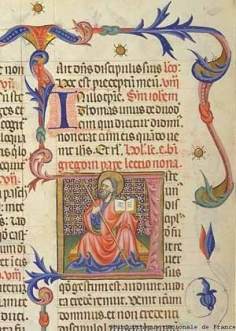 I’m slowly getting back in oscillationem rerum with Latin. The grammatical concepts are all more or less there, it’s just little things like, oh, vocabulary and the whole freakin’ verb system I have to cram back into my head. Optare, optavisse, optaturus esse, optari, optatus esse, optatum iri… if you see me on the elliptical machine at the gym looking like I’m having a very agitated conversation with myself, I’m reviewing Latin.
Fr. Stephen Freeman has an interesting look at the the word “fullness” and its implications within Orthodox Christianity. It is very much worth reading in its entirety, but a couple of points jump out at me:
Fullness means more than being correct. It is possible to be correct about something, and yet be empty and lifeless. Fullness is correct because it is a true reflection of God and not because it can be measured against the law or a set of rules (or the canons, etc.).
“It is possible to be correct about something, and yet be empty and lifeless.” So true as to not require any comment, only repetition.
Fullness implies a completeness.
The word Fr. Stephen is hinting at without saying is catholic–from κατά + ὅλον kata-holon, “according to the whole.” Catholicity, while a much-debated word, really boils down to the state of lacking nothing. The fullness of our faith, in other words, is where our catholicity is to be found–but this brings us to an irony:
I do know, and have said elsewhere, “Why would anyone want something less than the fullness of the faith?”
The irony here is that the very claim of “the fullness of the faith” is exactly what turns away some who I’ve known. Even if it’s true, so some have said to me, that shouldn’t be anything we care about if we are to preach only Christ, and Him crucified. If you think you’ve got the fullness of the faith, in other words, that’s proof that you don’t.
Isn’t epistemology fun?
Get Religion has a good post on political writers ignoring Roman Catholics. The last line sums it up well:
Yes, there is a longstanding antipathy between intellectuals devoted to the Enlightenment and Catholics devoted to Rome. Yet magazine writers wrote about Catholic voting trends. So why don’t political reporters?
I’m reminded of how in 2004, something of a big deal was made about how the Catholic vote was important enough to the Republicans that Bush paid a visit to the Knights of Columbus. I remember thinking to myself, “Do the Orthodox even have a comparable group for any of the political parties to snub?”
And, well–no, we don’t.
Not yet.
A series of events inspired this piece, which I wrote last fall and for which I presently find myself without a publisher. Enjoy.
—
A couple of years ago I was invited to a friend’s wedding across the country. It was somebody who I had known since the third grade, and it was important to me to be there. Nonetheless, I had a little bit of a scheduling issue of which I needed to make her aware: it was Easter on my church’s calendar.
“What do you mean?” she asked. “Easter is the month before.”
“Not for us.”
“Oh,” she said. “I understand—you’re pagan, right? It’s the solstice?”
“Er, no. I’m Orthodox,” I explained.
“I don’t even know what that is,” she said, “but as long as you’re there, that’s cool.”
The day of her wedding, I was lucky to be awake for the food, let alone the ceremony. Talking to the mother of the bride, I explained that I had been at church at four in the morning for an Easter service.
“How does that work?” She was clearly confused. “Wasn’t that a while ago?”
“Not for me,” I said. “I’m Orthodox.”
“Orthodox?” she asked. “Orthodox what? Jewish?”
Right, I thought. Because Easter is a Jewish holiday. “No,” I told her, “Orthodox Christian.” She stared at me. I might as well have been speaking Uyghur. “You know, like Greek Orthodox? Russian Orthodox?”
“Oh, I didn’t realize your wife was Greek! I guess she’s got dark hair—”
“She’s not. We converted.”
Mother of the Bride narrowed her eyes, started to say something, then changed her mind. “Well, I just hope that doesn’t mean you’re one of those fundamentalists the Republicans have sold out to,” she said, and moved on to the next guest.
Orthodoxy is a tough thing to explain to most Americans. It’s the world’s second largest discrete body of Christians after Roman Catholics, but it is largely unknown west of Greece. If people are aware of what it is at all, it is knowledge likely derived from passive contact—maybe they’ve been to an Arabic church festival and seen icons while munching on baklava. Possibly they’ve got a Russian friend who wears their wedding ring on their right hand. Maybe somebody’s been to a friend’s wedding or a baptism, and came away from the ceremony thinking that the whole thing felt weird and old. Beautiful, maybe, but still pretty alien and ancient compared to our own prefabricated, whitewashed, auditorium-style church culture.
Most likely, they saw My Big Fat Greek Wedding where that guy from Northern Exposure was baptized in a plastic kiddie pool.
What’s even tougher is trying to explain to your average White Anglo-Saxon Protestant, or whatever else they might be, that you’re Orthodox when your last name doesn’t end in “-opoulos” or “-evsky.” As with my friend’s mother, there’s often an assumption that there must be an external cultural force operating on you—you had to convert to get married, or your dad did, right? Or your grandparents had to change their names when they came to this country? Don’t you have to be born or get married into Orthodoxy, like Judaism? One or two people might have read something in Christianity Today about a group of a couple of thousand Evangelicals converting to Orthodoxy back in the 1980s—and also might have read something in the same magazine about a convert or two having buyer’s remorse sometime later.
As well, any sense of what Orthodox Christians actually believe is in all probability a bit murky. When I was involved in an Orthodox college ministry, we were often asked by people from other groups—“Do you guys believe in Jesus Christ?” Or, “Are the Orthodox saved?” There was one friend with whom I was discussing this who became visibly uncomfortable when he heard the words “Eastern Orthodox.” He stopped chewing his hashbrowns, squirmed a bit in his seat and said, “I’m not really sure what that even is.” Well, no. Most aren’t. I often get asked—it’s Roman Catholicism without the pope and in Greek instead of Latin? Something like that? More often than not, I know they just want the short version of the story, the bumper sticker rather than the divinity degree, so I smile, shrug, and say, “Something like that.” I’m bad at telling short versions in the first place, and any short version I come up with for this is going to make people more confused, not less.
Then there are the times where somebody seems genuinely interested in a real answer, and sometimes the outcome of providing that real answer surprises everybody. My wife and I were having Benjamin, a friend from school, over for dinner once when we were still getting to know him, and he asked about what we believed as Orthodox. I handed him a book called The Orthodox Church, written by Timothy Ware, a bishop and a much wiser man than I, saying, “Read this. He says it much better than I’ll ever be able to do.” Three years later, Benjamin is preparing to become a priest.
Truth be told, someone walking into an Orthodox church that’s been around for any length of time will quite possibly feel like they’ve happened upon an archaeological dig. There are icons, candles, and incense everywhere, the liturgy is chanted, the priests wear a lot of vestments and face the altar rather than the people, and so on.
Add to this that many perceive it as a “Greek thing” or a “Russian thing” or a “Lebanese thing” and just in general “not an American thing,” and even if you are successfully able to explain to somebody what Orthodoxy is, you’ve still got the uphill battle of justifying its relevance, how it fits in with a national understanding of Christianity shaped more by various opinions of Jerry Falwell than relative obscurities like the minutiae of the early Ecumenical Councils, and explaining why in the world an American in the twenty-first century with no direct ties to those cultures would care. Talk about feeling like a Jesus fish out of water. Maybe kiddie pools in ethnic-themed comedies are at least a place to start.
Even me—I’m a convert, so somebody had to explain it to me at some point in a way that made sense, right? That’s true. In a nutshell, I met somebody willing to give me a meaningful answer to the question “What is Orthodoxy?” at a time in my life when I was willing to listen to it. I didn’t convert immediately, but it was the right moment for me to start thinking about some things.
See, if I was raised anything, I was raised an Evangelical, but my dad is an atheist. He’s always asked me, “If Christianity’s the real deal, why can’t you all get your story straight?” It’s a legitimate question. Some estimate 26,000 Christian denominations, most of them mutually exclusive in terms of belief and teaching. The New Testament doesn’t make any mention of Methodists, Baptists, Episcopalians, Catholics, or—it can’t be denied—Orthodox. It speaks of “one Lord, one faith, one baptism,” and a faith “once delivered to the saints.” There was one Church, not thousands of denominations. What happened? Was it really just Martin Luther’s misadventure with a hammer?
Well, I reached a point in my lifelong journey as a Christian where I had to answer my dad’s question once and for all or lose my own faith. In reading Christian history, I found that this organic, single Church that emerged from apostolic times survived for quite a while. Where is it now? I wondered. Christ Himself said that the gates of hades would not prevail against His Church, and surely, if it still existed, as a professed Christian I would want to be part of it.
There was this friend of mine, Mark, who I knew to be Greek Orthodox. I had absolutely no idea what that meant except that he wore his wedding ring on his right hand and celebrated Easter on a different day. We got into a conversation one day where I found myself asking the question, “What is Orthodoxy?” I had to buy him dinner, but he was willing to give me a meaningful answer—basically telling the history from an Orthodox perspective, which I found answered my dad’s question and then some. It was a very compelling case indeed.
And after going our separate ways that evening, I completely forgot about it.
A little over a year later, there was an invitation from Tatiana, a Russian friend, to my wife and me to attend part of an Orthodox Easter service—just the food blessing, really. The priest looked like Rasputin with his long hair and beard and black robes, the Easter eggs were only one color—blood red—and everything was in Old Church Slavonic. I suddenly remembered everything my friend Mark had told me, and I found myself captivated.
The food blessing was in the social hall, and afterward Tatiana asked if we wanted to see the church. Yes, we said, of course. Walking into the church was very much the “archaeological dig” experience I mentioned earlier, and it put all of the pieces together for me—two thousand years of Christian history were brought to life at once. It was a sense of the presence of God I had never encountered before, and all I could do was light a candle and pray.
Then I promptly went back to the social hall and dropped sixty bucks at their book counter. And, while I’m not going to teach a catechism class right this second or go into the full blow-by-blow, two years later, we converted.
My conversion story isn’t really the point; all of this is just to say—people can and do convert to Eastern Orthodoxy. In fact, I did convert, and there were even good reasons why I wanted to do so. You most definitely do not have to be born into Orthodox Christianity or marry into it. (For that matter, you don’t with Judaism either.) I didn’t marry into a Greek family—my wife is Scotch-Slovak. It’s not likely my grandparents changed our name—Richard Raymond Barrett is about as post-Norman Invasion English as you can get, and there’s no possible permutation of it that could be made to sound Greek or Russian. (Barrettarides? Barrettaninoff? I don’t think so.) In the United States, a lot of converts don’t even go to Greek or Russian churches—they wind up in communities under the Church of Antioch (ethnically Lebanese and/or Syrian), which have made themselves very convert-friendly in the last two or three decades—to the point where a lot of ostensibly Arabic churches are made up mostly of converts.
We’re not exactly Roman Catholics with a Greek Mass and who don’t have a pope, but there are reasons why people might see it that way. We take the Nicene Creed very, very, verrrrrrry seriously, so yeah, it’s safe to say we believe in Jesus Christ. Are we saved? Sure, and that’s not all: we have been saved, we are being saved, and we will be saved.
But all of that, even, is just surface stuff. Orthodox Christian spirituality explicitly recasts the entire relationship with God in such a way that seems foreign to many Christian expressions prevalent in America. Rather than either an angry Divine Parent who needs to kill somebody in order to satisfy offended justice and who settles on His Son, or a disinterested Creator who really doesn’t care what we do (to name but two extremes), Orthodoxy Christianity presents the Church as a hospital to treat the diseases of sin and death to which human nature are subject. God, as the Orthodox understand Him, doesn’t need to punish anybody—rather, He seeks to heal everybody.
On the other hand, try explaining that “everybody” part to some Greeks, Russians, and Arabs. Sometimes, explaining to your Presbyterian next-door neighbor that you’re Orthodox is easier than convincing other Orthodox, particularly ones whose last names do end in “-opoulos” and “-evsky.” Plurality of religion in this country means that, for better or for worse, the different Christian communions compete with each other (not to mention everybody else) in a marketplace of ideas, and none of them co-terminate with a mythical, monolithic “American heritage,” much less the state; this can be hard to understand for a person whose religion does run parallel to their ethnicity. As a result, sometimes it feels like some of them have forgotten that even their own people were new converts, once upon a time.
A Ukrainian woman I worked with for awhile saw the three-bar crucifix I wear, a gift from my godfather when I converted. “Hey,” she said. “That’s an Orthodox cross. What are you doing wearing that?”
“I’m Orthodox.”
“I didn’t know you were Russian!”
“I’m not.”
“But you said you were Orthodox!”
“Right. I converted.”
She looked really confused, and pursed her lips. “How?” She swallowed. “Why? What would make you want to… to become part of that faith?” It was as if her mouth wouldn’t cooperate in saying the word “convert.”
“It’s a long story,” I said.
“You’ll have to tell it to me sometime,” she said. The chance never arose to tell her, as I quit and she moved out of state shortly thereafter.
Another time, a Greek gentleman with whom I was having a conversation noticed the crucifix. “You’re wearing an Orthodox cross,” he announced, perhaps thinking he was imparting new information. “Are you Russian?”
“No.”
“Are you Greek?”
“No.”
“Are you Orthodox?”
“Yes.”
He searched my face for a moment, trying to see if there was some chance I was putting him on. Finally he said, “Well, good for you,” and quickly changed conversation topics.
Doubt and curiosity aren’t always what I encounter; at one point I worked as a bank teller, and a Russian truck driver came through my line. “You’ve got an Orthodox cross on,” he said as I was processing his transaction. “It’s a lot like this one.” He pulled out his own from under his coat. Before I could say anything he asked, “Are you Orthodox?”
“Yes, sir, I am.”
“Did you convert?”
“Yes, sir, I did.”
“Why?”
As noted earlier, I’m terrible at short versions of stories, but sometimes time constraints, such as a line of customers looking increasingly impatient, force me to come up with something. The shortest and most factual sentence I could come up with was, “Because I came to the conclusion it was true.”
“Well, then.” He smiled at me. “Thank God!” He never once asked me what my heritage was.
My friend Anna was born in Athens and divided her time between America and Greece growing up. She was baptized and raised Orthodox, but by the time she started grad school, she wasn’t involved overly much. I met her at my home church during the last semester of her Masters in Library Science program, and watched her as she decided to take her faith seriously, seize it by the horns, and take ownership of it. When she went back to Greece after graduation, her dad gave her a hard time about going to an Arabic church in the States, but she hasn’t let that get her down. The truth is that by virtue of being Greek but rediscovering her faith among American converts, Anna straddles both worlds. She likes to call herself a “revert.”
It can get interesting sometimes for converts traveling abroad. Maggie, a dear friend of ours, spent a summer in Jerusalem once. She made a pilgrimage to the Church of the Holy Sepulchre, where some Orthodox at the door tried to chase her away—“Exo, exo,” they said in Greek (meaning “out”), making it plain that only Orthodox could be in there. She attempted to explain she was Orthodox, but they really didn’t get it—“You’re not Orthodox, you’re American,” they said. They were completely unaware of the phenomenon of American converts; after a little bit of back and forth they let her stay, but with distinct unease.
Last summer, my wife spent seven weeks in Germany, and found the Church of the Holy Spirit, a Greek church where she was staying. This summer she went on the same trip, and I got to spend the middle third of it with her, it being my very first time abroad. She took me to the Church of the Holy Spirit a couple of times, and all things considered, the service itself was not a much different experience from my usual Sunday morning. The Liturgy was entirely in Greek, including the homily, but that wasn’t really a problem; I’m familiar enough with the services by now that I knew where we were at, and I’ve had enough Greek that I was able to piece it together if I got confused.
Still, what was different were the people. Nobody said “Exo, exo” to us, but really nobody in the congregation said much of anything to us at all. The priest, Father Irodion, was a dear old man who was delighted that we were there, and seemed to have some understanding of why two non-Greek Americans would be seeking out their little church on the Rhineland. It also helped that they had a cantor who had been educated at an American seminary. Still, when we went up to receive Communion—of which only practicing Orthodox Christians may partake—body language and facial expressions of those around me suggested that a lot of them were thinking, What just happened here? At the coffee hour, we tried to introduce ourselves to a woman sitting right across the table from us. She said, “Nice to meet you,” and did not offer her name or say anything further.
It would have been easy to be frustrated or feel alienated, but I was prepared for it. Being ignored stuck in Megan’s craw, however, particularly since she had been there a number of times by now. “Well,” I said, “if you keep going, eventually somebody will make the adjustment and start talking to you of their own accord. Probably by the time that happens they’ll all already think of you as part of the family, you just won’t know it yet.”
I know from the conversations I’ve had with my own “Old Country” friends at church that sometimes they truthfully do not know what to say to us crazy American converts. It’s not a desire to be rude or push us away; in fact, they often don’t say anything because they’re afraid that they’ll come across as rude inadvertently. It’s a cultural miscommunication and nothing more—hardly anything malicious. Besides, the idea of faith and heritage being inextricably linked is hardly limited to the Orthodox; “Scandinavian” and “Lutheran” may no longer be as synonymous in the United States as they once were, but that’s just because they’ve been around longer and we’re used to it, not because it’s any less true. As someone with a lot of Danish on my mother’s side, believe me, I know.
A few days after my first time at the Church of the Holy Spirit, I took a brief trip to London. I happened to find myself at dinner one evening with three people who attended the Greek Orthodox cathedral in London. One gentleman was a native Englishman of Greek heritage, another man was a Greek native, and the third was his Romanian fiancée. They were some of the friendliest fellow Orthodox I have ever encountered, and while it was a surprise to them to run into an American convert, it wasn’t a stumbling block, and we had a lovely time. They insisted that I see the Cathedral during my stay, even though I wasn’t going to be around long enough for a service.
I got to the Cathedral with a bit of a difficulty—the Tube line that serviced that part of town was down that day, so I had to take a bus. Then, after walking up and down the street it was supposed to be on and not finding it, I stopped at a neighborhood library to see if they could give me directions. They had never heard of the place—making the Cathedral the first church I had been to in England where the immediate neighbors couldn’t give me an intimate history of every brick—but were able to print me off a map from the Internet. Once I found it, I was quite happy I did; it’s a beautiful church that was clearly built with a lot of care.
On my way out, a priest seemed to materialize—Father Nectarios, who I later found out had recently arrived from Greece. He was clearly confused by my presence, and asked in somewhat broken English if I was Russian; “No,” I explained, “I’m an American, but I’m Orthodox.”
He apologized for his English, but asked who my bishop was. “I’m under the Patriarch of Antioch,” I said.
“Antioch?” He looked more confused. “I don’t think I know what that is.”
“Patriarch Ignatius IV,” I said, hoping that that would make sense.
He thought about that for a moment, and then his face lit up. “Oh! Ig-nah-tee-os!” he exclaimed, pronouncing the name in Greek fashion. “Yes, we are the same. And you are Orthodox?”
“Yes, Father. My wife and I converted.”
“That’s wonderful! Congratulations and God bless you!” He motioned me back into the church. “Come, come.” I had a plane to catch, but I figured I could always catch the express train to Heathrow if it got too close to the wire.
Father Nectarios showed me around the church, explaining some of their history and distinctive features as best he could. Finally he said once again, “God bless you,” and disappeared as quickly as he had appeared. As it happened, I did take the express train, and then my flight was delayed an hour.
I’ve found that self-definition is tricky. It’s can be quite tough to explain what Orthodox Christianity is without having to define ourselves in terms of what it is not; we’re Catholic but not Roman, but not Roman while also being not Protestant. Confusing, isn’t it? Making it a “Greek thing” or a “Russian thing” is one way around that, but if you’re an American convert like me who doesn’t have a drop of Greek blood in his body, that doesn’t work and you have to rely on abstractions that are going to seem obscure to most people. Not only that, without ethnicity as a factor, some Orthodox aren’t going to understand, either.
The Sunday after I returned to the United States, I was back at my home church and Megan was once again at the Church of the Holy Spirit. Father Irodion asked if I had made it home safe. “I love that you Americans look for us when you’re so far away from home,” he said. “There are a lot of Greeks here I can’t convince to come.” Also, out of the blue, a woman named Tepi introduced herself—she was a Greek woman who grew up in Germany, and when she married a German man he converted. She translated a lot of the conversations going on at the table for Megan, and made her feel more at home.
This morning, my doctor noticed my cross. “That’s beautiful,” he said. “Is that an Orthodox cross?”
“Yes.”
“Did you get that while you were in Europe?”
“No, I’m Orthodox.”
“Oh,” he said. “Are you Russian?”
And it came to pass that Mary was enrolled with Joseph the old man in Bethlehem, since she was of the seed of David, and was great with the Lamb without seed. And when the time for delivery drew near, and they had no place in the village, the cave did appear to the Queen as a delightful palace. Verily, Christ shall be born, raising the likeness that fell of old.(Troparion from the Royal Hours of the Nativity, Byzantine rite)
A child is born to us, and a son is given to us, whose government is upon his shoulder; and his name will be called, the Angel of great counsel.
(Introit of the third Mass of Christmas Day, Roman rite)
Expect the media to bring up the usual historical “problems” with the Nativity account, according to Fr. Stephen Freeman, and don’t fret about it:
Literalism is a false means of interpretation (hermenuetic) and is a vain attempt to democratize the Holy writings. If they can be read on a literal level, then everyone has equal access to them and everybody has equal authority to interpret them. […] the seasons come and go and the media cannot resist speaking of what they do not know. And so they ask those who do not know to speak on their behalf. But if we would know Christ and the wonder of His incarnation, then we would do well to listen to those who have been appointed to speak and to hear them in the context given to us for listening – the liturgical life of the Church.
 In other news, blogging has been light the last couple of days because we’ve been madly scanning and shelving books. The Delicious Library and LibraryThing system has been fantastic, but most definitely less than perfect. One annoying thing is that even if Library of Congress data exists for a book, LibraryThing won’t always find it, requiring you to find it yourself on the Library of Congress website and enter it manually. For books that don’t have LC numbers, I’m not sure what I’m supposed to do; is there a way that one can divine what the number will eventually be?
What’s also frustrating is that LibraryThing is in theory able to identify new ISBNs when a list is uploaded and add only those, and it does this successfully in most cases, but there are somewhere around ten books that are always duplicated when I add a new list. This afternoon I eliminated somewhere around fifty dupes, in some cases there being seven entries for one book.
Another issue: I’ve entered 718 books into Delicious (representing probably roughly half of what we have), and I’ve exported the catalog to LibraryThing on a fairly regular basis. This afternoon, LibraryThing showed 756 books; after eliminating the duplicates, I’m down to 702 in LibraryThing with 8 ISBNs it can’t find (European books, I think). That means there are eight books Delicious is listing in its catalog that for some reason LibraryThing isn’t picking up.
Nonetheless, we’ve been able to accomplish in a weekend what would have surely taken us a month on our own, and that’s most certainly worth it.
Finally–any other Leopard users out there finding that with the latest update, searching for files within the File Upload dialog appears to be broken?
Merry Christmas to all!


 Leitourgeia kai Qurbana: Contra den Zeitgeist