Archive for the 'The Orthodox Faith' Category


Unabashedly not adhering to sola Scriptura – surely there’s another way to put that…

In a discussion with a Calvinist friend (and to be fair, I don’t know that he himself identifies as a Calvinist, but his church certainly identifies as “Reformed” with lots of appeals to Calvin) about something else recently, one of our points of disagreement on the issue at hand was determined to be rooted in doctrinal differences. In this case, it was a matter of whether or not the Gospel is principally a textual phenomenon. I said that it is not; the Gospel is Christ resurrected in the flesh, trampling down death and redeeming fallen Adam — that is, the Truth of our faith is a Person whom we know and with whom we have fellowship, not a set of texts we read. The texts are a way we know about Him, and a way He is proclaimed in the context of the worshipping body, but those texts aren’t the only way or even the principal way we know about Him or proclaim Him. My friend’s response was to say, you’re right, this is a doctrinal dispute that’s older than we are, but needless to say, I unabashedly adhere to sola Scriptura and believe Scripture teaches it.

A different conversation with an Orthodox person about a completely different matter also touched on the question of textuality, in this case whether or not liturgy, as understood by the Orthodox, is a chiefly textual experience. To this person, the answer was without question yes; everything in our services more or less expresses a set of texts, and anything that obscures those texts need to be reconsidered. My thoughts on the matter were that the Divine Liturgy is chiefly the celebration of the Eucharist — that is, communion with God — not a proclamation of text. While there are texts that are proclaimed, they are done so in the context of other sensory experiences — incense, icons, singing, movement, and so on. Yes, this person replied, but the celebration of the Eucharist is preceded by the parts of the service intended to prepare us to receive it, which means prayers that we’re supposed to say, and while we do adorn the texts with things like incense, those seem to have only become important as we’ve gotten away from understanding the Liturgy as textual. Part of my problem, as I told this person, is that sounds a little close to sola Scriptura for me; no, he replied, sola Scriptura is a doctrinal dispute between Protestants and Catholics that doesn’t have anything to do with us. Hm.

By contrast to both of those discussions, another friend was telling me about a paper he’s having to write for an ethics class. His professor is big on a threefold model of “doing, thinking, and knowing”, and evidently the model that gets used is that of romantic relationships — dating -> doing, engagement -> thinking, marriage -> knowing. So, my friend is looking at how this model might apply to textures of Byzantine chant. He’s arguing that things like psalm verses, refrains, petitions, liturgical dialogue, and so on constitute “doing”, stichera and troparia (to name a few) are “thinking”, and then the melismatic textures are “knowing”. He singled out kratemata and terirem (basically musical meditations on nonsense syllables) as, in this model, being the ultimate form of “knowing”, saying that if hesychasm is our ideal form of prayer, then these represent the musical equivalent. I was reminded of this passage from St. Augustine’s commentary on Ps. 100:

The one who sings a jubilus [qui iubilat] does not speak with words, but it is a certain sound of joy without words: it is the voice indeed of a soul exhilarated with joy, expressing to the extent possible love but not encompassing sentiment. A man rejoicing in his own exultation, after certain words which are not able to be spoken or understood, bursts forth into such a voice of exultation without words; so that it appears that he indeed rejoices with his own voice, but as though filled with too much joy, he is not able to express with words that in which he rejoices.

I’ll note that I’ve heard qui iubilat argued to mean “the one singing a jubilus” (that is, the melismatic ending to the Alleluia in the Mass); I’ve also heard it argued that this understanding must be anachronistic, and that is simply means “he who jubilates”. The former is what I was taught in music history, so I’ll stick with it for now. In any event, whatever qui iubilat means, this “sound of joy without words” seemed to be very much what my friend was getting at with the “knowing” part of the model.

Finally, I recently encountered this passage from a 1923 essay by Pavel Novgorodtsev titled “The Essence of the Russian Orthodox Consciousness”:

When… Protestant writers reproach the Orthodox Church for not developing sufficiently the practice of spiritual exhortation in its church services, for having little concern for the moral superiority of its flock, then here… misunderstanding continues. For the Protestant in his church service, between the bare walls of his temple, the chief thing is to listen well to the moralizing teaching, to do the expected psalm singing and prayers, which have as their goal the same moral concentration and self-purification. The chief thing here is human influence and personal introspection. On the contrary, for the Orthodox the main thing in the Church service is the action of divine grace on the believers, their communion with divine grace. Here it is not human influence that is determinate but divine action; the goal here is not simple moral education but mystical unity with God. The beneficent force of the Eucharist and liturgical religious rites, in which the grace of God mysteriously descends upon those who pray — this is the highest focus of the church services and prayerful exhortations. The cry of the holy servant [that is, the priest celebrating the Eucharist] “May the grace of our Lord Jesus Christ and the love of God the Father and the communion of the Holy Spirit be with you all” summons the gifts of divine grace on all present at the liturgy[.] (collected in A Revolution of the Spirit: Crisis of Value in Russia, 1890-1924, ed. Bernice Glatzer Rosenthal and Martha Bohachevsky-Chomiak)

How to put all of this together? To come back to the conversation with my Calvinist friend, I was really struck by how he described himself as “unabashedly” adhering to sola Scriptura. I’m pretty sure he didn’t mean this, but in thinking about it, it seemed that it could be understood as him thinking that the main reason one might not adhere to sola Scriptura is because they are “abashed” — that is, ashamed of Scripture. This would be suggested by something that he said, that we have to be willing to proclaim all the truth of Scripture — not just the easy, warm and fuzzy parts, but also the “gnarly” (his word) bits that are hard to reconcile with where the world is at right now.

In any event, I don’t adhere to sola Scriptura, and I unabashedly don’t adhere to sola Scriptura, but I don’t unabashedly not adhere to sola Scriptura because I’m ashamed of Scripture. Now, here’s the problem — how does one restate that positively?

The arguments about sola Scriptura are centuries old, and no blog post I could possibly write in between spurts of exam reading is going to resolve that dispute, so I’m not going to bother trying. Here are some things that I think I can say about the experience of an Orthodox Christian with respect to Scripture:

  • The principal experience of Scripture for an Orthodox Christian is hearing it proclaimed in the context of the worshipping body. That’s not to say that we don’t ever read it on our own, just that the normative way it is transmitted and received is that it is heard in the context of corporate worship. That includes the Epistle and Gospel readings in the Divine Liturgy, but it also includes Old Testament readings at Vespers, Gospel readings at Matins, and Psalms at every service. Another way to put this is that the Gospel, Epistles, Psalter, and Prophets are books written by the Church, organized and edited by the Church for the Church, and done so for the Church’s use. If this seems a bizarre way to think of the Bible, well, I refer you to Harold O. J. Brown, late of the faculty of Trinity Evangelical Divinity School, who noted once that “there is no way to make the New Testament older than the church” (“Proclamation and Preservation: The Necessity and Temptations of Church Traditions”, Reclaiming the Great Tradition,  Intervarsity Press, 1996).
  • (As a side note, I’ll say that somebody close to me recently bought an audiobook version of the Bible. “It’s really fascinating what you get out of it hearing it out loud rather than just reading it on your own,” this person said to me. “Have you ever heard it that way?” I gently suggested to this person that this is not exactly news in Orthodox circles.)
  • The hearing of Scripture in the context of the Liturgy is one of many elements in support of the celebration and reception of the Eucharist, the Body and Blood of Christ. The Eucharist is not in support or an expression of Scripture; it may be the Body and Blood of the incarnate Word, but that’s not the same thing as saying that it’s chiefly about words.
  • Scripture is not in conflict with Tradition. Scripture is the component of Tradition that has been passed down through the written witness of the Apostles, the Evangelists, and Prophets. We have knowledge of what Scripture is because the Church was able, by means of Tradition, to evaluate the various writings claiming status as Scripture.
  • The Truth that we proclaim is not a set of writings, but a Person. The Gospel is that the Christ, the Son of the Living God, having been crucified in the flesh, rose from the dead and trampled down death by means of death itself. Scripture is one of the ways that this is witnessed to and proclaimed, but it is neither the only way nor even the chief way. One of the chief ways, yes.
  • The Divine Liturgy, the celebration of the Eucharist, is itself not principally a textual experience. It is an experience of heaven on earth, communion with the Living God, a foretaste of the heavenly kingdom. There are many modalities of sensory experience that are used to present this image of heaven; hearing and sight are among them, but one hears many other things besides just the plain words of Scripture in the context of our worship, and while one may see things that invoke certain Scriptural images (there is a distinct relationship between what one sees going on at the altar and the description of heavenly worship in the Apocalypse of St. John, for example), one rarely sees the words of Scripture in a service as such (unless it is one’s liturgical function to proclaim Scripture). Sensory experience as a way of knowing God has a long Christian tradition; I refer the reader to Susan Ashbrook Harvey’s study of the sense of smell in the late antique Christian East, Scenting Salvation, as a place to start on this.
  • None of this is to discount, devalue, displace, diminish, disobey, marginalize, or minimize Scripture. No, indeed; the point is honor Scripture in its proper place — to “hold fast to the traditions received from [the Apostles], whether by [their] word or [their] epistle” (2 Thess 2:15), and to hold the high view of the Church that we are to have, as witnessed to by Scripture — that the Church is “the pillar and ground of the truth” (1 Tim 3:15).

As I said at the outset, my words — which sound an awful lot like a thousand other similar such things written by Orthodox Christians — aren’t going to resolve the long-held disagreements about this, so I’m not going to pretend they have any chance of doing so. The point is, what’s the positive thing that an Orthodox Christian can affirm so that we’re not just saying, “I don’t adhere to sola Scriptura“? Maybe ὅλη παράδοσις — “whole Tradition” (or “the whole of Holy Tradition”? Try saying that five times fast)? I guess it’s not found in Scripture in so many words, but it’s doing neither better nor worse than sola Scriptura on that front.

Let’s try that, then. I unabashedly adhere to ὅλη παράδοσις, Tradition in its fullness, and I believe that Scripture teaches it.
What does the term “educated class” actually mean?

In an exchange on Facebook yesterday where I outed myself as a godless commie pinko (I think that noise was Owen White blowing beer through his nose onto the library computer screen) because I think FOX is ridiculous in claiming that the Muppets are radical leftist propaganda, I mused that being part of the “educated class” (which, so we’re clear, I put in scare quotes and qualified by saying, “whatever that actually means”) seems to automatically place one to the left of most who publicly identify as “conservative”.

So what does the term “educated class” actually mean? About a year ago I was having a conversation with a friend about NPR as a source for news. I expressed appreciation for what seemed to be, on the whole, a lack of FOX News-style hyperbole; my friend said, “Well, it’s certainly the news outlet of choice for the educated class.” I’m sure that I had encountered the term “educated class” before, but not in a way struck me as being a discrete, identifiable category, and I’ve been chewing on it every so often over the past year.

Of course, in the past year, I’ve finished a Masters degree and completed doctoral coursework, so that makes me part of the so-called “educated class,” whatever that actually means, right…? I don’t know. Some initial poking into how the term actually gets used in public discourse turned up some not terribly conclusive references — it seems to be a term that neo-cons and moderates and “RINOs” use to pick cultural fights with each other more than anything. I’m half-tempted to see it as one of those terms like “moderate” where really it’s a label that allows for self-identification apart from distasteful extremes and is another way of saying “people like me”. It still seems, to me at least, that members of the “educated class” follow gut instinct as much as anybody else does, it’s just that we can back up our gut instinct with books you can’t find at Wal-Mart. Is that actually any better? I don’t know.

Since I’m not really sure whether or not to take it seriously, here is a half-serious/half-not look at what I think makes me part of the “educated class” (whatever that actually means):

  • I have multiple degrees and am still trying to get more.
  • I mostly hang out with people who have multiple degrees and/or are still working on more of them.
  • I am married to somebody with multiple degrees who is still working on more.
  • When I move (and remember I’m married to another academic), the single most expensive part of the move will be figuring out what to do with all of the books.
  • I belong to more academic societies than I will have degrees.
  • I assume that the people who write the books I read don’t make any money off of them.
  • I travel for conferences.
  • I actually attend conferences.
  • There are conferences for people in my field.
  • I have a “field”.
  • When I think of “conservatives” I think of people like David Gergen, Russell Kirk, and Rod Dreher. Names like Sarah Palin and Dick Cheney come to mind when I think of “angry and/or creepy white people”.
  • I get frustrated that what is presented as conservatism today seems to ignore its own intellectual history.
  • I think conservatism has an “intellectual history”.
  • I think there’s such a thing as “intellectual history”.
  • I think it’s weird that it’s spelled “conservatism” rather than “conservativism”.
  • I’d like to think that public discourse doesn’t have to be lowest common denominator in order to be effective.
  • I’ve read all of Ayn Rand’s major works (including some of her “non-fiction”) and I still think it’s not only intellectual garbage but bad literature.
  • I have to concede, with regret, that conservatives, at least in the last few decades, tend to produce lousy art.
  • I tend to agree with Paul Krugman that Newt Gingrich is a stupid person’s idea of what a smart person sounds like. I also think that tends to apply to Ayn Rand.
  • I think that “What do you read?” is a friendly, getting-to-know-you question. I’d love it if Katie Couric asked me that.
  • I’m weary of Republicans claiming that their willingness to eat their own is what separates them from the Democrats, when it is obvious to me that it isn’t true.
  • I’m aware that NPR isn’t free of bias but it’s nice to hear rational adults talking like rational adults, rather than watching either plastic people trying to buddy up to me over the anchor desk or angry white people yelling at me or each other about how a president who is to the right of Nixon on some points is a radical socialist.
  • I can tell you that Theodosius, not Constantine, made Christianity the official state religion of the Roman Empire.
  • Even as an Orthodox Christian, I don’t think that science is a secular conspiracy theory, and as such I think science has implications and consequences for my behavior and choices — much as Christianity does.
  • I actually want my hypothetical future kids to learn languages other than English.
  • I actually believe there’s a connection between what academics do and what happens in the real world.
  • I don’t see being articulate (read: “being able to string a coherent sentence together”) and being authentic as diametrically opposed qualities. I’m a both/and kind of guy.
  • When I’m given the opportunity to donate a book to a children’s group, I instinctively grab a single-volume copy of The Lord of the Rings and hope that it inspires some kid somewhere to think, to believe, to wonder, and maybe to be interested in the stuff that made Tolkien want to write the story in the first place.
  • To think, to believe, and to wonder are the things I learned to do best as a little kid and they’re what I’ve tried to figure out how to make a living at doing ever since.

That’s all I can think of for now. Yeah, it’s kinda SWPL-ish, isn’t it? Maybe that’s inescapable. I’d be curious for anybody to come up with their own list.

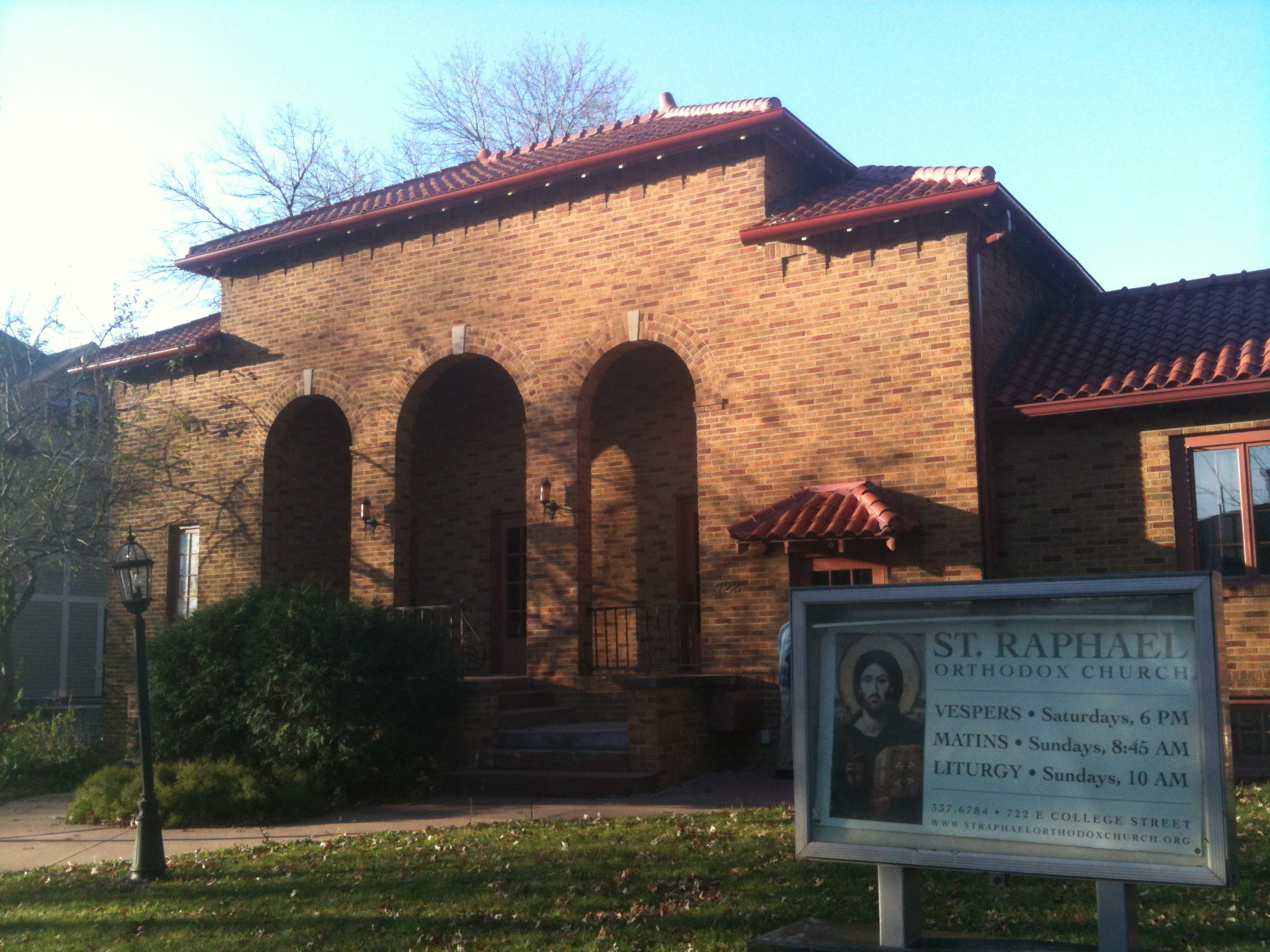
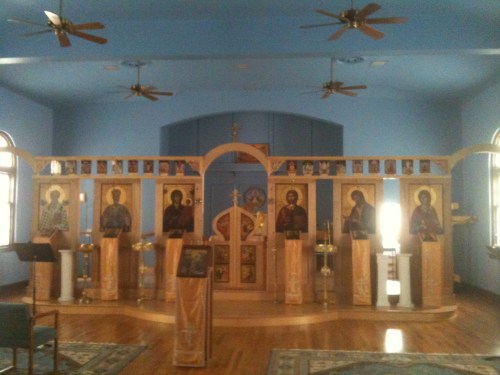
St. Raphael of Brooklyn, Iowa City — another lesson in Orthodox building repurposing

A couple of months ago, I wrote about getting to see St. Nicholas Orthodox Church in Oxford and the beautiful job they did renovating an old Anglican building. I also briefly mentioned St. Raphel of Brooklyn Orthodox Church in Iowa City as an example of similar work in America.

I have a number of personal ties to the Iowa City parish; Lori Branch, one of my predecessors as All Saints’ choir director, is there, as is Matthew Arndt, an old friend of mine going back to the seventh grade, and my good friend Paul Bauer spent some time there about eight or nine years ago when they were still in a storefront. I’ve been fortunate enough to have reason to visit there three times over the last year; once just to go and see my friends, another time to participate in fundraising concert they were putting on, and then just a couple of weeks ago to do something of an extended Byzantine chant advocacy session. (I’ve also gone a different way each trip; I drove the first time, flew the second, and this last go-round I went by train. Next time I think I’ll probably ride a horse.)

Anyway, in 2009, the parish was able to acquire a building that used to house a Christian Science congregation. It’s right in the center of downtown, maybe a five minute walk from the University of Iowa campus, so it’s very accessible to the people who actually live there. The shell of the structure on its own provides a number of great advantages; the nave is open and spacious, and the acoustics are wonderful. There’s an undercroft that’s perfect as a fellowship hall. What more or less functioned as the chancel with the original configuration has translated very nicely into the sanctuary. They’ve also done a pretty substantial remodeling of the interior, and they’ve done a number of things beautifully. The iconostasis and sanctuary are lovely, they’ve left a lot of space on the walls for frescoing when the time comes, they’ve put down hardwood with strategically located area rugs rather than covering every square inch of the floor with carpet (I mean, c’mon, who would do that anyway, right? Ahem…), and they’ve left the floor open, with benches around the perimeter and a handful of chairs. They probably won’t be able to put a dome on it in the long run, for both structural and municipal reasons, and the one thing they don’t have is a full kitchen, but they’re very well set otherwise. I have to say it was a real joy to be able to both sing and prattle on in their nave for the weekend — I was able to do something with them that I can’t do at my own parish, which was split them up into antiphonal choirs. There was more than enough room to set it up, and the acoustics are perfect for people to be able to hear each other (and themselves). (At All Saints, on the southeast side of the nave right next to the bishop’s throne, there’s a door leading out into the hallway that’s typically used as the main entrance into the church, for better or for worse. A right choir would block the door, which would tick some people off AND probably violate fire code. Hopefully we plan better for the permanent building.)

At the parish website, you can see much of the work that they had to go through to transform the building; as with the St. Nicholas situation, I think there’s a lot there to learn for parishes that wind up acquiring pre-existing structures (first off, start with something that was designed for a use not entirely dissimilar to Orthodox liturgy — i.e., not a bank if you can at all manage it). It’s not easy to do it right, but it seems to me to be very much worth doing well regardless!

Also as with the St. Nicholas situation, the parish very much had to take a leap of faith or five to take advantage of this opportunity; if you feel so inclined, I’d encourage you to make a contribution to their capital campaign as a show of support. Such things tend to come around when they go around, if you know what I mean. There doesn’t seem to be an electronic PayPal option, at least at this time, but I’m double-checking on that point.

Sander/Lapaev, As Far as the East is from the West now available

I said I’d post an update when this happened, and I’m probably a little late on doing so, but nonetheless, As Far as the East is from the West, featuring the choral music of Kurt Sander and Gennadiy Lapaev, is now available for purchase from several outlets, both as a CD and as a download. Buy early, buy often — it’s good stuff.

Is there any more militant “anti-” than an “ex-“?

Blogging has been light for much of the last year or so. This has been because I’ve been, well, busy. Flesh of My Flesh was in Germany on an academic exchange from the middle of September 2010 to the middle of August 2011, and trying to maintain a two-person household and lifestyle as one person, while also being a full-time grad student, while also having some level of teaching responsibilities for the first time, while also still being responsible for musical duties at All Saints, while also planning a big to-do last fall, while dealing with some personal issues that required a good amount of attention (to perhaps be told someday in another blog post), while also making a couple of semi-lengthy trips to Germany myself, meant that every last second of my time was spoken for, and I had absolutely nobody around to share the load or to delegate to in any meaningful or consistent way. Granted, there were lots of people around for much-appreciated moral support, but by and large I was on my own.

Another reason why it’s been light, however, is because there have been things going on in the circle of blogdom of which I am some kind of marginal member that have prompted the thought, “Maybe I should respond to that,” and ultimately I’ve chosen not to. I don’t like blogging pissing contests; to my mind they don’t resolve anything, they engender bad will, and tend to create (to say nothing of harden) battle lines. I’m at the point where I feel like there are some things that need to be said, however, and while I want to be frank, I also don’t want to pick a fight, so I’m going to keep things reasonably specific but nonetheless as abstract as I can make it. If you know what I’m talking about, then you know what I’m talking about; if you don’t, a Google search on some of the issues I raise should be reasonably fruitful.

Converting to Orthodox Christianity is a tricky business, perhaps a bit moreso than Roman Catholicism. I’ve heard it said that getting married isn’t just saying yes to one woman, it’s saying no to all the others, and that seems applicable here. There’s a way in which it seems to me that converting to Roman Catholicism is saying yes to one communion while at the same time construing all the others as being more or less part of yours, so you’re not really deciding against them in the same way. Choosing Orthodoxy, however, involves some more serious overtones of rejection, I think; when I converted, I told myself that in Orthodoxy Christianity I found fulfillment of many of the ideals I had as an Anglican, and that had also led me to read some Roman Catholic apologetics, but there was nonetheless a line, I was choosing a side, and the only for me to un-choose it was to be for all practical purposes an atheist. From people I’ve talked to, that kind of “double-or-nothing” mindset is fairly common, and for my part, I don’t know what the alternative is that isn’t converting for what amount to warm and squishy reasons.

If that’s the case, however, and you find, for one reason or another, that you can’t stay in Orthodoxy, then I suppose it’s not all that surprising that some do effectively become atheists who are nonetheless left with a particularly dogmatic approach to their atheism. There have been some rather public (as far as this niche of the blogging world goes) departures from Orthodox Christianity recently where this has happened, despite an initial assertion that they were going to a different communion, what they really appear to have embraced is an atheism that allows them to maintain a dogma about the things that they’ve decided they really care about. The irony, inevitable though perhaps it is, is that these were some of the more militantly Orthodox bloggers in their day; calling out bishops, parishes, and whomever for not being Orthodox enough, reading all the Right Theologians and so on, and certainly putting on a show of fighting the good fight. The militancy remains; only the Orthodoxy is gone, and the vacuum seems to have filled itself rather violently with other things — secular metanarratives of Marxist-style class struggle and revolution (highly ironic, since in one case I’m thinking of the person, while Orthodox, famously claimed to despise metanarrative) being one significant example, and their new “orthodoxy” tends be tinged by an ongoing and rather world-weary intellectual dismissal of the Christianity they’ve found wanting.

You know, I can respect that somebody for whom Orthodoxy “doesn’t take” is left without a lot of intellectually honest options that actually retain some veneer of Christianity. It strikes me nonetheless that there’s something far deeper going on here, and what it really seems to boil down to is an issue with people rather than an issue with the faith. How in the world can people like that be allowed in by anything less than crawling over broken glass covered with cow excrement, the reasoning seems to go, when I have this other category that tells me we should treat them as undesirables, if not outright enemies? Why should it be acceptable that the people who are becoming Orthodox are people I don’t like? Surely that’s a flaw in the faith itself. But even that, I think, is to overthink it — what it really boils down to is that, whatever song and dance we like to put on about catholicity, we want to go to church with people like ourselves. When we don’t find people like ourselves in sufficient critical mass, then we assume that it’s not for us. If this happens after we’ve already made a spiritual commitment, then the road out seems to be paved with bitterness and sour grapes. Smash the icons, burn the books, it wasn’t what I hoped it would be, so it must be all bad and full of pathological wackos.

Let’s be honest — for all the jawing converts like to do about “ethnic enclave” parishes, converts often tend to function as their own ethnicity. And, since most converts are white (note I said “most”, not all), and it’s socially unacceptable to claim to be a “white” church in the same way that a Greek/Russian/Arab church can claim to be a Greek/Russian/Arab church, the unifying factor tends to be cultural class, subsequently and quietly reinforced by race. Ethnic parishes, from what I’ve seen, tend to be more “catholic” in terms of class, because the ethnicity is able to explicitly function as the glue. Yes, fine, the Christian faith is supposed to be the glue, but for converts and for cradles it’s more complicated than that. We converts are choosing something that is on some level countercultural, and we want to know we’re not crazy, so we want to see the people like ourselves who make it work without it being contrived, some kind of a put-on. I have a dear friend who has expressed being self-conscious in a lot of parishes just by virtue of the fact that he has red hair, immediately and unmistakably marking him as somebody who doesn’t come from a traditionally Orthodox heritage. For cradles, they come from a background where being Orthodox is simply the default option, and there is nothing to reinforce that in a North American cultural context except ethnicity. One way or the other, whether you most strongly identify with class or heritage, if you go to church and don’t see people you can identify as being like yourself in your preferred category, you’re not going to feel comfortable. I suspect that no matter how much we want to talk about “catholicity”, that’s just the reality of being human. We can be taught to like the idea of cultural or ethnic pluralism, but in the ordering of our own lives, that’s not going to be a practical reality most of us will choose to embrace. Catholicity, I suspect, is an ideal to be supported on a macro-level; on the local level, most people will choose homogeneity. If pressed, I think some people would even go so far as to say that catholicity is great, as long as it doesn’t include those people.

The stones the “ex-“es who are now “anti-“s choose to throw I must take with a boulder of salt. Surely we all know that just because a monk says it doesn’t make it necessarily a) so b) universally applicable even if true. Surely we all know that someone being proclaimed as a saint doesn’t necessarily make them perfect or not subject to various historical circumstances and forces, and I would hope that the easy categorization of “the friend of my enemy is my enemy” is something most people would see as deeply problematic from a Christian standpoint, any Christian standpoint, no matter how much critical theory and class struggle-infused rhetoric one tries to throw at it. The recent assertion by one such person that “a mature Christianity is a nominal Christianity” and that Orthodoxy constitutes “the Byzantine slammer” must be rejected with frankness, yes, but also seen as part of what, I think, is best considered a grieving process. A mature Christianity might well perhaps be a humble Christianity, but by the same token, a mature secularism must also be a humble secularism.

To wrap this up for the moment — I heard it said while I was converting that the trouble with thinking your way into a religion is that it’s then no difficult task to think your way right out when your premises change. It’s perhaps particularly easy to do when one finds that the reality on the ground is harder than the marketing materials may have suggested. For those of us who haven’t fallen prey to this, thank God, but I’ve seen enough people leave for such a variety of reasons, some surprising and some not, that you just never know what’s going to challenge you next.

Review: Orthodoxy and Heterodoxy: Exploring Belief Systems Through The Lens of the Ancient Christian Faith, by Fr. Andrew Stephen Damick

First of all, in an ideal world, this would have gone up about three months ago. I had requested a review copy back at the beginning of May, and for one reason or another the copy wasn’t sent out until the beginning of August or thereabouts, which meant that I wasn’t actually in physical possession of the book until I got home from Oxford, and by that point it was off to the races for the start of the academic year. More about all of that elsewhere, however.

About six years ago or so, I was corresponding with a gentleman named Charles Carter. Charles was a Baptist who was something of a presence in Anglican online discussion groups, often as something of a gadfly. He was a strict five-point Calvinist (although I don’t know that he himself used that phrase), he had no patience for any kind of sacramental theology, and liked to say things like, “The Reformers had to whitewash the churches and tear out the organs in order to give them back to the people,” or recount how, growing up as a Baptist in the South, he “sincerely” wondered whether or not Catholics were Christians.

When Charles discovered that I was a former Episcopalian who had converted to Orthodox Christianity, he was perplexed to say the least. How was that the least bit justified? “Did you even consider the ‘Geneva option’?” he asked. One of his sticking points was the practice of so-called “closed Communion”, and he argued that any church organization that would exclude other Christians from partaking is demonstrating its lack of catholicity, not affirming it. (“If Jesus visited your Orthodox parish, would you let him take Communion?” was another one of his rhetorical questions. I pointed out that actually, Christ would serve as the celebrant, since he’s the high priest. He wasn’t impressed.) I suggested that this in the context of the historical self-understanding of the Orthodox and Catholics, Charles’ point of view imposed a definition of “catholicity” on them that didn’t take them on their own terms. Charles insisted that in contemporary times, no group that claims to be a Christian organization may presume to be “the Church,” but he acknowledged being largely ignorant of pre-Reformation history, and was open to hearing the historical argument that one might make.

I walked Charles through the history as I understood it, explained how I had resolved certain questions for myself, and also had him read the Florovsky essay “The Worshipping Church” for some background on the relationship between liturgy, ecclesiology, and catholicity, and for a while it seemed like we might be getting someplace. Still, he ultimately couldn’t get past his own presuppositions, and while he initially was quite taken with Florovsky, for example, his last word on it was, “It’s a compelling piece on its own terms, but I’m pretty sure I can disprove his whole argument from scripture.” As far as the historical argument went, he saw it in the end as question-begging (not illegitimate, I suppose, from a Protestant point of view), and our correspondence petered out when it became clear that the differences were insuperable. I’m not entirely sure what happened to him, although there was a commenter who called himself “Bubba” on Rod Dreher‘s old Crunchy Con blog who had an eerily similar temperament and set of pet issues when it came to Christians coming out of a sacramental tradition. I asked “Bubba” once if he was Charles, and he gave a strange, non-responsive answer that seemed to amount to, “Don’t call me that around here,” so I let it drop.

Today, if I were to find myself in a similar exchange, I would still have the person read Florovsky, but I would give him Fr. John McGuckin’s The Orthodox Church: An Introduction to its History, Doctrine, and Spiritual Culture for the history, and Fr. Andrew Stephen Damick’s Orthodoxy and Hetorodoxy: Exploring Belief Systems Through the Lens of the Ancient Christian Faith for a clear statement of how Orthodox Christianity sees itself in the midst of religious pluralism, be that Christian pluralism or non-Christian pluralism.

The project of Orthodoxy and Heterodoxy is to give the reader a clear picture of where Orthodox Christianity positions itself relative to other Christian groups, major and minor, as well as select few non-Christian so-called “world religions”. To this end, Fr. Andrew starts out with a clear statement that, yes, this book is going to deal with doctrine, it is going to do so with the core assumption that Orthodox Christianity teaches the right doctrine, and while all humility is intended to be employed, that’s going to involve saying where we think we’re right and others are wrong. In calling ourselves Orthodox, that presumes that differences constitute heresy and/or heterodoxy, and we’re going to use those words. Key distinctives of Orthodox doctrine are sketched out, and Fr. Andrew then walks the reader through a number of issues, historical and doctrinal, having to do with Roman Catholicism, the various historic Protestant groups (that is, the offshoots from the “magisterial” and “radical” Reformers), Revivalists, fringe groups, and so on.

There’s a very tricky space that the book is staking out from the first page; how do you accomplish the stated objective using the stated methodology without the book seeming like a non-stop polemic? It’s very easy to be tarred with the “anti-” brush just by pointing out where there is disagreement. Well, turns out that there is in fact a way to do it. Fr. Andrew’s approach is to discuss differences, yes, but to also always note agreement and similarities (where possible, at least), as well as points where there could be agreement, or at least similarity, should the other side clarify one or two things or move a little bit in some direction. In short, he calls a spade a spade, but he endeavors to do so to an extent where it acknowledges the positive as well as the negative. An example may be found in the conclusion to his chapter on Roman Catholicism:

…it is critical for Orthodox Christians to note that twentieth- and twenty-first-century Roman Catholicism has seen a number of developments bringing some theologians closer to Orthodoxy and others further away. There is much in the Ressourcement (French, “going back to the sources”) movement with its fresh emphasis on the Church Fathers that should encourage the Orthodox. At the same time, certain disturbing distortions occurred in some sectors of the Roman Catholic Church in the twentieth century, such as Liberation Theology, an attempt to wed church dogma with Marxist politics.

Because of these kinds of developments — as well as the ongoing problem of the gap between official Vatican teaching and what the average Roman Catholic personally believes or is taught from the pulpit — Orthodox believers should tread lightly in discussing theology with Roman Catholics. They may be closer to or further from Orthodoxy than what is officially taught by the Vatican. It is critical to discern what the person in front of you believes before launching into any sort of detailed refutation of Roman Catholic dogman and practice.

I also believe that much of modern Orthodox criticism of Roman Catholicism is based either on pre-twentieth-century models of Rome’s thought or simply on mischaracterizations and oversimplifications of its theology and practice. In my opinion, many of the Orthodox writers of our time have borrowed heavily from Protestant polemics against Rome, which are often based either in exaggerations of misunderstandings of Rome’s theology or are instead based on Protestant theology which is not consistent with Orthodoxy. Again, it is critical that we understand the theology of the person in front of us as well as our own (pp58-9).

Now, I have no doubt that somebody could jump all over him for a point or two here and there (I can think of one or two people who probably would not take kindly to his characterization of Liberation Theology as a “distortion”, for example, and I suspect that any positive assessment of Ressourcement would also raise the hackles of some others), but for my money there’s a lot to this approach to like. There is disagreement between Orthodoxy and Catholicism, but it is not monolithic; this is what’s good, this is what’s problematic, and we’re not exactly perfect in our own approaches to criticism, so let’s have some humility. That is more or less the tone of the whole book, and it is a welcome one.

That said, there are some things that come across more sharply than others. It is accurate to point out, as Fr. Andrew does, that since Orthodox Christianity sees the Church as the New Israel and God’s chosen people, present-day Israel and Judaism have no special status from an Orthodox perspective. It is also uncomfortable to read stated so matter-of-factly in so many words. Again, as noted earlier, pointing out disagreement seems to lend itself easily to accusations of prejudice in the current era. Nonetheless, Fr. Andrew both makes it abundantly clear that’s not where he’s coming from and extends the same notice of similarities and agreement that he does to every other religion discussed in the book.

Fr. Andrew’s writing style is clear and accessible, but it is also articulate enough that one never gets the sense that he is dumbing anything down. He says what he has to say, and explains what he thinks needs explaining, and the end result should be quite readable for the average person while still being sophisticated enough for the reader who perhaps might assume that the book is written for a fifth grade reading level. There are occasional moments where his lucid prose style is interrupted with a logical leap I couldn’t quite follow, but these are few and far between. He demonstrates a wide familiarity with source materials for other religions, and also a wider knowledge of Orthodox sources than I might have expected. His is perhaps the first “mainstream” book on Orthodox Christianity in the English language I’ve encountered that cites Fr. Seraphim Rose to support an argument, for example (and to my mind, that’s progress).

For me, there is only one truly awkward moment in the book, and I’ll be up front and say it’s probably a personal issue. It is when he invokes the Civil War in discussing the differing concepts of the episcopate between Roman Catholicism and Orthodoxy:

The vision of Church governance is not merely administrative but involves a theological outlook different from Orthodoxy’s collegial episcopacy. Students of American history will recognize a transition similar to the one in which centralized federal power won out in the Civil War against a looser federation of sovereign states. Just as Americans began thereafter to refer not to “these United Sates” but “the United Sates,” Roman Catholics who refer to the “the Church” most often have in mind the Vatican rather than a sense of the wholeness of the people of God (p35).

I will fully acknowledge that this quibble may well be my problem and my problem alone, but my godfather (himself the author of a book outlining the difference between Orthodox Christianity and Restorationist Christianity that would perhaps be a useful reference for Fr. Andrew in future editions) is a Southerner who refers to the Civil War as “the war of Northern aggression”, and Fr. Andrew is fairly outspoken publicly about his localist political views, so it is difficult for me to not see this carefully-worded paragraph as a moment where politics that are tangential to the topic are seeping through. It’s enough of a minor, subjective, and arguable point that I hesitate to even mention it, but I found myself reacting very strongly while reading it, so there we are.

If I have any suggestions for future editions or printings, consulting my godfather’s book for the chapter dealing with Campbell-Stone folks would be one; another would be to reconsider the subtitle. Last year I wrote a paper that used the word “lens”, much as this book’s subtitle does, to describe perspectives that shaped analysis (not the first time I’ve done so, mind), and the professor circled the word and wrote the comment, “In these troubled times, everybody is resorting to looking at things through lenses. It has become a cliché, so please find another way to phrase it.”

In sum, Fr. Andrew’s Orthodoxy and Heterodoxy is an articulate book that takes what could be treacherous subject matter and handles it with a lot of grace, authority, and humility. It strikes me as being a valuable resource for those who might have the responsibility of teaching adult catechism, as well as a worthwhile read for those non-Orthodox who want to get an adult-oriented, non-simplistic, reasonable take on just how much air there might be between Orthodoxy and their denomination. Recommended.

St. Nicholas Orthodox Church, Oxford, UK: or, how to remodel an existing church building

As I announced back in May, I got to spend the second week of August in Oxford, England for the 2011 Oxford Patristics Conference. It was a fantastic experience, and it will get its own blog post soon (I should be able to return to more regular postings now that Flesh of My Flesh is back from her year abroad). Something I’d like to bring to the attention of both of my devoted readers now, however, is the amazing work St. Nicholas Orthodox Church did on renovating an existing church building. We attended Vespers there the night before we flew back to the States and got to see it all with our own eyes. Let me tell you, this really should be, I think, the model for what to do when you’ve got an existing church building that you have to figure out how to retrofit. (I hasten to add that I do not mean to say that there aren’t good examples of this here in the States; St. Raphael of Brooklyn Orthodox Church in Iowa City comes to mind, and actually the two situations parallel each other to some degree, both in terms of circumstances, outcome, and ongoing efforts, so my present discussion of St. Nicholas is not meant by any means to suggest that it represents something that nobody in the States has done.)

You can read the story about St. Nicholas Church for yourself, how they acquired the building and everything they’ve had to do to it, right here. I can’t really add to any of that, except that from what Fr. Stephen Platt told me, there is a garage next door that used to be the church hall back in the building’s Anglican mission days; he hopes that once the renovation work on the temple is paid off, they can buy the garage and turn it back into the church’s hall.

My own observations are that the community has done a marvelous job of entering into this project with faith, and by doing so they acquired a building that was within short walking distance of many of the colleges — and it’s a lovely walk, too, on a footpath that takes you through a field and over water and so on — and is right smack dab in the middle of a residential area where there are people rather than being in the middle of nowhere. It’s a church that can actually be a visible witness to its neighborhood, and uniquely so, since the neighborhood has seen everything the parish has had to do to reclaim the building from being something of a severely under-utilized eyesore.

I will also note that they’ve made it a point to first and foremost treat the building as a place of worship, and they have prioritized their efforts accordingly. I am familiar with phased church building projects where the approach is, “Well, people come to church for services, but they stay for everything else a church does, so best to build something that one can get by in for worship and that maximizes the ability to do all of the ancillary things. Then you’ll grow faster and can build the temple down the road.” I humbly submit that this approach doesn’t really work, at least not from what I’ve seen. The Church is first and foremost a worshipping body, not a coffee-drinking body, and when you put what is supposed to be our first priority in second place so that the men’s group has somewhere to meet, I think people sense that. Worse, from what I’ve seen, the ways you have to rethink your liturgical practice in a setting you’ve built only for the bare minimum of accommodation have a nasty tendency to become permanent. This means that if the day ever comes where you get to build the permanent temple, you’re already wondering, “Well, why do we need [X component of ecclesiastical architecture] anyway, when it adds another $250k to the price and we’ve learned how to get along just fine without it in our existing space?” By contrast, St. Nicholas has prioritized the liturgical function of the building over secondary activities, and it shows with the care they’ve put into their furnishings. They’ve clearly been able to do a lot with what resources they have, and they’ve also shown a lot of forethought in leaving the walls white so that they can be frescoed later.

You can see all of my pictures of the church here. One more thing — as you can see from the PayPal button at the bottom of their page, they are still fundraising to pay off the five-year loan that allowed them to finance the building purchase in the first place. Whatever they can’t pay off in that timeframe (that is, by November 2013) will probably be converted to a standard bank loan, but obviously it’s a burden that it would be better to not have to carry for such a community, particularly if they hope to buy the hall in the future. I encourage anybody who is able to contribute something to this ongoing effort.

While the existence of two (well, three) Orthodox parishes in Oxford may have come out of difficulty (and I won’t elaborate; you can find the story elsewhere if you like, and I myself am not certain I understand everything), God seems to have turned it around for good. May it continue to be so!

Announcement: debut issue of Journal of American Orthodox Church History

The Society for Orthodox Christian History in the Americas (SOCHA) has published the first issue of its journal, the Journal of American Orthodox Church History. It looks like SOCHA has set this up as a peer-reviewed electronic journal (although I’m told that they are toying with the possibility of a print edition for academic libraries), with scholarly articles, source translations, and book reviews in each issue. It will be published annually on the Feast of the Dormition of the Mother God, 15 August. Issues are $10 apiece, which I would suggest is more than reasonable for an academic journal. The table of contents for the first issue, a summary of submission guidelines, and a brief statement of purpose for the Journal by SOCHA Executive Director Fr. Oliver Herbel, may be found here.

This seems like a great effort to support, both by buying issues as they come out, by citing articles that get published, and by submitting articles of publishable quality. I intend to do all three as I am able; please consider doing the same.

The Sander/Lapaev sessions, a year later

I got home from the Sacred Music Institute at the Antiochian Village on Sunday evening (which will be worthy of its own blog post eventually) to find six copies waiting for me of the CD that represents the fruits of the four days of recording on the Northern Kentucky University campus last August. As Far as the East is from the West is not yet available for purchase — that will probably be in September; keep an eye on this page for details, and I’ll certainly post an update when it happens — but all of us who sang have our copies, as well as a handful of extras to give away.

Since I’m on the recording, I don’t think I can ethically review it, but I will say that having listened to it, much as was the case when I drove home from the sessions, it’s a project of which I’m very grateful to have been a part. The recording sounds very much how I expected it to sound based on the sessions, and my only real disappointment is that the liner notes (written by one Sergey Furmanov) mention that the choir included “church musicians from parishes in New York, Chicago, Cleveland, San Francisco, Montreal, and Philadelphia,” but, alas, leaves off Bloomington. Oh well, you can’t have everything.

In any event, my sincere hope is that this CD helps to kindle a more general interest in both Kurt Sander’s and Gennady Lapaev’s music in this country, and one way or the other it is a document of some wonderful examples of current Orthodox liturgical music, as well as a reminder of treasured memories.

Help Cappella Romana record their concert in Greece!

So, Cappella Romana is singing not one, but two concerts in Greece in September — one at the 11th Annual Sacred Music Festival of Patmos, Greece, and at the 6th-century Church of 100 Doors, Paros. They are hoping to record the Paros concert, and they have set up a Kickstarter project to try to raise the funds quickly. They are a good chunk of the way there, but I encourage you to support them — this is a really exciting opportunity for them, and it would be a fantastic addition to their recorded library.


adventures in writing alexander lingas all saints bloomington all saints orthodox church american orthodox architecture american orthodox music american orthodoxy Antiochian Archdiocese Antiochian Orthodox Christian Archdiocese of North America Antiochians books byzantine chant cappella romana chant church architecture ecclesiastical chant ethnomusicologists ethnomusicology fellowship of ss. alban and sergius Greece Greek greek food greekness hazards of church music international travel tips ioannis arvanitis joe mckamey john michael boyer kurt sander Latin liturgical adventures liturgical architecture liturgical music liturgical texts and translation liturgy liturgy and life lycourgos angelopoulos medieval byzantine chant Metropolitan PHILIP militant americanist orthodoxy modern byzantine architecture modern greek music music as iconography my kids will latin and greek when they're newborns my kids will learn latin and greek when they're newborns orthodox architecture orthodox architecture is bloody expensive Orthodox choir schools Orthodox Ecclesiology orthodox outreach orthodox travel pascha at the singing school Patriarchate of Antioch Patriarch IGNATIUS IV Patriarch of Antioch publishing random acts of chant richard barrett in greece richard toensing rod dreher sacred music st. vlads st john of damascus society Syriac the Bishop MARK fan club the convert dilemma the dark knight The Episcopacy The Episcopate the only good language is a dead language this american church life travel we need more american saints why do we need beautiful music in churches?

Blog Stats

  • 269,312 hits

Flickr Photos