 December is here. This means any number of things. It means NaNoWriMo is over, it means the semester is almost over, it means West European Studies will hopefully get back to me soon one way or the other, it means we’re hip-deep in the Nativity Fast with the Christmas feast fast approaching, and it means we just got back from a much-needed, if shorter than ideal, vacation over the Thanksgiving break. It also means that a week from today, this blog will be a year old. Sheesh.
There were no natural disasters; I simply did not finish Pascha at the Singing School last week. Between preparing to go on the trip, going on the trip, and Megan getting sick the night before heading out for the trip, it just didn’t happen. I wrote most of Thanksgiving Day, got about 2,000 words into the ending, and I am within spitting distance, I just didn’t get there. My hope is that this weekend I’ll be able to make one last push to finish a first draft. I wrote approximately 11,442 words during November for an average of 381 words a day; not a stunning average by any means, but at least it’s an average, and the bottom line is that it was a busy month without NaNoWriMo. I am on the whole pleased that the event broke me out of the gridlock that had kept me stuck since probably April or May, now I just have to keep myself honest. Next year I might have another project for NaNoWriMo; we’ll see. There is something I’d very much like to write, but this would probably be much longer than 50,000 words, and it would require a lot of skill as a writer I’m not sure I have at this stage of the game. Maybe I’ll be brave enough to give it a shot, and maybe I won’t.
 The Thanksgiving break spent in Nashville was fantastic, and a very welcome getaway for us Barrettses. Check out pictures here. As noted, the Daisy Hill Bed and Breakfast (pictured at right με γυναίκα μου) comes heartily recommended by us; do consider them if you’re looking for a place to stay in the area.
Friday we had lunch at The Pancake Pantry with our friend Chelsea; it’s an experience worth having and the food is good, but if you don’t like lines and prefer a quieter dining experience, it probably won’t be your thing. We also saw  the replica of the Parthenon, which is impressive, but I gotta say, it loses something being made from poured concrete rather than marble.
Country music is decidedly not my thing, but I nonetheless have to admit that the Country Music Hall of Fame and Museum is a fascinating place to visit. Short version is that it is organized chronologically; you start at the third floor with early folk and gospel and work your way down, and you’re at the present day by the end of the second floor. I find that I am able to relate to and enjoy the early stuff a lot more than the music of the last 30-40 years; it seems to me there came a point where the musicians became very self-conscious and their music subsequently sounds, at least to me, extraordinarily contrived and false. The closer the connection to an actual folk tradition, the more genuine it sounds to my ears — to put it another way, somewhere along the way the musicians decide, “We’re going to play it and sing it this way because that’s what country music sounds like,” whereas before the mindset was perhaps more akin to, “Country music sounds like this because that’s how we play it and sing it.” As a result, at least to me (let me re-emphasize that this is subjective opinion) performers like Garth Brooks sound 100% calculated and processed, with everything intended to support a synthetic sound and persona. None of this is to say that musical forms can’t be codified or that something is inherently lost once there’s a formal idiom or tradition to which one adheres; that’s certainly what most classical is, and it’s definitely what liturgical music generally is. On the other hand, for a genre which — rather arrogantly, I find — claims to be “three chords and the truth”, it seems disingenuous to me that this would become prescriptive rather than descriptive. To quote the much underappreciated movie Singles, “You have an act, and not having an act is your act.” Good music is good music regardless of genre, but poseurs also transcend genre.
 Anyway, back to the museum. There were a number of clever uses of speakers and acoustic tiles to create very localized sound exhibits, which in and of itself was interesting to see and hear. One of the things to which I found myself drawn was the archive section being visible in the center of the gallery behind glass; you can see all of their compact shelving, their sound editing stations, everything. It’s actually a useful reminder that the museum isn’t just a tourist attraction; it’s also a professional and scholarly resource. The stuff we see as the general public is really the tip of the iceberg at best.
But then, Elvis’ gold piano is pretty cool, too.

 It would have been foolish to visit Nashville without hearing any live music, and we decided to go to a club called The Station Inn to hear The Roland White Band. Roland White is a bluegrass mandolin player who has been there, played that. He’s got a lot of institutional memory, as it were; he knows every song, knows who wrote it and when, and has probably taught somebody how to play it. He also has surrounded himself with a lot of absolutely fantastic younger musicians, most notably David Crow on the fiddle and Richard Bailey on the banjo. His bass player was
  also really good; tall, skinny younger guy named Andy, but I didn’t catch the last name. If anybody knows his last name, I’d love to know and find out what else he does. It was a show that was a lot of fun to see, and I plan on seeking out one of David Crow’s solo recordings. The Station Inn is also a neat little venue; it’s a dive that has Bud and hot nacho cheese sauce on tap and not much else, but it’s a dive with a long history, and best of all, it’s smoke-free!
 On Saturday, we went to Andante Day Spa for much-needed and long-awaited massages, as well as an aromatherapy sauna. If you’re looking for something nice to do with a spouse or even just by yourself, these guys are very classy and quite reasonable for the services. We left there probably more relaxed than we’ve been in a looooooooooong time. Ramona is who did my massage, and I’d go back in a heartbeat.
After massages, we tried to go to Alektor Cafe and Books, the Orthodox bookshop in Nashville, but alas, they were closed unannounced. Perhaps this is not surprising.
Next we spent a couple of hours at the Frist Center for the Visual Arts, seeing their Rodin exhibit as well as their photography and film exhibit. Both were interesting; I’d say I liked the latter more. I don’t really have the vocabulary to discuss sculpture (or much else, let’s be honest) intelligently; let’s just say that to my eyes, Rodin goes beyond glorification of the human body and into the realm of fetishization, and leave it at that for now. The photography exhibit included a section on Moroccan photographer Lalla Essaydi, and that was captivating. She does a lot with Arabic calligraphy on the body as well as on everything else; it was interesting to me for several reasons, and I may talk a bit more about it later.
 Vespers, to say nothing of Matins and Divine Liturgy on Sunday, at Holy Trinity was something else; it’s a beautiful church, they’ve got a large number of psaltes who know what they’redoing (three of them evidently having studied wtih Lycourgos Angelopoulos) and as a result they’re able to utilize a traditional two-choir setup, they’ve got a very broad

demographic and economic base while keeping their practice pretty unapologetically Byzantine, people were nice, and Fr. Gregory is a young convert priest who seems very enthusiastic. Every parish has its problems, to be sure, but these guys seem to have a lot of very good things going on.
 After Vespers Saturday we had dinner at a delicatessen called, appropriately enough, Noshville; the food was plenty good, but it was also on the expensive side for what it was — my one complaint. To put it another way, it was authentic New York delicatessen in every way, including price.
 Another bit of a walk through Lower Broadway followed, as did some rain. We saw Ryman Auditorium, and we also found something neat for which we weren’t looking was a life-sized statue of Chet Atkins; Megan decided to play air guitar next to him.

 We relocated to Tāyst for drinks and dessert; Tāyst is a restaurant with similar goals to those of FARMBloomington, but I’d say with significantly less of a gimmick quotient and without the self-consciousness. They have a terrific bartender, and wonderful desserts — next time we’ll actually try a meal.
Sunday was something of a demonstration that there are no accidents; we had loaded up the car before going to Holy Trinity and intended to just hit the road after Liturgy. Halfway through Liturgy I realized we had forgotten our large bag of Maggiano’s leftovers at the bed and breakfast, which necessitated a return trip to get them. It being 1pm or

so by this point, we needed to eat something as well; being right in the neighborhood, we decided to return to the Pancake Pantry. While in line, we were chatting about the morning at Holy Trinity, when the two gentlemen, clearly a father and son, turned around to us and said, “Orthodox Christians?” Turned out the son was also Orthodox. We ended up eating breakfast with them and having an awful lot to talk about; it doesn’t seem impossible that we could have met somehow one way or the other — it is a small world when one is Orthodox, after all — but given attendance at different parishes that morning, it was one of things where the odds of running into each other randomly were infinitesimal. Had we not forgotten the food at the bed and breakfast, we would have had no reason to return to that part of town, and it certainly wouldn’t have occurred to us to go the Pancake Pantry again. As I said, there are no accidents, we know some of the same people (although not the ones I would have expected) and hopefully we’ll keep in touch. He’s going to be attending Cambridge University (yes, that Cambridge) next fall for the Institute for Orthodox Christian Studies, and I’ll be very interested to hear about his work.
And with that, we were back on I-65 heading northbound. We had a ball in Nashville, we hope to go back at some point, and we were really happy with where we stayed and what we did. It was a much-need and much-appreciated getaway for us, and hopefully it won’t be another five and a half years before we get to do something like that again. I will say that I wasn’t thrilled to go back to work yesterday, but I also wasn’t exhausted from the vacation as I have often been on little whirlwind trips, so maybe we did something right in that regard.
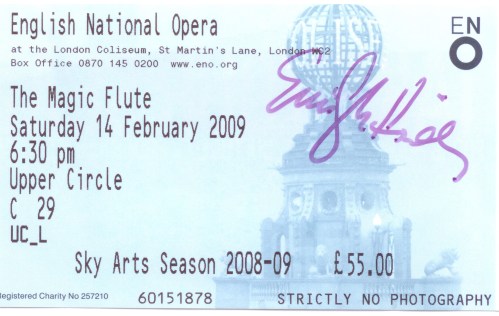 Word to the wise: programs are £4 apiece at ENO, and cash only.
 Following the show, Megan, I, Frank, Emily, and Ayla, an old schoolfriend of hers, and her boyfriend went to a bar called The Marquis for a drink. (“I’d like a Booker’s Manhattan and some nachos.” “I’m sorry sir, but we aren’t serving cocktails or food any longer this evening.” “So what can I order?” “Beer.”) Just about the entire cast and the conductor were there, too. You know, in high school, we went to Denny’s after shows for coffee and cheesesticks. In Seattle, a place called McMenamin’s provided the post-performance libation and nourishment. It’s nice to know that, even amongst seasoned professionals at a very high professional level in a different country, the initial impulse after a performance is to go out and drink something bad for you.
 One nice thing about listening to
  A brand-new recording is
  As may sometimes have been clear, 2008 wasn’t exactly a hoot and a holler and a gaggle of memories I’d love to relive. Exhaustive detail on all the reasons why wouldn’t be at all appropriate, let alone interesting, in many cases; therefore, instead of a lengthy retrospective, I decided to see if I could go month-by-month and write descriptive three-word phrases. Here’s what I came up with:
 Christ is born! Glorify Him!
 Goose, as it turns out, is on the expensive side. Being married to me has evidently done horrible things to Megan’s math, and/or her approach to thinking about food, and when she was asked how many people she was feeding when she ordered the goose, she added one plus one (her and me), and came up with the number seven. The resulting ten pound goose was, as you can see, not cheap. Ah well — if it had turned out terribly, it would have been a tragedy. As it is, we’re just fine with a few days’ worth of leftovers.
 I mentioned earlier the matter of brining the goose. This involved cleaning the bird and soaking it overnight in five gallons of water with lots of salt, sugar, peppercorns, bay leaves, cardamom, and so on. The exact recipe may be found
  I think we finally rolled out of bed around 10:30am on Christmas morning. We opened presents — some festal icons for us, a couple of reference works Megan wanted, and then for me home coffee roasting supplies — and then what I was really waiting for: eggs benedict from scratch, with biscuits made from the
 buttermilk that Megan’s butter-making efforts from a couple of days before had yielded.
 the fat can drain out while the bird is cooking, and then you have to be immensely careful when pulling it in and out of the oven lest all of the drippings splash over the side of the roasting pan. The plus of this is that goose fat is supposed to make fantastic mashed potatoes.
 We followed
  Anyway, one way or the other, the fowl was not foul in the least. My impression of how goose tastes is that it’s similar to roast beef as well as good dark meat on a turkey. We also had mashed potatoes, collard greens, and spinach, served with a very nice Lebanese red wine. Dessert was homemade pound cake.


 Leitourgeia kai Qurbana: Contra den Zeitgeist