Archive for the 'music' Category


(hack) Thanksgiving leftovers (koff)

It’s the first day of December. How the heck did that happen?

On the way out to New Mexico last week, I sat between a married couple who were both sick and kept coughing across me. It was Southwest Airlines, so seating was first come first serve, and they made it clear they would rather have me in the crossfire than give up either an aisle or a window seat. It must have been clear how this came across, because as we were getting off the plane, the wife said to me, “Don’t worry, you won’t catch anything from us — we’ve had this for the last four weeks.”

My stepfather was sick when I got to New Mexico. Flesh of My Flesh was sick on Thanksgiving day. My mom was getting sick over the weekend as we were preparing to leave.

So, perhaps it was inevitable, but Sunday evening I started developing a sore throat on the flight home, yesterday it was getting worse, and today I’m staying home trying to keep from getting worse or giving it to lots of people. I hate to be “that guy” who suspiciously gets sick immediately following a break, but here we are.

As I drink my gallon of Throat Coat tea, there are a few things upon which to muse:

  • My review copy of Cappella Romana’s recording of the Michaelides Divine Liturgy arrived in my absence, as did the Ensemble Organum disc I mentioned earlier. A full review will come shortly; for the moment, I will say only that both are worth your time and represent, in an odd way, flip sides of the same coin.
  • If you do iTunes, Lycourgos Angelopoulos’ 1993 album of Byzantine hymnody for Christmas has been rereleased in that format. It has been out of print for years as an actual disc, although there seem to be some used copies on Amazon. (Note that the iTunes release has a slightly different title: The Glory of Byzantium: Christmas Hymns.)
  • Rod Dreher is leaving the Dallas Morning News to become director of publications for the John Templeton Foundation. Close to four years ago, I started hearing various grumpy old men murmuring about “crunchy cons”. My godson Lucas at some point started reading the book and recommended I read it. It resonated quite a bit with me as somebody who looks more to Russell Kirk than Glenn Beck or Sarah Palin as a model of what conservatism should look like, and the point of the book seemed to me to be to ask how conservatives might, y’know, actually conserve something other than money or power or status. I gave copies of it to a lot of people, and I’m reasonably sure I know everybody in Bloomington who has read it (I’ll let you decide if I’m joking). I’ll fess up that, while a lot of Dreher’s critics had no patience for how he discussed food, I really appreciated what he had to say about a sacramental approach to it, and even if Michael Pollan isn’t using the word “sacramental”, his work and Dreher’s demonstrate that it can be a topic where liberals and conservatives can make common cause (and of course, Dreher interviewed Pollan for The American Conservative last year). Since the book came out, it has seemed as though he was searching unsuccessfully for a way to follow up what should have served as a strong statement of purpose; what he touted as a “sensibility” never quite materialized as a movement, exactly, eventually Crunchy Cons went out of print, and the hinted-at sequel about “the Benedict Option” never materialized, presumably because (as he kept saying in his blog) his newspaper job had become an exercise in self-preservation. A lot of water has flowed under the bridge in the last four years; Dreher converted to Orthodox Christianity, and right now conservatism seems to be floundering on the very cultural essentials the importance of which he was trying to stress, consequently lurching even more towards negativity and hostility. My hope is that a break from political commentary will allow Dreher to follow up on the issues discussed in Crunchy Cons from a more purely cultural perspective, because I think that’s where his heart has wanted to go with it anyway.
  • There was an interesting article in the New York Times this last Sunday about the traditional Latin Mass. Even more interesting has been the discussion of it in places like The New Liturgical Movement and Commonweal. I’m really not sure what a “liturgist” is — a liturgical scholar? a liturgical composer? a person who interprets rubrics? — but what I find striking is how for many modern Catholics, it seems like the rupture from tradition is in fact a selling point. I was in a large, old stone Catholic church once where they were doing a lot of work to restore the interior. The high altar was still in place, and I asked somebody if it ever got used; the person I asked looked highly offended that I would even dare to mention the high altar’s existence, and said, “No, Vatican II turned the altars around and returned the focus of the Mass to the people,” and made it clear that was the end of the conversation. Sometimes it seems like the majority of Westerners truly and actively yearn for their worship to be sentimental, banal, and tacky. At any rate, I don’t have a dog in this fight (except insofar as I strongly disagree with certain parties who think Orthodoxy needs its own Vatican II), but it seems to me that the traditionalist and modernist narratives are irreconcilable, as the comments on Wolfe’s article indicate. What I will say is that the invocation by a commenter at Commonweal of C. S. Lewis (“The modern habit of doing ceremonial things unceremoniously is no proof of humility; rather it proves the offender’s inability to forget himself in the rite, and his readiness to spoil for every one else the proper pleasure of ritual”) seems quite apt, and the apparent need, not just for the 1970 Missal to be embraced but for anything that ever came before it to be wiped from the face of the earth, is very telling — at least to me. At the risk of elevating aesthetics over all other concerns, I’ll point out that the Mass of St. Gregory inspired people like Josquin and Palestrina; the kinds of composers the Novus Ordo appears to have inspired are, shall we say, not even close.

Okay. I need more tea.

New release from Cappella Romana: The Divine Liturgy by Peter Michaelides

I don’t have my review copy yet (it is on the way), but be aware that this is now available; I’m looking forward to giving it a listen.

(UPDATE, 25 Nov. 8:53am MST: The sound samples the “Post to WordPress” button on my toolbar picked up were for the Toensing Kontakion of the Nativity, not the Michaelides. I think I’ve fixed this. I also added a link to the Cappella Romana site so that people can, y’know, actually buy it. Dangers of blogging when still tired from travelling…)

Vodpod videos no longer available.
more about “Cappella Romana“, posted with vodpod


This sounds familiar somehow…

Ensemble Organum, singing the Introit for the Midnight Mass of Christmas Day, “Dominus dixit ad me” (Ps. 2:7,1). From the recording Chant de l’Eglise de Rome (VIe – XIIIe Siècles). Old Roman Chant (perhaps c. 6th century) from an 11th century manuscript. (Consider my hat tipped to The New Liturgical Movement.)

Vodpod videos no longer available.

more about “This sounds familiar somehow…“, posted with vodpod


Liturgical question…

So, All Saints has historically just sung the Great Doxology in Tone 6 (that’s “Second Plagal Mode” for those of you out there who speak Byz) since time immemorial, and I am starting the long, slow process of incorporating the other seven modes into our liturgical practice. My understanding has always been that it goes with the Resurrectional mode of the week (an understanding reinforced by the OrthodoxWiki entry for the Great Doxology, which is clearly a critical source of no small import), but looking at the AOCNA liturgical guide (online, printed, and L.A. diocese version) it appears that they have it going with the Eothinon (hence being in Tone 5 this week rather than Tone 7). Looking at the Liturgikon, the “Five Pounder” (Divine Prayers and Services, Nassar), and the Antiochian little red service book, a rubric is not provided that resolves the question; in the Kazan Byzantine Project Matins book, the table of contents indicates that the Great Doxology is sung in the “tone of the day” but then the rubric in the music itself has it going with the Eothinon (first Eothinon, Tone 1, second Eothinon, Tone 2, etc.).

Can anybody clear up for me what’s happening here?

Alternate universes

I agree with every word of this article. On the other hand, it is so divorced from the reality I experience as a church musician that it may as well be Un Chien Andalou. Even in the comments thread, where it is suggested that $75,000/year is not a realistic number for some parishes and $5,000 might be closer to what would be doable, I have to shake my head and say, “That’s just not the world in which I live.”

I had an e-mail correspondence a few weeks ago with somebody who is very active in the world of Orthodox sacred music. He was responding to my article on choir schools, and while he thought that I had said all the right things to the extent of stating what should be obvious, and there’s no harm in trying to start a conversation, the blunt reality is that apathy and inertia have dominated musical practice in American parishes, and that we’re so far away from what the historical models look like that it’s probably not going to be terribly productive to talk about how things “should” or even “could” be:

Even those examples that you cite in your article are few and far between, no doubt the result of one extraordinary individual’s vision and focused effort. The reality must be “met,” so to speak, on its own, current level. Most parishes don’t even understand the need to hire well-qualified, educated professionals to lead the singing at worship (as they do, for example, in hiring a plumber or an electrician), so most of our churches are filled with well-meaning, dedicated church singers who don’t even know what it is they don’t know. How does one begin to address that?

That’s a great question, that is. How does one begin to address that? I’ve mused about some of this before, but how does one develop a vision in such a way that it can be articulated to others and have them understand, when we’re talking about an overall state of reality in which as soon as you say the words “professionally trained and paid cantor/choir director” (and notice that the correspondent here can’t even bring himself to use the words “choir director”, presumably because even that is to assume something that isn’t the reality at many parishes) you’re likely to encounter blank stares, if not outright hostility?

At least when it’s a blank stare, often it is informed by the plain reality that, minus a state-funded church, we have the level of Orthodox practice and expression for which we’re willing to pay. Traditional Christianity in its various expressions isn’t exactly populated by people who are rolling in dough, folks, at least not in this country; in the publication world, AGAIN has found this out the hard way, and Touchstone appears to be in the process of facing this reality. My own stipend as cantor and choir director is undeniably tiny, far less than what section leaders and soloists get at the Protestant churches up the street when they’re singing significantly less than I do on a weekly basis, but it’s still a burden for the parish. I’ve told the priest and the parish council chair any number of times that it is not about the money for me, not by any means, but I do think it’s important that the community understand that there is a value attached to what somebody like me does. We wouldn’t expect to get icons, architecture, vestments, or incense for free, but there is a mindset out there that assumes musicians are going to understand that providing for their services is something that just cannot be a priority right now, which usually means “not ever.” (Which is roughly where we’re at with being able to improve the acoustics in our nave, unfortunately.)

At the other end of the spectrum from the blank stare is the outright hostility. These are the people who would tell you that we don’t need “professionals” at our church, thank you very much, who also conveniently never come to rehearsal or are willing to put any time into learning to read music, who say that it’s far more important for the Liturgy to be prayerful than well-sung (a false dichotomy which I have always found bizarre and self-serving), and they’d rather have the whole congregation singing together in a different key per worshipper than have the Liturgy sung by the Metropolitan Opera Chorus. Among other issues, this is somebody who doesn’t understand that there is precious little difference between those two scenarios.

(Ba-DUM-pum.)

This is perhaps one area (of several) where the criticism that America is, at its core, “culturally Protestant” manifests itself unmistakeably. As I’ve said before, we would never tell an iconographer or an architect or a vestment maker that they’re too good at what they do to be able to do it in its fullness in the service of the Church, but many people seem very comfortable telling musicians exactly this (and that’s hardly limited to Orthodox Christianity, in all fairness — it seems to be an American thing in general). We pay lip service to “receiving the tradition,” but we can’t resist putting our own populist, Main Street Baptist Church spin on it, cutting ourselves off from a lot of the good things that we would be exposed to if we just received the tradition without tweaking it. Unfortunately, an approach of “say the black, do the red” is itself treated as a personal preference that isn’t any better than any other personal preference. I’m familiar with a mission parish that made the decision in its early days that congregational singing of everything was going to be one of its foundational principles; the way they accomplished this was simply to never sing any of the proper hymnody except for certain troparia for major feasts that everybody already knew anyway. If “the people” didn’t know it, they didn’t sing it, period, and it didn’t matter what the book said. I have also heard very earnest people refer to Orthodox Christianity in the United States as “an experiment by necessity,” and speaking as somebody who wanted very much to get away from ecclesiastical experiments, such statements trouble me greatly.

On the other hand, in all fairness, it’s not like the Orthodox musical tradition, regardless of national expression, is readily available to learn from a living source in the United States if you’re living deep in the heart of Middle America. For me to learn Byzantine chant from somebody who knows what they’re doing, for example, I either have to drive five hours to Nashville or fly somebody in from the East Coast or the West Coast. (Or, as it worked out, go to Greece for two months.) It’s unrealistic to expect that people are going to have the opportunities to do those things given what seem to be the economic and demographic realities of many parishes. The various jurisdictions have their weekend workshops and whatnot, but they can still be hard to get to, and my own experience of such things is that they tend to be rather idiosyncratic in their presentation of the material. The various seminaries have courses they teach on liturgical music, but again, what I’ve heard about the content is mixed at best. There need to be teachers here who know what they’re doing, but in order for those teachers to be accessible, they themselves have to learn from somebody, and in order for them to learn, there need to be teachers… you see the problem? From a perspective of scarce resources, getting it “good enough” from materials you can find online and having simple music that doesn’t require much more than a willing congregation seems rather practical. (Of course, even simple four-part music takes, well, four parts, not to mention some rehearsal, but never mind that now.) If it isn’t exactly the glory of Byzantine liturgical practice in all of its fullness, well, Orthodox Christianity in the United States is an experiment, remember?

A $75,000 salary for the choir director/cantor of a medium-to-large parish? Must be nice. So far as I know, most priests aren’t being paid that (although I’d love to be wrong). At the present moment, I can’t conceive of Orthodox Christianity in the United States being at a point where even half of this number would be something other than the punchline to a bad joke.

Sunday morning, 8:15am, Monastiraki, Athens, Greece

I am working on catching up on two and a half weeks of blogging now that I have an internet connection again. This may take a bit.

In the meantime, please give this a listen. What you are hearing is my walk to St. Irene Church in Monastiraki, starting from about two blocks away, and my subsequent entry into the church towards the end of Orthros.

It takes me, all told, about forty-five minutes or so in terms of raw transit time to get to St. Irene on Sunday morning — usually quite a bit more than that because the bus I have to take to the metro station is, shall we say, spotty at that time of day on that particular day of the week. There is also the reality that things start a good hour and a half or so earlier here than they do at my parish in the States (which is why I’ve only made it for Orthros once). This clip ought to give you an idea, at least in part, as to why that’s worth it to me.

Cappella Romana video clips

There seems to have been a mini-explosion of video clips of CR doing their thing when I wasn’t looking. Here’s a nice, unembeddable one from their recent performance at Stanford. Wish somebody had done that when they sang at Bloomington Early Music Festival back in ’04; that was an incredible concert.

Here are some other good ones:

(Yes, that’s my chant teacher.)

And for a non-Byzantine chant selection:

Various observations at around the 3/8 mark: in which the author is able to identify his hat and sandals a little too easily

I’ve been trying to post this since Thursday, but I’ve been subject to a very finicky Internet connection. Oh well.

Yesterday was the last day of my first class at the Athens Centre. It’s a bit hard to believe that this particular chapter has closed, but I suppose all those people who told me that the time would go by quickly are right.

The Athens Centre does six different levels in the Immersion category; I started out at level three, which is basically intermediate. We’ve finished the class not having hit quite all of the things which were covered by the fourth semester of the sequence at IU, but since I skipped over the middle two semesters, I’ve been content to have the chance to let things settle a bit. I’ve been very appreciative of Anna, the teacher, who has a grounding in Ancient Greek and Latin and is able to answer a lot of the kinds of questions I have; with her help, I was able to find the textbooks used in the secondary schools here to teach Ancient Greek. (They’re dirt cheap, too — three Euros or so a pop, and in the States books like these would cost around $25 apiece. I asked Anna if Greek linguistic pride was state subsidized; she smiled and said, “Φυσικά!” — “Of course!”) She uses the communicative approach while being able to talk about grammatical and linguistic issues, which is very helpful for me. As I found out yesterday, she’s also teaching Level IV, and I’m happy about that.

(Incidentally, for the last day, she had me make good on an earlier agreement to sing something for the class at some point. I broke out the ending section of “Cielo e mar” from La Gioconda — “Vieni, o donna, qui t’attendo…” — since it’s a reasonably useful party trick with the two sustained Bs flat at the end.)

I’m something of an oddball in the class; as I said earlier, I’m the only one who doesn’t have any Greek heritage, which also means I’m the only one who didn’t grow up hearing the language spoken, I’m the only one who has traveled specifically to take the class, I’m the only one who wasn’t in the previous class as well, and I’m also the only academic besides the teacher. What this all means from a practical standpoint is that grammatical issues aren’t really where I struggle, and I feel reasonably comfortable at least trying to express myself (perhaps a bit more than some of my classmates would prefer — hey, if we’re not at least attempting real conversations, how are we ever going to learn?), but my listening comprehension lags behind that of my fellow students. It’s gotten better; my ear is gradually waking up, but there’s still a good amount that flies past me. From that standpoint alone, I’m glad I still have another five weeks. By the end, we finally had reached the point in class where I had hoped we would start — that is, with Greek being the vast majority of what’s spoken in class — and I hope that means that I’ll feel pushed by Level IV. Alas, I’m the only one in this class going on to IV, so it’ll be a whole new group of people on Monday.

It’s really interesting trying to function in Greek; one very telling experiment was to go into a bunch of different shops starting off in Greek and seeing how long it took before either the shopkeeper switched to English or I had to switch to English to be able to tell them what I wanted. Some people replied in English immediately; one or two spoke English to me before I said anything at all but then looked taken aback, if not downright confused, when I replied in Greek. Cab drivers are great people to try to talk to; I usually take a taxi to and from my chant lesson, and the ones who talk seem to have a lot to say. I’ve gotten the same response from several when I’ve answered their questions about where I’m from and what I’m doing here — “Why? Since when do Americans care about what happens here?” One cabbie, when I assured him that I care very much about what happens here, told me, “Well, maybe you can get other Americans to care, too, then. You guys have all the power, not us.”

I also had to make an interesting mental shift during one cab ride when, after explaining that I was here specifically to learn Modern Greek, the driver asked, “What do you that you’re able to do that?” I started to say, “Well, I’m hoping eventually to be able to…” and then I realized, “Wait. I actually am.” (With apologies to my godson Lucas — for all of my fellow grammar Nazis out there, we might call this the power of the indicative mood.)

(Travel tip regarding hailing cabs here: if at first you don’t succeed, try, try, again. Keep trying, and eventually one will stop. Of the ones that stop, eventually one will agree to take you where you want to go. Just be patient and give yourself some extra time.)

My time with Arvanitis is extremely well-spent; I’ve had roughly ten hours or so worth of lessons with him, and we’ve been able to work through learning most, if not all, of the signs used in Byzantine notation; and with tonight’s lesson we started looking at actual chants. I’m still getting the hang of the intervals, but since he sings all of the exercises with me, my ear is gradually getting it. I feel awfully slow and dumb, but he assures me I’m not, telling me that we’ve covered in five lessons what he usually takes a semester to teach in class. He’s been a good person to get to know otherwise; he’s an adept scholar as well as a performer, and is able to speak with authority about why you’re reading those particular squiggles on the page, not just explain how. It’s also clear that what he does is informed by genuine faith; “When I sing, it’s to glorify God, not me,” he told me the other day, and it was refreshing beyond words to hear somebody like him say such a thing totally un-self-consciously. Last night’s lesson was rather unconventional; he met me at Kifissia Station and said, “Problem — I forgot the keys!” So, we had a lesson outside in the park sitting on a bench. I’ll be very interested to hear how the recording comes out.

By the way, my days of using cabs as my default mode of transportation from Halandri to Kifissia are, I think, over. I found a way to do it via public transportation that is far more reliable, to say nothing of faster by at least fifteen minutes and potentially half an hour depending on how things go. There are a lot more moving parts, but they go quickly, and they don’t involve me waiting for half an hour for a bus that may or may not come, since all of the buses involved are on major thoroughfares. Basically, I take one bus from home to Halandri Station, an express bus to Doukissis Plakentias Station, pick up the suburban railway there to Neratziotissa Station, and then the train to Kifissia Station. I’m not on any one leg of the trip more than five to ten minutes or so, and I don’t have to wait more than 10-15 minutes for any individual segment, either. (Richard public transportation WIN.)

So, one thing that it is pretty hard to get around when it comes to being in this part of the world:

It’s hot.

Now, it’s nowhere near as humid as Indiana is this time of year, so I’m on the whole more comfortable here than I would be at home, but back home I’d be in an air-conditioned building most of the day. That’s not the case here, generally. Greeks are built for the heat and tend to manage without A/C. Maybe they have it, and maybe they even tell you “Turn it on if you need it,” but there’s something unspoken, something behind the eyes, that says, “Only if it’s life or death, please.” I told Arvanitis that to me, it’s always hot here; he chuckled and said, “To me, when I’m in America, it’s always cold.”

To lay all cards on the table: my heritage is English and Danish. My ancestors, as I’ve noted before, were slaying each other in the ice and snow of northernmost Europe wearing only loinclothes and horned helmets. Some of my classmates have talked about finding their family villages while they’re here in Greece; I think mine is called Rydbjerg and it’s in Denmark. I tell them, only half-joking, that my kinsmen were ice fishing while theirs were raising goats.

In other words, I’m calibrated for about fifty degrees cooler than it is here right now, no getting around it. Trust me, I’m wearing all the linen and breathable fabrics I can; I wear a hat to keep off the sun, I carry water with me everywhere I go (and I even drink it without it being boiled in coffee grounds first), I’ve only worn sandals since I’ve been here. I wear undershirts; there are tradeoffs either way there, because the extra layer definitely heats me more, but it keeps me from sweating directly onto my outer shirt too much.

I still have sweat pouring off of me like I’m a miniature Niagara Falls. All. The. Time. I can be on a bus surrounded by people who are barely glowing, and I leave a puddle where I was standing. I have to carry water with me because I’m losing it faster than I’m able to take it in. Even though it’s light straw, my nice Panama hat still contains heat around my head, and I’ve actually sweated through it, with the band showing a telltale white trail from the salt, and I have to clean it out with rubbing alcohol more or less daily lest the hat be, shall we say, far more trouble than it’s worth. Since my feet sweat like the dickens too, essentially what I have to do when I get home is to take off my sandals, put them outside, and then go wash my feet. The sandals then stay outside until I need to wear them again. I also seem to have developed some heat rash on my legs, meaning I’m not wearing shorts again until it clears up.

I’m not sure that we in the constantly climate-controlled parts of the United States fully appreciate how much the weather has an impact on how people behave, to say nothing of the general rhythm of life, in this part of the world. There’s an extent to which dressing comfortably means something very different here than it usually does in the States, for example; mid-afternoon naps make more sense than working during the hottest part of the day; days tend to extend into the nights because it’s still warm but not too hot, and so on. Knowing that this is what the Mediterranean is like adds an extra dimension to St. Photini drawing her water from the well during the noon hour, and it certainly lends a very concrete, gritty reality to Christ washing the feet of the Disciples.

Anyway, for the heat sensitive traveler, I will say, at the risk of passing on too much information but nonetheless wanting to suggest something practical that might not be obvious, that the single best thing I’ve done (besides all of the above) is be smart about my undergarments. As much walking as I do here, there was a strong possibility of a wrong choice in that department making me miserable for the duration of the trip. Lest I really go down the TMI road, I’ll further add only that the closest you can get to something like Nike Dri-Fit shorts will be well worth it.

Oh, one other possibly useful travel tip: evidently, even with transformers and plug adapters, things like hair clippers and other tonsorial electronics from the States have a tendency to not like the power outlets here. I found this out the hard way at 11pm last night, when two things happened simultaneously: 1) the shield on my clippers slipped, taking a large chunk out of my hair, and 2) the batteries in my clippers died, and I was unable to recharge it at all. I wasn’t left with a lot of options beyond the disposable razor that Air France had given me when it turned out my luggage was still in Newark. As Anna the Greek teacher said to me this morning, “Why??? Your head looks like an egg!”

Can’t really say she’s wrong.

(I actually was thinking about donating my head after I die. To bowling.)

I close with a totally unrelated observation: memorials are big deals over here. Public notices are posted, and people travel to them. Here’s an example of such a notice posted near St. George here in Halandri:

“Μπορείτε να ετοιμάσετε ένα Manhattan;”: in which the author is faced with the dilemma of what to do when the bookstore that has everything he wants is actually open

There are a couple of housekeeping things I would like to bring to your attention.

First of all, I would like to congratulate my godchildren Subdn. Lucas and Stacey Christensen on the 20 June 2009 arrival of Theodore Lucas Christensen. He was born the day before Father’s Day, so Lucas’ first Father’s Day as a father was in fact within the first 24 hours of his tenure as a father. Life’s not terrible, huh? Many years to Theodore Lucas and parents!

Secondly, I would like to help spread the word about the Society for Orthodox Christian History in the Americas. This effort appears to being spearheaded by Fr. Oliver Herbel, Matthew Namee, and others, and so far as I can tell, it’s a good, honest, scholarly approach to questions that seem to be largely dominated thus far by ideological wishful thinking. I for one am looking forward to reading Fr. Oliver’s dissertation when it is published; I hope that it will serve to balance works that are out there such as The American Orthodox Church: A History of its Beginnings.

Thirdly, I’d ask your prayers for my stepfather, Joe. He is undergoing some pretty major surgery on 1 July, and as my mom put it, he’s tightly wrapped around the axle about it. So, please, if you think about it, that’d be appreciated.

Okay. Where to begin?

I’ve been gone about three weeks. My previous longest trip abroad (of the three) was something like two and a half weeks. I’ve got five weeks to go.

I’d like to tell you that everything is great, that it’s been a really smooth ride so far, and that pretty much all is going as expected.

This would be a lie.

Now, to clarify, what would also be a lie is to say that things are terrible, I’m having a horrible time, I’m getting nothing out of this trip, I want my mommy, etc. I’m saying only that reality, as is often the case, is a bit more complicated under the best and easiest of circumstances, and that adjusting to a more-or-less totally unfamiliar environment where virtually all of one’s instincts about how things work, what to say, to whom to say it, and so on, are wrong, does not exactly represent the easiest of circumstances. This is, of course, part of the education of this kind of trip, and this means that one way or the other, I will be returning to the United States having learned a tremendous amount. Whether or not it is exactly what I thought I would learn is a different question, but never mind that now. The point is, I haven’t just been thrown into the deep end of the pool; rather, it’s at the very least one of the Great Lakes. (Or maybe the Aegean Sea.) Perhaps ironically, perhaps not, the most familiar thing I encounter here is the Divine Liturgy (even given ecclesiastical Greek as the liturgical language), which is perhaps the least familiar thing for many Americans who travel here.

To put it one way, I will see foreigners in the States for extended periods with different eyes from here on out.

All that having been said, that photo of the Acropolis at the top of this entry is exactly what I see every day on my way to school, as is the Olympic stadium from the 1896 Summer Games. That’s saying something, isn’t it?

I left off last time just before a trip to a nearby beach for Anna’s goodbye party (this would be two Sundays ago, 21 June). At the beach, I had the, er, amusing experience of trying to explain to the bartender, in Greek, how to make a Manhattan. I did so; they didn’t believe me and looked on some recipe card that told them to add orange juice of all things, and I got to pay 7 Euros for the privilege of drinking what I didn’t order (and with Jack Daniels as the whiskey, no less). It wasn’t horrible; it was actually kind of interesting and potentially worth playing with further. It just wasn’t a Manhattan. The next night, for the after-party of Anna’s goodbye party, I more than happily paid 8 Euros for drinks that I knew were made the way I wanted them. (By the way, I have become a fan of the Pomegranate Splash for fruity drinks that don’t just taste like juice with attitude. There’s a bar here in Halandri that makes a very nice one, but I am blanking on the name. I’ll get back to you on that.)

I decided to change up my route to school; rather than walking 15 minutes to catch a bus all the way into Athens and it taking 45 minutes, I now catch a bus from a block away from the house, take it a short way to a metro station, take the metro into downtown Athens, and then a streetcar (“tram”, and you have to say it with a flipped r) to the bottom of the hill where the Athens Centre is located. It can still take a little over an hour, but there’s also the possibility of it taking closer to 40-45 minutes depending on when the bus comes. The tricky thing is that the bus route goes through two different metro stations; the second is theoretically is closer to the destination, but the traffic bottleneck just before that station is horrible in the morning. The first day I went this way I rode the bus all the way to the second station (Katehaki), and got to school about twenty minutes late thanks to the traffic. The second day, I got off the bus at the stop right before Katehaki, and beat the bus there by about fifteen minutes. From the skybridge going to Katahaki Station:

The third day, I just got off at the first metro station (Ethniki Amina), which has turned out to be the best option all around. I regularly get to school now between 9:00-9:15 instead of 9:20-9:40 — and while, as my teacher told me on the first day, “This is Greece, not Germany,” I still prefer being on the early side.

While I will be very curious to see what the system is like once the three metro stations presently under construction are open and everything is running everywhere, I have to say that it’s not bad. For the international traveler, it’s a heck of a deal; you can buy a weeklong pass for 10 Euros that gets you everywhere, or you can buy a monthlong pass for 35 Euros. Couple of things to note about the monthlong pass: you have to provide a photo (four passport photos typically cost 7 Euros at a photography shop), you have to buy it at the beginning of the calendar month, and if you show a student ID, you’ll get it for 18 Euros. The passes are not like the London Underground where there’s a card you keep and top off and use with a card reading system; these are disposable tickets, and to some extent, the system is “on your honor.” You should be able to produce a validated ticket at any time, but I’ve never actually seen anybody checking.

Thursday evening, Giorgos (Anna’s dad) said to me, “Go get your camera. I’m going to take you someplace you’ll like.” He took me to some spots overlooking Athens, as well as Penteli Monastery in, appropriately enough, New Penteli. From the vantage points above the city with the landscape spread out in front of us, Giorgos talked a lot about how really, even twenty to thirty years ago, almost none of the sprawl was here. What are now the suburbs were really separate villages, and the end result of the buildup of Athens into something they want to be a major European city is that people have emptied out the real villages and small towns of Greece. “We Greeks are eating each other, and the reason why is because people are getting rich off of it,” he said.
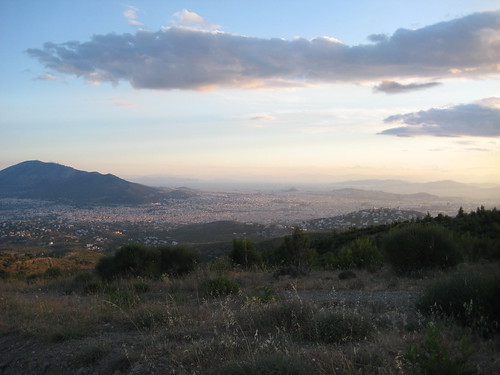
The monastery is really lovely; I can’t say I’ve ever seen any place quite like it in the States. While we were there, Giorgos pointed out a priest and identified him as a “left-wing monk” named Fr. Timotheos, saying that he’s quite the publicity hound. He didn’t go into a lot of detail, but what I was able to dig up later suggested that he’s more of a nationalist figure than anything. Not quite certain what the deal there is.

A disquieting moment was when we were standing in front of the gates of the monastery, and Giorgos pointed out the bullet holes in the doors from attacks in decades past. He also showed me the following:

“What do you suppose that slit in the wall next to the mosaic is all about?” he asked me. I had to confess I didn’t know.

“That was where they pointed the guns against intruders,” he said.

(Oh, and paging Rod Dreher: the monastery has chickens.)

One thing that would be really difficult to overstate is how there are churches everywhere. Big churches, little churches, medium-sized churches, tiny village chapels. You’ll turn a corner and just see something like this:

Or this:

As I said the other day, when I walked to one church and found they weren’t having Vespers, I was able to walk ten minutes to another church and see what they were doing. Had I been inclined, another 5-10 minute walk would have gotten me to another church. Coming from a country where I have to drive 15 minutes to get to church, and then my next nearest option is an hour and twenty minutes away, it’s remarkable.

Friday morning, I attended a session of the second annual “Greece in the World” conference, with this year’s theme being Byzantine Studies. This particular session was titled “Byzantine Studies and the Orthodox Tradition”; Metropolitan John (Zizioulas) of Pergamon was the moderator, and the speakers were Dimitrios Balageorgos of the National and Kapodistrian University of Athens, who gave a talk on Byzantine music in today’s educational system, Giorgos Filias of the University of Athens, who spoke on liturgy and the Byzantine tradition, and Archimandrite Nicholas Ioannides of the University of Athens, who spoke on theology and Byzantine tradition.

Now, I can’t tell you what these gentlemen said in their papers, exactly. There were headsets that allowed English speakers to listen to the talks being translated, but let’s just say that the level of translation wasn’t exactly that of the United Nations. I will acknowledge freely that I would not want to be a translator who had to deal with such a particular and specific vocabulary, so I’m not casting aspersions on anybody — that’s just the way it was. Still, there were three big takeaways for me from attending this session:

  1. Catalogs from a lot of academic publishers in Greece on Byzantine topics. Megan, stop rolling your eyes; this is more useful than it perhaps initially sounds, because it gives me an idea of the sources that are out there in modern Greek, and it gives me a sense of the institutions here who are doing Byzantine Studies in one form or another. It will be useful information in trying to determine what good possibilities might be for academic exchange if I’m ever applying for certain kinds of grants and fellowships, in other words.
  2. I officially see Modern Greek as a basic requirement for Byzantine studies, just as Ancient Greek is. There is so much scholarship over here in this field — and why should this make anybody scratch their head? It is their national heritage, plain and simple, and they really regard church history as their own history. You can walk into the equivalent of a Borders here and find the collected works of St. Romanos the Melodist in one volume, in Ancient Greek and Modern Greek on facing pages. I’ve seen it; it’s freaking huge. I am coming to see it as the same as needing to know modern English if you’re going to do American history. If you can’t read texts in the language, you’re cutting yourself off from a mammoth body of work in the field. My instinct, based on my own experience, is that a native English speaker interested in pursuing this path should probably do Ancient Greek before Modern Greek; I don’t know if there’s a consensus on this one way or the other. I think I would have had a much harder time if I had started out with Modern Greek’s periphrastic forms and then tried to see how they related to their Attic ancestors; the way Ancient Greek works actually forced me to learn the grammatical concepts accurately and precisely, which allowed me to make more sense of why Modern Greek does what it does when I got there.
  3. I know the names of some of the players over here. Knowing who Giorgos Filias is, for example, is a good thing for somebody interested in liturgy.

(Unofficial #4: a native English speaker who knew the terminology well enough to do simultaneous translation of these kinds of talks could potentially do very well for themselves.)

In the evening, Giorgos introduced me to his childhood friend, Giorgos. (“And that’s Nicky, Nicholas, Nick, Nick, Nicky, and Nick.”) Giorgos Secundus (or perhaps I should say Dhefteros) is well-read in history and very adept at ancient Greek; we had a lot to talk about, even if my Greek and his English are about on the same level. I told Giorgos Prime (or Protos, I suppose) later that I very much enjoyed meeting him; he got a bit of a smile on his face and said, “Yes, George always has something to say.” I’m not certain what that meant.

Saturday I spent some time exploring Athens and points south. I found Apostoliki Diakonia, the bookstore of the Church of Greece; well, to be more precise, I had found it the previous Monday, but the hours of operation for smaller shops are governed by rules I’m still not sure I understand, and Saturday was the first day I could get over there when they were open.

I can best describe this store by saying that they carry everything that is virtually impossible to get in the States without mammoth effort and economic expenditure. You want an Ieratikon? Check. A Typikon? No problem. The services, the Menaion, Triodion, and Pentecostarion in Byzantine chant bound into real books? You betcha — how many and which edition? A complete Synaxarion? Right this way, sir.

This poses its own set of problems, however, as a moment’s thought should make clear.

In other words — where the heck do you begin????

I mean, okay, you could just buy one of everything. Things are reasonably inexpensive, and it would be a lot less to just buy them here rather than have them shipped.

Except… oh, wait. There’s a 50 pound limit on items of luggage before overweight charges are incurred. And you can only check two items of luggage before you start paying per item. And I have other stuff to get home. And… and… and…

Suddenly you realize there’s only so much you can take back with you before you’re not really making it any more cost-effective and just giving yourself a heck of a lot more to carry — because make no mistake, these books are heavy.

I found myself thinking, I could easily spend hundreds of Euros here, and then have to spend hundreds of more Euros toting it all back home… Ultimately, I just bought a couple of small prayerbooks for now. I will go back later and buy some other things, gifts for a few people and then one or two chant books for my own reference. Other stuff… well, this won’t be my last trip here.

Ack. So many books, so little room in the suitcases.

I had lots of time before Vespers at St. Irene, so I took the train down to Piraeus Harbor. This is where one catches the boats to the various islands; for example, I’ll be going to Aegina from here on 18 July, where I’ll get to pay my respects to St. Nectarios.

There wasn’t a tremendous amount to do down here for somebody who was still a few weeks away from embarking, but I walked around for a bit before heading back. Here’s St. Dionysios Church, right next to the harbor:

And from the front:

Gotta love the Constantinopolitan flag, still flying after all these years… (By the way, in case anybody was wondering, yes, you can find an AEK onesie here.)

I returned to Athens and enjoyed a frappé at Singles, the café behind St. Irene Church, jotting down some notes for later before going into the church at 6:30 for 7pm Vespers.

(Did I mention there are a lot of cats and dogs in Athens? Here’s one at a table near where I was sitting at Singles.)

As I entered the church, I clearly heard Lycourgos Angelopoulos intoning the apichima for Tone 2 (or Second Authentic mode, as I think Arvanitis would prefer I say) and then proceeding to sing the Doxastikhon for “O Lord I have cried”. I guess Vespers actually started at 6 this week. Oops. As it worked out, in the morning for Liturgy I didn’t arrive until the very last doxology before the Trisagion. I’ll live.

Monday I was walking home through Halandri after my chant lesson, and as I passed St. George Church, I was aware of a large reception on the lawn with music, a sit-down dinner, and so on. Is this a wedding reception? I wondered. Then it occurred to me that it was a celebration of Ss. Peter and Paul (29 June), which seems to be a big deal over here. Anna told me that she didn’t know what the Apostles’ Fast was before she started going to All Saints in Bloomington, but the Greeks definitely know what 29 June is. I had seen other signs and posters elsewhere indicating festal services for Ss. Peter and Paul, as well.

This brings me pretty much up to today. I still have a lot to say, but since I’m already nearing 3,000 words for this entry, let’s call this the narrative and the next post will be the analysis and reflection. I need your paper topics by tomorrow, the quiz will be Monday, and the final is scheduled for — wait, where are you going?

More for my own organizational needs than anything else, let’s say that the next post will cover the following:

  • My Greek class, colleagues, classmates, etc.
  • Chanting lessons
  • Some more specifics on the adjustment to an unfamiliar environment, including, but not limited to, the linguistic experience
  • Travel tips, to say nothing of unavoidable realities, for heat-sensitive folks
  • Other cultural observations
  • Anything else that comes to mind

School’s in for the summer: in which the author tries to figure out how to make Nescafé bearable and nearly gets lost during inter-suburban transit

I’ve alluded to my opinions about Nescafé before; alas, it really does seem to be what most people drink here in terms of day-to-day coffee consumption.

When your options are Nescafé, Nescafé, and Nescafé, as they are at the Athens Centre, you start getting creative with how you can make that work. You explore your options. You do things you wouldn’t normally have done with real coffee. You make sacrifices. You lose illusions about purity.

You add ice and cream and sugar, in other words. Anything, and I mean anything, to get rid of that freeze-dried-for-aeons, cigarette-ash-mixed-with-stale-sweat aftertaste. What’s that you say? Sacrificing a goat would make this taste better? Great — is my pencil sharp enough to work, or should I just tear its throat out with my teeth? Do I add the blood to the Nescafé, or do I grind up the bones into powder for use as a non-dairy creamer?

Well, the discovery I have made here in my first week in Greece is one that may have monumental implications — and that is: Add condensed milk. (Along with the ice and sugar, of course.) This may get me through my mornings for the next seven weeks.

I’m through my first week of the Level III Immersion class; it’s going really well, and it is putting together a lot of pieces for me. Skipping from 100 to 250 as I did this last school year made sense on several levels, but it also meant that there are some holes in my vocabulary and in some various little things, and it also means that my ear is behind my brain in terms of comprehension ability. Level III here starts out a bit behind where I was at the end of 250 in terms of grammar, but is also a bit ahead in terms of vocabulary. There is some review and some new stuff to learn, in other words — probably an okay way to go while I’m adjusting to being in a foreign country for the first time. My teachers have said that they think I could have started with IV if I wanted to, but that this is also just fine.

The bus ride from Halandri to the part of town where the Athens Centre is located is a bit long, and hotter than would be entirely comfortable (I have to say, much to my own surprise, that I am finding it to be a lot more pleasant outside than inside as a general rule, even with 100 degrees Fahrenheit as we had Wednesday), but it really could be a lot worse. I left a bit early the first day to allow time for getting lost, and, sure enough, lost I got.

Problem number one: I was originally advised to get off at one stop in particular, and then walk up a particular hill. Then a different person advised me to get off at the next stop, that this would likely be quicker. I followed the second person’s advice; they were wrong.

Problem number two: clarity in street signage is not a highly-prized virtue in Athenian municipal government.

Between these two factors, I was walking in the absolutely opposite direction of what I wanted for a good ten minutes. I realized this was the case, and thankfully, the map in the Athens Moleskine notebook got me to where I wanted to be. (I had one of those on our London trip, too, by the way. Can’t recommend those things enough.)

My class is small; four people including myself, and then the teacher. From left to right in the picture is Alexander, who is from Switzerland, with a Greek mother and a Swiss father; Aspasia, a Texan woman with a Greek father; Anna, the teacher, who is as native Greek as the day is long; and Maro, a woman from Wisconsin who lives here now and also is of Greek heritage.

Yep, I’m the only Anglo. So it goes.

After class on Monday, I met with Ioannis Arvanitis at the café of the bookstore Eleftheroudakis. (To give you an idea of the size of this bookstore, I will tell you that their café is on the sixth floor, and there are still a floor to go after that.) We talked for about forty-five minutes — he’s an extraordinarily nice man, and we have a decent amount in common when it comes to academic paths which haven’t been entirely linear, and he told me about the work on Byzantine notation that he’s done for his in-progress dissertation. We set up a meeting for Tuesday, which was not altogether a simple thing to do; he lives an another suburb, doesn’t drive, doesn’t have a studio in the city, and his house is a little off the beaten path. I’m not terribly concerned, I told him; I’ve come this far, after all.

I killed some time amidst the seven floors of books. While I’m here in Greece, I want to see if I can find an Ancient Greek textbook written in Modern Greek; I also need to find an Ieratikon, and there are a couple of other things for which I’m keeping my eyes open. I didn’t find any of these things, but there were double-takes as I realized that this is a store where one can commonly find things like an Irmologion on the shelves.

I also found my inner voice murmuring — Good Lord. I’m in Greece, and I’m being paid to be here before I start my PhD work. I’m going to get to study Byzantine chant with a master. I am getting to do everything I was miserable about not being able to do this time last year. The one thing missing from this picture is my wife, and she’ll be here before the end.

I have no excuses anymore, my inner voice gasped in shock.

To call this a sobering, and not a little bit intimidating, thought is to understate the matter. I remember an interview with “lyric heldentenor” Ben Heppner in which he said that after he won his first major competition he wasn’t quite sure how to feel. He likened the experience to a child who finally ties his shoes on his own, then breaks out into tears when he realizes that means he will always have to tie his shoes on his own from now on.

But then I slapped my inner voice a few times and said, You’re telling me now that you’re nervous because things are going too well????

My inner voice promptly shut up. For the moment.

In the early evening, Stefanos Fafulas, the other IU student who’s here on the FLAS, met me at Syntagma, and Anna also joined us. We met up with Frank Hess, Stefanos’ and my Modern Greek teacher at IU, and his wife Vasiliki, whom I had never met before. We went to a café near the Acropolis for a frappé and caught up some. It was odd seeing all these people whom I know from school suddenly in the context of the Parthenon being visible over Frank’s right shoulder, but there you go.

Tuesday I discovered this view from the roof of the Athens Centre. That’s the Acropolis on the left. You know how in movies set in Seattle, the Space Needle is visible from every point of view in the city, even though it isn’t in real life? Well, in real life, the Acropolis is pretty much visible from any point in Athens. It’s a city that hasn’t really discovered ultra-tall skyscrapers, and while there are a number of smaller buildings that crowd together and make it difficult to see a lot of the surrounding hills, you can catch a glimpse of the former cathedral of Athens virtually everywhere you go.

In the evening I had my first lesson with Arvanitis. Getting there was, as promised, interesting; he texted me in the afternoon to tell me that he and his wife Olga would pick me up at Kifisia Station at 6:15pm and take me back to their house. All well and good, but there was still the matter of getting to Kifisia Station from where I am in Halandri. I am in a somewhat awkward part of Halandri to get to other suburbs; this time next year there will be a metro station a five minute walk from here, and there used to a be a metro station about a fifteen minute walk from here, but construction means that we’re in an in-between period at the moment where that’s concerned. So, I can walk twenty, twenty-five minutes to catch a bus that will take me straight there in about half an hour; alternately, I can take a ten minute bus ride to the nearest metro station, have a ten minute metro ride into downtown Athens, then take a forty minute train ride from downtown Athens to Kifisia Station; another option is to take a half an hour bus ride to its terminus point and then take another half an hour bus ride to Kifisia Station. Particularly when it’s roughly a twenty minute drive, these are not exactly ideal options, but there we are.

I took the option that started closest to where I’m staying. I wasn’t sure exactly where I needed to grab the second bus; I asked, and the driver seemed to not quite know himself, but sent me in a particular direction and said I should see it one way or the other.

After twenty minutes, it was clear that wasn’t going to happen. I turned around.

Back where I had gotten off the first bus, I saw the bus that I wanted, but it was nowhere near where I was under the impression I needed to catch it. I verified with the driver that it was going to Kifisia Station, and then on the way out it became clear why there had been confusion — the sign for the stop I had wanted was covered in tree branches. Only somebody looking for it who knew exactly where it was in the first place would have seen it.

Anyway, I pulled into Kifisia Station right at 6:15. The Arvantises pulled in exactly as I was getting off the bus; then we had another twenty minute drive to their house. He was not kidding when he said it was not going to be easy to get to him.

The good news, on the other hand, is that he and his wife are genuinely warm and friendly people, and spent a lot of time just talking to me and giving me coffee and ice cream before we worked. And work we did; he gave a thorough exposition on his approach to explaining what Byzantine notation is, where it came from, what it does, and why it does what it does; in short, it is notation that developed to serve the text. You couldn’t really use this notation for instruments, because the signs themselves assume a relationship to syllables in a word. We spent a bit of time starting to read very simple, stepwise exercises, and then it was time to call it a night. It was time well spent, and there is no doubt there is much I will be able to learn from him. He said that there was a place within walking distance of Kifisia Station where we could meet in the future, and that this would be a lot easier on everybody.

Wednesday, I went with Anna, Stefanos, and Liana to a concert at Theatro Vrahon, one of what I’m told are several picturesque outdoor venues in the area. The show was an Athens-based pop singer named Monika, a very young (early twenties, I think) performer who reminded me of what Tori Amos songs might sound like if reinterpreted by Chrissie Hynde. She’s very engaging as a performer, has a really nice natural voice, and the songs show a lot of interesting musical instincts. I think she needs to work with a native English speaker when it comes to writing her lyrics, and she doesn’t quite yet know how to end a song all the time, but there’s a lot there to like. The only place I have found where somebody in the United States might buy her music is here, and at $1.17 for the album that’s a steal. Let me recommend “Bloody sth” and “Over the hill” as places to start to see if it’s your thing. For a 100% cost-free inquiry, here is the video for “Over the hill,” which is evidently the radio-friendly favorite off the album, given that she played it twice during the concert.

Thursday, I made an important discovery: Greek uses the same verb, κλίνω “klino” to describe both the conjugation of a verb and the declension of a noun. This explains why my inner grammar nazi has been scratching his head for the last year hearing people talking about nouns conjugating.

Also, Coraline (subtitled “The house in the fog” in Greek) was a lot better with Greek subtitles than Angels and Demons was. (Not, mind you, that we should be surprised by this.)

Friday I was an hour late to my lesson with Arvanitis. Bottom line is that the second bus just never came; I wound up taking a taxi to Kifisia Station. He hung around and waited for me, God bless him, and still worked with me for an hour and forty-five minutes, but it was nonetheless frustrating. The useful discovery that came out of it, however, is that door to door, the cab ride between where we’re meeting and my front door here is a tick less than six Euros and it takes twenty minutes. I think that’s a much more economical use of time, all things considered.

Dinner was with Stefanos and Liana; Liana made pastitsio (sort of Greek lasagna, although I don’t think they would describe it that way), which nobody ever has to twist my arm to eat, but also melitzanopita, eggplant (melitzana) baked in filo dough. I never thought I’d develop any kind of taste for eggplant, but slowly but surely, I’m making my peace with it, and melitzanopita is quite tasty. The pastitsio was different from how I’ve eaten it before, having been made with a more Turkish array of spices. (As I said, food will probably justify its own post at some point.)

Then I went home and crashed. It was a very full week.

And so it was that I survived my first week of school here, Nescafé and all.


adventures in writing alexander lingas all saints bloomington all saints orthodox church american orthodox architecture american orthodox music american orthodoxy Antiochian Archdiocese Antiochian Orthodox Christian Archdiocese of North America Antiochians books byzantine chant cappella romana chant church architecture ecclesiastical chant ethnomusicologists ethnomusicology fellowship of ss. alban and sergius Greece Greek greek food greekness hazards of church music international travel tips ioannis arvanitis joe mckamey john michael boyer kurt sander Latin liturgical adventures liturgical architecture liturgical music liturgical texts and translation liturgy liturgy and life lycourgos angelopoulos medieval byzantine chant Metropolitan PHILIP militant americanist orthodoxy modern byzantine architecture modern greek music music as iconography my kids will latin and greek when they're newborns my kids will learn latin and greek when they're newborns orthodox architecture orthodox architecture is bloody expensive Orthodox choir schools Orthodox Ecclesiology orthodox outreach orthodox travel pascha at the singing school Patriarchate of Antioch Patriarch IGNATIUS IV Patriarch of Antioch publishing random acts of chant richard barrett in greece richard toensing rod dreher sacred music st. vlads st john of damascus society Syriac the Bishop MARK fan club the convert dilemma the dark knight The Episcopacy The Episcopate the only good language is a dead language this american church life travel we need more american saints why do we need beautiful music in churches?

Blog Stats

  • 269,207 hits

Flickr Photos